
A English
Nucleus and Chromosomes Questions in English
Class 11 Biology · Cell: The Unit of Life · Nucleus and Chromosomes
356+
Questions
English
Language
100%
With Solutions
Showing 50 of 356 questions in English
201
EasyMCQ
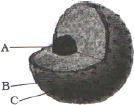
In the given figure,what does $A$ represent?
A
Nuclear pore
B
Nucleoplasm
C
Nucleolus
D
Nuclear membrane
Solution
(C) The provided figure shows the structure of the nucleus. In this diagram,label $A$ points to the dense,spherical body located inside the nucleus,which is the nucleolus. The nucleolus is the site of active ribosomal $RNA$ synthesis.
0 likes
View Solution202
EasyMCQ
In the given figure,what does $B$ represent?
A
Nuclear pores
B
Nucleoplasm
C
Nucleolus
D
Nuclear membrane
Solution
(B) The provided figure shows the structure of the nucleus.
In this diagram:
$A$ points to the nucleolus.
$B$ points to the nucleoplasm (the fluid inside the nucleus).
$C$ points to the nuclear membrane.
Therefore,$B$ represents the nucleoplasm.
In this diagram:
$A$ points to the nucleolus.
$B$ points to the nucleoplasm (the fluid inside the nucleus).
$C$ points to the nuclear membrane.
Therefore,$B$ represents the nucleoplasm.
0 likes
View Solution203
EasyMCQ
In the given figure,what does $C$,which is associated with the transport of $m-RNA$,represent?
A
Nuclear pore
B
Nucleoplasm
C
Nucleolus
D
Nuclear membrane
Solution
(A) In the provided diagram of the nucleus,the labels represent the following structures:
$A$ represents the Nucleolus.
$B$ represents the Nuclear membrane.
$C$ represents the Nuclear pore.
Nuclear pores are small openings in the nuclear membrane that allow for the selective transport of molecules,such as $m-RNA$ and proteins,between the nucleus and the cytoplasm. Therefore,$C$ represents the nuclear pore.
$A$ represents the Nucleolus.
$B$ represents the Nuclear membrane.
$C$ represents the Nuclear pore.
Nuclear pores are small openings in the nuclear membrane that allow for the selective transport of molecules,such as $m-RNA$ and proteins,between the nucleus and the cytoplasm. Therefore,$C$ represents the nuclear pore.
0 likes
View Solution204
EasyMCQ
In the given figure,what is the structure labeled as $A$?
A
Nucleolus
B
Chromatin
C
Nuclear envelope
D
Nucleoplasm
Solution
(A) In the provided diagram of the nucleus,the label $A$ points to the dense,spherical structure located within the nucleoplasm,which is known as the nucleolus. The nucleolus is the site of ribosomal $RNA$ $(rRNA)$ synthesis.
0 likes
View Solution205
EasyMCQ
In the given figure,which substance is synthesized by the part labeled $A$?
A
$m-RNA$
B
$r-RNA$
C
$t-RNA$
D
$DNA$
Solution
(B) The figure shows the structure of the nucleus. The part labeled $A$ is the nucleolus.
The nucleolus is a spherical structure present inside the nucleus and is the site for active ribosomal $RNA$ $(r-RNA)$ synthesis.
Therefore,the correct option is $B$.
The nucleolus is a spherical structure present inside the nucleus and is the site for active ribosomal $RNA$ $(r-RNA)$ synthesis.
Therefore,the correct option is $B$.
0 likes
View Solution206
MediumMCQ
Which type of chromosome is represented by the given figure?

A
Telocentric
B
Acrocentric
C
Submetacentric
D
Metacentric
Solution
(C) The given figure shows a chromosome where the centromere is located slightly away from the middle,resulting in one shorter arm and one longer arm. This structure is characteristic of a submetacentric chromosome.
In a metacentric chromosome,the centromere is in the middle.
In an acrocentric chromosome,the centromere is situated close to its end forming an extremely short and a very long arm.
In a telocentric chromosome,the centromere is at the terminal end.
In a metacentric chromosome,the centromere is in the middle.
In an acrocentric chromosome,the centromere is situated close to its end forming an extremely short and a very long arm.
In a telocentric chromosome,the centromere is at the terminal end.
0 likes
View Solution207
EasyMCQ
Select the correct option for the following matches:
| Column-$I$ | Column-$II$ |
| $(1)$ Chromosome arms are of equal length | $(a)$ Submetacentric |
| $(2)$ One arm of the chromosome is shorter | $(b)$ Acrocentric |
| $(3)$ One arm is extremely long and the other is very short | $(c)$ Telocentric |
| $(4)$ Terminal centromere | $(d)$ Metacentric |
A
$1-b, 2-a, 3-c, 4-d$
B
$1-d, 2-a, 3-b, 4-c$
C
$1-d, 2-b, 3-c, 4-a$
D
$1-a, 2-b, 3-d, 4-c$
Solution
(B) The classification of chromosomes is based on the position of the centromere:
$1$. Metacentric: The centromere is in the middle,resulting in two equal arms $(1-d)$.
$2$. Submetacentric: The centromere is slightly away from the middle,resulting in one shorter arm and one longer arm $(2-a)$.
$3$. Acrocentric: The centromere is situated close to the end,forming one extremely long arm and one very short arm $(3-b)$.
$4$. Telocentric: The centromere is at the terminal end of the chromosome $(4-c)$.
Therefore,the correct matching is $1-d, 2-a, 3-b, 4-c$.
$1$. Metacentric: The centromere is in the middle,resulting in two equal arms $(1-d)$.
$2$. Submetacentric: The centromere is slightly away from the middle,resulting in one shorter arm and one longer arm $(2-a)$.
$3$. Acrocentric: The centromere is situated close to the end,forming one extremely long arm and one very short arm $(3-b)$.
$4$. Telocentric: The centromere is at the terminal end of the chromosome $(4-c)$.
Therefore,the correct matching is $1-d, 2-a, 3-b, 4-c$.
0 likes
View Solution208
MediumMCQ
Match the following and select the correct option:
| List-$I$ | List-$II$ |
| $(1)$ Metacentric | $(a)$ Centromere at the terminal end |
| $(2)$ Sub-metacentric | $(b)$ Centromere close to the end |
| $(3)$ Acrocentric | $(c)$ Centromere slightly away from the middle |
| $(4)$ Telocentric | $(d)$ Centromere in the middle |
A
$1-d, 2-a, 3-b, 4-c$
B
$1-d, 2-b, 3-a, 4-c$
C
$1-d, 2-c, 3-b, 4-a$
D
$1-a, 2-b, 3-c, 4-d$
Solution
(C) The classification of chromosomes is based on the position of the centromere:
$1$. Metacentric: The centromere is located in the middle of the chromosome, forming two equal arms. Thus, $(1-d)$.
$2$. Sub-metacentric: The centromere is slightly away from the middle, resulting in one shorter arm and one longer arm. Thus, $(2-c)$.
$3$. Acrocentric: The centromere is situated close to the end, forming an extremely short arm and a very long arm. Thus, $(3-b)$.
$4$. Telocentric: The centromere is located at the terminal end of the chromosome. Thus, $(4-a)$.
Therefore, the correct matching is $(1-d, 2-c, 3-b, 4-a)$.
$1$. Metacentric: The centromere is located in the middle of the chromosome, forming two equal arms. Thus, $(1-d)$.
$2$. Sub-metacentric: The centromere is slightly away from the middle, resulting in one shorter arm and one longer arm. Thus, $(2-c)$.
$3$. Acrocentric: The centromere is situated close to the end, forming an extremely short arm and a very long arm. Thus, $(3-b)$.
$4$. Telocentric: The centromere is located at the terminal end of the chromosome. Thus, $(4-a)$.
Therefore, the correct matching is $(1-d, 2-c, 3-b, 4-a)$.
0 likes
View Solution209
MediumMCQ
The structure that separates the cytoplasm from the nucleus is composed of how many layers?
A
Single-layered
B
Double-layered
C
Triple-layered
D
Multi-layered
Solution
(B) The nucleus is separated from the cytoplasm by a nuclear envelope,which consists of two parallel membranes with a space between them (the perinuclear space). Therefore,the nuclear envelope is a double-layered structure.
0 likes
View Solution210
MediumMCQ
Match the chromosome types based on the position of the centromere as shown in the standard classification:
| Column-$I$ (Type) | Column-$II$ (Description) |
|---|---|
| $1$. Metacentric | $a$. Terminal centromere |
| $2$. Sub-metacentric | $b$. Sub-terminal centromere |
| $3$. Acrocentric | $c$. Middle centromere |
| $4$. Telocentric | $d$. Slightly away from the middle |
A
$1-c, 2-d, 3-b, 4-a$
B
$1-c, 2-d, 3-a, 4-b$
C
$1-d, 2-c, 3-b, 4-a$
D
$1-a, 2-b, 3-c, 4-d$
Solution
(A) The classification of chromosomes is based on the position of the centromere:
$1$. Metacentric: The centromere is in the middle,forming two equal arms $(1-c)$.
$2$. Sub-metacentric: The centromere is slightly away from the middle,resulting in one shorter and one longer arm $(2-d)$.
$3$. Acrocentric: The centromere is situated close to the end,forming one extremely short and one very long arm $(3-b)$.
$4$. Telocentric: The centromere is at the terminal end of the chromosome $(4-a)$.
Therefore,the correct matching is $1-c, 2-d, 3-b, 4-a$.
$1$. Metacentric: The centromere is in the middle,forming two equal arms $(1-c)$.
$2$. Sub-metacentric: The centromere is slightly away from the middle,resulting in one shorter and one longer arm $(2-d)$.
$3$. Acrocentric: The centromere is situated close to the end,forming one extremely short and one very long arm $(3-b)$.
$4$. Telocentric: The centromere is at the terminal end of the chromosome $(4-a)$.
Therefore,the correct matching is $1-c, 2-d, 3-b, 4-a$.
0 likes
View Solution211
EasyMCQ
What is the extended arrangement of chromosomes during interphase called?
A
Chromatid
B
Chromatin
C
Equatorial arrangement
D
Meiosis
Solution
(B) During the interphase stage of the cell cycle,the $DNA$ is not condensed into compact chromosomes. Instead,it exists in a loose,thread-like,and extended form known as $Chromatin$. This $Chromatin$ network allows for the processes of $DNA$ replication and transcription to occur efficiently. As the cell enters the mitotic phase,this $Chromatin$ condenses to form distinct chromosomes.
0 likes
View Solution212
MediumMCQ
$S -$ Assertion: Individual chromosomes are not identifiable during interphase.
$R -$ Reason: They exist as highly extended and elaborate nucleoprotein fibers called chromatin.
$R -$ Reason: They exist as highly extended and elaborate nucleoprotein fibers called chromatin.
A
$S$ and $R$ are both true,and $R$ is the correct explanation of $S$.
B
$S$ and $R$ are both true,but $R$ is not the correct explanation of $S$.
C
$S$ is true and $R$ is false.
D
$S$ is false and $R$ is true.
Solution
(A) During the interphase of the cell cycle,the cell is metabolically active and prepares for division. The genetic material exists in the form of a loose,thread-like network known as chromatin. Because these fibers are highly extended and dispersed throughout the nucleus,individual chromosomes cannot be distinguished under a light microscope. Chromosomes only become visible as distinct,condensed structures during the $M$-phase (mitosis or meiosis). Therefore,both the assertion and the reason are correct,and the reason provides the correct explanation for the assertion.
0 likes
View Solution213
MediumMCQ
What is the disc-shaped structure found on the surface of the centromere called?
A
Kinetochores
B
Chromatid
C
Middle lamella
D
Spindle fiber
Solution
(A) The $centromere$ is the region of a chromosome where the two sister chromatids are held together.
On the surface of the $centromere$,there are small disc-shaped structures present,which are known as $kinetochores$.
These $kinetochores$ serve as the sites of attachment for spindle fibers during cell division (mitosis and meiosis),allowing the chromosomes to move toward the poles.
On the surface of the $centromere$,there are small disc-shaped structures present,which are known as $kinetochores$.
These $kinetochores$ serve as the sites of attachment for spindle fibers during cell division (mitosis and meiosis),allowing the chromosomes to move toward the poles.
0 likes
View Solution214
EasyMCQ
Chromatids are associated with which of the following?
A
Nucleus
B
Centromere
C
Nucleolus
D
Cytoplasm
Solution
(B) Chromatids are the two identical halves of a replicated chromosome.
These two sister chromatids are held together at a specific region called the $Centromere$.
During cell division,the chromatids separate at the centromere to move to opposite poles.
These two sister chromatids are held together at a specific region called the $Centromere$.
During cell division,the chromatids separate at the centromere to move to opposite poles.
0 likes
View Solution215
MediumMCQ
Where is the nucleolus synthesized?
A
On the surface of the centromere
B
On the kinetochore
C
On the nucleolar organizer region
D
On the satellite
Solution
(C) The nucleolus is a non-membrane-bound structure present within the nucleus. It is the site of active ribosomal $RNA$ $(rRNA)$ synthesis. The nucleolus is organized around specific chromosomal regions known as the Nucleolar Organizer Regions $(NORs)$. These regions contain multiple copies of genes that code for $rRNA$. Therefore,the nucleolus is synthesized at the nucleolar organizer region.
0 likes
View Solution216
EasyMCQ
The small disc-shaped structures present on the surface of the centromere are called:
A
Chromatophores
B
Kinetophores
C
Kinetochores
D
Chromatin
Solution
(C) The $centromere$ is the region of a chromosome where the two sister chromatids are held together. On the surface of the $centromere$, there are small disc-shaped structures known as $kinetochores$. These structures serve as the sites of attachment for spindle fibers during cell division, allowing the chromosomes to move toward the poles.
0 likes
View Solution217
EasyMCQ
The nucleolus is synthesized at which region?
A
Equator
B
Pole
C
Nucleolar organizer
D
Nuclear envelope
Solution
(C) The nucleolus is a non-membrane-bound structure present within the nucleus. It is the site of active ribosomal $RNA$ $(rRNA)$ synthesis. The nucleolus is organized around specific chromosomal regions known as the Nucleolar Organizer Regions $(NORs)$. These regions contain multiple copies of genes that code for $rRNA$.
0 likes
View Solution218
MediumMCQ
What is formed from the nucleolar organizer region?
A
Nucleus
B
Nucleolus
C
Nuclear membrane
D
Chromosome
Solution
(B) The nucleolar organizer region $(NOR)$ is a specific chromosomal segment that contains the genes responsible for coding ribosomal $RNA$ $(rRNA)$.
These regions are located on specific chromosomes and are the sites where the nucleolus is synthesized and organized during the cell cycle.
Therefore,the nucleolus is formed from the nucleolar organizer region.
These regions are located on specific chromosomes and are the sites where the nucleolus is synthesized and organized during the cell cycle.
Therefore,the nucleolus is formed from the nucleolar organizer region.
0 likes
View Solution219
EasyMCQ
The structure present on the chromosome is:
A
Centrosome
B
Golgi apparatus
C
Nucleus
D
Centromere
Solution
(D) The $Centromere$ is a specialized $DNA$ sequence of a chromosome that links a pair of sister chromatids. During mitosis, spindle fibers attach to the $Centromere$ via the kinetochore to pull the chromatids apart. The other options ($Centrosome$, $Golgi$ $apparatus$, and $Nucleus$) are distinct organelles or cellular structures, not parts of the chromosome structure itself.
0 likes
View Solution220
EasyMCQ
What is chromatin?
A
Short and distinct chromosomes
B
Extended arrangement of chromosomes
C
Arrangement of two chromatids
D
Substance present in the cell
Solution
(B) Chromatin is the complex of $DNA$ and proteins (histones) found in the eukaryotic cell nucleus. During interphase,the genetic material exists in a loose,thread-like,and extended form known as chromatin. When the cell enters the division phase ($M$-phase),this chromatin condenses to form compact,distinct structures called chromosomes. Therefore,chromatin represents the extended,non-condensed arrangement of genetic material.
0 likes
View Solution221
EasyMCQ
What is a chromosome?
A
Cytoplasmic structure
B
Plasma membrane structure
C
Nuclear structure
D
Structure containing nuclear genes
Solution
(C) chromosome is a thread-like structure of nucleic acids and protein found in the nucleus of most living cells,carrying genetic information in the form of genes. Therefore,it is primarily defined as a nuclear structure composed of $DNA$ and proteins.
0 likes
View Solution222
EasyMCQ
Which cell structure is associated with heredity?
A
Cytoplasm
B
Golgi apparatus
C
Chromosome
D
Cell membrane
Solution
(C) Heredity refers to the transmission of genetic information from parents to offspring.
Chromosomes are thread-like structures located inside the nucleus of animal and plant cells.
Each chromosome is made of protein and a single molecule of deoxyribonucleic acid $(DNA)$.
$DNA$ contains the specific instructions that make each type of living creature unique and is the physical basis of heredity.
Chromosomes are thread-like structures located inside the nucleus of animal and plant cells.
Each chromosome is made of protein and a single molecule of deoxyribonucleic acid $(DNA)$.
$DNA$ contains the specific instructions that make each type of living creature unique and is the physical basis of heredity.
0 likes
View Solution223
EasyMCQ
In $1920$,nucleic acid was identified as a major component of which of the following?
A
Mitochondria
B
Chloroplast
C
Chromosome
D
Ribosome
Solution
(C) In $1920$,researchers identified that nucleic acids are a fundamental component of chromosomes. This discovery was crucial in understanding that genetic material is stored within the chromosomes of eukaryotic cells. While nucleic acids are present in other organelles like mitochondria and chloroplasts,they were historically and primarily identified as the structural and functional core of chromosomes.
0 likes
View Solution224
MediumMCQ
$A$: Chromosomes are responsible for hereditary traits in all living organisms.
$R$: Genes are microscopic structures that contain chromosomes.
$R$: Genes are microscopic structures that contain chromosomes.
A
$A$ and $R$ are both true and $R$ is the correct explanation of $A$.
B
$A$ and $R$ are both true,but $R$ is not the correct explanation of $A$.
C
$A$ is true and $R$ is false.
D
$A$ is false and $R$ is true.
Solution
(C) Assertion $(A)$ is true because chromosomes carry the genetic material $(DNA)$ which is responsible for the inheritance of traits from parents to offspring.
Reason $(R)$ is false because the relationship is the opposite: chromosomes are the structures that contain genes,not the other way around. Genes are segments of $DNA$ located on chromosomes.
Reason $(R)$ is false because the relationship is the opposite: chromosomes are the structures that contain genes,not the other way around. Genes are segments of $DNA$ located on chromosomes.
0 likes
View Solution225
EasyMCQ
Complete the sentence: Chromosomes are .........
A
Structures containing genes located in the cytoplasm
B
Structures containing genes located in cell organelles
C
Structures containing genes located in the nucleus
D
None of the above
Solution
(C) Chromosomes are thread-like structures made of $DNA$ and proteins that carry genetic information. In eukaryotic cells,these structures are located within the nucleus. Therefore,chromosomes are defined as structures containing genes located in the nucleus.
0 likes
View Solution226
MediumMCQ
The chromosomes in which the centromere is situated close to one end are:
A
telocentric
B
sub-metacentric
C
metacentric
D
acrocentric
Solution
(D) The centromere is a specialized region of a chromosome that attaches to the spindle fibers during cell division.
Based on the position of the centromere,chromosomes are classified as follows:
$1$. Metacentric: Centromere is in the middle,forming two equal arms.
$2$. Sub-metacentric: Centromere is slightly away from the middle,resulting in one shorter and one longer arm.
$3$. Acrocentric: Centromere is situated close to one end,resulting in one extremely short arm and one very long arm.
$4$. Telocentric: Centromere is at the terminal end of the chromosome.
Therefore,the correct answer is acrocentric.
Based on the position of the centromere,chromosomes are classified as follows:
$1$. Metacentric: Centromere is in the middle,forming two equal arms.
$2$. Sub-metacentric: Centromere is slightly away from the middle,resulting in one shorter and one longer arm.
$3$. Acrocentric: Centromere is situated close to one end,resulting in one extremely short arm and one very long arm.
$4$. Telocentric: Centromere is at the terminal end of the chromosome.
Therefore,the correct answer is acrocentric.
0 likes
View Solution227
MediumMCQ
Balbiani rings are sites of
A
polysaccharide synthesis
B
$RNA$ and protein synthesis
C
lipid synthesis
D
nucleotide synthesis
Solution
(B) : In certain developmental stages,polytene chromosomes exhibit conspicuous swellings known as chromosome puffs. The larger swellings are referred to as Balbiani rings.
In the region of a puff or Balbiani ring,the $DNA$ strands uncoil,become transcriptionally active,and produce numerous copies of $mRNA$.
The $mRNA$ molecules may be temporarily stored in the puff,where they undergo translation to synthesize proteins.
Thus,Balbiani rings are the primary sites of $RNA$ and protein synthesis.
In the region of a puff or Balbiani ring,the $DNA$ strands uncoil,become transcriptionally active,and produce numerous copies of $mRNA$.
The $mRNA$ molecules may be temporarily stored in the puff,where they undergo translation to synthesize proteins.
Thus,Balbiani rings are the primary sites of $RNA$ and protein synthesis.
0 likes
View Solution228
EasyMCQ
Ribosomal $RNA$ is actively synthesized in
A
lysosomes
B
nucleolus
C
nucleoplasm
D
ribosomes
Solution
(B) : The nucleolus is the primary site for the synthesis of ribosomal $RNA$ $(rRNA)$,which is essential for the formation of ribosomal subunits.
Ribosomal proteins are synthesized in the cytoplasm and then migrate into the nucleolus.
Inside the nucleolus,these proteins are assembled with $rRNA$ to form ribonucleoprotein complexes.
These complexes are then transported back to the cytoplasm,where they mature into functional ribosome particles.
Ribosomal proteins are synthesized in the cytoplasm and then migrate into the nucleolus.
Inside the nucleolus,these proteins are assembled with $rRNA$ to form ribonucleoprotein complexes.
These complexes are then transported back to the cytoplasm,where they mature into functional ribosome particles.
0 likes
View Solution229
MediumMCQ
There is no $DNA$ in
A
mature $RBCs$
B
a mature spermatozoon
C
hair root
D
Ovum
Solution
(A) Mature mammalian $RBCs$ (red blood cells) are enucleated,meaning they lack a nucleus and other organelles like mitochondria and ribosomes to maximize space for hemoglobin. Since the $DNA$ is contained within the nucleus,mature $RBCs$ do not contain $DNA$. In contrast,a mature spermatozoon contains a haploid nucleus with $DNA$,hair roots contain living cells with nuclei and $DNA$,and an ovum contains a haploid nucleus with $DNA$.
0 likes
View Solution230
EasyMCQ
Who discovered the nucleus?
A
Leeuwenhoek
B
Robert Brown
C
Porter
D
Virchow
Solution
(B) The nucleus was first described by Robert Brown in $1831$ in the cells of orchid roots. He observed it as a dense,spherical body within the cell,which he named the 'nucleus'.
0 likes
View Solution231
EasyMCQ
Where is the $DNA$ found?
A
Nucleus
B
Golgi body
C
Ribosome
D
Vacuole
Solution
(A) $DNA$ (Deoxyribonucleic acid) is primarily found in the nucleus of eukaryotic cells,where it is organized into chromosomes.
It is also present in mitochondria and chloroplasts (extranuclear $DNA$).
Among the given options,the nucleus is the primary site for $DNA$ storage and replication.
It is also present in mitochondria and chloroplasts (extranuclear $DNA$).
Among the given options,the nucleus is the primary site for $DNA$ storage and replication.
0 likes
View Solution232
EasyMCQ
By which structure does the transfer of protein and $RNA$ occur between the nucleoplasm and the cytoplasm?
A
Endoplasmic reticulum
B
Lysosome
C
Nuclear membrane pore
D
Cytoskeleton
Solution
(C) The nuclear envelope consists of two parallel membranes with a space between them called the perinuclear space. The nuclear envelope acts as a barrier between the materials of the nucleus and the cytoplasm. At a number of places,the nuclear envelope is interrupted by minute pores,which are formed by the fusion of its two membranes. These nuclear pores are the passages through which movement of $RNA$ and protein molecules takes place in both directions between the nucleus and the cytoplasm.
0 likes
View Solution233
MediumMCQ
Who coined the term $chromatin$?
A
Robert Brown
B
Camillo Golgi
C
Fleming
D
Robert Hooke
Solution
(C) The term $chromatin$ was coined by the German biologist $Walther$ $Fleming$ in $1880$.
He observed that the material within the nucleus stained with basic dyes,which he named $chromatin$ (from the Greek word $chroma$ meaning color).
He observed that the material within the nucleus stained with basic dyes,which he named $chromatin$ (from the Greek word $chroma$ meaning color).
0 likes
View Solution234
MediumMCQ
Chromatin consists of:
A
$DNA$
B
Histones
C
Both $A$ and $B$ are true
D
Both $A$ and $B$ are false
Solution
(C) Chromatin is the complex of macromolecules found in cells,consisting of $DNA$,protein,and $RNA$.
Specifically,the primary protein components of chromatin are histones,which help compact the $DNA$ into a more compact,dense shape.
Therefore,chromatin contains both $DNA$ and histones.
Specifically,the primary protein components of chromatin are histones,which help compact the $DNA$ into a more compact,dense shape.
Therefore,chromatin contains both $DNA$ and histones.
0 likes
View Solution235
MediumMCQ
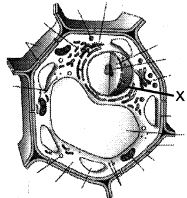
Identify $X$ from the given figure:
A
Nuclear envelope
B
Vacuole
C
Nucleolus
D
Plasma membrane
Solution
(C) The provided figure represents a plant cell. The label $X$ points to the dense,spherical structure located inside the nucleus.
This structure is the nucleolus,which is the site of ribosomal $RNA$ (rRNA) synthesis.
Therefore,the correct option is $C$.
This structure is the nucleolus,which is the site of ribosomal $RNA$ (rRNA) synthesis.
Therefore,the correct option is $C$.
0 likes
View Solution236
MediumMCQ
The number of large,metacentric chromosomes in humans is:
A
$3$
B
$6$
C
$7$
D
$4$
Solution
(B) According to the Denver classification of human chromosomes,chromosomes are categorized based on their size and centromere position.
Group $A$ consists of chromosomes $1, 2,$ and $3$.
Chromosome $1$ and $3$ are large metacentric chromosomes.
Chromosome $2$ is a large submetacentric chromosome.
However,in general cytogenetic classification,there are $3$ pairs of large metacentric chromosomes (Group $A$: $1, 3$ and Group $B$: $4, 5$ are submetacentric,but often $1, 3$ are cited as the primary large metacentric ones).
Specifically,looking at the standard karyotype,chromosomes $1, 3, 16, 19,$ and $20$ are metacentric. Among these,only $1$ and $3$ are considered 'large'.
Therefore,the correct count of large metacentric chromosomes is $3$ pairs (or $6$ individual chromosomes) if considering the standard grouping,but the question asks for the number of chromosomes. Based on standard biological assessments,the answer is $6$.
Group $A$ consists of chromosomes $1, 2,$ and $3$.
Chromosome $1$ and $3$ are large metacentric chromosomes.
Chromosome $2$ is a large submetacentric chromosome.
However,in general cytogenetic classification,there are $3$ pairs of large metacentric chromosomes (Group $A$: $1, 3$ and Group $B$: $4, 5$ are submetacentric,but often $1, 3$ are cited as the primary large metacentric ones).
Specifically,looking at the standard karyotype,chromosomes $1, 3, 16, 19,$ and $20$ are metacentric. Among these,only $1$ and $3$ are considered 'large'.
Therefore,the correct count of large metacentric chromosomes is $3$ pairs (or $6$ individual chromosomes) if considering the standard grouping,but the question asks for the number of chromosomes. Based on standard biological assessments,the answer is $6$.
0 likes
View Solution237
MediumMCQ
Which of the following is not a membrane-bound organelle?
A
Vacuole
B
Lysosome
C
Mitochondria
D
Nucleolus
Solution
(D) The $Nucleolus$ is a non-membrane-bound structure found within the nucleus of eukaryotic cells.
It is primarily involved in the synthesis and assembly of ribosomal $RNA$ $(rRNA)$.
In contrast, $Vacuoles$, $Lysosomes$, and $Mitochondria$ are all membrane-bound organelles.
$Vacuoles$ are bound by a single membrane called the tonoplast.
$Lysosomes$ are bound by a single membrane.
$Mitochondria$ are double-membrane-bound organelles.
It is primarily involved in the synthesis and assembly of ribosomal $RNA$ $(rRNA)$.
In contrast, $Vacuoles$, $Lysosomes$, and $Mitochondria$ are all membrane-bound organelles.
$Vacuoles$ are bound by a single membrane called the tonoplast.
$Lysosomes$ are bound by a single membrane.
$Mitochondria$ are double-membrane-bound organelles.
0 likes
View Solution238
EasyMCQ
.......... is a site for active ribosomal $RNA$ synthesis.
A
Nucleus
B
Nucleolus
C
Chromosome
D
None of the above
Solution
(B) The nucleolus is a spherical,non-membrane-bound structure found within the nucleus of eukaryotic cells.
It is the primary site for the transcription of ribosomal $RNA$ $(rRNA)$ and the assembly of ribosomal subunits.
Therefore,the nucleolus is known as the site for active ribosomal $RNA$ synthesis.
It is the primary site for the transcription of ribosomal $RNA$ $(rRNA)$ and the assembly of ribosomal subunits.
Therefore,the nucleolus is known as the site for active ribosomal $RNA$ synthesis.
0 likes
View Solution239
MediumMCQ
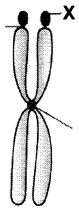
Identify $X$ in the given diagram of a chromosome.
A
Kinetochore
B
Secondary constriction
C
Ribosome
D
Centromere
Solution
(B) The given diagram represents a chromosome. The structure labeled as $X$ at the ends of the chromosome arms is the satellite,which is associated with a secondary constriction. However,in many standard textbook diagrams of this type,the structure at the very tip is often identified as a satellite,and the constriction itself is the secondary constriction. Looking at the options provided,'Secondary constriction' is the most appropriate biological term related to the region near the satellite in this context. The primary constriction is the centromere.
0 likes
View Solution240
MediumMCQ
Which of the following is a double-membrane bound organelle?
A
Nucleolus
B
Ribosomes
C
Nucleus
D
Vacuole
Solution
(C) The $Nucleus$ is a double-membrane bound organelle found in eukaryotic cells.
It is enclosed by a nuclear envelope, which consists of two parallel membranes with a space between them called the perinuclear space.
$Nucleolus$ is a non-membrane bound structure.
$Ribosomes$ are non-membrane bound organelles.
$Vacuole$ is a single-membrane bound organelle (tonoplast).
It is enclosed by a nuclear envelope, which consists of two parallel membranes with a space between them called the perinuclear space.
$Nucleolus$ is a non-membrane bound structure.
$Ribosomes$ are non-membrane bound organelles.
$Vacuole$ is a single-membrane bound organelle (tonoplast).
0 likes
View Solution241
EasyMCQ
Transfer of protein and $RNA$ between nucleus and cytoplasm occurs through
A
Nuclear pore
B
Plasmodesmata
C
Middle lamella
D
Microbodies
Solution
(A) The nuclear envelope consists of two parallel membranes with a space between them called the perinuclear space.
These membranes are interrupted by minute pores,which are formed by the fusion of the two nuclear membranes.
These pores are known as nuclear pores.
Nuclear pores are the passages through which movement of $RNA$ and protein molecules takes place in both directions between the nucleus and the cytoplasm.
These membranes are interrupted by minute pores,which are formed by the fusion of the two nuclear membranes.
These pores are known as nuclear pores.
Nuclear pores are the passages through which movement of $RNA$ and protein molecules takes place in both directions between the nucleus and the cytoplasm.
0 likes
View Solution242
MediumMCQ
Identify the cell organelle based on the following characteristics:
- It is not a membrane-bound organelle.
- It is the site for active ribosomal $RNA$ $(rRNA)$ synthesis.
- It is a spherical structure.
- It is not a membrane-bound organelle.
- It is the site for active ribosomal $RNA$ $(rRNA)$ synthesis.
- It is a spherical structure.
A
Centriole
B
Nucleus
C
Nucleolus
D
Ribosome
Solution
(C) The characteristics provided describe the $Nucleolus$.
$1$. It is not a membrane-bound organelle: The nucleolus is a dense,spherical region within the nucleus that lacks a limiting membrane.
$2$. Site for active ribosomal $RNA$ $(rRNA)$ synthesis: The nucleolus is the primary site for the transcription of $rRNA$ and the assembly of ribosomal subunits.
$3$. Spherical structure: It appears as a distinct,spherical,dark-staining body under a microscope.
Therefore,the correct option is $C$.
$1$. It is not a membrane-bound organelle: The nucleolus is a dense,spherical region within the nucleus that lacks a limiting membrane.
$2$. Site for active ribosomal $RNA$ $(rRNA)$ synthesis: The nucleolus is the primary site for the transcription of $rRNA$ and the assembly of ribosomal subunits.
$3$. Spherical structure: It appears as a distinct,spherical,dark-staining body under a microscope.
Therefore,the correct option is $C$.
0 likes
View Solution243
EasyMCQ
Where is the satellite found?
A
In cytoplasm
B
In mitochondria
C
On nuclear membrane
D
Chromosome
Solution
(D) satellite is a small chromosomal segment that is separated from the main body of the chromosome by a secondary constriction. It is a structural feature of certain chromosomes,often referred to as $SAT$-chromosomes. Therefore,it is found on the chromosome.
0 likes
View Solution244
MediumMCQ
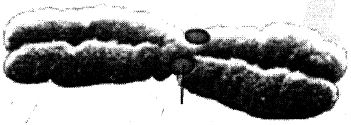
The given diagram shows a chromosome. Which of the following data refers correctly to the chromosome?
No. of Centromere - No. of Kinetochore - No. of Arms
No. of Centromere - No. of Kinetochore - No. of Arms
A
$2 - 1 - 4$
B
$1 - 2 - 4$
C
$2 - 2 - 4$
D
$1 - 2 - 2$
Solution
(B) The given diagram shows a metaphase chromosome consisting of two sister chromatids.
$1$. Centromere: It is the primary constriction point where the two sister chromatids are held together. In this diagram,there is $1$ centromere.
$2$. Kinetochore: These are disc-shaped structures present on the sides of the centromere. Since there are two chromatids,there are $2$ kinetochores (one on each chromatid).
$3$. Arms: The centromere divides the chromosome into arms. $A$ chromosome with two chromatids has $4$ arms in total.
Therefore,the correct data is $1$ centromere,$2$ kinetochores,and $4$ arms.
$1$. Centromere: It is the primary constriction point where the two sister chromatids are held together. In this diagram,there is $1$ centromere.
$2$. Kinetochore: These are disc-shaped structures present on the sides of the centromere. Since there are two chromatids,there are $2$ kinetochores (one on each chromatid).
$3$. Arms: The centromere divides the chromosome into arms. $A$ chromosome with two chromatids has $4$ arms in total.
Therefore,the correct data is $1$ centromere,$2$ kinetochores,and $4$ arms.
0 likes
View Solution245
EasyMCQ
The length of a lampbrush chromosome is: (in $\mu m$)
A
$20$
B
$1000$
C
$50$
D
$100$
Solution
(B) Lampbrush chromosomes are a special form of chromosome found in the growing oocytes (immature eggs) of most animals,except mammals.
They are characterized by their large size and distinct 'lampbrush' appearance due to lateral loops of chromatin.
The length of these chromosomes can be very significant,often reaching up to $1000 \ \mu m$ $(1 \ mm)$ or more in certain species like amphibians.
They are characterized by their large size and distinct 'lampbrush' appearance due to lateral loops of chromatin.
The length of these chromosomes can be very significant,often reaching up to $1000 \ \mu m$ $(1 \ mm)$ or more in certain species like amphibians.
0 likes
View Solution246
EasyMCQ
........ is present in a higher amount in the dark band of a polytene chromosome.
A
Lipid
B
$DNA$
C
Vitamin
D
$RNA$
Solution
(B) Polytene chromosomes are giant chromosomes found in the salivary glands of Drosophila larvae.
They consist of alternating dark bands and light interbands.
The dark bands are highly condensed regions of chromatin,which contain a significantly higher concentration of $DNA$ compared to the light interbands.
The light interbands are regions where the chromatin is less condensed and are often associated with active transcription.
They consist of alternating dark bands and light interbands.
The dark bands are highly condensed regions of chromatin,which contain a significantly higher concentration of $DNA$ compared to the light interbands.
The light interbands are regions where the chromatin is less condensed and are often associated with active transcription.
0 likes
View Solution247
EasyMCQ
Which of the following structures was discovered by Balbiani?
A
Polytene chromosome
B
Lampbrush chromosome
C
Centromere
D
Chromatophore
Solution
(A) $Polytene$ $chromosomes$ were first discovered by $E.G.$ $Balbiani$ in $1881$ in the salivary glands of $Chironomus$ larvae (a type of midge fly).
These chromosomes are giant chromosomes that are formed by repeated rounds of $DNA$ replication without cell division,a process known as endoreduplication.
They are characterized by distinct banding patterns and are commonly found in the salivary glands of $Dipteran$ insects.
These chromosomes are giant chromosomes that are formed by repeated rounds of $DNA$ replication without cell division,a process known as endoreduplication.
They are characterized by distinct banding patterns and are commonly found in the salivary glands of $Dipteran$ insects.
0 likes
View Solution248
EasyMCQ
Two sister chromatids are held together at the chromosome by which of the following structures?
A
Centromere
B
Kinetochore
C
Satellite
D
Synapsis
Solution
(A) During the process of $DNA$ replication,each chromosome consists of two identical sister chromatids.
These two chromatids are held together at a specific constricted region known as the $Centromere$.
While the $Kinetochore$ is a disc-shaped structure present on the surface of the $Centromere$ that serves as an attachment site for spindle fibers during cell division,the primary structure responsible for holding the chromatids together is the $Centromere$.
These two chromatids are held together at a specific constricted region known as the $Centromere$.
While the $Kinetochore$ is a disc-shaped structure present on the surface of the $Centromere$ that serves as an attachment site for spindle fibers during cell division,the primary structure responsible for holding the chromatids together is the $Centromere$.
0 likes
View Solution249
MediumMCQ
The main axis of lampbrush chromosome is made up of..........
A
$RNA$
B
$DNA$
C
Protein and $DNA$
D
$RNA$ and protein
Solution
(C) Lampbrush chromosomes are large,specialized chromosomes found in the oocytes of many vertebrates (except mammals).
They consist of a central axis formed by a single $DNA$ molecule (chromonema) that is highly condensed.
This $DNA$ axis is associated with various proteins that help in maintaining its structure and regulating gene expression.
Therefore,the main axis is primarily composed of $DNA$ and associated proteins.
They consist of a central axis formed by a single $DNA$ molecule (chromonema) that is highly condensed.
This $DNA$ axis is associated with various proteins that help in maintaining its structure and regulating gene expression.
Therefore,the main axis is primarily composed of $DNA$ and associated proteins.
0 likes
View Solution250
MediumMCQ
Where are nucleoproteins synthesized?
A
Nucleoplasm
B
Nuclear envelope
C
Nucleolus
D
Cytoplasm
Solution
(C) The nucleolus is a spherical structure present inside the nucleus. It is the site of active ribosomal $RNA$ $(rRNA)$ synthesis and processing. Since ribosomes are composed of $rRNA$ and ribosomal proteins (nucleoproteins),the nucleolus serves as the primary site for the synthesis and assembly of nucleoproteins and ribosomal subunits.
0 likes
View SolutionCell: The Unit of Life — Nucleus and Chromosomes · Frequently Asked Questions
1Are these Cell: The Unit of Life questions useful for JEE and NEET?
Yes. All questions in this section are mapped to JEE Main and NEET exam patterns. Previous year questions from JEE Main, NEET, GUJCET and state-level exams are included with full solutions.
2Can I switch to Hindi or Gujarati for these questions?
Yes. Use the language tabs in the hero section or the sidebar to view the same questions and solutions in English, Hindi or Gujarati.
3How do I generate a question paper from this subtopic?
Use the Vedclass Exam Paper Generator — select the chapter and subtopic, set difficulty, and generate Sets A, B, C, D automatically. First 3 chapters of every subject are free.
Vedclass Products
For Students
Vedclass Test Series
Mock tests in real JEE/NEET style with performance analysis. 5-day free trial.
Start Free TrialFor Teachers
Exam Paper Generator
Generate Set A/B/C/D papers from this chapter in 2 minutes. 3 chapters free.
Try FreeFor Institutes
Online Exam Module
Live online exams with unlimited students, 360° analytics & white-label branding.
See DemoFor Teachers & Institutes
Generate a Cell: The Unit of Life Exam Paper in 2 Minutes
Select subtopic & difficulty — Sets A, B, C, D auto-generated with No Repeat logic.
First 3 chapters of every subject are free — no payment required.