
A English
Nucleus and Chromosomes Questions in English
Class 11 Biology · Cell: The Unit of Life · Nucleus and Chromosomes
356+
Questions
English
Language
100%
With Solutions
Showing 50 of 356 questions in English
151
EasyMCQ
Which human cell lacks a nucleus?
A
$WBC$
B
$RBC$
C
Neuron
D
Sieve tube
Solution
(B) In mature human $RBC$ (Red Blood Cells),the nucleus is absent. This adaptation allows more space for hemoglobin,which increases the oxygen-carrying capacity of the cell. $WBC$ (White Blood Cells) are nucleated,neurons have a prominent nucleus,and sieve tubes are plant cells,not human cells.
0 likes
View Solution152
EasyMCQ
In which type of chromosome is one arm very short and the other arm very long?
A
Metacentric
B
Submetacentric
C
Acrocentric
D
Telocentric
Solution
(C) In an $Acrocentric$ chromosome,the centromere is situated close to its end,forming one extremely short arm and one very long arm.
In $Metacentric$ chromosomes,the centromere is in the middle,forming two equal arms.
In $Submetacentric$ chromosomes,the centromere is slightly away from the middle,resulting in one shorter and one longer arm.
In $Telocentric$ chromosomes,the centromere is at the terminal end.
In $Metacentric$ chromosomes,the centromere is in the middle,forming two equal arms.
In $Submetacentric$ chromosomes,the centromere is slightly away from the middle,resulting in one shorter and one longer arm.
In $Telocentric$ chromosomes,the centromere is at the terminal end.
0 likes
View Solution153
EasyMCQ
Which chromosome possesses a structure known as a satellite?
A
Metacentric
B
Submetacentric
C
Acrocentric
D
Telocentric
Solution
(C) satellite is a small chromosomal segment separated from the main body of the chromosome by a secondary constriction.
Chromosomes that possess this structure are known as $SAT$-chromosomes.
These are typically found in acrocentric chromosomes,where the secondary constriction is located near one end,resulting in a small knob-like structure called a satellite.
Chromosomes that possess this structure are known as $SAT$-chromosomes.
These are typically found in acrocentric chromosomes,where the secondary constriction is located near one end,resulting in a small knob-like structure called a satellite.
0 likes
View Solution154
EasyMCQ
What is the space between the two membranes of the nuclear envelope called?
A
Perinuclear space
B
Cytoplasmic space
C
Nuclear space
D
Nucleolar organizer region
Solution
(A) The nuclear envelope consists of two parallel membranes with a space between them ranging from $10$ to $50 \ nm$ called the perinuclear space. This space forms a barrier between the materials present inside the nucleus and those of the cytoplasm.
0 likes
View Solution155
MediumMCQ
Where is ribosomal $-RNA$ actively synthesized?
A
Nucleoplasm
B
Nucleolus
C
Ribosome
D
Rough endoplasmic reticulum
Solution
(B) The nucleolus is a spherical structure present inside the nucleus. It is not a membrane-bound organelle. The primary function of the nucleolus is the active synthesis of ribosomal $-RNA$ $(rRNA)$. Therefore,the correct option is $B$.
0 likes
View Solution156
EasyMCQ
Each chromosome has a disc-shaped structure called ...
A
Cytocore
B
Kaitocore
C
Kinetochore
D
Kinocore
Solution
(C) Each chromosome possesses a disc-shaped structure on the sides of the centromere,which is known as the $Kinetochore$.
These structures serve as the sites of attachment for spindle fibers during cell division.
These structures serve as the sites of attachment for spindle fibers during cell division.
0 likes
View Solution157
MediumMCQ
Which molecules are transported between the nucleoplasm and the cytoplasm through nuclear pores?
A
$RNA$
B
$DNA$
C
Ribosomes
D
Lipid molecules
Solution
(A) Nuclear pores are complex protein structures that span the nuclear envelope. They act as selective channels for the transport of molecules between the nucleoplasm and the cytoplasm. $RNA$ and protein molecules are the primary substances that move in both directions through these pores. $DNA$ remains inside the nucleus,and lipid molecules are part of the membrane structure itself,not transported through the pores.
0 likes
View Solution158
EasyMCQ
Which of the following components are included in the structure of the nucleus?
A
Nucleolus
B
Nucleoplasm
C
Nuclear envelope
D
All of the above
Solution
(D) The nucleus is a membrane-bound organelle that contains the genetic material of the cell.
Its structure consists of the following components:
$1$. Nuclear envelope: $A$ double-membrane structure that encloses the nucleus.
$2$. Nucleoplasm: The dense,protein-rich fluid inside the nucleus.
$3$. Nucleolus: $A$ spherical body involved in ribosome synthesis.
$4$. Chromatin: The thread-like network of $DNA$ and proteins.
Since all the listed options are integral parts of the nucleus,the correct answer is $D$.
Its structure consists of the following components:
$1$. Nuclear envelope: $A$ double-membrane structure that encloses the nucleus.
$2$. Nucleoplasm: The dense,protein-rich fluid inside the nucleus.
$3$. Nucleolus: $A$ spherical body involved in ribosome synthesis.
$4$. Chromatin: The thread-like network of $DNA$ and proteins.
Since all the listed options are integral parts of the nucleus,the correct answer is $D$.
0 likes
View Solution159
MediumMCQ
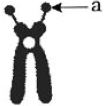
Which is the correct option for '$a$' indicated in the figure?
A
$a-$ Centromere,Telocentric chromosome
B
$a-$ Satellite,Acrocentric chromosome
C
$a-$ Kinetochore,Acrocentric chromosome
D
$a-$ Centromere,Acrocentric chromosome
Solution
(B) The figure shows a chromosome with a terminal satellite structure.
In this chromosome,the centromere is located very close to one end,which is characteristic of an acrocentric chromosome.
The small,rounded structure at the end of the short arm is known as a satellite.
Therefore,'$a$' represents the satellite,and the chromosome type is acrocentric.
In this chromosome,the centromere is located very close to one end,which is characteristic of an acrocentric chromosome.
The small,rounded structure at the end of the short arm is known as a satellite.
Therefore,'$a$' represents the satellite,and the chromosome type is acrocentric.
0 likes
View Solution160
EasyMCQ
Which of the following is a characteristic of a telocentric chromosome?
A
The centromere is located in the middle of the chromosome.
B
The centromere is located at the terminal end of the chromosome.
C
The chromosome lacks a centromere.
D
The chromosome possesses four arms.
Solution
(B) In a $telocentric$ chromosome,the centromere is situated at the terminal end of the chromosome,resulting in a single arm.
- $Metacentric$ chromosomes have the centromere in the middle,forming two equal arms.
- $Submetacentric$ chromosomes have the centromere slightly away from the middle,resulting in one shorter and one longer arm.
- $Acrocentric$ chromosomes have the centromere close to the end,forming one extremely short and one very long arm.
Therefore,the correct characteristic of a $telocentric$ chromosome is that the centromere is located at the terminal end.
- $Metacentric$ chromosomes have the centromere in the middle,forming two equal arms.
- $Submetacentric$ chromosomes have the centromere slightly away from the middle,resulting in one shorter and one longer arm.
- $Acrocentric$ chromosomes have the centromere close to the end,forming one extremely short and one very long arm.
Therefore,the correct characteristic of a $telocentric$ chromosome is that the centromere is located at the terminal end.
0 likes
View Solution161
EasyMCQ
In which type of chromosome is the centromere located at the terminal end?
A
Acrocentric
B
Metacentric
C
Telocentric
D
Sub-metacentric
Solution
(C) The position of the centromere determines the shape and type of the chromosome:
$1$. $Metacentric$: The centromere is in the middle, forming two equal arms.
$2$. $Sub-metacentric$: The centromere is slightly away from the middle, resulting in one shorter and one longer arm.
$3$. $Acrocentric$: The centromere is located close to the end, forming one extremely short arm and one very long arm.
$4$. $Telocentric$: The centromere is located at the terminal end of the chromosome, resulting in a single arm.
Therefore, the correct option is $C$.
$1$. $Metacentric$: The centromere is in the middle, forming two equal arms.
$2$. $Sub-metacentric$: The centromere is slightly away from the middle, resulting in one shorter and one longer arm.
$3$. $Acrocentric$: The centromere is located close to the end, forming one extremely short arm and one very long arm.
$4$. $Telocentric$: The centromere is located at the terminal end of the chromosome, resulting in a single arm.
Therefore, the correct option is $C$.
0 likes
View Solution162
EasyMCQ
The regulatory center of various activities in a cell is:
A
Centriole
B
Axoneme
C
Cytoskeleton
D
Nucleus
Solution
(D) The $Nucleus$ is known as the regulatory center of the cell because it contains the genetic material $(DNA)$.
It controls all cellular activities, including metabolism, protein synthesis, growth, and cell division, by regulating gene expression.
Therefore, the correct option is $D$.
It controls all cellular activities, including metabolism, protein synthesis, growth, and cell division, by regulating gene expression.
Therefore, the correct option is $D$.
0 likes
View Solution163
EasyMCQ
Which of the following animal cells lacks a nucleus?
A
White blood cell
B
Paramecium
C
Amoeba
D
Red blood cell
Solution
(D) In mature mammalian red blood cells $(RBCs)$,the nucleus is absent to provide more space for hemoglobin,which increases the oxygen-carrying capacity of the cell.
White blood cells,Paramecium,and Amoeba are all nucleated cells.
White blood cells,Paramecium,and Amoeba are all nucleated cells.
0 likes
View Solution164
EasyMCQ
The structure of the nucleus does not include which of the following?
A
Nuclear envelope
B
Cytoplasm
C
Nucleoplasm
D
Nucleolus
Solution
(B) The nucleus is a membrane-bound organelle found in eukaryotic cells.
It consists of the following components:
$1$. Nuclear envelope: $A$ double-membrane structure that encloses the nucleus.
$2$. Nucleoplasm: The dense fluid matrix inside the nucleus containing chromatin and nucleolus.
$3$. Nucleolus: $A$ spherical structure present inside the nucleoplasm involved in ribosome synthesis.
$4$. Chromatin: The thread-like network of $DNA$ and proteins.
Cytoplasm is the jelly-like substance present outside the nucleus,filling the cell,and is not a component of the nucleus itself.
Therefore,the correct answer is $B$.
It consists of the following components:
$1$. Nuclear envelope: $A$ double-membrane structure that encloses the nucleus.
$2$. Nucleoplasm: The dense fluid matrix inside the nucleus containing chromatin and nucleolus.
$3$. Nucleolus: $A$ spherical structure present inside the nucleoplasm involved in ribosome synthesis.
$4$. Chromatin: The thread-like network of $DNA$ and proteins.
Cytoplasm is the jelly-like substance present outside the nucleus,filling the cell,and is not a component of the nucleus itself.
Therefore,the correct answer is $B$.
0 likes
View Solution165
EasyMCQ
The double-layered tubular structure present in the nucleus is:
A
Nucleolus
B
Nucleoplasm
C
Nuclear envelope
D
Chromatin
Solution
(C) The nucleus is delimited by a nuclear envelope,which consists of two parallel membranes with a space between (the perinuclear space). This structure forms a barrier between the materials present inside the nucleus and that of the cytoplasm. Therefore,the double-layered structure is the nuclear envelope.
0 likes
View Solution166
EasyMCQ
The perinuclear space is defined as the space between:
A
The plasma membrane and the cell wall
B
The plasma membrane and the nucleus
C
The two membranes of the nuclear envelope
D
The nucleolus and the nuclear envelope
Solution
(C) The nuclear envelope consists of two parallel membranes with a space between them called the perinuclear space $(10-50 \ nm)$. This space separates the nucleoplasm from the cytoplasm and maintains the structural integrity of the nucleus.
0 likes
View Solution167
MediumMCQ
Through which structure does the movement of $RNA$ and protein molecules occur between the nucleoplasm and the cytoplasm?
A
Nuclear envelope
B
Nucleolus
C
Nuclear pore
D
Cytoplasmic strand
Solution
(C) The nuclear envelope consists of two parallel membranes with a space between them called the perinuclear space.
These membranes are interrupted by minute pores,which are formed by the fusion of the two nuclear membranes.
These are called nuclear pores.
Nuclear pores are the passages through which movement of $RNA$ and protein molecules takes place in both directions between the nucleus and the cytoplasm.
These membranes are interrupted by minute pores,which are formed by the fusion of the two nuclear membranes.
These are called nuclear pores.
Nuclear pores are the passages through which movement of $RNA$ and protein molecules takes place in both directions between the nucleus and the cytoplasm.
0 likes
View Solution168
MediumMCQ
What does the nucleoplasm contain?
A
Nuclear envelope,cytoplasm
B
Nucleoplasm,nucleus
C
Nucleolus,chromatin
D
Nucleoplasm,chromatin
Solution
(C) The nucleoplasm (or nuclear matrix) is the dense,protein-rich fluid enclosed within the nuclear envelope. It contains two primary components:
$1$. The nucleolus,which is a spherical structure involved in ribosome synthesis.
$2$. Chromatin,which consists of $DNA$ and histone proteins that condense to form chromosomes during cell division.
Therefore,the nucleoplasm contains the nucleolus and chromatin.
$1$. The nucleolus,which is a spherical structure involved in ribosome synthesis.
$2$. Chromatin,which consists of $DNA$ and histone proteins that condense to form chromosomes during cell division.
Therefore,the nucleoplasm contains the nucleolus and chromatin.
0 likes
View Solution169
EasyMCQ
Which structure is formed at the nucleolar organizer region of a chromosome?
A
Nucleus
B
Nucleolus
C
Nuclear envelope
D
Chromatin
Solution
(B) The nucleolar organizer region $(NOR)$ is a specific chromosomal segment that contains the genes for ribosomal $RNA$ $(rRNA)$.
This region is responsible for the synthesis and organization of the nucleolus within the nucleus.
Therefore,the nucleolus is formed at the nucleolar organizer region of the chromosome.
This region is responsible for the synthesis and organization of the nucleolus within the nucleus.
Therefore,the nucleolus is formed at the nucleolar organizer region of the chromosome.
0 likes
View Solution170
MediumMCQ
Which of the following is associated with the synthesis of ribosomal $RNA$ $(rRNA)$?
A
Nucleolus
B
Centriole
C
Nucleolar organizer region
D
Chromatin
Solution
(A) The nucleolus is a non-membrane-bound structure present within the nucleus of eukaryotic cells.
It is the primary site for the synthesis and processing of ribosomal $RNA$ $(rRNA)$.
Therefore,the nucleolus is often referred to as the 'ribosome factory' of the cell.
It is the primary site for the synthesis and processing of ribosomal $RNA$ $(rRNA)$.
Therefore,the nucleolus is often referred to as the 'ribosome factory' of the cell.
0 likes
View Solution171
MediumMCQ
The composition of chromatin material is:
A
$DNA, RNA$
B
$DNA, RNA$ and histone proteins
C
$DNA, RNA$,histone and non-histone proteins
D
$DNA$,histone and non-histone proteins
Solution
(D) Chromatin is the complex of $DNA$ and proteins found in eukaryotic cells.
It consists of $DNA$,basic proteins called histones,and non-histone chromosomal proteins.
While $RNA$ may be associated with chromatin during transcription,it is not a structural component of the chromatin material itself.
Therefore,the correct composition is $DNA$,histone proteins,and non-histone proteins.
It consists of $DNA$,basic proteins called histones,and non-histone chromosomal proteins.
While $RNA$ may be associated with chromatin during transcription,it is not a structural component of the chromatin material itself.
Therefore,the correct composition is $DNA$,histone proteins,and non-histone proteins.
0 likes
View Solution172
EasyMCQ
Chromosomes spread in the form of an indistinct network are called:
A
Chromatid
B
Chromatin
C
Chromonema
D
Nucleolus
Solution
(B) During the interphase stage of the cell cycle,the $DNA$ is not condensed into compact chromosomes. Instead,it exists as a loose,thread-like network of $DNA$ and proteins within the nucleus,which is known as chromatin. When the cell prepares to divide,this chromatin condenses to form distinct chromosomes.
0 likes
View Solution173
EasyMCQ
The disc-shaped structure present on the centromere of each chromosome is known as:
A
Metacentric
B
Telocentric
C
Kinetochore
D
Chromatin
Solution
(C) The centromere is the primary constriction of a chromosome.
On the sides of the centromere,there are disc-shaped structures called kinetochores.
These structures serve as the sites of attachment for spindle fibers during cell division (mitosis and meiosis).
On the sides of the centromere,there are disc-shaped structures called kinetochores.
These structures serve as the sites of attachment for spindle fibers during cell division (mitosis and meiosis).
0 likes
View Solution174
EasyMCQ
In which type of chromosome is the centromere situated in the middle?
A
Metacentric
B
Submetacentric
C
Acrocentric
D
Telocentric
Solution
(A) The position of the centromere determines the shape of the chromosome during cell division.
$1$. Metacentric chromosome: The centromere is located in the middle, forming two equal arms.
$2$. Submetacentric chromosome: The centromere is slightly away from the middle, resulting in one shorter arm and one longer arm.
$3$. Acrocentric chromosome: The centromere is situated close to the end, forming one extremely short arm and one very long arm.
$4$. Telocentric chromosome: The centromere is located at the terminal end of the chromosome.
Therefore, the correct answer is Metacentric.
$1$. Metacentric chromosome: The centromere is located in the middle, forming two equal arms.
$2$. Submetacentric chromosome: The centromere is slightly away from the middle, resulting in one shorter arm and one longer arm.
$3$. Acrocentric chromosome: The centromere is situated close to the end, forming one extremely short arm and one very long arm.
$4$. Telocentric chromosome: The centromere is located at the terminal end of the chromosome.
Therefore, the correct answer is Metacentric.
0 likes
View Solution175
MediumMCQ
Which of the following statements is correct for a submetacentric chromosome?
A
The centromere is situated in the middle of the chromosome.
B
The centromere is situated close to the end of the chromosome.
C
The centromere is situated slightly away from the middle of the chromosome.
D
The centromere is situated at the terminal end of the chromosome.
Solution
(C) In a submetacentric chromosome,the centromere is located slightly away from the middle of the chromosome,resulting in one shorter arm and one longer arm.
- Metacentric: Centromere is in the middle.
- Submetacentric: Centromere is slightly away from the middle.
- Acrocentric: Centromere is close to the end.
- Telocentric: Centromere is at the terminal end.
- Metacentric: Centromere is in the middle.
- Submetacentric: Centromere is slightly away from the middle.
- Acrocentric: Centromere is close to the end.
- Telocentric: Centromere is at the terminal end.
0 likes
View Solution176
EasyMCQ
In some chromosomes,non-staining secondary constrictions at a constant location are known as:
A
Kinetochore
B
Centromere
C
Chromonema
D
Satellite
Solution
(D) In some chromosomes,there are non-staining secondary constrictions at a constant location. This gives the appearance of a small fragment called a $Satellite$.
0 likes
View Solution177
MediumMCQ
Match the following columns correctly:
| Column-$I$ | Column-$II$ |
| $(a)$ Acrocentric | $(p)$ Centromere slightly away from the middle |
| $(b)$ Telocentric | $(q)$ Centromere in the middle |
| $(c)$ Submetacentric | $(r)$ Centromere near the end |
| $(d)$ Metacentric | $(s)$ Centromere at the terminal end |
A
$a-s, b-r, c-q, d-p$
B
$a-r, b-p, c-s, d-q$
C
$a-r, b-s, c-p, d-q$
D
$a-p, b-q, c-s, d-r$
Solution
(C) The classification of chromosomes is based on the position of the centromere:
$1$. $(a)$ Acrocentric: The centromere is located near the end of the chromosome,resulting in one very short arm and one very long arm. Thus,$(a)-(r)$.
$2$. $(b)$ Telocentric: The centromere is located at the terminal end of the chromosome. Thus,$(b)-(s)$.
$3$. $(c)$ Submetacentric: The centromere is located slightly away from the middle of the chromosome,resulting in one shorter arm and one longer arm. Thus,$(c)-(p)$.
$4$. $(d)$ Metacentric: The centromere is located in the middle of the chromosome,forming two equal arms. Thus,$(d)-(q)$.
Therefore,the correct matching is $(a)-(r), (b)-(s), (c)-(p), (d)-(q)$.
$1$. $(a)$ Acrocentric: The centromere is located near the end of the chromosome,resulting in one very short arm and one very long arm. Thus,$(a)-(r)$.
$2$. $(b)$ Telocentric: The centromere is located at the terminal end of the chromosome. Thus,$(b)-(s)$.
$3$. $(c)$ Submetacentric: The centromere is located slightly away from the middle of the chromosome,resulting in one shorter arm and one longer arm. Thus,$(c)-(p)$.
$4$. $(d)$ Metacentric: The centromere is located in the middle of the chromosome,forming two equal arms. Thus,$(d)-(q)$.
Therefore,the correct matching is $(a)-(r), (b)-(s), (c)-(p), (d)-(q)$.
0 likes
View Solution178
MediumMCQ
$S$ - Statement: $RNA$ and protein molecules move between the nucleoplasm and the cytoplasm.
$R$ - Reason: Nuclear pores are present at several locations in the nuclear envelope of the nucleus.
$R$ - Reason: Nuclear pores are present at several locations in the nuclear envelope of the nucleus.
A
Both $S$ and $R$ are true,and $R$ is the correct explanation of $S$.
B
Both $S$ and $R$ are true,but $R$ is not the correct explanation of $S$.
C
$S$ is true and $R$ is false.
D
$S$ is false and $R$ is true.
Solution
(A) The nuclear envelope consists of two parallel membranes with a space between them called the perinuclear space.
These membranes are interrupted by minute pores,known as nuclear pores,which are formed by the fusion of the two membranes.
These nuclear pores act as passages for the movement of $RNA$ and protein molecules in both directions between the nucleoplasm and the cytoplasm.
Therefore,both the statement $(S)$ and the reason $(R)$ are correct,and $R$ is the correct explanation of $S$.
These membranes are interrupted by minute pores,known as nuclear pores,which are formed by the fusion of the two membranes.
These nuclear pores act as passages for the movement of $RNA$ and protein molecules in both directions between the nucleoplasm and the cytoplasm.
Therefore,both the statement $(S)$ and the reason $(R)$ are correct,and $R$ is the correct explanation of $S$.
0 likes
View Solution179
MediumMCQ
$S -$ Statement: Based on the position of the centromere,chromosomes are classified into four types.
$R -$ Reason: Chromosomes contain a centromere,which is a primary constriction or disc-shaped structure.
$R -$ Reason: Chromosomes contain a centromere,which is a primary constriction or disc-shaped structure.
A
$S$ and $R$ are both true,and $R$ is the correct explanation of $S$.
B
$S$ and $R$ are both true,but $R$ is not the correct explanation of $S$.
C
$S$ is true and $R$ is false.
D
$S$ is false and $R$ is true.
Solution
(B) Statement $S$ is true because chromosomes are classified into four types (metacentric,sub-metacentric,acrocentric,and telocentric) based on the position of the centromere.
Reason $R$ is also true because the centromere is indeed the primary constriction on the chromosome,and it contains disc-shaped structures called kinetochores.
However,the reason $R$ describes the structure of the centromere,while statement $S$ describes the classification based on its position. Therefore,$R$ is not the direct explanation for why there are four types of chromosomes.
Reason $R$ is also true because the centromere is indeed the primary constriction on the chromosome,and it contains disc-shaped structures called kinetochores.
However,the reason $R$ describes the structure of the centromere,while statement $S$ describes the classification based on its position. Therefore,$R$ is not the direct explanation for why there are four types of chromosomes.
0 likes
View Solution180
MediumMCQ
$S -$ Statement: The nucleolus contains $DNA$.
$R -$ Reason: The nucleolus is a membrane-less spherical structure.
$R -$ Reason: The nucleolus is a membrane-less spherical structure.
A
$S$ and $R$ are both true,and $R$ is the correct explanation of $S$.
B
$S$ and $R$ are both true,but $R$ is not the correct explanation of $S$.
C
$S$ is true and $R$ is false.
D
$S$ is false and $R$ is true.
Solution
(D) The nucleolus is a site for active ribosomal $RNA$ $(rRNA)$ synthesis. It is a membrane-less spherical structure present within the nucleus. While the nucleolus is associated with the nucleolar organizer regions of chromosomes (which contain $DNA$ coding for $rRNA$),the nucleolus itself is primarily composed of $rRNA$ and proteins. The $DNA$ is located in the nucleoplasm of the nucleus,not inside the nucleolus. Therefore,the statement $S$ is false,and the reason $R$ is true.
0 likes
View Solution181
EasyMCQ
Which of the following is mismatched?
A
Metacentric: Centromere in the middle of the chromosome
B
Submetacentric: Centromere slightly away from the middle of the chromosome
C
Acrocentric: Centromere is located at the end of the chromosome
D
Kinetochore: Disc-shaped structure on the centromere of the chromosome
Solution
(C) The classification of chromosomes based on the position of the centromere is as follows:
$1$. Metacentric: The centromere is in the middle,forming two equal arms.
$2$. Submetacentric: The centromere is slightly away from the middle,resulting in one shorter and one longer arm.
$3$. Acrocentric: The centromere is situated close to the end,forming an extremely short and an extremely long arm.
$4$. Telocentric: The centromere is at the terminal end of the chromosome.
Therefore,the statement 'Acrocentric: Centromere is located at the end of the chromosome' is incorrect because it describes a Telocentric chromosome. Kinetochores are indeed disc-shaped structures present on the sides of the centromere.
$1$. Metacentric: The centromere is in the middle,forming two equal arms.
$2$. Submetacentric: The centromere is slightly away from the middle,resulting in one shorter and one longer arm.
$3$. Acrocentric: The centromere is situated close to the end,forming an extremely short and an extremely long arm.
$4$. Telocentric: The centromere is at the terminal end of the chromosome.
Therefore,the statement 'Acrocentric: Centromere is located at the end of the chromosome' is incorrect because it describes a Telocentric chromosome. Kinetochores are indeed disc-shaped structures present on the sides of the centromere.
0 likes
View Solution182
MediumMCQ
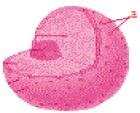
In the given figure,what does the part labeled '$a$' represent and what is its function?
A
Nuclear membrane,protection of the nucleus
B
Outer membrane,protection of the nucleolus
C
Nuclear pores,synthesis of ribosomal $RNA$
D
Nuclear pores,movement of $RNA$ and protein molecules between the cytoplasm and nucleoplasm
Solution
(D) The figure shows the structure of the nucleus. The part labeled '$a$' points to the small openings present on the nuclear envelope,which are known as nuclear pores.
These nuclear pores are formed by the fusion of the two nuclear membranes.
Their primary function is to act as channels for the movement of $RNA$ and protein molecules in both directions between the nucleus (nucleoplasm) and the cytoplasm.
These nuclear pores are formed by the fusion of the two nuclear membranes.
Their primary function is to act as channels for the movement of $RNA$ and protein molecules in both directions between the nucleus (nucleoplasm) and the cytoplasm.
0 likes
View Solution183
EasyMCQ
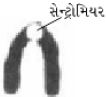
What type of chromosome is shown in the figure?
A
Telocentric
B
Acrocentric
C
Submetacentric
D
Metacentric
Solution
(B) The chromosome shown in the figure has its centromere located very close to one end,resulting in one extremely short arm and one very long arm. This configuration is characteristic of an acrocentric chromosome.
In a metacentric chromosome,the centromere is in the middle.
In a submetacentric chromosome,the centromere is slightly away from the middle.
In a telocentric chromosome,the centromere is at the terminal end.
In a metacentric chromosome,the centromere is in the middle.
In a submetacentric chromosome,the centromere is slightly away from the middle.
In a telocentric chromosome,the centromere is at the terminal end.
0 likes
View Solution184
EasyMCQ
How many layers are present in the nuclear envelope?
A
One
B
Two
C
Three
D
None
Solution
(B) The nuclear envelope consists of two parallel membranes with a space between them ($10$ to $50$ $nm$) called the perinuclear space.
These two membranes form a barrier between the materials present inside the nucleus and that of the cytoplasm.
Therefore,the nuclear envelope is a double-layered structure.
These two membranes form a barrier between the materials present inside the nucleus and that of the cytoplasm.
Therefore,the nuclear envelope is a double-layered structure.
0 likes
View Solution185
MediumMCQ
Which of the following structures is regularly transported from the nucleus to the cytoplasm?
A
Glycogen
B
Cholesterol
C
$RNA$
D
$DNA$
Solution
(C) The nucleus is the site of transcription,where $DNA$ is transcribed into $RNA$ (specifically $mRNA$,$tRNA$,and $rRNA$).
These $RNA$ molecules are then transported through the nuclear pores from the nucleus into the cytoplasm to participate in protein synthesis.
$DNA$ remains within the nucleus to protect the genetic information.
Glycogen and cholesterol are synthesized in the cytoplasm or other organelles,not the nucleus.
These $RNA$ molecules are then transported through the nuclear pores from the nucleus into the cytoplasm to participate in protein synthesis.
$DNA$ remains within the nucleus to protect the genetic information.
Glycogen and cholesterol are synthesized in the cytoplasm or other organelles,not the nucleus.
0 likes
View Solution186
EasyMCQ
What are chromosomes with arms of equal length called?
A
Metacentric
B
Acrocentric
C
Telocentric
D
Submetacentric
Solution
(A) Chromosomes are classified based on the position of the centromere.
$1$. In $Metacentric$ chromosomes,the centromere is located in the middle,resulting in two arms of equal length.
$2$. In $Submetacentric$ chromosomes,the centromere is slightly away from the center,resulting in one shorter arm and one longer arm.
$3$. In $Acrocentric$ chromosomes,the centromere is situated close to the end,forming one extremely short arm and one very long arm.
$4$. In $Telocentric$ chromosomes,the centromere is located at the terminal end of the chromosome.
Therefore,chromosomes with arms of equal length are called $Metacentric$.
$1$. In $Metacentric$ chromosomes,the centromere is located in the middle,resulting in two arms of equal length.
$2$. In $Submetacentric$ chromosomes,the centromere is slightly away from the center,resulting in one shorter arm and one longer arm.
$3$. In $Acrocentric$ chromosomes,the centromere is situated close to the end,forming one extremely short arm and one very long arm.
$4$. In $Telocentric$ chromosomes,the centromere is located at the terminal end of the chromosome.
Therefore,chromosomes with arms of equal length are called $Metacentric$.
0 likes
View Solution187
MediumMCQ
What happens if the nucleus is removed from a cell?
A
Metabolic rate increases
B
The cell dies
C
Metabolic rate decreases
D
Nothing happens
Solution
(B) The nucleus acts as the control center of the cell because it contains the genetic material $(DNA)$ which regulates all cellular activities,including protein synthesis and metabolism. If the nucleus is removed,the cell loses its ability to synthesize essential proteins and enzymes required for survival. Consequently,the cell cannot maintain its homeostasis and eventually dies.
0 likes
View Solution188
EasyMCQ
Which of the following is a membrane-less organelle?
A
Nucleus
B
Nucleolus
C
Golgi apparatus
D
Lysosome
Solution
(B) The $Nucleolus$ is a spherical structure present inside the nucleus of eukaryotic cells. It is not bound by any membrane. It is the site of active ribosomal $RNA$ $(rRNA)$ synthesis. In contrast,the nucleus,Golgi apparatus,and lysosomes are all membrane-bound organelles.
0 likes
View Solution189
EasyMCQ
Which of the following is actively involved in the synthesis of ribosomal $RNA$?
A
Nucleus
B
Nucleolus
C
Nucleoplasm
D
All of the above
Solution
(B) The nucleolus is a spherical structure present in the nucleoplasm of the nucleus.
It is not a membrane-bound structure.
The nucleolus is the site for active ribosomal $RNA$ $(rRNA)$ synthesis.
Therefore,the correct answer is the nucleolus.
It is not a membrane-bound structure.
The nucleolus is the site for active ribosomal $RNA$ $(rRNA)$ synthesis.
Therefore,the correct answer is the nucleolus.
0 likes
View Solution190
EasyMCQ
What is the disc-shaped structure present on the centromere of each chromosome called?
A
Satellite
B
Kinetochore
C
Chromatid
D
Histone
Solution
(B) Each chromosome has a primary constriction called the centromere. On the sides of the centromere,disc-shaped structures are present which are called kinetochores. These structures serve as the sites of attachment for spindle fibers during cell division.
0 likes
View Solution191
EasyMCQ
Which type of chromosome has the centromere located at the terminal end?
A
Acrocentric
B
Metacentric
C
Telocentric
D
Sub-metacentric
Solution
(C) In a $Telocentric$ chromosome,the centromere is situated at the terminal end,resulting in a single arm.
In a $Metacentric$ chromosome,the centromere is in the middle,forming two equal arms.
In a $Sub-metacentric$ chromosome,the centromere is slightly away from the middle,resulting in one shorter and one longer arm.
In an $Acrocentric$ chromosome,the centromere is located close to the end,forming one extremely short and one very long arm.
In a $Metacentric$ chromosome,the centromere is in the middle,forming two equal arms.
In a $Sub-metacentric$ chromosome,the centromere is slightly away from the middle,resulting in one shorter and one longer arm.
In an $Acrocentric$ chromosome,the centromere is located close to the end,forming one extremely short and one very long arm.
0 likes
View Solution192
EasyMCQ
What do $a$ and $b$ represent in the given figure,respectively?

A
Arm,Satellite
B
Centromere,Satellite
C
Satellite,Centromere
D
Satellite,Arm
Solution
(C) In the provided figure of a chromosome,the label '$a$' points to the small,rounded,non-staining terminal part of the chromosome,which is known as the 'Satellite'.
The label '$b$' points to the primary constriction or the central point where the two chromatids are joined,which is known as the 'Centromere'.
Therefore,'$a$' represents the Satellite and '$b$' represents the Centromere.
The label '$b$' points to the primary constriction or the central point where the two chromatids are joined,which is known as the 'Centromere'.
Therefore,'$a$' represents the Satellite and '$b$' represents the Centromere.
0 likes
View Solution193
EasyMCQ
In the given figure,what do $a$ and $b$ represent respectively?

A
Nucleolus,Nuclear envelope
B
Nucleus,Chromatin
C
Nuclear envelope,Nucleus
D
Nucleoplasm,Nucleolus
Solution
(A) In the provided diagram of the nucleus,the label $a$ points to the dense,spherical structure inside the nucleus known as the nucleolus. The label $b$ points to the outer boundary of the nucleus,which is the nuclear envelope (or nuclear membrane). Therefore,$a$ represents the nucleolus and $b$ represents the nuclear envelope.
0 likes
View Solution194
MediumMCQ
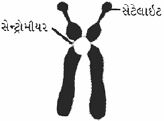
Which type of chromosome is shown in the figure below?
A
Acrocentric
B
Telocentric
C
Metacentric
D
Submetacentric
Solution
(A) The provided figure shows a chromosome where the centromere is located very close to one end,resulting in one extremely short arm and one very long arm. This specific configuration is characteristic of an acrocentric chromosome.
$1$. Metacentric: Centromere is in the middle,forming two equal arms.
$2$. Submetacentric: Centromere is slightly away from the middle,forming one shorter and one longer arm.
$3$. Acrocentric: Centromere is situated close to the end,forming an extremely short arm and a very long arm.
$4$. Telocentric: Centromere is at the terminal end of the chromosome.
Therefore,the correct option is $A$.
$1$. Metacentric: Centromere is in the middle,forming two equal arms.
$2$. Submetacentric: Centromere is slightly away from the middle,forming one shorter and one longer arm.
$3$. Acrocentric: Centromere is situated close to the end,forming an extremely short arm and a very long arm.
$4$. Telocentric: Centromere is at the terminal end of the chromosome.
Therefore,the correct option is $A$.
0 likes
View Solution195
EasyMCQ
The nucleolus is...
A
$A$ spherical structure found in the cytoplasm near the nucleus.
B
$A$ spherical structure present inside the nucleus containing $r-RNA$ and chromatin.
C
$A$ rod-shaped structure located near the nucleus.
D
None of the above.
Solution
(B) The nucleolus is a non-membrane-bound,spherical structure present within the nucleus of eukaryotic cells.
It is the site for active ribosomal $RNA$ $(r-RNA)$ synthesis.
It is often associated with the nucleolar organizer regions of chromosomes (chromatin).
Therefore,option $B$ is the correct description.
It is the site for active ribosomal $RNA$ $(r-RNA)$ synthesis.
It is often associated with the nucleolar organizer regions of chromosomes (chromatin).
Therefore,option $B$ is the correct description.
0 likes
View Solution196
MediumMCQ
What is the structure called when bands are observed in the arms of chromosomes under an electron microscope?
A
Genes
B
Nucleotides
C
Nucleosomes
D
Base pairs
Solution
(C) Under an electron microscope,the chromatin fibers within the chromosome arms appear as a 'beads-on-a-string' structure. These beads are known as $Nucleosomes$. $A$ $Nucleosome$ consists of $DNA$ wrapped around a core of histone proteins. The appearance of bands or beads is due to the packaging of $DNA$ into these compact units.
0 likes
View Solution197
DifficultMCQ
......... are the chromosomes that form ribosomal-$RNA$ $(rRNA)$.
A
Metacentric
B
Submetacentric
C
Acrocentric
D
Telocentric
Solution
(C) The chromosomes that contain the nucleolar organizer region $(NOR)$ are responsible for the formation of ribosomal-$RNA$ $(rRNA)$. These chromosomes are typically acrocentric in nature. The $NOR$ is located on the secondary constriction of these chromosomes,which is the site where the nucleolus is organized during interphase.
0 likes
View Solution198
MediumMCQ
In which type of chromosome is a satellite found?
A
Metacentric
B
Acrocentric
C
Telocentric
D
Submetacentric
Solution
(B) satellite is a small chromosomal segment separated from the main body of the chromosome by a secondary constriction.
These are typically observed in acrocentric chromosomes,which have a very small short arm ($p$-arm) and a long arm ($q$-arm).
The presence of a satellite is a characteristic feature of $SAT$-chromosomes (Sine Acid Thymonucleinico chromosomes).
These are typically observed in acrocentric chromosomes,which have a very small short arm ($p$-arm) and a long arm ($q$-arm).
The presence of a satellite is a characteristic feature of $SAT$-chromosomes (Sine Acid Thymonucleinico chromosomes).
0 likes
View Solution199
EasyMCQ
Chromosomes with unequal arm lengths are known as ...........
A
Acrocentric
B
Submetacentric
C
Metacentric
D
Both $(A)$ and $(B)$
Solution
(D) Chromosomes are classified based on the position of the centromere:
$1$. Metacentric: The centromere is in the middle,forming two equal arms.
$2$. Submetacentric: The centromere is slightly away from the middle,resulting in one shorter arm and one longer arm (unequal lengths).
$3$. Acrocentric: The centromere is situated close to the end,forming one extremely short arm and one very long arm (unequal lengths).
$4$. Telocentric: The centromere is at the terminal end.
Since both Submetacentric and Acrocentric chromosomes possess arms of unequal lengths,the correct option is $(D)$.
$1$. Metacentric: The centromere is in the middle,forming two equal arms.
$2$. Submetacentric: The centromere is slightly away from the middle,resulting in one shorter arm and one longer arm (unequal lengths).
$3$. Acrocentric: The centromere is situated close to the end,forming one extremely short arm and one very long arm (unequal lengths).
$4$. Telocentric: The centromere is at the terminal end.
Since both Submetacentric and Acrocentric chromosomes possess arms of unequal lengths,the correct option is $(D)$.
0 likes
View Solution200
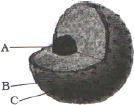
EasyMCQ
Which cell structure is represented in the given figure?
A
Nucleolus
B
Nucleus
C
Mitochondrion
D
Vacuole
Solution
(B) The provided figure shows the structure of a cell nucleus.
It displays the nuclear envelope,nucleoplasm,and a prominent central dense body known as the nucleolus.
Therefore,the correct option is $B$.
It displays the nuclear envelope,nucleoplasm,and a prominent central dense body known as the nucleolus.
Therefore,the correct option is $B$.
0 likes
View SolutionCell: The Unit of Life — Nucleus and Chromosomes · Frequently Asked Questions
1Are these Cell: The Unit of Life questions useful for JEE and NEET?
Yes. All questions in this section are mapped to JEE Main and NEET exam patterns. Previous year questions from JEE Main, NEET, GUJCET and state-level exams are included with full solutions.
2Can I switch to Hindi or Gujarati for these questions?
Yes. Use the language tabs in the hero section or the sidebar to view the same questions and solutions in English, Hindi or Gujarati.
3How do I generate a question paper from this subtopic?
Use the Vedclass Exam Paper Generator — select the chapter and subtopic, set difficulty, and generate Sets A, B, C, D automatically. First 3 chapters of every subject are free.
Vedclass Products
For Students
Vedclass Test Series
Mock tests in real JEE/NEET style with performance analysis. 5-day free trial.
Start Free TrialFor Teachers
Exam Paper Generator
Generate Set A/B/C/D papers from this chapter in 2 minutes. 3 chapters free.
Try FreeFor Institutes
Online Exam Module
Live online exams with unlimited students, 360° analytics & white-label branding.
See DemoFor Teachers & Institutes
Generate a Cell: The Unit of Life Exam Paper in 2 Minutes
Select subtopic & difficulty — Sets A, B, C, D auto-generated with No Repeat logic.
First 3 chapters of every subject are free — no payment required.