
A English
Endoplasmic reticulum and Golgi body Questions in English
Class 11 Biology · Cell: The Unit of Life · Endoplasmic reticulum and Golgi body
182+
Questions
English
Language
100%
With Solutions
Showing 49 of 182 questions in English
101
MediumMCQ
The Golgi complex plays a major role
A
as energy transferring organelles
B
in post-translational modification of proteins and glycosylation of lipids
C
in trapping the light and transforming it into chemical energy
D
in digesting proteins and carbohydrates
Solution
(B) : Post-translational modification $(PTM)$ is a crucial step in protein biosynthesis. Proteins are synthesized on ribosomes by translating $mRNA$ into polypeptide chains. These chains undergo $PTM$,such as folding,cleavage,and other modifications,to become mature functional proteins. Proteins synthesized by the rough endoplasmic reticulum $(RER)$ and lipids synthesized by the smooth endoplasmic reticulum $(SER)$ are transported to the cisternae of the Golgi apparatus. Within the Golgi,these molecules combine with carbohydrates to form glycoproteins and glycolipids. This specific process is known as glycosylation.
0 likes
View Solution102
MediumMCQ
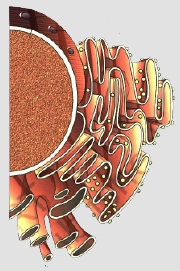
Which one of the following organelles in the figure correctly matches with its function?
A
Golgi apparatus,formation of glycolipids
B
Rough endoplasmic reticulum,protein synthesis
C
Rough endoplasmic reticulum,formation of glycoproteins
D
Golgi apparatus,protein synthesis
Solution
(B) The correct answer is $B$.
The given figure shows the endoplasmic reticulum with ribosomes attached to its surface,which is known as the Rough Endoplasmic Reticulum $(RER)$.
$RER$ is primarily involved in protein synthesis and secretion because the ribosomes attached to its surface are the sites of protein synthesis.
The given figure shows the endoplasmic reticulum with ribosomes attached to its surface,which is known as the Rough Endoplasmic Reticulum $(RER)$.
$RER$ is primarily involved in protein synthesis and secretion because the ribosomes attached to its surface are the sites of protein synthesis.
0 likes
View Solution103
MediumMCQ
$A$ major site for synthesis of lipids is
A
symplast
B
nucleoplasm
C
$RER$
D
$SER$
Solution
(D) $SER$ (Smooth Endoplasmic Reticulum) is a system of smooth membranes (i.e.,membranes lacking ribosomes) found within the cytoplasm of plant and animal cells.
It forms a structural link between the cell membrane and the nuclear membrane.
It serves as the primary site for critical metabolic reactions,including the synthesis of phospholipids and fatty acids.
In animal cells,lipid-like steroidal hormones are also synthesized within the $SER$.
It forms a structural link between the cell membrane and the nuclear membrane.
It serves as the primary site for critical metabolic reactions,including the synthesis of phospholipids and fatty acids.
In animal cells,lipid-like steroidal hormones are also synthesized within the $SER$.
0 likes
View Solution104
EasyMCQ
Important site for formation of glycoproteins and glycolipids is
A
vacuole
B
Golgi apparatus
C
plastid
D
lysosome
Solution
(B) : Eukaryotic cells contain a unique cluster of membrane vesicles known as Golgi apparatus. It principally performs the function of packaging materials. The newly synthesized proteins are handed over to the Golgi apparatus,where they are modified by the addition of carbohydrate,lipid,or sulphate moieties. Thus,the Golgi apparatus is the important site for the formation of glycoproteins and glycolipids.
0 likes
View Solution105
EasyMCQ
The diameter of the cisternae of the Golgi body is:
A
$0.5\, \mu m$ to $1.0\, \mu m$
B
$1.0\, \mu m$ to $1.5\, \mu m$
C
$0.05\, \mu m$ to $0.1\, \mu m$
D
$0.5\, \mu m$ to $0.1\, \mu m$
Solution
(A) The Golgi apparatus consists of many flat,disc-shaped sacs or cisternae.
These cisternae are stacked parallel to each other.
The diameter of these cisternae typically ranges from $0.5\, \mu m$ to $1.0\, \mu m$.
These cisternae are stacked parallel to each other.
The diameter of these cisternae typically ranges from $0.5\, \mu m$ to $1.0\, \mu m$.
0 likes
View Solution106
MediumMCQ
What are synthesized by the Golgi body?
A
Phospholipid and glycolipid
B
Glycoprotein and lipoprotein
C
Lipoprotein and glycolipid
D
Glycolipid and glycoprotein
Solution
(D) The Golgi apparatus is primarily responsible for the modification,packaging,and sorting of proteins and lipids.
It acts as the site for the synthesis of complex carbohydrates and polysaccharides.
Specifically,the Golgi body is involved in the synthesis of glycolipids and glycoproteins by adding carbohydrate chains to lipids and proteins,respectively,which are then transported to their final destinations.
It acts as the site for the synthesis of complex carbohydrates and polysaccharides.
Specifically,the Golgi body is involved in the synthesis of glycolipids and glycoproteins by adding carbohydrate chains to lipids and proteins,respectively,which are then transported to their final destinations.
0 likes
View Solution107
EasyMCQ
What is correct for a cell rich with $RER$?
A
Secretes more lipid
B
Secretes more protein
C
Secretes no protein
D
Secretes less protein
Solution
(B) $RER$ stands for Rough Endoplasmic Reticulum.
It is called 'rough' because ribosomes are attached to its surface.
Ribosomes are the sites of protein synthesis.
Therefore,cells that are rich in $RER$ are actively involved in the synthesis and secretion of proteins.
It is called 'rough' because ribosomes are attached to its surface.
Ribosomes are the sites of protein synthesis.
Therefore,cells that are rich in $RER$ are actively involved in the synthesis and secretion of proteins.
0 likes
View Solution108
MediumMCQ
Which of the following structures is found in the Golgi body?
A
Ribosome
B
Cisternae
C
Mesosome
D
Glycoproteins
Solution
(B) The Golgi apparatus consists of many flat,disc-shaped sacs or cisternae of $0.5 \mu m$ to $1.0 \mu m$ diameter. These are stacked parallel to each other. Varied numbers of cisternae are present in a Golgi complex. The Golgi cisternae are concentrically arranged near the nucleus with distinct convex 'cis' or the forming face and concave 'trans' or the maturing face.
0 likes
View Solution109
MediumMCQ
In which of the following are cisternae found?
A
Only in mitochondria
B
Only in $ER$
C
In $ER$ and Golgi body
D
Only in Golgi body
Solution
(C) Cisternae are flattened,sac-like structures that are characteristic components of both the Endoplasmic Reticulum $(ER)$ and the Golgi apparatus (Golgi body).
In the $ER$,they are often interconnected,while in the Golgi body,they are stacked parallel to each other.
Therefore,cisternae are found in both $ER$ and Golgi body.
In the $ER$,they are often interconnected,while in the Golgi body,they are stacked parallel to each other.
Therefore,cisternae are found in both $ER$ and Golgi body.
0 likes
View Solution110
EasyMCQ
In which form does $RER$ transform if it loses its ribosomes?
A
$SER$
B
Golgi body
C
Lysosome
D
Microtubule
Solution
(A) The $RER$ (Rough Endoplasmic Reticulum) is characterized by the presence of ribosomes on its surface,which are involved in protein synthesis.
When the ribosomes are detached or lost from the surface of the $RER$,the membrane becomes smooth in appearance.
This transformed structure is known as the $SER$ (Smooth Endoplasmic Reticulum),which is primarily involved in lipid synthesis and detoxification processes.
When the ribosomes are detached or lost from the surface of the $RER$,the membrane becomes smooth in appearance.
This transformed structure is known as the $SER$ (Smooth Endoplasmic Reticulum),which is primarily involved in lipid synthesis and detoxification processes.
0 likes
View Solution111
EasyMCQ
Which organelle possesses flat,disc-shaped sacs or cisternae and is found near the nucleus?
A
Golgi body
B
Mitochondria
C
Centriole
D
Nucleolus
Solution
(A) The $Golgi$ apparatus consists of many flat,disc-shaped sacs or cisternae of $0.5 \mu m$ to $1.0 \mu m$ diameter.
These are stacked parallel to each other.
Varied numbers of cisternae are present in a $Golgi$ complex.
The $Golgi$ cisternae are concentrically arranged near the nucleus with distinct convex $cis$ or the forming face and concave $trans$ or the maturing face.
These are stacked parallel to each other.
Varied numbers of cisternae are present in a $Golgi$ complex.
The $Golgi$ cisternae are concentrically arranged near the nucleus with distinct convex $cis$ or the forming face and concave $trans$ or the maturing face.
0 likes
View Solution112
MediumMCQ
Where do protein synthesis and protein modification occur in a plant cell?
A
Chloroplast and mitochondria
B
Cell wall and cell membrane
C
$ER$ and Golgi body
D
Centrosome and centriole
Solution
(C) In a plant cell,protein synthesis primarily occurs on the ribosomes attached to the Rough Endoplasmic Reticulum $(RER)$.
After synthesis,these proteins are transported to the Golgi body (Golgi apparatus) for modification,processing,and packaging.
The $ER$ provides the site for synthesis,while the Golgi body acts as the site for modification and sorting of proteins.
After synthesis,these proteins are transported to the Golgi body (Golgi apparatus) for modification,processing,and packaging.
The $ER$ provides the site for synthesis,while the Golgi body acts as the site for modification and sorting of proteins.
0 likes
View Solution113
MediumMCQ
In the following,what is the function of $SER$ (Smooth Endoplasmic Reticulum)?
A
Synthesis of steroid hormones
B
Synthesis of glycoprotein
C
Synthesis of hydrolase enzymes
D
Synthesis of lysosomes
Solution
(A) The $SER$ (Smooth Endoplasmic Reticulum) is primarily involved in the synthesis of lipids and lipid-like molecules.
In animal cells,$SER$ is the major site for the synthesis of steroid hormones such as cholesterol,progesterone,and testosterone.
$RER$ (Rough Endoplasmic Reticulum) is associated with protein synthesis (glycoproteins).
Lysosomes and hydrolase enzymes are typically associated with the Golgi apparatus and $RER$ pathways.
Therefore,the correct function of $SER$ among the given options is the synthesis of steroid hormones.
In animal cells,$SER$ is the major site for the synthesis of steroid hormones such as cholesterol,progesterone,and testosterone.
$RER$ (Rough Endoplasmic Reticulum) is associated with protein synthesis (glycoproteins).
Lysosomes and hydrolase enzymes are typically associated with the Golgi apparatus and $RER$ pathways.
Therefore,the correct function of $SER$ among the given options is the synthesis of steroid hormones.
0 likes
View Solution114
EasyMCQ
Which structure is connected with the plasma membrane and the nuclear membrane?
A
Ribosome
B
Endoplasmic reticulum
C
Golgi bodies
D
Vacuole
Solution
(B) The $Endoplasmic \text{ } Reticulum$ $(ER)$ is a network of membranous tubules and sacs that extends throughout the cytoplasm of eukaryotic cells.
It is structurally continuous with the outer nuclear membrane at certain points.
Furthermore, the $ER$ is often connected to the plasma membrane, facilitating the transport of materials between the nucleus and the cell surface.
It is structurally continuous with the outer nuclear membrane at certain points.
Furthermore, the $ER$ is often connected to the plasma membrane, facilitating the transport of materials between the nucleus and the cell surface.
0 likes
View Solution115
MediumMCQ
Lack of which organelle,steroid hormones do not synthesize in an animal cell?
A
$SER$
B
$RER$
C
$A$ and $B$ true
D
$A$ and $B$ false
Solution
(A) The Smooth Endoplasmic Reticulum $(SER)$ is the primary site for lipid and steroid hormone synthesis in animal cells.
$RER$ (Rough Endoplasmic Reticulum) is primarily involved in protein synthesis due to the presence of ribosomes on its surface.
Since $SER$ is responsible for the synthesis of steroid hormones,the absence of $SER$ would prevent their synthesis.
Therefore,the correct option is $A$.
$RER$ (Rough Endoplasmic Reticulum) is primarily involved in protein synthesis due to the presence of ribosomes on its surface.
Since $SER$ is responsible for the synthesis of steroid hormones,the absence of $SER$ would prevent their synthesis.
Therefore,the correct option is $A$.
0 likes
View Solution116
MediumMCQ
Which of the following is included in the endomembrane system?
A
Peroxisomes
B
Chloroplast
C
Golgi bodies
D
Mitochondria
Solution
(C) The endomembrane system includes organelles whose functions are coordinated. These include the endoplasmic reticulum $(ER)$,Golgi complex,lysosomes,and vacuoles. Since the functions of the mitochondria,chloroplasts,and peroxisomes are not coordinated with the above components,they are not considered part of the endomembrane system. Therefore,the correct option is $C$.
0 likes
View Solution117
MediumMCQ
Which of the following substances is produced in high amounts by cells that lack ribosomes on their endoplasmic reticulum?
A
Protein
B
Starch
C
Vitamin
D
Lipid
Solution
(D) The endoplasmic reticulum $(ER)$ is of two types: Rough Endoplasmic Reticulum $(RER)$ and Smooth Endoplasmic Reticulum $(SER)$.
Ribosomes are attached to the surface of the $RER$,which makes it the site of protein synthesis.
In contrast,the $SER$ lacks ribosomes on its surface.
The primary function of the Smooth Endoplasmic Reticulum $(SER)$ is the synthesis of lipids,including steroids and phospholipids.
Therefore,cells that lack ribosomes on their endoplasmic reticulum (i.e.,those with abundant $SER$) are specialized for the production of lipids.
Ribosomes are attached to the surface of the $RER$,which makes it the site of protein synthesis.
In contrast,the $SER$ lacks ribosomes on its surface.
The primary function of the Smooth Endoplasmic Reticulum $(SER)$ is the synthesis of lipids,including steroids and phospholipids.
Therefore,cells that lack ribosomes on their endoplasmic reticulum (i.e.,those with abundant $SER$) are specialized for the production of lipids.
0 likes
View Solution118
MediumMCQ
Which organelle is in touch with the outer nuclear membrane?
A
Endoplasmic reticulum
B
Mitochondria
C
Golgi bodies
D
Chloroplast
Solution
(A) The $Endoplasmic \text{ } reticulum$ $(ER)$ is a network of membranous tubules and sacs that is continuous with the outer nuclear membrane of the cell.
This connection allows for the direct transport of materials synthesized in the nucleus or associated with the nuclear envelope into the $ER$ lumen for further processing and distribution.
This connection allows for the direct transport of materials synthesized in the nucleus or associated with the nuclear envelope into the $ER$ lumen for further processing and distribution.
0 likes
View Solution119
EasyMCQ
Which organelle of the cell is responsible for the synthesis of steroids?
A
Smooth Endoplasmic Reticulum
B
Golgi body
C
Peroxisome
D
Lysosome
Solution
(A) The $Smooth$ $Endoplasmic$ $Reticulum$ $(SER)$ is the primary site for the synthesis of lipids and steroid hormones in animal cells.
Unlike the $Rough$ $Endoplasmic$ $Reticulum$ $(RER)$,the $SER$ lacks ribosomes on its surface,giving it a smooth appearance.
It plays a crucial role in lipid metabolism,detoxification of drugs and poisons,and the production of steroid hormones such as estrogen and testosterone.
Unlike the $Rough$ $Endoplasmic$ $Reticulum$ $(RER)$,the $SER$ lacks ribosomes on its surface,giving it a smooth appearance.
It plays a crucial role in lipid metabolism,detoxification of drugs and poisons,and the production of steroid hormones such as estrogen and testosterone.
0 likes
View Solution120
MediumMCQ
The compartments of Golgi bodies are composed of which of the following structures?
A
Membrane,tubule and vesicles
B
Cisternae,tubule and vesicles
C
Cisternae,tubule and membrane
D
Granum,thylakoid and vesicles
Solution
(B) The Golgi apparatus consists of many flat,disc-shaped sacs or cisternae,which are stacked parallel to each other.
In addition to cisternae,the Golgi complex also contains associated tubules and vesicles.
These structures work together to modify,sort,and package proteins and lipids for secretion or delivery to other organelles.
Therefore,the correct components are cisternae,tubules,and vesicles.
In addition to cisternae,the Golgi complex also contains associated tubules and vesicles.
These structures work together to modify,sort,and package proteins and lipids for secretion or delivery to other organelles.
Therefore,the correct components are cisternae,tubules,and vesicles.
0 likes
View Solution121
MediumMCQ
Granum bodies are indirectly connected with......
A
Respiration
B
Secretion
C
Excretion
D
Degeneration of senescence cells
Solution
(B) The term 'Granum bodies' is often used in older literature to refer to Golgi bodies or dictyosomes. Golgi bodies are primarily responsible for the packaging,modification,and secretion of proteins and lipids. Therefore,they are indirectly connected with the process of secretion in the cell.
0 likes
View Solution122
MediumMCQ
The $Trans$ face of the $Golgi$ apparatus is known as the:
A
Developing convex face
B
Maturing concave face
C
Convex and not well-developed face
D
Concave and not developed part
Solution
(B) The $Golgi$ apparatus consists of flattened,membrane-bound sacs called cisternae.
These cisternae are arranged in a stack parallel to each other.
The $Golgi$ apparatus has two distinct faces: the $Cis$ face and the $Trans$ face.
The $Cis$ face is the receiving or forming face,which is convex in shape and is directed towards the endoplasmic reticulum.
The $Trans$ face is the shipping or maturing face,which is concave in shape and is directed towards the plasma membrane.
Therefore,the $Trans$ face is the maturing,concave face of the $Golgi$ bodies.
These cisternae are arranged in a stack parallel to each other.
The $Golgi$ apparatus has two distinct faces: the $Cis$ face and the $Trans$ face.
The $Cis$ face is the receiving or forming face,which is convex in shape and is directed towards the endoplasmic reticulum.
The $Trans$ face is the shipping or maturing face,which is concave in shape and is directed towards the plasma membrane.
Therefore,the $Trans$ face is the maturing,concave face of the $Golgi$ bodies.
0 likes
View Solution123
MediumMCQ
Which of the following statements is correct regarding the arrangement of the Golgi body?
A
Cis is a concave part of the Golgi body.
B
Trans is a convex part of the Golgi body.
C
Cis and trans faces are interconnected.
D
Cis and trans faces are entirely independent of each other.
Solution
(C) The Golgi apparatus consists of many flat,disc-shaped sacs or cisternae stacked parallel to each other.
These cisternae have distinct polarities: the 'cis' face (forming face) and the 'trans' face (maturing face).
The 'cis' face is convex and is oriented towards the nucleus,while the 'trans' face is concave and is oriented towards the plasma membrane.
Although they have distinct polarities,the cisternae are interconnected through a network of tubules and vesicles,allowing for the transport and modification of proteins and lipids.
These cisternae have distinct polarities: the 'cis' face (forming face) and the 'trans' face (maturing face).
The 'cis' face is convex and is oriented towards the nucleus,while the 'trans' face is concave and is oriented towards the plasma membrane.
Although they have distinct polarities,the cisternae are interconnected through a network of tubules and vesicles,allowing for the transport and modification of proteins and lipids.
0 likes
View Solution124
EasyMCQ
Who first observed densely stained reticular structures near the nucleus?
A
Camillo Golgi
B
Flemming
C
Robert Brown
D
Robert Hooke
Solution
(A) In $1898$,Camillo Golgi first observed densely stained reticular structures near the nucleus of nerve cells. These structures were later named the Golgi apparatus or Golgi complex in his honor.
0 likes
View Solution125
MediumMCQ
The difference between rough and smooth endoplasmic reticulum is that
A
rough $ER$ has ribosomes
B
smooth $ER$ has ribosomes
C
smooth $ER$ takes part in protein synthesis
D
both have $F_1$ particles
Solution
(A) The endoplasmic reticulum $(ER)$ is classified into two types based on the presence or absence of ribosomes on its surface.
$1$. Rough Endoplasmic Reticulum $(RER)$: It has ribosomes attached to its outer surface,which gives it a rough appearance. These ribosomes are the sites of protein synthesis.
$2$. Smooth Endoplasmic Reticulum $(SER)$: It lacks ribosomes on its surface,giving it a smooth appearance. It is primarily involved in the synthesis of lipids and steroid hormones.
Therefore,the primary difference is that rough $ER$ has ribosomes,while smooth $ER$ does not.
$1$. Rough Endoplasmic Reticulum $(RER)$: It has ribosomes attached to its outer surface,which gives it a rough appearance. These ribosomes are the sites of protein synthesis.
$2$. Smooth Endoplasmic Reticulum $(SER)$: It lacks ribosomes on its surface,giving it a smooth appearance. It is primarily involved in the synthesis of lipids and steroid hormones.
Therefore,the primary difference is that rough $ER$ has ribosomes,while smooth $ER$ does not.
0 likes
View Solution126
MediumMCQ
Which organelle is an important site for the formation of glycoproteins and glycolipids?
A
Does not contain cisternae
B
Located near the cell wall
C
Contains cis and trans faces
D
Has a $9 + 2$ arrangement of microtubules
Solution
(C) The Golgi apparatus is the organelle responsible for the modification,packaging,and secretion of proteins and lipids.
In the Golgi apparatus,proteins synthesized by the rough endoplasmic reticulum are modified into glycoproteins,and lipids are modified into glycolipids.
The Golgi apparatus consists of flattened,disc-shaped sacs or cisternae stacked parallel to each other.
It has two distinct faces: the 'cis' face (forming face) and the 'trans' face (maturing face).
In the Golgi apparatus,proteins synthesized by the rough endoplasmic reticulum are modified into glycoproteins,and lipids are modified into glycolipids.
The Golgi apparatus consists of flattened,disc-shaped sacs or cisternae stacked parallel to each other.
It has two distinct faces: the 'cis' face (forming face) and the 'trans' face (maturing face).
0 likes
View Solution127
MediumMCQ
Read the given statements and select the correct option.
$I.$ In the Golgi complex,the cisternae have a $cis$ face and a $trans$ face.
$II.$ The $cis$ face and $trans$ face of the Golgi complex are called the forming face and maturing face,respectively.
$I.$ In the Golgi complex,the cisternae have a $cis$ face and a $trans$ face.
$II.$ The $cis$ face and $trans$ face of the Golgi complex are called the forming face and maturing face,respectively.
A
Statement $I$ is correct and statement $II$ is incorrect.
B
Both statements are incorrect.
C
Both statements are correct.
D
Statement $II$ is correct and statement $I$ is incorrect.
Solution
(C) The Golgi apparatus consists of many flat,disc-shaped sacs or cisternae stacked parallel to each other.
These cisternae have distinct polarities: a $cis$ face (forming face) and a $trans$ face (maturing face).
The $cis$ face is typically convex and faces the nucleus,while the $trans$ face is concave and faces the plasma membrane.
Therefore,both statements $I$ and $II$ are scientifically accurate.
These cisternae have distinct polarities: a $cis$ face (forming face) and a $trans$ face (maturing face).
The $cis$ face is typically convex and faces the nucleus,while the $trans$ face is concave and faces the plasma membrane.
Therefore,both statements $I$ and $II$ are scientifically accurate.
0 likes
View Solution128
EasyMCQ
Which organelle consists of flattened, sac-like structures called cisternae, which are arranged parallel to each other and located near the nucleus?
A
Nucleolus
B
Mitochondria
C
Centrosome
D
Golgi apparatus
Solution
(D) The $Golgi$ $apparatus$ is an organelle composed of many flat, disc-shaped sacs or cisternae of $0.5 \mu m$ to $1.0 \mu m$ diameter.
These are stacked parallel to each other.
Varied numbers of cisternae are present in a $Golgi$ complex.
The $Golgi$ cisternae are concentrically arranged near the nucleus with distinct convex $cis$ or the forming face and concave $trans$ or the maturing face.
These are stacked parallel to each other.
Varied numbers of cisternae are present in a $Golgi$ complex.
The $Golgi$ cisternae are concentrically arranged near the nucleus with distinct convex $cis$ or the forming face and concave $trans$ or the maturing face.
0 likes
View Solution129
MediumMCQ
What is the function of the smooth endoplasmic reticulum $(SER)$?
A
Synthesis of fats
B
Synthesis of proteins
C
Synthesis of lipids
D
Synthesis of steroids
Solution
(C) The smooth endoplasmic reticulum $(SER)$ is primarily responsible for the synthesis of lipids and lipid-like steroidal hormones. While the rough endoplasmic reticulum $(RER)$ is involved in protein synthesis due to the presence of ribosomes,the $SER$ lacks ribosomes and focuses on lipid metabolism and detoxification. Among the given options,the synthesis of lipids is the most comprehensive and standard biological function attributed to the $SER$ in $NCERT$ textbooks.
0 likes
View Solution130
MediumMCQ
Which cell organelle is associated with the glycosylation of proteins?
A
Ribosome
B
Peroxisome
C
Endoplasmic Reticulum
D
Mitochondria
Solution
(C) Glycosylation is the process of adding carbohydrate chains to proteins to form glycoproteins.
This process primarily occurs within the lumen of the Endoplasmic Reticulum $(ER)$ and is further modified in the Golgi apparatus.
Among the given options,the Endoplasmic Reticulum is the correct site where the initial glycosylation of proteins takes place.
This process primarily occurs within the lumen of the Endoplasmic Reticulum $(ER)$ and is further modified in the Golgi apparatus.
Among the given options,the Endoplasmic Reticulum is the correct site where the initial glycosylation of proteins takes place.
0 likes
View Solution131
EasyMCQ
Which organelle is primarily responsible for the synthesis of proteins that are typically functional?
A
Chloroplast
B
Mitochondria
C
Lysosome
D
Endoplasmic Reticulum
Solution
(D) The $Endoplasmic \text{ } Reticulum$ $(ER)$ is the primary organelle responsible for the synthesis of proteins. Specifically, the $Rough \text{ } Endoplasmic \text{ } Reticulum$ $(RER)$ contains ribosomes on its surface, which are the sites of protein synthesis. These proteins are then processed and transported to their functional destinations within or outside the cell.
0 likes
View Solution132
MediumMCQ
The Golgi apparatus plays a major role in -
A
Post-translational modifications of proteins and glycosylation of lipids
B
Trapping light and transforming it into chemical energy
C
Digestion of proteins and carbohydrates
D
As an energy-transducing organelle
Solution
(A) The Golgi apparatus is primarily responsible for the packaging,processing,and modification of proteins and lipids.
Specifically,it performs post-translational modifications of proteins (such as glycosylation) and the glycosylation of lipids to form glycoproteins and glycolipids.
Option $A$ correctly describes these functions.
Option $B$ refers to chloroplasts.
Option $C$ refers to lysosomes.
Option $D$ refers to mitochondria.
Specifically,it performs post-translational modifications of proteins (such as glycosylation) and the glycosylation of lipids to form glycoproteins and glycolipids.
Option $A$ correctly describes these functions.
Option $B$ refers to chloroplasts.
Option $C$ refers to lysosomes.
Option $D$ refers to mitochondria.
0 likes
View Solution133
EasyMCQ
Which of the following is a major site for lipid synthesis?
A
Nucleoplasm
B
Rough Endoplasmic Reticulum $(RER)$
C
Smooth Endoplasmic Reticulum $(SER)$
D
Symplast
Solution
(C) The Endoplasmic Reticulum $(ER)$ is divided into two types based on the presence or absence of ribosomes on its surface.
$1$. Rough Endoplasmic Reticulum $(RER)$ has ribosomes attached to its surface and is primarily involved in protein synthesis.
$2$. Smooth Endoplasmic Reticulum $(SER)$ lacks ribosomes and is the major site for the synthesis of lipids,including steroid hormones in animal cells.
$1$. Rough Endoplasmic Reticulum $(RER)$ has ribosomes attached to its surface and is primarily involved in protein synthesis.
$2$. Smooth Endoplasmic Reticulum $(SER)$ lacks ribosomes and is the major site for the synthesis of lipids,including steroid hormones in animal cells.
0 likes
View Solution134
MediumMCQ
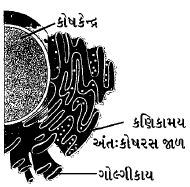
Match the organelle shown in the given figure with its correct function.
A
Rough Endoplasmic Reticulum,Protein synthesis
B
Rough Endoplasmic Reticulum,Formation of glycoproteins
C
Golgi apparatus,Protein synthesis
D
Golgi apparatus,Formation of glycolipids
Solution
(B) The figure shows the nucleus,Rough Endoplasmic Reticulum $(RER)$,and the Golgi apparatus.
The Rough Endoplasmic Reticulum $(RER)$ is characterized by the presence of ribosomes on its surface,which are responsible for protein synthesis.
However,the $RER$ is also the primary site for the modification of proteins,specifically the formation of glycoproteins by adding sugar residues to the synthesized proteins.
While protein synthesis occurs on the ribosomes attached to the $RER$,the specific functional association often tested in this context is the role of $RER$ in the synthesis and modification of proteins (glycoproteins).
Comparing the options,the Rough Endoplasmic Reticulum is correctly associated with the formation of glycoproteins.
The Rough Endoplasmic Reticulum $(RER)$ is characterized by the presence of ribosomes on its surface,which are responsible for protein synthesis.
However,the $RER$ is also the primary site for the modification of proteins,specifically the formation of glycoproteins by adding sugar residues to the synthesized proteins.
While protein synthesis occurs on the ribosomes attached to the $RER$,the specific functional association often tested in this context is the role of $RER$ in the synthesis and modification of proteins (glycoproteins).
Comparing the options,the Rough Endoplasmic Reticulum is correctly associated with the formation of glycoproteins.
0 likes
View Solution135
EasyMCQ
Who proposed the "Signal Hypothesis" for the biosynthesis of secretory proteins?
A
Camillo Golgi
B
Blobel and Sabatini
C
Baltimore
D
Schiller and Biachi
Solution
(B) The "Signal Hypothesis" was proposed by $Gunter$ $Blobel$ and $David$ $Sabatini$ in the $1970s$.
This hypothesis explains how secretory proteins are targeted to the endoplasmic reticulum during their synthesis.
It states that a specific signal sequence at the $N$-terminus of the nascent polypeptide chain directs the ribosome-mRNA complex to the endoplasmic reticulum membrane.
This hypothesis explains how secretory proteins are targeted to the endoplasmic reticulum during their synthesis.
It states that a specific signal sequence at the $N$-terminus of the nascent polypeptide chain directs the ribosome-mRNA complex to the endoplasmic reticulum membrane.
0 likes
View Solution136
MediumMCQ
Which of the following events does not occur in the rough endoplasmic reticulum $(RER)$?
A
Phospholipid synthesis
B
Protein folding
C
Cleavage of signal peptide
D
Protein glycosylation
Solution
(A) The rough endoplasmic reticulum $(RER)$ is primarily involved in the synthesis,folding,and modification of proteins destined for secretion or for use in membranes.
$1$. Protein folding occurs in the lumen of the $RER$ with the help of chaperone proteins.
$2$. Cleavage of the signal peptide occurs as the nascent polypeptide enters the $RER$ lumen.
$3$. Protein glycosylation (specifically $N$-linked glycosylation) begins in the $RER$.
$4$. Phospholipid synthesis primarily occurs in the smooth endoplasmic reticulum $(SER)$,not the $RER$. Therefore,phospholipid synthesis is the event that does not occur in the $RER$.
$1$. Protein folding occurs in the lumen of the $RER$ with the help of chaperone proteins.
$2$. Cleavage of the signal peptide occurs as the nascent polypeptide enters the $RER$ lumen.
$3$. Protein glycosylation (specifically $N$-linked glycosylation) begins in the $RER$.
$4$. Phospholipid synthesis primarily occurs in the smooth endoplasmic reticulum $(SER)$,not the $RER$. Therefore,phospholipid synthesis is the event that does not occur in the $RER$.
0 likes
View Solution137
MediumMCQ
The Golgi complex participates in
A
Activation of amino acid
B
Fatty acid breakdown
C
Respiration in bacteria
D
Formation of secretory vesicles
Solution
(D) The Golgi complex (or Golgi apparatus) is a membrane-bound organelle found in eukaryotic cells.
Its primary functions include the modification,sorting,and packaging of proteins and lipids synthesized in the endoplasmic reticulum.
These processed molecules are packaged into secretory vesicles,which then transport them to their final destinations,such as the plasma membrane,lysosomes,or the extracellular space.
Therefore,the formation of secretory vesicles is a key function of the Golgi complex.
Its primary functions include the modification,sorting,and packaging of proteins and lipids synthesized in the endoplasmic reticulum.
These processed molecules are packaged into secretory vesicles,which then transport them to their final destinations,such as the plasma membrane,lysosomes,or the extracellular space.
Therefore,the formation of secretory vesicles is a key function of the Golgi complex.
1 likes
View Solution138
MediumMCQ
Which of the following is responsible for the mechanical support, protein synthesis and enzyme transport?
A
Cell membrane
B
Mitochondria
C
Dictyosome
D
Endoplasmic reticulum
Solution
(D) Endoplasmic reticulum $(ER)$ is a network of membranous tubules and sacs present in the cytoplasm.
Rough $ER$ is studded with ribosomes and is primarily responsible for protein synthesis and the transport of enzymes.
Additionally, the $ER$ provides mechanical support to the cytoplasm, acting as a structural framework or cytoskeleton.
Rough $ER$ is studded with ribosomes and is primarily responsible for protein synthesis and the transport of enzymes.
Additionally, the $ER$ provides mechanical support to the cytoplasm, acting as a structural framework or cytoskeleton.
0 likes
View Solution139
DifficultMCQ
Three morphological forms of the Golgi complex are:
A
Lamellae,tubules and vesicles
B
Cisternae,tubules and vesicles
C
Cisternae,tubules and lamellae
D
Granum,thylakoids and vesicles
Solution
(B) The three morphological forms of the Golgi complex are cisternae,tubules,and vesicles.
$1$. Cisternae: These are flattened,disc-shaped sacs stacked parallel to each other. They have a distinct convex $cis$ (forming) face and a concave $trans$ (maturing) face.
$2$. Tubules: These are tubular structures associated with the periphery of the cisternae.
$3$. Vesicles: These are small,spherical,or oval structures that bud off from the tubules or cisternae,involved in the transport of materials.
$1$. Cisternae: These are flattened,disc-shaped sacs stacked parallel to each other. They have a distinct convex $cis$ (forming) face and a concave $trans$ (maturing) face.
$2$. Tubules: These are tubular structures associated with the periphery of the cisternae.
$3$. Vesicles: These are small,spherical,or oval structures that bud off from the tubules or cisternae,involved in the transport of materials.
0 likes
View Solution140
MediumMCQ
Which of the following cell organelles is present in the highest number in secretory cells?
A
Mitochondria
B
Golgi complex
C
Endoplasmic reticulum
D
Lysosomes
Solution
(B) Secretory cells are specialized to synthesize and export proteins or other substances.
The $Golgi$ complex plays a crucial role in the packaging,modification,and sorting of proteins and lipids for secretion.
Therefore,cells that are highly active in secretion,such as pancreatic acinar cells or goblet cells,contain a very high number of $Golgi$ complexes to handle the extensive processing and packaging requirements.
While the endoplasmic reticulum is involved in synthesis,the $Golgi$ complex is the primary organelle responsible for the final packaging and dispatch of secretory products.
The $Golgi$ complex plays a crucial role in the packaging,modification,and sorting of proteins and lipids for secretion.
Therefore,cells that are highly active in secretion,such as pancreatic acinar cells or goblet cells,contain a very high number of $Golgi$ complexes to handle the extensive processing and packaging requirements.
While the endoplasmic reticulum is involved in synthesis,the $Golgi$ complex is the primary organelle responsible for the final packaging and dispatch of secretory products.
0 likes
View Solution141
Easy
Describe the Endoplasmic Reticulum.
Solution
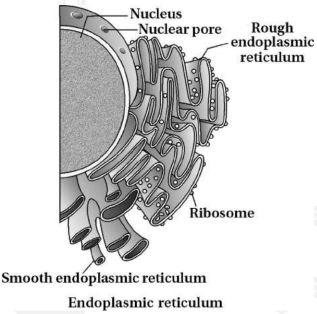
(N/A) $ \Rightarrow $ The network of tiny tubular structures scattered in the cytoplasm of eukaryotic cells is called the Endoplasmic Reticulum $(ER)$.
$ \Rightarrow $ The $ER$ divides the intracellular space into two distinct compartments, i.e., luminal (inside $ER$) and extra-luminal (cytoplasm) compartments.
$ \Rightarrow $ The $ER$ often shows ribosomes attached to its outer surface.
$ \Rightarrow $ The endoplasmic reticulum bearing ribosomes on its surface is called rough endoplasmic reticulum $(RER)$.
$ \Rightarrow $ In the absence of ribosomes, they appear smooth and are called smooth endoplasmic reticulum $(SER)$.
$ \Rightarrow $ $RER$ is frequently observed in cells actively involved in protein synthesis and secretion.
$ \Rightarrow $ They are extensive and continuous with the outer membrane of the nucleus.
$ \Rightarrow $ The smooth endoplasmic reticulum is the major site for the synthesis of lipids. In animal cells, lipid-like steroidal hormones are synthesized in the $SER$.
$ \Rightarrow $ The $ER$ divides the intracellular space into two distinct compartments, i.e., luminal (inside $ER$) and extra-luminal (cytoplasm) compartments.
$ \Rightarrow $ The $ER$ often shows ribosomes attached to its outer surface.
$ \Rightarrow $ The endoplasmic reticulum bearing ribosomes on its surface is called rough endoplasmic reticulum $(RER)$.
$ \Rightarrow $ In the absence of ribosomes, they appear smooth and are called smooth endoplasmic reticulum $(SER)$.
$ \Rightarrow $ $RER$ is frequently observed in cells actively involved in protein synthesis and secretion.
$ \Rightarrow $ They are extensive and continuous with the outer membrane of the nucleus.
$ \Rightarrow $ The smooth endoplasmic reticulum is the major site for the synthesis of lipids. In animal cells, lipid-like steroidal hormones are synthesized in the $SER$.
0 likes
View Solution142
Easy
Write a short note on Golgi Apparatus.
Solution
The Golgi apparatus,first described by Camillo Golgi in $1898$,is a membrane-bound organelle found in eukaryotic cells.
It consists of many flat,disc-shaped sacs or cisternae,stacked parallel to each other.
These cisternae are concentrically arranged near the nucleus with distinct convex 'cis' (forming) face and concave 'trans' (maturing) face.
The Golgi apparatus primarily performs the function of packaging materials,both proteins and lipids,to be delivered either to the intracellular targets or secreted outside the cell.
It is also the important site for the formation of glycoproteins and glycolipids.
It consists of many flat,disc-shaped sacs or cisternae,stacked parallel to each other.
These cisternae are concentrically arranged near the nucleus with distinct convex 'cis' (forming) face and concave 'trans' (maturing) face.
The Golgi apparatus primarily performs the function of packaging materials,both proteins and lipids,to be delivered either to the intracellular targets or secreted outside the cell.
It is also the important site for the formation of glycoproteins and glycolipids.
0 likes
View Solution143
EasyMCQ
What was the contribution of the scientist Camilo Golgi in $1898$?
A
Discovery of Mitochondria
B
Discovery of Golgi apparatus
C
Discovery of Ribosomes
D
Discovery of Lysosomes
Solution
(B) $\Rightarrow$ In $1898$,Camilo Golgi first observed densely stained reticular structures near the nucleus of the nerve cells of an owl.
$\Rightarrow$ These structures were later named Golgi bodies or Golgi apparatus in his honor.
$\Rightarrow$ These structures were later named Golgi bodies or Golgi apparatus in his honor.
0 likes
View Solution144
Easy
Differentiate between Rough Endoplasmic Reticulum $(RER)$ and Smooth Endoplasmic Reticulum $(SER)$.
Solution
(N/A)
| Rough Endoplasmic Reticulum $(RER)$ | Smooth Endoplasmic Reticulum $(SER)$ |
|---|---|
| $(i)$ Ribosomes are present on its surface,giving it a rough appearance. | $(i)$ Ribosomes are absent on its surface,giving it a smooth appearance. |
| $(ii)$ It is primarily involved in protein synthesis and modification. | $(ii)$ It is primarily involved in the synthesis of lipids,steroids,and glycogen metabolism. |
| $(iii)$ It is abundant in cells actively synthesizing proteins,such as liver cells or pancreatic cells. | $(iii)$ It is abundant in cells synthesizing steroids and lipids,such as cells of the testis,ovary,and adrenal cortex. |
0 likes
View Solution145
EasyMCQ
Which is the important site of formation of glycoproteins and glycolipids in eukaryotic cells?
A
Polysomes
B
Endoplasmic reticulum
C
Peroxisomes
D
Golgi bodies
Solution
(D) The Golgi apparatus (or Golgi bodies) is the primary site for the modification,packaging,and sorting of proteins and lipids.
In eukaryotic cells,proteins synthesized in the rough endoplasmic reticulum and lipids synthesized in the smooth endoplasmic reticulum are transported to the Golgi apparatus.
Within the Golgi cisternae,these molecules undergo glycosylation,where carbohydrates are added to them to form glycoproteins and glycolipids.
Therefore,the Golgi apparatus is the important site for the formation of glycoproteins and glycolipids.
In eukaryotic cells,proteins synthesized in the rough endoplasmic reticulum and lipids synthesized in the smooth endoplasmic reticulum are transported to the Golgi apparatus.
Within the Golgi cisternae,these molecules undergo glycosylation,where carbohydrates are added to them to form glycoproteins and glycolipids.
Therefore,the Golgi apparatus is the important site for the formation of glycoproteins and glycolipids.
0 likes
View Solution146
EasyMCQ
Which is the important site for the formation of glycoproteins and glycolipids in eukaryotic cells?
A
Endoplasmic reticulum
B
Peroxisomes
C
Golgi apparatus
D
Polysomes
Solution
(C) The Golgi apparatus is the principal organelle responsible for the modification,sorting,and packaging of proteins and lipids.
In eukaryotic cells,the Golgi apparatus acts as the site where glycoproteins and glycolipids are synthesized by adding carbohydrate chains to proteins and lipids,respectively,which are received from the endoplasmic reticulum.
In eukaryotic cells,the Golgi apparatus acts as the site where glycoproteins and glycolipids are synthesized by adding carbohydrate chains to proteins and lipids,respectively,which are received from the endoplasmic reticulum.
0 likes
View Solution147
EasyMCQ
Synthesis of lipid is the function of:
A
$SER$
B
$RER$
C
Golgi body
D
Mitochondria
Solution
(A) Various types of organelles are responsible for performing different types of functions.
$SER$ (Smooth Endoplasmic Reticulum) is primarily responsible for the synthesis of lipids,including steroidal hormones.
$RER$ (Rough Endoplasmic Reticulum) is mainly involved in protein synthesis due to the presence of ribosomes on its surface.
$SER$ also plays a crucial role in the detoxification of drugs and poisons in the body.
Therefore,the synthesis of lipids is the function of $SER$.
$SER$ (Smooth Endoplasmic Reticulum) is primarily responsible for the synthesis of lipids,including steroidal hormones.
$RER$ (Rough Endoplasmic Reticulum) is mainly involved in protein synthesis due to the presence of ribosomes on its surface.
$SER$ also plays a crucial role in the detoxification of drugs and poisons in the body.
Therefore,the synthesis of lipids is the function of $SER$.
0 likes
View Solution148
EasyMCQ
Which of the following organelles is directly connected to the outer membrane of the nucleus in a eukaryotic cell?
A
Mitochondrion
B
Lysosome
C
Golgi apparatus
D
Endoplasmic reticulum
Solution
(D) The $Endoplasmic \text{ } reticulum$ $(ER)$ is the organelle that is directly continuous with the outer nuclear membrane. This structural connection allows for the direct transport of materials, such as $mRNA$ synthesized in the nucleus, into the $ER$ for further processing and protein synthesis.
0 likes
View Solution149
MediumMCQ
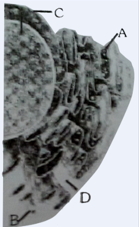
Identify the components labelled as $A$,$B$,$C$,and $D$ in the diagram given below from the list $(i)$ to $(viii)$.
$(i)$ Cristae of mitochondria $(ii)$ Inner membrane of mitochondria $(iii)$ Cytoplasm $(iv)$ Smooth endoplasmic reticulum $(v)$ Rough endoplasmic reticulum $(vi)$ Mitochondrial matrix $(vii)$ Ribosome $(viii)$ Nucleus
$(i)$ Cristae of mitochondria $(ii)$ Inner membrane of mitochondria $(iii)$ Cytoplasm $(iv)$ Smooth endoplasmic reticulum $(v)$ Rough endoplasmic reticulum $(vi)$ Mitochondrial matrix $(vii)$ Ribosome $(viii)$ Nucleus
A
$(viii)$,$(v)$,$(vii)$,$(iii)$
B
$(i)$,$(iv)$,$(vii)$,$(vi)$
C
$(vi)$,$(v)$,$(iv)$,$(vii)$
D
$(v)$,$(i)$,$(iii)$,$(ii)$
Solution
(A) In the provided diagram of the endoplasmic reticulum,the components are identified as follows:
$A$: Ribosome $(vii)$ - These are small particles attached to the surface of the rough endoplasmic reticulum.
$B$: Rough endoplasmic reticulum $(v)$ - This is the part of the endoplasmic reticulum studded with ribosomes.
$C$: Nucleus $(viii)$ - The central organelle shown in the diagram.
$D$: Cytoplasm $(iii)$ - The fluid medium surrounding the organelles.
Therefore,the correct sequence is $A = (vii)$,$B = (v)$,$C = (viii)$,$D = (iii)$.
However,looking at the options provided,option $A$ matches the components $(viii)$,$(v)$,$(vii)$,$(iii)$ which corresponds to $C$,$B$,$A$,$D$ respectively. Based on standard diagrammatic representations of this specific figure,the correct identification is $A$ as Ribosome,$B$ as Rough $ER$,$C$ as Nucleus,and $D$ as Cytoplasm. Given the options,option $A$ is the intended answer.
$A$: Ribosome $(vii)$ - These are small particles attached to the surface of the rough endoplasmic reticulum.
$B$: Rough endoplasmic reticulum $(v)$ - This is the part of the endoplasmic reticulum studded with ribosomes.
$C$: Nucleus $(viii)$ - The central organelle shown in the diagram.
$D$: Cytoplasm $(iii)$ - The fluid medium surrounding the organelles.
Therefore,the correct sequence is $A = (vii)$,$B = (v)$,$C = (viii)$,$D = (iii)$.
However,looking at the options provided,option $A$ matches the components $(viii)$,$(v)$,$(vii)$,$(iii)$ which corresponds to $C$,$B$,$A$,$D$ respectively. Based on standard diagrammatic representations of this specific figure,the correct identification is $A$ as Ribosome,$B$ as Rough $ER$,$C$ as Nucleus,and $D$ as Cytoplasm. Given the options,option $A$ is the intended answer.
0 likes
View SolutionCell: The Unit of Life — Endoplasmic reticulum and Golgi body · Frequently Asked Questions
1Are these Cell: The Unit of Life questions useful for JEE and NEET?
Yes. All questions in this section are mapped to JEE Main and NEET exam patterns. Previous year questions from JEE Main, NEET, GUJCET and state-level exams are included with full solutions.
2Can I switch to Hindi or Gujarati for these questions?
Yes. Use the language tabs in the hero section or the sidebar to view the same questions and solutions in English, Hindi or Gujarati.
3How do I generate a question paper from this subtopic?
Use the Vedclass Exam Paper Generator — select the chapter and subtopic, set difficulty, and generate Sets A, B, C, D automatically. First 3 chapters of every subject are free.
Vedclass Products
For Students
Vedclass Test Series
Mock tests in real JEE/NEET style with performance analysis. 5-day free trial.
Start Free TrialFor Teachers
Exam Paper Generator
Generate Set A/B/C/D papers from this chapter in 2 minutes. 3 chapters free.
Try FreeFor Institutes
Online Exam Module
Live online exams with unlimited students, 360° analytics & white-label branding.
See DemoFor Teachers & Institutes
Generate a Cell: The Unit of Life Exam Paper in 2 Minutes
Select subtopic & difficulty — Sets A, B, C, D auto-generated with No Repeat logic.
First 3 chapters of every subject are free — no payment required.