
A English
Lymphatic system Questions in English
Class 11 Biology · Body Fluids and Circulations · Lymphatic system
79+
Questions
English
Language
100%
With Solutions
Showing 29 of 79 questions in English
51
MediumMCQ
Which of the following statements is true for lymph?
A
White blood cells and serum
B
All components of blood plasma except red blood cells and some proteins
C
$RBC$,$WBC$ and blood plasma
D
$RBC$,proteins and platelets
Solution
(B) Lymph is a fluid connective tissue that acts as a middleman between blood and tissues.
It is essentially blood plasma that has leaked out of the capillaries into the interstitial spaces.
Lymph contains $WBC$s (primarily lymphocytes) but lacks $RBC$s,platelets,and large plasma proteins.
Therefore,it consists of blood plasma minus $RBC$s and some large proteins.
It is essentially blood plasma that has leaked out of the capillaries into the interstitial spaces.
Lymph contains $WBC$s (primarily lymphocytes) but lacks $RBC$s,platelets,and large plasma proteins.
Therefore,it consists of blood plasma minus $RBC$s and some large proteins.
0 likes
View Solution52
MediumMCQ
$A$ malfunction of the lymph nodes would most likely interfere with the
A
release of carbon dioxide into the lymph
B
filtering of glucose from the lymph
C
release of oxygen into the lymph
D
filtering of bacteria from the lymph
Solution
(D) The lymphatic system plays a crucial role in maintaining fluid balance and supporting the immune system.
Lymph nodes act as filters for the lymph fluid,trapping and destroying pathogens such as bacteria and viruses.
When lymph nodes malfunction,they cannot effectively filter these harmful microorganisms,which can lead to the spread of infection.
Therefore,the primary function that would be interfered with is the filtering of bacteria from the lymph.
Lymph nodes act as filters for the lymph fluid,trapping and destroying pathogens such as bacteria and viruses.
When lymph nodes malfunction,they cannot effectively filter these harmful microorganisms,which can lead to the spread of infection.
Therefore,the primary function that would be interfered with is the filtering of bacteria from the lymph.
0 likes
View Solution53
Medium
Write the differences between Blood and Lymph.
Solution
(N/A) The differences between Blood and Lymph are as follows:
| Blood | Lymph |
|---|---|
| $(1)$ Blood is a red-coloured fluid that contains $RBCs$. | $(1)$ Lymph is a colourless fluid that lacks $RBCs$. |
| $(2)$ It contains plasma,$RBCs$,$WBCs$,and platelets. It also contains high concentrations of proteins. | $(2)$ It contains plasma and a smaller number of $WBCs$. It lacks $RBCs$,platelets,and contains very few proteins. |
| $(3)$ Blood transports nutrients,oxygen,and hormones from one organ to another. | $(3)$ Lymph plays a role in the defensive system of the body and transports absorbed fats from the intestine. |
0 likes
View Solution54
Easy
Write a short note on: Lymph.
Solution
(N/A) As blood passes through the capillaries in tissues,some water along with small water-soluble substances move out into the spaces between the cells of tissues,leaving larger proteins and most of the formed elements in the blood vessels. This fluid released out is called the interstitial fluid or tissue fluid.
It has the same mineral distribution as that in plasma.
Exchange of nutrients,gases,etc.,between the blood and the cells always occurs through this fluid.
An elaborate network of vessels called the lymphatic system collects this fluid and drains it back into the major veins. The fluid present in the lymphatic system is called lymph.
Composition of Lymph: Lymph is a colourless fluid. Its composition is similar to blood plasma,but the concentration of salts dissolved in it is different.
Lymph has fewer protein elements and fibrinogen elements than blood plasma but contains waste elements from tissue metabolism.
There are no cells in lymph in smaller capillaries. However,when lymph passes through lymph nodes,small lymphocytes $(99 \%)$ and,in the remaining $1 \%$,RBCs and eosinophils are seen.
Function: Lymph possesses lymphocytes which are responsible for the immune responses of the body. It is an important carrier for nutrients,hormones,etc.
Fats are absorbed through lymph in the lacteals present in the intestinal villi.
It has the same mineral distribution as that in plasma.
Exchange of nutrients,gases,etc.,between the blood and the cells always occurs through this fluid.
An elaborate network of vessels called the lymphatic system collects this fluid and drains it back into the major veins. The fluid present in the lymphatic system is called lymph.
Composition of Lymph: Lymph is a colourless fluid. Its composition is similar to blood plasma,but the concentration of salts dissolved in it is different.
Lymph has fewer protein elements and fibrinogen elements than blood plasma but contains waste elements from tissue metabolism.
There are no cells in lymph in smaller capillaries. However,when lymph passes through lymph nodes,small lymphocytes $(99 \%)$ and,in the remaining $1 \%$,RBCs and eosinophils are seen.
Function: Lymph possesses lymphocytes which are responsible for the immune responses of the body. It is an important carrier for nutrients,hormones,etc.
Fats are absorbed through lymph in the lacteals present in the intestinal villi.
0 likes
View Solution55
Medium
Differentiate between: Blood and Lymph.
Solution
(N/A) The differences between blood and lymph are as follows:
$1$. Blood is a red-colored fluid connective tissue,whereas lymph is a colorless fluid connective tissue.
$2$. Blood contains red blood cells $(RBCs)$,white blood cells $(WBCs)$,and platelets,while lymph contains only white blood cells (mainly lymphocytes) and lacks $RBCs$ and platelets.
$3$. Blood contains more proteins,calcium,and phosphorus,whereas lymph contains fewer proteins and less calcium and phosphorus.
$4$. Blood flows in a closed circulatory system (arteries,veins,and capillaries),while lymph flows in an open system (lymphatic vessels) and moves in only one direction (from tissues to the heart).
$5$. Blood transports oxygen,carbon dioxide,nutrients,and hormones,whereas lymph primarily transports fats and helps in the body's immune response.
$1$. Blood is a red-colored fluid connective tissue,whereas lymph is a colorless fluid connective tissue.
$2$. Blood contains red blood cells $(RBCs)$,white blood cells $(WBCs)$,and platelets,while lymph contains only white blood cells (mainly lymphocytes) and lacks $RBCs$ and platelets.
$3$. Blood contains more proteins,calcium,and phosphorus,whereas lymph contains fewer proteins and less calcium and phosphorus.
$4$. Blood flows in a closed circulatory system (arteries,veins,and capillaries),while lymph flows in an open system (lymphatic vessels) and moves in only one direction (from tissues to the heart).
$5$. Blood transports oxygen,carbon dioxide,nutrients,and hormones,whereas lymph primarily transports fats and helps in the body's immune response.
0 likes
View Solution56
Medium
Explain the functional significance of the lymphatic system.
Solution
(N/A) The lymphatic system plays several critical roles in maintaining body homeostasis:
$1$. Fluid Balance: It collects excess interstitial fluid from tissues and returns it to the blood circulatory system,preventing edema.
$2$. Absorption of Fats: In the small intestine,specialized lymphatic capillaries called $Lacteals$ are responsible for the absorption and transport of dietary fats and fat-soluble vitamins.
$3$. Immune Defense: Lymph nodes act as filters,trapping pathogens,debris,and foreign particles. They contain lymphocytes ($B$-cells and $T$-cells) that initiate immune responses to protect the body against infections.
$4$. Waste Removal: It assists in the removal of metabolic waste products and cellular debris from the interstitial spaces.
$1$. Fluid Balance: It collects excess interstitial fluid from tissues and returns it to the blood circulatory system,preventing edema.
$2$. Absorption of Fats: In the small intestine,specialized lymphatic capillaries called $Lacteals$ are responsible for the absorption and transport of dietary fats and fat-soluble vitamins.
$3$. Immune Defense: Lymph nodes act as filters,trapping pathogens,debris,and foreign particles. They contain lymphocytes ($B$-cells and $T$-cells) that initiate immune responses to protect the body against infections.
$4$. Waste Removal: It assists in the removal of metabolic waste products and cellular debris from the interstitial spaces.
0 likes
View Solution57
Medium
Choose the correct option:
$(1)$ Severe and persistent chest pain is $Angina$ / $Hypertension$.
$(2)$ $Blood$ / $Lymph$ is a white connective tissue.
$(1)$ Severe and persistent chest pain is $Angina$ / $Hypertension$.
$(2)$ $Blood$ / $Lymph$ is a white connective tissue.
Solution
(A) $(1)$ $Angina$ is characterized by acute chest pain when no enough oxygen is reaching the heart muscle.
$(2)$ $Lymph$ is a colorless fluid containing specialized lymphocytes which are responsible for the immune responses of the body,often referred to as a white connective tissue.
$(2)$ $Lymph$ is a colorless fluid containing specialized lymphocytes which are responsible for the immune responses of the body,often referred to as a white connective tissue.
0 likes
View Solution58
EasyMCQ
What is the function of lymph?
A
Transport of nutrients and gases
B
Immune response and drainage of interstitial fluid
C
Blood clotting
D
Production of red blood cells
Solution
(B) Lymph is a colourless fluid that plays a crucial role in the body's immune system.
Its primary functions include:
$1$. It acts as a middleman between the blood and the tissues,facilitating the exchange of nutrients,hormones,and gases.
$2$. It helps in the drainage of excess interstitial fluid from the tissue spaces back into the blood circulation.
$3$. It transports absorbed fats from the digestive tract (via lacteals) into the bloodstream.
$4$. It contains lymphocytes which help in the body's defense mechanism against pathogens.
Its primary functions include:
$1$. It acts as a middleman between the blood and the tissues,facilitating the exchange of nutrients,hormones,and gases.
$2$. It helps in the drainage of excess interstitial fluid from the tissue spaces back into the blood circulation.
$3$. It transports absorbed fats from the digestive tract (via lacteals) into the bloodstream.
$4$. It contains lymphocytes which help in the body's defense mechanism against pathogens.
0 likes
View Solution59
EasyMCQ
How does lymph work in the absorption of fats?
A
Lymph transports glucose directly to the blood.
B
Fats are absorbed through lymph in the lacteals present in the intestinal villi.
C
Lymph breaks down complex fats into fatty acids.
D
Lymph stores excess fats in the liver.
Solution
(B) Lymph is a fluid connective tissue that plays a crucial role in the transport of nutrients.
In the digestive system,fats are not directly absorbed into the blood capillaries due to their large size.
Instead,they are absorbed into the lacteals,which are specialized lymphatic capillaries present in the intestinal villi.
From the lacteals,the absorbed fats (in the form of chylomicrons) are transported into the lymphatic system and eventually released into the bloodstream.
In the digestive system,fats are not directly absorbed into the blood capillaries due to their large size.
Instead,they are absorbed into the lacteals,which are specialized lymphatic capillaries present in the intestinal villi.
From the lacteals,the absorbed fats (in the form of chylomicrons) are transported into the lymphatic system and eventually released into the bloodstream.
0 likes
View Solution60
MediumMCQ
Lymph is a colourless fluid containing specialised:
A
$RBC$
B
Lymphocytes
C
Cells
D
Long lined cells
Solution
(B) Lymph is a colourless fluid containing specialised lymphocytes ($B$ and $T$ cells) which are responsible for the immune response of the body.
Lymph is also an important carrier for nutrients,hormones,etc.
Fats are absorbed by the lymph in the lacteals present in the intestinal villi.
Lymph is also an important carrier for nutrients,hormones,etc.
Fats are absorbed by the lymph in the lacteals present in the intestinal villi.
0 likes
View Solution61
EasyMCQ
Which of the following acts as the 'middle man of the body'?
A
Plasma
B
Lymph
C
$RBCs$
D
$WBCs$
Solution
(B) Lymph is known as the 'middle man of the body' because it acts as a carrier between the blood and the tissue cells. It transports nutrients,hormones,and oxygen from the blood to the cells and carries metabolic waste products from the cells back into the blood circulation.
0 likes
View Solution62
EasyMCQ
Lymph is an important carrier for the transport of
A
Gases
B
Hormones
C
Fats
D
Platelets
Solution
(C) Lymph is a colourless fluid containing specialised lymphocytes ($B$ and $T$ cells) which are responsible for the immune response of the body.
Lymph is also an important carrier for fats,as they are absorbed by the lymph in the lacteals present in the intestinal villi.
Lymph is also an important carrier for fats,as they are absorbed by the lymph in the lacteals present in the intestinal villi.
0 likes
View Solution63
MediumMCQ
The difference between blood and lymph is
A
Blood has $RBCs$ and $WBCs$,while lymph has no cells
B
Blood has $RBCs$ and $WBCs$,while lymph has only $WBCs$
C
Blood has no cells,while lymph has $RBCs$ and $WBCs$
D
Blood has only $RBCs$,while lymph has only $WBCs$
Solution
(B) Blood is a connective tissue that contains $RBCs$ (erythrocytes),$WBCs$ (leukocytes),platelets,and plasma.
Lymph is a fluid connective tissue that is derived from blood plasma but lacks $RBCs$ and platelets.
Lymph primarily contains $WBCs$ (specifically lymphocytes) which help in the immune response.
Therefore,the key difference is that blood contains both $RBCs$ and $WBCs$,whereas lymph contains only $WBCs$.
Lymph is a fluid connective tissue that is derived from blood plasma but lacks $RBCs$ and platelets.
Lymph primarily contains $WBCs$ (specifically lymphocytes) which help in the immune response.
Therefore,the key difference is that blood contains both $RBCs$ and $WBCs$,whereas lymph contains only $WBCs$.
0 likes
View Solution64
MediumMCQ
The lymphatic system is an elaborate network of vessels which collects the:
A
Interstitial fluid
B
Intrastitial fluid
C
Plasma fluid
D
Protein fluid
Solution
(A) The lymphatic system is an elaborate network of vessels that collects the interstitial fluid (also known as tissue fluid) from the intercellular spaces and drains it back into the major veins.
This process helps in maintaining fluid balance in the body and is known as lymphatic circulation.
This process helps in maintaining fluid balance in the body and is known as lymphatic circulation.
0 likes
View Solution65
MediumMCQ
Lymph ultimately releases the absorbed substances into
A
Lymphatic capillaries
B
Blood stream (veins)
C
Lymph node
D
Lymphatic duct
Solution
(B) Lymph acts as a middleman between the blood and the tissues. It transports nutrients,hormones,and other substances to the body cells and collects $CO_{2}$ and metabolic wastes from them. Finally,the lymph drains these substances into the venous system (major veins) to be returned to the blood circulation.
0 likes
View Solution66
MediumMCQ
What is the function of lymph nodes?
A
Filter the lymph
B
Contain phagocytic cells
C
Responsible for lymphocyte activation
D
All of these
Solution
(D) - Lymph nodes act as filters for the lymph fluid and are found in abundance in the neck,groin,and armpits.
- Lymph nodes contain phagocytic cells that help in trapping and removing microorganisms or pathogens.
- They are the sites where lymphocytes are activated and proliferate,which then enter the blood through the lymphatic system.
- Lymph nodes contain phagocytic cells that help in trapping and removing microorganisms or pathogens.
- They are the sites where lymphocytes are activated and proliferate,which then enter the blood through the lymphatic system.
0 likes
View Solution67
MediumMCQ
Read the following:
$a.$ Lymph absorbs and transports fat from the intestine.
$b.$ Lymph nodes produce fibrinogen.
$c.$ Lymphatic capillaries present in the intestinal villi are known as lacteals.
$d.$ Lymph transports oxygen only.
Which of these statements are true?
$a.$ Lymph absorbs and transports fat from the intestine.
$b.$ Lymph nodes produce fibrinogen.
$c.$ Lymphatic capillaries present in the intestinal villi are known as lacteals.
$d.$ Lymph transports oxygen only.
Which of these statements are true?
A
$a, c$
B
$b, d$
C
$c, d$
D
$a, b$
Solution
(A) Statement $a$ is true: Lymphatic vessels,specifically lacteals,are responsible for the absorption and transport of fats from the intestine.
Statement $b$ is false: Lymph nodes produce lymphocytes and antibodies,not fibrinogen. Fibrinogen is produced by the liver.
Statement $c$ is true: The lymphatic capillaries found in the intestinal villi are specialized for fat absorption and are called lacteals.
Statement $d$ is false: Lymph does not transport oxygen; it transports $CO_{2}$,nutrients,hormones,and waste products from tissues to the blood.
Therefore,statements $a$ and $c$ are correct.
Statement $b$ is false: Lymph nodes produce lymphocytes and antibodies,not fibrinogen. Fibrinogen is produced by the liver.
Statement $c$ is true: The lymphatic capillaries found in the intestinal villi are specialized for fat absorption and are called lacteals.
Statement $d$ is false: Lymph does not transport oxygen; it transports $CO_{2}$,nutrients,hormones,and waste products from tissues to the blood.
Therefore,statements $a$ and $c$ are correct.
0 likes
View Solution68
EasyMCQ
The middle man of the body is
A
Blood
B
Plasma
C
Lymph
D
Serum
Solution
(C) Lymph acts as the 'middle man' of the body.
It facilitates the transport of oxygen,nutrients,and hormones from the blood to the body cells.
Simultaneously,it collects carbon dioxide and other metabolic waste products from the cells and transports them back to the blood,which eventually drains into the venous system.
It facilitates the transport of oxygen,nutrients,and hormones from the blood to the body cells.
Simultaneously,it collects carbon dioxide and other metabolic waste products from the cells and transports them back to the blood,which eventually drains into the venous system.
0 likes
View Solution69
MediumMCQ
Lymph differs from blood in possessing
A
More proteins and less waste products
B
Less proteins and more waste products
C
More proteins and more waste products
D
Less proteins and less waste products
Solution
(B) Lymph is a fluid connective tissue that acts as a middleman between blood and tissues. It differs from blood in the following ways:
$1$. Composition: Lymph lacks $RBCs$ and platelets,containing mainly $WBCs$ (specifically lymphocytes).
$2$. Proteins: Lymph has a significantly lower concentration of plasma proteins compared to blood.
$3$. Waste Products: Since lymph collects metabolic waste from the interstitial spaces before returning it to the venous system,it contains a higher concentration of $CO_{2}$ and other metabolic waste products compared to blood.
$1$. Composition: Lymph lacks $RBCs$ and platelets,containing mainly $WBCs$ (specifically lymphocytes).
$2$. Proteins: Lymph has a significantly lower concentration of plasma proteins compared to blood.
$3$. Waste Products: Since lymph collects metabolic waste from the interstitial spaces before returning it to the venous system,it contains a higher concentration of $CO_{2}$ and other metabolic waste products compared to blood.
| Blood | Lymph |
|---|---|
| Contains plasma,$RBCs$,$WBCs$,and platelets. | Contains plasma and $WBCs$ only. |
| Higher concentration of proteins,$Ca$,and phosphorus. | Lower concentration of proteins,$Ca$,and phosphorus. |
| Normal levels of $CO_{2}$ and metabolic waste. | Higher levels of $CO_{2}$ and metabolic waste. |
0 likes
View Solution70
MediumMCQ
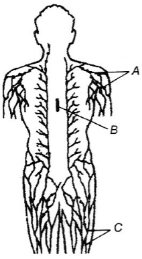
Given below is the diagrammatic representation of the human lymphatic system. Identify labels $A, B$ and $C$.
A
$A-$Lymph nodes,$B-$Thymus,$C-$Lymphatic vessels
B
$A-$Lymphatic vessels,$B-$Thyroid,$C-$Lymph nodes
C
$A-$Tonsils,$B-$Peyer's patches,$C-$Lymphatic vessels
D
$A-$Tonsils,$B-$Thymus,$C-$Peyer's patches
Solution
(A) Based on the standard diagram of the human lymphatic system provided in the $NCERT$ textbook:
$1$. Label $A$ points to the small,bean-shaped structures distributed throughout the body,which are the Lymph nodes.
$2$. Label $B$ points to the bilobed organ located near the heart and beneath the breastbone,which is the Thymus.
$3$. Label $C$ points to the network of vessels that transport lymph throughout the body,known as Lymphatic vessels.
Therefore,the correct identification is $A-$Lymph nodes,$B-$Thymus,$C-$Lymphatic vessels.
$1$. Label $A$ points to the small,bean-shaped structures distributed throughout the body,which are the Lymph nodes.
$2$. Label $B$ points to the bilobed organ located near the heart and beneath the breastbone,which is the Thymus.
$3$. Label $C$ points to the network of vessels that transport lymph throughout the body,known as Lymphatic vessels.
Therefore,the correct identification is $A-$Lymph nodes,$B-$Thymus,$C-$Lymphatic vessels.
0 likes
View Solution71
MediumMCQ
What is called interstitial fluid or tissue fluid?
A
Plasma
B
Lymph
C
Interstitial fluid
D
Serum
Solution
(C) As the blood passes through the capillaries in tissues,some water along with small water-soluble substances move out into the spaces between the cells of tissues,leaving the larger proteins and most of the formed elements in the blood vessels.
This fluid released out is called the interstitial fluid or tissue fluid.
This fluid released out is called the interstitial fluid or tissue fluid.
0 likes
View Solution72
MediumMCQ
What is the role of the spleen in the human body?
A
It acts as a filter for the blood by trapping blood-borne microorganisms.
B
It serves as a large reservoir for erythrocytes.
C
It helps in recycling old red blood cells and storing platelets and white blood cells.
D
All of the above.
Solution
(D) $\Rightarrow$ The spleen is a bean-shaped organ and the largest organ in the lymphatic system.
$\Rightarrow$ It is located under the ribcage and above the stomach in the upper left quadrant of the abdomen.
$\Rightarrow$ The spleen mainly contains lymphocytes and phagocytes.
$\Rightarrow$ It acts as a filter for the body by trapping blood-borne microorganisms.
$\Rightarrow$ The spleen also serves as the largest reservoir of erythrocytes. Old red blood cells are recycled in the spleen,and platelets and white blood cells are stored there.
$\Rightarrow$ Additionally,the spleen helps in fighting certain types of bacteria that cause pneumonia and meningitis.
$\Rightarrow$ It is located under the ribcage and above the stomach in the upper left quadrant of the abdomen.
$\Rightarrow$ The spleen mainly contains lymphocytes and phagocytes.
$\Rightarrow$ It acts as a filter for the body by trapping blood-borne microorganisms.
$\Rightarrow$ The spleen also serves as the largest reservoir of erythrocytes. Old red blood cells are recycled in the spleen,and platelets and white blood cells are stored there.
$\Rightarrow$ Additionally,the spleen helps in fighting certain types of bacteria that cause pneumonia and meningitis.
0 likes
View Solution73
MediumMCQ
In which direction does lymph flow?
A
From heart to organs
B
From organs to heart
C
Both directions
D
None of these
Solution
(B) Lymph is a colorless fluid containing specialized lymphocytes which are responsible for the immune responses of the body. The lymphatic system collects interstitial fluid from the tissue spaces and returns it to the blood circulatory system. The flow of lymph is unidirectional,moving from the tissue spaces (organs) towards the heart,where it eventually drains into the venous system.
0 likes
View Solution74
MediumMCQ
How many of the following statements are correct regarding lymph?
$I$ - It is a colourless fluid.
$II$ - It contains specialized lymphocytes.
$III$ - It is responsible for immunity.
$IV$ - It is an important carrier for nutrients and hormones.
$V$ - Starch is absorbed by lymph present in the lacteals of the intestinal villi.
$I$ - It is a colourless fluid.
$II$ - It contains specialized lymphocytes.
$III$ - It is responsible for immunity.
$IV$ - It is an important carrier for nutrients and hormones.
$V$ - Starch is absorbed by lymph present in the lacteals of the intestinal villi.
A
$I, II, III, IV, V$
B
$I, II, III, IV$
C
$I, II, IV, V$
D
$II, III, V$
Solution
(B) Statement $I$ is correct: Lymph is a colourless fluid.
Statement $II$ is correct: It contains specialized lymphocytes which are responsible for the immune responses of the body.
Statement $III$ is correct: Lymphocytes present in lymph provide immunity.
Statement $IV$ is correct: Lymph acts as a middleman for the transport of nutrients,hormones,etc.,between the blood and the tissues.
Statement $V$ is incorrect: Lacteals in the intestinal villi absorb fats (fatty acids and glycerol),not starch. Starch is absorbed into the blood capillaries as glucose.
Therefore,statements $I, II, III,$ and $IV$ are correct.
Statement $II$ is correct: It contains specialized lymphocytes which are responsible for the immune responses of the body.
Statement $III$ is correct: Lymphocytes present in lymph provide immunity.
Statement $IV$ is correct: Lymph acts as a middleman for the transport of nutrients,hormones,etc.,between the blood and the tissues.
Statement $V$ is incorrect: Lacteals in the intestinal villi absorb fats (fatty acids and glycerol),not starch. Starch is absorbed into the blood capillaries as glucose.
Therefore,statements $I, II, III,$ and $IV$ are correct.
0 likes
View Solution75
MediumMCQ
Interstitial fluid,after collecting as lymph,is eventually drained into the ........ .
A
Artery
B
Capillary
C
Vein
D
All of the above
Solution
(C) The interstitial fluid (tissue fluid) enters the lymphatic capillaries.
These lymphatic capillaries join to form larger lymphatic vessels,which eventually drain the lymph into the large veins (specifically the subclavian veins) before it returns to the blood circulation.
These lymphatic capillaries join to form larger lymphatic vessels,which eventually drain the lymph into the large veins (specifically the subclavian veins) before it returns to the blood circulation.
0 likes
View Solution76
MediumMCQ
Assertion: Interstitial fluid or tissue fluid has the same mineral distribution as that in plasma.
Reason: Exchange of nutrients,gases,etc.,between the blood and the cells always occurs through tissue fluid.
Reason: Exchange of nutrients,gases,etc.,between the blood and the cells always occurs through tissue fluid.
A
Both Assertion and Reason are true and the Reason is the correct explanation of the Assertion.
B
Both Assertion and Reason are true and the Reason is not the correct explanation of the Assertion.
C
Assertion is true and Reason is false.
D
Both Assertion and Reason are false.
Solution
(A) The Assertion is true because interstitial fluid is essentially plasma that has leaked out of the capillaries,minus the large plasma proteins. Therefore,it maintains a similar mineral and electrolyte composition to blood plasma.
The Reason is also true because the blood does not come into direct contact with the cells. Instead,nutrients,gases,and waste products are exchanged between the blood and the cells via the interstitial fluid (tissue fluid).
Since the interstitial fluid acts as the medium for this exchange,the Reason correctly explains why the composition of the interstitial fluid is maintained in equilibrium with the plasma.
The Reason is also true because the blood does not come into direct contact with the cells. Instead,nutrients,gases,and waste products are exchanged between the blood and the cells via the interstitial fluid (tissue fluid).
Since the interstitial fluid acts as the medium for this exchange,the Reason correctly explains why the composition of the interstitial fluid is maintained in equilibrium with the plasma.
0 likes
View Solution77
EasyMCQ
The interstitial fluid contains$-$
A
water
B
water soluble substances
C
lymphocytes
D
All of the above
Solution
(D) The interstitial fluid,also known as tissue fluid,is the fluid that surrounds the cells of multicellular organisms.
It is derived from blood plasma by filtration through the capillary walls.
It contains water,water-soluble substances (such as nutrients,ions,and hormones),and various cells,including lymphocytes,which migrate from the blood into the tissues to perform immune functions.
Therefore,all the listed components are present in the interstitial fluid.
It is derived from blood plasma by filtration through the capillary walls.
It contains water,water-soluble substances (such as nutrients,ions,and hormones),and various cells,including lymphocytes,which migrate from the blood into the tissues to perform immune functions.
Therefore,all the listed components are present in the interstitial fluid.
0 likes
View Solution78
EasyMCQ
Lymph does $NOT$ contain . . . . . . .
A
Macrophages and RBCs
B
RBCs and WBCs
C
WBCs and platelets
D
RBCs and platelets
Solution
(D) Lymph is a fluid connective tissue that is derived from blood plasma.
It is formed when interstitial fluid enters the lymphatic capillaries.
Its composition is similar to blood plasma but it lacks RBCs (Red Blood Cells),platelets,and large plasma proteins.
Therefore,lymph does not contain RBCs and platelets.
It is formed when interstitial fluid enters the lymphatic capillaries.
Its composition is similar to blood plasma but it lacks RBCs (Red Blood Cells),platelets,and large plasma proteins.
Therefore,lymph does not contain RBCs and platelets.
0 likes
View Solution79
EasyMCQ
Which is $NOT$ the function of lymph?
A
Transport RBCs
B
Drain excess tissue fluid
C
Transport lymphocyte and antibodies
D
Transport absorbed fat
Solution
(A) Lymph is a colorless fluid containing specialized lymphocytes which are responsible for the immune responses of the body.
Lymph is an important carrier for nutrients,hormones,etc.
Fats are absorbed through lymph in the lacteals present in the intestinal villi.
Lymph also helps in draining excess interstitial fluid from the tissue spaces back into the blood.
However,lymph does not contain $RBCs$ (Red Blood Cells) and therefore cannot transport them. Thus,transporting $RBCs$ is not a function of lymph.
Lymph is an important carrier for nutrients,hormones,etc.
Fats are absorbed through lymph in the lacteals present in the intestinal villi.
Lymph also helps in draining excess interstitial fluid from the tissue spaces back into the blood.
However,lymph does not contain $RBCs$ (Red Blood Cells) and therefore cannot transport them. Thus,transporting $RBCs$ is not a function of lymph.
0 likes
View SolutionBody Fluids and Circulations — Lymphatic system · Frequently Asked Questions
1Are these Body Fluids and Circulations questions useful for JEE and NEET?
Yes. All questions in this section are mapped to JEE Main and NEET exam patterns. Previous year questions from JEE Main, NEET, GUJCET and state-level exams are included with full solutions.
2Can I switch to Hindi or Gujarati for these questions?
Yes. Use the language tabs in the hero section or the sidebar to view the same questions and solutions in English, Hindi or Gujarati.
3How do I generate a question paper from this subtopic?
Use the Vedclass Exam Paper Generator — select the chapter and subtopic, set difficulty, and generate Sets A, B, C, D automatically. First 3 chapters of every subject are free.
Vedclass Products
For Students
Vedclass Test Series
Mock tests in real JEE/NEET style with performance analysis. 5-day free trial.
Start Free TrialFor Teachers
Exam Paper Generator
Generate Set A/B/C/D papers from this chapter in 2 minutes. 3 chapters free.
Try FreeFor Institutes
Online Exam Module
Live online exams with unlimited students, 360° analytics & white-label branding.
See DemoFor Teachers & Institutes
Generate a Body Fluids and Circulations Exam Paper in 2 Minutes
Select subtopic & difficulty — Sets A, B, C, D auto-generated with No Repeat logic.
First 3 chapters of every subject are free — no payment required.