
A English
Nucleic acids Questions in English
Class 11 Biology · Biomolecules · Nucleic acids
210+
Questions
English
Language
100%
With Solutions
Showing 10 of 210 questions in English
201
MediumMCQ
Select the correct option for the following:
Purines $\quad$ $\quad$ Pyrimidines
Purines $\quad$ $\quad$ Pyrimidines
A
Adenine,Guanine $\quad$ $\quad$ Cytosine,Uracil,Thymine
B
Cytosine,Uracil,Thymine $\quad$ $\quad$ Adenine,Guanine
C
Adenine,Guanine,Cytosine $\quad$ $\quad$ Uracil,Thymine
D
Uracil,Thymine $\quad$ $\quad$ Adenine,Guanine,Cytosine
Solution
(A) Nitrogenous bases are classified into two categories based on their chemical structure:
$1$. Purines: These are double-ring structures. Adenine $(A)$ and Guanine $(G)$ are purines.
$2$. Pyrimidines: These are single-ring structures. Cytosine $(C)$,Uracil $(U)$,and Thymine $(T)$ are pyrimidines.
Therefore,the correct classification is: Purines $(A, G)$ and Pyrimidines $(C, U, T)$.
$1$. Purines: These are double-ring structures. Adenine $(A)$ and Guanine $(G)$ are purines.
$2$. Pyrimidines: These are single-ring structures. Cytosine $(C)$,Uracil $(U)$,and Thymine $(T)$ are pyrimidines.
Therefore,the correct classification is: Purines $(A, G)$ and Pyrimidines $(C, U, T)$.
0 likes
View Solution202
MediumMCQ
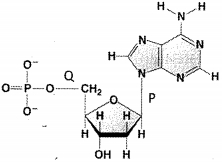
The structure of a nucleotide is given below. Identify the bonds $P$ and $Q$.
$P \quad \quad Q$
$P \quad \quad Q$
A
$N-$glycosidic bond $\quad \quad$ phosphoester bond
B
phosphoester bond $\quad \quad N-$glycosidic bond
C
phosphodiester bond $\quad \quad N-$glycosidic bond
D
$N-$glycosidic bond $\quad \quad$ phosphodiester bond
Solution
(A) In a nucleotide structure:
$1$. The bond labeled $P$ connects the nitrogenous base (adenine in this case) to the $1'$ carbon of the pentose sugar. This is known as an $N-$glycosidic bond.
$2$. The bond labeled $Q$ connects the phosphate group to the $5'$ carbon of the pentose sugar. This is known as a phosphoester bond.
Therefore,$P$ is an $N-$glycosidic bond and $Q$ is a phosphoester bond.
$1$. The bond labeled $P$ connects the nitrogenous base (adenine in this case) to the $1'$ carbon of the pentose sugar. This is known as an $N-$glycosidic bond.
$2$. The bond labeled $Q$ connects the phosphate group to the $5'$ carbon of the pentose sugar. This is known as a phosphoester bond.
Therefore,$P$ is an $N-$glycosidic bond and $Q$ is a phosphoester bond.
0 likes
View Solution203
EasyMCQ
Which bond is formed between two nucleotides in the structure of a nucleic acid?
A
Phosphoester bond
B
Phosphodiester bond
C
$N$-glycosidic bond
D
Peptide bond
Solution
(B) In the structure of a nucleic acid ($DNA$ or $RNA$),nucleotides are linked together to form a polynucleotide chain.
Specifically,the $3'$-$OH$ group of the sugar of one nucleotide reacts with the $5'$-phosphate group of the adjacent nucleotide.
This reaction results in the formation of a $3'-5'$ phosphodiester bond,which acts as the backbone of the nucleic acid strand.
Therefore,the correct answer is the phosphodiester bond.
Specifically,the $3'$-$OH$ group of the sugar of one nucleotide reacts with the $5'$-phosphate group of the adjacent nucleotide.
This reaction results in the formation of a $3'-5'$ phosphodiester bond,which acts as the backbone of the nucleic acid strand.
Therefore,the correct answer is the phosphodiester bond.
0 likes
View Solution204
MediumMCQ
Match List-$I$ with List-$II$.
Choose the option with all correct matches:
| List-$I$ | List-$II$ |
|---|---|
| $A$. Adenosine | $I$. Nitrogen base |
| $B$. Adenylic acid | $II$. Nucleotide |
| $C$. Adenine | $III$. Nucleoside |
| $D$. Alanine | $IV$. Amino acid |
Choose the option with all correct matches:
A
$A-III, B-IV, C-II, D-I$
B
$A-III, B-II, C-IV, D-I$
C
$A-III, B-II, C-I, D-IV$
D
$A-II, B-III, C-I, D-IV$
Solution
(C) The correct matches are as follows:
$1$. Adenosine is a nucleoside,which consists of a nitrogenous base attached to a sugar molecule $(A-III)$.
$2$. Adenylic acid is a nucleotide,which consists of a nitrogenous base,a sugar molecule,and a phosphate group $(B-II)$.
$3$. Adenine is a nitrogenous base (specifically a purine) $(C-I)$.
$4$. Alanine is an amino acid $(D-IV)$.
Therefore,the correct sequence is $A-III, B-II, C-I, D-IV$.
$1$. Adenosine is a nucleoside,which consists of a nitrogenous base attached to a sugar molecule $(A-III)$.
$2$. Adenylic acid is a nucleotide,which consists of a nitrogenous base,a sugar molecule,and a phosphate group $(B-II)$.
$3$. Adenine is a nitrogenous base (specifically a purine) $(C-I)$.
$4$. Alanine is an amino acid $(D-IV)$.
Therefore,the correct sequence is $A-III, B-II, C-I, D-IV$.
0 likes
View Solution205
MediumMCQ
Match the column $I$ with column $II$:
| Column $I$ | Column $II$ |
| $(A)$ Thymine | $(i)$ Nucleic acid |
| $(B)$ Deoxythymidine | $(ii)$ Nucleoside |
| $(C)$ Guanylic acid | $(iii)$ Nucleotide |
| $(D)$ Poly guanylic acid | $(iv)$ Nitrogenous base |
A
$A-iv, B-ii, C-iii, D-i$
B
$A-iii, B-iv, C-i, D-ii$
C
$A-ii, B-i, C-iv, D-iii$
D
$A-i, B-i, C-i, D-iv$
Solution
(A) The correct matching is as follows:
$1$. Thymine is a nitrogenous base (pyrimidine),so $(A)$ matches with $(iv)$.
$2$. Deoxythymidine is a nucleoside (base + sugar),so $(B)$ matches with $(ii)$.
$3$. Guanylic acid is a nucleotide (base + sugar + phosphate),so $(C)$ matches with $(iii)$.
$4$. Poly guanylic acid is a polymer of nucleotides,which is a nucleic acid,so $(D)$ matches with $(i)$.
Therefore,the correct sequence is $A-iv, B-ii, C-iii, D-i$.
$1$. Thymine is a nitrogenous base (pyrimidine),so $(A)$ matches with $(iv)$.
$2$. Deoxythymidine is a nucleoside (base + sugar),so $(B)$ matches with $(ii)$.
$3$. Guanylic acid is a nucleotide (base + sugar + phosphate),so $(C)$ matches with $(iii)$.
$4$. Poly guanylic acid is a polymer of nucleotides,which is a nucleic acid,so $(D)$ matches with $(i)$.
Therefore,the correct sequence is $A-iv, B-ii, C-iii, D-i$.
0 likes
View Solution206
EasyMCQ
What should be at the place of $A$ and $B$ in the following reaction:
$A \xrightarrow{\text{Nucleases}} B$
$A \xrightarrow{\text{Nucleases}} B$
A
| $A$. Nucleotides | Nucleosides |
B
| $B$. Nucleic acids | Nucleotides |
C
| $C$. Nucleosides | $N$-bases + Pentose sugar |
D
| $D$. Canola | Tobacco |
Solution
(B) Nucleases are enzymes that catalyze the hydrolysis of the phosphodiester bonds in nucleic acids ($DNA$ or $RNA$).
The reaction proceeds as follows:
$\text{Nucleic acids} \xrightarrow{\text{Nucleases}} \text{Nucleotides}$
Therefore,$A$ represents Nucleic acids and $B$ represents Nucleotides.
The reaction proceeds as follows:
$\text{Nucleic acids} \xrightarrow{\text{Nucleases}} \text{Nucleotides}$
Therefore,$A$ represents Nucleic acids and $B$ represents Nucleotides.
0 likes
View Solution207
EasyMCQ
Which one of the following is $NOT$ purely a nitrogenous base?
A
Guanosine
B
Adenine
C
Cytosine
D
Thymine
Solution
(A) nitrogenous base is a nitrogen-containing molecule that has the chemical properties of a base. Adenine,Cytosine,and Thymine are nitrogenous bases.
Guanosine is a nucleoside,which is formed by the attachment of a nitrogenous base (Guanine) to a sugar molecule (Ribose).
Therefore,Guanosine is not a nitrogenous base.
Guanosine is a nucleoside,which is formed by the attachment of a nitrogenous base (Guanine) to a sugar molecule (Ribose).
Therefore,Guanosine is not a nitrogenous base.
0 likes
View Solution208
EasyMCQ
Two consecutive nucleotides of a nucleic acid are linked with . . . . . . bond.
A
glycosidic
B
phospho-di-ester
C
peptide
D
hydrogen
Solution
(B) In a nucleic acid,the sugar of one nucleotide is linked to the phosphate group of the adjacent nucleotide.
This linkage is formed between the $3'$-carbon of the sugar of one nucleotide and the $5'$-carbon of the sugar of the next nucleotide via a phosphate group.
This specific covalent linkage is known as a $3'-5'$ phosphodiester bond.
Therefore,the correct option is $B$.
This linkage is formed between the $3'$-carbon of the sugar of one nucleotide and the $5'$-carbon of the sugar of the next nucleotide via a phosphate group.
This specific covalent linkage is known as a $3'-5'$ phosphodiester bond.
Therefore,the correct option is $B$.
0 likes
View Solution209
EasyMCQ
Which of the following contains an $N$-glycosidic bond?
A
Disaccharide
B
Dipeptide
C
Triglyceride
D
Nucleoside
Solution
(D) nucleoside is formed by the attachment of a nitrogenous base to a pentose sugar. The bond formed between the nitrogen of the nitrogenous base and the $1'$ carbon of the sugar is known as an $N$-glycosidic bond.
- Disaccharides contain glycosidic bonds (between two sugars).
- Dipeptides contain peptide bonds.
- Triglycerides contain ester bonds.
Therefore,the correct option is $D$.
- Disaccharides contain glycosidic bonds (between two sugars).
- Dipeptides contain peptide bonds.
- Triglycerides contain ester bonds.
Therefore,the correct option is $D$.
0 likes
View Solution210
EasyMCQ
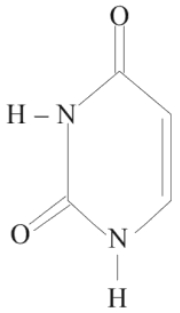
Identify the structure shown in the image.
A
Adenylic acid
B
Uracil
C
Cholesterol
D
Adenosine
Solution
(B) The structure shown in the image is $Uracil$.
$Uracil$ is a nitrogenous base,specifically a pyrimidine derivative,which is found in $RNA$ but not in $DNA$ (where it is replaced by $Thymine$).
The chemical structure consists of a six-membered ring containing two nitrogen atoms and two carbonyl groups,which matches the provided image.
Therefore,the correct option is $B$.
$Uracil$ is a nitrogenous base,specifically a pyrimidine derivative,which is found in $RNA$ but not in $DNA$ (where it is replaced by $Thymine$).
The chemical structure consists of a six-membered ring containing two nitrogen atoms and two carbonyl groups,which matches the provided image.
Therefore,the correct option is $B$.
0 likes
View SolutionBiomolecules — Nucleic acids · Frequently Asked Questions
1Are these Biomolecules questions useful for JEE and NEET?
Yes. All questions in this section are mapped to JEE Main and NEET exam patterns. Previous year questions from JEE Main, NEET, GUJCET and state-level exams are included with full solutions.
2Can I switch to Hindi or Gujarati for these questions?
Yes. Use the language tabs in the hero section or the sidebar to view the same questions and solutions in English, Hindi or Gujarati.
3How do I generate a question paper from this subtopic?
Use the Vedclass Exam Paper Generator — select the chapter and subtopic, set difficulty, and generate Sets A, B, C, D automatically. First 3 chapters of every subject are free.
Vedclass Products
For Students
Vedclass Test Series
Mock tests in real JEE/NEET style with performance analysis. 5-day free trial.
Start Free TrialFor Teachers
Exam Paper Generator
Generate Set A/B/C/D papers from this chapter in 2 minutes. 3 chapters free.
Try FreeFor Institutes
Online Exam Module
Live online exams with unlimited students, 360° analytics & white-label branding.
See DemoFor Teachers & Institutes
Generate a Biomolecules Exam Paper in 2 Minutes
Select subtopic & difficulty — Sets A, B, C, D auto-generated with No Repeat logic.
First 3 chapters of every subject are free — no payment required.