
A English
Nucleic acids Questions in English
Class 11 Biology · Biomolecules · Nucleic acids
210+
Questions
English
Language
100%
With Solutions
Showing 50 of 210 questions in English
101
EasyMCQ
Which of the following are purine $N_2$ bases?
A
Adenine,Cytosine
B
Adenine,Uracil
C
Adenine,Guanine
D
Adenine,Thymine
Solution
(C) Nitrogenous bases in nucleic acids are classified into two types: Purines and Pyrimidines.
Purines are double-ring structures,which include Adenine $(A)$ and Guanine $(G)$.
Pyrimidines are single-ring structures,which include Cytosine $(C)$,Thymine $(T)$,and Uracil $(U)$.
Therefore,Adenine and Guanine are purines.
Purines are double-ring structures,which include Adenine $(A)$ and Guanine $(G)$.
Pyrimidines are single-ring structures,which include Cytosine $(C)$,Thymine $(T)$,and Uracil $(U)$.
Therefore,Adenine and Guanine are purines.
0 likes
View Solution102
MediumMCQ
What is the main difference between a nucleoside and a nucleotide?
A
Pentose sugar
B
$N_2$ base
C
Phosphate group
D
No difference
Solution
(C) nucleoside consists of a nitrogenous base attached to a pentose sugar.
$A$ nucleotide consists of a nitrogenous base,a pentose sugar,and at least one phosphate group.
Therefore,the presence of a phosphate group is the fundamental difference that distinguishes a nucleotide from a nucleoside.
$A$ nucleotide consists of a nitrogenous base,a pentose sugar,and at least one phosphate group.
Therefore,the presence of a phosphate group is the fundamental difference that distinguishes a nucleotide from a nucleoside.
0 likes
View Solution103
EasyMCQ
What is $ATP$?
A
Nucleosides
B
Nucleotides
C
Polynucleotides
D
Nucleic acids
Solution
(B) $ATP$ stands for Adenosine Triphosphate.
It consists of an adenine base,a ribose sugar,and three phosphate groups.
Since it is a nitrogenous base attached to a sugar and phosphate groups,it is classified as a nucleotide.
It consists of an adenine base,a ribose sugar,and three phosphate groups.
Since it is a nitrogenous base attached to a sugar and phosphate groups,it is classified as a nucleotide.
0 likes
View Solution104
MediumMCQ
Which bond links two consecutive nucleotides to form a dinucleotide?
A
Glycosidic bond
B
Peptide bond
C
Ester bond
D
Phosphodiester bond
Solution
(D) In a nucleic acid,two consecutive nucleotides are joined by a $3'-5'$ phosphodiester linkage.
This bond is formed between the $3'$-hydroxyl group of the sugar of one nucleotide and the $5'$-phosphate group of the next nucleotide.
This linkage creates the sugar-phosphate backbone of the polynucleotide chain.
Therefore,the correct option is $D$.
This bond is formed between the $3'$-hydroxyl group of the sugar of one nucleotide and the $5'$-phosphate group of the next nucleotide.
This linkage creates the sugar-phosphate backbone of the polynucleotide chain.
Therefore,the correct option is $D$.
0 likes
View Solution105
EasyMCQ
The structure of a nucleoside consists of:
A
Nitrogenous base + Sugar
B
Nitrogenous base + Phosphate
C
Sugar + Phosphate
D
Nitrogenous base + Sugar + Phosphate
Solution
(A) nucleoside is formed by the combination of a nitrogenous base and a pentose sugar.
When a phosphate group is added to a nucleoside, it forms a nucleotide.
Therefore, the basic structure of a nucleoside is $Nitrogenous \text{ } base + Sugar$.
When a phosphate group is added to a nucleoside, it forms a nucleotide.
Therefore, the basic structure of a nucleoside is $Nitrogenous \text{ } base + Sugar$.
0 likes
View Solution106
MediumMCQ
$A$ nucleotide is composed of which subunits?
A
Pentose sugar
B
Nitrogenous base
C
Phosphoric acid
D
All of the above
Solution
(D) nucleotide is the basic structural unit of nucleic acids like $DNA$ and $RNA$.
It consists of three essential components:
$1$. $A$ pentose sugar (ribose in $RNA$ or deoxyribose in $DNA$).
$2$. $A$ nitrogenous base (purine or pyrimidine).
$3$. $A$ phosphoric acid group (phosphate group).
Therefore,all the given options are correct components of a nucleotide.
It consists of three essential components:
$1$. $A$ pentose sugar (ribose in $RNA$ or deoxyribose in $DNA$).
$2$. $A$ nitrogenous base (purine or pyrimidine).
$3$. $A$ phosphoric acid group (phosphate group).
Therefore,all the given options are correct components of a nucleotide.
0 likes
View Solution107
EasyMCQ
What is adenine?
A
Hormone
B
Protein
C
$N_2$ base
D
Pyrimidine
Solution
(C) Adenine is a nitrogenous base found in nucleic acids like $DNA$ and $RNA$.
It belongs to the class of compounds known as purines,which are double-ring structures.
In $DNA$,adenine pairs with thymine $(T)$ via two hydrogen bonds,and in $RNA$,it pairs with uracil $(U)$.
It belongs to the class of compounds known as purines,which are double-ring structures.
In $DNA$,adenine pairs with thymine $(T)$ via two hydrogen bonds,and in $RNA$,it pairs with uracil $(U)$.
0 likes
View Solution108
MediumMCQ
$m-RNA$ is a polymer of which of the following?
A
Deoxyribonucleosides
B
Ribonucleosides
C
Deoxyribonucleotides
D
Ribonucleotides
Solution
(D) $m-RNA$ stands for messenger $RNA$ (Ribonucleic Acid).
$RNA$ is a nucleic acid composed of long chains of nucleotides.
Each nucleotide in $RNA$ consists of a ribose sugar, a phosphate group, and a nitrogenous base $(Adenine, Guanine, Cytosine, or Uracil)$.
Since these building blocks are ribonucleotides, $m-RNA$ is defined as a polymer of ribonucleotides.
$RNA$ is a nucleic acid composed of long chains of nucleotides.
Each nucleotide in $RNA$ consists of a ribose sugar, a phosphate group, and a nitrogenous base $(Adenine, Guanine, Cytosine, or Uracil)$.
Since these building blocks are ribonucleotides, $m-RNA$ is defined as a polymer of ribonucleotides.
0 likes
View Solution109
EasyMCQ
What is a ribonucleoside?
A
Ribose + Phosphate + $N_2$ base
B
Ribose + $N_2$ base
C
Ribose + Phosphate
D
$N_2$ base + Phosphate
Solution
(B) nucleoside is formed by the combination of a pentose sugar and a nitrogenous base.
In the case of a ribonucleoside,the pentose sugar is ribose.
Therefore,a ribonucleoside consists of a ribose sugar linked to a nitrogenous $(N_2)$ base.
When a phosphate group is added to a nucleoside,it becomes a nucleotide.
In the case of a ribonucleoside,the pentose sugar is ribose.
Therefore,a ribonucleoside consists of a ribose sugar linked to a nitrogenous $(N_2)$ base.
When a phosphate group is added to a nucleoside,it becomes a nucleotide.
0 likes
View Solution110
MediumMCQ
What is formed by the polymerization of nucleotides of purines and pyrimidines?
A
Nucleosides
B
Amino acids
C
Nucleic acids
D
Lipids
Solution
(C) Nucleotides are the building blocks of nucleic acids.
Each nucleotide consists of a nitrogenous base (purine or pyrimidine),a pentose sugar,and a phosphate group.
When many nucleotides polymerize through phosphodiester bonds,they form long chains known as polynucleotides or nucleic acids ($DNA$ and $RNA$).
Each nucleotide consists of a nitrogenous base (purine or pyrimidine),a pentose sugar,and a phosphate group.
When many nucleotides polymerize through phosphodiester bonds,they form long chains known as polynucleotides or nucleic acids ($DNA$ and $RNA$).
0 likes
View Solution111
MediumMCQ
In the structure of a nucleoside, the nitrogenous base is attached to which carbon of the sugar molecule (in $1'$)?
A
$2'$
B
$4'$
C
$1'$
D
$5'$
Solution
(C) nucleoside is formed by the attachment of a nitrogenous base to a pentose sugar.
In both ribose and deoxyribose sugars, the nitrogenous base is linked to the $1'$ carbon atom of the sugar molecule via an $N$-glycosidic linkage.
The $5'$ carbon is typically where the phosphate group attaches to form a nucleotide, while the $2'$ carbon helps distinguish between ribose ($-OH$ group) and deoxyribose ($-H$ group).
In both ribose and deoxyribose sugars, the nitrogenous base is linked to the $1'$ carbon atom of the sugar molecule via an $N$-glycosidic linkage.
The $5'$ carbon is typically where the phosphate group attaches to form a nucleotide, while the $2'$ carbon helps distinguish between ribose ($-OH$ group) and deoxyribose ($-H$ group).
0 likes
View Solution112
EasyMCQ
Nucleotides are the structural components of nucleic acids. Each is composed of which of the following structures?
A
($N_2$ base-sugar-phosphate)$_n$
B
$N_2$ base-sugar-$OH$
C
$N_2$ base-sugar-phosphate
D
sugar-phosphate
Solution
(C) nucleotide is the basic building block of nucleic acids ($DNA$ and $RNA$).
It consists of three distinct chemical components:
$1$. $A$ nitrogenous base ($N_2$ base),which can be a purine or a pyrimidine.
$2$. $A$ pentose sugar (ribose in $RNA$ or deoxyribose in $DNA$).
$3$. $A$ phosphate group.
When these three components are linked together,they form a nucleotide. Therefore,the correct structure is $N_2$ base-sugar-phosphate.
It consists of three distinct chemical components:
$1$. $A$ nitrogenous base ($N_2$ base),which can be a purine or a pyrimidine.
$2$. $A$ pentose sugar (ribose in $RNA$ or deoxyribose in $DNA$).
$3$. $A$ phosphate group.
When these three components are linked together,they form a nucleotide. Therefore,the correct structure is $N_2$ base-sugar-phosphate.
0 likes
View Solution113
MediumMCQ
Which of the following sugars is found in nucleic acids?
A
Dextrose
B
Glucose
C
Ribulose
D
Deoxyribose
Solution
(D) Nucleic acids,such as $DNA$ and $RNA$,are polymers of nucleotides.
Each nucleotide consists of a nitrogenous base,a phosphate group,and a pentose sugar.
In $RNA$,the pentose sugar is ribose,while in $DNA$,the pentose sugar is $2$-deoxyribose.
Among the given options,deoxyribose is a sugar specifically found in $DNA$,which is a type of nucleic acid.
Each nucleotide consists of a nitrogenous base,a phosphate group,and a pentose sugar.
In $RNA$,the pentose sugar is ribose,while in $DNA$,the pentose sugar is $2$-deoxyribose.
Among the given options,deoxyribose is a sugar specifically found in $DNA$,which is a type of nucleic acid.
0 likes
View Solution114
EasyMCQ
Which of the following nucleotide sequences contains four pyrimidine bases?
A
$G-A-T-C-A-A-T-C-A$
B
$T-A-C-C-T-A-A-C-G$
C
$G-C-U-A-G-A-C-A-A$
D
$U-A-G-C-G-C-G-A-A$
Solution
(A) In nucleic acids,pyrimidine bases include Cytosine $(C)$,Thymine $(T)$,and Uracil $(U)$.
Let us analyze the number of pyrimidines in each option:
$A$: $G-A-T-C-A-A-T-C-A$ contains $T, C, T, C$ ($4$ pyrimidines).
$B$: $T-A-C-C-T-A-A-C-G$ contains $T, C, C, T, C$ ($5$ pyrimidines).
$C$: $G-C-U-A-G-A-C-A-A$ contains $C, U, C$ ($3$ pyrimidines).
$D$: $U-A-G-C-G-C-G-A-A$ contains $U, C, C$ ($3$ pyrimidines).
Therefore,the sequence containing exactly four pyrimidine bases is $G-A-T-C-A-A-T-C-A$.
Let us analyze the number of pyrimidines in each option:
$A$: $G-A-T-C-A-A-T-C-A$ contains $T, C, T, C$ ($4$ pyrimidines).
$B$: $T-A-C-C-T-A-A-C-G$ contains $T, C, C, T, C$ ($5$ pyrimidines).
$C$: $G-C-U-A-G-A-C-A-A$ contains $C, U, C$ ($3$ pyrimidines).
$D$: $U-A-G-C-G-C-G-A-A$ contains $U, C, C$ ($3$ pyrimidines).
Therefore,the sequence containing exactly four pyrimidine bases is $G-A-T-C-A-A-T-C-A$.
0 likes
View Solution115
MediumMCQ
Which of the following is an incorrect match?
A
Carbohydrate – Glycosidic
B
Protein – Peptide
C
Nucleic acid – Diester
D
Lipid – Ester
Solution
(C) In biological macromolecules,specific bonds link the monomers together.
$1$. Carbohydrates are linked by $Glycosidic$ bonds.
$2$. Proteins are linked by $Peptide$ bonds.
$3$. Nucleic acids ($DNA$/$RNA$) are linked by $Phosphodiester$ bonds,not just 'Diester' bonds. While 'Diester' is a component,the specific biological term is $Phosphodiester$.
$4$. Lipids (specifically triglycerides) are linked by $Ester$ bonds.
Therefore,the option $C$ is the most inaccurate or incomplete description compared to the others.
$1$. Carbohydrates are linked by $Glycosidic$ bonds.
$2$. Proteins are linked by $Peptide$ bonds.
$3$. Nucleic acids ($DNA$/$RNA$) are linked by $Phosphodiester$ bonds,not just 'Diester' bonds. While 'Diester' is a component,the specific biological term is $Phosphodiester$.
$4$. Lipids (specifically triglycerides) are linked by $Ester$ bonds.
Therefore,the option $C$ is the most inaccurate or incomplete description compared to the others.
0 likes
View Solution116
EasyMCQ
Nucleic acids primarily show the presence of which elements?
A
$C, H, O, N, K$
B
$C, H, O, N, P$
C
$C, H, O, N, S$
D
$C, H, O, N, Ca$
Solution
(B) Nucleic acids,such as $DNA$ and $RNA$,are polymers of nucleotides.
Each nucleotide consists of three components: a nitrogenous base,a pentose sugar,and a phosphate group.
The chemical composition of these components involves the elements Carbon $(C)$,Hydrogen $(H)$,Oxygen $(O)$,Nitrogen $(N)$,and Phosphorus $(P)$.
Therefore,nucleic acids primarily consist of these five elements.
Each nucleotide consists of three components: a nitrogenous base,a pentose sugar,and a phosphate group.
The chemical composition of these components involves the elements Carbon $(C)$,Hydrogen $(H)$,Oxygen $(O)$,Nitrogen $(N)$,and Phosphorus $(P)$.
Therefore,nucleic acids primarily consist of these five elements.
0 likes
View Solution117
MediumMCQ
Which bond is formed between two consecutive $C_5H_{10}O_5$ (pentose sugar) units in a polynucleotide chain?
A
Glycosidic bond
B
Phosphodiester bond
C
Peptide bond
D
Ester bond
Solution
(B) In a polynucleotide chain,the backbone is formed by the sugar and phosphate groups.
Specifically,the $3'$-carbon of one pentose sugar $(C_5H_{10}O_5)$ is linked to the $5'$-carbon of the adjacent pentose sugar through a phosphate group.
This linkage involves two ester bonds,one with each sugar,and is therefore known as a phosphodiester bond.
Thus,the correct answer is $B$.
Specifically,the $3'$-carbon of one pentose sugar $(C_5H_{10}O_5)$ is linked to the $5'$-carbon of the adjacent pentose sugar through a phosphate group.
This linkage involves two ester bonds,one with each sugar,and is therefore known as a phosphodiester bond.
Thus,the correct answer is $B$.
0 likes
View Solution118
EasyMCQ
What is the structure of nitrogenous bases?
A
Linear
B
Cyclic
C
Acyclic
D
Tetrahedral
Solution
(B) Nitrogenous bases are organic molecules that contain nitrogen and act as bases in chemical reactions.
In biological systems,these bases (purines and pyrimidines) are heterocyclic compounds,meaning they contain a ring structure consisting of carbon and nitrogen atoms.
Therefore,nitrogenous bases possess a cyclic structure.
In biological systems,these bases (purines and pyrimidines) are heterocyclic compounds,meaning they contain a ring structure consisting of carbon and nitrogen atoms.
Therefore,nitrogenous bases possess a cyclic structure.
0 likes
View Solution119
MediumMCQ
Which nitrogenous base is represented by the structural formula shown below?
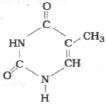
A
Uracil
B
Thymine
C
Cytosine
D
Guanine
Solution
(B) The structural formula provided shows a pyrimidine ring with a methyl group $(-CH_3)$ attached at the $5^{th}$ position. This specific structure is characteristic of Thymine ($5$-methyluracil). Uracil lacks this methyl group,while Cytosine has an amino group instead of a carbonyl group at the $4^{th}$ position. Guanine is a purine,which has a double-ring structure. Therefore,the correct answer is Thymine.
0 likes
View Solution120
MediumMCQ
Which nitrogenous base is represented by the structural formula shown below?
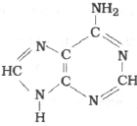
A
Cytosine
B
Thymine
C
Guanine
D
Adenine
Solution
(D) The provided structural formula represents a purine derivative.
Specifically,it shows a double-ring structure characteristic of purines with an amino group $(-NH_2)$ attached at the $6^{th}$ position.
This specific structure is Adenine.
Cytosine,Thymine,and Uracil are pyrimidines (single-ring structures),while Guanine is another purine but contains a carbonyl group $(=O)$ and an amino group $(-NH_2)$ at different positions.
Specifically,it shows a double-ring structure characteristic of purines with an amino group $(-NH_2)$ attached at the $6^{th}$ position.
This specific structure is Adenine.
Cytosine,Thymine,and Uracil are pyrimidines (single-ring structures),while Guanine is another purine but contains a carbonyl group $(=O)$ and an amino group $(-NH_2)$ at different positions.
0 likes
View Solution121
MediumMCQ
The chemical structure shown below is attached to which carbon atom of the pentose sugar?
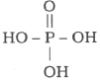
A
$2$
B
$3$
C
$4$
D
$5$
Solution
(D) The chemical structure shown is phosphoric acid $(H_3PO_4)$.
In a nucleotide,the phosphate group is attached to the $5'$ carbon atom of the pentose sugar via a phosphoester bond.
This linkage forms the backbone of the nucleic acid chain.
In a nucleotide,the phosphate group is attached to the $5'$ carbon atom of the pentose sugar via a phosphoester bond.
This linkage forms the backbone of the nucleic acid chain.
0 likes
View Solution122
EasyMCQ
What is the number of double bonds in thymine?
A
$1$
B
$2$
C
$3$
D
$4$
Solution
(C) Thymine ($5$-methyluracil) is a pyrimidine nucleobase.
The chemical structure of thymine consists of a heterocyclic ring with two carbonyl groups $(C=O)$ and one carbon-carbon double bond $(C=C)$ within the ring.
Specifically,there are two $C=O$ double bonds and one $C=C$ double bond.
Therefore,the total number of double bonds in the thymine molecule is $2 + 1 = 3$.
The chemical structure of thymine consists of a heterocyclic ring with two carbonyl groups $(C=O)$ and one carbon-carbon double bond $(C=C)$ within the ring.
Specifically,there are two $C=O$ double bonds and one $C=C$ double bond.
Therefore,the total number of double bonds in the thymine molecule is $2 + 1 = 3$.
0 likes
View Solution123
MediumMCQ
$A$: Pyrimidines are nitrogenous bases with a single-ring structure.
$R$: $DNA$ does not contain $U$ (Uracil).
$R$: $DNA$ does not contain $U$ (Uracil).
A
$A$ and $R$ are both true and $R$ is the correct explanation of $A$.
B
$A$ and $R$ are both true,but $R$ is not the correct explanation of $A$.
C
$A$ is true and $R$ is false.
D
$A$ is false and $R$ is true.
Solution
(B) $1$. Pyrimidines (Cytosine,Thymine,and Uracil) are heterocyclic aromatic organic compounds similar to pyridine,containing two nitrogen atoms at positions $1$ and $3$ of the six-membered ring. Thus,Assertion $A$ is true.
$2$. $DNA$ contains Adenine,Guanine,Cytosine,and Thymine. Uracil $(U)$ is found in $RNA$ instead of Thymine. Therefore,$DNA$ does not contain $U$. Thus,Reason $R$ is true.
$3$. While both statements are scientifically correct,the fact that $DNA$ does not contain $U$ is not the reason why pyrimidines have a single-ring structure. Therefore,$R$ is not the correct explanation of $A$.
$2$. $DNA$ contains Adenine,Guanine,Cytosine,and Thymine. Uracil $(U)$ is found in $RNA$ instead of Thymine. Therefore,$DNA$ does not contain $U$. Thus,Reason $R$ is true.
$3$. While both statements are scientifically correct,the fact that $DNA$ does not contain $U$ is not the reason why pyrimidines have a single-ring structure. Therefore,$R$ is not the correct explanation of $A$.
0 likes
View Solution124
MediumMCQ
What does the given chemical reaction indicate the formation of?
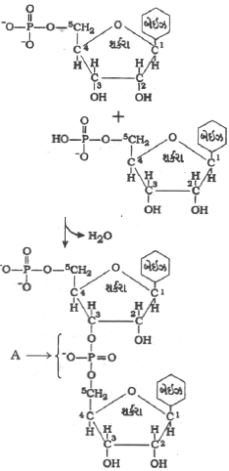
A
Disaccharide
B
Dinucleotide
C
Dipeptide
D
Triglyceride
Solution
(B) The given reaction shows the condensation of two nucleotides.
In the reaction,the $3'$-$OH$ group of one nucleotide reacts with the $5'$-phosphate group of another nucleotide.
This results in the formation of a phosphodiester bond (indicated by '$A$' in the diagram).
The linkage of two nucleotides via a phosphodiester bond results in the formation of a dinucleotide.
Therefore,the correct option is $(B)$.
In the reaction,the $3'$-$OH$ group of one nucleotide reacts with the $5'$-phosphate group of another nucleotide.
This results in the formation of a phosphodiester bond (indicated by '$A$' in the diagram).
The linkage of two nucleotides via a phosphodiester bond results in the formation of a dinucleotide.
Therefore,the correct option is $(B)$.
0 likes
View Solution125
MediumMCQ
In the given equation,what does $A$ represent?
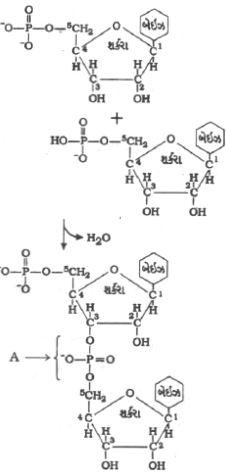
A
Glycosidic bond
B
Ester bond
C
Phosphodiester bond
D
Peptide bond
Solution
(C) The provided image shows the formation of a dinucleotide from two nucleotides. The reaction involves the removal of a water molecule $(H_2O)$ between the $3'-OH$ group of one nucleotide and the phosphate group attached to the $5'-CH_2$ of the adjacent nucleotide. The resulting linkage formed between the phosphate group and the sugar molecules is known as a phosphodiester bond. Therefore,$A$ represents the phosphodiester bond.
0 likes
View Solution126
MediumMCQ
What does the given structure represent?
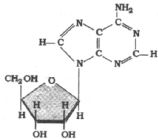
A
Nucleoside
B
Ribotide
C
Deoxyribotide
D
Deoxyriboside
Solution
(A) The given structure consists of a nitrogenous base (Adenine) attached to a pentose sugar (Ribose).
$1$. $A$ nucleoside is formed by the combination of a nitrogenous base and a pentose sugar.
$2$. The sugar shown in the structure has an $-OH$ group at the $2'$ position,which identifies it as ribose sugar.
$3$. Since there is no phosphate group attached,it is not a nucleotide (ribotide or deoxyribotide).
$4$. Therefore,the structure represents a nucleoside,specifically Adenosine.
$1$. $A$ nucleoside is formed by the combination of a nitrogenous base and a pentose sugar.
$2$. The sugar shown in the structure has an $-OH$ group at the $2'$ position,which identifies it as ribose sugar.
$3$. Since there is no phosphate group attached,it is not a nucleotide (ribotide or deoxyribotide).
$4$. Therefore,the structure represents a nucleoside,specifically Adenosine.
0 likes
View Solution127
EasyMCQ
What does the given figure represent?
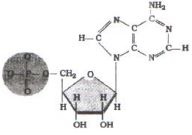
A
Riboside
B
Nucleotide
C
Deoxyribotide
D
Deoxyriboside
Solution
(B) The given figure shows a nitrogenous base (adenine) attached to a ribose sugar,which is further attached to a phosphate group.
$1$. $A$ nitrogenous base + sugar = Nucleoside.
$2$. $A$ nitrogenous base + sugar + phosphate group = Nucleotide.
$3$. Since the sugar has two hydroxyl $(-OH)$ groups at the $2'$ and $3'$ positions,it is a ribose sugar,making the entire structure a ribonucleotide.
$1$. $A$ nitrogenous base + sugar = Nucleoside.
$2$. $A$ nitrogenous base + sugar + phosphate group = Nucleotide.
$3$. Since the sugar has two hydroxyl $(-OH)$ groups at the $2'$ and $3'$ positions,it is a ribose sugar,making the entire structure a ribonucleotide.
0 likes
View Solution128
MediumMCQ
The given figure plays an important role in the formation of which of the following?
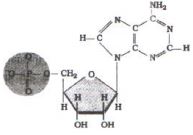
A
$DNA$
B
$ATP$
C
$GTP$
D
$RNA$
Solution
(D) The provided figure shows an Adenosine Monophosphate $(AMP)$ molecule. It consists of an adenine base,a ribose sugar,and a phosphate group. The presence of the hydroxyl $(-OH)$ group at the $2'$ position of the ribose sugar confirms that it is a ribonucleotide. Adenosine monophosphate is a fundamental building block of $RNA$ (Ribonucleic Acid). Therefore,it plays an important role in the formation of $RNA$.
0 likes
View Solution129
MediumMCQ
Which of the following biomolecules has a phosphodiester bond?
A
Amino acids in a polypeptide
B
Nucleic acids in a nucleotide
C
Fatty acids in a diglyceride
D
Monosaccharides in a polysaccharide
Solution
(B) phosphodiester bond is a chemical bond that joins the $3'$ carbon atom of one sugar molecule and the $5'$ carbon atom of another in a nucleic acid chain ($DNA$ or $RNA$).
- In a polypeptide,amino acids are linked by peptide bonds.
- In a diglyceride,fatty acids are linked to glycerol by ester bonds.
- In a polysaccharide,monosaccharides are linked by glycosidic bonds.
- Nucleic acids (polynucleotides) are formed by linking nucleotides through phosphodiester bonds.
Therefore,the correct option is $B$.
- In a polypeptide,amino acids are linked by peptide bonds.
- In a diglyceride,fatty acids are linked to glycerol by ester bonds.
- In a polysaccharide,monosaccharides are linked by glycosidic bonds.
- Nucleic acids (polynucleotides) are formed by linking nucleotides through phosphodiester bonds.
Therefore,the correct option is $B$.
1 likes
View Solution130
MediumMCQ
Uridine,present only in $RNA$,is a
A
nucleoside
B
nucleotide
C
purine
D
pyrimidine
Solution
(A) Uridine is a nucleoside formed by the combination of a nitrogenous base (Uracil) and a pentose sugar (Ribose).
$A$ nucleoside consists of a pentose sugar and a nitrogenous base,lacking the phosphate group.
Since Uridine is composed of Uracil and Ribose,it is classified as a nucleoside.
Uracil + Ribose $\to$ Uridine.
$A$ nucleoside consists of a pentose sugar and a nitrogenous base,lacking the phosphate group.
Since Uridine is composed of Uracil and Ribose,it is classified as a nucleoside.
Uracil + Ribose $\to$ Uridine.
0 likes
View Solution131
MediumMCQ
Uridine is formed when the pyrimidine nitrogen base uracil joins with:
A
Hexose sugar
B
Purine nitrogen base - Adenine
C
Phosphate
D
Pentose sugar
Solution
(D) nucleoside is formed by the linkage of a nitrogenous base with a pentose sugar through an $N$-glycosidic linkage.
Uridine is a nucleoside formed specifically by the combination of the pyrimidine base $Uracil$ and a $Ribose$ sugar (which is a pentose sugar).
Therefore,when uracil joins with a pentose sugar,it forms uridine.
Uridine is a nucleoside formed specifically by the combination of the pyrimidine base $Uracil$ and a $Ribose$ sugar (which is a pentose sugar).
Therefore,when uracil joins with a pentose sugar,it forms uridine.
0 likes
View Solution132
MediumMCQ
Phosphorus is present in which of the following structures?
A
Cell wall,some vitamins
B
Some proteins,all nucleic acids
C
Nucleotides,ribosomes
D
Some vitamins,nucleotides
Solution
(C) Phosphorus is a vital macro-nutrient for plants.
It is a constituent of cell membranes,all nucleic acids ($DNA$ and $RNA$),and nucleotides (such as $ATP$).
Ribosomes are composed of ribosomal $RNA$ (rRNA) and proteins; since rRNA contains phosphorus,ribosomes also contain phosphorus.
Therefore,phosphorus is present in nucleotides and ribosomes.
It is a constituent of cell membranes,all nucleic acids ($DNA$ and $RNA$),and nucleotides (such as $ATP$).
Ribosomes are composed of ribosomal $RNA$ (rRNA) and proteins; since rRNA contains phosphorus,ribosomes also contain phosphorus.
Therefore,phosphorus is present in nucleotides and ribosomes.
0 likes
View Solution133
MediumMCQ
Identify in which of the following carbon compounds heterocyclic rings can be found?
A
Proteins
B
Amino acids
C
Nitrogen bases
D
Lipids
Solution
(C) Heterocyclic rings are ring structures that contain at least one atom other than carbon within the ring,such as nitrogen,oxygen,or sulfur.
In biological systems,nitrogen bases (purines and pyrimidines) are classic examples of heterocyclic compounds.
Purines (like adenine and guanine) consist of a fused pyrimidine and imidazole ring,both of which are heterocyclic.
Pyrimidines (like cytosine,thymine,and uracil) consist of a single heterocyclic ring containing two nitrogen atoms.
Proteins and amino acids contain nitrogen,but the nitrogen is typically part of the amino or amide groups,not part of a heterocyclic ring structure (except for specific amino acids like histidine,proline,and tryptophan).
Lipids generally consist of long hydrocarbon chains or fused carbon rings (like steroids) and do not typically contain heterocyclic rings.
In biological systems,nitrogen bases (purines and pyrimidines) are classic examples of heterocyclic compounds.
Purines (like adenine and guanine) consist of a fused pyrimidine and imidazole ring,both of which are heterocyclic.
Pyrimidines (like cytosine,thymine,and uracil) consist of a single heterocyclic ring containing two nitrogen atoms.
Proteins and amino acids contain nitrogen,but the nitrogen is typically part of the amino or amide groups,not part of a heterocyclic ring structure (except for specific amino acids like histidine,proline,and tryptophan).
Lipids generally consist of long hydrocarbon chains or fused carbon rings (like steroids) and do not typically contain heterocyclic rings.
0 likes
View Solution134
MediumMCQ
$A$ nucleotide has three chemically distinct compounds. These are $A, B$ and $C$. Identify them.
A
$A$ - Sugar,$B$ - Carbonates,$C$ - Chlorides
B
$A$ - $DNA$,$B$ - Cellulose,$C$ - Chitin
C
$A$ - Purine or pyrimidine,$B$ - Monosaccharide,$C$ - Phosphate
D
$A$ - Phosphoric acid,$B$ - Proteins,$C$ - Acids
Solution
(C) nucleotide is the basic structural unit of nucleic acids ($DNA$ and $RNA$).
It consists of three chemically distinct components:
$1$. $A$ nitrogenous base (either a purine or a pyrimidine).
$2$. $A$ pentose sugar (a monosaccharide,specifically ribose or deoxyribose).
$3$. $A$ phosphate group (derived from phosphoric acid).
Therefore,option $C$ correctly identifies these components.
It consists of three chemically distinct components:
$1$. $A$ nitrogenous base (either a purine or a pyrimidine).
$2$. $A$ pentose sugar (a monosaccharide,specifically ribose or deoxyribose).
$3$. $A$ phosphate group (derived from phosphoric acid).
Therefore,option $C$ correctly identifies these components.
0 likes
View Solution135
EasyMCQ
Nucleic acids are the polymers of ...
A
Sugar
B
Bases
C
Nucleosides
D
Nucleotides
Solution
(D) Nucleic acids,such as $DNA$ and $RNA$,are long-chain polymers composed of repeating units called nucleotides.
Each nucleotide consists of three components: a nitrogenous base,a pentose sugar (ribose or deoxyribose),and a phosphate group.
Therefore,nucleic acids are defined as polynucleotides.
Each nucleotide consists of three components: a nitrogenous base,a pentose sugar (ribose or deoxyribose),and a phosphate group.
Therefore,nucleic acids are defined as polynucleotides.
0 likes
View Solution136
MediumMCQ
Identify the nucleoside from the following options.
A
Cytidylic acid
B
Guanylic acid
C
Uridylic acid
D
Thymidine
Solution
(D) nucleoside consists of a nitrogenous base attached to a pentose sugar.
Nucleotides,on the other hand,consist of a nitrogenous base,a pentose sugar,and a phosphate group.
$1$. Cytidylic acid,Guanylic acid,and Uridylic acid are all nucleotides because they contain a phosphate group.
$2$. Thymidine is a nucleoside formed by the combination of the nitrogenous base Thymine and the sugar Deoxyribose.
Therefore,the correct answer is $D$.
Nucleotides,on the other hand,consist of a nitrogenous base,a pentose sugar,and a phosphate group.
$1$. Cytidylic acid,Guanylic acid,and Uridylic acid are all nucleotides because they contain a phosphate group.
$2$. Thymidine is a nucleoside formed by the combination of the nitrogenous base Thymine and the sugar Deoxyribose.
Therefore,the correct answer is $D$.
0 likes
View Solution137
MediumMCQ
Identify nucleoside from the following.
A
Thymidine,guanilic acid
B
Arachidonic acid,phospholipid
C
Guanosine,adenosine
D
Thymidylic acid,cytidylic acid
Solution
(C) nucleoside is formed by the combination of a nitrogenous base and a pentose sugar.
Nucleotides are formed when a phosphate group is added to a nucleoside.
$1$. Thymidine is a nucleoside,but guanilic acid is a nucleotide.
$2$. Arachidonic acid is a fatty acid,and phospholipid is a lipid.
$3$. Guanosine (guanine + ribose) and adenosine (adenine + ribose) are both nucleosides.
$4$. Thymidylic acid and cytidylic acid are both nucleotides.
Therefore,the correct option is $C$.
Nucleotides are formed when a phosphate group is added to a nucleoside.
$1$. Thymidine is a nucleoside,but guanilic acid is a nucleotide.
$2$. Arachidonic acid is a fatty acid,and phospholipid is a lipid.
$3$. Guanosine (guanine + ribose) and adenosine (adenine + ribose) are both nucleosides.
$4$. Thymidylic acid and cytidylic acid are both nucleotides.
Therefore,the correct option is $C$.
0 likes
View Solution138
EasyMCQ
In which structure is $C_5H_{10}O_4$ present?
A
Starch
B
$RNA$
C
$DNA$
D
Amylase
Solution
(C) The chemical formula $C_5H_{10}O_4$ represents deoxyribose sugar.
Deoxyribose is a pentose sugar that lacks one oxygen atom compared to ribose $(C_5H_{10}O_5)$.
$DNA$ (Deoxyribonucleic acid) contains deoxyribose sugar as its backbone component.
$RNA$ (Ribonucleic acid) contains ribose sugar $(C_5H_{10}O_5)$.
Starch and Amylase are polymers of glucose and amino acids,respectively,and do not contain this specific pentose sugar structure.
Deoxyribose is a pentose sugar that lacks one oxygen atom compared to ribose $(C_5H_{10}O_5)$.
$DNA$ (Deoxyribonucleic acid) contains deoxyribose sugar as its backbone component.
$RNA$ (Ribonucleic acid) contains ribose sugar $(C_5H_{10}O_5)$.
Starch and Amylase are polymers of glucose and amino acids,respectively,and do not contain this specific pentose sugar structure.
0 likes
View Solution139
MediumMCQ
Choose the correct pair.
A
Purine nitrogen base - cytosine
B
Pyrimidine nitrogen base - adenine
C
Purine nitrogen base - guanine
D
All correct
Solution
(C) Nitrogenous bases are classified into two types: Purines and Pyrimidines.
$1$. Purines are double-ring structures,which include Adenine $(A)$ and Guanine $(G)$.
$2$. Pyrimidines are single-ring structures,which include Cytosine $(C)$,Thymine $(T)$,and Uracil $(U)$.
Comparing the options:
- Option $A$: Cytosine is a Pyrimidine,so this is incorrect.
- Option $B$: Adenine is a Purine,so this is incorrect.
- Option $C$: Guanine is a Purine,which is correct.
Therefore,the correct pair is Purine nitrogen base - Guanine.
$1$. Purines are double-ring structures,which include Adenine $(A)$ and Guanine $(G)$.
$2$. Pyrimidines are single-ring structures,which include Cytosine $(C)$,Thymine $(T)$,and Uracil $(U)$.
Comparing the options:
- Option $A$: Cytosine is a Pyrimidine,so this is incorrect.
- Option $B$: Adenine is a Purine,so this is incorrect.
- Option $C$: Guanine is a Purine,which is correct.
Therefore,the correct pair is Purine nitrogen base - Guanine.
0 likes
View Solution140
EasyMCQ
Which of the following is a structural component of nucleic acid?
A
Peptide
B
Nucleotide
C
Polysaccharide
D
Fatty acid and glycerol
Solution
(B) Nucleic acids,such as $DNA$ and $RNA$,are polymers composed of repeating units called nucleotides.
Each nucleotide consists of three components: a nitrogenous base,a pentose sugar (ribose or deoxyribose),and a phosphate group.
Peptides are components of proteins,polysaccharides are polymers of monosaccharides (carbohydrates),and fatty acids with glycerol are components of lipids.
Each nucleotide consists of three components: a nitrogenous base,a pentose sugar (ribose or deoxyribose),and a phosphate group.
Peptides are components of proteins,polysaccharides are polymers of monosaccharides (carbohydrates),and fatty acids with glycerol are components of lipids.
0 likes
View Solution141
EasyMCQ
Nucleic acids exhibit a wide variety of.....
A
Primary structure
B
Secondary structure
C
Tertiary structure
D
Octa structure
Solution
(B) Nucleic acids,such as $DNA$ and $RNA$,are complex polymers of nucleotides.
They exhibit a wide variety of secondary structures.
The most famous example is the $DNA$ double helix,which is a secondary structure proposed by Watson and Crick.
These structures are stabilized by hydrogen bonding between complementary base pairs.
They exhibit a wide variety of secondary structures.
The most famous example is the $DNA$ double helix,which is a secondary structure proposed by Watson and Crick.
These structures are stabilized by hydrogen bonding between complementary base pairs.
0 likes
View Solution142
MediumMCQ
Thymidine is
A
Nucleotide
B
Nucleoside
C
Polynucleotide
D
Nucleic acid
Solution
(B) nucleoside is formed by the combination of a nitrogenous base and a pentose sugar.
Thymidine is formed by the combination of the nitrogenous base $Thymine$ and the sugar $Deoxyribose$.
Since it lacks a phosphate group,it is classified as a nucleoside.
In contrast,a nucleotide contains a nitrogenous base,a pentose sugar,and a phosphate group (e.g.,Thymidylic acid).
Thymidine is formed by the combination of the nitrogenous base $Thymine$ and the sugar $Deoxyribose$.
Since it lacks a phosphate group,it is classified as a nucleoside.
In contrast,a nucleotide contains a nitrogenous base,a pentose sugar,and a phosphate group (e.g.,Thymidylic acid).
0 likes
View Solution143
MediumMCQ
$A$ nucleoside is formed when the $N$-base is linked to:
A
Sugar
B
Phosphates
C
Proteins
D
Fats
Solution
(A) nucleoside is a biochemical compound consisting of a nitrogenous base ($N$-base) covalently attached to a sugar molecule (pentose sugar,either ribose or deoxyribose) via an $N$-glycosidic linkage.
When a phosphate group is added to a nucleoside,it becomes a nucleotide.
Therefore,the correct option is $A$.
When a phosphate group is added to a nucleoside,it becomes a nucleotide.
Therefore,the correct option is $A$.
0 likes
View Solution144
MediumMCQ
$A$ nucleotide is composed of $..........$.
A
Purine,pyrimidine and phosphate
B
Purine,sugar and phosphate
C
Nitrogenous base,sugar and phosphate
D
Pyrimidine,sugar and phosphate
Solution
(C) nucleotide is the basic structural unit of nucleic acids like $DNA$ and $RNA$.
It consists of three main components:
$1$. $A$ nitrogenous base (either a purine or a pyrimidine).
$2$. $A$ pentose sugar (deoxyribose in $DNA$ or ribose in $RNA$).
$3$. $A$ phosphate group.
Therefore,the correct composition of a nucleotide is a nitrogenous base,a sugar,and a phosphate group.
It consists of three main components:
$1$. $A$ nitrogenous base (either a purine or a pyrimidine).
$2$. $A$ pentose sugar (deoxyribose in $DNA$ or ribose in $RNA$).
$3$. $A$ phosphate group.
Therefore,the correct composition of a nucleotide is a nitrogenous base,a sugar,and a phosphate group.
0 likes
View Solution145
MediumMCQ
What is the basic unit of a nucleic acid?
A
Pentose sugar
B
Nucleoid
C
Nucleoside
D
Nucleotide
Solution
(D) The basic structural unit of a nucleic acid (such as $DNA$ or $RNA$) is the $Nucleotide$.
Each $Nucleotide$ consists of three components: a nitrogenous base,a pentose sugar (ribose or deoxyribose),and a phosphate group.
While a $Nucleoside$ consists only of a nitrogenous base and a pentose sugar,the addition of a phosphate group converts it into a $Nucleotide$,which acts as the monomeric building block for nucleic acid polymers.
Each $Nucleotide$ consists of three components: a nitrogenous base,a pentose sugar (ribose or deoxyribose),and a phosphate group.
While a $Nucleoside$ consists only of a nitrogenous base and a pentose sugar,the addition of a phosphate group converts it into a $Nucleotide$,which acts as the monomeric building block for nucleic acid polymers.
0 likes
View Solution146
MediumMCQ
Adenine is a .............. .
A
Purine
B
Pyrimidine
C
Nucleoside
D
Nucleotide
Solution
(A) Adenine is a nitrogenous base found in $DNA$ and $RNA$.
Nitrogenous bases are classified into two categories: Purines and Pyrimidines.
Purines include Adenine $(A)$ and Guanine $(G)$,which are double-ring structures.
Pyrimidines include Cytosine $(C)$,Thymine $(T)$,and Uracil $(U)$,which are single-ring structures.
Therefore,Adenine is a Purine.
Nitrogenous bases are classified into two categories: Purines and Pyrimidines.
Purines include Adenine $(A)$ and Guanine $(G)$,which are double-ring structures.
Pyrimidines include Cytosine $(C)$,Thymine $(T)$,and Uracil $(U)$,which are single-ring structures.
Therefore,Adenine is a Purine.
0 likes
View Solution147
MediumMCQ
Which of the following statements is incorrect regarding nucleic acids?
A
Some viruses contain single-stranded $DNA$.
B
$RNA$ sometimes exists as a double-stranded molecule.
C
In $\beta-DNA$,one turn has a length of $45 \ \mathring{A}$.
D
$Z-DNA$ has $12$ base pairs per turn.
Solution
(C) In $\beta-DNA$ (the standard Watson-Crick model),one full turn of the helix is $34 \ \mathring{A}$ long,not $45 \ \mathring{A}$.
Therefore,the statement in option $C$ is incorrect.
- Some viruses (e.g.,$\phi X174$) contain single-stranded $DNA$.
- $RNA$ can be double-stranded in certain viruses (e.g.,Reovirus).
- $Z-DNA$ is a left-handed helix with $12$ base pairs per turn.
Therefore,the statement in option $C$ is incorrect.
- Some viruses (e.g.,$\phi X174$) contain single-stranded $DNA$.
- $RNA$ can be double-stranded in certain viruses (e.g.,Reovirus).
- $Z-DNA$ is a left-handed helix with $12$ base pairs per turn.
0 likes
View Solution148
MediumMCQ
Which bond connects two free ribonucleotide units to each other?
A
Peptide bond
B
Covalent bond
C
Hydrogen bond
D
Phosphodiester bond
Solution
(D) In a nucleic acid chain,individual nucleotides are linked together to form a polynucleotide chain.
This linkage occurs between the $3'$-carbon atom of the sugar moiety of one nucleotide and the $5'$-carbon atom of the sugar moiety of the adjacent nucleotide.
The bond formed by this linkage is known as a $3'-5'$ phosphodiester bond.
Therefore,the correct option is $D$.
This linkage occurs between the $3'$-carbon atom of the sugar moiety of one nucleotide and the $5'$-carbon atom of the sugar moiety of the adjacent nucleotide.
The bond formed by this linkage is known as a $3'-5'$ phosphodiester bond.
Therefore,the correct option is $D$.
0 likes
View Solution149
MediumMCQ
$ATP$ stands for which of the following?
A
Nucleotide
B
Nucleosome
C
Nucleoside
D
Urine
Solution
(A) $ATP$ stands for Adenosine Triphosphate.
It consists of an adenine base,a ribose sugar,and three phosphate groups.
Because it contains a nitrogenous base,a pentose sugar,and phosphate groups,it is classified as a nucleotide.
$A$ nucleoside consists only of a nitrogenous base and a sugar,whereas a nucleotide includes the phosphate group as well.
It consists of an adenine base,a ribose sugar,and three phosphate groups.
Because it contains a nitrogenous base,a pentose sugar,and phosphate groups,it is classified as a nucleotide.
$A$ nucleoside consists only of a nitrogenous base and a sugar,whereas a nucleotide includes the phosphate group as well.
0 likes
View Solution150
EasyMCQ
Nucleotides are the building blocks of nucleic acids. Each nucleotide is a complex molecule formed by ..........
A
Base - Sugar - Phosphate
B
Base - Sugar - $OH$
C
$(Base - Sugar - Phosphate)_n$
D
Sugar - Phosphate
Solution
(A) nucleotide is the fundamental monomeric unit of nucleic acids ($DNA$ and $RNA$). Each nucleotide consists of three distinct chemical components:
$1$. $A$ nitrogenous base (purine or pyrimidine).
$2$. $A$ pentose sugar (ribose in $RNA$ or deoxyribose in $DNA$).
$3$. $A$ phosphate group.
These three components are linked together to form a single nucleotide unit. Therefore, the correct composition is Base - Sugar - Phosphate.
$1$. $A$ nitrogenous base (purine or pyrimidine).
$2$. $A$ pentose sugar (ribose in $RNA$ or deoxyribose in $DNA$).
$3$. $A$ phosphate group.
These three components are linked together to form a single nucleotide unit. Therefore, the correct composition is Base - Sugar - Phosphate.
0 likes
View SolutionBiomolecules — Nucleic acids · Frequently Asked Questions
1Are these Biomolecules questions useful for JEE and NEET?
Yes. All questions in this section are mapped to JEE Main and NEET exam patterns. Previous year questions from JEE Main, NEET, GUJCET and state-level exams are included with full solutions.
2Can I switch to Hindi or Gujarati for these questions?
Yes. Use the language tabs in the hero section or the sidebar to view the same questions and solutions in English, Hindi or Gujarati.
3How do I generate a question paper from this subtopic?
Use the Vedclass Exam Paper Generator — select the chapter and subtopic, set difficulty, and generate Sets A, B, C, D automatically. First 3 chapters of every subject are free.
Vedclass Products
For Students
Vedclass Test Series
Mock tests in real JEE/NEET style with performance analysis. 5-day free trial.
Start Free TrialFor Teachers
Exam Paper Generator
Generate Set A/B/C/D papers from this chapter in 2 minutes. 3 chapters free.
Try FreeFor Institutes
Online Exam Module
Live online exams with unlimited students, 360° analytics & white-label branding.
See DemoFor Teachers & Institutes
Generate a Biomolecules Exam Paper in 2 Minutes
Select subtopic & difficulty — Sets A, B, C, D auto-generated with No Repeat logic.
First 3 chapters of every subject are free — no payment required.