
A English
Nucleic acids Questions in English
Class 11 Biology · Biomolecules · Nucleic acids
210+
Questions
English
Language
100%
With Solutions
Showing 50 of 210 questions in English
151
MediumMCQ
Which of the following sets correctly matches the three items with their group category?
Item $-$ Group
Item $-$ Group
A
Malleus,Incus,Cochlea $-$ Ear ossicles
B
Ilium,Ischium,Pubis $-$ Pelvic girdle bones
C
Actin,Myosin,Rhodopsin $-$ Muscle proteins
D
Cytosine,Uracil,Thymine $-$ Pyrimidines
Solution
(D) The correct set is $D$.
$1$. Malleus,Incus,and Stapes are ear ossicles; Cochlea is a part of the inner ear,so option $A$ is incorrect.
$2$. Ilium,Ischium,and Pubis are the three bones that fuse to form the coxal bone of the pelvic girdle,so option $B$ is correct.
$3$. Actin and Myosin are contractile muscle proteins,while Rhodopsin is a visual pigment found in the retina,so option $C$ is incorrect.
$4$. Cytosine,Uracil,and Thymine are all nitrogenous bases belonging to the Pyrimidine category,so option $D$ is correct.
Note: In the provided options,both $B$ and $D$ are biologically correct. However,in the context of standard biology questions regarding biomolecules,$D$ is the most direct classification of nitrogenous bases.
$1$. Malleus,Incus,and Stapes are ear ossicles; Cochlea is a part of the inner ear,so option $A$ is incorrect.
$2$. Ilium,Ischium,and Pubis are the three bones that fuse to form the coxal bone of the pelvic girdle,so option $B$ is correct.
$3$. Actin and Myosin are contractile muscle proteins,while Rhodopsin is a visual pigment found in the retina,so option $C$ is incorrect.
$4$. Cytosine,Uracil,and Thymine are all nitrogenous bases belonging to the Pyrimidine category,so option $D$ is correct.
Note: In the provided options,both $B$ and $D$ are biologically correct. However,in the context of standard biology questions regarding biomolecules,$D$ is the most direct classification of nitrogenous bases.
0 likes
View Solution152
MediumMCQ
Which of the following biomolecules contains a phosphodiester bond?
A
Nucleic acids in nucleotides
B
Fatty acids in diglycerides
C
Monosaccharides in polysaccharides
D
Amino acids in polypeptides
Solution
(A) phosphodiester bond is a chemical bond that links the $3'$ carbon atom of one sugar molecule and the $5'$ carbon atom of another in deoxyribonucleic acid $(DNA)$ and ribonucleic acid $(RNA)$.
These bonds are the structural backbone of nucleic acids,connecting individual nucleotides together.
In contrast,diglycerides contain ester bonds,polysaccharides contain glycosidic bonds,and polypeptides contain peptide bonds.
These bonds are the structural backbone of nucleic acids,connecting individual nucleotides together.
In contrast,diglycerides contain ester bonds,polysaccharides contain glycosidic bonds,and polypeptides contain peptide bonds.
0 likes
View Solution153
MediumMCQ
Which statement is true?
A
Adenine has $4$ nitrogen atoms.
B
Cytosine has $3$ nitrogen atoms.
C
Guanosine has $3$ nitrogen atoms.
D
Uracil has $5$ nitrogen atoms.
Solution
(A) Nucleotides consist of carbon,hydrogen,oxygen,nitrogen,and phosphorus.
Nitrogenous bases are classified as purines or pyrimidines.
Purines (Adenine and Guanine) are $9$-membered double-ringed structures containing $4$ nitrogen atoms.
Pyrimidines (Cytosine,Thymine,and Uracil) are single-ringed structures.
Specifically,Cytosine has $3$ nitrogen atoms,while Uracil and Thymine have $2$ nitrogen atoms.
Therefore,the statement that Adenine has $4$ nitrogen atoms is correct.
Nitrogenous bases are classified as purines or pyrimidines.
Purines (Adenine and Guanine) are $9$-membered double-ringed structures containing $4$ nitrogen atoms.
Pyrimidines (Cytosine,Thymine,and Uracil) are single-ringed structures.
Specifically,Cytosine has $3$ nitrogen atoms,while Uracil and Thymine have $2$ nitrogen atoms.
Therefore,the statement that Adenine has $4$ nitrogen atoms is correct.
0 likes
View Solution154
MediumMCQ
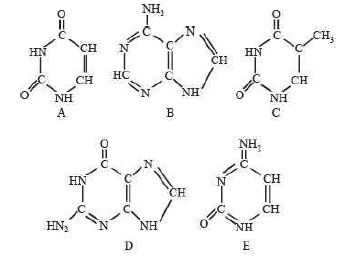
The following diagrams represent the nitrogenous bases of nucleic acid molecules. Identify the correct combination.
A
$A-$ uracil,$B-$ adenine,$C-$ thymine,$D-$ guanine,$E-$ cytosine
B
$A-$ uracil,$B-$ guanine,$C-$ cytosine,$D-$ adenine,$E-$ thymine
C
$A-$ uracil,$B-$ guanine,$C-$ thymine,$D-$ adenine,$E-$ cytosine
D
$A-$ thymine,$B-$ guanine,$C-$ uracil,$D-$ adenine,$E-$ cytosine
Solution
(A) By analyzing the chemical structures of the nitrogenous bases:
$A$ is Uracil,a pyrimidine base found in $RNA$.
$B$ is Adenine,a purine base.
$C$ is Thymine,a pyrimidine base with a methyl group $(-CH_3)$ at the $5^{th}$ position.
$D$ is Guanine,a purine base.
$E$ is Cytosine,a pyrimidine base.
Therefore,the correct combination is $A-$ uracil,$B-$ adenine,$C-$ thymine,$D-$ guanine,$E-$ cytosine.
$A$ is Uracil,a pyrimidine base found in $RNA$.
$B$ is Adenine,a purine base.
$C$ is Thymine,a pyrimidine base with a methyl group $(-CH_3)$ at the $5^{th}$ position.
$D$ is Guanine,a purine base.
$E$ is Cytosine,a pyrimidine base.
Therefore,the correct combination is $A-$ uracil,$B-$ adenine,$C-$ thymine,$D-$ guanine,$E-$ cytosine.
0 likes
View Solution155
MediumMCQ
Nucleotides are building blocks of nucleic acids. Each nucleotide is a composite molecule formed by
A
base-sugar-phosphate
B
base-sugar-$OH$
C
(base-sugar-phosphate)$_n$
D
sugar-phosphate
Solution
(A) Nucleotides are the building blocks of nucleic acids.
Each nucleotide consists of three distinct components:
$1$. $A$ pentose sugar (ribose in $RNA$ or deoxyribose in $DNA$).
$2$. $A$ phosphate group.
$3$. $A$ nitrogenous base (purine or pyrimidine).
Therefore,a nucleotide is formed by the combination of a base,a sugar,and a phosphate group.
Each nucleotide consists of three distinct components:
$1$. $A$ pentose sugar (ribose in $RNA$ or deoxyribose in $DNA$).
$2$. $A$ phosphate group.
$3$. $A$ nitrogenous base (purine or pyrimidine).
Therefore,a nucleotide is formed by the combination of a base,a sugar,and a phosphate group.
0 likes
View Solution156
Medium
What are heterocyclic organic carbon compounds? Explain with examples.
Solution
(N/A) Heterocyclic compounds are organic compounds that contain at least one atom other than carbon (such as nitrogen,oxygen,or sulfur) within their ring structure.
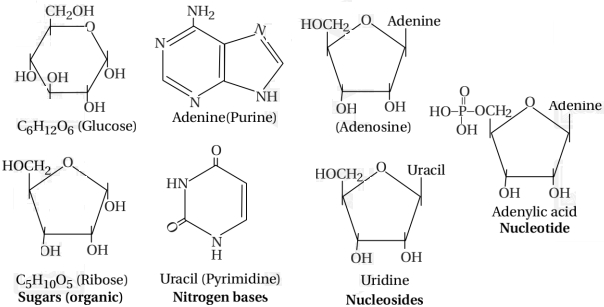
In living organisms,many important biomolecules contain heterocyclic rings. Nitrogenous bases are classic examples of such compounds.
Nitrogenous bases include purines (e.g.,Adenine,Guanine) and pyrimidines (e.g.,Cytosine,Uracil,Thymine).
When a nitrogenous base is attached to a sugar molecule,it forms a nucleoside (e.g.,Adenosine,Guanosine,Thymidine,Uridine,Cytidine).
When a phosphate group is also esterified to the sugar of a nucleoside,it forms a nucleotide (e.g.,Adenylic acid,Thymidylic acid,Guanylic acid,Uridylic acid,Cytidylic acid).
Nucleic acids like $DNA$ and $RNA$ are polymers of nucleotides and serve as the genetic material in living organisms.
In living organisms,many important biomolecules contain heterocyclic rings. Nitrogenous bases are classic examples of such compounds.
Nitrogenous bases include purines (e.g.,Adenine,Guanine) and pyrimidines (e.g.,Cytosine,Uracil,Thymine).
When a nitrogenous base is attached to a sugar molecule,it forms a nucleoside (e.g.,Adenosine,Guanosine,Thymidine,Uridine,Cytidine).
When a phosphate group is also esterified to the sugar of a nucleoside,it forms a nucleotide (e.g.,Adenylic acid,Thymidylic acid,Guanylic acid,Uridylic acid,Cytidylic acid).
Nucleic acids like $DNA$ and $RNA$ are polymers of nucleotides and serve as the genetic material in living organisms.
0 likes
View Solution157
Easy
Give information regarding nucleic acids.
Solution
(N/A) $\rightarrow$ In the acid-insoluble fraction of any living tissue,the other type of macromolecule is the nucleic acid.
$\rightarrow$ Together with polysaccharides and polypeptides,these comprise the true macromolecular fraction of any living cell/tissue.
$\rightarrow$ $A$ nucleotide is the building block for nucleic acid. Each nucleotide is formed by three different components: $(i)$ Heterocyclic compound - Nitrogenous base,$(ii)$ Monosaccharide,$(iii)$ Phosphoric acid/phosphate.
$\rightarrow$ The heterocyclic compounds in nucleic acids are the nitrogenous bases: Adenine,Guanine,Uracil,Cytosine,and Thymine. Adenine and Guanine are substituted purines,while Uracil,Cytosine,and Thymine are substituted pyrimidines.
$\rightarrow$ The sugar found in polynucleotides is either ribose or $2^{\prime}$-deoxyribose.
$\rightarrow$ $A$ nucleic acid containing deoxyribose is called deoxyribonucleic acid $(DNA)$,while that which contains ribose is called ribonucleic acid $(RNA)$.
$\rightarrow$ Together with polysaccharides and polypeptides,these comprise the true macromolecular fraction of any living cell/tissue.
$\rightarrow$ $A$ nucleotide is the building block for nucleic acid. Each nucleotide is formed by three different components: $(i)$ Heterocyclic compound - Nitrogenous base,$(ii)$ Monosaccharide,$(iii)$ Phosphoric acid/phosphate.
$\rightarrow$ The heterocyclic compounds in nucleic acids are the nitrogenous bases: Adenine,Guanine,Uracil,Cytosine,and Thymine. Adenine and Guanine are substituted purines,while Uracil,Cytosine,and Thymine are substituted pyrimidines.
$\rightarrow$ The sugar found in polynucleotides is either ribose or $2^{\prime}$-deoxyribose.
$\rightarrow$ $A$ nucleic acid containing deoxyribose is called deoxyribonucleic acid $(DNA)$,while that which contains ribose is called ribonucleic acid $(RNA)$.
0 likes
View Solution158
Easy
Differentiate between Purine and Pyrimidine.
Solution
(N/A)
| Purine | Pyrimidine |
|---|---|
| $(1)$ It consists of a double-ring structure. | $(1)$ It consists of a single-ring structure. |
| $(2)$ It contains $5$ carbon atoms in its heterocyclic ring system. | $(2)$ It contains $4$ carbon atoms in its heterocyclic ring system. |
| $(3)$ Examples include Adenine and Guanine. | $(3)$ Examples include Cytosine,Uracil,and Thymine. |
0 likes
View Solution159
Easy
Give the difference between a nucleoside and a nucleotide.
Solution
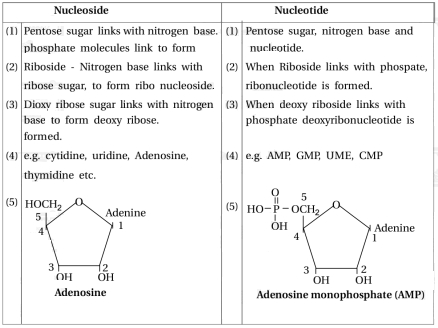
(N/A) The differences between a nucleoside and a nucleotide are as follows:
| Feature | Nucleoside | Nucleotide |
| :--- | :--- | :--- |
| Composition | Formed by the linkage of a pentose sugar and a nitrogenous base. | Formed by the linkage of a pentose sugar,a nitrogenous base,and a phosphate group. |
| Formation | $A$ nitrogenous base links with a ribose sugar to form a ribonucleoside. | When a ribonucleoside links with a phosphate group,a ribonucleotide is formed. |
| Deoxy form | $A$ nitrogenous base links with a deoxyribose sugar to form a deoxyribonucleoside. | When a deoxyribonucleoside links with a phosphate group,a deoxyribonucleotide is formed. |
| Examples | Cytidine,Uridine,Adenosine,Thymidine. | $AMP$,$GMP$,$UMP$,$CMP$. |
| Structure | Consists of a sugar and a base (e.g.,Adenosine). | Consists of a sugar,a base,and a phosphate group (e.g.,Adenosine monophosphate or $AMP$). |
| Feature | Nucleoside | Nucleotide |
| :--- | :--- | :--- |
| Composition | Formed by the linkage of a pentose sugar and a nitrogenous base. | Formed by the linkage of a pentose sugar,a nitrogenous base,and a phosphate group. |
| Formation | $A$ nitrogenous base links with a ribose sugar to form a ribonucleoside. | When a ribonucleoside links with a phosphate group,a ribonucleotide is formed. |
| Deoxy form | $A$ nitrogenous base links with a deoxyribose sugar to form a deoxyribonucleoside. | When a deoxyribonucleoside links with a phosphate group,a deoxyribonucleotide is formed. |
| Examples | Cytidine,Uridine,Adenosine,Thymidine. | $AMP$,$GMP$,$UMP$,$CMP$. |
| Structure | Consists of a sugar and a base (e.g.,Adenosine). | Consists of a sugar,a base,and a phosphate group (e.g.,Adenosine monophosphate or $AMP$). |
0 likes
View Solution160
Easy
Provide definitions/explanations for the following terms:
$(i)$ Nucleic acid
$(ii)$ Peptide bond
$(i)$ Nucleic acid
$(ii)$ Peptide bond
Solution
(N/A) $(i)$ Nucleic acids are macromolecules formed by the polymerization of nucleotides. Each nucleotide consists of three components: a nitrogenous base (heterocyclic compound),a pentose sugar (monosaccharide),and a phosphoric acid group.
$(ii)$ $A$ peptide bond is a chemical bond formed between the carboxyl group $(-COOH)$ of one amino acid and the amino group $(-NH_2)$ of the adjacent amino acid. This linkage occurs through a dehydration synthesis process,where a molecule of water is eliminated.
$(ii)$ $A$ peptide bond is a chemical bond formed between the carboxyl group $(-COOH)$ of one amino acid and the amino group $(-NH_2)$ of the adjacent amino acid. This linkage occurs through a dehydration synthesis process,where a molecule of water is eliminated.
0 likes
View Solution161
Easy
Provide the full names for the following abbreviations:
$(i)$ $ATP$
$(ii)$ $DNA$
$(iii)$ $RNA$
$(i)$ $ATP$
$(ii)$ $DNA$
$(iii)$ $RNA$
Solution
(N/A) $(i)$ $ATP$: Adenosine triphosphate
$(ii)$ $DNA$: Deoxyribonucleic acid
$(iii)$ $RNA$: Ribonucleic acid
$(ii)$ $DNA$: Deoxyribonucleic acid
$(iii)$ $RNA$: Ribonucleic acid
0 likes
View Solution162
Easy
Group the following as nitrogenous bases and nucleosides:
Adenine,Cytidine,Thymine,Guanosine,Uracil and Cytosine.
Adenine,Cytidine,Thymine,Guanosine,Uracil and Cytosine.
Solution
(N/A) Nitrogenous bases are organic molecules containing nitrogen that form the building blocks of nucleotides. In the given list,adenine,thymine,uracil,and cytosine are nitrogenous bases.
Nucleosides are compounds formed by the attachment of a nitrogenous base to a sugar molecule (ribose or deoxyribose). In the given list,cytidine (cytosine + sugar) and guanosine (guanine + sugar) are nucleosides.
Nucleosides are compounds formed by the attachment of a nitrogenous base to a sugar molecule (ribose or deoxyribose). In the given list,cytidine (cytosine + sugar) and guanosine (guanine + sugar) are nucleosides.
0 likes
View Solution163
Easy
Nucleic acids exhibit secondary structure. Justify with an example.
Solution
(N/A) Nucleic acids are polymeric macromolecules essential for the origin of life. The secondary structure of a nucleic acid refers to the spatial arrangement of the polynucleotide chain. $DNA$ and $RNA$ are the primary nucleic acids,and they differ significantly in their secondary structures. For example,the secondary structure of $DNA$ consists of two complementary polydeoxyribonucleotide strands that coil around a common axis to form a double-helical structure. This double-helical structure is stabilized by hydrogen bonds between complementary nitrogenous bases and hydrophobic interactions between stacked base pairs.
0 likes
View Solution164
Medium
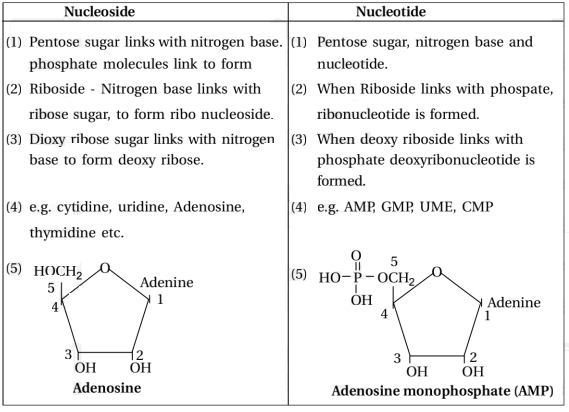
What is the difference between a nucleotide and nucleoside? Give two examples of each with their structure.
Solution
(N/A) nucleoside is formed by the combination of a pentose sugar and a nitrogenous base. In contrast,a nucleotide is formed when a nucleoside is linked to a phosphate group.
Key differences:
$1$. Composition: Nucleoside = Sugar + Nitrogen base; Nucleotide = Sugar + Nitrogen base + Phosphate group.
$2$. Examples of Nucleosides: Adenosine,Guanosine.
$3$. Examples of Nucleotides: Adenylic acid $(AMP)$,Guanylic acid $(GMP)$.
Structure:
- Adenosine (Nucleoside): Consists of Adenine attached to a ribose sugar at the $1'$ position.
- Adenosine monophosphate $(AMP)$ (Nucleotide): Consists of Adenine attached to a ribose sugar at the $1'$ position,with a phosphate group attached to the $5'$ carbon of the sugar.
Key differences:
$1$. Composition: Nucleoside = Sugar + Nitrogen base; Nucleotide = Sugar + Nitrogen base + Phosphate group.
$2$. Examples of Nucleosides: Adenosine,Guanosine.
$3$. Examples of Nucleotides: Adenylic acid $(AMP)$,Guanylic acid $(GMP)$.
Structure:
- Adenosine (Nucleoside): Consists of Adenine attached to a ribose sugar at the $1'$ position.
- Adenosine monophosphate $(AMP)$ (Nucleotide): Consists of Adenine attached to a ribose sugar at the $1'$ position,with a phosphate group attached to the $5'$ carbon of the sugar.
0 likes
View Solution165
MediumMCQ
If a nucleic acid contains deoxyribose in its structure,it is called $DNA$ or $RNA$?
A
$DNA$
B
$RNA$
C
Both $DNA$ and $RNA$
D
Neither $DNA$ nor $RNA$
Solution
(A) Nucleic acids are polymers of nucleotides. $DNA$ (Deoxyribonucleic acid) contains the pentose sugar deoxyribose,while $RNA$ (Ribonucleic acid) contains the pentose sugar ribose. Therefore,a nucleic acid containing deoxyribose is $DNA$.
0 likes
View Solution166
Medium
Provide the full names for the following abbreviations:
$(1)$ $GTP$
$(2)$ $GDP$
$(1)$ $GTP$
$(2)$ $GDP$
Solution
(N/A) $(1)$ $GTP$ stands for Guanosine Triphosphate. It is a purine nucleoside triphosphate that serves as an energy source or activator of substrates in metabolic reactions.
$(2)$ $GDP$ stands for Guanosine Diphosphate. It is a nucleoside diphosphate that is formed when $GTP$ loses a phosphate group,often during energy-releasing processes.
$(2)$ $GDP$ stands for Guanosine Diphosphate. It is a nucleoside diphosphate that is formed when $GTP$ loses a phosphate group,often during energy-releasing processes.
0 likes
View Solution167
Medium
Distinguish between: Nucleoside and Nucleotide.
Solution
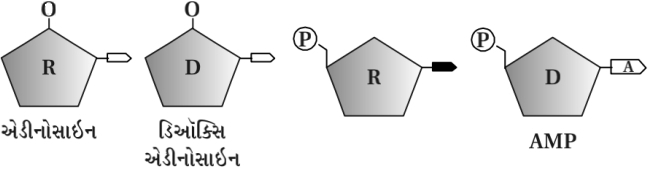
| Nucleoside | Nucleotide |
|---|---|
| $(1)$ $A$ nitrogenous base is linked to the $1^o$ carbon of a pentose sugar through an $N$-glycosidic linkage to form a nucleoside. | $(1)$ When a phosphate group is linked to the $5'$-$OH$ of a nucleoside through a phosphoester linkage,a corresponding nucleotide is formed. |
| $(2)$ Consists of a nitrogenous base and a pentose sugar. | $(2)$ Consists of a nitrogenous base,a pentose sugar,and a phosphate group. |
0 likes
View Solution168
MediumMCQ
Which of the following are nucleic acids?
A
$DNA$
B
$RNA$
C
Proteins
D
Both $A$ and $B$
Solution
(D) Nucleic acids are large biomolecules that play essential roles in all cells and viruses. The two primary types of nucleic acids are Deoxyribonucleic acid $(DNA)$ and Ribonucleic acid $(RNA)$.
$DNA$ serves as the genetic material in most organisms,while $RNA$ is involved in protein synthesis and gene regulation.
Proteins are polymers of amino acids,not nucleic acids.
Therefore,both $DNA$ and $RNA$ are nucleic acids.
$DNA$ serves as the genetic material in most organisms,while $RNA$ is involved in protein synthesis and gene regulation.
Proteins are polymers of amino acids,not nucleic acids.
Therefore,both $DNA$ and $RNA$ are nucleic acids.
0 likes
View Solution169
MediumMCQ
How many components does a nucleotide consist of?
A
One
B
Two
C
Three
D
Four
Solution
(C) nucleotide is the basic structural unit of nucleic acids like $DNA$ and $RNA$. It consists of three distinct chemical components:
$1$. $A$ nitrogenous base (purine or pyrimidine).
$2$. $A$ pentose sugar (deoxyribose in $DNA$ or ribose in $RNA$).
$3$. $A$ phosphate group.
Therefore,the correct answer is $3$.
$1$. $A$ nitrogenous base (purine or pyrimidine).
$2$. $A$ pentose sugar (deoxyribose in $DNA$ or ribose in $RNA$).
$3$. $A$ phosphate group.
Therefore,the correct answer is $3$.
0 likes
View Solution170
MediumMCQ
Select the correct option for a nucleotide.
A
Pentose sugar
B
Pentose sugar + Nitrogenous base
C
Nitrogenous base
D
Pentose sugar + Nitrogenous base + Phosphate group
Solution
(D) nucleotide is the basic structural unit of nucleic acids like $DNA$ and $RNA$.
It consists of three essential components:
$1$. $A$ pentose sugar (ribose in $RNA$ or deoxyribose in $DNA$).
$2$. $A$ nitrogenous base (purine or pyrimidine).
$3$. $A$ phosphate group.
When a pentose sugar is linked only to a nitrogenous base,it is called a nucleoside. When a phosphate group is added to a nucleoside,it becomes a nucleotide.
It consists of three essential components:
$1$. $A$ pentose sugar (ribose in $RNA$ or deoxyribose in $DNA$).
$2$. $A$ nitrogenous base (purine or pyrimidine).
$3$. $A$ phosphate group.
When a pentose sugar is linked only to a nitrogenous base,it is called a nucleoside. When a phosphate group is added to a nucleoside,it becomes a nucleotide.
0 likes
View Solution171
MediumMCQ
Select the correct option for a nucleoside.
A
Pentose sugar
B
Pentose sugar + Nitrogenous base
C
Nitrogenous base
D
Pentose sugar + Nitrogenous base + Phosphate
Solution
(B) nucleoside is a chemical compound formed by the combination of a pentose sugar and a nitrogenous base.
When a phosphate group is added to a nucleoside, it forms a nucleotide.
Therefore, the correct composition of a nucleoside is $Pentose \text{ } sugar + Nitrogenous \text{ } base$.
When a phosphate group is added to a nucleoside, it forms a nucleotide.
Therefore, the correct composition of a nucleoside is $Pentose \text{ } sugar + Nitrogenous \text{ } base$.
0 likes
View Solution172
MediumMCQ
Which of the following is not a pyrimidine nitrogenous base?
A
Uracil
B
Thymine
C
Cytosine
D
Guanine
Solution
(D) Nitrogenous bases in nucleic acids are classified into two types: purines and pyrimidines.
Purines include Adenine $(A)$ and Guanine $(G)$,which are double-ring structures.
Pyrimidines include Cytosine $(C)$,Thymine $(T)$,and Uracil $(U)$,which are single-ring structures.
Since Guanine is a purine,it is not a pyrimidine.
Purines include Adenine $(A)$ and Guanine $(G)$,which are double-ring structures.
Pyrimidines include Cytosine $(C)$,Thymine $(T)$,and Uracil $(U)$,which are single-ring structures.
Since Guanine is a purine,it is not a pyrimidine.
0 likes
View Solution173
MediumMCQ
Which bond connects the phosphate group to the pentose sugar in a nucleotide?
A
Phosphoester bond
B
Phosphodiester bond
C
Glycosidic bond
D
Peptide bond
Solution
(A) In a nucleotide,the phosphate group is attached to the $5'$-carbon of the pentose sugar through a phosphoester bond.
This bond is formed by the reaction between the hydroxyl group of the sugar and the phosphoric acid.
Note that a phosphodiester bond connects two nucleotides together,whereas the bond between a single phosphate and its sugar is a phosphoester bond.
This bond is formed by the reaction between the hydroxyl group of the sugar and the phosphoric acid.
Note that a phosphodiester bond connects two nucleotides together,whereas the bond between a single phosphate and its sugar is a phosphoester bond.
0 likes
View Solution174
MediumMCQ
Which of the following is a nucleoside?
A
Guanylic acid
B
Adenosine
C
Uridylic acid
D
Cytidylic acid
Solution
(B) nucleoside is formed by the combination of a nitrogenous base and a pentose sugar.
Nucleotides are formed when a phosphate group is added to a nucleoside.
$1$. Guanylic acid,Uridylic acid,and Cytidylic acid are nucleotides because they contain a phosphate group.
$2$. Adenosine is a nucleoside formed by the combination of the nitrogenous base Adenine and the sugar Ribose (or Deoxyribose).
Therefore,the correct option is $B$.
Nucleotides are formed when a phosphate group is added to a nucleoside.
$1$. Guanylic acid,Uridylic acid,and Cytidylic acid are nucleotides because they contain a phosphate group.
$2$. Adenosine is a nucleoside formed by the combination of the nitrogenous base Adenine and the sugar Ribose (or Deoxyribose).
Therefore,the correct option is $B$.
0 likes
View Solution175
MediumMCQ
Choose the correct option for $AMP$.
A
Adenosine monopurine
B
Adenine microphosphate
C
Adenosine monophosphate
D
Adenine monophosphate
Solution
(C) $AMP$ stands for Adenosine monophosphate.
It is a nucleotide consisting of an adenine base,a ribose sugar,and a single phosphate group.
It is formed by the hydrolysis of $ATP$ (Adenosine triphosphate) or $ADP$ (Adenosine diphosphate) in biological systems.
Therefore,the correct option is $C$.
It is a nucleotide consisting of an adenine base,a ribose sugar,and a single phosphate group.
It is formed by the hydrolysis of $ATP$ (Adenosine triphosphate) or $ADP$ (Adenosine diphosphate) in biological systems.
Therefore,the correct option is $C$.
0 likes
View Solution176
MediumMCQ
Which structure is not possible?
A
$AMP$
B
$CMP$
C
$TMP$
D
$GMP$
Solution
(C) In $DNA$,the nitrogenous bases are Adenine $(A)$,Guanine $(G)$,Cytosine $(C)$,and Thymine $(T)$.
Nucleotides are formed by the combination of a nitrogenous base,a pentose sugar (deoxyribose in $DNA$),and a phosphate group.
$AMP$ stands for Adenosine monophosphate,$CMP$ for Cytidine monophosphate,and $GMP$ for Guanosine monophosphate,which are all valid nucleotides found in $DNA$ or $RNA$.
$TMP$ stands for Thymidine monophosphate. In $DNA$,the nucleotide containing Thymine is specifically called Deoxythymidine monophosphate $(dTMP)$.
Since $DNA$ contains deoxyribose sugar,the term $TMP$ is technically incorrect as it implies the presence of ribose sugar (as in $RNA$),where Thymine is replaced by Uracil $(U)$. Therefore,$TMP$ is not a standard structure found in $DNA$ nomenclature.
Nucleotides are formed by the combination of a nitrogenous base,a pentose sugar (deoxyribose in $DNA$),and a phosphate group.
$AMP$ stands for Adenosine monophosphate,$CMP$ for Cytidine monophosphate,and $GMP$ for Guanosine monophosphate,which are all valid nucleotides found in $DNA$ or $RNA$.
$TMP$ stands for Thymidine monophosphate. In $DNA$,the nucleotide containing Thymine is specifically called Deoxythymidine monophosphate $(dTMP)$.
Since $DNA$ contains deoxyribose sugar,the term $TMP$ is technically incorrect as it implies the presence of ribose sugar (as in $RNA$),where Thymine is replaced by Uracil $(U)$. Therefore,$TMP$ is not a standard structure found in $DNA$ nomenclature.
0 likes
View Solution177
MediumMCQ
Which bond connects two nucleotides?
A
Phosphoester bond
B
$N$-glycosidic bond
C
Phosphodiester bond
D
Hydrogen bond
Solution
(C) In a $DNA$ or $RNA$ molecule,nucleotides are linked together to form a polynucleotide chain.
This linkage occurs between the $3'$-carbon atom of the sugar molecule of one nucleotide and the $5'$-carbon atom of the sugar molecule of the adjacent nucleotide through a phosphate group.
This specific covalent linkage is known as a $3'-5'$ phosphodiester bond.
This linkage occurs between the $3'$-carbon atom of the sugar molecule of one nucleotide and the $5'$-carbon atom of the sugar molecule of the adjacent nucleotide through a phosphate group.
This specific covalent linkage is known as a $3'-5'$ phosphodiester bond.
0 likes
View Solution178
MediumMCQ
Which of the following structures is not possible?
A
Adenylic acid
B
Deoxyguanylic acid
C
Deoxycytidylic acid
D
Deoxyuridylic acid
Solution
(D) In $DNA$,the nitrogenous bases present are Adenine $(A)$,Guanine $(G)$,Cytosine $(C)$,and Thymine $(T)$.
$RNA$ contains Uracil $(U)$ instead of Thymine $(T)$.
Deoxyribose sugar is the characteristic sugar of $DNA$,while Ribose sugar is found in $RNA$.
Therefore,'Deoxyuridylic acid' is not possible because Uracil is typically associated with Ribose sugar in $RNA$ (forming Uridylic acid),not with Deoxyribose sugar in $DNA$.
$RNA$ contains Uracil $(U)$ instead of Thymine $(T)$.
Deoxyribose sugar is the characteristic sugar of $DNA$,while Ribose sugar is found in $RNA$.
Therefore,'Deoxyuridylic acid' is not possible because Uracil is typically associated with Ribose sugar in $RNA$ (forming Uridylic acid),not with Deoxyribose sugar in $DNA$.
0 likes
View Solution179
MediumMCQ
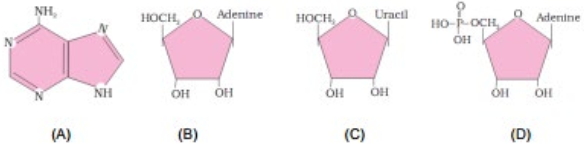
Identify the nucleosides from the given structures:
A
$A$ and $B$
B
$B$ and $C$
C
$C$ and $D$
D
$D$ and $A$
Solution
(B) nucleoside is formed by the attachment of a nitrogenous base to a sugar molecule (pentose sugar).
Structure $A$ represents a nitrogenous base (Adenine).
Structure $B$ represents a nucleoside (Adenosine),consisting of a sugar and Adenine.
Structure $C$ represents a nucleoside (Uridine),consisting of a sugar and Uracil.
Structure $D$ represents a nucleotide (Adenosine monophosphate),consisting of a sugar,Adenine,and a phosphate group.
Therefore,structures $B$ and $C$ are nucleosides. The correct option is $(B)$.
Structure $A$ represents a nitrogenous base (Adenine).
Structure $B$ represents a nucleoside (Adenosine),consisting of a sugar and Adenine.
Structure $C$ represents a nucleoside (Uridine),consisting of a sugar and Uracil.
Structure $D$ represents a nucleotide (Adenosine monophosphate),consisting of a sugar,Adenine,and a phosphate group.
Therefore,structures $B$ and $C$ are nucleosides. The correct option is $(B)$.
0 likes
View Solution180
DifficultMCQ
Which of the following is a nucleoside?
A
Adenosine,Adenylic acid,Cytosine
B
Adenosine,Guanosine,Cytidine
C
Cytidylic acid,Adenosine,Adenylic acid
D
Guanylic acid,Cytosine,Adenosine
Solution
(B) nucleoside is composed of a nitrogenous base and a pentose sugar (ribose or deoxyribose).
It does not contain a phosphate group.
Nucleotides are formed when a phosphate group is attached to a nucleoside.
Among the given options,Adenosine,Guanosine,and Cytidine are nucleosides,whereas Adenylic acid,Cytidylic acid,and Guanylic acid are nucleotides.
It does not contain a phosphate group.
Nucleotides are formed when a phosphate group is attached to a nucleoside.
Among the given options,Adenosine,Guanosine,and Cytidine are nucleosides,whereas Adenylic acid,Cytidylic acid,and Guanylic acid are nucleotides.
0 likes
View Solution181
MediumMCQ
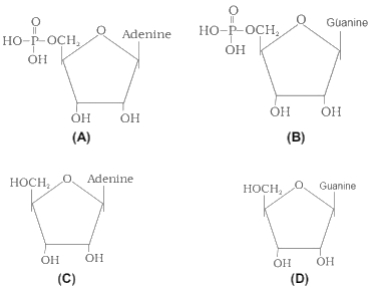
Which two are nucleotides?
A
$A \& B$
B
$C \& D$
C
$A \& D$
D
$B \& C$
Solution
(A) nucleotide consists of three components: a nitrogenous base,a pentose sugar,and a phosphate group.
In the provided image,structures $(A)$ and $(B)$ contain a phosphate group attached to the sugar-base complex,making them nucleotides.
Structures $(C)$ and $(D)$ lack the phosphate group and are therefore nucleosides.
Thus,$(A)$ and $(B)$ are the correct nucleotides.
In the provided image,structures $(A)$ and $(B)$ contain a phosphate group attached to the sugar-base complex,making them nucleotides.
Structures $(C)$ and $(D)$ lack the phosphate group and are therefore nucleosides.
Thus,$(A)$ and $(B)$ are the correct nucleotides.
0 likes
View Solution182
MediumMCQ
Which of the following are all Nucleotides?
A
Adenosine, Cytidilic acid, Cytosine
B
Adenylic acid, Cytidilic acid, Guanylic acid
C
Cytidine, Adenine, Adenylic acid
D
Uracil, Thymidine, Thymidylic acid
Solution
(B) Nucleotides are the fundamental building blocks of nucleic acids ($DNA$ and $RNA$).
$A$ nucleotide consists of a nitrogenous base, a pentose sugar, and a phosphate group.
$Adenylic$ $acid$, $cytidilic$ $acid$, and $guanylic$ $acid$ are all examples of nucleotides because they contain a nitrogenous base, a sugar, and a phosphate group.
In contrast, $Adenosine$, $Cytidine$, and $Thymidine$ are nucleosides (base + sugar), while $Adenine$, $Cytosine$, $Uracil$, and $Thymine$ are nitrogenous bases.
$A$ nucleotide consists of a nitrogenous base, a pentose sugar, and a phosphate group.
$Adenylic$ $acid$, $cytidilic$ $acid$, and $guanylic$ $acid$ are all examples of nucleotides because they contain a nitrogenous base, a sugar, and a phosphate group.
In contrast, $Adenosine$, $Cytidine$, and $Thymidine$ are nucleosides (base + sugar), while $Adenine$, $Cytosine$, $Uracil$, and $Thymine$ are nitrogenous bases.
0 likes
View Solution183
MediumMCQ
Nucleic acids are:
A
Polymers of nucleotides
B
Polymers of nucleosides
C
Polymers of purine bases through phosphate ester bonds
D
Phosphate ester bonds
Solution
(A) Nucleic acids ($RNA$ and $DNA$) are long-chain polymers composed of repeating units called nucleotides.
Each nucleotide consists of a nitrogenous base,a pentose sugar,and a phosphate group.
Therefore,they are correctly defined as polymers of nucleotides.
Each nucleotide consists of a nitrogenous base,a pentose sugar,and a phosphate group.
Therefore,they are correctly defined as polymers of nucleotides.
0 likes
View Solution184
MediumMCQ
The presence or absence of hydroxyl group on which carbon atom of sugar differentiates $RNA$ and $DNA$?
A
$1^{\text{st}}$
B
$2^{\text{nd}}$
C
$3^{\text{rd}}$
D
$4^{\text{th}}$
Solution
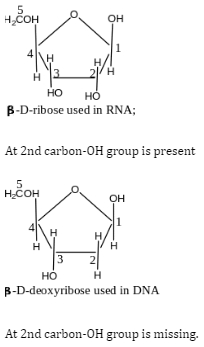
(B) The sugar present in $RNA$ is ribose,while the sugar present in $DNA$ is $2'$-deoxyribose.
In $\beta$-$D$-ribose (found in $RNA$),there is a hydroxyl $(-OH)$ group attached to the $2^{\text{nd}}$ carbon atom.
In $\beta$-$D$-deoxyribose (found in $DNA$),the hydroxyl group is absent at the $2^{\text{nd}}$ carbon atom,and only a hydrogen atom is present.
Therefore,the presence or absence of the hydroxyl group at the $2^{\text{nd}}$ carbon atom differentiates $RNA$ and $DNA$.
In $\beta$-$D$-ribose (found in $RNA$),there is a hydroxyl $(-OH)$ group attached to the $2^{\text{nd}}$ carbon atom.
In $\beta$-$D$-deoxyribose (found in $DNA$),the hydroxyl group is absent at the $2^{\text{nd}}$ carbon atom,and only a hydrogen atom is present.
Therefore,the presence or absence of the hydroxyl group at the $2^{\text{nd}}$ carbon atom differentiates $RNA$ and $DNA$.
0 likes
View Solution185
MediumMCQ
Adenosine is an example of:
A
Nucleotide
B
Nucleoside
C
Purine base
D
Pyrimidine base
Solution
(B) nucleoside is formed by the combination of a nitrogenous base and a pentose sugar. Adenosine is formed when the nitrogenous base adenine is linked to the sugar ribose. Therefore,adenosine is a nucleoside.
0 likes
View Solution186
EasyMCQ
The pentose sugar present in $RNA$ is
A
Galactose
B
Sucrose
C
Ribose
D
Fructose
Solution
(C) $RNA$ (Ribonucleic acid) contains a pentose sugar known as Ribose.
Deoxyribose is the pentose sugar found in $DNA$ (Deoxyribonucleic acid).
Deoxyribose is the pentose sugar found in $DNA$ (Deoxyribonucleic acid).
0 likes
View Solution187
MediumMCQ
Ribozymes are . . . . . . that behave like enzymes.
A
Proteins
B
Ribonucleic acids
C
Oligosaccharide
D
Simple lipids
Solution
(B) Ribozymes are $RNA$ molecules that possess catalytic activity and behave like enzymes.
Unlike most enzymes which are proteins,ribozymes are composed of ribonucleic acids.
Unlike most enzymes which are proteins,ribozymes are composed of ribonucleic acids.
0 likes
View Solution188
MediumMCQ
Nucleic acids exhibit
A
Secondary structure
B
Tertiary structure
C
Quaternary structure
D
Both $(b)$ and $(c)$
Solution
(A) Nucleic acids,such as $DNA$,primarily exhibit a secondary structure.
This is characterized by the double helical model proposed by Watson and Crick,where two polynucleotide chains are coiled around a common axis.
While some complex RNAs can fold into tertiary structures,the fundamental structural classification for nucleic acids in the context of biomolecules is the secondary structure.
This is characterized by the double helical model proposed by Watson and Crick,where two polynucleotide chains are coiled around a common axis.
While some complex RNAs can fold into tertiary structures,the fundamental structural classification for nucleic acids in the context of biomolecules is the secondary structure.
0 likes
View Solution189
EasyMCQ
Name the elements which occur in nucleic acid macromolecules.
A
$C, H, O, N, S$
B
$C, O, N, S$
C
$C, O, P, S$
D
$C, H, O, N, P$
Solution
(D) Nucleic acids ($DNA$ and $RNA$) are macromolecules and polymers of nucleotides.
Each nucleotide consists of three main components: a nitrogenous base,a pentose sugar,and a phosphate group.
The nitrogenous base contains carbon,hydrogen,nitrogen,and oxygen.
The pentose sugar contains carbon,hydrogen,and oxygen.
The phosphate group contains phosphorus and oxygen.
Therefore,the elements present in nucleic acid macromolecules are carbon $(C)$,hydrogen $(H)$,oxygen $(O)$,nitrogen $(N)$,and phosphorus $(P)$.
Each nucleotide consists of three main components: a nitrogenous base,a pentose sugar,and a phosphate group.
The nitrogenous base contains carbon,hydrogen,nitrogen,and oxygen.
The pentose sugar contains carbon,hydrogen,and oxygen.
The phosphate group contains phosphorus and oxygen.
Therefore,the elements present in nucleic acid macromolecules are carbon $(C)$,hydrogen $(H)$,oxygen $(O)$,nitrogen $(N)$,and phosphorus $(P)$.
0 likes
View Solution190
EasyMCQ
In terms of $DNA$ and $RNA$ structure,what is a nucleotide?
A
$A$ nucleotide is a heterocyclic base.
B
$A$ nucleotide is a sugar molecule covalently bonded to a heterocyclic base.
C
$A$ nucleotide is a sugar molecule bonded to a phosphate group and a heterocyclic base.
D
$A$ nucleotide is a heterocyclic base bonded to a phosphate group.
Solution
(C) nucleoside is composed of a sugar molecule and a heterocyclic base.
In contrast,a nucleotide is composed of three components: a sugar molecule,a phosphate group,and a heterocyclic base.
In contrast,a nucleotide is composed of three components: a sugar molecule,a phosphate group,and a heterocyclic base.
0 likes
View Solution191
MediumMCQ
Cytidine is a
A
Nucleoside
B
Nitrogen base
C
Nucleotide
D
Common dinucleotide in $DNA$ and $RNA$
Solution
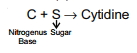
(A) nucleoside is formed by the combination of a nitrogenous base and a pentose sugar.
Cytidine is formed when the nitrogenous base Cytosine $(C)$ combines with a pentose sugar $(S)$.
Since it consists only of a nitrogenous base and a sugar,it is classified as a nucleoside.
Therefore,the correct option is $A$.
Cytidine is formed when the nitrogenous base Cytosine $(C)$ combines with a pentose sugar $(S)$.
Since it consists only of a nitrogenous base and a sugar,it is classified as a nucleoside.
Therefore,the correct option is $A$.
0 likes
View Solution192
MediumMCQ
Select the correct option from the following.
A
Nucleoside $+$ Phosphate $=$ Nucleotide
B
Nucleotide $+$ Phosphate $=$ Nucleoside
C
Nucleoside $+$ Sugar $=$ Nucleotide
D
Nucleotide $+$ Sugar $=$ Nucleoside
Solution
(A) $Nucleoside$ is formed by the combination of a nitrogenous base and a pentose sugar.
When a phosphate group is added to a $Nucleoside$,it forms a $Nucleotide$.
Therefore,the correct relationship is: $Nucleoside + Phosphate = Nucleotide$.
When a phosphate group is added to a $Nucleoside$,it forms a $Nucleotide$.
Therefore,the correct relationship is: $Nucleoside + Phosphate = Nucleotide$.
0 likes
View Solution193
MediumMCQ
Adenosine,guanosine,uridine,and cytidine are $...........$.
A
Nucleotides for $RNA$
B
Nucleosides for $RNA$
C
Nucleosides for $DNA$
D
Nucleotides for $DNA$
Solution
(B) nucleoside is formed by the combination of a nitrogenous base and a pentose sugar.
Adenosine,guanosine,uridine,and cytidine are formed by the combination of nitrogenous bases (adenine,guanine,uracil,and cytosine,respectively) with ribose sugar.
Since these contain ribose sugar,they are the nucleosides of $RNA$.
In $DNA$,the corresponding nucleosides are deoxyadenosine,deoxyguanosine,deoxythymidine,and deoxycytidine.
Adenosine,guanosine,uridine,and cytidine are formed by the combination of nitrogenous bases (adenine,guanine,uracil,and cytosine,respectively) with ribose sugar.
Since these contain ribose sugar,they are the nucleosides of $RNA$.
In $DNA$,the corresponding nucleosides are deoxyadenosine,deoxyguanosine,deoxythymidine,and deoxycytidine.
0 likes
View Solution194
MediumMCQ
Adenylic acid,uridylic acid,guanylic acid,and cytidylic acid are $.........$.
A
Nucleotides of $RNA$
B
Nucleosides of $RNA$
C
Nucleosides of $DNA$
D
Nucleotides of $DNA$
Solution
(A) nucleotide is composed of a nitrogenous base,a pentose sugar,and a phosphate group.
When a nitrogenous base is linked to a pentose sugar,it forms a nucleoside.
When a phosphate group is added to a nucleoside,it forms a nucleotide.
Adenylic acid,uridylic acid,guanylic acid,and cytidylic acid are the phosphorylated forms of adenosine,uridine,guanosine,and cytidine,respectively.
These are the constituent nucleotides of $RNA$ (Ribonucleic acid),as they contain the sugar ribose and the base uracil instead of thymine.
When a nitrogenous base is linked to a pentose sugar,it forms a nucleoside.
When a phosphate group is added to a nucleoside,it forms a nucleotide.
Adenylic acid,uridylic acid,guanylic acid,and cytidylic acid are the phosphorylated forms of adenosine,uridine,guanosine,and cytidine,respectively.
These are the constituent nucleotides of $RNA$ (Ribonucleic acid),as they contain the sugar ribose and the base uracil instead of thymine.
0 likes
View Solution195
MediumMCQ
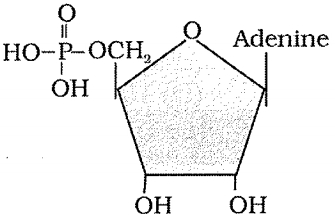
Choose the correct option for the given structure.
A
Adenosine - $RNA, DNA$
B
Adenylic acid - $RNA$
C
Deoxyadenylic acid - $DNA$
D
Adenylic acid - $RNA, DNA$
Solution
(B) The given structure shows a nitrogenous base (Adenine) attached to a pentose sugar,which has a hydroxyl $(-OH)$ group at the $2'$ position.
This indicates that the sugar is ribose,making the molecule a ribonucleotide.
$A$ nucleotide consisting of adenine,ribose sugar,and a phosphate group is called adenylic acid (or adenosine monophosphate).
Since it contains ribose sugar,it is a component of $RNA$.
This indicates that the sugar is ribose,making the molecule a ribonucleotide.
$A$ nucleotide consisting of adenine,ribose sugar,and a phosphate group is called adenylic acid (or adenosine monophosphate).
Since it contains ribose sugar,it is a component of $RNA$.
0 likes
View Solution196
MediumMCQ
$DNA$ is displayed at the ....... level.
A
Primary
B
Secondary
C
Tertiary
D
Quaternary
Solution
(B) The structure of $DNA$ is famously described as a double helix,which represents its secondary structure.
In the context of biological macromolecules,the primary structure refers to the sequence of nucleotides.
The secondary structure refers to the spatial arrangement of the polynucleotide chain,such as the double-helical structure of $DNA$ stabilized by hydrogen bonding between complementary base pairs.
Therefore,$DNA$ is typically displayed and studied at the secondary level.
In the context of biological macromolecules,the primary structure refers to the sequence of nucleotides.
The secondary structure refers to the spatial arrangement of the polynucleotide chain,such as the double-helical structure of $DNA$ stabilized by hydrogen bonding between complementary base pairs.
Therefore,$DNA$ is typically displayed and studied at the secondary level.
0 likes
View Solution197
EasyMCQ
Which of the following is a structural component of genetic material?
A
Calcium
B
Phosphorus
C
Potassium
D
Magnesium
Solution
(B) Genetic material,such as $DNA$ and $RNA$,consists of nucleotides.
Each nucleotide is composed of a nitrogenous base,a pentose sugar,and a phosphate group.
Phosphorus is a key element in the phosphate backbone of these nucleic acids.
Therefore,phosphorus is an essential structural component of genetic material.
Each nucleotide is composed of a nitrogenous base,a pentose sugar,and a phosphate group.
Phosphorus is a key element in the phosphate backbone of these nucleic acids.
Therefore,phosphorus is an essential structural component of genetic material.
0 likes
View Solution198
MediumMCQ
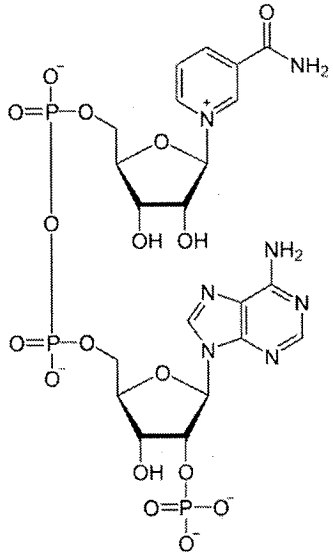
Identify the structure given below.
A
$NAD$
B
$NADP$
C
$FMN$
D
$FAD$
Solution
(B) The provided chemical structure shows a nicotinamide adenine dinucleotide phosphate $(NADP^+)$ molecule.
It consists of two nucleotides joined by a phosphate group.
One nucleotide contains a nicotinamide ring,and the other contains an adenine base.
Crucially,there is an additional phosphate group attached to the $2'$ carbon of the ribose sugar associated with the adenine base,which distinguishes $NADP^+$ from $NAD^+$.
Therefore,the correct structure is $NADP$.
It consists of two nucleotides joined by a phosphate group.
One nucleotide contains a nicotinamide ring,and the other contains an adenine base.
Crucially,there is an additional phosphate group attached to the $2'$ carbon of the ribose sugar associated with the adenine base,which distinguishes $NADP^+$ from $NAD^+$.
Therefore,the correct structure is $NADP$.
0 likes
View Solution199
EasyMCQ
$A$ nucleotide is composed of:
A
Sugar + Base
B
Sugar + Base + Phosphate
C
Base + Phosphate
D
Sugar + Phosphate
Solution
(B) nucleotide is the basic structural unit of nucleic acids ($DNA$ and $RNA$).
It consists of three components:
$1$. $A$ pentose sugar (ribose or deoxyribose).
$2$. $A$ nitrogenous base (purine or pyrimidine).
$3$. $A$ phosphate group.
When a sugar is linked to a nitrogenous base,it is called a nucleoside. When a phosphate group is added to a nucleoside,it forms a nucleotide.
It consists of three components:
$1$. $A$ pentose sugar (ribose or deoxyribose).
$2$. $A$ nitrogenous base (purine or pyrimidine).
$3$. $A$ phosphate group.
When a sugar is linked to a nitrogenous base,it is called a nucleoside. When a phosphate group is added to a nucleoside,it forms a nucleotide.
0 likes
View Solution200
EasyMCQ
Choose the correct option from the following.
A
Nucleoside = Nucleotide + Phosphate group
B
Nucleoside = Nucleotide + Nitrogenous base
C
Nucleoside = Nucleotide - Nitrogenous base
D
Nucleoside = Nucleotide - Phosphate group
Solution
(D) $Nucleotide$ is composed of three components: a nitrogenous base, a pentose sugar, and a phosphate group.
When the phosphate group is removed from a $Nucleotide$, the remaining structure is called a $Nucleoside$.
Therefore, the relationship is defined as: $Nucleoside = Nucleotide - \text{Phosphate group}$.
When the phosphate group is removed from a $Nucleotide$, the remaining structure is called a $Nucleoside$.
Therefore, the relationship is defined as: $Nucleoside = Nucleotide - \text{Phosphate group}$.
0 likes
View SolutionBiomolecules — Nucleic acids · Frequently Asked Questions
1Are these Biomolecules questions useful for JEE and NEET?
Yes. All questions in this section are mapped to JEE Main and NEET exam patterns. Previous year questions from JEE Main, NEET, GUJCET and state-level exams are included with full solutions.
2Can I switch to Hindi or Gujarati for these questions?
Yes. Use the language tabs in the hero section or the sidebar to view the same questions and solutions in English, Hindi or Gujarati.
3How do I generate a question paper from this subtopic?
Use the Vedclass Exam Paper Generator — select the chapter and subtopic, set difficulty, and generate Sets A, B, C, D automatically. First 3 chapters of every subject are free.
Vedclass Products
For Students
Vedclass Test Series
Mock tests in real JEE/NEET style with performance analysis. 5-day free trial.
Start Free TrialFor Teachers
Exam Paper Generator
Generate Set A/B/C/D papers from this chapter in 2 minutes. 3 chapters free.
Try FreeFor Institutes
Online Exam Module
Live online exams with unlimited students, 360° analytics & white-label branding.
See DemoFor Teachers & Institutes
Generate a Biomolecules Exam Paper in 2 Minutes
Select subtopic & difficulty — Sets A, B, C, D auto-generated with No Repeat logic.
First 3 chapters of every subject are free — no payment required.