
A English
Lipid Questions in English
Class 11 Biology · Biomolecules · Lipid
245+
Questions
English
Language
100%
With Solutions
Showing 50 of 245 questions in English
51
MediumMCQ
Assertion $A$: Fat is stored in the body as a reserve food material.
Reason $R$: Lipid is a nutrient with a high energy value.
Which option is correct for Assertion $A$ and Reason $R$?
Reason $R$: Lipid is a nutrient with a high energy value.
Which option is correct for Assertion $A$ and Reason $R$?
A
$A$ and $R$ are both true and $R$ is the correct explanation of $A$.
B
$A$ and $R$ are both true but $R$ is not the correct explanation of $A$.
C
$A$ is true and $R$ is false.
D
$A$ is false and $R$ is true.
Solution
(A) Assertion $A$ is true because fats are stored in adipose tissues as a long-term energy reserve in the body.
Reason $R$ is also true because lipids provide more energy per gram $(9.3 \ kcal/g)$ compared to carbohydrates or proteins $(4 \ kcal/g)$.
Since fats are highly energy-dense,they are the preferred form for long-term energy storage in the body. Therefore,$R$ is the correct explanation for $A$.
Reason $R$ is also true because lipids provide more energy per gram $(9.3 \ kcal/g)$ compared to carbohydrates or proteins $(4 \ kcal/g)$.
Since fats are highly energy-dense,they are the preferred form for long-term energy storage in the body. Therefore,$R$ is the correct explanation for $A$.
0 likes
View Solution52
MediumMCQ
What is the composition of wax?
A
$1$ glycerol and $1$ long-chain saturated fatty acid
B
$1$ glycerol and $1$ long-chain unsaturated fatty acid
C
$1$ monohydric alcohol and $1$ long-chain saturated fatty acid
D
$1$ monohydric alcohol and $1$ long-chain unsaturated fatty acid
Solution
(C) Waxes are esters formed by the reaction between a long-chain monohydric alcohol and a long-chain fatty acid.
Unlike triglycerides,which contain glycerol,waxes contain higher molecular weight monohydric alcohols.
Therefore,the correct composition is $1$ monohydric alcohol and $1$ long-chain fatty acid.
Unlike triglycerides,which contain glycerol,waxes contain higher molecular weight monohydric alcohols.
Therefore,the correct composition is $1$ monohydric alcohol and $1$ long-chain fatty acid.
0 likes
View Solution53
MediumMCQ
Sterone and sterol are distinguished based on the presence or absence of which group?
A
Carboxyl group
B
Keto group
C
Both $A$ and $B$
D
Amino group
Solution
(B) Steroids are a class of lipids characterized by a carbon skeleton with four fused rings.
Sterols (such as cholesterol) are a subgroup of steroids that contain a hydroxyl $(-OH)$ group at the $C-3$ position.
Sterones (such as progesterone or testosterone) are steroid hormones that contain a keto $(=O)$ group,typically at the $C-3$ position,instead of the hydroxyl group found in sterols.
Therefore,the presence or absence of a keto group is the primary distinguishing feature between sterones and sterols.
Sterols (such as cholesterol) are a subgroup of steroids that contain a hydroxyl $(-OH)$ group at the $C-3$ position.
Sterones (such as progesterone or testosterone) are steroid hormones that contain a keto $(=O)$ group,typically at the $C-3$ position,instead of the hydroxyl group found in sterols.
Therefore,the presence or absence of a keto group is the primary distinguishing feature between sterones and sterols.
0 likes
View Solution54
EasyMCQ
Which of the following molecules releases the highest amount of energy?
A
Carbohydrates
B
Proteins
C
Lipids
D
Peptides
Solution
(C) The energy content of biological molecules is measured in terms of calories per gram.
Lipids (fats) provide approximately $9.3 \ kcal/g$ of energy.
Carbohydrates and proteins provide approximately $4.1 \ kcal/g$ and $4.0 \ kcal/g$ of energy,respectively.
Therefore,lipids release the highest amount of energy per unit mass compared to carbohydrates,proteins,and peptides.
Lipids (fats) provide approximately $9.3 \ kcal/g$ of energy.
Carbohydrates and proteins provide approximately $4.1 \ kcal/g$ and $4.0 \ kcal/g$ of energy,respectively.
Therefore,lipids release the highest amount of energy per unit mass compared to carbohydrates,proteins,and peptides.
0 likes
View Solution55
EasyMCQ
Which type of lipid forms a protective layer on the outer surface of the aerial parts of plants?
A
Fats
B
Oils
C
Waxes
D
Steroids
Solution
(C) Waxes are a type of lipid that are esters of long-chain fatty acids with long-chain alcohols.
They are highly hydrophobic and form a protective coating known as the cuticle on the aerial parts of plants,such as leaves and stems.
This layer helps in reducing water loss through transpiration and protects the plant from mechanical injury and pathogens.
They are highly hydrophobic and form a protective coating known as the cuticle on the aerial parts of plants,such as leaves and stems.
This layer helps in reducing water loss through transpiration and protects the plant from mechanical injury and pathogens.
0 likes
View Solution56
MediumMCQ
What is present in higher amounts in vegetable ghee (Dalda) compared to vegetable oil?
A
Unsaturated fatty acids
B
Double bonds
C
Hydrogen atoms
D
-$COOH$ group
Solution
(C) Vegetable oil is primarily composed of unsaturated fatty acids,which contain double bonds in their carbon chains. Vegetable ghee (Dalda) is produced by the process of hydrogenation,where hydrogen gas is added to vegetable oil in the presence of a catalyst (like nickel). This process converts unsaturated fatty acids into saturated fatty acids by breaking the double bonds and adding hydrogen atoms. Therefore,vegetable ghee contains a higher amount of hydrogen atoms compared to vegetable oil.
0 likes
View Solution57
MediumMCQ
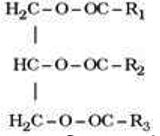
What is obtained upon the hydrolysis of the given molecule?
A
$1$ alcohol $+ 1$ fatty acid
B
$3$ alcohol $+ 1$ fatty acid
C
$3$ glycerol $+ 3$ fatty acid
D
$1$ glycerol $+ 3$ fatty acid
Solution
(D) The given structure represents a triglyceride (a type of lipid).
Triglycerides are esters formed from one molecule of glycerol and three molecules of fatty acids.
Upon hydrolysis,the ester bonds are broken in the presence of water,resulting in the release of one molecule of glycerol and three molecules of fatty acids.
Therefore,the correct option is $D$.
Triglycerides are esters formed from one molecule of glycerol and three molecules of fatty acids.
Upon hydrolysis,the ester bonds are broken in the presence of water,resulting in the release of one molecule of glycerol and three molecules of fatty acids.
Therefore,the correct option is $D$.
0 likes
View Solution58
MediumMCQ
Which of the following lipids does not contain fatty acids?
A
Waxes
B
Complex lipids
C
Cod liver oil
D
Steroids
Solution
(D) Lipids are a diverse group of hydrophobic molecules.
$1$. Waxes,complex lipids (like phospholipids),and oils (like cod liver oil) are typically esters of fatty acids and alcohols.
$2$. Steroids are a class of lipids characterized by a carbon skeleton with four fused rings.
$3$. Unlike other lipids,steroids do not contain fatty acids in their chemical structure.
Therefore,the correct answer is $D$.
$1$. Waxes,complex lipids (like phospholipids),and oils (like cod liver oil) are typically esters of fatty acids and alcohols.
$2$. Steroids are a class of lipids characterized by a carbon skeleton with four fused rings.
$3$. Unlike other lipids,steroids do not contain fatty acids in their chemical structure.
Therefore,the correct answer is $D$.
0 likes
View Solution59
MediumMCQ
Which of the following is not an example of an oil?
A
Groundnut oil
B
Coconut oil
C
Fish liver oil
D
Vegetable ghee
Solution
(D) Oils are lipids that remain in a liquid state at room temperature due to the presence of unsaturated fatty acids.
Groundnut oil,coconut oil,and fish liver oil are all examples of lipids that are liquid at room temperature,thus classified as oils.
Vegetable ghee (Vanaspati ghee) is produced by the hydrogenation of vegetable oils,which converts unsaturated fatty acids into saturated fatty acids.
This process makes it solid at room temperature,therefore it is classified as a fat,not an oil.
Groundnut oil,coconut oil,and fish liver oil are all examples of lipids that are liquid at room temperature,thus classified as oils.
Vegetable ghee (Vanaspati ghee) is produced by the hydrogenation of vegetable oils,which converts unsaturated fatty acids into saturated fatty acids.
This process makes it solid at room temperature,therefore it is classified as a fat,not an oil.
0 likes
View Solution60
MediumMCQ
Assertion $A$: Cholesterol is a lipid that does not contain fatty acids.
Reason $R$: Cholesterol does not contain a $-COOH$ or $>C=O$ group.
Which option is correct for Assertion $A$ and Reason $R$?
Reason $R$: Cholesterol does not contain a $-COOH$ or $>C=O$ group.
Which option is correct for Assertion $A$ and Reason $R$?
A
$A$ and $R$ are both true and $R$ is the correct explanation of $A$.
B
$A$ and $R$ are both true but $R$ is not the correct explanation of $A$.
C
$A$ is true and $R$ is false.
D
$A$ is false and $R$ is true.
Solution
(A) Cholesterol is a sterol,which is a type of lipid. It is classified as a non-saponifiable lipid because it does not contain fatty acids in its structure.
Assertion $A$ is true.
Cholesterol has a chemical structure based on a tetracyclic cyclopenta[a]phenanthrene skeleton. It contains a hydroxyl $(-OH)$ group but lacks a carboxylic acid $(-COOH)$ group or a ketone $(>C=O)$ group in its basic steroid nucleus.
Reason $R$ is true and correctly explains why cholesterol is not a typical fatty acid-containing lipid (like triglycerides).
Therefore,$A$ and $R$ are both true and $R$ is the correct explanation of $A$.
Assertion $A$ is true.
Cholesterol has a chemical structure based on a tetracyclic cyclopenta[a]phenanthrene skeleton. It contains a hydroxyl $(-OH)$ group but lacks a carboxylic acid $(-COOH)$ group or a ketone $(>C=O)$ group in its basic steroid nucleus.
Reason $R$ is true and correctly explains why cholesterol is not a typical fatty acid-containing lipid (like triglycerides).
Therefore,$A$ and $R$ are both true and $R$ is the correct explanation of $A$.
0 likes
View Solution61
EasyMCQ
Which of the following is a $16$ carbon fatty acid?
A
Palmitic acid
B
Stearic acid
C
Oleic acid
D
Butyric acid
Solution
(A) Fatty acids are carboxylic acids with a long aliphatic chain.
Palmitic acid is a saturated fatty acid that contains $16$ carbon atoms in its chain,including the carboxyl carbon.
Stearic acid contains $18$ carbon atoms.
Oleic acid is an unsaturated fatty acid with $18$ carbon atoms.
Butyric acid is a short-chain fatty acid with $4$ carbon atoms.
Therefore,the correct answer is Palmitic acid.
Palmitic acid is a saturated fatty acid that contains $16$ carbon atoms in its chain,including the carboxyl carbon.
Stearic acid contains $18$ carbon atoms.
Oleic acid is an unsaturated fatty acid with $18$ carbon atoms.
Butyric acid is a short-chain fatty acid with $4$ carbon atoms.
Therefore,the correct answer is Palmitic acid.
0 likes
View Solution62
MediumMCQ
Which of the following is the correct match for Column $I, II$ and $III$?
| Column $I$ | Column $II$ | Column $III$ |
| $I.$ Stearic acid | $p.$ Short chain | $x.$ Saturated |
| $II.$ Butyric acid | $q.$ Long chain | $y.$ Unsaturated |
| $III.$ Crotonic acid | ||
| $IV.$ Oleic acid |
A
$I-q-x, II-p-x, III-p-y, IV-q-y$
B
$I-q-y, II-p-x, III-p-y, IV-q-x$
C
$I-q-x, II-p-y, III-q-y, IV-p-x$
D
$I-p-x, II-p-x, III-q-y, IV-q-y$
Solution
(A) The classification of fatty acids is based on chain length and saturation:
$1$. Stearic acid $(C_{18}H_{36}O_2)$ is a long-chain saturated fatty acid $(I-q-x)$.
$2$. Butyric acid $(C_4H_8O_2)$ is a short-chain saturated fatty acid $(II-p-x)$.
$3$. Crotonic acid $(C_4H_6O_2)$ is a short-chain unsaturated fatty acid $(III-p-y)$.
$4$. Oleic acid $(C_{18}H_{34}O_2)$ is a long-chain unsaturated fatty acid $(IV-q-y)$.
Therefore, the correct matching is $I-q-x, II-p-x, III-p-y, IV-q-y$.
$1$. Stearic acid $(C_{18}H_{36}O_2)$ is a long-chain saturated fatty acid $(I-q-x)$.
$2$. Butyric acid $(C_4H_8O_2)$ is a short-chain saturated fatty acid $(II-p-x)$.
$3$. Crotonic acid $(C_4H_6O_2)$ is a short-chain unsaturated fatty acid $(III-p-y)$.
$4$. Oleic acid $(C_{18}H_{34}O_2)$ is a long-chain unsaturated fatty acid $(IV-q-y)$.
Therefore, the correct matching is $I-q-x, II-p-x, III-p-y, IV-q-y$.
0 likes
View Solution63
MediumMCQ
In mammals,the subcutaneous adipose tissue is primarily composed of which substance?
A
Cholesterol
B
Cortisone
C
Ergosterol
D
Fat (Triglycerides)
Solution
(D) The subcutaneous adipose tissue in mammals is a specialized connective tissue that functions primarily as a storage site for energy.
It is composed of adipocytes (fat cells) which store lipids in the form of triglycerides.
Triglycerides are the main constituent of these fat deposits,providing insulation and energy reserves for the body.
It is composed of adipocytes (fat cells) which store lipids in the form of triglycerides.
Triglycerides are the main constituent of these fat deposits,providing insulation and energy reserves for the body.
0 likes
View Solution64
MediumMCQ
Which of the following statements is incorrect regarding lipids?
A
They are insoluble in water.
B
They form a protective layer on the surface of aerial parts of plants.
C
They are structural components of nucleic acids.
D
They act as solvents for fat-soluble vitamins.
Solution
(C) Lipids are a diverse group of hydrophobic organic compounds.
$1$. They are generally insoluble in water due to their non-polar nature.
$2$. Waxes,a type of lipid,form protective coatings on the aerial parts of plants to prevent water loss.
$3$. Lipids act as solvents for fat-soluble vitamins like $A, D, E,$ and $K$.
$4$. Nucleic acids are composed of nucleotides,which consist of a nitrogenous base,a pentose sugar,and a phosphate group. Lipids are not structural components of nucleic acids.
Therefore,the statement that lipids are structural components of nucleic acids is incorrect.
$1$. They are generally insoluble in water due to their non-polar nature.
$2$. Waxes,a type of lipid,form protective coatings on the aerial parts of plants to prevent water loss.
$3$. Lipids act as solvents for fat-soluble vitamins like $A, D, E,$ and $K$.
$4$. Nucleic acids are composed of nucleotides,which consist of a nitrogenous base,a pentose sugar,and a phosphate group. Lipids are not structural components of nucleic acids.
Therefore,the statement that lipids are structural components of nucleic acids is incorrect.
0 likes
View Solution65
EasyMCQ
Which process is used to convert vegetable oil into vegetable ghee?
A
Hydrogenation
B
Dehydrogenation
C
Oxidation
D
Carboxylation
Solution
(A) Vegetable oils contain unsaturated fatty acids with double bonds.
Hydrogenation is the chemical process in which hydrogen gas is added to these unsaturated fats in the presence of a catalyst (like nickel,$Ni$) to convert them into saturated fats (vegetable ghee/vanaspati ghee).
This process increases the melting point of the oil,turning it into a solid or semi-solid state at room temperature.
Hydrogenation is the chemical process in which hydrogen gas is added to these unsaturated fats in the presence of a catalyst (like nickel,$Ni$) to convert them into saturated fats (vegetable ghee/vanaspati ghee).
This process increases the melting point of the oil,turning it into a solid or semi-solid state at room temperature.
0 likes
View Solution66
MediumMCQ
Which type of lipid is classified into triglycerides and waxes?
A
Simple lipids
B
Complex lipids
C
Derived lipids
D
Steroids
Solution
(A) Lipids are classified into three main categories based on their chemical composition: Simple lipids,Complex lipids,and Derived lipids.
Simple lipids are esters of fatty acids with various alcohols.
They are further subdivided into two main types:
$1$. Fats and oils (Triglycerides),which are esters of fatty acids with glycerol.
$2$. Waxes,which are esters of fatty acids with higher molecular weight monohydric alcohols.
Therefore,triglycerides and waxes are types of simple lipids.
Simple lipids are esters of fatty acids with various alcohols.
They are further subdivided into two main types:
$1$. Fats and oils (Triglycerides),which are esters of fatty acids with glycerol.
$2$. Waxes,which are esters of fatty acids with higher molecular weight monohydric alcohols.
Therefore,triglycerides and waxes are types of simple lipids.
0 likes
View Solution67
EasyMCQ
Lipoproteins are an example of which type of lipids?
A
Simple lipids
B
Conjugated (Complex) lipids
C
Steroids
D
Sterols
Solution
(B) Lipids are classified into three main categories: simple lipids,conjugated (complex) lipids,and derived lipids.
Simple lipids are esters of fatty acids with various alcohols (e.g.,fats,oils,and waxes).
Conjugated or complex lipids are esters of fatty acids containing groups in addition to an alcohol and a fatty acid. Lipoproteins are a classic example of complex lipids,where lipids are conjugated with proteins.
Steroids and sterols are examples of derived lipids.
Therefore,the correct answer is $B$.
Simple lipids are esters of fatty acids with various alcohols (e.g.,fats,oils,and waxes).
Conjugated or complex lipids are esters of fatty acids containing groups in addition to an alcohol and a fatty acid. Lipoproteins are a classic example of complex lipids,where lipids are conjugated with proteins.
Steroids and sterols are examples of derived lipids.
Therefore,the correct answer is $B$.
0 likes
View Solution68
MediumMCQ
Waxes do not contain glycerol in their structure,but instead contain which type of alcohol?
A
Monohydric
B
Dihydric
C
Trihydric
D
Tetrahydric
Solution
(A) Waxes are esters formed by the combination of long-chain fatty acids and long-chain monohydric alcohols. Unlike triglycerides (fats and oils),which contain glycerol (a trihydric alcohol),waxes contain a single hydroxyl group $(-OH)$ in their alcohol component,making them monohydric alcohols. Therefore,the correct option is $A$.
0 likes
View Solution69
MediumMCQ
Which of the following contains only saturated fatty acids in its structure?
A
Fish liver oil
B
Sesame oil
C
Butter
D
Coconut oil
Solution
(D) Saturated fatty acids are those that contain no double bonds between carbon atoms in their hydrocarbon chain.
Coconut oil is primarily composed of saturated fatty acids,such as lauric acid,myristic acid,and palmitic acid.
In contrast,fish liver oil,sesame oil,and butter contain significant amounts of unsaturated fatty acids,which have one or more double bonds in their structure.
Coconut oil is primarily composed of saturated fatty acids,such as lauric acid,myristic acid,and palmitic acid.
In contrast,fish liver oil,sesame oil,and butter contain significant amounts of unsaturated fatty acids,which have one or more double bonds in their structure.
0 likes
View Solution70
MediumMCQ
In the structure of lipids,the number of $H$ atoms is much higher than the number of $O$ atoms.
A
$H, O$
B
$O, H$
C
$N, O$
D
$O, N$
Solution
(A) Lipids are organic compounds composed primarily of carbon,hydrogen,and oxygen atoms.
Unlike carbohydrates,which have a ratio of hydrogen to oxygen atoms of $2:1$ (similar to water),lipids contain a significantly higher proportion of hydrogen atoms relative to oxygen atoms.
This high hydrogen-to-oxygen ratio is a characteristic feature of fatty acids and glycerol,the building blocks of lipids,which contributes to their hydrophobic nature and high energy density.
Unlike carbohydrates,which have a ratio of hydrogen to oxygen atoms of $2:1$ (similar to water),lipids contain a significantly higher proportion of hydrogen atoms relative to oxygen atoms.
This high hydrogen-to-oxygen ratio is a characteristic feature of fatty acids and glycerol,the building blocks of lipids,which contributes to their hydrophobic nature and high energy density.
0 likes
View Solution71
MediumMCQ
Which of the following is a group of long-chain fatty acids?
A
Palmitic acid,Butyric acid,Oleic acid
B
Palmitic acid,Stearic acid,Oleic acid
C
Stearic acid,Butyric acid,Crotonic acid
D
Butyric acid,Crotonic acid,Linolenic acid
Solution
(B) Fatty acids are classified based on the length of their carbon chain.
Long-chain fatty acids typically contain $14$ to $22$ or more carbon atoms.
$1$. Palmitic acid $(C_{16}H_{32}O_2)$ has $16$ carbons.
$2$. Stearic acid $(C_{18}H_{36}O_2)$ has $18$ carbons.
$3$. Oleic acid $(C_{18}H_{34}O_2)$ has $18$ carbons.
Butyric acid $(C_4H_8O_2)$ is a short-chain fatty acid ($4$ carbons).
Crotonic acid $(C_4H_6O_2)$ is also a short-chain fatty acid.
Therefore,the group consisting of Palmitic,Stearic,and Oleic acids represents long-chain fatty acids.
Long-chain fatty acids typically contain $14$ to $22$ or more carbon atoms.
$1$. Palmitic acid $(C_{16}H_{32}O_2)$ has $16$ carbons.
$2$. Stearic acid $(C_{18}H_{36}O_2)$ has $18$ carbons.
$3$. Oleic acid $(C_{18}H_{34}O_2)$ has $18$ carbons.
Butyric acid $(C_4H_8O_2)$ is a short-chain fatty acid ($4$ carbons).
Crotonic acid $(C_4H_6O_2)$ is also a short-chain fatty acid.
Therefore,the group consisting of Palmitic,Stearic,and Oleic acids represents long-chain fatty acids.
0 likes
View Solution72
MediumMCQ
Which of the following contains unsaturated fatty acids in its structure?
A
Fish liver oil
B
Butter
C
Vegetable ghee
D
Animal fat
Solution
(A) Unsaturated fatty acids contain one or more double bonds in their carbon chain.
These are typically found in plant oils and marine oils,which remain liquid at room temperature.
Fish liver oil is rich in polyunsaturated fatty acids (PUFAs),such as omega-$3$ fatty acids.
In contrast,butter,vegetable ghee (hydrogenated fat),and animal fats are primarily composed of saturated fatty acids,which are solid at room temperature.
These are typically found in plant oils and marine oils,which remain liquid at room temperature.
Fish liver oil is rich in polyunsaturated fatty acids (PUFAs),such as omega-$3$ fatty acids.
In contrast,butter,vegetable ghee (hydrogenated fat),and animal fats are primarily composed of saturated fatty acids,which are solid at room temperature.
0 likes
View Solution73
MediumMCQ
Assertion $A$: Lipoproteins are complex lipids.
Reason $R$: The structure of a lipoprotein is formed by fatty acids,alcohol,and a non-lipid component.
Which option is correct for Assertion $A$ and Reason $R$?
Reason $R$: The structure of a lipoprotein is formed by fatty acids,alcohol,and a non-lipid component.
Which option is correct for Assertion $A$ and Reason $R$?
A
$A$ and $R$ are both true and $R$ is the correct explanation of $A$.
B
$A$ and $R$ are both true but $R$ is not the correct explanation of $A$.
C
$A$ is true and $R$ is false.
D
$A$ is false and $R$ is true.
Solution
(A) Lipids are classified into simple,compound (complex),and derived lipids.
Compound lipids are esters of fatty acids containing other groups in addition to alcohol and fatty acids.
Lipoproteins are a type of compound lipid where lipids are conjugated with proteins (a non-lipid component).
Assertion $A$ is true because lipoproteins are indeed complex (compound) lipids.
Reason $R$ states that they are formed by fatty acids,alcohol,and a non-lipid component. While compound lipids generally contain these,the specific definition of a lipoprotein is a lipid conjugated with a protein. The statement in $R$ is a general description of compound lipids,but it is technically correct in the context of their composition.
Therefore,both $A$ and $R$ are true,and $R$ provides the correct explanation for why lipoproteins are classified as complex lipids.
Compound lipids are esters of fatty acids containing other groups in addition to alcohol and fatty acids.
Lipoproteins are a type of compound lipid where lipids are conjugated with proteins (a non-lipid component).
Assertion $A$ is true because lipoproteins are indeed complex (compound) lipids.
Reason $R$ states that they are formed by fatty acids,alcohol,and a non-lipid component. While compound lipids generally contain these,the specific definition of a lipoprotein is a lipid conjugated with a protein. The statement in $R$ is a general description of compound lipids,but it is technically correct in the context of their composition.
Therefore,both $A$ and $R$ are true,and $R$ provides the correct explanation for why lipoproteins are classified as complex lipids.
0 likes
View Solution74
MediumMCQ
How many alcohol groups are typically present in the structure of glycerol?
A
$3$
B
$2$
C
$1$
D
$4$
Solution
(A) Glycerol,also known as propane-$1,2,3$-triol,is a simple polyol compound.
Its chemical formula is $C_3H_8O_3$.
The structure consists of a three-carbon chain where each carbon atom is attached to a hydroxyl $(-OH)$ group.
Since there are three hydroxyl groups,glycerol contains $3$ alcohol groups.
Its chemical formula is $C_3H_8O_3$.
The structure consists of a three-carbon chain where each carbon atom is attached to a hydroxyl $(-OH)$ group.
Since there are three hydroxyl groups,glycerol contains $3$ alcohol groups.
0 likes
View Solution75
MediumMCQ
How many molecules of fatty acids combine with one molecule of glycerol to form a lipid molecule?
A
$1$
B
$2$
C
$3$
D
$4$
Solution
(C) lipid molecule,specifically a triglyceride (or triacylglycerol),is formed by the esterification of one molecule of glycerol with three molecules of fatty acids.
In this process,each of the three hydroxyl $(-OH)$ groups of the glycerol molecule reacts with the carboxyl $(-COOH)$ group of a fatty acid,resulting in the formation of three ester bonds and the release of three water molecules.
In this process,each of the three hydroxyl $(-OH)$ groups of the glycerol molecule reacts with the carboxyl $(-COOH)$ group of a fatty acid,resulting in the formation of three ester bonds and the release of three water molecules.
0 likes
View Solution76
EasyMCQ
Which process results in the release of water molecules during the formation of a triglyceride?
A
Dehydration
B
Hydrolysis
C
Oxidation
D
Photolysis
Solution
(A) triglyceride is formed by the esterification of one molecule of glycerol with three molecules of fatty acids.
During this reaction,the hydroxyl $(-OH)$ group of the glycerol reacts with the carboxyl $(-COOH)$ group of the fatty acids.
This reaction releases three molecules of water $(H_2O)$ as a byproduct.
This type of reaction,where water is removed to form a bond,is known as a dehydration synthesis or condensation reaction.
During this reaction,the hydroxyl $(-OH)$ group of the glycerol reacts with the carboxyl $(-COOH)$ group of the fatty acids.
This reaction releases three molecules of water $(H_2O)$ as a byproduct.
This type of reaction,where water is removed to form a bond,is known as a dehydration synthesis or condensation reaction.
0 likes
View Solution77
EasyMCQ
In saturated fatty acids,how many bonds connect two consecutive carbon atoms?
A
$1$
B
$2$
C
$3$
D
$4$
Solution
(A) Saturated fatty acids are characterized by the presence of only single bonds between consecutive carbon atoms in their hydrocarbon chain.
This means that each carbon atom is bonded to the maximum possible number of hydrogen atoms,making the chain 'saturated' with hydrogen.
In contrast,unsaturated fatty acids contain one or more double bonds between carbon atoms.
Therefore,the correct number of bonds connecting two consecutive carbon atoms in a saturated fatty acid is $1$.
This means that each carbon atom is bonded to the maximum possible number of hydrogen atoms,making the chain 'saturated' with hydrogen.
In contrast,unsaturated fatty acids contain one or more double bonds between carbon atoms.
Therefore,the correct number of bonds connecting two consecutive carbon atoms in a saturated fatty acid is $1$.
0 likes
View Solution78
MediumMCQ
The energy released by the oxidation of fats is:
A
Equal to the energy released by the oxidation of carbohydrates.
B
Less than the energy released by the oxidation of carbohydrates.
C
More than double the energy released by the oxidation of carbohydrates.
D
Double the energy released by the oxidation of carbohydrates.
Solution
(C) The energy content of different biomolecules varies significantly.
Carbohydrates provide approximately $4.0 \ kcal/g$ of energy.
Fats (lipids) provide approximately $9.0 \ kcal/g$ of energy.
Since $9.0 \ kcal/g$ is more than double $4.0 \ kcal/g$,the energy released by the oxidation of fats is more than double the energy released by the oxidation of carbohydrates.
Carbohydrates provide approximately $4.0 \ kcal/g$ of energy.
Fats (lipids) provide approximately $9.0 \ kcal/g$ of energy.
Since $9.0 \ kcal/g$ is more than double $4.0 \ kcal/g$,the energy released by the oxidation of fats is more than double the energy released by the oxidation of carbohydrates.
0 likes
View Solution79
MediumMCQ
Which of the following is absent in the structure of steroids?
A
$ -COOH $
B
$ >C=O $
C
$ HOOC-R_1 $
D
$ -OH $
Solution
(A) Steroids are a class of lipids characterized by a carbon skeleton with four fused rings.
They typically contain a hydroxyl group $(-OH)$ and sometimes a carbonyl group $(>C=O)$ in their structure.
However,they do not contain a carboxyl group $(-COOH)$ as part of their core structure,which is characteristic of fatty acids.
Therefore,the carboxyl group is absent in the structure of steroids.
They typically contain a hydroxyl group $(-OH)$ and sometimes a carbonyl group $(>C=O)$ in their structure.
However,they do not contain a carboxyl group $(-COOH)$ as part of their core structure,which is characteristic of fatty acids.
Therefore,the carboxyl group is absent in the structure of steroids.
0 likes
View Solution80
MediumMCQ
In a triglyceride,how are the alcohol (glycerol) and fatty acids linked?
A
Ester bond $(-COO-)$
B
Peptide bond $(-CONH-)$
C
Glycosidic bond $(-C-O-C-)$
D
Phosphodiester bond $(-O-P-O-)$
Solution
(A) triglyceride is formed by the esterification of one molecule of glycerol with three molecules of fatty acids.
In this process,the hydroxyl $(-OH)$ groups of glycerol react with the carboxyl $(-COOH)$ groups of fatty acids.
This reaction results in the formation of an ester bond $(-COO-)$ between the glycerol backbone and the fatty acid chains,releasing water molecules as a byproduct.
In this process,the hydroxyl $(-OH)$ groups of glycerol react with the carboxyl $(-COOH)$ groups of fatty acids.
This reaction results in the formation of an ester bond $(-COO-)$ between the glycerol backbone and the fatty acid chains,releasing water molecules as a byproduct.
0 likes
View Solution81
EasyMCQ
Oleic acid is an example of ........
A
Short-chain saturated fatty acid
B
Long-chain saturated fatty acid
C
Short-chain unsaturated fatty acid
D
Long-chain unsaturated fatty acid
Solution
(D) Oleic acid is a fatty acid with the chemical formula $C_{18}H_{34}O_2$.
It consists of a long hydrocarbon chain containing $18$ carbon atoms.
It contains one double bond in its structure,which makes it an unsaturated fatty acid.
Therefore,it is classified as a long-chain unsaturated fatty acid.
It consists of a long hydrocarbon chain containing $18$ carbon atoms.
It contains one double bond in its structure,which makes it an unsaturated fatty acid.
Therefore,it is classified as a long-chain unsaturated fatty acid.
0 likes
View Solution82
MediumMCQ
How do lipids differ from carbohydrates?
A
They contain more oxygen than carbon.
B
They contain more carbon and less oxygen.
C
The ratio of carbon and hydrogen to oxygen is lower.
D
There is no relationship between carbon,hydrogen,and oxygen.
Solution
(B) Lipids are organic molecules composed primarily of carbon,hydrogen,and oxygen atoms.
Unlike carbohydrates,which generally have a $1:2:1$ ratio of $C:H:O$,lipids contain a much higher proportion of carbon and hydrogen atoms relative to oxygen atoms.
Because oxygen is highly electronegative and pulls electrons away from carbon and hydrogen,the high carbon-hydrogen content in lipids allows them to store significantly more energy per gram than carbohydrates.
Therefore,lipids are characterized by having a higher carbon content and a lower oxygen content compared to carbohydrates.
Unlike carbohydrates,which generally have a $1:2:1$ ratio of $C:H:O$,lipids contain a much higher proportion of carbon and hydrogen atoms relative to oxygen atoms.
Because oxygen is highly electronegative and pulls electrons away from carbon and hydrogen,the high carbon-hydrogen content in lipids allows them to store significantly more energy per gram than carbohydrates.
Therefore,lipids are characterized by having a higher carbon content and a lower oxygen content compared to carbohydrates.
0 likes
View Solution83
EasyMCQ
Each molecule of fat is composed of what?
A
$1$ glycerol and $1$ fatty acid molecule
B
$1$ glycerol and $3$ fatty acid molecules
C
$3$ glycerol and $1$ fatty acid molecule
D
$3$ glycerol and $3$ fatty acid molecules
Solution
(B) fat molecule,also known as a triglyceride,is formed by the esterification of one molecule of glycerol with three molecules of fatty acids.
During this process,three water molecules are released as the three hydroxyl $(-OH)$ groups of glycerol react with the carboxyl $(-COOH)$ groups of the three fatty acids.
Therefore,the correct composition is $1$ glycerol and $3$ fatty acid molecules.
During this process,three water molecules are released as the three hydroxyl $(-OH)$ groups of glycerol react with the carboxyl $(-COOH)$ groups of the three fatty acids.
Therefore,the correct composition is $1$ glycerol and $3$ fatty acid molecules.
0 likes
View Solution84
EasyMCQ
$A$ heterogeneous group of compounds related to fatty acids is:
A
Carbohydrates
B
Lipids
C
Proteins
D
Nucleic acids
Solution
(B) Lipids are a heterogeneous group of compounds that are generally water-insoluble but soluble in non-polar organic solvents.
They are chemically related to fatty acids,which are long-chain carboxylic acids.
Lipids include fats,oils,waxes,phospholipids,and steroids,all of which share a common structural or functional relationship with fatty acids or their derivatives.
They are chemically related to fatty acids,which are long-chain carboxylic acids.
Lipids include fats,oils,waxes,phospholipids,and steroids,all of which share a common structural or functional relationship with fatty acids or their derivatives.
0 likes
View Solution85
EasyMCQ
Which of the following is not an example of a lipid?
A
Lignin
B
Wax
C
Fat
D
Oil
Solution
(A) Lipids are a diverse group of hydrophobic organic molecules that include fats,oils,waxes,and steroids.
$1$. Fats and oils are triglycerides (esters of fatty acids and glycerol).
$2$. Waxes are esters of long-chain fatty acids and long-chain alcohols.
$3$. Lignin is a complex organic polymer deposited in the cell walls of many plants,making them rigid and woody. It is a phenolic compound,not a lipid.
$1$. Fats and oils are triglycerides (esters of fatty acids and glycerol).
$2$. Waxes are esters of long-chain fatty acids and long-chain alcohols.
$3$. Lignin is a complex organic polymer deposited in the cell walls of many plants,making them rigid and woody. It is a phenolic compound,not a lipid.
0 likes
View Solution86
EasyMCQ
In which of the following is fat insoluble?
A
Ether
B
Chloroform
C
Benzene
D
Water
Solution
(D) Fats are non-polar organic compounds.
According to the principle of 'like dissolves like',non-polar substances dissolve in non-polar solvents such as ether,chloroform,and benzene.
Water is a polar solvent.
Therefore,fats are insoluble in water.
According to the principle of 'like dissolves like',non-polar substances dissolve in non-polar solvents such as ether,chloroform,and benzene.
Water is a polar solvent.
Therefore,fats are insoluble in water.
0 likes
View Solution87
EasyMCQ
Which of the following is not present in fats?
A
$C$
B
$H$
C
$S$
D
$O$
Solution
(C) Fats are lipids,which are primarily composed of carbon $(C)$,hydrogen $(H)$,and oxygen $(O)$ atoms. They are esters of fatty acids and glycerol. Sulfur $(S)$ is not a constituent element of standard fats (triglycerides).
0 likes
View Solution88
MediumMCQ
What is the ratio of $H$ and $O$ atoms in the structure of fats?
A
The ratio of $H$ to $O$ is $2 : 1$.
B
The ratio of $H$ to $O$ is $1 : 2$.
C
The number of $O$ atoms is much higher than $H$.
D
The number of $H$ atoms is much higher than $O$.
Solution
(D) Fats (lipids) are composed of carbon,hydrogen,and oxygen atoms.
In the structure of fatty acids and triglycerides,the number of hydrogen atoms is significantly higher than the number of oxygen atoms.
Unlike carbohydrates,where the ratio of $H$ to $O$ is typically $2 : 1$,fats contain a much lower proportion of oxygen relative to hydrogen.
Therefore,the number of $H$ atoms is much higher than $O$ atoms in fats.
In the structure of fatty acids and triglycerides,the number of hydrogen atoms is significantly higher than the number of oxygen atoms.
Unlike carbohydrates,where the ratio of $H$ to $O$ is typically $2 : 1$,fats contain a much lower proportion of oxygen relative to hydrogen.
Therefore,the number of $H$ atoms is much higher than $O$ atoms in fats.
0 likes
View Solution89
MediumMCQ
In which form is alcohol present in lipids?
A
Glycerol
B
Monohydroxy alcohol
C
Dihydroxy alcohol
D
Both $A$ and $B$
Solution
(D) Lipids are esters of fatty acids with alcohols.
In simple lipids,the alcohol component can be glycerol (a trihydroxy alcohol) or long-chain monohydroxy alcohols (often found in waxes).
Therefore,both glycerol and monohydroxy alcohols are forms of alcohol found in lipids.
Thus,the correct option is $D$.
In simple lipids,the alcohol component can be glycerol (a trihydroxy alcohol) or long-chain monohydroxy alcohols (often found in waxes).
Therefore,both glycerol and monohydroxy alcohols are forms of alcohol found in lipids.
Thus,the correct option is $D$.
0 likes
View Solution90
MediumMCQ
What does a trihydroxy alcohol contain?
A
Three carbons and three $-OH$ groups
B
Three carbons and one $-OH$ group
C
Three carbons and three hydrogens
D
One carbon and three $-OH$ groups
Solution
(A) trihydroxy alcohol,commonly known as glycerol (or glycerine),is a polyol compound.
It consists of a three-carbon backbone where each carbon atom is attached to a hydroxyl $(-OH)$ group.
The chemical formula for glycerol is $C_3H_8O_3$ or $CH_2(OH)CH(OH)CH_2(OH)$.
Therefore,it contains three carbon atoms and three $-OH$ groups.
It consists of a three-carbon backbone where each carbon atom is attached to a hydroxyl $(-OH)$ group.
The chemical formula for glycerol is $C_3H_8O_3$ or $CH_2(OH)CH(OH)CH_2(OH)$.
Therefore,it contains three carbon atoms and three $-OH$ groups.
0 likes
View Solution91
MediumMCQ
Which of the following are types of fatty acids?
A
Saturated
B
Unsaturated
C
Long-chain
D
All of the above
Solution
(D) Fatty acids are carboxylic acids with a long aliphatic chain,which can be either saturated or unsaturated.
$1$. Saturated fatty acids contain only single bonds between carbon atoms (e.g.,palmitic acid).
$2$. Unsaturated fatty acids contain one or more double bonds between carbon atoms (e.g.,oleic acid).
$3$. Fatty acids are also classified based on the length of their carbon chain,such as long-chain fatty acids (typically $14$ to $24$ carbons).
Therefore,all the given options represent valid classifications or types of fatty acids.
$1$. Saturated fatty acids contain only single bonds between carbon atoms (e.g.,palmitic acid).
$2$. Unsaturated fatty acids contain one or more double bonds between carbon atoms (e.g.,oleic acid).
$3$. Fatty acids are also classified based on the length of their carbon chain,such as long-chain fatty acids (typically $14$ to $24$ carbons).
Therefore,all the given options represent valid classifications or types of fatty acids.
0 likes
View Solution92
MediumMCQ
Which of the following types of fatty acids can accept hydrogen or halogen atoms?
A
Butyric acid
B
Palmitic acid
C
Oleic acid
D
Stearic acid
Solution
(C) Fatty acids that can accept hydrogen or halogen atoms are known as unsaturated fatty acids.
Unsaturated fatty acids contain one or more double bonds between carbon atoms in their hydrocarbon chain.
These double bonds are sites of unsaturation where additional atoms (like $H$ or halogens) can be added through addition reactions.
Among the given options,Butyric acid,Palmitic acid,and Stearic acid are saturated fatty acids (containing only single bonds).
Oleic acid is an unsaturated fatty acid (containing one double bond),which allows it to undergo addition reactions.
Unsaturated fatty acids contain one or more double bonds between carbon atoms in their hydrocarbon chain.
These double bonds are sites of unsaturation where additional atoms (like $H$ or halogens) can be added through addition reactions.
Among the given options,Butyric acid,Palmitic acid,and Stearic acid are saturated fatty acids (containing only single bonds).
Oleic acid is an unsaturated fatty acid (containing one double bond),which allows it to undergo addition reactions.
0 likes
View Solution93
EasyMCQ
Which of the following is an example of a short-chain saturated fatty acid?
A
Palmitic acid
B
Butyric acid
C
Stearic acid
D
Crotonic acid
Solution
(B) Fatty acids are classified based on the length of their carbon chain.
$1$. Short-chain fatty acids typically contain fewer than $6$ carbon atoms.
$2$. Butyric acid $(C_4H_8O_2)$ is a $4$-carbon saturated fatty acid,making it a short-chain fatty acid.
$3$. Palmitic acid ($16$ carbons) and Stearic acid ($18$ carbons) are long-chain saturated fatty acids.
$4$. Crotonic acid is an unsaturated fatty acid.
Therefore,the correct option is $B$.
$1$. Short-chain fatty acids typically contain fewer than $6$ carbon atoms.
$2$. Butyric acid $(C_4H_8O_2)$ is a $4$-carbon saturated fatty acid,making it a short-chain fatty acid.
$3$. Palmitic acid ($16$ carbons) and Stearic acid ($18$ carbons) are long-chain saturated fatty acids.
$4$. Crotonic acid is an unsaturated fatty acid.
Therefore,the correct option is $B$.
0 likes
View Solution94
EasyMCQ
Which of the following is an example of a long-chain saturated fatty acid?
A
Stearic acid
B
Butyric acid
C
Crotonic acid
D
Oleic acid
Solution
(A) Fatty acids are carboxylic acids with a long aliphatic chain.
$1$. Stearic acid $(C_{18}H_{36}O_2)$ is a long-chain saturated fatty acid containing $18$ carbon atoms.
$2$. Butyric acid is a short-chain fatty acid ($4$ carbons).
$3$. Crotonic acid is an unsaturated fatty acid.
$4$. Oleic acid is a long-chain unsaturated fatty acid.
Therefore,the correct answer is Stearic acid.
$1$. Stearic acid $(C_{18}H_{36}O_2)$ is a long-chain saturated fatty acid containing $18$ carbon atoms.
$2$. Butyric acid is a short-chain fatty acid ($4$ carbons).
$3$. Crotonic acid is an unsaturated fatty acid.
$4$. Oleic acid is a long-chain unsaturated fatty acid.
Therefore,the correct answer is Stearic acid.
0 likes
View Solution95
MediumMCQ
Which fatty acid contains a double bond between two consecutive carbon atoms?
A
Butyric acid
B
Palmitic acid
C
Crotonic acid
D
Stearic acid
Solution
(C) fatty acid that contains one or more double bonds between carbon atoms is known as an unsaturated fatty acid.
Among the given options,Butyric acid $(C_4H_8O_2)$,Palmitic acid $(C_{16}H_{32}O_2)$,and Stearic acid $(C_{18}H_{36}O_2)$ are saturated fatty acids,meaning they contain only single bonds between carbon atoms.
Crotonic acid $(CH_3CH=CHCOOH)$ is an unsaturated fatty acid (specifically a $trans$-but$-2-$enoic acid) that contains a double bond between the second and third carbon atoms.
Therefore,the correct option is $C$.
Among the given options,Butyric acid $(C_4H_8O_2)$,Palmitic acid $(C_{16}H_{32}O_2)$,and Stearic acid $(C_{18}H_{36}O_2)$ are saturated fatty acids,meaning they contain only single bonds between carbon atoms.
Crotonic acid $(CH_3CH=CHCOOH)$ is an unsaturated fatty acid (specifically a $trans$-but$-2-$enoic acid) that contains a double bond between the second and third carbon atoms.
Therefore,the correct option is $C$.
0 likes
View Solution96
MediumMCQ
$A$ fatty acid that has the capacity to absorb hydrogen or halogen atoms is:
A
Crotonic acid
B
Butyric acid
C
Palmitic acid
D
Stearic acid
Solution
(A) fatty acid that has the capacity to absorb hydrogen or halogen atoms is an unsaturated fatty acid.
Unsaturated fatty acids contain one or more double bonds $(C=C)$ in their hydrocarbon chain.
These double bonds can undergo addition reactions with hydrogen (hydrogenation) or halogens (halogenation).
Among the given options,$A$ (Crotonic acid) is an unsaturated fatty acid $(CH_3CH=CHCOOH)$,while $B$,$C$,and $D$ are saturated fatty acids.
Therefore,Crotonic acid is the correct answer.
Unsaturated fatty acids contain one or more double bonds $(C=C)$ in their hydrocarbon chain.
These double bonds can undergo addition reactions with hydrogen (hydrogenation) or halogens (halogenation).
Among the given options,$A$ (Crotonic acid) is an unsaturated fatty acid $(CH_3CH=CHCOOH)$,while $B$,$C$,and $D$ are saturated fatty acids.
Therefore,Crotonic acid is the correct answer.
0 likes
View Solution97
EasyMCQ
Which of the following is not a type of lipid?
A
Simple lipids
B
Compound lipids
C
Steroids
D
Lignin
Solution
(D) Lipids are a diverse group of hydrophobic molecules. They are generally classified into three main categories: $1$. Simple lipids (e.g.,fats,oils,and waxes),$2$. Compound or conjugated lipids (e.g.,phospholipids),and $3$. Derived lipids (e.g.,steroids). Lignin is a complex organic polymer deposited in the cell walls of many plants,making them rigid and woody. It is a phenolic compound,not a lipid.
0 likes
View Solution98
MediumMCQ
Which of the following is a type of simple lipid?
A
Triglyceride
B
Glycolipid
C
Progesterone
D
Ergosterol
Solution
(A) Simple lipids are esters of fatty acids with various alcohols.
Triglycerides (or triacylglycerols) are the most common simple lipids,formed by the esterification of three fatty acid molecules with one glycerol molecule.
Glycolipids are conjugated lipids containing carbohydrates.
Progesterone is a steroid hormone (derived from lipids but not a simple lipid).
Ergosterol is a sterol (a type of derived lipid).
Triglycerides (or triacylglycerols) are the most common simple lipids,formed by the esterification of three fatty acid molecules with one glycerol molecule.
Glycolipids are conjugated lipids containing carbohydrates.
Progesterone is a steroid hormone (derived from lipids but not a simple lipid).
Ergosterol is a sterol (a type of derived lipid).
0 likes
View Solution99
MediumMCQ
In the structure of a triglyceride,the glycerol molecule is linked to fatty acid molecules by which bond?
A
Glycosidic
B
Ester
C
Peptide
D
Hydrogen
Solution
(B) triglyceride is formed by the esterification of one molecule of glycerol with three molecules of fatty acids.
In this process,the hydroxyl $(-OH)$ groups of glycerol react with the carboxyl $(-COOH)$ groups of fatty acids.
This reaction results in the formation of an ester bond $(-COO-)$ and the release of water molecules.
Therefore,the correct bond involved is the ester bond.
In this process,the hydroxyl $(-OH)$ groups of glycerol react with the carboxyl $(-COOH)$ groups of fatty acids.
This reaction results in the formation of an ester bond $(-COO-)$ and the release of water molecules.
Therefore,the correct bond involved is the ester bond.
0 likes
View Solution100
MediumMCQ
In the structure of a triglyceride,each fatty acid is attached to the trihydroxy alcohol by which group?
A
$-NH_2$
B
$-COOH$
C
$-CHO$
D
$>C=O$
Solution
(B) triglyceride is formed by the esterification of one molecule of glycerol (a trihydroxy alcohol) with three molecules of fatty acids.
In this reaction,the carboxyl group $(-COOH)$ of each fatty acid reacts with the hydroxyl group $(-OH)$ of the glycerol molecule.
This results in the formation of an ester bond,which links the fatty acid to the glycerol backbone.
Therefore,the fatty acid is attached to the trihydroxy alcohol via its carboxyl group $(-COOH)$.
In this reaction,the carboxyl group $(-COOH)$ of each fatty acid reacts with the hydroxyl group $(-OH)$ of the glycerol molecule.
This results in the formation of an ester bond,which links the fatty acid to the glycerol backbone.
Therefore,the fatty acid is attached to the trihydroxy alcohol via its carboxyl group $(-COOH)$.
0 likes
View SolutionBiomolecules — Lipid · Frequently Asked Questions
1Are these Biomolecules questions useful for JEE and NEET?
Yes. All questions in this section are mapped to JEE Main and NEET exam patterns. Previous year questions from JEE Main, NEET, GUJCET and state-level exams are included with full solutions.
2Can I switch to Hindi or Gujarati for these questions?
Yes. Use the language tabs in the hero section or the sidebar to view the same questions and solutions in English, Hindi or Gujarati.
3How do I generate a question paper from this subtopic?
Use the Vedclass Exam Paper Generator — select the chapter and subtopic, set difficulty, and generate Sets A, B, C, D automatically. First 3 chapters of every subject are free.
Vedclass Products
For Students
Vedclass Test Series
Mock tests in real JEE/NEET style with performance analysis. 5-day free trial.
Start Free TrialFor Teachers
Exam Paper Generator
Generate Set A/B/C/D papers from this chapter in 2 minutes. 3 chapters free.
Try FreeFor Institutes
Online Exam Module
Live online exams with unlimited students, 360° analytics & white-label branding.
See DemoFor Teachers & Institutes
Generate a Biomolecules Exam Paper in 2 Minutes
Select subtopic & difficulty — Sets A, B, C, D auto-generated with No Repeat logic.
First 3 chapters of every subject are free — no payment required.