
A English
Viruses, Viroids, Prions and Lichens Questions in English
Class 11 Biology · Biological Classification · Viruses, Viroids, Prions and Lichens
529+
Questions
English
Language
100%
With Solutions
Showing 49 of 529 questions in English
401
EasyMCQ
Which of the following is $NOT$ true for lichens?
A
Their body is composed of algal and fungal cells.
B
They serve as food for some reindeer in Arctic regions.
C
Some species are used as pollution indicators.
D
They grow very rapidly,at a rate of about $2 \ cm$ per year.
Solution
(D) Lichens are symbiotic associations between algae (phycobiont) and fungi (mycobiont).
They are very slow-growing organisms,often taking many years to cover a small surface area.
They are known to be pollution indicators,especially for $SO_2$ (sulfur dioxide),as they do not grow in polluted areas.
They serve as a primary food source for reindeer in the Arctic tundra.
Therefore,the statement that they grow rapidly at a rate of $2 \ cm$ per year is false.
They are very slow-growing organisms,often taking many years to cover a small surface area.
They are known to be pollution indicators,especially for $SO_2$ (sulfur dioxide),as they do not grow in polluted areas.
They serve as a primary food source for reindeer in the Arctic tundra.
Therefore,the statement that they grow rapidly at a rate of $2 \ cm$ per year is false.
0 likes
View Solution402
EasyMCQ
Most lichens consist of:
A
Blue-green algae and Basidiomycetes
B
Blue-green algae and Ascomycetes
C
Red algae and Ascomycetes
D
Brown algae and Phycomycetes
Solution
(B) Lichens are symbiotic associations between fungi (mycobiont) and algae or cyanobacteria (phycobiont).
In the majority of lichen associations,the fungal partner belongs to the class Ascomycetes,and the algal partner is either a green alga or a blue-green alga (cyanobacteria).
Therefore,most lichens consist of blue-green algae and Ascomycetes.
In the majority of lichen associations,the fungal partner belongs to the class Ascomycetes,and the algal partner is either a green alga or a blue-green alga (cyanobacteria).
Therefore,most lichens consist of blue-green algae and Ascomycetes.
0 likes
View Solution403
EasyMCQ
Which of the following describes the use of lichens in relation to pollution?
A
Lichens are not related to pollution.
B
They are biological indicators of pollution.
C
They treat polluted water.
D
They increase pollution.
Solution
(B) Lichens are symbiotic associations between algae and fungi. They are highly sensitive to atmospheric pollutants,especially sulfur dioxide $(SO_2)$. Because they do not grow in polluted areas,they are widely used as biological indicators of air pollution.
0 likes
View Solution404
EasyMCQ
Lichens are a well-known association between algae and fungi. In this association,the fungus has a/an ..... relationship with the algae.
A
Saprophytic relationship with algae
B
Epiphytic relationship with algae
C
Parasitic relationship with algae
D
Symbiotic relationship with algae
Solution
(D) Lichens represent a symbiotic association between algae (phycobiont) and fungi (mycobiont).
In this relationship,the fungus provides protection,anchorage,and absorption of minerals and water for the algae.
In return,the algae provide food (carbohydrates) produced through photosynthesis to the fungus.
Since both organisms benefit from this association,it is classified as a symbiotic relationship.
In this relationship,the fungus provides protection,anchorage,and absorption of minerals and water for the algae.
In return,the algae provide food (carbohydrates) produced through photosynthesis to the fungus.
Since both organisms benefit from this association,it is classified as a symbiotic relationship.
0 likes
View Solution405
MediumMCQ
In lichens,a symbiotic association is found between algae and fungi. The fungus . . . . . . .
A
provides support,protection,and absorption for the algae.
B
provides food for the algae.
C
fixes atmospheric nitrogen for the algae.
D
releases oxygen for the algae.
Solution
(A) Lichens represent a symbiotic relationship between algae $(phycobiont)$ and fungi $(mycobiont)$.
In this association,the algal component is responsible for photosynthesis,providing food for the fungus.
Conversely,the fungal component provides protection,anchorage (support),and absorbs water and mineral nutrients from the environment for the algae.
Therefore,the fungus provides support,protection,and absorption for the algae.
In this association,the algal component is responsible for photosynthesis,providing food for the fungus.
Conversely,the fungal component provides protection,anchorage (support),and absorbs water and mineral nutrients from the environment for the algae.
Therefore,the fungus provides support,protection,and absorption for the algae.
0 likes
View Solution406
MediumMCQ
Bovine Spongiform Encephalopathy $(BSE)$ is a disease in cattle. Which of the following human diseases is related to it?
A
Kala-azar
B
Encephalitis
C
Cerebral spondylitis
D
Creutzfeldt-Jakob disease
Solution
(D) Bovine Spongiform Encephalopathy $(BSE)$,commonly known as 'mad cow disease',is a progressive neurological disorder in cattle.
It is caused by prions,which are misfolded proteins that can induce abnormal folding of normal cellular proteins in the brain.
In humans,the consumption of meat from $BSE$-infected cattle can lead to a variant form of Creutzfeldt-Jakob disease $(vCJD)$.
This is a fatal neurodegenerative disorder characterized by the rapid deterioration of brain tissue,leading to sponge-like holes in the brain.
It is caused by prions,which are misfolded proteins that can induce abnormal folding of normal cellular proteins in the brain.
In humans,the consumption of meat from $BSE$-infected cattle can lead to a variant form of Creutzfeldt-Jakob disease $(vCJD)$.
This is a fatal neurodegenerative disorder characterized by the rapid deterioration of brain tissue,leading to sponge-like holes in the brain.
0 likes
View Solution407
EasyMCQ
Which of the following is the most suitable indicator of $SO_2$ pollution in the environment?
A
Fungi
B
Lichens
C
Conifers
D
Algae
Solution
(B) Lichens are symbiotic associations between fungi and algae.
They are highly sensitive to sulfur dioxide $(SO_2)$ pollution in the air.
In areas with high levels of $SO_2$,lichens fail to grow,making them excellent bioindicators for air quality monitoring.
They are highly sensitive to sulfur dioxide $(SO_2)$ pollution in the air.
In areas with high levels of $SO_2$,lichens fail to grow,making them excellent bioindicators for air quality monitoring.
0 likes
View Solution408
EasyMCQ
Which of the following statements is incorrect?
A
Viroids lack a protein coat.
B
Viruses are obligate parasites.
C
Infective constituent in viruses is the protein coat.
D
Prions consist of abnormally folded proteins.
Solution
(C) The correct answer is $C$.
$1$. Viroids consist of free $RNA$ and lack a protein coat,which makes statement $A$ correct.
$2$. Viruses are obligate parasites because they require a host cell to replicate,making statement $B$ correct.
$3$. In viruses,the genetic material ($DNA$ or $RNA$) is the infective constituent,not the protein coat (capsid). The protein coat only protects the genetic material. Therefore,statement $C$ is incorrect.
$4$. Prions are infectious agents composed entirely of abnormally folded proteins,making statement $D$ correct.
$1$. Viroids consist of free $RNA$ and lack a protein coat,which makes statement $A$ correct.
$2$. Viruses are obligate parasites because they require a host cell to replicate,making statement $B$ correct.
$3$. In viruses,the genetic material ($DNA$ or $RNA$) is the infective constituent,not the protein coat (capsid). The protein coat only protects the genetic material. Therefore,statement $C$ is incorrect.
$4$. Prions are infectious agents composed entirely of abnormally folded proteins,making statement $D$ correct.
0 likes
View Solution409
MediumMCQ
Which one of the following statements is correct?
A
Prions are the smallest free-living cells.
B
The cell wall of Mycoplasmas is made up of amino sugars.
C
Viroids consist of single-stranded $RNA$ molecule.
D
Rickettsiae lack cell wall.
Solution
(C) $Viroid$ is a small infective segment of nucleic acid,usually $RNA$,which lacks a protein coat.
$Prions$ are infectious pathogenic agents composed mainly of proteins and are devoid of nucleic acid.
$Mycoplasmas$ are the smallest known living cells and they completely lack a cell wall.
$Rickettsiae$ are bacteria that possess a cell wall.
$Prions$ are infectious pathogenic agents composed mainly of proteins and are devoid of nucleic acid.
$Mycoplasmas$ are the smallest known living cells and they completely lack a cell wall.
$Rickettsiae$ are bacteria that possess a cell wall.
0 likes
View Solution410
MediumMCQ
Which of the following statements is not correct for viruses?
A
Viruses are obligate parasites.
B
Viruses can multiply only when they are inside the living cells.
C
Viruses cannot pass through bacterial filters.
D
Viruses are made up of protein and $DNA$ or $RNA$ (never both $DNA$ and $RNA$).
Solution
(C) Viruses are sub-microscopic infectious agents that replicate only inside the living cells of a host organism.
They are obligate parasites,meaning they require a host to complete their life cycle.
Because viruses are significantly smaller than bacteria,they can easily pass through bacterial-proof filters.
Therefore,the statement that viruses cannot pass through bacterial filters is incorrect.
They are obligate parasites,meaning they require a host to complete their life cycle.
Because viruses are significantly smaller than bacteria,they can easily pass through bacterial-proof filters.
Therefore,the statement that viruses cannot pass through bacterial filters is incorrect.
0 likes
View Solution411
MediumMCQ
Assertion: Viruses are not considered organisms.
Reason: Viruses are nucleoproteins and lack cell organelles,etc.
Reason: Viruses are nucleoproteins and lack cell organelles,etc.
A
If both Assertion and Reason are correct and the Reason is a correct explanation of the Assertion.
B
If both Assertion and Reason are correct but Reason is not a correct explanation of the Assertion.
C
If the Assertion is correct but Reason is incorrect.
D
If both the Assertion and Reason are incorrect.
Solution
(A) Viruses are considered to be at the borderline between living and non-living. They are not considered true organisms because they lack a cellular structure,independent metabolic machinery,and the ability to replicate outside a host cell.
They consist of genetic material ($DNA$ or $RNA$) enclosed in a protein coat (capsid),making them nucleoproteins.
Since they lack cell organelles and cannot perform life processes independently,the Reason correctly explains why they are not classified as organisms.
They consist of genetic material ($DNA$ or $RNA$) enclosed in a protein coat (capsid),making them nucleoproteins.
Since they lack cell organelles and cannot perform life processes independently,the Reason correctly explains why they are not classified as organisms.
0 likes
View Solution412
MediumMCQ
Assertion : $TMV$ is a virus which causes mosaic disease.
Reason : $TMV$ has $RNA$ as genetic material.
Reason : $TMV$ has $RNA$ as genetic material.
A
If both Assertion and Reason are correct and the Reason is a correct explanation of the Assertion.
B
If both Assertion and Reason are correct but Reason is not a correct explanation of the Assertion.
C
If the Assertion is correct but Reason is incorrect.
D
If both the Assertion and Reason are incorrect.
Solution
(B) The Assertion is correct because $TMV$ (Tobacco Mosaic Virus) is indeed the causative agent of mosaic disease in tobacco plants.
The Reason is also correct because the genetic material of $TMV$ is a single-stranded $RNA$ molecule.
However,the fact that $TMV$ has $RNA$ as its genetic material does not explain why it causes mosaic disease; these are two independent biological facts about the virus. Therefore,the Reason is not the correct explanation of the Assertion.
The Reason is also correct because the genetic material of $TMV$ is a single-stranded $RNA$ molecule.
However,the fact that $TMV$ has $RNA$ as its genetic material does not explain why it causes mosaic disease; these are two independent biological facts about the virus. Therefore,the Reason is not the correct explanation of the Assertion.
0 likes
View Solution413
MediumMCQ
Assertion: Lichen is important for chemical industries.
Reason: Litmus and Orcein are formed from lichens.
Reason: Litmus and Orcein are formed from lichens.
A
If both Assertion and Reason are correct and the Reason is a correct explanation of the Assertion.
B
If both Assertion and Reason are correct but Reason is not a correct explanation of the Assertion.
C
If the Assertion is correct but Reason is incorrect.
D
If both the Assertion and Reason are incorrect.
Solution
(A) Lichens are economically important in various industries, including the chemical industry.
Litmus is a well-known acid-base indicator used extensively in chemical laboratories, which is extracted from lichens like $Rocella montaignei$.
Orcein is another important dye and biological stain derived from lichens like $Rocella tinctoria$.
Since these chemical products are derived from lichens, the reason correctly explains why lichens are important for chemical industries.
Litmus is a well-known acid-base indicator used extensively in chemical laboratories, which is extracted from lichens like $Rocella montaignei$.
Orcein is another important dye and biological stain derived from lichens like $Rocella tinctoria$.
Since these chemical products are derived from lichens, the reason correctly explains why lichens are important for chemical industries.
0 likes
View Solution414
MediumMCQ
Mad cow disease in cattle is caused by an organism which has
A
inert crystalline structure
B
abnormally folded protein
C
free $RNA$ without protein coat
D
free $DNA$ without protein coat
Solution
(B) Mad cow disease,also known as Bovine Spongiform Encephalopathy $(BSE)$,is a neurodegenerative disease in cattle.
It is caused by prions.
Prions are infectious agents that consist entirely of abnormally folded proteins.
They lack nucleic acids ($DNA$ or $RNA$) and are smaller than viruses.
Therefore,the correct option is $B$.
It is caused by prions.
Prions are infectious agents that consist entirely of abnormally folded proteins.
They lack nucleic acids ($DNA$ or $RNA$) and are smaller than viruses.
Therefore,the correct option is $B$.
0 likes
View Solution415
EasyMCQ
Which of the following statements is correct?
A
Lichens do not grow in polluted areas.
B
Algal component of lichens is called mycobiont.
C
Fungal component of lichens is called phycobiont.
D
Lichens are not good pollution indicators.
Solution
(A) Lichens are symbiotic associations between algae and fungi.
$1$. The algal component is known as the phycobiont,which is autotrophic.
$2$. The fungal component is known as the mycobiont,which is heterotrophic.
$3$. Lichens are very sensitive to $SO_2$ pollution and do not grow in polluted areas,making them excellent pollution indicators.
Therefore,statement $A$ is correct.
$1$. The algal component is known as the phycobiont,which is autotrophic.
$2$. The fungal component is known as the mycobiont,which is heterotrophic.
$3$. Lichens are very sensitive to $SO_2$ pollution and do not grow in polluted areas,making them excellent pollution indicators.
Therefore,statement $A$ is correct.
0 likes
View Solution416
MediumMCQ
How are viroids different from viruses?
A
Viroids contain protein coat but lack $RNA$.
B
Viroids are larger than viruses.
C
Viroids lack a protein coat and contain free $RNA$ of low molecular weight.
D
Viroids contain $DNA$ instead of $RNA$.
Solution
(C) Viroids were discovered in $1971$ by $T.O.$ Diener.
They cause potato spindle tuber disease.
They are smaller in size than viruses.
They lack the protein coat found in viruses and contain free $RNA$ of low molecular weight.
They cause potato spindle tuber disease.
They are smaller in size than viruses.
They lack the protein coat found in viruses and contain free $RNA$ of low molecular weight.
0 likes
View Solution417
EasyMCQ
What do the terms phycobiont and mycobiont signify?
A
Phycobiont is fungal and mycobiont is algal component.
B
Phycobiont is algal and mycobiont is fungal component.
C
Both are fungal components.
D
Both are algal components.
Solution
(B) Phycobiont refers to the algal component of the lichens,and mycobiont refers to the fungal component.
Algae contain chlorophyll and prepare food for fungi,whereas the fungus provides shelter to algae and absorbs water and nutrients from the soil.
This type of mutually beneficial relationship is referred to as symbiotic.
Algae contain chlorophyll and prepare food for fungi,whereas the fungus provides shelter to algae and absorbs water and nutrients from the soil.
This type of mutually beneficial relationship is referred to as symbiotic.
0 likes
View Solution418
Difficult
Give a brief account of viruses with respect to their structure and nature of genetic material. Also,name four common viral diseases.
Solution
(N/A) Viruses are sub-microscopic infectious agents that can infect all living organisms. $A$ virus consists of genetic material surrounded by a protein coat called a capsid.
The genetic material may be present in the form of $DNA$ or $RNA$.
Most plant viruses have single-stranded $RNA$ as their genetic material. Viruses infecting animals may have single or double-stranded $RNA$ or double-stranded $DNA$.
Bacteriophages,which are viruses that infect bacteria,usually possess double-stranded $DNA$. The protein coat (capsid) is made up of small subunits called capsomeres,which are arranged in helical or polyhedral geometric forms.
$AIDS$,smallpox,mumps,and influenza are four common examples of viral diseases.
The genetic material may be present in the form of $DNA$ or $RNA$.
Most plant viruses have single-stranded $RNA$ as their genetic material. Viruses infecting animals may have single or double-stranded $RNA$ or double-stranded $DNA$.
Bacteriophages,which are viruses that infect bacteria,usually possess double-stranded $DNA$. The protein coat (capsid) is made up of small subunits called capsomeres,which are arranged in helical or polyhedral geometric forms.
$AIDS$,smallpox,mumps,and influenza are four common examples of viral diseases.
0 likes
View Solution419
Difficult
Organise a discussion in your class on the topic: Are viruses living or non-living?
Solution
(N/A) Viruses are microscopic entities that exhibit characteristics of both living and non-living organisms.
$1$. Evidence for living nature: They contain genetic material ($DNA$ or $RNA$) and can replicate,but only inside a host cell. They also exhibit mutations and can respond to environmental stimuli within the host.
$2$. Evidence for non-living nature: They are acellular,lack metabolic machinery (like ribosomes or enzymes for energy production),and cannot reproduce independently outside a host cell. They can also be crystallized,a property typical of non-living matter.
Conclusion: Because they bridge the gap between living and non-living,they are often considered 'obligate parasites' or 'borderline' entities in biological classification.
$1$. Evidence for living nature: They contain genetic material ($DNA$ or $RNA$) and can replicate,but only inside a host cell. They also exhibit mutations and can respond to environmental stimuli within the host.
$2$. Evidence for non-living nature: They are acellular,lack metabolic machinery (like ribosomes or enzymes for energy production),and cannot reproduce independently outside a host cell. They can also be crystallized,a property typical of non-living matter.
Conclusion: Because they bridge the gap between living and non-living,they are often considered 'obligate parasites' or 'borderline' entities in biological classification.
0 likes
View Solution420
Easy
Write a short note on viruses.
Solution
(N/A) $\rightarrow$ Viruses are non-cellular organisms characterized by having an inert crystalline structure outside the living cell.
$\rightarrow$ They are not truly 'living' and thus did not find a place in the classification system.
$\rightarrow$ Once they infect a host cell,they take over the host's machinery to replicate themselves,eventually killing the host.
$\rightarrow$ The term 'virus',meaning venom or poisonous fluid,was given by Pasteur.
$\rightarrow$ $D. I. Ivanowsky (1892)$ recognized certain microbes as the causal organisms of the mosaic disease of tobacco,which were smaller than bacteria as they passed through bacteria-proof filters.
$\rightarrow$ $M. W. Beijerinck (1898)$ demonstrated that the extract of infected tobacco plants could cause infection in healthy plants and called the fluid 'Contagium vivum fluidum' (infectious living fluid).
$\rightarrow$ $W. M. Stanley (1935)$ showed that viruses could be crystallized,and these crystals consist largely of proteins.
$\rightarrow$ Viruses are obligate parasites.
$\rightarrow$ Structure: They contain genetic material,which could be either $RNA$ or $DNA$,but never both.
$\rightarrow$ $A$ virus is a nucleoprotein,and the genetic material is infectious.
$\rightarrow$ Plant viruses usually have single-stranded $RNA$,while animal viruses have single or double-stranded $RNA$ or double-stranded $DNA$.
$\rightarrow$ Bacteriophages (viruses that infect bacteria) are usually double-stranded $DNA$ viruses.
$\rightarrow$ The protein coat,called the capsid,is made of small subunits called capsomeres,which protect the nucleic acid and are arranged in helical or polyhedral geometric forms.
$\rightarrow$ Viruses cause diseases like mumps,smallpox,herpes,influenza,and $AIDS$ in humans.
$\rightarrow$ They are not truly 'living' and thus did not find a place in the classification system.
$\rightarrow$ Once they infect a host cell,they take over the host's machinery to replicate themselves,eventually killing the host.
$\rightarrow$ The term 'virus',meaning venom or poisonous fluid,was given by Pasteur.
$\rightarrow$ $D. I. Ivanowsky (1892)$ recognized certain microbes as the causal organisms of the mosaic disease of tobacco,which were smaller than bacteria as they passed through bacteria-proof filters.
$\rightarrow$ $M. W. Beijerinck (1898)$ demonstrated that the extract of infected tobacco plants could cause infection in healthy plants and called the fluid 'Contagium vivum fluidum' (infectious living fluid).
$\rightarrow$ $W. M. Stanley (1935)$ showed that viruses could be crystallized,and these crystals consist largely of proteins.
$\rightarrow$ Viruses are obligate parasites.
$\rightarrow$ Structure: They contain genetic material,which could be either $RNA$ or $DNA$,but never both.
$\rightarrow$ $A$ virus is a nucleoprotein,and the genetic material is infectious.
$\rightarrow$ Plant viruses usually have single-stranded $RNA$,while animal viruses have single or double-stranded $RNA$ or double-stranded $DNA$.
$\rightarrow$ Bacteriophages (viruses that infect bacteria) are usually double-stranded $DNA$ viruses.
$\rightarrow$ The protein coat,called the capsid,is made of small subunits called capsomeres,which protect the nucleic acid and are arranged in helical or polyhedral geometric forms.
$\rightarrow$ Viruses cause diseases like mumps,smallpox,herpes,influenza,and $AIDS$ in humans.
0 likes
View Solution421
Medium
Write a short note on Viroids.
Solution
(N/A) Viroids were discovered by $T.O. Diener$ in $1971$ as a new infectious agent that is smaller than viruses.
$1$. Structure: They consist of a short strand of low molecular weight $RNA$ and lack the protein coat that is found in viruses,hence the name 'viroid'.
$2$. Genetic Material: The $RNA$ of the viroid is of low molecular weight.
$3$. Pathogenicity: They cause diseases in plants,such as the potato spindle tuber disease.
$4$. Replication: They replicate inside the host plant cells using the host's machinery.
$1$. Structure: They consist of a short strand of low molecular weight $RNA$ and lack the protein coat that is found in viruses,hence the name 'viroid'.
$2$. Genetic Material: The $RNA$ of the viroid is of low molecular weight.
$3$. Pathogenicity: They cause diseases in plants,such as the potato spindle tuber disease.
$4$. Replication: They replicate inside the host plant cells using the host's machinery.
0 likes
View Solution422
Easy
Write a short note on Lichens.
Solution
(N/A) $\rightarrow$ Lichens are symbiotic associations,i.e.,mutually useful associations between algae and fungi.
$\rightarrow$ The algal component is known as the phycobiont and the fungal component as the mycobiont; they are autotrophic and heterotrophic,respectively.
$\rightarrow$ Algae prepare food for fungi,and fungi provide shelter and absorb mineral nutrients and water for their partner.
$\rightarrow$ Their association is so close that if one saw a lichen in nature,one would never imagine that they had two different organisms within them.
$\rightarrow$ Lichens are very good pollution indicators; they do not grow in polluted areas.
$\rightarrow$ The algal component is known as the phycobiont and the fungal component as the mycobiont; they are autotrophic and heterotrophic,respectively.
$\rightarrow$ Algae prepare food for fungi,and fungi provide shelter and absorb mineral nutrients and water for their partner.
$\rightarrow$ Their association is so close that if one saw a lichen in nature,one would never imagine that they had two different organisms within them.
$\rightarrow$ Lichens are very good pollution indicators; they do not grow in polluted areas.
0 likes
View Solution423
MediumMCQ
Are viruses animate or inanimate?
A
Animate
B
Inanimate
C
Both animate and inanimate
D
Neither animate nor inanimate
Solution
(C) Viruses are considered to be at the borderline between living (animate) and non-living (inanimate) entities.
They are considered inanimate (non-living) because they lack cellular machinery,metabolism,and the ability to reproduce independently outside a host cell.
They are considered animate (living) because they possess genetic material ($DNA$ or $RNA$) and can replicate,mutate,and evolve once they infect a suitable host cell.
Therefore,they exhibit characteristics of both living and non-living things depending on their environment.
They are considered inanimate (non-living) because they lack cellular machinery,metabolism,and the ability to reproduce independently outside a host cell.
They are considered animate (living) because they possess genetic material ($DNA$ or $RNA$) and can replicate,mutate,and evolve once they infect a suitable host cell.
Therefore,they exhibit characteristics of both living and non-living things depending on their environment.
0 likes
View Solution424
EasyMCQ
Describe the characteristics of viruses.
A
They are cellular organisms.
B
They contain both $DNA$ and $RNA$.
C
They are obligate parasites that require a living host to replicate.
D
They can reproduce independently outside a host cell.
Solution
(C) Viruses are non-cellular organisms characterized by having an inert crystalline structure outside the living cell.
They are obligate parasites,meaning they require a living host cell to replicate their genetic material and produce new viral particles.
Each virus contains either $DNA$ or $RNA$ as its genetic material,but never both.
The protein coat,called a capsid,protects the nucleic acid.
They are smaller than bacteria and cannot be cultured on artificial media.
They are obligate parasites,meaning they require a living host cell to replicate their genetic material and produce new viral particles.
Each virus contains either $DNA$ or $RNA$ as its genetic material,but never both.
The protein coat,called a capsid,protects the nucleic acid.
They are smaller than bacteria and cannot be cultured on artificial media.
0 likes
View Solution425
Medium
Describe the structure of viruses.
Solution
(N/A) Viruses are non-cellular organisms characterized by having an inert crystalline structure outside the living cell.
They are obligate parasites.
In addition to proteins,viruses also contain genetic material that could be either $RNA$ or $DNA$.
No virus contains both $RNA$ and $DNA$.
$A$ virus is a nucleoprotein,and the genetic material is infectious.
In general,viruses that infect plants have single-stranded $RNA$,and viruses that infect animals have either single or double-stranded $RNA$ or double-stranded $DNA$.
Bacterial viruses or bacteriophages (viruses that infect the bacteria) are usually double-stranded $DNA$ viruses.
The protein coat called capsid made of small subunits called capsomeres,protects the nucleic acid. These capsomeres are arranged in helical or polyhedral geometric forms.
They are obligate parasites.
In addition to proteins,viruses also contain genetic material that could be either $RNA$ or $DNA$.
No virus contains both $RNA$ and $DNA$.
$A$ virus is a nucleoprotein,and the genetic material is infectious.
In general,viruses that infect plants have single-stranded $RNA$,and viruses that infect animals have either single or double-stranded $RNA$ or double-stranded $DNA$.
Bacterial viruses or bacteriophages (viruses that infect the bacteria) are usually double-stranded $DNA$ viruses.
The protein coat called capsid made of small subunits called capsomeres,protects the nucleic acid. These capsomeres are arranged in helical or polyhedral geometric forms.
0 likes
View Solution426
MediumMCQ
Give scientific reasons: Lichens are an example of symbiosis.
A
They consist of a fungus and an alga living together.
B
The fungus provides protection and minerals to the alga.
C
The alga provides food to the fungus through photosynthesis.
D
All of the above.
Solution
(D) Lichens represent a symbiotic association between an alga (phycobiont) and a fungus (mycobiont).
In this relationship,the algal component performs photosynthesis to produce food,which is shared with the fungus.
The fungal component provides structural protection,absorbs water,and acquires mineral nutrients from the environment for the alga.
Since both organisms benefit from this mutualistic interaction,it is a classic example of symbiosis.
In this relationship,the algal component performs photosynthesis to produce food,which is shared with the fungus.
The fungal component provides structural protection,absorbs water,and acquires mineral nutrients from the environment for the alga.
Since both organisms benefit from this mutualistic interaction,it is a classic example of symbiosis.
0 likes
View Solution427
Easy
Give scientific reasons: Lichens are good pollution indicators.
Solution
(N/A) Lichens are symbiotic associations between algae (phycobiont) and fungi (mycobiont).
They are considered excellent indicators of air pollution,particularly sulfur dioxide $(SO_2)$ pollution,for the following reasons:
$1$. Lichens do not have roots and absorb nutrients and water directly from the atmosphere through their surface.
$2$. They lack a protective cuticle or stomatal regulation,making them highly sensitive to the accumulation of toxic gases and heavy metals present in the air.
$3$. In areas with high levels of $SO_2$ pollution,lichens fail to grow or die,as $SO_2$ interferes with their chlorophyll and metabolic processes.
$4$. Their absence in a specific area serves as a biological marker for high air pollution levels.
They are considered excellent indicators of air pollution,particularly sulfur dioxide $(SO_2)$ pollution,for the following reasons:
$1$. Lichens do not have roots and absorb nutrients and water directly from the atmosphere through their surface.
$2$. They lack a protective cuticle or stomatal regulation,making them highly sensitive to the accumulation of toxic gases and heavy metals present in the air.
$3$. In areas with high levels of $SO_2$ pollution,lichens fail to grow or die,as $SO_2$ interferes with their chlorophyll and metabolic processes.
$4$. Their absence in a specific area serves as a biological marker for high air pollution levels.
0 likes
View Solution428
Medium
Give scientific reasons: Viruses are considered a connecting link between living and non-living organisms.
Solution
(N/A) Viruses are considered a connecting link between living and non-living organisms because they exhibit characteristics of both.
$1$. Non-living characteristics: Viruses are acellular and exist as inert crystalline structures when outside a host cell.
$2$. Living characteristics: Once they infect a host cell,they take over the host's machinery to replicate themselves,showing metabolic activity and reproduction.
Since they behave as non-living matter in a free state but exhibit life processes like replication within a host,they are defined as the connecting link between living and non-living entities.
$1$. Non-living characteristics: Viruses are acellular and exist as inert crystalline structures when outside a host cell.
$2$. Living characteristics: Once they infect a host cell,they take over the host's machinery to replicate themselves,showing metabolic activity and reproduction.
Since they behave as non-living matter in a free state but exhibit life processes like replication within a host,they are defined as the connecting link between living and non-living entities.
0 likes
View Solution429
Easy
Define the following terms:
$(i)$ Capsid
$(ii)$ Capsomeres
$(i)$ Capsid
$(ii)$ Capsomeres
Solution
(N/A) $(i)$ Capsid: It is the protein coat that surrounds the genetic material of a virus. It protects the nucleic acid from environmental damage.
$(ii)$ Capsomeres: These are the individual protein subunits that arrange themselves in a precise geometric pattern to form the capsid.
$(ii)$ Capsomeres: These are the individual protein subunits that arrange themselves in a precise geometric pattern to form the capsid.
0 likes
View Solution430
EasyMCQ
What was the contribution of the scientist $D$.$J$. Ivanowsky $(1892)$?
A
He discovered the structure of bacteriophages.
B
He recognized certain microbes as the causative organisms of the mosaic disease of tobacco.
C
He demonstrated that viruses are crystalline in nature.
D
He proposed the five-kingdom classification system.
Solution
(B) .$J$. Ivanowsky $(1892)$ recognized certain microbes as the causative organisms of the mosaic disease of tobacco.
He demonstrated that these microbes were smaller than bacteria because they passed through bacteria-proof filters.
His work laid the foundation for the discovery of viruses.
He demonstrated that these microbes were smaller than bacteria because they passed through bacteria-proof filters.
His work laid the foundation for the discovery of viruses.
0 likes
View Solution431
EasyMCQ
What was the contribution of the scientist $M. W. Beijerinck$ in $1898$ regarding the study of viruses?
A
He discovered the first virus.
B
He demonstrated that the extract of the infected plants of tobacco could cause infection in healthy plants and called the fluid as Contagium vivum fluidum.
C
He showed that viruses could be crystallized.
D
He discovered that viruses contain $RNA$.
Solution
(B) In $1898$, $M. W. Beijerinck$ demonstrated that the extract of the infected plants of tobacco could cause infection in healthy plants.
He called the fluid as $Contagium \text{ } vivum \text{ } fluidum$ (infectious living fluid).
This was a significant milestone in the study of viruses, as it suggested that the causative agent was not a bacterium but something smaller and capable of multiplication within the host.
He called the fluid as $Contagium \text{ } vivum \text{ } fluidum$ (infectious living fluid).
This was a significant milestone in the study of viruses, as it suggested that the causative agent was not a bacterium but something smaller and capable of multiplication within the host.
0 likes
View Solution432
MediumMCQ
What was the significant contribution of the scientist $W$. $M$. Stanley in $1935$ regarding viruses?
A
He discovered the first virus.
B
He showed that viruses could be crystallized and that these crystals consist largely of proteins.
C
He proved that viruses contain only $DNA$.
D
He developed the first vaccine against a viral disease.
Solution
(B) In $1935$,$W$. $M$. Stanley demonstrated that viruses could be crystallized.
He further showed that these crystals consist largely of proteins.
This discovery was a landmark in virology as it suggested that viruses are non-cellular entities that can be treated like chemical substances.
He further showed that these crystals consist largely of proteins.
This discovery was a landmark in virology as it suggested that viruses are non-cellular entities that can be treated like chemical substances.
0 likes
View Solution433
EasyMCQ
What was the contribution of Louis Pasteur regarding the term 'virus'?
A
He discovered the structure of the virus.
B
He coined the term 'virus',which means 'venom' or 'poisonous fluid'.
C
He proved that viruses are living organisms.
D
He developed the first vaccine against a virus.
Solution
(B) Louis Pasteur is credited with coining the term $virus$.
In Latin,the word $virus$ means 'venom' or 'poisonous fluid'.
He used this term to describe the infectious agents that caused diseases like rabies.
In Latin,the word $virus$ means 'venom' or 'poisonous fluid'.
He used this term to describe the infectious agents that caused diseases like rabies.
0 likes
View Solution434
MediumMCQ
What was the contribution of the scientist $T$. $O$. Diener in $1971$?
A
Discovery of viruses
B
Discovery of viroids
C
Discovery of prions
D
Discovery of lichens
Solution
(B) In $1971$,$T$. $O$. Diener discovered a new infectious agent that was smaller than viruses.
This agent was named 'viroids'.
Viroids consist of a short strand of low molecular weight $RNA$ and lack a protein coat.
They are known to cause the potato spindle tuber disease.
This agent was named 'viroids'.
Viroids consist of a short strand of low molecular weight $RNA$ and lack a protein coat.
They are known to cause the potato spindle tuber disease.
0 likes
View Solution435
EasyMCQ
Choose the correct option for the following statements:
$(i)$ The name virus,meaning venom or poisonous fluid,was given by $Pasteur / D. J. Ivanowsky$.
$(ii)$ $W. M. Stanley / T. O. Diener$ discovered viroids.
$(i)$ The name virus,meaning venom or poisonous fluid,was given by $Pasteur / D. J. Ivanowsky$.
$(ii)$ $W. M. Stanley / T. O. Diener$ discovered viroids.
A
$Pasteur, W. M. Stanley$
B
$Pasteur, T. O. Diener$
C
$D. J. Ivanowsky, W. M. Stanley$
D
$D. J. Ivanowsky, T. O. Diener$
Solution
(B) $(i)$ The name virus,which means venom or poisonous fluid,was given by $Louis Pasteur$.
$(ii)$ $T. O. Diener$ discovered viroids in $1971$ as an infectious agent that was smaller than viruses and lacked the protein coat.
$(ii)$ $T. O. Diener$ discovered viroids in $1971$ as an infectious agent that was smaller than viruses and lacked the protein coat.
0 likes
View Solution436
EasyMCQ
Choose the correct option regarding the components of a lichen:
In lichens,the algal component is called the . . . . . . .
In lichens,the algal component is called the . . . . . . .
A
Phycobiont
B
Mycobiont
C
Symbiont
D
Saprophyte
Solution
(A) Lichens are symbiotic associations between algae and fungi.
The algal component is known as the $Phycobiont$ (or $phyco$ meaning algae).
The fungal component is known as the $Mycobiont$ (or $myco$ meaning fungi).
Therefore,the correct term for the algal component is $Phycobiont$.
The algal component is known as the $Phycobiont$ (or $phyco$ meaning algae).
The fungal component is known as the $Mycobiont$ (or $myco$ meaning fungi).
Therefore,the correct term for the algal component is $Phycobiont$.
0 likes
View Solution437
Easy
Lichen is usually cited as an example of 'symbiosis' in plants where an algal and a fungal species live together for their mutual benefit. Which of the following will happen if algal and fungal partners are separated from each other?
$A$. Both will survive and grow normally and independent from each other.
$B$. Both will die.
$C$. Algal component will survive while the fungal component will die.
$D$. Fungal component will survive while algal partner will die.
Based on your answer,how do you justify this association as symbiosis?
$A$. Both will survive and grow normally and independent from each other.
$B$. Both will die.
$C$. Algal component will survive while the fungal component will die.
$D$. Fungal component will survive while algal partner will die.
Based on your answer,how do you justify this association as symbiosis?
Solution
(B) $\rightarrow$ The correct answer is $B$.
$\rightarrow$ Lichen represents an obligate mutualistic symbiosis between algae (phycobiont) and fungi (mycobiont). Both organisms live together for their mutual benefit.
$\rightarrow$ The fungal component provides protection,anchorage,and absorbs water and minerals from the environment,which it shares with the algal partner. In return,the algal component performs photosynthesis to provide organic food (carbohydrates) to the fungus.
$\rightarrow$ Because of this high degree of physiological interdependence,if the two partners are separated,they cannot survive independently in the harsh environments (like bare rocks) where lichens typically grow. Thus,both components are unable to sustain themselves without each other,justifying the association as an obligate symbiosis.
$\rightarrow$ Lichen represents an obligate mutualistic symbiosis between algae (phycobiont) and fungi (mycobiont). Both organisms live together for their mutual benefit.
$\rightarrow$ The fungal component provides protection,anchorage,and absorbs water and minerals from the environment,which it shares with the algal partner. In return,the algal component performs photosynthesis to provide organic food (carbohydrates) to the fungus.
$\rightarrow$ Because of this high degree of physiological interdependence,if the two partners are separated,they cannot survive independently in the harsh environments (like bare rocks) where lichens typically grow. Thus,both components are unable to sustain themselves without each other,justifying the association as an obligate symbiosis.
0 likes
View Solution438
Medium
Name any three viruses which have $RNA$ as the genetic material.
Solution
(N/A) The three viruses that contain $RNA$ as their genetic material are:
$(i)$ $TMV$ (Tobacco Mosaic Virus)
$(ii)$ $HIV$ (Human Immunodeficiency Virus)
$(iii)$ $Influenza$ virus
$(i)$ $TMV$ (Tobacco Mosaic Virus)
$(ii)$ $HIV$ (Human Immunodeficiency Virus)
$(iii)$ $Influenza$ virus
0 likes
View Solution439
Easy
Give an example of a rod-shaped virus.
Solution
(N/A) Tobacco mosaic virus $(TMV)$ is a well-known example of a rod-shaped virus. It consists of a single-stranded $RNA$ genome enclosed within a protein coat called a capsid,which is composed of many identical protein subunits known as capsomeres arranged in a helical structure.
0 likes
View Solution440
Easy
What are viruses parasitising bacteria called? Draw a well-labelled diagram of the same.
Solution
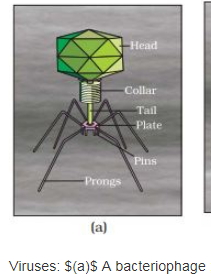
(N/A) Viruses that infect and parasitize bacteria are known as bacteriophages.
These viruses do not consume bacteria as food; instead,they attach to the bacterial surface,inject their genetic material,and utilize the host's cellular machinery to replicate themselves,eventually leading to the lysis of the bacterial cell.
[Diagram: $A$ bacteriophage showing parts like Head,Collar,Tail,Plate,Pins,and Prongs.]
These viruses do not consume bacteria as food; instead,they attach to the bacterial surface,inject their genetic material,and utilize the host's cellular machinery to replicate themselves,eventually leading to the lysis of the bacterial cell.
[Diagram: $A$ bacteriophage showing parts like Head,Collar,Tail,Plate,Pins,and Prongs.]
0 likes
View Solution441
EasyMCQ
Which of the following is correct about viroids?
A
They have free $DNA$ without protein coat.
B
They have $RNA$ with protein coat.
C
They have free $RNA$ without protein coat.
D
They have $DNA$ with protein coat.
Solution
(C) Viroids were discovered by $T.O. Diener$ in $1971$. They are infectious agents that are smaller than viruses. Structurally,they consist of a low molecular weight free $RNA$ molecule and lack the protein coat that is found in viruses. Therefore,they are essentially 'naked' $RNA$ particles.
0 likes
View Solution442
EasyMCQ
Which of the following is true for viroids?
A
They have $RNA$ with a protein coat.
B
They have free $DNA$ without a protein coat.
C
They have $DNA$ with a protein coat.
D
They have free $RNA$ without a protein coat.
Solution
(D) Viroids are infectious agents that are smaller than viruses.
They consist of a short strand of circular,single-stranded $RNA$ without a protein coat (capsid).
Because they lack a protein coat,they are distinct from viruses.
Therefore,the correct statement is that they have free $RNA$ without a protein coat.
They consist of a short strand of circular,single-stranded $RNA$ without a protein coat (capsid).
Because they lack a protein coat,they are distinct from viruses.
Therefore,the correct statement is that they have free $RNA$ without a protein coat.
0 likes
View Solution443
MediumMCQ
Which of the following infects bacteria?
A
$TMV$
B
Retrovirus
C
Poliovirus
D
Bacteriophage
Solution
(D) Bacteriophages,often referred to as $phage$ viruses,are viruses that specifically infect and replicate within bacteria. $TMV$ (Tobacco Mosaic Virus) infects plants,while Retroviruses and Polioviruses typically infect animal cells. Therefore,the correct option is $D$.
0 likes
View Solution444
MediumMCQ
Which of the following viruses contains $RNA$ as its genetic material?
A
Retrovirus
B
Poliovirus
C
Tobacco Mosaic Virus
D
All of the above
Solution
(D) In many viruses,$RNA$ serves as the genetic material instead of $DNA$.
$1$. Retroviruses (e.g.,$HIV$) contain $RNA$ as their genetic material.
$2$. Poliovirus is a single-stranded $RNA$ virus.
$3$. Tobacco Mosaic Virus $(TMV)$ also contains $RNA$ as its genetic material.
Therefore,all the listed viruses use $RNA$ as their genetic material.
$1$. Retroviruses (e.g.,$HIV$) contain $RNA$ as their genetic material.
$2$. Poliovirus is a single-stranded $RNA$ virus.
$3$. Tobacco Mosaic Virus $(TMV)$ also contains $RNA$ as its genetic material.
Therefore,all the listed viruses use $RNA$ as their genetic material.
0 likes
View Solution445
MediumMCQ
Which organisms cannot grow in polluted areas?
A
Moths
B
Lichens
C
Bacteria
D
All of the above
Solution
(B) Lichens are known as bio-indicators of air pollution,specifically sulfur dioxide $(SO_2)$ pollution. They are highly sensitive to pollutants and cannot grow in areas where the air is contaminated. Therefore,they are absent in polluted regions.
0 likes
View Solution446
EasyMCQ
Which of the following is the pathogen responsible for the mosaic disease in plants?
A
Virus
B
Viroid
C
Fungus
D
Prions
Solution
(A) Mosaic diseases in plants,such as Tobacco Mosaic Virus $(TMV)$,are caused by viruses. These pathogens infect plant cells,leading to characteristic mottled or mosaic patterns on leaves due to the destruction of chlorophyll.
0 likes
View Solution447
EasyMCQ
Which of the following are proteinaceous infectious agents?
A
Viruses
B
Viroids
C
Bacteria
D
Prions
Solution
(D) Prions are abnormal,misfolded proteins that can induce abnormal folding in normal cellular proteins in the brain. They are known to cause several neurodegenerative diseases such as Bovine Spongiform Encephalopathy $(BSE)$ in cattle and Creutzfeldt-Jakob disease $(CJD)$ in humans. Unlike viruses or viroids,they do not contain nucleic acids ($DNA$ or $RNA$).
0 likes
View Solution448
MediumMCQ
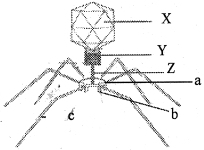
Identify the given figure.
A
Bacteriophage
B
Tobacco Mosaic Virus
C
Rod-shaped bacteria
D
Fungi
Solution
(A) The provided image shows the structure of a $Bacteriophage$.
$Bacteriophages$ are viruses that infect bacteria.
They consist of a head (labeled $X$), a collar (labeled $Y$), a tail (labeled $Z$), and tail fibers (labeled $c$).
These structures are characteristic of a $Bacteriophage$ virus, which is distinct from the rod-shaped $Tobacco Mosaic Virus$ or other microorganisms.
$Bacteriophages$ are viruses that infect bacteria.
They consist of a head (labeled $X$), a collar (labeled $Y$), a tail (labeled $Z$), and tail fibers (labeled $c$).
These structures are characteristic of a $Bacteriophage$ virus, which is distinct from the rod-shaped $Tobacco Mosaic Virus$ or other microorganisms.
0 likes
View Solution449
MediumMCQ
In the given figure,what do $X$ and $Y$ represent respectively?
A
Collar and Tail
B
Head and Tail
C
Head and Collar
D
Collar and Tail fiber
Solution
(C) The given figure represents a bacteriophage,which is a virus that infects bacteria.
In the diagram:
$X$ points to the head (capsid) of the bacteriophage.
$Y$ points to the collar region,which connects the head to the tail.
Therefore,$X$ represents the head and $Y$ represents the collar.
In the diagram:
$X$ points to the head (capsid) of the bacteriophage.
$Y$ points to the collar region,which connects the head to the tail.
Therefore,$X$ represents the head and $Y$ represents the collar.
0 likes
View SolutionBiological Classification — Viruses, Viroids, Prions and Lichens · Frequently Asked Questions
1Are these Biological Classification questions useful for JEE and NEET?
Yes. All questions in this section are mapped to JEE Main and NEET exam patterns. Previous year questions from JEE Main, NEET, GUJCET and state-level exams are included with full solutions.
2Can I switch to Hindi or Gujarati for these questions?
Yes. Use the language tabs in the hero section or the sidebar to view the same questions and solutions in English, Hindi or Gujarati.
3How do I generate a question paper from this subtopic?
Use the Vedclass Exam Paper Generator — select the chapter and subtopic, set difficulty, and generate Sets A, B, C, D automatically. First 3 chapters of every subject are free.
Vedclass Products
For Students
Vedclass Test Series
Mock tests in real JEE/NEET style with performance analysis. 5-day free trial.
Start Free TrialFor Teachers
Exam Paper Generator
Generate Set A/B/C/D papers from this chapter in 2 minutes. 3 chapters free.
Try FreeFor Institutes
Online Exam Module
Live online exams with unlimited students, 360° analytics & white-label branding.
See DemoFor Teachers & Institutes
Generate a Biological Classification Exam Paper in 2 Minutes
Select subtopic & difficulty — Sets A, B, C, D auto-generated with No Repeat logic.
First 3 chapters of every subject are free — no payment required.