
A English
Viruses, Viroids, Prions and Lichens Questions in English
Class 11 Biology · Biological Classification · Viruses, Viroids, Prions and Lichens
529+
Questions
English
Language
100%
With Solutions
Showing 49 of 529 questions in English
351
EasyMCQ
In the given figure,what does the part labeled as $A$ represent?

A
Head
B
Tail
C
Collar
D
Tail fibers
Solution
(D) The given figure represents a bacteriophage,which is a virus that infects bacteria.
The structure consists of a polyhedral head containing genetic material and a tail assembly.
The part labeled as $A$ points to the thread-like structures at the base of the tail,which are known as tail fibers.
These tail fibers are responsible for recognizing and attaching to specific receptor sites on the surface of the host bacterium.
The structure consists of a polyhedral head containing genetic material and a tail assembly.
The part labeled as $A$ points to the thread-like structures at the base of the tail,which are known as tail fibers.
These tail fibers are responsible for recognizing and attaching to specific receptor sites on the surface of the host bacterium.
0 likes
View Solution352
MediumMCQ
Viroids differ from viruses in having
A
$DNA$ molecules without protein coat
B
$RNA$ molecules with protein coat
C
$RNA$ molecules without protein coat
D
$DNA$ molecules with protein coat
Solution
(C) Viroids are infectious agents that consist only of a short strand of circular,single-stranded $RNA$ without a protein coat (capsid).
In contrast,viruses consist of genetic material ($DNA$ or $RNA$) enclosed within a protein coat called a capsid.
Therefore,the defining characteristic of viroids is that they are $RNA$ molecules without a protein coat.
In contrast,viruses consist of genetic material ($DNA$ or $RNA$) enclosed within a protein coat called a capsid.
Therefore,the defining characteristic of viroids is that they are $RNA$ molecules without a protein coat.
0 likes
View Solution353
MediumMCQ
Which of the following statements is wrong for viroids?
A
They cause infections.
B
Their $RNA$ is of high molecular weight.
C
They lack a protein coat.
D
They are smaller than viruses.
Solution
(B) The correct answer is $B$. Viroids are infectious agents that consist only of a short strand of circular single-stranded $RNA$ without a protein coat. $A$ key characteristic of viroid $RNA$ is that it has a low molecular weight compared to the $RNA$ found in viruses. Therefore,the statement that their $RNA$ is of high molecular weight is incorrect.
0 likes
View Solution354
MediumMCQ
Select the wrong statement.
A
The term 'contagium vivum fluidum' was coined by $M$. $W$. Beijerinck.
B
Mosaic disease in tobacco and $AIDS$ in human being are caused by viruses.
C
The viroids were discovered by $D$.$J$. Ivanowsky.
D
$W$.$M$. Stanley showed that viruses could be crystallised.
Solution
(C) : Viroids are infectious $RNA$ particles which were discovered by $T$.$O$. Diener $(1971)$.
These are devoid of protein coat and cause diseases in plants only,e.g.,potato spindle tuber,chrysanthemum stunt etc.
Therefore,the statement that viroids were discovered by $D$.$J$. Ivanowsky is incorrect,as $D$.$J$. Ivanowsky discovered the causal organism of tobacco mosaic disease.
These are devoid of protein coat and cause diseases in plants only,e.g.,potato spindle tuber,chrysanthemum stunt etc.
Therefore,the statement that viroids were discovered by $D$.$J$. Ivanowsky is incorrect,as $D$.$J$. Ivanowsky discovered the causal organism of tobacco mosaic disease.
0 likes
View Solution355
EasyMCQ
Which of the following shows coiled $RNA$ strand and capsomeres?
A
Polio virus
B
Tobacco mosaic virus
C
Measles virus
D
Retrovirus
Solution
(B) : Tobacco mosaic virus $(TMV)$ is a $RNA$ virus that causes tobacco mosaic disease.
It contains a single-stranded coiled $RNA$ molecule as its genetic material.
The protein coat,known as the capsid,consists of approximately $2130$ capsomeres.
These capsomeres are arranged in a helical pattern to form a hollow cylinder with a diameter of about $4 \ nm$.
It contains a single-stranded coiled $RNA$ molecule as its genetic material.
The protein coat,known as the capsid,consists of approximately $2130$ capsomeres.
These capsomeres are arranged in a helical pattern to form a hollow cylinder with a diameter of about $4 \ nm$.
0 likes
View Solution356
MediumMCQ
Viruses have
A
$DNA$ enclosed in a protein coat
B
prokaryotic nucleus
C
single chromosome
D
both $DNA$ and $RNA$
Solution
(A) The correct answer is $A$.
Viruses are non-cellular,nucleoprotein entities that utilize the synthetic machinery of a living host cell for their replication.
They do not possess a cellular structure,such as a nucleus or organelles.
Their genetic material consists of either $DNA$ or $RNA$,but never both.
This genetic material is enclosed within a protective protein coat called a capsid.
Viruses are non-cellular,nucleoprotein entities that utilize the synthetic machinery of a living host cell for their replication.
They do not possess a cellular structure,such as a nucleus or organelles.
Their genetic material consists of either $DNA$ or $RNA$,but never both.
This genetic material is enclosed within a protective protein coat called a capsid.
0 likes
View Solution357
MediumMCQ
Which statement is wrong for viruses?
A
All are parasites.
B
All of them have helical symmetry.
C
They have ability to synthesize nucleic acids and proteins.
D
Antibiotics have no effect on them.
Solution
(B) : In viruses,three architectural forms are found: helical (elongated body,e.g.,$TMV$),cuboidal (short broad body with rhombic,rounded,polyhedral shape,e.g.,poliovirus),and binal (with both cuboidal and helical parts,e.g.,$T_2$ phage). Therefore,the statement that all viruses have helical symmetry is incorrect.
0 likes
View Solution358
EasyMCQ
The protein coat of a virus is known as:
A
capsid
B
virion
C
nucleoprotein
D
core
Solution
(A) The correct answer is $A$. The nucleic acid of a virus is surrounded by a protective protein coat called the capsid. The capsid is composed of small protein subunits known as capsomeres. In some viruses,this capsid is further covered by an outer layer called an envelope,which typically consists of a combination of lipids,proteins,and carbohydrates.
0 likes
View Solution359
MediumMCQ
Given below is the diagram of a bacteriophage. In which one of the options are all the four parts $A, B, C$ and $D$ correctly identified?
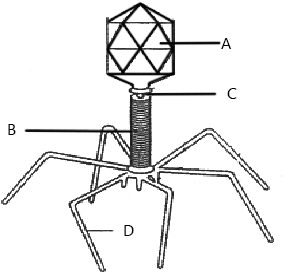
A
$A$-Tail fibres,$B$-Head,$C$-Sheath,$D$-Collar
B
$A$-Sheath,$B$-Collar,$C$-Head,$D$-Tail fibres
C
$A$-Head,$B$-Sheath,$C$-Collar,$D$-Tail fibres
D
$A$-Collar,$B$-Tail fibres,$C$-Head,$D$-Sheath
Solution
(C) Based on the structure of a bacteriophage:
$A$ represents the Head,which contains the viral genetic material.
$B$ represents the Sheath (or tail tube),which is the contractile part of the tail.
$C$ represents the Collar,which connects the head to the tail.
$D$ represents the Tail fibres,which are used for attachment to the host cell surface.
Therefore,the correct identification is $A$-Head,$B$-Sheath,$C$-Collar,$D$-Tail fibres,which corresponds to option $C$.
$A$ represents the Head,which contains the viral genetic material.
$B$ represents the Sheath (or tail tube),which is the contractile part of the tail.
$C$ represents the Collar,which connects the head to the tail.
$D$ represents the Tail fibres,which are used for attachment to the host cell surface.
Therefore,the correct identification is $A$-Head,$B$-Sheath,$C$-Collar,$D$-Tail fibres,which corresponds to option $C$.
0 likes
View Solution360
MediumMCQ
$T$.$O$. Diener discovered a
A
free infectious $DNA$
B
infectious protein
C
bacteriophage
D
free infectious $RNA$
Solution
(D) The correct answer is $(d)$.
Viroids are infectious $RNA$ particles that were discovered by $T$.$O$. Diener in $1971$.
These particles are devoid of a protein coat (capsid) and consist only of a short strand of low molecular weight $RNA$.
Viroids cause various diseases in plants,such as potato spindle tuber disease and chrysanthemum stunt disease.
Viroids are infectious $RNA$ particles that were discovered by $T$.$O$. Diener in $1971$.
These particles are devoid of a protein coat (capsid) and consist only of a short strand of low molecular weight $RNA$.
Viroids cause various diseases in plants,such as potato spindle tuber disease and chrysanthemum stunt disease.
0 likes
View Solution361
MediumMCQ
Satellite $RNAs$ are present in some
A
viroids
B
prions
C
bacteriophages
D
plant viruses
Solution
(D) : Plant viruses often contain parasites of their own,referred to as satellites.
Satellite $RNAs$ are highly dependent on their helper virus for both replication and encapsidation.
Their size varies from $194$ to $1500$ nucleotides (approx.).
The larger satellites contain open reading frames and express proteins,whereas smaller satellites do not produce functional proteins.
Satellite $RNAs$ are highly dependent on their helper virus for both replication and encapsidation.
Their size varies from $194$ to $1500$ nucleotides (approx.).
The larger satellites contain open reading frames and express proteins,whereas smaller satellites do not produce functional proteins.
0 likes
View Solution362
EasyMCQ
Infectious proteins are present in
A
gemini viruses
B
prions
C
viroids
D
satellite viruses
Solution
(B) : Prions were named by Stanley Prusiner (who received the Nobel Prize in $1997$).
Prions are infectious agents composed entirely of proteins,lacking any nucleic acid.
Prions are the causative agents of diseases such as scrapie in sheep and bovine spongiform encephalopathy (mad cow disease) in cattle.
Prions are infectious agents composed entirely of proteins,lacking any nucleic acid.
Prions are the causative agents of diseases such as scrapie in sheep and bovine spongiform encephalopathy (mad cow disease) in cattle.
0 likes
View Solution363
EasyMCQ
The causative agent of mad-cow disease is a
A
virus
B
bacterium
C
prion
D
worm
Solution
(C) : Mad cow disease is the common term for Bovine Spongiform Encephalopathy $(BSE)$,a progressive neurological disorder of cattle.
It is caused by prions.
Symptoms include an excitable or nervous temperament to external stimuli such as touch to the skin.
$A$ prion (short for proteinaceous infectious particle) is a unique type of infectious agent,as it is made only of protein.
Prions are abnormally structured forms of a host protein,which are able to convert normal molecules of the protein into the abnormal structure.
It is caused by prions.
Symptoms include an excitable or nervous temperament to external stimuli such as touch to the skin.
$A$ prion (short for proteinaceous infectious particle) is a unique type of infectious agent,as it is made only of protein.
Prions are abnormally structured forms of a host protein,which are able to convert normal molecules of the protein into the abnormal structure.
0 likes
View Solution364
EasyMCQ
Which of the following are most suitable indicators of $SO_2$ pollution in the environment?
A
Algae
B
Fungi
C
Lichens
D
Conifers
Solution
(C) : Lichens are highly sensitive to $SO_2$ pollution. They are unable to survive in areas with high concentrations of sulfur dioxide in the atmosphere. Because of this sensitivity,they serve as excellent biological indicators for monitoring $SO_2$ pollution levels in the environment.
0 likes
View Solution365
EasyMCQ
$RNA$ is the genetic material in:
A
Tobacco mosaic virus
B
Cyanobacteria
C
Cladophora
D
Sieve cells
Solution
(A) The genetic material in most organisms is $DNA$,but in some viruses,$RNA$ acts as the genetic material.
Tobacco mosaic virus $(TMV)$ is a well-known example of a virus that contains $RNA$ as its genetic material.
Cyanobacteria,Cladophora (an alga),and Sieve cells (in plants) all contain $DNA$ as their primary genetic material.
Therefore,the correct option is $A$.
Tobacco mosaic virus $(TMV)$ is a well-known example of a virus that contains $RNA$ as its genetic material.
Cyanobacteria,Cladophora (an alga),and Sieve cells (in plants) all contain $DNA$ as their primary genetic material.
Therefore,the correct option is $A$.
0 likes
View Solution366
MediumMCQ
Which of the following acts as a pollution indicator?
A
Australian marsupials
B
Lobefins
C
Ichthyosaurs
D
Lichens
Solution
(D) Lichens are symbiotic associations between fungi and algae. They are highly sensitive to atmospheric pollutants,especially sulfur dioxide $(SO_2)$. Therefore,they do not grow in polluted areas and act as natural pollution indicators.
0 likes
View Solution367
EasyMCQ
They are proteinous infectious agents.
A
Fungi
B
Algae
C
Protozoa
D
Prions
Solution
(D) Prions are abnormal,misfolded proteins that act as infectious agents.
They do not contain any nucleic acids ($DNA$ or $RNA$).
They are responsible for several neurodegenerative diseases in animals and humans,such as bovine spongiform encephalopathy $(BSE)$ in cattle and Creutzfeldt-Jakob disease $(CJD)$ in humans.
Therefore,the correct option is $D$.
They do not contain any nucleic acids ($DNA$ or $RNA$).
They are responsible for several neurodegenerative diseases in animals and humans,such as bovine spongiform encephalopathy $(BSE)$ in cattle and Creutzfeldt-Jakob disease $(CJD)$ in humans.
Therefore,the correct option is $D$.
0 likes
View Solution368
MediumMCQ
Prions are....
A
Fungi with lipids
B
Proteinaceous infectious particles
C
Algae with carbohydrates
D
None of the above
Solution
(B) Prions are abnormally folded proteins that cause infectious diseases. They differ from viruses or bacteria because they do not contain nucleic acids ($DNA$ or $RNA$). Therefore,prions are known as 'proteinaceous infectious particles'.
0 likes
View Solution369
MediumMCQ
An example of mutualism is
A
Riccia
B
Selaginella
C
Lichen
D
Spirogyra
Solution
(C) Mutualism is a type of biological interaction between two species where both organisms benefit from the relationship.
Lichen represents a classic example of mutualism between a fungus and an alga (or cyanobacteria).
The fungus provides protection,water,and minerals to the alga,while the alga provides food (carbohydrates) through photosynthesis.
Therefore,the correct option is $C$.
Lichen represents a classic example of mutualism between a fungus and an alga (or cyanobacteria).
The fungus provides protection,water,and minerals to the alga,while the alga provides food (carbohydrates) through photosynthesis.
Therefore,the correct option is $C$.
0 likes
View Solution370
EasyMCQ
Lichens secrete .......... to dissolve rock.
A
Water
B
Digestive enzymes
C
Organic matter
D
Acid
Solution
(D) Lichens are pioneer species in primary succession on bare rocks. They secrete organic acids (such as oxalic acid) that help in the weathering and dissolution of rock surfaces,which contributes to soil formation.
0 likes
View Solution371
DifficultMCQ
The total number of $RNA$ strands in an animal virus is:
A
Only one
B
One or two
C
Only two
D
Always more than one
Solution
(B) Animal viruses can contain either $DNA$ or $RNA$ as their genetic material. In the case of $RNA$ viruses,the genome can be single-stranded $(ssRNA)$ or double-stranded $(dsRNA)$. Therefore,the number of $RNA$ strands present in an animal virus can be one (in $ssRNA$ viruses) or two (in $dsRNA$ viruses). Thus,the correct answer is one or two.
0 likes
View Solution372
MediumMCQ
Who stated that viruses are crystalline?
A
Beijerinck
B
Ivanowsky
C
Diener
D
Stanley
Solution
(D) $W$.$M$. $Stanley$ demonstrated in $1935$ that viruses could be crystallized and that crystals consist largely of proteins. This discovery was a significant milestone in virology,showing that viruses could be treated like chemical substances while retaining their infectious nature.
0 likes
View Solution373
EasyMCQ
In Lichen,the algal components are called:
A
Mycobiont
B
Phycobiont
C
Conidiophore
D
Basidium
Solution
(B) Lichens are symbiotic associations between fungi and algae.
In this association,the fungal component is known as the $Mycobiont$,which is usually an Ascomycete or Basidiomycete.
The algal component is known as the $Phycobiont$,which is usually a green alga or a cyanobacterium.
Therefore,the correct option is $B$.
In this association,the fungal component is known as the $Mycobiont$,which is usually an Ascomycete or Basidiomycete.
The algal component is known as the $Phycobiont$,which is usually a green alga or a cyanobacterium.
Therefore,the correct option is $B$.
0 likes
View Solution374
EasyMCQ
Who recognized certain microbes as the causative organisms of the mosaic disease of tobacco?
A
Beijerinck
B
Pasteur
C
Stanley
D
Ivanowsky
Solution
(D) In $1892$,$D.J. Ivanowsky$ recognized certain microbes as the causative organisms of the mosaic disease of tobacco. He found that these microbes were smaller than bacteria because they could pass through bacteria-proof filters.
0 likes
View Solution375
EasyMCQ
They are smaller than virus.
A
Bacteria
B
Mycoplasma
C
Viroids
D
Cyanobacteria
Solution
(C) Viroids are infectious agents that are smaller than viruses. They consist solely of a short strand of circular,single-stranded $RNA$ without a protein coat (capsid). In contrast,viruses consist of genetic material ($DNA$ or $RNA$) enclosed within a protein coat. Therefore,viroids are the smallest known infectious agents.
0 likes
View Solution376
MediumMCQ
What is the characteristic of a viroid?
A
$RNA$ without a protein coat
B
$A$ protein chain without $DNA$ layering
C
Double-stranded $DNA$ with a protein coat
D
$DNA$ with a lipid layer
Solution
(A) Viroids were discovered by $T.O. Diener$ in $1971$ as an infectious agent that is smaller than viruses.
They consist of a low molecular weight $RNA$ molecule.
Unlike viruses,viroids lack the protein coat (capsid) that is typically found in viruses.
Therefore,they are essentially free $RNA$ molecules that cause diseases in plants.
They consist of a low molecular weight $RNA$ molecule.
Unlike viruses,viroids lack the protein coat (capsid) that is typically found in viruses.
Therefore,they are essentially free $RNA$ molecules that cause diseases in plants.
0 likes
View Solution377
EasyMCQ
Which of the following are most suitable indicators of $SO_2$ pollution in the environment?
A
Conifers
B
Algae
C
Fungi
D
Lichens
Solution
(D) Lichens are symbiotic associations between algae and fungi. They are highly sensitive to sulfur dioxide $(SO_2)$ pollution. Because they lack roots and absorb nutrients directly from the atmosphere,they accumulate pollutants. In areas with high levels of $SO_2$,lichens fail to grow,making them excellent bioindicators for air quality monitoring.
0 likes
View Solution378
MediumMCQ
Which of the following shows a coiled $RNA$ strand and capsomeres?
A
Polio virus
B
Tobacco mosaic virus
C
Measles virus
D
Retrovirus
Solution
(B) The Tobacco mosaic virus $(TMV)$ is a well-studied plant virus.
It consists of a single-stranded $RNA$ molecule that is helically coiled.
This $RNA$ strand is protected by a protein coat called a capsid,which is composed of smaller subunits known as capsomeres.
The helical arrangement of capsomeres around the $RNA$ gives the virus its characteristic rod-like shape.
It consists of a single-stranded $RNA$ molecule that is helically coiled.
This $RNA$ strand is protected by a protein coat called a capsid,which is composed of smaller subunits known as capsomeres.
The helical arrangement of capsomeres around the $RNA$ gives the virus its characteristic rod-like shape.
0 likes
View Solution379
MediumMCQ
Select the wrong statements.
A
$W.M. Stanley$ showed that viruses could be crystallized.
B
The term 'contagium vivum fluidum' was coined by $M.W. Beijerinck$.
C
Mosaic disease in tobacco and $AIDS$ in human beings are caused by viruses.
D
The viroids were discovered by $T.O. Diener$.
Solution
(D) $1$. $W.M. Stanley$ $(1935)$ demonstrated that viruses could be crystallized and crystals consist largely of proteins. This statement is correct.
$2$. The term 'contagium vivum fluidum' (infectious living fluid) was coined by $M.W. Beijerinck$ $(1898)$ for the extract of infected tobacco plants. This statement is correct.
$3$. Mosaic disease in tobacco is caused by $Tobacco Mosaic Virus$ $(TMV)$,and $AIDS$ in humans is caused by $Human Immunodeficiency Virus$ $(HIV)$. Both are viral diseases. This statement is correct.
$4$. Viroids were discovered by $T.O. Diener$ in $1971$,not $D.J. Ivanowski$. $D.J. Ivanowski$ $(1892)$ recognized certain microbes as causal organisms of the mosaic disease of tobacco. Thus,option $D$ is the wrong statement.
$2$. The term 'contagium vivum fluidum' (infectious living fluid) was coined by $M.W. Beijerinck$ $(1898)$ for the extract of infected tobacco plants. This statement is correct.
$3$. Mosaic disease in tobacco is caused by $Tobacco Mosaic Virus$ $(TMV)$,and $AIDS$ in humans is caused by $Human Immunodeficiency Virus$ $(HIV)$. Both are viral diseases. This statement is correct.
$4$. Viroids were discovered by $T.O. Diener$ in $1971$,not $D.J. Ivanowski$. $D.J. Ivanowski$ $(1892)$ recognized certain microbes as causal organisms of the mosaic disease of tobacco. Thus,option $D$ is the wrong statement.
0 likes
View Solution380
MediumMCQ
They are pollution indicators and never grow in polluted areas.
A
Fungi
B
Algae
C
Lichen
D
Mycorrhizae
Solution
(C) Lichens are symbiotic associations between algae and fungi. They are known as pollution indicators,especially for sulfur dioxide $(SO_2)$. They are very sensitive to air pollution and do not grow in areas where the air is contaminated with pollutants.
0 likes
View Solution381
EasyMCQ
It is responsible for potato spindle tuber disease.
A
Viroids
B
Fungi
C
Bacteria
D
Lichen
Solution
(A) Potato spindle tuber disease is caused by $Viroids$.
$Viroids$ are infectious agents that consist of a short strand of circular,single-stranded $RNA$ without a protein coat.
They were discovered by $T.O. Diener$ in $1971$.
Unlike viruses,they lack a capsid and are much smaller in size.
$Viroids$ are infectious agents that consist of a short strand of circular,single-stranded $RNA$ without a protein coat.
They were discovered by $T.O. Diener$ in $1971$.
Unlike viruses,they lack a capsid and are much smaller in size.
0 likes
View Solution382
MediumMCQ
Which one of the following statements about viruses is correct?
A
Nucleic acid of viruses is known as capsid
B
Viruses possess their own metabolic system
C
All viruses contain both $RNA$ and $DNA$
D
Viruses are obligate parasites
Solution
(D) Viruses are considered obligate parasites because they lack their own metabolic machinery and require a living host cell to replicate.
Option $A$ is incorrect because the protein coat of a virus is called a capsid,not the nucleic acid.
Option $B$ is incorrect because viruses do not have their own metabolic system; they rely entirely on the host cell's machinery.
Option $C$ is incorrect because a virus contains either $RNA$ or $DNA$ as its genetic material,never both.
Option $A$ is incorrect because the protein coat of a virus is called a capsid,not the nucleic acid.
Option $B$ is incorrect because viruses do not have their own metabolic system; they rely entirely on the host cell's machinery.
Option $C$ is incorrect because a virus contains either $RNA$ or $DNA$ as its genetic material,never both.
0 likes
View Solution383
EasyMCQ
Tobacco Mosaic Virus $(TMV)$ genes are
A
Double stranded $RNA$
B
Single stranded $RNA$
C
Polyribonucleotides
D
Proteinaceous
Solution
(B) The Tobacco Mosaic Virus $(TMV)$ is a well-studied plant virus.
Its genetic material consists of a single molecule of single-stranded $RNA$ $(ssRNA)$.
This $RNA$ is encapsulated within a protein coat called a capsid,which is made up of repeating protein subunits known as capsomeres.
Therefore,the correct description of $TMV$ genes is that they are single-stranded $RNA$.
Its genetic material consists of a single molecule of single-stranded $RNA$ $(ssRNA)$.
This $RNA$ is encapsulated within a protein coat called a capsid,which is made up of repeating protein subunits known as capsomeres.
Therefore,the correct description of $TMV$ genes is that they are single-stranded $RNA$.
0 likes
View Solution384
MediumMCQ
The genetic material of Tobacco Mosaic Virus $(TMV)$ is:
A
Double-stranded $RNA$
B
Single-stranded $RNA$
C
Polyribonucleotide
D
Proteinaceous
Solution
(B) Tobacco Mosaic Virus $(TMV)$ is a well-known plant virus that infects a wide range of plants,especially tobacco.
It consists of a single strand of $RNA$ encapsulated within a protein coat called a capsid.
Therefore,the genetic material of $TMV$ is single-stranded $RNA$ $(ssRNA)$.
It consists of a single strand of $RNA$ encapsulated within a protein coat called a capsid.
Therefore,the genetic material of $TMV$ is single-stranded $RNA$ $(ssRNA)$.
0 likes
View Solution385
EasyMCQ
The genetic material in an $Influenza$ virus is:
A
$DNA$
B
$RNA$
C
Both $(a)$ and $(b)$
D
Only protein,no nucleic acid
Solution
(B) The $Influenza$ virus belongs to the family $Orthomyxoviridae$.
It is an enveloped virus that contains a segmented,single-stranded $RNA$ genome.
Unlike some other viruses,it does not contain $DNA$ as its genetic material.
Therefore,the correct option is $RNA$.
It is an enveloped virus that contains a segmented,single-stranded $RNA$ genome.
Unlike some other viruses,it does not contain $DNA$ as its genetic material.
Therefore,the correct option is $RNA$.
0 likes
View Solution386
MediumMCQ
Which of the following statements is true for viruses?
A
Viruses have their own metabolic system.
B
Viruses contain either $DNA$ or $RNA$.
C
Viruses are facultative parasites.
D
Viruses are killed by antibiotics.
Solution
(B) Viruses are obligate parasites that lack their own metabolic machinery. They consist of genetic material,which is either $DNA$ or $RNA$,enclosed in a protein coat. Because they lack the cellular machinery targeted by antibiotics (such as cell wall synthesis or bacterial protein synthesis),they are not affected by antibiotics. Therefore,the statement that viruses contain either $DNA$ or $RNA$ is correct.
0 likes
View Solution387
EasyMCQ
Cauliflower mosaic virus contains . . . . . . .
A
$dsDNA$
B
$ssRNA$
C
$dsRNA$
D
$ssDNA$
Solution
(A) Cauliflower mosaic virus $(CaMV)$ is a member of the family $Caulimoviridae$.
Unlike most plant viruses which contain $RNA$ as their genetic material,$CaMV$ contains double-stranded $DNA$ $(dsDNA)$ as its genetic material.
Therefore,the correct option is $A$.
Unlike most plant viruses which contain $RNA$ as their genetic material,$CaMV$ contains double-stranded $DNA$ $(dsDNA)$ as its genetic material.
Therefore,the correct option is $A$.
0 likes
View Solution388
EasyMCQ
The Tobacco Mosaic Virus $(TMV)$ is a tubular filament of size:
A
$700 \times 30 \, nm$
B
$300 \times 10 \, nm$
C
$300 \times 5 \, nm$
D
$300 \times 18 \, nm$
Solution
(D) The Tobacco Mosaic Virus $(TMV)$ is a well-studied plant virus.
It has a rod-shaped or tubular structure.
The dimensions of the $TMV$ particle are approximately $300 \, nm$ in length and $18 \, nm$ in diameter.
Therefore,the correct size is $300 \times 18 \, nm$.
It has a rod-shaped or tubular structure.
The dimensions of the $TMV$ particle are approximately $300 \, nm$ in length and $18 \, nm$ in diameter.
Therefore,the correct size is $300 \times 18 \, nm$.
0 likes
View Solution389
MediumMCQ
Which of the following statements is true for viruses?
A
The nucleic acid of a virus is called a capsid.
B
Viruses possess their own metabolic system.
C
All viruses contain both $RNA$ and $DNA$.
D
Viruses are obligate parasites.
Solution
(D) Viruses are non-cellular organisms characterized by having an inert crystalline structure outside the living cell.
They are obligate parasites,meaning they require a living host cell to replicate as they lack their own metabolic machinery.
The protein coat of a virus is called a capsid,not the nucleic acid.
Viruses contain either $RNA$ or $DNA$,never both.
They are obligate parasites,meaning they require a living host cell to replicate as they lack their own metabolic machinery.
The protein coat of a virus is called a capsid,not the nucleic acid.
Viruses contain either $RNA$ or $DNA$,never both.
0 likes
View Solution390
MediumMCQ
Viruses are no more alive than isolated chromosomes because .........
A
Both require a cellular environment for replication.
B
They both require $DNA$ and $RNA$.
C
They both require food molecules.
D
They both require oxygen for respiration.
Solution
(A) Viruses are considered to be at the border of living and non-living organisms. They are inert outside a host cell because they lack the metabolic machinery required for self-replication. Similarly,isolated chromosomes are just genetic material that cannot replicate or perform metabolic functions on their own. Therefore,both viruses and isolated chromosomes require a living cellular environment to replicate their genetic material.
0 likes
View Solution391
EasyMCQ
The viruses that infect bacteria,multiply within them,and cause their lysis are called .........
A
Lysozyme
B
Lytic
C
Lipolytic
D
Lysogenic
Solution
(B) Viruses that infect bacteria are known as bacteriophages. When these viruses enter a bacterial cell,they take over the host's machinery to replicate. In the lytic cycle,the virus multiplies rapidly and eventually causes the host cell to burst or undergo lysis,releasing the new viral particles. Therefore,these are referred to as lytic viruses.
0 likes
View Solution392
MediumMCQ
$T$.$O$. Diener discovered . . . . . . .
A
Free infectious $RNA$
B
Free infectious $DNA$
C
Infectious proteins
D
Bacteriophages
Solution
(A) In $1971$,$T$.$O$. Diener discovered a new infectious agent that was smaller than viruses and caused potato spindle tuber disease. This agent was found to be a free infectious $RNA$ molecule that lacked the protein coat typically found in viruses. This infectious agent was named a 'viroid'.
0 likes
View Solution393
EasyMCQ
The protein coat of a virus is called ...........
A
Capsid
B
Virion
C
Nucleoprotein
D
Core
Solution
(A) virus consists of a genetic material ($DNA$ or $RNA$) enclosed within a protective protein shell. This protective protein coat is known as the $Capsid$. The $Capsid$ is made up of smaller protein subunits called $Capsomeres$.
0 likes
View Solution394
MediumMCQ
Which of the following statements is false regarding viruses?
A
All are obligate parasites.
B
All have helical symmetry.
C
They have the ability to synthesize nucleic acids and proteins.
D
They are not affected by antibiotics.
Solution
(C) Viruses are obligate parasites that require a living host cell to replicate. Statement $A$ is true.
Viruses exhibit various symmetries,such as icosahedral,helical,or complex,not just helical symmetry. Therefore,statement $B$ is false.
Viruses lack the metabolic machinery (ribosomes,enzymes) to synthesize their own nucleic acids and proteins independently; they hijack the host cell's machinery for this purpose. Therefore,statement $C$ is also false.
Viruses do not possess the targets (like cell walls or specific metabolic pathways) that antibiotics act upon,so they are unaffected by antibiotics. Statement $D$ is true.
In the context of standard biology multiple-choice questions,statement $C$ is the most fundamentally incorrect regarding their biological autonomy.
Viruses exhibit various symmetries,such as icosahedral,helical,or complex,not just helical symmetry. Therefore,statement $B$ is false.
Viruses lack the metabolic machinery (ribosomes,enzymes) to synthesize their own nucleic acids and proteins independently; they hijack the host cell's machinery for this purpose. Therefore,statement $C$ is also false.
Viruses do not possess the targets (like cell walls or specific metabolic pathways) that antibiotics act upon,so they are unaffected by antibiotics. Statement $D$ is true.
In the context of standard biology multiple-choice questions,statement $C$ is the most fundamentally incorrect regarding their biological autonomy.
0 likes
View Solution395
EasyMCQ
Which of the following contains a helical $RNA$ strand and capsomeres?
A
Polio virus
B
Tobacco mosaic virus
C
Chickenpox virus
D
Retrovirus
Solution
(B) The Tobacco mosaic virus $(TMV)$ is a well-studied plant virus.
It consists of a single-stranded $RNA$ molecule that is coiled in a helical structure.
This $RNA$ is protected by a protein coat called a capsid,which is composed of smaller structural subunits known as capsomeres.
Therefore,$TMV$ is characterized by its helical $RNA$ and the presence of capsomeres.
It consists of a single-stranded $RNA$ molecule that is coiled in a helical structure.
This $RNA$ is protected by a protein coat called a capsid,which is composed of smaller structural subunits known as capsomeres.
Therefore,$TMV$ is characterized by its helical $RNA$ and the presence of capsomeres.
0 likes
View Solution396
MediumMCQ
Select the incorrect statement.
A
Viroids were discovered by $D. J. Ivanowsky$.
B
$W. M. Stanley$ showed that viruses could be crystallized.
C
The term $Contagium \text{ } vivum \text{ } fluidum$ was coined by $M. W. Beijerinck$.
D
Tobacco mosaic disease and $AIDS$ in humans are caused by viruses.
Solution
(A) The correct answer is $A$.
$1$. Viroids were discovered by $T. O. Diener$ in $1971$, not by $D. J. Ivanowsky$.
$2$. $W. M. Stanley$ demonstrated that viruses could be crystallized and crystals consist largely of proteins.
$3$. $M. W. Beijerinck$ demonstrated that the extract of the infected plants of tobacco could cause infection in healthy plants and called the fluid as $Contagium \text{ } vivum \text{ } fluidum$ (infectious living fluid).
$4$. Tobacco mosaic disease and $AIDS$ are indeed viral diseases.
$1$. Viroids were discovered by $T. O. Diener$ in $1971$, not by $D. J. Ivanowsky$.
$2$. $W. M. Stanley$ demonstrated that viruses could be crystallized and crystals consist largely of proteins.
$3$. $M. W. Beijerinck$ demonstrated that the extract of the infected plants of tobacco could cause infection in healthy plants and called the fluid as $Contagium \text{ } vivum \text{ } fluidum$ (infectious living fluid).
$4$. Tobacco mosaic disease and $AIDS$ are indeed viral diseases.
0 likes
View Solution397
MediumMCQ
Which of the following statements is false regarding viroids?
A
They are smaller than viruses.
B
They are infectious.
C
Their $RNA$ has a high molecular weight.
D
They lack a protein coat.
Solution
(C) Viroids were discovered by $T.O. Diener$ in $1971$ as a new infectious agent that is smaller than viruses.
They consist of a free,low molecular weight $RNA$ and lack the protein coat that is found in viruses.
Therefore,the statement that their $RNA$ has a high molecular weight is false,as they contain low molecular weight $RNA$.
They consist of a free,low molecular weight $RNA$ and lack the protein coat that is found in viruses.
Therefore,the statement that their $RNA$ has a high molecular weight is false,as they contain low molecular weight $RNA$.
0 likes
View Solution398
EasyMCQ
Viroids differ from viruses in that they possess:
A
$DNA$ molecules with protein coats
B
$DNA$ molecules without protein coats
C
$RNA$ molecules with protein coats
D
$RNA$ molecules without protein coats
Solution
(D) Viroids were discovered by $T.O. Diener$ in $1971$ as a new infectious agent that is smaller than viruses.
They consist of a low molecular weight $RNA$ molecule.
Unlike viruses,viroids lack the protein coat (capsid) that is typically found in viruses.
Therefore,viroids are characterized as free $RNA$ molecules without a protein coat.
They consist of a low molecular weight $RNA$ molecule.
Unlike viruses,viroids lack the protein coat (capsid) that is typically found in viruses.
Therefore,viroids are characterized as free $RNA$ molecules without a protein coat.
0 likes
View Solution399
MediumMCQ
Lichens are indicators of $SO_2$ pollution because they are ........
A
symbiotic associations of algae and fungi.
B
growing faster than others.
C
sensitive to $SO_2$.
D
flourishing in $SO_2$ rich environments.
Solution
(C) Lichens are composite organisms consisting of a symbiotic association between algae (phycobiont) and fungi (mycobiont).
They are well-known as biological indicators of air pollution,specifically sulfur dioxide $(SO_2)$.
Lichens are highly sensitive to $SO_2$ and cannot grow in areas where the concentration of $SO_2$ is high.
Therefore,their absence in a particular area serves as an indicator of $SO_2$ pollution.
They are well-known as biological indicators of air pollution,specifically sulfur dioxide $(SO_2)$.
Lichens are highly sensitive to $SO_2$ and cannot grow in areas where the concentration of $SO_2$ is high.
Therefore,their absence in a particular area serves as an indicator of $SO_2$ pollution.
0 likes
View SolutionBiological Classification — Viruses, Viroids, Prions and Lichens · Frequently Asked Questions
1Are these Biological Classification questions useful for JEE and NEET?
Yes. All questions in this section are mapped to JEE Main and NEET exam patterns. Previous year questions from JEE Main, NEET, GUJCET and state-level exams are included with full solutions.
2Can I switch to Hindi or Gujarati for these questions?
Yes. Use the language tabs in the hero section or the sidebar to view the same questions and solutions in English, Hindi or Gujarati.
3How do I generate a question paper from this subtopic?
Use the Vedclass Exam Paper Generator — select the chapter and subtopic, set difficulty, and generate Sets A, B, C, D automatically. First 3 chapters of every subject are free.
Vedclass Products
For Students
Vedclass Test Series
Mock tests in real JEE/NEET style with performance analysis. 5-day free trial.
Start Free TrialFor Teachers
Exam Paper Generator
Generate Set A/B/C/D papers from this chapter in 2 minutes. 3 chapters free.
Try FreeFor Institutes
Online Exam Module
Live online exams with unlimited students, 360° analytics & white-label branding.
See DemoFor Teachers & Institutes
Generate a Biological Classification Exam Paper in 2 Minutes
Select subtopic & difficulty — Sets A, B, C, D auto-generated with No Repeat logic.
First 3 chapters of every subject are free — no payment required.