
A English
Viruses, Viroids, Prions and Lichens Questions in English
Class 11 Biology · Biological Classification · Viruses, Viroids, Prions and Lichens
529+
Questions
English
Language
100%
With Solutions
Showing 29 of 529 questions in English
501
EasyMCQ
What is the importance of lichens?
A
They act as pollution indicators.
B
They are used in the production of antibiotics and dyes.
C
They serve as a food source for various animals.
D
All of the above.
Solution
(D) Lichens are ecologically and economically important for several reasons:
$1$. Lichens contain a complex carbohydrate called lichenin,making them a food source for many animals,such as reindeer.
$2$. They are used in the production of various medicines,including antibiotics.
$3$. Lichens like $Roccella$ $tinctoria$,$Parmelia$,and $Omphalodes$ are used in the manufacturing of different types of dyes.
$4$. They are also well-known as pollution indicators,particularly for $SO_2$ (sulfur dioxide),as they do not grow in polluted areas.
$1$. Lichens contain a complex carbohydrate called lichenin,making them a food source for many animals,such as reindeer.
$2$. They are used in the production of various medicines,including antibiotics.
$3$. Lichens like $Roccella$ $tinctoria$,$Parmelia$,and $Omphalodes$ are used in the manufacturing of different types of dyes.
$4$. They are also well-known as pollution indicators,particularly for $SO_2$ (sulfur dioxide),as they do not grow in polluted areas.
0 likes
View Solution502
MediumMCQ
$A$ virus is considered a living organism and an obligate parasite when inside a host cell. However,viruses are not classified along with bacteria or fungi. What are the characteristics of a virus that are similar to non-living objects?
A
They possess a complex cellular organization.
B
They can replicate independently outside a host.
C
They have an inert crystalline structure outside a living cell.
D
They contain both $DNA$ and $RNA$ as genetic material.
Solution
(C) The characteristics of a virus that are similar to non-living objects are as follows:
$(a)$ They exist as an inert crystalline structure when outside a living host cell.
$(b)$ They lack cellular machinery,such as ribosomes,mitochondria,or other cell organelles,which are essential for independent metabolism.
$(a)$ They exist as an inert crystalline structure when outside a living host cell.
$(b)$ They lack cellular machinery,such as ribosomes,mitochondria,or other cell organelles,which are essential for independent metabolism.
0 likes
View Solution503
MediumMCQ
Algae $+$ Fungi $= .........$
A
Lichens
B
Mycorrhiza
C
Parasitism
D
Predation
Solution
(A) Lichens are symbiotic associations,i.e.,mutually useful associations,between algae and fungi.
The algal component is known as phycobiont (which is autotrophic) and the fungal component is known as mycobiont (which is heterotrophic).
The algae prepare food for fungi,and the fungi provide shelter and absorb mineral nutrients and water for their partner.
The algal component is known as phycobiont (which is autotrophic) and the fungal component is known as mycobiont (which is heterotrophic).
The algae prepare food for fungi,and the fungi provide shelter and absorb mineral nutrients and water for their partner.
0 likes
View Solution504
MediumMCQ
Which of the following is considered a connecting link between living and non-living organisms?
A
Viruses
B
Viroids
C
Lichens
D
Bacteria
Solution
(A) Viruses are considered a connecting link between living and non-living organisms because they exhibit characteristics of both.
$1$. Non-living characteristics: They can be crystallized,lack metabolic machinery,and cannot reproduce outside a host cell.
$2$. Living characteristics: They possess genetic material ($DNA$ or $RNA$),can replicate inside a host cell,and can undergo mutations.
Therefore,option $A$ is the correct answer.
$1$. Non-living characteristics: They can be crystallized,lack metabolic machinery,and cannot reproduce outside a host cell.
$2$. Living characteristics: They possess genetic material ($DNA$ or $RNA$),can replicate inside a host cell,and can undergo mutations.
Therefore,option $A$ is the correct answer.
0 likes
View Solution505
MediumMCQ
In which kingdom are viruses classified?
A
Bacteria
B
Protista
C
Fungi
D
None of these
Solution
(D) In the $R.H. Whittaker$ five-kingdom classification system,viruses,viroids,prions,and lichens are not given any place or kingdom.
Viruses are considered non-cellular organisms that are characterized by having an inert crystalline structure outside the living cell.
Since they do not possess a cellular structure,they do not fit into the $Monera$,$Protista$,$Fungi$,$Plantae$,or $Animalia$ kingdoms.
Viruses are considered non-cellular organisms that are characterized by having an inert crystalline structure outside the living cell.
Since they do not possess a cellular structure,they do not fit into the $Monera$,$Protista$,$Fungi$,$Plantae$,or $Animalia$ kingdoms.
0 likes
View Solution506
MediumMCQ
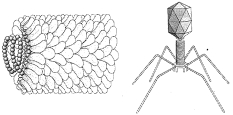
Identify the viruses given below.
A
Bacteriophage and Tobacco Mosaic Virus
B
Tobacco Mosaic Virus and Bacteriophage
C
Animal virus and Bacteriophage
D
Bacteriophage and Animal virus
Solution
(B) The image on the left represents the Tobacco Mosaic Virus $(TMV)$,which is a plant virus.
The image on the right represents a Bacteriophage,which is a virus that infects bacteria.
Therefore,the correct identification is Tobacco Mosaic Virus and Bacteriophage.
The image on the right represents a Bacteriophage,which is a virus that infects bacteria.
Therefore,the correct identification is Tobacco Mosaic Virus and Bacteriophage.
0 likes
View Solution507
MediumMCQ
Which of the following is an incorrect statement regarding viruses?
A
They have a cellular structure.
B
They are inert crystalline structures outside a living cell.
C
They are obligate parasites.
D
Viruses can pass through bacteria-proof filters.
Solution
(A) Viruses are considered non-cellular organisms because they lack a true cellular structure (they do not have a cell membrane,cytoplasm,or organelles).
They consist only of genetic material ($DNA$ or $RNA$) enclosed in a protein coat.
Therefore,the statement that they have a cellular structure is incorrect.
All other statements are correct: they are inert outside a host,they are obligate parasites,and their small size allows them to pass through bacteria-proof filters.
They consist only of genetic material ($DNA$ or $RNA$) enclosed in a protein coat.
Therefore,the statement that they have a cellular structure is incorrect.
All other statements are correct: they are inert outside a host,they are obligate parasites,and their small size allows them to pass through bacteria-proof filters.
0 likes
View Solution508
EasyMCQ
Who discovered the Tobacco Mosaic Virus $(TMV)$?
A
$D.J. Ivanowsky$
B
$M.W. Beijerinck$
C
$W.M. Stanley$
D
$T.O. Diener$
Solution
(A) $D.J. Ivanowsky$ $(1892)$ recognized certain microbes as causal organisms of the mosaic disease of tobacco. These were found to be smaller than bacteria because they passed through bacteria-proof filters.
0 likes
View Solution509
EasyMCQ
Which scientist demonstrated that the extract of infected tobacco plants could cause infection in healthy plants?
A
$D. J. Ivanowsky$
B
$M. W. Beijerinck$
C
$W. M. Stanley$
D
$T. O. Diener$
Solution
(B) In $1892$, $D. J. Ivanowsky$ recognized certain microbes as causal organisms of the mosaic disease of tobacco. He demonstrated that these microbes could pass through bacteria-proof filters. Later, in $1898$, $M. W. Beijerinck$ demonstrated that the extract of the infected plants of tobacco could cause infection in healthy plants and called the fluid as $Contagium \text{ } vivum \text{ } fluidum$ (infectious living fluid). Therefore, the correct answer is $M. W. Beijerinck$.
0 likes
View Solution510
MediumMCQ
Which of the following is known as a nucleoprotein?
A
Ribosomes
B
Nucleoid
C
Viruses
D
All of the above
Solution
(C) nucleoprotein is any protein that is structurally associated with nucleic acid (either $DNA$ or $RNA$).
Viruses are composed of a genetic material ($DNA$ or $RNA$) enclosed within a protein coat called a capsid.
Because they consist of nucleic acid and protein,viruses are classified as nucleoproteins.
Ribosomes are also nucleoprotein complexes (rRNA and proteins),but in the context of biological classification and the study of infectious agents,viruses are the primary entities referred to as nucleoproteins.
Viruses are composed of a genetic material ($DNA$ or $RNA$) enclosed within a protein coat called a capsid.
Because they consist of nucleic acid and protein,viruses are classified as nucleoproteins.
Ribosomes are also nucleoprotein complexes (rRNA and proteins),but in the context of biological classification and the study of infectious agents,viruses are the primary entities referred to as nucleoproteins.
0 likes
View Solution511
MediumMCQ
Match the following columns:
| Column-$I$ (Virus) | Column-$II$ (Type of Genetic Material) |
| $P$. Animal virus | $I$. $ssRNA$ |
| $Q$. Plant virus | $II$. $dsRNA$ or $dsDNA$ or $ssRNA$ |
| $R$. Bacterial virus | $III$. $dsDNA$ |
A
$P-II, Q-I, R-III$
B
$P-I, Q-II, R-III$
C
$P-III, Q-I, R-II$
D
$P-III, Q-II, R-I$
Solution
(A) According to biological classification:
$1$. Animal viruses generally contain $dsRNA$,$dsDNA$,or $ssRNA$ as their genetic material $(P-II)$.
$2$. Plant viruses generally contain single-stranded $RNA$ $(ssRNA)$ as their genetic material $(Q-I)$.
$3$. Bacterial viruses (bacteriophages) generally contain double-stranded $DNA$ $(dsDNA)$ as their genetic material $(R-III)$.
Therefore,the correct matching is $P-II, Q-I, R-III$.
$1$. Animal viruses generally contain $dsRNA$,$dsDNA$,or $ssRNA$ as their genetic material $(P-II)$.
$2$. Plant viruses generally contain single-stranded $RNA$ $(ssRNA)$ as their genetic material $(Q-I)$.
$3$. Bacterial viruses (bacteriophages) generally contain double-stranded $DNA$ $(dsDNA)$ as their genetic material $(R-III)$.
Therefore,the correct matching is $P-II, Q-I, R-III$.
0 likes
View Solution512
MediumMCQ
Select the incorrect statement from the following:
A
The unit of a capsid is a capsomere.
B
The capsid protects the nucleic acid.
C
Capsomeres are made of proteins.
D
Capsomeres are arranged in helical or polyhedral geometric forms.
Solution
(A) The correct answer is $A$.
In virology,the capsid is the protein shell of a virus,which encloses its genetic material.
The capsid is composed of protein subunits called capsomeres.
Therefore,the statement '$A$' is incorrect because it reverses the relationship: a capsid is made of capsomeres,not the other way around.
Statements '$B$','$C$',and '$D$' are correct descriptions of viral structure.
In virology,the capsid is the protein shell of a virus,which encloses its genetic material.
The capsid is composed of protein subunits called capsomeres.
Therefore,the statement '$A$' is incorrect because it reverses the relationship: a capsid is made of capsomeres,not the other way around.
Statements '$B$','$C$',and '$D$' are correct descriptions of viral structure.
0 likes
View Solution513
EasyMCQ
Who discovered viroids?
A
$D$.$J$. Ivanowsky
B
$M$.$W$. Beijerinck
C
$W$.$M$. Stanley
D
$T$.$O$. Diener
Solution
(D) Viroids were discovered by $T.O. Diener$ in $1971$.
They are infectious agents that are smaller than viruses and consist of a free low molecular weight $RNA$ without a protein coat.
They are infectious agents that are smaller than viruses and consist of a free low molecular weight $RNA$ without a protein coat.
0 likes
View Solution514
EasyMCQ
Which of the following causes the potato spindle tuber disease?
A
Fungi
B
Viruses
C
Viroids
D
Lichens
Solution
(C) The potato spindle tuber disease is caused by $Viroids$.
$Viroids$ are infectious agents that consist of a short strand of circular,single-stranded $RNA$ without a protein coat.
They were discovered by $T.O. Diener$ in $1971$.
Unlike viruses,they are much smaller and lack the capsid structure.
$Viroids$ are infectious agents that consist of a short strand of circular,single-stranded $RNA$ without a protein coat.
They were discovered by $T.O. Diener$ in $1971$.
Unlike viruses,they are much smaller and lack the capsid structure.
0 likes
View Solution515
EasyMCQ
Identify the components of lichens.
Phycobiont $\quad\quad\quad$ Mycobiont
Phycobiont $\quad\quad\quad$ Mycobiont
A
Fungal component $\quad\quad\quad$ Algal component
B
Algal component $\quad\quad\quad$ Fungal component
C
Fungal component $\quad\quad\quad$ Root component
D
Root component $\quad\quad\quad$ Fungal component
Solution
(B) Lichens are symbiotic associations between algae and fungi.
The algal component is known as the phycobiont,which is autotrophic and provides food through photosynthesis.
The fungal component is known as the mycobiont,which is heterotrophic and provides protection,anchorage,and absorption of minerals and water for the algae.
Therefore,phycobiont refers to the algal component and mycobiont refers to the fungal component.
The algal component is known as the phycobiont,which is autotrophic and provides food through photosynthesis.
The fungal component is known as the mycobiont,which is heterotrophic and provides protection,anchorage,and absorption of minerals and water for the algae.
Therefore,phycobiont refers to the algal component and mycobiont refers to the fungal component.
0 likes
View Solution516
MediumMCQ
Which of the following acts as a pollution indicator?
A
Viruses
B
Viroids
C
Bacteria
D
Lichens
Solution
(D) Lichens are symbiotic associations between fungi and algae. They are highly sensitive to sulfur dioxide $(SO_2)$ pollution. They do not grow in polluted areas,especially those with high levels of $SO_2$. Therefore,they are widely used as biological indicators of air pollution.
0 likes
View Solution517
MediumMCQ
What are prions?
A
Infectious $RNA$
B
Infectious $DNA$
C
Infectious proteins
D
All of the above
Solution
(C) Prions are abnormally folded proteins that can induce normal proteins to misfold into the same infectious shape.
They are known to cause several neurological diseases in animals,such as bovine spongiform encephalopathy $(BSE)$ in cattle and its analogous variant in humans.
Unlike viruses or viroids,prions do not contain any nucleic acids ($DNA$ or $RNA$).
They are known to cause several neurological diseases in animals,such as bovine spongiform encephalopathy $(BSE)$ in cattle and its analogous variant in humans.
Unlike viruses or viroids,prions do not contain any nucleic acids ($DNA$ or $RNA$).
0 likes
View Solution518
MediumMCQ
Select the correct option for $Prions$.
A
They cause $Mad$ $Cow$ $Disease$ in cattle.
B
They cause $Creutzfeldt-Jakob$ $Disease$ $(CJD)$ in humans.
C
They cause neurological disorders.
D
All of the above.
Solution
(D) $Prions$ are abnormally folded proteins that act as infectious pathogens.
$1$. They cause $Mad$ $Cow$ $Disease$ ($Bovine$ $Spongiform$ $Encephalopathy$) in cattle.
$2$. They are responsible for serious diseases like $Creutzfeldt-Jakob$ $Disease$ $(CJD)$ in humans.
$3$. These diseases primarily affect the central nervous system,hence they are classified as neurological disorders.
Therefore,all the given options are correct.
$1$. They cause $Mad$ $Cow$ $Disease$ ($Bovine$ $Spongiform$ $Encephalopathy$) in cattle.
$2$. They are responsible for serious diseases like $Creutzfeldt-Jakob$ $Disease$ $(CJD)$ in humans.
$3$. These diseases primarily affect the central nervous system,hence they are classified as neurological disorders.
Therefore,all the given options are correct.
0 likes
View Solution519
EasyMCQ
Lichens are a symbiotic association between:
A
Algae and Fungi
B
Algae and Bears
C
Fungi and Roots
D
Roots and Algae
Solution
(A) Lichens represent a symbiotic association between an algal component $(Phycobiont)$ and a fungal component $(Mycobiont)$.
In this relationship, the algae prepare food through photosynthesis, while the fungi provide protection, anchorage, and absorption of water and minerals for the algae.
Therefore, the correct answer is $Algae + Fungi$.
In this relationship, the algae prepare food through photosynthesis, while the fungi provide protection, anchorage, and absorption of water and minerals for the algae.
Therefore, the correct answer is $Algae + Fungi$.
0 likes
View Solution520
MediumMCQ
Which of the following are known as proteinaceous infectious agents?
A
Prions
B
Viruses
C
Viroids
D
Bacteria
Solution
(A) Prions are misfolded proteins that have the ability to transmit their misfolded shape onto normal variants of the same protein.
They are known as proteinaceous infectious agents because they lack nucleic acids ($DNA$ or $RNA$) and consist entirely of protein.
Viruses contain genetic material ($DNA$ or $RNA$) enclosed in a protein coat.
Viroids consist only of a short strand of circular,single-stranded $RNA$ without a protein coat.
Bacteria are unicellular prokaryotic organisms with a complex cell structure.
Therefore,the correct option is $A$.
They are known as proteinaceous infectious agents because they lack nucleic acids ($DNA$ or $RNA$) and consist entirely of protein.
Viruses contain genetic material ($DNA$ or $RNA$) enclosed in a protein coat.
Viroids consist only of a short strand of circular,single-stranded $RNA$ without a protein coat.
Bacteria are unicellular prokaryotic organisms with a complex cell structure.
Therefore,the correct option is $A$.
0 likes
View Solution521
MediumMCQ
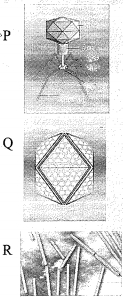
Match the following columns:
| Column-$I$ | Column-$II$ |
|---|---|
| $P$ | $I$. Tobacco Mosaic Virus |
| $Q$ | $II$. Bacteriophage |
| $R$ | $III$. Adenovirus |
A
$(P-III), (Q-II), (R-I)$
B
$(P-I), (Q-III), (R-II)$
C
$(P-II), (Q-III), (R-I)$
D
$(P-I), (Q-II), (R-III)$
Solution
(C) Based on the provided images:
$P$ represents a Bacteriophage,which is a virus that infects bacteria.
$Q$ represents an Adenovirus,which causes respiratory infections.
$R$ represents the Tobacco Mosaic Virus $(TMV)$,which is a rod-shaped virus that infects tobacco plants.
Therefore,the correct matching is $(P-II), (Q-III), (R-I)$.
$P$ represents a Bacteriophage,which is a virus that infects bacteria.
$Q$ represents an Adenovirus,which causes respiratory infections.
$R$ represents the Tobacco Mosaic Virus $(TMV)$,which is a rod-shaped virus that infects tobacco plants.
Therefore,the correct matching is $(P-II), (Q-III), (R-I)$.
0 likes
View Solution522
MediumMCQ
Mad cow disease in cattle and $Creutzfeldt-Jakob$ disease in humans are due to infection by
A
Bacterium
B
Virus
C
Viroid
D
Prion
Solution
(D) Mad cow disease (Bovine Spongiform Encephalopathy) in cattle and $Creutzfeldt-Jakob$ disease $(CJD)$ in humans are caused by prions.
Prions are abnormally folded proteins that can induce abnormal folding in normal proteins.
They are infectious agents that lack nucleic acids ($DNA$ or $RNA$) and are smaller than viruses.
Therefore,the correct option is $D$.
Prions are abnormally folded proteins that can induce abnormal folding in normal proteins.
They are infectious agents that lack nucleic acids ($DNA$ or $RNA$) and are smaller than viruses.
Therefore,the correct option is $D$.
0 likes
View Solution523
DifficultMCQ
Prions are $-$
A
Some mutated form of bacteria
B
Infectious proteins
C
Plant pathogens
D
Virus having single stranded $DNA$
Solution
(B) Prions are abnormally folded proteins that can induce abnormal folding in normal proteins.
They are known to cause several neurological diseases in animals,such as bovine spongiform encephalopathy $(BSE)$ or mad cow disease,and its analogous variant in humans,Creutzfeldt-Jakob disease $(CJD)$.
Unlike viruses,prions do not contain nucleic acids ($DNA$ or $RNA$).
Therefore,they are defined as infectious proteins.
They are known to cause several neurological diseases in animals,such as bovine spongiform encephalopathy $(BSE)$ or mad cow disease,and its analogous variant in humans,Creutzfeldt-Jakob disease $(CJD)$.
Unlike viruses,prions do not contain nucleic acids ($DNA$ or $RNA$).
Therefore,they are defined as infectious proteins.
0 likes
View Solution524
MediumMCQ
Select the incorrect statement about virus $:$
A
Non-cellular organisms
B
Inert crystalline structure outside the living cell
C
Extract of infectious plant was called "contagium vivum fluidum" by $\text{M.W. Beijerinck}$
D
Contains both $\text{RNA}$ and $\text{DNA}$
Solution
(D) Viruses are non-cellular organisms that are characterized by having an inert crystalline structure outside the living cell.
They are obligate parasites.
$\text{M.W. Beijerinck}$ $(1898)$ demonstrated that the extract of the infected plants of tobacco could cause infection in healthy plants and called the fluid as "contagium vivum fluidum" (infectious living fluid).
$A$ virus is a nucleoprotein, meaning it contains genetic material (either $\text{RNA}$ or $\text{DNA}$) and a protein coat.
No virus contains both $\text{RNA}$ and $\text{DNA}$ as its genetic material.
Therefore, the statement that viruses contain both $\text{RNA}$ and $\text{DNA}$ is incorrect.
They are obligate parasites.
$\text{M.W. Beijerinck}$ $(1898)$ demonstrated that the extract of the infected plants of tobacco could cause infection in healthy plants and called the fluid as "contagium vivum fluidum" (infectious living fluid).
$A$ virus is a nucleoprotein, meaning it contains genetic material (either $\text{RNA}$ or $\text{DNA}$) and a protein coat.
No virus contains both $\text{RNA}$ and $\text{DNA}$ as its genetic material.
Therefore, the statement that viruses contain both $\text{RNA}$ and $\text{DNA}$ is incorrect.
0 likes
View Solution525
MediumMCQ
Which of the following is a very good pollution indicator?
A
Fungi
B
Algae
C
Lichens
D
Bryophyta
Solution
(C) Lichens are symbiotic associations between algae and fungi.
They are highly sensitive to atmospheric pollutants,especially sulfur dioxide $(SO_2)$.
Because they do not grow in polluted areas,they serve as excellent bio-indicators of air pollution.
They are highly sensitive to atmospheric pollutants,especially sulfur dioxide $(SO_2)$.
Because they do not grow in polluted areas,they serve as excellent bio-indicators of air pollution.
0 likes
View Solution526
MediumMCQ
Match the following columns.
| Column $I$ | Column $II$ |
|---|---|
| $(A)$ $DJ$ Ivanowsky | $(i)$ Viroids |
| $(B)$ $MW$ Beijerinck | $(ii)$ Crystallised virus |
| $(C)$ $WM$ Stanley | $(iii)$ Contagium vivum fluidum |
| $(D)$ $TO$ Diener | $(iv)$ Mosaic disease of tobacco |
A
$A \longrightarrow (i), B \longrightarrow (iv), C \longrightarrow (iii), D \longrightarrow (ii)$
B
$A \longrightarrow (ii), B \longrightarrow (i), C \longrightarrow (iv), D \longrightarrow (iii)$
C
$A \longrightarrow (iv), B \longrightarrow (iii), C \longrightarrow (ii), D \longrightarrow (i)$
D
$A \longrightarrow (iii), B \longrightarrow (ii), C \longrightarrow (i), D \longrightarrow (iv)$
Solution
(C) The correct matches are as follows:
$1$. $DJ$ Ivanowsky $(1892)$ discovered the causal organism of the mosaic disease of tobacco,which was smaller than bacteria.
$2$. $MW$ Beijerinck $(1898)$ demonstrated that the extract of the infected plants of tobacco could cause infection in healthy plants and called the fluid as 'Contagium vivum fluidum' (infectious living fluid).
$3$. $WM$ Stanley $(1935)$ showed that viruses could be crystallised and crystals consist largely of proteins.
$4$. $TO$ Diener $(1971)$ discovered a new infectious agent that was smaller than viruses and caused potato spindle tuber disease,which was named as Viroids.
Therefore,the correct matching is: $A \longrightarrow (iv), B \longrightarrow (iii), C \longrightarrow (ii), D \longrightarrow (i)$.
$1$. $DJ$ Ivanowsky $(1892)$ discovered the causal organism of the mosaic disease of tobacco,which was smaller than bacteria.
$2$. $MW$ Beijerinck $(1898)$ demonstrated that the extract of the infected plants of tobacco could cause infection in healthy plants and called the fluid as 'Contagium vivum fluidum' (infectious living fluid).
$3$. $WM$ Stanley $(1935)$ showed that viruses could be crystallised and crystals consist largely of proteins.
$4$. $TO$ Diener $(1971)$ discovered a new infectious agent that was smaller than viruses and caused potato spindle tuber disease,which was named as Viroids.
Therefore,the correct matching is: $A \longrightarrow (iv), B \longrightarrow (iii), C \longrightarrow (ii), D \longrightarrow (i)$.
0 likes
View Solution527
EasyMCQ
Infectious and free $\text{RNA}$ particles having low molecular weight were discovered by $:-$
A
Diener
B
Beijerinek
C
Stanley
D
Pasteur
Solution
(A) The infectious and free $\text{RNA}$ particles with low molecular weight are known as $\text{Viroids}$.
They were discovered by $T.O. \text{Diener}$ in $1971$.
These particles lack the protein coat that is found in viruses,which is why they are called 'free' $\text{RNA}$ particles.
Therefore,the correct answer is $A$.
They were discovered by $T.O. \text{Diener}$ in $1971$.
These particles lack the protein coat that is found in viruses,which is why they are called 'free' $\text{RNA}$ particles.
Therefore,the correct answer is $A$.
0 likes
View Solution528
MediumMCQ
Match the column $I$ with column $II$:
| Particles/Microorganisms | Diseases |
|---|---|
| $(i)$ Viroid | $(a)$ $\text{CJD}$ |
| $(ii)$ Virus | $(b)$ Citrus canker |
| $(iii)$ Bacteria | $(c)$ Potato spindle tuber disease |
| $(iv)$ Prion | $(d)$ Mumps |
A
$i - a, ii - b, iii - d, iv - c$
B
$i - c, ii - d, iii - a, iv - b$
C
$i - c, ii - d, iii - b, iv - a$
D
$i - a, ii - c, iii - b, iv - d$
Solution
(C) The correct matches are as follows:
$(i)$ Viroids are infectious $RNA$ particles that cause diseases like Potato spindle tuber disease $(c)$.
$(ii)$ Viruses are infectious agents that cause various diseases,including Mumps $(d)$.
$(iii)$ Bacteria are prokaryotic organisms that cause diseases such as Citrus canker $(b)$.
$(iv)$ Prions are misfolded proteins that cause neurodegenerative diseases like $\text{CJD}$ (Creutzfeldt-Jakob disease) $(a)$.
Therefore,the correct matching is $(i-c, ii-d, iii-b, iv-a)$.
$(i)$ Viroids are infectious $RNA$ particles that cause diseases like Potato spindle tuber disease $(c)$.
$(ii)$ Viruses are infectious agents that cause various diseases,including Mumps $(d)$.
$(iii)$ Bacteria are prokaryotic organisms that cause diseases such as Citrus canker $(b)$.
$(iv)$ Prions are misfolded proteins that cause neurodegenerative diseases like $\text{CJD}$ (Creutzfeldt-Jakob disease) $(a)$.
Therefore,the correct matching is $(i-c, ii-d, iii-b, iv-a)$.
0 likes
View Solution529
EasyMCQ
The concept of "Contagium vivum fluidum" was given by
A
$D$. $J$. Ivanowsky
B
$W$. $M$. Stanley
C
$M$. $W$. Beijerinck
D
$R$. $H$. Whittaker
Solution
(C) The correct answer is $C$.
In $1898$, the Dutch microbiologist $M. W. Beijerinck$ demonstrated that the extract of infected tobacco plants could cause infection in healthy plants.
He called this fluid extract "Contagium vivum fluidum", which translates to "infectious living fluid".
In $1898$, the Dutch microbiologist $M. W. Beijerinck$ demonstrated that the extract of infected tobacco plants could cause infection in healthy plants.
He called this fluid extract "Contagium vivum fluidum", which translates to "infectious living fluid".
0 likes
View SolutionBiological Classification — Viruses, Viroids, Prions and Lichens · Frequently Asked Questions
1Are these Biological Classification questions useful for JEE and NEET?
Yes. All questions in this section are mapped to JEE Main and NEET exam patterns. Previous year questions from JEE Main, NEET, GUJCET and state-level exams are included with full solutions.
2Can I switch to Hindi or Gujarati for these questions?
Yes. Use the language tabs in the hero section or the sidebar to view the same questions and solutions in English, Hindi or Gujarati.
3How do I generate a question paper from this subtopic?
Use the Vedclass Exam Paper Generator — select the chapter and subtopic, set difficulty, and generate Sets A, B, C, D automatically. First 3 chapters of every subject are free.
Vedclass Products
For Students
Vedclass Test Series
Mock tests in real JEE/NEET style with performance analysis. 5-day free trial.
Start Free TrialFor Teachers
Exam Paper Generator
Generate Set A/B/C/D papers from this chapter in 2 minutes. 3 chapters free.
Try FreeFor Institutes
Online Exam Module
Live online exams with unlimited students, 360° analytics & white-label branding.
See DemoFor Teachers & Institutes
Generate a Biological Classification Exam Paper in 2 Minutes
Select subtopic & difficulty — Sets A, B, C, D auto-generated with No Repeat logic.
First 3 chapters of every subject are free — no payment required.