
A English
Viruses, Viroids, Prions and Lichens Questions in English
Class 11 Biology · Biological Classification · Viruses, Viroids, Prions and Lichens
529+
Questions
English
Language
100%
With Solutions
Showing 50 of 529 questions in English
301
EasyMCQ
Assertion $A$: Viroids and viruses can pass through bacteria-proof filters.
Reason $R$: Bacteria are retained by bacteria-proof filters.
Which option is correct for Assertion $A$ and Reason $R$?
Reason $R$: Bacteria are retained by bacteria-proof filters.
Which option is correct for Assertion $A$ and Reason $R$?
A
$A$ and $R$ are both true and $R$ is the correct explanation of $A$.
B
$A$ and $R$ are both true but $R$ is not the correct explanation of $A$.
C
$A$ is true and $R$ is false.
D
$A$ and $R$ are both false.
Solution
(A) $1$. Viroids and viruses are significantly smaller than bacteria. Because of their extremely small size,they can easily pass through the pores of bacteria-proof filters.
$2$. Bacteria-proof filters are designed with pore sizes that are small enough to trap bacteria but large enough to allow smaller particles like viruses and viroids to pass through.
$3$. Therefore,Assertion $A$ is true because they pass through these filters.
$4$. Reason $R$ is also true because the primary function of these filters is to retain bacteria.
$5$. Since the ability of viruses and viroids to pass through the filter is directly due to their size being smaller than the bacteria that the filter is designed to trap,$R$ is the correct explanation of $A$.
$2$. Bacteria-proof filters are designed with pore sizes that are small enough to trap bacteria but large enough to allow smaller particles like viruses and viroids to pass through.
$3$. Therefore,Assertion $A$ is true because they pass through these filters.
$4$. Reason $R$ is also true because the primary function of these filters is to retain bacteria.
$5$. Since the ability of viruses and viroids to pass through the filter is directly due to their size being smaller than the bacteria that the filter is designed to trap,$R$ is the correct explanation of $A$.
0 likes
View Solution302
MediumMCQ
Match the items in Column-$I$ with those in Column-$II$ and select the correct option.
| Column-$I$ | Column-$II$ |
| $(A)$ Tobacco Mosaic Virus | $(p)$ Human |
| $(B)$ Potato Leaf Roll | $(q)$ Bacteriophage |
| $(C)$ Mumps | $(r)$ Plant Virus |
| $(D)$ Bacteriophage | $(s)$ Tobacco |
| $(E)$ Polio Virus | $(t)$ Potato |
| $(u)$ Animal Virus |
A
$(A-s), (B-t), (C-u), (D-q), (E-p)$
B
$(A-u), (B-t), (C-p), (D-q), (E-r)$
C
$(A-r), (B-t), (C-p), (D-q), (E-u)$
D
$(A-s), (B-r), (C-p), (D-t), (E-q)$
Solution
$(A)$ The correct matches are as follows:
$(A)$ Tobacco Mosaic Virus $(TMV)$ is a plant virus that infects tobacco plants. Thus, $(A-s)$.
$(B)$ Potato Leaf Roll is a viral disease affecting potato plants. Thus, $(B-t)$.
$(C)$ Mumps is a viral disease caused by the mumps virus, which is an animal virus infecting humans. Thus, $(C-u)$.
$(D)$ Bacteriophage is a virus that infects bacteria. Thus, $(D-q)$.
$(E)$ Polio virus is an animal virus that infects humans. Thus, $(E-p)$.
Combining these, we get $(A-s), (B-t), (C-u), (D-q), (E-p)$. Therefore, option $(A)$ is correct.
$(A)$ Tobacco Mosaic Virus $(TMV)$ is a plant virus that infects tobacco plants. Thus, $(A-s)$.
$(B)$ Potato Leaf Roll is a viral disease affecting potato plants. Thus, $(B-t)$.
$(C)$ Mumps is a viral disease caused by the mumps virus, which is an animal virus infecting humans. Thus, $(C-u)$.
$(D)$ Bacteriophage is a virus that infects bacteria. Thus, $(D-q)$.
$(E)$ Polio virus is an animal virus that infects humans. Thus, $(E-p)$.
Combining these, we get $(A-s), (B-t), (C-u), (D-q), (E-p)$. Therefore, option $(A)$ is correct.
0 likes
View Solution303
MediumMCQ
Which of the following represents the ascending order of size?
A
Virus < Viroid < Bacteria < Yeast < Ascomycetes
B
Viroid < Virus < Bacteria < Yeast < Ascomycetes
C
Viroid < Virus < Bacteria < Yeast < Mushroom
D
Virus < Viroid < Bacteria < Yeast < Mushroom
Solution
(B) The ascending order of size for the given biological entities is as follows:
$1$. Viroids are the smallest infectious agents, consisting only of short strands of circular $RNA$.
$2$. Viruses are larger than viroids, consisting of genetic material enclosed in a protein coat.
$3$. Bacteria are prokaryotic cells, which are significantly larger than viruses.
$4$. Yeast is a unicellular fungus (eukaryotic), which is larger than bacteria.
$5$. Ascomycetes (like mushrooms or multicellular fungi) are the largest among these, being multicellular eukaryotes.
Therefore, the correct sequence is: $Viroid < Virus < Bacteria < Yeast < Ascomycetes$.
$1$. Viroids are the smallest infectious agents, consisting only of short strands of circular $RNA$.
$2$. Viruses are larger than viroids, consisting of genetic material enclosed in a protein coat.
$3$. Bacteria are prokaryotic cells, which are significantly larger than viruses.
$4$. Yeast is a unicellular fungus (eukaryotic), which is larger than bacteria.
$5$. Ascomycetes (like mushrooms or multicellular fungi) are the largest among these, being multicellular eukaryotes.
Therefore, the correct sequence is: $Viroid < Virus < Bacteria < Yeast < Ascomycetes$.
0 likes
View Solution304
MediumMCQ
Assertion $(S)$: The symbiotic association between algal and fungal components is called lichen.
Reason $(R)$: The study of lichens is called lichenology.
Reason $(R)$: The study of lichens is called lichenology.
A
$S$ and $R$ are both true,and $R$ is the correct explanation of $S$.
B
$S$ and $R$ are both true,but $R$ is not the correct explanation of $S$.
C
$S$ is true and $R$ is false.
D
$S$ is false and $R$ is true.
Solution
(B) $1$. Assertion $(S)$: Lichens are composite organisms consisting of a symbiotic association between an alga (phycobiont) and a fungus (mycobiont). This statement is correct.
$2$. Reason $(R)$: The scientific study of lichens is indeed known as lichenology. This statement is also correct.
$3$. Relationship: While both statements are scientifically accurate,the definition of a lichen $(S)$ does not depend on the fact that its study is called lichenology $(R)$. Therefore,$R$ is not the explanation for $S$.
$2$. Reason $(R)$: The scientific study of lichens is indeed known as lichenology. This statement is also correct.
$3$. Relationship: While both statements are scientifically accurate,the definition of a lichen $(S)$ does not depend on the fact that its study is called lichenology $(R)$. Therefore,$R$ is not the explanation for $S$.
0 likes
View Solution305
EasyMCQ
Which nucleic acid is present in the structure of a viroid in a stranded form?
A
$DNA$
B
$RNA$
C
$ATP$
D
None of these
Solution
(B) Viroids are infectious agents that are smaller than viruses.
They consist solely of a short strand of circular,single-stranded $RNA$ without a protein coat (capsid).
Unlike viruses,they do not contain $DNA$ or proteins.
Therefore,the correct answer is $RNA$.
They consist solely of a short strand of circular,single-stranded $RNA$ without a protein coat (capsid).
Unlike viruses,they do not contain $DNA$ or proteins.
Therefore,the correct answer is $RNA$.
0 likes
View Solution306
EasyMCQ
Which of the following statements is true regarding viruses?
A
They are ubiquitous and extremely small in size.
B
They can pass through bacteria-proof filters.
C
They are obligate parasites in living cells.
D
All of the above $(A), (B),$ and $(C)$.
0 likes
View Solution307
EasyMCQ
Which of the following is the function of the fungal component in the structure of a lichen?
A
It performs photosynthesis to prepare food.
B
It absorbs water and $CO_2$.
C
It absorbs water and mineral nutrients.
D
It absorbs $CO_2$ and provides it to the algae.
Solution
(C) Lichens represent a symbiotic association between algae (phycobiont) and fungi (mycobiont).
In this association,the algal component is responsible for photosynthesis and food production.
The fungal component provides protection,anchors the lichen to the substrate,and is responsible for the absorption of water and mineral nutrients from the environment for the algal partner.
In this association,the algal component is responsible for photosynthesis and food production.
The fungal component provides protection,anchors the lichen to the substrate,and is responsible for the absorption of water and mineral nutrients from the environment for the algal partner.
0 likes
View Solution308
MediumMCQ
Which method of reproduction occurs in lichens?
A
Asexual reproduction
B
Sexual reproduction
C
Vegetative reproduction
D
Both $A$ and $B$
Solution
(D) Lichens are symbiotic associations between algae and fungi.
They reproduce through various methods:
$1$. Asexual reproduction: This occurs through the formation of specialized structures like soredia,isidia,and fragmentation.
$2$. Sexual reproduction: This is primarily performed by the fungal partner (mycobiont),which produces fruiting bodies such as apothecia or perithecia.
$3$. Vegetative reproduction: This occurs through simple fragmentation of the thallus.
Since lichens exhibit both asexual and sexual modes of reproduction,the most appropriate answer is that they can undergo both.
They reproduce through various methods:
$1$. Asexual reproduction: This occurs through the formation of specialized structures like soredia,isidia,and fragmentation.
$2$. Sexual reproduction: This is primarily performed by the fungal partner (mycobiont),which produces fruiting bodies such as apothecia or perithecia.
$3$. Vegetative reproduction: This occurs through simple fragmentation of the thallus.
Since lichens exhibit both asexual and sexual modes of reproduction,the most appropriate answer is that they can undergo both.
0 likes
View Solution309
EasyMCQ
Which of the following is associated with Lichens?
A
Strigula
B
Usnea
C
Both $(A)$ and $(B)$
D
Spirogyra
Solution
(C) Lichens are symbiotic associations between algae (phycobiont) and fungi (mycobiont).
$Strigula$ is a genus of foliicolous lichens (lichens that grow on leaves).
$Usnea$ is a well-known genus of fruticose lichens,often called 'old man's beard'.
$Spirogyra$ is a genus of filamentous green algae and is not a lichen.
Therefore,both $Strigula$ and $Usnea$ are examples of lichens.
$Strigula$ is a genus of foliicolous lichens (lichens that grow on leaves).
$Usnea$ is a well-known genus of fruticose lichens,often called 'old man's beard'.
$Spirogyra$ is a genus of filamentous green algae and is not a lichen.
Therefore,both $Strigula$ and $Usnea$ are examples of lichens.
0 likes
View Solution310
EasyMCQ
Statement $X$: Lichens are composed of two main components. Statement $Y$: In lichens,the phycobiont is the heterotrophic component and the mycobiont is the autotrophic component.
A
Statement $X$ is true and Statement $Y$ is false.
B
Statement $X$ is true and Statement $Y$ is true,but Statement $Y$ is not the correct explanation of Statement $X$.
C
Statement $X$ is true and Statement $Y$ is the correct explanation of Statement $X$.
D
Statement $Y$ is true and Statement $X$ is false.
Solution
(A) Lichens are symbiotic associations between algae and fungi.
Statement $X$ is true because lichens consist of two main components: the algal component (phycobiont) and the fungal component (mycobiont).
Statement $Y$ is false because the phycobiont (algae) is autotrophic (prepares its own food) and the mycobiont (fungi) is heterotrophic (provides protection and absorbs minerals/water for the algae).
Therefore,Statement $X$ is true and Statement $Y$ is false.
Statement $X$ is true because lichens consist of two main components: the algal component (phycobiont) and the fungal component (mycobiont).
Statement $Y$ is false because the phycobiont (algae) is autotrophic (prepares its own food) and the mycobiont (fungi) is heterotrophic (provides protection and absorbs minerals/water for the algae).
Therefore,Statement $X$ is true and Statement $Y$ is false.
0 likes
View Solution311
EasyMCQ
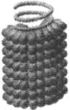
Identify the microorganism shown in the given figure.
A
Bacteriophage
B
Retrovirus
C
$TMV$ (Tobacco Mosaic Virus)
D
$BSV$ (Banana Streak Virus)
Solution
(C) The figure shows the structure of the Tobacco Mosaic Virus $(TMV)$.
$TMV$ is a plant virus that has a helical symmetry.
It consists of a single-stranded $RNA$ molecule surrounded by a protein coat called a capsid,which is made up of subunits called capsomeres.
This specific rod-like helical structure is characteristic of $TMV$ as shown in $NCERT$ biology textbooks.
$TMV$ is a plant virus that has a helical symmetry.
It consists of a single-stranded $RNA$ molecule surrounded by a protein coat called a capsid,which is made up of subunits called capsomeres.
This specific rod-like helical structure is characteristic of $TMV$ as shown in $NCERT$ biology textbooks.
0 likes
View Solution312
EasyMCQ
In which plant is the microorganism shown in the given figure found?
A
Potato
B
Tobacco
C
Tomato
D
Cabbage
Solution
(B) The figure shows the Tobacco Mosaic Virus $(TMV)$.
$TMV$ is a plant virus that infects a wide range of plants,but it is most famously known for causing the mosaic disease in tobacco plants.
It was the first virus to be discovered and crystallized.
$TMV$ is a plant virus that infects a wide range of plants,but it is most famously known for causing the mosaic disease in tobacco plants.
It was the first virus to be discovered and crystallized.
0 likes
View Solution313
EasyMCQ
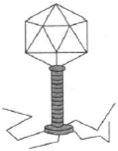
Which microorganism is shown in the given figure?
A
Bacteriophage
B
Retrovirus
C
$TMV$
D
$BSV$
Solution
(A) The figure represents a $Bacteriophage$.
$Bacteriophages$ are viruses that infect bacteria.
They typically consist of a polyhedral head containing genetic material and a tail structure used for attachment to the host cell surface.
$Bacteriophages$ are viruses that infect bacteria.
They typically consist of a polyhedral head containing genetic material and a tail structure used for attachment to the host cell surface.
0 likes
View Solution314
EasyMCQ
The microorganism shown in the given figure infects which of the following?
A
Protozoa
B
Protista
C
Bacteria
D
All of the above $(A), (B)$ and $(C)$
Solution
(C) The figure shows a bacteriophage,which is a virus that infects bacteria. Bacteriophages are viruses that specifically target and replicate within bacterial cells.
0 likes
View Solution315
EasyMCQ
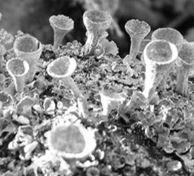
Identify the organism shown in the given figure.
A
Mushroom
B
Lichen
C
Strigula
D
Parmelia
Solution
(B) The organism shown in the figure is a type of lichen,specifically 'Cladonia',which is known for its cup-shaped structures called podetia.
Lichens are symbiotic associations between fungi and algae.
While 'Parmelia' (option $D$) is also a type of lichen,the specific cup-like structure shown in the image is characteristic of 'Cladonia'.
However,in the context of general classification,the organism is a Lichen.
Lichens are symbiotic associations between fungi and algae.
While 'Parmelia' (option $D$) is also a type of lichen,the specific cup-like structure shown in the image is characteristic of 'Cladonia'.
However,in the context of general classification,the organism is a Lichen.
0 likes
View Solution316
MediumMCQ
What are the reproductive structures shown in the given image of the organism called?
A
Conidia
B
Sporangia
C
Apothecia
D
Fruit
Solution
(C) The image shows a lichen,specifically a species of Cladonia. The cup-shaped structures visible on the thallus are the reproductive bodies known as apothecia. Apothecia are the fruiting bodies (ascocarps) of many fungi,particularly those in the class Ascomycetes,which form the fungal component of these lichens. They are responsible for producing and dispersing ascospores.
0 likes
View Solution317
EasyMCQ
What acts as the phycobiont in the organism shown in the given figure?
A
Fungi
B
Algae
C
Lysosome
D
All of the above
Solution
(B) The organism shown in the figure is a lichen. Lichens are symbiotic associations between algae and fungi. The algal component is known as the phycobiont,and the fungal component is known as the mycobiont. Therefore,the phycobiont is algae.
0 likes
View Solution318
EasyMCQ
The scientist who gave the name $Virus$ is ........
A
Ivanowsky
B
Diener
C
Pasteur
D
Iyengar
Solution
(C) The term $Virus$ (meaning venom or poisonous fluid) was given by Louis Pasteur.
$D.J. Ivanowsky$ discovered the causal organism of tobacco mosaic disease, but the name $Virus$ was coined by $Louis Pasteur$.
$D.J. Ivanowsky$ discovered the causal organism of tobacco mosaic disease, but the name $Virus$ was coined by $Louis Pasteur$.
0 likes
View Solution319
EasyMCQ
From which plant did $D.J. \text{Ivanowsky}$ discover viruses?
A
Maize
B
Tobacco
C
Sugarcane
D
Sunflower
Solution
(B) In $1892$, $D.J. \text{Ivanowsky}$ recognized certain microbes as causal organisms of the mosaic disease of tobacco.
These were found to be smaller than bacteria because they passed through bacteria-proof filters.
Therefore, the correct answer is Tobacco.
These were found to be smaller than bacteria because they passed through bacteria-proof filters.
Therefore, the correct answer is Tobacco.
0 likes
View Solution320
EasyMCQ
Which disease in tobacco was identified by $D.J. Ivanowsky$ as being caused by viruses?
A
Alzheimer's
B
Polio
C
Mosaic disease
D
Parkinson's
Solution
(C) In $1892$,$D.J. Ivanowsky$ recognized certain microbes as causal organisms of the mosaic disease of tobacco. These were found to be smaller than bacteria because they passed through bacteria-proof filters. He named these infectious agents as viruses,which means 'venom' or 'poisonous fluid'.
0 likes
View Solution321
EasyMCQ
Which nucleic acid is found in viruses?
A
$RNA$
B
$DNA$
C
Protein
D
$RNA$ or $DNA$
Solution
(D) Viruses are nucleoproteins,meaning they consist of a genetic material core surrounded by a protein coat called a capsid.
In viruses,the genetic material is either $RNA$ or $DNA$,but never both.
Therefore,a virus can contain either $RNA$ or $DNA$ as its nucleic acid.
In viruses,the genetic material is either $RNA$ or $DNA$,but never both.
Therefore,a virus can contain either $RNA$ or $DNA$ as its nucleic acid.
0 likes
View Solution322
EasyMCQ
What is the capsid made of?
A
$RNA$
B
$DNA$
C
Capsomeres
D
Capsule
Solution
(C) The capsid is the protein coat of a virus that encloses its genetic material. It is composed of smaller protein subunits called capsomeres. These capsomeres are arranged in a precise geometric pattern to protect the viral genome.
0 likes
View Solution323
EasyMCQ
Assertion $(S)$: Viruses are considered as a link between living and non-living organisms.
Reason $(R)$: Viruses replicate only when they are inside a host cell,whereas they behave as non-living particles in a free state.
Reason $(R)$: Viruses replicate only when they are inside a host cell,whereas they behave as non-living particles in a free state.
A
$S$ and $R$ are both true,and $R$ is the correct explanation of $S$.
B
$S$ and $R$ are both true,but $R$ is not the correct explanation of $S$.
C
$S$ is true and $R$ is false.
D
$S$ is false and $R$ is true.
Solution
(A) Viruses are considered as a connecting link between living and non-living organisms because they exhibit characteristics of both.
They lack independent metabolic machinery and cannot replicate outside a host cell,which is a non-living trait.
However,once they enter a host cell,they hijack the host's machinery to replicate their genetic material,which is a living trait.
Therefore,both the assertion and the reason are true,and the reason correctly explains why viruses are considered a link between living and non-living entities.
They lack independent metabolic machinery and cannot replicate outside a host cell,which is a non-living trait.
However,once they enter a host cell,they hijack the host's machinery to replicate their genetic material,which is a living trait.
Therefore,both the assertion and the reason are true,and the reason correctly explains why viruses are considered a link between living and non-living entities.
0 likes
View Solution324
MediumMCQ
Assertion $(S)$: Viruses can pass through bacteria-proof filters.
Reason $(R)$: Viruses are extremely small in size.
Reason $(R)$: Viruses are extremely small in size.
A
$S$ and $R$ are both true,and $R$ is the correct explanation of $S$.
B
$S$ and $R$ are both true,but $R$ is not the correct explanation of $S$.
C
$S$ is true and $R$ is false.
D
$S$ is false and $R$ is true.
Solution
(A) Viruses are obligate parasites that are significantly smaller than bacteria. Because of their extremely small size (typically ranging from $20-300 \ nm$),they are capable of passing through filters that are designed to trap bacteria (bacteria-proof filters). Therefore,both the assertion and the reason are true,and the reason correctly explains why viruses can pass through these filters.
0 likes
View Solution325
EasyMCQ
Which of the following is considered a borderline case between living and non-living entities?
A
Bacteria
B
Viruses
C
Cyanobacteria
D
Mosses
Solution
(B) Viruses are considered to be at the borderline between living and non-living organisms.
They are non-living outside a host cell because they lack cellular machinery,metabolic pathways,and the ability to reproduce independently.
However,once they enter a living host cell,they hijack the host's machinery to replicate their genetic material and synthesize viral proteins,exhibiting characteristics of living organisms.
They are non-living outside a host cell because they lack cellular machinery,metabolic pathways,and the ability to reproduce independently.
However,once they enter a living host cell,they hijack the host's machinery to replicate their genetic material and synthesize viral proteins,exhibiting characteristics of living organisms.
0 likes
View Solution326
EasyMCQ
What is a bacteriophage?
A
Algae
B
Fungi
C
Virus
D
Lichen
Solution
(C) bacteriophage is a type of virus that infects and replicates within bacteria. The term is derived from 'bacteria' and the Greek word 'phagein' meaning 'to eat'. They consist of a genetic material ($DNA$ or $RNA$) enclosed within a protein coat (capsid). Therefore,the correct option is $C$.
0 likes
View Solution327
EasyMCQ
Which of the following represents the composition of a virus?
A
Proteins and $DNA$ or $RNA$
B
Proteins,$DNA$ and $RNA$
C
Proteins,$DNA, RNA$ and lipids
D
Carbohydrates,nucleic acids and lipids
Solution
(A) virus is a nucleoprotein entity.
It consists of a genetic material,which can be either $DNA$ or $RNA$,enclosed within a protein coat called a capsid.
Viruses never contain both $DNA$ and $RNA$ simultaneously.
Therefore,the correct composition is proteins and $DNA$ or $RNA$.
It consists of a genetic material,which can be either $DNA$ or $RNA$,enclosed within a protein coat called a capsid.
Viruses never contain both $DNA$ and $RNA$ simultaneously.
Therefore,the correct composition is proteins and $DNA$ or $RNA$.
0 likes
View Solution328
EasyMCQ
The term $Virus$ means...
A
Poison
B
Infectious agent
C
Living chemical
D
All of the above
Solution
(D) The term $Virus$ is derived from the Latin word meaning '$poison$' or '$venom$'.
Historically, $Louis \ Pasteur$ coined the term $Virus$ to describe the infectious agents that cause diseases.
$Viruses$ are often described as '$living \ chemicals$' because they consist of genetic material ($DNA$ or $RNA$) enclosed in a protein coat, lacking independent metabolic machinery, and only replicating inside a living host cell.
Therefore, all the given options describe different aspects or historical contexts of viruses.
Historically, $Louis \ Pasteur$ coined the term $Virus$ to describe the infectious agents that cause diseases.
$Viruses$ are often described as '$living \ chemicals$' because they consist of genetic material ($DNA$ or $RNA$) enclosed in a protein coat, lacking independent metabolic machinery, and only replicating inside a living host cell.
Therefore, all the given options describe different aspects or historical contexts of viruses.
0 likes
View Solution329
EasyMCQ
Who discovered $TMV$ (Tobacco Mosaic Virus)?
A
Ivanovsky
B
Pasteur
C
Dayer
D
Theophrastus
Solution
(A) Dmitri Ivanovsky,a Russian botanist,discovered the Tobacco Mosaic Virus $(TMV)$ in $1892$. He demonstrated that the causative agent of tobacco mosaic disease could pass through bacterial-proof filters,which was the first evidence of the existence of viruses.
0 likes
View Solution330
EasyMCQ
$D$.$J$. Ivanowsky is famous for the discovery of which of the following?
A
Tomato mosaic virus
B
Potato mosaic virus
C
Tobacco mosaic virus
D
Polio virus
Solution
(C) In $1892$,$D$.$J$. Ivanowsky recognized certain microbes as causal organisms of the mosaic disease of tobacco. These were found to be smaller than bacteria because they passed through bacteria-proof filters. This led to the discovery of the Tobacco Mosaic Virus $(TMV)$.
0 likes
View Solution331
EasyMCQ
Which virus was discovered first?
A
Influenza virus
B
$TMV$ (Tobacco Mosaic Virus)
C
Bacterial virus
D
$BSV$ (Banana Streak Virus)
Solution
(B) The first virus to be discovered was the $TMV$ $(Tobacco \ Mosaic \ Virus)$.
In $1892$,Dmitri Ivanovsky discovered that certain microbes caused tobacco mosaic disease,which could pass through bacteria-proof filters.
Later,in $1898$,Martinus Beijerinck demonstrated that the extract of infected tobacco plants could cause infection in healthy plants and called the fluid '$Contagium \ vivum \ fluidum$' (infectious living fluid).
This discovery marked the beginning of virology.
In $1892$,Dmitri Ivanovsky discovered that certain microbes caused tobacco mosaic disease,which could pass through bacteria-proof filters.
Later,in $1898$,Martinus Beijerinck demonstrated that the extract of infected tobacco plants could cause infection in healthy plants and called the fluid '$Contagium \ vivum \ fluidum$' (infectious living fluid).
This discovery marked the beginning of virology.
0 likes
View Solution332
EasyMCQ
Viruses can pass through which of the following?
A
Bacteria-proof filters
B
Virus-proof filters
C
Chromatography-proof filters
D
Cobalt chloride-proof filters
Solution
(A) Viruses are significantly smaller than bacteria. Because of their extremely small size (typically ranging from $20 \ nm$ to $300 \ nm$),they can easily pass through standard bacteria-proof filters (such as $Chamberland$ filters) that are designed to retain bacteria. Therefore,viruses are often referred to as filterable agents.
0 likes
View Solution333
EasyMCQ
The main structural component of a virus is...
A
Nucleoid
B
Nucleic acid
C
Nucleoprotein
D
Protein
Solution
(C) virus is a submicroscopic infectious agent that replicates only inside the living cells of an organism. Structurally,a virus consists of genetic material (either $DNA$ or $RNA$) enclosed within a protein coat called a capsid. Together,the nucleic acid and the protein coat form a complex known as a nucleoprotein. Therefore,the main structural component of a virus is nucleoprotein.
0 likes
View Solution334
MediumMCQ
What is the habitat of a virus in its free-living state?
A
Outside a living cell
B
Inside a living cell
C
Both $(A)$ and $(B)$
D
None of these
Solution
(A) Viruses are considered obligate parasites.
When they are outside a living host cell,they are inert and exist in a crystalline or free-living state.
They do not show any metabolic activity outside the host cell.
Therefore,the habitat of a virus in its free-living state is outside a living cell.
When they are outside a living host cell,they are inert and exist in a crystalline or free-living state.
They do not show any metabolic activity outside the host cell.
Therefore,the habitat of a virus in its free-living state is outside a living cell.
0 likes
View Solution335
MediumMCQ
In a free-living state,what is the condition of a virus?
A
Inactive and living
B
Inactive and non-living
C
Active and non-living
D
Active and living
Solution
(B) Viruses are considered to be at the border of living and non-living organisms.
When they are outside a host cell (free-living state),they do not show any metabolic activities and are considered inert or non-living.
They only exhibit characteristics of living organisms when they enter a host cell and hijack its machinery to replicate.
Therefore,in a free-living state,they are inactive and non-living.
When they are outside a host cell (free-living state),they do not show any metabolic activities and are considered inert or non-living.
They only exhibit characteristics of living organisms when they enter a host cell and hijack its machinery to replicate.
Therefore,in a free-living state,they are inactive and non-living.
0 likes
View Solution336
EasyMCQ
What characteristic does a virus exhibit when it is inside a host cell?
A
Active
B
Living
C
Inactive
D
Both $(A)$ and $(B)$
Solution
(D) Viruses are considered to be at the border of living and non-living organisms.
When a virus is outside a host cell,it is inert or inactive.
However,once it enters a host cell,it takes over the host's machinery to replicate its genetic material and synthesize viral proteins.
Therefore,inside a host cell,a virus exhibits characteristics of a living organism and is considered active.
When a virus is outside a host cell,it is inert or inactive.
However,once it enters a host cell,it takes over the host's machinery to replicate its genetic material and synthesize viral proteins.
Therefore,inside a host cell,a virus exhibits characteristics of a living organism and is considered active.
0 likes
View Solution337
EasyMCQ
Who was the first scientist to use the term 'virus' as a pathogen of infectious diseases?
A
Ivanowsky
B
Dayer
C
Pasteur
D
Whittaker
Solution
(C) Louis Pasteur was the first scientist to use the term 'virus' (which means venom or poisonous fluid) to describe the causative agents of infectious diseases,such as rabies. Dmitri Ivanowsky is known for discovering the tobacco mosaic virus,but the term itself was coined by Pasteur.
0 likes
View Solution338
EasyMCQ
The protein coat of a virus is known as:
A
Capsomere
B
Microtubule
C
Microfilament
D
Capsid
Solution
(D) virus consists of a genetic material (either $DNA$ or $RNA$) enclosed within a protective protein shell.
This protective protein coat is called the $Capsid$.
The $Capsid$ is composed of smaller protein subunits known as $Capsomeres$.
This protective protein coat is called the $Capsid$.
The $Capsid$ is composed of smaller protein subunits known as $Capsomeres$.
0 likes
View Solution339
EasyMCQ
The protective coat of structural protein in a virus is made up of units called:
A
Capsomeres
B
Capsid
C
Microfilaments
D
Microtubules
Solution
(A) The protein coat of a virus is known as the $Capsid$.
This $Capsid$ is composed of small structural subunits called $Capsomeres$.
These $Capsomeres$ are arranged in helical or polyhedral geometric forms to protect the viral nucleic acid.
This $Capsid$ is composed of small structural subunits called $Capsomeres$.
These $Capsomeres$ are arranged in helical or polyhedral geometric forms to protect the viral nucleic acid.
0 likes
View Solution340
EasyMCQ
Which of the following is an example of an animal virus?
A
Alzheimer virus
B
Polio virus
C
Bacterial virus
D
None of these
Solution
(B) Viruses are classified based on the type of host they infect.
$1$. Plant viruses usually contain single-stranded $RNA$.
$2$. Bacterial viruses (bacteriophages) usually contain double-stranded $DNA$.
$3$. Animal viruses can contain either $DNA$ or $RNA$ as their genetic material.
Among the given options,the Polio virus is a well-known animal virus that infects humans.
$1$. Plant viruses usually contain single-stranded $RNA$.
$2$. Bacterial viruses (bacteriophages) usually contain double-stranded $DNA$.
$3$. Animal viruses can contain either $DNA$ or $RNA$ as their genetic material.
Among the given options,the Polio virus is a well-known animal virus that infects humans.
0 likes
View Solution341
EasyMCQ
An example of a plant virus is -
A
Potato tuber virus
B
Tobacco mosaic virus
C
Bacteriophage
D
Both $(A)$ and $(B)$
Solution
(D) Viruses that infect plants are known as plant viruses.
Tobacco mosaic virus $(TMV)$ is a well-known plant virus that causes mosaic disease in tobacco plants.
Potato tuber virus is also a type of plant virus that infects potato crops.
Bacteriophages are viruses that infect bacteria,not plants.
Therefore,both $(A)$ and $(B)$ are examples of plant viruses.
Tobacco mosaic virus $(TMV)$ is a well-known plant virus that causes mosaic disease in tobacco plants.
Potato tuber virus is also a type of plant virus that infects potato crops.
Bacteriophages are viruses that infect bacteria,not plants.
Therefore,both $(A)$ and $(B)$ are examples of plant viruses.
0 likes
View Solution342
EasyMCQ
What is a capsomere made of?
A
Peptide chain
B
Nucleotide chain
C
Polypeptide
D
Polynucleotide chain
Solution
(C) virus consists of a genetic material ($DNA$ or $RNA$) enclosed within a protein coat called a capsid.
The capsid is composed of small protein subunits known as capsomeres.
Since these subunits are proteins,they are essentially chains of amino acids,which are referred to as polypeptides.
Therefore,a capsomere is made of polypeptides.
The capsid is composed of small protein subunits known as capsomeres.
Since these subunits are proteins,they are essentially chains of amino acids,which are referred to as polypeptides.
Therefore,a capsomere is made of polypeptides.
0 likes
View Solution343
MediumMCQ
How are viruses characterized?
A
Living organisms
B
Non-living organisms
C
Connecting link between living and non-living organisms
D
Living organisms that lack the ability to multiply
Solution
(C) Viruses are considered to be at the border of living and non-living entities.
They are non-cellular organisms characterized by having an inert crystalline structure outside the living cell.
However,once they infect a host cell,they take over the machinery of the host cell to replicate themselves.
Due to this dual nature—being inert like non-living matter outside a host and showing characteristics of life (like replication) inside a host—they are known as the connecting link between living and non-living organisms.
They are non-cellular organisms characterized by having an inert crystalline structure outside the living cell.
However,once they infect a host cell,they take over the machinery of the host cell to replicate themselves.
Due to this dual nature—being inert like non-living matter outside a host and showing characteristics of life (like replication) inside a host—they are known as the connecting link between living and non-living organisms.
0 likes
View Solution344
EasyMCQ
What is the protein coat of a virus known as?
A
Nucleoprotein
B
Capsid
C
Capsomere
D
Phage
Solution
(B) The genetic material of a virus is enclosed within a protective protein coat called the $Capsid$.
This $Capsid$ is made up of small protein subunits known as $Capsomeres$.
The $Capsid$ protects the viral nucleic acid ($DNA$ or $RNA$) from environmental damage.
This $Capsid$ is made up of small protein subunits known as $Capsomeres$.
The $Capsid$ protects the viral nucleic acid ($DNA$ or $RNA$) from environmental damage.
0 likes
View Solution345
MediumMCQ
Viruses are considered as a link between living and non-living organisms because -
A
They exist in host cells and in a free state.
B
They behave as inert and non-living matter.
C
They behave as active and living organisms.
D
All of the above
Solution
(D) Viruses are considered a connecting link between living and non-living things because they exhibit characteristics of both.
$1$. They behave as inert,non-living matter (like crystals) when they are outside a host cell.
$2$. They become active and exhibit characteristics of living organisms (like replication) only when they enter a host cell.
$3$. Since they exist in both states (free state as non-living and host cell as living),they are classified as a bridge between the two.
$1$. They behave as inert,non-living matter (like crystals) when they are outside a host cell.
$2$. They become active and exhibit characteristics of living organisms (like replication) only when they enter a host cell.
$3$. Since they exist in both states (free state as non-living and host cell as living),they are classified as a bridge between the two.
0 likes
View Solution346
EasyMCQ
Viruses behave as non-living entities because outside a host cell they:
A
Reproduce.
B
Grow.
C
Multiply.
D
None of these.
Solution
(D) Viruses are considered to be at the border between living and non-living organisms. They are obligate parasites that require a host cell to replicate their genetic material and synthesize proteins. Outside the host cell,viruses are inert particles that do not exhibit any metabolic activities,growth,or reproduction. Therefore,they behave as non-living entities outside the host.
0 likes
View Solution347
EasyMCQ
Viruses behave as non-living entities because -
A
They reproduce.
B
They can be crystallized.
C
They grow.
D
They are active.
Solution
(B) Viruses are considered to be at the border between living and non-living organisms. They behave as non-living entities outside a host cell because they can be crystallized and stored like chemical substances. They lack metabolic machinery and cellular structure,which are characteristic of living organisms. They only show signs of life (reproduction) when they enter a host cell.
0 likes
View Solution348
MediumMCQ
Viruses are distinct from other living cells because -
A
They grow.
B
They multiply.
C
They reproduce.
D
They are intermediate between living and non-living.
Solution
(D) Viruses are considered to be at the boundary between living and non-living organisms. They lack the cellular machinery required for independent metabolism and reproduction. They only show characteristics of life (such as replication) when they infect a host cell. Outside a host,they behave like inert,non-living particles. Therefore,they are distinct from true living cells.
0 likes
View Solution349
MediumMCQ
Which of the following is an important characteristic of viruses?
A
They are active and alive only inside a host cell.
B
They contain only one type of nucleic acid (either $DNA$ or $RNA$).
C
They are ultramicroscopic in size.
D
They are carriers of infectious diseases.
Solution
(A) Viruses are considered obligate parasites because they lack the machinery required for independent metabolism and replication.
They are inert outside a host cell and only become active and replicate when they enter a living host cell.
While they are ultramicroscopic and contain nucleic acids,the most defining biological characteristic that distinguishes them from other life forms is their absolute dependence on a host cell for metabolic activity and reproduction.
They are inert outside a host cell and only become active and replicate when they enter a living host cell.
While they are ultramicroscopic and contain nucleic acids,the most defining biological characteristic that distinguishes them from other life forms is their absolute dependence on a host cell for metabolic activity and reproduction.
0 likes
View Solution350
MediumMCQ
What is a bacteriophage known as?
A
$A$ virus that lives in animals.
B
$A$ virus that contains only $DNA$.
C
$A$ virus that infects and lives on bacteria.
D
$A$ virus that contains only $RNA$.
Solution
(C) bacteriophage is a type of virus that specifically infects and replicates within bacteria.
The term 'bacteriophage' literally means 'bacteria eater' (from Greek 'phagein' meaning 'to eat').
These viruses attach to the surface of a bacterium and inject their genetic material into the host cell to hijack its machinery for viral replication.
Therefore,option $C$ is the correct description.
The term 'bacteriophage' literally means 'bacteria eater' (from Greek 'phagein' meaning 'to eat').
These viruses attach to the surface of a bacterium and inject their genetic material into the host cell to hijack its machinery for viral replication.
Therefore,option $C$ is the correct description.
0 likes
View SolutionBiological Classification — Viruses, Viroids, Prions and Lichens · Frequently Asked Questions
1Are these Biological Classification questions useful for JEE and NEET?
Yes. All questions in this section are mapped to JEE Main and NEET exam patterns. Previous year questions from JEE Main, NEET, GUJCET and state-level exams are included with full solutions.
2Can I switch to Hindi or Gujarati for these questions?
Yes. Use the language tabs in the hero section or the sidebar to view the same questions and solutions in English, Hindi or Gujarati.
3How do I generate a question paper from this subtopic?
Use the Vedclass Exam Paper Generator — select the chapter and subtopic, set difficulty, and generate Sets A, B, C, D automatically. First 3 chapters of every subject are free.
Vedclass Products
For Students
Vedclass Test Series
Mock tests in real JEE/NEET style with performance analysis. 5-day free trial.
Start Free TrialFor Teachers
Exam Paper Generator
Generate Set A/B/C/D papers from this chapter in 2 minutes. 3 chapters free.
Try FreeFor Institutes
Online Exam Module
Live online exams with unlimited students, 360° analytics & white-label branding.
See DemoFor Teachers & Institutes
Generate a Biological Classification Exam Paper in 2 Minutes
Select subtopic & difficulty — Sets A, B, C, D auto-generated with No Repeat logic.
First 3 chapters of every subject are free — no payment required.