
A English
Viruses, Viroids, Prions and Lichens Questions in English
Class 11 Biology · Biological Classification · Viruses, Viroids, Prions and Lichens
529+
Questions
English
Language
100%
With Solutions
Showing 50 of 529 questions in English
451
MediumMCQ
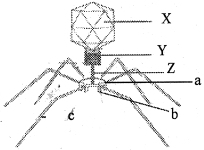
In the given figure,what do 'a' and 'c' represent respectively?
A
Tail and Plate
B
Plate and Tail fiber
C
Pin and Tail fiber
D
Plate and Pin
Solution
(B) The given figure represents a bacteriophage.
In the structure of a bacteriophage:
'a' points to the base plate.
'b' points to the pins.
'c' points to the tail fibers.
Therefore,'a' represents the plate and 'c' represents the tail fiber.
In the structure of a bacteriophage:
'a' points to the base plate.
'b' points to the pins.
'c' points to the tail fibers.
Therefore,'a' represents the plate and 'c' represents the tail fiber.
0 likes
View Solution452
MediumMCQ
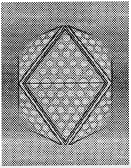
Identify the given figure.
A
Bacteriophage
B
$TMV$
C
Bacteria
D
Adenovirus
Solution
(D) The provided figure shows the structure of an Adenovirus.
Adenoviruses are medium-sized,non-enveloped viruses with a nucleocapsid containing a double-stranded $DNA$ genome.
They are characterized by their icosahedral shape,which is clearly visible in the provided image.
Adenoviruses are medium-sized,non-enveloped viruses with a nucleocapsid containing a double-stranded $DNA$ genome.
They are characterized by their icosahedral shape,which is clearly visible in the provided image.
0 likes
View Solution453
MediumMCQ
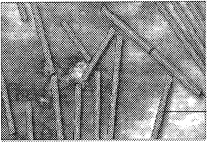
What does the given figure represent?
A
Adenovirus
B
$TMV$
C
Bacteriophage
D
Bacteria
Solution
(B) The given figure shows rod-shaped viral particles.
These are characteristic of the Tobacco Mosaic Virus $(TMV)$.
$TMV$ is a plant virus with a helical symmetry and a rod-like structure.
These are characteristic of the Tobacco Mosaic Virus $(TMV)$.
$TMV$ is a plant virus with a helical symmetry and a rod-like structure.
0 likes
View Solution454
MediumMCQ
What is the shape of the Tobacco Mosaic Virus $(TMV)$?
A
Rod-shaped
B
Spherical
C
Comma-shaped
D
All of the above
Solution
(A) The Tobacco Mosaic Virus $(TMV)$ is a well-studied plant virus.
It possesses a helical symmetry and is characteristically rod-shaped.
Its structure consists of a single-stranded $RNA$ genome surrounded by a protein coat called a capsid,which is made up of capsomeres arranged in a helical fashion.
It possesses a helical symmetry and is characteristically rod-shaped.
Its structure consists of a single-stranded $RNA$ genome surrounded by a protein coat called a capsid,which is made up of capsomeres arranged in a helical fashion.
0 likes
View Solution455
MediumMCQ
What does the adenovirus contain as its genetic material?
A
Single-stranded $RNA$
B
Single-stranded $DNA$
C
Double-stranded $RNA$
D
Double-stranded $DNA$
Solution
(D) Adenoviruses are a group of viruses that cause respiratory infections,conjunctivitis,or gastroenteritis.
They are characterized by a non-enveloped,icosahedral capsid containing a linear,double-stranded $DNA$ genome.
Therefore,the correct genetic material found in adenoviruses is double-stranded $DNA$.
They are characterized by a non-enveloped,icosahedral capsid containing a linear,double-stranded $DNA$ genome.
Therefore,the correct genetic material found in adenoviruses is double-stranded $DNA$.
0 likes
View Solution456
EasyMCQ
Lichens represent a symbiotic relationship between which of the following?
A
Algae and Fungi
B
Cyanobacteria and Algae
C
Fungi and Bryophytes
D
All of the above
Solution
(A) Lichens are a classic example of a symbiotic relationship,specifically mutualism,between two distinct organisms:
$1$. The algal component,known as phycobiont,which is autotrophic and prepares food.
$2$. The fungal component,known as mycobiont,which provides shelter,absorbs water,and provides minerals for the algae.
Therefore,lichens represent a symbiotic association between algae and fungi.
$1$. The algal component,known as phycobiont,which is autotrophic and prepares food.
$2$. The fungal component,known as mycobiont,which provides shelter,absorbs water,and provides minerals for the algae.
Therefore,lichens represent a symbiotic association between algae and fungi.
0 likes
View Solution457
MediumMCQ
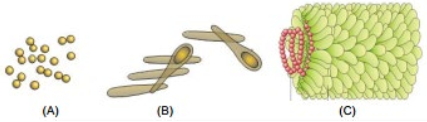
Identify the organisms shown in the figures $A$,$B$,and $C$:
A
$A$ - Tobacco mosaic virus,$B$ - Coccus,$C$ - Bacillus
B
$A$ - Coccus,$B$ - Bacillus,$C$ - Tobacco mosaic virus
C
$A$ - Bacillus,$B$ - Coccus,$C$ - Tobacco mosaic virus
D
$A$ - Coccus,$B$ - Tobacco mosaic virus,$C$ - Bacillus
Solution
(B) Based on the provided biological diagrams:
$1$. Figure $A$ shows spherical bacteria,which are known as $Coccus$.
$2$. Figure $B$ shows rod-shaped bacteria,which are known as $Bacillus$.
$3$. Figure $C$ shows the structure of the $Tobacco \ mosaic \ virus$ $(TMV)$,which is a plant virus with a helical capsid.
Therefore,the correct matching is $A$ - $Coccus$,$B$ - $Bacillus$,$C$ - $Tobacco \ mosaic \ virus$. The correct option is $(B)$.
$1$. Figure $A$ shows spherical bacteria,which are known as $Coccus$.
$2$. Figure $B$ shows rod-shaped bacteria,which are known as $Bacillus$.
$3$. Figure $C$ shows the structure of the $Tobacco \ mosaic \ virus$ $(TMV)$,which is a plant virus with a helical capsid.
Therefore,the correct matching is $A$ - $Coccus$,$B$ - $Bacillus$,$C$ - $Tobacco \ mosaic \ virus$. The correct option is $(B)$.
0 likes
View Solution458
MediumMCQ
Match the following:
| Column $I$ | Column $II$ |
| $(a)$ Potato spindle tuber | $(i)$ Virus |
| $(b)$ Creutzfeldt-Jakob disease $(CJD)$ | $(ii)$ Viroid |
| $(c)$ Cholera | $(iii)$ Prion |
| $(d)$ Leaf rolling and curling | $(iv)$ Bacteria |
A
$a-i, b-ii, c-iii, d-iv$
B
$a-iv, b-iii, c-ii, d-i$
C
$a-ii, b-iii, c-iv, d-i$
D
$a-iv, b-i, c-iii, d-ii$
Solution
(C) The correct matching is as follows:
$(a)$ Potato spindle tuber is caused by a Viroid $(ii)$.
$(b)$ Creutzfeldt-Jakob disease $(CJD)$ is a neurodegenerative disorder caused by a Prion $(iii)$.
$(c)$ Cholera is a bacterial infection caused by Vibrio cholerae $(iv)$.
$(d)$ Leaf rolling and curling in plants is a common symptom of viral infection $(i)$.
Therefore,the correct sequence is $a-ii, b-iii, c-iv, d-i$,which corresponds to option $(C)$.
$(a)$ Potato spindle tuber is caused by a Viroid $(ii)$.
$(b)$ Creutzfeldt-Jakob disease $(CJD)$ is a neurodegenerative disorder caused by a Prion $(iii)$.
$(c)$ Cholera is a bacterial infection caused by Vibrio cholerae $(iv)$.
$(d)$ Leaf rolling and curling in plants is a common symptom of viral infection $(i)$.
Therefore,the correct sequence is $a-ii, b-iii, c-iv, d-i$,which corresponds to option $(C)$.
0 likes
View Solution459
MediumMCQ
Match List-$A$ and List-$B$ and choose the correct option.
| List-$A$ | List-$B$ |
| $(a)$ Citrus canker | $(i)$ Fungi |
| $(b)$ Spongiform encephalopathy | $(ii)$ Prion |
| $(c)$ Herpes | $(iii)$ Virus |
| $(d)$ Red rot | $(iv)$ Bacteria |
A
$a-i, b-ii, c-iii, d-iv$
B
$a-ii, b-iii, c-iv, d-i$
C
$a-iv, b-ii, c-iii, d-i$
D
$a-i, b-iii, c-ii, d-iv$
Solution
(C) The correct option is $(C)$.
$(a)$ Citrus canker is a plant disease caused by the bacterium $Xanthomonas \text{ citri}$. Thus,$(a)-(iv)$.
$(b)$ Spongiform encephalopathy (such as bovine spongiform encephalopathy or mad cow disease) is caused by infectious proteins known as prions. Thus,$(b)-(ii)$.
$(c)$ Herpes is a viral infection caused by the herpes simplex virus. Thus,$(c)-(iii)$.
$(d)$ Red rot of sugarcane is a fungal disease caused by $Colletotrichum \text{ falcatum}$. Thus,$(d)-(i)$.
Therefore,the correct matching is $a-iv, b-ii, c-iii, d-i$.
$(a)$ Citrus canker is a plant disease caused by the bacterium $Xanthomonas \text{ citri}$. Thus,$(a)-(iv)$.
$(b)$ Spongiform encephalopathy (such as bovine spongiform encephalopathy or mad cow disease) is caused by infectious proteins known as prions. Thus,$(b)-(ii)$.
$(c)$ Herpes is a viral infection caused by the herpes simplex virus. Thus,$(c)-(iii)$.
$(d)$ Red rot of sugarcane is a fungal disease caused by $Colletotrichum \text{ falcatum}$. Thus,$(d)-(i)$.
Therefore,the correct matching is $a-iv, b-ii, c-iii, d-i$.
0 likes
View Solution460
MediumMCQ
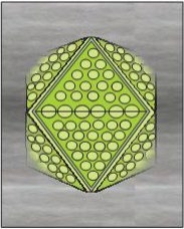
The given diagram shows an Adenovirus. Choose the correct option regarding it.
A
Adenovirus - Cause of respiratory disease
B
Bacteriophage - Tobacco mosaic disease
C
Viroid - Potato spindle tumor disease
D
Prion - Alzheimer's disease
Solution
(A) The provided diagram represents an Adenovirus. Adenoviruses are a group of viruses that typically cause respiratory infections,such as the common cold,conjunctivitis,or bronchitis. Therefore,option $A$ is the correct statement.
0 likes
View Solution461
MediumMCQ
Match the Column-$I$ and Column-$II$:
| Column-$I$ | Column-$II$ |
|---|---|
| $(i)$ Viroid | $(a)$ Ramachandran |
| $(ii)$ Cell | $(b)$ Leeuwenhoek |
| $(iii)$ Virus | $(c)$ $T.O. Diener$ |
| $(iv)$ Triple helical structure of collagen | $(d)$ Ivanowsky |
A
$(i)-(c), (ii)-(b), (iii)-(d), (iv)-(a)$
B
$(i)-(a), (ii)-(b), (iii)-(c), (iv)-(d)$
C
$(i)-(d), (ii)-(c), (iii)-(b), (iv)-(a)$
D
$(i)-(c), (ii)-(d), (iii)-(b), (iv)-(a)$
Solution
(A) $(i)$ Viroid was discovered by $T.O. Diener$ in $1971$.
$(ii)$ The first living cell was observed and described by $Antonie van Leeuwenhoek$.
$(iii)$ Virus was discovered by $D.J. Ivanowsky$ in $1892$ while studying tobacco mosaic disease.
$(iv)$ The triple helical structure of collagen was proposed by $G.N. Ramachandran$.
Therefore, the correct matching is $(i)-(c), (ii)-(b), (iii)-(d), (iv)-(a)$.
$(ii)$ The first living cell was observed and described by $Antonie van Leeuwenhoek$.
$(iii)$ Virus was discovered by $D.J. Ivanowsky$ in $1892$ while studying tobacco mosaic disease.
$(iv)$ The triple helical structure of collagen was proposed by $G.N. Ramachandran$.
Therefore, the correct matching is $(i)-(c), (ii)-(b), (iii)-(d), (iv)-(a)$.
0 likes
View Solution462
MediumMCQ
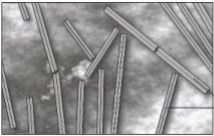
Identify the diagram.
A
Bacteria
B
Bacteriophage
C
$TMV$
D
Adenovirus
Solution
(C) $TMV$ (Tobacco Mosaic Virus) is a rod-shaped helical virus containing single-stranded $RNA$. The provided image shows the characteristic rod-like structure of $TMV$ particles.
0 likes
View Solution463
MediumMCQ
$A$ virus can be considered a living organism because it
A
has enzymes
B
respires
C
reproduces (inside the host)
D
can cause disease
Solution
(C) virus is an infective agent that typically consists of a nucleic acid molecule in a protein coat. It is too small to be seen by light microscopy and is able to multiply only within the living cells of a host. It is considered a living organism because it possesses the ability to reproduce inside the host cell,which is a fundamental characteristic of life.
0 likes
View Solution464
MediumMCQ
$A$ scientist $X$ demonstrated that the extract of infected plants of $Y$ could cause infection in healthy plants and called the fluid as "Contagium vivum fluidum". Identify $X$ and $Y$.
A
$W. M. Stanley$, Potato
B
$M. W. Beijerinck$, Tobacco
C
$D. J. Ivanowsky$, Cauliflower
D
Pasteur, Tomato
Solution
(B) $M. W. Beijerinck$ demonstrated in $1898$ that the extract of infected plants of tobacco could cause infection in healthy plants. He called the fluid as "Contagium vivum fluidum" (living infectious fluid).
0 likes
View Solution465
EasyMCQ
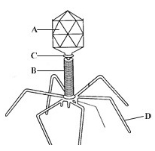
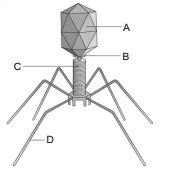
The figure given below shows the structure of a bacteriophage. Identify its parts labelled as $A, B, C$ and $D$.
A
$A$-Head,$B$-Sheath,$C$-Collar,$D$-Tail fibres
B
$A$-Tail fibres,$B$-Head,$C$-Sheath,$D$-Collar
C
$A$-Head,$B$-Collar,$C$-Sheath,$D$-Tail fibres
D
$A$-Collar,$B$-Tail fibres,$C$-Head,$D$-Sheath
Solution
(A) The given diagram represents a bacteriophage,which is a virus that infects bacteria.
It possesses a tadpole-like structure consisting of a head and a tail.
The head contains the genetic material,typically $DNA$.
The tail consists of a hollow core surrounded by a contractile tail sheath.
At the base of the tail,a base plate is present to which the tail fibres are attached.
Based on the provided diagram:
$A$ points to the Head.
$B$ points to the Sheath.
$C$ points to the Collar.
$D$ points to the Tail fibres.
Therefore,the correct identification is $A$-Head,$B$-Sheath,$C$-Collar,$D$-Tail fibres.
It possesses a tadpole-like structure consisting of a head and a tail.
The head contains the genetic material,typically $DNA$.
The tail consists of a hollow core surrounded by a contractile tail sheath.
At the base of the tail,a base plate is present to which the tail fibres are attached.
Based on the provided diagram:
$A$ points to the Head.
$B$ points to the Sheath.
$C$ points to the Collar.
$D$ points to the Tail fibres.
Therefore,the correct identification is $A$-Head,$B$-Sheath,$C$-Collar,$D$-Tail fibres.
0 likes
View Solution466
MediumMCQ
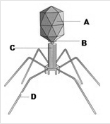
The given figure shows some structures labelled as $A, B, C$ and $D$. Which structure has the protein coat that encloses the nucleic acid?
A
$A$
B
$B$
C
$C$
D
$D$
Solution
(A) The structures marked as $A, B, C$ and $D$ are respectively the head,collar,sheath,and tail fibres of a bacteriophage.
In the head (structure marked as $A$),the protein coat (called the capsid) is made of small subunits called capsomeres,which protect the enclosed nucleic acid ($DNA$ or $RNA$).
In the head (structure marked as $A$),the protein coat (called the capsid) is made of small subunits called capsomeres,which protect the enclosed nucleic acid ($DNA$ or $RNA$).
0 likes
View Solution467
MediumMCQ
The subunit of the capsid is called
A
core
B
nucleotide
C
amino acid
D
capsomere
Solution
(D) The capsid is the protein shell of a virus,which encloses its genetic material.
This protein shell is composed of smaller structural units known as capsomeres.
These capsomeres self-assemble to form the protective capsid structure.
This protein shell is composed of smaller structural units known as capsomeres.
These capsomeres self-assemble to form the protective capsid structure.
0 likes
View Solution468
EasyMCQ
The symbiotic association between fungi and algae is called
A
lichen
B
mycorrhiza
C
rhizome
D
endomycorrhiza
Solution
(A) The symbiotic association between fungi and algae is known as $Lichen$.
In $Lichen$,there are two components: the algal partner,which is called the $phycobiont$,and the fungal partner,which is called the $mycobiont$.
These two organisms live in a mutually beneficial relationship where the algae provide food through photosynthesis,and the fungi provide protection,anchorage,and absorption of minerals.
In $Lichen$,there are two components: the algal partner,which is called the $phycobiont$,and the fungal partner,which is called the $mycobiont$.
These two organisms live in a mutually beneficial relationship where the algae provide food through photosynthesis,and the fungi provide protection,anchorage,and absorption of minerals.
0 likes
View Solution469
MediumMCQ
The genetic material of a virus includes
A
only $RNA$.
B
only $DNA$.
C
$RNA$ and $DNA$ both.
D
$RNA$ or $DNA$,i.e.,one nucleic acid in a virus.
Solution
(D) Viruses are obligate intracellular parasites that can reproduce only by invading and taking over other cells,as they lack the cellular machinery for self-reproduction.
Viruses contain either $DNA$ or $RNA$ as their genetic material,but never both in the same virus.
Viruses having $RNA$ as the genetic material are often referred to as Retroviruses if they possess the enzyme reverse transcriptase.
Viruses contain either $DNA$ or $RNA$ as their genetic material,but never both in the same virus.
Viruses having $RNA$ as the genetic material are often referred to as Retroviruses if they possess the enzyme reverse transcriptase.
0 likes
View Solution470
MediumMCQ
Which of the following statements is incorrect?
A
$TMV$ has a double-stranded $RNA$ molecule.
B
Most plant viruses are $RNA$ viruses.
C
The bacteriophages are usually double-stranded $DNA$ viruses.
D
Animal viruses are either single or double-stranded $RNA$ or double-stranded $DNA$ viruses.
Solution
(A) Tobacco mosaic virus $(TMV)$ is a single-stranded $RNA$ virus. Therefore,the statement that $TMV$ has a double-stranded $RNA$ molecule is incorrect. Most plant viruses contain $RNA$ as their genetic material. Bacteriophages (viruses that infect bacteria) usually contain double-stranded $DNA$. Animal viruses can contain either single or double-stranded $RNA$ or double-stranded $DNA$.
0 likes
View Solution471
MediumMCQ
$T. O.$ Diener discovered a new infectious agent that was smaller than viruses and has the following characteristics:
$(i)$ It causes potato spindle tuber disease.
$(ii)$ It has free $RNA$.
$(iii)$ The molecular weight of $RNA$ is low.
Identify the infectious agent.
$(i)$ It causes potato spindle tuber disease.
$(ii)$ It has free $RNA$.
$(iii)$ The molecular weight of $RNA$ is low.
Identify the infectious agent.
A
Viruses
B
Viroids
C
Virion
D
Mycoplasma
Solution
(B) In $1971$,$T. O.$ Diener discovered a new infectious agent that was smaller than viruses and caused potato spindle tuber disease.
It was found to be a free $RNA$; it lacked the protein coat that is found in viruses,hence the name 'Viroid'.
The $RNA$ of the viroid was of low molecular weight.
Therefore,the infectious agent described is a Viroid.
It was found to be a free $RNA$; it lacked the protein coat that is found in viruses,hence the name 'Viroid'.
The $RNA$ of the viroid was of low molecular weight.
Therefore,the infectious agent described is a Viroid.
0 likes
View Solution472
EasyMCQ
Which organisms are not included in the five kingdom system of classification?
A
Protozoans
B
Viruses
C
Lichens
D
Both $(b)$ and $(c)$
Solution
(D) The five kingdom system of classification was proposed by $R$.$H$. Whittaker.
This system includes Monera,Protista,Fungi,Plantae,and Animalia.
Viruses,viroids,prions,and lichens are not placed in any of these kingdoms because they do not truly fit the definition of a living organism or have a unique cellular structure that does not align with the criteria used for these kingdoms.
This system includes Monera,Protista,Fungi,Plantae,and Animalia.
Viruses,viroids,prions,and lichens are not placed in any of these kingdoms because they do not truly fit the definition of a living organism or have a unique cellular structure that does not align with the criteria used for these kingdoms.
0 likes
View Solution473
MediumMCQ
Which of the following statements is incorrect about viruses?
A
Viruses contain either $RNA$ or $DNA$.
B
Viruses do not have their own metabolic system.
C
Bacteriophages are usually double-stranded $DNA$ viruses.
D
$TMV$ contains both $RNA$ and $DNA$ as its genetic material.
Solution
(D) The correct answer is $D$. $TMV$ (Tobacco Mosaic Virus) is a plant virus that contains only $RNA$ as its genetic material,not both $RNA$ and $DNA$. Viruses are obligate parasites and never contain both types of nucleic acids simultaneously.
0 likes
View Solution474
MediumMCQ
Viruses that infect bacteria are termed as
A
Cyanophages
B
Bacteriophages
C
Mycophages
D
Both $(a)$ and $(b)$
Solution
(B) Viruses that infect bacteria are known as $Bacteriophages$.
$Cyanophages$ are viruses that infect cyanobacteria.
$Mycophages$ are viruses that infect fungi.
Therefore,the correct term for viruses infecting bacteria is $Bacteriophages$.
$Cyanophages$ are viruses that infect cyanobacteria.
$Mycophages$ are viruses that infect fungi.
Therefore,the correct term for viruses infecting bacteria is $Bacteriophages$.
0 likes
View Solution475
EasyMCQ
Who demonstrated that the extract of the infected plants of tobacco could cause infection in healthy plants?
A
Pasteur
B
$M.W. Beijerinek$
C
$D.J. Ivanowsky$
D
$W.M. Stanley$
Solution
(B) $M.W. Beijerinek$ demonstrated in $1898$ that the extract of the infected plants of tobacco could cause infection in healthy plants. He called the fluid as $Contagium \text{ } vivum \text{ } fluidum$ (infectious living fluid).
0 likes
View Solution476
EasyMCQ
The protein coat called capsid,made of small subunits called capsomeres,is present in:
A
Viruses
B
Bacteria
C
Fungi
D
Gymnosperms
Solution
(A) Viruses consist of a genetic material ($DNA$ or $RNA$) enclosed within a protein coat known as a capsid. This capsid is composed of small protein subunits called capsomeres,which protect the viral genome.
0 likes
View Solution477
MediumMCQ
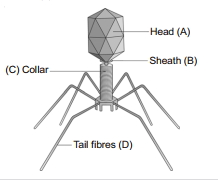
Identify $A, B, C$ and $D$ parts in this diagram of bacteriophage.
A
$A$ - Head,$B$ - Collar,$C$ - Sheath,$D$ - Tail fibres
B
$A$ - Head,$B$ - Sheath,$C$ - Collar,$D$ - Tail fibres
C
$A$ - Head,$B$ - Collar,$C$ - Tail fibres,$D$ - Sheath
D
$A$ - Head,$B$ - Sheath,$C$ - Tail fibres,$D$ - Collar
Solution
(A) Based on the provided diagram of a bacteriophage:
$A$ represents the Head,which contains the genetic material.
$B$ represents the Collar,which connects the head to the tail.
$C$ represents the Sheath,which surrounds the central tail tube.
$D$ represents the Tail fibres,which are used for attachment to the host cell.
Therefore,the correct identification is $A$ - Head,$B$ - Collar,$C$ - Sheath,$D$ - Tail fibres.
$A$ represents the Head,which contains the genetic material.
$B$ represents the Collar,which connects the head to the tail.
$C$ represents the Sheath,which surrounds the central tail tube.
$D$ represents the Tail fibres,which are used for attachment to the host cell.
Therefore,the correct identification is $A$ - Head,$B$ - Collar,$C$ - Sheath,$D$ - Tail fibres.
0 likes
View Solution478
MediumMCQ
Select the correct statement.
A
Viroids have double stranded $RNA$.
B
$RNA$ of viroids have high molecular weight than viruses.
C
Mumps and Herpes are viral diseases.
D
The name virus was given by $D$.$J$. Ivanowsky.
Solution
(C) $(i)$ Viroids are infectious agents consisting of a short strand of circular,single-stranded $RNA$ without a protein coat.
$(ii)$ The $RNA$ of viroids has a significantly lower molecular weight compared to the $RNA$ found in viruses.
$(iii)$ Mumps and Herpes are indeed caused by viruses,making this statement correct.
$(iv)$ The name '$virus$' (meaning venom or poisonous fluid) was given by Louis Pasteur,while $D$.$J$. Ivanowsky recognized certain microbes as causal organisms of the mosaic disease of tobacco.
$(ii)$ The $RNA$ of viroids has a significantly lower molecular weight compared to the $RNA$ found in viruses.
$(iii)$ Mumps and Herpes are indeed caused by viruses,making this statement correct.
$(iv)$ The name '$virus$' (meaning venom or poisonous fluid) was given by Louis Pasteur,while $D$.$J$. Ivanowsky recognized certain microbes as causal organisms of the mosaic disease of tobacco.
0 likes
View Solution479
MediumMCQ
Lichens show a symbiotic relationship between
A
Algae and fungi
B
Algae and bacteria
C
Fungi and bacteriophage
D
Algae and bacteriophage
Solution
(A) Lichens represent a symbiotic association,which is a mutually beneficial relationship between algae and fungi.
In this association,the algal component is known as phycobiont,and the fungal component is known as mycobiont.
The algae prepare food through photosynthesis,while the fungi provide protection,anchorage,and absorption of water and minerals for the algae.
In this association,the algal component is known as phycobiont,and the fungal component is known as mycobiont.
The algae prepare food through photosynthesis,while the fungi provide protection,anchorage,and absorption of water and minerals for the algae.
0 likes
View Solution480
MediumMCQ
Which is correct $w.r.t.$ lichens?
A
Mycobiont is autotrophic component
B
Phycobiont is heterotrophic component
C
They are good pollution indicators
D
They do not grow in non-polluted areas
Solution
(C) Lichens are symbiotic associations between algae and fungi. The algal component is called phycobiont (autotrophic),and the fungal component is called mycobiont (heterotrophic). Lichens are very sensitive to sulfur dioxide $(SO_2)$ pollution and therefore do not grow in polluted areas. Thus,they act as excellent indicators of air pollution.
0 likes
View Solution481
MediumMCQ
Which of the following symptoms is $NOT$ seen in plants due to viruses?
A
Mosaic formation
B
Leaf rolling and curling
C
Yellowing and vein clearing
D
Root knot
Solution
(D) Viral infections in plants typically manifest as symptoms such as mosaic formation,leaf rolling,leaf curling,yellowing,and vein clearing.
- Mosaic formation,leaf rolling,curling,yellowing,and vein clearing are characteristic symptoms of viral diseases in plants.
- Root knot is a symptom typically caused by nematodes (e.g.,Meloidogyne incognita),not by viruses.
Therefore,the correct answer is $D$.
- Mosaic formation,leaf rolling,curling,yellowing,and vein clearing are characteristic symptoms of viral diseases in plants.
- Root knot is a symptom typically caused by nematodes (e.g.,Meloidogyne incognita),not by viruses.
Therefore,the correct answer is $D$.
0 likes
View Solution482
MediumMCQ
Viruses possess all the following properties,except
A
They are non-cellular organisms
B
Possess both $DNA$ and $RNA$
C
Capsid protects nucleic acid
D
Have inert crystalline structure outside living cells
Solution
(B) Viruses are obligate parasites that contain either $DNA$ or $RNA$ as their genetic material,but never both. Therefore,the statement that they possess both $DNA$ and $RNA$ is incorrect.
0 likes
View Solution483
MediumMCQ
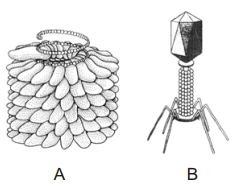
Identify $A$ and $B$ given below:
A
$A$ - $DNA$ virus - Cauliflower mosaic virus
$B$ - $RNA$ virus - Pox virus
$B$ - $RNA$ virus - Pox virus
B
$A$ - $RNA$ virus - $TMV$
$B$ - $DNA$ virus - $T_4$ bacteriophage
$B$ - $DNA$ virus - $T_4$ bacteriophage
C
$A$ - $RNA$ virus - Hepatitis $B$ virus
$B$ - Retrovirus - $TMV$
$B$ - Retrovirus - $TMV$
D
$A$ - Retrovirus - Hepatitis $B$ virus
$B$ - $RNA$ virus - $T_4$ bacteriophage
$B$ - $RNA$ virus - $T_4$ bacteriophage
Solution
(B) The image $A$ represents the Tobacco Mosaic Virus $(TMV)$,which is a well-known $RNA$ virus.
The image $B$ represents the $T_4$ bacteriophage,which is a virus that infects bacteria and contains $DNA$ as its genetic material.
Therefore,$A$ is an $RNA$ virus $(TMV)$ and $B$ is a $DNA$ virus ($T_4$ bacteriophage).
The image $B$ represents the $T_4$ bacteriophage,which is a virus that infects bacteria and contains $DNA$ as its genetic material.
Therefore,$A$ is an $RNA$ virus $(TMV)$ and $B$ is a $DNA$ virus ($T_4$ bacteriophage).
0 likes
View Solution484
MediumMCQ
Read the following statements carefully and identify correct statements $w.r.t.$ Lichens:
$a.$ The association cannot tolerate air pollution,especially due to sulphur dioxide.
$b.$ Lichens are annuals and their growth is slow.
$c.$ The fungal partner mostly belongs to Ascomycetes.
$d.$ Soredia are most efficient means of asexual reproduction.
$e.$ Orchids seldom occur without this association.
$f.$ Foliose lichens are pioneers of succession in a water body.
$a.$ The association cannot tolerate air pollution,especially due to sulphur dioxide.
$b.$ Lichens are annuals and their growth is slow.
$c.$ The fungal partner mostly belongs to Ascomycetes.
$d.$ Soredia are most efficient means of asexual reproduction.
$e.$ Orchids seldom occur without this association.
$f.$ Foliose lichens are pioneers of succession in a water body.
A
$c, d, f$
B
$a, c, d, f$
C
$a, b, e$
D
$a, c, d$
Solution
(D) $a.$ Lichens are sensitive to $SO_2$ pollution,making them good bioindicators. This is correct.
$b.$ Lichens are perennial,not annuals. This is incorrect.
$c.$ The fungal partner (mycobiont) in most lichens belongs to Ascomycetes. This is correct.
$d.$ Soredia are specialized structures for vegetative/asexual reproduction in lichens. This is correct.
$e.$ Orchids are associated with mycorrhiza,not lichens. This is incorrect.
$f.$ Crustose lichens (not foliose) are pioneers of succession on bare rocks. Foliose lichens are not pioneers in water bodies. This is incorrect.
Therefore,the correct statements are $a, c,$ and $d$.
$b.$ Lichens are perennial,not annuals. This is incorrect.
$c.$ The fungal partner (mycobiont) in most lichens belongs to Ascomycetes. This is correct.
$d.$ Soredia are specialized structures for vegetative/asexual reproduction in lichens. This is correct.
$e.$ Orchids are associated with mycorrhiza,not lichens. This is incorrect.
$f.$ Crustose lichens (not foliose) are pioneers of succession on bare rocks. Foliose lichens are not pioneers in water bodies. This is incorrect.
Therefore,the correct statements are $a, c,$ and $d$.
0 likes
View Solution485
MediumMCQ
$A$: Lichens do not grow in polluted areas having $SO_2$.
$R$: Lichens secrete carbonic acid and oxalic acid on barren rocks.
$R$: Lichens secrete carbonic acid and oxalic acid on barren rocks.
A
Assertion and Reason both are correct and Reason is the correct explanation of Assertion.
B
Assertion and Reason both are correct but Reason is not the correct explanation of Assertion.
C
Assertion is correct,but Reason is incorrect.
D
Both Assertion and Reason are incorrect.
Solution
(B) Assertion $(A)$ is correct because lichens are highly sensitive to sulfur dioxide $(SO_2)$ pollution and act as pollution indicators; they do not grow in areas with high $SO_2$ levels.
Reason $(R)$ is also correct because lichens are pioneer species that colonize barren rocks. They secrete organic acids like carbonic acid and oxalic acid,which help in the weathering of rocks and soil formation.
However,the Reason does not explain why lichens do not grow in polluted areas. Therefore,both are correct,but the Reason is not the correct explanation of the Assertion.
Reason $(R)$ is also correct because lichens are pioneer species that colonize barren rocks. They secrete organic acids like carbonic acid and oxalic acid,which help in the weathering of rocks and soil formation.
However,the Reason does not explain why lichens do not grow in polluted areas. Therefore,both are correct,but the Reason is not the correct explanation of the Assertion.
0 likes
View Solution486
MediumMCQ
$A$: Phycobiont is the dominant parent in lichens.
$R$: The algal component in these dual organisms can be eukaryotic only.
$R$: The algal component in these dual organisms can be eukaryotic only.
A
Assertion and Reason both are correct and Reason is the correct explanation of Assertion.
B
Assertion and Reason both are correct but Reason is not the correct explanation of Assertion.
C
Assertion is correct,but Reason is incorrect.
D
Both Assertion and Reason are incorrect.
Solution
(D) In lichens,the fungal component is known as the mycobiont,and the algal component is known as the phycobiont.
The mycobiont is the dominant partner because it provides the structural framework,protection,and absorbs minerals and water for the lichen.
Therefore,the assertion that the phycobiont is the dominant parent is incorrect.
Regarding the reason,the algal component (phycobiont) can be either a prokaryote (like $Cyanobacteria$) or a eukaryote (like green algae).
Thus,the statement that the algal component can be eukaryotic only is also incorrect.
Since both the assertion and the reason are false,the correct option is $D$.
The mycobiont is the dominant partner because it provides the structural framework,protection,and absorbs minerals and water for the lichen.
Therefore,the assertion that the phycobiont is the dominant parent is incorrect.
Regarding the reason,the algal component (phycobiont) can be either a prokaryote (like $Cyanobacteria$) or a eukaryote (like green algae).
Thus,the statement that the algal component can be eukaryotic only is also incorrect.
Since both the assertion and the reason are false,the correct option is $D$.
0 likes
View Solution487
MediumMCQ
$A$ : Viroids are not included in the five-kingdom system.
$R$ : They are non-cellular.
$R$ : They are non-cellular.
A
Assertion and Reason both are correct and Reason is the correct explanation of Assertion.
B
Assertion and Reason both are correct but Reason is not the correct explanation of Assertion.
C
Assertion is correct,but Reason is incorrect.
D
Both Assertion and Reason are incorrect.
Solution
(A) The five-kingdom system of classification proposed by $R.H. Whittaker$ includes organisms that are cellular in nature (Monera,Protista,Fungi,Plantae,and Animalia).
Viroids are infectious agents that consist only of a short strand of circular single-stranded $RNA$ without a protein coat.
Because viroids are non-cellular entities (they lack a cell structure,organelles,and metabolic machinery),they do not fit into the five-kingdom classification system.
Therefore,both the Assertion and the Reason are correct,and the Reason provides the correct explanation for why viroids are excluded from the system.
Viroids are infectious agents that consist only of a short strand of circular single-stranded $RNA$ without a protein coat.
Because viroids are non-cellular entities (they lack a cell structure,organelles,and metabolic machinery),they do not fit into the five-kingdom classification system.
Therefore,both the Assertion and the Reason are correct,and the Reason provides the correct explanation for why viroids are excluded from the system.
0 likes
View Solution488
MediumMCQ
$A$: Viruses which infect animals generally possess $ssRNA$ or $dsRNA$ or $dsDNA$.
$R$: Phytophagineae generally contain $dsDNA$.
$R$: Phytophagineae generally contain $dsDNA$.
A
Assertion and Reason both are correct and Reason is the correct explanation of Assertion.
B
Assertion and Reason both are correct but Reason is not the correct explanation of Assertion.
C
Assertion is correct,but Reason is incorrect.
D
Both Assertion and Reason are incorrect.
Solution
(C) Assertion $(A)$ is correct: Animal viruses typically contain either single-stranded $RNA$ $(ssRNA)$,double-stranded $RNA$ $(dsRNA)$,or double-stranded $DNA$ $(dsDNA)$ as their genetic material.
Reason $(R)$ is incorrect: Phytophagineae (plant viruses) generally contain $ssRNA$ as their genetic material,not $dsDNA$.
Reason $(R)$ is incorrect: Phytophagineae (plant viruses) generally contain $ssRNA$ as their genetic material,not $dsDNA$.
0 likes
View Solution489
EasyMCQ
The genetic material of Tobacco mosaic virus is
A
$RNA$
B
$DNA$
C
$Protein$
D
$NADPH$
Solution
(A) Tobacco mosaic virus $(TMV)$ is a well-studied plant virus.
Its genetic material consists of a single-stranded $RNA$ $(ssRNA)$ molecule,which is enclosed within a protein coat called a capsid.
Its genetic material consists of a single-stranded $RNA$ $(ssRNA)$ molecule,which is enclosed within a protein coat called a capsid.
0 likes
View Solution490
MediumMCQ
Many scientists consider viruses as living entities because these:
A
Respire
B
Can cause diseases
C
Reproduce (inside host)
D
Respond to tough environment
Solution
(C) Viruses are often considered at the borderline between living and non-living entities. The primary characteristic that classifies them as living is their ability to replicate or reproduce,but this process can only occur inside a living host cell. Outside the host,they are inert and behave like non-living chemicals. Therefore,the ability to reproduce is the key biological trait that links them to living organisms.
0 likes
View Solution491
MediumMCQ
Which of the following can be used as an industrial pollution indicator?
A
Lichens
B
White-winged moths
C
Dark-winged moths
D
Fossils
Solution
(A) Lichens are symbiotic organisms consisting of algae and fungi. They are highly sensitive to air pollution,particularly sulfur dioxide $(SO_2)$. Because they cannot survive in environments with high levels of industrial pollutants,they are widely used as bio-indicators to assess air quality in industrial regions.
0 likes
View Solution492
MediumMCQ
Which of the following microbes is made up of protein only?
A
Virus
B
Bacteria
C
Viroids
D
Prions
Solution
(D) Virus consists of protein and nucleic acid ($DNA$ or $RNA$).
Bacteria are prokaryotic organisms with a cell envelope,cytoplasm,and nucleoid.
Viroids are infectious agents consisting only of short strands of low molecular weight $RNA$ without a protein coat.
Prions are infectious agents composed entirely of abnormally folded protein,lacking any nucleic acid.
Bacteria are prokaryotic organisms with a cell envelope,cytoplasm,and nucleoid.
Viroids are infectious agents consisting only of short strands of low molecular weight $RNA$ without a protein coat.
Prions are infectious agents composed entirely of abnormally folded protein,lacking any nucleic acid.
0 likes
View Solution493
EasyMCQ
The infectious agents made up of $RNA$ only are
A
Viroids
B
Bacteria
C
Fungi
D
Virus
Solution
(A) Viroids are infectious agents that consist only of a short strand of circular,single-stranded $RNA$ without a protein coat. They are smaller than viruses and are known to cause diseases in plants.
0 likes
View Solution494
MediumMCQ
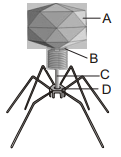
Identify the parts labelled as $A, B, C$ and $D$ in the given diagram of a bacteriophage.
A
| $A$. Head | $B$. Neck | $C$. Collar | $D$. Tail |
B
| $A$. Capsule | $B$. Tail | $C$. Collar | $D$. Pins |
C
| $A$. Head | $B$. Collar | $C$. Tail | $D$. Plate |
D
| $A$. Head | $B$. Tail | $C$. Collar | $D$. Prongs |
Solution
(C) The given diagram represents a bacteriophage,which is a virus that infects bacteria. The labels correspond to the following structures:
$A$ - Head (contains the genetic material)
$B$ - Collar
$C$ - Tail
$D$ - Base plate (or end plate,to which tail fibers are attached)
Comparing these with the given options,option $C$ correctly identifies the parts as: $A$ - Head,$B$ - Collar,$C$ - Tail,and $D$ - Plate.
$A$ - Head (contains the genetic material)
$B$ - Collar
$C$ - Tail
$D$ - Base plate (or end plate,to which tail fibers are attached)
Comparing these with the given options,option $C$ correctly identifies the parts as: $A$ - Head,$B$ - Collar,$C$ - Tail,and $D$ - Plate.
0 likes
View Solution495
MediumMCQ
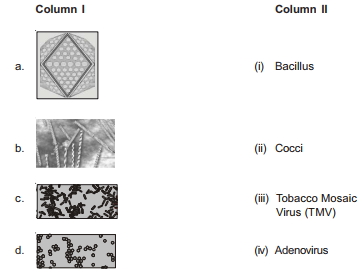
Match the following (Column-$I$ with Column-$II$):
A
$a(iv), b(iii), c(i), d(ii)$
B
$a(iii), b(iv), c(i), d(ii)$
C
$a(iv), b(iii), c(ii), d(i)$
D
$a(i), b(iii), c(ii), d(iv)$
Solution
(A) Based on the provided images:
$a$. Adenovirus (shows a geometric viral structure).
$b$. Tobacco Mosaic Virus $(TMV)$ (shows rod-shaped viral particles).
$c$. Bacillus (shows rod-shaped bacteria).
$d$. Cocci (shows spherical bacteria).
Therefore,the correct matching is: $a(iv), b(iii), c(i), d(ii)$.
$a$. Adenovirus (shows a geometric viral structure).
$b$. Tobacco Mosaic Virus $(TMV)$ (shows rod-shaped viral particles).
$c$. Bacillus (shows rod-shaped bacteria).
$d$. Cocci (shows spherical bacteria).
Therefore,the correct matching is: $a(iv), b(iii), c(i), d(ii)$.
0 likes
View Solution496
MediumMCQ
Bovine spongiform encephalopathy disease is equal to:
A
Kala Azar
B
Parkinson's disease
C
Creutzfeldt-Jacob disease
D
None of the above
Solution
(C) Bovine spongiform encephalopathy $(BSE)$,commonly known as 'mad cow disease',is a progressive neurological disorder of cattle.
It is caused by an infectious protein particle called a prion.
In humans,a similar disease caused by prions is known as Creutzfeldt-Jacob disease $(CJD)$.
Both conditions are characterized by the accumulation of misfolded proteins in the brain,leading to spongiform degeneration of brain tissue.
It is caused by an infectious protein particle called a prion.
In humans,a similar disease caused by prions is known as Creutzfeldt-Jacob disease $(CJD)$.
Both conditions are characterized by the accumulation of misfolded proteins in the brain,leading to spongiform degeneration of brain tissue.
0 likes
View Solution497
MediumMCQ
What are Viroids?
A
Infectious agents with $DNA$ and protein coat.
B
Infectious agents with free $RNA$ and no protein coat.
C
Infectious agents with only protein coat.
D
Infectious agents with $DNA$ and no protein coat.
Solution
(B) $\rightarrow$ In $1971$,$T.O. Diener$ discovered a new infectious agent that was smaller than viruses and caused potato spindle tuber disease.
$\rightarrow$ It was found to be a free $RNA$; it lacked the protein coat that is found in viruses,hence the name viroid.
$\rightarrow$ The $RNA$ of the viroid was of low molecular weight.
$\rightarrow$ It was found to be a free $RNA$; it lacked the protein coat that is found in viruses,hence the name viroid.
$\rightarrow$ The $RNA$ of the viroid was of low molecular weight.
0 likes
View Solution498
Medium
Mention the contributions of various scientists regarding viruses.
Solution
(N/A) $\rightarrow$ $D. J. Ivanowsky (1892)$ recognized certain microbes as the causal organisms of the mosaic disease of tobacco.
$\rightarrow$ These were found to be smaller than bacteria because they passed through bacteria-proof filters.
$\rightarrow$ $M. W. Beijerinck (1898)$ demonstrated that the extract of infected tobacco plants could cause infection in healthy plants and called the fluid $Contagium$ $\text{vivum}$ $\text{fluidum}$ (infectious living fluid).
$\rightarrow$ $W. M. Stanley (1935)$ showed that viruses could be crystallized and crystals consist largely of proteins.
$\rightarrow$ These were found to be smaller than bacteria because they passed through bacteria-proof filters.
$\rightarrow$ $M. W. Beijerinck (1898)$ demonstrated that the extract of infected tobacco plants could cause infection in healthy plants and called the fluid $Contagium$ $\text{vivum}$ $\text{fluidum}$ (infectious living fluid).
$\rightarrow$ $W. M. Stanley (1935)$ showed that viruses could be crystallized and crystals consist largely of proteins.
0 likes
View Solution499
Medium
Give scientific reasons: Lichens play an important role in biological succession and soil formation.
Solution
(N/A) $\rightarrow$ Lichens growing on rocks secrete organic acids,such as oxalic acid.
These acids penetrate the rock surface and create numerous crevices.
Dust and organic matter accumulate within these crevices.
Moss spores are then able to germinate and grow in these crevices,initiating the process of biological succession and contributing to soil formation.
These acids penetrate the rock surface and create numerous crevices.
Dust and organic matter accumulate within these crevices.
Moss spores are then able to germinate and grow in these crevices,initiating the process of biological succession and contributing to soil formation.
0 likes
View Solution500
EasyMCQ
What is the full form of $TMV$?
A
Tobacco Mosaic Virus
B
Total Mosaic Virus
C
Tobacco Mutant Virus
D
Tobacco Micro Virus
Solution
(A) The full form of $TMV$ is Tobacco Mosaic Virus.
It is a positive-sense single-stranded $RNA$ virus that infects a wide range of plants,especially tobacco and other members of the family Solanaceae.
It was the first virus to be discovered and crystallized.
It is a positive-sense single-stranded $RNA$ virus that infects a wide range of plants,especially tobacco and other members of the family Solanaceae.
It was the first virus to be discovered and crystallized.
0 likes
View SolutionBiological Classification — Viruses, Viroids, Prions and Lichens · Frequently Asked Questions
1Are these Biological Classification questions useful for JEE and NEET?
Yes. All questions in this section are mapped to JEE Main and NEET exam patterns. Previous year questions from JEE Main, NEET, GUJCET and state-level exams are included with full solutions.
2Can I switch to Hindi or Gujarati for these questions?
Yes. Use the language tabs in the hero section or the sidebar to view the same questions and solutions in English, Hindi or Gujarati.
3How do I generate a question paper from this subtopic?
Use the Vedclass Exam Paper Generator — select the chapter and subtopic, set difficulty, and generate Sets A, B, C, D automatically. First 3 chapters of every subject are free.
Vedclass Products
For Students
Vedclass Test Series
Mock tests in real JEE/NEET style with performance analysis. 5-day free trial.
Start Free TrialFor Teachers
Exam Paper Generator
Generate Set A/B/C/D papers from this chapter in 2 minutes. 3 chapters free.
Try FreeFor Institutes
Online Exam Module
Live online exams with unlimited students, 360° analytics & white-label branding.
See DemoFor Teachers & Institutes
Generate a Biological Classification Exam Paper in 2 Minutes
Select subtopic & difficulty — Sets A, B, C, D auto-generated with No Repeat logic.
First 3 chapters of every subject are free — no payment required.