
A English
Monera (Prokaryotes) Questions in English
Class 11 Biology · Biological Classification · Monera (Prokaryotes)
632+
Questions
English
Language
100%
With Solutions
Showing 49 of 632 questions in English
451
MediumMCQ
Heterocyst is found in
A
Methanogens
B
Nostoc
C
Gonyaulax
D
Euglena
Solution
(B) Heterocysts are specialized,thick-walled cells found in certain filamentous cyanobacteria such as $Nostoc$ and $Anabaena$.
These cells are specialized for the process of nitrogen fixation because they provide an anaerobic environment necessary for the enzyme nitrogenase to function,as it is sensitive to oxygen.
$Methanogens$ are Archaebacteria,$Gonyaulax$ is a dinoflagellate (Protista),and $Euglena$ is a flagellated protozoan (Protista).
Therefore,the correct option is $B$.
These cells are specialized for the process of nitrogen fixation because they provide an anaerobic environment necessary for the enzyme nitrogenase to function,as it is sensitive to oxygen.
$Methanogens$ are Archaebacteria,$Gonyaulax$ is a dinoflagellate (Protista),and $Euglena$ is a flagellated protozoan (Protista).
Therefore,the correct option is $B$.
0 likes
View Solution452
EasyMCQ
Thermoacidophiles are:
A
Autotrophic bacteria
B
Chemosynthetic bacteria
C
Archaebacteria
D
Possess xanthophyll
Solution
(C) Thermoacidophiles belong to the domain $Archaea$.
They are a group of extremophilic microorganisms that thrive in extremely hot and acidic environments,such as hot springs and volcanic vents.
Unlike typical bacteria,their cell walls lack peptidoglycan,and their membrane lipids contain branched-chain hydrocarbons,which are characteristic features of $Archaebacteria$.
They are a group of extremophilic microorganisms that thrive in extremely hot and acidic environments,such as hot springs and volcanic vents.
Unlike typical bacteria,their cell walls lack peptidoglycan,and their membrane lipids contain branched-chain hydrocarbons,which are characteristic features of $Archaebacteria$.
0 likes
View Solution453
MediumMCQ
Cyanobacteria are
A
Archaebacteria
B
Autotrophic
C
Heterotrophic
D
Halophilus
Solution
(B) Cyanobacteria,also known as blue-green algae,are photosynthetic prokaryotes.
They contain chlorophyll $a$,similar to green plants,which allows them to perform oxygenic photosynthesis.
Since they can synthesize their own food using light energy,they are classified as autotrophic organisms.
They belong to the Kingdom $Monera$.
They contain chlorophyll $a$,similar to green plants,which allows them to perform oxygenic photosynthesis.
Since they can synthesize their own food using light energy,they are classified as autotrophic organisms.
They belong to the Kingdom $Monera$.
0 likes
View Solution454
MediumMCQ
In the kingdom $Monera$, which kind of reproduction is seen in adverse conditions and which is seen in normal conditions, respectively?
A
Spore formation, binary fission.
B
Budding, multiple fission.
C
Binary fission, exogenous budding.
D
Fragmentation, sexually.
Solution
(A) In the kingdom $Monera$ (bacteria), reproduction primarily occurs through asexual means.
Under favorable (normal) conditions, bacteria reproduce rapidly by $binary \text{ } fission$, where a single cell divides into two daughter cells.
Under unfavorable (adverse) conditions, bacteria produce spores (such as $endospores$) to survive the harsh environment until conditions become favorable again.
Therefore, the correct sequence is spore formation for adverse conditions and binary fission for normal conditions.
Under favorable (normal) conditions, bacteria reproduce rapidly by $binary \text{ } fission$, where a single cell divides into two daughter cells.
Under unfavorable (adverse) conditions, bacteria produce spores (such as $endospores$) to survive the harsh environment until conditions become favorable again.
Therefore, the correct sequence is spore formation for adverse conditions and binary fission for normal conditions.
0 likes
View Solution455
MediumMCQ
Which of the following are concerned with eubacteria?
$(1)$ Methanogens $(2)$ Anabaena $(3)$ $N_2$ fixation $(4)$ Thermoacidophiles $(5)$ Eukaryotes $(6)$ Diatoms $(7)$ Gelatinous sheath $(8)$ Heterocyst
$(1)$ Methanogens $(2)$ Anabaena $(3)$ $N_2$ fixation $(4)$ Thermoacidophiles $(5)$ Eukaryotes $(6)$ Diatoms $(7)$ Gelatinous sheath $(8)$ Heterocyst
A
$1, 4, 7$
B
$2, 3, 7, 8$
C
$4, 5, 6, 7$
D
$1, 3, 6, 7$
Solution
(B) Eubacteria are known as 'true bacteria'.
$(2)$ Anabaena is a cyanobacterium (blue-green alga),which is a type of eubacteria.
$(3)$ Many cyanobacteria like Anabaena perform $N_2$ fixation.
$(7)$ Cyanobacteria possess a gelatinous sheath surrounding their colonies.
$(8)$ Heterocysts are specialized cells found in some filamentous cyanobacteria (like Anabaena) that are responsible for $N_2$ fixation.
Methanogens $(1)$ and Thermoacidophiles $(4)$ are Archaebacteria.
Diatoms $(6)$ are Protists (Eukaryotes).
Therefore,the correct association with eubacteria is $(2, 3, 7, 8)$.
$(2)$ Anabaena is a cyanobacterium (blue-green alga),which is a type of eubacteria.
$(3)$ Many cyanobacteria like Anabaena perform $N_2$ fixation.
$(7)$ Cyanobacteria possess a gelatinous sheath surrounding their colonies.
$(8)$ Heterocysts are specialized cells found in some filamentous cyanobacteria (like Anabaena) that are responsible for $N_2$ fixation.
Methanogens $(1)$ and Thermoacidophiles $(4)$ are Archaebacteria.
Diatoms $(6)$ are Protists (Eukaryotes).
Therefore,the correct association with eubacteria is $(2, 3, 7, 8)$.
0 likes
View Solution456
MediumMCQ
Select the correct pair.
A
Nitrogen fixation - Nostoc
B
Dinoflagellates - virus
C
Paramoecium - flagellated
D
Unicellular fungi - penicillium
Solution
(A) Option $A$ is correct. $Nostoc$ is a cyanobacterium (blue-green alga) that possesses specialized cells called heterocysts,which are responsible for nitrogen fixation.
Option $B$ is incorrect because Dinoflagellates are protists,not viruses.
Option $C$ is incorrect because $Paramoecium$ is a ciliated protozoan,not flagellated.
Option $D$ is incorrect because $Penicillium$ is a multicellular fungus,whereas yeast is an example of a unicellular fungus.
Option $B$ is incorrect because Dinoflagellates are protists,not viruses.
Option $C$ is incorrect because $Paramoecium$ is a ciliated protozoan,not flagellated.
Option $D$ is incorrect because $Penicillium$ is a multicellular fungus,whereas yeast is an example of a unicellular fungus.
0 likes
View Solution457
MediumMCQ
Specialized cells for fixing atmospheric nitrogen in $Nostoc$ are
A
Archegoniophore
B
Heterocysts
C
Hormogonia
D
Pellicles
Solution
(B) $Nostoc$ is a genus of cyanobacteria (blue-green algae) that can fix atmospheric nitrogen.
These organisms possess specialized,thick-walled cells known as $Heterocysts$.
$Heterocysts$ provide an anaerobic environment necessary for the enzyme $Nitrogenase$ to function,which is responsible for the conversion of atmospheric nitrogen into ammonia.
These organisms possess specialized,thick-walled cells known as $Heterocysts$.
$Heterocysts$ provide an anaerobic environment necessary for the enzyme $Nitrogenase$ to function,which is responsible for the conversion of atmospheric nitrogen into ammonia.
0 likes
View Solution458
EasyMCQ
Kingdom Monera consists of:
A
Unicellular eukaryotes
B
Multicellular eukaryotes
C
Bacteria
D
$A$ and $C$ both
Solution
(C) Kingdom Monera includes all prokaryotic organisms.
Bacteria are the sole members of the Kingdom Monera.
They are unicellular and prokaryotic,meaning they lack a membrane-bound nucleus and other organelles.
Unicellular eukaryotes are classified under Kingdom Protista,and multicellular eukaryotes are classified under Kingdoms Fungi,Plantae,and Animalia.
Therefore,the correct answer is Bacteria.
Bacteria are the sole members of the Kingdom Monera.
They are unicellular and prokaryotic,meaning they lack a membrane-bound nucleus and other organelles.
Unicellular eukaryotes are classified under Kingdom Protista,and multicellular eukaryotes are classified under Kingdoms Fungi,Plantae,and Animalia.
Therefore,the correct answer is Bacteria.
0 likes
View Solution459
DifficultMCQ
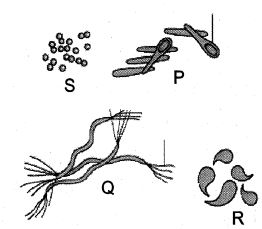
Bacteria are grouped into four categories based on their shape. Study the given figure and identify $P, Q, R,$ and $S$.
A
$P$-Bacilli,$Q$-Spirilla,$R$-Vibrio,$S$-Cocci
B
$P$-Cocci,$Q$-Bacilli,$R$-Spirilla,$S$-Vibrio
C
$P$-Vibrio,$Q$-Cocci,$R$-Bacilli,$S$-Spirilla
D
$P$-Spirilla,$Q$-Vibrio,$R$-Cocci,$S$-Bacilli
Solution
(A) Based on the shapes of bacteria,they are classified into four types:
$1$. Cocci: Spherical shaped bacteria (labeled as $S$ in the figure).
$2$. Bacilli: Rod-shaped bacteria,often with endospores (labeled as $P$ in the figure).
$3$. Spirilla: Spiral-shaped bacteria with flagella (labeled as $Q$ in the figure).
$4$. Vibrio: Comma-shaped bacteria (labeled as $R$ in the figure).
Therefore,the correct identification is $P$-Bacilli,$Q$-Spirilla,$R$-Vibrio,and $S$-Cocci.
$1$. Cocci: Spherical shaped bacteria (labeled as $S$ in the figure).
$2$. Bacilli: Rod-shaped bacteria,often with endospores (labeled as $P$ in the figure).
$3$. Spirilla: Spiral-shaped bacteria with flagella (labeled as $Q$ in the figure).
$4$. Vibrio: Comma-shaped bacteria (labeled as $R$ in the figure).
Therefore,the correct identification is $P$-Bacilli,$Q$-Spirilla,$R$-Vibrio,and $S$-Cocci.
0 likes
View Solution460
MediumMCQ
Methanogens are most abundant in a
A
Sulphur rock
B
Cattle yard
C
Polluted stream
D
Hot spring
Solution
(B) Methanogens are a group of archaebacteria that produce methane $(CH_4)$ as a metabolic byproduct in anoxic conditions.
They are commonly found in the gut of ruminant animals like cows and buffaloes,where they help in the digestion of cellulose.
Therefore,they are found in high concentrations in cattle yards due to the presence of animal dung,which provides an ideal anaerobic environment for their growth.
They are commonly found in the gut of ruminant animals like cows and buffaloes,where they help in the digestion of cellulose.
Therefore,they are found in high concentrations in cattle yards due to the presence of animal dung,which provides an ideal anaerobic environment for their growth.
0 likes
View Solution461
EasyMCQ
Which one of the following statements about mycoplasma is wrong?
A
They lack cell wall
B
They are sensitive to penicillin
C
They cause disease in plants
D
They are also called $PPLO$
Solution
(B) Mycoplasma are organisms that completely lack a cell wall.
Because they lack a cell wall,they are naturally resistant to antibiotics like penicillin,which work by inhibiting cell wall synthesis.
They are the smallest living cells known and can survive without oxygen.
They are also known as $PPLO$ ($Pleuro-Pneumonia-Like$ $Organisms$).
They are pathogenic to both plants and animals.
Therefore,the statement that they are sensitive to penicillin is incorrect.
Because they lack a cell wall,they are naturally resistant to antibiotics like penicillin,which work by inhibiting cell wall synthesis.
They are the smallest living cells known and can survive without oxygen.
They are also known as $PPLO$ ($Pleuro-Pneumonia-Like$ $Organisms$).
They are pathogenic to both plants and animals.
Therefore,the statement that they are sensitive to penicillin is incorrect.
0 likes
View Solution462
MediumMCQ
Which of the following is not found in $Eubacteria$?
A
Rigid cell wall
B
Chlorophyll-$a$
C
Gelatinous envelope
D
Zygote
Solution
(D) $Eubacteria$ are prokaryotic organisms characterized by a rigid cell wall made of peptidoglycan.
Photosynthetic $Eubacteria$ (like Cyanobacteria) contain chlorophyll-$a$,similar to green plants.
Many bacteria possess a gelatinous envelope or slime layer outside the cell wall.
$A$ $Zygote$ is a diploid cell formed by the fusion of two haploid gametes,which is a characteristic feature of eukaryotic sexual reproduction.
$Eubacteria$ reproduce primarily by binary fission and do not undergo sexual reproduction involving gamete fusion to form a $Zygote$.
Photosynthetic $Eubacteria$ (like Cyanobacteria) contain chlorophyll-$a$,similar to green plants.
Many bacteria possess a gelatinous envelope or slime layer outside the cell wall.
$A$ $Zygote$ is a diploid cell formed by the fusion of two haploid gametes,which is a characteristic feature of eukaryotic sexual reproduction.
$Eubacteria$ reproduce primarily by binary fission and do not undergo sexual reproduction involving gamete fusion to form a $Zygote$.
0 likes
View Solution463
MediumMCQ
What is true for Archaebacteria?
A
All halophiles
B
All photosynthetic
C
All fossils
D
Oldest living beings
Solution
(D) Archaebacteria are considered the oldest living organisms because they possess a unique cell wall structure that allows them to survive in some of the most harsh habitats,such as extreme salty areas (halophiles),hot springs (thermoacidophiles),and marshy areas (methanogens).
These organisms are believed to have evolved very early in the history of life on Earth,hence they are often referred to as 'living fossils' or the oldest living beings.
These organisms are believed to have evolved very early in the history of life on Earth,hence they are often referred to as 'living fossils' or the oldest living beings.
0 likes
View Solution464
MediumMCQ
What is the full form of $PPLO$?
A
Pleuro Pneumonia Long Organisms
B
Pleuro Pneumonia Like Organisms
C
Pleuro Positive like Organisms
D
Pleuro Pneumonia like Organ
Solution
(B) $PPLO$ stands for Pleuro Pneumonia-Like Organisms.
These are the smallest living cells known,which can survive without oxygen.
They are also known as Mycoplasma and lack a cell wall.
These are the smallest living cells known,which can survive without oxygen.
They are also known as Mycoplasma and lack a cell wall.
0 likes
View Solution465
MediumMCQ
Gas vacuoles are found in:
A
Blue-green bacteria
B
Green photosynthetic bacteria
C
Purple photosynthetic bacteria
D
All of the above
Solution
(D) Gas vacuoles (also known as gas vesicles) are specialized structures found in certain prokaryotes,including various bacteria and archaea.
These structures provide buoyancy,allowing the organisms to float at specific depths in aquatic environments to optimize light absorption for photosynthesis or to reach nutrient-rich layers.
Gas vacuoles are commonly present in photosynthetic prokaryotes such as $A$ (Blue-green bacteria or Cyanobacteria),$B$ (Green photosynthetic bacteria),and $C$ (Purple photosynthetic bacteria).
Therefore,the correct answer is $D$ (All of the above).
These structures provide buoyancy,allowing the organisms to float at specific depths in aquatic environments to optimize light absorption for photosynthesis or to reach nutrient-rich layers.
Gas vacuoles are commonly present in photosynthetic prokaryotes such as $A$ (Blue-green bacteria or Cyanobacteria),$B$ (Green photosynthetic bacteria),and $C$ (Purple photosynthetic bacteria).
Therefore,the correct answer is $D$ (All of the above).
0 likes
View Solution466
MediumMCQ
Which of the following statements correctly describes $Cyanobacteria$?
A
Prokaryotic cell,having chromatophore
B
Eukaryotic cell,having plasmid
C
Plant cell,having chloroplast
D
Prokaryotic cell,having nuclear membrane
Solution
(A) $Cyanobacteria$ are photosynthetic prokaryotes.
They lack membrane-bound organelles such as a nucleus or chloroplasts.
Instead,they contain specialized pigment-containing structures called chromatophores,which are extensions of the plasma membrane that facilitate photosynthesis.
Therefore,they are prokaryotic cells that possess chromatophores.
They lack membrane-bound organelles such as a nucleus or chloroplasts.
Instead,they contain specialized pigment-containing structures called chromatophores,which are extensions of the plasma membrane that facilitate photosynthesis.
Therefore,they are prokaryotic cells that possess chromatophores.
0 likes
View Solution467
EasyMCQ
Which of the following is included in the kingdom $Monera$?
A
$Amoeba$
B
$Escherichia$
C
$Gelidium$
D
$Spirogyra$
Solution
(B) The kingdom $Monera$ consists of prokaryotic organisms, primarily bacteria.
$Escherichia$ (e.g., $Escherichia coli$) is a well-known bacterium belonging to the kingdom $Monera$.
$Amoeba$ is a protist (kingdom $Protista$).
$Gelidium$ is a red alga (kingdom $Protista$).
$Spirogyra$ is a green alga (kingdom $Plantae$).
Therefore, the correct option is $B$.
$Escherichia$ (e.g., $Escherichia coli$) is a well-known bacterium belonging to the kingdom $Monera$.
$Amoeba$ is a protist (kingdom $Protista$).
$Gelidium$ is a red alga (kingdom $Protista$).
$Spirogyra$ is a green alga (kingdom $Plantae$).
Therefore, the correct option is $B$.
0 likes
View Solution468
EasyMCQ
The main difference between Gram-positive $(+ve)$ and Gram-negative $(-ve)$ bacteria lies in their $........$.
A
Cell wall
B
Cell membrane
C
Cytoplasm
D
Flagella
Solution
(A) The primary difference between Gram-positive and Gram-negative bacteria is the composition and structure of their cell wall.
Gram-positive bacteria possess a thick layer of peptidoglycan (murein) in their cell wall,which retains the crystal violet stain.
Gram-negative bacteria have a much thinner layer of peptidoglycan and an additional outer membrane containing lipopolysaccharides $(LPS)$,which prevents the retention of the crystal violet stain.
Gram-positive bacteria possess a thick layer of peptidoglycan (murein) in their cell wall,which retains the crystal violet stain.
Gram-negative bacteria have a much thinner layer of peptidoglycan and an additional outer membrane containing lipopolysaccharides $(LPS)$,which prevents the retention of the crystal violet stain.
0 likes
View Solution469
MediumMCQ
The thermal tolerance of thermophilic blue-green algae is due to:
A
Cell wall structure
B
Cellular organization
C
Mitochondrial structure
D
Homopolar bonds in their proteins
Solution
(D) Thermophilic blue-green algae (cyanobacteria) can survive in high-temperature environments due to the presence of specific structural adaptations in their proteins. These organisms possess proteins with a high proportion of homopolar bonds,which provide greater thermal stability and prevent denaturation at high temperatures. This allows them to maintain their metabolic functions even in extreme heat.
0 likes
View Solution470
MediumMCQ
The sex factor in bacteria is .......
A
Chromosomal replication
B
$F$-plasmid
C
$RNA$
D
Sex pilus
Solution
(B) In bacteria,the sex factor is known as the $F$-factor or $F$-plasmid (Fertility factor).
This plasmid contains the genes necessary for the formation of the sex pilus,which is required for the process of conjugation.
During conjugation,the $F$-plasmid is transferred from the donor cell $(F^+)$ to the recipient cell $(F^-)$,thereby converting the recipient into a donor cell.
Therefore,the correct option is $B$.
This plasmid contains the genes necessary for the formation of the sex pilus,which is required for the process of conjugation.
During conjugation,the $F$-plasmid is transferred from the donor cell $(F^+)$ to the recipient cell $(F^-)$,thereby converting the recipient into a donor cell.
Therefore,the correct option is $B$.
0 likes
View Solution471
MediumMCQ
Some microorganisms grow and multiply at temperatures of $100-105^{\circ}C$. They are included in:
A
Marine archaebacteria
B
Thermophilic sulfur bacteria
C
Hot spring blue-green algae (cyanobacteria)
D
Thermophilic,suberian fungi
Solution
(A) The microorganisms that can survive and multiply at extremely high temperatures $(100-105^{\circ}C)$ are known as hyperthermophiles.
These organisms belong to the domain $Archaea$.
Specifically,certain species of archaebacteria,such as those found in deep-sea hydrothermal vents,are adapted to thrive in these extreme conditions due to the unique structure of their cell walls and membranes.
Therefore,the correct category is marine archaebacteria.
These organisms belong to the domain $Archaea$.
Specifically,certain species of archaebacteria,such as those found in deep-sea hydrothermal vents,are adapted to thrive in these extreme conditions due to the unique structure of their cell walls and membranes.
Therefore,the correct category is marine archaebacteria.
0 likes
View Solution472
MediumMCQ
Which statement is true for photolithotrophs?
A
Obtain energy from radiation and $H$ from organic compounds.
B
Obtain energy from radiation and $H$ from inorganic compounds.
C
Obtain energy from organic compounds.
D
Obtain energy from inorganic compounds.
Solution
(B) Photolithotrophs are organisms that use light (photo) as their energy source and inorganic compounds (litho) as their electron donor (source of $H$ or electrons).
Therefore,they obtain energy from radiation and $H$ from inorganic compounds.
Therefore,they obtain energy from radiation and $H$ from inorganic compounds.
0 likes
View Solution473
MediumMCQ
Which of the following is true for Cyanobacteria?
A
Oxygenic with nitrogenase
B
Oxygenic without nitrogenase
C
Non-oxygenic with nitrogenase
D
Non-oxygenic without nitrogenase
Solution
(A) Cyanobacteria are photosynthetic prokaryotes that perform oxygenic photosynthesis,meaning they release $O_2$ as a byproduct.
Many species of Cyanobacteria (e.g.,Nostoc,Anabaena) are capable of nitrogen fixation,a process catalyzed by the enzyme nitrogenase.
Since they perform oxygenic photosynthesis and possess the nitrogenase enzyme for nitrogen fixation,they are characterized as oxygenic with nitrogenase.
Many species of Cyanobacteria (e.g.,Nostoc,Anabaena) are capable of nitrogen fixation,a process catalyzed by the enzyme nitrogenase.
Since they perform oxygenic photosynthesis and possess the nitrogenase enzyme for nitrogen fixation,they are characterized as oxygenic with nitrogenase.
0 likes
View Solution474
EasyMCQ
Which of the following is true for Archaebacteria?
A
All are thermophilic
B
All are photosynthetic
C
All are fossils
D
Oldest living organisms
Solution
(D) Archaebacteria are considered the oldest living organisms because they possess unique cell wall structures (lacking peptidoglycan) that allow them to survive in extreme environmental conditions,such as high temperatures,high salinity,and acidic environments. They are believed to be the ancestors of modern bacteria and eukaryotes. Therefore,they are often referred to as the 'oldest living organisms'.
0 likes
View Solution475
EasyMCQ
In bacteria,plasmids are ............... .
A
Extra-chromosomal material
B
Main $DNA$
C
Non-functional $DNA$
D
Repetitive genes
Solution
(A) Plasmids are small,circular,double-stranded $DNA$ molecules that are distinct from a cell's chromosomal $DNA$.
They are found in bacteria and some other microorganisms.
These are considered extra-chromosomal genetic elements because they exist and replicate independently of the main bacterial chromosome.
Plasmids often carry genes that provide advantages to the bacteria,such as antibiotic resistance.
They are found in bacteria and some other microorganisms.
These are considered extra-chromosomal genetic elements because they exist and replicate independently of the main bacterial chromosome.
Plasmids often carry genes that provide advantages to the bacteria,such as antibiotic resistance.
0 likes
View Solution476
MediumMCQ
Organisms that obtain energy by the oxidation of reduced inorganic compounds are called .............
A
Photosynthetic
B
Chemosynthetic
C
Saprophytic
D
Heterotrophic
Solution
(B) Organisms that derive energy from the oxidation of reduced inorganic substances (such as ammonia, nitrites, or sulfides) are known as $Chemosynthetic$ autotrophs. These organisms play a vital role in recycling nutrients like nitrogen, phosphorus, iron, and sulfur in the ecosystem. Unlike photosynthetic organisms, they do not require sunlight for energy production.
0 likes
View Solution477
MediumMCQ
Barophilic prokaryotes are ..........
A
grow slowly in highly alkaline frozen lakes at high altitudes.
B
found in water containing high concentrations of barium hydroxide.
C
grow and multiply in deep sea sediments.
D
grow and divide rapidly in any soluble salt of barium in sea water.
Solution
(C) Barophilic prokaryotes,also known as piezophiles,are organisms that thrive at high atmospheric pressures.
These organisms are typically found in deep-sea environments,such as deep-sea sediments or hydrothermal vents,where the pressure is significantly higher than at the surface.
They have evolved specialized cellular structures and metabolic pathways to function optimally under these extreme pressure conditions.
Therefore,the correct description is that they grow and multiply in deep sea sediments.
These organisms are typically found in deep-sea environments,such as deep-sea sediments or hydrothermal vents,where the pressure is significantly higher than at the surface.
They have evolved specialized cellular structures and metabolic pathways to function optimally under these extreme pressure conditions.
Therefore,the correct description is that they grow and multiply in deep sea sediments.
0 likes
View Solution478
MediumMCQ
Which of the following statements is incorrect regarding Mycoplasma?
A
They are also called $PPLO$.
B
They are pleomorphic.
C
They are sensitive to penicillin.
D
They are pathogenic in plants.
Solution
(C) Mycoplasma are organisms that completely lack a cell wall.
Because they lack a cell wall,they are naturally resistant to antibiotics like penicillin,which work by inhibiting cell wall synthesis.
Therefore,the statement that they are sensitive to penicillin is incorrect.
They are also known as $PPLO$ (Pleuropneumonia-like organisms),they exhibit pleomorphism (change shape),and many species are pathogenic in both plants and animals.
Because they lack a cell wall,they are naturally resistant to antibiotics like penicillin,which work by inhibiting cell wall synthesis.
Therefore,the statement that they are sensitive to penicillin is incorrect.
They are also known as $PPLO$ (Pleuropneumonia-like organisms),they exhibit pleomorphism (change shape),and many species are pathogenic in both plants and animals.
0 likes
View Solution479
MediumMCQ
Thermococcus,Methanococcus,and Methanobacterium are examples of:
A
Archaebacteria that contain protein homologous to core histones of Eukaryota.
B
Archaebacteria that lack histones resembling those found in Eukaryota but possess $DNA$ supercoiling.
C
Bacteria whose $DNA$ is relaxed or positively supercoiled but which have a cytoskeleton and mitochondria.
D
Bacteria that contain a cytoskeleton and mitochondria.
Solution
(A) Thermococcus,Methanococcus,and Methanobacterium belong to the domain $Archaea$.
These organisms are known as Archaebacteria.
$A$ key characteristic of many Archaebacteria,particularly those in the $Euryarchaeota$ phylum,is the presence of histone-like proteins that are homologous to the core histones found in Eukaryota.
These proteins help in the packaging of $DNA$ into nucleosome-like structures,which is a feature shared with eukaryotes,distinguishing them from typical eubacteria.
These organisms are known as Archaebacteria.
$A$ key characteristic of many Archaebacteria,particularly those in the $Euryarchaeota$ phylum,is the presence of histone-like proteins that are homologous to the core histones found in Eukaryota.
These proteins help in the packaging of $DNA$ into nucleosome-like structures,which is a feature shared with eukaryotes,distinguishing them from typical eubacteria.
0 likes
View Solution480
MediumMCQ
Some hyperthermophilic organisms that grow in highly acidic habitats are divided into two groups,which are called:
A
Eubacteria and Archaea
B
Cyanobacteria and Diatoms
C
Protozoa and Mosses
D
Liverworts and Yeasts
Solution
(A) Hyperthermophilic organisms that thrive in extremely acidic environments (acidophiles) are primarily found within the domains $Eubacteria$ and $Archaea$. Many members of the domain $Archaea$,specifically those in the group $Crenarchaeota$,are well-known for being both hyperthermophilic and acidophilic. Similarly,certain species of $Eubacteria$ have adapted to survive in such extreme conditions. Therefore,these organisms are classified into these two distinct domains.
0 likes
View Solution481
EasyMCQ
Organisms known as methanogens are found in abundance in ............ .
A
Cattle yard
B
Polluted streams
C
Hot springs
D
Sulfur rocks
Solution
(A) Methanogens are a group of archaebacteria that produce methane $(CH_4)$ as a metabolic byproduct in anoxic conditions.
These organisms are commonly found in the gut of several ruminant animals such as cows and buffaloes.
In the gut,they help in the breakdown of cellulose and are present in the excreta (dung) of these animals.
Therefore,they are found in abundance in cattle yards where cattle dung is present.
These organisms are commonly found in the gut of several ruminant animals such as cows and buffaloes.
In the gut,they help in the breakdown of cellulose and are present in the excreta (dung) of these animals.
Therefore,they are found in abundance in cattle yards where cattle dung is present.
0 likes
View Solution482
MediumMCQ
The greatest nutritional diversity is found in the group ..........
A
Fungi
B
Animalia
C
Monera
D
Plantae
Solution
(C) The kingdom $Monera$ exhibits the most extensive nutritional diversity among all biological kingdoms.
Members of this kingdom can be autotrophic (photosynthetic or chemosynthetic) or heterotrophic (saprophytic,parasitic,or symbiotic).
This metabolic versatility allows them to survive in diverse and extreme environments,which is not observed to the same extent in other groups like $Plantae$ (mostly autotrophic) or $Animalia$ (mostly heterotrophic).
Members of this kingdom can be autotrophic (photosynthetic or chemosynthetic) or heterotrophic (saprophytic,parasitic,or symbiotic).
This metabolic versatility allows them to survive in diverse and extreme environments,which is not observed to the same extent in other groups like $Plantae$ (mostly autotrophic) or $Animalia$ (mostly heterotrophic).
0 likes
View Solution483
EasyMCQ
In which of the following organisms is the cell wall absent in their cells?
A
Penicillium
B
Agaricus
C
Volvox
D
Mycoplasma
Solution
(D) The cell wall is a rigid layer present outside the plasma membrane in plants,fungi,and most bacteria.
$A$. $Penicillium$ is a fungus and possesses a chitinous cell wall.
$B$. $Agaricus$ is a fungus and possesses a chitinous cell wall.
$C$. $Volvox$ is a green alga and possesses a cellulosic cell wall.
$D$. $Mycoplasma$ is a genus of bacteria that lacks a cell wall entirely.
Therefore,$Mycoplasma$ is the correct organism where the cell wall is absent.
$A$. $Penicillium$ is a fungus and possesses a chitinous cell wall.
$B$. $Agaricus$ is a fungus and possesses a chitinous cell wall.
$C$. $Volvox$ is a green alga and possesses a cellulosic cell wall.
$D$. $Mycoplasma$ is a genus of bacteria that lacks a cell wall entirely.
Therefore,$Mycoplasma$ is the correct organism where the cell wall is absent.
0 likes
View Solution484
EasyMCQ
Cyanobacteria are also known as ....
A
Protists
B
Golden algae
C
Slime moulds
D
Blue-green algae
Solution
(D) Cyanobacteria are photosynthetic prokaryotes that contain chlorophyll $a$,similar to green plants. Due to their ability to perform oxygenic photosynthesis and their characteristic blue-green pigmentation,they are commonly referred to as blue-green algae.
0 likes
View Solution485
MediumMCQ
Which of the following are likely to be present in deep-sea hydrothermal vents?
A
Archaebacteria
B
Eubacteria
C
Blue-green algae
D
Symbiotic fungi
Solution
(A) Archaebacteria are unique organisms that can survive in some of the most extreme environmental conditions on Earth.
These conditions include high salinity (halophiles),extreme temperatures (thermophiles),and highly acidic environments.
Deep-sea hydrothermal vents are characterized by extremely high temperatures and high pressure,which are conditions where only $Archaebacteria$ (specifically thermoacidophiles) can thrive.
Therefore,the correct option is $A$.
These conditions include high salinity (halophiles),extreme temperatures (thermophiles),and highly acidic environments.
Deep-sea hydrothermal vents are characterized by extremely high temperatures and high pressure,which are conditions where only $Archaebacteria$ (specifically thermoacidophiles) can thrive.
Therefore,the correct option is $A$.
0 likes
View Solution486
MediumMCQ
In some cyanobacteria,pigment-containing membranous extensions are called ..........
A
Heterocysts
B
Basal bodies
C
Pneumatophores
D
Chromatophores
Solution
(D) In some prokaryotes like cyanobacteria,there are other membranous extensions into the cytoplasm called chromatophores which contain pigments.
These structures are responsible for photosynthesis in these organisms.
Heterocysts are specialized cells for nitrogen fixation,basal bodies are associated with flagella,and pneumatophores are respiratory roots in plants.
These structures are responsible for photosynthesis in these organisms.
Heterocysts are specialized cells for nitrogen fixation,basal bodies are associated with flagella,and pneumatophores are respiratory roots in plants.
0 likes
View Solution487
EasyMCQ
Chromatophores are involved in which of the following processes?
A
Photosynthesis
B
Growth
C
Movement
D
Respiration
Solution
(A) Chromatophores are specialized membranous extensions into the cytoplasm in some prokaryotes,such as cyanobacteria. These structures contain pigments that are essential for the process of photosynthesis. Therefore,they are involved in photosynthesis.
0 likes
View Solution488
MediumMCQ
The primitive prokaryotes responsible for the production of biogas from the dung of ruminant animals include .......
A
Thermoacidophiles
B
Methanogens
C
Eubacteria
D
Halophiles
Solution
(B) Methanogens are a group of archaebacteria that are strictly anaerobic.
They are found in the gut of several ruminant animals such as cows and buffaloes.
These bacteria help in the breakdown of cellulose in the digestive tract of these animals.
They are responsible for the production of methane (biogas) from the dung of these animals.
They are found in the gut of several ruminant animals such as cows and buffaloes.
These bacteria help in the breakdown of cellulose in the digestive tract of these animals.
They are responsible for the production of methane (biogas) from the dung of these animals.
0 likes
View Solution489
EasyMCQ
Which of the following are the smallest living cells,lack a cell wall,are pathogenic to both plants and animals,and can survive without oxygen?
A
Mycoplasma
B
Pseudomonas
C
Bacillus
D
Nostoc
Solution
(A) Mycoplasma are the smallest known living cells that can survive without oxygen. They completely lack a cell wall,which makes them naturally resistant to many antibiotics like penicillin that target cell wall synthesis. Many species of Mycoplasma are pathogenic to both plants and animals.
0 likes
View Solution490
MediumMCQ
Which of the following does not perform nitrogen fixation?
A
Nostoc
B
Azotobacter
C
Spirogyra
D
Anabaena
Solution
(C) Nitrogen fixation is the process of converting atmospheric nitrogen into ammonia,which is essential for plant growth.
$Nostoc$,$Azotobacter$,and $Anabaena$ are well-known nitrogen-fixing organisms.
$Nostoc$ and $Anabaena$ are cyanobacteria (blue-green algae) that possess specialized cells called heterocysts for nitrogen fixation.
$Azotobacter$ is a free-living soil bacterium that also fixes nitrogen.
$Spirogyra$ is a filamentous green alga that performs photosynthesis but lacks the ability to fix atmospheric nitrogen.
Therefore,the correct answer is $Spirogyra$.
$Nostoc$,$Azotobacter$,and $Anabaena$ are well-known nitrogen-fixing organisms.
$Nostoc$ and $Anabaena$ are cyanobacteria (blue-green algae) that possess specialized cells called heterocysts for nitrogen fixation.
$Azotobacter$ is a free-living soil bacterium that also fixes nitrogen.
$Spirogyra$ is a filamentous green alga that performs photosynthesis but lacks the ability to fix atmospheric nitrogen.
Therefore,the correct answer is $Spirogyra$.
0 likes
View Solution491
EasyMCQ
Blue-green algae are included in ............ .
A
Eukaryotes
B
Prokaryotes
C
Rhodophyceae
D
Chlorophyceae
Solution
(B) Blue-green algae,also known as $Cyanobacteria$,are photosynthetic prokaryotic organisms.
They lack a well-defined nucleus and membrane-bound organelles.
According to the $Whittaker$ classification system,they are placed under the Kingdom $Monera$,which consists of all prokaryotic organisms.
Therefore,they are classified as prokaryotes.
They lack a well-defined nucleus and membrane-bound organelles.
According to the $Whittaker$ classification system,they are placed under the Kingdom $Monera$,which consists of all prokaryotic organisms.
Therefore,they are classified as prokaryotes.
0 likes
View Solution492
MediumMCQ
Which of the following organisms is not an example of a $Eukaryote$?
A
$Paramecium$ $caudatum$
B
$Escherichia$ $coli$
C
$Euglena$ $viridis$
D
$Amoeba$ $proteus$
Solution
(B) $Eukaryote$ is an organism whose cells contain a nucleus and other membrane-bound organelles.
$Paramecium$ $caudatum$,$Euglena$ $viridis$,and $Amoeba$ $proteus$ are all unicellular eukaryotic protists.
$Escherichia$ $coli$ $(E. coli)$ is a bacterium.
Bacteria are $Prokaryotes$,which lack a defined nucleus and membrane-bound organelles.
Therefore,$Escherichia$ $coli$ is not a $Eukaryote$.
$Paramecium$ $caudatum$,$Euglena$ $viridis$,and $Amoeba$ $proteus$ are all unicellular eukaryotic protists.
$Escherichia$ $coli$ $(E. coli)$ is a bacterium.
Bacteria are $Prokaryotes$,which lack a defined nucleus and membrane-bound organelles.
Therefore,$Escherichia$ $coli$ is not a $Eukaryote$.
0 likes
View Solution493
MediumMCQ
Identify the incorrect statement.
A
Cyanobacteria do not possess flagellated cells.
B
Mycoplasma are the smallest organisms lacking a cell wall.
C
The bacterial cell wall is composed of peptidoglycan.
D
Pili and fimbriae are involved in the motility of bacterial cells.
Solution
(D) The correct answer is $D$.
$A$: Cyanobacteria (blue-green algae) are photosynthetic prokaryotes that lack flagella throughout their life cycle. This statement is correct.
$B$: Mycoplasma are the smallest known living cells and they completely lack a cell wall,making them resistant to many antibiotics. This statement is correct.
$C$: The cell wall of bacteria is made up of peptidoglycan (murein). This statement is correct.
$D$: Pili and fimbriae are surface structures of bacteria. Pili are involved in conjugation (transfer of $DNA$),and fimbriae are involved in attachment to rocks or host tissues. Neither of these structures is involved in motility. Flagella are the primary structures responsible for bacterial motility. Therefore,this statement is incorrect.
$A$: Cyanobacteria (blue-green algae) are photosynthetic prokaryotes that lack flagella throughout their life cycle. This statement is correct.
$B$: Mycoplasma are the smallest known living cells and they completely lack a cell wall,making them resistant to many antibiotics. This statement is correct.
$C$: The cell wall of bacteria is made up of peptidoglycan (murein). This statement is correct.
$D$: Pili and fimbriae are surface structures of bacteria. Pili are involved in conjugation (transfer of $DNA$),and fimbriae are involved in attachment to rocks or host tissues. Neither of these structures is involved in motility. Flagella are the primary structures responsible for bacterial motility. Therefore,this statement is incorrect.
0 likes
View Solution494
MediumMCQ
Which of the following statements is correct regarding transformation in bacteria?
A
Transfer of some genes from one bacterium to another by a virus.
B
Transfer of genes from one bacterium to another through conjugation.
C
Bacteria take up $DNA$ directly from the environment.
D
Bacteria receive $DNA$ from an external head.
Solution
(C) Transformation is a process of horizontal gene transfer in which a bacterium takes up naked $DNA$ fragments from its surrounding environment.
This process was first discovered by Frederick Griffith in $1928$ during his experiments with $Streptococcus$ $pneumoniae$.
The $DNA$ taken up by the competent bacterial cell is incorporated into its own genome,potentially altering its genetic characteristics.
Option $A$ refers to transduction,while option $B$ refers to conjugation.
This process was first discovered by Frederick Griffith in $1928$ during his experiments with $Streptococcus$ $pneumoniae$.
The $DNA$ taken up by the competent bacterial cell is incorporated into its own genome,potentially altering its genetic characteristics.
Option $A$ refers to transduction,while option $B$ refers to conjugation.
0 likes
View Solution495
EasyMCQ
Spliceosomes are not found in the cells of .............
A
Plants
B
Fungi
C
Animals
D
Bacteria
Solution
(D) Spliceosomes are complex molecular machines primarily composed of small nuclear ribonucleoproteins $(snRNPs)$ and proteins. They are responsible for the splicing of pre-messenger $RNA$ $(pre-mRNA)$ to remove introns and join exons. This process is a characteristic feature of eukaryotic cells. Bacteria are prokaryotes,which lack a membrane-bound nucleus and complex internal organelles like spliceosomes. Therefore,spliceosomes are not found in bacteria.
0 likes
View Solution496
MediumMCQ
In which of the following does oxygenic photosynthesis occur?
A
Oscillatoria
B
Rhodospirillum
C
Chlorobium
D
Chromatium
Solution
(A) Oxygenic photosynthesis is a process in which water $(H_2O)$ is used as an electron donor,resulting in the release of oxygen $(O_2)$ as a byproduct.
Cyanobacteria,such as $Oscillatoria$,are the only prokaryotes that perform oxygenic photosynthesis,similar to green plants.
$Rhodospirillum$ (purple non-sulfur bacteria),$Chlorobium$ (green sulfur bacteria),and $Chromatium$ (purple sulfur bacteria) are examples of anoxygenic photosynthetic organisms that use substances like hydrogen sulfide $(H_2S)$ instead of water,and thus do not evolve oxygen.
Cyanobacteria,such as $Oscillatoria$,are the only prokaryotes that perform oxygenic photosynthesis,similar to green plants.
$Rhodospirillum$ (purple non-sulfur bacteria),$Chlorobium$ (green sulfur bacteria),and $Chromatium$ (purple sulfur bacteria) are examples of anoxygenic photosynthetic organisms that use substances like hydrogen sulfide $(H_2S)$ instead of water,and thus do not evolve oxygen.
0 likes
View Solution497
MediumMCQ
Which category of bacteria is most abundant in nature and is helpful in making curd from milk and in the production of antibiotics?
A
Cyanobacteria
B
Archaebacteria
C
Chemosynthetic autotrophs
D
Heterotrophic bacteria
Solution
(D) Heterotrophic bacteria are the most abundant bacteria in nature.
Many of these are important to human beings in making curd from milk (e.g.,$Lactobacillus$),production of antibiotics (e.g.,$Streptomyces$),fixing nitrogen in legume roots,etc.
They act as decomposers and play a vital role in nutrient cycling.
Many of these are important to human beings in making curd from milk (e.g.,$Lactobacillus$),production of antibiotics (e.g.,$Streptomyces$),fixing nitrogen in legume roots,etc.
They act as decomposers and play a vital role in nutrient cycling.
0 likes
View Solution498
MediumMCQ
Which of the following groups exhibits the most extensive nutritional diversity?
A
Fungi
B
Animals
C
Monera
D
Plantae
Solution
(C) The kingdom $Monera$ (which includes bacteria) exhibits the most extensive nutritional diversity among all biological groups.
Bacteria can be autotrophic (photoautotrophic or chemoautotrophic) or heterotrophic (saprophytic,parasitic,or symbiotic).
This metabolic versatility allows them to survive in diverse and extreme environments,unlike other kingdoms which have more restricted modes of nutrition.
Bacteria can be autotrophic (photoautotrophic or chemoautotrophic) or heterotrophic (saprophytic,parasitic,or symbiotic).
This metabolic versatility allows them to survive in diverse and extreme environments,unlike other kingdoms which have more restricted modes of nutrition.
0 likes
View Solution499
MediumMCQ
Which among the following is $not$ a prokaryote?
A
Oscillatoria
B
Saccharomyces
C
Nostoc
D
Mycobacterium
Solution
(B) An organism that does not possess a true nucleus (nucleus with nuclear membrane) and double membrane-bounded organelles is called a prokaryote.
Kingdom Monera consists of prokaryotes,such as bacteria (e.g.,$Mycobacterium$) and cyanobacteria (e.g.,$Nostoc$ and $Oscillatoria$).
In contrast,$Saccharomyces$ (yeast) belongs to the Kingdom Fungi. It possesses a true nucleus and membrane-bound organelles,making it a eukaryote.
Kingdom Monera consists of prokaryotes,such as bacteria (e.g.,$Mycobacterium$) and cyanobacteria (e.g.,$Nostoc$ and $Oscillatoria$).
In contrast,$Saccharomyces$ (yeast) belongs to the Kingdom Fungi. It possesses a true nucleus and membrane-bound organelles,making it a eukaryote.
0 likes
View SolutionBiological Classification — Monera (Prokaryotes) · Frequently Asked Questions
1Are these Biological Classification questions useful for JEE and NEET?
Yes. All questions in this section are mapped to JEE Main and NEET exam patterns. Previous year questions from JEE Main, NEET, GUJCET and state-level exams are included with full solutions.
2Can I switch to Hindi or Gujarati for these questions?
Yes. Use the language tabs in the hero section or the sidebar to view the same questions and solutions in English, Hindi or Gujarati.
3How do I generate a question paper from this subtopic?
Use the Vedclass Exam Paper Generator — select the chapter and subtopic, set difficulty, and generate Sets A, B, C, D automatically. First 3 chapters of every subject are free.
Vedclass Products
For Students
Vedclass Test Series
Mock tests in real JEE/NEET style with performance analysis. 5-day free trial.
Start Free TrialFor Teachers
Exam Paper Generator
Generate Set A/B/C/D papers from this chapter in 2 minutes. 3 chapters free.
Try FreeFor Institutes
Online Exam Module
Live online exams with unlimited students, 360° analytics & white-label branding.
See DemoFor Teachers & Institutes
Generate a Biological Classification Exam Paper in 2 Minutes
Select subtopic & difficulty — Sets A, B, C, D auto-generated with No Repeat logic.
First 3 chapters of every subject are free — no payment required.