
A English
Monera (Prokaryotes) Questions in English
Class 11 Biology · Biological Classification · Monera (Prokaryotes)
632+
Questions
English
Language
100%
With Solutions
Showing 50 of 632 questions in English
551
MediumMCQ
The highly resistant nature of an endospore is due to the presence of:
A
Dipicolinic acid and peptidoglycan in the spore coat
B
Peptidoglycan in the exosporium
C
Dipicolinic acid and $Ca$ in the cortex
D
Dipicolinic acid and $Ca$ in the cell membrane
Solution
(C) The highly resistant nature of an endospore is primarily attributed to the presence of dipicolinic acid and calcium ions $(Ca^{2+})$ in the cortex layer of the spore.
These components contribute to the heat resistance,chemical resistance,and overall stability of the endospore,allowing it to survive in harsh environmental conditions.
These components contribute to the heat resistance,chemical resistance,and overall stability of the endospore,allowing it to survive in harsh environmental conditions.
0 likes
View Solution552
MediumMCQ
Endospores formed by certain bacteria are actually the means for
A
Reproduction
B
Perennation
C
Bioluminescence
D
Red snow formation
Solution
(B) Endospores are highly resistant,dormant structures produced by certain bacteria such as $Bacillus$ and $Clostridium$ species.
They are not a method of reproduction because they do not increase the number of individuals.
Instead,they serve as a means of perennation,allowing the bacteria to survive under extremely harsh environmental conditions like high temperature,radiation,desiccation,and chemical disinfectants.
They are not a method of reproduction because they do not increase the number of individuals.
Instead,they serve as a means of perennation,allowing the bacteria to survive under extremely harsh environmental conditions like high temperature,radiation,desiccation,and chemical disinfectants.
0 likes
View Solution553
MediumMCQ
Select an incorrect statement for $F^{+}$ bacteria.
A
It has $F$ plasmid.
B
Only somatic pili are present.
C
It is considered as donor bacterium.
D
It cannot conjugate with another $F^{+}$ form.
Solution
(B) $F^{+}$ bacteria contain the $F$ plasmid (fertility factor).
They are considered donor bacteria because they can transfer genetic material to $F^{-}$ recipient cells.
They cannot conjugate with another $F^{+}$ cell because the presence of the $F$ plasmid prevents the formation of a conjugation bridge between two donor cells.
$F^{+}$ bacteria possess both fertility pili (sex pili) and somatic pili,not just somatic pili. Therefore,the statement that 'only somatic pili are present' is incorrect.
They are considered donor bacteria because they can transfer genetic material to $F^{-}$ recipient cells.
They cannot conjugate with another $F^{+}$ cell because the presence of the $F$ plasmid prevents the formation of a conjugation bridge between two donor cells.
$F^{+}$ bacteria possess both fertility pili (sex pili) and somatic pili,not just somatic pili. Therefore,the statement that 'only somatic pili are present' is incorrect.
0 likes
View Solution554
MediumMCQ
$A$: $MLOs$ (Mycoplasma-like organisms) are pleomorphic and non-motile monerans.
$R$: They are insensitive to antibiotics like penicillin.
$R$: They are insensitive to antibiotics like penicillin.
A
Assertion and Reason both are correct and Reason is the correct explanation of Assertion.
B
Assertion and Reason both are correct but Reason is not the correct explanation of Assertion.
C
Assertion is correct,but Reason is incorrect.
D
Both Assertion and Reason are incorrect.
Solution
(A) $MLOs$ (Mycoplasma-like organisms) are members of the kingdom $Monera$. They lack a cell wall,which makes them pleomorphic (variable in shape) and non-motile.
Since they lack a cell wall,they are not affected by antibiotics like penicillin,which specifically target cell wall synthesis in bacteria.
Therefore,both the Assertion $(A)$ and the Reason $(R)$ are correct,and the Reason correctly explains why $MLOs$ are insensitive to penicillin.
Since they lack a cell wall,they are not affected by antibiotics like penicillin,which specifically target cell wall synthesis in bacteria.
Therefore,both the Assertion $(A)$ and the Reason $(R)$ are correct,and the Reason correctly explains why $MLOs$ are insensitive to penicillin.
0 likes
View Solution555
MediumMCQ
$A$ : Majority of bacteria are autotrophs.
$R$ : Chemoheterotrophic nutrition is absent in bacteria.
$R$ : Chemoheterotrophic nutrition is absent in bacteria.
A
Assertion and Reason both are correct and Reason is the correct explanation of Assertion.
B
Assertion and Reason both are correct but Reason is not the correct explanation of Assertion.
C
Assertion is correct,but Reason is incorrect.
D
Both Assertion and Reason are incorrect.
Solution
(D) The Assertion is incorrect because the majority of bacteria are heterotrophs,not autotrophs. They depend on other organisms or on dead organic matter for food.
The Reason is also incorrect because chemoheterotrophic nutrition is,in fact,the most common mode of nutrition in bacteria. Many bacteria are saprophytes or parasites that obtain energy and carbon from organic compounds.
Therefore,both the Assertion and the Reason are incorrect.
The Reason is also incorrect because chemoheterotrophic nutrition is,in fact,the most common mode of nutrition in bacteria. Many bacteria are saprophytes or parasites that obtain energy and carbon from organic compounds.
Therefore,both the Assertion and the Reason are incorrect.
0 likes
View Solution556
MediumMCQ
Membranous extensions in blue-green algae are known as
A
phytochrome
B
chromatophore
C
mesosome
D
pneumatophore
Solution
(B) In some prokaryotes like cyanobacteria or blue-green algae,there are specialized membranous extensions in the cytoplasm that contain pigments,which are called chromatophores.
These structures are involved in photosynthesis.
These structures are involved in photosynthesis.
0 likes
View Solution557
MediumMCQ
Gas vacuoles are found in
A
Blue green algae
B
Green and purple bacteria
C
Bacillus
D
More than one option is correct
Solution
(D) Gas vacuoles,also known as pseudovacuoles,are specialized structures found in certain prokaryotic organisms.
These structures provide buoyancy to the cells,allowing them to float at specific depths in aquatic environments.
Gas vacuoles are characteristically present in Blue-green algae (cyanobacteria),as well as green and purple photosynthetic bacteria.
Since both option $A$ and option $B$ are correct,the most appropriate choice is $D$.
These structures provide buoyancy to the cells,allowing them to float at specific depths in aquatic environments.
Gas vacuoles are characteristically present in Blue-green algae (cyanobacteria),as well as green and purple photosynthetic bacteria.
Since both option $A$ and option $B$ are correct,the most appropriate choice is $D$.
0 likes
View Solution558
MediumMCQ
Peptidoglycan present in the bacterial cell envelope is:
A
Made up of cellulose
B
$A$ heteropolymer
C
An oligosaccharide
D
$A$ homopolymer
Solution
(B) Peptidoglycan, also known as murein, is a polymer consisting of sugars and amino acids that forms a mesh-like layer outside the plasma membrane of most bacteria, forming the cell wall.
It is a heteropolymer (specifically a heteropolysaccharide) because it is composed of two alternating amino sugar molecules, $N$-acetylglucosamine $(NAG)$ and $N$-acetylmuramic acid $(NAM)$, which are linked by $\beta-(1,4)$ glycosidic bonds and cross-linked by short peptide chains.
It is a heteropolymer (specifically a heteropolysaccharide) because it is composed of two alternating amino sugar molecules, $N$-acetylglucosamine $(NAG)$ and $N$-acetylmuramic acid $(NAM)$, which are linked by $\beta-(1,4)$ glycosidic bonds and cross-linked by short peptide chains.
0 likes
View Solution559
EasyMCQ
The structure present in cyanobacteria $(BGA)$ that helps in nitrogen fixation is
A
Haplosperm
B
Holostrum
C
Holotrema
D
Heterocyst
Solution
(D) Cyanobacteria,also known as blue-green algae $(BGA)$,possess the unique ability to fix atmospheric nitrogen.
This process is facilitated by specialized,thick-walled cells known as heterocysts.
These cells provide an anaerobic environment necessary for the activity of the enzyme nitrogenase,which is sensitive to oxygen.
This process is facilitated by specialized,thick-walled cells known as heterocysts.
These cells provide an anaerobic environment necessary for the activity of the enzyme nitrogenase,which is sensitive to oxygen.
0 likes
View Solution560
EasyMCQ
The free-living,aerobic,and saprotrophic $N_2$-fixing microbe is
A
Azotobacter
B
Rhodospirillum
C
Rhizobium
D
Anabaena
Solution
(A) $Azotobacter$ is a free-living,aerobic,and saprotrophic nitrogen-fixing bacterium.
It lives in the soil and fixes atmospheric nitrogen independently without forming a symbiotic relationship with plants.
It lives in the soil and fixes atmospheric nitrogen independently without forming a symbiotic relationship with plants.
0 likes
View Solution561
EasyMCQ
Those organisms which cannot use oxygen for growth and are even harmed by its presence are known as:
A
Obligate aerobes
B
Aerotolerant anaerobes
C
Facultative anaerobes
D
Obligate anaerobes
Solution
(D) Obligate anaerobes are organisms that cannot use oxygen for growth and are often killed or harmed by its presence.
They lack the enzymes (such as superoxide dismutase and catalase) required to detoxify the reactive oxygen species produced in the presence of $O_2$.
Therefore,they grow only in environments completely devoid of oxygen.
They lack the enzymes (such as superoxide dismutase and catalase) required to detoxify the reactive oxygen species produced in the presence of $O_2$.
Therefore,they grow only in environments completely devoid of oxygen.
0 likes
View Solution562
MediumMCQ
The mode equivalent to sexual reproduction in bacteria is:
A
Formation of gametes
B
Endospore formation
C
Conjugation
D
Zoospore formation
Solution
(C) Bacteria do not undergo true sexual reproduction as they lack meiosis and gamete formation. However,they exhibit genetic recombination,which is a process equivalent to sexual reproduction.
Conjugation is the primary mechanism of genetic recombination in bacteria,where genetic material (usually a plasmid) is transferred from a donor bacterium to a recipient bacterium through a direct physical contact via a pilus.
Therefore,conjugation is considered the mode equivalent to sexual reproduction in bacteria.
Conjugation is the primary mechanism of genetic recombination in bacteria,where genetic material (usually a plasmid) is transferred from a donor bacterium to a recipient bacterium through a direct physical contact via a pilus.
Therefore,conjugation is considered the mode equivalent to sexual reproduction in bacteria.
0 likes
View Solution563
MediumMCQ
One of the following is not a characteristic feature of cyanobacteria:
A
They are multicellular
B
They form colonies
C
They form blooms in polluted water bodies
D
They can fix atmospheric nitrogen
Solution
(A) Cyanobacteria,also known as blue-green algae,are prokaryotic organisms.
They are primarily unicellular,colonial,or filamentous,but they are not multicellular in the true sense of having differentiated tissues or organs.
They are known for forming colonies and often produce blooms in polluted water bodies due to nutrient enrichment (eutrophication).
Many species of cyanobacteria,such as $Anabaena$ and $Nostoc$,possess specialized cells called heterocysts that allow them to fix atmospheric nitrogen.
Therefore,the statement that they are multicellular is not a characteristic feature of cyanobacteria.
They are primarily unicellular,colonial,or filamentous,but they are not multicellular in the true sense of having differentiated tissues or organs.
They are known for forming colonies and often produce blooms in polluted water bodies due to nutrient enrichment (eutrophication).
Many species of cyanobacteria,such as $Anabaena$ and $Nostoc$,possess specialized cells called heterocysts that allow them to fix atmospheric nitrogen.
Therefore,the statement that they are multicellular is not a characteristic feature of cyanobacteria.
0 likes
View Solution564
MediumMCQ
Which of the following features is correct for bacteria?
A
Presence of intervening sequences in $DNA$
B
$DNA$ does not show coiling
C
Linear $ss-DNA$ representing single chromosome
D
$DNA$ can be chromosomal as well as extrachromosomal
Solution
(D) Bacteria possess a single circular $ds-DNA$ molecule which acts as the main chromosomal $DNA$ and is located in the nucleoid region.
Additionally,many bacteria contain small,circular,extrachromosomal $DNA$ molecules known as plasmids.
Therefore,$DNA$ in bacteria can be both chromosomal (nucleoid) and extrachromosomal (plasmid).
Additionally,many bacteria contain small,circular,extrachromosomal $DNA$ molecules known as plasmids.
Therefore,$DNA$ in bacteria can be both chromosomal (nucleoid) and extrachromosomal (plasmid).
0 likes
View Solution565
MediumMCQ
Which of the following cyanobacteria can fix atmospheric nitrogen?
$I.$ Anabaena
$II.$ Oscillatoria
$III.$ Nostoc
Choose the correct option.
$I.$ Anabaena
$II.$ Oscillatoria
$III.$ Nostoc
Choose the correct option.
A
$I \, \& \, II$
B
$II \, \& \, III$
C
$I \, \& \, III$
D
$I, II \, \& \, III$
Solution
(D) Cyanobacteria are autotrophic microbes widely distributed in aquatic and terrestrial environments.
Many of these cyanobacteria,such as $Anabaena$,$Nostoc$,and $Oscillatoria$,are capable of fixing atmospheric nitrogen.
They contribute to soil fertility by increasing the organic matter content through their photosynthetic activity and nitrogen fixation.
Therefore,all three mentioned organisms are capable of nitrogen fixation.
Many of these cyanobacteria,such as $Anabaena$,$Nostoc$,and $Oscillatoria$,are capable of fixing atmospheric nitrogen.
They contribute to soil fertility by increasing the organic matter content through their photosynthetic activity and nitrogen fixation.
Therefore,all three mentioned organisms are capable of nitrogen fixation.
0 likes
View Solution566
EasyMCQ
$A$ nutritionally wild type organism,which does not require any additional growth supplement,is known as:
A
Phenotype
B
Holotype
C
Auxotroph
D
Prototroph
Solution
(D) An organism (such as a bacterium) that can grow on a minimal medium without needing any specific nutritional supplements is called a $Prototroph$.
In contrast,an $Auxotroph$ is a mutant organism that cannot synthesize a particular compound required for its growth and therefore requires the addition of that specific nutrient (such as an amino acid or vitamin) to the growth medium.
In contrast,an $Auxotroph$ is a mutant organism that cannot synthesize a particular compound required for its growth and therefore requires the addition of that specific nutrient (such as an amino acid or vitamin) to the growth medium.
0 likes
View Solution567
MediumMCQ
The organisms found in boiling thermal springs are:
A
Fungi
B
Protists
C
Archaebacteria
D
Actinomycetes
Solution
(C) Archaebacteria are the organisms found in extreme environments like boiling thermal springs and deep-sea hydrothermal vents.
This is due to the unique structure of their cell wall and cell membrane,which contains branched-chain lipids that provide stability and resistance to extreme heat and acidic conditions.
This is due to the unique structure of their cell wall and cell membrane,which contains branched-chain lipids that provide stability and resistance to extreme heat and acidic conditions.
0 likes
View Solution568
Medium
Write a short note on Mycoplasma.
Solution
(N/A) Mycoplasma are organisms that completely lack a cell wall.
$\rightarrow$ They are the smallest living cells known and can survive without oxygen.
$\rightarrow$ Many mycoplasma are pathogenic in animals and plants.
$\rightarrow$ Mycoplasma are the simplest free-living prokaryotes.
$\rightarrow$ They are also known as $PPLO$ (Pleuropneumonia-like organisms).
$\rightarrow$ They are the smallest living cells known and can survive without oxygen.
$\rightarrow$ Many mycoplasma are pathogenic in animals and plants.
$\rightarrow$ Mycoplasma are the simplest free-living prokaryotes.
$\rightarrow$ They are also known as $PPLO$ (Pleuropneumonia-like organisms).
0 likes
View Solution569
Medium
Give the differences between Eubacteria and Archaebacteria.
Solution
(N/A)
| Eubacteria | Archaebacteria |
|---|---|
| $(1)$ Cell wall is made up of peptidoglycan. | $(1)$ Peptidoglycan is absent in the cell wall; it is composed of complex polysaccharides and proteins. |
| $(2)$ Plasma membrane consists of straight-chain fatty acids linked by ester bonds. | $(2)$ Plasma membrane consists of branched-chain lipids linked by ether bonds. |
| $(3)$ Genes are generally not interrupted by non-coding sequences (introns). | $(3)$ Genes are often interrupted by introns,similar to eukaryotes. |
| $(4)$ Ribosomal proteins and $RNA$ polymerase enzymes are distinct from those of eukaryotes. | $(4)$ Ribosomal proteins and $RNA$ polymerase are structurally similar to those of eukaryotes. |
0 likes
View Solution570
Medium
Give differences: Bacteria and Cyanobacteria.
Solution
(N/A)
| Bacteria | Cyanobacteria |
| $(1)$ Cells are smaller. | $(1)$ Cells are comparatively larger. |
| $(2)$ Cell wall is $1-2$ layered. | $(2)$ Cell wall is four-layered. |
| $(3)$ They may possess flagella. | $(3)$ They lack flagella. |
| $(4)$ They are autotrophic and heterotrophic. | $(4)$ They are primarily autotrophic. |
| $(5)$ Autotrophic bacteria contain bacteriochlorophyll. | $(5)$ They possess chlorophyll-$a$ as found in eukaryotic autotrophs. |
| $(6)$ Photosynthesis is anoxygenic. | $(6)$ Photosynthesis is oxygenic. |
| $(7)$ They may be aerobic or anaerobic. | $(7)$ They are aerobic. |
| $(8)$ The reserve food is glycogen. | $(8)$ The reserve food is cyanophycean starch. |
0 likes
View Solution571
Easy
Provide the full names for the following abbreviations:
$(1)$ $MLO$
$(2)$ $VAM$
$(1)$ $MLO$
$(2)$ $VAM$
Solution
(N/A) $(1)$ $MLO$ stands for Mycoplasma-Like Organisms. These are small,wall-less prokaryotes that are often pathogenic to plants.
$(2)$ $VAM$ stands for Vesicular-Arbuscular Mycorrhizae. These are a type of endomycorrhiza in which fungi form vesicles and arbuscules within the root cells of plants to facilitate nutrient uptake.
$(2)$ $VAM$ stands for Vesicular-Arbuscular Mycorrhizae. These are a type of endomycorrhiza in which fungi form vesicles and arbuscules within the root cells of plants to facilitate nutrient uptake.
0 likes
View Solution572
MediumMCQ
What is the importance of Cyanobacteria?
A
They fix atmospheric nitrogen.
B
They help in soil erosion prevention and conservation.
C
Spirulina is a protein-rich supplement for humans.
D
All of the above.
Solution
(D) Cyanobacteria are significant for several reasons:
$1$. Nitrogen Fixation: Many cyanobacteria,such as $Anabaena$ and $Nostoc$,possess specialized cells called heterocysts that fix atmospheric nitrogen into ammonia,enriching soil fertility.
$2$. Environmental Conservation: They help in the prevention of soil erosion and contribute to soil conservation by forming crusts on the soil surface.
$3$. Nutritional Value: Species like $Spirulina$ are widely used as protein-rich dietary supplements for humans due to their high nutritional content.
$1$. Nitrogen Fixation: Many cyanobacteria,such as $Anabaena$ and $Nostoc$,possess specialized cells called heterocysts that fix atmospheric nitrogen into ammonia,enriching soil fertility.
$2$. Environmental Conservation: They help in the prevention of soil erosion and contribute to soil conservation by forming crusts on the soil surface.
$3$. Nutritional Value: Species like $Spirulina$ are widely used as protein-rich dietary supplements for humans due to their high nutritional content.
0 likes
View Solution573
EasyMCQ
What was the contribution of the scientist Ehrenberg in the field of microbiology?
A
Discovery of viruses
B
Coined the term Bacteria
C
Discovery of penicillin
D
Development of the germ theory
Solution
(B) The term $Bacteria$ was proposed by the scientist Christian Gottfried Ehrenberg in $1829$.
0 likes
View Solution574
EasyMCQ
Which of the following organisms was discovered by Anton Von Leeuwenhoek?
A
Viruses
B
Bacteria
C
Fungi
D
Protozoa
Solution
(B) Anton Von Leeuwenhoek is credited with the discovery of bacteria. He observed these microorganisms for the first time in $1675$ using a simple microscope he designed himself.
0 likes
View Solution575
Easy
Polluted water bodies usually have a very high abundance of plants like $Nostoc$ and $Oscillatoria$. Give reasons.
Solution
(N/A) $\rightarrow$ Some cyanobacteria or blue-green algae like $Nostoc$ and $Oscillatoria$ can tolerate adverse conditions,including pollutants,much better than other aquatic plants.
This is due to the presence of a protective mucilage covering,resistant proteins,and the absence of sap vacuoles.
They release a large quantity of spores that are always present in the air.
These organisms obtain plenty of nutrients in polluted water,which promotes their rapid growth.
Hence,they often bloom in such conditions and are found in abundance in polluted water.
This is due to the presence of a protective mucilage covering,resistant proteins,and the absence of sap vacuoles.
They release a large quantity of spores that are always present in the air.
These organisms obtain plenty of nutrients in polluted water,which promotes their rapid growth.
Hence,they often bloom in such conditions and are found in abundance in polluted water.
0 likes
View Solution576
MediumMCQ
Are chemosynthetic bacteria autotrophic or heterotrophic?
A
Autotrophic
B
Heterotrophic
C
Both
D
None of these
Solution
(A) Chemosynthetic bacteria are autotrophic because they can synthesize their own food.
During chemosynthesis,they use inorganic chemicals as a source of energy to fix carbon dioxide into organic compounds.
During chemosynthesis,they use inorganic chemicals as a source of energy to fix carbon dioxide into organic compounds.
0 likes
View Solution577
Medium
Cyanobacteria and heterotrophic bacteria have been clubbed together in eubacteria of kingdom-Monera as per the "five kingdom classification", even though the two are vastly different from each other. Is this grouping of the two types of taxa in the same kingdom justified? If so, why? Discuss the cellular composition of cyanobacteria and heterotrophic bacteria that make them classified as eubacteria.
Solution
(A) $1$. According to the "five kingdom classification" proposed by $R$.$H$. Whittaker, all prokaryotic organisms are placed under the kingdom Monera.
$2$. Both cyanobacteria and heterotrophic bacteria are prokaryotic in nature, meaning they lack a membrane-bound nucleus and other membrane-bound organelles.
$3$. The classification is justified because the primary criterion for placing organisms in kingdom Monera is their prokaryotic cellular organization.
$4$. Cyanobacteria (blue-green algae) are photosynthetic autotrophs containing chlorophyll-$a$, while heterotrophic bacteria obtain nutrients from organic matter. Despite this difference in the mode of nutrition, their fundamental cellular structure (prokaryotic) remains the same, which is the defining characteristic of eubacteria.
$2$. Both cyanobacteria and heterotrophic bacteria are prokaryotic in nature, meaning they lack a membrane-bound nucleus and other membrane-bound organelles.
$3$. The classification is justified because the primary criterion for placing organisms in kingdom Monera is their prokaryotic cellular organization.
$4$. Cyanobacteria (blue-green algae) are photosynthetic autotrophs containing chlorophyll-$a$, while heterotrophic bacteria obtain nutrients from organic matter. Despite this difference in the mode of nutrition, their fundamental cellular structure (prokaryotic) remains the same, which is the defining characteristic of eubacteria.
0 likes
View Solution578
MediumMCQ
Given below are two statements:
Statement $I$: Mycoplasma can pass through less than $1 \ \mu m$ filter size.
Statement $II$: Mycoplasma are bacteria with cell wall.
In the light of the above statements,choose the most appropriate answer from the options given below:
Statement $I$: Mycoplasma can pass through less than $1 \ \mu m$ filter size.
Statement $II$: Mycoplasma are bacteria with cell wall.
In the light of the above statements,choose the most appropriate answer from the options given below:
A
Both Statement $I$ and Statement $II$ are incorrect.
B
Statement $I$ is correct but Statement $II$ is incorrect.
C
Statement $I$ is incorrect but Statement $II$ is correct.
D
Both Statement $I$ and Statement $II$ are correct.
Solution
(B) Statement $I$ is correct: Mycoplasma are the smallest known living cells,typically ranging from $0.1 \ \mu m$ to $0.3 \ \mu m$ in size. Due to their extremely small size,they can easily pass through bacterial-proof filters (which usually have a pore size of $1 \ \mu m$ or less).
Statement $II$ is incorrect: Mycoplasma are unique among bacteria because they completely lack a cell wall. This absence of a cell wall makes them naturally resistant to antibiotics like penicillin that target cell wall synthesis.
Therefore,Statement $I$ is correct and Statement $II$ is incorrect.
Statement $II$ is incorrect: Mycoplasma are unique among bacteria because they completely lack a cell wall. This absence of a cell wall makes them naturally resistant to antibiotics like penicillin that target cell wall synthesis.
Therefore,Statement $I$ is correct and Statement $II$ is incorrect.
0 likes
View Solution579
MediumMCQ
Which of the following is a correct statement?
A
Bacteria are exclusively heterotrophic organisms.
B
Slime moulds are saprophytic organisms classified under Kingdom Monera.
C
Mycoplasma have $DNA$,Ribosome and cell wall.
D
Cyanobacteria are a group of autotrophic organisms classified under Kingdom Monera.
Solution
(D) Option $A$ is incorrect because bacteria can be autotrophic (photosynthetic or chemosynthetic) or heterotrophic.
Option $B$ is incorrect because slime moulds are protists,not members of Kingdom $Monera$.
Option $C$ is incorrect because $Mycoplasma$ lack a cell wall.
Option $D$ is correct because $Cyanobacteria$ (blue-green algae) are photosynthetic autotrophs and are classified under Kingdom $Monera$ as prokaryotes.
Option $B$ is incorrect because slime moulds are protists,not members of Kingdom $Monera$.
Option $C$ is incorrect because $Mycoplasma$ lack a cell wall.
Option $D$ is correct because $Cyanobacteria$ (blue-green algae) are photosynthetic autotrophs and are classified under Kingdom $Monera$ as prokaryotes.
0 likes
View Solution580
MediumMCQ
How many of the following organisms are prokaryotic?
Bacteria,Blue-green algae,Fungi,Porifera,Echinodermata,Moss,Bryophytes,Pteridophytes,Gymnosperms,Ctenophora,Angiosperms
Bacteria,Blue-green algae,Fungi,Porifera,Echinodermata,Moss,Bryophytes,Pteridophytes,Gymnosperms,Ctenophora,Angiosperms
A
$2$
B
$3$
C
$4$
D
$5$
Solution
(A) Prokaryotic organisms belong to the Kingdom $Monera$.
$1$. Bacteria: These are prokaryotic organisms.
$2$. Blue-green algae (Cyanobacteria): These are also prokaryotic organisms.
All other organisms listed (Fungi,Porifera,Echinodermata,Moss,Bryophytes,Pteridophytes,Gymnosperms,Ctenophora,and Angiosperms) are eukaryotic organisms.
Therefore,there are only $2$ prokaryotic organisms in the given list.
Thus,the correct option is $A$.
$1$. Bacteria: These are prokaryotic organisms.
$2$. Blue-green algae (Cyanobacteria): These are also prokaryotic organisms.
All other organisms listed (Fungi,Porifera,Echinodermata,Moss,Bryophytes,Pteridophytes,Gymnosperms,Ctenophora,and Angiosperms) are eukaryotic organisms.
Therefore,there are only $2$ prokaryotic organisms in the given list.
Thus,the correct option is $A$.
0 likes
View Solution581
EasyMCQ
Which kingdom consists of unicellular prokaryotic organisms?
A
Monera
B
Protista
C
Fungi
D
Plantae
Solution
(A) The kingdom $Monera$ is the only kingdom in the five-kingdom classification system that consists of unicellular prokaryotic organisms. These organisms lack a defined nucleus and membrane-bound organelles. Examples include bacteria and cyanobacteria.
0 likes
View Solution582
MediumMCQ
How many categories are bacteria divided into based on their shape?
A
$4$
B
$3$
C
$2$
D
$5$
Solution
(A) Bacteria are grouped into $4$ categories based on their shape:
$1$. Spherical (Coccus)
$2$. Rod-shaped (Bacillus)
$3$. Comma-shaped (Vibrio)
$4$. Spiral (Spirillum)
$1$. Spherical (Coccus)
$2$. Rod-shaped (Bacillus)
$3$. Comma-shaped (Vibrio)
$4$. Spiral (Spirillum)
0 likes
View Solution583
MediumMCQ
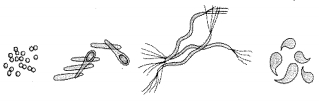
Identify the bacteria given in the figure below.
A
Coccus,Spirillum,Vibrio,Bacillus
B
Bacillus,Vibrio,Spirillum,Coccus
C
Bacillus,Coccus,Spirillum,Vibrio
D
Coccus,Bacillus,Spirillum,Vibrio
Solution
(D) Based on the morphological shapes of bacteria shown in the figure:
$1$. The first group shows spherical-shaped bacteria,which are known as $Coccus$.
$2$. The second group shows rod-shaped bacteria,which are known as $Bacillus$.
$3$. The third group shows spiral-shaped bacteria,which are known as $Spirillum$.
$4$. The fourth group shows comma-shaped bacteria,which are known as $Vibrio$.
Therefore,the correct sequence is $Coccus$,$Bacillus$,$Spirillum$,$Vibrio$.
$1$. The first group shows spherical-shaped bacteria,which are known as $Coccus$.
$2$. The second group shows rod-shaped bacteria,which are known as $Bacillus$.
$3$. The third group shows spiral-shaped bacteria,which are known as $Spirillum$.
$4$. The fourth group shows comma-shaped bacteria,which are known as $Vibrio$.
Therefore,the correct sequence is $Coccus$,$Bacillus$,$Spirillum$,$Vibrio$.
0 likes
View Solution584
MediumMCQ
Choose the incorrect option for bacteria.
A
Bacteria have a simple structure despite their complex behavior.
B
Bacteria exhibit a wide range of metabolic diversity.
C
Most bacteria are heterotrophic.
D
Autotrophic bacteria synthesize food from inorganic substrates.
Solution
(A) According to the $NCERT$ textbook,bacteria are characterized by a very simple structure but complex behavior. Therefore,the statement that 'Bacteria have a simple structure despite their complex behavior' is correct. Bacteria show the most extensive metabolic diversity among all organisms. Most bacteria are heterotrophic (they do not synthesize their own food but depend on other organisms or on dead organic matter for food). Autotrophic bacteria synthesize their own food from inorganic substrates. Thus,all given options are factually correct based on biological principles. However,if the question asks for an 'incorrect' option and all are correct,it implies a potential error in the question framing. Given the standard $NCERT$ text,all these statements are true.
0 likes
View Solution585
MediumMCQ
Autotrophic bacteria - $P$
Heterotrophic bacteria - $Q$
Select the correct option for $P$ and $Q$.
Heterotrophic bacteria - $Q$
Select the correct option for $P$ and $Q$.
A
$P$ - Chemosynthetic,Parasitic,Saprophytic
$Q$ - Photosynthetic
$Q$ - Photosynthetic
B
$P$ - Photosynthetic
$Q$ - Chemosynthetic,Parasitic,Saprophytic
$Q$ - Chemosynthetic,Parasitic,Saprophytic
C
$P$ - Parasitic,Saprophytic
$Q$ - Photosynthetic,Chemosynthetic
$Q$ - Photosynthetic,Chemosynthetic
D
$P$ - Photosynthetic,Chemosynthetic
$Q$ - Parasitic,Saprophytic
$Q$ - Parasitic,Saprophytic
Solution
(D) Bacteria are classified based on their mode of nutrition into two main categories: Autotrophic and Heterotrophic.
$1$. Autotrophic bacteria $(P)$ can synthesize their own food. They are further divided into photosynthetic (using light energy) and chemosynthetic (using chemical energy) bacteria.
$2$. Heterotrophic bacteria $(Q)$ cannot synthesize their own food and depend on other organisms. They include parasitic (living on or in other organisms) and saprophytic (decomposing dead organic matter) bacteria.
Therefore,$P$ includes photosynthetic and chemosynthetic bacteria,while $Q$ includes parasitic and saprophytic bacteria. The correct option is $D$.
$1$. Autotrophic bacteria $(P)$ can synthesize their own food. They are further divided into photosynthetic (using light energy) and chemosynthetic (using chemical energy) bacteria.
$2$. Heterotrophic bacteria $(Q)$ cannot synthesize their own food and depend on other organisms. They include parasitic (living on or in other organisms) and saprophytic (decomposing dead organic matter) bacteria.
Therefore,$P$ includes photosynthetic and chemosynthetic bacteria,while $Q$ includes parasitic and saprophytic bacteria. The correct option is $D$.
0 likes
View Solution586
EasyMCQ
Which bacteria live in extreme conditions?
A
Archaebacteria
B
Eubacteria
C
Both
D
None of these
Solution
(A) Archaebacteria are unique because they live in some of the most harsh habitats such as extreme salty areas (halophiles),hot springs (thermoacidophiles),and marshy areas (methanogens).
Their cell wall structure is responsible for their survival in these extreme conditions,which is different from other bacteria.
Their cell wall structure is responsible for their survival in these extreme conditions,which is different from other bacteria.
0 likes
View Solution587
EasyMCQ
Match the following columns:
| Column-$I$ (Habitat) | Column-$II$ (Archaebacteria) |
| $P$. Salty areas | $I$. Thermoacidophiles |
| $Q$. Marshy areas | $II$. Methanogens |
| $R$. Hot springs | $III$. Halophiles |
A
$P-II, Q-III, R-I$
B
$P-III, Q-II, R-I$
C
$P-I, Q-II, R-III$
D
$P-I, Q-III, R-II$
Solution
(B) Archaebacteria are special because they live in some of the most harsh habitats.
$1$. Halophiles $(P)$ are found in extremely salty areas.
$2$. Methanogens $(Q)$ are found in marshy areas.
$3$. Thermoacidophiles $(R)$ are found in hot springs.
Therefore, the correct matching is $P-III, Q-II, R-I$.
$1$. Halophiles $(P)$ are found in extremely salty areas.
$2$. Methanogens $(Q)$ are found in marshy areas.
$3$. Thermoacidophiles $(R)$ are found in hot springs.
Therefore, the correct matching is $P-III, Q-II, R-I$.
0 likes
View Solution588
EasyMCQ
In the digestive tract of several ruminant animals like cows and buffaloes,which bacteria are present?
A
$Thermoacidophiles$
B
$Methanogens$
C
$Halophiles$
D
None of these
Solution
(B) $Methanogens$ are a group of $Archaebacteria$ that are strictly anaerobic. They are found in the gut of several ruminant animals such as cows and buffaloes. These bacteria are responsible for the production of methane (biogas) from the dung of these animals.
0 likes
View Solution589
MediumMCQ
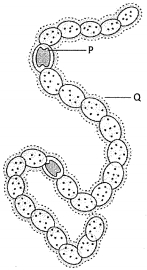
The given figure represents a filamentous blue-green alga. Select the correct option for it.
A
Nostoc - $P$ (Mycoplasma),$Q$ (Cell membrane)
B
Nostoc - $P$ (Heterocyst),$Q$ (Mucilaginous sheath)
C
Anabaena - $P$ (Mycoplasma),$Q$ (Cell membrane)
D
Anabaena - $P$ (Heterocyst),$Q$ (Mucilaginous sheath)
Solution
(B) The provided figure shows a filamentous cyanobacterium (blue-green alga) known as $Nostoc$.
In the diagram,$P$ represents the $Heterocyst$,which is a specialized cell responsible for nitrogen fixation.
$Q$ represents the $Mucilaginous$ $sheath$ that surrounds the colony of cells.
Therefore,the correct identification is $Nostoc$ with $P$ as $Heterocyst$ and $Q$ as $Mucilaginous$ $sheath$.
In the diagram,$P$ represents the $Heterocyst$,which is a specialized cell responsible for nitrogen fixation.
$Q$ represents the $Mucilaginous$ $sheath$ that surrounds the colony of cells.
Therefore,the correct identification is $Nostoc$ with $P$ as $Heterocyst$ and $Q$ as $Mucilaginous$ $sheath$.
0 likes
View Solution590
EasyMCQ
Which of the following is a photosynthetic bacterium?
A
Cyanobacteria
B
Rhizobium
C
Mycoplasma
D
Lactobacillus
Solution
(A) Cyanobacteria,also known as blue-green algae,are photosynthetic prokaryotes that contain chlorophyll $a$ and perform oxygenic photosynthesis.
Rhizobium is a nitrogen-fixing bacterium found in root nodules of leguminous plants.
Mycoplasma is a genus of bacteria that lack a cell wall and are generally parasitic or saprophytic.
Lactobacillus is a lactic acid bacterium involved in the fermentation of milk into curd.
Therefore,the correct answer is Cyanobacteria.
Rhizobium is a nitrogen-fixing bacterium found in root nodules of leguminous plants.
Mycoplasma is a genus of bacteria that lack a cell wall and are generally parasitic or saprophytic.
Lactobacillus is a lactic acid bacterium involved in the fermentation of milk into curd.
Therefore,the correct answer is Cyanobacteria.
0 likes
View Solution591
EasyMCQ
What is the function of heterocysts?
A
Fixation of atmospheric $N_2$
B
Conversion of insoluble phosphorus into soluble form
C
Phagocytosis
D
Locomotion
Solution
(A) Heterocysts are specialized,thick-walled cells found in certain filamentous cyanobacteria like $Nostoc$ and $Anabaena$.
Their primary function is the fixation of atmospheric nitrogen $(N_2)$ into ammonia,which is essential for the organism's growth.
They provide an anaerobic environment necessary for the activity of the enzyme nitrogenase,which is sensitive to oxygen.
Their primary function is the fixation of atmospheric nitrogen $(N_2)$ into ammonia,which is essential for the organism's growth.
They provide an anaerobic environment necessary for the activity of the enzyme nitrogenase,which is sensitive to oxygen.
0 likes
View Solution592
MediumMCQ
Select the correct option for chemoautotrophs:
A
They are a type of autotrophs.
B
They oxidize inorganic substances.
C
They use the energy released from oxidation for the production of $ATP$.
D
All of the above.
Solution
(D) Chemoautotrophs are organisms that synthesize their own food by utilizing the chemical energy released from the oxidation of inorganic substances (such as nitrates,nitrites,or ammonia).
$1$. They are autotrophs because they synthesize their own food.
$2$. They oxidize inorganic substances to obtain energy.
$3$. The energy released during this oxidation process is used for the production of $ATP$.
Therefore,all the given options are correct.
$1$. They are autotrophs because they synthesize their own food.
$2$. They oxidize inorganic substances to obtain energy.
$3$. The energy released during this oxidation process is used for the production of $ATP$.
Therefore,all the given options are correct.
0 likes
View Solution593
MediumMCQ
Select the incorrect statement regarding Eubacteria:
A
Autotrophic bacteria are abundant in nature.
B
They are prokaryotic organisms.
C
The smallest living cells are included in Eubacteria.
D
Blue-green algae are included in Eubacteria.
Solution
(C) The incorrect statement is $C$.
$Mycoplasma$ are known as the smallest living cells.
$Mycoplasma$ are organisms that lack a cell wall and can survive without oxygen.
They are not part of Eubacteria but are distinct organisms within the Kingdom Monera.
All other statements are correct: Eubacteria are prokaryotic,autotrophic bacteria are abundant in nature,and blue-green algae $(Cyanobacteria)$ are classified under Eubacteria.
$Mycoplasma$ are known as the smallest living cells.
$Mycoplasma$ are organisms that lack a cell wall and can survive without oxygen.
They are not part of Eubacteria but are distinct organisms within the Kingdom Monera.
All other statements are correct: Eubacteria are prokaryotic,autotrophic bacteria are abundant in nature,and blue-green algae $(Cyanobacteria)$ are classified under Eubacteria.
0 likes
View Solution594
MediumMCQ
Select the correct statement for $Eubacteria$.
A
They are helpful in making curd from milk,production of antibiotics,and nitrogen fixation in legume roots.
B
They cause damage to human beings,crops,farm animals,and pets.
C
Diseases like cholera,typhoid,tetanus,and citrus canker are caused by bacteria.
D
All of the above.
Solution
(D) $Eubacteria$ (true bacteria) are extremely diverse in nature.
$1.$ They are helpful in making curd from milk (e.g.,$Lactobacillus$),production of antibiotics,and nitrogen fixation in legume roots (e.g.,$Rhizobium$).
$2.$ Many bacteria are pathogenic and cause damage to human beings,crops,farm animals,and pets.
$3.$ Diseases such as cholera,typhoid,tetanus,and citrus canker are caused by different bacteria.
Therefore,all the given statements are correct.
$1.$ They are helpful in making curd from milk (e.g.,$Lactobacillus$),production of antibiotics,and nitrogen fixation in legume roots (e.g.,$Rhizobium$).
$2.$ Many bacteria are pathogenic and cause damage to human beings,crops,farm animals,and pets.
$3.$ Diseases such as cholera,typhoid,tetanus,and citrus canker are caused by different bacteria.
Therefore,all the given statements are correct.
0 likes
View Solution595
MediumMCQ
Select the incorrect statement regarding conjugation.
A
Plasmid is transferred from one bacterium to another.
B
Fimbriae play an important role in conjugation.
C
It is a form of sexual reproduction.
D
All of the above.
Solution
(B) Conjugation is a process in bacteria where genetic material,typically a plasmid (such as the $F$-plasmid),is transferred from a donor bacterium to a recipient bacterium.
In this process,specialized structures called 'pili' or 'sex pili' play a crucial role in establishing contact between the cells.
Fimbriae,on the other hand,are primarily involved in the attachment of bacteria to surfaces or host tissues,not in the conjugation process.
Furthermore,while conjugation involves the transfer of genetic material,it is not considered true sexual reproduction because it does not involve meiosis or the formation of gametes.
Therefore,both statement $B$ and statement $C$ are technically incorrect,but since the question asks for the incorrect statement and $B$ is a specific structural error regarding the mechanism,$B$ is the most direct incorrect statement provided.
In this process,specialized structures called 'pili' or 'sex pili' play a crucial role in establishing contact between the cells.
Fimbriae,on the other hand,are primarily involved in the attachment of bacteria to surfaces or host tissues,not in the conjugation process.
Furthermore,while conjugation involves the transfer of genetic material,it is not considered true sexual reproduction because it does not involve meiosis or the formation of gametes.
Therefore,both statement $B$ and statement $C$ are technically incorrect,but since the question asks for the incorrect statement and $B$ is a specific structural error regarding the mechanism,$B$ is the most direct incorrect statement provided.
0 likes
View Solution596
MediumMCQ
Select the incorrect statement for $Mycoplasma$:
A
They lack a cell wall.
B
They are the smallest living cells known.
C
They can survive without oxygen.
D
They cause diseases only in animals.
Solution
(D) $Mycoplasma$ are organisms that completely lack a cell wall.
They are the smallest living cells known and can survive without oxygen.
$Mycoplasma$ are pathogenic to both plants and animals.
Therefore,the statement that they cause diseases only in animals is incorrect.
They are the smallest living cells known and can survive without oxygen.
$Mycoplasma$ are pathogenic to both plants and animals.
Therefore,the statement that they cause diseases only in animals is incorrect.
0 likes
View Solution597
MediumMCQ
Which kingdom includes prokaryotic cells?
A
Plantae
B
Protista
C
Fungi
D
Monera
Solution
(D) Prokaryotic cells are characterized by the absence of a well-defined nucleus and membrane-bound organelles. According to the five-kingdom classification system proposed by $R$.$H$. Whittaker,all prokaryotic organisms are placed under the kingdom $Monera$. Kingdoms $Plantae$,$Protista$,and $Fungi$ consist of eukaryotic organisms.
1 likes
View Solution598
EasyMCQ
Bacteria that take up the Gram stain are called . . . . . . and those that do not take up the Gram stain are called . . . . . . .
A
Gram-negative,Gram-positive
B
Gram-positive,Gram-negative
C
Gram-positive,Gram-positive
D
Gram-negative,Gram-negative
Solution
(B) Bacteria are classified into two groups based on the differences in their cell envelopes and the manner in which they respond to the staining procedure developed by Christian Gram.
$1$. Bacteria that take up and retain the Gram stain (crystal violet) are known as Gram-positive bacteria.
$2$. Bacteria that do not retain the Gram stain are known as Gram-negative bacteria.
$1$. Bacteria that take up and retain the Gram stain (crystal violet) are known as Gram-positive bacteria.
$2$. Bacteria that do not retain the Gram stain are known as Gram-negative bacteria.
0 likes
View Solution599
EasyMCQ
In the cytoplasm of cyanobacteria,membrane-bound extensions are observed,which are called $.....$.
A
Chloroplast
B
Chromoplast
C
Chromatophore
D
Mitochondria
Solution
(C) Cyanobacteria are photosynthetic prokaryotes. They contain membrane-bound extensions in their cytoplasm that contain pigments,which are known as $Chromatophores$. These structures are involved in photosynthesis. Chloroplasts and mitochondria are membrane-bound organelles found only in eukaryotic cells,and chromoplasts are a type of plastid found in plants.
0 likes
View Solution600
MediumMCQ
If fimbriae are removed from bacteria,which of the following will happen?
A
They will not be able to perform conjugation.
B
They will not be able to perform locomotion.
C
They will not be able to attach to the substrate.
D
All of the above.
Solution
(C) Fimbriae are small,bristle-like fibers sprouting out of the cell in many bacteria. Their primary function is to help the bacteria attach to rocks in streams and also to the host tissues. Conjugation is primarily mediated by pili,not fimbriae. Locomotion in bacteria is primarily mediated by flagella. Therefore,the removal of fimbriae specifically prevents the bacteria from attaching to the substrate.
0 likes
View SolutionBiological Classification — Monera (Prokaryotes) · Frequently Asked Questions
1Are these Biological Classification questions useful for JEE and NEET?
Yes. All questions in this section are mapped to JEE Main and NEET exam patterns. Previous year questions from JEE Main, NEET, GUJCET and state-level exams are included with full solutions.
2Can I switch to Hindi or Gujarati for these questions?
Yes. Use the language tabs in the hero section or the sidebar to view the same questions and solutions in English, Hindi or Gujarati.
3How do I generate a question paper from this subtopic?
Use the Vedclass Exam Paper Generator — select the chapter and subtopic, set difficulty, and generate Sets A, B, C, D automatically. First 3 chapters of every subject are free.
Vedclass Products
For Students
Vedclass Test Series
Mock tests in real JEE/NEET style with performance analysis. 5-day free trial.
Start Free TrialFor Teachers
Exam Paper Generator
Generate Set A/B/C/D papers from this chapter in 2 minutes. 3 chapters free.
Try FreeFor Institutes
Online Exam Module
Live online exams with unlimited students, 360° analytics & white-label branding.
See DemoFor Teachers & Institutes
Generate a Biological Classification Exam Paper in 2 Minutes
Select subtopic & difficulty — Sets A, B, C, D auto-generated with No Repeat logic.
First 3 chapters of every subject are free — no payment required.