
A English
Monera (Prokaryotes) Questions in English
Class 11 Biology · Biological Classification · Monera (Prokaryotes)
632+
Questions
English
Language
100%
With Solutions
Showing 50 of 632 questions in English
501
MediumMCQ
Bacterial cell wall is composed of peptidoglycan,a complex of oligosaccharides and proteins. The oligosaccharide component consists of
A
linear chain of alternating $NAG$ and $NAM$ linked by $\alpha \,(1-4)$ linkage
B
linear chains of alternating $NAG$ and $NAM$ linked by $\beta \,(1-4)$ linkage
C
linear chain of glucose linked by $\beta \,(1-4)$ linkage
D
linear chain of glucose linked by $\alpha \,(1-4)$ linkage
Solution
(B) The bacterial cell wall is made of peptidoglycan (also known as murein).
The oligosaccharide backbone of peptidoglycan consists of long,linear chains of alternating $N$-acetylglucosamine $(NAG)$ and $N$-acetylmuramic acid $(NAM)$ residues.
These sugar residues are covalently linked to each other by $\beta \,(1-4)$ glycosidic linkages.
Therefore,option $B$ is the correct description.
The oligosaccharide backbone of peptidoglycan consists of long,linear chains of alternating $N$-acetylglucosamine $(NAG)$ and $N$-acetylmuramic acid $(NAM)$ residues.
These sugar residues are covalently linked to each other by $\beta \,(1-4)$ glycosidic linkages.
Therefore,option $B$ is the correct description.
0 likes
View Solution502
MediumMCQ
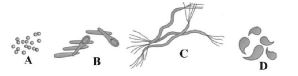
Choose the correct names of the different bacteria according to their shapes.
A
$A -$ Cocci,$B -$ Bacilli,$C -$ Spirilla,$D -$ Vibrio
B
$A -$ Bacilli,$B -$ Cocci,$C -$ Spirilla,$D -$ Vibrio
C
$A -$ Spirilla,$B -$ Bacilli,$C -$ Cocci,$D -$ Vibrio
D
$A -$ Spirilla,$B -$ Vibrio,$C -$ Cocci,$D -$ Bacilli
Solution
(A) Bacteria are grouped into four categories based on their shape:
$1$. $A$ represents spherical bacteria,known as Cocci.
$2$. $B$ represents rod-shaped bacteria,known as Bacilli.
$3$. $C$ represents spiral-shaped bacteria,known as Spirilla.
$4$. $D$ represents comma-shaped bacteria,known as Vibrio.
Therefore,the correct sequence is $A -$ Cocci,$B -$ Bacilli,$C -$ Spirilla,$D -$ Vibrio.
$1$. $A$ represents spherical bacteria,known as Cocci.
$2$. $B$ represents rod-shaped bacteria,known as Bacilli.
$3$. $C$ represents spiral-shaped bacteria,known as Spirilla.
$4$. $D$ represents comma-shaped bacteria,known as Vibrio.
Therefore,the correct sequence is $A -$ Cocci,$B -$ Bacilli,$C -$ Spirilla,$D -$ Vibrio.
0 likes
View Solution503
MediumMCQ
Which of the following statements regarding cyanobacteria is incorrect?
A
It is also called blue-green algae.
B
They are chemosynthetic heterotrophs.
C
It forms blooms in polluted water bodies.
D
It is unicellular,colonial or filamentous,marine or terrestrial bacteria.
Solution
(B) Cyanobacteria are photosynthetic autotrophs,not chemosynthetic heterotrophs. They contain chlorophyll $a$ similar to green plants and perform oxygenic photosynthesis. They are prokaryotic organisms that can be unicellular,colonial,or filamentous,and they are found in marine,freshwater,or terrestrial environments. They often form blooms in polluted water bodies.
0 likes
View Solution504
MediumMCQ
Assertion: Bacteria have three basic shapes,i.e.,round,rod,spiral.
Reason: Cocci and Bacilli may form clusters or chains of a definite length.
Reason: Cocci and Bacilli may form clusters or chains of a definite length.
A
If both Assertion and Reason are correct and the Reason is a correct explanation of the Assertion.
B
If both Assertion and Reason are correct but Reason is not a correct explanation of the Assertion.
C
If the Assertion is correct but Reason is incorrect.
D
If the Assertion is incorrect but the Reason is correct.
Solution
(D) The Assertion is incorrect because bacteria have four basic shapes: coccus (spherical/round),bacillus (rod-shaped),vibrio (comma-shaped),and spirillum (spiral-shaped). The statement mentions only three shapes,omitting the vibrio form.
The Reason is correct as bacteria like cocci and bacilli can indeed form clusters (e.g.,staphylococci) or chains (e.g.,streptococci) of varying lengths.
Therefore,the Assertion is incorrect,but the Reason is correct.
The Reason is correct as bacteria like cocci and bacilli can indeed form clusters (e.g.,staphylococci) or chains (e.g.,streptococci) of varying lengths.
Therefore,the Assertion is incorrect,but the Reason is correct.
0 likes
View Solution505
MediumMCQ
Assertion: Gram-negative bacteria do not retain the stain when washed with alcohol.
Reason: The outer face of the outer membrane of Gram-negative bacteria contains lipopolysaccharides,a part of which is integrated into the membrane lipids.
Reason: The outer face of the outer membrane of Gram-negative bacteria contains lipopolysaccharides,a part of which is integrated into the membrane lipids.
A
If both Assertion and Reason are correct and the Reason is a correct explanation of the Assertion.
B
If both Assertion and Reason are correct but Reason is not a correct explanation of the Assertion.
C
If the Assertion is correct but Reason is incorrect.
D
If both the Assertion and Reason are incorrect.
Solution
(A) Gram-negative bacteria possess a thin peptidoglycan layer and an outer membrane rich in lipids.
When treated with alcohol,the lipid-rich outer membrane dissolves,allowing the crystal violet-iodine complex to wash out,which is why they do not retain the stain.
The outer membrane of Gram-negative bacteria indeed contains lipopolysaccharides $(LPS)$,which are integral components of the outer leaflet of the outer membrane.
Therefore,both the Assertion and the Reason are correct,and the presence of the lipid-rich outer membrane (containing $LPS$) is the reason why the stain is not retained.
When treated with alcohol,the lipid-rich outer membrane dissolves,allowing the crystal violet-iodine complex to wash out,which is why they do not retain the stain.
The outer membrane of Gram-negative bacteria indeed contains lipopolysaccharides $(LPS)$,which are integral components of the outer leaflet of the outer membrane.
Therefore,both the Assertion and the Reason are correct,and the presence of the lipid-rich outer membrane (containing $LPS$) is the reason why the stain is not retained.
0 likes
View Solution506
DifficultMCQ
Assertion: Chemosynthesis is an autotrophic nutrition.
Reason: Chemoautotrophs contain chlorophyll pigments.
Reason: Chemoautotrophs contain chlorophyll pigments.
A
If both Assertion and Reason are correct and the Reason is a correct explanation of the Assertion.
B
If the Assertion is correct but Reason is incorrect.
C
If both Assertion and Reason are correct but Reason is not a correct explanation of the Assertion.
D
If both the Assertion and Reason are incorrect.
Solution
(B) Chemosynthesis is a form of autotrophic nutrition where organisms synthesize organic molecules using energy derived from the oxidation of inorganic substances.
Chemoautotrophs do not contain chlorophyll pigments; chlorophyll is characteristic of photoautotrophs,which use solar energy to synthesize organic compounds.
Therefore,the Assertion is correct,but the Reason is incorrect.
Chemoautotrophs do not contain chlorophyll pigments; chlorophyll is characteristic of photoautotrophs,which use solar energy to synthesize organic compounds.
Therefore,the Assertion is correct,but the Reason is incorrect.
0 likes
View Solution507
EasyMCQ
In the vast marine ecosystem, certain seas develop red colouration. This red colour is due to the presence of a large population of which one of the following organisms?
A
Trichodesmium erythreum
B
Physarum
C
Dinoflagellates
D
Diatoms and members of red algae
Solution
(A) $Trichodesmium erythreum$ is a cyanobacterium (blue-green alga). Although it is a blue-green alga, it possesses a pigment called phycoerythrin, which is red in colour. When these organisms multiply rapidly, they impart a red colour to the seawater, which is why the Red Sea is named as such.
0 likes
View Solution508
EasyMCQ
Match the organisms in Column-$I$ with habitats in Column-$II$.
Select the correct answer from the options given below:
| Column-$I$ | Column-$II$ |
| $(a)$ Halophiles | $(i)$ Hot springs |
| $(b)$ Thermoacidophiles | $(ii)$ Aquatic environment |
| $(c)$ Methanogens | $(iii)$ Guts of ruminants |
| $(d)$ Cyanobacteria | $(iv)$ Salty area |
Select the correct answer from the options given below:
A
$(a)-(iv), (b)-(i), (c)-(iii), (d)-(ii)$
B
$(a)-(i), (b)-(ii), (c)-(iii), (d)-(iv)$
C
$(a)-(iii), (b)-(iv), (c)-(ii), (d)-(i)$
D
$(a)-(ii), (b)-(iv), (c)-(iii), (d)-(i)$
Solution
(A) The correct matches are as follows:
$(a)$ Halophiles are archaebacteria found in extremely salty areas,so $(a)-(iv)$.
$(b)$ Thermoacidophiles are archaebacteria found in hot springs,so $(b)-(i)$.
$(c)$ Methanogens are archaebacteria found in the guts of several ruminant animals such as cows and buffaloes,so $(c)-(iii)$.
$(d)$ Cyanobacteria (blue-green algae) are photosynthetic autotrophs found in aquatic environments,so $(d)-(ii)$.
Therefore,the correct sequence is $(a)-(iv), (b)-(i), (c)-(iii), (d)-(ii)$.
$(a)$ Halophiles are archaebacteria found in extremely salty areas,so $(a)-(iv)$.
$(b)$ Thermoacidophiles are archaebacteria found in hot springs,so $(b)-(i)$.
$(c)$ Methanogens are archaebacteria found in the guts of several ruminant animals such as cows and buffaloes,so $(c)-(iii)$.
$(d)$ Cyanobacteria (blue-green algae) are photosynthetic autotrophs found in aquatic environments,so $(d)-(ii)$.
Therefore,the correct sequence is $(a)-(iv), (b)-(i), (c)-(iii), (d)-(ii)$.
0 likes
View Solution509
Medium
State two economically important uses of:
$(a)$ Heterotrophic bacteria
$(b)$ Archaebacteria
$(a)$ Heterotrophic bacteria
$(b)$ Archaebacteria
Solution
(N/A) Heterotrophic bacteria:
$(1)$ They act as decomposers and help in the formation of humus.
$(2)$ They help in the production of curd from milk.
$(3)$ Many antibiotics are obtained from some species of bacteria.
$(4)$ Many soil bacteria help in the fixation of atmospheric nitrogen.
$(b)$ Archaebacteria:
$(1)$ Methane gas is produced from the dung of ruminants by methanogens.
$(2)$ Methanogens are also involved in the formation of biogas and sewage treatment.
$(1)$ They act as decomposers and help in the formation of humus.
$(2)$ They help in the production of curd from milk.
$(3)$ Many antibiotics are obtained from some species of bacteria.
$(4)$ Many soil bacteria help in the fixation of atmospheric nitrogen.
$(b)$ Archaebacteria:
$(1)$ Methane gas is produced from the dung of ruminants by methanogens.
$(2)$ Methanogens are also involved in the formation of biogas and sewage treatment.
0 likes
View Solution510
Medium
Write a short note on Archaebacteria.
Solution
(N/A) $\rightarrow$ Archaebacteria are special because they live in some of the most harsh habitats,such as extreme salty areas (halophiles),hot springs (thermoacidophiles),and marshy areas (methanogens).
$\rightarrow$ Archaebacteria differ from other bacteria due to their unique cell wall structure. This feature is responsible for their survival in extreme environmental conditions.
$\rightarrow$ Methanogens are present in the gut of several ruminant animals,such as cows and buffaloes,and they are responsible for the production of methane (biogas) from the dung of these animals.
$\rightarrow$ Archaebacteria differ from other bacteria due to their unique cell wall structure. This feature is responsible for their survival in extreme environmental conditions.
$\rightarrow$ Methanogens are present in the gut of several ruminant animals,such as cows and buffaloes,and they are responsible for the production of methane (biogas) from the dung of these animals.
0 likes
View Solution511
Easy
Write a short note on Eubacteria.
Solution
(N/A) $\rightarrow$ Eubacteria: There are thousands of different eubacteria or true bacteria.
$\rightarrow$ They are characterised by the presence of a rigid cell wall and, if motile, a flagellum.
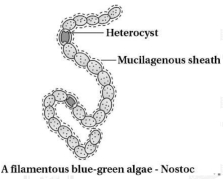
$\rightarrow$ Cyanobacteria: The cyanobacteria (also referred to as blue-green algae) have chlorophyll $a$ similar to green plants and are photosynthetic autotrophs.
$\rightarrow$ Habitat: The cyanobacteria are unicellular, colonial or filamentous, freshwater/marine or terrestrial algae. The colonies are generally surrounded by a gelatinous sheath. They often bloom in polluted water bodies.
$\rightarrow$ Function: Some of these organisms can fix atmospheric nitrogen in specialised cells called heterocysts, e.g., $Nostoc$ and $Anabaena$.
$\rightarrow$ Chemosynthetic autotrophic bacteria: These bacteria oxidise various inorganic substances such as nitrates, nitrites, and ammonia and use the released energy for their $ATP$ production. They play a great role in recycling nutrients like nitrogen, phosphorous, iron, and sulphur.
$\rightarrow$ Heterotrophic bacteria: These bacteria are the most abundant in nature. The majority are important decomposers. Many of them have a significant impact on human affairs. They are helpful in making curd from milk, production of antibiotics, fixing nitrogen in legume roots, etc. Some are pathogens causing damage to human beings, crops, farm animals, and pets. Cholera, typhoid, tetanus, and citrus canker are well-known diseases caused by different bacteria.
$\rightarrow$ Reproduction: Bacteria reproduce mainly by fission.
$\rightarrow$ They are characterised by the presence of a rigid cell wall and, if motile, a flagellum.
$\rightarrow$ Cyanobacteria: The cyanobacteria (also referred to as blue-green algae) have chlorophyll $a$ similar to green plants and are photosynthetic autotrophs.
$\rightarrow$ Habitat: The cyanobacteria are unicellular, colonial or filamentous, freshwater/marine or terrestrial algae. The colonies are generally surrounded by a gelatinous sheath. They often bloom in polluted water bodies.
$\rightarrow$ Function: Some of these organisms can fix atmospheric nitrogen in specialised cells called heterocysts, e.g., $Nostoc$ and $Anabaena$.
$\rightarrow$ Chemosynthetic autotrophic bacteria: These bacteria oxidise various inorganic substances such as nitrates, nitrites, and ammonia and use the released energy for their $ATP$ production. They play a great role in recycling nutrients like nitrogen, phosphorous, iron, and sulphur.
$\rightarrow$ Heterotrophic bacteria: These bacteria are the most abundant in nature. The majority are important decomposers. Many of them have a significant impact on human affairs. They are helpful in making curd from milk, production of antibiotics, fixing nitrogen in legume roots, etc. Some are pathogens causing damage to human beings, crops, farm animals, and pets. Cholera, typhoid, tetanus, and citrus canker are well-known diseases caused by different bacteria.
$\rightarrow$ Reproduction: Bacteria reproduce mainly by fission.
0 likes
View Solution512
Easy
Define/Explain: $Methanogens$.
Solution
(N/A) $Methanogens$ are a group of anaerobic bacteria that produce large quantities of methane $(CH_4)$ along with carbon dioxide $(CO_2)$ and hydrogen $(H_2)$ during the decomposition of organic matter,typically found in the rumen of cattle and in anaerobic sludge.
0 likes
View Solution513
Medium
Most living organisms cannot survive at temperatures above $45\,^{\circ}C$. How are some microbes able to live in habitats with temperatures exceeding $100\,^{\circ}C$?
Solution
(N/A) Archaebacteria (specifically thermophiles) are ancient forms of bacteria found in extreme environments like hot water springs and deep-sea hydrothermal vents.
They are able to survive in high temperatures (which far exceed $100\,^{\circ}C$) because their cellular structures have adapted to such extreme conditions.
These organisms contain specialized thermo-resistant enzymes that maintain their structural integrity and catalytic activity,allowing them to carry out essential metabolic functions without being denatured at such high temperatures.
They are able to survive in high temperatures (which far exceed $100\,^{\circ}C$) because their cellular structures have adapted to such extreme conditions.
These organisms contain specialized thermo-resistant enzymes that maintain their structural integrity and catalytic activity,allowing them to carry out essential metabolic functions without being denatured at such high temperatures.
0 likes
View Solution514
Easy
Provide the full forms of the following abbreviations:
$(i)$ $PPLO$
$(ii)$ $RNA$
$(i)$ $PPLO$
$(ii)$ $RNA$
Solution
(N/A) $(i)$ $PPLO$: Pleuropneumonia-like organisms.
$(ii)$ $RNA$: Ribonucleic acid.
$(ii)$ $RNA$: Ribonucleic acid.
0 likes
View Solution515
Easy
Cyanobacteria and heterotrophic bacteria have been clubbed together in eubacteria of kingdom-Monera as per the 'five kingdom classification' even though the two are vastly different from each other. Is this grouping of the two types of taxa in the same kingdom justified? If so,why? Discuss the cellular composition of cyanobacteria and heterotrophic bacteria that make them introduced in eubacteria.
Solution
(N/A) Yes,the grouping is justified because both cyanobacteria and heterotrophic bacteria are prokaryotic organisms.
$1$. Both lack a well-defined nucleus and membrane-bound organelles.
$2$. Both possess a rigid cell wall made of peptidoglycan (murein).
$3$. Both contain $70S$ ribosomes.
$4$. Cyanobacteria are photosynthetic autotrophs containing chlorophyll $a$ (similar to green plants),while heterotrophic bacteria obtain nutrients from organic matter.
$5$. Despite their metabolic differences,their fundamental cellular organization (prokaryotic nature) is identical,which is the primary criterion for their placement in the kingdom-Monera under the 'five kingdom classification'.
$1$. Both lack a well-defined nucleus and membrane-bound organelles.
$2$. Both possess a rigid cell wall made of peptidoglycan (murein).
$3$. Both contain $70S$ ribosomes.
$4$. Cyanobacteria are photosynthetic autotrophs containing chlorophyll $a$ (similar to green plants),while heterotrophic bacteria obtain nutrients from organic matter.
$5$. Despite their metabolic differences,their fundamental cellular organization (prokaryotic nature) is identical,which is the primary criterion for their placement in the kingdom-Monera under the 'five kingdom classification'.
0 likes
View Solution516
Medium
State the characteristic features of Kingdom Monera.
Solution
(N/A) $\rightarrow$ Bacteria are the sole members of the Kingdom Monera.
$\rightarrow$ Occurrence: Bacteria are the most abundant microorganisms which occur almost everywhere.
$\rightarrow$ Hundreds of bacteria are present in a handful of soil.
$\rightarrow$ They also live in extreme habitats such as hot springs, deserts, snow, and deep oceans where very few other life forms can survive.
$\rightarrow$ Many of them live in or on other organisms as parasites.
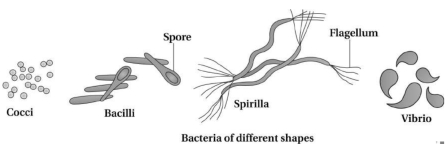
$\rightarrow$ Types based on shape: Bacteria are grouped under four categories based on their shape:
$1$. The spherical Coccus (Pl. Cocci)
$2$. The rod-shaped Bacillus (Pl. bacilli)
$3$. The comma-shaped Vibrium (Pl. Vibrio)
$4$. The spiral-shaped Spirillum (Pl. Spirilla)
$\rightarrow$ Mode of nutrition: Though the bacterial structure is very simple, they are very complex in behavior.
$\rightarrow$ Bacteria show the most extensive metabolic diversity.
$\rightarrow$ Some of the bacteria are autotrophic, i.e., they synthesize their own food from inorganic substrates.
$\rightarrow$ They may be photosynthetic autotrophic or chemosynthetic autotrophic.
$\rightarrow$ The vast majority of bacteria are heterotrophs, i.e., they do not synthesize their own food but depend on other organisms or on dead organic matter for food.
$\rightarrow$ Occurrence: Bacteria are the most abundant microorganisms which occur almost everywhere.
$\rightarrow$ Hundreds of bacteria are present in a handful of soil.
$\rightarrow$ They also live in extreme habitats such as hot springs, deserts, snow, and deep oceans where very few other life forms can survive.
$\rightarrow$ Many of them live in or on other organisms as parasites.
$\rightarrow$ Types based on shape: Bacteria are grouped under four categories based on their shape:
$1$. The spherical Coccus (Pl. Cocci)
$2$. The rod-shaped Bacillus (Pl. bacilli)
$3$. The comma-shaped Vibrium (Pl. Vibrio)
$4$. The spiral-shaped Spirillum (Pl. Spirilla)
$\rightarrow$ Mode of nutrition: Though the bacterial structure is very simple, they are very complex in behavior.
$\rightarrow$ Bacteria show the most extensive metabolic diversity.
$\rightarrow$ Some of the bacteria are autotrophic, i.e., they synthesize their own food from inorganic substrates.
$\rightarrow$ They may be photosynthetic autotrophic or chemosynthetic autotrophic.
$\rightarrow$ The vast majority of bacteria are heterotrophs, i.e., they do not synthesize their own food but depend on other organisms or on dead organic matter for food.
0 likes
View Solution517
Medium
In a way,green plants and cyanobacteria have synthesized all the food on the earth. Comment.
Solution
(N/A) Cyanobacteria are prokaryotic organisms that possess photosynthetic pigments like chlorophyll $a$,phycocyanin,and phycoerythrin,which give them their characteristic blue-green color. They perform oxygenic photosynthesis,producing food for themselves and supporting aquatic food chains.
Green plants are multicellular eukaryotes that perform photosynthesis in chloroplasts using $CO_2$,$H_2O$,and light energy to produce glucose.
Together,these two groups are the primary producers on Earth,forming the foundation of almost all food webs by converting solar energy into chemical energy,thereby sustaining life on the planet.
Green plants are multicellular eukaryotes that perform photosynthesis in chloroplasts using $CO_2$,$H_2O$,and light energy to produce glucose.
Together,these two groups are the primary producers on Earth,forming the foundation of almost all food webs by converting solar energy into chemical energy,thereby sustaining life on the planet.
0 likes
View Solution518
MediumMCQ
Cyanobacteria and some other photosynthetic bacteria do not have chloroplasts. How do they conduct photosynthesis?
A
They use mitochondria for photosynthesis.
B
They use specialized membranous structures called thylakoids or lamellae.
C
They perform photosynthesis in the nucleus.
D
They do not perform photosynthesis.
Solution
(B) Cyanobacteria and photosynthetic bacteria are prokaryotic organisms.
They lack membrane-bound organelles like chloroplasts.
However,they possess specialized membranous structures within their cytoplasm that contain photosynthetic pigments.
These structures,often referred to as thylakoids or lamellae,allow them to capture light energy and perform photosynthesis.
They lack membrane-bound organelles like chloroplasts.
However,they possess specialized membranous structures within their cytoplasm that contain photosynthetic pigments.
These structures,often referred to as thylakoids or lamellae,allow them to capture light energy and perform photosynthesis.
0 likes
View Solution519
Easy
What is the full form of $E. coli$?
Solution
(N/A) The full form of $E. coli$ is $\text{Escherichia coli}$. It is a Gram-negative,facultative anaerobic,rod-shaped bacterium that is commonly found in the lower intestine of warm-blooded organisms.
0 likes
View Solution520
EasyMCQ
Which process is a type of reproduction in $E. coli$?
A
Meiosis
B
Mitosis
C
Binary fission
D
All of the above
Solution
(C) $E. coli$ is a prokaryotic organism (bacterium).
Prokaryotes do not undergo meiosis or mitosis as they lack a true nucleus and complex cell division machinery.
They primarily reproduce asexually through a process called binary fission,where the cell divides into two identical daughter cells.
Prokaryotes do not undergo meiosis or mitosis as they lack a true nucleus and complex cell division machinery.
They primarily reproduce asexually through a process called binary fission,where the cell divides into two identical daughter cells.
0 likes
View Solution521
MediumMCQ
Identify the incorrect option regarding Cyanobacteria.
A
Autotrophic
B
Microorganism
C
Blue-green algae
D
Heterotrophic
Solution
(D) Cyanobacteria are photosynthetic prokaryotes,which means they are autotrophic in nature. They are commonly known as blue-green algae and are microscopic organisms. They are not heterotrophic,as they do not depend on other organisms for their food source. Therefore,the option 'Heterotrophic' is incorrect.
0 likes
View Solution522
MediumMCQ
Which type of bacteria show adaptation at $100^{\circ}C$ temperature?
A
Eubacteria
B
Archaebacteria
C
Halophilic bacteria
D
Mycoplasma
Solution
(B) Archaebacteria are a unique group of bacteria that can survive in extreme environmental conditions.
Thermophilic archaebacteria,specifically those known as thermoacidophiles,are capable of surviving and thriving in extremely high temperatures,often reaching up to $100^{\circ}C$ or more,such as in hot springs and hydrothermal vents.
This adaptation is due to the unique structure of their cell walls and membranes,which lack peptidoglycan and contain branched-chain lipids that provide stability at high temperatures.
Thermophilic archaebacteria,specifically those known as thermoacidophiles,are capable of surviving and thriving in extremely high temperatures,often reaching up to $100^{\circ}C$ or more,such as in hot springs and hydrothermal vents.
This adaptation is due to the unique structure of their cell walls and membranes,which lack peptidoglycan and contain branched-chain lipids that provide stability at high temperatures.
0 likes
View Solution523
EasyMCQ
Which of the following is incorrect about Cyanobacteria?
A
They have chlorophyll $a$ similar to green plants.
B
They are photoautotrophs.
C
They lack heterocysts.
D
They often form blooms in polluted water bodies.
Solution
(C) Cyanobacteria are photosynthetic autotrophs. Some species of Cyanobacteria,such as $Nostoc$ and $Anabaena$,possess specialized cells called heterocysts. These heterocysts are responsible for fixing atmospheric nitrogen into ammonia,which is essential for the organism's survival in nitrogen-deficient environments. Therefore,the statement that they lack heterocysts is incorrect.
0 likes
View Solution524
EasyMCQ
Which of the following statements is correct?
A
Mycoplasma is the smallest and wall-less living organism.
B
Influenza and herpes are caused by viruses having both $DNA$ and $RNA$.
C
Nostoc and Anabaena are important decomposers.
D
Methanogens are methane-producing bacteria found in wheat crops.
Solution
(A) Mycoplasma is the smallest known living microorganism and it completely lacks a cell wall around its plasma membrane. Other options are incorrect because: Influenza and herpes viruses contain either $DNA$ or $RNA$,not both. Nostoc and Anabaena are cyanobacteria (autotrophs),not decomposers. Methanogens are found in the gut of ruminants and in marshy areas,not in wheat crops.
0 likes
View Solution525
MediumMCQ
Bacteria lack alternation of generation because there is
A
neither syngamy nor reduction division.
B
no distinct chromosomes.
C
no conjugation.
D
no exchange of genetic material.
Solution
(A) Alternation of generation involves the regular alternation between a haploid $(n)$ and a diploid $(2n)$ phase,which requires syngamy (fusion of gametes) to form a diploid zygote and reduction division (meiosis) to return to the haploid state.
Bacteria are prokaryotic organisms that reproduce primarily through binary fission (asexual reproduction).
They lack a true nucleus and do not undergo mitosis or meiosis.
Since bacteria do not possess a diploid phase and do not undergo syngamy or meiosis,they cannot exhibit alternation of generation.
While bacteria can exchange genetic material through processes like transformation,transduction,and conjugation,these are not equivalent to sexual reproduction involving gametic fusion and meiosis.
Bacteria are prokaryotic organisms that reproduce primarily through binary fission (asexual reproduction).
They lack a true nucleus and do not undergo mitosis or meiosis.
Since bacteria do not possess a diploid phase and do not undergo syngamy or meiosis,they cannot exhibit alternation of generation.
While bacteria can exchange genetic material through processes like transformation,transduction,and conjugation,these are not equivalent to sexual reproduction involving gametic fusion and meiosis.
0 likes
View Solution526
MediumMCQ
Bacteria are found to be primitive organisms because they
A
are small,microscopic which are not seen with naked eye.
B
cause serious diseases to human being,domestic animals and crop plants.
C
produce endospores which are very resistant to adverse conditions.
D
possess incipient nucleus and show amitotic division.
Solution
(D) Bacteria are microscopic organisms whose single cells have neither a membrane-enclosed nucleus nor other membrane-enclosed organelles like mitochondria and chloroplasts.
Bacteria are considered primitive organisms because they lack a well-defined nucleus (incipient nucleus or nucleoid) and undergo simple cell division,specifically amitotic division,rather than complex mitosis.
Bacteria are considered primitive organisms because they lack a well-defined nucleus (incipient nucleus or nucleoid) and undergo simple cell division,specifically amitotic division,rather than complex mitosis.
0 likes
View Solution527
EasyMCQ
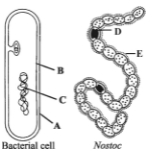
Refer to the given figures of a bacterial cell and Nostoc and choose the option which shows the correct labels for the structures marked as $A$,$B$,$C$,$D$,and $E$.
A
$A$ - Cell wall,$B$ - Cell membrane,$C$ - $DNA$,$D$ - Heterocyst,$E$ - Mucilaginous sheath
B
$A$ - Cell wall,$B$ - Cell membrane,$C$ - Heterocyst,$D$ - $DNA$,$E$ - Mucilaginous sheath
C
$A$ - Cell wall,$B$ - Cell membrane,$C$ - Mucilaginous sheath,$D$ - Heterocyst,$E$ - $DNA$
D
$A$ - Cell membrane,$B$ - Cell wall,$C$ - $DNA$,$D$ - Heterocyst,$E$ - Mucilaginous sheath
Solution
(A) Based on the provided diagrams:
$A$ points to the outermost layer of the bacterial cell,which is the cell wall.
$B$ points to the layer just inside the cell wall,which is the cell membrane.
$C$ points to the genetic material located in the center of the bacterial cell,which is $DNA$.
$D$ points to the specialized nitrogen-fixing cell found in the Nostoc filament,known as a heterocyst.
$E$ points to the outer gelatinous layer surrounding the Nostoc filament,known as the mucilaginous sheath.
Therefore,the correct sequence is $A$ - Cell wall,$B$ - Cell membrane,$C$ - $DNA$,$D$ - Heterocyst,$E$ - Mucilaginous sheath.
$A$ points to the outermost layer of the bacterial cell,which is the cell wall.
$B$ points to the layer just inside the cell wall,which is the cell membrane.
$C$ points to the genetic material located in the center of the bacterial cell,which is $DNA$.
$D$ points to the specialized nitrogen-fixing cell found in the Nostoc filament,known as a heterocyst.
$E$ points to the outer gelatinous layer surrounding the Nostoc filament,known as the mucilaginous sheath.
Therefore,the correct sequence is $A$ - Cell wall,$B$ - Cell membrane,$C$ - $DNA$,$D$ - Heterocyst,$E$ - Mucilaginous sheath.
0 likes
View Solution528
MediumMCQ
Choose the correct names of the different bacteria given below according to their shapes.
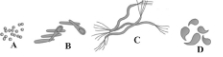
A
$A$ - Cocci,$B$ - Bacilli,$C$ - Spirilla,$D$ - Vibrio
B
$A$ - Bacilli,$B$ - Cocci,$C$ - Spirilla,$D$ - Vibrio
C
$A$ - Spirilla,$B$ - Bacilli,$C$ - Cocci,$D$ - Vibrio
D
$A$ - Spirilla,$B$ - Vibrio,$C$ - Cocci,$D$ - Bacilli
Solution
(A) - Cocci (spherical),
$B$ - Bacilli (rod-shaped),
$C$ - Spirilla (spiral),
$D$ - Vibrio (comma-shaped).
These are the four basic shapes of bacteria.
$B$ - Bacilli (rod-shaped),
$C$ - Spirilla (spiral),
$D$ - Vibrio (comma-shaped).
These are the four basic shapes of bacteria.
0 likes
View Solution529
MediumMCQ
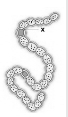
The given figure shows the structure of filamentous blue-green algae,Nostoc,with a structure marked as $X$. Select the option which shows the correct identification of $X$ with its feature.
A
Spores - Reproduction
B
Heterocysts - Nitrogen fixation
C
Pellicle - Recycling of nutrition
D
Mucilaginous sheath - Photosynthesis
Solution
(B) The structure marked as $X$ in the filamentous blue-green alga Nostoc is a heterocyst.
Heterocysts are specialized,pale-yellow,thick-walled cells found in some cyanobacteria.
They are the sites of nitrogen fixation,where the enzyme nitrogenase functions in an anaerobic environment to convert atmospheric nitrogen into ammonia,which is essential for the organism's growth.
Heterocysts are specialized,pale-yellow,thick-walled cells found in some cyanobacteria.
They are the sites of nitrogen fixation,where the enzyme nitrogenase functions in an anaerobic environment to convert atmospheric nitrogen into ammonia,which is essential for the organism's growth.
0 likes
View Solution530
MediumMCQ
Organisms of which of the following kingdom do not have a nuclear membrane?
A
Protista
B
Fungi
C
Monera
D
Plantae
Solution
(C) Monera is the group of prokaryotes.
They are basically unicellular,and may be mycelial,colonial,or filamentous.
They do not contain any organized nucleus with a distinct nuclear membrane.
They are basically unicellular,and may be mycelial,colonial,or filamentous.
They do not contain any organized nucleus with a distinct nuclear membrane.
0 likes
View Solution531
MediumMCQ
Which of the following pigments is present in cyanobacteria?
A
Chlorophyll $a$
B
Chlorophyll $b$
C
Chlorophyll $c$
D
Chlorophyll $d$
Solution
(A) Cyanobacteria,also known as blue-green algae,are the largest and most diverse group of photosynthetic bacteria.
They contain chlorophyll $a$,which is similar to that found in green plants.
They are considered the first organisms to have performed oxygenic photosynthesis,thereby making the atmosphere aerobic.
They contain chlorophyll $a$,which is similar to that found in green plants.
They are considered the first organisms to have performed oxygenic photosynthesis,thereby making the atmosphere aerobic.
0 likes
View Solution532
MediumMCQ
Which of the following is the smallest living cell and can live without oxygen?
A
Mycoplasma
B
Mycorrhiza
C
Euglena
D
Trypanosoma
Solution
(A) $Mycoplasma$ are the smallest known living cells that completely lack a cell wall and can survive without oxygen.
0 likes
View Solution533
MediumMCQ
The bacteria which oxidize various inorganic substances and use the released energy for the synthesis of food are called . . . . . . .
A
Archaebacteria
B
Heterotrophic bacteria
C
Photosynthetic autotrophic bacteria
D
Chemosynthetic autotrophic bacteria
Solution
(D) Chemosynthetic autotrophic bacteria use the energy obtained by the oxidation of inorganic chemicals for the synthesis of food.
They play a great role in the recycling of nutrients like nitrogen,phosphorus,iron,and sulfur.
They play a great role in the recycling of nutrients like nitrogen,phosphorus,iron,and sulfur.
0 likes
View Solution534
MediumMCQ
Which of the following statements is correct for archaea?
A
Archaea resemble eukaryotes in all respects.
B
Archaea have some novel features that are absent in other prokaryotes and eukaryotes.
C
Archaea completely differ from both prokaryotes and eukaryotes.
D
Archaea completely differ from prokaryotes.
Solution
(B) Archaebacteria are found in the most harsh habitats.
Their cell wall is adapted to tolerate extreme conditions (the wall contains proteins and non-cellulosic polysaccharides).
Cell membranes are characterized by the presence of branched-chain lipids that make them highly resistant to heat and low $pH$.
These unique structural features are not found in other prokaryotes or eukaryotes,making them distinct.
Their cell wall is adapted to tolerate extreme conditions (the wall contains proteins and non-cellulosic polysaccharides).
Cell membranes are characterized by the presence of branched-chain lipids that make them highly resistant to heat and low $pH$.
These unique structural features are not found in other prokaryotes or eukaryotes,making them distinct.
0 likes
View Solution535
MediumMCQ
Which of the following statements is not correct for methanogens?
A
They are archaebacteria.
B
They live in marshy areas.
C
Methane is their preferred carbon source.
D
They are present in the guts of several ruminant animals (cow,buffaloes) and produce biogas $(CH_{4})$ from the dung of these animals.
Solution
(C) Methanogens are a group of archaebacteria that thrive in anaerobic (anoxic) environments such as marshy areas and the rumen of ruminant animals. They produce methane $(CH_{4})$ as a metabolic byproduct during the process of anaerobic respiration. Methane is not their carbon source; rather,they use carbon dioxide $(CO_{2})$ or other simple organic compounds as carbon sources to produce methane. Therefore,the statement that methane is their preferred carbon source is incorrect.
0 likes
View Solution536
MediumMCQ
Which of the following statements is correct for both blue-green algae and bacteria?
A
Both show anaerobic respiration.
B
Both have chlorophyll pigment.
C
Both are devoid of true nucleus.
D
None of the above
Solution
(C) Both blue-green algae (cyanobacteria) and bacteria are classified under the kingdom $Monera$.
They are prokaryotic organisms,which means they lack a membrane-bound true nucleus and other membrane-bound organelles.
Blue-green algae contain chlorophyll $a$ for photosynthesis,whereas most bacteria are devoid of chlorophyll.
Therefore,the common characteristic between them is the absence of a true nucleus.
They are prokaryotic organisms,which means they lack a membrane-bound true nucleus and other membrane-bound organelles.
Blue-green algae contain chlorophyll $a$ for photosynthesis,whereas most bacteria are devoid of chlorophyll.
Therefore,the common characteristic between them is the absence of a true nucleus.
1 likes
View Solution537
MediumMCQ
Which of the following statement$(s)$ is/are correct for bacteria?
A
They are members of the kingdom Monera.
B
They live in extreme habitats such as hot springs,deserts,snow,and deep oceans.
C
They show the most extensive metabolic diversity.
D
All of the above.
Solution
(D) Bacteria are the sole members of the kingdom Monera. They are the most abundant microorganisms and occur almost everywhere. They exhibit the most extensive metabolic diversity,meaning they can be autotrophic (photosynthetic or chemosynthetic) or heterotrophic (saprophytic or parasitic). Furthermore,they are found in extreme habitats such as hot springs,deserts,snow,and deep oceans where very few other life forms can survive. Therefore,all the given statements are correct.
0 likes
View Solution538
MediumMCQ
Choose the correct statements $(i - iv)$ regarding mycoplasma:
$(i)$ Mycoplasma has no cell wall.
$(ii)$ Mycoplasma is the smallest living organism known.
$(iii)$ Mycoplasma cannot survive without $O_2$.
$(iv)$ Mycoplasma are pathogenic in animals and plants.
$(i)$ Mycoplasma has no cell wall.
$(ii)$ Mycoplasma is the smallest living organism known.
$(iii)$ Mycoplasma cannot survive without $O_2$.
$(iv)$ Mycoplasma are pathogenic in animals and plants.
A
$(ii), (iii) \text{ and } (iv)$
B
$(i), (iii) \text{ and } (iv)$
C
$(i), (ii) \text{ and } (iii)$
D
$(i), (ii) \text{ and } (iv)$
Solution
(D) Mycoplasma is a genus of bacteria that lacks a cell wall around its cell membrane.
Statement $(i)$ is correct because they are pleomorphic due to the absence of a cell wall.
Statement $(ii)$ is correct as they are known to be the smallest living cells.
Statement $(iii)$ is incorrect because Mycoplasma are facultative anaerobes; they can survive without $O_2$.
Statement $(iv)$ is correct as many species of Mycoplasma are pathogenic to both animals and plants.
Therefore,statements $(i), (ii),$ and $(iv)$ are correct.
Statement $(i)$ is correct because they are pleomorphic due to the absence of a cell wall.
Statement $(ii)$ is correct as they are known to be the smallest living cells.
Statement $(iii)$ is incorrect because Mycoplasma are facultative anaerobes; they can survive without $O_2$.
Statement $(iv)$ is correct as many species of Mycoplasma are pathogenic to both animals and plants.
Therefore,statements $(i), (ii),$ and $(iv)$ are correct.
0 likes
View Solution539
MediumMCQ
The given characters are seen in which of the following group?
$(i)$ Unicellular,colonial,filamentous,symbiotic or free living.
$(ii)$ The colonies are surrounded by a gelatinous sheath.
$(iii)$ Some can fix atmospheric nitrogen in specialized cells called heterocysts.
$(iv)$ They often form blooms in water bodies.
$(i)$ Unicellular,colonial,filamentous,symbiotic or free living.
$(ii)$ The colonies are surrounded by a gelatinous sheath.
$(iii)$ Some can fix atmospheric nitrogen in specialized cells called heterocysts.
$(iv)$ They often form blooms in water bodies.
A
Archaebacteria
B
Cyanobacteria
C
Chrysophytes
D
Dinoflagellates
Solution
(B) The characteristics described belong to $Cyanobacteria$ (also known as blue-green algae).
$1$. $Cyanobacteria$ are photosynthetic prokaryotes that can be unicellular,colonial,or filamentous.
$2$. Their colonies are typically surrounded by a gelatinous sheath.
$3$. They possess specialized cells called $heterocysts$ that are capable of fixing atmospheric nitrogen.
$4$. They often form blooms in polluted water bodies due to nutrient enrichment.
$1$. $Cyanobacteria$ are photosynthetic prokaryotes that can be unicellular,colonial,or filamentous.
$2$. Their colonies are typically surrounded by a gelatinous sheath.
$3$. They possess specialized cells called $heterocysts$ that are capable of fixing atmospheric nitrogen.
$4$. They often form blooms in polluted water bodies due to nutrient enrichment.
0 likes
View Solution540
EasyMCQ
In members of which kingdom,nuclear membrane is absent?
A
Monera
B
Protista
C
Fungi
D
Plantae
Solution
(A) The nuclear membrane is absent in prokaryotic organisms.
According to the $5$-kingdom classification system,all prokaryotes are placed in the kingdom $Monera$.
In contrast,members of kingdoms $Protista$,$Fungi$,$Plantae$,and $Animalia$ are eukaryotes,which possess a well-defined nucleus enclosed by a nuclear membrane.
According to the $5$-kingdom classification system,all prokaryotes are placed in the kingdom $Monera$.
In contrast,members of kingdoms $Protista$,$Fungi$,$Plantae$,and $Animalia$ are eukaryotes,which possess a well-defined nucleus enclosed by a nuclear membrane.
0 likes
View Solution541
MediumMCQ
In the five-kingdom classification,the kingdom that includes blue-green algae,nitrogen-fixing bacteria,and methanogenic archaebacteria is:
A
Monera
B
Protista
C
Fungi
D
Plantae
Solution
(A) The five-kingdom classification system,proposed by $R.H. Whittaker$,classifies organisms based on cell structure,body organization,mode of nutrition,and reproduction.
$1$. Blue-green algae (cyanobacteria) are photosynthetic prokaryotes.
$2$. Nitrogen-fixing bacteria (e.g.,$Rhizobium$,$Azotobacter$) are prokaryotic organisms.
$3$. Methanogenic archaebacteria are prokaryotic organisms that live in extreme environments.
Since all these organisms are prokaryotic and unicellular,they are placed in the Kingdom $Monera$.
$1$. Blue-green algae (cyanobacteria) are photosynthetic prokaryotes.
$2$. Nitrogen-fixing bacteria (e.g.,$Rhizobium$,$Azotobacter$) are prokaryotic organisms.
$3$. Methanogenic archaebacteria are prokaryotic organisms that live in extreme environments.
Since all these organisms are prokaryotic and unicellular,they are placed in the Kingdom $Monera$.
0 likes
View Solution542
MediumMCQ
Match the following:
| Column-$I$ (Group of bacteria) | Column-$II$ (Their shape) |
| $a.$ Coccus | $(i)$ Rod-shaped |
| $b.$ Bacillus | $(ii)$ Spherical |
| $c.$ Spirillum | $(iii)$ Spiral |
| $d.$ Vibrio | $(iv)$ Comma-shaped |
A
$a-(i), b-(ii), c-(iii), d-(iv)$
B
$a-(ii), b-(i), c-(iii), d-(iv)$
C
$a-(i), b-(ii), c-(iv), d-(iii)$
D
$a-(ii), b-(i), c-(iv), d-(iii)$
Solution
(B) The shapes of bacteria are classified as follows:
$1.$ Coccus: These are spherical or oval-shaped bacteria.
$2.$ Bacillus: These are rod-shaped bacteria.
$3.$ Spirillum: These are spiral-shaped bacteria.
$4.$ Vibrio: These are comma-shaped bacteria.
Therefore, the correct matching is: $a-(ii), b-(i), c-(iii), d-(iv)$.
$1.$ Coccus: These are spherical or oval-shaped bacteria.
$2.$ Bacillus: These are rod-shaped bacteria.
$3.$ Spirillum: These are spiral-shaped bacteria.
$4.$ Vibrio: These are comma-shaped bacteria.
Therefore, the correct matching is: $a-(ii), b-(i), c-(iii), d-(iv)$.
0 likes
View Solution543
MediumMCQ
During favourable conditions,bacteria mainly reproduce by:
A
Budding
B
Fragmentation
C
Sporulation
D
Fission
Solution
(D) Under favourable conditions,bacteria primarily reproduce through a process called binary fission.
In this process,the bacterial cell replicates its genetic material and then divides into two identical daughter cells.
This is the most common and rapid method of reproduction in bacteria.
In this process,the bacterial cell replicates its genetic material and then divides into two identical daughter cells.
This is the most common and rapid method of reproduction in bacteria.
0 likes
View Solution544
EasyMCQ
Select the incorrect statement.
A
Nostoc and Anabaena have heterocysts for nitrogen fixation.
B
Cyanobacteria often form blooms in polluted water bodies.
C
Heterotrophic bacteria are more abundant in nature.
D
The cell wall of Mycoplasma are made up of chitin.
Solution
(D) Mycoplasma are organisms that completely lack a cell wall. Therefore,the statement that their cell wall is made of chitin is incorrect.
0 likes
View Solution545
EasyMCQ
Heterocysts present in $Anabaena$ are specialised for:
A
Nitrogen fixation
B
Food storage
C
Fission
D
Sexual reproduction
Solution
(A) Heterocysts are specialized,thick-walled cells found in certain filamentous cyanobacteria like $Anabaena$. These cells provide an anaerobic environment necessary for the enzyme nitrogenase to function,which is responsible for nitrogen fixation. Therefore,heterocysts are specialized for nitrogen fixation.
0 likes
View Solution546
MediumMCQ
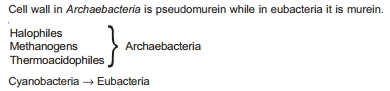
Mark the odd one $w.r.t.$ cell wall.
A
Halophiles
B
Methanogens
C
Thermoacidophiles
D
Cyanobacteria
Solution
(D) The cell wall of $Archaebacteria$ (which includes Halophiles,Methanogens,and Thermoacidophiles) lacks peptidoglycan (murein) and is composed of pseudomurein or other proteins/polysaccharides.
In contrast,$Cyanobacteria$ are $Eubacteria$ (true bacteria),and their cell wall is composed of peptidoglycan (murein).
Therefore,$Cyanobacteria$ is the odd one out.
In contrast,$Cyanobacteria$ are $Eubacteria$ (true bacteria),and their cell wall is composed of peptidoglycan (murein).
Therefore,$Cyanobacteria$ is the odd one out.
0 likes
View Solution547
EasyMCQ
Primitive bacteria living in salty areas are called as
A
Methanogens
B
Thermoacidophiles
C
Halophiles
D
Heliophytes
Solution
(C) Archaebacteria are a group of primitive bacteria that can survive in extreme environmental conditions.
Those that live in extremely salty areas are known as $Halophiles$.
$Methanogens$ are found in marshy areas,and $Thermoacidophiles$ are found in hot springs.
Those that live in extremely salty areas are known as $Halophiles$.
$Methanogens$ are found in marshy areas,and $Thermoacidophiles$ are found in hot springs.
0 likes
View Solution548
MediumMCQ
Bacteria are considered primitive organisms because they
A
Possess an incipient nucleus
B
Are small,microscopic plants,which are not seen by the naked eyes
C
Cause serious diseases to human beings,domesticated animals,and crop plants
D
Produce endospores which are very resistant to adverse conditions
Solution
(A) Bacteria are classified as primitive organisms because they are prokaryotic in nature.
Prokaryotes lack a well-defined membrane-bound nucleus.
Instead,they possess an incipient nucleus,also known as a nucleoid,where the genetic material $(DNA)$ is present in the cytoplasm without a nuclear envelope.
Prokaryotes lack a well-defined membrane-bound nucleus.
Instead,they possess an incipient nucleus,also known as a nucleoid,where the genetic material $(DNA)$ is present in the cytoplasm without a nuclear envelope.
0 likes
View Solution549
MediumMCQ
There is no alternation of generation in $Escherichia$ $coli$ because of the absence of
A
Syngamy
B
Reduction division
C
Conjugation
D
Both $(a)$ and $(b)$
Solution
(D) Alternation of generation involves the regular cycle between a haploid phase and a diploid phase, which requires syngamy (fertilization) to form a diploid state and reduction division (meiosis) to return to a haploid state.
$Escherichia$ $coli$ is a prokaryote that reproduces primarily by binary fission.
It lacks true sexual reproduction involving syngamy and meiosis (reduction division).
Therefore, because both syngamy and reduction division are absent, there is no alternation of generation.
$Escherichia$ $coli$ is a prokaryote that reproduces primarily by binary fission.
It lacks true sexual reproduction involving syngamy and meiosis (reduction division).
Therefore, because both syngamy and reduction division are absent, there is no alternation of generation.
0 likes
View Solution550
EasyMCQ
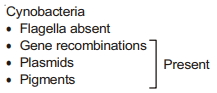
Cyanobacteria do not possess
A
Gene recombinations
B
Flagella
C
Plasmids
D
Pigments
Solution
(B) Cyanobacteria,also known as blue-green algae,are photosynthetic prokaryotes.
They lack motile structures such as flagella at all stages of their life cycle.
However,they do possess gene recombinations,plasmids,and various photosynthetic pigments (like chlorophyll $a$,phycocyanin,etc.) which are essential for their survival and metabolic activities.
Therefore,the correct answer is flagella.
They lack motile structures such as flagella at all stages of their life cycle.
However,they do possess gene recombinations,plasmids,and various photosynthetic pigments (like chlorophyll $a$,phycocyanin,etc.) which are essential for their survival and metabolic activities.
Therefore,the correct answer is flagella.
0 likes
View SolutionBiological Classification — Monera (Prokaryotes) · Frequently Asked Questions
1Are these Biological Classification questions useful for JEE and NEET?
Yes. All questions in this section are mapped to JEE Main and NEET exam patterns. Previous year questions from JEE Main, NEET, GUJCET and state-level exams are included with full solutions.
2Can I switch to Hindi or Gujarati for these questions?
Yes. Use the language tabs in the hero section or the sidebar to view the same questions and solutions in English, Hindi or Gujarati.
3How do I generate a question paper from this subtopic?
Use the Vedclass Exam Paper Generator — select the chapter and subtopic, set difficulty, and generate Sets A, B, C, D automatically. First 3 chapters of every subject are free.
Vedclass Products
For Students
Vedclass Test Series
Mock tests in real JEE/NEET style with performance analysis. 5-day free trial.
Start Free TrialFor Teachers
Exam Paper Generator
Generate Set A/B/C/D papers from this chapter in 2 minutes. 3 chapters free.
Try FreeFor Institutes
Online Exam Module
Live online exams with unlimited students, 360° analytics & white-label branding.
See DemoFor Teachers & Institutes
Generate a Biological Classification Exam Paper in 2 Minutes
Select subtopic & difficulty — Sets A, B, C, D auto-generated with No Repeat logic.
First 3 chapters of every subject are free — no payment required.