
A English
Monera (Prokaryotes) Questions in English
Class 11 Biology · Biological Classification · Monera (Prokaryotes)
632+
Questions
English
Language
100%
With Solutions
Showing 50 of 632 questions in English
401
EasyMCQ
Organisms that can survive in high temperatures and thrive in highly acidic $(pH \approx 2)$ habitats belong to which group?
A
Archaebacteria
B
Cyanobacteria and Diatoms
C
Protista and Mosses
D
Chlorophyta and Yeasts
Solution
(A) The organisms that thrive in extreme environmental conditions,such as high temperatures and highly acidic $(pH \approx 2)$ environments,are known as thermoacidophiles.
These organisms belong to the group Archaebacteria.
Archaebacteria are unique because they possess a different cell wall structure compared to other bacteria,which allows them to survive in extreme conditions like hot springs and hydrothermal vents.
These organisms belong to the group Archaebacteria.
Archaebacteria are unique because they possess a different cell wall structure compared to other bacteria,which allows them to survive in extreme conditions like hot springs and hydrothermal vents.
0 likes
View Solution402
EasyMCQ
The body organization of blue-green algae differs from other algae because...
A
Blue-green algae have different photosynthetic pigments.
B
Blue-green algae lack tissue organization.
C
Blue-green algae are found only in multicellular forms.
D
Blue-green algae are prokaryotic.
Solution
(D) Blue-green algae,also known as $Cyanobacteria$,are classified under the Kingdom $Monera$ because they are prokaryotic organisms.
Unlike other algae (such as green,brown,or red algae),which are eukaryotic and belong to the Kingdom $Protista$ (or $Plantae$ in older systems),blue-green algae lack a membrane-bound nucleus and other membrane-bound organelles.
Therefore,their body organization is fundamentally different due to their prokaryotic nature.
Unlike other algae (such as green,brown,or red algae),which are eukaryotic and belong to the Kingdom $Protista$ (or $Plantae$ in older systems),blue-green algae lack a membrane-bound nucleus and other membrane-bound organelles.
Therefore,their body organization is fundamentally different due to their prokaryotic nature.
0 likes
View Solution403
EasyMCQ
In which kingdom did Whittaker classify non-nucleated organisms?
A
Monera
B
Protista
C
Fungi
D
Plantae
Solution
(A) $R$.$H$. Whittaker proposed the $5$-kingdom classification system.
Non-nucleated organisms are prokaryotic in nature,meaning they lack a well-defined nucleus and membrane-bound organelles.
According to Whittaker's classification,all prokaryotic organisms are placed in the kingdom $Monera$.
Therefore,the correct option is $A$.
Non-nucleated organisms are prokaryotic in nature,meaning they lack a well-defined nucleus and membrane-bound organelles.
According to Whittaker's classification,all prokaryotic organisms are placed in the kingdom $Monera$.
Therefore,the correct option is $A$.
0 likes
View Solution404
EasyMCQ
Which of the following is responsible for the production of methane?
A
Halophiles
B
Methanogens
C
Spirochetes
D
Thermoacidophiles
Solution
(B) Methanogens are a group of archaebacteria that belong to the domain $Archaea$.
They are strictly anaerobic organisms.
These bacteria are found in marshy areas and in the gut of several ruminant animals such as cows and buffaloes.
They are responsible for the production of methane (biogas) from the dung of these animals.
Therefore,the correct option is $B$.
They are strictly anaerobic organisms.
These bacteria are found in marshy areas and in the gut of several ruminant animals such as cows and buffaloes.
They are responsible for the production of methane (biogas) from the dung of these animals.
Therefore,the correct option is $B$.
0 likes
View Solution405
MediumMCQ
Which of the following statements is correct?
A
The Eukarya domain includes many well-known pathogenic organisms.
B
Archaebacteria lack a cell wall.
C
The cell wall of Eubacteria is not made of peptidoglycan.
D
Thermoacidophiles can survive in acidic and high-temperature environments.
Solution
(D) $1$. The Eukarya domain includes plants,animals,fungi,and protists. While some protists are pathogenic,it is not the defining characteristic of the entire domain.
$2$. Archaebacteria possess a cell wall,but it lacks peptidoglycan,which distinguishes them from Eubacteria.
$3$. Eubacteria (true bacteria) have a cell wall composed of peptidoglycan.
$4$. Thermoacidophiles are a group of Archaebacteria that thrive in extremely acidic environments and high temperatures,making statement $D$ correct.
$2$. Archaebacteria possess a cell wall,but it lacks peptidoglycan,which distinguishes them from Eubacteria.
$3$. Eubacteria (true bacteria) have a cell wall composed of peptidoglycan.
$4$. Thermoacidophiles are a group of Archaebacteria that thrive in extremely acidic environments and high temperatures,making statement $D$ correct.
0 likes
View Solution406
MediumMCQ
Match Column-$I$ with Column-$II$ and select the correct option.
| Column-$I$ | Column-$II$ |
| $(A)$ Halophiles | $(p)$ Gram-positive bacteria |
| $(B)$ Firmicutes | $(q)$ Hot springs habitat |
| $(C)$ Methanogens | $(r)$ Gram-negative bacteria |
| $(D)$ Spirochetes | $(s)$ Photosynthetic bacteria |
| $(E)$ Thermoacidophiles | $(t)$ Extremely salty areas habitat |
| $(u)$ Responsible for biogas production |
A
$(A-u), (B-r), (C-t), (D-p), (E-q)$
B
$(A-q), (B-r), (C-u), (D-p), (E-t)$
C
$(A-t), (B-p), (C-u), (D-r), (E-q)$
D
$(A-u), (B-p), (C-t), (D-q), (E-r)$
Solution
$(C)$ The correct matches are as follows:
$(A)$ Halophiles: These are archaebacteria found in extremely salty areas, so $(A-t)$.
$(B)$ Firmicutes: These are a phylum of bacteria that are typically Gram-positive, so $(B-p)$.
$(C)$ Methanogens: These are archaebacteria responsible for the production of methane (biogas) in anaerobic conditions, so $(C-u)$.
$(D)$ Spirochetes: These are a phylum of Gram-negative bacteria with a unique helical shape, so $(D-r)$.
$(E)$ Thermoacidophiles: These are archaebacteria that thrive in hot springs and acidic environments, so $(E-q)$.
Therefore, the correct sequence is $(A-t), (B-p), (C-u), (D-r), (E-q)$.
$(A)$ Halophiles: These are archaebacteria found in extremely salty areas, so $(A-t)$.
$(B)$ Firmicutes: These are a phylum of bacteria that are typically Gram-positive, so $(B-p)$.
$(C)$ Methanogens: These are archaebacteria responsible for the production of methane (biogas) in anaerobic conditions, so $(C-u)$.
$(D)$ Spirochetes: These are a phylum of Gram-negative bacteria with a unique helical shape, so $(D-r)$.
$(E)$ Thermoacidophiles: These are archaebacteria that thrive in hot springs and acidic environments, so $(E-q)$.
Therefore, the correct sequence is $(A-t), (B-p), (C-u), (D-r), (E-q)$.
0 likes
View Solution407
MediumMCQ
Match the following columns:
| Column-$I$ | Column-$II$ |
| $A$. Halophiles | $i$. Gram-negative bacteria |
| $B$. Thermoacidophiles | $ii$. Extremely salty areas |
| $C$. Spirochetes | $iii$. Responsible for methane production |
| $D$. Firmicutes | $iv$. Acidic and high temperature environments |
| $v$. Gram-positive bacteria |
A
$A-i, B-ii, C-iii, D-iv$
B
$A-v, B-iv, C-iii, D-ii$
C
$A-ii, B-iv, C-i, D-v$
D
$A-ii, B-iv, C-iii, D-v$
Solution
(C) The correct matches are as follows:
$A$. Halophiles are specialized archaebacteria found in extremely salty areas $(ii)$.
$B$. Thermoacidophiles are archaebacteria that thrive in acidic and high-temperature environments $(iv)$.
$C$. Spirochetes are a phylum of Gram-negative bacteria $(i)$.
$D$. Firmicutes are a phylum of bacteria that are typically Gram-positive $(v)$.
Therefore, the correct matching is $A-ii, B-iv, C-i, D-v$.
$A$. Halophiles are specialized archaebacteria found in extremely salty areas $(ii)$.
$B$. Thermoacidophiles are archaebacteria that thrive in acidic and high-temperature environments $(iv)$.
$C$. Spirochetes are a phylum of Gram-negative bacteria $(i)$.
$D$. Firmicutes are a phylum of bacteria that are typically Gram-positive $(v)$.
Therefore, the correct matching is $A-ii, B-iv, C-i, D-v$.
0 likes
View Solution408
EasyMCQ
To which kingdom does the organism shown in the given figure belong?

A
Protista
B
Monera
C
Fungi
D
Plantae
Solution
(B) The figure shows a filamentous cyanobacterium (blue-green alga),specifically $Nostoc$.
Cyanobacteria are prokaryotic organisms that perform oxygenic photosynthesis.
According to the five-kingdom classification system,all prokaryotic organisms are placed under the kingdom $Monera$.
Therefore,the correct option is $B$.
Cyanobacteria are prokaryotic organisms that perform oxygenic photosynthesis.
According to the five-kingdom classification system,all prokaryotic organisms are placed under the kingdom $Monera$.
Therefore,the correct option is $B$.
0 likes
View Solution409
EasyMCQ
Which are the first living forms?
A
Monera
B
Protista
C
Eukaryota
D
Protozoa
Solution
(A) The first living forms on Earth are considered to be the prokaryotic organisms,which are classified under the kingdom $Monera$. These organisms were simple,unicellular,and lacked a well-defined nucleus,appearing approximately $3.5$ to $3.8$ billion years ago. Therefore,$Monera$ represents the earliest life forms.
0 likes
View Solution410
EasyMCQ
Which microorganisms are included in the Kingdom $Monera$?
A
$Anabaena$
B
$Amoeba$
C
$Bacteria$
D
Both $(A)$ and $(C)$
Solution
(D) The Kingdom $Monera$ consists of prokaryotic organisms.
$Bacteria$ are the sole members of the Kingdom $Monera$.
$Anabaena$ is a type of cyanobacteria (blue-green algae),which is also a prokaryote and thus belongs to the Kingdom $Monera$.
$Amoeba$ is a unicellular eukaryotic organism belonging to the Kingdom $Protista$.
Therefore,both $Anabaena$ and $Bacteria$ are included in the Kingdom $Monera$.
$Bacteria$ are the sole members of the Kingdom $Monera$.
$Anabaena$ is a type of cyanobacteria (blue-green algae),which is also a prokaryote and thus belongs to the Kingdom $Monera$.
$Amoeba$ is a unicellular eukaryotic organism belonging to the Kingdom $Protista$.
Therefore,both $Anabaena$ and $Bacteria$ are included in the Kingdom $Monera$.
0 likes
View Solution411
EasyMCQ
The cell wall of halophilic bacteria is $NOT$ made up of which of the following?
A
Cellulose
B
Glycocalyx
C
Peptidoglycan
D
Chitin
Solution
(C) Halophilic bacteria belong to the domain $Archaea$.
Unlike true bacteria $(Eubacteria)$,the cell walls of $Archaea$ do not contain $Peptidoglycan$.
Instead,they are composed of proteins,complex polysaccharides,or pseudomurein.
However,the options provided include $Cellulose$,$Glycocalyx$,$Peptidoglycan$,and $Chitin$.
In the context of typical biological classification questions regarding $Archaea$,they lack $Peptidoglycan$ (which is characteristic of $Eubacteria$).
However,$Cellulose$ and $Chitin$ are also absent in prokaryotic cell walls.
Given the standard curriculum focus,$Peptidoglycan$ is the specific component that distinguishes $Archaea$ from $Eubacteria$ in terms of cell wall composition.
Therefore,$Peptidoglycan$ is the correct answer as it is absent in $Archaea$.
Unlike true bacteria $(Eubacteria)$,the cell walls of $Archaea$ do not contain $Peptidoglycan$.
Instead,they are composed of proteins,complex polysaccharides,or pseudomurein.
However,the options provided include $Cellulose$,$Glycocalyx$,$Peptidoglycan$,and $Chitin$.
In the context of typical biological classification questions regarding $Archaea$,they lack $Peptidoglycan$ (which is characteristic of $Eubacteria$).
However,$Cellulose$ and $Chitin$ are also absent in prokaryotic cell walls.
Given the standard curriculum focus,$Peptidoglycan$ is the specific component that distinguishes $Archaea$ from $Eubacteria$ in terms of cell wall composition.
Therefore,$Peptidoglycan$ is the correct answer as it is absent in $Archaea$.
0 likes
View Solution412
MediumMCQ
Identify the organism shown in the figure and select the correct option regarding its classification.
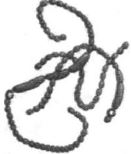
A
Anabaena - Blue-green algae - Kingdom Monera
B
Spirogyra - Algae - Kingdom Protista
C
Euglena - Autotroph - Kingdom Monera
D
Anabaena - Autotroph - Kingdom Protista
Solution
(A) The figure shows a filamentous structure with specialized cells called heterocysts,which is characteristic of the cyanobacterium Anabaena.
Cyanobacteria (also known as blue-green algae) are photosynthetic prokaryotes.
According to the five-kingdom classification system,all prokaryotic organisms are placed in the Kingdom Monera.
Therefore,Anabaena is a blue-green alga belonging to the Kingdom Monera.
Cyanobacteria (also known as blue-green algae) are photosynthetic prokaryotes.
According to the five-kingdom classification system,all prokaryotic organisms are placed in the Kingdom Monera.
Therefore,Anabaena is a blue-green alga belonging to the Kingdom Monera.
0 likes
View Solution413
MediumMCQ
Which kingdom is included in the five-kingdom classification system?
A
Monera
B
Eukarya
C
Archaea
D
Bacteria
Solution
(A) The five-kingdom classification system was proposed by $R.H. Whittaker$ in $1969$.
The five kingdoms included in this system are:
$1$. Kingdom $Monera$
$2$. Kingdom $Protista$
$3$. Kingdom $Fungi$
$4$. Kingdom $Plantae$
$5$. Kingdom $Animalia$
Among the given options,$Monera$ is one of the five kingdoms.
The five kingdoms included in this system are:
$1$. Kingdom $Monera$
$2$. Kingdom $Protista$
$3$. Kingdom $Fungi$
$4$. Kingdom $Plantae$
$5$. Kingdom $Animalia$
Among the given options,$Monera$ is one of the five kingdoms.
0 likes
View Solution414
EasyMCQ
Which kingdom consists of organisms that possess a nucleoid?
A
Monera
B
Protista
C
Plantae
D
Fungi
Solution
(A) nucleoid is a region within a prokaryotic cell that contains all or most of the genetic material.
Since organisms in the kingdom Monera are prokaryotic (e.g.,bacteria),they possess a nucleoid instead of a membrane-bound nucleus.
Kingdoms Protista,Plantae,and Fungi consist of eukaryotic organisms,which possess a well-defined membrane-bound nucleus.
Since organisms in the kingdom Monera are prokaryotic (e.g.,bacteria),they possess a nucleoid instead of a membrane-bound nucleus.
Kingdoms Protista,Plantae,and Fungi consist of eukaryotic organisms,which possess a well-defined membrane-bound nucleus.
0 likes
View Solution415
MediumMCQ
Select the correct option for the following matches:
| $(1)$ Gram-positive bacteria | $(a)$ Thermoacidophiles |
| $(2)$ Bacteria living in acidic medium | $(b)$ Firmicutes |
| $(3)$ Gram-negative bacteria | $(c)$ Halophiles |
| $(4)$ Bacteria living in extreme salty conditions | $(d)$ Spirochetes |
A
$(1-d), (2-c), (3-b), (4-a)$
B
$(1-a), (2-c), (3-b), (4-d)$
C
$(1-c), (2-d), (3-a), (4-b)$
D
$(1-b), (2-a), (3-d), (4-c)$
Solution
(D) The correct matches are as follows:
$(1)$ Gram-positive bacteria are classified under the phylum Firmicutes. Thus, $(1-b)$.
$(2)$ Thermoacidophiles are archaea that thrive in extremely acidic and high-temperature environments. Thus, $(2-a)$.
$(3)$ Spirochetes are a group of Gram-negative bacteria with a unique helical morphology. Thus, $(3-d)$.
$(4)$ Halophiles are organisms that thrive in high salt concentrations. Thus, $(4-c)$.
Therefore, the correct sequence is $(1-b), (2-a), (3-d), (4-c)$.
$(1)$ Gram-positive bacteria are classified under the phylum Firmicutes. Thus, $(1-b)$.
$(2)$ Thermoacidophiles are archaea that thrive in extremely acidic and high-temperature environments. Thus, $(2-a)$.
$(3)$ Spirochetes are a group of Gram-negative bacteria with a unique helical morphology. Thus, $(3-d)$.
$(4)$ Halophiles are organisms that thrive in high salt concentrations. Thus, $(4-c)$.
Therefore, the correct sequence is $(1-b), (2-a), (3-d), (4-c)$.
0 likes
View Solution416
MediumMCQ
Which of the following statements is incorrect?
A
Firmicutes are Gram-positive bacteria.
B
The cell wall of Spirochaetes is made of peptidoglycan.
C
Cyanobacteria are known as blue-green algae.
D
The domain Archaea consists of eukaryotic organisms.
Solution
(D) The domain $Archaea$ consists of prokaryotic organisms,not eukaryotic organisms. They are known for living in extreme environments and possess unique cell wall compositions lacking peptidoglycan. Therefore,statement $D$ is incorrect.
0 likes
View Solution417
MediumMCQ
Which of the following are found in extreme saline conditions?
A
Eubacteria
B
Cyanobacteria
C
Mycobacteria
D
Archaebacteria
Solution
(D) : Halophiles are a specialized group of archaebacteria that are adapted to survive in extreme saline environments,such as salt pans,salt beds,and salt marshes. They possess unique cell wall structures that allow them to thrive in high salt concentrations where other organisms cannot survive.
0 likes
View Solution418
MediumMCQ
Which among the following are the smallest living cells,known without a definite cell wall,pathogenic to plants as well as animals and can survive without oxygen?
A
Pseudomonas
B
Mycoplasma
C
Nostoc
D
Bacillus
Solution
(B) $Mycoplasma$ are the smallest known living cells that lack a definite cell wall.
They are pathogenic to both plants and animals.
These organisms are capable of surviving without oxygen (facultative or obligate anaerobes).
They are pathogenic to both plants and animals.
These organisms are capable of surviving without oxygen (facultative or obligate anaerobes).
0 likes
View Solution419
MediumMCQ
Methanogens belong to
A
eubacteria
B
archaebacteria
C
dinoflagellates
D
slime moulds
Solution
(B) $Methanogens$ belong to $Archaebacteria$.
They include methane-producing genera such as $Methanobacillus$ and $Methanothrix$.
$Methanogens$ are obligate anaerobes found in oxygen-deficient environments,such as marshes,swamps,sludge (formed during sewage treatment),and the digestive systems of ruminants.
Mostly,they obtain their energy by reducing carbon dioxide $(CO_2)$ and oxidising hydrogen $(H_2)$,with the production of methane $(CH_4)$.
They include methane-producing genera such as $Methanobacillus$ and $Methanothrix$.
$Methanogens$ are obligate anaerobes found in oxygen-deficient environments,such as marshes,swamps,sludge (formed during sewage treatment),and the digestive systems of ruminants.
Mostly,they obtain their energy by reducing carbon dioxide $(CO_2)$ and oxidising hydrogen $(H_2)$,with the production of methane $(CH_4)$.
0 likes
View Solution420
MediumMCQ
The structures that help some bacteria to attach to rocks and/or host tissues are
A
mesosomes
B
holdfast
C
rhizoids
D
fimbriae
Solution
(D) : Fimbriae are small bristle-like solid structures arising from the bacterial cell surface.
There are $300-400$ fimbriae per cell.
Their diameter is $3-10 \ nm$ while their length is $0.5-1.5 \ \mu m$.
Fimbriae are involved in attaching bacteria to solid surfaces (e.g.,rocks in a water body) or host tissues (e.g.,the urinary tract in $Neisseria \ gonorrhoeae$).
Some fimbriae cause the agglutination of $RBCs$.
They also help in the mutual clinging of bacteria.
There are $300-400$ fimbriae per cell.
Their diameter is $3-10 \ nm$ while their length is $0.5-1.5 \ \mu m$.
Fimbriae are involved in attaching bacteria to solid surfaces (e.g.,rocks in a water body) or host tissues (e.g.,the urinary tract in $Neisseria \ gonorrhoeae$).
Some fimbriae cause the agglutination of $RBCs$.
They also help in the mutual clinging of bacteria.
1 likes
View Solution421
MediumMCQ
Pick up the wrong statement.
A
Some fungi are edible.
B
Nuclear membrane is present in Monera.
C
Cell wall is absent in Animalia.
D
Protists have photosynthetic and heterotrophic modes of nutrition.
Solution
(B) : Kingdom Monera consists of prokaryotic organisms,which are characterized by the absence of a nuclear envelope around the nucleus and the absence of membrane-bound cell organelles. Therefore,the statement that a nuclear membrane is present in Monera is incorrect.
0 likes
View Solution422
MediumMCQ
Cell wall is absent in
A
Mycoplasma
B
Nostoc
C
Aspergillus
D
Funaria
Solution
(A) : Mycoplasma (Kingdom Monera) are the simplest and smallest free-living prokaryotes that are devoid of a cell wall. The plasma membrane forms the outer boundary of the cell in Mycoplasma.
$B$: Nostoc is a cyanobacterium (Kingdom Monera),in which the cell wall is composed of peptidoglycans.
$C$: Aspergillus is a fungus (Kingdom Fungi),in which the cell wall is mainly made of chitin.
$D$: Funaria is a bryophyte (Kingdom Plantae),in which the cell wall is cellulosic in nature.
Therefore,the correct answer is $A$.
$B$: Nostoc is a cyanobacterium (Kingdom Monera),in which the cell wall is composed of peptidoglycans.
$C$: Aspergillus is a fungus (Kingdom Fungi),in which the cell wall is mainly made of chitin.
$D$: Funaria is a bryophyte (Kingdom Plantae),in which the cell wall is cellulosic in nature.
Therefore,the correct answer is $A$.
0 likes
View Solution423
MediumMCQ
True nucleus is absent in
A
Vaucheria
B
Volvox
C
Anabaena
D
Mucor
Solution
(C) : $Anabaena$ is a prokaryotic organism.
It is a cyanobacterium (blue-green alga) which belongs to Kingdom $Monera$.
Like all other prokaryotes,it lacks a true nucleus and membrane-bound cell organelles.
It is a cyanobacterium (blue-green alga) which belongs to Kingdom $Monera$.
Like all other prokaryotes,it lacks a true nucleus and membrane-bound cell organelles.
0 likes
View Solution424
MediumMCQ
Archaebacteria differ from eubacteria in:
A
cell membrane structure
B
mode of nutrition
C
cell shape
D
mode of reproduction
Solution
(A) : Archaebacteria are the 'ancient' bacteria that include extremophiles like methanogens,halophiles,and thermophiles. They represent some of the most ancient life forms that persist today.
They possess both eubacterial and eukaryotic characters in addition to features unique to them.
Their mode of reproduction,nutrition,and cell shape and size resemble typical eubacteria.
However,their cell walls are made of a variety of polymers and do not contain peptidoglycan,unlike eubacteria.
Furthermore,the lipids of their cytoplasmic membranes are ether-linked,whereas eubacteria contain glycerol ester-linked lipids in their cell membranes.
They possess both eubacterial and eukaryotic characters in addition to features unique to them.
Their mode of reproduction,nutrition,and cell shape and size resemble typical eubacteria.
However,their cell walls are made of a variety of polymers and do not contain peptidoglycan,unlike eubacteria.
Furthermore,the lipids of their cytoplasmic membranes are ether-linked,whereas eubacteria contain glycerol ester-linked lipids in their cell membranes.
0 likes
View Solution425
MediumMCQ
Which of the following are likely to be present in deep sea water?
A
Blue-green algae
B
Saprophytic fungi
C
Archaebacteria
D
Eubacteria
Solution
(C) : Archaebacteria belong to a group of prokaryotic organisms called Kingdom Monera.
These include halophilic bacteria (halophiles),which thrive in extremely salty environments and are found in deep sea water and other hypersaline habitats.
Unlike other bacteria,Archaebacteria possess a unique cell wall structure that allows them to survive in extreme conditions.
These include halophilic bacteria (halophiles),which thrive in extremely salty environments and are found in deep sea water and other hypersaline habitats.
Unlike other bacteria,Archaebacteria possess a unique cell wall structure that allows them to survive in extreme conditions.
0 likes
View Solution426
MediumMCQ
Pigment containing membranous extensions in some cyanobacteria are
A
pneumatophores
B
chromatophores
C
heterocysts
D
basal bodies
Solution
(B) : Chromatophores are pigmented,lamellar,or vesicular structures that can be isolated from disrupted photosynthetic bacteria or cyanobacteria.
Their plasma membrane may project into the cytoplasm as folds,forming lamellae that possess a double unit-membrane structure.
The pigments and most of the enzymes required for light-induced electron transport and phosphorylation processes of photosynthesis are located within these plasma membrane extensions and lamellae.
Their plasma membrane may project into the cytoplasm as folds,forming lamellae that possess a double unit-membrane structure.
The pigments and most of the enzymes required for light-induced electron transport and phosphorylation processes of photosynthesis are located within these plasma membrane extensions and lamellae.
0 likes
View Solution427
MediumMCQ
Why is a capsule advantageous to a bacterium?
A
It protects the bacterium from desiccation.
B
It provides means of locomotion.
C
It allows the bacterium to hide from the host's immune system.
D
It allows the bacterium to attach to the surface.
Solution
(C) The correct answer is $C$.
$S$-type or virulent bacteria possess a capsule.
The capsule is a thick,tough,mucilaginous layer composed of polysaccharides and sometimes amino acids.
It provides protection to the bacterium by preventing phagocytosis,thereby allowing the bacterium to hide from the host's immune system.
$S$-type or virulent bacteria possess a capsule.
The capsule is a thick,tough,mucilaginous layer composed of polysaccharides and sometimes amino acids.
It provides protection to the bacterium by preventing phagocytosis,thereby allowing the bacterium to hide from the host's immune system.
0 likes
View Solution428
MediumMCQ
Maximum nutritional diversity is found in the group
A
fungi
B
animalia
C
monera
D
plantae
Solution
(C) $(C) :$ Although the bacterial structure is very simple,they are very complex in behavior. Compared to many other organisms,bacteria as a group show the most extensive metabolic diversity.
Some bacteria are autotrophic,$i.e.$,they synthesize their own food from inorganic substrates. They may be photosynthetic autotrophic or chemosynthetic autotrophic.
The vast majority of bacteria are heterotrophs,$i.e.$,they do not synthesize their own food but depend on other organisms or on dead organic matter for food.
Some bacteria are autotrophic,$i.e.$,they synthesize their own food from inorganic substrates. They may be photosynthetic autotrophic or chemosynthetic autotrophic.
The vast majority of bacteria are heterotrophs,$i.e.$,they do not synthesize their own food but depend on other organisms or on dead organic matter for food.
0 likes
View Solution429
EasyMCQ
Nuclear membrane is absent in
A
Penicillium
B
Agaricus
C
Volvox
D
Nostoc
Solution
(D) $Penicillium$ and $Agaricus$ are fungi,while $Volvox$ is an alga. All three are eukaryotes and thus possess a membrane-bound nucleus.
$Nostoc$ is a cyanobacterium,i.e.,a prokaryote. Prokaryotes lack a true nucleus,and therefore,the nuclear membrane is absent in $Nostoc$.
$Nostoc$ is a cyanobacterium,i.e.,a prokaryote. Prokaryotes lack a true nucleus,and therefore,the nuclear membrane is absent in $Nostoc$.
0 likes
View Solution430
EasyMCQ
The cyanobacteria are also referred to as
A
protists
B
golden algae
C
slime moulds
D
blue-green algae
Solution
(D) Cyanobacteria are a phylum of bacteria that obtain their energy through photosynthesis.
They are commonly referred to as blue-green algae because of their characteristic blue-green pigmentation.
Although they were historically classified as algae due to their photosynthetic nature,they are prokaryotic organisms and are now classified under the kingdom $Monera$.
They are commonly referred to as blue-green algae because of their characteristic blue-green pigmentation.
Although they were historically classified as algae due to their photosynthetic nature,they are prokaryotic organisms and are now classified under the kingdom $Monera$.
0 likes
View Solution431
MediumMCQ
The most abundant prokaryotes helpful to humans in making curd from milk and in production of antibiotics are the ones categorized as
A
cyanobacteria
B
archaebacteria
C
chemosynthetic autotrophs
D
heterotrophic bacteria
Solution
(D) The correct answer is $D$.
$1$. Heterotrophic bacteria are the most abundant prokaryotes in nature.
$2$. Many heterotrophic bacteria are significantly helpful to humans,such as $Lactobacillus$ (Lactic Acid Bacteria),which is used in the conversion of milk into curd.
$3$. Additionally,many antibiotics are derived from soil-dwelling heterotrophic bacteria,specifically actinomycetes (e.g.,$Streptomyces$),which are saprotrophic in nature.
$1$. Heterotrophic bacteria are the most abundant prokaryotes in nature.
$2$. Many heterotrophic bacteria are significantly helpful to humans,such as $Lactobacillus$ (Lactic Acid Bacteria),which is used in the conversion of milk into curd.
$3$. Additionally,many antibiotics are derived from soil-dwelling heterotrophic bacteria,specifically actinomycetes (e.g.,$Streptomyces$),which are saprotrophic in nature.
0 likes
View Solution432
EasyMCQ
Which one of the following organisms is not an eukaryote?
A
Paramecium caudatum
B
Escherichia coli
C
Euglena viridis
D
Amoeba proteus
Solution
(B) : $Escherichia \ coli$ (bacterium) is not an example of a eukaryotic cell. It is a typical example of a prokaryotic cell,which lacks a membrane-bound nucleus and other membrane-bound organelles.
0 likes
View Solution433
MediumMCQ
Some hyperthermophilic organisms that grow in highly acidic $(pH \ 2)$ habitats belong to the two groups:
A
eubacteria and archaea
B
cyanobacteria and diatoms
C
protists and mosses
D
liverworts and yeasts
Solution
(A) The correct answer is $A$.
$1$. Hyperthermophilic organisms that thrive in extremely acidic environments (such as $pH \ 2$) and high temperatures are primarily classified under the domain $Archaea$,specifically the group known as thermoacidophiles.
$2$. $Archaebacteria$ are known for their unique cell wall structure that allows them to survive in extreme conditions like hot sulphur springs.
$3$. Certain $Eubacteria$ also exhibit remarkable adaptability and can survive in diverse,hostile environments including hot springs and acidic conditions,although they are distinct from $Archaea$ in their biochemical composition.
$1$. Hyperthermophilic organisms that thrive in extremely acidic environments (such as $pH \ 2$) and high temperatures are primarily classified under the domain $Archaea$,specifically the group known as thermoacidophiles.
$2$. $Archaebacteria$ are known for their unique cell wall structure that allows them to survive in extreme conditions like hot sulphur springs.
$3$. Certain $Eubacteria$ also exhibit remarkable adaptability and can survive in diverse,hostile environments including hot springs and acidic conditions,although they are distinct from $Archaea$ in their biochemical composition.
0 likes
View Solution434
MediumMCQ
Membrane-bound organelles are absent in
A
Saccharomyces
B
Streptococcus
C
Chlamydomonas
D
Plasmodium
Solution
(B) $Streptococcus$ is a bacterium included under Kingdom $Monera$.
$Monerans$ possess a prokaryotic cell organization in which membrane-bound organelles like mitochondria,endoplasmic reticulum,Golgi bodies,etc.,are absent.
All the other three,$i.e.$,$Saccharomyces$ (a fungus),$Chlamydomonas$ (an alga),and $Plasmodium$ (a protozoan protist),are eukaryotes containing true membrane-bound organelles.
$Monerans$ possess a prokaryotic cell organization in which membrane-bound organelles like mitochondria,endoplasmic reticulum,Golgi bodies,etc.,are absent.
All the other three,$i.e.$,$Saccharomyces$ (a fungus),$Chlamydomonas$ (an alga),and $Plasmodium$ (a protozoan protist),are eukaryotes containing true membrane-bound organelles.
0 likes
View Solution435
MediumMCQ
$Thermococcus$,$Methanococcus$ and $Methanobacterium$ exemplify:
A
bacteria whose $DNA$ is relaxed or positively supercoiled but which have a cytoskeleton as well as mitochondria.
B
bacteria that contain a cytoskeleton and ribosomes.
C
archaebacteria that contain protein homologous to eukaryotic core histones.
D
archaebacteria that lack any histones resembling those found in eukaryotes but whose $DNA$ is negatively supercoiled.
Solution
(C) $Thermococcus$,$Methanococcus$ and $Methanobacterium$ are examples of archaebacteria.
These organisms are characterized by a unique cell wall that lacks peptidoglycan and consists of polysaccharides and proteins.
They closely resemble the eukaryotic cell in the mechanism of protein synthesis,structural proteins,and the $RNA$ components of the ribosomes.
Furthermore,they contain proteins that are homologous to eukaryotic core histones,which helps in the packaging of their $DNA$.
These organisms are characterized by a unique cell wall that lacks peptidoglycan and consists of polysaccharides and proteins.
They closely resemble the eukaryotic cell in the mechanism of protein synthesis,structural proteins,and the $RNA$ components of the ribosomes.
Furthermore,they contain proteins that are homologous to eukaryotic core histones,which helps in the packaging of their $DNA$.
0 likes
View Solution436
MediumMCQ
In the light of the recent classification of living organisms into three domains of life ($Bacteria$,$Archaea$,and $Eukarya$),which one of the following statements is true about $Archaea$?
A
$Archaea$ completely differ from both prokaryotes and eukaryotes.
B
$Archaea$ completely differ from prokaryotes.
C
$Archaea$ resemble $Eukarya$ in all respects.
D
$Archaea$ have some novel features that are absent in other prokaryotes and eukaryotes.
Solution
(D) : $Archaebacteria$ represent a cell type that possesses characteristics of both prokaryotes and eukaryotes.
In size,$Archaebacteria$ are about $1 \mu m$ in diameter,similar to typical prokaryotes.
They lack membrane-bound organelles,their nuclear bodies are not bound by nuclear membranes (like prokaryotes),and they possess $70S$ ribosomes.
However,they have a unique cell wall that lacks peptidoglycan.
They resemble eukaryotic cells in mechanisms of protein synthesis,structural proteins,and $RNA$ components of ribosomes.
$A$ distinctive feature of $Archaebacterial$ genes is the presence of introns,which are absent in other prokaryotes but common in eukaryotes.
Furthermore,$Archaebacteria$ possess unique characteristics found in neither eukaryotes nor prokaryotes,such as membrane lipids with branched chains and ether linkages,which enable them to tolerate extreme heat and $pH$.
In size,$Archaebacteria$ are about $1 \mu m$ in diameter,similar to typical prokaryotes.
They lack membrane-bound organelles,their nuclear bodies are not bound by nuclear membranes (like prokaryotes),and they possess $70S$ ribosomes.
However,they have a unique cell wall that lacks peptidoglycan.
They resemble eukaryotic cells in mechanisms of protein synthesis,structural proteins,and $RNA$ components of ribosomes.
$A$ distinctive feature of $Archaebacterial$ genes is the presence of introns,which are absent in other prokaryotes but common in eukaryotes.
Furthermore,$Archaebacteria$ possess unique characteristics found in neither eukaryotes nor prokaryotes,such as membrane lipids with branched chains and ether linkages,which enable them to tolerate extreme heat and $pH$.
0 likes
View Solution437
MediumMCQ
Which one of the following statements about mycoplasma is wrong?
A
They are pleomorphic.
B
They are sensitive to penicillin.
C
They cause diseases in plants.
D
They are also called $PPLO$.
Solution
(B) : Mycoplasma are small,unicellular,non-motile prokaryotic organisms.
They are pleomorphic,meaning they can change their shape.
Therefore,they are known as pleuropneumonia-like organisms $(PPLO)$.
They lack a cell wall.
They contain cytoplasm,ribosomes,and $DNA$.
They are inhibited by tetracyclines but are insensitive to penicillin because penicillin acts by inhibiting cell wall synthesis,and mycoplasma lack a cell wall.
They cause various diseases in both plants and animals.
They are pleomorphic,meaning they can change their shape.
Therefore,they are known as pleuropneumonia-like organisms $(PPLO)$.
They lack a cell wall.
They contain cytoplasm,ribosomes,and $DNA$.
They are inhibited by tetracyclines but are insensitive to penicillin because penicillin acts by inhibiting cell wall synthesis,and mycoplasma lack a cell wall.
They cause various diseases in both plants and animals.
0 likes
View Solution438
EasyMCQ
Specialized cells for fixing atmospheric nitrogen in $Nostoc$ are
A
heterocysts
B
hormogonia
C
nodules
D
akinetes
Solution
(A) : Certain species of cyanobacteria $(Nostoc)$ possess some special cells called heterocysts which occur in terminal,basal,and intercalary positions.
These heterocysts are yellowish in color and their contents are homogeneous.
Heterocysts are now known as the primary sites of nitrogen fixation.
Atmospheric nitrogen is converted into ammonia by these cells in cyanobacteria.
These heterocysts are yellowish in color and their contents are homogeneous.
Heterocysts are now known as the primary sites of nitrogen fixation.
Atmospheric nitrogen is converted into ammonia by these cells in cyanobacteria.
0 likes
View Solution439
MediumMCQ
Chromatophores take part in
A
movement
B
respiration
C
photosynthesis
D
growth
Solution
(C) : Chromatophores are the internal membrane systems of photosynthetic forms which possess photosynthetic pigments. They occur in photoautotrophic bacteria,$e.g.$,purple bacteria and green bacteria.
0 likes
View Solution440
EasyMCQ
The bacterium ($Clostridium$ $botulinum$) that causes botulism is
A
an obligate aerobe
B
a facultative anaerobe
C
an obligate anaerobe
D
a facultative aerobe
Solution
(C) $Clostridium$ is a genus of Gram-positive bacteria. They are obligate anaerobes capable of producing endospores. Individual cells are rod-shaped.
Foodborne disease caused by $C. botulinum$ is referred to as botulism (a muscle-paralyzing disease).
It is caused by the ingestion of a neurotoxin (botulin) produced by the microorganism in the food.
Botulin blocks nerve function,leading to respiratory and musculoskeletal paralysis.
Symptoms of botulism include weakness,fatigue,and dizziness,followed by blurred vision and progressive difficulty in speaking and swallowing.
Weakening of the respiratory muscles is also observed,and death may occur due to respiratory failure.
Foodborne disease caused by $C. botulinum$ is referred to as botulism (a muscle-paralyzing disease).
It is caused by the ingestion of a neurotoxin (botulin) produced by the microorganism in the food.
Botulin blocks nerve function,leading to respiratory and musculoskeletal paralysis.
Symptoms of botulism include weakness,fatigue,and dizziness,followed by blurred vision and progressive difficulty in speaking and swallowing.
Weakening of the respiratory muscles is also observed,and death may occur due to respiratory failure.
0 likes
View Solution441
MediumMCQ
Organisms called methanogens are most abundant in a
A
sulphur rock
B
cattle yard
C
polluted stream
D
hot spring
Solution
(B) $Methanogens$ are a group of $Archaebacteria$ that produce methane gas as a metabolic byproduct in anoxic conditions.
They are obligate anaerobes,meaning they cannot survive in the presence of oxygen.
They are commonly found in oxygen-deficient environments such as marshes,swamps,waterlogged paddy fields,and the rumen (a part of the stomach) of ruminant animals like cattle.
In the rumen,they help in the breakdown of cellulose.
Because they are present in the gut of cattle,their excreta (dung) is rich in these bacteria,making a cattle yard a highly abundant source of $Methanogens$.
They are also used in biogas (gobar gas) plants to produce methane from animal waste.
They are obligate anaerobes,meaning they cannot survive in the presence of oxygen.
They are commonly found in oxygen-deficient environments such as marshes,swamps,waterlogged paddy fields,and the rumen (a part of the stomach) of ruminant animals like cattle.
In the rumen,they help in the breakdown of cellulose.
Because they are present in the gut of cattle,their excreta (dung) is rich in these bacteria,making a cattle yard a highly abundant source of $Methanogens$.
They are also used in biogas (gobar gas) plants to produce methane from animal waste.
0 likes
View Solution442
EasyMCQ
In which of the following is meiosis not seen?
A
Pteridophytes
B
Gymnosperms
C
Angiosperms
D
Bacteria
Solution
(D) Meiosis is a specialized type of cell division that reduces the chromosome number by half,resulting in the production of haploid gametes or spores. This process is characteristic of eukaryotic organisms that undergo sexual reproduction.
$A$,$B$,and $C$ (Pteridophytes,Gymnosperms,and Angiosperms) are all eukaryotic plants that reproduce sexually and exhibit meiosis during their life cycle.
$D$ (Bacteria) are prokaryotic organisms. They reproduce primarily through binary fission,which is a form of asexual reproduction. They do not undergo meiosis because they lack a membrane-bound nucleus and complex chromosome structures required for the meiotic process.
$A$,$B$,and $C$ (Pteridophytes,Gymnosperms,and Angiosperms) are all eukaryotic plants that reproduce sexually and exhibit meiosis during their life cycle.
$D$ (Bacteria) are prokaryotic organisms. They reproduce primarily through binary fission,which is a form of asexual reproduction. They do not undergo meiosis because they lack a membrane-bound nucleus and complex chromosome structures required for the meiotic process.
0 likes
View Solution443
EasyMCQ
What is the shape of $Bacteroides$?
A
Spherical
B
Rod like
C
Comma
D
Spiral
Solution
(B) $Bacteroides$ is a genus of Gram-negative,obligate anaerobic bacteria.
These bacteria are typically rod-shaped (bacilli) in morphology.
They are commonly found in the gut microbiome of humans and animals.
These bacteria are typically rod-shaped (bacilli) in morphology.
They are commonly found in the gut microbiome of humans and animals.
0 likes
View Solution444
MediumMCQ
Cyanobacteria are
A
Algae
B
Fungi
C
Prokaryote
D
Chemosynthetic algae
Solution
(C) Cyanobacteria,also known as blue-green algae,are photosynthetic organisms.
They lack a defined nucleus and membrane-bound organelles,which are characteristic features of prokaryotic cells.
According to the $5$-kingdom classification system,they are placed under the Kingdom $Monera$ because they are unicellular prokaryotes.
Therefore,the correct classification for Cyanobacteria is that they are prokaryotes.
They lack a defined nucleus and membrane-bound organelles,which are characteristic features of prokaryotic cells.
According to the $5$-kingdom classification system,they are placed under the Kingdom $Monera$ because they are unicellular prokaryotes.
Therefore,the correct classification for Cyanobacteria is that they are prokaryotes.
0 likes
View Solution445
MediumMCQ
Which of the following statements are incorrect for $Nostoc$ and $Anabaena$?
$(a)$. Possess tissue level organization
$(b)$. Have heterocysts
$(c)$. Can fix atmospheric hydrogen
$(d)$. They are eubacteria
$(a)$. Possess tissue level organization
$(b)$. Have heterocysts
$(c)$. Can fix atmospheric hydrogen
$(d)$. They are eubacteria
A
$a$ and $c$
B
$b$ and $d$
C
$b$ and $c$
D
$a$ and $c$
Solution
(A) $Nostoc$ and $Anabaena$ are cyanobacteria,which belong to the kingdom Monera.
$1$. They are prokaryotic organisms and do not possess tissue-level organization,as tissues are a characteristic of multicellular eukaryotes. Thus,statement $(a)$ is incorrect.
$2$. They possess specialized cells called heterocysts for nitrogen fixation. Thus,statement $(b)$ is correct.
$3$. They fix atmospheric nitrogen (not hydrogen) into ammonia. Thus,statement $(c)$ is incorrect.
$4$. They are photosynthetic prokaryotes,also known as eubacteria. Thus,statement $(d)$ is correct.
Therefore,statements $(a)$ and $(c)$ are incorrect.
$1$. They are prokaryotic organisms and do not possess tissue-level organization,as tissues are a characteristic of multicellular eukaryotes. Thus,statement $(a)$ is incorrect.
$2$. They possess specialized cells called heterocysts for nitrogen fixation. Thus,statement $(b)$ is correct.
$3$. They fix atmospheric nitrogen (not hydrogen) into ammonia. Thus,statement $(c)$ is incorrect.
$4$. They are photosynthetic prokaryotes,also known as eubacteria. Thus,statement $(d)$ is correct.
Therefore,statements $(a)$ and $(c)$ are incorrect.
0 likes
View Solution446
MediumMCQ
Which group of Archaebacteria is found in extremely salty areas?
A
Halophiles
B
Methanogens
C
Thermoacidophiles
D
Cyanobacteria
Solution
(A) Archaebacteria are a special group of bacteria that live in some of the most harsh habitats.
$1$. Halophiles are found in extremely salty areas.
$2$. Thermoacidophiles are found in hot springs.
$3$. Methanogens are found in marshy areas and the gut of several ruminant animals.
$4$. Cyanobacteria are photosynthetic autotrophs,not Archaebacteria.
Therefore,the correct option is $A$.
$1$. Halophiles are found in extremely salty areas.
$2$. Thermoacidophiles are found in hot springs.
$3$. Methanogens are found in marshy areas and the gut of several ruminant animals.
$4$. Cyanobacteria are photosynthetic autotrophs,not Archaebacteria.
Therefore,the correct option is $A$.
0 likes
View Solution447
MediumMCQ
What is the primary function of a heterocyst in cyanobacteria?
A
Respiration
B
Protection
C
Nitrogen fixation
D
Digestion
Solution
(C) Heterocysts are specialized,thick-walled cells found in certain filamentous cyanobacteria like $Nostoc$ and $Anabaena$.
Their primary function is nitrogen fixation.
They contain the enzyme nitrogenase,which is sensitive to oxygen.
Because heterocysts have a thick wall and lack Photosystem $II$ (which produces oxygen),they create an anaerobic environment suitable for the nitrogenase enzyme to function efficiently in converting atmospheric nitrogen into ammonia.
Their primary function is nitrogen fixation.
They contain the enzyme nitrogenase,which is sensitive to oxygen.
Because heterocysts have a thick wall and lack Photosystem $II$ (which produces oxygen),they create an anaerobic environment suitable for the nitrogenase enzyme to function efficiently in converting atmospheric nitrogen into ammonia.
0 likes
View Solution448
MediumMCQ
Citrus canker is caused by which of the following?
A
Virus
B
Archaebacteria
C
Eubacteria
D
Fungus
Solution
(C) Citrus canker is a plant disease caused by the bacterium $Xanthomonas$ $axonopodis$ $pv.$ $citri$.
Since $Xanthomonas$ belongs to the domain Bacteria (specifically Eubacteria),the correct classification for the causative agent is Eubacteria.
Therefore,the correct option is $C$.
Since $Xanthomonas$ belongs to the domain Bacteria (specifically Eubacteria),the correct classification for the causative agent is Eubacteria.
Therefore,the correct option is $C$.
0 likes
View Solution449
MediumMCQ
Which of the following organisms do not possess a eukaryotic cell?
A
Protista
B
Plants
C
Fungi
D
Monera
Solution
(D) The kingdom $Monera$ consists of prokaryotic organisms.
Prokaryotic cells lack a well-defined nucleus and membrane-bound organelles.
In contrast,$Protista$,$Fungi$,and $Plantae$ (Plants) are composed of eukaryotic cells,which possess a distinct nucleus and membrane-bound organelles.
Therefore,the correct answer is $Monera$.
Prokaryotic cells lack a well-defined nucleus and membrane-bound organelles.
In contrast,$Protista$,$Fungi$,and $Plantae$ (Plants) are composed of eukaryotic cells,which possess a distinct nucleus and membrane-bound organelles.
Therefore,the correct answer is $Monera$.
0 likes
View Solution450
MediumMCQ
They play a great role in recycling nutrients like Nitrogen,Phosphorous,iron and sulphur.
A
Eubacteria
B
Euglenoids
C
Archaebacteria
D
Dinoflagellates
Solution
(A) Eubacteria,often referred to as 'true bacteria',are characterized by the presence of a rigid cell wall and,if motile,a flagellum.
Many eubacteria are heterotrophic and act as decomposers.
These decomposers play a vital role in the ecosystem by breaking down complex organic matter,thereby recycling essential nutrients such as Nitrogen,Phosphorous,Iron,and Sulphur back into the environment.
Many eubacteria are heterotrophic and act as decomposers.
These decomposers play a vital role in the ecosystem by breaking down complex organic matter,thereby recycling essential nutrients such as Nitrogen,Phosphorous,Iron,and Sulphur back into the environment.
0 likes
View SolutionBiological Classification — Monera (Prokaryotes) · Frequently Asked Questions
1Are these Biological Classification questions useful for JEE and NEET?
Yes. All questions in this section are mapped to JEE Main and NEET exam patterns. Previous year questions from JEE Main, NEET, GUJCET and state-level exams are included with full solutions.
2Can I switch to Hindi or Gujarati for these questions?
Yes. Use the language tabs in the hero section or the sidebar to view the same questions and solutions in English, Hindi or Gujarati.
3How do I generate a question paper from this subtopic?
Use the Vedclass Exam Paper Generator — select the chapter and subtopic, set difficulty, and generate Sets A, B, C, D automatically. First 3 chapters of every subject are free.
Vedclass Products
For Students
Vedclass Test Series
Mock tests in real JEE/NEET style with performance analysis. 5-day free trial.
Start Free TrialFor Teachers
Exam Paper Generator
Generate Set A/B/C/D papers from this chapter in 2 minutes. 3 chapters free.
Try FreeFor Institutes
Online Exam Module
Live online exams with unlimited students, 360° analytics & white-label branding.
See DemoFor Teachers & Institutes
Generate a Biological Classification Exam Paper in 2 Minutes
Select subtopic & difficulty — Sets A, B, C, D auto-generated with No Repeat logic.
First 3 chapters of every subject are free — no payment required.