
A English
Monera (Prokaryotes) Questions in English
Class 11 Biology · Biological Classification · Monera (Prokaryotes)
632+
Questions
English
Language
100%
With Solutions
Showing 50 of 632 questions in English
351
MediumMCQ
$A$: Blue-green algae are prokaryotic algae.
$R$: Blue-green algae contain $70S$ type ribosomes.
$R$: Blue-green algae contain $70S$ type ribosomes.
A
$A$ and $R$ are both true and $R$ is the correct explanation of $A$.
B
$A$ and $R$ are both true,but $R$ is not the correct explanation of $A$.
C
$A$ is true and $R$ is false.
D
$A$ is false and $R$ is true.
Solution
(A) Blue-green algae (Cyanobacteria) are prokaryotic organisms because they lack a membrane-bound nucleus and other membrane-bound organelles.
Prokaryotic cells are characterized by the presence of $70S$ type ribosomes,which are smaller than the $80S$ ribosomes found in eukaryotic cells.
Since blue-green algae are prokaryotes,they possess $70S$ ribosomes.
Therefore,both $A$ and $R$ are true,and $R$ correctly explains why blue-green algae are classified as prokaryotes.
Prokaryotic cells are characterized by the presence of $70S$ type ribosomes,which are smaller than the $80S$ ribosomes found in eukaryotic cells.
Since blue-green algae are prokaryotes,they possess $70S$ ribosomes.
Therefore,both $A$ and $R$ are true,and $R$ correctly explains why blue-green algae are classified as prokaryotes.
0 likes
View Solution352
EasyMCQ
$A$: Some bacteria are Gram-negative.
$R$: Gram-negative bacteria do not retain the Gram stain.
$R$: Gram-negative bacteria do not retain the Gram stain.
A
$A$ and $R$ are both true and $R$ is the correct explanation of $A$.
B
$A$ and $R$ are both true,but $R$ is not the correct explanation of $A$.
C
$A$ is true and $R$ is false.
D
$A$ is false and $R$ is true.
Solution
(A) Gram staining is a technique used to differentiate bacteria into two groups: Gram-positive and Gram-negative.
Gram-positive bacteria retain the crystal violet stain (appearing purple),while Gram-negative bacteria do not retain the crystal violet stain when washed with alcohol or acetone,and instead take up the counterstain (safranin),appearing pink or red.
This difference is due to the structure of the cell wall; Gram-negative bacteria have a thinner peptidoglycan layer and an outer lipopolysaccharide membrane that prevents the retention of the primary stain.
Therefore,both the assertion $(A)$ and the reason $(R)$ are true,and the reason correctly explains why some bacteria are classified as Gram-negative.
Gram-positive bacteria retain the crystal violet stain (appearing purple),while Gram-negative bacteria do not retain the crystal violet stain when washed with alcohol or acetone,and instead take up the counterstain (safranin),appearing pink or red.
This difference is due to the structure of the cell wall; Gram-negative bacteria have a thinner peptidoglycan layer and an outer lipopolysaccharide membrane that prevents the retention of the primary stain.
Therefore,both the assertion $(A)$ and the reason $(R)$ are true,and the reason correctly explains why some bacteria are classified as Gram-negative.
0 likes
View Solution353
EasyMCQ
Which of the following are the first known living forms?
A
Monera
B
Protista
C
Parazoa
D
Metazoa
Solution
(A) The first known living forms on Earth are considered to be simple,unicellular prokaryotic organisms.
According to the $5$-kingdom classification system,all prokaryotic organisms are placed under the Kingdom $Monera$.
These organisms,such as bacteria and cyanobacteria,were the first to evolve and inhabit the Earth billions of years ago.
Therefore,$Monera$ represents the earliest known living forms.
According to the $5$-kingdom classification system,all prokaryotic organisms are placed under the Kingdom $Monera$.
These organisms,such as bacteria and cyanobacteria,were the first to evolve and inhabit the Earth billions of years ago.
Therefore,$Monera$ represents the earliest known living forms.
0 likes
View Solution354
EasyMCQ
Which of the following represents the genetic material of organisms in Kingdom $Monera$?
A
Nucleoid
B
Nucleotide
C
Nucleic acid
D
Nucleoprotein
Solution
(A) Organisms in Kingdom $Monera$ are prokaryotic,meaning they lack a well-defined nucleus.
Their genetic material is not enclosed within a nuclear membrane.
This naked,circular,double-stranded $DNA$ molecule,which is found in the cytoplasm,is referred to as the $Nucleoid$ (or $Genophore$).
Their genetic material is not enclosed within a nuclear membrane.
This naked,circular,double-stranded $DNA$ molecule,which is found in the cytoplasm,is referred to as the $Nucleoid$ (or $Genophore$).
0 likes
View Solution355
EasyMCQ
Which of the following kingdoms consists of organisms that lack a well-defined nucleus?
A
Protista
B
Archaea
C
Fungi
D
Monera
Solution
(D) Organisms that lack a well-defined nucleus are known as prokaryotes.
According to the five-kingdom classification system,the kingdom $Monera$ is the only kingdom that consists of prokaryotic organisms.
Kingdoms $Protista$,$Fungi$,$Plantae$,and $Animalia$ consist of eukaryotic organisms,which possess a well-defined nucleus enclosed by a nuclear membrane.
According to the five-kingdom classification system,the kingdom $Monera$ is the only kingdom that consists of prokaryotic organisms.
Kingdoms $Protista$,$Fungi$,$Plantae$,and $Animalia$ consist of eukaryotic organisms,which possess a well-defined nucleus enclosed by a nuclear membrane.
0 likes
View Solution356
EasyMCQ
Identify the correct option for the given figure.
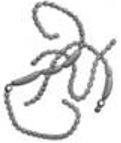
A
Anabaena - Blue-green algae - Kingdom Monera
B
Spirogyra - Algae - Kingdom Protista
C
Euglena - Autotrophic - Kingdom Monera
D
Anabaena - Autotrophic - Kingdom Protista
Solution
(A) The figure shows a filamentous structure with specialized cells called heterocysts,which is characteristic of the cyanobacterium Anabaena.
Anabaena belongs to the group of blue-green algae (cyanobacteria).
Cyanobacteria are prokaryotic organisms,which are classified under Kingdom Monera.
Therefore,the correct identification is Anabaena - Blue-green algae - Kingdom Monera.
Anabaena belongs to the group of blue-green algae (cyanobacteria).
Cyanobacteria are prokaryotic organisms,which are classified under Kingdom Monera.
Therefore,the correct identification is Anabaena - Blue-green algae - Kingdom Monera.
0 likes
View Solution357
EasyMCQ
Which feature is characteristic of organisms belonging to the Kingdom Monera?
A
Membrane-bound organelles
B
Absence of cell wall
C
Lomasomes
D
Nucleoid
Solution
(D) Organisms in the Kingdom $Monera$ are prokaryotic in nature.
Prokaryotic cells lack membrane-bound organelles such as mitochondria,endoplasmic reticulum,and a well-defined nucleus.
Instead of a true nucleus,they possess a naked genetic material known as the $Nucleoid$,which is a region containing the circular $DNA$ molecule.
Therefore,the presence of a $Nucleoid$ is a characteristic feature of $Monera$.
Prokaryotic cells lack membrane-bound organelles such as mitochondria,endoplasmic reticulum,and a well-defined nucleus.
Instead of a true nucleus,they possess a naked genetic material known as the $Nucleoid$,which is a region containing the circular $DNA$ molecule.
Therefore,the presence of a $Nucleoid$ is a characteristic feature of $Monera$.
0 likes
View Solution358
EasyMCQ
Which of the following kingdoms consists of organisms that lack membrane-bound organelles?
A
Protista
B
Monera
C
Fungi
D
Animalia
Solution
(B) Organisms belonging to the kingdom $Monera$ are prokaryotic in nature.
Prokaryotic cells are characterized by the absence of a well-defined nucleus and membrane-bound organelles such as mitochondria,endoplasmic reticulum,Golgi apparatus,etc.
Kingdoms $Protista$,$Fungi$,$Plantae$,and $Animalia$ consist of eukaryotic organisms which possess membrane-bound organelles.
Therefore,the correct answer is $Monera$.
Prokaryotic cells are characterized by the absence of a well-defined nucleus and membrane-bound organelles such as mitochondria,endoplasmic reticulum,Golgi apparatus,etc.
Kingdoms $Protista$,$Fungi$,$Plantae$,and $Animalia$ consist of eukaryotic organisms which possess membrane-bound organelles.
Therefore,the correct answer is $Monera$.
0 likes
View Solution359
EasyMCQ
Cyanobacteria are...
A
Heterotrophic bacteria.
B
Organisms with a nucleus.
C
Blue-green algae.
D
Primitive protists.
Solution
(C) Cyanobacteria,also known as blue-green algae,are photosynthetic prokaryotes. They contain chlorophyll $a$ similar to green plants and are autotrophic. They are classified under the Kingdom Monera because they are prokaryotic organisms lacking a membrane-bound nucleus.
0 likes
View Solution360
EasyMCQ
What type of nutrition is exhibited by organisms of the Kingdom Monera?
A
Autotrophic
B
Heterotrophic
C
Autotrophic and Heterotrophic
D
Holozoic
Solution
(C) Organisms belonging to Kingdom $Monera$ exhibit a wide range of nutritional modes.
They can be autotrophic,which includes both photosynthetic (e.g.,$Cyanobacteria$) and chemosynthetic (e.g.,certain bacteria that oxidize inorganic substances) modes.
They can also be heterotrophic,which includes saprophytic,parasitic,or symbiotic modes of nutrition.
Therefore,organisms of Kingdom $Monera$ exhibit both autotrophic and heterotrophic types of nutrition.
They can be autotrophic,which includes both photosynthetic (e.g.,$Cyanobacteria$) and chemosynthetic (e.g.,certain bacteria that oxidize inorganic substances) modes.
They can also be heterotrophic,which includes saprophytic,parasitic,or symbiotic modes of nutrition.
Therefore,organisms of Kingdom $Monera$ exhibit both autotrophic and heterotrophic types of nutrition.
0 likes
View Solution361
EasyMCQ
Which of the following is a prokaryotic kingdom?
A
Protista
B
Monera
C
Plantae
D
Fungi
Solution
(B) The kingdom $Monera$ is the only kingdom in the five-kingdom classification system that consists of prokaryotic organisms.
Prokaryotes are characterized by the absence of a well-defined nucleus and membrane-bound organelles.
Protista,Plantae,and Fungi are all eukaryotic kingdoms.
Prokaryotes are characterized by the absence of a well-defined nucleus and membrane-bound organelles.
Protista,Plantae,and Fungi are all eukaryotic kingdoms.
0 likes
View Solution362
EasyMCQ
Which group includes microorganisms that lack a defined nucleus but contain genetic material (nucleoid)?
A
Protista
B
Monera
C
Fungi
D
Plantae
Solution
(B) The kingdom $Monera$ consists of prokaryotic organisms.
Prokaryotes are characterized by the absence of a well-defined nucleus and membrane-bound organelles.
Instead of a nucleus,they contain a region called the nucleoid where their genetic material (circular $DNA$) is located.
Protista,Fungi,and Plantae are eukaryotic organisms that possess a well-defined nucleus.
Prokaryotes are characterized by the absence of a well-defined nucleus and membrane-bound organelles.
Instead of a nucleus,they contain a region called the nucleoid where their genetic material (circular $DNA$) is located.
Protista,Fungi,and Plantae are eukaryotic organisms that possess a well-defined nucleus.
0 likes
View Solution363
MediumMCQ
Which kingdom is characterized by the presence of a rigid cell wall and nucleoprotein as genetic material?
A
Monera
B
Protista
C
Fungi
D
Plantae
Solution
(A) The kingdom $Monera$ consists of prokaryotic organisms.
These organisms possess a rigid cell wall (typically made of peptidoglycan) and their genetic material is organized as a nucleoprotein complex (nucleoid) without a well-defined nuclear membrane.
In contrast,$Protista$,$Fungi$,and $Plantae$ are eukaryotic and possess a well-defined nucleus with a nuclear envelope.
These organisms possess a rigid cell wall (typically made of peptidoglycan) and their genetic material is organized as a nucleoprotein complex (nucleoid) without a well-defined nuclear membrane.
In contrast,$Protista$,$Fungi$,and $Plantae$ are eukaryotic and possess a well-defined nucleus with a nuclear envelope.
0 likes
View Solution364
MediumMCQ
Which of the following is a characteristic of the domain $Archaea$?
A
The cell wall is made of peptidoglycan.
B
The cell wall is not made of peptidoglycan.
C
The cell wall is absent.
D
The cell wall is made of cellulose or fungal cellulose.
Solution
(B) The domain $Archaea$ consists of prokaryotic organisms that are distinct from $Bacteria$.
One of the primary differences is the composition of their cell walls.
Unlike $Bacteria$,which have cell walls containing peptidoglycan,$Archaea$ lack peptidoglycan in their cell walls.
Instead,their cell walls are composed of various proteins,polysaccharides,or pseudomurein.
Therefore,the correct characteristic is that the cell wall is not made of peptidoglycan.
One of the primary differences is the composition of their cell walls.
Unlike $Bacteria$,which have cell walls containing peptidoglycan,$Archaea$ lack peptidoglycan in their cell walls.
Instead,their cell walls are composed of various proteins,polysaccharides,or pseudomurein.
Therefore,the correct characteristic is that the cell wall is not made of peptidoglycan.
0 likes
View Solution365
EasyMCQ
Which are the most primitive types of organisms?
A
Protista
B
Bacteria
C
Algae
D
Fungi
Solution
(B) Bacteria,specifically the domain $Archaea$ and $Eubacteria$,are considered the most primitive organisms on Earth. They are prokaryotic,meaning they lack a membrane-bound nucleus and other complex organelles. According to the evolutionary timeline,prokaryotes appeared long before eukaryotic organisms like $Protista$,$Algae$ (which are often eukaryotic),and $Fungi$.
0 likes
View Solution366
EasyMCQ
Which kingdom includes prokaryotic organisms?
A
Monera
B
Protista
C
Lichen
D
Fungi
Solution
(A) Prokaryotic organisms are characterized by the absence of a well-defined nucleus and membrane-bound organelles. According to the five-kingdom classification system proposed by $R$.$H$. Whittaker,all prokaryotic organisms are placed in the kingdom $Monera$. Examples include bacteria,cyanobacteria (blue-green algae),and mycoplasma.
0 likes
View Solution367
EasyMCQ
If an organism is placed in the Kingdom $Monera$,then the organism...
A
Is not unicellular.
B
Possesses membrane-bound organelles.
C
Is surrounded by a capsule.
D
Lacks a nuclear membrane that separates the genetic material from the cytoplasm.
Solution
(D) Kingdom $Monera$ consists of prokaryotic organisms.
Prokaryotes are characterized by the absence of a well-defined nucleus,meaning they lack a nuclear membrane to enclose their genetic material.
They also lack membrane-bound organelles such as mitochondria,chloroplasts,or the endoplasmic reticulum.
Therefore,the defining feature of organisms in Kingdom $Monera$ is the absence of a nuclear membrane.
Prokaryotes are characterized by the absence of a well-defined nucleus,meaning they lack a nuclear membrane to enclose their genetic material.
They also lack membrane-bound organelles such as mitochondria,chloroplasts,or the endoplasmic reticulum.
Therefore,the defining feature of organisms in Kingdom $Monera$ is the absence of a nuclear membrane.
0 likes
View Solution368
EasyMCQ
What is the genetic material of Cyanobacteria known as?
A
Nucleoprotein
B
Nucleohistone
C
Chromatin material
D
Chromosome
Solution
(A) Cyanobacteria are prokaryotic organisms. In prokaryotes,the genetic material is not enclosed within a membrane-bound nucleus. Instead,it exists as a naked,circular,double-stranded $DNA$ molecule located in the cytoplasm,often referred to as the nucleoid or genophore. Among the given options,the term 'Nucleoprotein' is the most appropriate description for the complex of $DNA$ and associated proteins found in the nucleoid region of prokaryotes.
0 likes
View Solution369
EasyMCQ
Which of the following organisms lacks a well-defined nucleus?
A
Lichen
B
Fungi
C
Green algae
D
Anabaena
Solution
(D) Organisms that lack a well-defined nucleus are classified as prokaryotes.
$Anabaena$ is a type of cyanobacteria (blue-green algae),which is a prokaryotic organism.
Prokaryotes do not have a membrane-bound nucleus or membrane-bound organelles.
In contrast,Lichens,Fungi,and Green algae are eukaryotes,which possess a well-defined nucleus.
$Anabaena$ is a type of cyanobacteria (blue-green algae),which is a prokaryotic organism.
Prokaryotes do not have a membrane-bound nucleus or membrane-bound organelles.
In contrast,Lichens,Fungi,and Green algae are eukaryotes,which possess a well-defined nucleus.
0 likes
View Solution370
EasyMCQ
Which characteristics are included in the Kingdom $Monera$?
A
Cellulose and chitin are absent
B
Well-defined nucleus is absent
C
Known as prokaryotic cells
D
All of the above
Solution
(D) The Kingdom $Monera$ consists of prokaryotic organisms.
$1$. They lack a well-defined nucleus,meaning their genetic material is not enclosed by a nuclear membrane.
$2$. Their cell wall,if present,is made of peptidoglycan (murein),and they lack cellulose and chitin,which are characteristic of plants and fungi,respectively.
$3$. They are unicellular prokaryotes.
Since all the given options describe the characteristics of $Monera$,the correct answer is $D$.
$1$. They lack a well-defined nucleus,meaning their genetic material is not enclosed by a nuclear membrane.
$2$. Their cell wall,if present,is made of peptidoglycan (murein),and they lack cellulose and chitin,which are characteristic of plants and fungi,respectively.
$3$. They are unicellular prokaryotes.
Since all the given options describe the characteristics of $Monera$,the correct answer is $D$.
0 likes
View Solution371
EasyMCQ
Identify the correct statement:
A
All bacteria are heterotrophic.
B
All bacteria are autotrophic.
C
All bacteria are photosynthetic.
D
Most bacteria are heterotrophic and some are autotrophic.
Solution
(D) Bacteria are the most abundant microorganisms. They exhibit a wide range of metabolic diversity. While some bacteria are autotrophic (synthesizing their own food from inorganic substrates,either through photosynthesis or chemosynthesis),the vast majority of bacteria are heterotrophic,meaning they depend on other organisms or on dead organic matter for food. Therefore,the statement that most bacteria are heterotrophic and some are autotrophic is correct.
0 likes
View Solution372
MediumMCQ
Which of the following characteristics is $NOT$ present in the $Bacteria$ domain?
A
They are prokaryotic cells lacking a nuclear membrane.
B
The cell wall is not made of peptidoglycan.
C
The cell wall is made of peptidoglycan.
D
It includes many well-known pathogenic organisms.
Solution
(B) The $Bacteria$ domain consists of prokaryotic organisms. Their cell walls are characteristically composed of $peptidoglycan$ (murein). Option $B$ states that the cell wall is not made of peptidoglycan,which is a characteristic of the $Archaea$ domain,not the $Bacteria$ domain. Therefore,this is the correct answer as it is not a feature of $Bacteria$.
0 likes
View Solution373
EasyMCQ
Which of the following characteristics is $NOT$ included in the $Archaea$ domain?
A
Prokaryotic cells lacking a nuclear membrane
B
Cell wall is not composed of peptidoglycan
C
Cells living in extreme conditions
D
Eukaryotic cells with a nuclear membrane
Solution
(D) The $Archaea$ domain consists of prokaryotic organisms,which means they lack a membrane-bound nucleus and other membrane-bound organelles.
$Archaea$ are known for their ability to survive in extreme environments (extremophiles).
Their cell walls do not contain peptidoglycan,which is a characteristic feature of the $Bacteria$ domain.
Option $D$ states that they have eukaryotic cells with a nuclear membrane,which is incorrect because $Archaea$ are prokaryotes and lack a true nuclear membrane.
$Archaea$ are known for their ability to survive in extreme environments (extremophiles).
Their cell walls do not contain peptidoglycan,which is a characteristic feature of the $Bacteria$ domain.
Option $D$ states that they have eukaryotic cells with a nuclear membrane,which is incorrect because $Archaea$ are prokaryotes and lack a true nuclear membrane.
0 likes
View Solution374
EasyMCQ
Which bacteria are included in the domain $Bacteria$?
A
Photosynthetic bacteria
B
Gram-negative bacteria
C
Gram-positive bacteria
D
All of the above
Solution
(D) The domain $Bacteria$ (also known as $Eubacteria$) is a vast group of prokaryotic organisms.
It encompasses a wide diversity of bacterial types,including $Photosynthetic$ bacteria (like cyanobacteria),$Gram-negative$ bacteria,and $Gram-positive$ bacteria.
These organisms are characterized by the presence of a cell wall containing $peptidoglycan$.
Therefore,all the listed options are included in the domain $Bacteria$.
It encompasses a wide diversity of bacterial types,including $Photosynthetic$ bacteria (like cyanobacteria),$Gram-negative$ bacteria,and $Gram-positive$ bacteria.
These organisms are characterized by the presence of a cell wall containing $peptidoglycan$.
Therefore,all the listed options are included in the domain $Bacteria$.
0 likes
View Solution375
EasyMCQ
Which domain of organisms can survive in extreme conditions?
A
Archaea domain
B
Bacteria domain
C
Eukarya domain
D
All of the above
Solution
(A) The domain $Archaea$ consists of organisms known as extremophiles. These organisms are capable of surviving in extreme environmental conditions such as high temperatures,high salinity,and acidic environments,which are typically lethal to other forms of life. Therefore,the correct answer is $A$.
0 likes
View Solution376
EasyMCQ
Which of the following is $NOT$ associated with Archaebacteria?
A
Methanogens - Responsible for the production of biogas (methane)
B
Halophytes - Inhabit extremely arid regions
C
Halophiles - Inhabit extremely salty areas
D
Thermoacidophiles - Survive in acidic and high-temperature environments
Solution
(B) Archaebacteria are a group of unique bacteria that live in some of the most harsh habitats.
$1$. Methanogens are found in marshy areas and are responsible for the production of methane (biogas) in the gut of several ruminant animals.
$2$. Halophiles are specialized archaebacteria that live in extremely salty areas.
$3$. Thermoacidophiles are found in hot springs and are capable of surviving in acidic and high-temperature conditions.
$4$. Halophytes are salt-tolerant plants,not archaebacteria. Therefore,the association of Halophytes with archaebacteria is incorrect.
$1$. Methanogens are found in marshy areas and are responsible for the production of methane (biogas) in the gut of several ruminant animals.
$2$. Halophiles are specialized archaebacteria that live in extremely salty areas.
$3$. Thermoacidophiles are found in hot springs and are capable of surviving in acidic and high-temperature conditions.
$4$. Halophytes are salt-tolerant plants,not archaebacteria. Therefore,the association of Halophytes with archaebacteria is incorrect.
0 likes
View Solution377
EasyMCQ
Gram-positive bacteria belong to the phylum:
A
Cyanobacteria
B
Spirochaetes
C
Firmicutes
D
Methanogens
Solution
(C) Gram-positive bacteria are classified under the phylum $Firmicutes$ in the bacterial taxonomy.
$Cyanobacteria$ are photosynthetic bacteria.
$Spirochaetes$ are a distinct phylum of Gram-negative bacteria.
$Methanogens$ belong to the domain $Archaea$.
$Cyanobacteria$ are photosynthetic bacteria.
$Spirochaetes$ are a distinct phylum of Gram-negative bacteria.
$Methanogens$ belong to the domain $Archaea$.
0 likes
View Solution378
MediumMCQ
Which of the following pairs is $NOT$ correctly matched with Eubacteria?
A
Archaea - Archaebacteria
B
Spirochetes - Gram-negative bacteria
C
Cyanobacteria - Photosynthetic bacteria
D
Firmicutes - Gram-positive bacteria
Solution
(A) The domain $Eubacteria$ (or $Bacteria$) includes various groups of prokaryotes.
$1$. $Spirochetes$ are a phylum of Gram-negative bacteria.
$2$. $Cyanobacteria$ are photosynthetic bacteria capable of oxygenic photosynthesis.
$3$. $Firmicutes$ are a phylum of bacteria,most of which have a Gram-positive cell wall structure.
$4$. $Archaea$ (Archaebacteria) are a distinct domain of life separate from $Eubacteria$. They have different cell wall compositions (lacking peptidoglycan) and membrane lipids compared to true bacteria.
Therefore,the pair $Archaea - Archaebacteria$ is not matched with $Eubacteria$.
$1$. $Spirochetes$ are a phylum of Gram-negative bacteria.
$2$. $Cyanobacteria$ are photosynthetic bacteria capable of oxygenic photosynthesis.
$3$. $Firmicutes$ are a phylum of bacteria,most of which have a Gram-positive cell wall structure.
$4$. $Archaea$ (Archaebacteria) are a distinct domain of life separate from $Eubacteria$. They have different cell wall compositions (lacking peptidoglycan) and membrane lipids compared to true bacteria.
Therefore,the pair $Archaea - Archaebacteria$ is not matched with $Eubacteria$.
0 likes
View Solution379
MediumMCQ
Which of the following is not included in the domain $Bacteria$?
A
Spirochetes
B
Halophiles
C
Firmicutes
D
Cyanobacteria
Solution
(B) According to the three-domain system proposed by Carl Woese,all living organisms are classified into three domains: $Bacteria$,$Archaea$,and $Eukarya$.
$1$. The domain $Bacteria$ includes true bacteria such as $Cyanobacteria$,$Spirochetes$,and $Firmicutes$.
$2$. The domain $Archaea$ includes organisms that live in extreme environments,such as $Halophiles$ (salt-loving),$Methanogens$,and $Thermoacidophiles$.
$3$. Since $Halophiles$ belong to the domain $Archaea$,they are not included in the domain $Bacteria$.
$1$. The domain $Bacteria$ includes true bacteria such as $Cyanobacteria$,$Spirochetes$,and $Firmicutes$.
$2$. The domain $Archaea$ includes organisms that live in extreme environments,such as $Halophiles$ (salt-loving),$Methanogens$,and $Thermoacidophiles$.
$3$. Since $Halophiles$ belong to the domain $Archaea$,they are not included in the domain $Bacteria$.
0 likes
View Solution380
EasyMCQ
Spirochaetes are ...
A
Photosynthetic bacteria
B
Gram-negative bacteria
C
Gram-positive bacteria
D
Archaebacteria
Solution
(B) Spirochaetes are a phylum of Gram-negative bacteria that have long,helically coiled cells. They are characterized by the presence of axial filaments (endoflagella) located in the periplasmic space,which allow them to move in a corkscrew-like motion. Therefore,they are classified as Gram-negative bacteria.
0 likes
View Solution381
MediumMCQ
Statement $X$: Methanogens are responsible for the production of methane.
Statement $Y$: They can survive in acidic and high-temperature conditions.
Statement $Y$: They can survive in acidic and high-temperature conditions.
A
Both Statement $X$ and Statement $Y$ are correct.
B
Both Statement $X$ and Statement $Y$ are incorrect.
C
Statement $X$ is correct,and Statement $Y$ is incorrect.
D
Both Statement $X$ and Statement $Y$ are correct,but Statement $Y$ is not the explanation of Statement $X$.
Solution
(C) Methanogens are a group of archaebacteria that produce methane $(CH_4)$ as a metabolic byproduct in anoxic conditions. This makes Statement $X$ correct.
Methanogens are typically found in anaerobic environments like the rumen of cattle or marshy areas. They are not characterized by survival in highly acidic or extremely high-temperature conditions; those traits are specific to thermoacidophiles (another group of archaebacteria). Therefore,Statement $Y$ is incorrect.
Methanogens are typically found in anaerobic environments like the rumen of cattle or marshy areas. They are not characterized by survival in highly acidic or extremely high-temperature conditions; those traits are specific to thermoacidophiles (another group of archaebacteria). Therefore,Statement $Y$ is incorrect.
0 likes
View Solution382
EasyMCQ
Which of the following domains lacks a cell wall?
A
Archaea domain
B
Bacteria domain
C
Eukarya domain
D
Both $(A)$ and $(B)$
Solution
(C) The domain $Eukarya$ includes organisms such as animals and certain protists that lack a cell wall. In contrast,members of the domains $Archaea$ and $Bacteria$ typically possess cell walls composed of different chemical substances (e.g.,peptidoglycan in bacteria and various proteins or polysaccharides in archaea). Therefore,the domain $Eukarya$ is the correct answer as it contains groups that do not have a cell wall.
0 likes
View Solution383
EasyMCQ
Archaea that live in hot springs belong to the group:
A
Methanogens
B
Halophiles
C
Thermoacidophiles
D
Spirochetes
Solution
(C) Archaea are unique organisms that can survive in extreme environmental conditions.
$1$. Methanogens are found in marshy areas and the gut of ruminant animals.
$2$. Halophiles are found in extremely salty areas.
$3$. Thermoacidophiles are specialized Archaea that thrive in extremely hot and acidic environments,such as hot springs.
$4$. Spirochetes are a phylum of Gram-negative bacteria,not Archaea.
Therefore,the correct option is $C$.
$1$. Methanogens are found in marshy areas and the gut of ruminant animals.
$2$. Halophiles are found in extremely salty areas.
$3$. Thermoacidophiles are specialized Archaea that thrive in extremely hot and acidic environments,such as hot springs.
$4$. Spirochetes are a phylum of Gram-negative bacteria,not Archaea.
Therefore,the correct option is $C$.
0 likes
View Solution384
EasyMCQ
Which of the following statements is consistent with Halophiles?
A
Responsible for the production of methane
B
Inhabit extremely salty areas
C
Survive in acidic and high-temperature conditions
D
Survive in hot springs
Solution
(B) Halophiles are a type of Archaebacteria that are specifically adapted to live in extremely salty environments (halophilic conditions).
Methanogens are responsible for methane production.
Thermoacidophiles are capable of surviving in acidic and high-temperature conditions.
Therefore,the correct statement for Halophiles is that they inhabit extremely salty areas.
Methanogens are responsible for methane production.
Thermoacidophiles are capable of surviving in acidic and high-temperature conditions.
Therefore,the correct statement for Halophiles is that they inhabit extremely salty areas.
0 likes
View Solution385
EasyMCQ
Which of the following has a cell wall made of peptidoglycan?
A
Archaea domain
B
Bacteria domain
C
Eukarya domain
D
Both $(A)$ and $(B)$
Solution
(B) The cell wall of organisms in the domain $Bacteria$ (specifically $Eubacteria$) is composed of peptidoglycan (murein).
In contrast,the cell wall of organisms in the domain $Archaea$ lacks peptidoglycan and is instead composed of pseudomurein or other polysaccharides and proteins.
Organisms in the domain $Eukarya$ (such as plants and fungi) have cell walls made of cellulose or chitin,respectively.
Therefore,only the $Bacteria$ domain possesses a cell wall made of peptidoglycan.
In contrast,the cell wall of organisms in the domain $Archaea$ lacks peptidoglycan and is instead composed of pseudomurein or other polysaccharides and proteins.
Organisms in the domain $Eukarya$ (such as plants and fungi) have cell walls made of cellulose or chitin,respectively.
Therefore,only the $Bacteria$ domain possesses a cell wall made of peptidoglycan.
0 likes
View Solution386
EasyMCQ
Which domain includes well-known pathogenic organisms?
A
Archaea domain
B
Bacteria domain
C
Eukarya domain
D
None of these
Solution
(B) The domain $Bacteria$ (often referred to as $Eubacteria$) includes a vast number of organisms,many of which are well-known pathogens that cause diseases in humans,animals,and plants. While some $Archaea$ are extremophiles,they are generally not known to be pathogenic. $Eukarya$ includes protists,fungi,plants,and animals; while some protists and fungi are pathogenic,the domain $Bacteria$ is most characteristically associated with a wide variety of common pathogenic organisms.
0 likes
View Solution387
EasyMCQ
Which of the following are photosynthetic bacteria?
A
Cyanobacteria
B
Spirochaetes
C
Firmicutes
D
Archaebacteria
Solution
(A) Cyanobacteria,also known as blue-green algae,are photosynthetic prokaryotes that contain chlorophyll $a$ and perform oxygenic photosynthesis. They are the only group of bacteria capable of producing oxygen during photosynthesis. Spirochaetes,Firmicutes,and Archaebacteria do not primarily perform oxygenic photosynthesis in the same manner as Cyanobacteria.
0 likes
View Solution388
MediumMCQ
Statement $S$: Methanogens are responsible for the production of methane. Statement $R$: They can survive even in acidic and high-temperature conditions.
A
$S$ and $R$ are both true,and $R$ is the correct explanation of $S$.
B
$S$ and $R$ are both true,but $R$ is not the correct explanation of $S$.
C
$S$ is true and $R$ is false.
D
$S$ is false and $R$ is true.
Solution
(C) Statement $S$ is true because methanogens are archaebacteria that produce methane $(CH_4)$ in anaerobic conditions,such as in the rumen of cattle or marshy areas.
Statement $R$ is false because methanogens are generally found in anaerobic environments like marshy areas and the gut of ruminants; they are not typically characterized by survival in highly acidic or extremely high-temperature conditions (those characteristics are more specific to thermoacidophiles).
Statement $R$ is false because methanogens are generally found in anaerobic environments like marshy areas and the gut of ruminants; they are not typically characterized by survival in highly acidic or extremely high-temperature conditions (those characteristics are more specific to thermoacidophiles).
0 likes
View Solution389
MediumMCQ
Assertion $(S)$: Thermoacidophiles can survive in acidic and high-temperature conditions.
Reason $(R)$: Archaea can survive in extreme conditions.
Reason $(R)$: Archaea can survive in extreme conditions.
A
$S$ and $R$ are both true,and $R$ is the correct explanation of $S$.
B
$S$ and $R$ are both true,but $R$ is not the correct explanation of $S$.
C
$S$ is true and $R$ is false.
D
$S$ is false and $R$ is true.
Solution
(A) Thermoacidophiles are a group of Archaea that thrive in extremely acidic environments and high temperatures.
Archaea are known for their ability to survive in extreme environmental conditions (extremophiles) such as high salinity (halophiles),extreme temperatures (thermophiles),and acidic environments (acidophiles).
Since thermoacidophiles are a type of Archaea,their ability to survive in these harsh conditions is a direct consequence of the unique characteristics of Archaea that allow them to live in extreme environments.
Therefore,$R$ is the correct explanation of $S$.
Archaea are known for their ability to survive in extreme environmental conditions (extremophiles) such as high salinity (halophiles),extreme temperatures (thermophiles),and acidic environments (acidophiles).
Since thermoacidophiles are a type of Archaea,their ability to survive in these harsh conditions is a direct consequence of the unique characteristics of Archaea that allow them to live in extreme environments.
Therefore,$R$ is the correct explanation of $S$.
0 likes
View Solution390
MediumMCQ
Select the mismatched pair from the following.
A
Methanogens - Biogas production
B
Halophiles - Habitat in extremely salty areas
C
Spirochetes - Gram-positive bacteria
D
Cyanobacteria - Photosynthetic bacteria
Solution
(C) The correct answer is $C$.
$1$. Methanogens are archaebacteria that produce methane in anaerobic conditions,commonly used in biogas production.
$2$. Halophiles are archaebacteria that thrive in extremely salty environments.
$3$. Spirochetes are a phylum of Gram-negative bacteria that have long,helically coiled cells. Therefore,the statement that they are Gram-positive is incorrect.
$4$. Cyanobacteria are photosynthetic autotrophs containing chlorophyll $a$,similar to green plants.
$1$. Methanogens are archaebacteria that produce methane in anaerobic conditions,commonly used in biogas production.
$2$. Halophiles are archaebacteria that thrive in extremely salty environments.
$3$. Spirochetes are a phylum of Gram-negative bacteria that have long,helically coiled cells. Therefore,the statement that they are Gram-positive is incorrect.
$4$. Cyanobacteria are photosynthetic autotrophs containing chlorophyll $a$,similar to green plants.
0 likes
View Solution391
EasyMCQ
At high temperatures,which of the following are present?
A
Archaebacteria
B
Eubacteria
C
Both $(A)$ and $(B)$
D
None of these
Solution
(A) Archaebacteria are a special group of bacteria that live in some of the most harsh habitats such as extreme salty areas (halophiles),hot springs (thermoacidophiles),and marshy areas (methanogens).
Thermoacidophiles are specifically adapted to survive in extremely high temperatures and acidic environments.
Eubacteria generally do not survive in such extreme conditions.
Therefore,the correct option is $(A)$.
Thermoacidophiles are specifically adapted to survive in extremely high temperatures and acidic environments.
Eubacteria generally do not survive in such extreme conditions.
Therefore,the correct option is $(A)$.
0 likes
View Solution392
EasyMCQ
Which of the following are completely autotrophic bacteria?
A
Archaebacteria
B
Eubacteria
C
Both ($A$ and $B$)
D
None of these
Solution
(C) Autotrophic bacteria are those that can synthesize their own food from inorganic substances.
$1$. Archaebacteria include groups like methanogens,halophiles,and thermoacidophiles,which are often chemoautotrophic.
$2$. Eubacteria include photosynthetic autotrophs (e.g.,Cyanobacteria) and chemoautotrophic bacteria.
Since both groups contain members that are autotrophic,the correct answer is $C$.
$1$. Archaebacteria include groups like methanogens,halophiles,and thermoacidophiles,which are often chemoautotrophic.
$2$. Eubacteria include photosynthetic autotrophs (e.g.,Cyanobacteria) and chemoautotrophic bacteria.
Since both groups contain members that are autotrophic,the correct answer is $C$.
0 likes
View Solution393
EasyMCQ
$A$ characteristic feature linking Monera is .........
A
Autotrophic
B
Heterotrophic
C
Eukaryotic cell
D
Both $(A)$ and $(B)$
Solution
(D) The kingdom Monera consists of prokaryotic organisms.
These organisms exhibit diverse modes of nutrition,including both autotrophic (e.g.,photosynthetic or chemosynthetic) and heterotrophic (e.g.,saprophytic or parasitic) modes.
Since both autotrophic and heterotrophic modes are found within the kingdom Monera,option $(D)$ is the correct answer.
Monera are strictly prokaryotic,so option $(C)$ is incorrect.
These organisms exhibit diverse modes of nutrition,including both autotrophic (e.g.,photosynthetic or chemosynthetic) and heterotrophic (e.g.,saprophytic or parasitic) modes.
Since both autotrophic and heterotrophic modes are found within the kingdom Monera,option $(D)$ is the correct answer.
Monera are strictly prokaryotic,so option $(C)$ is incorrect.
0 likes
View Solution394
EasyMCQ
Which of the following are included in the kingdom $Monera$?
A
Eubacteria
B
All of these
C
Mycoplasma
D
Cyanobacteria
Solution
(B) The kingdom $Monera$ consists of prokaryotic organisms.
These organisms are unicellular and lack a well-defined nucleus.
$Eubacteria$ (true bacteria),$Cyanobacteria$ (blue-green algae),and $Mycoplasma$ are all examples of organisms that belong to the kingdom $Monera$.
Therefore,all the given options are included in this kingdom.
These organisms are unicellular and lack a well-defined nucleus.
$Eubacteria$ (true bacteria),$Cyanobacteria$ (blue-green algae),and $Mycoplasma$ are all examples of organisms that belong to the kingdom $Monera$.
Therefore,all the given options are included in this kingdom.
0 likes
View Solution395
MediumMCQ
The classification of $Monera$ is based on which of the following?
A
Biochemical characteristics
B
Physiological characteristics
C
Ecological characteristics
D
All of the above
Solution
(D) The kingdom $Monera$ includes all prokaryotic organisms,primarily bacteria. The classification of $Monera$ is comprehensive and considers multiple criteria to distinguish between different groups. These criteria include:
$1$. Biochemical characteristics: Analysis of cell wall composition,metabolic pathways,and chemical constituents.
$2$. Physiological characteristics: How these organisms function,their nutritional modes,and their response to environmental stimuli.
$3$. Ecological characteristics: Their habitats,roles in nutrient cycling,and symbiotic relationships.
Therefore,the classification of $Monera$ is based on all these factors.
$1$. Biochemical characteristics: Analysis of cell wall composition,metabolic pathways,and chemical constituents.
$2$. Physiological characteristics: How these organisms function,their nutritional modes,and their response to environmental stimuli.
$3$. Ecological characteristics: Their habitats,roles in nutrient cycling,and symbiotic relationships.
Therefore,the classification of $Monera$ is based on all these factors.
0 likes
View Solution396
EasyMCQ
Cyanobacteria are –
A
Gram-positive bacteria
B
Gram-negative bacteria
C
Photosynthetic bacteria
D
None of the above
Solution
(C) Cyanobacteria,also known as blue-green algae,are photosynthetic prokaryotes.
They contain chlorophyll $a$ similar to green plants and are photosynthetic in nature.
They are classified under the kingdom $Monera$ and are Gram-negative bacteria because they possess a thin peptidoglycan layer and an outer membrane.
However,in the context of biological classification and their most defining characteristic,they are primarily identified as photosynthetic bacteria.
Given the options,while they are Gram-negative,their most distinct biological feature is being photosynthetic.
They contain chlorophyll $a$ similar to green plants and are photosynthetic in nature.
They are classified under the kingdom $Monera$ and are Gram-negative bacteria because they possess a thin peptidoglycan layer and an outer membrane.
However,in the context of biological classification and their most defining characteristic,they are primarily identified as photosynthetic bacteria.
Given the options,while they are Gram-negative,their most distinct biological feature is being photosynthetic.
0 likes
View Solution397
EasyMCQ
Which of the following is a characteristic of thermoacidophiles?
A
They are photosynthetic
B
They live in high temperatures
C
They inhabit saline environments
D
All of the above
Solution
(B) Thermoacidophiles belong to the group of Archaebacteria.
They are specifically adapted to survive in extreme environments.
They are characterized by their ability to thrive in high-temperature and highly acidic conditions.
Option $B$ is correct because they are known for living in high-temperature environments (often associated with hot springs).
Photosynthetic organisms are not typically classified as thermoacidophiles,and organisms living in highly saline environments are known as halophiles.
They are specifically adapted to survive in extreme environments.
They are characterized by their ability to thrive in high-temperature and highly acidic conditions.
Option $B$ is correct because they are known for living in high-temperature environments (often associated with hot springs).
Photosynthetic organisms are not typically classified as thermoacidophiles,and organisms living in highly saline environments are known as halophiles.
0 likes
View Solution398
EasyMCQ
What is the habitat of halophiles?
A
Salty areas
B
Hot springs
C
Freshwater
D
Human gut
Solution
(A) Halophiles are a group of Archaebacteria that are specifically adapted to live in extremely salty environments.
They possess special cell wall structures and membrane proteins that allow them to survive and thrive in high-salinity conditions where most other organisms would perish.
Therefore,the correct habitat for halophiles is salty areas.
They possess special cell wall structures and membrane proteins that allow them to survive and thrive in high-salinity conditions where most other organisms would perish.
Therefore,the correct habitat for halophiles is salty areas.
0 likes
View Solution399
MediumMCQ
Which bacteria can survive in water at temperatures above $100 \,^{\circ}\text{C}$?
A
Cyanobacteria
B
Gram-negative bacteria
C
Thermoacidophiles
D
Halophiles
Solution
(C) Thermoacidophiles are a group of Archaebacteria that thrive in extremely hot and acidic environments.
They possess specialized enzymes and membrane structures that allow them to remain stable and functional at temperatures exceeding $100 \,^{\circ}\text{C}$.
Cyanobacteria are photosynthetic,Gram-negative bacteria are common mesophiles,and Halophiles are adapted to high salt concentrations.
They possess specialized enzymes and membrane structures that allow them to remain stable and functional at temperatures exceeding $100 \,^{\circ}\text{C}$.
Cyanobacteria are photosynthetic,Gram-negative bacteria are common mesophiles,and Halophiles are adapted to high salt concentrations.
0 likes
View Solution400
EasyMCQ
Which of the following is a common characteristic shared by both methanogens and halophiles?
A
Both are archaebacteria.
B
Both produce biogas.
C
Both are acidic.
D
Both are photosynthetic.
Solution
(A) Methanogens and halophiles are both members of the domain $Archaea$ (archaebacteria).
Archaebacteria are distinct from other bacteria due to their unique cell wall structure,which allows them to survive in extreme environmental conditions.
Methanogens are found in marshy areas and the gut of ruminant animals,while halophiles are found in extremely salty areas.
Therefore,the common characteristic is that they both belong to the group $Archaebacteria$.
Archaebacteria are distinct from other bacteria due to their unique cell wall structure,which allows them to survive in extreme environmental conditions.
Methanogens are found in marshy areas and the gut of ruminant animals,while halophiles are found in extremely salty areas.
Therefore,the common characteristic is that they both belong to the group $Archaebacteria$.
0 likes
View SolutionBiological Classification — Monera (Prokaryotes) · Frequently Asked Questions
1Are these Biological Classification questions useful for JEE and NEET?
Yes. All questions in this section are mapped to JEE Main and NEET exam patterns. Previous year questions from JEE Main, NEET, GUJCET and state-level exams are included with full solutions.
2Can I switch to Hindi or Gujarati for these questions?
Yes. Use the language tabs in the hero section or the sidebar to view the same questions and solutions in English, Hindi or Gujarati.
3How do I generate a question paper from this subtopic?
Use the Vedclass Exam Paper Generator — select the chapter and subtopic, set difficulty, and generate Sets A, B, C, D automatically. First 3 chapters of every subject are free.
Vedclass Products
For Students
Vedclass Test Series
Mock tests in real JEE/NEET style with performance analysis. 5-day free trial.
Start Free TrialFor Teachers
Exam Paper Generator
Generate Set A/B/C/D papers from this chapter in 2 minutes. 3 chapters free.
Try FreeFor Institutes
Online Exam Module
Live online exams with unlimited students, 360° analytics & white-label branding.
See DemoFor Teachers & Institutes
Generate a Biological Classification Exam Paper in 2 Minutes
Select subtopic & difficulty — Sets A, B, C, D auto-generated with No Repeat logic.
First 3 chapters of every subject are free — no payment required.