
A English
Mix Example-Biological Classification Questions in English
Class 11 Biology · Biological Classification · Mix Example-Biological Classification
213+
Questions
English
Language
100%
With Solutions
Showing 50 of 213 questions in English
101
MediumMCQ
Match the following columns:
| Column-$I$ | Column-$II$ |
|---|---|
| $1$. Conidia | $p$. Flask-shaped fruiting body |
| $2$. Perithecium | $q$. Sex organ |
| $3$. Crustose | $r$. Asexual reproduction |
| $4$. Fruiting body | $s$. External form of lichen |
A
$1-r, 2-s, 3-q, 4-p$
B
$1-q, 2-p, 3-q, 4-r$
C
$1-s, 2-r, 3-q, 4-p$
D
$1-r, 2-p, 3-s, 4-q$
Solution
The correct matching is as follows:
$1$. Conidia $(1-r)$: Conidia are asexual spores produced in fungi.
$2$. Perithecium $(2-p)$: It is a type of flask-shaped fruiting body (ascocarp) found in certain Ascomycetes.
$3$. Crustose $(3-s)$: This refers to the growth form of lichens that appear as a crust on the substrate.
$4$. Fruiting body $(4-q)$: It is the reproductive structure of fungi that contains the sex organs or spores.
Therefore,the correct sequence is $1-r, 2-p, 3-s, 4-q$.
$1$. Conidia $(1-r)$: Conidia are asexual spores produced in fungi.
$2$. Perithecium $(2-p)$: It is a type of flask-shaped fruiting body (ascocarp) found in certain Ascomycetes.
$3$. Crustose $(3-s)$: This refers to the growth form of lichens that appear as a crust on the substrate.
$4$. Fruiting body $(4-q)$: It is the reproductive structure of fungi that contains the sex organs or spores.
Therefore,the correct sequence is $1-r, 2-p, 3-s, 4-q$.
0 likes
View Solution102
EasyMCQ
How many orders does the series Bicarpellatae contain?
A
$3$
B
$2$
C
$4$
D
$5$
Solution
(C) In the Bentham and Hooker system of classification,the series Bicarpellatae belongs to the class Dicotyledonae and subclass Gamopetalae.
This series is characterized by flowers having a bicarpellary ovary.
It comprises $4$ orders: $1.$ Polemoniales,$2.$ Gentianales,$3.$ Personales,and $4.$ Lamiales.
This series is characterized by flowers having a bicarpellary ovary.
It comprises $4$ orders: $1.$ Polemoniales,$2.$ Gentianales,$3.$ Personales,and $4.$ Lamiales.
0 likes
View Solution103
EasyMCQ
The series Disciflorae consists of .........
A
$4$ cohorts and many families.
B
$5$ cohorts and many families.
C
$6$ cohorts and many families.
D
$3$ cohorts and many families.
Solution
(A) In the Bentham and Hooker system of classification,the subclass Polypetalae is divided into three series: Thalamiflorae,Disciflorae,and Calyciflorae.
Specifically,the series Disciflorae is characterized by the presence of a prominent disc-like structure (hypogynous disc) between the stamens and the ovary.
This series comprises $4$ cohorts (orders) and $23$ families.
Specifically,the series Disciflorae is characterized by the presence of a prominent disc-like structure (hypogynous disc) between the stamens and the ovary.
This series comprises $4$ cohorts (orders) and $23$ families.
0 likes
View Solution104
MediumMCQ
Assertion $(A)$: The domain $Eukarya$ is divided into five kingdoms.
Reason $(R)$: The three-domain system of classification was proposed by $Carl$ $Woese$.
Reason $(R)$: The three-domain system of classification was proposed by $Carl$ $Woese$.
A
$A$ and $R$ are both true,and $R$ is the correct explanation of $A$.
B
$A$ and $R$ are both true,but $R$ is not the correct explanation of $A$.
C
$A$ is true,but $R$ is false.
D
$A$ is false,but $R$ is true.
Solution
(D) The assertion $(A)$ is false because the domain $Eukarya$ includes four kingdoms ($Protista$,$Fungi$,$Plantae$,and $Animalia$),not five. The five-kingdom system was proposed by $R.H.$ $Whittaker$,which is a separate classification system.
The reason $(R)$ is true because $Carl$ $Woese$ proposed the three-domain system ($Bacteria$,$Archaea$,and $Eukarya$) based on $16S$ $rRNA$ gene sequences.
Therefore,$A$ is false and $R$ is true.
The reason $(R)$ is true because $Carl$ $Woese$ proposed the three-domain system ($Bacteria$,$Archaea$,and $Eukarya$) based on $16S$ $rRNA$ gene sequences.
Therefore,$A$ is false and $R$ is true.
0 likes
View Solution105
EasyMCQ
Which of the following kingdoms consists of organisms that possess a well-defined nucleus and membrane-bound organelles?
A
Protista
B
Plantae
C
Animalia
D
All of the above
Solution
(D) Organisms that possess a well-defined nucleus and membrane-bound organelles are classified as eukaryotes.
According to the $5$-kingdom classification system proposed by $R$.$H$. Whittaker,the kingdom Monera consists of prokaryotes.
The kingdoms Protista,Fungi,Plantae,and Animalia consist of eukaryotic organisms.
Therefore,Protista,Plantae,and Animalia all contain organisms with a well-defined nucleus and membrane-bound organelles.
According to the $5$-kingdom classification system proposed by $R$.$H$. Whittaker,the kingdom Monera consists of prokaryotes.
The kingdoms Protista,Fungi,Plantae,and Animalia consist of eukaryotic organisms.
Therefore,Protista,Plantae,and Animalia all contain organisms with a well-defined nucleus and membrane-bound organelles.
0 likes
View Solution106
MediumMCQ
Match the following columns:
| Column $I$ | Column $II$ |
| $1.$ Strigula | $p.$ Peacock feather |
| $2.$ Viroid | $q.$ Sessile plants and motile animals |
| $3.$ Protista | $r.$ Lichen |
| $4.$ Cyanobacteria | $s.$ Filamentous gall disease |
| $5.$ Thuja | $t.$ Anabaena |
A
$1-s, 2-t, 3-r, 4-q, 5-p$
B
$1-r, 2-s, 3-q, 4-t, 5-p$
C
$1-r, 2-t, 3-p, 4-q, 5-s$
D
$1-s, 2-t, 3-p, 4-q, 5-r$
Solution
(B) The correct matching is as follows:
$1.$ Strigula is a type of lichen $(r)$.
$2.$ Viroids are known to cause diseases like potato spindle tuber disease, but in this context, it relates to the filamentous nature of certain pathogens or specific biological associations $(s)$.
$3.$ Protista includes organisms that exhibit characteristics of both plants and animals, often described as sessile/motile or having diverse modes of nutrition $(q)$.
$4.$ Cyanobacteria, such as Anabaena, are photosynthetic prokaryotes $(t)$.
$5.$ Thuja is a gymnosperm often associated with ornamental features like its leaf structure resembling a peacock feather $(p)$.
Thus, the correct sequence is $1-r, 2-s, 3-q, 4-t, 5-p$.
$1.$ Strigula is a type of lichen $(r)$.
$2.$ Viroids are known to cause diseases like potato spindle tuber disease, but in this context, it relates to the filamentous nature of certain pathogens or specific biological associations $(s)$.
$3.$ Protista includes organisms that exhibit characteristics of both plants and animals, often described as sessile/motile or having diverse modes of nutrition $(q)$.
$4.$ Cyanobacteria, such as Anabaena, are photosynthetic prokaryotes $(t)$.
$5.$ Thuja is a gymnosperm often associated with ornamental features like its leaf structure resembling a peacock feather $(p)$.
Thus, the correct sequence is $1-r, 2-s, 3-q, 4-t, 5-p$.
0 likes
View Solution107
MediumMCQ
Column-$I$ contains the names of kingdoms and Column-$II$ contains the names of organisms. Select the correct option.
| Column-$I$ | Column-$II$ |
| $(A)$ Monera (Prokaryotic Kingdom) | $(p)$ Mucor |
| $(B)$ Protista (Primary Aquatic Eukaryotic Kingdom) | $(q)$ Spirulina |
| $(C)$ Fungi (Multicellular Decomposer Kingdom) | $(r)$ Earthworm |
| $(D)$ Plantae (Multicellular Producer Kingdom) | $(s)$ Euglena |
| $(E)$ Animalia (Multicellular Consumer Kingdom) | $(t)$ Fern |
A
$(A-q), (B-s), (C-r), (D-t), (E-p)$
B
$(A-s), (B-q), (C-p), (D-t), (E-r)$
C
$(A-q), (B-s), (C-p), (D-t), (E-r)$
D
$(A-s), (B-t), (C-r), (D-q), (E-p)$
Solution
$(C)$ The correct matching is as follows:
$(A)$ Monera (Prokaryotic): Spirulina $(q)$ is a cyanobacterium (blue-green alga) which is a prokaryote.
$(B)$ Protista (Primary Aquatic Eukaryotic): Euglena $(s)$ is a well-known unicellular eukaryotic organism found in aquatic environments.
$(C)$ Fungi (Multicellular Decomposer): Mucor $(p)$ is a saprophytic fungus that acts as a decomposer.
$(D)$ Plantae (Multicellular Producer): Fern $(t)$ is a multicellular photosynthetic plant that acts as a producer.
$(E)$ Animalia (Multicellular Consumer): Earthworm $(r)$ is a multicellular heterotrophic organism that acts as a consumer.
Therefore, the correct sequence is $(A-q), (B-s), (C-p), (D-t), (E-r)$.
$(A)$ Monera (Prokaryotic): Spirulina $(q)$ is a cyanobacterium (blue-green alga) which is a prokaryote.
$(B)$ Protista (Primary Aquatic Eukaryotic): Euglena $(s)$ is a well-known unicellular eukaryotic organism found in aquatic environments.
$(C)$ Fungi (Multicellular Decomposer): Mucor $(p)$ is a saprophytic fungus that acts as a decomposer.
$(D)$ Plantae (Multicellular Producer): Fern $(t)$ is a multicellular photosynthetic plant that acts as a producer.
$(E)$ Animalia (Multicellular Consumer): Earthworm $(r)$ is a multicellular heterotrophic organism that acts as a consumer.
Therefore, the correct sequence is $(A-q), (B-s), (C-p), (D-t), (E-r)$.
0 likes
View Solution108
EasyMCQ
Which of the following statements is correct?
A
Dinoflagellates lack membrane-bound organelles.
B
The cell wall in mushrooms is made of fungal cellulose.
C
Cyanobacteria lack a rigid cell wall.
D
In multicellular consumer organisms,excluding algae,embryos are formed as a result of reproduction.
Solution
(D) $1$. Dinoflagellates are eukaryotes,meaning they possess membrane-bound organelles like the nucleus,mitochondria,and chloroplasts. Thus,option $A$ is incorrect.
$2$. The cell wall of mushrooms (fungi) is composed of chitin,not fungal cellulose. Thus,option $B$ is incorrect.
$3$. Cyanobacteria are prokaryotes that possess a rigid cell wall made of peptidoglycan. Thus,option $C$ is incorrect.
$4$. In the kingdom Animalia (multicellular consumers),reproduction typically involves the formation of an embryo. Algae are classified under kingdom Plantae (producers) or Protista,and while they reproduce,they do not form embryos in the same manner as higher plants or animals. Therefore,the statement regarding multicellular consumers is correct.
$2$. The cell wall of mushrooms (fungi) is composed of chitin,not fungal cellulose. Thus,option $B$ is incorrect.
$3$. Cyanobacteria are prokaryotes that possess a rigid cell wall made of peptidoglycan. Thus,option $C$ is incorrect.
$4$. In the kingdom Animalia (multicellular consumers),reproduction typically involves the formation of an embryo. Algae are classified under kingdom Plantae (producers) or Protista,and while they reproduce,they do not form embryos in the same manner as higher plants or animals. Therefore,the statement regarding multicellular consumers is correct.
0 likes
View Solution109
EasyMCQ
Which domain of the three-domain system includes the Kingdom Monera of the five-kingdom classification system?
A
Archaea domain
B
Bacteria domain
C
Eukarya domain
D
Both Archaea domain and Bacteria domain
Solution
(D) The five-kingdom classification system,proposed by $R.H. Whittaker$,includes Kingdom $Monera$ which consists of all prokaryotic organisms.
In the three-domain system proposed by $Carl$ $Woese$,all living organisms are divided into three domains: $Archaea$,$Bacteria$,and $Eukarya$.
The Kingdom $Monera$ includes both archaebacteria and eubacteria.
Therefore,the Kingdom $Monera$ is distributed across both the $Archaea$ domain and the $Bacteria$ domain of the three-domain system.
In the three-domain system proposed by $Carl$ $Woese$,all living organisms are divided into three domains: $Archaea$,$Bacteria$,and $Eukarya$.
The Kingdom $Monera$ includes both archaebacteria and eubacteria.
Therefore,the Kingdom $Monera$ is distributed across both the $Archaea$ domain and the $Bacteria$ domain of the three-domain system.
0 likes
View Solution110
MediumMCQ
Match the items in Column-$I$ with Column-$II$ and select the correct option.
| Column-$I$ | Column-$II$ |
| $(A)$ Father of Phycology | $(p)$ Ivanovsky |
| $(B)$ Discovery of Lichen | $(q)$ Prof. Shiv Ram Kashyap |
| $(C)$ Discovery of Virus | $(r)$ Prof. Iyengar |
| $(D)$ Father of Bryology | $(s)$ Rothmaler |
| $(t)$ Tulasne |
A
$(A-r), (B-s), (C-q), (D-p)$
B
$(A-q), (B-t), (C-p), (D-r)$
C
$(A-r), (B-t), (C-p), (D-q)$
D
$(A-r), (B-t), (C-p), (D-s)$
Solution
(C) The correct matches are as follows:
$(A)$ Father of Phycology (study of algae) is Prof. Iyengar $(r)$.
$(B)$ The discovery of the nature of Lichens was made by Tulasne $(t)$.
$(C)$ The discovery of Viruses was made by Ivanovsky $(p)$ through his work on Tobacco Mosaic Disease.
$(D)$ Father of Bryology in India is Prof. Shiv Ram Kashyap $(q)$.
Therefore, the correct sequence is $(A-r), (B-t), (C-p), (D-q)$.
$(A)$ Father of Phycology (study of algae) is Prof. Iyengar $(r)$.
$(B)$ The discovery of the nature of Lichens was made by Tulasne $(t)$.
$(C)$ The discovery of Viruses was made by Ivanovsky $(p)$ through his work on Tobacco Mosaic Disease.
$(D)$ Father of Bryology in India is Prof. Shiv Ram Kashyap $(q)$.
Therefore, the correct sequence is $(A-r), (B-t), (C-p), (D-q)$.
0 likes
View Solution111
EasyMCQ
Match the following columns:
| Column-$I$ | Column-$II$ |
| $1.$ Greek Naturalist | $p.$ Linnaeus |
| $2.$ Swedish Botanist | $q.$ Whittaker |
| $3.$ Five Kingdom Classification | $r.$ Woese |
| $4.$ Three Domain System | $s.$ Theophrastus |
A
$1-s, 2-p, 3-q, 4-r$
B
$1-s, 2-r, 3-q, 4-p$
C
$1-p, 2-s, 3-q, 4-r$
D
$1-p, 2-r, 3-q, 4-s$
Solution
(A) The correct matches are as follows:
$1$. Greek Naturalist: Theophrastus $(s)$ is known as the father of botany.
$2$. Swedish Botanist: Carolus Linnaeus $(p)$ was a Swedish botanist who developed the binomial nomenclature.
$3$. Five Kingdom Classification: $R.H.$ Whittaker $(q)$ proposed the five-kingdom classification system.
$4$. Three Domain System: Carl Woese $(r)$ proposed the three-domain system of classification.
Therefore, the correct sequence is $1-s, 2-p, 3-q, 4-r$.
$1$. Greek Naturalist: Theophrastus $(s)$ is known as the father of botany.
$2$. Swedish Botanist: Carolus Linnaeus $(p)$ was a Swedish botanist who developed the binomial nomenclature.
$3$. Five Kingdom Classification: $R.H.$ Whittaker $(q)$ proposed the five-kingdom classification system.
$4$. Three Domain System: Carl Woese $(r)$ proposed the three-domain system of classification.
Therefore, the correct sequence is $1-s, 2-p, 3-q, 4-r$.
0 likes
View Solution112
MediumMCQ
In what respects do algae and fungi differ?
A
Composition of cell wall
B
Mode of nutrition
C
Stored food
D
All of the above
Solution
(D) Algae and fungi differ in several fundamental biological aspects:
$1$. $\text{Composition of cell wall}$: Algal cell walls are primarily composed of cellulose, whereas fungal cell walls are composed of chitin.
$2$. $\text{Mode of nutrition}$: Algae are autotrophic (photosynthetic), while fungi are heterotrophic (saprophytic or parasitic).
$3$. $\text{Stored food}$: Algae store food mainly as starch, whereas fungi store food in the form of glycogen and oil droplets.
Therefore, all the given options are correct.
$1$. $\text{Composition of cell wall}$: Algal cell walls are primarily composed of cellulose, whereas fungal cell walls are composed of chitin.
$2$. $\text{Mode of nutrition}$: Algae are autotrophic (photosynthetic), while fungi are heterotrophic (saprophytic or parasitic).
$3$. $\text{Stored food}$: Algae store food mainly as starch, whereas fungi store food in the form of glycogen and oil droplets.
Therefore, all the given options are correct.
0 likes
View Solution113
EasyMCQ
Match the following columns:
| Column $I$ | Column $II$ |
| $1.$ Kingdom Monera | $p.$ Multicellular producer |
| $2.$ Kingdom Protista | $q.$ Multicellular decomposer |
| $3.$ Kingdom Fungi | $r.$ Multicellular consumer |
| $4.$ Kingdom Metaphyta | $s.$ Bacteria |
| $5.$ Kingdom Metazoa | $t.$ Euglena |
A
$1-t, 2-s, 3-q, 4-p, 5-r$
B
$1-s, 2-t, 3-q, 4-p, 5-r$
C
$1-q, 2-s, 3-t, 4-p, 5-r$
D
$1-s, 2-q, 3-t, 4-p, 5-r$
Solution
(B) The correct matching is as follows:
$1.$ Kingdom Monera consists of prokaryotic organisms like $s.$ Bacteria.
$2.$ Kingdom Protista includes unicellular eukaryotic organisms like $t.$ Euglena.
$3.$ Kingdom Fungi consists of organisms that are mostly multicellular decomposers $(q.)$.
$4.$ Kingdom Metaphyta (Plantae) consists of multicellular producers $(p.)$ that perform photosynthesis.
$5.$ Kingdom Metazoa (Animalia) consists of multicellular consumers $(r.)$ that ingest food.
Therefore,the correct sequence is $1-s, 2-t, 3-q, 4-p, 5-r$.
$1.$ Kingdom Monera consists of prokaryotic organisms like $s.$ Bacteria.
$2.$ Kingdom Protista includes unicellular eukaryotic organisms like $t.$ Euglena.
$3.$ Kingdom Fungi consists of organisms that are mostly multicellular decomposers $(q.)$.
$4.$ Kingdom Metaphyta (Plantae) consists of multicellular producers $(p.)$ that perform photosynthesis.
$5.$ Kingdom Metazoa (Animalia) consists of multicellular consumers $(r.)$ that ingest food.
Therefore,the correct sequence is $1-s, 2-t, 3-q, 4-p, 5-r$.
0 likes
View Solution114
EasyMCQ
Select the mismatched pair from the following.
A
Monera - Prokaryotic kingdom
B
Protista - Primary aquatic eukaryotic kingdom
C
Fungi - Multicellular producer kingdom
D
Animalia - Multicellular consumer kingdom
Solution
(C) The kingdom $Fungi$ consists of organisms that are heterotrophic, meaning they obtain nutrients by absorbing organic matter from their environment. They are not producers (autotrophs) because they lack chlorophyll and cannot perform photosynthesis. Therefore, the pair $Fungi - \text{Multicellular producer kingdom}$ is incorrect.
0 likes
View Solution115
EasyMCQ
Bacteria and yeast are similar in all features except one. Identify the exception.
A
Both are unicellular.
B
Both belong to the Kingdom Plantae.
C
Both possess a cell wall.
D
Both are prokaryotic.
Solution
(D) Bacteria are prokaryotic organisms belonging to the Kingdom $Monera$,while yeast is a eukaryotic fungus belonging to the Kingdom $Fungi$. Therefore,they are not similar in their cellular organization (prokaryotic vs eukaryotic). Both bacteria and yeast are unicellular,both possess a cell wall (made of peptidoglycan in bacteria and chitin in yeast),and neither belongs to the Kingdom $Plantae$. Thus,the statement that they are both prokaryotic is incorrect.
0 likes
View Solution116
EasyMCQ
Which of the following is a common characteristic shared by yeast and bryophytes?
A
The cell wall of both is made of fungal cellulose.
B
The cells of both are not organized into tissues.
C
Both are eukaryotic organisms.
D
Both act as photosynthetic organisms.
Solution
(C) Yeast is a unicellular fungus belonging to the Kingdom Fungi,while bryophytes are multicellular plants belonging to the Kingdom Plantae.
Both yeast and bryophytes are $Eukaryotic$ organisms,meaning their cells contain a well-defined nucleus and membrane-bound organelles.
Option $A$ is incorrect because yeast cell walls are made of chitin,not fungal cellulose.
Option $B$ is incorrect because bryophytes have a tissue-level organization,whereas yeast is unicellular.
Option $D$ is incorrect because yeast is heterotrophic,while bryophytes are photosynthetic.
Both yeast and bryophytes are $Eukaryotic$ organisms,meaning their cells contain a well-defined nucleus and membrane-bound organelles.
Option $A$ is incorrect because yeast cell walls are made of chitin,not fungal cellulose.
Option $B$ is incorrect because bryophytes have a tissue-level organization,whereas yeast is unicellular.
Option $D$ is incorrect because yeast is heterotrophic,while bryophytes are photosynthetic.
0 likes
View Solution117
EasyMCQ
The domain $Eukarya$ is divided into which kingdoms?
A
Fungi and Protista
B
Plantae and Animalia
C
Monera and Fungi
D
$A$ and $B$ both
Solution
(D) The domain $Eukarya$ includes all eukaryotic organisms. According to the five-kingdom classification system,the eukaryotic kingdoms are $Protista$,$Fungi$,$Plantae$,and $Animalia$. Since options $A$ ($Fungi$ and $Protista$) and $B$ ($Plantae$ and $Animalia$) both represent kingdoms within the domain $Eukarya$,the correct answer is $D$ ($A$ and $B$ both).
0 likes
View Solution118
MediumMCQ
Select the correct match for $X$ and $Y$:
| Column $X$ | Column $Y$ |
| $(1)$ Thermoacidophiles | $(P)$ Chitinous cell wall |
| $(2)$ Protista | $(Q)$ Gram-positive bacteria |
| $(3)$ Morel (Fungi) | $(R)$ Hot springs |
| $(4)$ Firmicutes | $(S)$ Slime molds |
A
$(1)-(R), (2)-(S), (3)-(Q), (4)-(P)$
B
$(1)-(R), (2)-(S), (3)-(P), (4)-(Q)$
C
$(1)-(R), (2)-(P), (3)-(Q), (4)-(S)$
D
$(1)-(R), (2)-(Q), (3)-(P), (4)-(S)$
Solution
(B) The correct matches are as follows:
$(1)$ Thermoacidophiles are a type of Archaebacteria that thrive in extreme environments like hot springs,so $(1)-(R)$.
$(2)$ Protista includes various organisms,and Slime molds are a group within the kingdom Protista,so $(2)-(S)$.
$(3)$ Morel (Morchella) is a type of Ascomycete fungus,which possesses a cell wall made of chitin,so $(3)-(P)$.
$(4)$ Firmicutes are a phylum of bacteria that are typically Gram-positive,so $(4)-(Q)$.
Therefore,the correct sequence is $(1)-(R), (2)-(S), (3)-(P), (4)-(Q)$.
$(1)$ Thermoacidophiles are a type of Archaebacteria that thrive in extreme environments like hot springs,so $(1)-(R)$.
$(2)$ Protista includes various organisms,and Slime molds are a group within the kingdom Protista,so $(2)-(S)$.
$(3)$ Morel (Morchella) is a type of Ascomycete fungus,which possesses a cell wall made of chitin,so $(3)-(P)$.
$(4)$ Firmicutes are a phylum of bacteria that are typically Gram-positive,so $(4)-(Q)$.
Therefore,the correct sequence is $(1)-(R), (2)-(S), (3)-(P), (4)-(Q)$.
0 likes
View Solution119
MediumMCQ
Match Column $X$ with Column $Y$ and select the correct option:
| Column $X$ | Column $Y$ |
| $(1)$ Nostoc | $(P)$ Filamentous |
| $(2)$ Chlamydomonas | $(Q)$ Cyanobacteria |
| $(3)$ Spirogyra | $(R)$ Colonial algae |
| $(4)$ Volvox | $(S)$ Unicellular algae |
A
$(1)-(Q), (2)-(S), (3)-(P), (4)-(R)$
B
$(1)-(S), (2)-(R), (3)-(P), (4)-(Q)$
C
$(1)-(Q), (2)-(R), (3)-(P), (4)-(S)$
D
$(1)-(S), (2)-(Q), (3)-(P), (4)-(R)$
Solution
(A) The correct matches are as follows:
$(1)$ $Nostoc$ is a type of $Cyanobacteria$ (Blue-green algae).
$(2)$ $Chlamydomonas$ is a unicellular green alga.
$(3)$ $Spirogyra$ is a filamentous green alga.
$(4)$ $Volvox$ is a colonial green alga.
Therefore, the correct matching is $(1)-(Q), (2)-(S), (3)-(P), (4)-(R)$.
$(1)$ $Nostoc$ is a type of $Cyanobacteria$ (Blue-green algae).
$(2)$ $Chlamydomonas$ is a unicellular green alga.
$(3)$ $Spirogyra$ is a filamentous green alga.
$(4)$ $Volvox$ is a colonial green alga.
Therefore, the correct matching is $(1)-(Q), (2)-(S), (3)-(P), (4)-(R)$.
0 likes
View Solution120
MediumMCQ
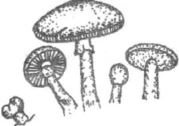
What type of sexual reproduction can be observed in the organism shown in the given figure?
A
Isogamous
B
Anisogamous
C
Oogamous
D
All of the above $(A)$,$(B)$ and $(C)$
Solution
(D) The organism shown in the figure is a mushroom,which belongs to the class Basidiomycetes (Kingdom Fungi). In Basidiomycetes,sexual reproduction occurs through plasmogamy (fusion of two vegetative or somatic cells of different strains or genotypes),followed by karyogamy and meiosis. However,they do not produce typical motile gametes. In the context of general fungal classification and their evolutionary history,different groups exhibit different modes of sexual reproduction. Since the question asks about the organism shown (a fungus),and considering the options provided,it is important to note that fungi exhibit a wide range of sexual reproduction types across different classes. However,for Basidiomycetes specifically,the fusion of somatic cells is the primary mode. Given the options,this question is often interpreted in a broader biological context where fungi can exhibit isogamy,anisogamy,or oogamy depending on the specific group being discussed. Therefore,all these types can be observed within the kingdom Fungi.
0 likes
View Solution121
MediumMCQ
Identify the mismatched pair from the following:
A
Volvox - Colonial alga
B
Slime mold - Protista
C
Sargassum - Schizophyta
D
Lichen - Symbiotic association
Solution
(C) The correct answer is $C$.
$Sargassum$ is a genus of brown algae belonging to the class $Phaeophyceae$,not $Schizophyta$.
$Volvox$ is a colonial green alga.
$Slime$ $molds$ are classified under the kingdom $Protista$.
$Lichens$ represent a symbiotic association between algae and fungi.
$Sargassum$ is a genus of brown algae belonging to the class $Phaeophyceae$,not $Schizophyta$.
$Volvox$ is a colonial green alga.
$Slime$ $molds$ are classified under the kingdom $Protista$.
$Lichens$ represent a symbiotic association between algae and fungi.
0 likes
View Solution122
MediumMCQ
Match the following plants/organisms with their respective groups and select the correct option:
| Organism/Plant | Group |
| $A$. Dinoflagellates,Euglenoids | $a$. Cyanobacteria |
| $B$. Anabaena,Nostoc | $b$. Bryophytes |
| $C$. Thuja,Bennettites | $c$. Protista |
| $D$. Funaria,Marchantia | $d$. Gymnosperms |
A
$A-c, B-a, C-d, D-b$
B
$A-a, B-b, C-c, D-d$
C
$A-b, B-c, C-d, D-a$
D
$A-d, B-c, C-b, D-a$
Solution
(A) The correct matching is as follows:
$1$. Dinoflagellates and Euglenoids belong to the kingdom $Protista$.
$2$. Anabaena and Nostoc are examples of $Cyanobacteria$ (Blue-green algae).
$3$. Thuja and Bennettites are classified under $Gymnosperms$.
$4$. Funaria and Marchantia are examples of $Bryophytes$.
Therefore,the correct sequence is $A-c, B-a, C-d, D-b$.
$1$. Dinoflagellates and Euglenoids belong to the kingdom $Protista$.
$2$. Anabaena and Nostoc are examples of $Cyanobacteria$ (Blue-green algae).
$3$. Thuja and Bennettites are classified under $Gymnosperms$.
$4$. Funaria and Marchantia are examples of $Bryophytes$.
Therefore,the correct sequence is $A-c, B-a, C-d, D-b$.
0 likes
View Solution123
MediumMCQ
Match the following columns and select the correct option:
| Column-$I$ | Column-$II$ |
|---|---|
| $(1)$ Eichler | $(a)$ Classified dicots into $3$ groups. |
| $(2)$ Linnaeus | $(b)$ Classified organisms into $3$ domains. |
| $(3)$ Woese | $(c)$ Classified plants into $2$ groups. |
| $(4)$ Bentham and Hooker | $(d)$ Classified plants into $24$ classes. |
A
$(1-b), (2-c), (3-a), (4-d)$
B
$(1-c), (2-d), (3-b), (4-a)$
C
$(1-d), (2-a), (3-c), (4-b)$
D
$(1-c), (2-a), (3-d), (4-b)$
Solution
(B) The correct matching is as follows:
$(1)$ Eichler classified plants into $2$ groups (Cryptogams and Phanerogams),so $(1-c)$.
$(2)$ Linnaeus classified plants into $24$ classes based on stamens,so $(2-d)$.
$(3)$ Woese proposed the $3$-domain system of classification,so $(3-b)$.
$(4)$ Bentham and Hooker classified dicots into $3$ groups (Polypetalae,Gamopetalae,and Monochlamydeae),so $(4-a)$.
Thus,the correct sequence is $(1-c), (2-d), (3-b), (4-a)$.
$(1)$ Eichler classified plants into $2$ groups (Cryptogams and Phanerogams),so $(1-c)$.
$(2)$ Linnaeus classified plants into $24$ classes based on stamens,so $(2-d)$.
$(3)$ Woese proposed the $3$-domain system of classification,so $(3-b)$.
$(4)$ Bentham and Hooker classified dicots into $3$ groups (Polypetalae,Gamopetalae,and Monochlamydeae),so $(4-a)$.
Thus,the correct sequence is $(1-c), (2-d), (3-b), (4-a)$.
0 likes
View Solution124
MediumMCQ
Identify the mismatched pair from the following.
A
Presence of rigid cell wall - Monera
B
Cell wall made of chitin - Multicellular decomposer kingdom
C
Cell wall made of cellulose - Multicellular producer kingdom
D
Cell wall made of peptidoglycan - Archaebacteria
Solution
(D) The correct answer is $D$.
$1$. Monera includes bacteria which possess a rigid cell wall.
$2$. Fungi (multicellular decomposers) have cell walls composed of chitin.
$3$. Plantae (multicellular producers) have cell walls composed of cellulose.
$4$. Archaebacteria are unique because their cell walls lack peptidoglycan; instead,they contain pseudomurein or other proteins/polysaccharides. Therefore,the pair 'Cell wall made of peptidoglycan - Archaebacteria' is mismatched.
$1$. Monera includes bacteria which possess a rigid cell wall.
$2$. Fungi (multicellular decomposers) have cell walls composed of chitin.
$3$. Plantae (multicellular producers) have cell walls composed of cellulose.
$4$. Archaebacteria are unique because their cell walls lack peptidoglycan; instead,they contain pseudomurein or other proteins/polysaccharides. Therefore,the pair 'Cell wall made of peptidoglycan - Archaebacteria' is mismatched.
0 likes
View Solution125
MediumMCQ
Select the correct option for the matching of scientists and their research:
| Scientists | Research |
| $(1)$ Thallassane | $(a)$ Father of Modern Phycology |
| $(2)$ Ivanowsky | $(b)$ First discovery of Lichen |
| $(3)$ Rothmaler | $(c)$ Discovered $TMV$ |
| $(4)$ Prof. Iyengar | $(d)$ Divided Bryophytes into three classes |
A
$1-b, 2-c, 3-d, 4-a$
B
$1-b, 2-a, 3-c, 4-d$
C
$1-c, 2-d, 3-a, 4-b$
D
$1-b, 2-d, 3-c, 4-a$
Solution
$(A)$ The correct matching is as follows:
$(1)$ Thallassane: $(b)$ First discovery of Lichen.
$(2)$ Ivanowsky: $(c)$ Discovered $TMV$ (Tobacco Mosaic Virus).
$(3)$ Rothmaler: $(d)$ Divided Bryophytes into three classes.
$(4)$ Prof. Iyengar: $(a)$ Father of Modern Phycology (Indian Phycology).
Therefore, the correct sequence is $1-b, 2-c, 3-d, 4-a$.
$(1)$ Thallassane: $(b)$ First discovery of Lichen.
$(2)$ Ivanowsky: $(c)$ Discovered $TMV$ (Tobacco Mosaic Virus).
$(3)$ Rothmaler: $(d)$ Divided Bryophytes into three classes.
$(4)$ Prof. Iyengar: $(a)$ Father of Modern Phycology (Indian Phycology).
Therefore, the correct sequence is $1-b, 2-c, 3-d, 4-a$.
0 likes
View Solution126
EasyMCQ
Who among the following did not propose a system of classification?
A
Bentham
B
Robert Brown
C
Aristotle
D
Whittaker
Solution
(B) Aristotle proposed the earliest scientific classification based on simple morphological characters. Bentham and Hooker proposed a natural system of classification for seed plants. $R$.$H$. Whittaker proposed the Five Kingdom classification system. Robert Brown is famous for the discovery of the cell nucleus and his work on plant embryology and taxonomy,but he did not propose a formal system of biological classification.
0 likes
View Solution127
EasyMCQ
What is the main basis of classification in the Five Kingdom system?
A
Amount of free energy
B
Mode of nutrition
C
Structure of cell wall
D
Asexual reproduction
Solution
(B) The Five Kingdom system of classification was proposed by $R.H. Whittaker$ in $1969$. The main criteria used by him for classification include cell structure,body organization,mode of nutrition,reproduction,and phylogenetic relationships. Among these,the mode of nutrition is considered a primary and fundamental basis for distinguishing between the kingdoms (e.g.,autotrophic vs. heterotrophic).
0 likes
View Solution128
EasyMCQ
Which classification system of organisms was proposed by $R.H. Whittaker$?
A
Five-kingdom classification
B
Two-kingdom classification
C
Modern classification
D
Biochemical classification
Solution
(A) $R.H. Whittaker$ proposed the $Five-Kingdom$ classification system in $1969$. The five kingdoms proposed were $Monera$,$Protista$,$Fungi$,$Plantae$,and $Animalia$. This system is based on criteria such as cell structure,body organization,mode of nutrition,reproduction,and phylogenetic relationships.
0 likes
View Solution129
MediumMCQ
Which one of the following statements is wrong?
A
Eubacteria are also called false bacteria.
B
Phycomycetes are also called algal fungi.
C
Cyanobacteria are also called blue-green algae.
D
Golden algae are also called desmids.
Solution
(A) The correct answer is $A$.
$A$: Eubacteria are known as 'true bacteria',not 'false bacteria'. Therefore,this statement is incorrect.
$B$: Phycomycetes are commonly referred to as 'algal fungi' because their mycelium is aseptate and coenocytic,resembling algae.
$C$: Cyanobacteria are photosynthetic prokaryotes commonly known as 'blue-green algae'.
$D$: Golden algae (Chrysophytes) include diatoms and desmids.
$A$: Eubacteria are known as 'true bacteria',not 'false bacteria'. Therefore,this statement is incorrect.
$B$: Phycomycetes are commonly referred to as 'algal fungi' because their mycelium is aseptate and coenocytic,resembling algae.
$C$: Cyanobacteria are photosynthetic prokaryotes commonly known as 'blue-green algae'.
$D$: Golden algae (Chrysophytes) include diatoms and desmids.
0 likes
View Solution130
MediumMCQ
The five kingdom system of classification suggested by $R.H. Whittaker$ is not based on:
A
Presence or absence of a well-defined nucleus
B
Mode of reproduction
C
Mode of nutrition
D
Complexity of body organization
Solution
(B) $R.H. Whittaker$ proposed the five kingdom system of classification based on the following criteria:
$1$. Complexity of cell structure (prokaryotic vs. eukaryotic).
$2$. Complexity of body organization (unicellular vs. multicellular).
$3$. Mode of nutrition (autotrophic vs. heterotrophic).
$4$. Ecological lifestyle.
$5$. Phylogenetic relationships.
Mode of reproduction was not a primary criterion used in this system. Therefore,the correct option is $B$.
$1$. Complexity of cell structure (prokaryotic vs. eukaryotic).
$2$. Complexity of body organization (unicellular vs. multicellular).
$3$. Mode of nutrition (autotrophic vs. heterotrophic).
$4$. Ecological lifestyle.
$5$. Phylogenetic relationships.
Mode of reproduction was not a primary criterion used in this system. Therefore,the correct option is $B$.
0 likes
View Solution131
MediumMCQ
Select the correct combination of the statements $(i-iv)$ regarding the characteristics of certain organisms.
$(i)$ Methanogens are archaebacteria which produce methane in marshy areas.
$(ii)$ Nostoc is a filamentous blue-green alga which fixes atmospheric nitrogen.
$(iii)$ Chemosynthetic autotrophic bacteria synthesize cellulose from glucose.
$(iv)$ Mycoplasma lack a cell wall and can survive without oxygen.
The correct statements are:
$(i)$ Methanogens are archaebacteria which produce methane in marshy areas.
$(ii)$ Nostoc is a filamentous blue-green alga which fixes atmospheric nitrogen.
$(iii)$ Chemosynthetic autotrophic bacteria synthesize cellulose from glucose.
$(iv)$ Mycoplasma lack a cell wall and can survive without oxygen.
The correct statements are:
A
$(ii)$ and $(iii)$
B
$(i), (ii)$ and $(iii)$
C
$(ii), (iii)$ and $(iv)$
D
$(i), (ii)$ and $(iv)$
Solution
(D) Statement $(i)$ is correct: Methanogens are archaebacteria found in marshy areas that produce methane $(CH_4)$.
Statement $(ii)$ is correct: Nostoc is a filamentous cyanobacterium (blue-green alga) that possesses heterocysts for atmospheric nitrogen fixation.
Statement $(iii)$ is incorrect: Chemosynthetic autotrophic bacteria oxidize inorganic substances (like nitrates,nitrites,or ammonia) to produce $ATP$ for energy,not to synthesize cellulose from glucose.
Statement $(iv)$ is correct: Mycoplasma are the smallest living cells,lack a cell wall,and are facultative anaerobes,meaning they can survive without oxygen.
Therefore,statements $(i), (ii),$ and $(iv)$ are correct.
Statement $(ii)$ is correct: Nostoc is a filamentous cyanobacterium (blue-green alga) that possesses heterocysts for atmospheric nitrogen fixation.
Statement $(iii)$ is incorrect: Chemosynthetic autotrophic bacteria oxidize inorganic substances (like nitrates,nitrites,or ammonia) to produce $ATP$ for energy,not to synthesize cellulose from glucose.
Statement $(iv)$ is correct: Mycoplasma are the smallest living cells,lack a cell wall,and are facultative anaerobes,meaning they can survive without oxygen.
Therefore,statements $(i), (ii),$ and $(iv)$ are correct.
0 likes
View Solution132
MediumMCQ
How many organisms in the list given below are autotrophs?
Lactobacillus,Nostoc,Chara,Nitrosomonas,Nitrobacter,Streptomyces,Saccharomyces,Trypanosoma,Porphyra,Wolffia
Lactobacillus,Nostoc,Chara,Nitrosomonas,Nitrobacter,Streptomyces,Saccharomyces,Trypanosoma,Porphyra,Wolffia
A
Four
B
Five
C
Six
D
Three
Solution
(C) Autotrophic nutrition involves the manufacture of organic materials from inorganic raw materials using energy obtained from external sources. It is of two types: chemosynthesis and photosynthesis.
$1$. Chemoautotrophs: Organisms that manufacture organic food from inorganic raw materials using energy derived from exergonic chemical reactions. In the given list,$Nitrosomonas$ and $Nitrobacter$ are chemoautotrophic nitrifying bacteria.
$2$. Photoautotrophs: Organisms that manufacture organic compounds from inorganic raw materials using solar energy in the presence of photosynthetic pigments. In the given list,$Nostoc$ (cyanobacteria),$Chara$ (algae),$Porphyra$ (algae),and $Wolffia$ (angiosperm) are photoautotrophs.
Total autotrophs = $2$ (chemoautotrophs) + $4$ (photoautotrophs) = $6$.
Therefore,the correct option is $C$.
$1$. Chemoautotrophs: Organisms that manufacture organic food from inorganic raw materials using energy derived from exergonic chemical reactions. In the given list,$Nitrosomonas$ and $Nitrobacter$ are chemoautotrophic nitrifying bacteria.
$2$. Photoautotrophs: Organisms that manufacture organic compounds from inorganic raw materials using solar energy in the presence of photosynthetic pigments. In the given list,$Nostoc$ (cyanobacteria),$Chara$ (algae),$Porphyra$ (algae),and $Wolffia$ (angiosperm) are photoautotrophs.
Total autotrophs = $2$ (chemoautotrophs) + $4$ (photoautotrophs) = $6$.
Therefore,the correct option is $C$.
0 likes
View Solution133
MediumMCQ
Which one of the following is a wrong statement?
A
$Anabaena$ and $Nostoc$ are capable of fixing nitrogen in a free-living state also.
B
Root nodule forming nitrogen fixers live as aerobes under free-living conditions.
C
Vitamin is a constituent of cell membranes,certain nucleic acids,and cell proteins.
D
$Nitrosomonas$ and $Nitrobacter$ are chemoautotrophs.
Solution
(C) The statement in option $C$ is incorrect because vitamins are organic compounds required in small quantities for normal health and metabolism,but they are not structural constituents of cell membranes,nucleic acids,or proteins. Phospholipids,proteins,and cholesterol are the main constituents of cell membranes. Nucleic acids are composed of nucleotides (sugar,phosphate,and nitrogenous base). Proteins are composed of amino acids. $Anabaena$ and $Nostoc$ are cyanobacteria that fix nitrogen in both symbiotic and free-living states. Root nodule bacteria like $Rhizobium$ are aerobic when free-living in the soil. $Nitrosomonas$ and $Nitrobacter$ are classic examples of chemoautotrophic bacteria that derive energy from the oxidation of inorganic substances.
0 likes
View Solution134
MediumMCQ
Identify the odd one out:
A
Nostoc
B
Methanogens
C
Anabaena
D
Euglena
Solution
(D) The correct answer is $D$ (Euglena).
$Nostoc$,$Methanogens$,and $Anabaena$ are all prokaryotic organisms belonging to the Kingdom $Monera$.
$Nostoc$ and $Anabaena$ are cyanobacteria,while $Methanogens$ are archaebacteria.
$Euglena$ is a eukaryotic organism belonging to the Kingdom $Protista$ (specifically under the group $Euglenoids$).
$Nostoc$,$Methanogens$,and $Anabaena$ are all prokaryotic organisms belonging to the Kingdom $Monera$.
$Nostoc$ and $Anabaena$ are cyanobacteria,while $Methanogens$ are archaebacteria.
$Euglena$ is a eukaryotic organism belonging to the Kingdom $Protista$ (specifically under the group $Euglenoids$).
0 likes
View Solution135
MediumMCQ
Identify the odd one out from the given groups based on their biological classification.
A
Porphyra,Ustilago,Gelidium
B
Laminaria,Sargassum,Porphyra,Chlorella,Spirulina
C
Gracilaria,Sargassum,Agaricus
D
Laminaria,Albugo,Gelidium,Trichoderma
Solution
(B) To identify the odd one,we must classify each organism:
$1$. $Porphyra$ (Red Algae),$Ustilago$ (Fungi),$Gelidium$ (Red Algae). This group is mixed.
$2$. $Laminaria$ (Brown Algae),$Sargassum$ (Brown Algae),$Porphyra$ (Red Algae),$Chlorella$ (Green Algae),$Spirulina$ (Cyanobacteria). This group is mixed.
$3$. $Gracilaria$ (Red Algae),$Sargassum$ (Brown Algae),$Agaricus$ (Fungi). This group is mixed.
$4$. $Laminaria$ (Brown Algae),$Albugo$ (Fungi),$Gelidium$ (Red Algae),$Trichoderma$ (Fungi). This group is mixed.
However,if we look for a group containing only algae,option $B$ is the most diverse but contains only photosynthetic organisms (Algae and Cyanobacteria),whereas the others contain Fungi. Thus,option $B$ is the odd one out as it does not contain any Fungi.
$1$. $Porphyra$ (Red Algae),$Ustilago$ (Fungi),$Gelidium$ (Red Algae). This group is mixed.
$2$. $Laminaria$ (Brown Algae),$Sargassum$ (Brown Algae),$Porphyra$ (Red Algae),$Chlorella$ (Green Algae),$Spirulina$ (Cyanobacteria). This group is mixed.
$3$. $Gracilaria$ (Red Algae),$Sargassum$ (Brown Algae),$Agaricus$ (Fungi). This group is mixed.
$4$. $Laminaria$ (Brown Algae),$Albugo$ (Fungi),$Gelidium$ (Red Algae),$Trichoderma$ (Fungi). This group is mixed.
However,if we look for a group containing only algae,option $B$ is the most diverse but contains only photosynthetic organisms (Algae and Cyanobacteria),whereas the others contain Fungi. Thus,option $B$ is the odd one out as it does not contain any Fungi.
0 likes
View Solution136
MediumMCQ
Select the correct option for the following sequence:
Archaebacteria $-$ Eubacteria $-$ Flagellated protozoans $-$ Sporozoans
Archaebacteria $-$ Eubacteria $-$ Flagellated protozoans $-$ Sporozoans
A
Thermoacidophiles $-$ Methanogens $-$ Anabaena $-$ Euglena
B
Anabaena $-$ Halophiles $-$ Plasmodium $-$ Trypanosoma
C
Methanogens $-$ Anabaena $-$ Trypanosoma $-$ Plasmodium
D
Paramoecium $-$ Amoeba $-$ Anabaena $-$ Methanogen
Solution
(C) The correct sequence is as follows:
$1$. Archaebacteria: Methanogens are a type of archaebacteria.
$2$. Eubacteria: Anabaena is a cyanobacterium,which belongs to eubacteria.
$3$. Flagellated protozoans: Trypanosoma is a well-known flagellated protozoan.
$4$. Sporozoans: Plasmodium is a classic example of a sporozoan.
Therefore,the correct sequence is Methanogens $-$ Anabaena $-$ Trypanosoma $-$ Plasmodium.
$1$. Archaebacteria: Methanogens are a type of archaebacteria.
$2$. Eubacteria: Anabaena is a cyanobacterium,which belongs to eubacteria.
$3$. Flagellated protozoans: Trypanosoma is a well-known flagellated protozoan.
$4$. Sporozoans: Plasmodium is a classic example of a sporozoan.
Therefore,the correct sequence is Methanogens $-$ Anabaena $-$ Trypanosoma $-$ Plasmodium.
0 likes
View Solution137
MediumMCQ
Identify the odd one out.
A
Plasmodium - parasites
B
Entamoeba - parasites
C
Algae + fungi - lichens
D
Basidiomycetes - morels
Solution
(D) The correct answer is $D$.
$Plasmodium$ is a well-known parasite.
$Entamoeba$ is also a parasite.
Lichens represent a symbiotic association between algae and fungi.
Morels belong to the class $Ascomycetes$,not $Basidiomycetes$. Therefore,the pair $Basidiomycetes - morels$ is incorrect and is the odd one out.
$Plasmodium$ is a well-known parasite.
$Entamoeba$ is also a parasite.
Lichens represent a symbiotic association between algae and fungi.
Morels belong to the class $Ascomycetes$,not $Basidiomycetes$. Therefore,the pair $Basidiomycetes - morels$ is incorrect and is the odd one out.
0 likes
View Solution138
MediumMCQ
Arrange the following microbes/organisms in ascending order according to their complexity of body (from simple to complex):
$a$ - animal,$b$ - viroids,$c$ - bacteria,$d$ - virus,$e$ - algae.
$a$ - animal,$b$ - viroids,$c$ - bacteria,$d$ - virus,$e$ - algae.
A
$a-c-b-d-e$
B
$b-d-c-e-a$
C
$c-a-d-b-e$
D
$e-d-c-a-b$
Solution
(B) To arrange these organisms in ascending order of complexity (from simple to complex),we analyze their biological structure:
$1$. $b$ - Viroids: These are the simplest infectious agents,consisting only of a short strand of circular single-stranded $RNA$ without a protein coat.
$2$. $d$ - Virus: These are slightly more complex than viroids,consisting of genetic material ($DNA$ or $RNA$) enclosed in a protein coat (capsid).
$3$. $c$ - Bacteria: These are unicellular prokaryotic organisms with a complex cell wall and cellular machinery.
$4$. $e$ - Algae: These are eukaryotic organisms,which are more complex than prokaryotes due to the presence of membrane-bound organelles and a nucleus.
$5$. $a$ - Animal: These are multicellular,complex eukaryotic organisms with specialized tissues and organ systems.
Therefore,the correct order is $b-d-c-e-a$.
$1$. $b$ - Viroids: These are the simplest infectious agents,consisting only of a short strand of circular single-stranded $RNA$ without a protein coat.
$2$. $d$ - Virus: These are slightly more complex than viroids,consisting of genetic material ($DNA$ or $RNA$) enclosed in a protein coat (capsid).
$3$. $c$ - Bacteria: These are unicellular prokaryotic organisms with a complex cell wall and cellular machinery.
$4$. $e$ - Algae: These are eukaryotic organisms,which are more complex than prokaryotes due to the presence of membrane-bound organelles and a nucleus.
$5$. $a$ - Animal: These are multicellular,complex eukaryotic organisms with specialized tissues and organ systems.
Therefore,the correct order is $b-d-c-e-a$.
0 likes
View Solution139
MediumMCQ
Which one single organism or the pair of organisms is correctly assigned to its taxonomic group?
A
$Paramoecium$ and $Plasmodium$ belong to the same kingdom as that of $Penicillium$.
B
Lichen is a composite organism formed from the symbiotic association of an algae and a protozoan.
C
Yeast used in making bread and beer is a fungus.
D
$Nostoc$ and $Anabaena$ are examples of Protista.
Solution
(C) $Paramoecium$ and $Plasmodium$ are Protists,while $Penicillium$ is a Fungus. Thus,option $A$ is incorrect.
Lichens are symbiotic associations between algae (phycobiont) and fungi (mycobiont),not protozoans. Thus,option $B$ is incorrect.
Yeast ($Saccharomyces$ $cerevisiae$) is a unicellular fungus used in the fermentation process for bread and beer production. Thus,option $C$ is correct.
$Nostoc$ and $Anabaena$ are cyanobacteria (blue-green algae) belonging to the kingdom Monera,not Protista. Thus,option $D$ is incorrect.
Lichens are symbiotic associations between algae (phycobiont) and fungi (mycobiont),not protozoans. Thus,option $B$ is incorrect.
Yeast ($Saccharomyces$ $cerevisiae$) is a unicellular fungus used in the fermentation process for bread and beer production. Thus,option $C$ is correct.
$Nostoc$ and $Anabaena$ are cyanobacteria (blue-green algae) belonging to the kingdom Monera,not Protista. Thus,option $D$ is incorrect.
0 likes
View Solution140
MediumMCQ
Which of the following statements is true for the animal kingdom but not true for fungi?
A
Asexual reproduction occurs through conidia
B
Food storage is in the form of glycogen or fat
C
Thallus is branched and septate
D
Germ cells are always isogamous
Solution
(B) In the biological classification,animals and fungi share some characteristics but differ in others.
$1$. Fungi store food as glycogen or oil droplets,whereas animals store food as glycogen or fat.
$2$. However,the specific mode of food storage as 'glycogen or fat' is a characteristic feature of the animal kingdom.
$3$. Fungi typically reproduce via spores (like conidia),have a branched and septate thallus (in many groups),and their gametes can vary (isogamous,anisogamous,or oogamous).
$4$. Therefore,the statement 'Food storage is in the form of glycogen or fat' is a defining characteristic of animals,while fungi primarily store food as glycogen or oil.
$1$. Fungi store food as glycogen or oil droplets,whereas animals store food as glycogen or fat.
$2$. However,the specific mode of food storage as 'glycogen or fat' is a characteristic feature of the animal kingdom.
$3$. Fungi typically reproduce via spores (like conidia),have a branched and septate thallus (in many groups),and their gametes can vary (isogamous,anisogamous,or oogamous).
$4$. Therefore,the statement 'Food storage is in the form of glycogen or fat' is a defining characteristic of animals,while fungi primarily store food as glycogen or oil.
0 likes
View Solution141
MediumMCQ
Plant decomposers are
A
Monera and fungi
B
Fungi and plants
C
Protista and animalia
D
Animalia and monera
Solution
(A) Decomposers are organisms that break down dead or decaying organic matter. In the biological world,the primary decomposers are bacteria (Kingdom $Monera$) and fungi (Kingdom $Fungi$). They secrete digestive enzymes onto the organic material and absorb the nutrients,playing a crucial role in nutrient cycling in ecosystems.
0 likes
View Solution142
MediumMCQ
How many organisms in the list given below show autotrophic nutrition method?
$Lactobacillus, Nostoc, Chara, Wolffia, Nitrosomonas, Nitrobacter, Porphyra, Streptococcus, Saccharomyces, Trypanosoma$
$Lactobacillus, Nostoc, Chara, Wolffia, Nitrosomonas, Nitrobacter, Porphyra, Streptococcus, Saccharomyces, Trypanosoma$
A
Four
B
Five
C
Six
D
Three
Solution
(C) Autotrophic organisms synthesize their own food using inorganic substances.
From the given list,the autotrophic organisms are:
$1$. $Nostoc$ (Photoautotroph - Cyanobacteria)
$2$. $Chara$ (Photoautotroph - Algae)
$3$. $Wolffia$ (Photoautotroph - Angiosperm)
$4$. $Porphyra$ (Photoautotroph - Algae)
$5$. $Nitrosomonas$ (Chemoautotroph - Bacteria)
$6$. $Nitrobacter$ (Chemoautotroph - Bacteria)
The other organisms $(Lactobacillus, Streptococcus, Saccharomyces, Trypanosoma)$ are heterotrophs,as they rely on organic compounds for nutrition.
Therefore,there are a total of $6$ autotrophic organisms in the list.
From the given list,the autotrophic organisms are:
$1$. $Nostoc$ (Photoautotroph - Cyanobacteria)
$2$. $Chara$ (Photoautotroph - Algae)
$3$. $Wolffia$ (Photoautotroph - Angiosperm)
$4$. $Porphyra$ (Photoautotroph - Algae)
$5$. $Nitrosomonas$ (Chemoautotroph - Bacteria)
$6$. $Nitrobacter$ (Chemoautotroph - Bacteria)
The other organisms $(Lactobacillus, Streptococcus, Saccharomyces, Trypanosoma)$ are heterotrophs,as they rely on organic compounds for nutrition.
Therefore,there are a total of $6$ autotrophic organisms in the list.
0 likes
View Solution143
EasyMCQ
Which of the following statements is incorrect?
A
Golden algae are also called desmids.
B
Eubacteria are also called false bacteria.
C
Phycomycetes are also called algal fungi.
D
Cyanobacteria are also called blue-green algae.
Solution
(B) The statement '$Eubacteria$ are also called false bacteria' is incorrect.
$Eubacteria$ are known as 'true bacteria' because they possess a rigid cell wall and,if motile,a flagellum.
$Chrysophytes$ (which include diatoms and golden algae or desmids) are correctly named.
$Phycomycetes$ are commonly referred to as 'algal fungi' due to their filamentous body structure.
$Cyanobacteria$ are photosynthetic autotrophs commonly known as 'blue-green algae'.
$Eubacteria$ are known as 'true bacteria' because they possess a rigid cell wall and,if motile,a flagellum.
$Chrysophytes$ (which include diatoms and golden algae or desmids) are correctly named.
$Phycomycetes$ are commonly referred to as 'algal fungi' due to their filamentous body structure.
$Cyanobacteria$ are photosynthetic autotrophs commonly known as 'blue-green algae'.
0 likes
View Solution144
EasyMCQ
Identify the incorrect statement.
A
Cell wall is absent in animal kingdom.
B
Protista includes both photosynthetic and heterotrophic modes of nutrition.
C
Some fungi are edible.
D
Nuclear membrane is present in Monera.
Solution
(D) The kingdom $Monera$ consists of prokaryotic organisms. $A$ defining characteristic of prokaryotes is the absence of a well-defined nucleus and membrane-bound organelles,including the nuclear membrane. Therefore,the statement that 'Nuclear membrane is present in Monera' is incorrect. In contrast,animals lack a cell wall,Protists exhibit diverse nutritional modes (photosynthetic,heterotrophic,etc.),and certain fungi (like mushrooms) are edible.
0 likes
View Solution145
EasyMCQ
Which of the following are considered as the decomposers of the plant kingdom?
A
Monera and Fungi
B
Fungi and Plants
C
Protista and Animalia
D
Animalia and Monera
Solution
(A) Decomposers are organisms that break down dead or decaying organic matter. In the biological classification system,$Monera$ (specifically certain bacteria) and $Fungi$ are the primary decomposers in the ecosystem. $Fungi$ are heterotrophic organisms that absorb nutrients from dead organic matter,while many bacteria in the kingdom $Monera$ act as saprophytes,playing a crucial role in nutrient cycling.
0 likes
View Solution146
EasyMCQ
Match Column $- I$ with Column $- II.$
Choose the correct answer from the options given below:
| Column $- I$ | Column $- II$ |
| $(a)$ Saprophyte | $(i)$ Symbiotic association of fungi with plant roots |
| $(b)$ Parasite | $(ii)$ Decomposition of dead organic materials |
| $(c)$ Lichens | $(iii)$ Living on living plants or animals |
| $(d)$ Mycorrhiza | $(iv)$ Symbiotic association of algae and fungi |
Choose the correct answer from the options given below:
A
$(i), (ii), (iii), (iv)$
B
$(iii), (ii), (i), (iv)$
C
$(ii), (i), (iii), (iv)$
D
$(ii), (iii), (iv), (i)$
Solution
(D) The correct matches are as follows:
$(a)$ Saprophyte: Organisms that obtain nutrients from dead and decaying organic matter,leading to the decomposition of dead organic materials $(ii)$.
$(b)$ Parasite: Organisms that live on or inside other living organisms (hosts) and derive nutrients from them,thus living on living plants or animals $(iii)$.
$(c)$ Lichens: These represent a symbiotic association between algae (phycobiont) and fungi (mycobiont) $(iv)$.
$(d)$ Mycorrhiza: This is a symbiotic association of fungi with the roots of higher plants $(i)$.
Therefore,the correct sequence is $(a)-(ii), (b)-(iii), (c)-(iv), (d)-(i)$.
$(a)$ Saprophyte: Organisms that obtain nutrients from dead and decaying organic matter,leading to the decomposition of dead organic materials $(ii)$.
$(b)$ Parasite: Organisms that live on or inside other living organisms (hosts) and derive nutrients from them,thus living on living plants or animals $(iii)$.
$(c)$ Lichens: These represent a symbiotic association between algae (phycobiont) and fungi (mycobiont) $(iv)$.
$(d)$ Mycorrhiza: This is a symbiotic association of fungi with the roots of higher plants $(i)$.
Therefore,the correct sequence is $(a)-(ii), (b)-(iii), (c)-(iv), (d)-(i)$.
0 likes
View Solution147
MediumMCQ
The system of classification based on evolutionary and genetic relationships among organisms,ignoring the morphological similarities or differences,is called
A
cladistics
B
phenetics
C
classical systematics
D
new systematics
Solution
(A) Cladistics is a method of classification that groups organisms based on shared derived characteristics (synapomorphies) that can be traced to a common ancestor.
It focuses exclusively on evolutionary and genetic relationships,often ignoring superficial morphological similarities or differences that may arise due to convergent evolution.
In contrast,phenetics classifies organisms based on overall morphological similarity,while classical systematics relies heavily on morphological traits.
Therefore,the system described is known as cladistics.
It focuses exclusively on evolutionary and genetic relationships,often ignoring superficial morphological similarities or differences that may arise due to convergent evolution.
In contrast,phenetics classifies organisms based on overall morphological similarity,while classical systematics relies heavily on morphological traits.
Therefore,the system described is known as cladistics.
0 likes
View Solution148
MediumMCQ
Plants are autotrophic. Can you think of some plants that are partially heterotrophic?
A
Pitcher plant $(Nepenthes)$
B
Venus fly trap
C
Bladderwort and sundew
D
All of the above
Solution
(D) Plants typically exhibit an autotrophic mode of nutrition because they contain the chlorophyll pigment,which allows them to synthesize their own food through the process of photosynthesis.
However,certain plants,known as insectivorous plants,are partially heterotrophic.
These plants grow in nitrogen-deficient soils and have evolved specialized mechanisms to capture insects to supplement their diet with essential nitrogenous nutrients.
Examples of such plants include the pitcher plant $(Nepenthes)$,Venus fly trap,bladderwort,and sundew.
However,certain plants,known as insectivorous plants,are partially heterotrophic.
These plants grow in nitrogen-deficient soils and have evolved specialized mechanisms to capture insects to supplement their diet with essential nitrogenous nutrients.
Examples of such plants include the pitcher plant $(Nepenthes)$,Venus fly trap,bladderwort,and sundew.
0 likes
View Solution149
Medium
Differentiate between Kingdom Monera and Kingdom Protista.
Solution
| Kingdom Monera | Kingdom Protista |
|---|---|
| $(1)$ Cell wall is composed of peptidoglycan (in bacteria). | $(1)$ Cell wall,if present,is composed of cellulose or other materials. |
| $(2)$ Respiratory enzymes are associated with the plasma membrane. | $(2)$ Respiratory enzymes are located within mitochondria. |
| $(3)$ Ribosomes are of the $70S$ type. | $(3)$ Ribosomes are of the $80S$ type (cytoplasmic). |
| $(4)$ Organisms are prokaryotic with naked circular $DNA$. | $(4)$ Organisms are eukaryotic with linear $DNA$ enclosed in a nucleus. |
| $(5)$ Extrachromosomal $DNA$ is present as plasmids. | $(5)$ Extrachromosomal $DNA$ is present in organelles like mitochondria and chloroplasts. |
0 likes
View Solution150
MediumMCQ
Differentiate between Kingdom Monera and Kingdom Protista.
A
Monera are prokaryotic; Protista are eukaryotic.
B
Monera lack membrane-bound organelles; Protista possess them.
C
Monera reproduce mainly by fission; Protista reproduce by both asexual and sexual methods.
D
Monera include bacteria; Protista include algae,protozoans,and slime molds.
Solution
(A) The differences between Kingdom Monera and Kingdom Protista are as follows:
$1$. Cell Type: Monera consists of prokaryotic organisms (lacking a defined nucleus),whereas Protista consists of eukaryotic organisms (having a well-defined nucleus).
$2$. Organelles: Membrane-bound organelles like mitochondria,chloroplasts,and endoplasmic reticulum are absent in Monera,but present in Protista.
$3$. Genetic Material: In Monera,the genetic material is a circular $DNA$ (nucleoid) without histones. In Protista,$DNA$ is linear and associated with histone proteins.
$4$. Reproduction: Monera primarily reproduce asexually through binary fission or budding. Protista exhibit both asexual (fission,spores) and sexual (syngamy,conjugation) modes of reproduction.
$5$. Examples: Monera includes bacteria and cyanobacteria. Protista includes organisms like Amoeba,Paramecium,and Euglena.
$1$. Cell Type: Monera consists of prokaryotic organisms (lacking a defined nucleus),whereas Protista consists of eukaryotic organisms (having a well-defined nucleus).
$2$. Organelles: Membrane-bound organelles like mitochondria,chloroplasts,and endoplasmic reticulum are absent in Monera,but present in Protista.
$3$. Genetic Material: In Monera,the genetic material is a circular $DNA$ (nucleoid) without histones. In Protista,$DNA$ is linear and associated with histone proteins.
$4$. Reproduction: Monera primarily reproduce asexually through binary fission or budding. Protista exhibit both asexual (fission,spores) and sexual (syngamy,conjugation) modes of reproduction.
$5$. Examples: Monera includes bacteria and cyanobacteria. Protista includes organisms like Amoeba,Paramecium,and Euglena.
0 likes
View SolutionBiological Classification — Mix Example-Biological Classification · Frequently Asked Questions
1Are these Biological Classification questions useful for JEE and NEET?
Yes. All questions in this section are mapped to JEE Main and NEET exam patterns. Previous year questions from JEE Main, NEET, GUJCET and state-level exams are included with full solutions.
2Can I switch to Hindi or Gujarati for these questions?
Yes. Use the language tabs in the hero section or the sidebar to view the same questions and solutions in English, Hindi or Gujarati.
3How do I generate a question paper from this subtopic?
Use the Vedclass Exam Paper Generator — select the chapter and subtopic, set difficulty, and generate Sets A, B, C, D automatically. First 3 chapters of every subject are free.
Vedclass Products
For Students
Vedclass Test Series
Mock tests in real JEE/NEET style with performance analysis. 5-day free trial.
Start Free TrialFor Teachers
Exam Paper Generator
Generate Set A/B/C/D papers from this chapter in 2 minutes. 3 chapters free.
Try FreeFor Institutes
Online Exam Module
Live online exams with unlimited students, 360° analytics & white-label branding.
See DemoFor Teachers & Institutes
Generate a Biological Classification Exam Paper in 2 Minutes
Select subtopic & difficulty — Sets A, B, C, D auto-generated with No Repeat logic.
First 3 chapters of every subject are free — no payment required.