
A English
Mix Example-Biological Classification Questions in English
Class 11 Biology · Biological Classification · Mix Example-Biological Classification
213+
Questions
English
Language
100%
With Solutions
Showing 50 of 213 questions in English
151
EasyMCQ
What was the primary contribution of $Huz$ $(1978)$ in the field of biological classification?
A
Proposed the $5$-kingdom classification system.
B
Introduced the concept of $3$-domain system.
C
Proposed the $6$-kingdom classification system.
D
Developed the binomial nomenclature system.
Solution
(C) In the history of biological classification,$Huz$ $(1978)$ is recognized for proposing the $6$-kingdom classification system.
This system further divided the kingdom $Monera$ into two separate kingdoms: $Archaebacteria$ and $Eubacteria$,based on their distinct evolutionary and biochemical characteristics.
Therefore,the correct option is $C$.
This system further divided the kingdom $Monera$ into two separate kingdoms: $Archaebacteria$ and $Eubacteria$,based on their distinct evolutionary and biochemical characteristics.
Therefore,the correct option is $C$.
0 likes
View Solution152
Medium
Biological classification is a dynamic and ever-evolving phenomenon which keeps changing with our understanding of life forms. Justify the statement by taking any two examples.
Solution
(N/A) $\rightarrow$ Biological classification is a dynamic process that evolves as our understanding of life forms increases.
$\rightarrow$ Initially, early naturalists like Aristotle, Theophrastus, John Ray, and Linnaeus used simple morphological characters for classification.
$\rightarrow$ For instance, Linnaeus classified plants primarily based on their reproductive organs.
$\rightarrow$ As more scientific knowledge was gathered regarding the structure, cell biology, and evolutionary relationships of organisms, the systems of classification became more natural and complex.
$\rightarrow$ This can be justified by the following examples:
$(i)$ The Two-Kingdom classification system was replaced by the Three-Kingdom system when Ernst Haeckel $(1866)$ proposed the Kingdom Protista to include unicellular organisms.
$(ii)$ Later, the system was expanded to a Four-Kingdom classification by Copeland, who proposed the Kingdom Monera for prokaryotic organisms.
$(iii)$ $R.H. Whittaker$ $(1969)$ further refined this into the Five-Kingdom classification system, which is widely accepted today.
$(iv)$ With advancements in molecular biology and the study of archaebacteria, Carl Woese proposed the Three-Domain system, which further classifies life into Bacteria, Archaea, and Eukarya.
$\rightarrow$ Initially, early naturalists like Aristotle, Theophrastus, John Ray, and Linnaeus used simple morphological characters for classification.
$\rightarrow$ For instance, Linnaeus classified plants primarily based on their reproductive organs.
$\rightarrow$ As more scientific knowledge was gathered regarding the structure, cell biology, and evolutionary relationships of organisms, the systems of classification became more natural and complex.
$\rightarrow$ This can be justified by the following examples:
$(i)$ The Two-Kingdom classification system was replaced by the Three-Kingdom system when Ernst Haeckel $(1866)$ proposed the Kingdom Protista to include unicellular organisms.
$(ii)$ Later, the system was expanded to a Four-Kingdom classification by Copeland, who proposed the Kingdom Monera for prokaryotic organisms.
$(iii)$ $R.H. Whittaker$ $(1969)$ further refined this into the Five-Kingdom classification system, which is widely accepted today.
$(iv)$ With advancements in molecular biology and the study of archaebacteria, Carl Woese proposed the Three-Domain system, which further classifies life into Bacteria, Archaea, and Eukarya.
0 likes
View Solution153
EasyMCQ
Identify the correct terms for the following analogy-based questions:
$(i)$ Algae : Autotrophic :: Fungi : .....
$(ii)$ Prokaryotes : Bacteria :: Eukaryotes : .....
$(i)$ Algae : Autotrophic :: Fungi : .....
$(ii)$ Prokaryotes : Bacteria :: Eukaryotes : .....
A
$(i)$ Heterotrophic,$(ii)$ Paramecium
B
$(i)$ Saprophytic,$(ii)$ Bacteria
C
$(i)$ Autotrophic,$(ii)$ Virus
D
$(i)$ Parasitic,$(ii)$ Mycoplasma
Solution
(A) $(i)$ Algae are autotrophic organisms that produce their own food via photosynthesis. Fungi are heterotrophic organisms that obtain nutrients by absorbing organic matter.
$(ii)$ Prokaryotes are organisms lacking a membrane-bound nucleus,such as bacteria. Eukaryotes are organisms with a membrane-bound nucleus,such as Paramecium.
$(ii)$ Prokaryotes are organisms lacking a membrane-bound nucleus,such as bacteria. Eukaryotes are organisms with a membrane-bound nucleus,such as Paramecium.
0 likes
View Solution154
Difficult
Mention the merits and demerits of the five-kingdom classification system.
Solution
(N/A) $\Rightarrow$ Merits of the five-kingdom classification system:
$1$. It separates prokaryotes (Kingdom $Monera$) from eukaryotes (Kingdoms $Protista$,$Fungi$,$Plantae$,and $Animalia$).
$2$. It places unicellular and multicellular organisms into separate groups,unlike the two-kingdom system.
$3$. $Fungi$ are placed in a separate kingdom due to their unique biochemical,physiological,and structural organization.
$4$. It provides a more logical placement for organisms like $Euglena$,which share characteristics of both plants and animals,by placing them in Kingdom $Protista$.
$5$. The $Plantae$ and $Animalia$ kingdoms are more homogenous compared to the two-kingdom system.
$\Rightarrow$ Demerits of the five-kingdom classification system:
$1$. Kingdom $Protista$ is a heterogeneous group that includes organisms with diverse characteristics,such as $Chlamydomonas$ (with cell walls) and $Amoeba$ (without cell walls).
$2$. It does not provide a clear or proper place for viruses,viroids,and lichens.
$3$. $Yeasts$ are unicellular eukaryotes but are not included in Kingdom $Protista$.
$4$. The classification criteria are still debated for organisms with flexible lifestyles,such as slime moulds.
$1$. It separates prokaryotes (Kingdom $Monera$) from eukaryotes (Kingdoms $Protista$,$Fungi$,$Plantae$,and $Animalia$).
$2$. It places unicellular and multicellular organisms into separate groups,unlike the two-kingdom system.
$3$. $Fungi$ are placed in a separate kingdom due to their unique biochemical,physiological,and structural organization.
$4$. It provides a more logical placement for organisms like $Euglena$,which share characteristics of both plants and animals,by placing them in Kingdom $Protista$.
$5$. The $Plantae$ and $Animalia$ kingdoms are more homogenous compared to the two-kingdom system.
$\Rightarrow$ Demerits of the five-kingdom classification system:
$1$. Kingdom $Protista$ is a heterogeneous group that includes organisms with diverse characteristics,such as $Chlamydomonas$ (with cell walls) and $Amoeba$ (without cell walls).
$2$. It does not provide a clear or proper place for viruses,viroids,and lichens.
$3$. $Yeasts$ are unicellular eukaryotes but are not included in Kingdom $Protista$.
$4$. The classification criteria are still debated for organisms with flexible lifestyles,such as slime moulds.
0 likes
View Solution155
Easy
Definitions / Explanation :
$(i)$ Autotrophic Nutrition
$(ii)$ Parasitic Nutrition
$(i)$ Autotrophic Nutrition
$(ii)$ Parasitic Nutrition
Solution
(N/A) $(i)$ Autotrophic Nutrition: Organisms that possess chlorophyll,such as green plants,can synthesize their own organic food from simple inorganic substances like carbon dioxide and water using light energy. This process is known as autotrophic nutrition,and such organisms are called autotrophs.
$(ii)$ Parasitic Nutrition: Organisms that depend on other living plants or animals (hosts) for their nutrition without killing them immediately are called parasites. This mode of nutrition,where the parasite derives nutrients directly from the host's body,is known as parasitic nutrition.
$(ii)$ Parasitic Nutrition: Organisms that depend on other living plants or animals (hosts) for their nutrition without killing them immediately are called parasites. This mode of nutrition,where the parasite derives nutrients directly from the host's body,is known as parasitic nutrition.
0 likes
View Solution156
MediumMCQ
What was the major contribution of the scientists George Bentham and Joseph Dalton Hooker $(1817-1911)$?
A
They proposed the Five Kingdom classification system.
B
They developed a natural system of classification for flowering plants.
C
They discovered the process of double fertilization in angiosperms.
D
They introduced the concept of binomial nomenclature.
Solution
(B) George Bentham and Joseph Dalton Hooker are renowned for their monumental work, 'Genera Plantarum'.
They proposed a highly influential natural system of classification for seed plants (flowering plants).
This system is widely recognized for its practical utility in herbarium arrangements.
They proposed a highly influential natural system of classification for seed plants (flowering plants).
This system is widely recognized for its practical utility in herbarium arrangements.
0 likes
View Solution157
EasyMCQ
Match the columns:
| Column-$I$ | Column-$II$ |
| $(a)$ Saprotrophs | $(i)$ Organisms that make their own food |
| $(b)$ Omnivores | $(ii)$ Organisms that feed on dead and decaying matter |
| $(c)$ Autotrophs | $(iii)$ Organisms that eat both plants and animals |
| $(d)$ Herbivores | $(iv)$ Organisms that eat only plants |
A
$a-ii, b-iii, c-i, d-iv$
B
$a-i, b-ii, c-iii, d-iv$
C
$a-iv, b-iii, c-ii, d-i$
D
$a-ii, b-iv, c-i, d-iii$
Solution
(A) The correct matching is as follows:
$(a)$ Saprotrophs: These organisms obtain nutrients from dead and decaying organic matter $(ii)$.
$(b)$ Omnivores: These organisms consume both plant and animal matter $(iii)$.
$(c)$ Autotrophs: These organisms synthesize their own food using sunlight or chemical energy $(i)$.
$(d)$ Herbivores: These organisms feed exclusively on plant material $(iv)$.
Therefore, the correct sequence is $a-ii, b-iii, c-i, d-iv$.
$(a)$ Saprotrophs: These organisms obtain nutrients from dead and decaying organic matter $(ii)$.
$(b)$ Omnivores: These organisms consume both plant and animal matter $(iii)$.
$(c)$ Autotrophs: These organisms synthesize their own food using sunlight or chemical energy $(i)$.
$(d)$ Herbivores: These organisms feed exclusively on plant material $(iv)$.
Therefore, the correct sequence is $a-ii, b-iii, c-i, d-iv$.
0 likes
View Solution158
EasyMCQ
What is the nature of the offspring produced by organisms included in Protista and Monera?
A
Different from parents
B
Partially similar to parents
C
Exact copies of their parents
D
Morphologically similar but genetically different
Solution
(C) In organisms like Protista and Monera,the organism or the parent cell divides by mitosis into two to give rise to new individuals. Thus,the offspring produced are genetically and morphologically identical to the parent,which is referred to as a clone. Therefore,they are exact copies of their parents.
0 likes
View Solution159
MediumMCQ
Heterotrophic organisms can include .......
A
Producers
B
Microorganisms
C
Consumers
D
Both $B$ and $C$
Solution
(D) Heterotrophic organisms are those that cannot synthesize their own food and depend on other organisms for nutrition.
Consumers (animals) are heterotrophs that feed on plants or other animals.
Microorganisms,such as bacteria and fungi,are decomposers (saprotrophs),which are also a type of heterotroph as they obtain nutrients from dead organic matter.
Therefore,both consumers and microorganisms fall under the category of heterotrophs.
Consumers (animals) are heterotrophs that feed on plants or other animals.
Microorganisms,such as bacteria and fungi,are decomposers (saprotrophs),which are also a type of heterotroph as they obtain nutrients from dead organic matter.
Therefore,both consumers and microorganisms fall under the category of heterotrophs.
0 likes
View Solution160
MediumMCQ
Match the column $I$ and $II$:
| Column $I$ | Column $II$ |
| $(i)$ Chrysophyte | $(a)$ Gonyaulax |
| $(ii)$ Dinoflagellate | $(b)$ Euglena |
| $(iii)$ Euglenoids | $(c)$ Diatom |
| $(iv)$ Slime moulds | $(d)$ Plasmodium |
A
$i-a, ii-c, iii-b, iv-d$
B
$i-a, ii-d, iii-b, iv-c$
C
$i-c, ii-b, iii-d, iv-a$
D
$i-c, ii-a, iii-b, iv-d$
Solution
(D) The correct matching is as follows:
$(i)$ Chrysophytes include diatoms and golden algae (desmids). Thus, $(i)$ matches with $(c)$.
$(ii)$ Dinoflagellates include organisms like Gonyaulax. Thus, $(ii)$ matches with $(a)$.
$(iii)$ Euglenoids include organisms like Euglena. Thus, $(iii)$ matches with $(b)$.
$(iv)$ Slime moulds are saprophytic protists, and an example is Plasmodium (an aggregation). Thus, $(iv)$ matches with $(d)$.
Therefore, the correct sequence is $i-c, ii-a, iii-b, iv-d$, which corresponds to option $(D)$.
$(i)$ Chrysophytes include diatoms and golden algae (desmids). Thus, $(i)$ matches with $(c)$.
$(ii)$ Dinoflagellates include organisms like Gonyaulax. Thus, $(ii)$ matches with $(a)$.
$(iii)$ Euglenoids include organisms like Euglena. Thus, $(iii)$ matches with $(b)$.
$(iv)$ Slime moulds are saprophytic protists, and an example is Plasmodium (an aggregation). Thus, $(iv)$ matches with $(d)$.
Therefore, the correct sequence is $i-c, ii-a, iii-b, iv-d$, which corresponds to option $(D)$.
0 likes
View Solution161
MediumMCQ
Match the Column-$I$ and Column-$II$:
| Column-$I$ | Column-$II$ |
| $(i)$ Chrysophyta | $(a)$ Fungi |
| $(ii)$ Gonyaulax | $(b)$ Diatom |
| $(iii)$ Penicillium | $(c)$ Plasmodium |
| $(iv)$ Slime mould | $(d)$ Dinoflagellate |
A
$(i)-a, (ii)-b, (iii)-c, (iv)-d$
B
$(i)-b, (ii)-c, (iii)-a, (iv)-d$
C
$(i)-b, (ii)-c, (iii)-d, (iv)-a$
D
$(i)-b, (ii)-d, (iii)-a, (iv)-c$
Solution
(D) The correct matches are as follows:
$1$. $(i)$ Chrysophyta includes diatoms and golden algae,so $(i) - b$.
$2$. $(ii)$ Gonyaulax is a well-known genus of dinoflagellates,so $(ii) - d$.
$3$. $(iii)$ Penicillium is a genus of fungi (Ascomycetes),so $(iii) - a$.
$4$. $(iv)$ Slime moulds are saprophytic protists,and their aggregation is called Plasmodium,so $(iv) - c$.
Therefore,the correct sequence is $(i)-b, (ii)-d, (iii)-a, (iv)-c$.
$1$. $(i)$ Chrysophyta includes diatoms and golden algae,so $(i) - b$.
$2$. $(ii)$ Gonyaulax is a well-known genus of dinoflagellates,so $(ii) - d$.
$3$. $(iii)$ Penicillium is a genus of fungi (Ascomycetes),so $(iii) - a$.
$4$. $(iv)$ Slime moulds are saprophytic protists,and their aggregation is called Plasmodium,so $(iv) - c$.
Therefore,the correct sequence is $(i)-b, (ii)-d, (iii)-a, (iv)-c$.
0 likes
View Solution162
MediumMCQ
Which of the following organisms is/are correctly assigned to its/their taxonomic group?
A
$Paramecium$ and $Plasmodium$ belong to the same kingdom as that of $Penicillium$.
B
Lichen is a composite organism formed from the symbiotic association of an alga and a protozoan.
C
Yeast is a fungus that is used in making bread and beer.
D
$Nostoc$ and $Anabaena$ are examples of Protista.
Solution
(C) $Saccharomyces$ $cerevisiae$ is a yeast used in making bread (Baker's yeast) and the commercial production of ethanol.
$Paramecium$ and $Plasmodium$ are both Protozoan Protists,while $Penicillium$ is a fungus.
Lichen is a composite organism formed from the symbiotic association of an alga and a fungus.
$Nostoc$ and $Anabaena$ are nitrogen-fixing cyanobacteria (Kingdom Monera).
$Paramecium$ and $Plasmodium$ are both Protozoan Protists,while $Penicillium$ is a fungus.
Lichen is a composite organism formed from the symbiotic association of an alga and a fungus.
$Nostoc$ and $Anabaena$ are nitrogen-fixing cyanobacteria (Kingdom Monera).
0 likes
View Solution163
MediumMCQ
Bacteria and yeast are similar in all the following features except that
A
both are unicellular.
B
both are prokaryotes.
C
both are capable of causing fermentation.
D
both produce spores.
Solution
(B) Bacteria and yeast are both unicellular organisms that can perform fermentation and reproduce by forming spores. However,they differ in their cellular organization. Bacteria are prokaryotic organisms belonging to the kingdom Monera,while yeast is a eukaryotic organism belonging to the kingdom Fungi. Therefore,the statement that both are prokaryotes is incorrect.
0 likes
View Solution164
MediumMCQ
Identify the figures $A$,$B$,and $C$ given below.
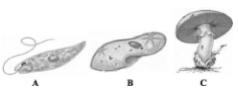
A
$A$ - Euglena,$B$ - Paramecium,$C$ - Agaricus
B
$A$ - Trypanosoma,$B$ - Planaria,$C$ - Agaricus
C
$A$ - Leishmania,$B$ - Vorticella,$C$ - Agaricus
D
$A$ - Euglena,$B$ - Leishmania,$C$ - Aspergillus
Solution
(A) Figure $A$ represents Euglena,which is a flagellated protist belonging to the group Euglenoids. It possesses both plant-like characteristics (presence of chlorophyll) and animal-like characteristics.
Figure $B$ represents Paramecium,which is a ciliated protozoan. It is an aquatic organism that moves actively due to the presence of thousands of cilia on its body surface.
Figure $C$ represents Agaricus (commonly known as a mushroom),which belongs to the class Basidiomycetes of the kingdom Fungi.
Figure $B$ represents Paramecium,which is a ciliated protozoan. It is an aquatic organism that moves actively due to the presence of thousands of cilia on its body surface.
Figure $C$ represents Agaricus (commonly known as a mushroom),which belongs to the class Basidiomycetes of the kingdom Fungi.
0 likes
View Solution165
MediumMCQ
Which of the following characteristic$(s)$ is/are used by Whittaker for the classification of organisms?
A
Mode of nutrition
B
Thallus organisation
C
Phylogenetic relationships
D
All of the above
Solution
(D) $R$.$H$. Whittaker $(1969)$ proposed a five kingdom classification system.
The main criteria for classification used by him include cell structure,thallus organisation,mode of nutrition,reproduction,and phylogenetic relationships.
Since all the options listed (mode of nutrition,thallus organisation,and phylogenetic relationships) are part of his criteria,the correct answer is all of the above.
The main criteria for classification used by him include cell structure,thallus organisation,mode of nutrition,reproduction,and phylogenetic relationships.
Since all the options listed (mode of nutrition,thallus organisation,and phylogenetic relationships) are part of his criteria,the correct answer is all of the above.
0 likes
View Solution166
MediumMCQ
| Column-$I$ (Terms) | Column-$II$ (Examples) |
| $A$. Ascus | $I$. Spirulina |
| $B$. Basidium | $II$. Penicillium |
| $C$. Protista | $III$. Agaricus |
| $D$. Cyanobacteria | $IV$. Euglena |
| $E$. Animalia | $V$. Sponges |
A
$A-II, B-III, C-IV, D-V, E-I$
B
$A-I, B-II, C-III, D-V, E-IV$
C
$A-II, B-V, C-III, D-I, E-IV$
D
$A-II, B-III, C-IV, D-I, E-V$
Solution
(D) The correct matches are as follows:
$A$. Ascus: It is a sac-like structure found in Ascomycetes fungi,e.g.,$Penicillium$.
$B$. Basidium: It is a club-shaped spore-bearing structure found in Basidiomycetes fungi,e.g.,$Agaricus$ (Mushroom).
$C$. Protista: $Euglena$ is a well-known example of a protist.
$D$. Cyanobacteria: $Spirulina$ is a type of cyanobacteria (blue-green algae).
$E$. Animalia: Sponges (Porifera) belong to the kingdom Animalia.
Therefore,the correct sequence is $A-II, B-III, C-IV, D-I, E-V$.
$A$. Ascus: It is a sac-like structure found in Ascomycetes fungi,e.g.,$Penicillium$.
$B$. Basidium: It is a club-shaped spore-bearing structure found in Basidiomycetes fungi,e.g.,$Agaricus$ (Mushroom).
$C$. Protista: $Euglena$ is a well-known example of a protist.
$D$. Cyanobacteria: $Spirulina$ is a type of cyanobacteria (blue-green algae).
$E$. Animalia: Sponges (Porifera) belong to the kingdom Animalia.
Therefore,the correct sequence is $A-II, B-III, C-IV, D-I, E-V$.
0 likes
View Solution167
MediumMCQ
Match column-$I$ (Kingdom) with column-$II$ (Class) and select the correct option.
| Column-$I$ (Kingdom) | Column-$II$ (Class) |
| $A$. Plantae | $I$. Archaebacteria |
| $B$. Fungi | $II$. Euglenoids |
| $C$. Protista | $III$. Phycomycetes |
| $D$. Monera | $IV$. Algae |
A
$A-IV, B-III, C-II, D-I$
B
$A-I, B-II, C-III, D-IV$
C
$A-III, B-IV, C-II, D-I$
D
$A-IV, B-II, C-III, D-I$
Solution
(A) The correct matching is as follows:
$A$. Plantae includes classes like Algae $(IV)$.
$B$. Fungi includes classes like Phycomycetes $(III)$.
$C$. Protista includes groups like Euglenoids $(II)$.
$D$. Monera includes groups like Archaebacteria $(I)$.
Therefore, the correct sequence is $A-IV, B-III, C-II, D-I$.
$A$. Plantae includes classes like Algae $(IV)$.
$B$. Fungi includes classes like Phycomycetes $(III)$.
$C$. Protista includes groups like Euglenoids $(II)$.
$D$. Monera includes groups like Archaebacteria $(I)$.
Therefore, the correct sequence is $A-IV, B-III, C-II, D-I$.
0 likes
View Solution168
MediumMCQ
Match the scientists given in column $I$ with their discovery given in column $II$ and choose the correct option.
| Column-$I$ (Scientists) | Column-$II$ (Discovery) |
| $A$. Ernst Mayr | $I$. Discovered Viroids |
| $B$. Whittaker | $II$. Gave the name virus |
| $C$. Ivanowsky | $III$. Proposed five kingdom classification |
| $D$. Diener | $IV$. Evolutionary biology |
A
$A-IV, B-III, C-II, D-I$
B
$A-III, B-IV, C-II, D-I$
C
$A-II, B-III, C-IV, D-I$
D
$A-I, B-II, C-III, D-IV$
Solution
(A) The correct matches are as follows:
$1$. Ernst Mayr: Known as the 'Darwin of the 20th century', he contributed significantly to evolutionary biology $(A-IV)$.
$2$. $R$.$H$. Whittaker: Proposed the five-kingdom classification system in $1969$ $(B-III)$.
$3$. $D$.$J$. Ivanowsky: Recognized the causal organism of tobacco mosaic disease and gave the name 'virus' $(C-II)$.
$4$. $T$.$O$. Diener: Discovered viroids, which are smaller than viruses and lack a protein coat $(D-I)$.
Therefore, the correct sequence is $A-IV, B-III, C-II, D-I$.
$1$. Ernst Mayr: Known as the 'Darwin of the 20th century', he contributed significantly to evolutionary biology $(A-IV)$.
$2$. $R$.$H$. Whittaker: Proposed the five-kingdom classification system in $1969$ $(B-III)$.
$3$. $D$.$J$. Ivanowsky: Recognized the causal organism of tobacco mosaic disease and gave the name 'virus' $(C-II)$.
$4$. $T$.$O$. Diener: Discovered viroids, which are smaller than viruses and lack a protein coat $(D-I)$.
Therefore, the correct sequence is $A-IV, B-III, C-II, D-I$.
0 likes
View Solution169
MediumMCQ
Match column-$I$ (Characters/features) with column-$II$ (Examples) and choose the correct option.
| Column-$I$ (Characters/features) | Column-$II$ (Examples) |
| $A$. Red dinoflagellates | $I$. Rhizopus |
| $B$. Unicellular fungi | $II$. Gonyaulax |
| $C$. Source of antibiotics | $III$. Yeast |
| $D$. Bread mould | $IV$. Penicillium |
A
$A-III, B-II, C-I, D-IV$
B
$A-II, B-III, C-I, D-IV$
C
$A-II, B-III, C-IV, D-I$
D
$A-II, B-IV, C-III, D-I$
Solution
$(C)$. Red dinoflagellates are represented by $Gonyaulax$ $(II)$, which causes red tides.
$B$. Yeast $(III)$ is a well-known unicellular fungus.
$C$. $Penicillium$ $(IV)$ is a major source of the antibiotic penicillin.
$D$. $Rhizopus$ $(I)$ is commonly known as bread mould.
Therefore, the correct matching is $A-II, B-III, C-IV, D-I$.
$B$. Yeast $(III)$ is a well-known unicellular fungus.
$C$. $Penicillium$ $(IV)$ is a major source of the antibiotic penicillin.
$D$. $Rhizopus$ $(I)$ is commonly known as bread mould.
Therefore, the correct matching is $A-II, B-III, C-IV, D-I$.
0 likes
View Solution170
MediumMCQ
Which of the following pairs is not correctly matched?
A
Anabaena - Cyanobacteria
B
Amoeba - Protozoa
C
Gonyaulax - Dinoflagellates
D
Albugo - Chrysophytes
Solution
(D) $Albugo$ is a parasitic fungus that causes white rust in mustard. It belongs to the class Phycomycetes (Oomycetes) within the kingdom Fungi, not the group Chrysophytes. Chrysophytes include diatoms and golden algae (desmids). Therefore, the pair $Albugo - \text{Chrysophytes}$ is incorrectly matched.
0 likes
View Solution171
MediumMCQ
Consider the following statements with respect to characteristic features of the kingdoms:
$(i)$ In $Animalia$,the mode of nutrition is autotrophic.
$(ii)$ In $Monera$,the nuclear membrane is present.
$(iii)$ In $Protista$,the cell type is prokaryotic.
$(iv)$ In $Plantae$,all organisms have a cell wall.
Of the above statements,which one is correct?
$(i)$ In $Animalia$,the mode of nutrition is autotrophic.
$(ii)$ In $Monera$,the nuclear membrane is present.
$(iii)$ In $Protista$,the cell type is prokaryotic.
$(iv)$ In $Plantae$,all organisms have a cell wall.
Of the above statements,which one is correct?
A
$(i)$ only
B
$(ii)$ only
C
$(iii)$ only
D
$(iv)$ only
Solution
(D) Statement $(i)$ is incorrect because $Animalia$ are heterotrophic.
Statement $(ii)$ is incorrect because $Monera$ are prokaryotic and lack a nuclear membrane.
Statement $(iii)$ is incorrect because $Protista$ are eukaryotic.
Statement $(iv)$ is correct because all organisms in kingdom $Plantae$ possess a cell wall composed of cellulose.
Statement $(ii)$ is incorrect because $Monera$ are prokaryotic and lack a nuclear membrane.
Statement $(iii)$ is incorrect because $Protista$ are eukaryotic.
Statement $(iv)$ is correct because all organisms in kingdom $Plantae$ possess a cell wall composed of cellulose.
0 likes
View Solution172
EasyMCQ
Which one of the following is not the basis of five kingdom classification?
A
Cell structure
B
Body organisation
C
Reproduction
D
Reserve food material
Solution
(D) The five kingdom classification proposed by $R.H. Whittaker$ is based on the following criteria:
$1$. Cell structure (Complexity of cell,i.e.,prokaryotic or eukaryotic).
$2$. Body organisation (Unicellular or multicellular).
$3$. Mode of nutrition (Autotrophic or heterotrophic).
$4$. Reproduction (Sexual or asexual methods).
$5$. Phylogenetic relationships (Evolutionary history).
Reserve food material is not a primary criterion used in this classification system. Therefore,option $D$ is the correct answer.
$1$. Cell structure (Complexity of cell,i.e.,prokaryotic or eukaryotic).
$2$. Body organisation (Unicellular or multicellular).
$3$. Mode of nutrition (Autotrophic or heterotrophic).
$4$. Reproduction (Sexual or asexual methods).
$5$. Phylogenetic relationships (Evolutionary history).
Reserve food material is not a primary criterion used in this classification system. Therefore,option $D$ is the correct answer.
0 likes
View Solution173
MediumMCQ
The position of bacteria in the kingdom system of classification proposed by Linnaeus is
A
Monera
B
Protista
C
Plantae
D
Animalia
Solution
(C) Linnaeus proposed the Two Kingdom classification system,which divided all living organisms into two kingdoms: Plantae and Animalia.
In this system,bacteria were placed under the kingdom Plantae because they possess a cell wall,which was a characteristic feature used to classify plants at that time.
In this system,bacteria were placed under the kingdom Plantae because they possess a cell wall,which was a characteristic feature used to classify plants at that time.
0 likes
View Solution174
EasyMCQ
Who was the founder of the five-kingdom system of classification?
A
$C.$ Linnaeus
B
$R.H.$ Whittaker
C
Aristotle
D
$T.O.$ Diener
Solution
(B) $R.H.$ Whittaker proposed the five-kingdom system of classification in $1969$. The five kingdoms defined by him are Monera,Protista,Fungi,Plantae,and Animalia.
0 likes
View Solution175
EasyMCQ
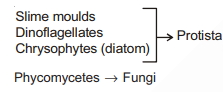
Select the non-protistan group.
A
Slime moulds
B
Dinoflagellates
C
Phycomycetes
D
Chrysophytes
Solution
(C) The kingdom $Protista$ includes chrysophytes,dinoflagellates,euglenoids,slime moulds,and protozoans.
$Phycomycetes$ is a class of fungi,not protists.
Therefore,$Phycomycetes$ is the non-protistan group.
$Phycomycetes$ is a class of fungi,not protists.
Therefore,$Phycomycetes$ is the non-protistan group.
0 likes
View Solution176
EasyMCQ
Which kingdom was introduced in the four-kingdom classification,and who proposed it?
A
Protista and Copeland
B
Plantae and Linnaeus
C
Monera and Whittaker
D
Monera and Copeland
Solution
(D) The Four-Kingdom Classification system was proposed by Herbert $F$. Copeland in $1956$.
In this system,the kingdom $Monera$ was introduced to include prokaryotic organisms,which were previously grouped with other organisms.
The four kingdoms in this system are $Monera$,$Protista$,$Plantae$,and $Animalia$.
Therefore,the correct answer is $Monera$ and Copeland.
In this system,the kingdom $Monera$ was introduced to include prokaryotic organisms,which were previously grouped with other organisms.
The four kingdoms in this system are $Monera$,$Protista$,$Plantae$,and $Animalia$.
Therefore,the correct answer is $Monera$ and Copeland.
0 likes
View Solution177
MediumMCQ
Select the correct match with respect to Whittaker's system of classification.
A
Monera : Unicellular,osmotrophs,producers and decomposers,true cellulosic cell wall
B
Protista : Unicellular,eukaryotic,photoautotrophs and chemoautotrophs
C
Fungi : Multicellular/loose tissue,eukaryotic,osmotrophs,chitinous wall
D
Animalia : Multicellular,eukaryotic,organ or organ system,holozoic,no saprobic
Solution
(C) Whittaker's system of classification categorizes organisms into five kingdoms: Monera,Protista,Fungi,Plantae,and Animalia.
Option $A$ is incorrect because Monera are prokaryotic and lack a cellulosic cell wall (they have peptidoglycan).
Option $B$ is incorrect because Protista are primarily aquatic and while they can be photoautotrophs,they are not typically classified as chemoautotrophs.
Option $C$ is correct: Fungi are eukaryotic,mostly multicellular (or loose tissue),heterotrophic (osmotrophs/saprotrophs),and possess a chitinous cell wall.
Option $D$ is incorrect because while Animalia are multicellular,eukaryotic,and holozoic,the term 'no saprobic' is not a defining characteristic used in this specific context compared to the accuracy of option $C$.
Option $A$ is incorrect because Monera are prokaryotic and lack a cellulosic cell wall (they have peptidoglycan).
Option $B$ is incorrect because Protista are primarily aquatic and while they can be photoautotrophs,they are not typically classified as chemoautotrophs.
Option $C$ is correct: Fungi are eukaryotic,mostly multicellular (or loose tissue),heterotrophic (osmotrophs/saprotrophs),and possess a chitinous cell wall.
Option $D$ is incorrect because while Animalia are multicellular,eukaryotic,and holozoic,the term 'no saprobic' is not a defining characteristic used in this specific context compared to the accuracy of option $C$.
0 likes
View Solution178
EasyMCQ
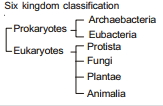
Domain Eukarya includes how many kingdoms (w.r.t. six kingdom system)?
A
$2$
B
$3$
C
$4$
D
$6$
Solution
(C) In the six-kingdom classification system,organisms are divided into two main groups: Prokaryotes and Eukaryotes.
Prokaryotes include two kingdoms: Archaebacteria and Eubacteria.
Eukaryotes include four kingdoms: Protista,Fungi,Plantae,and Animalia.
Therefore,the domain Eukarya includes $4$ kingdoms.
Prokaryotes include two kingdoms: Archaebacteria and Eubacteria.
Eukaryotes include four kingdoms: Protista,Fungi,Plantae,and Animalia.
Therefore,the domain Eukarya includes $4$ kingdoms.
0 likes
View Solution179
MediumMCQ
Fungi differ from bacteria in:
A
Mode of nutrition
B
Having $NAG$ in cell wall
C
Flagella structure
D
Reserve food material as glycogen
Solution
(C) Fungi are eukaryotic organisms,whereas bacteria are prokaryotic. The structure of flagella in eukaryotes ($9+2$ arrangement of microtubules) is fundamentally different from the flagella found in prokaryotes (composed of the protein flagellin). Therefore,fungi differ from bacteria in their flagella structure.
0 likes
View Solution180
MediumMCQ
$A$: Unicellular eukaryotes are included in Monera.
$R$: Unicellular eukaryotes have $70S$ cytoribosomes.
$R$: Unicellular eukaryotes have $70S$ cytoribosomes.
A
Assertion and Reason both are correct and Reason is the correct explanation of Assertion.
B
Assertion and Reason both are correct but Reason is not the correct explanation of Assertion.
C
Assertion is correct,but Reason is incorrect.
D
Both Assertion and Reason are incorrect.
Solution
(D) The Assertion is incorrect because unicellular eukaryotes are classified under the Kingdom $Protista$,not Monera. Kingdom $Monera$ consists of prokaryotic organisms.
The Reason is also incorrect because eukaryotic cells contain $80S$ ribosomes in their cytoplasm (cytoribosomes),whereas $70S$ ribosomes are characteristic of prokaryotes and organelles like mitochondria and chloroplasts.
Therefore,both the Assertion and the Reason are incorrect.
The Reason is also incorrect because eukaryotic cells contain $80S$ ribosomes in their cytoplasm (cytoribosomes),whereas $70S$ ribosomes are characteristic of prokaryotes and organelles like mitochondria and chloroplasts.
Therefore,both the Assertion and the Reason are incorrect.
0 likes
View Solution181
MediumMCQ
Natural system of classification was developed by
A
Linnaeus
B
Engler and Prantl
C
Bentham and Hooker
D
Aristotle
Solution
(C) The natural system of classification was developed by George Bentham and Joseph Dalton Hooker.
This system is based on the natural affinities among organisms,considering both external and internal features.
Key features considered include phytochemistry,anatomy,ultra-structure,and embryology.
This system is based on the natural affinities among organisms,considering both external and internal features.
Key features considered include phytochemistry,anatomy,ultra-structure,and embryology.
0 likes
View Solution182
MediumMCQ
Artificial system of classification was given by $A$ and based on $B$. Fill in the blanks with respect to $A$ and $B$. Choose the correct option.
A
$A-Aristotle; B-\text{anatomical characters}$
B
$A-\text{Linnaeus}; B-\text{cytological information}$
C
$A-\text{Linnaeus}; B-\text{morphological characters}$
D
$A-\text{Haeckel}; B-\text{morphological characters}$
Solution
(C) The artificial system of classification was proposed by $A-\text{Linnaeus}$.
This system was primarily based on gross superficial morphological characters such as habit, color, number, and shape of leaves, etc.
This system was primarily based on gross superficial morphological characters such as habit, color, number, and shape of leaves, etc.
0 likes
View Solution183
MediumMCQ
The sexual system of classification is:
A
Artificial system
B
Based on stamen characters
C
Based on corolla and carpel characters
D
Both $(A)$ and $(B)$
Solution
(D) The sexual system of classification,proposed by Carolus Linnaeus,is considered an artificial system of classification.
It is primarily based on the vegetative characters or the superficial morphological characters,specifically the number and arrangement of stamens and carpels.
Since it relies on a limited number of characteristics rather than natural affinities,it is classified as an artificial system.
Therefore,both $(A)$ and $(B)$ are correct.
It is primarily based on the vegetative characters or the superficial morphological characters,specifically the number and arrangement of stamens and carpels.
Since it relies on a limited number of characteristics rather than natural affinities,it is classified as an artificial system.
Therefore,both $(A)$ and $(B)$ are correct.
0 likes
View Solution184
MediumMCQ
The Bentham and Hooker's classification is:
A
Classification of taxa based on actual examination
B
Artificial system of classification
C
Phylogenetic system of classification
D
Based on evolution
Solution
(A) The Bentham and Hooker's classification system is a natural system of classification. It is primarily based on the actual examination of specimens and morphological characters rather than evolutionary relationships or artificial criteria. Therefore,it is considered a classification of taxa based on actual examination.
0 likes
View Solution185
MediumMCQ
Which of the following lacks a cell wall?
A
Gametes
B
Amoeba
C
Mycoplasma
D
All of these
Solution
(D) The cell wall is a characteristic feature of the cells of plants,bacteria,fungi,algae,and some archaea. It is located outside the cell membrane. The major function of the cell wall is to provide rigidity,tensile strength,structural support,and protection against mechanical stress and infection. It also helps in the diffusion of gases in and out of the cell. Gametes,Amoeba,and Mycoplasma all lack a cell wall.
0 likes
View Solution186
EasyMCQ
Cell division is the mode of reproduction in
A
Monera
B
Protista
C
Plants
D
Both $(a)$ and $(b)$
Solution
(D) In cell division,the cell divides into two parts having the same genetic constituent.
Only $Monera$ and $Protista$ are the organisms that are single-celled in the five-kingdom classification system.
Therefore,cell division is the common mode of reproduction in both $Monera$ and $Protista$.
Only $Monera$ and $Protista$ are the organisms that are single-celled in the five-kingdom classification system.
Therefore,cell division is the common mode of reproduction in both $Monera$ and $Protista$.
0 likes
View Solution187
MediumMCQ
$A$: Biodiversity of the prokaryotes cannot be estimated.
$R$: Conventional taxonomic methods are not suitable for identification and characterisation of microbes.
$R$: Conventional taxonomic methods are not suitable for identification and characterisation of microbes.
A
Assertion and Reason both are correct and Reason is the correct explanation of Assertion.
B
Assertion and Reason both are correct but Reason is not the correct explanation of Assertion.
C
Assertion is correct,but Reason is incorrect.
D
Both Assertion and Reason are incorrect.
Solution
(A) The biodiversity of prokaryotic microorganisms cannot be estimated using conventional taxonomic methods because many of these microbes cannot be cultured in laboratory conditions.
Conventional taxonomic methods rely heavily on morphological and biochemical characterization,which are often insufficient for identifying and classifying the vast diversity of prokaryotes.
Therefore,both the Assertion and the Reason are correct,and the Reason provides the correct explanation for the Assertion.
Conventional taxonomic methods rely heavily on morphological and biochemical characterization,which are often insufficient for identifying and classifying the vast diversity of prokaryotes.
Therefore,both the Assertion and the Reason are correct,and the Reason provides the correct explanation for the Assertion.
0 likes
View Solution188
Medium
Differentiate between the three domains of life.
Solution
(N/A) The three-domain system,proposed by Carl Woese,classifies life into Archaea,Bacteria,and Eukarya. The differences are summarized below:
| Character | Archaea | Bacteria | Eukarya |
|---|---|---|---|
| Cell type | Prokaryotic | Prokaryotic | Eukaryotic |
| Histones | Present (similar to eukaryotes) | Absent | Present |
| Introns | Present in some genes | Absent | Present |
| Ribosome size | $70S$ | $70S$ | $80S$ (cytoplasmic) |
| Cell wall | Non-peptidoglycan (pseudomurein) | Peptidoglycan | Varies (Cellulose in plants,Chitin in fungi) |
0 likes
View Solution189
Medium
How is the five kingdom classification advantageous over the two kingdom classification?
Solution
(N/A) $\rightarrow$ In the two kingdom classification,many unrelated organisms were grouped together under the same kingdom.
$\rightarrow$ The two kingdom system of classification divided organisms only into $Plantae$ and $Animalia$.
$\rightarrow$ In contrast,the five kingdom classification is based on more specific and scientific criteria such as cell structure,body organization,mode of nutrition,and evolutionary relationships (phylogeny).
$\rightarrow$ This system effectively separates organisms like fungi,bacteria,and protists from plants and animals,providing a more accurate representation of biological diversity.
$\rightarrow$ The two kingdom system of classification divided organisms only into $Plantae$ and $Animalia$.
$\rightarrow$ In contrast,the five kingdom classification is based on more specific and scientific criteria such as cell structure,body organization,mode of nutrition,and evolutionary relationships (phylogeny).
$\rightarrow$ This system effectively separates organisms like fungi,bacteria,and protists from plants and animals,providing a more accurate representation of biological diversity.
0 likes
View Solution190
EasyMCQ
In the five-kingdom system of Whittaker,how many kingdoms are eukaryotes?
A
$2$
B
$3$
C
$4$
D
$5$
Solution
(C) In the five-kingdom system proposed by Whittaker,the kingdoms are Monera,Protista,Fungi,Plantae,and Animalia.
Out of these,Kingdom Monera consists of prokaryotes.
The remaining four kingdoms are eukaryotes,which are as follows:
$\rightarrow$ $(a)$ Protista
$(b)$ Fungi
$(c)$ Plantae
$(d)$ Animalia
Therefore,the total number of eukaryotic kingdoms is $4$.
Out of these,Kingdom Monera consists of prokaryotes.
The remaining four kingdoms are eukaryotes,which are as follows:
$\rightarrow$ $(a)$ Protista
$(b)$ Fungi
$(c)$ Plantae
$(d)$ Animalia
Therefore,the total number of eukaryotic kingdoms is $4$.
0 likes
View Solution191
EasyMCQ
In the five-kingdom classification system,how many kingdoms are eukaryotic?
A
$1$
B
$2$
C
$3$
D
$4$
Solution
(D) The five-kingdom classification system proposed by $R.H. Whittaker$ includes the following kingdoms:
$1$. Kingdom $Monera$ (Prokaryotic)
$2$. Kingdom $Protista$ (Eukaryotic)
$3$. Kingdom $Fungi$ (Eukaryotic)
$4$. Kingdom $Plantae$ (Eukaryotic)
$5$. Kingdom $Animalia$ (Eukaryotic)
Out of these five kingdoms,only Kingdom $Monera$ is prokaryotic,while the remaining four kingdoms ($Protista$,$Fungi$,$Plantae$,and $Animalia$) are eukaryotic.
Therefore,the total number of eukaryotic kingdoms is $4$.
$1$. Kingdom $Monera$ (Prokaryotic)
$2$. Kingdom $Protista$ (Eukaryotic)
$3$. Kingdom $Fungi$ (Eukaryotic)
$4$. Kingdom $Plantae$ (Eukaryotic)
$5$. Kingdom $Animalia$ (Eukaryotic)
Out of these five kingdoms,only Kingdom $Monera$ is prokaryotic,while the remaining four kingdoms ($Protista$,$Fungi$,$Plantae$,and $Animalia$) are eukaryotic.
Therefore,the total number of eukaryotic kingdoms is $4$.
0 likes
View Solution192
MediumMCQ
Match the following columns:
| Column-$I$ (Kingdom) | Column-$II$ (Cell Wall) |
|---|---|
| $P$. Monera | $I$. Present in some |
| $Q$. Protista | $II$. Cellulosic cell wall |
| $R$. Fungi | $III$. Absent |
| $S$. Plantae | $IV$. Polysaccharide $+$ amino acid |
| $T$. Animalia | $V$. Chitin |
A
$(P-IV), (Q-I), (R-V), (S-II), (T-III)$
B
$(P-IV), (Q-II), (R-V), (S-I), (T-III)$
C
$(P-III), (Q-I), (R-V), (S-II), (T-IV)$
D
$(P-II), (Q-IV), (R-I), (S-III), (T-V)$
Solution
(A) The correct matches based on the five-kingdom classification are:
$P$. Monera: The cell wall is made of polysaccharides and amino acids (peptidoglycan). Thus,$P-IV$.
$Q$. Protista: The cell wall is present in some organisms (e.g.,diatoms,dinoflagellates). Thus,$Q-I$.
$R$. Fungi: The cell wall is composed of chitin. Thus,$R-V$.
$S$. Plantae: The cell wall is primarily made of cellulose. Thus,$S-II$.
$T$. Animalia: Cell wall is absent in animals. Thus,$T-III$.
Therefore,the correct sequence is $(P-IV), (Q-I), (R-V), (S-II), (T-III)$.
$P$. Monera: The cell wall is made of polysaccharides and amino acids (peptidoglycan). Thus,$P-IV$.
$Q$. Protista: The cell wall is present in some organisms (e.g.,diatoms,dinoflagellates). Thus,$Q-I$.
$R$. Fungi: The cell wall is composed of chitin. Thus,$R-V$.
$S$. Plantae: The cell wall is primarily made of cellulose. Thus,$S-II$.
$T$. Animalia: Cell wall is absent in animals. Thus,$T-III$.
Therefore,the correct sequence is $(P-IV), (Q-I), (R-V), (S-II), (T-III)$.
0 likes
View Solution193
MediumMCQ
Which criteria are included in the five-kingdom classification system?
A
Cell structure,thallus organization
B
Mode of nutrition,reproduction
C
Phylogenetic relationships
D
All of the above
Solution
(D) The five-kingdom classification system,proposed by $R.H. Whittaker$ in $1969$,is based on several key criteria.
These criteria include:
$1$. Cell structure (prokaryotic vs. eukaryotic).
$2$. Thallus organization (unicellular vs. multicellular).
$3$. Mode of nutrition (autotrophic vs. heterotrophic).
$4$. Reproduction (sexual vs. asexual).
$5$. Phylogenetic relationships (evolutionary history).
Therefore,all the given options are correct components of this classification system.
These criteria include:
$1$. Cell structure (prokaryotic vs. eukaryotic).
$2$. Thallus organization (unicellular vs. multicellular).
$3$. Mode of nutrition (autotrophic vs. heterotrophic).
$4$. Reproduction (sexual vs. asexual).
$5$. Phylogenetic relationships (evolutionary history).
Therefore,all the given options are correct components of this classification system.
0 likes
View Solution194
MediumMCQ
According to the two-kingdom classification system,how many of the following organism groups are included in the Kingdom Plantae?
Bacteria,Blue-green algae,Fungi,Porifera,Echinodermata,Mosses,Bryophytes,Pteridophytes,Gymnosperms,Ctenophora,Angiosperms
Bacteria,Blue-green algae,Fungi,Porifera,Echinodermata,Mosses,Bryophytes,Pteridophytes,Gymnosperms,Ctenophora,Angiosperms
A
$6$
B
$7$
C
$8$
D
$9$
Solution
(C) The two-kingdom classification system,proposed by Carolus Linnaeus,divided all living organisms into two kingdoms: Kingdom Plantae and Kingdom Animalia.
In this system,all organisms that possessed a cell wall and were autotrophic (or perceived as plants) were placed in Kingdom Plantae.
Let's analyze the given list:
$1$. Bacteria: Included in Plantae (due to cell wall).
$2$. Blue-green algae: Included in Plantae.
$3$. Fungi: Included in Plantae (due to cell wall).
$4$. Porifera: Animalia.
$5$. Echinodermata: Animalia.
$6$. Mosses: Plantae.
$7$. Bryophytes: Plantae.
$8$. Pteridophytes: Plantae.
$9$. Gymnosperms: Plantae.
$10$. Ctenophora: Animalia.
$11$. Angiosperms: Plantae.
The groups included in Kingdom Plantae are: Bacteria,Blue-green algae,Fungi,Mosses,Bryophytes,Pteridophytes,Gymnosperms,and Angiosperms.
Counting these,we get a total of $8$ groups.
In this system,all organisms that possessed a cell wall and were autotrophic (or perceived as plants) were placed in Kingdom Plantae.
Let's analyze the given list:
$1$. Bacteria: Included in Plantae (due to cell wall).
$2$. Blue-green algae: Included in Plantae.
$3$. Fungi: Included in Plantae (due to cell wall).
$4$. Porifera: Animalia.
$5$. Echinodermata: Animalia.
$6$. Mosses: Plantae.
$7$. Bryophytes: Plantae.
$8$. Pteridophytes: Plantae.
$9$. Gymnosperms: Plantae.
$10$. Ctenophora: Animalia.
$11$. Angiosperms: Plantae.
The groups included in Kingdom Plantae are: Bacteria,Blue-green algae,Fungi,Mosses,Bryophytes,Pteridophytes,Gymnosperms,and Angiosperms.
Counting these,we get a total of $8$ groups.
0 likes
View Solution195
MediumMCQ
According to the two-kingdom classification,Chlamydomonas and Chlorella are included in the kingdom .....,and according to the five-kingdom classification,they are included in the kingdom ...... .
A
Monera,Plantae
B
Protista,Monera
C
Plantae,Monera
D
Plantae,Protista
Solution
(D) In the two-kingdom classification system proposed by Carolus Linnaeus,all organisms were divided into two kingdoms: Plantae and Animalia. Under this system,both Chlamydomonas and Chlorella were placed in the kingdom Plantae due to the presence of a cell wall and photosynthetic ability.
In the five-kingdom classification system proposed by $R$.$H$. Whittaker,unicellular eukaryotic organisms like Chlamydomonas and Chlorella (which were previously placed in algae under Plantae) were moved to the kingdom Protista.
In the five-kingdom classification system proposed by $R$.$H$. Whittaker,unicellular eukaryotic organisms like Chlamydomonas and Chlorella (which were previously placed in algae under Plantae) were moved to the kingdom Protista.
0 likes
View Solution196
MediumMCQ
Select the correct option based on the evolutionary relationships between the kingdoms.
A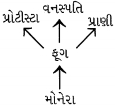
B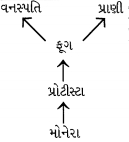
C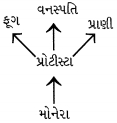
D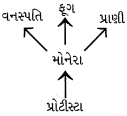
Solution
(C) According to the evolutionary relationships in the five-kingdom classification system,the evolutionary path is as follows:
$1$. The earliest organisms were prokaryotic,belonging to the kingdom Monera.
$2$. From Monera,the eukaryotic kingdom Protista evolved.
$3$. From the ancestral Protista,the three multicellular eukaryotic kingdoms—Fungi,Plantae,and Animalia—diverged independently.
Therefore,the correct evolutionary sequence is Monera -> Protista -> (Fungi,Plantae,Animalia). This corresponds to option $C$.
$1$. The earliest organisms were prokaryotic,belonging to the kingdom Monera.
$2$. From Monera,the eukaryotic kingdom Protista evolved.
$3$. From the ancestral Protista,the three multicellular eukaryotic kingdoms—Fungi,Plantae,and Animalia—diverged independently.
Therefore,the correct evolutionary sequence is Monera -> Protista -> (Fungi,Plantae,Animalia). This corresponds to option $C$.
0 likes
View Solution197
MediumMCQ
Multicellular and autotrophic organisms are included in which of the following kingdoms?
A
Monera
B
Protista
C
Fungi
D
Plantae
Solution
(D) According to the $5$-kingdom classification system proposed by $R.H. Whittaker$,the kingdom $Plantae$ consists of organisms that are multicellular,eukaryotic,and autotrophic (photosynthetic).
$Monera$ consists of unicellular prokaryotes.
$Protista$ consists of unicellular eukaryotes.
$Fungi$ are multicellular but heterotrophic (saprophytic or parasitic).
Therefore,the correct option is $D$.
$Monera$ consists of unicellular prokaryotes.
$Protista$ consists of unicellular eukaryotes.
$Fungi$ are multicellular but heterotrophic (saprophytic or parasitic).
Therefore,the correct option is $D$.
0 likes
View Solution198
MediumMCQ
Select the correct option for natural systems of classification.
A
Based on natural affinities among the organisms.
B
Considered internal features like ultrastructure,anatomy,embryology,and phytochemistry in addition to external features.
C
Such a classification for flowering plants was given by Bentham and Hooker.
D
All of the above.
Solution
(D) Natural systems of classification are based on natural affinities among organisms.
This system considers not only external features but also internal features such as ultrastructure,anatomy,embryology,and phytochemistry.
This type of classification for flowering plants was proposed by George Bentham and Joseph Dalton Hooker.
Therefore,all the given options are correct.
This system considers not only external features but also internal features such as ultrastructure,anatomy,embryology,and phytochemistry.
This type of classification for flowering plants was proposed by George Bentham and Joseph Dalton Hooker.
Therefore,all the given options are correct.
0 likes
View Solution199
MediumMCQ
Which of the following organisms is unicellular?
A
Bacteria
B
Protozoa
C
Yeast
D
All of the above
Solution
(D) Unicellular organisms are those that consist of a single cell.
$1$. Bacteria are prokaryotic unicellular organisms.
$2$. Protozoa (such as Amoeba and Paramecium) are eukaryotic unicellular organisms.
$3$. Yeast $(Saccharomyces \, cerevisiae)$ is a unicellular fungus.
Therefore, all the given options represent unicellular organisms.
$1$. Bacteria are prokaryotic unicellular organisms.
$2$. Protozoa (such as Amoeba and Paramecium) are eukaryotic unicellular organisms.
$3$. Yeast $(Saccharomyces \, cerevisiae)$ is a unicellular fungus.
Therefore, all the given options represent unicellular organisms.
0 likes
View Solution200
MediumMCQ
How many of the following groups are included in microorganisms?
Protozoa,Bacteria,Porifera,Fungi,Bryophytes,Viruses,Viroids,Prions
Protozoa,Bacteria,Porifera,Fungi,Bryophytes,Viruses,Viroids,Prions
A
$5$
B
$6$
C
$7$
D
$8$
Solution
(B) Microorganisms are microscopic organisms that are not visible to the naked eye.
$1$. Protozoa: Microscopic (Included)
$2$. Bacteria: Microscopic (Included)
$3$. Porifera: Multicellular animals,macroscopic (Excluded)
$4$. Fungi: Many are microscopic,e.g.,yeast (Included)
$5$. Bryophytes: Multicellular plants,macroscopic (Excluded)
$6$. Viruses: Microscopic (Included)
$7$. Viroids: Microscopic (Included)
$8$. Prions: Microscopic (Included)
The groups included are Protozoa,Bacteria,Fungi,Viruses,Viroids,and Prions.
Total count = $6$.
$1$. Protozoa: Microscopic (Included)
$2$. Bacteria: Microscopic (Included)
$3$. Porifera: Multicellular animals,macroscopic (Excluded)
$4$. Fungi: Many are microscopic,e.g.,yeast (Included)
$5$. Bryophytes: Multicellular plants,macroscopic (Excluded)
$6$. Viruses: Microscopic (Included)
$7$. Viroids: Microscopic (Included)
$8$. Prions: Microscopic (Included)
The groups included are Protozoa,Bacteria,Fungi,Viruses,Viroids,and Prions.
Total count = $6$.
0 likes
View SolutionBiological Classification — Mix Example-Biological Classification · Frequently Asked Questions
1Are these Biological Classification questions useful for JEE and NEET?
Yes. All questions in this section are mapped to JEE Main and NEET exam patterns. Previous year questions from JEE Main, NEET, GUJCET and state-level exams are included with full solutions.
2Can I switch to Hindi or Gujarati for these questions?
Yes. Use the language tabs in the hero section or the sidebar to view the same questions and solutions in English, Hindi or Gujarati.
3How do I generate a question paper from this subtopic?
Use the Vedclass Exam Paper Generator — select the chapter and subtopic, set difficulty, and generate Sets A, B, C, D automatically. First 3 chapters of every subject are free.
Vedclass Products
For Students
Vedclass Test Series
Mock tests in real JEE/NEET style with performance analysis. 5-day free trial.
Start Free TrialFor Teachers
Exam Paper Generator
Generate Set A/B/C/D papers from this chapter in 2 minutes. 3 chapters free.
Try FreeFor Institutes
Online Exam Module
Live online exams with unlimited students, 360° analytics & white-label branding.
See DemoFor Teachers & Institutes
Generate a Biological Classification Exam Paper in 2 Minutes
Select subtopic & difficulty — Sets A, B, C, D auto-generated with No Repeat logic.
First 3 chapters of every subject are free — no payment required.