
A English
Phylum-Platyhelminthes Questions in English
Class 11 Biology · Animal Kingdom · Phylum-Platyhelminthes
200+
Questions
English
Language
100%
With Solutions
Showing 50 of 200 questions in English
151
EasyMCQ
Which of the following types of animals are triploblastic?
A
Flatworms
B
Sponges
C
Ctenophores
D
Corals
Solution
(A) Triploblastic animals are those that possess three germ layers: ectoderm,mesoderm,and endoderm during embryonic development.
$1$. Sponges (Porifera) are diploblastic or lack true tissue organization.
$2$. Ctenophores and Corals (Cnidaria) are diploblastic,meaning they have only two germ layers (ectoderm and endoderm).
$3$. Flatworms (Platyhelminthes) are the first group in the animal kingdom to exhibit triploblastic organization,as they possess a middle layer called the mesoderm.
Therefore,the correct option is $A$.
$1$. Sponges (Porifera) are diploblastic or lack true tissue organization.
$2$. Ctenophores and Corals (Cnidaria) are diploblastic,meaning they have only two germ layers (ectoderm and endoderm).
$3$. Flatworms (Platyhelminthes) are the first group in the animal kingdom to exhibit triploblastic organization,as they possess a middle layer called the mesoderm.
Therefore,the correct option is $A$.
0 likes
View Solution152
MediumMCQ
Which of the following organisms has only a single opening that serves as both the mouth and the anus?
A
Octopus
B
Asterias
C
Ascidia
D
Liver fluke
Solution
(D) Organisms with a single opening for both ingestion and egestion possess an incomplete digestive system (blind sac body plan).
Liver fluke ($Fasciola$ $hepatica$),which belongs to the phylum $Platyhelminthes$,exhibits this type of digestive system.
In contrast,$Octopus$ (Mollusca),$Asterias$ (Echinodermata),and $Ascidia$ (Chordata/Urochordata) possess a complete digestive system with two separate openings (mouth and anus).
Liver fluke ($Fasciola$ $hepatica$),which belongs to the phylum $Platyhelminthes$,exhibits this type of digestive system.
In contrast,$Octopus$ (Mollusca),$Asterias$ (Echinodermata),and $Ascidia$ (Chordata/Urochordata) possess a complete digestive system with two separate openings (mouth and anus).
0 likes
View Solution153
MediumMCQ
What is prominently observed in Planaria?
A
Metamorphosis
B
Regeneration
C
Metagenesis
D
Bioluminescence
Solution
(B) Planaria is a member of the phylum Platyhelminthes. It possesses a high capacity for regeneration. When the body of a Planaria is cut into pieces,each piece can develop into a complete organism. This process is known as true regeneration.
0 likes
View Solution154
Medium
What are the peculiar features that you find in parasitic platyhelminthes?
Solution
(N/A) Parasitic platyhelminthes,such as $Taenia$ (tapeworm) and $Fasciola$ (liver fluke),exhibit specific adaptations for their parasitic mode of life:
$1$. Body Structure: They possess a dorsiventrally flattened body.
$2$. Attachment Organs: They bear hooks and suckers,which allow them to attach firmly to the tissues inside the host's body.
$3$. Protective Covering: Their body is covered with a thick tegument (cuticle),which protects them from the action of the host's digestive enzymes and acidic environment.
$4$. Nutrient Absorption: The tegument is specialized to absorb nutrients directly from the host's body fluids.
$1$. Body Structure: They possess a dorsiventrally flattened body.
$2$. Attachment Organs: They bear hooks and suckers,which allow them to attach firmly to the tissues inside the host's body.
$3$. Protective Covering: Their body is covered with a thick tegument (cuticle),which protects them from the action of the host's digestive enzymes and acidic environment.
$4$. Nutrient Absorption: The tegument is specialized to absorb nutrients directly from the host's body fluids.
0 likes
View Solution155
Medium
Give the characteristics of the phylum $Platyhelminthes$.
Solution
(N/A) The phylum $Platyhelminthes$ (flatworms) exhibits the following characteristics:
$1$. Body Symmetry: They are $bilaterally$ symmetrical.
$2$. Germ Layers: They are $triploblastic$ (three germ layers: ectoderm, mesoderm, and endoderm).
$3$. Body Cavity: They are $acoelomate$ (lack a true body cavity).
$4$. Organization: They show $organ-system$ level of body organization.
$5$. Digestive System: The digestive system is incomplete (a single opening serves as both mouth and anus).
$6$. Excretion: Specialized cells called $flame$ cells (protonephridia) help in osmoregulation and excretion.
$7$. Reproduction: They are mostly $hermaphrodite$ (bisexual). Fertilization is internal, and development includes many larval stages.
$8$. Lifestyle: Many members are endoparasites in animals, including humans. They possess hooks and suckers for attachment.
$1$. Body Symmetry: They are $bilaterally$ symmetrical.
$2$. Germ Layers: They are $triploblastic$ (three germ layers: ectoderm, mesoderm, and endoderm).
$3$. Body Cavity: They are $acoelomate$ (lack a true body cavity).
$4$. Organization: They show $organ-system$ level of body organization.
$5$. Digestive System: The digestive system is incomplete (a single opening serves as both mouth and anus).
$6$. Excretion: Specialized cells called $flame$ cells (protonephridia) help in osmoregulation and excretion.
$7$. Reproduction: They are mostly $hermaphrodite$ (bisexual). Fertilization is internal, and development includes many larval stages.
$8$. Lifestyle: Many members are endoparasites in animals, including humans. They possess hooks and suckers for attachment.
0 likes
View Solution156
Medium
Give the characteristics of Phylum-Platyhelminthes (Flatworms).
Solution
(N/A) The characteristics of Phylum-Platyhelminthes are as follows:
$1$. Body Shape: They have a dorso-ventrally flattened body,hence they are called flatworms.
$2$. Symmetry and Germ Layers: They are bilaterally symmetrical,triploblastic,and acoelomate animals.
$3$. Organ System: They exhibit organ-system level of organization.
$4$. Hooks and Suckers: Parasitic forms possess hooks and suckers for attachment to the host.
$5$. Excretion: Specialized cells called flame cells help in osmoregulation and excretion.
$6$. Reproduction: They are hermaphrodites (bisexual). Fertilization is internal,and development is through many larval stages.
$7$. Regeneration: Some members like Planaria possess high regeneration capacity.
$1$. Body Shape: They have a dorso-ventrally flattened body,hence they are called flatworms.
$2$. Symmetry and Germ Layers: They are bilaterally symmetrical,triploblastic,and acoelomate animals.
$3$. Organ System: They exhibit organ-system level of organization.
$4$. Hooks and Suckers: Parasitic forms possess hooks and suckers for attachment to the host.
$5$. Excretion: Specialized cells called flame cells help in osmoregulation and excretion.
$6$. Reproduction: They are hermaphrodites (bisexual). Fertilization is internal,and development is through many larval stages.
$7$. Regeneration: Some members like Planaria possess high regeneration capacity.
0 likes
View Solution157
Medium
Endoparasites are found inside the host body. Mention the special structure possessed by these and which enables them to survive in those conditions.
Solution
(N/A) Endoparasites live in a nutrient-rich environment,so most of their adaptations help them in maximizing absorption.
The endoparasites such as $Taenia$ $solium$ (Tapeworm) and $Fasciola$ $hepatica$ (Liver fluke) are found inside the host body and survive due to the presence of certain characters:
$(1)$ They perform anaerobic respiration,and gaseous exchange occurs through the general body surface.
$(2)$ These organisms have additional organs for attachment to the host. $Fasciola$ $hepatica$ possesses an acetabulum or posterior sucker for attachment. $Taenia$ $solium$ possesses hooks and suckers for attachment to the host.
$(3)$ They are generally hermaphrodite,and self-fertilization is common in them.
$(4)$ $A$ thick tegument is present,which is resistant to the host's digestive enzymes and antitoxins.
$(5)$ Absence of locomotory organs.
$(6)$ Tapeworms lack digestive organs because the digested or semi-digested food of the host is directly absorbed through the body surface.
The endoparasites such as $Taenia$ $solium$ (Tapeworm) and $Fasciola$ $hepatica$ (Liver fluke) are found inside the host body and survive due to the presence of certain characters:
$(1)$ They perform anaerobic respiration,and gaseous exchange occurs through the general body surface.
$(2)$ These organisms have additional organs for attachment to the host. $Fasciola$ $hepatica$ possesses an acetabulum or posterior sucker for attachment. $Taenia$ $solium$ possesses hooks and suckers for attachment to the host.
$(3)$ They are generally hermaphrodite,and self-fertilization is common in them.
$(4)$ $A$ thick tegument is present,which is resistant to the host's digestive enzymes and antitoxins.
$(5)$ Absence of locomotory organs.
$(6)$ Tapeworms lack digestive organs because the digested or semi-digested food of the host is directly absorbed through the body surface.
0 likes
View Solution158
Medium
Describe phylum Platyhelminthes.
Solution
(N/A) $\rightarrow$ Platyhelminthes have a dorso-ventrally flattened body,hence they are called flatworms.
$\rightarrow$ These are mostly endoparasites found in animals,including human beings.
$\rightarrow$ Flatworms are bilaterally symmetrical,triploblastic,and acoelomate animals with an organ-level of organization.
$\rightarrow$ Hooks and suckers are present in the parasitic forms.
$\rightarrow$ Some of them absorb nutrients from the host directly through their body surface.
$\rightarrow$ Specialized cells called flame cells help in osmoregulation and excretion.
$\rightarrow$ Sexes are not separate (hermaphrodites).
$\rightarrow$ Fertilization is internal,and development occurs through many larval stages.
$\rightarrow$ Some members like Planaria possess high regeneration capacity.
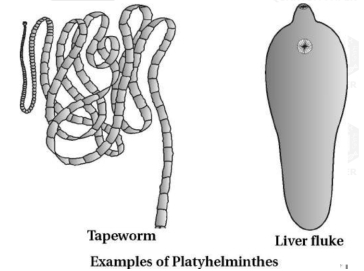
$\rightarrow$ Examples: Taenia (Tapeworm),Fasciola (Liver fluke).
$\rightarrow$ These are mostly endoparasites found in animals,including human beings.
$\rightarrow$ Flatworms are bilaterally symmetrical,triploblastic,and acoelomate animals with an organ-level of organization.
$\rightarrow$ Hooks and suckers are present in the parasitic forms.
$\rightarrow$ Some of them absorb nutrients from the host directly through their body surface.
$\rightarrow$ Specialized cells called flame cells help in osmoregulation and excretion.
$\rightarrow$ Sexes are not separate (hermaphrodites).
$\rightarrow$ Fertilization is internal,and development occurs through many larval stages.
$\rightarrow$ Some members like Planaria possess high regeneration capacity.
$\rightarrow$ Examples: Taenia (Tapeworm),Fasciola (Liver fluke).
0 likes
View Solution159
Medium
Write the general features of flatworms.
Solution
(N/A) $\rightarrow$ $Platyhelminthes$ have a dorso-ventrally flattened body,hence they are called flatworms.
$\rightarrow$ These are mostly endoparasites found in animals,including human beings.
$\rightarrow$ Flatworms are bilaterally symmetrical,triploblastic,and acoelomate animals with an organ-level of organization.
$\rightarrow$ Hooks and suckers are present in the parasitic forms.
$\rightarrow$ Some of them absorb nutrients from the host directly through their body surface.
$\rightarrow$ Specialized cells called flame cells help in osmoregulation and excretion.
$\rightarrow$ Sexes are not separate (hermaphrodite).
$\rightarrow$ Fertilization is internal,and development is indirect through many larval stages.
$\rightarrow$ Some members like $Planaria$ possess high regeneration capacity.
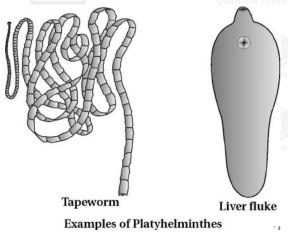
$\rightarrow$ Examples: $Taenia$ (Tapeworm),$Fasciola$ (Liver fluke).
$\rightarrow$ These are mostly endoparasites found in animals,including human beings.
$\rightarrow$ Flatworms are bilaterally symmetrical,triploblastic,and acoelomate animals with an organ-level of organization.
$\rightarrow$ Hooks and suckers are present in the parasitic forms.
$\rightarrow$ Some of them absorb nutrients from the host directly through their body surface.
$\rightarrow$ Specialized cells called flame cells help in osmoregulation and excretion.
$\rightarrow$ Sexes are not separate (hermaphrodite).
$\rightarrow$ Fertilization is internal,and development is indirect through many larval stages.
$\rightarrow$ Some members like $Planaria$ possess high regeneration capacity.
$\rightarrow$ Examples: $Taenia$ (Tapeworm),$Fasciola$ (Liver fluke).
0 likes
View Solution160
EasyMCQ
Bilaterally symmetrical and acoelomate animals are exemplified by
A
Annelida
B
Ctenophora
C
Platyhelminthes
D
Aschelminthes
Solution
(C) The animals belonging to the phylum $Platyhelminthes$ (flatworms) exhibit bilateral symmetry,where the body can be divided into two identical left and right halves in only one plane.
They are also acoelomate,meaning they lack a body cavity (coelom) between the body wall and the digestive tract.
$Annelida$ are coelomates,$Ctenophora$ exhibit radial symmetry,and $Aschelminthes$ are pseudocoelomates.
They are also acoelomate,meaning they lack a body cavity (coelom) between the body wall and the digestive tract.
$Annelida$ are coelomates,$Ctenophora$ exhibit radial symmetry,and $Aschelminthes$ are pseudocoelomates.
0 likes
View Solution161
EasyMCQ
Bilateral symmetry and acoelomate body organization are exhibited by which of the following?
A
Ctenophora
B
Platyhelminthes
C
Aschelminthes
D
Annelida
Solution
(B) $1$. Bilateral symmetry means the body can be divided into identical left and right halves in only one plane.
$2$. Acoelomate means the animal lacks a body cavity (coelom) between the body wall and the digestive tract.
$3$. Phylum $Platyhelminthes$ (flatworms) are the first group of animals to exhibit bilateral symmetry and are acoelomate.
$4$. $Ctenophora$ are radially symmetrical,$Aschelminthes$ are pseudocoelomate,and $Annelida$ are coelomate.
$2$. Acoelomate means the animal lacks a body cavity (coelom) between the body wall and the digestive tract.
$3$. Phylum $Platyhelminthes$ (flatworms) are the first group of animals to exhibit bilateral symmetry and are acoelomate.
$4$. $Ctenophora$ are radially symmetrical,$Aschelminthes$ are pseudocoelomate,and $Annelida$ are coelomate.
0 likes
View Solution162
MediumMCQ
How many intermediate hosts do trematode parasites require to complete their life cycle?
A
$1$
B
$2$
C
$3$
D
None
Solution
(B) Trematode parasites (flukes) are complex organisms that often require more than one host to complete their life cycle.
For example,the human liver fluke,$Fasciola \ hepatica$,requires two hosts: a primary host (human or other mammals) and an intermediate host (a snail).
Similarly,the blood fluke,$Schistosoma$,also utilizes two hosts to complete its life cycle.
Therefore,they typically require $2$ hosts to complete their life cycle.
For example,the human liver fluke,$Fasciola \ hepatica$,requires two hosts: a primary host (human or other mammals) and an intermediate host (a snail).
Similarly,the blood fluke,$Schistosoma$,also utilizes two hosts to complete its life cycle.
Therefore,they typically require $2$ hosts to complete their life cycle.
0 likes
View Solution163
MediumMCQ
The liver fluke ($Fasciola$ $hepatica$) completes its life cycle in which two hosts?
A
Human,Mosquito
B
Snail,Fish
C
Human,Snail
D
Sheep,Goat,Human
Solution
(C) The liver fluke ($Fasciola$ $hepatica$) is a digenetic trematode,meaning it requires two hosts to complete its life cycle.
$1$. The primary host is a mammal,such as a human or sheep,where the adult fluke resides and reproduces sexually.
$2$. The intermediate host is a freshwater snail (such as $Lymnaea$),where the larval stages of the parasite develop and multiply asexually.
Therefore,the correct answer is Human and Snail.
$1$. The primary host is a mammal,such as a human or sheep,where the adult fluke resides and reproduces sexually.
$2$. The intermediate host is a freshwater snail (such as $Lymnaea$),where the larval stages of the parasite develop and multiply asexually.
Therefore,the correct answer is Human and Snail.
0 likes
View Solution164
MediumMCQ
Animals of which phylum have hooks and suckers and are endoparasites on other animals?
A
Platyhelminthes
B
Annelida
C
Aschelminthes
D
Arthropoda
Solution
(A) Phylum $Platyhelminthes$ consists of organisms that are mostly endoparasites found in animals,including human beings. These organisms possess specialized structures like hooks and suckers for attachment to the host's body.
0 likes
View Solution165
MediumMCQ
Acoelomate animals with flame cells are:
A
Platyhelminthes
B
Annelida
C
Aschelminthes
D
Arthropoda
Solution
(A) Platyhelminthes are acoelomate animals,meaning they lack a body cavity.
They possess specialized cells called flame cells,which are primarily responsible for osmoregulation and excretion.
These organisms often possess suckers and hooks and are frequently found as endoparasites in other animals.
Therefore,the correct option is $A$.
They possess specialized cells called flame cells,which are primarily responsible for osmoregulation and excretion.
These organisms often possess suckers and hooks and are frequently found as endoparasites in other animals.
Therefore,the correct option is $A$.
0 likes
View Solution166
MediumMCQ
Which of the following does not belong to phylum-Platyhelminthes?
A
Fasciola
B
Taenia
C
Wuchereria
D
Planaria
Solution
(C) $Fasciola$ (liver fluke),$Planaria$,and $Taenia$ (tapeworm) are examples of animals belonging to phylum-$Platyhelminthes$.
$Wuchereria$ (filarial worm) is an example of phylum-$Aschelminthes$.
$Wuchereria$ (filarial worm) is an example of phylum-$Aschelminthes$.
0 likes
View Solution167
EasyMCQ
An animal without an anus is
A
Unio
B
Pheretima
C
Fasciola
D
Periplaneta
Solution
(C) The blind sac body plan is exhibited by some eumetazoans,such as cnidarians (e.g.,$Hydra$) and flatworms (e.g.,$Fasciola$).
In these organisms,the body has a single opening that serves as both the mouth and the anus,meaning they lack a complete digestive tract.
In these organisms,the body has a single opening that serves as both the mouth and the anus,meaning they lack a complete digestive tract.
0 likes
View Solution168
MediumMCQ
Platyhelminthes are also called
A
Roundworms
B
Flatworms
C
Ringworms
D
Hookworms
Solution
(B) Platyhelminthes are commonly known as flatworms. The name is derived from the Greek words 'platys' meaning flat and 'helmins' meaning worm. They are characterized by a dorso-ventrally flattened body,which is why they are referred to as flatworms.
0 likes
View Solution169
MediumMCQ
$Taenia$ $solium$ derives its energy from the breakdown of
A
Nucleic acids
B
Amino acids
C
Glycogen
D
Glycerol
Solution
(C) $Taenia$ $solium$ is an endoparasitic flatworm that lives in the intestine of its host.
It lacks a complex digestive system and absorbs nutrients directly from the host's environment.
It stores energy primarily in the form of glycogen within its tissues.
When energy is required,it breaks down this stored glycogen through anaerobic respiration to produce energy for its metabolic activities.
The glycogen content of $T. solium$ by net weight is approximately $2.17$ percent.
It lacks a complex digestive system and absorbs nutrients directly from the host's environment.
It stores energy primarily in the form of glycogen within its tissues.
When energy is required,it breaks down this stored glycogen through anaerobic respiration to produce energy for its metabolic activities.
The glycogen content of $T. solium$ by net weight is approximately $2.17$ percent.
0 likes
View Solution170
MediumMCQ
Which of the following is true about phylum-$Platyhelminthes$?
A
They are mostly ectoparasites
B
They are mostly free-living
C
They are mostly commensals
D
They are mostly endoparasites
Solution
(D) Most members of phylum-$Platyhelminthes$ are endoparasites.
They are characterized by the presence of specialized structures like hooks and suckers for attachment inside the body of the host.
They are characterized by the presence of specialized structures like hooks and suckers for attachment inside the body of the host.
0 likes
View Solution171
MediumMCQ
All flatworms differ from all roundworms in having
A
Triploblastic body
B
Solid mesoderm
C
Bilateral symmetry
D
Metamorphosis in the life history
Solution
(B) Flatworms $(Platyhelminthes)$ and roundworms $(Aschelminthes)$ both possess a triploblastic body,bilateral symmetry,and metamorphosis in their life history.
However,flatworms differ from all roundworms in having a solid mesoderm.
The mesodermally derived tissue includes a loose tissue called parenchyma,which fills the body space (the space between the body wall and the internal organs),as flatworms are acoelomate.
However,flatworms differ from all roundworms in having a solid mesoderm.
The mesodermally derived tissue includes a loose tissue called parenchyma,which fills the body space (the space between the body wall and the internal organs),as flatworms are acoelomate.
0 likes
View Solution172
EasyMCQ
Rostellum and hooks are absent in the scolex of
A
Taenia saginata
B
Taenia solium
C
Echinococcus granulosus
D
Fasciola hepatica
Solution
(A) In $Taenia$ $saginata$, the scolex is small and rounded, resembling a pinhead. It lacks both a rostellum and hooks.
In contrast, the scolex of $Taenia$ $solium$ possesses a rostellum and is armed with hooks.
$Fasciola$ $hepatica$ (liver fluke) does not possess a scolex as it belongs to the class Trematoda, whereas the others are Cestodes.
In contrast, the scolex of $Taenia$ $solium$ possesses a rostellum and is armed with hooks.
$Fasciola$ $hepatica$ (liver fluke) does not possess a scolex as it belongs to the class Trematoda, whereas the others are Cestodes.
0 likes
View Solution173
MediumMCQ
In which of the following organisms,self-fertilization is rarely seen?
A
Fish
B
Roundworm
C
Earthworm
D
Liver fluke
Solution
(D) In $Fasciola \ hepatica$ (Liver fluke),which is a hermaphrodite,cross-fertilization is the standard mode of reproduction to ensure genetic diversity. Self-fertilization is rarely observed in this organism. Fertilization is internal.
0 likes
View Solution174
MediumMCQ
Which stage in the life cycle of $Taenia \ solium$ infects the intermediate host?
A
Hexacanth larva
B
Oncosphere
C
Cysticercus larva
D
Miracidium
Solution
(B) The six-hooked embryo of $Taenia \ solium$ is called a hexacanth.
Hexacanth,along with its protective membranes,is referred to as an oncosphere.
These oncospheres are excreted along with human feces.
When the pig (the intermediate or secondary host) ingests contaminated food or water,these oncospheres enter the pig's intestine.
Therefore,the oncosphere is the stage that infects the intermediate host.
Hexacanth,along with its protective membranes,is referred to as an oncosphere.
These oncospheres are excreted along with human feces.
When the pig (the intermediate or secondary host) ingests contaminated food or water,these oncospheres enter the pig's intestine.
Therefore,the oncosphere is the stage that infects the intermediate host.
0 likes
View Solution175
MediumMCQ
"Triploblastic, unsegmented, acoelomate exhibiting bilateral symmetry and reproducing both asexually and sexually, with some parasitic forms". The above description is the characteristic of phylum:
A
Annelida
B
Ctenophora
C
Cnidaria
D
Platyhelminthes
Solution
(D) Phylum-$Platyhelminthes$ (flatworms) are characterized by being triploblastic, unsegmented, and acoelomate with bilateral symmetry.
They exhibit both sexual and asexual reproduction.
Many members of this phylum are parasitic, such as $Fasciola$ (liver fluke) and $Taenia$ (tapeworm).
They exhibit both sexual and asexual reproduction.
Many members of this phylum are parasitic, such as $Fasciola$ (liver fluke) and $Taenia$ (tapeworm).
0 likes
View Solution176
EasyMCQ
Which specialised cells are present for excretion in the phylum $Platyhelminthes$?
A
Collar cells
B
Cnidoblasts
C
Flame cells
D
Nematocytes
Solution
(C) Flame cells are specialised cells found in $Platyhelminthes$ that assist in both excretion and osmoregulation.
These cells are named 'flame cells' due to their flickering, flame-like appearance under a microscope.
Flame cells are also known as $Protonephridia$.
These cells are named 'flame cells' due to their flickering, flame-like appearance under a microscope.
Flame cells are also known as $Protonephridia$.
0 likes
View Solution177
EasyMCQ
High regeneration capacity is possessed by
A
Aurelia
B
Pheretima
C
Bombyx
D
Planaria
Solution
(D) Regeneration is the ability of an organism to replace its lost or damaged parts or the ability to develop a complete and normal individual from a part of its body.
Planaria $(Dugesia)$ exhibits a very high power of regeneration,where even a small fragment of the body can develop into a complete organism.
Planaria $(Dugesia)$ exhibits a very high power of regeneration,where even a small fragment of the body can develop into a complete organism.
0 likes
View Solution178
MediumMCQ
The $Cysticercus$ larva of $Taenia$ $solium$ develops in:
A
Man
B
Goat
C
Sheep
D
Pig
Solution
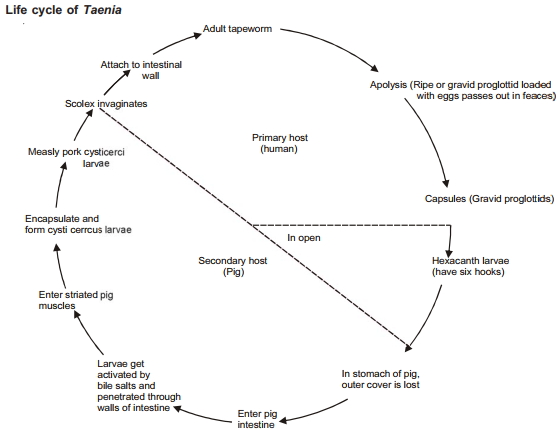
(D) $Taenia$ $solium$ is a digenetic parasite. The primary host is human,and the secondary (intermediate) host is the pig. The $Cysticercus$ larva (also known as bladder worm) develops within the muscles of the pig. When a human consumes undercooked or raw pork containing these $Cysticercus$ larvae,they develop into adult tapeworms in the human intestine.
0 likes
View Solution179
EasyMCQ
The free-swimming ciliated larva of the liver fluke is
A
Redia
B
Miracidium
C
Metacercaria
D
Cercaria
Solution
(B) The $Miracidium$ larva is the free-swimming larva of $Fasciola$ (liver fluke) and possesses a ciliated epidermis.
This larva represents the infective stage for the secondary host,which is a snail,during the life cycle of $Fasciola$.
This larva represents the infective stage for the secondary host,which is a snail,during the life cycle of $Fasciola$.
0 likes
View Solution180
MediumMCQ
One example of animals having a single opening to the outside that serves both as mouth as well as anus is
A
Fasciola
B
Ancylostoma
C
Asterias
D
Ascidia
Solution
(A) Animals that have a single opening to the outside,which serves as both mouth and anus,possess an incomplete digestive system.
Platyhelminthes,such as $Fasciola$,exhibit an incomplete digestive system.
In contrast,$Ancylostoma$ (Aschelminthes),$Asterias$ (Echinodermata),and $Ascidia$ (Urochordata) possess a complete digestive system with two separate openings: a mouth and an anus.
Platyhelminthes,such as $Fasciola$,exhibit an incomplete digestive system.
In contrast,$Ancylostoma$ (Aschelminthes),$Asterias$ (Echinodermata),and $Ascidia$ (Urochordata) possess a complete digestive system with two separate openings: a mouth and an anus.
0 likes
View Solution181
MediumMCQ
The characteristics of a tapeworm are:
$(A)$ Large,quadrate scolex,without rostellum and hooks
$(B)$ Primary host man,and secondary host cattle
$(C)$ Length $5$ to $10$ metres
Identify the tapeworm.
$(A)$ Large,quadrate scolex,without rostellum and hooks
$(B)$ Primary host man,and secondary host cattle
$(C)$ Length $5$ to $10$ metres
Identify the tapeworm.
A
Taenia solium
B
Taenia saginata
C
Echinococcus
D
Hymenolepsis nana
Solution
(B) $Taenia \ saginata$ is commonly known as the beef tapeworm.
Its primary host is man,and the intermediate (secondary) host is cattle (cow,buffalo,or sheep).
In $Taenia \ saginata$,the scolex is large and quadrate,and it lacks a rostellum and hooks.
It is the longest tapeworm,typically reaching a length of $5$ to $10$ meters,and is the most common tapeworm found in humans.
Its primary host is man,and the intermediate (secondary) host is cattle (cow,buffalo,or sheep).
In $Taenia \ saginata$,the scolex is large and quadrate,and it lacks a rostellum and hooks.
It is the longest tapeworm,typically reaching a length of $5$ to $10$ meters,and is the most common tapeworm found in humans.
0 likes
View Solution182
MediumMCQ
$A$: Cysticercosis is caused by the accidental ingestion of onchospheres.
$R$: Taenia solium is a monogenetic parasite.
$R$: Taenia solium is a monogenetic parasite.
A
Assertion and Reason both are correct and Reason is the correct explanation of Assertion.
B
Assertion and Reason both are correct but Reason is not the correct explanation of Assertion.
C
Assertion is correct,but Reason is incorrect.
D
Both Assertion and Reason are incorrect.
Solution
(C) Assertion is true: Cysticercosis is a parasitic infection caused by the accidental ingestion of the eggs or onchosphere larvae of the pork tapeworm,$Taenia \ solium$.
Reason is false: $Taenia \ solium$ is a digenetic parasite,meaning it requires two hosts to complete its life cycle. Humans act as the primary (definitive) host,while pigs serve as the secondary (intermediate) host.
Reason is false: $Taenia \ solium$ is a digenetic parasite,meaning it requires two hosts to complete its life cycle. Humans act as the primary (definitive) host,while pigs serve as the secondary (intermediate) host.
0 likes
View Solution183
EasyMCQ
Which one is the excretory organ in the $Platyhelminthes$?
A
Archaeocyte
B
Choanocyte
C
Pinacocyte
D
Solenocyte
Solution
(D) Solenocytes, also known as flame cells, are the specialized excretory structures found in the phylum $Platyhelminthes$.
These cells function primarily in osmoregulation and excretion by filtering metabolic wastes from the body fluids.
These cells function primarily in osmoregulation and excretion by filtering metabolic wastes from the body fluids.
0 likes
View Solution184
MediumMCQ
In which of the following organisms is self-fertilization seen?
A
Fishes
B
Earthworm
C
Tapeworm
D
Cockroach
Solution
(C) Fishes are dioecious,so they do not exhibit self-fertilization.
Earthworms are hermaphrodites (bisexual),but they typically undergo cross-fertilization.
Cockroaches are dioecious (unisexual),so they reproduce via cross-fertilization.
Tapeworms (e.g.,$Taenia$ $solium$) are hermaphrodites and are capable of self-fertilization,where the sperm from the same individual fertilizes the eggs within the same proglottid or different proglottids of the same organism.
Earthworms are hermaphrodites (bisexual),but they typically undergo cross-fertilization.
Cockroaches are dioecious (unisexual),so they reproduce via cross-fertilization.
Tapeworms (e.g.,$Taenia$ $solium$) are hermaphrodites and are capable of self-fertilization,where the sperm from the same individual fertilizes the eggs within the same proglottid or different proglottids of the same organism.
0 likes
View Solution185
Medium
Give a scientific reason: Having a flat body is an advantage among flatworms.
Solution
(N/A) $\rightarrow$ Flatworms lack specialized circulatory and respiratory systems.
The flat body shape ensures that each cell remains in close proximity to the external environment,facilitating the diffusion of respiratory gases.
Additionally,being close to the digestive tract allows for efficient nutrient distribution.
In the case of tapeworms,the digestive system is entirely absent,and nutrients are absorbed directly through the body surface,which is made possible by their flattened morphology.
The flat body shape ensures that each cell remains in close proximity to the external environment,facilitating the diffusion of respiratory gases.
Additionally,being close to the digestive tract allows for efficient nutrient distribution.
In the case of tapeworms,the digestive system is entirely absent,and nutrients are absorbed directly through the body surface,which is made possible by their flattened morphology.
0 likes
View Solution186
EasyMCQ
Organ-system level of organization is first observed in which of the following phyla?
A
Platyhelminthes
B
Aschelminthes
C
Annelida
D
Arthropoda
Solution
(A) The organ-system level of organization is first observed in the phylum $Platyhelminthes$.
In this phylum,tissues are grouped together to form organs,which then specialize to perform specific functions,marking the beginning of organ-system level complexity in the animal kingdom.
In this phylum,tissues are grouped together to form organs,which then specialize to perform specific functions,marking the beginning of organ-system level complexity in the animal kingdom.
0 likes
View Solution187
MediumMCQ
Which phylum exhibits the first appearance of triploblastic organization?
A
Ctenophora
B
Platyhelminthes
C
Aschelminthes
D
Annelida
Solution
(B) Triploblastic organization refers to the presence of three germ layers: ectoderm,mesoderm,and endoderm during embryonic development.
Phylum $Ctenophora$ and $Cnidaria$ are diploblastic,meaning they have only two germ layers.
Phylum $Platyhelminthes$ (flatworms) is the first group in the animal kingdom to exhibit triploblastic organization,where a third layer,the mesoderm,is present between the ectoderm and endoderm.
Therefore,the correct option is $B$.
Phylum $Ctenophora$ and $Cnidaria$ are diploblastic,meaning they have only two germ layers.
Phylum $Platyhelminthes$ (flatworms) is the first group in the animal kingdom to exhibit triploblastic organization,where a third layer,the mesoderm,is present between the ectoderm and endoderm.
Therefore,the correct option is $B$.
0 likes
View Solution188
MediumMCQ
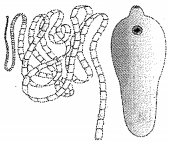
Identify the given Platyhelminthes organisms.
A
Tapeworm $\quad$ Liver fluke
B
Liver fluke $\quad$ Tapeworm
C
Tapeworm $\quad$ Planaria
D
Planaria $\quad$ Liver fluke
Solution
(A) The image shows two organisms belonging to the phylum Platyhelminthes.
$1$. The organism on the left is a Tapeworm (Taenia),which is characterized by a long,segmented,ribbon-like body.
$2$. The organism on the right is a Liver fluke (Fasciola),which has a leaf-like,unsegmented body.
Therefore,the correct identification is Tapeworm and Liver fluke.
$1$. The organism on the left is a Tapeworm (Taenia),which is characterized by a long,segmented,ribbon-like body.
$2$. The organism on the right is a Liver fluke (Fasciola),which has a leaf-like,unsegmented body.
Therefore,the correct identification is Tapeworm and Liver fluke.
0 likes
View Solution189
MediumMCQ
Animals possessing hooks and suckers belong to this phylum.
A
Coelenterata
B
Ctenophora
C
Platyhelminthes
D
Aschelminthes
Solution
(C) The phylum $Platyhelminthes$ (flatworms) consists of organisms that are mostly endoparasites in animals.
To survive inside the host,these parasites have evolved specialized structures such as hooks and suckers for attachment to the host's tissues.
Therefore,the presence of hooks and suckers is a characteristic feature of the phylum $Platyhelminthes$.
To survive inside the host,these parasites have evolved specialized structures such as hooks and suckers for attachment to the host's tissues.
Therefore,the presence of hooks and suckers is a characteristic feature of the phylum $Platyhelminthes$.
0 likes
View Solution190
MediumMCQ
Which of the following organisms excrete through flame cells?
A
Cnidaria
B
Ctenophora
C
Platyhelminthes
D
Aschelminthes
Solution
(C) Flame cells are specialized excretory cells found in the phylum $Platyhelminthes$ (flatworms).
These cells are primarily responsible for osmoregulation and excretion.
They function by filtering body fluids and removing metabolic waste products.
Therefore,the correct option is $C$.
These cells are primarily responsible for osmoregulation and excretion.
They function by filtering body fluids and removing metabolic waste products.
Therefore,the correct option is $C$.
0 likes
View Solution191
MediumMCQ
Consider the following characters $:-$
$1.$ Bilateral symmetry
$2.$ Acoelomate
$3.$ Incomplete digestive system
$4.$ Mostly endoparasites
Select the correct group of phylum with its corresponding animal for the above-given characters $:-$
$1.$ Bilateral symmetry
$2.$ Acoelomate
$3.$ Incomplete digestive system
$4.$ Mostly endoparasites
Select the correct group of phylum with its corresponding animal for the above-given characters $:-$
A
Arthropoda $-$ cockroach
B
Ctenophora $-$ Ctenoplana
C
Aschelminthes $-$ Taenia solium
D
Platyhelminthes $-$ Fasciola hepatica
Solution
(D) The given characters are characteristic features of the phylum $Platyhelminthes$ (flatworms):
$1.$ They exhibit bilateral symmetry.
$2.$ They are acoelomate (lack a body cavity).
$3.$ They possess an incomplete digestive system (a single opening serves as both mouth and anus).
$4.$ Most members are endoparasites found in animals,including humans.
$Fasciola hepatica$ (liver fluke) belongs to the phylum $Platyhelminthes$,making option $D$ the correct choice.
$Taenia solium$ is also a platyhelminth,but option $C$ incorrectly labels it as $Aschelminthes$.
$1.$ They exhibit bilateral symmetry.
$2.$ They are acoelomate (lack a body cavity).
$3.$ They possess an incomplete digestive system (a single opening serves as both mouth and anus).
$4.$ Most members are endoparasites found in animals,including humans.
$Fasciola hepatica$ (liver fluke) belongs to the phylum $Platyhelminthes$,making option $D$ the correct choice.
$Taenia solium$ is also a platyhelminth,but option $C$ incorrectly labels it as $Aschelminthes$.
0 likes
View Solution192
MediumMCQ
Among the following animals,which one possesses three germinal layers but lacks a body cavity or coelom?
A
Sponge
B
Hydra
C
Ctenoplana
D
Planaria
Solution
(D) $1$. Sponges (Porifera) are diploblastic and acoelomate.
$2$. Hydra (Cnidaria) is diploblastic and acoelomate.
$3$. Ctenoplana (Ctenophora) is diploblastic and acoelomate.
$4$. Planaria (Platyhelminthes) is triploblastic (possesses three germinal layers: ectoderm,mesoderm,and endoderm) but is acoelomate (lacks a body cavity). Therefore,the correct answer is Planaria.
$2$. Hydra (Cnidaria) is diploblastic and acoelomate.
$3$. Ctenoplana (Ctenophora) is diploblastic and acoelomate.
$4$. Planaria (Platyhelminthes) is triploblastic (possesses three germinal layers: ectoderm,mesoderm,and endoderm) but is acoelomate (lacks a body cavity). Therefore,the correct answer is Planaria.
0 likes
View Solution193
EasyMCQ
Triploblastic but acoelomate animals are?
A
Platyhelminthes
B
Ctenophora
C
Porifera
D
Annelida
Solution
(A) Animals are classified based on the number of germ layers and the presence or absence of a body cavity (coelom).
$1$. Triploblastic animals possess three germ layers: ectoderm,mesoderm,and endoderm.
$2$. Acoelomate animals are those that lack a body cavity between the body wall and the digestive tract.
$3$. Phylum $Platyhelminthes$ (flatworms) are the first group of animals to exhibit triploblastic organization,but they do not possess a true body cavity (acoelomate).
$4$. $Ctenophora$ and $Porifera$ are diploblastic,and $Annelida$ are triploblastic but coelomate.
$1$. Triploblastic animals possess three germ layers: ectoderm,mesoderm,and endoderm.
$2$. Acoelomate animals are those that lack a body cavity between the body wall and the digestive tract.
$3$. Phylum $Platyhelminthes$ (flatworms) are the first group of animals to exhibit triploblastic organization,but they do not possess a true body cavity (acoelomate).
$4$. $Ctenophora$ and $Porifera$ are diploblastic,and $Annelida$ are triploblastic but coelomate.
0 likes
View Solution194
EasyMCQ
Animal having flame cells as excretory structure is . . . . . . .
A
round worm
B
ant
C
Planaria
D
earthworm
Solution
(C) Flame cells are specialized excretory cells found in Platyhelminthes (flatworms),such as $Planaria$.
These cells function primarily in osmoregulation and excretion.
Roundworms (Aschelminthes) use renette cells or excretory canals.
Ants (Arthropoda) use Malpighian tubules.
Earthworms (Annelida) use nephridia.
These cells function primarily in osmoregulation and excretion.
Roundworms (Aschelminthes) use renette cells or excretory canals.
Ants (Arthropoda) use Malpighian tubules.
Earthworms (Annelida) use nephridia.
0 likes
View Solution195
EasyMCQ
In Platyhelminthes and rotifers,the excretory organs are . . . . . . .
A
flame cells
B
green glands
C
nephridia
D
Malpighian tubules
Solution
(A) In $Platyhelminthes$ (flatworms) and rotifers,the specialized excretory structures are known as flame cells (also called protonephridia).
Flame cells are primarily responsible for osmoregulation and excretion.
$Green$ $glands$ are found in crustaceans like prawns.
$Nephridia$ are the tubular excretory structures of earthworms and other annelids.
$Malpighian$ $tubules$ are the excretory organs of most insects.
Flame cells are primarily responsible for osmoregulation and excretion.
$Green$ $glands$ are found in crustaceans like prawns.
$Nephridia$ are the tubular excretory structures of earthworms and other annelids.
$Malpighian$ $tubules$ are the excretory organs of most insects.
0 likes
View Solution196
EasyMCQ
Parenchymal circulation is found in . . . . . . .
A
earthworm
B
flatworms
C
roundworm
D
ringworm
Solution
(B) Parenchymal circulation refers to the movement of fluids through the parenchyma,which is the loose connective tissue filling the body cavity of acoelomate animals.
Flatworms (Phylum $Platyhelminthes$) are acoelomate organisms that lack a true body cavity $(coelom)$.
In these organisms,the space between the body wall and the digestive tract is filled with parenchyma cells.
Nutrients and metabolic wastes are transported through this parenchymal tissue,a process known as parenchymal circulation.
Flatworms (Phylum $Platyhelminthes$) are acoelomate organisms that lack a true body cavity $(coelom)$.
In these organisms,the space between the body wall and the digestive tract is filled with parenchyma cells.
Nutrients and metabolic wastes are transported through this parenchymal tissue,a process known as parenchymal circulation.
0 likes
View Solution197
EasyMCQ
Given below are two statements.
Statement $I$: Cephalic ganglion appears like $U$ shaped structure in Hydra.
Statement $II$: Ventral nerve cords are connected to each other by commissure in a ladder like manner in Planarian.
In the light of above statements,choose the most appropriate answer from the options given below:
Statement $I$: Cephalic ganglion appears like $U$ shaped structure in Hydra.
Statement $II$: Ventral nerve cords are connected to each other by commissure in a ladder like manner in Planarian.
In the light of above statements,choose the most appropriate answer from the options given below:
A
Both statement $I$ and statement $II$ are incorrect.
B
Both statement $I$ and statement $II$ are correct.
C
Statement $I$ is incorrect but statement $II$ is correct.
D
Statement $I$ is correct but statement $II$ is incorrect.
Solution
(C) Statement $I$ is incorrect because $Hydra$ possesses a nerve net (diffuse nervous system) and lacks a cephalic ganglion.
Statement $II$ is correct because $Planaria$ (a flatworm) exhibits a primitive central nervous system consisting of a cephalic ganglion (brain) and two longitudinal ventral nerve cords connected by transverse commissures,forming a ladder-like nervous system.
Statement $II$ is correct because $Planaria$ (a flatworm) exhibits a primitive central nervous system consisting of a cephalic ganglion (brain) and two longitudinal ventral nerve cords connected by transverse commissures,forming a ladder-like nervous system.
0 likes
View Solution198
EasyMCQ
. . . . . . is an example of a trematode parasite.
A
Plasmodium
B
Nematode
C
Human liver flukes
D
Wuchereria
Solution
(C) The correct answer is $C$. Human liver flukes (such as $Fasciola \ hepatica$ or $Clonorchis \ sinensis$) belong to the class $Trematoda$ within the phylum $Platyhelminthes$. $Plasmodium$ is a protozoan,$Nematode$ is a separate phylum (roundworms),and $Wuchereria$ is a nematode parasite.
0 likes
View Solution199
EasyMCQ
Identify the Phylum $X$ based on the given flow chart.
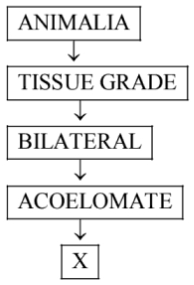
A
Hemichordata
B
Aschelminthes
C
Platyhelminthes
D
Ctenophora
Solution
(C) The flow chart describes the following characteristics:
$1$. Kingdom: $Animalia$
$2$. Level of organisation: Tissue grade
$3$. Symmetry: Bilateral
$4$. Coelom: Acoelomate
Analysis of the options:
- $Hemichordata$: Organ-system level,bilateral symmetry,coelomate.
- $Aschelminthes$: Organ-system level,bilateral symmetry,pseudocoelomate.
- $Platyhelminthes$: Organ-system level,bilateral symmetry,acoelomate.
- $Ctenophora$: Tissue grade,biradial symmetry,acoelomate.
Note: While $Platyhelminthes$ are acoelomate and bilateral,they typically exhibit organ-system level of organisation. However,in many simplified classification schemes,$Platyhelminthes$ is the only phylum that fits the 'acoelomate' and 'bilateral' criteria among the choices provided. Therefore,$Platyhelminthes$ is the most appropriate answer.
$1$. Kingdom: $Animalia$
$2$. Level of organisation: Tissue grade
$3$. Symmetry: Bilateral
$4$. Coelom: Acoelomate
Analysis of the options:
- $Hemichordata$: Organ-system level,bilateral symmetry,coelomate.
- $Aschelminthes$: Organ-system level,bilateral symmetry,pseudocoelomate.
- $Platyhelminthes$: Organ-system level,bilateral symmetry,acoelomate.
- $Ctenophora$: Tissue grade,biradial symmetry,acoelomate.
Note: While $Platyhelminthes$ are acoelomate and bilateral,they typically exhibit organ-system level of organisation. However,in many simplified classification schemes,$Platyhelminthes$ is the only phylum that fits the 'acoelomate' and 'bilateral' criteria among the choices provided. Therefore,$Platyhelminthes$ is the most appropriate answer.
0 likes
View Solution200
EasyMCQ
Flame cells present in the members of Platyhelminthes are specialized to perform:
A
Respiration and Osmoregulation
B
Osmoregulation and Circulation
C
Osmoregulation and Excretion
D
Respiration and Excretion
Solution
(C) The correct answer is $C$.
Flame cells (also known as protonephridia) are specialized excretory structures found in the members of the phylum $Platyhelminthes$ (flatworms).
These cells are primarily responsible for osmoregulation (maintaining water and salt balance) and the excretion of nitrogenous waste products from the body.
Flame cells (also known as protonephridia) are specialized excretory structures found in the members of the phylum $Platyhelminthes$ (flatworms).
These cells are primarily responsible for osmoregulation (maintaining water and salt balance) and the excretion of nitrogenous waste products from the body.
0 likes
View SolutionAnimal Kingdom — Phylum-Platyhelminthes · Frequently Asked Questions
1Are these Animal Kingdom questions useful for JEE and NEET?
Yes. All questions in this section are mapped to JEE Main and NEET exam patterns. Previous year questions from JEE Main, NEET, GUJCET and state-level exams are included with full solutions.
2Can I switch to Hindi or Gujarati for these questions?
Yes. Use the language tabs in the hero section or the sidebar to view the same questions and solutions in English, Hindi or Gujarati.
3How do I generate a question paper from this subtopic?
Use the Vedclass Exam Paper Generator — select the chapter and subtopic, set difficulty, and generate Sets A, B, C, D automatically. First 3 chapters of every subject are free.
Vedclass Products
For Students
Vedclass Test Series
Mock tests in real JEE/NEET style with performance analysis. 5-day free trial.
Start Free TrialFor Teachers
Exam Paper Generator
Generate Set A/B/C/D papers from this chapter in 2 minutes. 3 chapters free.
Try FreeFor Institutes
Online Exam Module
Live online exams with unlimited students, 360° analytics & white-label branding.
See DemoFor Teachers & Institutes
Generate a Animal Kingdom Exam Paper in 2 Minutes
Select subtopic & difficulty — Sets A, B, C, D auto-generated with No Repeat logic.
First 3 chapters of every subject are free — no payment required.