
A English
Phylum-Platyhelminthes Questions in English
Class 11 Biology · Animal Kingdom · Phylum-Platyhelminthes
200+
Questions
English
Language
100%
With Solutions
Showing 49 of 200 questions in English
101
EasyMCQ
The first phylum of animals to exhibit triploblastic organization is:
A
Cnidaria
B
Platyhelminthes
C
Aschelminthes
D
Porifera
Solution
(B) Triploblastic animals are those that possess three germ layers: ectoderm,mesoderm,and endoderm during embryonic development.
$1$. Porifera and Cnidaria are diploblastic,meaning they have only two germ layers (ectoderm and endoderm).
$2$. Platyhelminthes (flatworms) are the first group of animals in the evolutionary sequence to develop a third germ layer,the mesoderm,between the ectoderm and endoderm.
$3$. Therefore,Platyhelminthes is the first phylum to exhibit triploblastic organization.
$1$. Porifera and Cnidaria are diploblastic,meaning they have only two germ layers (ectoderm and endoderm).
$2$. Platyhelminthes (flatworms) are the first group of animals in the evolutionary sequence to develop a third germ layer,the mesoderm,between the ectoderm and endoderm.
$3$. Therefore,Platyhelminthes is the first phylum to exhibit triploblastic organization.
0 likes
View Solution102
EasyMCQ
Flatworms possess a dorso-ventrally flattened body.
A
Planaria
B
Hydra
C
Ascaris
D
Earthworm
Solution
(A) The phylum $Platyhelminthes$ is commonly known as flatworms because their body is dorso-ventrally flattened. $Planaria$ belongs to the phylum $Platyhelminthes$ (Class $Turbellaria$). $Hydra$ belongs to phylum $Cnidaria$,$Ascaris$ belongs to phylum $Aschelminthes$ (roundworms),and $Earthworm$ belongs to phylum $Annelida$.
0 likes
View Solution103
EasyMCQ
The animal group that is acoelomate is:
A
Nematoda
B
Platyhelminthes
C
Cnidaria
D
Annelida
Solution
(B) Acoelomates are animals that lack a body cavity (coelom) between the digestive tract and the outer body wall.
Among the given options,$Platyhelminthes$ (flatworms) are acoelomates.
$Nematoda$ are pseudocoelomates,while $Cnidaria$ are diploblastic and lack a true coelom but are generally classified based on tissue organization. $Annelida$ are true coelomates.
Among the given options,$Platyhelminthes$ (flatworms) are acoelomates.
$Nematoda$ are pseudocoelomates,while $Cnidaria$ are diploblastic and lack a true coelom but are generally classified based on tissue organization. $Annelida$ are true coelomates.
0 likes
View Solution104
EasyMCQ
Which of the following organisms lacks a digestive system?
A
Tapeworm
B
Roundworm
C
Sea anemone
D
Sandworm
Solution
(A) The $Tapeworm$ (belonging to the phylum $Platyhelminthes$) is an endoparasite that lives in the intestine of its host. Since it absorbs pre-digested nutrients directly from the host's body through its body surface, it lacks a digestive system. $Roundworms$ (phylum $Aschelminthes$) have a complete digestive system. $Sea$ $anemones$ (phylum $Cnidaria$) have an incomplete digestive system with a single opening. $Sandworms$ (phylum $Annelida$) have a complete digestive system.
0 likes
View Solution105
EasyMCQ
Which of the following organisms possesses an incomplete,branched,and anus-less digestive system?
A
Aschelminthes
B
Annelida
C
Platyhelminthes
D
Mollusca
Solution
(C) The organisms belonging to the phylum $Platyhelminthes$ (flatworms) exhibit an incomplete digestive system.
An incomplete digestive system means there is only a single opening that serves as both the mouth and the anus.
Furthermore,in many flatworms,the digestive cavity is highly branched to facilitate the distribution of nutrients throughout the body,as they lack a circulatory system.
Therefore,the correct option is $C$.
An incomplete digestive system means there is only a single opening that serves as both the mouth and the anus.
Furthermore,in many flatworms,the digestive cavity is highly branched to facilitate the distribution of nutrients throughout the body,as they lack a circulatory system.
Therefore,the correct option is $C$.
0 likes
View Solution106
EasyMCQ
The excretory unit found in the phylum $Platyhelminthes$ is: .........
A
Renal corpuscles
B
Malpighian tubules
C
Nephridia
D
Flame cells
Solution
(D) In the phylum $Platyhelminthes$ (flatworms),the specialized cells responsible for excretion and osmoregulation are known as $Flame \ cells$ (also called $Protonephridia$).
These cells function by filtering body fluids and removing metabolic waste through an excretory pore.
$Renal \ corpuscles$ are found in vertebrates,$Malpighian \ tubules$ are found in insects,and $Nephridia$ are found in annelids.
These cells function by filtering body fluids and removing metabolic waste through an excretory pore.
$Renal \ corpuscles$ are found in vertebrates,$Malpighian \ tubules$ are found in insects,and $Nephridia$ are found in annelids.
0 likes
View Solution107
EasyMCQ
Which of the following statements is incorrect for the phylum $Platyhelminthes$?
A
Organ-system level of organization,triploblastic,and bilaterally symmetrical.
B
They are mostly endoparasites found in animals including human beings.
C
They exhibit alternation of generation.
D
Sexes are not separate,fertilization is internal,and development is indirect.
Solution
(C) The phylum $Platyhelminthes$ (flatworms) is characterized by an organ-system level of organization,triploblastic body,and bilateral symmetry.
They are mostly endoparasites found in animals,including humans.
Sexes are not separate (hermaphrodites),fertilization is internal,and development is indirect through many larval stages.
However,they do not exhibit 'alternation of generation' (metagenesis). Alternation of generation is a characteristic feature of the phylum $Cnidaria$ (e.g.,$Obelia$),where the polyp form alternates with the medusa form. Therefore,option $C$ is incorrect.
They are mostly endoparasites found in animals,including humans.
Sexes are not separate (hermaphrodites),fertilization is internal,and development is indirect through many larval stages.
However,they do not exhibit 'alternation of generation' (metagenesis). Alternation of generation is a characteristic feature of the phylum $Cnidaria$ (e.g.,$Obelia$),where the polyp form alternates with the medusa form. Therefore,option $C$ is incorrect.
0 likes
View Solution108
EasyMCQ
Which of the following animals belongs to the phylum $Platyhelminthes$?
A
Filarial worm
B
Liver fluke
C
Corals
D
Earthworm
Solution
(B) The phylum $Platyhelminthes$ consists of flatworms.
$A$. Filarial worm $(Wuchereria)$ belongs to the phylum $Aschelminthes$.
$B$. Liver fluke ($Fasciola$ $hepatica$) belongs to the phylum $Platyhelminthes$.
$C$. Corals belong to the phylum $Cnidaria$.
$D$. Earthworm $(Pheretima)$ belongs to the phylum $Annelida$.
Therefore,the correct option is $B$.
$A$. Filarial worm $(Wuchereria)$ belongs to the phylum $Aschelminthes$.
$B$. Liver fluke ($Fasciola$ $hepatica$) belongs to the phylum $Platyhelminthes$.
$C$. Corals belong to the phylum $Cnidaria$.
$D$. Earthworm $(Pheretima)$ belongs to the phylum $Annelida$.
Therefore,the correct option is $B$.
0 likes
View Solution109
MediumMCQ
Which of the following groups is consistent?
A
$Leucosolenia$, Sea anemone, $Planaria$.
B
$Planaria$, Liver fluke, Tapeworm.
C
Roundworm, Liver fluke, Tapeworm.
D
Leech, Coral, Sea anemone.
Solution
(B) The group $Planaria$, Liver fluke, and Tapeworm is consistent because all three organisms belong to the phylum $Platyhelminthes$ (flatworms).
$Planaria$ belongs to the class $Turbellaria$.
Liver fluke $(Fasciola)$ belongs to the class $Trematoda$.
Tapeworm $(Taenia)$ belongs to the class $Cestoda$.
All these organisms share the common characteristics of being dorso-ventrally flattened, acoelomate, and triploblastic.
$Planaria$ belongs to the class $Turbellaria$.
Liver fluke $(Fasciola)$ belongs to the class $Trematoda$.
Tapeworm $(Taenia)$ belongs to the class $Cestoda$.
All these organisms share the common characteristics of being dorso-ventrally flattened, acoelomate, and triploblastic.
0 likes
View Solution110
EasyMCQ
Which of the following is a correct match?
A
Lizard $\rightarrow$ Four-chambered heart
B
Liver fluke $\rightarrow$ Flame cells
C
Platypus $\rightarrow$ Right aortic arch
D
Frog $\rightarrow$ Exoskeleton of hair
Solution
(B) $1$. Lizard (Reptile) has a three-chambered heart (except crocodiles). So,$A$ is incorrect.
$2$. Liver fluke (Fasciola hepatica) belongs to Phylum Platyhelminthes,and they possess flame cells for excretion and osmoregulation. So,$B$ is correct.
$3$. Platypus (Mammal) has a left aortic arch,not a right one. So,$C$ is incorrect.
$4$. Frog (Amphibian) has moist skin without hair; hair is a characteristic of mammals. So,$D$ is incorrect.
$2$. Liver fluke (Fasciola hepatica) belongs to Phylum Platyhelminthes,and they possess flame cells for excretion and osmoregulation. So,$B$ is correct.
$3$. Platypus (Mammal) has a left aortic arch,not a right one. So,$C$ is incorrect.
$4$. Frog (Amphibian) has moist skin without hair; hair is a characteristic of mammals. So,$D$ is incorrect.
0 likes
View Solution111
EasyMCQ
In which of the following is a digestive system absent?
A
Earthworm
B
Cockroach
C
Tapeworm
D
Roundworm
Solution
(C) The digestive system is absent in $Tapeworm$ (class $Cestoda$, phylum $Platyhelminthes$).
$Tapeworms$ are endoparasites that live in the intestine of the host.
They absorb digested nutrients directly from the host's intestine through their body surface.
Therefore, they do not require a specialized digestive system.
$Tapeworms$ are endoparasites that live in the intestine of the host.
They absorb digested nutrients directly from the host's intestine through their body surface.
Therefore, they do not require a specialized digestive system.
0 likes
View Solution112
EasyMCQ
Which of the following animals possesses an incomplete digestive system (lacking an anus)?
A
Fasciola (Liver fluke)
B
Ascaris (Roundworm)
C
Pheretima (Earthworm)
D
Periplaneta (Cockroach)
Solution
(A) An incomplete digestive system is characterized by a single opening that serves as both the mouth and the anus.
This type of digestive system is a characteristic feature of the phylum $Platyhelminthes$.
Among the given options,$Fasciola$ (Liver fluke) belongs to the phylum $Platyhelminthes$.
$Ascaris$ (Aschelminthes),$Pheretima$ (Annelida),and $Periplaneta$ (Arthropoda) all possess a complete digestive system with both a mouth and an anus.
This type of digestive system is a characteristic feature of the phylum $Platyhelminthes$.
Among the given options,$Fasciola$ (Liver fluke) belongs to the phylum $Platyhelminthes$.
$Ascaris$ (Aschelminthes),$Pheretima$ (Annelida),and $Periplaneta$ (Arthropoda) all possess a complete digestive system with both a mouth and an anus.
0 likes
View Solution113
EasyMCQ
In which of the following phyla is sexual dimorphism not observed?
A
Annelida
B
Amphibia
C
Platyhelminthes
D
Mollusca
Solution
(C) Sexual dimorphism refers to the distinct morphological differences between males and females of the same species.
In the phylum $Platyhelminthes$ (flatworms),most organisms are hermaphrodites (monoecious),meaning both male and female reproductive organs are present in the same individual.
Because they are hermaphroditic,they do not exhibit sexual dimorphism.
In contrast,$Annelida$,$Amphibia$,and $Mollusca$ generally contain species that are dioecious (separate sexes),where males and females can be distinguished morphologically.
In the phylum $Platyhelminthes$ (flatworms),most organisms are hermaphrodites (monoecious),meaning both male and female reproductive organs are present in the same individual.
Because they are hermaphroditic,they do not exhibit sexual dimorphism.
In contrast,$Annelida$,$Amphibia$,and $Mollusca$ generally contain species that are dioecious (separate sexes),where males and females can be distinguished morphologically.
0 likes
View Solution114
EasyMCQ
Which of the following phyla is acoelomate?
A
Platyhelminthes
B
Annelida
C
Arthropoda
D
Echinodermata
Solution
(A) Acoelomates are animals that lack a body cavity (coelom) between the body wall and the digestive tract.
$1$. Platyhelminthes (flatworms) are acoelomate,meaning they do not have a fluid-filled body cavity.
$2$. Annelida,Arthropoda,and Echinodermata are all coelomate animals,meaning they possess a true body cavity lined by mesoderm.
$1$. Platyhelminthes (flatworms) are acoelomate,meaning they do not have a fluid-filled body cavity.
$2$. Annelida,Arthropoda,and Echinodermata are all coelomate animals,meaning they possess a true body cavity lined by mesoderm.
0 likes
View Solution115
MediumMCQ
In which of the following is the digestive system incomplete, branched, or absent?
A
Earthworm
B
Cockroach
C
Tapeworm
D
Roundworm
Solution
(C) The digestive system is considered incomplete when there is only a single opening to the outside of the body that serves as both mouth and anus.
In $Platyhelminthes$ (flatworms), such as the $Tapeworm$ $(Taenia)$, the digestive system is often incomplete or even absent (as in the case of $Tapeworms$ which absorb nutrients directly through their body surface).
$Earthworms$ $(Annelida)$, $Cockroaches$ $(Arthropoda)$, and $Roundworms$ $(Aschelminthes)$ possess a complete digestive system with two separate openings (mouth and anus).
In $Platyhelminthes$ (flatworms), such as the $Tapeworm$ $(Taenia)$, the digestive system is often incomplete or even absent (as in the case of $Tapeworms$ which absorb nutrients directly through their body surface).
$Earthworms$ $(Annelida)$, $Cockroaches$ $(Arthropoda)$, and $Roundworms$ $(Aschelminthes)$ possess a complete digestive system with two separate openings (mouth and anus).
0 likes
View Solution116
EasyMCQ
Identify the correct pair of the phylum and three examples.
A
Mollusca - Loligo, Octopus, Hyalonema
B
Arthropoda - Spongilla, Plasmodium
C
Platyhelminthes - Planaria, Liver fluke, Tapeworm
D
Protozoa - Euglena, Opalina, Crab
Solution
(C) $1$. In option $A$, $Hyalonema$ belongs to the phylum $Porifera$, not $Mollusca$.
$2$. In option $B$, $Spongilla$ belongs to $Porifera$ and $Plasmodium$ belongs to $Protozoa$ (Protista), not $Arthropoda$.
$3$. In option $C$, $Planaria$, $Liver \text{ } fluke$ $(Fasciola)$, and $Tapeworm$ $(Taenia)$ all belong to the phylum $Platyhelminthes$. This is the correct pair.
$4$. In option $D$, $Crab$ belongs to $Arthropoda$, not $Protozoa$.
$2$. In option $B$, $Spongilla$ belongs to $Porifera$ and $Plasmodium$ belongs to $Protozoa$ (Protista), not $Arthropoda$.
$3$. In option $C$, $Planaria$, $Liver \text{ } fluke$ $(Fasciola)$, and $Tapeworm$ $(Taenia)$ all belong to the phylum $Platyhelminthes$. This is the correct pair.
$4$. In option $D$, $Crab$ belongs to $Arthropoda$, not $Protozoa$.
0 likes
View Solution117
EasyMCQ
Which phylum consists of acoelomate animals that are dorso-ventrally flattened?
A
Aschelminthes
B
Annelida
C
Platyhelminthes
D
Coelenterata
Solution
(C) The phylum $Platyhelminthes$ consists of organisms that are dorso-ventrally flattened,which is why they are commonly known as flatworms.
These animals are triploblastic,bilaterally symmetrical,and acoelomate (lacking a body cavity).
Therefore,the correct option is $C$.
These animals are triploblastic,bilaterally symmetrical,and acoelomate (lacking a body cavity).
Therefore,the correct option is $C$.
0 likes
View Solution118
EasyMCQ
Flame cells are associated with which system?
A
Excretory system
B
Digestive system
C
Respiratory system
D
Circulatory system
Solution
(A) Flame cells (also known as protonephridia) are specialized excretory cells found in the simplest freshwater invertebrates,such as flatworms (Phylum $Platyhelminthes$).
Their primary function is osmoregulation and the excretion of nitrogenous waste products from the body.
Therefore,they are directly associated with the excretory system.
Their primary function is osmoregulation and the excretion of nitrogenous waste products from the body.
Therefore,they are directly associated with the excretory system.
0 likes
View Solution119
EasyMCQ
In which of the following animals is the digestive system absent?
A
Planaria
B
Ascaris
C
Taenia (Tapeworm)
D
Earthworm
Solution
(C) The digestive system is absent in $Taenia$ (Tapeworm),which belongs to the phylum $Platyhelminthes$.
These organisms are endoparasites that live in the intestine of the host.
Since they live in an environment where food is already digested by the host,they absorb nutrients directly through their body surface using their tegument.
Therefore,they do not require a specialized digestive system.
These organisms are endoparasites that live in the intestine of the host.
Since they live in an environment where food is already digested by the host,they absorb nutrients directly through their body surface using their tegument.
Therefore,they do not require a specialized digestive system.
0 likes
View Solution120
EasyMCQ
What kind of lifestyle do liver flukes lead?
A
Endoparasitism
B
Larval form
C
Ectoparasitism
D
All of the above
Solution
(A) Liver flukes,such as $Fasciola$ $hepatica$,belong to the phylum $Platyhelminthes$.
These organisms are primarily endoparasites,meaning they live inside the body of their host (typically in the bile ducts of mammals).
They exhibit specialized adaptations for a parasitic mode of life,such as hooks and suckers for attachment,and a thick tegument to protect against host digestive enzymes.
Therefore,they lead an endoparasitic lifestyle.
These organisms are primarily endoparasites,meaning they live inside the body of their host (typically in the bile ducts of mammals).
They exhibit specialized adaptations for a parasitic mode of life,such as hooks and suckers for attachment,and a thick tegument to protect against host digestive enzymes.
Therefore,they lead an endoparasitic lifestyle.
0 likes
View Solution121
EasyMCQ
What is the excretory system in flatworms $(Platyhelminthes)$ composed of?
A
Protonephridia
B
Cnidocytes
C
Flame cells
D
Malpighian tubules
Solution
(C) In $Platyhelminthes$ (flatworms),the excretory system consists of specialized cells called flame cells (also known as protonephridia).
These cells are primarily responsible for osmoregulation and excretion.
Flame cells function by filtering metabolic waste from the body fluids and propelling it through a network of excretory ducts to the outside environment.
Cnidocytes are characteristic of $Cnidaria$,and Malpighian tubules are the excretory organs in insects $(Arthropoda)$.
These cells are primarily responsible for osmoregulation and excretion.
Flame cells function by filtering metabolic waste from the body fluids and propelling it through a network of excretory ducts to the outside environment.
Cnidocytes are characteristic of $Cnidaria$,and Malpighian tubules are the excretory organs in insects $(Arthropoda)$.
0 likes
View Solution122
EasyMCQ
Which structure is found in the phylum Platyhelminthes to attach to the host?
A
Setae
B
Hooks
C
Mouthparts
D
Parapodia
Solution
(B) The phylum $Platyhelminthes$ (flatworms) includes many parasitic forms,such as tapeworms $(Taenia)$.
These parasitic flatworms possess specialized structures like hooks and suckers on their anterior end (scolex) to attach themselves firmly to the body of the host.
Setae and parapodia are typically found in phylum $Annelida$,and mouthparts are general structures not specific to the attachment mechanism of parasitic flatworms.
These parasitic flatworms possess specialized structures like hooks and suckers on their anterior end (scolex) to attach themselves firmly to the body of the host.
Setae and parapodia are typically found in phylum $Annelida$,and mouthparts are general structures not specific to the attachment mechanism of parasitic flatworms.
0 likes
View Solution123
EasyMCQ
Which of the following is $NOT$ applicable to the liver fluke ($Fasciola$ $hepatica$)?
A
Excretion by flame cells
B
Presence of hooks
C
Hermaphroditic (sexes are not separate)
D
Complete digestive system
Solution
(D) The liver fluke ($Fasciola$ $hepatica$) belongs to the phylum $Platyhelminthes$ (flatworms).
$1$. Excretion occurs through specialized cells called flame cells (protonephridia),which is a characteristic feature of this phylum.
$2$. They possess hooks and suckers for attachment to the host.
$3$. They are hermaphroditic,meaning both male and female reproductive organs are present in the same individual.
$4$. They have an incomplete digestive system (a single opening serves as both mouth and anus),or it may be absent in some parasitic forms. Therefore,a complete digestive system is $NOT$ applicable to them.
$1$. Excretion occurs through specialized cells called flame cells (protonephridia),which is a characteristic feature of this phylum.
$2$. They possess hooks and suckers for attachment to the host.
$3$. They are hermaphroditic,meaning both male and female reproductive organs are present in the same individual.
$4$. They have an incomplete digestive system (a single opening serves as both mouth and anus),or it may be absent in some parasitic forms. Therefore,a complete digestive system is $NOT$ applicable to them.
0 likes
View Solution124
EasyMCQ
In which phylum do animals have a digestive tract that opens at only one end?
A
Porifera
B
Platyhelminthes
C
Aschelminthes
D
Annelida
Solution
(B) Animals in the phylum $Platyhelminthes$ (flatworms) possess an incomplete digestive system.
This means they have a single opening to the outside of the body that serves as both the mouth and the anus.
In contrast,$Porifera$ lack a true digestive system,while $Aschelminthes$ and $Annelida$ possess a complete digestive system with two separate openings (mouth and anus).
This means they have a single opening to the outside of the body that serves as both the mouth and the anus.
In contrast,$Porifera$ lack a true digestive system,while $Aschelminthes$ and $Annelida$ possess a complete digestive system with two separate openings (mouth and anus).
0 likes
View Solution125
MediumMCQ
Which animal possesses an incomplete,branched,and blind-sac digestive system?
A
Ascaris
B
Sea anemone
C
Wuchereria
D
Planaria
Solution
(D) An incomplete digestive system is one that has only a single opening to the outside of the body that serves as both mouth and anus.
Planaria (a flatworm belonging to the phylum Platyhelminthes) exhibits a highly branched gastrovascular cavity which acts as an incomplete digestive system.
Sea anemones (Cnidaria) also have a blind-sac body plan,but Planaria is the classic example often cited for a branched,incomplete digestive system in biological studies.
Planaria (a flatworm belonging to the phylum Platyhelminthes) exhibits a highly branched gastrovascular cavity which acts as an incomplete digestive system.
Sea anemones (Cnidaria) also have a blind-sac body plan,but Planaria is the classic example often cited for a branched,incomplete digestive system in biological studies.
0 likes
View Solution126
EasyMCQ
Which of the following statements regarding the digestive system of $Platyhelminthes$ is incorrect?
A
The alimentary canal lacks an anus.
B
The digestive system is absent.
C
The alimentary canal possesses an anus.
D
The alimentary canal is incomplete and branched.
Solution
(C) The phylum $Platyhelminthes$ (flatworms) is characterized by an incomplete digestive system.
In this system,the alimentary canal has only a single opening that serves as both mouth and anus,meaning it lacks a separate anus.
Some parasitic forms,like $Taenia$ (tapeworm),lack a digestive system entirely as they absorb nutrients directly from the host's body.
Therefore,the statement that the alimentary canal possesses an anus is incorrect.
In this system,the alimentary canal has only a single opening that serves as both mouth and anus,meaning it lacks a separate anus.
Some parasitic forms,like $Taenia$ (tapeworm),lack a digestive system entirely as they absorb nutrients directly from the host's body.
Therefore,the statement that the alimentary canal possesses an anus is incorrect.
0 likes
View Solution127
EasyMCQ
Assertion $A$: Animals of Phylum $Platyhelminthes$ have an incomplete digestive tract.
Reason $R$: In $Platyhelminthes$,the digestive tract opens to the outside through a single opening.
Which option is correct for Assertion $A$ and Reason $R$?
Reason $R$: In $Platyhelminthes$,the digestive tract opens to the outside through a single opening.
Which option is correct for Assertion $A$ and Reason $R$?
A
$A$ and $R$ are both true and $R$ is the correct explanation of $A$.
B
$A$ and $R$ are both true but $R$ is not the correct explanation of $A$.
C
$A$ is true and $R$ is false.
D
$A$ is false and $R$ is true.
Solution
(A) In Phylum $Platyhelminthes$ (flatworms),the digestive system is incomplete,meaning it has only a single opening to the outside of the body that serves as both mouth and anus.
This single opening is used for both ingestion of food and egestion of waste.
Therefore,Assertion $A$ is true because the digestive tract is incomplete.
Reason $R$ is also true and correctly explains why the digestive tract is considered incomplete.
This single opening is used for both ingestion of food and egestion of waste.
Therefore,Assertion $A$ is true because the digestive tract is incomplete.
Reason $R$ is also true and correctly explains why the digestive tract is considered incomplete.
0 likes
View Solution128
EasyMCQ
What is the covering present around the body of parasitic animals belonging to the phyla Platyhelminthes and Nematoda?
A
Cuticle
B
Chitin
C
Quinine
D
Pectin
Solution
(A) Parasitic animals belonging to the phyla $Platyhelminthes$ (flatworms) and $Nematoda$ (roundworms) live inside the host body where they are exposed to digestive enzymes and harsh conditions.
To protect themselves from these enzymes and the host's immune system,their body is covered by a thick,resistant,and non-living layer called the $Cuticle$.
The $Cuticle$ provides structural support and acts as a protective barrier against the host's digestive juices.
To protect themselves from these enzymes and the host's immune system,their body is covered by a thick,resistant,and non-living layer called the $Cuticle$.
The $Cuticle$ provides structural support and acts as a protective barrier against the host's digestive juices.
0 likes
View Solution129
EasyMCQ
Which triploblastic animal lacks a coelom?
A
Platyhelminthes
B
Aschelminthes
C
Annelida
D
Arthropoda
Solution
(A) Triploblastic animals are those that possess three germ layers: ectoderm,mesoderm,and endoderm.
Among the given options,$Platyhelminthes$ (flatworms) are triploblastic but are acoelomate,meaning they lack a body cavity (coelom).
$Aschelminthes$ are pseudocoelomates,while $Annelida$ and $Arthropoda$ are true coelomates.
Among the given options,$Platyhelminthes$ (flatworms) are triploblastic but are acoelomate,meaning they lack a body cavity (coelom).
$Aschelminthes$ are pseudocoelomates,while $Annelida$ and $Arthropoda$ are true coelomates.
0 likes
View Solution130
EasyMCQ
What is observed in Platyhelminthes,in contrast to Annelida?
A
Radial symmetry
B
Presence of pseudocoelom
C
Bilateral symmetry
D
Absence of coelom
Solution
(D) Annelids ($Phylum$ $Annelida$) are characterized by the presence of a true coelom,meaning they are coelomate animals. In contrast,Platyhelminthes ($Phylum$ $Platyhelminthes$) are acoelomate,meaning they lack a body cavity (coelom) between the body wall and the digestive tract. Therefore,the absence of a coelom is the key feature observed in Platyhelminthes that contrasts with the coelomate nature of Annelida.
0 likes
View Solution131
MediumMCQ
In which triploblastic animals is the coelom absent?
A
Platyhelminthes
B
Annelida
C
Arthropoda
D
Aves
Solution
(A) Triploblastic animals are those that possess three germ layers: ectoderm,mesoderm,and endoderm.
Among the given options,$Platyhelminthes$ (flatworms) are triploblastic but are acoelomate,meaning they lack a body cavity (coelom).
$Annelida$ and $Arthropoda$ are coelomate animals.
$Aves$ (birds) are also coelomate animals.
Therefore,the correct answer is $Platyhelminthes$.
Among the given options,$Platyhelminthes$ (flatworms) are triploblastic but are acoelomate,meaning they lack a body cavity (coelom).
$Annelida$ and $Arthropoda$ are coelomate animals.
$Aves$ (birds) are also coelomate animals.
Therefore,the correct answer is $Platyhelminthes$.
0 likes
View Solution132
EasyMCQ
The first animal phylum to exhibit a triploblastic body organization is .........
A
Coelenterata
B
Porifera
C
Platyhelminthes
D
Aschelminthes
Solution
(C) Triploblastic organization refers to the presence of three germ layers: ectoderm,mesoderm,and endoderm during embryonic development.
Porifera and Coelenterata are diploblastic,meaning they have only two germ layers.
Platyhelminthes (flatworms) are the first phylum in the evolutionary sequence to exhibit a triploblastic body organization.
Therefore,the correct option is $C$.
Porifera and Coelenterata are diploblastic,meaning they have only two germ layers.
Platyhelminthes (flatworms) are the first phylum in the evolutionary sequence to exhibit a triploblastic body organization.
Therefore,the correct option is $C$.
0 likes
View Solution133
EasyMCQ
Which phylum of animals lacks organ systems?
A
Echinodermata
B
Platyhelminthes
C
Arthropoda
D
Annelida
Solution
(B) The organization of animals can be categorized into cellular,tissue,organ,and organ-system levels.
$1$. Porifera exhibits a cellular level of organization.
$2$. Cnidaria and Ctenophora exhibit a tissue level of organization.
$3$. Platyhelminthes (flatworms) are the first phylum to exhibit an organ-level of organization,but they lack a complete organ system (e.g.,they lack a complete digestive tract).
$4$. Phyla from Aschelminthes to Chordata exhibit an organ-system level of organization.
Therefore,among the given options,Platyhelminthes is the phylum that does not possess a complete organ system.
$1$. Porifera exhibits a cellular level of organization.
$2$. Cnidaria and Ctenophora exhibit a tissue level of organization.
$3$. Platyhelminthes (flatworms) are the first phylum to exhibit an organ-level of organization,but they lack a complete organ system (e.g.,they lack a complete digestive tract).
$4$. Phyla from Aschelminthes to Chordata exhibit an organ-system level of organization.
Therefore,among the given options,Platyhelminthes is the phylum that does not possess a complete organ system.
0 likes
View Solution134
EasyMCQ
Identify the given animal and its habitat.
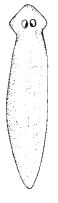
A
Apolina,free-living
B
Liver fluke,parasitic
C
Planaria,free-living
D
Filaria,parasitic
Solution
(C) The image shows $Planaria$,which belongs to the phylum Platyhelminthes.
$Planaria$ is a well-known example of a free-living flatworm.
Unlike other flatworms like liver flukes $(Fasciola)$ or tapeworms $(Taenia)$ which are parasitic,$Planaria$ lives in freshwater environments and exhibits high regenerative capacity.
Therefore,the correct identification is $Planaria$ and its habitat is free-living.
$Planaria$ is a well-known example of a free-living flatworm.
Unlike other flatworms like liver flukes $(Fasciola)$ or tapeworms $(Taenia)$ which are parasitic,$Planaria$ lives in freshwater environments and exhibits high regenerative capacity.
Therefore,the correct identification is $Planaria$ and its habitat is free-living.
0 likes
View Solution135
EasyMCQ
Planaria possesses high capacity of
A
metamorphosis
B
regeneration
C
alternation of generation
D
bioluminescence
Solution
(B) $Planaria$ possesses a high degree of regeneration. Both epimorphosis,in which the missing parts are formed,and morphallaxis,in which the whole body can be regenerated from a fragment of the body,occur in this organism.
0 likes
View Solution136
MediumMCQ
One example of animals having a single opening to the outside that serves both as mouth as well as anus is
A
Octopus
B
Asterias
C
Ascidia
D
Fasciola
Solution
(D) The correct answer is $D$. In $Fasciola$ (a member of Platyhelminthes),the body plan is known as the 'blind sac' body plan.
This means the digestive system has only a single opening that serves both as the mouth for ingestion (intake of food) and as the anus for egestion (removal of undigested waste).
In contrast,organisms like $Octopus$,$Asterias$,and $Ascidia$ possess a complete digestive tract with two separate openings (mouth and anus).
This means the digestive system has only a single opening that serves both as the mouth for ingestion (intake of food) and as the anus for egestion (removal of undigested waste).
In contrast,organisms like $Octopus$,$Asterias$,and $Ascidia$ possess a complete digestive tract with two separate openings (mouth and anus).
0 likes
View Solution137
MediumMCQ
Which one of the following kinds of animals are triploblastic?
A
Flatworms
B
Sponges
C
Ctenophores
D
Corals
Solution
(A) $Triploblastic$ is a condition describing an animal having a body composed of three embryonic germ layers: the ectoderm,mesoderm,and endoderm.
Most multicellular animals belonging to phylum $Platyhelminthes$ to phylum $Chordata$ are triploblastic.
Flatworms (phylum $Platyhelminthes$) are the first group of animals to exhibit triploblastic organization.
$Ctenophores$,sponges (phylum $Porifera$),and corals (phylum $Cnidaria$) are diploblastic,meaning they possess only two germ layers: the ectoderm and endoderm.
Most multicellular animals belonging to phylum $Platyhelminthes$ to phylum $Chordata$ are triploblastic.
Flatworms (phylum $Platyhelminthes$) are the first group of animals to exhibit triploblastic organization.
$Ctenophores$,sponges (phylum $Porifera$),and corals (phylum $Cnidaria$) are diploblastic,meaning they possess only two germ layers: the ectoderm and endoderm.
0 likes
View Solution138
MediumMCQ
The human liver fluke depends on how many intermediate hosts to complete its life cycle?
A
$2$
B
$3$
C
$4$
D
$1$
Solution
(A) The human liver fluke,$Fasciola \ hepatica$,requires two intermediate hosts to complete its life cycle.
$1$. The primary host is a human or other mammal (definitive host).
$2$. The first intermediate host is a freshwater snail (e.g.,$Lymnaea$ species).
$3$. The second intermediate host is an aquatic plant (e.g.,watercress),which acts as a vector for the encysted metacercariae stage.
$1$. The primary host is a human or other mammal (definitive host).
$2$. The first intermediate host is a freshwater snail (e.g.,$Lymnaea$ species).
$3$. The second intermediate host is an aquatic plant (e.g.,watercress),which acts as a vector for the encysted metacercariae stage.
0 likes
View Solution139
MediumMCQ
True regeneration is found in
A
Earthworm
B
Cockroach
C
Planaria
D
Lizard
Solution
(C) True regeneration is the ability of an organism to regrow lost or damaged body parts from the remaining tissue.
In $Planaria$ (a flatworm),this process is highly developed. If a $Planaria$ body is cut into several pieces,each piece can regenerate into a complete,fully functional individual.
While other organisms like lizards can perform autotomy (regrowing a tail),this is limited and not considered 'true' regeneration in the biological sense compared to the extensive regenerative capacity seen in $Planaria$.
In $Planaria$ (a flatworm),this process is highly developed. If a $Planaria$ body is cut into several pieces,each piece can regenerate into a complete,fully functional individual.
While other organisms like lizards can perform autotomy (regrowing a tail),this is limited and not considered 'true' regeneration in the biological sense compared to the extensive regenerative capacity seen in $Planaria$.
0 likes
View Solution140
MediumMCQ
Which of the following animals is bilaterally symmetrical,triploblastic,and acoelomate?
A
Liver fluke
B
Aurelia
C
Adamsia
D
Locusta
Solution
(A) The animals belonging to the phylum Platyhelminthes are characterized by being bilaterally symmetrical,triploblastic,and acoelomate (lacking a body cavity).
Liver fluke (Fasciola hepatica) belongs to the phylum Platyhelminthes.
Aurelia and Adamsia belong to the phylum Cnidaria,which are radially symmetrical and diploblastic.
Locusta belongs to the phylum Arthropoda,which are bilaterally symmetrical,triploblastic,and coelomate.
Liver fluke (Fasciola hepatica) belongs to the phylum Platyhelminthes.
Aurelia and Adamsia belong to the phylum Cnidaria,which are radially symmetrical and diploblastic.
Locusta belongs to the phylum Arthropoda,which are bilaterally symmetrical,triploblastic,and coelomate.
0 likes
View Solution141
MediumMCQ
$Taenia$ (tapeworm) and $Fasciola$ (liver fluke) are:
A
Autotrophs
B
Ectoparasites
C
Endoparasites
D
$A$ and $B$ both
Solution
(C) $Taenia$ and $Fasciola$ belong to the phylum $Platyhelminthes$.
These organisms are flatworms that live inside the body of their host to obtain nutrients.
Since they reside within the host's body,they are classified as endoparasites.
They are not autotrophs as they cannot synthesize their own food,and they are not ectoparasites because they do not live on the external surface of the host.
These organisms are flatworms that live inside the body of their host to obtain nutrients.
Since they reside within the host's body,they are classified as endoparasites.
They are not autotrophs as they cannot synthesize their own food,and they are not ectoparasites because they do not live on the external surface of the host.
0 likes
View Solution142
EasyMCQ
In $Fasciola$ (liver fluke),the digestive system is:
A
Complete
B
Incomplete
C
Well developed
D
Absent
Solution
(B) $Fasciola$ (liver fluke) belongs to the phylum $Platyhelminthes$ (flatworms).
These organisms possess an incomplete digestive system,which means they have a single opening that serves as both the mouth and the anus.
They lack a complete alimentary canal with separate openings for ingestion and egestion.
Therefore,the correct option is $B$.
These organisms possess an incomplete digestive system,which means they have a single opening that serves as both the mouth and the anus.
They lack a complete alimentary canal with separate openings for ingestion and egestion.
Therefore,the correct option is $B$.
0 likes
View Solution143
MediumMCQ
In the secondary host,the transmission of $Taenia$ occurs in the form of:
A
Oncosphere
B
Cysticercus
C
Morula
D
Ovum
Solution
(A) The life cycle of $Taenia$ $solium$ (pork tapeworm) involves two hosts. The primary host is human,and the secondary (intermediate) host is the pig.
In the human intestine,the eggs are released and passed out with feces. When the pig (secondary host) ingests these eggs,the embryos (oncospheres) hatch and migrate to the muscles.
In the muscles of the pig,the oncosphere develops into a bladder-like larva known as $Cysticercus$ $cellulosae$ (also called bladder worm).
Therefore,the transmission of $Taenia$ to the secondary host occurs in the form of the oncosphere,which then develops into the $Cysticercus$ stage.
In the human intestine,the eggs are released and passed out with feces. When the pig (secondary host) ingests these eggs,the embryos (oncospheres) hatch and migrate to the muscles.
In the muscles of the pig,the oncosphere develops into a bladder-like larva known as $Cysticercus$ $cellulosae$ (also called bladder worm).
Therefore,the transmission of $Taenia$ to the secondary host occurs in the form of the oncosphere,which then develops into the $Cysticercus$ stage.
0 likes
View Solution144
EasyMCQ
The bladder worm / $Cysticercus$ is the larval stage of $..........$.
A
Tapeworm
B
Roundworm
C
Pinworm
D
Liver fluke
Solution
(A) The $Cysticercus$ (bladder worm) is a larval stage in the life cycle of the tapeworm (specifically $Taenia$ $solium$).
It develops from the $Oncosphere$ larva after it is ingested by the intermediate host (pig).
This larva encysts in the muscles of the host,forming a fluid-filled bladder,hence the name 'bladder worm'.
It develops from the $Oncosphere$ larva after it is ingested by the intermediate host (pig).
This larva encysts in the muscles of the host,forming a fluid-filled bladder,hence the name 'bladder worm'.
0 likes
View Solution145
MediumMCQ
The excretory structure in flatworms/Taenia is ........
A
Flame cells
B
Protonephridia
C
Malpighian tubules
D
Green glands
Solution
(A) In flatworms (Phylum Platyhelminthes),such as $Taenia$ (tapeworm),the specialized cells used for excretion and osmoregulation are known as flame cells or protonephridia.
Flame cells function by filtering metabolic waste from the body fluids and propelling it through the excretory duct system to the outside.
Malpighian tubules are found in insects,and green glands (antennary glands) are found in crustaceans.
Flame cells function by filtering metabolic waste from the body fluids and propelling it through the excretory duct system to the outside.
Malpighian tubules are found in insects,and green glands (antennary glands) are found in crustaceans.
0 likes
View Solution146
MediumMCQ
Which of the following is true for $Taenia$?
A
Male organs develop in posterior proglottids.
B
Male organs develop in anterior proglottids.
C
Female organs develop in anterior proglottids.
D
Mature proglottids contain both male and female organs.
Solution
(D) $Taenia$ (tapeworm) is a hermaphrodite organism.
In its life cycle,the proglottids are segments that mature as they move away from the scolex (anterior end).
The anterior proglottids are immature.
The middle proglottids are mature and contain both male and female reproductive organs (hermaphroditic).
The posterior proglottids are gravid,containing fertilized eggs.
Therefore,the mature proglottids contain both male and female reproductive organs.
In its life cycle,the proglottids are segments that mature as they move away from the scolex (anterior end).
The anterior proglottids are immature.
The middle proglottids are mature and contain both male and female reproductive organs (hermaphroditic).
The posterior proglottids are gravid,containing fertilized eggs.
Therefore,the mature proglottids contain both male and female reproductive organs.
0 likes
View Solution147
MediumMCQ
Which of the following is true for $Taenia$ $saginata$?
A
Pig is the intermediate host in its life cycle.
B
It has two large suckers on the scolex.
C
Rostellar hooks are absent.
D
There is a double row of hooks on the rostellum.
Solution
(C) $Taenia$ $saginata$,commonly known as the beef tapeworm,is a parasite that infects humans.
Its primary intermediate host is cattle ($Bos$ $taurus$),not pigs.
The scolex of $Taenia$ $saginata$ possesses four suckers but lacks a rostellum and rostellar hooks.
Therefore,the statement that rostellar hooks are absent is correct.
Its primary intermediate host is cattle ($Bos$ $taurus$),not pigs.
The scolex of $Taenia$ $saginata$ possesses four suckers but lacks a rostellum and rostellar hooks.
Therefore,the statement that rostellar hooks are absent is correct.
0 likes
View Solution148
EasyMCQ
Which of the following is included in the phylum Platyhelminthes?
A
Schistosoma
B
Trypanosoma
C
Plasmodium
D
Wuchereria
Solution
(A) The phylum $Platyhelminthes$ consists of flatworms.
$Schistosoma$ (blood fluke) belongs to the class $Trematoda$ within the phylum $Platyhelminthes$.
$Trypanosoma$ is a protozoan belonging to the phylum $Protozoa$ (or $Sarcomastigophora$).
$Plasmodium$ is a protozoan belonging to the phylum $Protozoa$ (or $Apicomplexa$).
$Wuchereria$ is a roundworm belonging to the phylum $Aschelminthes$ (or $Nematoda$).
Therefore,the correct option is $A$.
$Schistosoma$ (blood fluke) belongs to the class $Trematoda$ within the phylum $Platyhelminthes$.
$Trypanosoma$ is a protozoan belonging to the phylum $Protozoa$ (or $Sarcomastigophora$).
$Plasmodium$ is a protozoan belonging to the phylum $Protozoa$ (or $Apicomplexa$).
$Wuchereria$ is a roundworm belonging to the phylum $Aschelminthes$ (or $Nematoda$).
Therefore,the correct option is $A$.
0 likes
View Solution149
MediumMCQ
During its life cycle,the liver fluke ($Fasciola$ $hepatica$) infects its intermediate host and primary host,respectively,through which of the following larval stages?
A
Miracidium and Metacercaria
B
Redia and Miracidium
C
Cercaria and Redia
D
Metacercaria and Cercaria
Solution
(A) The life cycle of the liver fluke ($Fasciola$ $hepatica$) involves two hosts.
$1$. The primary host is a sheep or human (vertebrate),and the intermediate host is a snail (mollusc).
$2$. The $Miracidium$ larva infects the intermediate host (snail) to continue its development.
$3$. After passing through various stages ($Sporocyst$,$Redia$,$Cercaria$) within the snail,the $Cercaria$ larvae emerge and encyst on aquatic vegetation to form the $Metacercaria$ stage.
$4$. The $Metacercaria$ is the infective stage for the primary host (sheep/human) when ingested with vegetation.
Therefore,the liver fluke infects the intermediate host as a $Miracidium$ and the primary host as a $Metacercaria$.
$1$. The primary host is a sheep or human (vertebrate),and the intermediate host is a snail (mollusc).
$2$. The $Miracidium$ larva infects the intermediate host (snail) to continue its development.
$3$. After passing through various stages ($Sporocyst$,$Redia$,$Cercaria$) within the snail,the $Cercaria$ larvae emerge and encyst on aquatic vegetation to form the $Metacercaria$ stage.
$4$. The $Metacercaria$ is the infective stage for the primary host (sheep/human) when ingested with vegetation.
Therefore,the liver fluke infects the intermediate host as a $Miracidium$ and the primary host as a $Metacercaria$.
0 likes
View SolutionAnimal Kingdom — Phylum-Platyhelminthes · Frequently Asked Questions
1Are these Animal Kingdom questions useful for JEE and NEET?
Yes. All questions in this section are mapped to JEE Main and NEET exam patterns. Previous year questions from JEE Main, NEET, GUJCET and state-level exams are included with full solutions.
2Can I switch to Hindi or Gujarati for these questions?
Yes. Use the language tabs in the hero section or the sidebar to view the same questions and solutions in English, Hindi or Gujarati.
3How do I generate a question paper from this subtopic?
Use the Vedclass Exam Paper Generator — select the chapter and subtopic, set difficulty, and generate Sets A, B, C, D automatically. First 3 chapters of every subject are free.
Vedclass Products
For Students
Vedclass Test Series
Mock tests in real JEE/NEET style with performance analysis. 5-day free trial.
Start Free TrialFor Teachers
Exam Paper Generator
Generate Set A/B/C/D papers from this chapter in 2 minutes. 3 chapters free.
Try FreeFor Institutes
Online Exam Module
Live online exams with unlimited students, 360° analytics & white-label branding.
See DemoFor Teachers & Institutes
Generate a Animal Kingdom Exam Paper in 2 Minutes
Select subtopic & difficulty — Sets A, B, C, D auto-generated with No Repeat logic.
First 3 chapters of every subject are free — no payment required.