
A English
Phylum-Echinodermata Questions in English
Class 11 Biology · Animal Kingdom · Phylum-Echinodermata
122+
Questions
English
Language
100%
With Solutions
Showing 22 of 122 questions in English
101
MediumMCQ
Arms are absent in
A
Sea urchin
B
Sea cucumber
C
Both $(A)$ and $(B)$
D
None of these
Solution
(C) Arms are absent in the class $Echinoidea$ (e.g.,sea urchins) and class $Holothuroidea$ (e.g.,sea cucumbers).
In $Echinodermata$,the body plan varies significantly.
Sea urchins belong to $Echinoidea$,which are globular or disc-shaped and lack arms.
Sea cucumbers belong to $Holothuroidea$,which are elongated and also lack arms.
In $Echinodermata$,the body plan varies significantly.
Sea urchins belong to $Echinoidea$,which are globular or disc-shaped and lack arms.
Sea cucumbers belong to $Holothuroidea$,which are elongated and also lack arms.
0 likes
View Solution102
EasyMCQ
All of the following are echinoderms,except:
A
Sea lily
B
Sea cucumber
C
Sea hare
D
Sea urchin
Solution
(C) The phylum $Echinodermata$ includes marine animals characterized by a water vascular system and radial symmetry in adults.
$A$. Sea lily $(Antedon)$ belongs to the class $Crinoidea$ of the phylum $Echinodermata$.
$B$. Sea cucumber $(Cucumaria)$ belongs to the class $Holothuroidea$ of the phylum $Echinodermata$.
$C$. Sea hare $(Aplysia)$ belongs to the class $Gastropoda$ of the phylum $Mollusca$,not $Echinodermata$.
$D$. Sea urchin $(Echinus)$ belongs to the class $Echinoidea$ of the phylum $Echinodermata$.
Therefore,the correct answer is $C$.
$A$. Sea lily $(Antedon)$ belongs to the class $Crinoidea$ of the phylum $Echinodermata$.
$B$. Sea cucumber $(Cucumaria)$ belongs to the class $Holothuroidea$ of the phylum $Echinodermata$.
$C$. Sea hare $(Aplysia)$ belongs to the class $Gastropoda$ of the phylum $Mollusca$,not $Echinodermata$.
$D$. Sea urchin $(Echinus)$ belongs to the class $Echinoidea$ of the phylum $Echinodermata$.
Therefore,the correct answer is $C$.
0 likes
View Solution103
EasyMCQ
The calcareous ossicles in echinoderms form the
A
Exoskeleton
B
Visceral hump
C
Notochord
D
Endoskeleton
Solution
(D) Echinoderms possess an endoskeleton (internal skeleton) composed of calcareous ossicles (small bony plates),which are embedded within the dermis of the skin.
This endoskeleton is derived from the mesoderm during embryonic development.
This endoskeleton is derived from the mesoderm during embryonic development.
0 likes
View Solution104
MediumMCQ
The larval stage in Asterias is:
$(a)$ Absent
$(b)$ Free-swimming
$(c)$ Bilaterally symmetrical
$(d)$ Radially symmetrical
$(a)$ Absent
$(b)$ Free-swimming
$(c)$ Bilaterally symmetrical
$(d)$ Radially symmetrical
A
$Only \; (a)$
B
$(b) \; \text{and} \; (c)$
C
$(b) \; \text{and} \; (d)$
D
$Only \; (c)$
Solution
(B) $Asterias$ (starfish) belongs to the phylum $Echinodermata$.
Echinoderms are free-living marine animals.
Adult echinoderms exhibit radial symmetry, whereas their larval stages exhibit bilateral symmetry.
These larval stages are also free-swimming in nature.
Therefore, both statements $(b)$ and $(c)$ are correct.
Echinoderms are free-living marine animals.
Adult echinoderms exhibit radial symmetry, whereas their larval stages exhibit bilateral symmetry.
These larval stages are also free-swimming in nature.
Therefore, both statements $(b)$ and $(c)$ are correct.
0 likes
View Solution105
EasyMCQ
The water vascular system in phylum $Echinodermata$ helps in
A
Locomotion,capture and transport of food
B
Excretion
C
Respiration
D
All of these
Solution
(D) The water vascular system is the most distinctive feature of $Echinoderms$.
This system plays a vital role in locomotion,the capture and transport of food,respiration,and excretion.
This system plays a vital role in locomotion,the capture and transport of food,respiration,and excretion.
0 likes
View Solution106
MediumMCQ
Which organ system is lacking in the animals that bear a water vascular system?
A
Nervous system
B
Excretory system
C
Circulatory system
D
Sensory system
Solution
(B) The water vascular system is a characteristic feature of the phylum $Echinodermata$.
In echinoderms,a specialized excretory system is absent.
The excretory products diffuse out from the body tissues into the coelomic fluid,from where the waste is eliminated out of the body.
In echinoderms,a specialized excretory system is absent.
The excretory products diffuse out from the body tissues into the coelomic fluid,from where the waste is eliminated out of the body.
0 likes
View Solution107
EasyMCQ
Tube feet are the characteristic structures of
A
Star fish
B
Jelly fish
C
Devil fish
D
Cuttle fish
Solution
(A) The water vascular system is a characteristic feature of the phylum $Echinodermata$.
Tube feet are an essential component of the water vascular system in echinoderms,which helps in locomotion,capture of food,and respiration.
Star fish $(Asterias)$ is a well-known member of the phylum $Echinodermata$,and therefore,it possesses tube feet.
Tube feet are an essential component of the water vascular system in echinoderms,which helps in locomotion,capture of food,and respiration.
Star fish $(Asterias)$ is a well-known member of the phylum $Echinodermata$,and therefore,it possesses tube feet.
0 likes
View Solution108
MediumMCQ
$A$ : Echinoderms are the only radially symmetrical animals with true coelom.
$R$ : Echinoderms have secondarily adapted to radial symmetry.
$R$ : Echinoderms have secondarily adapted to radial symmetry.
A
Assertion and Reason both are correct and Reason is the correct explanation of Assertion.
B
Assertion and Reason both are correct but Reason is not the correct explanation of Assertion.
C
Assertion is correct,but Reason is incorrect.
D
Both Assertion and Reason are incorrect.
Solution
(B) Assertion is true: Echinoderms are the only radially symmetrical animals that possess a true coelom.
Reason is also true: Echinoderms exhibit secondary radial symmetry. This means that their larval stages are bilaterally symmetrical,but they develop radial symmetry as adults.
Conclusion: While both statements are scientifically accurate,the fact that they adapted to radial symmetry secondarily does not explain why they are the only radially symmetrical animals with a true coelom. Therefore,the Reason is not the correct explanation for the Assertion.
Reason is also true: Echinoderms exhibit secondary radial symmetry. This means that their larval stages are bilaterally symmetrical,but they develop radial symmetry as adults.
Conclusion: While both statements are scientifically accurate,the fact that they adapted to radial symmetry secondarily does not explain why they are the only radially symmetrical animals with a true coelom. Therefore,the Reason is not the correct explanation for the Assertion.
0 likes
View Solution109
EasyMCQ
Identify the phylum in which adults exhibit radial symmetry and larva exhibit bilateral symmetry.
A
Mollusca
B
Echinodermata
C
Chordata
D
Arthropoda
Solution
(B) In the phylum $Echinodermata$, the adult organisms exhibit $radial$ $symmetry$ (specifically $pentamerous$ $radial$ $symmetry$), whereas the larval stages exhibit $bilateral$ $symmetry$. This is a characteristic feature of this phylum.
0 likes
View Solution110
MediumMCQ
Which phylum exhibits bilateral symmetry in the larval stage and radial symmetry in the adult stage?
A
Cnidaria
B
Ctenophora
C
Echinodermata
D
All of the above
Solution
(C) The phylum $Echinodermata$ is characterized by a unique feature where the larvae exhibit bilateral symmetry,while the adults exhibit radial symmetry (specifically pentamerous radial symmetry). This transition occurs during metamorphosis.
0 likes
View Solution111
EasyMCQ
The water vascular system is a characteristic feature of which phylum?
A
Arthropoda
B
Mollusca
C
Echinodermata
D
Hemichordata
Solution
(C) The water vascular system is a unique and diagnostic feature of the phylum $Echinodermata$. This system consists of a network of fluid-filled canals that play a crucial role in locomotion,capture and transport of food,and respiration.
0 likes
View Solution112
MediumMCQ
Match the following columns:
| Column-$I$ (Animal) | Column-$II$ (Genus) |
| $P$. Starfish | $I$. Antedon |
| $Q$. Sea urchin | $II$. Echinus |
| $R$. Sea lily | $III$. Cucumaria |
| $S$. Sea cucumber | $IV$. Asterias |
| $T$. Brittle star | $V$. Ophiura |
A
$(P-IV), (Q-II), (R-III), (S-I), (T-V)$
B
$(P-IV), (Q-II), (R-I), (S-III), (T-V)$
C
$(P-IV), (Q-I), (R-II), (S-V), (T-III)$
D
$(P-I), (Q-II), (R-IV), (S-III), (T-V)$
Solution
(B) The correct matches for the given animals in the phylum Echinodermata are as follows:
$P$. Starfish is $Asterias$ $(IV)$.
$Q$. Sea urchin is $Echinus$ $(II)$.
$R$. Sea lily is $Antedon$ $(I)$.
$S$. Sea cucumber is $Cucumaria$ $(III)$.
$T$. Brittle star is $Ophiura$ $(V)$.
Therefore, the correct sequence is $(P-IV), (Q-II), (R-I), (S-III), (T-V)$.
$P$. Starfish is $Asterias$ $(IV)$.
$Q$. Sea urchin is $Echinus$ $(II)$.
$R$. Sea lily is $Antedon$ $(I)$.
$S$. Sea cucumber is $Cucumaria$ $(III)$.
$T$. Brittle star is $Ophiura$ $(V)$.
Therefore, the correct sequence is $(P-IV), (Q-II), (R-I), (S-III), (T-V)$.
0 likes
View Solution113
MediumMCQ
Which of the following is $NOT$ a function of the water vascular system in echinoderms?
A
Capture and transport of food.
B
Respiration.
C
Reproduction.
D
Locomotion.
Solution
(C) The water vascular system is a unique characteristic of the phylum $Echinodermata$.
Its primary functions include:
$1$. Locomotion (movement using tube feet).
$2$. Capture and transport of food.
$3$. Respiration (gas exchange).
Reproduction is $NOT$ a function of the water vascular system; it is a separate physiological process involving the reproductive organs (gonads).
Its primary functions include:
$1$. Locomotion (movement using tube feet).
$2$. Capture and transport of food.
$3$. Respiration (gas exchange).
Reproduction is $NOT$ a function of the water vascular system; it is a separate physiological process involving the reproductive organs (gonads).
0 likes
View Solution114
MediumMCQ
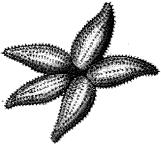
Select the incorrect statement for the organism given below:
A
Marine
B
Possesses water vascular system
C
Acoelomate
D
Triploblastic
Solution
(C) The organism shown in the image is a starfish (Asterias),which belongs to the phylum Echinodermata.
Key characteristics of Echinoderms include:
$1$. They are exclusively marine.
$2$. They possess a unique water vascular system,which helps in locomotion,capture and transport of food,and respiration.
$3$. They are triploblastic (derived from three germ layers).
$4$. They are coelomates (possess a true body cavity).
Therefore,the statement 'Acoelomate' is incorrect because Echinoderms are coelomate animals.
Key characteristics of Echinoderms include:
$1$. They are exclusively marine.
$2$. They possess a unique water vascular system,which helps in locomotion,capture and transport of food,and respiration.
$3$. They are triploblastic (derived from three germ layers).
$4$. They are coelomates (possess a true body cavity).
Therefore,the statement 'Acoelomate' is incorrect because Echinoderms are coelomate animals.
0 likes
View Solution115
MediumMCQ
Role of the water vascular system in Echinoderms is :
$A.$ Respiration and Locomotion
$B.$ Excretion and Locomotion
$C.$ Capture and transport of food
$D.$ Digestion and Respiration
$E.$ Digestion and Excretion
Choose the correct answer from the options given below :
$A.$ Respiration and Locomotion
$B.$ Excretion and Locomotion
$C.$ Capture and transport of food
$D.$ Digestion and Respiration
$E.$ Digestion and Excretion
Choose the correct answer from the options given below :
A
$A$ and $B$ only
B
$A$ and $C$ only
C
$B$ and $C$ only
D
$B, D$ and $E$ only
Solution
(B) The water vascular system is a unique characteristic of the phylum Echinodermata.
It plays a crucial role in multiple physiological processes.
Specifically,it is involved in locomotion (via tube feet),respiration (gas exchange across the tube feet/dermal branchiae),and the capture and transport of food.
Therefore,the functions listed in $A$ (Respiration and Locomotion) and $C$ (Capture and transport of food) are correct.
Thus,the correct option is $A$ and $C$ only.
It plays a crucial role in multiple physiological processes.
Specifically,it is involved in locomotion (via tube feet),respiration (gas exchange across the tube feet/dermal branchiae),and the capture and transport of food.
Therefore,the functions listed in $A$ (Respiration and Locomotion) and $C$ (Capture and transport of food) are correct.
Thus,the correct option is $A$ and $C$ only.
0 likes
View Solution116
MediumMCQ
Match List-$I$ with List-$II$:
Choose the correct answer from the options given below:
| List-$I$ (Biological Name) | List-$II$ (Common Name) |
|---|---|
| $A$. Asterias | $I$. Sea urchin |
| $B$. Antedon | $II$. Brittle star |
| $C$. Echinus | $III$. Sea lily |
| $D$. Ophiura | $IV$. Star fish |
Choose the correct answer from the options given below:
A
$A-IV, B-III, C-I, D-II$
B
$A-II, B-III, C-I, D-IV$
C
$A-I, B-II, C-IV, D-III$
D
$A-III, B-IV, C-II, D-I$
Solution
(A) The correct matching is as follows:
$A$. Asterias is commonly known as Star fish $(IV)$
$B$. Antedon is commonly known as Sea lily $(III)$
$C$. Echinus is commonly known as Sea urchin $(I)$
$D$. Ophiura is commonly known as Brittle star $(II)$
Therefore,the correct sequence is $A-IV, B-III, C-I, D-II$.
$A$. Asterias is commonly known as Star fish $(IV)$
$B$. Antedon is commonly known as Sea lily $(III)$
$C$. Echinus is commonly known as Sea urchin $(I)$
$D$. Ophiura is commonly known as Brittle star $(II)$
Therefore,the correct sequence is $A-IV, B-III, C-I, D-II$.
0 likes
View Solution117
MediumMCQ
Match column-$I$ with column-$II$ :
| Column-$I$ | Column-$II$ |
| $(i)$ Asterias | $(a)$ Brittle star |
| $(ii)$ Echinus | $(b)$ Sea lily |
| $(iii)$ Antedon | $(c)$ Sea urchin |
| $(iv)$ Ophiura | $(d)$ Star fish |
A
$i-d, ii-c, iii-b, iv-a$
B
$i-d, ii-b, iii-c, iv-a$
C
$i-b, ii-d, iii-a, iv-c$
D
$i-c, ii-d, iii-a, iv-b$
Solution
(A) The correct matches for the given organisms belonging to Phylum Echinodermata are as follows:
$(i)$ Asterias is commonly known as Star fish.
$(ii)$ Echinus is commonly known as Sea urchin.
$(iii)$ Antedon is commonly known as Sea lily.
$(iv)$ Ophiura is commonly known as Brittle star.
Therefore, the correct matching sequence is $i-d, ii-c, iii-b, iv-a$.
$(i)$ Asterias is commonly known as Star fish.
$(ii)$ Echinus is commonly known as Sea urchin.
$(iii)$ Antedon is commonly known as Sea lily.
$(iv)$ Ophiura is commonly known as Brittle star.
Therefore, the correct matching sequence is $i-d, ii-c, iii-b, iv-a$.
0 likes
View Solution118
MediumMCQ
Which of the following statements is true regarding $Echinodermata$?
A
Have endoskeleton of calcareous ossicles
B
Are marine with spiny skin
C
Have water vascular system
D
All are correct
Solution
(D) The phylum $Echinodermata$ is characterized by the following features:
$1$. They possess an endoskeleton of calcareous ossicles,which is why they are named $Echinodermata$ (spiny-skinned).
$2$. They are exclusively marine organisms.
$3$. $A$ unique feature of this phylum is the presence of a water vascular system,which helps in locomotion,capture and transport of food,and respiration.
Since all the given statements are correct,the correct option is $D$.
$1$. They possess an endoskeleton of calcareous ossicles,which is why they are named $Echinodermata$ (spiny-skinned).
$2$. They are exclusively marine organisms.
$3$. $A$ unique feature of this phylum is the presence of a water vascular system,which helps in locomotion,capture and transport of food,and respiration.
Since all the given statements are correct,the correct option is $D$.
0 likes
View Solution119
MediumMCQ
Triploblastic,coelomate,complete digestive system and radial symmetry is found in$-$
A
Periplaneta
B
Fasciola
C
Pila
D
Echinus
Solution
(D) The organism that exhibits triploblastic,coelomate,complete digestive system,and radial symmetry is $Echinus$ (a member of the phylum $Echinodermata$).
$1$. $Periplaneta$ (cockroach) is triploblastic,coelomate,and has a complete digestive system,but it exhibits bilateral symmetry.
$2$. $Fasciola$ (liver fluke) is triploblastic,acoelomate,and exhibits bilateral symmetry.
$3$. $Pila$ (snail) is triploblastic,coelomate,and exhibits bilateral symmetry.
$4$. $Echinus$ (sea urchin) is triploblastic,coelomate,has a complete digestive system,and exhibits radial symmetry (specifically pentamerous radial symmetry in adults).
$1$. $Periplaneta$ (cockroach) is triploblastic,coelomate,and has a complete digestive system,but it exhibits bilateral symmetry.
$2$. $Fasciola$ (liver fluke) is triploblastic,acoelomate,and exhibits bilateral symmetry.
$3$. $Pila$ (snail) is triploblastic,coelomate,and exhibits bilateral symmetry.
$4$. $Echinus$ (sea urchin) is triploblastic,coelomate,has a complete digestive system,and exhibits radial symmetry (specifically pentamerous radial symmetry in adults).
0 likes
View Solution120
MediumMCQ
Water vascular system is present in $:-$
A
Sycon
B
Antedon
C
Balanoglossus
D
Loligo
Solution
(B) The water vascular system is a unique characteristic feature of the phylum $Echinodermata$.
$Antedon$ (commonly known as feather star) belongs to the phylum $Echinodermata$.
$Sycon$ belongs to the phylum $Porifera$.
$Balanoglossus$ belongs to the phylum $Hemichordata$.
$Loligo$ belongs to the phylum $Mollusca$.
Therefore,the correct answer is $Antedon$.
$Antedon$ (commonly known as feather star) belongs to the phylum $Echinodermata$.
$Sycon$ belongs to the phylum $Porifera$.
$Balanoglossus$ belongs to the phylum $Hemichordata$.
$Loligo$ belongs to the phylum $Mollusca$.
Therefore,the correct answer is $Antedon$.
0 likes
View Solution121
EasyMCQ
In which of the following phyla does the adult show radial symmetry,while the larva shows bilateral symmetry?
A
Annelids
B
Arthropods
C
Molluscs
D
Echinodermata
Solution
(D) The correct answer is $D$.
In the phylum $Echinodermata$,adult animals exhibit radial symmetry,while their larval stages exhibit bilateral symmetry.
This transition in symmetry from bilateral in the larval stage to radial in the adult form is a characteristic feature of echinoderms.
In contrast,$Annelids$,$Arthropods$,and $Molluscs$ exhibit bilateral symmetry throughout their life cycles.
In the phylum $Echinodermata$,adult animals exhibit radial symmetry,while their larval stages exhibit bilateral symmetry.
This transition in symmetry from bilateral in the larval stage to radial in the adult form is a characteristic feature of echinoderms.
In contrast,$Annelids$,$Arthropods$,and $Molluscs$ exhibit bilateral symmetry throughout their life cycles.
0 likes
View Solution122
EasyMCQ
The adult animal in this phylum is radially symmetrical; but its larva exhibits bilateral symmetry.
A
Echinodermata
B
Coelenterata
C
Arthropoda
D
Protozoa
Solution
(A) The correct answer is $A$.
In the phylum $Echinodermata$,adult animals exhibit radial symmetry,while their larval stages show bilateral symmetry.
This transition from bilateral symmetry in the larval stage to radial symmetry in the adult form is a unique and characteristic feature of echinoderms.
In the phylum $Echinodermata$,adult animals exhibit radial symmetry,while their larval stages show bilateral symmetry.
This transition from bilateral symmetry in the larval stage to radial symmetry in the adult form is a unique and characteristic feature of echinoderms.
0 likes
View SolutionAnimal Kingdom — Phylum-Echinodermata · Frequently Asked Questions
1Are these Animal Kingdom questions useful for JEE and NEET?
Yes. All questions in this section are mapped to JEE Main and NEET exam patterns. Previous year questions from JEE Main, NEET, GUJCET and state-level exams are included with full solutions.
2Can I switch to Hindi or Gujarati for these questions?
Yes. Use the language tabs in the hero section or the sidebar to view the same questions and solutions in English, Hindi or Gujarati.
3How do I generate a question paper from this subtopic?
Use the Vedclass Exam Paper Generator — select the chapter and subtopic, set difficulty, and generate Sets A, B, C, D automatically. First 3 chapters of every subject are free.
Vedclass Products
For Students
Vedclass Test Series
Mock tests in real JEE/NEET style with performance analysis. 5-day free trial.
Start Free TrialFor Teachers
Exam Paper Generator
Generate Set A/B/C/D papers from this chapter in 2 minutes. 3 chapters free.
Try FreeFor Institutes
Online Exam Module
Live online exams with unlimited students, 360° analytics & white-label branding.
See DemoFor Teachers & Institutes
Generate a Animal Kingdom Exam Paper in 2 Minutes
Select subtopic & difficulty — Sets A, B, C, D auto-generated with No Repeat logic.
First 3 chapters of every subject are free — no payment required.