
A English
Phylum-Echinodermata Questions in English
Class 11 Biology · Animal Kingdom · Phylum-Echinodermata
122+
Questions
English
Language
100%
With Solutions
Showing 49 of 122 questions in English
51
MediumMCQ
Which of the following phyla consists exclusively of marine animals?
A
Chordata
B
Echinodermata
C
Protozoa
D
Porifera
Solution
(B) The phylum $Echinodermata$ consists of organisms that are exclusively marine. They are characterized by an endoskeleton of calcareous ossicles and a water vascular system. While other phyla like $Chordata$,$Protozoa$,and $Porifera$ contain many marine species,they also have numerous freshwater or terrestrial representatives.
0 likes
View Solution52
MediumMCQ
Which of the following terms is $NOT$ applicable to the phylum Echinodermata?
A
Madreporite
B
Parapodia
C
Marine habitat
D
Pentaradial symmetry
Solution
(B) The phylum $Echinodermata$ is characterized by the presence of a water vascular system,which includes a structure called the $Madreporite$. They are exclusively $Marine$ in habitat and exhibit $Pentaradial$ symmetry in their adult stage. $Parapodia$ are lateral appendages found in the phylum $Annelida$ (specifically in class $Polychaeta$),which are used for locomotion and respiration. Therefore,$Parapodia$ is not applicable to $Echinodermata$.
0 likes
View Solution53
EasyMCQ
The perforated plate located at the aboral end of a starfish is known as:
A
Madreporite
B
Tube feet
C
Both
D
None
Solution
(A) The $Madreporite$ is a light-colored,calcareous,perforated plate located on the aboral surface of a starfish (echinoderm). It serves as the entry point for water into the water vascular system,which is essential for locomotion,respiration,and food capture. Tube feet are the locomotory organs,not the perforated plate itself.
0 likes
View Solution54
EasyMCQ
The $Bipinnaria$ larva is found in:
A
Porifera
B
Cnidaria
C
Mollusca
D
Echinodermata
Solution
(D) The $Bipinnaria$ larva is a characteristic larval stage found in the phylum $Echinodermata$.
Specifically,it is the first larval stage in the life cycle of many species of sea stars (starfish),which belong to the class $Asteroidea$.
This larva is free-swimming,ciliated,and exhibits bilateral symmetry,which later undergoes metamorphosis into a radially symmetrical adult.
Specifically,it is the first larval stage in the life cycle of many species of sea stars (starfish),which belong to the class $Asteroidea$.
This larva is free-swimming,ciliated,and exhibits bilateral symmetry,which later undergoes metamorphosis into a radially symmetrical adult.
0 likes
View Solution55
EasyMCQ
The system in echinoderms that provides water for feeding,respiration,and locomotion is called .........
A
Canal system
B
Water vascular system
C
Vascular system
D
None of these
Solution
(B) The phylum $Echinodermata$ is characterized by the presence of a unique water vascular system.
This system plays a vital role in locomotion,capture and transport of food,and respiration.
It consists of a system of canals and tube feet that circulate seawater throughout the body of the organism.
This system plays a vital role in locomotion,capture and transport of food,and respiration.
It consists of a system of canals and tube feet that circulate seawater throughout the body of the organism.
0 likes
View Solution56
EasyMCQ
Which of the following animal groups exhibits radial symmetry?
A
Porifera
B
Annelida
C
Echinodermata
D
None of these
Solution
(C) Radial symmetry is a characteristic feature of adult Echinoderms. In adult Echinodermata,the body exhibits radial symmetry (specifically pentamerous radial symmetry),although their larvae show bilateral symmetry. Porifera are mostly asymmetrical,and Annelida exhibit bilateral symmetry.
0 likes
View Solution57
MediumMCQ
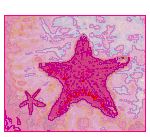
Which type of symmetry is exhibited by the animal shown below?
A
Bilateral symmetry
B
Radial symmetry
C
Asymmetry
D
Pentamerous radial symmetry
Solution
(B) The animal shown in the image is a starfish (Asterias),which belongs to the phylum Echinodermata. Adult echinoderms exhibit radial symmetry (specifically,pentamerous radial symmetry),meaning their body parts are arranged around a central axis in five parts. While their larvae show bilateral symmetry,the adult form is characterized by radial symmetry.
0 likes
View Solution58
EasyMCQ
Which of the following is an invertebrate phylum?
A
Pisces
B
Mammalia
C
Reptilia
D
Echinodermata
Solution
(D) Invertebrates are animals that lack a vertebral column (backbone).
$A$. Pisces (fishes),$B$. Mammalia (mammals),and $C$. Reptilia (reptiles) are all classes belonging to the phylum Chordata,specifically the subphylum Vertebrata,meaning they possess a backbone.
$D$. Echinodermata is a phylum of marine invertebrates characterized by a water vascular system and radial symmetry in adults. Therefore,Echinodermata is the correct invertebrate phylum.
$A$. Pisces (fishes),$B$. Mammalia (mammals),and $C$. Reptilia (reptiles) are all classes belonging to the phylum Chordata,specifically the subphylum Vertebrata,meaning they possess a backbone.
$D$. Echinodermata is a phylum of marine invertebrates characterized by a water vascular system and radial symmetry in adults. Therefore,Echinodermata is the correct invertebrate phylum.
0 likes
View Solution59
MediumMCQ
Which phylum consists exclusively of marine animals?
A
Protozoa
B
Echinodermata
C
Platyhelminthes
D
Mollusca
Solution
(B) The phylum $Echinodermata$ consists of organisms that are exclusively marine. These animals are characterized by an endoskeleton of calcareous ossicles and a water vascular system,which is a unique feature of this phylum. Other options like $Protozoa$,$Platyhelminthes$,and $Mollusca$ contain both marine and freshwater or terrestrial species.
0 likes
View Solution60
EasyMCQ
Which animal group possesses a water vascular system?
A
Annelida
B
Arthropoda
C
Platyhelminthes
D
Echinodermata
Solution
(D) The water vascular system is a unique characteristic feature of the phylum $Echinodermata$.
This system plays a vital role in locomotion,capture and transport of food,and respiration.
Examples of this phylum include starfish $(Asterias)$,sea urchins $(Echinus)$,etc.
Therefore,the correct option is $D$.
This system plays a vital role in locomotion,capture and transport of food,and respiration.
Examples of this phylum include starfish $(Asterias)$,sea urchins $(Echinus)$,etc.
Therefore,the correct option is $D$.
0 likes
View Solution61
EasyMCQ
What is the body wall of Echinoderms composed of?
A
Calcium carbonate plates and spines
B
Calcium carbonate only
C
Sodium bicarbonate and spines
D
Chitin and calcium spines
Solution
(A) The body of Echinoderms is covered by an endoskeleton consisting of calcareous ossicles (calcium carbonate plates) and spines. These structures are derived from the mesoderm and provide protection and support to the organism. Therefore,the correct answer is $A$.
0 likes
View Solution62
EasyMCQ
Which organism exhibits a body divided into five arms (pentamerous symmetry)?
A
Balanoglossus
B
Brittle star
C
Octopus
D
Prawn
Solution
(B) The organism that exhibits a body divided into five arms is the Brittle star (Ophiuroidea).
$1$. Brittle stars belong to the phylum Echinodermata.
$2$. $A$ characteristic feature of adult echinoderms is pentamerous radial symmetry,meaning their body parts are arranged in fives around a central axis.
$3$. Balanoglossus is a hemichordate,Octopus is a mollusk,and Prawn is an arthropod,none of which exhibit pentamerous symmetry.
$1$. Brittle stars belong to the phylum Echinodermata.
$2$. $A$ characteristic feature of adult echinoderms is pentamerous radial symmetry,meaning their body parts are arranged in fives around a central axis.
$3$. Balanoglossus is a hemichordate,Octopus is a mollusk,and Prawn is an arthropod,none of which exhibit pentamerous symmetry.
0 likes
View Solution63
EasyMCQ
What does the water vascular system consist of?
A
Soft feet
B
Parapodia
C
Tube feet
D
Oral arms
Solution
(C) The water vascular system is a characteristic feature of the phylum $Echinodermata$. This system consists of a network of water-filled canals that branch into extensions called $tube \ feet$ (podia). These $tube \ feet$ are used for locomotion,capturing food,and respiration.
0 likes
View Solution64
EasyMCQ
The water vascular system is $NOT$ associated with the function of which of the following?
A
Reproduction
B
Respiration
C
Excretion
D
Locomotion
Solution
(A) The water vascular system is a unique characteristic feature of the phylum $Echinodermata$.
It plays a crucial role in $locomotion$, $respiration$, and $excretion$ by facilitating the movement of water through the canal system and tube feet.
However, the water vascular system is not involved in $reproduction$.
Therefore, the correct option is $A$.
It plays a crucial role in $locomotion$, $respiration$, and $excretion$ by facilitating the movement of water through the canal system and tube feet.
However, the water vascular system is not involved in $reproduction$.
Therefore, the correct option is $A$.
0 likes
View Solution65
EasyMCQ
State the function of the water vascular system (tube feet) in echinoderms.
A
Reproduction
B
Respiration
C
Locomotion
D
Digestion
Solution
(C) The water vascular system is a unique characteristic of the phylum $Echinodermata$.
Tube feet are the primary components of this system.
Their main functions include locomotion,capture and transport of food,and respiration.
Among the given options,locomotion is the most significant and primary function associated with tube feet.
Tube feet are the primary components of this system.
Their main functions include locomotion,capture and transport of food,and respiration.
Among the given options,locomotion is the most significant and primary function associated with tube feet.
0 likes
View Solution66
EasyMCQ
Which of the following is a characteristic of Phylum $Echinodermata$?
A
Dioecious or monoecious,internal fertilization,direct development.
B
Dioecious,external fertilization,indirect development with free-swimming larvae.
C
Dioecious,internal fertilization,direct development with free-swimming larvae.
D
Usually dioecious,external fertilization,free-swimming $Tornaria$ larvae.
Solution
(B) Phylum $Echinodermata$ exhibits the following characteristics:
$1$. They are mostly dioecious (sexes are separate).
$2$. Fertilization is usually external.
$3$. Development is indirect,meaning they have a larval stage that is free-swimming and morphologically different from the adult.
$4$. Therefore,option $B$ is the most accurate description of their reproductive and developmental traits.
$1$. They are mostly dioecious (sexes are separate).
$2$. Fertilization is usually external.
$3$. Development is indirect,meaning they have a larval stage that is free-swimming and morphologically different from the adult.
$4$. Therefore,option $B$ is the most accurate description of their reproductive and developmental traits.
0 likes
View Solution67
EasyMCQ
Which of the following is a group of animals belonging to the phylum $Echinodermata$?
A
Sea lily,Sea cucumber,Sea horse,Sea fan
B
Starfish,Sea urchin,Balanoglossus
C
Sea lily,Sea cucumber,Sea urchin,Starfish
D
Starfish,Silverfish,Ray fish,Sea urchin
Solution
(C) The phylum $Echinodermata$ includes marine animals characterized by a spiny skin and a water vascular system.
$1$. Sea lily $(Antedon)$
$2$. Sea cucumber $(Cucumaria)$
$3$. Sea urchin $(Echinus)$
$4$. Starfish $(Asterias)$
All these organisms belong to the phylum $Echinodermata$. Sea horse is a fish $(Chordata)$,Sea fan is a $Cnidarian$,Balanoglossus is a $Hemichordate$,Silverfish is an insect $(Arthropoda)$,and Ray fish is a cartilaginous fish $(Chordata)$.
$1$. Sea lily $(Antedon)$
$2$. Sea cucumber $(Cucumaria)$
$3$. Sea urchin $(Echinus)$
$4$. Starfish $(Asterias)$
All these organisms belong to the phylum $Echinodermata$. Sea horse is a fish $(Chordata)$,Sea fan is a $Cnidarian$,Balanoglossus is a $Hemichordate$,Silverfish is an insect $(Arthropoda)$,and Ray fish is a cartilaginous fish $(Chordata)$.
1 likes
View Solution68
MediumMCQ
Which of the following is a consistent group?
A
Seahorse,Shark,Ray fish
B
Starfish,Sea urchin,Sea cucumber
C
Pila,Dentalium,Brittle star
D
Earthworm,Pila,Sepia
Solution
(B) The correct group is $B$ (Starfish,Sea urchin,Sea cucumber).
$1$. Starfish (Asterias),Sea urchin (Echinus),and Sea cucumber (Cucumaria) all belong to the phylum $Echinodermata$.
$2$. Seahorse,Shark,and Ray fish belong to the class $Pisces$ (Chordata).
$3$. Pila and Sepia are $Molluscs$,while Earthworm is an $Annelid$.
$4$. Dentalium is a $Mollusc$,and Brittle star is an $Echinoderm$,so option $C$ is inconsistent.
$1$. Starfish (Asterias),Sea urchin (Echinus),and Sea cucumber (Cucumaria) all belong to the phylum $Echinodermata$.
$2$. Seahorse,Shark,and Ray fish belong to the class $Pisces$ (Chordata).
$3$. Pila and Sepia are $Molluscs$,while Earthworm is an $Annelid$.
$4$. Dentalium is a $Mollusc$,and Brittle star is an $Echinoderm$,so option $C$ is inconsistent.
0 likes
View Solution69
MediumMCQ
Which of the following is $NOT$ a characteristic of the phylum Echinodermata?
A
Water vascular system
B
Trochophore larva
C
Tube feet
D
Spiny endoskeleton
Solution
(B) The phylum $Echinodermata$ is characterized by the presence of a water vascular system,tube feet (podia),and a spiny endoskeleton made of calcareous ossicles.
Trochophore larva is a characteristic feature of the phylum $Annelida$ and $Mollusca$,not $Echinodermata$.
Echinoderms typically undergo metamorphosis through larval stages like $bipinnaria$ or $pluteus$,but not the trochophore larva.
Trochophore larva is a characteristic feature of the phylum $Annelida$ and $Mollusca$,not $Echinodermata$.
Echinoderms typically undergo metamorphosis through larval stages like $bipinnaria$ or $pluteus$,but not the trochophore larva.
0 likes
View Solution70
EasyMCQ
In Echinodermata,the digestive tract is ..........
A
Absent
B
Complete with mouth on the lower side and anus on the upper side
C
Incomplete
D
Blind sac type
Solution
(B) In $Echinodermata$,the digestive system is usually complete. It consists of a mouth,which is typically located on the ventral (lower) side,and an anus,which is typically located on the dorsal (upper) side. Therefore,the digestive tract is complete,not absent,incomplete,or of the blind sac type.
0 likes
View Solution71
EasyMCQ
Which phylum is characterized by the presence of a water vascular system?
A
Arthropoda
B
Mollusca
C
Echinodermata
D
Aschelminthes
Solution
(C) The water vascular system is a unique feature of the phylum $Echinodermata$.
This system consists of a network of fluid-filled canals that function in locomotion,capture and transport of food,and respiration.
$Arthropoda$ are characterized by jointed appendages,$Mollusca$ by a mantle and shell,and $Aschelminthes$ by a pseudocoelom.
This system consists of a network of fluid-filled canals that function in locomotion,capture and transport of food,and respiration.
$Arthropoda$ are characterized by jointed appendages,$Mollusca$ by a mantle and shell,and $Aschelminthes$ by a pseudocoelom.
0 likes
View Solution72
EasyMCQ
These animals exhibit bilateral symmetry in the larval stage and radial symmetry in the adult stage.
A
Amphibians
B
Nematodes
C
Echinoderms
D
Cnidarians
Solution
(C) The animals belonging to the phylum $Echinodermata$ exhibit a unique characteristic where the larvae show bilateral symmetry,while the adults exhibit radial symmetry (specifically pentamerous radial symmetry). This is a diagnostic feature used to classify organisms within this phylum.
0 likes
View Solution73
EasyMCQ
Which of the following phyla consists exclusively of marine animals?
A
Protozoa
B
Echinodermata
C
Platyhelminthes
D
Mollusca
Solution
(B) The phylum $Echinodermata$ consists exclusively of marine animals. All members of this phylum are found in the ocean. Other phyla listed,such as $Protozoa$,$Platyhelminthes$,and $Mollusca$,contain both marine and freshwater or terrestrial species.
0 likes
View Solution74
EasyMCQ
Echinoderms are exclusively...
A
marine.
B
intertidal.
C
estuarine.
D
freshwater.
Solution
(A) Echinoderms belong to the phylum $Echinodermata$.
All members of this phylum are exclusively marine organisms.
They are not found in freshwater or terrestrial habitats.
Therefore,the correct option is $A$.
All members of this phylum are exclusively marine organisms.
They are not found in freshwater or terrestrial habitats.
Therefore,the correct option is $A$.
0 likes
View Solution75
EasyMCQ
Which of the following is a unique characteristic of the phylum Echinodermata?
A
Metamerism
B
Water vascular system
C
Bilateral symmetry
D
Tornaria larva
Solution
(B) The phylum $Echinodermata$ is characterized by the presence of a water vascular system,which is a unique feature of this phylum.
This system plays a vital role in locomotion,capture and transport of food,and respiration.
Metamerism is a characteristic of $Annelida$.
Adult echinoderms exhibit radial symmetry,while larvae exhibit bilateral symmetry.
Tornaria larva is characteristic of $Hemichordata$.
This system plays a vital role in locomotion,capture and transport of food,and respiration.
Metamerism is a characteristic of $Annelida$.
Adult echinoderms exhibit radial symmetry,while larvae exhibit bilateral symmetry.
Tornaria larva is characteristic of $Hemichordata$.
0 likes
View Solution76
MediumMCQ
Which phylum consists of animals that are free-swimming in the larval stage and sessile (attached to a substrate) in the adult stage?
A
Porifera
B
Cnidaria
C
Echinodermata
D
Annelida
Solution
(C) The phylum $Echinodermata$ exhibits a unique life cycle where the larvae are bilaterally symmetrical and free-swimming,while the adults are radially symmetrical and typically sessile or sedentary,living attached to a substrate or moving slowly along the ocean floor. While some $Cnidarians$ (like polyps) are sessile,the larval stage $(planula)$ is free-swimming; however,$Echinoderms$ are the classic example often cited in biology for this distinct transition in symmetry and lifestyle.
0 likes
View Solution77
EasyMCQ
In which animal is the water vascular system found?
A
Starfish
B
Brittle star
C
Leucosolenia
D
Hydra
Solution
(A) The water vascular system is a unique characteristic feature of the phylum $Echinodermata$.
This system consists of a network of water-filled canals that function in locomotion,capture and transport of food,and respiration.
Among the given options,$Starfish$ $(Asterias)$ belongs to the phylum $Echinodermata$,and therefore possesses a water vascular system.
$Leucosolenia$ belongs to $Porifera$,$Hydra$ belongs to $Cnidaria$,and $Brittle$ $star$ $(Ophiuroidea)$ also belongs to $Echinodermata$,but $Starfish$ is the most classic example cited for this system.
This system consists of a network of water-filled canals that function in locomotion,capture and transport of food,and respiration.
Among the given options,$Starfish$ $(Asterias)$ belongs to the phylum $Echinodermata$,and therefore possesses a water vascular system.
$Leucosolenia$ belongs to $Porifera$,$Hydra$ belongs to $Cnidaria$,and $Brittle$ $star$ $(Ophiuroidea)$ also belongs to $Echinodermata$,but $Starfish$ is the most classic example cited for this system.
0 likes
View Solution78
MediumMCQ
Which of the following functions is $NOT$ performed by the water vascular system of a starfish $(Asterias)$?
A
Excretion
B
Digestion
C
Respiration
D
Locomotion
Solution
(B) The water vascular system in echinoderms like starfish $(Asterias)$ is a unique system of fluid-filled canals.
It plays a crucial role in $Locomotion$ (via tube feet), $Respiration$ (gas exchange), and $Excretion$ (removal of metabolic wastes).
However, the $Digestion$ of food is primarily carried out by the digestive system, which includes the mouth, esophagus, stomach, and intestine.
Therefore, the water vascular system does not perform the function of digestion.
It plays a crucial role in $Locomotion$ (via tube feet), $Respiration$ (gas exchange), and $Excretion$ (removal of metabolic wastes).
However, the $Digestion$ of food is primarily carried out by the digestive system, which includes the mouth, esophagus, stomach, and intestine.
Therefore, the water vascular system does not perform the function of digestion.
0 likes
View Solution79
MediumMCQ
In Echinodermata,the water vascular system is derived from which of the following?
A
Mesoderm
B
Ectoderm
C
Coelom
D
Mesoglea
Solution
(C) The water vascular system in $Echinodermata$ is a unique system of fluid-filled canals. It is derived from the $coelom$ (enterocoelous origin). This system plays a vital role in locomotion,capture and transport of food,and respiration.
0 likes
View Solution80
MediumMCQ
Which phylum of animals exhibits bilateral symmetry in the larval stage and radial symmetry in the adult stage?
A
Cnidaria
B
Echinodermata
C
Amphibia
D
Nematoda
Solution
(B) The animals belonging to the phylum $Echinodermata$ exhibit a unique characteristic in their body symmetry.
In the larval stage, these animals possess $bilateral$ symmetry.
However, as they undergo metamorphosis and reach the adult stage, they develop $radial$ symmetry (specifically $pentamerous$ radial symmetry).
Therefore, the correct answer is $Echinodermata$.
In the larval stage, these animals possess $bilateral$ symmetry.
However, as they undergo metamorphosis and reach the adult stage, they develop $radial$ symmetry (specifically $pentamerous$ radial symmetry).
Therefore, the correct answer is $Echinodermata$.
0 likes
View Solution81
EasyMCQ
What type of body symmetry do Echinoderms exhibit?
A
Radial symmetry
B
Bilateral symmetry
C
Asymmetry
D
All of the above
Solution
(A) Echinoderms exhibit a unique pattern of symmetry.
Adult echinoderms typically show radial symmetry (specifically pentaradial symmetry).
However,their larvae exhibit bilateral symmetry.
Since the question asks about the body symmetry of the organisms generally,and radial symmetry is the characteristic feature of the adult form,the most appropriate answer is radial symmetry.
Adult echinoderms typically show radial symmetry (specifically pentaradial symmetry).
However,their larvae exhibit bilateral symmetry.
Since the question asks about the body symmetry of the organisms generally,and radial symmetry is the characteristic feature of the adult form,the most appropriate answer is radial symmetry.
0 likes
View Solution82
EasyMCQ
Which structure is used for locomotion in starfish?
A
Tube feet
B
Parapodia
C
Setae
D
Tentacles
Solution
(A) Starfish belongs to the phylum $Echinodermata$.
They possess a unique water vascular system which plays an important role in locomotion, capture and transport of food, and respiration.
The $tube feet$ (podia) are the external extensions of this water vascular system, which are primarily used for locomotion and attachment to the substrate.
They possess a unique water vascular system which plays an important role in locomotion, capture and transport of food, and respiration.
The $tube feet$ (podia) are the external extensions of this water vascular system, which are primarily used for locomotion and attachment to the substrate.
0 likes
View Solution83
EasyMCQ
Whose body wall is made of calcium carbonate?
A
Scorpion
B
Prawn
C
Cockroach
D
Sea urchin
Solution
(D) The body wall of organisms belonging to the phylum $Echinodermata$ is characterized by the presence of an endoskeleton composed of calcareous ossicles (calcium carbonate plates).
Among the given options,the sea urchin $(Echinus)$ belongs to the phylum $Echinodermata$.
Scorpion,Prawn,and Cockroach belong to the phylum $Arthropoda$,which possess an exoskeleton made of chitin.
Among the given options,the sea urchin $(Echinus)$ belongs to the phylum $Echinodermata$.
Scorpion,Prawn,and Cockroach belong to the phylum $Arthropoda$,which possess an exoskeleton made of chitin.
0 likes
View Solution84
EasyMCQ
Which organism has a body divided into five arms?
A
Octopus
B
Sepia
C
Brittle star
D
Balanoglossus
Solution
(C) The organism with a body divided into five arms is the Brittle star (Ophiuroidea). Brittle stars are echinoderms that typically exhibit pentaradial symmetry,meaning their body plan is organized into five distinct arms radiating from a central disc.
0 likes
View Solution85
MediumMCQ
The phylum of $Asterias$ is
A
Echinodermata
B
Arthropoda
C
Coelenterata
D
Porifera
Solution
(A) $Asterias$,commonly known as the starfish,belongs to the phylum $Echinodermata$.
Key characteristics of this phylum include a water vascular system,radial symmetry in adults,and a calcareous endoskeleton.
Key characteristics of this phylum include a water vascular system,radial symmetry in adults,and a calcareous endoskeleton.
0 likes
View Solution86
MediumMCQ
Higher phyla like Echinodermata are characterized as:
A
triploblastic animals without notochord
B
terrestrial animals
C
diploblastic animals
D
monoecious only
Solution
(A) Echinoderms are members of the phylum $Echinodermata$.
$1$. They are exclusively marine animals.
$2$. They exhibit organ-system level of organization and are triploblastic (possessing three germ layers: ectoderm,mesoderm,and endoderm).
$3$. They possess a coelom (coelomate animals).
$4$. Adult echinoderms exhibit radial symmetry,while larvae exhibit bilateral symmetry.
$5$. They lack a notochord throughout their life cycle,placing them in the group of non-chordates.
Therefore,the correct description is that they are triploblastic animals without a notochord.
$1$. They are exclusively marine animals.
$2$. They exhibit organ-system level of organization and are triploblastic (possessing three germ layers: ectoderm,mesoderm,and endoderm).
$3$. They possess a coelom (coelomate animals).
$4$. Adult echinoderms exhibit radial symmetry,while larvae exhibit bilateral symmetry.
$5$. They lack a notochord throughout their life cycle,placing them in the group of non-chordates.
Therefore,the correct description is that they are triploblastic animals without a notochord.
0 likes
View Solution87
MediumMCQ
Which of the following is observed in $Echinodermata$?
A
Bilateral symmetry
B
Radial symmetry
C
Porous body
D
Soft skin
Solution
(B) The phylum $Echinodermata$ is characterized by a unique feature where adults exhibit radial symmetry (specifically pentamerous radial symmetry),while their larvae exhibit bilateral symmetry. Among the given options,radial symmetry is the defining characteristic of adult echinoderms. Porous bodies are characteristic of $Porifera$,and bilateral symmetry is found in most other phyla like $Platyhelminthes$ to $Chordata$.
0 likes
View Solution88
MediumMCQ
Starfish belongs to the class:
A
Asteroidea
B
Ophiuroidea
C
Holothuroidea
D
Crinoidea
Solution
(A) The phylum $Echinodermata$ is divided into several classes based on their body structure and symmetry.
Starfish,also known as sea stars,belong to the class $Asteroidea$.
Members of this class are characterized by a central disc with five or more arms radiating from it.
$Ophiuroidea$ includes brittle stars,$Holothuroidea$ includes sea cucumbers,and $Crinoidea$ includes sea lilies.
Starfish,also known as sea stars,belong to the class $Asteroidea$.
Members of this class are characterized by a central disc with five or more arms radiating from it.
$Ophiuroidea$ includes brittle stars,$Holothuroidea$ includes sea cucumbers,and $Crinoidea$ includes sea lilies.
0 likes
View Solution89
EasyMCQ
Aristotle's lantern is found in the class .......... .
A
Echinoidea
B
Asteroidea
C
Holothuroidea
D
Ophiuroidea
Solution
(A) Aristotle's lantern is a specialized chewing apparatus found in sea urchins,which belong to the class $Echinoidea$ of the phylum $Echinodermata$.
It consists of five hard,calcareous teeth that are used to scrape algae and other food materials from rocks.
Therefore,the correct option is $A$.
It consists of five hard,calcareous teeth that are used to scrape algae and other food materials from rocks.
Therefore,the correct option is $A$.
0 likes
View Solution90
EasyMCQ
Water vascular system (ambulacral system) is found in ...................
A
Cockroach
B
Starfish
C
Leech
D
Sea anemone
Solution
(B) The water vascular system,also known as the ambulacral system,is a unique characteristic feature of the phylum $Echinodermata$.
This system consists of a network of water-filled canals that function in locomotion,capture and transport of food,and respiration.
Among the given options,$Starfish$ $(Asterias)$ belongs to the phylum $Echinodermata$.
Therefore,the water vascular system is found in $Starfish$.
This system consists of a network of water-filled canals that function in locomotion,capture and transport of food,and respiration.
Among the given options,$Starfish$ $(Asterias)$ belongs to the phylum $Echinodermata$.
Therefore,the water vascular system is found in $Starfish$.
0 likes
View Solution91
EasyMCQ
The water vascular system is a characteristic feature of which of the following phyla?
A
Echinodermata
B
Platyhelminthes
C
Cnidaria
D
Porifera
Solution
(A) The water vascular system is a unique and characteristic feature of the phylum $Echinodermata$.
This system plays a crucial role in locomotion,capture and transport of food,and respiration.
While $Porifera$ (sponges) have a water canal system,it is distinct from the water vascular system of echinoderms.
Therefore,the correct option is $A$.
This system plays a crucial role in locomotion,capture and transport of food,and respiration.
While $Porifera$ (sponges) have a water canal system,it is distinct from the water vascular system of echinoderms.
Therefore,the correct option is $A$.
0 likes
View Solution92
EasyMCQ
Which phylum does an animal belong to that exhibits bilateral symmetry in the larval stage and pentamerous radial symmetry in the adult stage?
A
Annelida
B
Mollusca
C
Cnidaria
D
Echinodermata
Solution
(D) The animals belonging to the phylum $Echinodermata$ exhibit a unique characteristic where the larvae show bilateral symmetry,while the adults exhibit pentamerous radial symmetry. This is a diagnostic feature of this phylum.
0 likes
View Solution93
MediumMCQ
Assertion : Ambulacral system plays a major role in locomotion of echinoderm.
Reason : Hydraulic pressure of fluid and contraction of muscle of tube feet make possible movement of echinoderm.
Reason : Hydraulic pressure of fluid and contraction of muscle of tube feet make possible movement of echinoderm.
A
If both Assertion and Reason are correct and the Reason is a correct explanation of the Assertion.
B
If both Assertion and Reason are correct but Reason is not a correct explanation of the Assertion.
C
If the Assertion is correct but Reason is incorrect.
D
If both the Assertion and Reason are incorrect.
Solution
(A) The water vascular system (also known as the ambulacral system) is a unique organ system found in echinoderms that functions in locomotion,food capture,respiration,and excretion.
This system consists of a network of water-filled canals that connect to external tube feet.
The movement of echinoderms is facilitated by the hydraulic pressure of the fluid within the system and the coordinated contraction of the muscles associated with the tube feet.
Therefore,the assertion is correct,and the reason provides a correct explanation for how the ambulacral system enables locomotion.
This system consists of a network of water-filled canals that connect to external tube feet.
The movement of echinoderms is facilitated by the hydraulic pressure of the fluid within the system and the coordinated contraction of the muscles associated with the tube feet.
Therefore,the assertion is correct,and the reason provides a correct explanation for how the ambulacral system enables locomotion.
0 likes
View Solution94
EasyMCQ
Water vascular system is the characteristic of which group of the following:
$(a)$ Porifera $(b)$ Ctenophora $(c)$ Echinodermata $(d)$ Chordata
$(a)$ Porifera $(b)$ Ctenophora $(c)$ Echinodermata $(d)$ Chordata
A
Porifera
B
Ctenophora
C
Echinodermata
D
Chordata
Solution
(C) The water vascular system is a unique and characteristic feature of the phylum $Echinodermata$.
It consists of a system of radiating canals,tube feet,and a madreporite.
This system plays a crucial role in locomotion,capturing and transport of food,and respiration.
It consists of a system of radiating canals,tube feet,and a madreporite.
This system plays a crucial role in locomotion,capturing and transport of food,and respiration.
0 likes
View Solution95
Easy
Write the general characteristics of the phylum Echinodermata.
Solution
(N/A) $\rightarrow$ Echinoderms possess an endoskeleton of calcareous ossicles,hence the name Echinodermata (spiny-bodied).
$\rightarrow$ All are marine with an organ-system level of organization.
$\rightarrow$ Adult echinoderms are radially symmetrical,whereas larvae are bilaterally symmetrical.
$\rightarrow$ They are triploblastic and coelomate animals.
$\rightarrow$ The digestive system is complete,with the mouth on the lower (ventral) side and the anus on the upper (dorsal) side.
$\rightarrow$ The most distinctive feature of echinoderms is the presence of a water vascular system,which aids in locomotion,capture and transport of food,and respiration.
$\rightarrow$ An excretory system is absent.
$\rightarrow$ Sexes are separate (dioecious).
$\rightarrow$ Reproduction is sexual.
$\rightarrow$ Fertilization is usually external.
$\rightarrow$ Development is indirect,involving a free-swimming larva.
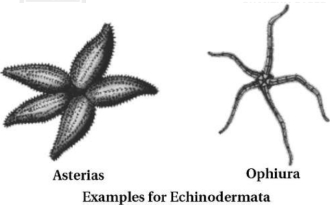
$\rightarrow$ Examples: Asterias (starfish),Echinus (sea urchin),Antedon (sea lily),Cucumaria (sea cucumber),and Ophiura (brittle star).
$\rightarrow$ All are marine with an organ-system level of organization.
$\rightarrow$ Adult echinoderms are radially symmetrical,whereas larvae are bilaterally symmetrical.
$\rightarrow$ They are triploblastic and coelomate animals.
$\rightarrow$ The digestive system is complete,with the mouth on the lower (ventral) side and the anus on the upper (dorsal) side.
$\rightarrow$ The most distinctive feature of echinoderms is the presence of a water vascular system,which aids in locomotion,capture and transport of food,and respiration.
$\rightarrow$ An excretory system is absent.
$\rightarrow$ Sexes are separate (dioecious).
$\rightarrow$ Reproduction is sexual.
$\rightarrow$ Fertilization is usually external.
$\rightarrow$ Development is indirect,involving a free-swimming larva.
$\rightarrow$ Examples: Asterias (starfish),Echinus (sea urchin),Antedon (sea lily),Cucumaria (sea cucumber),and Ophiura (brittle star).
0 likes
View Solution96
MediumMCQ
Which of the following options have features corresponding to the given animals?
$Aplysia$, $Asterias$, $Antedon$, $Echinus$
$Aplysia$, $Asterias$, $Antedon$, $Echinus$
A
Water vascular system, Calcareous shell
B
Water Canal system, Calcareous shell
C
Calcareous shell, acoelomate
D
Pseudocoelomate, Water vascular system
Solution
(A) The animals $Asterias$ (Starfish), $Antedon$ (Sea lily), and $Echinus$ (Sea urchin) belong to the phylum $Echinodermata$.
$Aplysia$ (Sea hare) is a mollusk, but in the context of this specific question grouping, the features $Water \text{ } vascular \text{ } system$ and $Calcareous \text{ } shell$ (endoskeleton) are characteristic of the $Echinodermata$ group.
$Echinoderms$ possess a unique water vascular system and an endoskeleton of calcareous ossicles.
$Aplysia$ (Sea hare) is a mollusk, but in the context of this specific question grouping, the features $Water \text{ } vascular \text{ } system$ and $Calcareous \text{ } shell$ (endoskeleton) are characteristic of the $Echinodermata$ group.
$Echinoderms$ possess a unique water vascular system and an endoskeleton of calcareous ossicles.
0 likes
View Solution97
MediumMCQ
Secondary radial symmetry is found in
A
Cnidaria
B
Jelly fish
C
Echinodermata
D
Hemichordata
Solution
(C) Secondary radial symmetry is found in phylum-$Echinodermata$.
The members of this phylum are exclusively marine forms.
In these organisms,the larvae exhibit bilateral symmetry,but during metamorphosis,the symmetry of the adults usually changes to pentamerous radial symmetry.
The members of this phylum are exclusively marine forms.
In these organisms,the larvae exhibit bilateral symmetry,but during metamorphosis,the symmetry of the adults usually changes to pentamerous radial symmetry.
0 likes
View Solution98
MediumMCQ
The echinoderms are
A
Arboreal insects
B
Marine animals
C
Terrestrial insects
D
Freshwater worms
Solution
(B) Echinoderms belong to the phylum $Echinodermata$. All existing species of this phylum are exclusively marine. They are characterized by an endoskeleton of calcareous ossicles and a water vascular system.
0 likes
View Solution99
EasyMCQ
Tube-feet are the locomotory organs of
A
Platyhelminthes
B
Echinodermata
C
Mollusca
D
Arthropoda
Solution
(B) Tube-feet are the characteristic locomotory organs found in the phylum $Echinodermata$.
These structures are part of the water vascular system, which is unique to echinoderms.
They are sac-like protrusions of the body wall that assist in locomotion, food capture, and respiration.
These structures are part of the water vascular system, which is unique to echinoderms.
They are sac-like protrusions of the body wall that assist in locomotion, food capture, and respiration.
0 likes
View SolutionAnimal Kingdom — Phylum-Echinodermata · Frequently Asked Questions
1Are these Animal Kingdom questions useful for JEE and NEET?
Yes. All questions in this section are mapped to JEE Main and NEET exam patterns. Previous year questions from JEE Main, NEET, GUJCET and state-level exams are included with full solutions.
2Can I switch to Hindi or Gujarati for these questions?
Yes. Use the language tabs in the hero section or the sidebar to view the same questions and solutions in English, Hindi or Gujarati.
3How do I generate a question paper from this subtopic?
Use the Vedclass Exam Paper Generator — select the chapter and subtopic, set difficulty, and generate Sets A, B, C, D automatically. First 3 chapters of every subject are free.
Vedclass Products
For Students
Vedclass Test Series
Mock tests in real JEE/NEET style with performance analysis. 5-day free trial.
Start Free TrialFor Teachers
Exam Paper Generator
Generate Set A/B/C/D papers from this chapter in 2 minutes. 3 chapters free.
Try FreeFor Institutes
Online Exam Module
Live online exams with unlimited students, 360° analytics & white-label branding.
See DemoFor Teachers & Institutes
Generate a Animal Kingdom Exam Paper in 2 Minutes
Select subtopic & difficulty — Sets A, B, C, D auto-generated with No Repeat logic.
First 3 chapters of every subject are free — no payment required.