
A English
Phylum-Coelenterata (Cnideria) Questions in English
Class 11 Biology · Animal Kingdom · Phylum-Coelenterata (Cnideria)
236+
Questions
English
Language
100%
With Solutions
Showing 36 of 236 questions in English
201
MediumMCQ
Sea fan belongs to
A
Coelenterata
B
Porifera
C
Echinodermata
D
Mollusca
Solution
(A) Sea fan $(Gorgonia)$ is a marine organism that belongs to the phylum $Coelenterata$ (also known as $Cnidaria$).
It is characterized by the presence of cnidoblasts and a radial symmetry,which are diagnostic features of this phylum.
It is characterized by the presence of cnidoblasts and a radial symmetry,which are diagnostic features of this phylum.
0 likes
View Solution202
MediumMCQ
Absence of circulatory system in $Hydra$ is compensated by
A
Pseudocoelomic fluid
B
Gastrovascular cavity
C
Presence of tentacles
D
None of these
Solution
(B) $Hydra$ belongs to the phylum $Cnidaria$ (or $Coelenterata$).
It lacks a specialized circulatory system for the transport of nutrients and gases.
Instead,it possesses a central body cavity known as the gastrovascular cavity (or coelenteron).
This cavity is lined by endoderm and is responsible for both digestion and the distribution of nutrients throughout the body,effectively compensating for the absence of a circulatory system.
It lacks a specialized circulatory system for the transport of nutrients and gases.
Instead,it possesses a central body cavity known as the gastrovascular cavity (or coelenteron).
This cavity is lined by endoderm and is responsible for both digestion and the distribution of nutrients throughout the body,effectively compensating for the absence of a circulatory system.
0 likes
View Solution203
MediumMCQ
Nematoblasts of $Hydra$ are
A
Sensory
B
Complicated
C
With nematocyst apparatus
D
All of the above
Solution
(D) Nematoblasts (also known as $cnidoblasts$) are specialized cells found in $Hydra$.
They are sensory in nature,as they respond to external stimuli.
They contain a complex structure called the nematocyst apparatus,which is used for prey capture,offence,and defence.
They are sensory in nature,as they respond to external stimuli.
They contain a complex structure called the nematocyst apparatus,which is used for prey capture,offence,and defence.
0 likes
View Solution204
MediumMCQ
$Portuguese\; man\; of\; war$ is
A
Obelia
B
Physalia
C
Aurelia
D
Branchiostoma
Solution
(B) $Physalia$ (class $Hydrozoa$) is commonly known as the '$Portuguese\; man\; of\; war$'.
It belongs to the phylum $Cnidaria$ (also known as $Coelenterata$).
It belongs to the phylum $Cnidaria$ (also known as $Coelenterata$).
0 likes
View Solution205
EasyMCQ
The poisonous fluid present in the nematocyst of $Hydra$ is
A
Venom
B
Haematin
C
Toxin
D
Hypnotoxin
Solution
(D) The nematocyst of $Hydra$ is filled with a poisonous fluid known as hypnotoxin.
This substance is a complex mixture of proteins and phenols.
The nematocyst serves as a specialized organelle for offense,defense,food capture,anchorage,and locomotion in $Hydra$.
This substance is a complex mixture of proteins and phenols.
The nematocyst serves as a specialized organelle for offense,defense,food capture,anchorage,and locomotion in $Hydra$.
0 likes
View Solution206
EasyMCQ
Tissue level of organization is seen in which of the following phyla?
A
Coelenterata
B
Chordata
C
Arthropoda
D
Mollusca
Solution
(A) The level of organization in animals is classified as cellular,tissue,organ,or organ-system level.
$1$. Cellular level: Seen in Porifera.
$2$. Tissue level: Seen in Coelenterata (Cnidaria) and Ctenophora.
$3$. Organ level: Seen in Platyhelminthes.
$4$. Organ-system level: Seen in Aschelminthes,Annelida,Arthropoda,Mollusca,Echinodermata,Hemichordata,and Chordata.
Since Coelenterata exhibits the tissue level of organization,option $A$ is the correct answer.
$1$. Cellular level: Seen in Porifera.
$2$. Tissue level: Seen in Coelenterata (Cnidaria) and Ctenophora.
$3$. Organ level: Seen in Platyhelminthes.
$4$. Organ-system level: Seen in Aschelminthes,Annelida,Arthropoda,Mollusca,Echinodermata,Hemichordata,and Chordata.
Since Coelenterata exhibits the tissue level of organization,option $A$ is the correct answer.
0 likes
View Solution207
MediumMCQ
Which of the following is a characteristic feature of the phylum $Coelenterata$ (Cnidaria)?
A
Nematocysts
B
Polymorphism
C
Flame cells
D
Choanocytes
Solution
(A) The phylum $Coelenterata$ (also known as $Cnidaria$) is characterized by the presence of specialized stinging cells called $Nematocysts$ (or $Cnidoblasts$).
These cells are used for anchorage,defense,and the capture of prey.
$Polymorphism$ is also seen in some cnidarians,but $Nematocysts$ are the defining diagnostic feature of the entire phylum.
$Flame$ $cells$ are characteristic of the phylum $Platyhelminthes$ (excretion).
$Choanocytes$ are characteristic of the phylum $Porifera$ (sponges).
These cells are used for anchorage,defense,and the capture of prey.
$Polymorphism$ is also seen in some cnidarians,but $Nematocysts$ are the defining diagnostic feature of the entire phylum.
$Flame$ $cells$ are characteristic of the phylum $Platyhelminthes$ (excretion).
$Choanocytes$ are characteristic of the phylum $Porifera$ (sponges).
0 likes
View Solution208
MediumMCQ
Which of the following is not the function of cnidoblasts?
A
Digestion of food
B
Anchorage
C
Defense
D
Capture of prey
Solution
(A) Cnidoblasts are specialized stinging cells found in the phylum $Cnidaria$.
They serve several critical functions for the organism:
$1$. Capture of prey: Cnidoblasts contain a nematocyst that can coil around or penetrate the prey to capture it.
$2$. Defense: They protect the cnidarian by paralyzing or killing potential predators or threats using toxins and spines.
$3$. Anchorage: Cnidoblasts secrete sticky substances that help the organism attach to surfaces for locomotion or stability.
Digestion of food is performed by the gastrovascular cavity and intracellular digestion within the cells lining the cavity,not by cnidoblasts.
Therefore,digestion of food is not a function of cnidoblasts.
They serve several critical functions for the organism:
$1$. Capture of prey: Cnidoblasts contain a nematocyst that can coil around or penetrate the prey to capture it.
$2$. Defense: They protect the cnidarian by paralyzing or killing potential predators or threats using toxins and spines.
$3$. Anchorage: Cnidoblasts secrete sticky substances that help the organism attach to surfaces for locomotion or stability.
Digestion of food is performed by the gastrovascular cavity and intracellular digestion within the cells lining the cavity,not by cnidoblasts.
Therefore,digestion of food is not a function of cnidoblasts.
0 likes
View Solution209
MediumMCQ
Coelenterates are
A
Asymmetric animals
B
Radially symmetric animals
C
Bilaterally symmetric animals
D
Spherically symmetric animals
Solution
(B) Coelenterates (Phylum $Cnidaria$) exhibit radial symmetry.
In radially symmetric animals,any plane passing through the central axis of the body divides the organism into two identical halves.
In radially symmetric animals,any plane passing through the central axis of the body divides the organism into two identical halves.
0 likes
View Solution210
MediumMCQ
Digestion in coelenterates is
A
Only intracellular
B
Only extracellular
C
Both extracellular and intracellular
D
Not required
Solution
(C) Digestion in phylum $Cnidaria$ (coelenterates) is both extracellular and intracellular.
Firstly,extracellular digestion occurs within the gastrovascular cavity.
Subsequently,intracellular digestion takes place within the gastrodermal cells.
Firstly,extracellular digestion occurs within the gastrovascular cavity.
Subsequently,intracellular digestion takes place within the gastrodermal cells.
0 likes
View Solution211
MediumMCQ
Metagenesis can be seen in
A
Adamsia
B
Hydra
C
Physalia
D
Meandrina
Solution
(C) Metagenesis (alternation of generation) is a phenomenon observed in certain cnidarians where the organism exists in two distinct body forms: the sessile,cylindrical $polyp$ form and the free-swimming,umbrella-shaped $medusa$ form.
In this process,polyps produce medusae asexually,and medusae produce polyps sexually.
Among the given options,$Physalia$ (Portuguese man-of-war) is a member of the class $Hydrozoa$ that exhibits this phenomenon.
$Hydra$ exists only in the polyp form,while $Adamsia$ and $Meandrina$ exist primarily in the polyp form.
In this process,polyps produce medusae asexually,and medusae produce polyps sexually.
Among the given options,$Physalia$ (Portuguese man-of-war) is a member of the class $Hydrozoa$ that exhibits this phenomenon.
$Hydra$ exists only in the polyp form,while $Adamsia$ and $Meandrina$ exist primarily in the polyp form.
0 likes
View Solution212
EasyMCQ
Which of the following is not a characteristic feature of cnidarians?
A
They exhibit tissue level of organisation
B
They may be aquatic or terrestrial
C
They may be sessile or free-swimming
D
They are diploblastic animals
Solution
(B) Cnidarians (phylum $Cnidaria$) are exclusively aquatic animals,mostly marine. They are not found in terrestrial habitats.
They exhibit tissue level of organization.
They can be sessile (e.g.,$Hydra$) or free-swimming (e.g.,$Aurelia$).
They are diploblastic animals,meaning their body is derived from two embryonic layers: ectoderm and endoderm.
They exhibit tissue level of organization.
They can be sessile (e.g.,$Hydra$) or free-swimming (e.g.,$Aurelia$).
They are diploblastic animals,meaning their body is derived from two embryonic layers: ectoderm and endoderm.
0 likes
View Solution213
MediumMCQ
In $Hydra$,waste materials after digestion and nitrogenous waste materials are removed from
A
Mouth only
B
Body wall only
C
Mouth and body wall respectively
D
Mouth and tentacles respectively
Solution
(C) $Cnidarians$ are ammonotelic and possess an incomplete digestive system,which has a single opening for both the entry of food and the exit of undigested waste. Nitrogenous waste materials,such as ammonia,are removed from the body surface via diffusion through the body wall.
0 likes
View Solution214
MediumMCQ
Which of the following cells are present only in the epidermis of Hydra?
$(A)$ Interstitial cells
$(B)$ Cnidoblasts
$(C)$ Sensory cells
$(D)$ Germ cells
$(A)$ Interstitial cells
$(B)$ Cnidoblasts
$(C)$ Sensory cells
$(D)$ Germ cells
A
$B$ and $C$
B
$B$ only
C
$B$ and $D$
D
$A, B, C$ and $D$
Solution
(B) The epidermis of $Hydra$ contains several specialized cell types.
$1$. Interstitial cells: These are totipotent cells found in both the epidermis and gastrodermis,capable of differentiating into various cell types.
$2$. Cnidoblasts (or Cnidocytes): These are specialized stinging cells that contain nematocysts. They are exclusively found in the epidermis of cnidarians and are a characteristic feature of the phylum $Cnidaria$.
$3$. Sensory cells: These are found in the epidermis,but similar sensory structures are also present in other animal phyla.
$4$. Germ cells: These are derived from interstitial cells and are found in the epidermis during the reproductive phase,but they are not restricted to the epidermis in all contexts.
Since $Cnidoblasts$ are the unique and characteristic cells found only in the epidermis of cnidarians,the correct answer is $B$ only.
$1$. Interstitial cells: These are totipotent cells found in both the epidermis and gastrodermis,capable of differentiating into various cell types.
$2$. Cnidoblasts (or Cnidocytes): These are specialized stinging cells that contain nematocysts. They are exclusively found in the epidermis of cnidarians and are a characteristic feature of the phylum $Cnidaria$.
$3$. Sensory cells: These are found in the epidermis,but similar sensory structures are also present in other animal phyla.
$4$. Germ cells: These are derived from interstitial cells and are found in the epidermis during the reproductive phase,but they are not restricted to the epidermis in all contexts.
Since $Cnidoblasts$ are the unique and characteristic cells found only in the epidermis of cnidarians,the correct answer is $B$ only.
0 likes
View Solution215
MediumMCQ
Obelia is characterised by:
$A$. Ciliated free-swimming planula larva
$B$. Metagenesis
$C$. Acraspedote medusa
$D$. Statocysts present in medusoid stage
$A$. Ciliated free-swimming planula larva
$B$. Metagenesis
$C$. Acraspedote medusa
$D$. Statocysts present in medusoid stage
A
$A$ and $B$
B
$B$ only
C
$A, B$ and $D$
D
$A, B, C$ and $D$
Solution
(C) Obelia (sea fur) belongs to the class $Hydrozoa$,phylum $Cnidaria$.
$1$. After fertilization,a ciliated free-swimming larva called the planula larva is formed ($A$ is correct).
$2$. $Obelia$ exhibits alternation of generations,also known as metagenesis,where the polyp stage reproduces asexually and the medusa stage reproduces sexually ($B$ is correct).
$3$. The medusae of $Obelia$ possess a true velum (a shelf-like fold of tissue),which makes them 'craspedote' medusae,not 'acraspedote' ($C$ is incorrect).
$4$. The medusoid stage of $Obelia$ contains statocysts,which are sensory organs for balance ($D$ is correct).
Therefore,the correct characteristics are $A, B$,and $D$.
$1$. After fertilization,a ciliated free-swimming larva called the planula larva is formed ($A$ is correct).
$2$. $Obelia$ exhibits alternation of generations,also known as metagenesis,where the polyp stage reproduces asexually and the medusa stage reproduces sexually ($B$ is correct).
$3$. The medusae of $Obelia$ possess a true velum (a shelf-like fold of tissue),which makes them 'craspedote' medusae,not 'acraspedote' ($C$ is incorrect).
$4$. The medusoid stage of $Obelia$ contains statocysts,which are sensory organs for balance ($D$ is correct).
Therefore,the correct characteristics are $A, B$,and $D$.
0 likes
View Solution216
EasyMCQ
Which of the following coral reefs is horse shoe shaped reef that encircles a lagoon but not an island?
A
Atoll reef
B
Fringing reefs
C
Barrier reefs
D
Hawaiian island
Solution
(A) An atoll reef is also called a coral island or lagoon island,which is a circular or horse shoe-shaped reef that encircles a lagoon but does not enclose an island.
It may be complete or broken by a number of channels.
$e.g.$ - Lakshadweep and Maldive islands in the Indian Ocean.
It may be complete or broken by a number of channels.
$e.g.$ - Lakshadweep and Maldive islands in the Indian Ocean.
0 likes
View Solution217
MediumMCQ
Hydra can use its tentacles for
A
Capturing its prey
B
Locomotion
C
Digestion
D
Both $(a)$ and $(b)$
Solution
(D) The correct answer is both $(a)$ and $(b)$.
Locomotory structures do not necessarily have to be different from those involved in other types of movements.
For example,in $Paramecium$,cilia help in the movement of food through the cytopharynx and also in locomotion.
Similarly,$Hydra$ can use its tentacles for capturing its prey and also for locomotion (somersaulting).
Humans use limbs for changes in body postures as well as for locomotion.
Locomotory structures do not necessarily have to be different from those involved in other types of movements.
For example,in $Paramecium$,cilia help in the movement of food through the cytopharynx and also in locomotion.
Similarly,$Hydra$ can use its tentacles for capturing its prey and also for locomotion (somersaulting).
Humans use limbs for changes in body postures as well as for locomotion.
0 likes
View Solution218
Easy
Define/Explain: Metagenesis.
Solution
(N/A) $\rightarrow$ The cnidarians or coelenterates that exist in both polyp and medusa forms exhibit a phenomenon called alternation of generation,known as metagenesis.
In this process,polyps produce medusae asexually,and medusae produce polyps sexually.
For example,$Obelia$.
In this process,polyps produce medusae asexually,and medusae produce polyps sexually.
For example,$Obelia$.
0 likes
View Solution219
Easy
Define/Explain: Polyp.
Solution
(N/A) $Polyp$ is a body form of $Cnidaria$ (coelenterates) that is sessile and cylindrical in shape.
Examples include $Hydra$ and $Adamsia$ (sea anemone).
It is typically attached to a substrate and may reproduce asexually.
Examples include $Hydra$ and $Adamsia$ (sea anemone).
It is typically attached to a substrate and may reproduce asexually.
0 likes
View Solution220
Easy
Define/Explain: Medusa.
Solution
(N/A) Medusa is a free-swimming,umbrella-shaped body form found in the phylum Cnidaria (Coelenterata).
Examples include $Aurelia$ (jellyfish).
It is characterized by a mouth directed downwards and is primarily involved in sexual reproduction.
Examples include $Aurelia$ (jellyfish).
It is characterized by a mouth directed downwards and is primarily involved in sexual reproduction.
0 likes
View Solution221
MediumMCQ
What is the location and function of stinging cells or cnidoblasts?
A
Location: Endoderm; Function: Digestion
B
Location: Ectoderm of tentacles and body; Function: Offence and defence
C
Location: Mesoderm; Function: Excretion
D
Location: Entire body surface; Function: Respiration
Solution
(B) $\rightarrow$ Location: Stinging cells or cnidoblasts are present on the ectoderm of the tentacles and the body wall of organisms belonging to the phylum $Coelenterata$ (also known as $Cnidaria$).
$\rightarrow$ Function: These cells are specialized structures used for anchorage,capturing prey,and for offence and defence against predators.
$\rightarrow$ Function: These cells are specialized structures used for anchorage,capturing prey,and for offence and defence against predators.
0 likes
View Solution222
Easy
What is metagenesis? Mention an example which exhibits this phenomenon.
Solution
(N/A) Metagenesis is the phenomenon of alternation of generation in certain cnidarians,where the asexual polyp form alternates with the sexual medusa form in the life cycle.
In this process,polyps produce medusae asexually,and medusae produce polyps sexually.
An example of an organism that exhibits metagenesis is $Obelia$.
In this process,polyps produce medusae asexually,and medusae produce polyps sexually.
An example of an organism that exhibits metagenesis is $Obelia$.
0 likes
View Solution223
EasyMCQ
Where are cnidoblasts found?
A
Lining of the porifera
B
Lining of the coelenteron
C
Tentacles of the cnidarians
D
Comb plates of the ctenophores
Solution
(C) Cnidoblasts (also known as cnidocytes) are specialized cells characteristic of the phylum $Cnidaria$.
These cells contain stinging capsules called nematocysts.
They are primarily located on the tentacles and the body surface of cnidarians.
They are used for anchorage,defense,and the capture of prey.
These cells contain stinging capsules called nematocysts.
They are primarily located on the tentacles and the body surface of cnidarians.
They are used for anchorage,defense,and the capture of prey.
0 likes
View Solution224
MediumMCQ
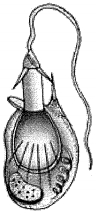
Where are the cells shown in the image found?
A
Lining of Porifera
B
Lining of Coelenteron
C
Tentacles of Cnidaria
D
Comb plates of Ctenophora
Solution
(C) The image shows a cnidoblast or cnidocyte,which is a characteristic cell of the phylum Cnidaria (Coelenterata).
These cells contain a stinging capsule called a nematocyst.
Cnidoblasts are primarily found on the tentacles and the body surface of cnidarians.
They are used for anchorage,defense,and for the capture of prey.
These cells contain a stinging capsule called a nematocyst.
Cnidoblasts are primarily found on the tentacles and the body surface of cnidarians.
They are used for anchorage,defense,and for the capture of prey.
0 likes
View Solution225
MediumMCQ
What type of digestion occurs in Coelenterates (Cnidarians)?
A
Intracellular
B
Extracellular
C
Both $A$ and $B$
D
None of these
Solution
(C) In Coelenterates (Cnidarians),digestion is both extracellular and intracellular.
$1$. Extracellular digestion occurs in the gastrovascular cavity,where enzymes are secreted onto the food.
$2$. Intracellular digestion occurs within the food vacuoles of the cells lining the gastrovascular cavity after the food particles are engulfed.
$1$. Extracellular digestion occurs in the gastrovascular cavity,where enzymes are secreted onto the food.
$2$. Intracellular digestion occurs within the food vacuoles of the cells lining the gastrovascular cavity after the food particles are engulfed.
0 likes
View Solution226
DifficultMCQ
Identify the correct features for $Medusa$ and $Polyp$ forms in Phylum $Coelenterata$ (Cnidaria) from the given list:
$I$ - $Sessile$
$II$ - $Umbrella-shaped$
$III$ - $Free-swimming$
$IV$ - $Produced$ $by$ $asexual$ $reproduction$
$V$ - $Cylindrical$
$VI$ - $Produced$ $by$ $sexual$ $reproduction$
$Medusa$ $\quad\quad$ $Polyp$
$I$ - $Sessile$
$II$ - $Umbrella-shaped$
$III$ - $Free-swimming$
$IV$ - $Produced$ $by$ $asexual$ $reproduction$
$V$ - $Cylindrical$
$VI$ - $Produced$ $by$ $sexual$ $reproduction$
$Medusa$ $\quad\quad$ $Polyp$
A
$II, III, IV \quad\quad I, V, VI$
B
$I, V, VI \quad\quad II, III, VI$
C
$II, III, VI \quad\quad I, IV, V$
D
$I, IV, V \quad\quad II, III, VI$
Solution
(C) In Phylum $Coelenterata$ (Cnidaria),the two basic body forms are $Polyp$ and $Medusa$.
$1$. $Polyp$ is a $sessile$ and $cylindrical$ form (e.g.,$Hydra$,$Adamsia$). It is produced by $asexual$ reproduction.
$2$. $Medusa$ is an $umbrella-shaped$ and $free-swimming$ form (e.g.,$Aurelia$ or jellyfish). It is produced by $sexual$ reproduction.
Matching the given statements:
- $Medusa$: $II$ $(Umbrella-shaped)$,$III$ $(Free-swimming)$,$VI$ ($Produced$ $by$ $sexual$ $reproduction$)
- $Polyp$: $I$ $(Sessile)$,$IV$ ($Produced$ $by$ $asexual$ $reproduction$),$V$ $(Cylindrical)$
Therefore,the correct matching is $Medusa$ $(II, III, VI)$ and $Polyp$ $(I, IV, V)$.
$1$. $Polyp$ is a $sessile$ and $cylindrical$ form (e.g.,$Hydra$,$Adamsia$). It is produced by $asexual$ reproduction.
$2$. $Medusa$ is an $umbrella-shaped$ and $free-swimming$ form (e.g.,$Aurelia$ or jellyfish). It is produced by $sexual$ reproduction.
Matching the given statements:
- $Medusa$: $II$ $(Umbrella-shaped)$,$III$ $(Free-swimming)$,$VI$ ($Produced$ $by$ $sexual$ $reproduction$)
- $Polyp$: $I$ $(Sessile)$,$IV$ ($Produced$ $by$ $asexual$ $reproduction$),$V$ $(Cylindrical)$
Therefore,the correct matching is $Medusa$ $(II, III, VI)$ and $Polyp$ $(I, IV, V)$.
0 likes
View Solution227
MediumMCQ
What are the functions of the tentacles in Phylum $Cnidaria$ (Coelenterata)?
A
Defense
B
Anchorage to the substrate
C
Capture of prey
D
All of the above
Solution
(D) The tentacles in $Cnidarians$ are specialized structures equipped with $cnidoblasts$ (stinging cells).
These tentacles perform multiple vital functions:
$1$. $Defense$: They protect the organism from predators.
$2$. $Anchorage$: They help the organism attach to the substrate or surface.
$3$. $Capture of prey$: They are used to paralyze and capture prey using the toxins released by the $cnidoblasts$.
Therefore, all the given options are correct functions of the tentacles.
These tentacles perform multiple vital functions:
$1$. $Defense$: They protect the organism from predators.
$2$. $Anchorage$: They help the organism attach to the substrate or surface.
$3$. $Capture of prey$: They are used to paralyze and capture prey using the toxins released by the $cnidoblasts$.
Therefore, all the given options are correct functions of the tentacles.
0 likes
View Solution228
MediumMCQ
This organism possesses an organized endoskeleton made of calcium carbonate.
A
Adamsia
B
Meandrina
C
Sycon
D
Ctenoplana
Solution
(B) The organism that possesses an organized endoskeleton made of calcium carbonate is $Meandrina$,commonly known as the brain coral.
$Meandrina$ belongs to the phylum $Cnidaria$ (or $Coelenterata$).
Corals like $Meandrina$ secrete calcium carbonate $(CaCO_3)$ to form a hard,protective exoskeleton or endoskeleton structure.
$Adamsia$ is a sea anemone,$Sycon$ is a sponge (phylum $Porifera$),and $Ctenoplana$ belongs to the phylum $Ctenophora$.
$Meandrina$ belongs to the phylum $Cnidaria$ (or $Coelenterata$).
Corals like $Meandrina$ secrete calcium carbonate $(CaCO_3)$ to form a hard,protective exoskeleton or endoskeleton structure.
$Adamsia$ is a sea anemone,$Sycon$ is a sponge (phylum $Porifera$),and $Ctenoplana$ belongs to the phylum $Ctenophora$.
0 likes
View Solution229
MediumMCQ
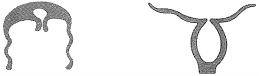
Identify the given body forms of Coelenterates.
A
Tubular $\quad\quad$ Polyp
B
Medusa $\quad\quad$ Polyp
C
Polyp $\quad\quad$ Medusa
D
Polyp $\quad\quad$ Tubular
Solution
(B) The phylum Coelenterata (Cnidaria) exhibits two basic body forms: Polyp and Medusa.
$1$. The first figure (left) represents the Medusa form,which is umbrella-shaped and free-swimming (e.g.,Aurelia).
$2$. The second figure (right) represents the Polyp form,which is cylindrical and sessile (e.g.,Hydra,Adamsia).
Therefore,the correct sequence is Medusa and Polyp.
$1$. The first figure (left) represents the Medusa form,which is umbrella-shaped and free-swimming (e.g.,Aurelia).
$2$. The second figure (right) represents the Polyp form,which is cylindrical and sessile (e.g.,Hydra,Adamsia).
Therefore,the correct sequence is Medusa and Polyp.
0 likes
View Solution230
DifficultMCQ
Match the following columns:
| Column-$I$ | Column-$II$ |
| $P$. Brain coral | $I$. Adamsia |
| $Q$. Portuguese man-of-war | $II$. Meandrina |
| $R$. Sea anemone | $III$. Hydra |
| $S$. Hydra | $IV$. Gorgonia |
| $T$. Sea fan | $V$. Physalia |
| $U$. Sea pen | $VI$. Pennatula |
A
$(P-III), (Q-II), (R-IV), (S-V), (T-I), (U-VI)$
B
$(P-II), (Q-V), (R-I), (S-III), (T-IV), (U-VI)$
C
$(P-V), (Q-II), (R-IV), (S-III), (T-I), (U-VI)$
D
$(P-II), (Q-I), (R-V), (S-III), (T-IV), (U-VI)$
Solution
(B) The correct matches are as follows:
$P$. Brain coral is $Meandrina$ $(II)$.
$Q$. Portuguese man-of-war is $Physalia$ $(V)$.
$R$. Sea anemone is $Adamsia$ $(I)$.
$S$. Hydra is $Hydra$ $(III)$.
$T$. Sea fan is $Gorgonia$ $(IV)$.
$U$. Sea pen is $Pennatula$ $(VI)$.
Therefore, the correct sequence is $(P-II), (Q-V), (R-I), (S-III), (T-IV), (U-VI)$.
$P$. Brain coral is $Meandrina$ $(II)$.
$Q$. Portuguese man-of-war is $Physalia$ $(V)$.
$R$. Sea anemone is $Adamsia$ $(I)$.
$S$. Hydra is $Hydra$ $(III)$.
$T$. Sea fan is $Gorgonia$ $(IV)$.
$U$. Sea pen is $Pennatula$ $(VI)$.
Therefore, the correct sequence is $(P-II), (Q-V), (R-I), (S-III), (T-IV), (U-VI)$.
0 likes
View Solution231
MediumMCQ
Coelenterate with a skeleton of $CaCO_3$ is called as:
A
Polyp
B
Medusa
C
Coral
D
Anemone
Solution
(C) Corals are members of the phylum Coelenterata (Cnidaria) that secrete a hard exoskeleton composed of calcium carbonate $(CaCO_3)$. These structures form the basis of coral reefs.
0 likes
View Solution232
MediumMCQ
What is the function of $Cnidoblast$?
A
Anchorage
B
Defense and capture of prey
C
Digestion and Grinding
D
Both $A$ and $B$
Solution
(D) $Cnidoblasts$ (or $cnidocytes$) are specialized cells found in the phylum $Cnidaria$.
These cells contain stinging capsules called $nematocysts$.
The primary functions of $cnidoblasts$ are:
$1$. $Anchorage$: Helping the organism attach to a substrate.
$2$. $Defense$: Protecting the organism from predators.
$3$. $Capture \, of \, prey$: Paralyzing or killing prey using toxins.
Therefore, both $Anchorage$ and $Defense \, and \, capture \, of \, prey$ are correct functions.
These cells contain stinging capsules called $nematocysts$.
The primary functions of $cnidoblasts$ are:
$1$. $Anchorage$: Helping the organism attach to a substrate.
$2$. $Defense$: Protecting the organism from predators.
$3$. $Capture \, of \, prey$: Paralyzing or killing prey using toxins.
Therefore, both $Anchorage$ and $Defense \, and \, capture \, of \, prey$ are correct functions.
0 likes
View Solution233
MediumMCQ
Polyp phase is absent in $....$
A
Hydra
B
Aurelia
C
Physalia
D
Obelia
Solution
(B) Cnidarians exhibit two basic body forms: the polyp and the medusa.
$Hydra$ exists only in the polyp form.
$Obelia$ and $Physalia$ exhibit both polyp and medusa forms (alternation of generation).
$Aurelia$ (jellyfish) exists primarily in the medusa form,and the polyp phase is absent or highly reduced in its life cycle.
$Hydra$ exists only in the polyp form.
$Obelia$ and $Physalia$ exhibit both polyp and medusa forms (alternation of generation).
$Aurelia$ (jellyfish) exists primarily in the medusa form,and the polyp phase is absent or highly reduced in its life cycle.
0 likes
View Solution234
EasyMCQ
Name the animal that has a central gastrovascular cavity.
A
Adamsia
B
Spongilla
C
Taenia
D
Sycon
Solution
(A) The central gastrovascular cavity is a characteristic feature of the phylum $Cnidaria$ (also known as $Coelenterata$).
$Adamsia$ (Sea anemone) belongs to the phylum $Cnidaria$ and possesses a central gastrovascular cavity with a single opening called the hypostome.
$Spongilla$ and $Sycon$ belong to the phylum $Porifera$,which lack a gastrovascular cavity.
$Taenia$ (Tapeworm) belongs to the phylum $Platyhelminthes$,which has an incomplete digestive system but lacks a true gastrovascular cavity as found in cnidarians.
Therefore,the correct option is $A$.
$Adamsia$ (Sea anemone) belongs to the phylum $Cnidaria$ and possesses a central gastrovascular cavity with a single opening called the hypostome.
$Spongilla$ and $Sycon$ belong to the phylum $Porifera$,which lack a gastrovascular cavity.
$Taenia$ (Tapeworm) belongs to the phylum $Platyhelminthes$,which has an incomplete digestive system but lacks a true gastrovascular cavity as found in cnidarians.
Therefore,the correct option is $A$.
0 likes
View Solution235
MediumMCQ
Which of the following statement$(s)$ is/are correct regarding phylum $Coelenterata$ (Cnidaria)?
$(A)$ They are aquatic,mostly marine,sessile or free-swimming,radially symmetrical animals.
$(B)$ They have a central gastro-vascular cavity with a single opening on hypostome.
$(C)$ Digestion is extracellular and intracellular.
$(D)$ Their members are $Sycon$,$Spongilla$ and $Euspongia$.
$(A)$ They are aquatic,mostly marine,sessile or free-swimming,radially symmetrical animals.
$(B)$ They have a central gastro-vascular cavity with a single opening on hypostome.
$(C)$ Digestion is extracellular and intracellular.
$(D)$ Their members are $Sycon$,$Spongilla$ and $Euspongia$.
A
$A$ and $B$
B
$A$ and $D$
C
$A, B$ and $C$
D
$A, B, C$ and $D$
Solution
(C) Statement $(A)$ is correct: $Coelenterates$ (Cnidarians) are aquatic,mostly marine,sessile or free-swimming,and radially symmetrical.
Statement $(B)$ is correct: They possess a central gastro-vascular cavity with a single opening called the hypostome.
Statement $(C)$ is correct: Digestion in $Coelenterates$ is both extracellular and intracellular.
Statement $(D)$ is incorrect: $Sycon$,$Spongilla$,and $Euspongia$ are members of phylum $Porifera$,not $Coelenterata$.
Therefore,statements $(A), (B),$ and $(C)$ are correct.
Statement $(B)$ is correct: They possess a central gastro-vascular cavity with a single opening called the hypostome.
Statement $(C)$ is correct: Digestion in $Coelenterates$ is both extracellular and intracellular.
Statement $(D)$ is incorrect: $Sycon$,$Spongilla$,and $Euspongia$ are members of phylum $Porifera$,not $Coelenterata$.
Therefore,statements $(A), (B),$ and $(C)$ are correct.
0 likes
View Solution236
EasyMCQ
$A$ diffused nervous system is observed in . . . . . . .
A
sponge
B
cnidarian
C
flatworm
D
earthworm
Solution
(B) diffused nervous system is a primitive type of nervous system where nerve cells are distributed throughout the body in a net-like pattern,rather than being concentrated in a central brain or ganglia.
This type of nervous system is characteristic of the phylum $Cnidaria$ (e.g.,Hydra),where a nerve net is present beneath the epidermis to coordinate responses to stimuli.
This type of nervous system is characteristic of the phylum $Cnidaria$ (e.g.,Hydra),where a nerve net is present beneath the epidermis to coordinate responses to stimuli.
0 likes
View SolutionAnimal Kingdom — Phylum-Coelenterata (Cnideria) · Frequently Asked Questions
1Are these Animal Kingdom questions useful for JEE and NEET?
Yes. All questions in this section are mapped to JEE Main and NEET exam patterns. Previous year questions from JEE Main, NEET, GUJCET and state-level exams are included with full solutions.
2Can I switch to Hindi or Gujarati for these questions?
Yes. Use the language tabs in the hero section or the sidebar to view the same questions and solutions in English, Hindi or Gujarati.
3How do I generate a question paper from this subtopic?
Use the Vedclass Exam Paper Generator — select the chapter and subtopic, set difficulty, and generate Sets A, B, C, D automatically. First 3 chapters of every subject are free.
Vedclass Products
For Students
Vedclass Test Series
Mock tests in real JEE/NEET style with performance analysis. 5-day free trial.
Start Free TrialFor Teachers
Exam Paper Generator
Generate Set A/B/C/D papers from this chapter in 2 minutes. 3 chapters free.
Try FreeFor Institutes
Online Exam Module
Live online exams with unlimited students, 360° analytics & white-label branding.
See DemoFor Teachers & Institutes
Generate a Animal Kingdom Exam Paper in 2 Minutes
Select subtopic & difficulty — Sets A, B, C, D auto-generated with No Repeat logic.
First 3 chapters of every subject are free — no payment required.