
A English
Phylum-Coelenterata (Cnideria) Questions in English
Class 11 Biology · Animal Kingdom · Phylum-Coelenterata (Cnideria)
236+
Questions
English
Language
100%
With Solutions
Showing 50 of 236 questions in English
151
EasyMCQ
To which phylum is the jellyfish classified?
A
Porifera
B
Mollusca
C
Echinodermata
D
Cnidaria
Solution
(D) Jellyfish,scientifically known as $Aurelia$,belongs to the phylum $Cnidaria$ (also known as $Coelenterata$).
These organisms are characterized by the presence of cnidoblasts or cnidocytes on the tentacles and body,which are used for anchorage,defense,and capturing prey.
They exhibit radial symmetry and are diploblastic animals.
These organisms are characterized by the presence of cnidoblasts or cnidocytes on the tentacles and body,which are used for anchorage,defense,and capturing prey.
They exhibit radial symmetry and are diploblastic animals.
0 likes
View Solution152
EasyMCQ
Mesoglea is present between which of the following?
A
Ectoderm and Endoderm
B
Ectoderm and Mesoderm
C
Mesoderm and Endoderm
D
Just below the Mesoderm
Solution
(A) In diploblastic animals,such as those belonging to the phyla $Cnidaria$ and $Ctenophora$,the body is composed of two germinal layers: an external $Ectoderm$ and an internal $Endoderm$.
An undifferentiated,jelly-like layer known as the $Mesoglea$ is present between these two layers.
Therefore,the $Mesoglea$ acts as a non-cellular,gelatinous matrix separating the $Ectoderm$ and the $Endoderm$.
An undifferentiated,jelly-like layer known as the $Mesoglea$ is present between these two layers.
Therefore,the $Mesoglea$ acts as a non-cellular,gelatinous matrix separating the $Ectoderm$ and the $Endoderm$.
0 likes
View Solution153
MediumMCQ
In which of the following is radial symmetry observed?
A
Platyhelminthes
B
Coelenterata
C
Annelida
D
Arthropoda
Solution
(B) Radial symmetry is a type of body symmetry where the body can be divided into identical halves by any plane passing through the central axis.
This type of symmetry is characteristic of the phyla $Cnidaria$ (also known as $Coelenterata$),$Ctenophora$,and adult $Echinodermata$.
$Platyhelminthes$,$Annelida$,and $Arthropoda$ exhibit bilateral symmetry,where the body can be divided into two identical left and right halves only through a single plane.
This type of symmetry is characteristic of the phyla $Cnidaria$ (also known as $Coelenterata$),$Ctenophora$,and adult $Echinodermata$.
$Platyhelminthes$,$Annelida$,and $Arthropoda$ exhibit bilateral symmetry,where the body can be divided into two identical left and right halves only through a single plane.
0 likes
View Solution154
MediumMCQ
Which form in Phylum $Cnidaria$ is free-swimming?
A
Medusa
B
Polyp
C
Strobila
D
Larva
Solution
(A) In Phylum $Cnidaria$ (Coelenterata),organisms exhibit two main body forms: the $Polyp$ and the $Medusa$.
$1$. The $Polyp$ form is sessile and cylindrical,such as in $Hydra$ and $Adamsia$.
$2$. The $Medusa$ form is umbrella-shaped and free-swimming,such as in $Aurelia$ (jellyfish).
Therefore,the $Medusa$ form is the free-swimming stage.
$1$. The $Polyp$ form is sessile and cylindrical,such as in $Hydra$ and $Adamsia$.
$2$. The $Medusa$ form is umbrella-shaped and free-swimming,such as in $Aurelia$ (jellyfish).
Therefore,the $Medusa$ form is the free-swimming stage.
0 likes
View Solution155
EasyMCQ
Which type of larva is found in the phylum $Cnidaria$?
A
Planula
B
Amphiblastula
C
Parenchymula
D
Morula
Solution
(A) In the phylum $Cnidaria$ (also known as $Coelenterata$),the characteristic free-swimming,ciliated larva is known as the $Planula$ larva.
This larva develops from the zygote and eventually settles on a substrate to develop into a polyp.
$Amphiblastula$ is characteristic of certain sponges (Porifera),while $Parenchymula$ is another type of sponge larva.
$Morula$ is an early embryonic stage in animal development,not a specific larval form.
This larva develops from the zygote and eventually settles on a substrate to develop into a polyp.
$Amphiblastula$ is characteristic of certain sponges (Porifera),while $Parenchymula$ is another type of sponge larva.
$Morula$ is an early embryonic stage in animal development,not a specific larval form.
0 likes
View Solution156
EasyMCQ
Which structure contains hypnotoxin?
A
Flame cell
B
Choanocyte
C
Phagocyte
D
Cnidoblast
Solution
(D) The $Cnidoblast$ (also known as a $Cnidocyte$) is a specialized cell found in the phylum $Cnidaria$.
These cells contain a stinging organelle called a $Nematocyst$.
The $Nematocyst$ contains a poisonous fluid known as $Hypnotoxin$,which is used for defense,capturing prey,and anchorage.
These cells contain a stinging organelle called a $Nematocyst$.
The $Nematocyst$ contains a poisonous fluid known as $Hypnotoxin$,which is used for defense,capturing prey,and anchorage.
0 likes
View Solution157
EasyMCQ
Which structure is associated with defense and prey capture?
A
Pseudopodia
B
Ostia
C
Haustoria
D
Cnidoblasts
Solution
(D) The phylum $Cnidaria$ (also known as $Coelenterata$) is characterized by the presence of specialized cells called $Cnidoblasts$ or $Cnidocytes$.
These cells are located on the tentacles and the body surface.
$Cnidoblasts$ contain stinging capsules or nematocysts,which are used for anchorage,defense,and the capture of prey.
Therefore,$Cnidoblasts$ are the structures associated with defense and prey capture.
These cells are located on the tentacles and the body surface.
$Cnidoblasts$ contain stinging capsules or nematocysts,which are used for anchorage,defense,and the capture of prey.
Therefore,$Cnidoblasts$ are the structures associated with defense and prey capture.
0 likes
View Solution158
EasyMCQ
Which phylum of animals possesses a nerve net?
A
Porifera
B
Cnidaria
C
Annelida
D
Mollusca
Solution
(B) The phylum $Cnidaria$ (also known as $Coelenterata$) is characterized by the presence of a primitive nervous system known as a nerve net.
This nerve net consists of interconnected neurons that allow the organism to respond to stimuli from all directions.
$Porifera$ lack a nervous system.
$Annelida$ and $Mollusca$ possess more advanced nervous systems with ganglia and nerve cords.
This nerve net consists of interconnected neurons that allow the organism to respond to stimuli from all directions.
$Porifera$ lack a nervous system.
$Annelida$ and $Mollusca$ possess more advanced nervous systems with ganglia and nerve cords.
0 likes
View Solution159
EasyMCQ
In jellyfish,the gastrovascular cavity opens through which of the following?
A
Mouth
B
Hypostome
C
Ostia
D
Manubrium
Solution
(B) In jellyfish (phylum $Cnidaria$),the gastrovascular cavity is a central digestive cavity. It opens to the exterior through a single opening called the $hypostome$. The $hypostome$ is a conical structure that bears the mouth at its apex. Therefore,the correct answer is $hypostome$.
0 likes
View Solution160
EasyMCQ
Which of the following functions is $NOT$ performed by cnidoblasts?
A
Capture of prey
B
Defense
C
Respiration
D
Anchorage
Solution
(C) Cnidoblasts (or cnidocytes) are specialized cells found in the phylum $Cnidaria$.
These cells contain stinging capsules called nematocysts.
Their primary functions include:
$1$. Capture of prey: By injecting toxins to paralyze the prey.
$2$. Defense: Protecting the organism from predators.
$3$. Anchorage: Helping the organism attach to a substrate.
Respiration in $Cnidarians$ occurs via simple diffusion across the body surface,not through cnidoblasts.
Therefore,respiration is the correct answer.
These cells contain stinging capsules called nematocysts.
Their primary functions include:
$1$. Capture of prey: By injecting toxins to paralyze the prey.
$2$. Defense: Protecting the organism from predators.
$3$. Anchorage: Helping the organism attach to a substrate.
Respiration in $Cnidarians$ occurs via simple diffusion across the body surface,not through cnidoblasts.
Therefore,respiration is the correct answer.
0 likes
View Solution161
EasyMCQ
In which animal is an undifferentiated layer called mesoglea present between the two germ layers?
A
Sea cucumber
B
Sea horse
C
Sea lily
D
Sea anemone
Solution
(D) The animals that possess two germ layers (diploblastic) have an undifferentiated layer called mesoglea present between the ectoderm and the endoderm.
Among the given options,the sea anemone belongs to the phylum $Cnidaria$ (or $Coelenterata$),which is characterized by diploblastic organization and the presence of mesoglea.
Sea cucumber $(Echinodermata)$,sea horse $(Chordata)$,and sea lily $(Echinodermata)$ are triploblastic animals.
Among the given options,the sea anemone belongs to the phylum $Cnidaria$ (or $Coelenterata$),which is characterized by diploblastic organization and the presence of mesoglea.
Sea cucumber $(Echinodermata)$,sea horse $(Chordata)$,and sea lily $(Echinodermata)$ are triploblastic animals.
0 likes
View Solution162
EasyMCQ
Which of the following structures is present in animals of the phylum $Coelenterata$ (Cnidaria)?
A
Hypostome
B
Tentacles
C
Flame cells
D
Choanocytes
Solution
(B) Animals belonging to the phylum $Coelenterata$ (also known as $Cnidaria$) are characterized by the presence of tentacles.
These tentacles are used for capturing prey,defense,and locomotion.
$A$. Hypostome is a structure found in $Cnidaria$ but it is not the defining characteristic feature compared to tentacles.
$B$. Tentacles are a characteristic feature of $Cnidaria$.
$C$. Flame cells are the excretory structures found in the phylum $Platyhelminthes$.
$D$. Choanocytes (collar cells) are the characteristic cells found in the phylum $Porifera$.
These tentacles are used for capturing prey,defense,and locomotion.
$A$. Hypostome is a structure found in $Cnidaria$ but it is not the defining characteristic feature compared to tentacles.
$B$. Tentacles are a characteristic feature of $Cnidaria$.
$C$. Flame cells are the excretory structures found in the phylum $Platyhelminthes$.
$D$. Choanocytes (collar cells) are the characteristic cells found in the phylum $Porifera$.
0 likes
View Solution163
EasyMCQ
Which of the following exhibits metagenesis?
A
Sea anemone
B
Sea cucumber
C
Starfish
D
Obelia
Solution
(D) Metagenesis is the phenomenon of alternation of generation between the asexual polyp form and the sexual medusa form in the life cycle of certain Cnidarians. $Obelia$ is a classic example of an organism that exhibits metagenesis,where polyps produce medusae asexually and medusae produce polyps sexually.
0 likes
View Solution164
EasyMCQ
The presence of which of the following is a characteristic feature of Cnidarians?
A
Cnidoblasts
B
Choanocytes
C
Tentacles
D
Gastrovascular cavity
Solution
(A) The phylum $Cnidaria$ (also known as $Coelenterata$) is characterized by the presence of specialized stinging cells called $Cnidoblasts$ or $Cnidocytes$.
These cells are used for anchorage, defense, and capturing prey.
While $Tentacles$ and $Gastrovascular cavity$ are also present in $Cnidarians$, the $Cnidoblasts$ are the unique, diagnostic feature that defines the phylum.
$Choanocytes$ are characteristic of the phylum $Porifera$.
These cells are used for anchorage, defense, and capturing prey.
While $Tentacles$ and $Gastrovascular cavity$ are also present in $Cnidarians$, the $Cnidoblasts$ are the unique, diagnostic feature that defines the phylum.
$Choanocytes$ are characteristic of the phylum $Porifera$.
0 likes
View Solution165
EasyMCQ
Polymorphism is a characteristic feature of which of the following animal groups?
A
Coelenterata
B
Platyhelminthes
C
Aschelminthes
D
Annelida
Solution
(A) Polymorphism is a phenomenon where an organism exists in more than one morphological form. In the phylum $Coelenterata$ (also known as $Cnidaria$),many species exhibit polymorphism,where individuals of the same species exist in different forms such as polyps and medusae. For example,in $Obelia$,both polyp and medusa forms are present in the life cycle.
0 likes
View Solution166
EasyMCQ
It is a common cavity that performs both digestive and circulatory functions.
A
Spongocoel
B
Coelenteron
C
Coelom
D
Mantle cavity
Solution
(B) The $Coelenteron$ (also known as the gastrovascular cavity) is a central cavity found in the phylum $Cnidaria$ (Coelenterata).
It serves a dual purpose: it acts as a digestive system (extracellular digestion) and as a circulatory system (distributing nutrients throughout the body).
$Spongocoel$ is the central cavity of sponges.
$Coelom$ is the body cavity lined by mesoderm.
$Mantle cavity$ is the space between the mantle and the body in mollusks.
It serves a dual purpose: it acts as a digestive system (extracellular digestion) and as a circulatory system (distributing nutrients throughout the body).
$Spongocoel$ is the central cavity of sponges.
$Coelom$ is the body cavity lined by mesoderm.
$Mantle cavity$ is the space between the mantle and the body in mollusks.
0 likes
View Solution167
EasyMCQ
Which of the following animal phyla exhibit radial symmetry in their body organization?
A
Platyhelminthes
B
Coelenterata (Cnidaria)
C
Annelida
D
Mollusca
Solution
(B) Radial symmetry is a body plan where an organism can be divided into identical halves by any plane passing through the central axis.
In the animal kingdom,members of the phyla $Coelenterata$ (also known as $Cnidaria$) and $Ctenophora$,as well as adult $Echinodermata$,exhibit radial symmetry.
$Platyhelminthes$,$Annelida$,and $Mollusca$ typically exhibit bilateral symmetry.
In the animal kingdom,members of the phyla $Coelenterata$ (also known as $Cnidaria$) and $Ctenophora$,as well as adult $Echinodermata$,exhibit radial symmetry.
$Platyhelminthes$,$Annelida$,and $Mollusca$ typically exhibit bilateral symmetry.
0 likes
View Solution168
MediumMCQ
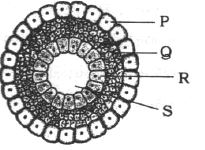
Identify the correct labeling for the given diagram.
A
$P - \text{Ectoderm}, Q - \text{Mesoglea}, R - \text{Endoderm}, S - \text{Gastrovascular cavity}$
B
$P - \text{Ectoderm}, Q - \text{Mesoderm}, R - \text{Endoderm}, S - \text{Gastrovascular cavity}$
C
$P - \text{Ectoderm}, Q - \text{Mesoderm}, R - \text{Endoderm}, S - \text{Pseudocoelom}$
D
$P - \text{Ectoderm}, Q - \text{Mesoderm}, R - \text{Endoderm}, S - \text{Coelom}$
Solution
(A) The provided diagram represents a cross-section of a diploblastic organism (like Cnidaria).
$P$ points to the outer layer, which is the Ectoderm.
$Q$ points to the undifferentiated, jelly-like layer between the two germ layers, known as the Mesoglea.
$R$ points to the inner layer, which is the Endoderm.
$S$ points to the central cavity, which is the Gastrovascular cavity (coelenteron).
Therefore, the correct labeling is $P - \text{Ectoderm}, Q - \text{Mesoglea}, R - \text{Endoderm}, S - \text{Gastrovascular cavity}$.
$P$ points to the outer layer, which is the Ectoderm.
$Q$ points to the undifferentiated, jelly-like layer between the two germ layers, known as the Mesoglea.
$R$ points to the inner layer, which is the Endoderm.
$S$ points to the central cavity, which is the Gastrovascular cavity (coelenteron).
Therefore, the correct labeling is $P - \text{Ectoderm}, Q - \text{Mesoglea}, R - \text{Endoderm}, S - \text{Gastrovascular cavity}$.
0 likes
View Solution169
EasyMCQ
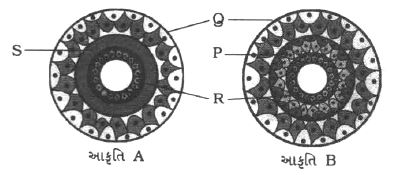
In which animals is the germ layer organization shown in figure $A$ found?
A
Spongilla
B
Hydra
C
Planaria
D
Ascaris
Solution
(B) Figure $A$ shows a diploblastic organization,where the body consists of two germ layers: an external ectoderm and an internal endoderm,with an undifferentiated mesoglea in between. This type of organization is characteristic of the phylum Cnidaria (Coelenterata). Among the given options,$Hydra$ belongs to the phylum Cnidaria. Therefore,the correct option is $B$.
0 likes
View Solution170
EasyMCQ
Which of the following animals exhibit metagenesis,similar to plants?
A
Porifera
B
Echinodermata
C
Arthropoda
D
Coelenterata
Solution
(D) Metagenesis is the phenomenon of alternation of generation between asexual and sexual phases in the life cycle of an organism.
In the phylum $Coelenterata$ (also known as $Cnidaria$),certain species like $Obelia$ exhibit metagenesis.
In this process,polyps produce medusae asexually,and medusae form the polyps sexually.
Therefore,the correct option is $D$.
In the phylum $Coelenterata$ (also known as $Cnidaria$),certain species like $Obelia$ exhibit metagenesis.
In this process,polyps produce medusae asexually,and medusae form the polyps sexually.
Therefore,the correct option is $D$.
0 likes
View Solution171
EasyMCQ
Which of the following is true for the polyp form of Coelenterata (Cnidaria)?
A
It reproduces asexually.
B
It reproduces sexually.
C
It possesses a planula larva.
D
It is a free-swimming form.
Solution
(A) In the phylum Coelenterata (Cnidaria),there are two main body forms: polyp and medusa.
$1$. The polyp form is typically cylindrical and sessile (fixed),such as in Hydra and Adamsia.
$2$. The medusa form is umbrella-shaped and free-swimming,such as in Aurelia.
$3$. Polyp forms reproduce asexually to produce medusa forms,while medusa forms reproduce sexually to produce polyp forms (a phenomenon known as metagenesis or alternation of generations).
Therefore,the correct statement for the polyp form is that it reproduces asexually.
$1$. The polyp form is typically cylindrical and sessile (fixed),such as in Hydra and Adamsia.
$2$. The medusa form is umbrella-shaped and free-swimming,such as in Aurelia.
$3$. Polyp forms reproduce asexually to produce medusa forms,while medusa forms reproduce sexually to produce polyp forms (a phenomenon known as metagenesis or alternation of generations).
Therefore,the correct statement for the polyp form is that it reproduces asexually.
0 likes
View Solution172
MediumMCQ
Metagenesis refers to
A
occurrence of a drastic change in form during post-embryonic development
B
presence of a segmented body and parthenogenetic mode of reproduction
C
presence of different morphic forms
D
alternation of generation between asexual and sexual phases of an organism
Solution
(D) : Metagenesis refers to the alternation of generation between asexual and sexual phases of an organism.
In this process,the organism exists in two different forms.
For example,in $Obelia$ (a coelenterate),the polyp form reproduces asexually to produce medusae,and the medusa form reproduces sexually to produce polyps.
In this process,the organism exists in two different forms.
For example,in $Obelia$ (a coelenterate),the polyp form reproduces asexually to produce medusae,and the medusa form reproduces sexually to produce polyps.
0 likes
View Solution173
MediumMCQ
Select the taxon mentioned that represents both marine and fresh water species.
A
Echinoderms
B
Ctenophora
C
Cephalochordata
D
Cnidaria
Solution
(D) : Cnidarians are sac-like animals that are aquatic. They are mostly marine,but some species like $Hydra$ are found in fresh water. They are the simplest organisms that have attained a tissue level of organization. Members of $Ctenophora$,$Cephalochordata$,and $Echinodermata$ are exclusively marine.
0 likes
View Solution174
EasyMCQ
Which one of the following living organisms completely lacks a cell wall?
A
Cyanobacteria
B
Sea fan (Gorgonia)
C
Saccharomyces
D
Blue-green algae
Solution
(B) : $Gorgonia$ (sea fan) is an animal belonging to the phylum $Coelenterata$ (also known as $Cnidaria$).
All animals lack a cell wall,as their cells are bounded only by a plasma membrane.
$Cyanobacteria$ and blue-green algae (which are the same) have a peptidoglycan cell wall.
$Saccharomyces$ (yeast) is a fungus and possesses a chitinous cell wall.
All animals lack a cell wall,as their cells are bounded only by a plasma membrane.
$Cyanobacteria$ and blue-green algae (which are the same) have a peptidoglycan cell wall.
$Saccharomyces$ (yeast) is a fungus and possesses a chitinous cell wall.
0 likes
View Solution175
MediumMCQ
What is incorrect for $Physalia$?
A
It is diploblastic.
B
It shows cellular level of organization.
C
Nematocysts are present in its tentacles.
D
Its gastro-vascular cavity opens by a hole called hypostome.
Solution
(B) $Physalia$ (Portuguese man-of-war) belongs to the phylum $Cnidaria$ (Coelenterata).
$1$. $Cnidarians$ are diploblastic animals,so option $A$ is correct.
$2$. $Cnidarians$ exhibit tissue level of organization,not cellular level. Thus,option $B$ is incorrect.
$3$. $Cnidarians$ possess cnidoblasts or cnidocytes containing nematocysts on their tentacles for defense and prey capture,making option $C$ correct.
$4$. The gastro-vascular cavity in $Cnidarians$ opens to the outside through a single opening called the hypostome,making option $D$ correct.
Therefore,the incorrect statement is $B$.
$1$. $Cnidarians$ are diploblastic animals,so option $A$ is correct.
$2$. $Cnidarians$ exhibit tissue level of organization,not cellular level. Thus,option $B$ is incorrect.
$3$. $Cnidarians$ possess cnidoblasts or cnidocytes containing nematocysts on their tentacles for defense and prey capture,making option $C$ correct.
$4$. The gastro-vascular cavity in $Cnidarians$ opens to the outside through a single opening called the hypostome,making option $D$ correct.
Therefore,the incorrect statement is $B$.
0 likes
View Solution176
MediumMCQ
What is the function of nematocysts in the phylum $Cnidaria$?
A
Only for stability
B
Defence and digestion
C
Defence,capture of prey,and excretion
D
Defence and capture of prey
Solution
(D) Nematocysts (or cnidoblasts) are specialized stinging cells found in the tentacles and body of organisms in the phylum $Cnidaria$.
These cells contain a coiled,thread-like structure that can be everted rapidly.
The primary functions of nematocysts are:
$1$. Defence against predators.
$2$. Capture of prey by injecting toxins to paralyze them.
Therefore,the correct option is $D$.
These cells contain a coiled,thread-like structure that can be everted rapidly.
The primary functions of nematocysts are:
$1$. Defence against predators.
$2$. Capture of prey by injecting toxins to paralyze them.
Therefore,the correct option is $D$.
0 likes
View Solution177
EasyMCQ
Metagenesis is seen in
A
Corals
B
Pleurobrachia
C
Tapeworm
D
Obelia
Solution
(D) Metagenesis,also known as alternation of generations,is a phenomenon where a life cycle involves both asexual and sexual phases.
In the phylum $Cnidaria$,certain organisms exhibit this phenomenon.
$Obelia$ is a classic example of a cnidarian that shows metagenesis,where the polyp form reproduces asexually to produce medusae,and the medusae reproduce sexually to produce polyps.
In the phylum $Cnidaria$,certain organisms exhibit this phenomenon.
$Obelia$ is a classic example of a cnidarian that shows metagenesis,where the polyp form reproduces asexually to produce medusae,and the medusae reproduce sexually to produce polyps.
0 likes
View Solution178
EasyMCQ
Diploblastic animals belong to the phylum
A
Chordates
B
Aschelminthes
C
Coelenterates
D
Platyhelminthes
Solution
(C) Animals in which the cells are arranged in two embryonic layers,an external ectoderm and an internal endoderm,are called diploblastic animals.
Examples of diploblastic animals include phylum $Cnidaria$ (also known as $Coelenterata$) and $Ctenophora$.
$Chordates$,$Aschelminthes$,and $Platyhelminthes$ are triploblastic,meaning they possess three germ layers: ectoderm,mesoderm,and endoderm.
Examples of diploblastic animals include phylum $Cnidaria$ (also known as $Coelenterata$) and $Ctenophora$.
$Chordates$,$Aschelminthes$,and $Platyhelminthes$ are triploblastic,meaning they possess three germ layers: ectoderm,mesoderm,and endoderm.
0 likes
View Solution179
DifficultMCQ
Match the following columns:
Select the correct sequence for $a, b, c, d$.
| $a$. Pennatula | $1$. Brain coral |
| $b$. Meandrina | $2$. Sea-fan |
| $c$. Gorgonia | $3$. Sea-pen |
| $d$. Adamsia | $4$. Sea-anemone |
Select the correct sequence for $a, b, c, d$.
A
$3, 1, 2, 4$
B
$1, 3, 2, 4$
C
$2, 4, 1, 3$
D
$2, 3, 4, 1$
Solution
(A) The correct matches are as follows:
$a$. Pennatula is commonly known as Sea-pen $(3)$.
$b$. Meandrina is commonly known as Brain coral $(1)$.
$c$. Gorgonia is commonly known as Sea-fan $(2)$.
$d$. Adamsia is commonly known as Sea-anemone $(4)$.
Therefore,the correct sequence is $a-3, b-1, c-2, d-4$.
$a$. Pennatula is commonly known as Sea-pen $(3)$.
$b$. Meandrina is commonly known as Brain coral $(1)$.
$c$. Gorgonia is commonly known as Sea-fan $(2)$.
$d$. Adamsia is commonly known as Sea-anemone $(4)$.
Therefore,the correct sequence is $a-3, b-1, c-2, d-4$.
0 likes
View Solution180
MediumMCQ
Medusa is the reproductive structure of
A
Hydra
B
Obelia
C
Sea anemone
D
Star fish
Solution
(B) In the phylum $Cnidaria$,certain species exhibit a phenomenon known as metagenesis or alternation of generations.
$Obelia$ is a classic example of this,where the organism exists in two body forms: the polyp and the medusa.
The polyp is the sessile,asexual form,while the medusa is the free-swimming,sexual form.
The medusa produces gametes,which fuse to form a zygote,eventually developing into a new polyp,thus acting as the reproductive structure.
$Obelia$ is a classic example of this,where the organism exists in two body forms: the polyp and the medusa.
The polyp is the sessile,asexual form,while the medusa is the free-swimming,sexual form.
The medusa produces gametes,which fuse to form a zygote,eventually developing into a new polyp,thus acting as the reproductive structure.
0 likes
View Solution181
EasyMCQ
The organ-pipe coral is known as .......
A
Tubipora
B
Astraea
C
Heliopora
D
Fungia
Solution
(A) The organ-pipe coral is scientifically known as $Tubipora$ $musica$. It belongs to the phylum $Cnidaria$ (or $Coelenterata$). It is named 'organ-pipe coral' because its skeletal structure consists of parallel tubes that resemble the pipes of a musical organ. Therefore,the correct option is $A$.
0 likes
View Solution182
EasyMCQ
Jellyfish belongs to the class $...$.
A
Hydrozoa
B
Scyphozoa
C
Anthozoa
D
None of these
Solution
(B) Jellyfish,scientifically known as $Aurelia$,belongs to the phylum $Cnidaria$ (or $Coelenterata$).
Within this phylum,the class $Scyphozoa$ is commonly referred to as the 'true jellyfish' class.
Members of the class $Hydrozoa$ include organisms like $Hydra$ and $Obelia$,while the class $Anthozoa$ includes corals and sea anemones.
Therefore,the correct classification for jellyfish is $Scyphozoa$.
Within this phylum,the class $Scyphozoa$ is commonly referred to as the 'true jellyfish' class.
Members of the class $Hydrozoa$ include organisms like $Hydra$ and $Obelia$,while the class $Anthozoa$ includes corals and sea anemones.
Therefore,the correct classification for jellyfish is $Scyphozoa$.
0 likes
View Solution183
MediumMCQ
Which of the following animals possesses neurons but lacks a nervous system (nerve net/ganglia/brain)?
A
Hydra
B
Tapeworm
C
Earthworm
D
Frog tadpole
Solution
(A) Hydra belongs to the phylum $Cnidaria$.
It possesses a primitive nervous system consisting of a network of neurons (nerve net) spread throughout the body.
However, it lacks a centralized nervous system, such as a brain or distinct nerve cords, which are characteristic of higher animals like flatworms $(Platyhelminthes)$, annelids $(Earthworm)$, and chordates $(Frog$ tadpole).
Therefore, among the given options, $Hydra$ is the most primitive organism with a diffuse nerve net rather than a complex nervous system.
It possesses a primitive nervous system consisting of a network of neurons (nerve net) spread throughout the body.
However, it lacks a centralized nervous system, such as a brain or distinct nerve cords, which are characteristic of higher animals like flatworms $(Platyhelminthes)$, annelids $(Earthworm)$, and chordates $(Frog$ tadpole).
Therefore, among the given options, $Hydra$ is the most primitive organism with a diffuse nerve net rather than a complex nervous system.
0 likes
View Solution184
EasyMCQ
The characteristic feature of Phylum $Cnidaria$ is .....
A
Polymorphism
B
Cnidoblasts
C
Flame cells
D
Hermaphroditism
Solution
(B) The phylum $Cnidaria$ (also known as $Coelenterata$) is characterized by the presence of specialized cells called $Cnidoblasts$ or $Cnidocytes$.
These cells contain stinging capsules known as $nematocysts$, which are used for anchorage, defense, and capturing prey.
$Flame$ $cells$ are characteristic of Phylum $Platyhelminthes$ (excretion).
$Polymorphism$ is seen in some $Cnidarians$ but is not the defining characteristic of the entire phylum.
$Hermaphroditism$ is found in various phyla and is not a unique feature of $Cnidaria$.
These cells contain stinging capsules known as $nematocysts$, which are used for anchorage, defense, and capturing prey.
$Flame$ $cells$ are characteristic of Phylum $Platyhelminthes$ (excretion).
$Polymorphism$ is seen in some $Cnidarians$ but is not the defining characteristic of the entire phylum.
$Hermaphroditism$ is found in various phyla and is not a unique feature of $Cnidaria$.
0 likes
View Solution185
EasyMCQ
Identify the non-parasitic organism.
A
Tapeworm
B
Mosquito
C
Leech
D
Sea Anemone
Solution
(D) $1$. Tapeworms $(Taenia)$ are endoparasites that live in the intestine of humans.
$2$. Mosquitoes are ectoparasites that feed on the blood of vertebrates.
$3$. Leeches $(Hirudinaria)$ are ectoparasites that feed on the blood of various animals.
$4$. Sea Anemones $(Adamsia)$ are marine cnidarians that are free-living and predatory,not parasitic. Therefore,the Sea Anemone is the non-parasitic organism.
$2$. Mosquitoes are ectoparasites that feed on the blood of vertebrates.
$3$. Leeches $(Hirudinaria)$ are ectoparasites that feed on the blood of various animals.
$4$. Sea Anemones $(Adamsia)$ are marine cnidarians that are free-living and predatory,not parasitic. Therefore,the Sea Anemone is the non-parasitic organism.
0 likes
View Solution186
MediumMCQ
The most appropriate term to describe the life cycle of $Obelia$ is .....
A
Neoteny
B
Metagenesis
C
Metamorphosis
D
All of the above
Solution
(B) $Obelia$ exhibits an alternation of generations between the asexual polyp form and the sexual medusa form. This phenomenon,where the asexual phase alternates with the sexual phase in the life cycle of certain cnidarians,is specifically termed as Metagenesis.
0 likes
View Solution187
EasyMCQ
Which of the following phyla includes both freshwater and marine species?
A
Echinodermata
B
Ctenophora
C
Cephalochordata
D
Cnidaria
Solution
(D) The phylum $Cnidaria$ (also known as $Coelenterata$) includes organisms that are mostly marine,but some species,such as $Hydra$,are found in freshwater. $Echinodermata$,$Ctenophora$,and $Cephalochordata$ are exclusively marine.
0 likes
View Solution188
EasyMCQ
Which of the following organisms lacks a cell wall?
A
Gorgonia (Sea-fan)
B
Cyanobacteria
C
Saccharomyces
D
Blue-green algae
Solution
(A) The cell wall is a characteristic feature of plants,fungi,and most bacteria.
$A$. $Gorgonia$ (Sea-fan) belongs to the phylum $Cnidaria$ (Kingdom $Animalia$). Animals do not possess a cell wall.
$B$. $Cyanobacteria$ are prokaryotes that possess a peptidoglycan cell wall.
$C$. $Saccharomyces$ (Yeast) is a fungus and possesses a chitinous cell wall.
$D$. Blue-green algae are $Cyanobacteria$ and possess a cell wall.
Therefore,$Gorgonia$ is the correct answer.
$A$. $Gorgonia$ (Sea-fan) belongs to the phylum $Cnidaria$ (Kingdom $Animalia$). Animals do not possess a cell wall.
$B$. $Cyanobacteria$ are prokaryotes that possess a peptidoglycan cell wall.
$C$. $Saccharomyces$ (Yeast) is a fungus and possesses a chitinous cell wall.
$D$. Blue-green algae are $Cyanobacteria$ and possess a cell wall.
Therefore,$Gorgonia$ is the correct answer.
0 likes
View Solution189
MediumMCQ
Metagenesis is observed in the context of ............... .
A
Presence of different morphological forms
B
Alternation of generation between asexual and sexual phases of an organism
C
Sudden change during post-embryonic development
D
Segmented body and reproduction by apomixis
Solution
(B) Metagenesis is a phenomenon observed in certain members of the phylum $Cnidaria$ (e.g.,$Obelia$).
It refers to the alternation of generation between the asexual polyp form and the sexual medusa form.
In this process,polyps produce medusae asexually,and medusae produce polyps sexually.
Therefore,it represents the alternation of generation between asexual and sexual phases.
It refers to the alternation of generation between the asexual polyp form and the sexual medusa form.
In this process,polyps produce medusae asexually,and medusae produce polyps sexually.
Therefore,it represents the alternation of generation between asexual and sexual phases.
0 likes
View Solution190
MediumMCQ
In $Hydra$,undigested food and nitrogenous waste products are removed through:
A
Mouth and Mouth
B
Body wall and Body wall
C
Mouth and Body wall
D
Mouth and Tentacles
Solution
(C) In $Hydra$,the digestive system is incomplete,meaning it has only one opening which acts as both the mouth and the anus. Therefore,undigested food is egested through the mouth. Nitrogenous waste products,such as ammonia,are primarily removed via simple diffusion through the general body surface (body wall) into the surrounding water.
0 likes
View Solution191
EasyMCQ
Which animal possesses neurons but lacks a brain?
A
Bath sponge
B
Earthworm
C
Cockroach
D
Hydra
Solution
(D) The $Hydra$ belongs to the phylum $Cnidaria$ (or $Coelenterata$).
These organisms possess a primitive nervous system consisting of a network of neurons (nerve net) spread throughout the body.
Unlike higher animals,$Hydra$ does not have a centralized brain or a central nervous system to process information.
Therefore,it is the correct answer.
These organisms possess a primitive nervous system consisting of a network of neurons (nerve net) spread throughout the body.
Unlike higher animals,$Hydra$ does not have a centralized brain or a central nervous system to process information.
Therefore,it is the correct answer.
0 likes
View Solution192
EasyMCQ
"Portuguese man of war" is
A
Soldier of world war $I$
B
Portuguese soldier
C
$A$ sponge
D
$A$ polymorphic, colonial, coelenterate
Solution
(D) "Portuguese man of war" is a polymorphic, colonial coelenterate known as $Physalia \ physalis$.
It is named so due to its appearance, which resembles Portuguese warships (caravels) sailing in the sea during the $15^{th}$ and $16^{th}$ centuries.
It is named so due to its appearance, which resembles Portuguese warships (caravels) sailing in the sea during the $15^{th}$ and $16^{th}$ centuries.
0 likes
View Solution193
Easy
Write the characteristics of Phylum Coelenterata (Cnidaria).
Solution
(N/A) The characteristics of Phylum $Coelenterata$ (also known as $Cnidaria$) are as follows:
$1$. Habitat: They are mostly aquatic,mostly marine,sessile or free-swimming,and radially symmetrical animals.
$2$. Body Organization: They exhibit tissue-level organization and are diploblastic (composed of two germ layers: ectoderm and endoderm).
$3$. Body Cavity: They possess a central gastro-vascular cavity with a single opening called the $hypostome$ (mouth on the oral surface).
$4$. Specialized Cells: They contain $cnidoblasts$ or $cnidocytes$ (stinging cells) on the tentacles and body,which are used for anchorage,defense,and capturing prey.
$5$. Digestion: Digestion is both extracellular and intracellular.
$6$. Body Forms: They exhibit two basic body forms: the polyp (sessile and cylindrical,e.g.,$Hydra$,$Adamsia$) and the medusa (umbrella-shaped and free-swimming,e.g.,$Aurelia$ or jellyfish).
$7$. Alternation of Generation: Some species exhibit $metagenesis$ (alternation of generation),where polyps produce medusae asexually and medusae produce polyps sexually.
$1$. Habitat: They are mostly aquatic,mostly marine,sessile or free-swimming,and radially symmetrical animals.
$2$. Body Organization: They exhibit tissue-level organization and are diploblastic (composed of two germ layers: ectoderm and endoderm).
$3$. Body Cavity: They possess a central gastro-vascular cavity with a single opening called the $hypostome$ (mouth on the oral surface).
$4$. Specialized Cells: They contain $cnidoblasts$ or $cnidocytes$ (stinging cells) on the tentacles and body,which are used for anchorage,defense,and capturing prey.
$5$. Digestion: Digestion is both extracellular and intracellular.
$6$. Body Forms: They exhibit two basic body forms: the polyp (sessile and cylindrical,e.g.,$Hydra$,$Adamsia$) and the medusa (umbrella-shaped and free-swimming,e.g.,$Aurelia$ or jellyfish).
$7$. Alternation of Generation: Some species exhibit $metagenesis$ (alternation of generation),where polyps produce medusae asexually and medusae produce polyps sexually.
0 likes
View Solution194
Medium
Write the characteristics of a polyp (hypostome) animal.
Solution
(N/A) The polyp form is a sessile and cylindrical body form found in the phylum $Cnidaria$.
Key characteristics include:
$1$. Body Shape: It has a cylindrical body shape.
$2$. Lifestyle: It is a sessile form,meaning it remains attached to a substrate.
$3$. Mouth Position: The mouth is directed upwards and is surrounded by tentacles.
$4$. Examples: Common examples include $Hydra$ and $Adamsia$ (sea anemone).
$5$. Reproduction: It typically reproduces asexually by budding.
Key characteristics include:
$1$. Body Shape: It has a cylindrical body shape.
$2$. Lifestyle: It is a sessile form,meaning it remains attached to a substrate.
$3$. Mouth Position: The mouth is directed upwards and is surrounded by tentacles.
$4$. Examples: Common examples include $Hydra$ and $Adamsia$ (sea anemone).
$5$. Reproduction: It typically reproduces asexually by budding.
0 likes
View Solution195
Easy
Describe the location and function of the following structures in Phylum Coelenterata:
$(i)$ Tentacles
$(ii)$ Hypostome
$(i)$ Tentacles
$(ii)$ Hypostome
Solution
(N/A) $(i)$ Tentacles:
Location: In Coelenterata (Cnidaria),the mouth is surrounded by many thin,long,slender,and hollow structures known as tentacles.
Function: They are used for capturing prey,paralyzing prey using cnidoblasts,attachment to surfaces,and for defense and offense.
$(ii)$ Hypostome:
Location: It is a conical,elevated structure located at the center of the oral end of the body,bearing the mouth at its apex.
Function: It acts as the mouth-bearing region and helps in the ingestion of food.
Location: In Coelenterata (Cnidaria),the mouth is surrounded by many thin,long,slender,and hollow structures known as tentacles.
Function: They are used for capturing prey,paralyzing prey using cnidoblasts,attachment to surfaces,and for defense and offense.
$(ii)$ Hypostome:
Location: It is a conical,elevated structure located at the center of the oral end of the body,bearing the mouth at its apex.
Function: It acts as the mouth-bearing region and helps in the ingestion of food.
0 likes
View Solution196
Easy
Differentiate between: Polyp and Medusa.
Solution
(N/A)
| Polyp | Medusa |
|---|---|
| $(1)$ Polyps are sessile and resemble a cylindrical stalk with mouth and tentacles. | $(1)$ Medusae are free-floating,umbrella-like structures with tentacles. |
| $(2)$ Polyps reproduce asexually by budding. | $(2)$ Medusae reproduce sexually by liberating gametes into the water. |
0 likes
View Solution197
EasyMCQ
In which phylum was the neural system developed for the first time?
A
Porifera
B
Cnidaria
C
Platyhelminthes
D
Ctenophora
Solution
(B) The neural system was developed for the first time in the phylum $Cnidaria$ (also known as $Coelenterata$).
In these organisms,it consists of a simple network of neurons dispersed throughout the body,which helps in coordinating the activities of the organism.
In these organisms,it consists of a simple network of neurons dispersed throughout the body,which helps in coordinating the activities of the organism.
0 likes
View Solution198
Medium
Give general characteristics of phylum Coelenterata (Cnidaria).
Solution
(N/A) $\rightarrow$ There are about $9000$ species of Cnidarians.
$\rightarrow$ The name Cnidaria (Knide-nettle or sting cells) is derived from the stinging cells or Cnidoblasts present on the ectoderm of tentacles and the body of these animals.
$\rightarrow$ Cnidoblasts are used for anchorage, defense, and for the capture of prey.
$\rightarrow$ Cnidarians exhibit tissue level of organization and are diploblastic.
$\rightarrow$ They have a central gastro-vascular cavity with a single opening, the hypostome.
$\rightarrow$ Digestion is extracellular and intracellular. Some of the cnidarians, e.g., corals, have a skeleton composed of calcium carbonate $(CaCO_{3})$.
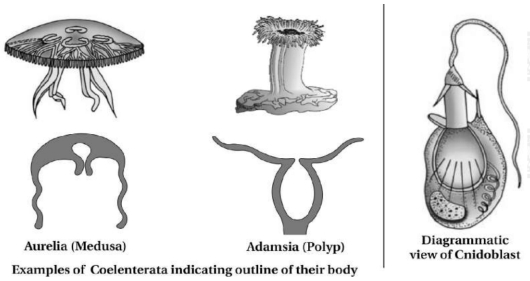
$\rightarrow$ Cnidarians exhibit two basic body forms called polyp and medusa.
$\rightarrow$ Polyp is a sessile and cylindrical form like Hydra, Adamsia, etc., whereas the medusa is umbrella-shaped and free-swimming like Aurelia or jelly fish.
$\rightarrow$ Those cnidarians which exist in both forms exhibit alternation of generation (Metagenesis), i.e., polyps produce medusae asexually and medusae form the polyps sexually (e.g., Obelia).
$\rightarrow$ Examples: Physalia (Portuguese man-of-war), Adamsia (Sea anemone), Pennatula (Sea-pen), Gorgonia (Sea-fan), Meandrina (Brain coral), Aurelia (Jelly fish), Obelia (Sea fur).
$\rightarrow$ The name Cnidaria (Knide-nettle or sting cells) is derived from the stinging cells or Cnidoblasts present on the ectoderm of tentacles and the body of these animals.
$\rightarrow$ Cnidoblasts are used for anchorage, defense, and for the capture of prey.
$\rightarrow$ Cnidarians exhibit tissue level of organization and are diploblastic.
$\rightarrow$ They have a central gastro-vascular cavity with a single opening, the hypostome.
$\rightarrow$ Digestion is extracellular and intracellular. Some of the cnidarians, e.g., corals, have a skeleton composed of calcium carbonate $(CaCO_{3})$.
$\rightarrow$ Cnidarians exhibit two basic body forms called polyp and medusa.
$\rightarrow$ Polyp is a sessile and cylindrical form like Hydra, Adamsia, etc., whereas the medusa is umbrella-shaped and free-swimming like Aurelia or jelly fish.
$\rightarrow$ Those cnidarians which exist in both forms exhibit alternation of generation (Metagenesis), i.e., polyps produce medusae asexually and medusae form the polyps sexually (e.g., Obelia).
$\rightarrow$ Examples: Physalia (Portuguese man-of-war), Adamsia (Sea anemone), Pennatula (Sea-pen), Gorgonia (Sea-fan), Meandrina (Brain coral), Aurelia (Jelly fish), Obelia (Sea fur).
0 likes
View Solution199
MediumMCQ
Free-swimming,radially symmetrical animals with cnidocytes belong to
A
Coelenterata
B
Platyhelminthes
C
Ctenophora
D
Echinodermata
Solution
(A) The animals belonging to the phylum $Coelenterata$ (also known as $Cnidaria$) are characterized by being free-swimming or sessile,exhibiting radial symmetry,and possessing specialized cells called $cnidocytes$ or $cnidoblasts$.
These $cnidocytes$ contain stinging capsules called $nematocysts$,which are used for anchorage,defense,and capturing prey.
These $cnidocytes$ contain stinging capsules called $nematocysts$,which are used for anchorage,defense,and capturing prey.
0 likes
View Solution200
MediumMCQ
Body forms present in Cnidarians are
A
Cylindrical and umbrella-shaped
B
Corals and coral reefs
C
Polyp and medusa
D
Cnidoblasts and nematocytes
Solution
(C) Cnidarians exhibit two basic body forms: the $Polyp$ and the $Medusa$.
$Polyp$ is a sessile and cylindrical form,like $Hydra$ and $Adamsia$.
$Medusa$ is an umbrella-shaped and free-swimming form,like $Aurelia$ (jellyfish).
$Polyp$ is a sessile and cylindrical form,like $Hydra$ and $Adamsia$.
$Medusa$ is an umbrella-shaped and free-swimming form,like $Aurelia$ (jellyfish).
0 likes
View SolutionAnimal Kingdom — Phylum-Coelenterata (Cnideria) · Frequently Asked Questions
1Are these Animal Kingdom questions useful for JEE and NEET?
Yes. All questions in this section are mapped to JEE Main and NEET exam patterns. Previous year questions from JEE Main, NEET, GUJCET and state-level exams are included with full solutions.
2Can I switch to Hindi or Gujarati for these questions?
Yes. Use the language tabs in the hero section or the sidebar to view the same questions and solutions in English, Hindi or Gujarati.
3How do I generate a question paper from this subtopic?
Use the Vedclass Exam Paper Generator — select the chapter and subtopic, set difficulty, and generate Sets A, B, C, D automatically. First 3 chapters of every subject are free.
Vedclass Products
For Students
Vedclass Test Series
Mock tests in real JEE/NEET style with performance analysis. 5-day free trial.
Start Free TrialFor Teachers
Exam Paper Generator
Generate Set A/B/C/D papers from this chapter in 2 minutes. 3 chapters free.
Try FreeFor Institutes
Online Exam Module
Live online exams with unlimited students, 360° analytics & white-label branding.
See DemoFor Teachers & Institutes
Generate a Animal Kingdom Exam Paper in 2 Minutes
Select subtopic & difficulty — Sets A, B, C, D auto-generated with No Repeat logic.
First 3 chapters of every subject are free — no payment required.