
A English
Phylum-Coelenterata (Cnideria) Questions in English
Class 11 Biology · Animal Kingdom · Phylum-Coelenterata (Cnideria)
236+
Questions
English
Language
100%
With Solutions
Showing 50 of 236 questions in English
101
MediumMCQ
Hydra is a $Coelenterate$ because it has ........
A
Tentacles.
B
Mesoglea.
C
Coelenteron and cnidoblasts.
D
Hypostome.
Solution
(C) Hydra belongs to the phylum $Coelenterata$ (also known as $Cnidaria$).
Key characteristics of this phylum include the presence of a central gastrovascular cavity known as the $Coelenteron$ and specialized stinging cells called $Cnidoblasts$ (or $Cnidocytes$).
These $Cnidoblasts$ are used for anchorage,defense,and the capture of prey,which is a defining feature of this phylum.
Key characteristics of this phylum include the presence of a central gastrovascular cavity known as the $Coelenteron$ and specialized stinging cells called $Cnidoblasts$ (or $Cnidocytes$).
These $Cnidoblasts$ are used for anchorage,defense,and the capture of prey,which is a defining feature of this phylum.
0 likes
View Solution102
EasyMCQ
"Polymorphism" is observed in members of the class:
A
Anthozoa
B
Scyphozoa
C
Sporozoa
D
Hydrozoa
Solution
(D) Polymorphism is a phenomenon where a single species exhibits different morphological forms (zooids) to perform specialized functions like feeding, reproduction, and protection. This is a characteristic feature of the class $Hydrozoa$ within the phylum $Cnidaria$. Examples include $Physalia$ (Portuguese man-of-war) and $Obelia$.
0 likes
View Solution103
MediumMCQ
Which of the following is a diploblastic animal with radial symmetry?
A
Roundworm
B
Earthworm
C
Hydra
D
Liver fluke
Solution
(C) $1$. Diploblastic animals are those in which the cells are arranged in two embryonic layers,an external ectoderm and an internal endoderm.
$2$. Radial symmetry is a characteristic feature of the phylum $Cnidaria$ (also known as $Coelenterata$).
$3$. Among the given options,$Hydra$ belongs to the phylum $Cnidaria$.
$4$. Roundworms $(Aschelminthes)$ are triploblastic and bilaterally symmetrical.
$5$. Earthworms $(Annelida)$ are triploblastic and bilaterally symmetrical.
$6$. Liver flukes $(Platyhelminthes)$ are triploblastic and bilaterally symmetrical.
$7$. Therefore,$Hydra$ is the correct answer.
$2$. Radial symmetry is a characteristic feature of the phylum $Cnidaria$ (also known as $Coelenterata$).
$3$. Among the given options,$Hydra$ belongs to the phylum $Cnidaria$.
$4$. Roundworms $(Aschelminthes)$ are triploblastic and bilaterally symmetrical.
$5$. Earthworms $(Annelida)$ are triploblastic and bilaterally symmetrical.
$6$. Liver flukes $(Platyhelminthes)$ are triploblastic and bilaterally symmetrical.
$7$. Therefore,$Hydra$ is the correct answer.
0 likes
View Solution104
MediumMCQ
Which of the following is a $Coelenterate$?
A
Sea cow
B
Sea cucumber
C
Sea fan
D
Sea horse
Solution
(C) The phylum $Coelenterata$ (also known as $Cnidaria$) includes organisms like corals,jellyfish,and sea anemones.
$Sea$ $fan$ (scientific name: $Gorgonia$) belongs to the class $Anthozoa$ under the phylum $Coelenterata$.
$Sea$ $cow$ is a mammal $(Sirenia)$.
$Sea$ $cucumber$ belongs to the phylum $Echinodermata$.
$Sea$ $horse$ is a bony fish $(Osteichthyes)$ belonging to the phylum $Chordata$.
$Sea$ $fan$ (scientific name: $Gorgonia$) belongs to the class $Anthozoa$ under the phylum $Coelenterata$.
$Sea$ $cow$ is a mammal $(Sirenia)$.
$Sea$ $cucumber$ belongs to the phylum $Echinodermata$.
$Sea$ $horse$ is a bony fish $(Osteichthyes)$ belonging to the phylum $Chordata$.
0 likes
View Solution105
EasyMCQ
Cnidoblasts are present in .......
A
Cnidaria
B
Ctenophora
C
Porifera
D
Protozoa
Solution
(A) Cnidoblasts (also known as cnidocytes) are specialized cells containing stinging capsules or nematocysts. These cells are characteristic of the phylum $Cnidaria$ (also known as $Coelenterata$). They are used for anchorage,defense,and the capture of prey. Therefore,the correct option is $A$.
0 likes
View Solution106
EasyMCQ
Radial symmetry is observed in . . . . . . .
A
Planaria
B
Taenia
C
Fasciola
D
Sea anemone
Solution
(D) Radial symmetry is a type of symmetry where an organism can be divided into identical halves by any plane passing through the central axis.
Among the given options, $Planaria$, $Taenia$ (Tapeworm), and $Fasciola$ (Liver fluke) belong to the phylum $Platyhelminthes$, which exhibits bilateral symmetry.
$Sea \text{ } anemone$ belongs to the phylum $Cnidaria$ (or $Coelenterata$), which is characterized by radial symmetry.
Therefore, the correct answer is $Sea \text{ } anemone$.
Among the given options, $Planaria$, $Taenia$ (Tapeworm), and $Fasciola$ (Liver fluke) belong to the phylum $Platyhelminthes$, which exhibits bilateral symmetry.
$Sea \text{ } anemone$ belongs to the phylum $Cnidaria$ (or $Coelenterata$), which is characterized by radial symmetry.
Therefore, the correct answer is $Sea \text{ } anemone$.
0 likes
View Solution107
MediumMCQ
The function of cnidoblasts in Coelenterata is ..........
A
Locomotion
B
Defense and offense
C
Reproduction
D
Nutrition
Solution
(B) Cnidoblasts (or cnidocytes) are specialized cells found in the phylum $Coelenterata$ (also known as $Cnidaria$).
These cells contain a stinging capsule called a $nematocyst$.
The primary functions of cnidoblasts are anchorage,defense,and the capture of prey (offense).
Therefore,they are essential for both defense and offense.
These cells contain a stinging capsule called a $nematocyst$.
The primary functions of cnidoblasts are anchorage,defense,and the capture of prey (offense).
Therefore,they are essential for both defense and offense.
0 likes
View Solution108
MediumMCQ
Which of the following is a member of the phylum $Coelenterata$ (also known as $Cnidaria$)?
A
Sea lily
B
Sea squirt
C
Sea cucumber
D
Sea fan
Solution
(D) The phylum $Coelenterata$ (or $Cnidaria$) includes organisms like $Hydra$,$Obelia$,$Physalia$ (Portuguese man-of-war),$Adamsia$ (Sea anemone),$Pennatula$ (Sea pen),and $Gorgonia$ (Sea fan).
$A$. Sea lily $(Antedon)$ belongs to the phylum $Echinodermata$.
$B$. Sea squirt $(Herdmania)$ belongs to the phylum $Chordata$ (subphylum $Urochordata$).
$C$. Sea cucumber $(Cucumaria)$ belongs to the phylum $Echinodermata$.
$D$. Sea fan $(Gorgonia)$ belongs to the phylum $Coelenterata$ $(Cnidaria)$.
Therefore,the correct option is $D$.
$A$. Sea lily $(Antedon)$ belongs to the phylum $Echinodermata$.
$B$. Sea squirt $(Herdmania)$ belongs to the phylum $Chordata$ (subphylum $Urochordata$).
$C$. Sea cucumber $(Cucumaria)$ belongs to the phylum $Echinodermata$.
$D$. Sea fan $(Gorgonia)$ belongs to the phylum $Coelenterata$ $(Cnidaria)$.
Therefore,the correct option is $D$.
0 likes
View Solution109
MediumMCQ
"Portuguese man-of-war" is a/an:
A
Soldier of World War $I$
B
Portuguese soldier
C
Sponge
D
Polymorphic, colonial, coelenterate
Solution
(D) The "Portuguese man-of-war" is scientifically known as $Physalia$ $physalis$.
It belongs to the phylum $Cnidaria$ (also known as $Coelenterata$).
It is a colonial organism, meaning it consists of a colony of specialized individuals called zooids that work together.
It exhibits polymorphism, meaning it has different forms of zooids (like gastrozooids, dactylozooids, and gonozooids) within the same colony to perform different functions.
It belongs to the phylum $Cnidaria$ (also known as $Coelenterata$).
It is a colonial organism, meaning it consists of a colony of specialized individuals called zooids that work together.
It exhibits polymorphism, meaning it has different forms of zooids (like gastrozooids, dactylozooids, and gonozooids) within the same colony to perform different functions.
0 likes
View Solution110
MediumMCQ
In which phylum are neurons present,but nerves are absent?
A
Porifera
B
Cnidaria
C
Platyhelminthes
D
Aschelminthes
Solution
(B) In the phylum $Cnidaria$ (also known as $Coelenterata$),organisms exhibit a primitive nervous system.
They possess a network of neurons (nerve cells) distributed throughout the body,which helps in coordinating activities.
However,they lack a centralized nervous system or organized nerves (nerve bundles/tracts) as seen in higher animals.
Therefore,they have neurons but lack organized nerves.
They possess a network of neurons (nerve cells) distributed throughout the body,which helps in coordinating activities.
However,they lack a centralized nervous system or organized nerves (nerve bundles/tracts) as seen in higher animals.
Therefore,they have neurons but lack organized nerves.
0 likes
View Solution111
MediumMCQ
Cnidoblasts are found in .........
A
Porifera
B
Coelenterata
C
Aschelminthes
D
Annelida
Solution
(B) Cnidoblasts (or cnidocytes) are specialized cells containing stinging capsules or nematocysts. These cells are the characteristic feature of the phylum $Coelenterata$ (also known as $Cnidaria$). They are used for anchorage,defense,and for the capture of prey. Therefore,the correct option is $B$.
0 likes
View Solution112
MediumMCQ
"Sea pen" and "sea fan" are marine.........
A
Hydrozoa
B
Anthozoa
C
Mollusca
D
Fish
Solution
(B) "Sea pen" (Pennatula) and "sea fan" (Gorgonia) belong to the class $Anthozoa$ of the phylum $Cnidaria$ (also known as $Coelenterata$).
These organisms are exclusively marine and exhibit a polyp form, which is the dominant stage in their life cycle.
Therefore, the correct option is $B$.
These organisms are exclusively marine and exhibit a polyp form, which is the dominant stage in their life cycle.
Therefore, the correct option is $B$.
0 likes
View Solution113
EasyMCQ
Which of the following does not possess a skeleton?
A
Cockroach
B
Mosquito
C
Butterfly
D
Jellyfish
Solution
(D) The $Cockroach$, $Mosquito$, and $Butterfly$ are all members of the phylum $Arthropoda$. These organisms possess an exoskeleton made of chitin, which provides structural support and protection. In contrast, the $Jellyfish$ belongs to the phylum $Cnidaria$. $Cnidarians$ are soft-bodied organisms that lack a hard skeleton, relying instead on a hydrostatic skeleton (water-filled body cavity) for support and movement.
0 likes
View Solution114
EasyMCQ
Which animal possesses neurons but lacks a brain?
A
Sponge
B
Earthworm
C
Cockroach
D
Hydra
Solution
(D) The $Hydra$ belongs to the phylum $Cnidaria$.
It possesses a primitive nervous system consisting of a network of neurons (nerve net) spread throughout its body.
However,it lacks a centralized nervous system or a brain to process information.
In contrast,sponges $(Porifera)$ lack neurons entirely,while earthworms and cockroaches possess a centralized nervous system with a brain or cerebral ganglia.
It possesses a primitive nervous system consisting of a network of neurons (nerve net) spread throughout its body.
However,it lacks a centralized nervous system or a brain to process information.
In contrast,sponges $(Porifera)$ lack neurons entirely,while earthworms and cockroaches possess a centralized nervous system with a brain or cerebral ganglia.
0 likes
View Solution115
EasyMCQ
Which phylum of animals exhibits tissue-level body organization?
A
Porifera
B
Coelenterata (Cnidaria)
C
Platyhelminthes
D
Aschelminthes
Solution
(B) The level of body organization in the animal kingdom progresses from cellular to tissue,organ,and organ-system levels.
$1$. Porifera (sponges) exhibit a cellular level of organization.
$2$. Coelenterata (Cnidaria) and Ctenophora exhibit a tissue level of organization.
$3$. Platyhelminthes and higher phyla exhibit organ and organ-system levels of organization.
Therefore,the phylum that exhibits tissue-level body organization is Coelenterata (Cnidaria).
$1$. Porifera (sponges) exhibit a cellular level of organization.
$2$. Coelenterata (Cnidaria) and Ctenophora exhibit a tissue level of organization.
$3$. Platyhelminthes and higher phyla exhibit organ and organ-system levels of organization.
Therefore,the phylum that exhibits tissue-level body organization is Coelenterata (Cnidaria).
0 likes
View Solution116
EasyMCQ
In animals belonging to the phylum $Coelenterata$ $(Cnidaria)$, cells performing similar functions aggregate to form which level of organization?
A
Cellular level
B
Tissue level
C
Organ level
D
Organ system level
Solution
(B) The phylum $Coelenterata$ (also known as $Cnidaria$) exhibits a $Tissue$ level of body organization.
In these organisms, cells performing similar functions are arranged into tissues, which is a higher level of complexity compared to the $Cellular$ level of organization seen in $Porifera$ (sponges).
Therefore, the correct answer is $Tissue$ level.
In these organisms, cells performing similar functions are arranged into tissues, which is a higher level of complexity compared to the $Cellular$ level of organization seen in $Porifera$ (sponges).
Therefore, the correct answer is $Tissue$ level.
0 likes
View Solution117
EasyMCQ
Which phylum exhibits tissue-level organization for the first time?
A
Platyhelminthes
B
Annelida
C
Coelenterata (Cnidaria)
D
Protozoa
Solution
(C) In the animal kingdom, the level of organization evolves from cellular to tissue, organ, and organ-system levels.
$1$. Porifera exhibits a cellular level of organization.
$2$. Coelenterata (Cnidaria) and Ctenophora are the first phyla to exhibit a tissue-level of organization, where cells performing the same function are arranged into tissues.
$3$. Platyhelminthes exhibit an organ-level of organization.
Therefore, the correct answer is $Coelenterata$.
$1$. Porifera exhibits a cellular level of organization.
$2$. Coelenterata (Cnidaria) and Ctenophora are the first phyla to exhibit a tissue-level of organization, where cells performing the same function are arranged into tissues.
$3$. Platyhelminthes exhibit an organ-level of organization.
Therefore, the correct answer is $Coelenterata$.
0 likes
View Solution118
EasyMCQ
In which of the following phyla are organ systems $NOT$ found?
A
Mollusca
B
Echinodermata
C
Arthropoda
D
Coelenterata
Solution
(D) The level of organization in the animal kingdom progresses from cellular to tissue,and then to organ and organ system levels.
$1$. $Coelenterata$ (Cnidaria) exhibit a tissue level of organization.
$2$. $Mollusca$,$Echinodermata$,and $Arthropoda$ all exhibit an organ-system level of organization.
Therefore,$Coelenterata$ is the phylum that does not possess organ systems.
$1$. $Coelenterata$ (Cnidaria) exhibit a tissue level of organization.
$2$. $Mollusca$,$Echinodermata$,and $Arthropoda$ all exhibit an organ-system level of organization.
Therefore,$Coelenterata$ is the phylum that does not possess organ systems.
0 likes
View Solution119
EasyMCQ
In the animals of which phylum are organ systems not found?
A
Coelenterata
B
Annelida
C
Arthropoda
D
Mollusca
Solution
(A) The level of organization in the animal kingdom progresses from cellular to tissue,and then to organ and organ system levels.
$1$. Porifera exhibit a cellular level of organization.
$2$. Coelenterata (Cnidaria) and Ctenophora exhibit a tissue level of organization.
$3$. Platyhelminthes exhibit an organ level of organization.
$4$. From Aschelminthes to Chordata,animals exhibit an organ-system level of organization.
Therefore,Coelenterata (Cnidaria) is the phylum that does not possess an organ system level of organization; it only has a tissue level of organization.
$1$. Porifera exhibit a cellular level of organization.
$2$. Coelenterata (Cnidaria) and Ctenophora exhibit a tissue level of organization.
$3$. Platyhelminthes exhibit an organ level of organization.
$4$. From Aschelminthes to Chordata,animals exhibit an organ-system level of organization.
Therefore,Coelenterata (Cnidaria) is the phylum that does not possess an organ system level of organization; it only has a tissue level of organization.
0 likes
View Solution120
MediumMCQ
Radial symmetry is observed in:
A
Platyhelminthes
B
Coelenterata
C
Annelida
D
Arthropoda
Solution
(B) Radial symmetry is a body plan where an organism can be divided into identical halves by any plane passing through the central axis.
In the animal kingdom,radial symmetry is a characteristic feature of the phyla $Cnidaria$ (also known as $Coelenterata$),$Ctenophora$,and adult $Echinodermata$.
$Platyhelminthes$,$Annelida$,and $Arthropoda$ exhibit bilateral symmetry.
In the animal kingdom,radial symmetry is a characteristic feature of the phyla $Cnidaria$ (also known as $Coelenterata$),$Ctenophora$,and adult $Echinodermata$.
$Platyhelminthes$,$Annelida$,and $Arthropoda$ exhibit bilateral symmetry.
0 likes
View Solution121
EasyMCQ
Which phylum consists of animals that exhibit radial symmetry?
A
Coelenterata
B
Annelida
C
Arthropoda
D
Mollusca
Solution
(A) Radial symmetry is a characteristic feature of the phylum $Coelenterata$ (also known as $Cnidaria$) and $Ctenophora$. In radial symmetry,any plane passing through the central axis of the body divides the organism into two identical halves. $Annelida$,$Arthropoda$,and $Mollusca$ exhibit bilateral symmetry.
0 likes
View Solution122
EasyMCQ
In which phylum is triploblastic organization $NOT$ observed?
A
Platyhelminthes
B
Chordata
C
Arthropoda
D
Cnidaria
Solution
(D) Triploblastic organisms are those that possess three germ layers: ectoderm,mesoderm,and endoderm.
Phyla such as Platyhelminthes,Arthropoda,and Chordata are triploblastic.
Cnidaria (also known as Coelenterata) are diploblastic,meaning they have only two germ layers: ectoderm and endoderm,with an undifferentiated layer called mesoglea in between.
Therefore,the correct answer is $D$ (Cnidaria).
Phyla such as Platyhelminthes,Arthropoda,and Chordata are triploblastic.
Cnidaria (also known as Coelenterata) are diploblastic,meaning they have only two germ layers: ectoderm and endoderm,with an undifferentiated layer called mesoglea in between.
Therefore,the correct answer is $D$ (Cnidaria).
0 likes
View Solution123
EasyMCQ
In which phylum are the animals characterized by cells arranged in two embryonic layers?
A
Coelenterata
B
Platyhelminthes
C
Porifera
D
Annelida
Solution
(A) Animals in which the cells are arranged in two embryonic layers,an external ectoderm and an internal endoderm,are called diploblastic.
This characteristic is a defining feature of the phylum Coelenterata (also known as Cnidaria).
In contrast,Porifera are generally considered cellular-level organisms without true tissue layers,while Platyhelminthes and Annelida are triploblastic,meaning they possess three germ layers (ectoderm,mesoderm,and endoderm).
This characteristic is a defining feature of the phylum Coelenterata (also known as Cnidaria).
In contrast,Porifera are generally considered cellular-level organisms without true tissue layers,while Platyhelminthes and Annelida are triploblastic,meaning they possess three germ layers (ectoderm,mesoderm,and endoderm).
0 likes
View Solution124
EasyMCQ
Which germ layer is absent in the phylum $Coelenterata$?
A
Ectoderm
B
Mesoderm
C
Endoderm
D
Both $(A)$ and $(B)$
Solution
(B) The phylum $Coelenterata$ (also known as $Cnidaria$) consists of diploblastic animals.
Diploblastic animals possess two germ layers: an outer layer called the ectoderm and an inner layer called the endoderm.
They lack a middle germ layer,which is known as the mesoderm.
Instead of a true mesoderm,they have an undifferentiated,jelly-like layer called the mesoglea between the ectoderm and the endoderm.
Diploblastic animals possess two germ layers: an outer layer called the ectoderm and an inner layer called the endoderm.
They lack a middle germ layer,which is known as the mesoderm.
Instead of a true mesoderm,they have an undifferentiated,jelly-like layer called the mesoglea between the ectoderm and the endoderm.
0 likes
View Solution125
MediumMCQ
In which phylum of animals is an acellular mesoglea present between the two germ layers?
A
Platyhelminthes
B
Arthropoda
C
Cnidaria
D
Protozoa
Solution
(C) Animals belonging to the phylum $Cnidaria$ (also known as $Coelenterata$) are diploblastic,meaning they possess two germ layers: an outer ectoderm and an inner endoderm.
Between these two layers,there is an undifferentiated,jelly-like,acellular substance known as the $mesoglea$.
This $mesoglea$ provides structural support and helps in maintaining the body shape of these organisms.
Therefore,the correct option is $C$.
Between these two layers,there is an undifferentiated,jelly-like,acellular substance known as the $mesoglea$.
This $mesoglea$ provides structural support and helps in maintaining the body shape of these organisms.
Therefore,the correct option is $C$.
0 likes
View Solution126
EasyMCQ
Which of the following phyla exhibits diploblastic organization?
A
Cnidaria
B
Platyhelminthes
C
Chordata
D
Arthropoda
Solution
(A) Diploblastic organisms are those in which the cells are arranged in two embryonic layers: an external ectoderm and an internal endoderm,with an undifferentiated layer called mesoglea in between.
Among the given options,the phylum $Cnidaria$ (also known as $Coelenterata$) is characterized by diploblastic organization.
$Platyhelminthes$,$Chordata$,and $Arthropoda$ are all triploblastic,meaning they possess three germ layers: ectoderm,mesoderm,and endoderm.
Among the given options,the phylum $Cnidaria$ (also known as $Coelenterata$) is characterized by diploblastic organization.
$Platyhelminthes$,$Chordata$,and $Arthropoda$ are all triploblastic,meaning they possess three germ layers: ectoderm,mesoderm,and endoderm.
0 likes
View Solution127
MediumMCQ
What is present between the two germ layers in the phylum $Cnidaria$?
A
Mesoglea
B
Multicellular mesoglea
C
Undifferentiated mesoglea
D
Unicellular mesoglea
Solution
(A) In the phylum $Cnidaria$ (also known as $Coelenterata$),the organisms are diploblastic,meaning they possess two germ layers: an outer ectoderm and an inner endoderm.
Between these two layers,an undifferentiated,jelly-like substance is present,which is known as $Mesoglea$.
$Mesoglea$ is non-cellular or acellular in nature,providing structural support to the body.
Between these two layers,an undifferentiated,jelly-like substance is present,which is known as $Mesoglea$.
$Mesoglea$ is non-cellular or acellular in nature,providing structural support to the body.
0 likes
View Solution128
EasyMCQ
Which of the following organisms exhibits diploblastic organization?
A
Hydra
B
Hyalonema
C
Filarial worm
D
Leech
Solution
(A) Diploblastic organisms are those in which the cells are arranged in two embryonic layers,an external ectoderm and an internal endoderm.
$Hydra$ belongs to the phylum $Cnidaria$ (or $Coelenterata$),which is characterized by diploblastic organization.
$Hyalonema$ belongs to the phylum $Porifera$,which is also diploblastic. However,in the context of standard biology questions,$Hydra$ is the most classic example of a diploblastic organism.
$Filarial$ $worm$ $(Wuchereria)$ belongs to $Aschelminthes$ and $Leech$ $(Hirudinaria)$ belongs to $Annelida$,both of which are triploblastic.
$Hydra$ belongs to the phylum $Cnidaria$ (or $Coelenterata$),which is characterized by diploblastic organization.
$Hyalonema$ belongs to the phylum $Porifera$,which is also diploblastic. However,in the context of standard biology questions,$Hydra$ is the most classic example of a diploblastic organism.
$Filarial$ $worm$ $(Wuchereria)$ belongs to $Aschelminthes$ and $Leech$ $(Hirudinaria)$ belongs to $Annelida$,both of which are triploblastic.
0 likes
View Solution129
MediumMCQ
Which of the following phyla includes diploblastic animals?
A
Cnidaria
B
Platyhelminthes
C
Echinodermata
D
None of the above
Solution
(A) Diploblastic animals are those in which the cells are arranged in two embryonic layers: an external ectoderm and an internal endoderm.
Phylum $Cnidaria$ (also known as Coelenterata) consists of animals that are diploblastic.
Phylum $Platyhelminthes$ and $Echinodermata$ are triploblastic,meaning they have three germ layers (ectoderm,mesoderm,and endoderm).
Phylum $Cnidaria$ (also known as Coelenterata) consists of animals that are diploblastic.
Phylum $Platyhelminthes$ and $Echinodermata$ are triploblastic,meaning they have three germ layers (ectoderm,mesoderm,and endoderm).
0 likes
View Solution130
EasyMCQ
Which of the following phyla is diploblastic?
A
Cnidaria
B
Porifera
C
Platyhelminthes
D
None of the above
Solution
(A) Diploblastic animals are those in which the cells are arranged in two embryonic layers,an external ectoderm and an internal endoderm.
Cnidarians (phylum $Cnidaria$) are diploblastic.
Porifera (sponges) are generally considered cellular-level organisms and are often excluded from the diploblastic/triploblastic classification,though they lack true germ layers.
Platyhelminthes (flatworms) are triploblastic,meaning they possess three germ layers: ectoderm,mesoderm,and endoderm.
Therefore,the correct answer is $Cnidaria$.
Cnidarians (phylum $Cnidaria$) are diploblastic.
Porifera (sponges) are generally considered cellular-level organisms and are often excluded from the diploblastic/triploblastic classification,though they lack true germ layers.
Platyhelminthes (flatworms) are triploblastic,meaning they possess three germ layers: ectoderm,mesoderm,and endoderm.
Therefore,the correct answer is $Cnidaria$.
0 likes
View Solution131
MediumMCQ
In the given figure,what do $a$ and $b$ represent respectively?
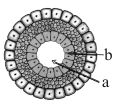
A
Gastrovascular cavity,Endoderm
B
Endoderm,Gastrovascular cavity
C
Gastrovascular cavity,Mesoderm
D
Gastrovascular cavity,Coelenteron
Solution
(A) The provided figure represents a cross-section of a diploblastic organism,such as a member of the phylum Cnidaria.
In this diagram,'$a$' points to the central cavity,which is the gastrovascular cavity (also known as the coelenteron).
'$b$' points to the inner layer of cells lining this cavity,which is the endoderm (or gastrodermis).
Therefore,'$a$' represents the gastrovascular cavity and '$b$' represents the endoderm.
In this diagram,'$a$' points to the central cavity,which is the gastrovascular cavity (also known as the coelenteron).
'$b$' points to the inner layer of cells lining this cavity,which is the endoderm (or gastrodermis).
Therefore,'$a$' represents the gastrovascular cavity and '$b$' represents the endoderm.
0 likes
View Solution132
EasyMCQ
Which phylum consists of animals with radial symmetry?
A
Cnidaria
B
Annelida
C
Arthropoda
D
Mollusca
Solution
(A) Radial symmetry is a characteristic feature of the phylum $Cnidaria$ (also known as $Coelenterata$) and $Ctenophora$. In radial symmetry,any plane passing through the central axis of the body divides the organism into two identical halves. $Annelida$,$Arthropoda$,and $Mollusca$ exhibit bilateral symmetry.
0 likes
View Solution133
EasyMCQ
Which of the following is a diploblastic animal phylum?
A
Protozoa
B
Aschelminthes
C
Coelenterata
D
Porifera
Solution
(C) Diploblastic animals are those in which the cells are arranged in two embryonic layers,an external ectoderm and an internal endoderm.
Phylum $Coelenterata$ (also known as $Cnidaria$) is characteristically diploblastic.
Protozoa is not a phylum in the modern classification of Kingdom Animalia.
Porifera is considered cellular level of organization and is generally considered diploblastic,but $Coelenterata$ is the classic example of a true diploblastic phylum with tissue-level organization.
Aschelminthes are triploblastic.
Phylum $Coelenterata$ (also known as $Cnidaria$) is characteristically diploblastic.
Protozoa is not a phylum in the modern classification of Kingdom Animalia.
Porifera is considered cellular level of organization and is generally considered diploblastic,but $Coelenterata$ is the classic example of a true diploblastic phylum with tissue-level organization.
Aschelminthes are triploblastic.
0 likes
View Solution134
EasyMCQ
Animals possessing cnidoblasts are ..........
A
Sponges
B
Corals
C
Ascaris
D
Amoeba
Solution
(B) Cnidoblasts (or stinging cells) are the characteristic feature of the phylum $Cnidaria$ (also known as $Coelenterata$).
Among the given options,corals belong to the phylum $Cnidaria$.
Sponges belong to the phylum $Porifera$,$Ascaris$ belongs to the phylum $Aschelminthes$ (roundworms),and $Amoeba$ is a protozoan protist.
Therefore,the correct answer is corals.
Among the given options,corals belong to the phylum $Cnidaria$.
Sponges belong to the phylum $Porifera$,$Ascaris$ belongs to the phylum $Aschelminthes$ (roundworms),and $Amoeba$ is a protozoan protist.
Therefore,the correct answer is corals.
0 likes
View Solution135
EasyMCQ
These animals exhibit tissue-level organization,are diploblastic,and show radial or bilateral symmetry.
A
Porifera
B
Protozoa
C
Coelenterata
D
Platyhelminthes
Solution
(C) The animals described exhibit tissue-level organization and are diploblastic. Among the given options,$Coelenterata$ (also known as $Cnidaria$) are characterized by tissue-level organization and are diploblastic. While most $Coelenterates$ exhibit radial symmetry,some forms can show variations. $Porifera$ exhibit cellular-level organization. $Platyhelminthes$ are triploblastic and exhibit organ-level organization. Therefore,the correct option is $C$.
0 likes
View Solution136
EasyMCQ
The presence of cnidoblasts is a characteristic feature of which phylum?
A
Coelenterata
B
Protozoa
C
Porifera
D
Annelida
Solution
(A) Cnidoblasts (also known as cnidocytes) are specialized cells containing stinging capsules called nematocysts. These cells are used for anchorage,defense,and capturing prey. The presence of cnidoblasts is the defining characteristic of the phylum Coelenterata (also known as Cnidaria).
0 likes
View Solution137
EasyMCQ
Which of the following is $NOT$ a function of the cnidoblast (nematocyst)?
A
Defense
B
Capture of prey
C
Response
D
Fertilization
Solution
(D) Cnidoblasts (or cnidocytes) are specialized cells found in the phylum $Cnidaria$ (Coelenterata).
They contain a stinging organelle called a nematocyst.
The primary functions of cnidoblasts include:
$1$. Defense against predators.
$2$. Capture of prey by paralyzing them with toxins.
$3$. Anchorage or attachment to substrates.
Fertilization in cnidarians is a reproductive process involving the fusion of gametes,which is not a function of the cnidoblast cell.
Therefore,the correct answer is $D$.
They contain a stinging organelle called a nematocyst.
The primary functions of cnidoblasts include:
$1$. Defense against predators.
$2$. Capture of prey by paralyzing them with toxins.
$3$. Anchorage or attachment to substrates.
Fertilization in cnidarians is a reproductive process involving the fusion of gametes,which is not a function of the cnidoblast cell.
Therefore,the correct answer is $D$.
0 likes
View Solution138
EasyMCQ
Through which structure does the coelenteron open at one end?
A
Hypostome
B
Spongocoel
C
Mouth
D
Peristome
Solution
(A) In the phylum $Cnidaria$ (also known as $Coelenterata$),the body organization is tissue-level.
They possess a central gastrovascular cavity called the coelenteron.
This cavity opens to the exterior at one end through a structure called the $Hypostome$.
The $Hypostome$ is a conical elevation that bears the mouth at its apex,surrounded by tentacles.
They possess a central gastrovascular cavity called the coelenteron.
This cavity opens to the exterior at one end through a structure called the $Hypostome$.
The $Hypostome$ is a conical elevation that bears the mouth at its apex,surrounded by tentacles.
0 likes
View Solution139
EasyMCQ
Which of the following is the larva of Cnidaria?
A
Planula
B
Ostia
C
Parenchymula
D
Gemmules
Solution
(A) The larva of the phylum $Cnidaria$ (also known as $Coelenterata$) is called the $Planula$ larva.
$Planula$ is a free-swimming,ciliated,flattened,and oval-shaped larva.
$Ostia$ are the pores present in the body wall of $Porifera$.
$Parenchymula$ is the larva of certain sponges $(Porifera)$.
$Gemmules$ are internal buds involved in asexual reproduction in sponges.
$Planula$ is a free-swimming,ciliated,flattened,and oval-shaped larva.
$Ostia$ are the pores present in the body wall of $Porifera$.
$Parenchymula$ is the larva of certain sponges $(Porifera)$.
$Gemmules$ are internal buds involved in asexual reproduction in sponges.
0 likes
View Solution140
EasyMCQ
In the phylum $Coelenterata$ $(Cnidaria)$,what are the sequential names of the asexual and sexual stages?
A
Polymorphism,Medusa
B
Medusa,Polyp
C
Polyp,Medusa
D
Medusa,Polymorphism
Solution
(C) In the phylum $Coelenterata$ $(Cnidaria)$,many species exhibit two basic body forms known as $Polyp$ and $Medusa$.
$1$. The $Polyp$ form is sessile and cylindrical,representing the asexual stage of the life cycle.
$2$. The $Medusa$ form is umbrella-shaped and free-swimming,representing the sexual stage of the life cycle.
Therefore,the correct sequence for the asexual and sexual stages is $Polyp$ and $Medusa$ respectively.
$1$. The $Polyp$ form is sessile and cylindrical,representing the asexual stage of the life cycle.
$2$. The $Medusa$ form is umbrella-shaped and free-swimming,representing the sexual stage of the life cycle.
Therefore,the correct sequence for the asexual and sexual stages is $Polyp$ and $Medusa$ respectively.
0 likes
View Solution141
EasyMCQ
Which of the following is an example of the phylum $Coelenterata$ (Cnidaria)?
A
Planaria
B
Wuchereria
C
Hydra
D
Hyalonema
Solution
(C) The phylum $Coelenterata$ (also known as $Cnidaria$) includes aquatic,mostly marine,sessile or free-swimming,radially symmetrical animals.
$Hydra$ is a well-known example of this phylum.
$Planaria$ belongs to phylum $Platyhelminthes$.
$Wuchereria$ belongs to phylum $Aschelminthes$.
$Hyalonema$ belongs to phylum $Porifera$.
$Hydra$ is a well-known example of this phylum.
$Planaria$ belongs to phylum $Platyhelminthes$.
$Wuchereria$ belongs to phylum $Aschelminthes$.
$Hyalonema$ belongs to phylum $Porifera$.
0 likes
View Solution142
EasyMCQ
Coral is known as ........
A
Hydra
B
Sea Anemone
C
Jellyfish
D
Coral
Solution
(D) Coral belongs to the phylum $Cnidaria$ (also known as $Coelenterata$).
Specifically,corals are marine invertebrates within the class $Anthozoa$.
They are colonial organisms that secrete a hard calcium carbonate skeleton.
Therefore,the term 'Coral' refers to the organisms belonging to the group commonly known as 'Parvala' in Hindi/Gujarati or simply 'Coral' in English.
Specifically,corals are marine invertebrates within the class $Anthozoa$.
They are colonial organisms that secrete a hard calcium carbonate skeleton.
Therefore,the term 'Coral' refers to the organisms belonging to the group commonly known as 'Parvala' in Hindi/Gujarati or simply 'Coral' in English.
0 likes
View Solution143
EasyMCQ
In which animals is metagenesis observed?
A
Porifera
B
Cnidaria
C
Mollusca
D
Annelida
Solution
(B) Metagenesis (alternation of generation) is a phenomenon observed in the phylum $Cnidaria$ (also known as $Coelenterata$).
In this process,polyps produce medusae asexually and medusae produce polyps sexually.
Example: $Obelia$ exhibits this alternation of generation.
In this process,polyps produce medusae asexually and medusae produce polyps sexually.
Example: $Obelia$ exhibits this alternation of generation.
0 likes
View Solution144
MediumMCQ
$S$ - Statement: Some species of $Coelenterata$ exhibit polymorphism.
$R$ - Reason: In $Coelenterata$,the medusa form is observed as the asexual stage.
$R$ - Reason: In $Coelenterata$,the medusa form is observed as the asexual stage.
A
$S$ and $R$ are both true,and $R$ is the correct explanation of $S$.
B
$S$ and $R$ are both true,but $R$ is not the correct explanation of $S$.
C
$S$ is true and $R$ is false.
D
$S$ is false and $R$ is true.
Solution
(C) $1$. Polymorphism is a phenomenon where an organism exists in more than one morphological form. In $Coelenterata$ (Cnidaria),many species exhibit polymorphism by existing in two body forms: polyp and medusa.
$2$. The polyp form is typically sessile and cylindrical (e.g.,$Hydra$,$Adamsia$),while the medusa form is umbrella-shaped and free-swimming (e.g.,$Aurelia$).
$3$. In the life cycle of $Obelia$,both forms alternate (metagenesis). The polyp produces medusae asexually,and the medusae produce polyps sexually.
$4$. Therefore,the statement $S$ is true. However,the reason $R$ is false because the medusa is typically the sexual stage,not the asexual stage.
$2$. The polyp form is typically sessile and cylindrical (e.g.,$Hydra$,$Adamsia$),while the medusa form is umbrella-shaped and free-swimming (e.g.,$Aurelia$).
$3$. In the life cycle of $Obelia$,both forms alternate (metagenesis). The polyp produces medusae asexually,and the medusae produce polyps sexually.
$4$. Therefore,the statement $S$ is true. However,the reason $R$ is false because the medusa is typically the sexual stage,not the asexual stage.
0 likes
View Solution145
MediumMCQ
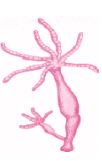
Which of the following is true for the animal shown in the figure?
A
Flame cells are the excretory units.
B
Presence of cnidoblasts.
C
Possesses setae as locomotory organs.
D
Performs ecdysis.
Solution
(B) The animal shown in the figure is Hydra,which belongs to the phylum Cnidaria (Coelenterata).
Cnidarians are characterized by the presence of cnidoblasts (stinging cells) on the tentacles and body,which are used for anchorage,defense,and capturing prey.
Flame cells are characteristic of Platyhelminthes (flatworms).
Setae are locomotory organs found in Annelids like earthworms.
Ecdysis (molting) is a characteristic feature of Arthropods.
Therefore,the presence of cnidoblasts is the correct statement for Hydra.
Cnidarians are characterized by the presence of cnidoblasts (stinging cells) on the tentacles and body,which are used for anchorage,defense,and capturing prey.
Flame cells are characteristic of Platyhelminthes (flatworms).
Setae are locomotory organs found in Annelids like earthworms.
Ecdysis (molting) is a characteristic feature of Arthropods.
Therefore,the presence of cnidoblasts is the correct statement for Hydra.
0 likes
View Solution146
EasyMCQ
The colonial form found in Phylum $Coelenterata$ (Cnidaria) is:
A
$Physalia$
B
$Adamsia$
C
$Meandrina$
D
$Gorgonia$
Solution
(A) In the Phylum $Coelenterata$ (Cnidaria),organisms exhibit two main body forms: the polyp and the medusa.
$Physalia$ (Portuguese man-of-war) is a well-known example of a colonial form,where individuals live together in a colony.
$Adamsia$ (Sea anemone) is a solitary polyp.
$Meandrina$ (Brain coral) is a colonial form but is typically described as a reef-building coral.
$Gorgonia$ (Sea fan) is also a colonial form.
However,in the context of standard biology curriculum questions regarding colonial forms in $Cnidaria$,$Physalia$ is the most frequently cited example.
$Physalia$ (Portuguese man-of-war) is a well-known example of a colonial form,where individuals live together in a colony.
$Adamsia$ (Sea anemone) is a solitary polyp.
$Meandrina$ (Brain coral) is a colonial form but is typically described as a reef-building coral.
$Gorgonia$ (Sea fan) is also a colonial form.
However,in the context of standard biology curriculum questions regarding colonial forms in $Cnidaria$,$Physalia$ is the most frequently cited example.
0 likes
View Solution147
EasyMCQ
The poisonous substance present in the cnidoblasts of Hydra is:
A
Toxin
B
Venom
C
Haematin
D
Hypnotoxin
Solution
(D) Cnidoblasts (or nematocysts) are specialized cells found in the tentacles of Hydra. These cells contain a poisonous fluid called $Hypnotoxin$. This substance is used for paralyzing prey and for defense purposes. When the trigger of the cnidoblast is touched,the nematocyst is discharged,injecting the $Hypnotoxin$ into the victim.
0 likes
View Solution148
EasyMCQ
Jellyfish belongs to which of the following phyla?
A
Porifera
B
Coelenterata (Cnidaria)
C
Mollusca
D
Echinodermata
Solution
(B) Jellyfish,scientifically known as $Aurelia$,belongs to the phylum $Coelenterata$ (also known as $Cnidaria$).
Key characteristics of this phylum include the presence of cnidoblasts (stinging cells) on the tentacles and body,a central gastrovascular cavity with a single opening (hypostome),and radial symmetry.
Therefore,the correct option is $B$.
Key characteristics of this phylum include the presence of cnidoblasts (stinging cells) on the tentacles and body,a central gastrovascular cavity with a single opening (hypostome),and radial symmetry.
Therefore,the correct option is $B$.
0 likes
View Solution149
MediumMCQ
Which of the following animals exhibits polymorphism?
A
Sea Anemone
B
Starfish
C
Physalia (Portuguese man-of-war)
D
Octopus
Solution
(C) Polymorphism is a phenomenon where an organism exists in more than one morphological form. In the phylum $Cnidaria$,specifically in the class $Hydrozoa$,organisms like $Physalia$ (Portuguese man-of-war) exhibit polymorphism. They possess different types of zooids such as gastrozooids (for feeding),dactylozooids (for defense),and gonozooids (for reproduction) within a single colony.
0 likes
View Solution150
EasyMCQ
The animals of this phylum exhibit tissue-level organization.
A
Platyhelminthes
B
Aschelminthes
C
Coelenterata
D
Porifera
Solution
(C) The level of organization in the animal kingdom progresses from cellular to tissue,organ,and organ-system levels.
$1$. $Porifera$ exhibits cellular-level organization.
$2$. $Coelenterata$ $(Cnidaria)$ and $Ctenophora$ exhibit tissue-level organization.
$3$. $Platyhelminthes$ and higher phyla exhibit organ or organ-system level organization.
Therefore,the correct answer is $Coelenterata$.
$1$. $Porifera$ exhibits cellular-level organization.
$2$. $Coelenterata$ $(Cnidaria)$ and $Ctenophora$ exhibit tissue-level organization.
$3$. $Platyhelminthes$ and higher phyla exhibit organ or organ-system level organization.
Therefore,the correct answer is $Coelenterata$.
0 likes
View SolutionAnimal Kingdom — Phylum-Coelenterata (Cnideria) · Frequently Asked Questions
1Are these Animal Kingdom questions useful for JEE and NEET?
Yes. All questions in this section are mapped to JEE Main and NEET exam patterns. Previous year questions from JEE Main, NEET, GUJCET and state-level exams are included with full solutions.
2Can I switch to Hindi or Gujarati for these questions?
Yes. Use the language tabs in the hero section or the sidebar to view the same questions and solutions in English, Hindi or Gujarati.
3How do I generate a question paper from this subtopic?
Use the Vedclass Exam Paper Generator — select the chapter and subtopic, set difficulty, and generate Sets A, B, C, D automatically. First 3 chapters of every subject are free.
Vedclass Products
For Students
Vedclass Test Series
Mock tests in real JEE/NEET style with performance analysis. 5-day free trial.
Start Free TrialFor Teachers
Exam Paper Generator
Generate Set A/B/C/D papers from this chapter in 2 minutes. 3 chapters free.
Try FreeFor Institutes
Online Exam Module
Live online exams with unlimited students, 360° analytics & white-label branding.
See DemoFor Teachers & Institutes
Generate a Animal Kingdom Exam Paper in 2 Minutes
Select subtopic & difficulty — Sets A, B, C, D auto-generated with No Repeat logic.
First 3 chapters of every subject are free — no payment required.