
A English
Meristematic Tissue Questions in English
Class 11 Biology · Anatomy of Flowering Plants · Meristematic Tissue
223+
Questions
English
Language
100%
With Solutions
Showing 23 of 223 questions in English
201
MediumMCQ
$A$. According to Clowes,the root apex consists of an inverted cup-like structure.
$B$. $A$ low amount of $RNA$,$DNA$,and protein is a characteristic of the waiting meristem.
$C$. Cells of the reserve meristem can divide only when the root apex gets injured.
$B$. $A$ low amount of $RNA$,$DNA$,and protein is a characteristic of the waiting meristem.
$C$. Cells of the reserve meristem can divide only when the root apex gets injured.
A
All are correct
B
$A$ and $C$ are incorrect
C
$A$ and $B$ are incorrect
D
$B$ and $C$ are incorrect
Solution
(A) . The statement is correct. $F$.$A$.$L$. Clowes proposed the Quiescent Center theory,describing the root apex as having an inverted cup-shaped region of inactive cells.
$B$. The statement is correct. The waiting meristem (quiescent center) is characterized by low metabolic activity,resulting in low concentrations of $RNA$,$DNA$,and proteins compared to surrounding meristematic tissues.
$C$. The statement is correct. The cells of the reserve meristem (quiescent center) remain inactive under normal conditions but resume division to replace damaged cells if the root apex is injured.
Therefore,all statements are correct.
$B$. The statement is correct. The waiting meristem (quiescent center) is characterized by low metabolic activity,resulting in low concentrations of $RNA$,$DNA$,and proteins compared to surrounding meristematic tissues.
$C$. The statement is correct. The cells of the reserve meristem (quiescent center) remain inactive under normal conditions but resume division to replace damaged cells if the root apex is injured.
Therefore,all statements are correct.
0 likes
View Solution202
MediumMCQ
$A$: Intercalary meristems are commonly located at the base of leaves,above the nodes,or below the nodes.
$R$: Vacuoles are large-sized in the cells of intercalary meristem.
$R$: Vacuoles are large-sized in the cells of intercalary meristem.
A
Assertion and Reason both are correct and Reason is the correct explanation of Assertion.
B
Assertion and Reason both are correct but Reason is not the correct explanation of Assertion.
C
Assertion is correct,but Reason is incorrect.
D
Both Assertion and Reason are incorrect.
Solution
(C) The Assertion is correct because intercalary meristems are found between permanent tissues,typically at the base of leaves,above the nodes,or below the nodes.
The Reason is incorrect because meristematic cells,including those of the intercalary meristem,are characterized by having small or no vacuoles,dense cytoplasm,and a prominent nucleus to facilitate rapid cell division.
Large vacuoles are typically found in mature cells undergoing the elongation phase.
The Reason is incorrect because meristematic cells,including those of the intercalary meristem,are characterized by having small or no vacuoles,dense cytoplasm,and a prominent nucleus to facilitate rapid cell division.
Large vacuoles are typically found in mature cells undergoing the elongation phase.
0 likes
View Solution203
MediumMCQ
Specific areas in higher plants which take part in the formation of new cells are called:
A
Permanent tissue
B
Quiescent centre
C
Meristems
D
Subapical part
Solution
(C) Higher plants possess specific areas that actively divide to form new cells. These areas are known as meristems.
Meristems are classified into three types based on their location:
$(i)$ Apical meristem: Located at the tips of roots and shoots.
$(ii)$ Intercalary meristem: Located between permanent tissues.
$(iii)$ Lateral meristem: Responsible for secondary growth in thickness.
Meristems are classified into three types based on their location:
$(i)$ Apical meristem: Located at the tips of roots and shoots.
$(ii)$ Intercalary meristem: Located between permanent tissues.
$(iii)$ Lateral meristem: Responsible for secondary growth in thickness.
0 likes
View Solution204
MediumMCQ
The cells in the root and shoot apex:
A
Are rich in protoplasm
B
Have conspicuous nuclei
C
Have cell walls which are primary in nature,thin,and cellulosic with abundant plasmodesmatal connections
D
All of the above
Solution
(D) The cells in the root and shoot apex exhibit the following characteristics:
$(i)$ They are rich in protoplasm.
$(ii)$ They possess conspicuous nuclei.
$(iii)$ Their cell walls are primary in nature,thin,and cellulosic,with abundant plasmodesmatal connections.
Therefore,all the given options are correct.
$(i)$ They are rich in protoplasm.
$(ii)$ They possess conspicuous nuclei.
$(iii)$ Their cell walls are primary in nature,thin,and cellulosic,with abundant plasmodesmatal connections.
Therefore,all the given options are correct.
0 likes
View Solution205
MediumMCQ
Which type of cells have the capacity of self-perpetuation?
A
Meristematic cells
B
Companion cells
C
Sieve cells
D
Parenchyma cells
Solution
(A) Meristematic cells are characterized by their ability to divide continuously throughout the life of the plant.
This process of continuous division allows them to maintain their population and contribute to the growth of the plant,a property known as self-perpetuation.
Unlike mature cells,meristematic cells remain in a state of active division.
This process of continuous division allows them to maintain their population and contribute to the growth of the plant,a property known as self-perpetuation.
Unlike mature cells,meristematic cells remain in a state of active division.
0 likes
View Solution206
EasyMCQ
Examples of lateral meristems are
A
Phellogen and collenchyma
B
Vascular cambium and phellem
C
Vascular cambium and cork cambium
D
Xylem and cork cambium
Solution
(C) Lateral meristems are responsible for secondary growth in plants,which increases the girth or diameter of the stem and root.
These meristems are cylindrical in nature.
The primary examples of lateral meristems are the vascular cambium and the cork cambium (also known as phellogen).
Vascular cambium is responsible for the production of secondary xylem and secondary phloem.
Cork cambium is responsible for the production of periderm (cork or phellem on the outside and phelloderm on the inside).
These meristems are cylindrical in nature.
The primary examples of lateral meristems are the vascular cambium and the cork cambium (also known as phellogen).
Vascular cambium is responsible for the production of secondary xylem and secondary phloem.
Cork cambium is responsible for the production of periderm (cork or phellem on the outside and phelloderm on the inside).
0 likes
View Solution207
MediumMCQ
Stem cells can give rise to:
A
Any types of cells
B
Heart cells
C
Special tissue
D
Special organs only
Solution
(A) Stem cells are undifferentiated cells that have the unique ability to differentiate into various specialized cell types. Depending on their potency,such as totipotency,they can give rise to any type of cell in the organism. While they are present in both plants and animals,they are particularly abundant in plant meristematic tissues.
0 likes
View Solution208
Easy
Define/Explain: Primary growth.
Solution
(N/A) The increase in length of plant organs over time is due to the activity of apical meristems located at their tips. This type of growth is known as primary growth.
0 likes
View Solution209
EasyMCQ
Which region consists of undifferentiated cells?
A
Root cap
B
Region of elongation
C
Region of meristematic activity
D
Region of maturation
Solution
(C) The root tip is divided into three zones: the region of meristematic activity,the region of elongation,and the region of maturation.
$1$. The region of meristematic activity is located a few millimeters above the root cap.
$2$. The cells in this region are very small,thin-walled,and with dense protoplasm.
$3$. These cells divide repeatedly,meaning they are undifferentiated and actively undergoing mitosis to produce new cells for the root.
$1$. The region of meristematic activity is located a few millimeters above the root cap.
$2$. The cells in this region are very small,thin-walled,and with dense protoplasm.
$3$. These cells divide repeatedly,meaning they are undifferentiated and actively undergoing mitosis to produce new cells for the root.
0 likes
View Solution210
MediumMCQ
Cells of meristematic tissue are ........
A
Differentiated
B
Undifferentiated
C
Dividing
D
Both $B$ and $C$
Solution
(D) Meristematic tissues consist of cells that are actively dividing $(C)$.
These cells are undifferentiated $(B)$,meaning they have not yet acquired a specific structure or function and retain the capacity to divide.
Therefore,both $B$ and $C$ are correct characteristics of meristematic cells.
These cells are undifferentiated $(B)$,meaning they have not yet acquired a specific structure or function and retain the capacity to divide.
Therefore,both $B$ and $C$ are correct characteristics of meristematic cells.
0 likes
View Solution211
MediumMCQ
$A$ group of actively dividing cells is called $...............$.
A
Permanent tissue
B
Meristematic tissue
C
Simple tissue
D
Complex tissue
Solution
(B) The cells that have the capacity to divide actively are known as meristematic cells. $A$ group of such actively dividing cells is collectively referred to as $Meristematic$ tissue. These tissues are responsible for the growth of the plant body.
0 likes
View Solution212
MediumMCQ
Which tissue is responsible for the formation of axillary buds?
A
Intercalary meristem
B
Apical meristem
C
Secondary meristem
D
All of the above
Solution
(B) The apical meristem is located at the shoot apex. During the formation of leaves and the elongation of the stem,some cells are left behind from the shoot apical meristem. These cells constitute the axillary bud. Axillary buds are present in the axils of leaves and are capable of forming a branch or a flower.
0 likes
View Solution213
MediumMCQ
Identify the tissues $P$ and $Q$ based on their functions:
Tissue $P$: Responsible for the increase in length of roots and stems.
Tissue $Q$: Responsible for the increase in girth (thickness) of roots and stems.
Choose the correct option for $P$ and $Q$.
Tissue $P$: Responsible for the increase in length of roots and stems.
Tissue $Q$: Responsible for the increase in girth (thickness) of roots and stems.
Choose the correct option for $P$ and $Q$.
A
$P-$Apical meristem
$Q-$Lateral meristem
$Q-$Lateral meristem
B
$P-$Lateral meristem
$Q-$Apical meristem
$Q-$Apical meristem
C
$P-$Intercalary meristem
$Q-$Lateral meristem
$Q-$Lateral meristem
D
$P-$Lateral meristem
$Q-$Intercalary meristem
$Q-$Intercalary meristem
Solution
(A) $1$. Apical meristems are found at the shoot and root apices and are responsible for primary growth,which increases the length of the plant axis.
$2$. Lateral meristems (such as vascular cambium and cork cambium) are found in the mature regions of roots and shoots and are responsible for secondary growth,which increases the girth or thickness of the plant organ.
$3$. Therefore,$P$ corresponds to the Apical meristem and $Q$ corresponds to the Lateral meristem.
$2$. Lateral meristems (such as vascular cambium and cork cambium) are found in the mature regions of roots and shoots and are responsible for secondary growth,which increases the girth or thickness of the plant organ.
$3$. Therefore,$P$ corresponds to the Apical meristem and $Q$ corresponds to the Lateral meristem.
0 likes
View Solution214
MediumMCQ
The meristematic tissue located between mature tissues is known as:
A
Intercalary meristem
B
Apical meristem
C
Secondary meristem
D
All of the above
Solution
(A) The meristematic tissue that occurs between mature tissues is called the intercalary meristem.
It is a portion of the primary meristem that gets separated from the apical meristem during the development of the plant body.
It is commonly found in grasses and helps in the regeneration of parts removed by grazing herbivores.
It is a portion of the primary meristem that gets separated from the apical meristem during the development of the plant body.
It is commonly found in grasses and helps in the regeneration of parts removed by grazing herbivores.
0 likes
View Solution215
MediumMCQ
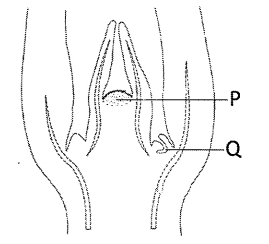
The following figure shows a longitudinal section of a shoot apex. Select the correct option for $P$ and $Q$.
| Option | $P$ | $Q$ |
| $A$ | Meristematic tissue | Plumule |
| $B$ | Plumule | Differentiated vascular tissue |
| $C$ | Plumule | Axillary bud |
| $D$ | Meristematic region | Axillary bud |
A
$A$
B
$B$
C
$C$
D
$D$
Solution
(D) In the longitudinal section of a shoot apex,the region labeled $P$ represents the shoot apical meristem,which is a region of actively dividing meristematic cells responsible for primary growth. The structure labeled $Q$ represents an axillary bud,which develops in the axil of a leaf and is capable of forming a branch or a flower. Therefore,the correct identification is $P$ as the meristematic region and $Q$ as the axillary bud,which corresponds to option $D$.
0 likes
View Solution216
MediumMCQ
Select the incorrect statement regarding meristematic tissue.
A
Meristematic tissue possesses the ability to divide.
B
Meristematic tissue is differentiated.
C
Meristematic tissue gives rise to permanent tissue.
D
Fascicular cambium,interfascicular cambium,and cork cambium are examples of secondary meristems.
Solution
(B) Meristematic tissues are characterized by their ability to undergo continuous cell division. They are undifferentiated cells that eventually lose the ability to divide and become differentiated to form permanent tissues. Therefore,the statement that 'Meristematic tissue is differentiated' is incorrect,as differentiated cells constitute permanent tissue,not meristematic tissue. Fascicular cambium,interfascicular cambium,and cork cambium are indeed examples of secondary meristems that arise from permanent tissues.
0 likes
View Solution217
MediumMCQ
The meristematic tissue present between the primary phloem and primary xylem is known as:
A
Intrafascicular cambium
B
Interfascicular cambium
C
Cambial ring
D
All of the above
Solution
(A) In dicot stems, the vascular bundles contain a strip of meristematic tissue between the primary xylem and primary phloem, which is known as the $Intrafascicular \text{ } cambium$.
This tissue is responsible for secondary growth in plants.
Later, cells of medullary rays adjoining the $Intrafascicular \text{ } cambium$ become meristematic and form the $Interfascicular \text{ } cambium$.
Together, these form a complete $Cambial \text{ } ring$.
Since the question specifically asks for the tissue present between primary phloem and primary xylem, the correct answer is $Intrafascicular \text{ } cambium$.
This tissue is responsible for secondary growth in plants.
Later, cells of medullary rays adjoining the $Intrafascicular \text{ } cambium$ become meristematic and form the $Interfascicular \text{ } cambium$.
Together, these form a complete $Cambial \text{ } ring$.
Since the question specifically asks for the tissue present between primary phloem and primary xylem, the correct answer is $Intrafascicular \text{ } cambium$.
0 likes
View Solution218
MediumMCQ
Select the odd one out from the following.
A
Cork cambium
B
Vascular cambium
C
Intercalary meristem
D
Lateral meristem
Solution
(C) The correct answer is $C$.
$1$. Cork cambium,vascular cambium,and lateral meristem are all types of lateral meristems responsible for secondary growth in plants.
$2$. Intercalary meristem is a type of primary meristem,which is responsible for the increase in the length of the plant (primary growth),typically found at the base of leaves or internodes.
$3$. Therefore,intercalary meristem is the odd one out as it is not involved in secondary growth.
$1$. Cork cambium,vascular cambium,and lateral meristem are all types of lateral meristems responsible for secondary growth in plants.
$2$. Intercalary meristem is a type of primary meristem,which is responsible for the increase in the length of the plant (primary growth),typically found at the base of leaves or internodes.
$3$. Therefore,intercalary meristem is the odd one out as it is not involved in secondary growth.
0 likes
View Solution219
MediumMCQ
In apical and lateral meristems,$..........$ type of cell division is observed.
A
Mitosis
B
Amitosis
C
Meiosis
D
All of the above
Solution
(A) Apical and lateral meristems are responsible for the growth of the plant body in length and girth,respectively.
These tissues consist of actively dividing cells that contribute to the vegetative growth of the plant.
In somatic cells of plants,the type of cell division that occurs to maintain the same chromosome number in daughter cells is mitosis.
Therefore,mitosis is the type of cell division observed in apical and lateral meristems.
These tissues consist of actively dividing cells that contribute to the vegetative growth of the plant.
In somatic cells of plants,the type of cell division that occurs to maintain the same chromosome number in daughter cells is mitosis.
Therefore,mitosis is the type of cell division observed in apical and lateral meristems.
0 likes
View Solution220
MediumMCQ
Which of the following tissues is responsible for the indeterminate growth of plants?
A
Parenchyma
B
Collenchyma
C
Sclerenchyma
D
Meristematic tissue
Solution
(D) Plants possess the capacity for unlimited growth throughout their life. This phenomenon is due to the presence of meristematic tissue at certain locations in their body.
Meristematic tissues consist of actively dividing cells that continuously add new cells to the plant body,leading to indeterminate growth.
Parenchyma,collenchyma,and sclerenchyma are permanent tissues that have lost the ability to divide.
Meristematic tissues consist of actively dividing cells that continuously add new cells to the plant body,leading to indeterminate growth.
Parenchyma,collenchyma,and sclerenchyma are permanent tissues that have lost the ability to divide.
0 likes
View Solution221
MediumMCQ
Identify the labels $P$ and $Q$ in the given diagram.
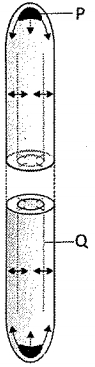
A
Shoot Apical Meristem,Vascular Cambium
B
Shoot Apical Meristem,Fascicular Cambium
C
Root Apical Meristem,Vascular Cambium
D
Root Apical Meristem,Fascicular Cambium
Solution
(B) In the provided diagram,$P$ represents the Shoot Apical Meristem,which is responsible for the primary growth of the shoot.
$Q$ represents the Fascicular Cambium,which is a lateral meristem responsible for secondary growth in plants.
$Q$ represents the Fascicular Cambium,which is a lateral meristem responsible for secondary growth in plants.
0 likes
View Solution222
MediumMCQ
The cells of this tissue have the capacity to divide.
A
Parenchyma
B
Meristematic tissue
C
Collenchyma
D
Sclerenchyma
Solution
(B) Meristematic tissue consists of actively dividing cells that are responsible for the growth of the plant.
These cells are undifferentiated and have the ability to undergo mitosis continuously to produce new cells.
In contrast,Parenchyma,Collenchyma,and Sclerenchyma are permanent tissues that have lost the ability to divide.
These cells are undifferentiated and have the ability to undergo mitosis continuously to produce new cells.
In contrast,Parenchyma,Collenchyma,and Sclerenchyma are permanent tissues that have lost the ability to divide.
0 likes
View Solution223
MediumMCQ
Which of the following are characteristics of cells in the meristematic region?
$I-$ Cells divide continuously.
$II-$ Cells are rich in protoplasm.
$III-$ Cells possess a large,conspicuous nucleus.
$IV-$ All cells of meristematic tissue are differentiated.
$V-$ Cell walls are primary,thin,and cellulosic with abundant plasmodesmata.
$I-$ Cells divide continuously.
$II-$ Cells are rich in protoplasm.
$III-$ Cells possess a large,conspicuous nucleus.
$IV-$ All cells of meristematic tissue are differentiated.
$V-$ Cell walls are primary,thin,and cellulosic with abundant plasmodesmata.
A
$II, III, IV, V$
B
$I, II, III, IV, V$
C
$II, III, V$
D
$I, II, III, V$
Solution
(D) The meristematic region consists of cells that are actively dividing.
$I-$ Correct: Meristematic cells are characterized by their ability to divide continuously.
$II-$ Correct: These cells are metabolically active and rich in protoplasm.
$III-$ Correct: They contain a large,conspicuous nucleus to support high metabolic activity.
$IV-$ Incorrect: Meristematic cells are undifferentiated (or immature) cells,not differentiated.
$V-$ Correct: The cell walls are primary,thin,and cellulosic,and they possess abundant plasmodesmata to facilitate communication between cells.
Therefore,the correct characteristics are $I, II, III,$ and $V$.
$I-$ Correct: Meristematic cells are characterized by their ability to divide continuously.
$II-$ Correct: These cells are metabolically active and rich in protoplasm.
$III-$ Correct: They contain a large,conspicuous nucleus to support high metabolic activity.
$IV-$ Incorrect: Meristematic cells are undifferentiated (or immature) cells,not differentiated.
$V-$ Correct: The cell walls are primary,thin,and cellulosic,and they possess abundant plasmodesmata to facilitate communication between cells.
Therefore,the correct characteristics are $I, II, III,$ and $V$.
0 likes
View SolutionAnatomy of Flowering Plants — Meristematic Tissue · Frequently Asked Questions
1Are these Anatomy of Flowering Plants questions useful for JEE and NEET?
Yes. All questions in this section are mapped to JEE Main and NEET exam patterns. Previous year questions from JEE Main, NEET, GUJCET and state-level exams are included with full solutions.
2Can I switch to Hindi or Gujarati for these questions?
Yes. Use the language tabs in the hero section or the sidebar to view the same questions and solutions in English, Hindi or Gujarati.
3How do I generate a question paper from this subtopic?
Use the Vedclass Exam Paper Generator — select the chapter and subtopic, set difficulty, and generate Sets A, B, C, D automatically. First 3 chapters of every subject are free.
Vedclass Products
For Students
Vedclass Test Series
Mock tests in real JEE/NEET style with performance analysis. 5-day free trial.
Start Free TrialFor Teachers
Exam Paper Generator
Generate Set A/B/C/D papers from this chapter in 2 minutes. 3 chapters free.
Try FreeFor Institutes
Online Exam Module
Live online exams with unlimited students, 360° analytics & white-label branding.
See DemoFor Teachers & Institutes
Generate a Anatomy of Flowering Plants Exam Paper in 2 Minutes
Select subtopic & difficulty — Sets A, B, C, D auto-generated with No Repeat logic.
First 3 chapters of every subject are free — no payment required.