
A English
Meristematic Tissue Questions in English
Class 11 Biology · Anatomy of Flowering Plants · Meristematic Tissue
223+
Questions
English
Language
100%
With Solutions
Showing 50 of 223 questions in English
101
MediumMCQ
The quiescent centre in root meristem serves as a
A
Site for storage of food,which is utilized during maturation
B
Reservoir of growth hormones
C
Reserve for replenishment of damaged cells of the meristem
D
Region for absorption of water
Solution
(C) The quiescent centre is a region in the root apical meristem where the rate of cell division is very low. It acts as a reservoir of active initials that can replace damaged cells of the meristem,ensuring the continuous growth of the root.
0 likes
View Solution102
MediumMCQ
On the basis of the plane of division,the growth forms of meristems have been distinguished as:
A
Mass,plate and rib meristems
B
Outer,middle and inner meristems
C
Peripheral and inner meristem
D
Periclinal,anticlinal and radial meristem
Solution
(A) Based on the plane of cell division,meristems are classified into three types:
$1$. Mass meristem: Division occurs in all planes,resulting in a mass of cells (e.g.,embryo,endosperm).
$2$. Plate meristem: Division occurs in two planes,resulting in a plate-like structure (e.g.,leaf lamina).
$3$. Rib (or file) meristem: Division occurs in only one plane,resulting in rows or files of cells (e.g.,root cortex).
$1$. Mass meristem: Division occurs in all planes,resulting in a mass of cells (e.g.,embryo,endosperm).
$2$. Plate meristem: Division occurs in two planes,resulting in a plate-like structure (e.g.,leaf lamina).
$3$. Rib (or file) meristem: Division occurs in only one plane,resulting in rows or files of cells (e.g.,root cortex).
0 likes
View Solution103
MediumMCQ
The organisation of the shoot apex into tunica and corpus is determined largely on the basis of
A
Rate of shoot tip growth
B
Rate of cell division
C
Planes of cell division
D
Regions of meristematic activity
Solution
(C) The $Tunica-Corpus$ theory,proposed by $Schmidt$ $(1924)$,explains the organization of the shoot apical meristem.
According to this theory,the shoot apex is divided into two distinct zones based on the planes of cell division:
$1$. $Tunica$: It consists of one or more peripheral layers of cells that divide primarily by anticlinal divisions,contributing to surface growth.
$2$. $Corpus$: It is the central mass of cells enclosed by the $Tunica$,where cells divide in various planes,contributing to the increase in volume.
Therefore,the organization is determined by the planes of cell division.
According to this theory,the shoot apex is divided into two distinct zones based on the planes of cell division:
$1$. $Tunica$: It consists of one or more peripheral layers of cells that divide primarily by anticlinal divisions,contributing to surface growth.
$2$. $Corpus$: It is the central mass of cells enclosed by the $Tunica$,where cells divide in various planes,contributing to the increase in volume.
Therefore,the organization is determined by the planes of cell division.
0 likes
View Solution104
MediumMCQ
The tissue of highest respiratory activity is
A
Meristems
B
Ground tissue
C
Phloem
D
Mechanical tissue
Solution
(A) The correct answer is $A$.
Meristematic tissues consist of actively dividing cells.
These cells require a significant amount of energy to perform continuous mitosis and cell growth.
Consequently,they exhibit the highest rate of metabolic activity and,therefore,the highest rate of respiration compared to other plant tissues.
Meristematic tissues consist of actively dividing cells.
These cells require a significant amount of energy to perform continuous mitosis and cell growth.
Consequently,they exhibit the highest rate of metabolic activity and,therefore,the highest rate of respiration compared to other plant tissues.
0 likes
View Solution105
MediumMCQ
In a mango tree,metabolic energy is most extensively used in
A
Cambium
B
Cork
C
Xylem
D
Root parenchyma
Solution
(A) Metabolic energy is primarily required for active cell division and growth.
$(a)$ Cambium cells are meristematic in nature,meaning they are constantly dividing to produce new cells for secondary growth.
$(b)$ Cork cells are dead at maturity and provide protection.
$(c)$ Xylem cells (tracheids and vessels) are mostly dead at maturity and serve in water conduction.
$(d)$ Root parenchyma cells are mature,differentiated cells that primarily function in storage and are less metabolically active compared to meristematic tissues.
Therefore,the cambium utilizes the most metabolic energy.
$(a)$ Cambium cells are meristematic in nature,meaning they are constantly dividing to produce new cells for secondary growth.
$(b)$ Cork cells are dead at maturity and provide protection.
$(c)$ Xylem cells (tracheids and vessels) are mostly dead at maturity and serve in water conduction.
$(d)$ Root parenchyma cells are mature,differentiated cells that primarily function in storage and are less metabolically active compared to meristematic tissues.
Therefore,the cambium utilizes the most metabolic energy.
0 likes
View Solution106
MediumMCQ
Where would you look for active cell division in plants?
A
In the pith cells
B
In the cells of cortex
C
In the internodal region
D
At the tip of root and shoot
Solution
(D) Active cell division in plants occurs primarily in meristematic tissues.
Apical meristems are located at the tips of roots and shoots.
These regions contain cells that are constantly dividing to facilitate the primary growth of the plant.
Therefore,the correct location to observe active cell division is at the tip of the root and shoot.
Apical meristems are located at the tips of roots and shoots.
These regions contain cells that are constantly dividing to facilitate the primary growth of the plant.
Therefore,the correct location to observe active cell division is at the tip of the root and shoot.
0 likes
View Solution107
MediumMCQ
Plant growth in length is increased by
A
Apical meristem
B
Lateral meristem
C
Dermatogen
D
Periblem
Solution
(A) . Apical meristems are found at the shoot and root apex.
As a result of the activity of these meristems,plants increase in length.
As a result of the activity of these meristems,plants increase in length.
0 likes
View Solution108
MediumMCQ
"Cytochimeras" means
A
Cells having haploid number of chromosomes
B
Cells having two nuclei
C
Cells having different chromosomes than other vegetative cells
D
None of the above
Solution
(C) The term "Cytochimeras" refers to organisms or tissues that contain cells with different chromosomal constitutions (ploidy levels or genetic makeup) within the same individual.
In plant biology, this often occurs due to mutations or irregular cell divisions in the meristematic regions.
Therefore, option $C$ is the correct answer as it describes cells having different chromosomal characteristics compared to other vegetative cells in the same organism.
In plant biology, this often occurs due to mutations or irregular cell divisions in the meristematic regions.
Therefore, option $C$ is the correct answer as it describes cells having different chromosomal characteristics compared to other vegetative cells in the same organism.
0 likes
View Solution109
MediumMCQ
Management of garden grass is done more effectively because .....
A
Regeneration occurs with the stimulation of the sheath.
B
Apical dominance is removed and intercalary meristem is stimulated.
C
Apical dominance is removed.
D
Apical dominance is removed and lateral meristem growth is induced.
Solution
(B) In vascular plants,apical dominance is a common phenomenon where the apical meristem inhibits the growth of lateral buds.
This is primarily mediated by the hormone $Auxin$,which is synthesized in the apical meristem and transported downwards.
When the grass is mowed,the apical meristem (the source of $Auxin$) is removed,which eliminates apical dominance.
This removal stimulates the activity of the $intercalary$ $meristem$,leading to rapid growth and a well-maintained,dense lawn.
This is primarily mediated by the hormone $Auxin$,which is synthesized in the apical meristem and transported downwards.
When the grass is mowed,the apical meristem (the source of $Auxin$) is removed,which eliminates apical dominance.
This removal stimulates the activity of the $intercalary$ $meristem$,leading to rapid growth and a well-maintained,dense lawn.
0 likes
View Solution110
MediumMCQ
Which tissue exhibits the highest rate of respiration?
A
Meristematic tissue
B
Parenchyma tissue
C
Phloem tissue
D
Mechanical tissue
Solution
(A) Respiration is a metabolic process that provides energy for cellular activities.
Meristematic tissues consist of actively dividing cells that require a significant amount of energy for mitosis,$DNA$ replication,and the synthesis of new cellular components.
Due to this high metabolic demand,meristematic tissues exhibit the highest rate of respiration compared to other plant tissues like parenchyma or mechanical tissues,which are often more mature or specialized.
Meristematic tissues consist of actively dividing cells that require a significant amount of energy for mitosis,$DNA$ replication,and the synthesis of new cellular components.
Due to this high metabolic demand,meristematic tissues exhibit the highest rate of respiration compared to other plant tissues like parenchyma or mechanical tissues,which are often more mature or specialized.
0 likes
View Solution111
MediumMCQ
In which cells does the synthesis of cyclin proteins occur?
A
Permanent tissue
B
Meristematic tissue
C
Lignified cells
D
All types of cells
Solution
(B) Cyclin proteins are regulatory proteins that control the progression of the cell cycle by activating cyclin-dependent kinases $(CDKs)$.
Since the cell cycle involves active division,cyclin synthesis is primarily associated with cells that are actively dividing.
Meristematic tissues consist of cells that are in a continuous state of division $(mitosis)$.
Permanent tissues and lignified cells are typically in the $G_0$ phase or are terminally differentiated and do not undergo the cell cycle; thus,they do not synthesize cyclins for division.
Therefore,the synthesis of cyclin proteins occurs in meristematic tissues.
Since the cell cycle involves active division,cyclin synthesis is primarily associated with cells that are actively dividing.
Meristematic tissues consist of cells that are in a continuous state of division $(mitosis)$.
Permanent tissues and lignified cells are typically in the $G_0$ phase or are terminally differentiated and do not undergo the cell cycle; thus,they do not synthesize cyclins for division.
Therefore,the synthesis of cyclin proteins occurs in meristematic tissues.
0 likes
View Solution112
EasyMCQ
In plants,during the embryonic stage,the meristematic activity is restricted to:
A
Every cell of the embryo.
B
$A$ single apical cell.
C
$A$ group of apical cells.
D
Both apical and lateral cells.
Solution
(C) In plants,during the embryonic stage,the growth is not uniform across all cells. The meristematic activity,which is responsible for continuous cell division and growth,is restricted to a specific group of cells located at the tips of the embryo,known as the apical meristems. Therefore,the correct answer is a group of apical cells.
0 likes
View Solution113
MediumMCQ
What does plate meristem exhibit?
A
Anticlinal divisions at right angles to each other in two planes
B
Anticlinal divisions in a single plane
C
Periclinal and anticlinal divisions in a single plane
D
Three-dimensional divisions
Solution
(A) Plate meristem is a type of meristematic tissue where cells divide by anticlinal divisions in two planes at right angles to each other. This type of division results in the formation of a plate-like structure,which increases the surface area of the organ (e.g.,leaf lamina). Therefore,the correct answer is $A$.
0 likes
View Solution114
MediumMCQ
In flowering plants,the vascular tissue develops from:
A
Plerome
B
Periblem
C
Dermatogen
D
Calyptrogen
Solution
(A) According to the Histogen theory proposed by Hanstein,the apical meristem of the root consists of three distinct zones or histogens:
$1$. $Dermatogen$: The outermost layer that gives rise to the epidermis.
$2$. $Periblem$: The middle layer that gives rise to the cortex.
$3$. $Plerome$: The central core that gives rise to the vascular tissue (xylem and phloem) and the pith.
Therefore,the vascular tissue develops from the $Plerome$.
$1$. $Dermatogen$: The outermost layer that gives rise to the epidermis.
$2$. $Periblem$: The middle layer that gives rise to the cortex.
$3$. $Plerome$: The central core that gives rise to the vascular tissue (xylem and phloem) and the pith.
Therefore,the vascular tissue develops from the $Plerome$.
0 likes
View Solution115
MediumMCQ
Which meristem is present at the margin of the leaf primordia?
A
Apical meristem
B
Intercalary meristem
C
Marginal meristem
D
Lateral meristem
Solution
(C) The growth of the leaf lamina occurs due to the activity of the $Marginal \ meristem$.
This meristem is located at the margins of the leaf primordia and is responsible for the expansion of the leaf blade in terms of width and surface area.
Therefore,the correct option is $C$.
This meristem is located at the margins of the leaf primordia and is responsible for the expansion of the leaf blade in terms of width and surface area.
Therefore,the correct option is $C$.
0 likes
View Solution116
MediumMCQ
When the root or stem undergoes .....,the conducting elements with annular and spiral thickenings usually develop in the protoxylem.
A
Differentiation
B
Maturation
C
Elongation
D
Expansion
Solution
(C) In the development of primary xylem,the first-formed xylem elements are called protoxylem. During the early stages of plant growth,when the root or stem undergoes $elongation$,the conducting elements of the protoxylem,which have annular and spiral thickenings,are formed. These types of thickenings allow the xylem vessels to stretch as the organ grows in length. As the organ matures and stops elongating,metaxylem with more complex thickenings (like pitted or reticulate) develops.
0 likes
View Solution117
MediumMCQ
In plants, which of the following shows the highest degree of totipotency?
A
Tracheids
B
Meristematic tissue
C
Cork
D
Sieve tube
Solution
(B) Totipotency is the ability of a single cell to divide and produce all the differentiated cells in an organism.
In plants, $Meristematic \text{ } tissue$ consists of undifferentiated, actively dividing cells.
These cells have the highest capacity to undergo mitosis and differentiate into various types of tissues, thus exhibiting the highest degree of totipotency.
Tracheids, cork, and sieve tubes are examples of permanent tissues that have lost the ability to divide.
In plants, $Meristematic \text{ } tissue$ consists of undifferentiated, actively dividing cells.
These cells have the highest capacity to undergo mitosis and differentiate into various types of tissues, thus exhibiting the highest degree of totipotency.
Tracheids, cork, and sieve tubes are examples of permanent tissues that have lost the ability to divide.
0 likes
View Solution118
EasyMCQ
In the embryonic stage,the cells are .........
A
Collenchymatous
B
Sclerenchymatous
C
Meristematic
D
Parenchymatous
Solution
(C) In the embryonic stage,the cells of a plant are actively dividing to form various tissues and organs. These actively dividing cells are known as $Meristematic$ cells. They possess the ability to undergo mitosis,which is essential for the growth and development of the plant body.
0 likes
View Solution119
MediumMCQ
The cells of the quiescent center are characterized by:
A
Dense cytoplasm and prominent nuclei
B
Light cytoplasm and small nuclei
C
Regular division adding to the corpus
D
Regular division adding to the tunica
Solution
(B) The quiescent center is a region in the root apical meristem where the cells have a very low rate of division. These cells are characterized by having a light cytoplasm and small nuclei,which distinguishes them from the actively dividing cells of the surrounding meristematic regions. They serve as a reservoir of cells that can replace damaged meristematic cells.
0 likes
View Solution120
EasyMCQ
The length of different internodes in the stem of sugarcane is variable due to the activity of:
A
Position of axillary buds
B
Size of the leaf lamina at the node below each internode
C
Intercalary meristem
D
Shoot apical meristem
Solution
(C) The growth of the stem in monocots like sugarcane is primarily due to the activity of the intercalary meristem.
Intercalary meristems are located between permanent tissues and are responsible for the elongation of internodes.
Since the activity of these meristems varies at different nodes,the length of the internodes in the sugarcane stem is variable.
Intercalary meristems are located between permanent tissues and are responsible for the elongation of internodes.
Since the activity of these meristems varies at different nodes,the length of the internodes in the sugarcane stem is variable.
0 likes
View Solution121
MediumMCQ
The apical meristem is present in .....
A
Only in the radicle
B
Only in the taproot
C
Only in the adventitious root
D
All roots
Solution
(D) The apical meristem is a type of meristematic tissue responsible for the primary growth of plants. It is located at the tips of both the shoot and the root. In the context of roots,the root apical meristem is responsible for the elongation of the root system. Since all types of roots (radicle,taproot,and adventitious roots) possess a growing tip,the apical meristem is present in all of them.
0 likes
View Solution122
EasyMCQ
Who proposed the Quiescent Center theory?
A
Schuepp
B
Hanstein
C
Clowes
D
Nageli
Solution
(C) The Quiescent Center theory was proposed by $Clowes$ in $1954$.
It describes a region of inactive or slowly dividing cells located at the root apical meristem,situated between the root cap and the active meristematic region.
These cells act as a reservoir of cells that can resume division if the primary meristematic cells are damaged.
It describes a region of inactive or slowly dividing cells located at the root apical meristem,situated between the root cap and the active meristematic region.
These cells act as a reservoir of cells that can resume division if the primary meristematic cells are damaged.
0 likes
View Solution123
MediumMCQ
Apical meristem is present in ..........
A
Root tips
B
Shoot tips
C
Axillary buds
D
All of the above
Solution
(D) Apical meristems are the meristematic tissues responsible for primary growth in plants.
They are located at the growing tips of the plant body.
Specifically,they are found at the root tips (root apical meristem) and shoot tips (shoot apical meristem).
Axillary buds are also derived from the shoot apical meristem and contain meristematic cells capable of forming branches or flowers.
Therefore,all the given options are correct locations for apical meristematic activity.
They are located at the growing tips of the plant body.
Specifically,they are found at the root tips (root apical meristem) and shoot tips (shoot apical meristem).
Axillary buds are also derived from the shoot apical meristem and contain meristematic cells capable of forming branches or flowers.
Therefore,all the given options are correct locations for apical meristematic activity.
0 likes
View Solution124
EasyMCQ
The $Tunica-Corpus$ theory was proposed by:
A
Schmidt
B
Hanstein
C
Karl Nageli
D
Strasburger
Solution
(A) The $Tunica-Corpus$ theory was proposed by $Schmidt$ in $1924$. This theory explains the organization of the shoot apical meristem in angiosperms. According to this theory,the shoot apex consists of two distinct regions: the $Tunica$ (peripheral layer) and the $Corpus$ (central mass).
0 likes
View Solution125
EasyMCQ
The shoot apex is protected by which of the following?
A
Root cap
B
Shoot cap
C
Leaf primordia
D
Coleoptile
Solution
(C) The shoot apex (apical meristem) is protected by the developing leaf primordia.
Leaf primordia are small,immature leaves that grow around the shoot apical meristem to shield it from mechanical injury and desiccation as it grows.
Leaf primordia are small,immature leaves that grow around the shoot apical meristem to shield it from mechanical injury and desiccation as it grows.
0 likes
View Solution126
MediumMCQ
Which of the following is an example of a primary meristematic tissue?
A
Cork cambium
B
Root vascular cambium
C
Interfascicular cambium
D
Intrafascicular cambium
Solution
(D) Meristematic tissues are classified based on their origin and development.
Primary meristems are derived from the promeristem and are responsible for the primary growth of the plant.
Intrafascicular cambium is a type of primary meristem located within the vascular bundles of stems and roots.
Cork cambium (phellogen) and interfascicular cambium are examples of secondary meristems,as they arise from permanent tissues during secondary growth.
Primary meristems are derived from the promeristem and are responsible for the primary growth of the plant.
Intrafascicular cambium is a type of primary meristem located within the vascular bundles of stems and roots.
Cork cambium (phellogen) and interfascicular cambium are examples of secondary meristems,as they arise from permanent tissues during secondary growth.
0 likes
View Solution127
EasyMCQ
According to the $Apical$ $Cell$ $Theory$, the shoot apex contains a single apical cell with three cutting faces. This theory applies to some higher algae, bryophytes, and pteridophytes, but not to gymnosperms and angiosperms. Who proposed this theory?
A
$C$. Nageli
B
Hanstein
C
Schmidt
D
Clowes
Solution
(A) The $Apical$ $Cell$ $Theory$ was proposed by $Carl$ $Wilhelm$ $von$ $Nageli$ in $1858$. This theory states that the entire plant body is derived from a single apical cell. It is applicable to lower plants like algae, bryophytes, and pteridophytes, but it does not explain the shoot apex organization in higher plants like gymnosperms and angiosperms, where a group of cells is responsible for growth. Therefore, the correct option is $A$.
0 likes
View Solution128
MediumMCQ
Which of the following is an example of lateral meristem?
A
Fascicular vascular cambium
B
Interfascicular cambium
C
Cork cambium
D
All of the above
Solution
(D) Lateral meristems are meristems that are found in the mature regions of roots and shoots of many plants,particularly those that produce woody axis and appear later than primary meristems.
They are cylindrical meristems.
Examples of lateral meristems include:
$1$. Fascicular vascular cambium
$2$. Interfascicular cambium
$3$. Cork cambium (phellogen)
Since all the given options are examples of lateral meristems,the correct answer is $D$.
They are cylindrical meristems.
Examples of lateral meristems include:
$1$. Fascicular vascular cambium
$2$. Interfascicular cambium
$3$. Cork cambium (phellogen)
Since all the given options are examples of lateral meristems,the correct answer is $D$.
0 likes
View Solution129
MediumMCQ
Which of the following is a meristematic tissue?
A
Phellogen
B
Phellem
C
Phelloderm
D
Bark
Solution
(A) In the process of secondary growth in dicot stems,the cork cambium or $Phellogen$ is a meristematic tissue.
$Phellogen$ cuts off cells on both sides.
The cells cut off on the outer side form the cork or $Phellem$.
The cells cut off on the inner side form the secondary cortex or $Phelloderm$.
$Bark$ is a non-technical term that refers to all tissues exterior to the vascular cambium,including secondary phloem,$Phelloderm$,$Phellogen$,and $Phellem$.
$Phellogen$ cuts off cells on both sides.
The cells cut off on the outer side form the cork or $Phellem$.
The cells cut off on the inner side form the secondary cortex or $Phelloderm$.
$Bark$ is a non-technical term that refers to all tissues exterior to the vascular cambium,including secondary phloem,$Phelloderm$,$Phellogen$,and $Phellem$.
0 likes
View Solution130
MediumMCQ
Which of the following is not a lateral meristem?
A
Intercalary meristem
B
Fascicular vascular cambium
C
Interfascicular cambium
D
Cork cambium
Solution
(A) Lateral meristems are responsible for secondary growth in plants, leading to an increase in girth.
Examples of lateral meristems include $Fascicular vascular cambium$, $Interfascicular cambium$, and $Cork cambium$ $(Phellogen)$.
$Intercalary meristem$ is a type of primary meristem found between mature tissues, primarily responsible for the elongation of internodes in grasses and other monocots.
Therefore, $Intercalary meristem$ is not a lateral meristem.
Examples of lateral meristems include $Fascicular vascular cambium$, $Interfascicular cambium$, and $Cork cambium$ $(Phellogen)$.
$Intercalary meristem$ is a type of primary meristem found between mature tissues, primarily responsible for the elongation of internodes in grasses and other monocots.
Therefore, $Intercalary meristem$ is not a lateral meristem.
0 likes
View Solution131
MediumMCQ
Histogens are the components of which of the following?
A
Apical meristem
B
Intercalary meristem
C
Lateral meristem
D
Secondary meristem
Solution
(A) The histogen theory,proposed by Hanstein,states that the root and shoot apices of plants are composed of distinct layers of meristematic cells called histogens. These histogens are responsible for the development of different tissue systems in the plant body. Specifically,histogens are the components of the apical meristem,which is located at the tips of roots and shoots.
0 likes
View Solution132
MediumMCQ
Meristematic tissue can be defined as a group of cells that:
A
Add bulk to the plant body.
B
Store food materials.
C
Divide continuously to add new cells.
D
Expand to increase the mass of cells.
Solution
(C) Meristematic tissue is a specialized plant tissue consisting of undifferentiated cells that possess the ability to divide continuously. These cells are actively involved in the formation of new cells,which contributes to both the primary and secondary growth of the plant. Therefore,the correct option is $C$.
0 likes
View Solution133
MediumMCQ
In a woody dicot tree,which of the following parts will primarily contain primary tissues?
A
Stems and roots
B
All parts
C
Shoot tips and root tips
D
Flowers,fruits,and leaves
Solution
(C) Primary tissues are derived from the apical meristems and are responsible for the primary growth of the plant.
In a woody dicot tree,secondary growth occurs in the stems and roots,leading to the formation of secondary tissues (secondary xylem and phloem).
However,the shoot tips and root tips (apical meristems) continue to produce primary tissues throughout the life of the plant to facilitate elongation.
Therefore,the shoot tips and root tips are the regions that primarily contain primary tissues.
In a woody dicot tree,secondary growth occurs in the stems and roots,leading to the formation of secondary tissues (secondary xylem and phloem).
However,the shoot tips and root tips (apical meristems) continue to produce primary tissues throughout the life of the plant to facilitate elongation.
Therefore,the shoot tips and root tips are the regions that primarily contain primary tissues.
0 likes
View Solution134
MediumMCQ
The pith is formed by . . . . . . .
A
Ground meristem
B
Procambium
C
Plerome
D
Dermatogen
Solution
(C) According to the Histogen theory proposed by Hanstein,the apical meristem of the root is divided into three distinct zones:
$1$. $Dermatogen$: It gives rise to the epidermis.
$2$. $Periblem$: It gives rise to the cortex.
$3$. $Plerome$: It gives rise to the central stele,which includes the pith,pericycle,and vascular tissues.
Therefore,the pith is formed by the $Plerome$.
$1$. $Dermatogen$: It gives rise to the epidermis.
$2$. $Periblem$: It gives rise to the cortex.
$3$. $Plerome$: It gives rise to the central stele,which includes the pith,pericycle,and vascular tissues.
Therefore,the pith is formed by the $Plerome$.
0 likes
View Solution135
MediumMCQ
Wound cambium is ............ .
A
Secondary meristem
B
Induced cambium
C
Lateral meristem
D
All of the above
Solution
(D) Wound cambium is a type of meristematic tissue that develops at the site of an injury in plants.
It is considered a $Secondary$ $meristem$ because it arises from differentiated cells that regain the ability to divide.
It is also known as $Induced$ $cambium$ because its formation is triggered by external injury.
Since it is located on the sides of the stem or root and contributes to secondary growth (callus formation),it is classified as a $Lateral$ $meristem$.
Therefore,all the given options are correct.
It is considered a $Secondary$ $meristem$ because it arises from differentiated cells that regain the ability to divide.
It is also known as $Induced$ $cambium$ because its formation is triggered by external injury.
Since it is located on the sides of the stem or root and contributes to secondary growth (callus formation),it is classified as a $Lateral$ $meristem$.
Therefore,all the given options are correct.
0 likes
View Solution136
MediumMCQ
Which tissue undergoes mitosis to allow for the continuous growth of plants?
A
Parenchyma
B
Collenchyma
C
Meristem
D
Sclerenchyma
Solution
(C) The continuous growth of plants throughout their life is due to the presence of meristematic tissues at specific locations.
Meristematic tissues consist of actively dividing cells that undergo mitosis to produce new cells.
These new cells then differentiate into various permanent tissues,contributing to the increase in length and girth of the plant.
Therefore,meristematic tissue is responsible for the continuous growth of plants.
Meristematic tissues consist of actively dividing cells that undergo mitosis to produce new cells.
These new cells then differentiate into various permanent tissues,contributing to the increase in length and girth of the plant.
Therefore,meristematic tissue is responsible for the continuous growth of plants.
0 likes
View Solution137
MediumMCQ
Which tissue is responsible for continuous growth in plants?
A
Meristematic tissue
B
Sclerenchyma tissue
C
Parenchyma tissue
D
Aerenchyma tissue
Solution
(A) Meristematic tissue is responsible for the continuous growth in plants.
These tissues consist of actively dividing cells that are capable of mitosis.
They are located in specific regions of the plant body,such as the root and shoot tips (apical meristems),which allow the plant to increase in length and girth throughout its life.
These tissues consist of actively dividing cells that are capable of mitosis.
They are located in specific regions of the plant body,such as the root and shoot tips (apical meristems),which allow the plant to increase in length and girth throughout its life.
0 likes
View Solution138
MediumMCQ
The meristematic tissue responsible for the increase in the girth of a tree trunk is:
A
Intercalary meristem
B
Lateral meristem
C
Phellogen
D
Apical meristem
Solution
(B) : Lateral meristems are the meristems present along the lateral sides of stems and roots. They divide in the radial direction,leading to secondary growth. The vascular cambium (formed by intrafascicular and interfascicular cambium) and the cork cambium (phellogen) are examples of lateral meristems. These tissues are responsible for the increase in the girth (diameter) of stems and roots.
0 likes
View Solution139
MediumMCQ
Which one of the following is not a lateral meristem?
A
Intrafascicular cambium
B
Interfascicular cambium
C
Phellogen
D
Intercalary meristem
Solution
(D) The correct answer is $(d)$.
Meristems are classified based on their position in the plant body into apical,intercalary,and lateral meristems.
Lateral meristems are responsible for secondary growth and are located on the lateral sides of the stem and root. Examples include vascular cambium (which consists of intrafascicular and interfascicular cambium) and cork cambium (phellogen).
Intercalary meristems are located between permanent tissues and are responsible for the elongation of internodes in grasses and other monocots. Therefore,intercalary meristem is not a lateral meristem.
Meristems are classified based on their position in the plant body into apical,intercalary,and lateral meristems.
Lateral meristems are responsible for secondary growth and are located on the lateral sides of the stem and root. Examples include vascular cambium (which consists of intrafascicular and interfascicular cambium) and cork cambium (phellogen).
Intercalary meristems are located between permanent tissues and are responsible for the elongation of internodes in grasses and other monocots. Therefore,intercalary meristem is not a lateral meristem.
0 likes
View Solution140
MediumMCQ
Vascular tissues in flowering plants develop from
A
periblem
B
dermatogen
C
phellogen
D
plerome
Solution
(D) $Dermatogen$ is the outermost layer of the apical meristem that gives rise to the epidermis.
$Periblem$ is the middle layer of the apical meristem that develops into the cortex.
$Plerome$ is the central core of the apical meristem that gives rise to the stele,which includes the vascular tissues (xylem and phloem).
Therefore,vascular tissues develop from the $plerome$ region.
$Periblem$ is the middle layer of the apical meristem that develops into the cortex.
$Plerome$ is the central core of the apical meristem that gives rise to the stele,which includes the vascular tissues (xylem and phloem).
Therefore,vascular tissues develop from the $plerome$ region.
0 likes
View Solution141
MediumMCQ
The length of different internodes in a culm of sugarcane is variable because of
A
size of leaf lamina at the node below each internode
B
intercalary meristem
C
shoot apical meristem
D
position of axillary buds.
Solution
(B) The correct answer is $B$.
An internode is the portion of a plant stem located between two adjacent nodes.
Intercalary meristems are located at the internodes and are typically found in the stems of grasses and other monocotyledonous plants,such as sugarcane.
In the early stages of development,the internode is entirely or partially meristematic.
As the plant grows,some parts of the internode mature more rapidly than others.
This differential growth rate,driven by the activity of the intercalary meristem,results in the variable lengths of internodes observed in the culm of sugarcane.
An internode is the portion of a plant stem located between two adjacent nodes.
Intercalary meristems are located at the internodes and are typically found in the stems of grasses and other monocotyledonous plants,such as sugarcane.
In the early stages of development,the internode is entirely or partially meristematic.
As the plant grows,some parts of the internode mature more rapidly than others.
This differential growth rate,driven by the activity of the intercalary meristem,results in the variable lengths of internodes observed in the culm of sugarcane.
0 likes
View Solution142
MediumMCQ
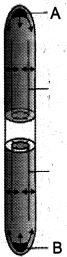
Identify $A$ and $B$ in the given figure and choose the correct option.
A
$A-$ Root apical meristem; $B -$ Shoot apical meristem
B
$A-$ Shoot apical meristem; $B -$ Root apical meristem
C
$A-$ Seed coat; $B -$ Radicle tissue
D
$A-$ Radicle tissue; $B -$ Root
Solution
(B) The given figure illustrates the growth regions in a plant body.
$A$ is located at the top of the shoot axis,representing the Shoot apical meristem,which is responsible for the growth of the stem and leaves.
$B$ is located at the tip of the root,representing the Root apical meristem,which is responsible for the downward growth of the root system.
Therefore,the correct identification is $A-$ Shoot apical meristem and $B-$ Root apical meristem.
$A$ is located at the top of the shoot axis,representing the Shoot apical meristem,which is responsible for the growth of the stem and leaves.
$B$ is located at the tip of the root,representing the Root apical meristem,which is responsible for the downward growth of the root system.
Therefore,the correct identification is $A-$ Shoot apical meristem and $B-$ Root apical meristem.
0 likes
View Solution143
MediumMCQ
The cells in the root and shoot apex regions are:
A
rich in protoplasm
B
having large conspicuous nuclei
C
having primary cell walls that are thin and cellulosic with abundant plasmodesmatal connections
D
All of the above
Solution
(D) The cells in the root and shoot apex regions are meristematic cells. These cells are characterized by:
$1$. Being rich in protoplasm.
$2$. Having large and conspicuous nuclei.
$3$. Possessing primary cell walls that are thin and cellulosic,which allows for rapid cell division and expansion.
$4$. Having abundant plasmodesmatal connections to facilitate communication between adjacent cells.
Therefore,all the given statements are correct.
$1$. Being rich in protoplasm.
$2$. Having large and conspicuous nuclei.
$3$. Possessing primary cell walls that are thin and cellulosic,which allows for rapid cell division and expansion.
$4$. Having abundant plasmodesmatal connections to facilitate communication between adjacent cells.
Therefore,all the given statements are correct.
0 likes
View Solution144
MediumMCQ
The cells in this region are rich in protoplasm and possess large,conspicuous nuclei.
A
Elongation
B
Maturation
C
Meristematic
D
Maturation and meristematic
Solution
(C) The root apex is divided into three zones: the zone of cell division (meristematic zone),the zone of elongation,and the zone of maturation.
$1$. The meristematic zone consists of cells that are small,thin-walled,and rich in protoplasm with large,conspicuous nuclei.
$2$. These cells divide repeatedly to produce new cells for the plant body.
$3$. Therefore,the description provided corresponds to the meristematic region.
$1$. The meristematic zone consists of cells that are small,thin-walled,and rich in protoplasm with large,conspicuous nuclei.
$2$. These cells divide repeatedly to produce new cells for the plant body.
$3$. Therefore,the description provided corresponds to the meristematic region.
0 likes
View Solution145
MediumMCQ
What are the characteristics of the cells present in the root apex and shoot apex?
A
$a, b, c$
B
$a, b, d$
C
$c, d, e$
D
$a, b, e$
Solution
(D) The cells in the root apex and shoot apex are meristematic cells.
These cells are characterized by:
$1$. Constant division (meristematic activity).
$2$. Thin,primary cell walls rich in cellulose.
$3$. Large,conspicuous nuclei.
$4$. Dense cytoplasm.
$5$. Small or absent vacuoles (they do not show increased vacuolation,which is a feature of mature cells).
Therefore,the correct characteristics are $a$ (constantly dividing),$b$ (primary cell walls),and $e$ (large conspicuous nuclei).
Thus,the correct option is $a, b, e$.
These cells are characterized by:
$1$. Constant division (meristematic activity).
$2$. Thin,primary cell walls rich in cellulose.
$3$. Large,conspicuous nuclei.
$4$. Dense cytoplasm.
$5$. Small or absent vacuoles (they do not show increased vacuolation,which is a feature of mature cells).
Therefore,the correct characteristics are $a$ (constantly dividing),$b$ (primary cell walls),and $e$ (large conspicuous nuclei).
Thus,the correct option is $a, b, e$.
0 likes
View Solution146
MediumMCQ
What is a characteristic of the meristematic region of a root?
A
Produce root hair
B
Elongated and big in size
C
Dense cytoplasm
D
All given
Solution
(C) The root tip is divided into three zones: the region of meristematic activity,the region of elongation,and the region of maturation.
$1$. The region of meristematic activity is located a few millimeters above the root cap.
$2$. The cells in this region are very small,thin-walled,and possess a dense protoplasm (cytoplasm).
$3$. These cells divide repeatedly to produce new cells.
$4$. The region of elongation is characterized by cells that undergo rapid elongation and enlargement.
$5$. The region of maturation is where cells differentiate and mature,often producing root hairs.
Therefore,the characteristic feature of the meristematic region is having dense cytoplasm.
$1$. The region of meristematic activity is located a few millimeters above the root cap.
$2$. The cells in this region are very small,thin-walled,and possess a dense protoplasm (cytoplasm).
$3$. These cells divide repeatedly to produce new cells.
$4$. The region of elongation is characterized by cells that undergo rapid elongation and enlargement.
$5$. The region of maturation is where cells differentiate and mature,often producing root hairs.
Therefore,the characteristic feature of the meristematic region is having dense cytoplasm.
0 likes
View Solution147
MediumMCQ
From the following,identify the lateral meristem.
A
Interfascicular cambium
B
Fascicular cambium
C
Cork cambium
D
All of the above
Solution
(D) Lateral meristems are meristems that occur in the mature regions of roots and shoots of many plants,particularly those that produce woody axis and appear later than primary meristems.
They are cylindrical meristems.
Examples of lateral meristems include:
$1$. Fascicular vascular cambium (found within vascular bundles).
$2$. Interfascicular cambium (formed from medullary rays).
$3$. Cork cambium (phellogen).
Since all the given options represent types of lateral meristems,the correct answer is $D$.
They are cylindrical meristems.
Examples of lateral meristems include:
$1$. Fascicular vascular cambium (found within vascular bundles).
$2$. Interfascicular cambium (formed from medullary rays).
$3$. Cork cambium (phellogen).
Since all the given options represent types of lateral meristems,the correct answer is $D$.
0 likes
View Solution148
MediumMCQ
Choose the correct sentences:
$(1)$ The meristem present at the tips of roots and shoots is called apical meristem.
$(2)$ Apical meristems are secondary meristems.
$(3)$ Intercalary meristem is the meristem that occurs between mature tissues and appears later than primary meristem.
$(4)$ Fascicular vascular cambium and interfascicular cambium are lateral meristems.
$(1)$ The meristem present at the tips of roots and shoots is called apical meristem.
$(2)$ Apical meristems are secondary meristems.
$(3)$ Intercalary meristem is the meristem that occurs between mature tissues and appears later than primary meristem.
$(4)$ Fascicular vascular cambium and interfascicular cambium are lateral meristems.
A
$2, 3$
B
$1, 2$
C
$3, 4$
D
$1, 4$
Solution
(D) Statement $(1)$ is correct: Apical meristems are found at the tips of roots and shoots.
Statement $(2)$ is incorrect: Apical meristems are primary meristems,not secondary.
Statement $(3)$ is incorrect: Intercalary meristems are primary meristems that occur between mature tissues,not in the mature region itself,and they do not appear later than primary meristem.
Statement $(4)$ is correct: Fascicular vascular cambium,interfascicular cambium,and cork cambium are examples of lateral meristems,which are secondary meristems.
Therefore,statements $(1)$ and $(4)$ are correct.
Statement $(2)$ is incorrect: Apical meristems are primary meristems,not secondary.
Statement $(3)$ is incorrect: Intercalary meristems are primary meristems that occur between mature tissues,not in the mature region itself,and they do not appear later than primary meristem.
Statement $(4)$ is correct: Fascicular vascular cambium,interfascicular cambium,and cork cambium are examples of lateral meristems,which are secondary meristems.
Therefore,statements $(1)$ and $(4)$ are correct.
0 likes
View Solution149
Medium
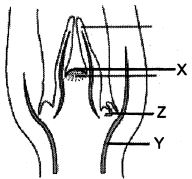
Identify part $Y$ in the given diagram of a shoot apex.
Solution
(D) In the provided diagram of a shoot apex,the labels represent different structures:
$X$ represents the shoot apical meristem.
$Z$ represents the leaf primordium.
$Y$ represents the differentiated vascular tissue (or developing leaf/stem tissue below the meristematic region).
Therefore,$Y$ corresponds to the differentiated vascular tissue.
$X$ represents the shoot apical meristem.
$Z$ represents the leaf primordium.
$Y$ represents the differentiated vascular tissue (or developing leaf/stem tissue below the meristematic region).
Therefore,$Y$ corresponds to the differentiated vascular tissue.
0 likes
View Solution150
MediumMCQ
Axillary bud formation occurs from which tissue?
A
Apical meristem
B
Lateral meristem
C
Intercalary meristem
D
Xylem tissue
Solution
(A) During the formation of leaves and elongation of the stem,some cells 'left behind' from the shoot apical meristem constitute the axillary bud.
These buds are present in the axils of leaves and are capable of forming a branch or a flower.
Therefore,the axillary bud originates from the apical meristem.
These buds are present in the axils of leaves and are capable of forming a branch or a flower.
Therefore,the axillary bud originates from the apical meristem.
0 likes
View SolutionAnatomy of Flowering Plants — Meristematic Tissue · Frequently Asked Questions
1Are these Anatomy of Flowering Plants questions useful for JEE and NEET?
Yes. All questions in this section are mapped to JEE Main and NEET exam patterns. Previous year questions from JEE Main, NEET, GUJCET and state-level exams are included with full solutions.
2Can I switch to Hindi or Gujarati for these questions?
Yes. Use the language tabs in the hero section or the sidebar to view the same questions and solutions in English, Hindi or Gujarati.
3How do I generate a question paper from this subtopic?
Use the Vedclass Exam Paper Generator — select the chapter and subtopic, set difficulty, and generate Sets A, B, C, D automatically. First 3 chapters of every subject are free.
Vedclass Products
For Students
Vedclass Test Series
Mock tests in real JEE/NEET style with performance analysis. 5-day free trial.
Start Free TrialFor Teachers
Exam Paper Generator
Generate Set A/B/C/D papers from this chapter in 2 minutes. 3 chapters free.
Try FreeFor Institutes
Online Exam Module
Live online exams with unlimited students, 360° analytics & white-label branding.
See DemoFor Teachers & Institutes
Generate a Anatomy of Flowering Plants Exam Paper in 2 Minutes
Select subtopic & difficulty — Sets A, B, C, D auto-generated with No Repeat logic.
First 3 chapters of every subject are free — no payment required.