
A English
Meristematic Tissue Questions in English
Class 11 Biology · Anatomy of Flowering Plants · Meristematic Tissue
223+
Questions
English
Language
100%
With Solutions
Showing 50 of 223 questions in English
151
MediumMCQ
Intercalary meristem is found between the
A
mature tissues
B
apical root meristem
C
shoot meristem
D
two flowers
Solution
(A) Intercalary meristem is a type of meristematic tissue that is located between regions of mature tissues.
It is responsible for the growth in length of internodes,particularly in monocotyledonous plants like grasses.
These meristems are derived from the apical meristem but become separated from it by the development of permanent tissues as the plant grows.
Therefore,the correct option is $A$.
It is responsible for the growth in length of internodes,particularly in monocotyledonous plants like grasses.
These meristems are derived from the apical meristem but become separated from it by the development of permanent tissues as the plant grows.
Therefore,the correct option is $A$.
0 likes
View Solution152
EasyMCQ
The $Tunica-Corpus$ theory is associated with ..........
A
Root apex
B
Root cap
C
Shoot apex
D
Secondary growth
Solution
(C) The $Tunica-Corpus$ theory was proposed by $Schmidt$ in $1924$.
This theory explains the organization and development of the $Shoot$ $Apex$ in angiosperms.
According to this theory,the shoot apex consists of two distinct zones:
$1$. $Tunica$: The peripheral layer$(s)$ that divide anticlinally to increase the surface area.
$2$. $Corpus$: The central mass of cells that divide in various planes to increase the volume of the shoot apex.
Therefore,the correct option is $C$.
This theory explains the organization and development of the $Shoot$ $Apex$ in angiosperms.
According to this theory,the shoot apex consists of two distinct zones:
$1$. $Tunica$: The peripheral layer$(s)$ that divide anticlinally to increase the surface area.
$2$. $Corpus$: The central mass of cells that divide in various planes to increase the volume of the shoot apex.
Therefore,the correct option is $C$.
0 likes
View Solution153
EasyMCQ
Which meristematic tissue is responsible for increasing the girth of the plant?
A
Lateral meristem
B
Intercalary meristem
C
Promeristem
D
Apical meristem
Solution
(A) The lateral meristem is responsible for secondary growth in plants,which leads to an increase in the diameter or girth of the stem and root. Examples include the vascular cambium and cork cambium. Apical meristems are responsible for primary growth (increase in length),while intercalary meristems are found at the base of leaves or internodes and help in elongation.
0 likes
View Solution154
MediumMCQ
The organization of the shoot apex into $Corpus$ and $Tunica$ is determined by:
A
Plane of cell division
B
Region of meristematic activity
C
Rate of cell growth
D
Rate of shoot apex growth
Solution
(A) The $Tunica-Corpus$ theory,proposed by $Schmidt$ $(1924)$,explains the organization of the shoot apical meristem in angiosperms.
According to this theory,the shoot apex is divided into two distinct zones based on the plane of cell division:
$1$. $Tunica$: The peripheral layer$(s)$ where cells divide primarily by anticlinal divisions,leading to surface growth.
$2$. $Corpus$: The central mass of cells where divisions occur in various planes,contributing to the increase in volume.
Therefore,the differentiation between $Tunica$ and $Corpus$ is determined by the plane of cell division.
According to this theory,the shoot apex is divided into two distinct zones based on the plane of cell division:
$1$. $Tunica$: The peripheral layer$(s)$ where cells divide primarily by anticlinal divisions,leading to surface growth.
$2$. $Corpus$: The central mass of cells where divisions occur in various planes,contributing to the increase in volume.
Therefore,the differentiation between $Tunica$ and $Corpus$ is determined by the plane of cell division.
0 likes
View Solution155
EasyMCQ
Monocot leaves possess.........
A
Intercalary meristem
B
Lateral meristem
C
Apical meristem
D
Mass meristem
Solution
(A) Monocot leaves,specifically the leaves of grasses,possess $Intercalary$ $meristem$.
This type of meristem is located between mature tissues and is responsible for the growth in length of the leaves and internodes.
It allows the plant to regenerate parts that have been removed by grazing animals.
This type of meristem is located between mature tissues and is responsible for the growth in length of the leaves and internodes.
It allows the plant to regenerate parts that have been removed by grazing animals.
0 likes
View Solution156
MediumMCQ
The procambium gives rise to ..............
A
Primary vascular bundles only
B
Vascular bundles only
C
Cork cambium only
D
Primary vascular tissues and vascular cambium
Solution
(D) The procambium is a primary meristematic tissue derived from the apical meristem.
It differentiates into the primary vascular tissues,which include primary xylem and primary phloem.
Additionally,it gives rise to the vascular cambium,which is responsible for secondary growth in dicotyledonous plants.
Therefore,the procambium gives rise to primary vascular tissues and the vascular cambium.
It differentiates into the primary vascular tissues,which include primary xylem and primary phloem.
Additionally,it gives rise to the vascular cambium,which is responsible for secondary growth in dicotyledonous plants.
Therefore,the procambium gives rise to primary vascular tissues and the vascular cambium.
0 likes
View Solution157
MediumMCQ
The leaf primordium develops into a mature leaf by the activity of ................
A
Apical meristem
B
Lateral meristem
C
Marginal meristem
D
Initially apical meristem and later mostly marginal meristem
Solution
(D) The development of a leaf primordium into a mature leaf involves specific meristematic activities.
Initially,the leaf primordium arises from the shoot apical meristem.
However,the subsequent growth and expansion of the leaf blade (lamina) are primarily driven by the activity of the marginal meristem,which is located along the edges of the developing leaf primordium.
Therefore,the correct sequence is that it starts with the apical meristem and is followed by the activity of the marginal meristem.
Initially,the leaf primordium arises from the shoot apical meristem.
However,the subsequent growth and expansion of the leaf blade (lamina) are primarily driven by the activity of the marginal meristem,which is located along the edges of the developing leaf primordium.
Therefore,the correct sequence is that it starts with the apical meristem and is followed by the activity of the marginal meristem.
0 likes
View Solution158
EasyMCQ
Axillary buds and terminal buds are formed due to the activity of .........
A
Lateral meristem
B
Intercalary meristem
C
Apical meristem
D
Parenchyma
Solution
(C) The $Apical$ $\text{meristem}$ is responsible for the primary growth of plants. It is located at the tips of shoots and roots. During the formation of the shoot, some cells are left behind from the $Apical$ $\text{meristem}$ in the axils of leaves, which develop into $Axillary$ $\text{buds}$. The $Terminal$ $\text{bud}$ is the primary growing point at the apex of the stem, also derived from the $Apical$ $\text{meristem}$. Therefore, both axillary and terminal buds are products of the activity of the $Apical$ $\text{meristem}$.
0 likes
View Solution159
MediumMCQ
What is the characteristic of the cells in the quiescent center?
A
They divide regularly to increase the tunica.
B
They possess dense cytoplasm and a prominent nucleus.
C
They possess thin cytoplasm and a small nucleus.
D
They divide continuously to increase the growth of the body.
Solution
(C) The quiescent center is a region found in the root apical meristem.
It consists of cells that have a very low rate of cell division.
These cells are characterized by having a thin cytoplasm and a small nucleus,which indicates their low metabolic activity compared to the surrounding actively dividing meristematic cells.
Therefore,option $C$ is the correct description.
It consists of cells that have a very low rate of cell division.
These cells are characterized by having a thin cytoplasm and a small nucleus,which indicates their low metabolic activity compared to the surrounding actively dividing meristematic cells.
Therefore,option $C$ is the correct description.
0 likes
View Solution160
MediumMCQ
The root apical meristem is present in ............ .
A
All roots
B
Only embryonic roots
C
Only taproots
D
Only adventitious roots
Solution
(A) The root apical meristem is a region of actively dividing cells located at the tip of the root. It is responsible for the primary growth of the root system. Since all types of roots (taproots,fibrous roots,and adventitious roots) grow in length from their tips,the root apical meristem is present in all roots.
0 likes
View Solution161
MediumMCQ
In a woody dicot plant,which of the following parts contain primary tissues?
A
All parts
B
Roots and stems
C
Flowers,fruits,and leaves
D
Shoot tips and root tips
Solution
(D) In woody dicot plants,secondary growth occurs in the stems and roots,leading to the formation of secondary tissues. However,the apical meristems,which are responsible for primary growth,are located at the shoot tips and root tips. These regions continuously produce primary tissues throughout the life of the plant. Therefore,the shoot tips and root tips are the parts that contain primary tissues.
0 likes
View Solution162
MediumMCQ
In flowering plants,the vascular tissue originates from which of the following?
A
Dermatogen
B
Plerome
C
Periblem
D
Protoderm
Solution
(B) According to the Histogen theory proposed by Hanstein,the shoot apex is divided into three distinct zones or histogens:
$1$. $Dermatogen$: The outermost layer which gives rise to the epidermis.
$2$. $Periblem$: The middle layer which gives rise to the cortex and endodermis.
$3$. $Plerome$: The central core which gives rise to the vascular tissue (xylem and phloem) and the pith.
Therefore,the vascular tissue originates from the $Plerome$.
$1$. $Dermatogen$: The outermost layer which gives rise to the epidermis.
$2$. $Periblem$: The middle layer which gives rise to the cortex and endodermis.
$3$. $Plerome$: The central core which gives rise to the vascular tissue (xylem and phloem) and the pith.
Therefore,the vascular tissue originates from the $Plerome$.
0 likes
View Solution163
MediumMCQ
The length of different internodes in the stem of sugarcane is variable because of:
A
Apical meristem
B
Position of axillary buds
C
Size of the leaf lamina at the node below each internode
D
Intercalary meristem
Solution
(D) The growth in the length of the stem in monocots like sugarcane is primarily due to the activity of the $Intercalary$ $meristem$.
These meristems are located between mature tissues and are responsible for the elongation of internodes.
Since the activity of these meristems varies at different nodes, the length of the internodes in sugarcane is variable.
These meristems are located between mature tissues and are responsible for the elongation of internodes.
Since the activity of these meristems varies at different nodes, the length of the internodes in sugarcane is variable.
0 likes
View Solution164
MediumMCQ
Lawn grass is managed more effectively because
A
it regenerates with the stimulation of the sheath.
B
apical dominance is removed and intercalary meristems are stimulated.
C
apical dominance is removed.
D
apical dominance is removed and lateral meristem growth is induced.
Solution
(B) Lawn grass is managed by regular mowing. When the top of the grass is cut,the apical bud (which is the source of apical dominance due to auxin production) is removed. This removal of apical dominance allows the intercalary meristems,which are located at the base of the nodes or internodes,to become active and stimulate the growth of the grass,leading to a thicker and more uniform lawn.
0 likes
View Solution165
DifficultMCQ
Assertion : Apical meristem of root is subterminal.
Reason : At the terminal end of root, root cap is present.
Reason : At the terminal end of root, root cap is present.
A
If both Assertion and Reason are correct and the Reason is a correct explanation of the Assertion.
B
If both Assertion and Reason are correct but Reason is not a correct explanation of the Assertion.
C
If the Assertion is correct but Reason is incorrect.
D
If both the Assertion and Reason are incorrect.
Solution
(A) The root apical meristem is responsible for the growth of the root.
It is located slightly behind the tip of the root, making it subterminal.
This is because the terminal end of the root is covered by a protective structure called the root cap $(root\,cap)$.
The root cap protects the delicate meristematic tissue as the root pushes through the soil.
Therefore, the presence of the root cap at the terminal end is the reason why the apical meristem is subterminal.
Both the Assertion and the Reason are correct, and the Reason is the correct explanation of the Assertion.
It is located slightly behind the tip of the root, making it subterminal.
This is because the terminal end of the root is covered by a protective structure called the root cap $(root\,cap)$.
The root cap protects the delicate meristematic tissue as the root pushes through the soil.
Therefore, the presence of the root cap at the terminal end is the reason why the apical meristem is subterminal.
Both the Assertion and the Reason are correct, and the Reason is the correct explanation of the Assertion.
0 likes
View Solution166
MediumMCQ
Meristematic tissue responsible for the increase in the girth of a tree trunk is:
A
Apical meristem
B
Intercalary meristem
C
Lateral meristem
D
Phellogen
Solution
(C) The increase in the girth or diameter of a plant stem is known as secondary growth.
This growth is facilitated by lateral meristems,which include the vascular cambium and the cork cambium (phellogen).
While phellogen is a type of lateral meristem,the term 'lateral meristem' is the broader,more accurate category that encompasses all tissues responsible for secondary growth in thickness.
Therefore,lateral meristem is the primary tissue responsible for the increase in girth.
This growth is facilitated by lateral meristems,which include the vascular cambium and the cork cambium (phellogen).
While phellogen is a type of lateral meristem,the term 'lateral meristem' is the broader,more accurate category that encompasses all tissues responsible for secondary growth in thickness.
Therefore,lateral meristem is the primary tissue responsible for the increase in girth.
0 likes
View Solution167
MediumMCQ
Assertion : Higher plants have meristematic regions for indefinite growth.
Reason : Higher plants have root and shoot apices.
Reason : Higher plants have root and shoot apices.
A
If both Assertion and Reason are correct and the Reason is a correct explanation of the Assertion.
B
If both Assertion and Reason are correct but Reason is not a correct explanation of the Assertion.
C
If the Assertion is correct but Reason is incorrect.
D
If both the Assertion and Reason are incorrect.
Solution
(A) The root apex and shoot apex are meristematic in nature.
These meristematic tissues are embryonic in origin.
They are primary in origin because they develop from embryonic tissues and primary in function because they form the primary structure of the plant,such as the root apex and shoot apex,which persist throughout the life of the plant.
Because these meristematic regions remain active throughout the plant's life,higher plants exhibit the feature of indefinite growth.
Therefore,the Reason correctly explains the Assertion.
These meristematic tissues are embryonic in origin.
They are primary in origin because they develop from embryonic tissues and primary in function because they form the primary structure of the plant,such as the root apex and shoot apex,which persist throughout the life of the plant.
Because these meristematic regions remain active throughout the plant's life,higher plants exhibit the feature of indefinite growth.
Therefore,the Reason correctly explains the Assertion.
0 likes
View Solution168
MediumMCQ
Regeneration of damaged growing grass following grazing is largely due to
A
Lateral meristem
B
Apical meristem
C
Intercalary meristem
D
Secondary meristem
Solution
(C) The regeneration of damaged grass after grazing is primarily due to the presence of $Intercalary$ $meristem$.
These meristems are located between mature tissues and are responsible for the growth in length of internodes in monocots,such as grasses.
When herbivores graze on grass,they remove the apical meristem,but the intercalary meristems allow the grass to continue growing from the base or nodes,facilitating rapid recovery.
These meristems are located between mature tissues and are responsible for the growth in length of internodes in monocots,such as grasses.
When herbivores graze on grass,they remove the apical meristem,but the intercalary meristems allow the grass to continue growing from the base or nodes,facilitating rapid recovery.
0 likes
View Solution169
Difficult
State the location and function of different types of meristems.
Solution
(N/A) Meristems are specialized regions of plant growth where active cell division occurs. They are classified into three types based on their location:
$1$. Apical meristem: Located at the root and shoot apices. The shoot apical meristem is at the tip of the shoots,responsible for stem elongation and leaf formation. The root apical meristem aids in root elongation.
$2$. Intercalary meristem: Located between masses of mature tissues,specifically at the bases of leaves or internodes in grasses. It helps in the regeneration of parts removed by grazing herbivores. Both apical and intercalary meristems are considered primary meristems.
$3$. Lateral meristem: Found in the mature regions of roots and shoots. It is known as secondary meristem because it appears later in the plant's life. It is responsible for increasing the girth of the plant by adding secondary tissues. Examples include fascicular vascular cambium,interfascicular cambium,and cork cambium.
$1$. Apical meristem: Located at the root and shoot apices. The shoot apical meristem is at the tip of the shoots,responsible for stem elongation and leaf formation. The root apical meristem aids in root elongation.
$2$. Intercalary meristem: Located between masses of mature tissues,specifically at the bases of leaves or internodes in grasses. It helps in the regeneration of parts removed by grazing herbivores. Both apical and intercalary meristems are considered primary meristems.
$3$. Lateral meristem: Found in the mature regions of roots and shoots. It is known as secondary meristem because it appears later in the plant's life. It is responsible for increasing the girth of the plant by adding secondary tissues. Examples include fascicular vascular cambium,interfascicular cambium,and cork cambium.
0 likes
View Solution170
Medium
What is meant by tissue? Which are two main types of tissue?
Solution
(N/A) $\rightarrow$ $A$ tissue is a group of cells having a common origin and usually performing a common function.
$\rightarrow$ Tissues are classified into two main groups based on whether the cells are capable of dividing or not: $(1)$ Meristematic tissue and $(2)$ Permanent tissue.
$\rightarrow$ Tissues are classified into two main groups based on whether the cells are capable of dividing or not: $(1)$ Meristematic tissue and $(2)$ Permanent tissue.
0 likes
View Solution171
Easy
What is meant by meristematic tissues? Explain its various types.
Solution
(N/A) $\rightarrow$ Growth in plants is largely restricted to specialized regions of active cell division called meristems.
$\rightarrow$ Plants have different kinds of meristems. They are as follows:
$(A)$ Apical Meristems: The meristems which occur at the tips of roots and shoots and produce primary tissues are called apical meristems.
$\rightarrow$ Root apical meristem occupies the tip of a root while the shoot apical meristem occupies the distant most region of the stem axis.
$\rightarrow$ During the formation of leaves and elongation of stem,some cells 'left behind' from shoot apical meristem constitute the axillary bud. Such buds are present in the axils of leaves and are capable of forming a branch or a flower.
$(B)$ Intercalary Meristem: The meristem which occurs between mature tissues is known as intercalary meristem. They occur in grasses and regenerate parts removed by the grazing herbivores.
Both apical meristems and intercalary meristems are primary meristems because they appear early in the life of a plant and contribute to the formation of the primary plant body.
$(C)$ Lateral Meristem: The meristem that occurs in the mature regions of roots and shoots of many plants,particularly those that produce woody axis and appear later than primary meristem,is called the secondary or lateral meristem.
$\rightarrow$ They are cylindrical meristems. Fascicular vascular cambium,interfascicular cambium,and cork cambium are examples of lateral meristems. These are responsible for producing the secondary tissues.
$\rightarrow$ Plants have different kinds of meristems. They are as follows:
$(A)$ Apical Meristems: The meristems which occur at the tips of roots and shoots and produce primary tissues are called apical meristems.
$\rightarrow$ Root apical meristem occupies the tip of a root while the shoot apical meristem occupies the distant most region of the stem axis.
$\rightarrow$ During the formation of leaves and elongation of stem,some cells 'left behind' from shoot apical meristem constitute the axillary bud. Such buds are present in the axils of leaves and are capable of forming a branch or a flower.
$(B)$ Intercalary Meristem: The meristem which occurs between mature tissues is known as intercalary meristem. They occur in grasses and regenerate parts removed by the grazing herbivores.
Both apical meristems and intercalary meristems are primary meristems because they appear early in the life of a plant and contribute to the formation of the primary plant body.
$(C)$ Lateral Meristem: The meristem that occurs in the mature regions of roots and shoots of many plants,particularly those that produce woody axis and appear later than primary meristem,is called the secondary or lateral meristem.
$\rightarrow$ They are cylindrical meristems. Fascicular vascular cambium,interfascicular cambium,and cork cambium are examples of lateral meristems. These are responsible for producing the secondary tissues.
0 likes
View Solution172
Medium
Write a note on Meristematic tissue.
Solution
(N/A) Meristematic tissue is a group of actively dividing cells in plants that are responsible for growth.
Key characteristics include:
$1$. Cells are small,thin-walled,and have dense cytoplasm with a prominent nucleus.
$2$. They lack intercellular spaces.
$3$. They are capable of continuous cell division.
$4$. Based on their location,they are classified as apical,intercalary,and lateral meristems.
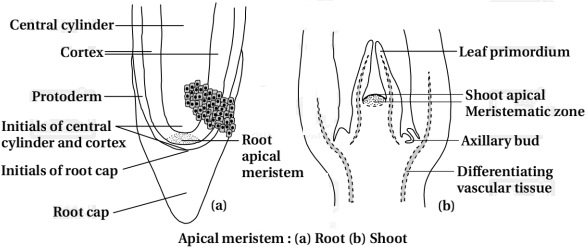
$5$. Apical meristems (as shown in the image for root and shoot apices) are responsible for primary growth in length.
Key characteristics include:
$1$. Cells are small,thin-walled,and have dense cytoplasm with a prominent nucleus.
$2$. They lack intercellular spaces.
$3$. They are capable of continuous cell division.
$4$. Based on their location,they are classified as apical,intercalary,and lateral meristems.
$5$. Apical meristems (as shown in the image for root and shoot apices) are responsible for primary growth in length.
0 likes
View Solution173
Easy
How can the apical meristematic tissue of the root and shoot be studied?
Solution
(N/A) The apical meristematic tissue of the root and shoot can be studied by observing the growth patterns of onion roots.
$1$. Take two glass jars and fill them with water.
$2$. Place an onion bulb on each jar.
$3$. Observe the growth of roots in both bulbs for a few days.
$4$. Cut the root tips of one of the onions after a few days and observe the further growth.
$5$. It will be observed that the root whose tip was cut stops growing,demonstrating that the apical meristem is responsible for primary growth at the tips.
$1$. Take two glass jars and fill them with water.
$2$. Place an onion bulb on each jar.
$3$. Observe the growth of roots in both bulbs for a few days.
$4$. Cut the root tips of one of the onions after a few days and observe the further growth.
$5$. It will be observed that the root whose tip was cut stops growing,demonstrating that the apical meristem is responsible for primary growth at the tips.
0 likes
View Solution174
Medium
Why is it easier to culture meristems compared to permanent tissues?
Solution
(N/A) Meristems consist of undifferentiated cells that possess the active capacity for continuous cell division,which is essential for rapid growth in tissue culture.
In contrast,permanent tissues consist of cells that have lost the capacity for division and have become specialized or differentiated to perform specific functions,making them less suitable for regeneration in culture.
In contrast,permanent tissues consist of cells that have lost the capacity for division and have become specialized or differentiated to perform specific functions,making them less suitable for regeneration in culture.
0 likes
View Solution175
MediumMCQ
The lawn grass ($Cynodon$ $dactylon$) needs to be mowed frequently to prevent its overgrowth. Which tissue is responsible for its rapid growth?
A
Apical meristem
B
Intercalary meristem
C
Lateral meristem
D
Permanent tissue
Solution
(B) The rapid growth of lawn grass after mowing is primarily due to the presence of $Intercalary$ $meristem$.
These meristematic tissues are located at the base of the leaves or internodes in grasses.
When the apical part is removed by mowing,the $Intercalary$ $meristem$ becomes active and promotes the regeneration and rapid elongation of the grass blades.
This allows the grass to recover quickly from grazing or mowing.
These meristematic tissues are located at the base of the leaves or internodes in grasses.
When the apical part is removed by mowing,the $Intercalary$ $meristem$ becomes active and promotes the regeneration and rapid elongation of the grass blades.
This allows the grass to recover quickly from grazing or mowing.
0 likes
View Solution176
Easy
What are the structural characteristics of $(a)$ Meristematic cells near the root tip and $(b)$ The cells in the elongation zone of the root?
Solution
(N/A) The meristematic cells near the root tip are characterized by:
- Rich protoplasm.
- Large,conspicuous nucleus.
- Thin,primary cellulosic cell walls.
- Fewer and smaller vacuoles.
- High metabolic activity with a greater number of mitochondria.
- Numerous plasmodesmata for intercellular communication.
$(b)$ The cells in the elongation zone of the root are characterized by:
- Increased vacuolation,which helps in cell enlargement.
- Significant increase in cell size and dimensions.
- Deposition of new cell wall materials to support the expanded cell structure.
- Rich protoplasm.
- Large,conspicuous nucleus.
- Thin,primary cellulosic cell walls.
- Fewer and smaller vacuoles.
- High metabolic activity with a greater number of mitochondria.
- Numerous plasmodesmata for intercellular communication.
$(b)$ The cells in the elongation zone of the root are characterized by:
- Increased vacuolation,which helps in cell enlargement.
- Significant increase in cell size and dimensions.
- Deposition of new cell wall materials to support the expanded cell structure.
0 likes
View Solution177
MediumMCQ
In a slide showing different types of cells,can you identify which type of cell may be meristematic and which one is incapable of dividing,and how?
A
Meristematic cells have thin walls and dense cytoplasm; non-dividing cells have thick walls and reduced cytoplasm.
B
Meristematic cells have thick walls and large vacuoles; non-dividing cells have thin walls and no vacuoles.
C
Meristematic cells are dead; non-dividing cells are living.
D
There is no difference in the appearance of meristematic and non-dividing cells.
Solution
(A) Meristematic cells are characterized by being rich in protoplasm and possessing large,conspicuous nuclei.
Their cell walls are primary in nature,thin,and cellulosic,with abundant plasmodesmatal connections.
In contrast,cells that are incapable of dividing (permanent cells) have attained their maximal size and show significant wall thickening and protoplasmic modifications,such as the presence of large vacuoles or the loss of active cytoplasm.
Their cell walls are primary in nature,thin,and cellulosic,with abundant plasmodesmatal connections.
In contrast,cells that are incapable of dividing (permanent cells) have attained their maximal size and show significant wall thickening and protoplasmic modifications,such as the presence of large vacuoles or the loss of active cytoplasm.
0 likes
View Solution178
MediumMCQ
The meristematic tissue responsible for the cutting of vascular tissue $(xylem \text{ and } phloem)$ is called:
A
Cork cambium
B
Vascular cambium
C
Lateral meristem
D
Endodermis
Solution
(B) Vascular cambium is the correct answer.
The meristematic layer responsible for the production (cutting off) of vascular tissues,specifically secondary xylem and secondary phloem,is known as the vascular cambium.
In a young stem,it exists as a single layer of cells located in patches between the primary xylem and primary phloem.
As the plant undergoes secondary growth,these patches join together to form a complete,continuous ring of meristematic tissue.
The meristematic layer responsible for the production (cutting off) of vascular tissues,specifically secondary xylem and secondary phloem,is known as the vascular cambium.
In a young stem,it exists as a single layer of cells located in patches between the primary xylem and primary phloem.
As the plant undergoes secondary growth,these patches join together to form a complete,continuous ring of meristematic tissue.
0 likes
View Solution179
MediumMCQ
Which one of the following is not a lateral meristem?
A
Intrafascicular cambium
B
Interfascicular cambium
C
Phellogen
D
Phelloderm
Solution
(D) Lateral meristems are meristematic tissues that are responsible for secondary growth in plants,leading to an increase in girth.
$A$. Intrafascicular cambium is a type of vascular cambium present within the vascular bundles,which is a lateral meristem.
$B$. Interfascicular cambium develops from medullary rays during secondary growth and is also a lateral meristem.
$C$. Phellogen,also known as cork cambium,is a lateral meristem responsible for the production of cork and secondary cortex.
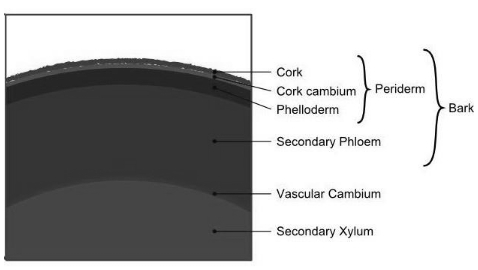
$D$. Phelloderm is the secondary cortex formed by the phellogen on its inner side. It is a permanent tissue,not a meristematic one. Therefore,it is not a lateral meristem.
$A$. Intrafascicular cambium is a type of vascular cambium present within the vascular bundles,which is a lateral meristem.
$B$. Interfascicular cambium develops from medullary rays during secondary growth and is also a lateral meristem.
$C$. Phellogen,also known as cork cambium,is a lateral meristem responsible for the production of cork and secondary cortex.
$D$. Phelloderm is the secondary cortex formed by the phellogen on its inner side. It is a permanent tissue,not a meristematic one. Therefore,it is not a lateral meristem.
0 likes
View Solution180
MediumMCQ
The length of the petiole increases due to the division of:
A
Apical meristem
B
Lateral meristem
C
Intercalary meristem
D
All of these
Solution
(C) The intercalary meristems are responsible for localized growth in plants.
They are essentially portions of the apical meristem that have been separated from the main apex during the development of the plant body.
These meristems are found at the base of leaves (as in the petiole),in the internodes of grasses,and at the base of nodes.
Therefore,the increase in the length of the petiole is primarily due to the activity of the intercalary meristem.
They are essentially portions of the apical meristem that have been separated from the main apex during the development of the plant body.
These meristems are found at the base of leaves (as in the petiole),in the internodes of grasses,and at the base of nodes.
Therefore,the increase in the length of the petiole is primarily due to the activity of the intercalary meristem.
0 likes
View Solution181
MediumMCQ
Root apical meristem occupies the ...$A$... of roots,while shoot apical meristem occupies the distant most region of the ...$B$... axis.
A
$A-$ tip; $B-$ stem
B
$A-$ side; $B-$ shoot
C
$A-$ laterally; $B-$ root
D
$A-$ tip; $B-$ meristematic
Solution
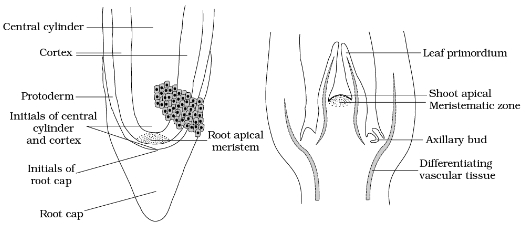
(A) The root apical meristem is responsible for the primary growth of the root and is located at the tip of the root.
Similarly,the shoot apical meristem is responsible for the primary growth of the shoot and is located at the distant most region of the stem axis.
Therefore,$A$ corresponds to the tip and $B$ corresponds to the stem.
Similarly,the shoot apical meristem is responsible for the primary growth of the shoot and is located at the distant most region of the stem axis.
Therefore,$A$ corresponds to the tip and $B$ corresponds to the stem.
0 likes
View Solution182
EasyMCQ
Meristematic tissues are:
A
Immature having the ability of division
B
Mature,not having the ability of division
C
Immature,not having the ability of division
D
Complex,differentiating into xylem,phloem,and cambium
Solution
(A) tissue is a group of cells performing a particular function. Tissues are mainly of two types:
$(i)$ Meristematic tissues: These tissues contain immature and young cells that are highly active and capable of continuous division and re-division. They include promeristem,primary meristem,secondary meristem,apical meristem,intercalary meristem,and lateral meristem.
$(ii)$ Permanent tissues: These are made up of mature cells that have lost the capacity to divide and have attained a permanent shape,size,and function,e.g.,simple (parenchyma,collenchyma,sclerenchyma) and complex (xylem,phloem) tissues.
$(i)$ Meristematic tissues: These tissues contain immature and young cells that are highly active and capable of continuous division and re-division. They include promeristem,primary meristem,secondary meristem,apical meristem,intercalary meristem,and lateral meristem.
$(ii)$ Permanent tissues: These are made up of mature cells that have lost the capacity to divide and have attained a permanent shape,size,and function,e.g.,simple (parenchyma,collenchyma,sclerenchyma) and complex (xylem,phloem) tissues.
0 likes
View Solution183
MediumMCQ
Intercalary meristem is a derivative of
A
Lateral meristem
B
Promeristem
C
Primary meristem
D
Secondary meristem
Solution
(C) The meristem that lies between the regions of permanent tissues is called intercalary meristem.
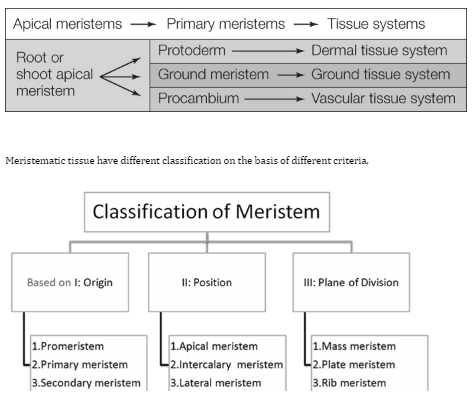
Intercalary meristem is considered a part of the primary meristem because it originates from the apical meristem during the development of the plant body.
Since the primary meristem is responsible for the formation of the primary plant body,and intercalary meristem helps in the elongation of internodes,it is classified as a derivative of the primary meristem.
Intercalary meristem is considered a part of the primary meristem because it originates from the apical meristem during the development of the plant body.
Since the primary meristem is responsible for the formation of the primary plant body,and intercalary meristem helps in the elongation of internodes,it is classified as a derivative of the primary meristem.
0 likes
View Solution184
EasyMCQ
Bamboo and grasses elongate by the activity of
A
Secondary meristem
B
Lateral meristem
C
Apical meristem
D
Intercalary meristem
Solution
(D) Intercalary meristematic tissues are found between permanent tissues.
They are located at the base of internodes (e.g.,in grasses and bamboo),at the base of leaves (e.g.,in $Pinus$),or at the base of nodes (e.g.,in mint).
The activity of intercalary meristem is responsible for the elongation of the plant or its specific organs.
They are located at the base of internodes (e.g.,in grasses and bamboo),at the base of leaves (e.g.,in $Pinus$),or at the base of nodes (e.g.,in mint).
The activity of intercalary meristem is responsible for the elongation of the plant or its specific organs.
0 likes
View Solution185
EasyMCQ
Root apical meristem is derived from the
A
Plumule part of embryo
B
Scutellum part of embryo
C
Radicle part of embryo
D
Endosperm part of embryo
Solution
(C) The $Root$ $Apical$ $Meristem$ is located at the tip of the main root and its branches.
In the case of a tap root system,the root apical meristem is formed from the radicle part of the embryo or its derivatives.
In adventitious roots,the root apical meristem is produced from the derivatives of the shoot apex.
In the case of a tap root system,the root apical meristem is formed from the radicle part of the embryo or its derivatives.
In adventitious roots,the root apical meristem is produced from the derivatives of the shoot apex.
0 likes
View Solution186
EasyMCQ
The tunica-corpus theory was proposed by
A
Hofmeister
B
Nagelli
C
Strasburger
D
Schmidt
Solution
(D) Schmidt $(1924)$ proposed the tunica-corpus theory,which describes the presence of two distinct zones in the shoot apices of angiosperms.
The peripheral layer$(s)$ of cells is called the tunica,while the inner mass of cells is called the corpus,which is surrounded by the tunica.
The peripheral layer$(s)$ of cells is called the tunica,while the inner mass of cells is called the corpus,which is surrounded by the tunica.
0 likes
View Solution187
EasyMCQ
Axillary bud originates from
A
Meristem
B
Shoot apical meristem
C
Root apical meristem
D
Secondary meristem
Solution
(B) During the formation of leaves and elongation of the stem,some cells are left behind from the shoot apical meristem. These cells constitute the axillary buds. Such buds are present in the axils of leaves and are capable of forming a branch or a flower.
0 likes
View Solution188
EasyMCQ
Apical meristems are present at the
A
Tips of roots
B
Tips of shoots
C
Lateral sides of roots and shoots
D
Both $(a)$ and $(b)$
Solution
(D) The meristematic tissue that is located at the growing tips of both roots and shoots is known as the apical meristem.
These cells are responsible for the primary growth of the plant,which leads to an increase in the length of the plant body.
Therefore,apical meristems are found at the tips of roots (root apical meristem) and the tips of shoots (shoot apical meristem).
These cells are responsible for the primary growth of the plant,which leads to an increase in the length of the plant body.
Therefore,apical meristems are found at the tips of roots (root apical meristem) and the tips of shoots (shoot apical meristem).
0 likes
View Solution189
MediumMCQ
Intercalary meristem results in
A
Secondary growth
B
Primary growth
C
Apical growth
D
None of these
Solution
(B) Intercalary meristem is present at the base of internodes,e.g.,in grasses $(Gramineae)$ or at the base of leaves,e.g.,in $Pinus$ or at the base of nodes,e.g.,mint.
Intercalary meristem is a part of the apical meristem that gets separated during the development of the plant body and is responsible for the increase in length of the plant axis,which is a characteristic of primary growth.
Intercalary meristem is a part of the apical meristem that gets separated during the development of the plant body and is responsible for the increase in length of the plant axis,which is a characteristic of primary growth.
0 likes
View Solution190
MediumMCQ
Meristematic tissue in a vascular bundle is
A
Phellem
B
Procambium
C
Interfascicular cambium
D
Fascicular cambium
Solution
(D) The cambium present between the xylem and phloem of a vascular bundle is called the vascular cambium.
It is a lateral meristem that gives rise to secondary xylem and phloem and occurs in the form of a thin strip.
Vascular cambium present within the vascular bundle is specifically known as fascicular cambium.
It is a lateral meristem that gives rise to secondary xylem and phloem and occurs in the form of a thin strip.
Vascular cambium present within the vascular bundle is specifically known as fascicular cambium.
0 likes
View Solution191
MediumMCQ
Choose the wrong statement from the following:
A
Axillary/terminal bud develops from apical meristem
B
Meristematic activity occurs at stem apex/root apex
C
Permanent tissues are produced by primary and secondary meristem
D
None of the above
Solution
(D) Meristematic activity is characterized by the presence of meristematic tissue,which is found at the root apex $(RAM)$ and shoot apex $(SAM)$.
These meristems are responsible for the formation of permanent tissues.
Axillary buds are formed from the cells left behind by the shoot apical meristem.
Since all the statements provided ($A$,$B$,and $C$) are scientifically correct,the correct choice is $D$.
These meristems are responsible for the formation of permanent tissues.
Axillary buds are formed from the cells left behind by the shoot apical meristem.
Since all the statements provided ($A$,$B$,and $C$) are scientifically correct,the correct choice is $D$.
0 likes
View Solution192
EasyMCQ
Apical meristem and intercalary meristem are called primary meristem because?
A
They appear early in the life of a plant and contribute to the formation of the primary plant body.
B
They make secondary tissue.
C
They make the whole plant body.
D
All of the above.
Solution
(A) Apical meristems and intercalary meristems are classified as primary meristems because they appear early in the life of a plant.
They are responsible for the formation of the primary plant body,which includes the development of the stem,roots,and leaves.
They are responsible for the formation of the primary plant body,which includes the development of the stem,roots,and leaves.
0 likes
View Solution193
MediumMCQ
Identify $A, B$ and $C$ in the given diagram of the shoot apical meristem.
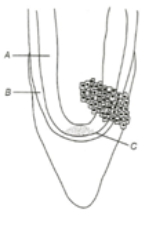
A
$A-$ Leaf primordium,$B-$ Axillary bud,$C-$ Vascular bud
B
$A-$ Leaf primordium,$B-$ Axillary bud,$C-$ Vascular tissue
C
$A-$ Shoot primordium,$B-$ Axillary bud,$C-$ Vascular tissue
D
$A-$ Shoot primordium,$B-$ Apical bud,$C-$ Vascular tissue
Solution
(B) The provided diagram represents the longitudinal section of a shoot apex.
$A$ points to the leaf primordium,which is a young,developing leaf structure.
$B$ points to the axillary bud,which is a structure that develops in the axil of a leaf and has the potential to form a branch or flower.
$C$ points to the developing vascular tissue,which will differentiate into xylem and phloem.
Therefore,the correct identification is $A-$ Leaf primordium,$B-$ Axillary bud,$C-$ Vascular tissue.
$A$ points to the leaf primordium,which is a young,developing leaf structure.
$B$ points to the axillary bud,which is a structure that develops in the axil of a leaf and has the potential to form a branch or flower.
$C$ points to the developing vascular tissue,which will differentiate into xylem and phloem.
Therefore,the correct identification is $A-$ Leaf primordium,$B-$ Axillary bud,$C-$ Vascular tissue.
0 likes
View Solution194
EasyMCQ
Plant tissues are divided into meristematic and permanent tissues on which of the following basis?
A
Whether the plant is a dicot or a monocot
B
Whether the cells being formed are capable of dividing or not
C
Position
D
Origin
Solution
(B) Meristematic tissue: These are groups of cells that are actively dividing and are responsible for the growth of the plant.
Permanent tissue: These are cells that have lost their ability to divide and have attained a specific shape,size,and function.
Permanent tissue: These are cells that have lost their ability to divide and have attained a specific shape,size,and function.
0 likes
View Solution195
MediumMCQ
The axillary bud is constituted by the cells 'left behind' from
A
Root apical meristem
B
Shoot apical meristem
C
Intercalary meristem
D
Lateral meristem
Solution
(B) During the formation of leaves and elongation of the stem,some cells 'left behind' from the shoot apical meristem remain in the axils of leaves. These cells constitute the axillary bud,which is capable of forming a branch or a flower.
0 likes
View Solution196
MediumMCQ
All of the following are lateral meristems, except
A
Intercalary meristem
B
Fascicular vascular cambium
C
Interfascicular cambium
D
Cork cambium
Solution
(A) Lateral meristems are responsible for increasing the girth or diameter of the plant body.
Examples of lateral meristems include $Fascicular \text{ } vascular \text{ } cambium$, $Interfascicular \text{ } cambium$, and $Cork \text{ } cambium$.
$Intercalary \text{ } meristem$ is a type of primary meristem found in the internodal regions of grasses and is responsible for longitudinal growth, not lateral growth.
Examples of lateral meristems include $Fascicular \text{ } vascular \text{ } cambium$, $Interfascicular \text{ } cambium$, and $Cork \text{ } cambium$.
$Intercalary \text{ } meristem$ is a type of primary meristem found in the internodal regions of grasses and is responsible for longitudinal growth, not lateral growth.
0 likes
View Solution197
MediumMCQ
What is the function of lateral meristem?
A
It gives rise to the lateral branches
B
It increases girth of the plant axis
C
It increases girth as well as length of the plant axis
D
It increases only length of the plant axis
Solution
(B) Lateral meristem,which includes vascular cambium and cork cambium,is responsible for secondary growth in plants.
This process results in an increase in the diameter or girth of the plant axis (stems and roots).
This process results in an increase in the diameter or girth of the plant axis (stems and roots).
0 likes
View Solution198
MediumMCQ
The intrafascicular cambium:
A
Is a simple permanent tissue
B
Is a meristematic tissue
C
Is a complex permanent tissue
D
Is secondary meristem
Solution
(B) The intrafascicular cambium is present between the primary xylem and primary phloem within the vascular bundle. It is a type of meristematic tissue because its cells retain the ability to divide. It is primary in origin as it originates from the procambium during the development of the plant body.
0 likes
View Solution199
MediumMCQ
Meristem is characterized by
A
Isodiametric cells with cellulosic thin wall
B
Absence of intercellular space and vacuole
C
Absence of reserve food material and plastids
D
All of these
Solution
(D) Meristematic cells are characterized by the following features:
$1$. They consist of actively dividing cells.
$2$. The cells are typically isodiametric with thin cellulosic cell walls.
$3$. They lack intercellular spaces between them.
$4$. They have very small or no vacuoles.
$5$. They lack reserve food materials and fully developed plastids (proplastids may be present).
Therefore,all the given options are correct characteristics of meristematic tissue.
$1$. They consist of actively dividing cells.
$2$. The cells are typically isodiametric with thin cellulosic cell walls.
$3$. They lack intercellular spaces between them.
$4$. They have very small or no vacuoles.
$5$. They lack reserve food materials and fully developed plastids (proplastids may be present).
Therefore,all the given options are correct characteristics of meristematic tissue.
0 likes
View Solution200
EasyMCQ
According to the histogen theory,the stem epidermis is derived from:
A
Calyptrogen
B
Dermatogen
C
Protoderm
D
Periblem
Solution
(B) According to the histogen theory proposed by Hanstein,the shoot apex is divided into three distinct zones or histogens: Dermatogen,Periblem,and Plerome.
$1$. The Dermatogen is the outermost layer of the apical meristem.
$2$. It gives rise to the epidermis of the stem and leaves.
$3$. Therefore,the stem epidermis is derived from the Dermatogen.
$1$. The Dermatogen is the outermost layer of the apical meristem.
$2$. It gives rise to the epidermis of the stem and leaves.
$3$. Therefore,the stem epidermis is derived from the Dermatogen.
0 likes
View SolutionAnatomy of Flowering Plants — Meristematic Tissue · Frequently Asked Questions
1Are these Anatomy of Flowering Plants questions useful for JEE and NEET?
Yes. All questions in this section are mapped to JEE Main and NEET exam patterns. Previous year questions from JEE Main, NEET, GUJCET and state-level exams are included with full solutions.
2Can I switch to Hindi or Gujarati for these questions?
Yes. Use the language tabs in the hero section or the sidebar to view the same questions and solutions in English, Hindi or Gujarati.
3How do I generate a question paper from this subtopic?
Use the Vedclass Exam Paper Generator — select the chapter and subtopic, set difficulty, and generate Sets A, B, C, D automatically. First 3 chapters of every subject are free.
Vedclass Products
For Students
Vedclass Test Series
Mock tests in real JEE/NEET style with performance analysis. 5-day free trial.
Start Free TrialFor Teachers
Exam Paper Generator
Generate Set A/B/C/D papers from this chapter in 2 minutes. 3 chapters free.
Try FreeFor Institutes
Online Exam Module
Live online exams with unlimited students, 360° analytics & white-label branding.
See DemoFor Teachers & Institutes
Generate a Anatomy of Flowering Plants Exam Paper in 2 Minutes
Select subtopic & difficulty — Sets A, B, C, D auto-generated with No Repeat logic.
First 3 chapters of every subject are free — no payment required.