
A English
Internal structure of root Questions in English
Class 11 Biology · Anatomy of Flowering Plants · Internal structure of root
159+
Questions
English
Language
100%
With Solutions
Showing 50 of 159 questions in English
101
MediumMCQ
What are passage cells?
A
Cells with thin walls that allow the passage of water and dissolved substances.
B
Cells that are heavily lignified and impermeable to water.
C
Cells that store starch grains in the cortex.
D
Cells that form the vascular cambium.
Solution
(A) The innermost layer of the cortex is called the $Endodermis$.
The cells of this layer are tightly connected to each other.
The radial and inner walls of these cells are thickened with lignin and suberin,forming a structure known as the $Casparian$ $strip$.
Some cells in the $Endodermis$ opposite to the protoxylem remain thin-walled and lack these thickenings.
These thin-walled cells are called $Passage$ $cells$,which facilitate the movement of water and dissolved salts from the cortex to the pericycle.
The cells of this layer are tightly connected to each other.
The radial and inner walls of these cells are thickened with lignin and suberin,forming a structure known as the $Casparian$ $strip$.
Some cells in the $Endodermis$ opposite to the protoxylem remain thin-walled and lack these thickenings.
These thin-walled cells are called $Passage$ $cells$,which facilitate the movement of water and dissolved salts from the cortex to the pericycle.
0 likes
View Solution102
MediumMCQ
Mark the correct sequence of layers found in root anatomy.
A
Epiblema,cortex,endodermis,pericycle
B
Cortex,epiblema,pericycle,endodermis
C
Epiblema,cortex,pericycle,endodermis
D
Cortex,epiblema,endodermis,epidermis
Solution
(A) Anatomically,the root is distinguishable into the following layers or regions sequentially:
Epiblema $\rightarrow$ Cortex $\rightarrow$ Endodermis $\rightarrow$ Pericycle $\rightarrow$ Vascular system $\rightarrow$ Pith.
Epiblema is the outermost piliferous layer of root tissue.
Cortex is the extrastelar fundamental tissue of the sporophyte.
Endodermis is the innermost layer of the cortex,surrounding the pericycle.
Pericycle is the outermost layer of the stele,located between the endodermis and the vascular tissues.
Epiblema $\rightarrow$ Cortex $\rightarrow$ Endodermis $\rightarrow$ Pericycle $\rightarrow$ Vascular system $\rightarrow$ Pith.
Epiblema is the outermost piliferous layer of root tissue.
Cortex is the extrastelar fundamental tissue of the sporophyte.
Endodermis is the innermost layer of the cortex,surrounding the pericycle.
Pericycle is the outermost layer of the stele,located between the endodermis and the vascular tissues.
0 likes
View Solution103
MediumMCQ
Polyarch condition is found in which of the following?
A
Monocotyledonous stem
B
Monocotyledonous leaves
C
Monocotyledonous roots
D
Dicotyledonous stem
Solution
(C) The correct answer is Monocotyledonous roots.
The anatomy of the monocot root is similar to the dicot root in many respects,as both possess epidermis,cortex,endodermis,pericycle,vascular bundles,and pith.
However,a key distinguishing feature is the number of xylem bundles. While dicot roots typically have fewer xylem bundles (diarch to hexarch),monocot roots usually contain more than six xylem bundles,a condition known as $polyarch$.
Additionally,monocot roots possess a large and well-developed pith and do not undergo any secondary growth.
The anatomy of the monocot root is similar to the dicot root in many respects,as both possess epidermis,cortex,endodermis,pericycle,vascular bundles,and pith.
However,a key distinguishing feature is the number of xylem bundles. While dicot roots typically have fewer xylem bundles (diarch to hexarch),monocot roots usually contain more than six xylem bundles,a condition known as $polyarch$.
Additionally,monocot roots possess a large and well-developed pith and do not undergo any secondary growth.
0 likes
View Solution104
MediumMCQ
Central part of root occupied by parenchymatous (thin or thick-walled) cells is called:
A
Pith
B
Endodermis
C
Pericycle
D
Meristem
Solution
(A) The central part of the root,particularly in monocots,is occupied by the pith.
It consists of parenchymatous cells that can be thin-walled or thick-walled,and they may be rounded or angular in shape.
Intercellular spaces are typically present between these cells.
The primary function of the pith is the storage of food.
In dicot roots,the pith is usually small or inconspicuous,whereas in monocot roots,it is large and well-developed.
It consists of parenchymatous cells that can be thin-walled or thick-walled,and they may be rounded or angular in shape.
Intercellular spaces are typically present between these cells.
The primary function of the pith is the storage of food.
In dicot roots,the pith is usually small or inconspicuous,whereas in monocot roots,it is large and well-developed.
0 likes
View Solution105
EasyMCQ
Casparian strip is found in
A
Epidermis
B
Pericycle
C
Endodermis
D
Endothecium
Solution
(C) The $Endodermis$ is the innermost layer of the cortex and consists of a single layer of cells.
It is characterized by the presence of $Casparian$ strips,which are bands of suberized material on the radial and tangential walls of the endodermal cells.
These strips prevent the apoplastic movement of water and solutes into the vascular cylinder.
It is characterized by the presence of $Casparian$ strips,which are bands of suberized material on the radial and tangential walls of the endodermal cells.
These strips prevent the apoplastic movement of water and solutes into the vascular cylinder.
0 likes
View Solution106
EasyMCQ
The layer of cells outside the phloem meant for giving rise to the root branches is called
A
Cambium
B
Carpus
C
Endodermis
D
Pericycle
Solution
(D) The $Pericycle$ is the outermost layer of the $stele$ in roots.
It is situated between the $endodermis$ and the vascular tissues ($xylem$ and $phloem$).
In dicot roots, the lateral roots (root branches) originate endogenously from the $pericycle$ cells.
It is situated between the $endodermis$ and the vascular tissues ($xylem$ and $phloem$).
In dicot roots, the lateral roots (root branches) originate endogenously from the $pericycle$ cells.
0 likes
View Solution107
MediumMCQ
Conjunctive tissue is made up of
A
Parenchymatous cells,i.e.,in between the xylem and phloem
B
Sclerenchymatous cells,i.e.,in between the xylem and phloem
C
Collenchymatous cells,i.e.,in between the xylem and phloem
D
Meristematic cells,i.e.,in between the xylem and phloem
Solution
(A) Conjunctive tissue refers to the parenchymatous cells that are located between the xylem and phloem bundles in the roots of dicotyledonous and monocotyledonous plants. These cells serve as a storage site and are essential for the structural integrity of the vascular cylinder.
0 likes
View Solution108
MediumMCQ
In dicotyledonous roots,the initiation of lateral roots takes place in
A
Endodermal cells
B
Cortical cells
C
Epidermal cells
D
Pericycle cells
Solution
(D) In dicotyledonous roots,the initiation of lateral roots and the vascular cambium during secondary growth occurs in the pericycle cells. The pericycle is a layer of cells located between the endodermis and the vascular tissue. These cells retain the ability to divide and form lateral roots,which emerge by pushing through the cortex and epidermis.
0 likes
View Solution109
EasyMCQ
The innermost layer of the cortex is called
A
Epidermis
B
Casparian strips
C
Endodermis
D
Pericycle
Solution
(C) The innermost layer of the cortex is called the endodermis.
It consists of a single layer of barrel-shaped cells that lack intercellular spaces.
The tangential and radial walls of the endodermal cells contain a deposition of a water-impermeable,waxy substance known as suberin,which forms structures called Casparian strips.
It consists of a single layer of barrel-shaped cells that lack intercellular spaces.
The tangential and radial walls of the endodermal cells contain a deposition of a water-impermeable,waxy substance known as suberin,which forms structures called Casparian strips.
0 likes
View Solution110
MediumMCQ
$Exarch$ is the condition of vascular bundles in which:
A
Protoxylem lies toward the outside and metaxylem lies inward.
B
Metaxylem lies toward the outside and protoxylem lies inward.
C
Metaxylem lies toward the lateral side and protoxylem lies inward.
D
Protoxylem lies toward the lateral side and metaxylem lies inward.
Solution
(A) $Exarch$ is a condition of vascular bundles where the $protoxylem$ (the first-formed xylem) is situated toward the periphery (outside) and the $metaxylem$ (the later-formed xylem) is situated toward the center (inward). This arrangement is characteristic of the roots of flowering plants.
In contrast,$Endarch$ is the condition where the $protoxylem$ lies toward the center (inward) and the $metaxylem$ lies toward the periphery (outside),which is characteristic of stems.
In contrast,$Endarch$ is the condition where the $protoxylem$ lies toward the center (inward) and the $metaxylem$ lies toward the periphery (outside),which is characteristic of stems.
0 likes
View Solution111
MediumMCQ
Intercellular spaces are found in $A$ region. Intercellular spaces are absent in $B$ region. Choose the correct option for $A$ and $B$.
A
$A-$ cortex,$B-$ endodermis
B
$A-$ endodermis,$B-$ cortex
C
$A-$ endodermis,$B-$ pericycle
D
$A-$ cortex,$B-$ pericycle
Solution
(A) In dicotyledonous roots,the cortex consists of several layers of thin-walled parenchyma cells. These parenchyma cells possess intercellular spaces.
The innermost layer of the cortex is called the endodermis. It comprises a single layer of barrel-shaped cells that are tightly packed without any intercellular spaces.
The tangential as well as radial walls of the endodermal cells have a deposition of water-impermeable,waxy material called suberin in the form of Casparian strips.
Therefore,intercellular spaces are found in the cortex $(A)$ and are absent in the endodermis $(B)$.
The innermost layer of the cortex is called the endodermis. It comprises a single layer of barrel-shaped cells that are tightly packed without any intercellular spaces.
The tangential as well as radial walls of the endodermal cells have a deposition of water-impermeable,waxy material called suberin in the form of Casparian strips.
Therefore,intercellular spaces are found in the cortex $(A)$ and are absent in the endodermis $(B)$.
0 likes
View Solution112
MediumMCQ
In a vascular bundle,if xylem vessels develop in a centripetal fashion,the xylem is likely to be
A
Mesarch
B
Centrarch
C
Endarch
D
Exarch
Solution
(D) In the development of xylem,when the protoxylem is located towards the periphery and the metaxylem is located towards the center,the condition is known as $Exarch$.
In this arrangement,the differentiation of xylem proceeds from the periphery towards the center,which is described as centripetal development.
This type of xylem arrangement is characteristic of roots in angiosperms.
In this arrangement,the differentiation of xylem proceeds from the periphery towards the center,which is described as centripetal development.
This type of xylem arrangement is characteristic of roots in angiosperms.
0 likes
View Solution113
MediumMCQ
In monocot roots,which type of vascular bundles are found?
A
Collateral,conjoint and closed
B
Radial with exarch xylem
C
Bicollateral,conjoint and closed
D
Radial with endarch xylem
Solution
(B) In roots,the xylem and phloem are arranged in an alternating manner on different radii,which is known as a radial vascular bundle.
In the roots of flowering plants,the protoxylem is located towards the periphery and the metaxylem is located towards the center,a condition known as exarch xylem.
Therefore,monocot roots exhibit radial vascular bundles with exarch xylem.
In the roots of flowering plants,the protoxylem is located towards the periphery and the metaxylem is located towards the center,a condition known as exarch xylem.
Therefore,monocot roots exhibit radial vascular bundles with exarch xylem.
0 likes
View Solution114
MediumMCQ
In the diagram of the $TS$ of the stele of a dicot root,the different parts have been indicated by alphabets. Choose the answer in which these alphabets correctly match with the parts they indicate.
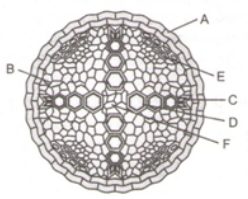
A
$A-$ Endodermis,$B-$ Conjunctive tissue,$C-$ Metaxylem,$D-$ Protoxylem,$E-$ Phloem,$F-$ Pith
B
$A-$ Endodermis,$B-$ Pith,$C-$ Protoxylem,$D-$ Metaxylem,$E-$ Phloem,$F-$ Conjunctive tissue
C
$A-$ Pericycle,$B-$ Conjunctive tissue,$C-$ Metaxylem,$D-$ Protoxylem,$E-$ Phloem,$F-$ Pith
D
$A-$ Endodermis,$B-$ Conjunctive tissue,$C-$ Protoxylem,$D-$ Metaxylem,$E-$ Phloem,$F-$ Pith
Solution
(D) Based on the anatomical structure of a dicot root:
$A$ points to the Endodermis,which is the innermost layer of the cortex.
$B$ points to the Conjunctive tissue,which is the parenchymatous tissue present between the xylem and phloem bundles.
$C$ points to the Protoxylem,which consists of smaller vessels located towards the periphery.
$D$ points to the Metaxylem,which consists of larger vessels located towards the center.
$E$ points to the Phloem,located outside the xylem.
$F$ points to the Pith,which is small or inconspicuous in dicot roots,located at the center.
Therefore,the correct sequence is $A-$ Endodermis,$B-$ Conjunctive tissue,$C-$ Protoxylem,$D-$ Metaxylem,$E-$ Phloem,$F-$ Pith.
$A$ points to the Endodermis,which is the innermost layer of the cortex.
$B$ points to the Conjunctive tissue,which is the parenchymatous tissue present between the xylem and phloem bundles.
$C$ points to the Protoxylem,which consists of smaller vessels located towards the periphery.
$D$ points to the Metaxylem,which consists of larger vessels located towards the center.
$E$ points to the Phloem,located outside the xylem.
$F$ points to the Pith,which is small or inconspicuous in dicot roots,located at the center.
Therefore,the correct sequence is $A-$ Endodermis,$B-$ Conjunctive tissue,$C-$ Protoxylem,$D-$ Metaxylem,$E-$ Phloem,$F-$ Pith.
0 likes
View Solution115
MediumMCQ
Identify $A, B$ and $C$ indicated in the diagram of the root apex given below.
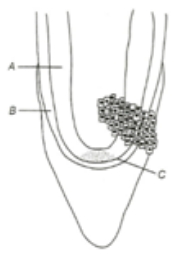
A
$A-$ Vascular bundle,$B-$ Epidermis,$C-$ Root apical meristem
B
$A-$ Cortex,$B-$ Epidermis,$C-$ Root apical meristem
C
$A-$ Cortex,$B-$ Protoderm,$C-$ Root apical meristem
D
$A-$ Cortex,$B-$ Epidermis,$C-$ Root apical meristem
Solution
(B) Based on the anatomical structure of the root apex:
$A$ represents the Cortex,which is the region of ground tissue located between the epidermis and the vascular cylinder.
$B$ represents the Epidermis (or Epiblema),the outermost layer of the root.
$C$ represents the Root apical meristem,which is the region of actively dividing cells at the tip of the root responsible for primary growth.
Therefore,the correct identification is $A-$ Cortex,$B-$ Epidermis,$C-$ Root apical meristem.
$A$ represents the Cortex,which is the region of ground tissue located between the epidermis and the vascular cylinder.
$B$ represents the Epidermis (or Epiblema),the outermost layer of the root.
$C$ represents the Root apical meristem,which is the region of actively dividing cells at the tip of the root responsible for primary growth.
Therefore,the correct identification is $A-$ Cortex,$B-$ Epidermis,$C-$ Root apical meristem.
0 likes
View Solution116
MediumMCQ
Which type of arrangement of vascular bundles occurs in the roots of monocots?
A
Conjoint open
B
Radial
C
Conjoint closed
D
Bicollateral
Solution
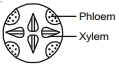
(B) In the roots of monocots and dicots,the vascular bundles are of the radial type.
In a radial vascular bundle,the xylem and phloem are arranged in an alternate manner on different radii.
This arrangement is characteristic of root anatomy,as shown in the provided diagram where xylem and phloem patches are separated by parenchymatous tissue.
In a radial vascular bundle,the xylem and phloem are arranged in an alternate manner on different radii.
This arrangement is characteristic of root anatomy,as shown in the provided diagram where xylem and phloem patches are separated by parenchymatous tissue.
0 likes
View Solution117
MediumMCQ
Lateral roots arise from
A
Endodermis
B
Pericycle
C
Conjunctive tissue
D
Cambium ring
Solution
(B) Lateral roots originate from the $Pericycle$ layer of the root. Because they arise from internal tissues rather than the epidermis,they are described as being $endogenous$ in origin.
0 likes
View Solution118
MediumMCQ
Polyarch xylem bundles are found in
A
Monocot root
B
Dicot root
C
Monocot stem
D
Dicot stem
Solution
(A) Polyarch xylem refers to the presence of more than six xylem bundles in the vascular tissue. This arrangement is a characteristic feature of monocot roots. In contrast,dicot roots typically exhibit diarch to hexarch conditions,while stems have vascular bundles arranged in a ring or scattered manner.
0 likes
View Solution119
MediumMCQ
The Casparian strips are present on the plant cells of the root which are:
A
Bean-shaped
B
Dumb-bell shaped
C
Barrel-shaped
D
Lens-shaped
Solution
(C) The Casparian strips are present on the endodermal cells of the root,which are barrel-shaped.
Bean-shaped guard cells are characteristic of the dicot stomatal apparatus.
Dumb-bell shaped guard cells are characteristic of the monocot stomatal apparatus.
Lenticels are lens-shaped structures involved in gaseous exchange.
Bean-shaped guard cells are characteristic of the dicot stomatal apparatus.
Dumb-bell shaped guard cells are characteristic of the monocot stomatal apparatus.
Lenticels are lens-shaped structures involved in gaseous exchange.
0 likes
View Solution120
MediumMCQ
The conjunctive tissue lies between the
A
Xylem and phloem
B
Pericycle and endodermis
C
Epidermis and cortex
D
Epidermis and hypodermis
Solution
(A) In the anatomy of roots,the parenchymatous cells that are located between the xylem and phloem bundles are known as conjunctive tissue. This tissue helps in the storage of food and provides structural support.
0 likes
View Solution121
MediumMCQ
In which of the following characters,a monocot root differs from a dicot root?
A
Radial vascular bundles
B
Large pith
C
Conjunctive tissue in between xylem and phloem
D
Single layered endodermis
Solution
(B) In a dicot root,the pith is either absent or very small/poorly developed. In contrast,a monocot root is characterized by the presence of a large and well-developed pith in the center. Therefore,the presence of a large pith is a distinguishing character where a monocot root differs from a dicot root.
0 likes
View Solution122
MediumMCQ
The pericycle of the roots is never sclerenchymatous because it
A
Does not act as a mechanical tissue in roots
B
Is the site of origin for lateral roots
C
Gives rise to root hairs
D
Gives rise to root hairs (when the root is young) and to lateral roots (at maturity)
Solution
(B) The pericycle in roots is composed of thin-walled parenchymatous cells. It is never sclerenchymatous because it is the site of origin for lateral roots. Lateral roots are endogenous in origin,meaning they arise from the pericycle cells. If the pericycle were sclerenchymatous,the lateral roots would not be able to emerge through the cortex and epidermis.
0 likes
View Solution123
MediumMCQ
The tissue commonly known as the passport point or biological check post is characterised by:
A
Bulliform cells and raphides
B
Cystolith and motor cells
C
Casparian bands and passage cells
D
Passage cells and fats
Solution
(C) The endodermis of the root is often referred to as the biological check post or passport point because it regulates the movement of water and solutes into the vascular cylinder.
This layer is characterised by the presence of Casparian bands,which are suberized thickenings that prevent the apoplastic movement of water.
Additionally,it contains passage cells,which are thin-walled cells that allow the radial movement of water and minerals into the xylem.
This layer is characterised by the presence of Casparian bands,which are suberized thickenings that prevent the apoplastic movement of water.
Additionally,it contains passage cells,which are thin-walled cells that allow the radial movement of water and minerals into the xylem.
0 likes
View Solution124
MediumMCQ
Centripetal and centrifugal xylem are the important features of
A
Root and stem respectively
B
Exarch and endarch respectively
C
Endarch and exarch respectively
D
Both $(A)$ and $(B)$
Solution
(A) In roots,the xylem arrangement is $Exarch$,where the protoxylem is directed towards the periphery (centripetal development).
In stems,the xylem arrangement is $Endarch$,where the protoxylem is directed towards the pith (centrifugal development).
Therefore,centripetal xylem is a feature of roots,and centrifugal xylem is a feature of stems.
Thus,the correct answer is $(A)$.
In stems,the xylem arrangement is $Endarch$,where the protoxylem is directed towards the pith (centrifugal development).
Therefore,centripetal xylem is a feature of roots,and centrifugal xylem is a feature of stems.
Thus,the correct answer is $(A)$.
0 likes
View Solution125
MediumMCQ
$A$: According to Clowes,there are three histogens in monocot root.
$R$: In dicot roots,innermost groups of initials form root cap.
$R$: In dicot roots,innermost groups of initials form root cap.
A
Assertion and Reason both are correct and also correct explanation.
B
Assertion and Reason both are correct but not explanation of assertion.
C
Assertion is correct,but Reason is incorrect.
D
Both Assertion and Reason are incorrect.
Solution
(D) According to Hanstein's Histogen theory,there are three histogens: dermatogen,periblem,and plerome.
In monocot roots,there are four histogens (including calyptrogen for root cap),not three as stated by Clowes.
Therefore,the Assertion is incorrect.
In dicot roots,the innermost group of initials (plerome) forms the central stele,not the root cap.
Therefore,the Reason is also incorrect.
In monocot roots,there are four histogens (including calyptrogen for root cap),not three as stated by Clowes.
Therefore,the Assertion is incorrect.
In dicot roots,the innermost group of initials (plerome) forms the central stele,not the root cap.
Therefore,the Reason is also incorrect.
0 likes
View Solution126
MediumMCQ
$A$: In monocot roots,the pericycle gives rise to lateral roots and cork cambium.
$R$: It usually has tetrach vascular bundles.
$R$: It usually has tetrach vascular bundles.
A
Assertion and Reason both are correct and Reason is the correct explanation of Assertion.
B
Assertion and Reason both are correct but Reason is not the correct explanation of Assertion.
C
Assertion is correct,but Reason is incorrect.
D
Both Assertion and Reason are incorrect.
Solution
(D) In monocot roots,the pericycle only gives rise to lateral roots; it does not produce cork cambium because monocot roots do not undergo secondary growth.
Therefore,the Assertion is incorrect.
Monocot roots typically possess polyarch vascular bundles (more than six xylem bundles),not tetrach bundles.
Tetrach vascular bundles are characteristic of dicot roots.
Therefore,the Reason is also incorrect.
Therefore,the Assertion is incorrect.
Monocot roots typically possess polyarch vascular bundles (more than six xylem bundles),not tetrach bundles.
Tetrach vascular bundles are characteristic of dicot roots.
Therefore,the Reason is also incorrect.
0 likes
View Solution127
EasyMCQ
What is the location of Casparian strips,which interrupt the movement of water inside a root?
A
Endodermis
B
Pericycle
C
Cortex
D
Hypodermis
Solution
(A) The Casparian strips are bands of suberized matrix present in the cell walls of the endodermis.
These strips are water-impermeable and force water and solutes to move through the symplastic pathway (through the cytoplasm) rather than the apoplastic pathway (through cell walls) at the endodermis layer.
Therefore,the correct location is the endodermis.
These strips are water-impermeable and force water and solutes to move through the symplastic pathway (through the cytoplasm) rather than the apoplastic pathway (through cell walls) at the endodermis layer.
Therefore,the correct location is the endodermis.
0 likes
View Solution128
MediumMCQ
Protoxylem is the first-formed xylem. If the protoxylem lies next to the phloem,what kind of arrangement of xylem would you call it?
A
Endarch
B
Exarch
C
Mesarch
D
Centrarch
Solution
(B) Protoxylem is the first-formed primary xylem element.
When the protoxylem is directed towards the periphery and the metaxylem is directed towards the center,the arrangement is called $Exarch$.
In this arrangement,the protoxylem lies closer to the phloem.
This type of arrangement is characteristic of roots in angiosperms.
When the protoxylem is directed towards the periphery and the metaxylem is directed towards the center,the arrangement is called $Exarch$.
In this arrangement,the protoxylem lies closer to the phloem.
This type of arrangement is characteristic of roots in angiosperms.
0 likes
View Solution129
Medium
What part of the plant would show the following:
$(a)$ Radial vascular bundle
$(b)$ Polyarch xylem
$(c)$ Well developed pith
$(a)$ Radial vascular bundle
$(b)$ Polyarch xylem
$(c)$ Well developed pith
Solution
(MONOCOT ROOT) Radial vascular bundle: In roots,xylem and phloem are arranged in an alternating manner on different radii. This arrangement is known as a radial vascular bundle.
$(b)$ Polyarch xylem: When more than six groups of xylem are present,the condition is called polyarch. This is a characteristic feature of monocot roots.
$(c)$ Well developed pith: $A$ large,well-developed pith consisting of parenchymatous cells with intercellular spaces is a characteristic feature of monocot roots.
$(b)$ Polyarch xylem: When more than six groups of xylem are present,the condition is called polyarch. This is a characteristic feature of monocot roots.
$(c)$ Well developed pith: $A$ large,well-developed pith consisting of parenchymatous cells with intercellular spaces is a characteristic feature of monocot roots.
0 likes
View Solution130
MediumMCQ
The cross-section of a plant material showed the following features when viewed under the microscope.
$(A)$ The vascular bundles were radially arranged.
$(B)$ Four xylem strands with exarch condition of protoxylem.
To which organ should it be assigned?
$(A)$ The vascular bundles were radially arranged.
$(B)$ Four xylem strands with exarch condition of protoxylem.
To which organ should it be assigned?
A
Dicot stem
B
Monocot stem
C
Dicot root
D
Monocot root
Solution
(C) $\Rightarrow$ The characteristics mentioned in the question are typical of a root.
$1$. In roots,vascular bundles are arranged on different radii,which is known as a radial arrangement.
$2$. The presence of four xylem strands (tetrarch) with an exarch condition (protoxylem located towards the periphery) is a characteristic feature of a dicot root.
Therefore,the plant material is a dicot root.
$1$. In roots,vascular bundles are arranged on different radii,which is known as a radial arrangement.
$2$. The presence of four xylem strands (tetrarch) with an exarch condition (protoxylem located towards the periphery) is a characteristic feature of a dicot root.
Therefore,the plant material is a dicot root.
0 likes
View Solution131
MediumMCQ
The study of the internal structure of plants is called .........
A
Histology
B
Morphology
C
Anatomy
D
All of the above
Solution
(C) The study of the internal structure of organisms is known as $Anatomy$.
$Morphology$ deals with the study of external forms and features.
$Histology$ is the study of tissues.
Therefore,the study of the internal structure of plants is specifically referred to as $Anatomy$.
$Morphology$ deals with the study of external forms and features.
$Histology$ is the study of tissues.
Therefore,the study of the internal structure of plants is specifically referred to as $Anatomy$.
0 likes
View Solution132
MediumMCQ
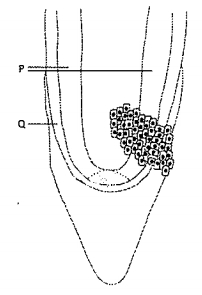
The given figure shows a section of a root apex. Select the correct option for $P$ and $Q$.
| $P$ | $Q$ | |
| $A$ | Epiblema | Cortex |
| $B$ | Cortex | Epiblema |
| $C$ | Stele | Cortex |
| $D$ | Cortex | Stele |
A
$A$
B
$B$
C
$C$
D
$D$
Solution
(B) In the longitudinal section of a root apex,the outermost layer of cells is the epiblema (also known as the piliferous layer or rhizodermis).
The region located just internal to the epiblema,consisting of several layers of thin-walled parenchyma cells with intercellular spaces,is the cortex.
In the provided diagram,$P$ points to the inner region of the root,which represents the cortex.
$Q$ points to the outermost layer of the root,which represents the epiblema.
Therefore,$P$ is the cortex and $Q$ is the epiblema,which corresponds to option $B$.
The region located just internal to the epiblema,consisting of several layers of thin-walled parenchyma cells with intercellular spaces,is the cortex.
In the provided diagram,$P$ points to the inner region of the root,which represents the cortex.
$Q$ points to the outermost layer of the root,which represents the epiblema.
Therefore,$P$ is the cortex and $Q$ is the epiblema,which corresponds to option $B$.
0 likes
View Solution133
MediumMCQ
To understand the tissue organization of roots,stems,and leaves,which of the following sections are taken?
A
Transverse
B
Longitudinal
C
Oblique
D
None of the above
Solution
(A) To study the internal structure and tissue organization of plant organs like roots,stems,and leaves,botanists typically take transverse sections $(TS)$ or cross-sections.
Transverse sections allow for the observation of the radial arrangement of tissues,such as the epidermis,cortex,endodermis,pericycle,and vascular bundles.
While longitudinal sections $(LS)$ are also used to study the vertical arrangement of cells,the transverse section is the standard method for understanding the overall tissue organization.
Transverse sections allow for the observation of the radial arrangement of tissues,such as the epidermis,cortex,endodermis,pericycle,and vascular bundles.
While longitudinal sections $(LS)$ are also used to study the vertical arrangement of cells,the transverse section is the standard method for understanding the overall tissue organization.
0 likes
View Solution134
MediumMCQ
Identify the correct sequence of layers from the periphery to the center in a dicot root.
A
Epiblema $\rightarrow$ Cortex $\rightarrow$ Pericycle $\rightarrow$ Endodermis $\rightarrow$ Pith
B
Epiblema $\rightarrow$ Cortex $\rightarrow$ Pericycle $\rightarrow$ Pith $\rightarrow$ Endodermis
C
Epiblema $\rightarrow$ Cortex $\rightarrow$ Endodermis $\rightarrow$ Pericycle $\rightarrow$ Pith
D
Epiblema $\rightarrow$ Pith $\rightarrow$ Cortex $\rightarrow$ Endodermis $\rightarrow$ Pericycle
Solution
(C) In a dicot root,the anatomical layers from the periphery (outermost) to the center (innermost) are arranged as follows:
$1$. Epiblema (or Piliferous layer): The outermost single layer of cells.
$2$. Cortex: Several layers of thin-walled parenchyma cells with intercellular spaces.
$3$. Endodermis: The innermost layer of the cortex,characterized by Casparian strips.
$4$. Pericycle: $A$ layer of cells next to the endodermis,which gives rise to lateral roots.
$5$. Pith: The central core,which is usually small or inconspicuous in dicot roots.
Therefore,the correct sequence is Epiblema $\rightarrow$ Cortex $\rightarrow$ Endodermis $\rightarrow$ Pericycle $\rightarrow$ Pith.
$1$. Epiblema (or Piliferous layer): The outermost single layer of cells.
$2$. Cortex: Several layers of thin-walled parenchyma cells with intercellular spaces.
$3$. Endodermis: The innermost layer of the cortex,characterized by Casparian strips.
$4$. Pericycle: $A$ layer of cells next to the endodermis,which gives rise to lateral roots.
$5$. Pith: The central core,which is usually small or inconspicuous in dicot roots.
Therefore,the correct sequence is Epiblema $\rightarrow$ Cortex $\rightarrow$ Endodermis $\rightarrow$ Pericycle $\rightarrow$ Pith.
0 likes
View Solution135
EasyMCQ
Which layer of the root contains the Casparian strip?
A
Cortex
B
Epidermis
C
Pericycle
D
Endodermis
Solution
(D) The $Endodermis$ is the innermost layer of the cortex in roots.
It is characterized by the presence of $Casparian$ $strips$, which are water-impermeable bands of $suberin$ and $lignin$ deposited in the radial and tangential walls of the endodermal cells.
These strips prevent the apoplastic movement of water and solutes into the vascular cylinder, forcing them to pass through the plasma membrane of the endodermal cells.
It is characterized by the presence of $Casparian$ $strips$, which are water-impermeable bands of $suberin$ and $lignin$ deposited in the radial and tangential walls of the endodermal cells.
These strips prevent the apoplastic movement of water and solutes into the vascular cylinder, forcing them to pass through the plasma membrane of the endodermal cells.
0 likes
View Solution136
MediumMCQ
Select the correct option regarding the stele of monocot and dicot roots.
| Option | Monocot Root Stele | Dicot Root Stele |
| $A$ | Exarch | Exarch |
| $B$ | Endarch | Endarch |
| $C$ | Endarch | Exarch |
| $D$ | Exarch | Endarch |
A
$A$
B
$B$
C
$C$
D
$D$
Solution
$(A)$ In flowering plants, the arrangement of xylem in roots is characteristically 'exarch'.
In an exarch condition, the protoxylem lies towards the periphery and the metaxylem lies towards the center.
Both monocot roots and dicot roots exhibit the exarch condition of xylem development.
Therefore, both monocot and dicot roots have an exarch stele.
In an exarch condition, the protoxylem lies towards the periphery and the metaxylem lies towards the center.
Both monocot roots and dicot roots exhibit the exarch condition of xylem development.
Therefore, both monocot and dicot roots have an exarch stele.
1 likes
View Solution137
EasyMCQ
Lateral roots originate from this layer.
A
Cortex
B
Endodermis
C
Epidermis
D
Pericycle
Solution
(D) In dicot roots,the lateral roots originate from the $Pericycle$.
The $Pericycle$ is a layer of cells located just inside the $Endodermis$.
These cells retain the ability to divide and give rise to lateral roots,which is why the origin of lateral roots is described as $Endogenous$.
The $Pericycle$ is a layer of cells located just inside the $Endodermis$.
These cells retain the ability to divide and give rise to lateral roots,which is why the origin of lateral roots is described as $Endogenous$.
0 likes
View Solution138
MediumMCQ
Which of the following is $NOT$ true for a monocot root?
A
It has more xylem bundles than a dicot root.
B
The pith is small and inconspicuous.
C
It does not show secondary growth.
D
Vascular cambium is absent.
Solution
(B) In monocot roots,the number of xylem bundles is typically more than $6$ (polyarch),whereas dicot roots usually have $2$ to $4$ xylem bundles. Monocot roots possess a large and well-developed pith,while in dicot roots,the pith is either very small or absent. Therefore,the statement that the pith is small and inconspicuous is incorrect for a monocot root. Monocot plants do not exhibit secondary growth,and vascular cambium is absent in their roots.
0 likes
View Solution139
MediumMCQ
Identify the organ from the given internal structure.
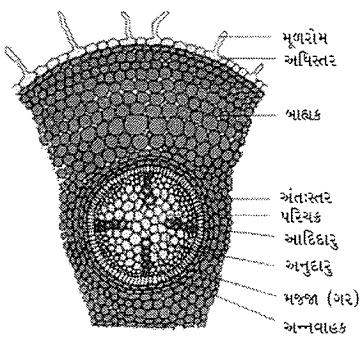
A
Monocot root
B
Dicot root
C
Monocot stem
D
Dicot stem
Solution
(B) The provided image shows the internal structure of a root. Key features include the presence of root hairs,a distinct endodermis,and a radial vascular bundle arrangement where xylem and phloem are arranged in an alternating manner. Specifically,the xylem shows a tetrarch condition (four xylem bundles),which is a characteristic feature of a dicot root. Monocot roots typically show polyarch conditions (many xylem bundles). Therefore,the structure represents a dicot root.
0 likes
View Solution140
MediumMCQ
Identify $P, Q,$ and $R$ in the given anatomical structure.
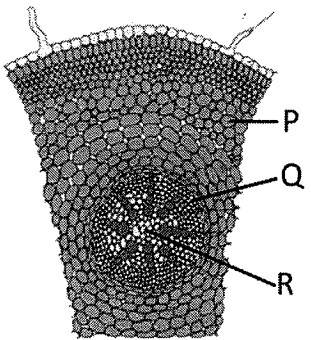
A
$P=$ Cortex,$Q=$ Protoxylem,$R=$ Pith
B
$P=$ Cortex,$Q=$ Metaxylem,$R=$ Pith
C
$P=$ Endodermis,$Q=$ Pericycle,$R=$ Metaxylem
D
$P=$ Endodermis,$Q=$ Protoxylem,$R=$ Metaxylem
Solution
(A) The provided image shows the transverse section of a dicot root.
$P$ points to the cortex,which is the region between the epidermis and the endodermis.
$Q$ points to the protoxylem,which consists of smaller xylem vessels located towards the periphery.
$R$ points to the pith,which is the central part of the root,typically small or inconspicuous in dicot roots.
$P$ points to the cortex,which is the region between the epidermis and the endodermis.
$Q$ points to the protoxylem,which consists of smaller xylem vessels located towards the periphery.
$R$ points to the pith,which is the central part of the root,typically small or inconspicuous in dicot roots.
0 likes
View Solution141
MediumMCQ
Select the incorrect statement from the following.
A
Casparian strips are found in the endodermis of the stem.
B
Casparian strips are suberized thickenings.
C
Casparian strips are impermeable to water molecules.
D
Casparian strips do not create an obstacle in the symplastic pathway.
Solution
(A) The Casparian strip is a band of cell wall material deposited in the radial and transverse walls of the endodermis,and it is chemically composed of suberin.
$1$. Casparian strips are characteristic of the endodermis of the $root$,not the $stem$. Thus,option $A$ is incorrect.
$2$. They are indeed suberized thickenings,making option $B$ correct.
$3$. Due to the presence of suberin,they are impermeable to water,making option $C$ correct.
$4$. In the symplastic pathway,water moves through the cytoplasm and plasmodesmata,bypassing the cell wall barriers; therefore,the Casparian strip does not obstruct this pathway,making option $D$ correct.
$1$. Casparian strips are characteristic of the endodermis of the $root$,not the $stem$. Thus,option $A$ is incorrect.
$2$. They are indeed suberized thickenings,making option $B$ correct.
$3$. Due to the presence of suberin,they are impermeable to water,making option $C$ correct.
$4$. In the symplastic pathway,water moves through the cytoplasm and plasmodesmata,bypassing the cell wall barriers; therefore,the Casparian strip does not obstruct this pathway,making option $D$ correct.
0 likes
View Solution142
DifficultMCQ
Given below are two statements:
Statement $I:$ Endarch and exarch are the terms often used for describing the position of secondary xylem in the plant body.
Statement $II:$ Exarch condition is the most common feature of the root system.
In the light of the above statements,choose the correct answer from the options given below:
Statement $I:$ Endarch and exarch are the terms often used for describing the position of secondary xylem in the plant body.
Statement $II:$ Exarch condition is the most common feature of the root system.
In the light of the above statements,choose the correct answer from the options given below:
A
Statement $I$ is incorrect but Statement $II$ is true.
B
Both Statement $I$ and Statement $II$ are true.
C
Both Statement $I$ and Statement $II$ are false.
D
Statement $I$ is correct but Statement $II$ is false.
Solution
(A) Endarch and exarch are terms used to describe the arrangement of primary xylem,not secondary xylem.
Primary xylem consists of protoxylem and metaxylem. Based on the relative position of protoxylem and metaxylem within an organ,the arrangement is classified as either endarch or exarch.
In the endarch condition,protoxylem lies towards the center (pith),which is characteristic of stems. In the exarch condition,protoxylem lies towards the periphery,which is a characteristic feature of roots.
Therefore,Statement $I$ is false because it mentions secondary xylem instead of primary xylem,and Statement $II$ is true.
Primary xylem consists of protoxylem and metaxylem. Based on the relative position of protoxylem and metaxylem within an organ,the arrangement is classified as either endarch or exarch.
In the endarch condition,protoxylem lies towards the center (pith),which is characteristic of stems. In the exarch condition,protoxylem lies towards the periphery,which is a characteristic feature of roots.
Therefore,Statement $I$ is false because it mentions secondary xylem instead of primary xylem,and Statement $II$ is true.
0 likes
View Solution143
MediumMCQ
Innermost layer of cortex in dicot root is :-
A
Pericycle
B
Hypodermis
C
Endodermis
D
Pith
Solution
(C) In the anatomy of a dicot root,the cortex is the region between the epidermis and the vascular bundle.
It consists of several layers of thin-walled parenchyma cells with intercellular spaces.
The innermost layer of the cortex is known as the endodermis.
It is composed of a single layer of barrel-shaped cells that are closely packed without any intercellular spaces.
The endodermal cells are characterized by the presence of water-impermeable,waxy material called suberin in the form of Casparian strips.
It consists of several layers of thin-walled parenchyma cells with intercellular spaces.
The innermost layer of the cortex is known as the endodermis.
It is composed of a single layer of barrel-shaped cells that are closely packed without any intercellular spaces.
The endodermal cells are characterized by the presence of water-impermeable,waxy material called suberin in the form of Casparian strips.
0 likes
View Solution144
EasyMCQ
In dicotyledonous root,the parenchymatous cells which lie between xylem and phloem are called $:-$
A
Pith
B
Stele
C
Bulliform cells
D
Conjunctive tissue
Solution
(D) In dicotyledonous roots,the xylem and phloem bundles are arranged in an alternating manner.
The parenchymatous cells that lie between the xylem and phloem bundles are known as conjunctive tissue.
These cells play a role in the formation of the vascular cambium during secondary growth.
The parenchymatous cells that lie between the xylem and phloem bundles are known as conjunctive tissue.
These cells play a role in the formation of the vascular cambium during secondary growth.
0 likes
View Solution145
MediumMCQ
Xylem and phloem arranged in an alternate manner on different radii,the vascular bundle is called?
A
Conjoint
B
Radial
C
Conjoint,open
D
Endarch
Solution
(B) In a $Radial$ vascular bundle,the $Xylem$ and $Phloem$ are arranged in an alternate manner on different radii. This type of arrangement is a characteristic feature of the roots of angiosperms and gymnosperms. In contrast,$Conjoint$ bundles have $Xylem$ and $Phloem$ situated at the same radius. Therefore,the correct answer is $Radial$.
0 likes
View Solution146
MediumMCQ
Presence of casparian strips is the characteristic feature of$-$
A
Hypodermis
B
Endodermis
C
Pericycle
D
Epidermis
Solution
(B) The $Casparian$ strips are bands of suberized material present on the radial and tangential walls of the endodermal cells.
These strips are impermeable to water and are a characteristic feature of the $Endodermis$ in roots.
They play a crucial role in regulating the flow of water and solutes into the vascular cylinder by forcing water to move through the symplastic pathway.
These strips are impermeable to water and are a characteristic feature of the $Endodermis$ in roots.
They play a crucial role in regulating the flow of water and solutes into the vascular cylinder by forcing water to move through the symplastic pathway.
0 likes
View Solution147
MediumMCQ
$(i)$ Unicellular hair
$(ii)$ Endodermis with passage cells
$(iii)$ Pith$-$small$/$inconspicuous
$(iv)$ Radial vascular bundle
$(v)$ Xylem exarch
$(vi)$ $2-4$ xylem and phloem
The above description refers to which of the following?
$(ii)$ Endodermis with passage cells
$(iii)$ Pith$-$small$/$inconspicuous
$(iv)$ Radial vascular bundle
$(v)$ Xylem exarch
$(vi)$ $2-4$ xylem and phloem
The above description refers to which of the following?
A
Monocot root
B
Dicot root
C
Monocot stem
D
Dicot stem
Solution
(B) The given features describe the internal anatomy of a Dicot root:
$1$. Unicellular root hairs are characteristic of roots.
$2$. The endodermis contains passage cells,which are thin-walled cells opposite to the protoxylem.
$3$. The pith is small or inconspicuous in dicot roots.
$4$. Vascular bundles are radial,meaning xylem and phloem are arranged on different radii.
$5$. Xylem is exarch,meaning protoxylem lies towards the periphery and metaxylem towards the center.
$6$. Dicot roots typically have $2-4$ xylem and phloem patches (diarch to tetrarch condition).
$1$. Unicellular root hairs are characteristic of roots.
$2$. The endodermis contains passage cells,which are thin-walled cells opposite to the protoxylem.
$3$. The pith is small or inconspicuous in dicot roots.
$4$. Vascular bundles are radial,meaning xylem and phloem are arranged on different radii.
$5$. Xylem is exarch,meaning protoxylem lies towards the periphery and metaxylem towards the center.
$6$. Dicot roots typically have $2-4$ xylem and phloem patches (diarch to tetrarch condition).
0 likes
View Solution148
MediumMCQ
Hypodermis is not found in $ - $
A
Monocot stem only
B
Monocot root only
C
Dicot $ & $ monocot root
D
Dicot stem only
Solution
(C) The hypodermis is a layer of cells located immediately below the epidermis in the stem of plants.
In dicot stems, the hypodermis is typically collenchymatous, providing mechanical support.
In monocot stems, the hypodermis is typically sclerenchymatous.
However, the hypodermis is absent in the roots of both monocot and dicot plants.
In roots, the layer immediately below the epidermis is the cortex, and there is no specialized hypodermal layer.
In dicot stems, the hypodermis is typically collenchymatous, providing mechanical support.
In monocot stems, the hypodermis is typically sclerenchymatous.
However, the hypodermis is absent in the roots of both monocot and dicot plants.
In roots, the layer immediately below the epidermis is the cortex, and there is no specialized hypodermal layer.
0 likes
View Solution149
EasyMCQ
How many xylem bundles are found in the internal structure of a sunflower root?
A
$2$
B
$3$
C
$4$
D
$8$
Solution
(C) The sunflower root is a typical dicot root.
In dicot roots,the number of xylem and phloem bundles usually ranges from $2$ to $6$.
Specifically,the sunflower root is typically tetrarch,meaning it contains $4$ xylem bundles.
Therefore,the correct answer is $4$.
In dicot roots,the number of xylem and phloem bundles usually ranges from $2$ to $6$.
Specifically,the sunflower root is typically tetrarch,meaning it contains $4$ xylem bundles.
Therefore,the correct answer is $4$.
0 likes
View Solution150
MediumMCQ
Which type of primary xylem is present in the given figure?
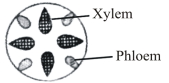
A
Exarch
B
Endarch
C
Mesarch
D
Concentric
Solution
(A) In the given figure,the xylem bundles are arranged in a radial pattern where the protoxylem is directed towards the periphery and the metaxylem is directed towards the center. This arrangement is characteristic of roots and is known as the $Exarch$ condition. In contrast,$Endarch$ condition is found in stems where protoxylem is towards the center. Therefore,the correct option is $A$.
0 likes
View SolutionAnatomy of Flowering Plants — Internal structure of root · Frequently Asked Questions
1Are these Anatomy of Flowering Plants questions useful for JEE and NEET?
Yes. All questions in this section are mapped to JEE Main and NEET exam patterns. Previous year questions from JEE Main, NEET, GUJCET and state-level exams are included with full solutions.
2Can I switch to Hindi or Gujarati for these questions?
Yes. Use the language tabs in the hero section or the sidebar to view the same questions and solutions in English, Hindi or Gujarati.
3How do I generate a question paper from this subtopic?
Use the Vedclass Exam Paper Generator — select the chapter and subtopic, set difficulty, and generate Sets A, B, C, D automatically. First 3 chapters of every subject are free.
Vedclass Products
For Students
Vedclass Test Series
Mock tests in real JEE/NEET style with performance analysis. 5-day free trial.
Start Free TrialFor Teachers
Exam Paper Generator
Generate Set A/B/C/D papers from this chapter in 2 minutes. 3 chapters free.
Try FreeFor Institutes
Online Exam Module
Live online exams with unlimited students, 360° analytics & white-label branding.
See DemoFor Teachers & Institutes
Generate a Anatomy of Flowering Plants Exam Paper in 2 Minutes
Select subtopic & difficulty — Sets A, B, C, D auto-generated with No Repeat logic.
First 3 chapters of every subject are free — no payment required.