
A English
Internal structure of root Questions in English
Class 11 Biology · Anatomy of Flowering Plants · Internal structure of root
159+
Questions
English
Language
100%
With Solutions
Showing 50 of 159 questions in English
1
MediumMCQ
Lateral roots arise from primordia developed by the division of:
A
Pericycle cells in between two protoxylem points
B
Pericycle cells opposite protoxylem points
C
Endodermis cells in between two protoxylem points
D
Endodermis opposite protoxylem points
Solution
(B) Lateral roots are endogenous in origin,meaning they arise from tissues located inside the endodermis.
Specifically,they originate from the pericycle cells located opposite to the protoxylem points (or patches).
These pericycle cells undergo repeated divisions to form a root primordium,which eventually pushes through the endodermis and cortex to emerge as a lateral root.
Specifically,they originate from the pericycle cells located opposite to the protoxylem points (or patches).
These pericycle cells undergo repeated divisions to form a root primordium,which eventually pushes through the endodermis and cortex to emerge as a lateral root.
0 likes
View Solution2
EasyMCQ
In angiosperms,lateral roots arise from
A
Endodermis
B
Cortex
C
Pericycle
D
Epiblemma
Solution
(C) In angiosperms,the lateral roots are endogenous in origin.
They originate from the pericycle cells,which are located just inside the endodermis.
These cells undergo division to form the lateral root primordium,which then pushes through the cortex and epidermis to emerge.
They originate from the pericycle cells,which are located just inside the endodermis.
These cells undergo division to form the lateral root primordium,which then pushes through the cortex and epidermis to emerge.
0 likes
View Solution3
MediumMCQ
The Casparian strips of the root endodermis contain a mixture of:
A
Cellulose and cutin
B
Cellulose and lignin
C
Lignin and suberin
D
Cellulose and suberin
Solution
(C) The Casparian strips are water-impermeable bands found in the endodermal cells of plant roots.
These strips are primarily composed of a waxy,hydrophobic substance called suberin.
In some cases,lignin may also be deposited along with suberin to provide additional structural support and impermeability.
Therefore,the correct composition is a mixture of lignin and suberin.
These strips are primarily composed of a waxy,hydrophobic substance called suberin.
In some cases,lignin may also be deposited along with suberin to provide additional structural support and impermeability.
Therefore,the correct composition is a mixture of lignin and suberin.
0 likes
View Solution4
MediumMCQ
When protoxylem develops towards the periphery,it is called
A
Centripetal xylem
B
Centrifugal xylem
C
Endarch
D
None of the above
Solution
(A) In plants,the arrangement of xylem is classified based on the position of protoxylem relative to the metaxylem.
When the protoxylem is directed towards the periphery (outside) and the metaxylem is towards the center,the condition is known as $Exarch$.
This type of arrangement is characteristic of roots and is also referred to as $Centripetal \ xylem$ because the development of xylem proceeds towards the center.
Therefore,the correct option is $A$.
When the protoxylem is directed towards the periphery (outside) and the metaxylem is towards the center,the condition is known as $Exarch$.
This type of arrangement is characteristic of roots and is also referred to as $Centripetal \ xylem$ because the development of xylem proceeds towards the center.
Therefore,the correct option is $A$.
0 likes
View Solution5
MediumMCQ
Parenchyma cells in between xylem and phloem bundles in roots are called as
A
Conjunctive tissue
B
Complimentary tissue
C
Cambial tissue
D
None of the above
Solution
(A) In the roots of flowering plants,the xylem and phloem are arranged in an alternating manner on separate radii.
These vascular bundles are separated by parenchymatous cells.
This specific tissue located between the xylem and phloem bundles is known as the conjunctive tissue.
These vascular bundles are separated by parenchymatous cells.
This specific tissue located between the xylem and phloem bundles is known as the conjunctive tissue.
0 likes
View Solution6
EasyMCQ
How many histogens are present at the apex of the root?
A
$1$
B
$2$
C
$3$
D
$4$
Solution
(C) According to the histogen theory proposed by Hanstein,the root apex is composed of three distinct layers of meristematic tissue called histogens.
These three histogens are:
$1$. Dermatogen: The outermost layer that gives rise to the epidermis (epiblema).
$2$. Periblem: The middle layer that develops into the cortex.
$3$. Pleurome: The central core that gives rise to the stele (vascular cylinder).
Therefore,there are $3$ histogens present at the apex of the root.
These three histogens are:
$1$. Dermatogen: The outermost layer that gives rise to the epidermis (epiblema).
$2$. Periblem: The middle layer that develops into the cortex.
$3$. Pleurome: The central core that gives rise to the stele (vascular cylinder).
Therefore,there are $3$ histogens present at the apex of the root.
0 likes
View Solution7
EasyMCQ
In the Korper-Kappe theory,the term Korper refers to the body,and Kappe refers to:
A
Calyptrogen
B
Cap
C
Cortical
D
Carpel
Solution
(B) The Korper-Kappe theory was proposed by Schüepp $(1917)$ to explain the organization of the root apical meristem.
In this theory,the term 'Korper' (German for 'body') refers to the central body of the root apex,while 'Kappe' (German for 'cap') refers to the root cap.
Therefore,the term Kappe is meant for the cap.
In this theory,the term 'Korper' (German for 'body') refers to the central body of the root apex,while 'Kappe' (German for 'cap') refers to the root cap.
Therefore,the term Kappe is meant for the cap.
0 likes
View Solution8
MediumMCQ
The layer of cells between the endodermis and vascular bundles is called:
A
Epidermis
B
Pericycle
C
Hypodermis
D
Pith
Solution
(B) The $Pericycle$ is a layer of cells located between the endodermis and the vascular bundles in roots. It consists of a single layer or multiple layers of thin-walled or thick-walled cells. It plays a crucial role in the initiation of lateral roots and secondary growth.
0 likes
View Solution9
MediumMCQ
When the formation of metaxylem is in a centripetal manner,the xylem is known as:
A
Endarch
B
Exarch
C
Mesarch
D
Radial
Solution
(B) In plants,the arrangement of xylem is classified based on the position of protoxylem and metaxylem relative to the center of the organ.
When the protoxylem is located towards the periphery and the metaxylem develops towards the center (centripetal development),the condition is called $Exarch$.
This type of arrangement is characteristic of the roots of flowering plants.
In contrast,$Endarch$ refers to the condition where protoxylem is towards the center and metaxylem is towards the periphery (centrifugal development),which is typical of stems.
When the protoxylem is located towards the periphery and the metaxylem develops towards the center (centripetal development),the condition is called $Exarch$.
This type of arrangement is characteristic of the roots of flowering plants.
In contrast,$Endarch$ refers to the condition where protoxylem is towards the center and metaxylem is towards the periphery (centrifugal development),which is typical of stems.
0 likes
View Solution10
EasyMCQ
Passage cells are found in
A
Dicot stem
B
Aerial root
C
Monocot root
D
Monocot stem
Solution
(C) Passage cells are thin-walled cells found in the endodermis of roots,specifically located opposite to the protoxylem elements.
These cells allow the radial movement of water and dissolved minerals from the cortex into the xylem.
They are characteristic of monocot roots,where the endodermis remains thin-walled except for the Casparian strips,and these specific cells lack the suberin deposition.
These cells allow the radial movement of water and dissolved minerals from the cortex into the xylem.
They are characteristic of monocot roots,where the endodermis remains thin-walled except for the Casparian strips,and these specific cells lack the suberin deposition.
0 likes
View Solution11
MediumMCQ
Endodermis is the innermost layer of the
A
Xylem
B
Phloem
C
Cortex
D
Cambium
Solution
(C) The endodermis is the innermost layer of the cortex in roots.
It is composed of a single layer of barrel-shaped cells that are closely packed without intercellular spaces.
These cells are characterized by the presence of Casparian strips,which are water-impermeable waxy material deposits (suberin) on their radial and tangential walls.
Therefore,the correct option is $C$.
It is composed of a single layer of barrel-shaped cells that are closely packed without intercellular spaces.
These cells are characterized by the presence of Casparian strips,which are water-impermeable waxy material deposits (suberin) on their radial and tangential walls.
Therefore,the correct option is $C$.
0 likes
View Solution12
MediumMCQ
The innermost layer of the cortex which shows Casparian thickenings in its cells is called as
A
Epidermis
B
Endodermis
C
Pericycle
D
Exodermis
Solution
(B) The correct answer is $B$.
The $Endodermis$ is the innermost layer of the cortex in roots.
It consists of a single layer of barrel-shaped,compactly arranged parenchymatous cells.
The radial and tangential walls of these cells contain water-impermeable,waxy material called $Suberin$,which forms the $Casparian$ strips.
The $Endodermis$ is the innermost layer of the cortex in roots.
It consists of a single layer of barrel-shaped,compactly arranged parenchymatous cells.
The radial and tangential walls of these cells contain water-impermeable,waxy material called $Suberin$,which forms the $Casparian$ strips.
0 likes
View Solution13
EasyMCQ
Vascular bundles of roots are:
A
Conjoint
B
Concentric
C
Bicollateral
D
Radial
Solution
(D) In roots,the xylem and phloem are arranged in an alternating manner on different radii.
Such vascular bundles are termed as radial vascular bundles.
This arrangement is a characteristic feature of root anatomy in plants.
Such vascular bundles are termed as radial vascular bundles.
This arrangement is a characteristic feature of root anatomy in plants.
0 likes
View Solution14
MediumMCQ
Passage cells are present in
A
Epidermis
B
Endodermis
C
Xylem
D
Lenticels and hydathodes
Solution
(B) Passage cells are specialized thin-walled cells found in the endodermis of roots.
In the endodermis,most cells have $Casparian$ strips (thickened with suberin),which are impermeable to water.
However,the cells located opposite to the protoxylem elements remain thin-walled and lack $Casparian$ strips.
These cells are known as passage cells,and they facilitate the movement of water and dissolved minerals from the cortex into the vascular cylinder (stele).
In the endodermis,most cells have $Casparian$ strips (thickened with suberin),which are impermeable to water.
However,the cells located opposite to the protoxylem elements remain thin-walled and lack $Casparian$ strips.
These cells are known as passage cells,and they facilitate the movement of water and dissolved minerals from the cortex into the vascular cylinder (stele).
0 likes
View Solution15
MediumMCQ
Radial vascular bundle can be seen in
A
Leaf
B
Dicot root
C
Stem
D
Flower
Solution
(B) In a radial vascular bundle,the xylem and phloem are arranged in an alternate manner on different radii.
This type of vascular arrangement is a characteristic feature of roots in angiosperms,including both dicot and monocot roots.
In stems and leaves,the vascular bundles are typically conjoint (xylem and phloem are located on the same radius).
Therefore,the correct answer is $B$ (Dicot root).
This type of vascular arrangement is a characteristic feature of roots in angiosperms,including both dicot and monocot roots.
In stems and leaves,the vascular bundles are typically conjoint (xylem and phloem are located on the same radius).
Therefore,the correct answer is $B$ (Dicot root).
0 likes
View Solution16
EasyMCQ
Who first recognized the presence of Casparian strips?
A
Doffins in $1885$
B
Caspary in $1865$
C
Hofmeister in $1895$
D
Bailey in $1975$
Solution
(B) The Casparian strips are water-impermeable deposits of suberin found in the radial and tangential walls of the endodermal cells in roots.
These structures were first described and identified by the German botanist Robert Caspary in $1865$.
Therefore,the correct option is $B$.
These structures were first described and identified by the German botanist Robert Caspary in $1865$.
Therefore,the correct option is $B$.
0 likes
View Solution17
MediumMCQ
What is the important characteristic of an endodermal cell?
A
Barrel-shaped appearance
B
Lignified walls
C
Presence of suberin lamellae and Casparian bands
D
Presence of cutin and wax
Solution
(C) The endodermis is the innermost layer of the cortex in roots.
Its cells are characterized by the presence of Casparian bands,which are water-impermeable waxy deposits of suberin.
These bands prevent the apoplastic movement of water and solutes into the vascular cylinder,forcing them to enter the symplastic pathway.
Therefore,the presence of suberin lamellae and Casparian bands is the most significant diagnostic feature of endodermal cells.
Its cells are characterized by the presence of Casparian bands,which are water-impermeable waxy deposits of suberin.
These bands prevent the apoplastic movement of water and solutes into the vascular cylinder,forcing them to enter the symplastic pathway.
Therefore,the presence of suberin lamellae and Casparian bands is the most significant diagnostic feature of endodermal cells.
0 likes
View Solution18
MediumMCQ
Exarch and polyarch vascular bundles occur in
A
Monocot stem
B
Monocot root
C
Dicot stem
D
Dicot root
Solution
(B) In plants,vascular bundles are classified based on the position of protoxylem and the number of xylem bundles.
$Exarch$ condition refers to the arrangement where protoxylem lies towards the periphery and metaxylem towards the center,which is a characteristic feature of roots.
$Polyarch$ condition refers to the presence of more than six xylem bundles.
Monocot roots typically exhibit a $polyarch$ arrangement (usually more than six xylem bundles) and $exarch$ xylem.
Therefore,$exarch$ and $polyarch$ vascular bundles are characteristic of monocot roots.
$Exarch$ condition refers to the arrangement where protoxylem lies towards the periphery and metaxylem towards the center,which is a characteristic feature of roots.
$Polyarch$ condition refers to the presence of more than six xylem bundles.
Monocot roots typically exhibit a $polyarch$ arrangement (usually more than six xylem bundles) and $exarch$ xylem.
Therefore,$exarch$ and $polyarch$ vascular bundles are characteristic of monocot roots.
0 likes
View Solution19
MediumMCQ
In roots,the xylem is:
A
Mesarch
B
Exarch
C
Placed at different places in different plants
D
Endarch
Solution
(B) In roots,the xylem arrangement is $Exarch$.
In an $Exarch$ condition,the $protoxylem$ is directed towards the periphery (outside) and the $metaxylem$ is directed towards the center of the organ.
This is a characteristic feature of the root anatomy in vascular plants.
In an $Exarch$ condition,the $protoxylem$ is directed towards the periphery (outside) and the $metaxylem$ is directed towards the center of the organ.
This is a characteristic feature of the root anatomy in vascular plants.
0 likes
View Solution20
MediumMCQ
In a dicot root:
A
Vascular bundles are scattered and with cambium
B
Vascular bundles are arranged in a ring and have cambium
C
Xylem and phloem are radially arranged
D
Xylem is always endarch
Solution
(C) In dicot roots,the vascular bundles are radial,meaning the xylem and phloem are arranged in an alternating manner on different radii. They are separated by parenchymatous cells. This radial arrangement is a characteristic feature of roots,whereas conjoint vascular bundles (with cambium) are characteristic of stems.
0 likes
View Solution21
MediumMCQ
Monocot root differs from dicot root in having
A
Open vascular bundles
B
Scattered vascular bundles
C
Well developed pith
D
Radially arranged vascular bundles
Solution
(C) In a dicot root,the pith is either very small or completely absent. In contrast,a monocot root is characterized by the presence of a large,well-developed pith at the center of the vascular cylinder. Therefore,the presence of a well-developed pith is a distinguishing feature of monocot roots.
0 likes
View Solution22
MediumMCQ
Polyarch condition is seen in
A
Monocot stem
B
Monocot root
C
Dicot root
D
Dicot stem
Solution
(B) The polyarch condition refers to the presence of many vascular bundles (typically more than $6$) in the root.
This condition is a characteristic feature of monocot roots.
In contrast,dicot roots typically show a diarch to hexarch condition (fewer vascular bundles).
This condition is a characteristic feature of monocot roots.
In contrast,dicot roots typically show a diarch to hexarch condition (fewer vascular bundles).
0 likes
View Solution23
MediumMCQ
Which of the following is not a characteristic feature of the anatomy of a dicotyledonous root?
A
Radial vascular bundles
B
Secondary growth
C
Pith is little or absent
D
Vascular bundles are $15-20$
Solution
(D) In dicotyledonous roots,the number of xylem and phloem bundles (vascular bundles) usually ranges from $2$ to $6$ (diarch to hexarch). $A$ high number of vascular bundles (polyarch,typically more than $6$) is a characteristic feature of monocotyledonous roots. Therefore,having $15-20$ vascular bundles is not a feature of dicot roots.
0 likes
View Solution24
MediumMCQ
The cortex in the monocot root is composed of:
A
Parenchymatous cells
B
Collenchymatous cells
C
Sclerenchymatous cells
D
Companion cells
Solution
(A) In the monocot root,the cortex consists of several layers of thin-walled parenchyma cells with intercellular spaces.
These cells are responsible for the storage of food and water.
Therefore,the cortex is primarily composed of parenchymatous cells.
These cells are responsible for the storage of food and water.
Therefore,the cortex is primarily composed of parenchymatous cells.
0 likes
View Solution25
MediumMCQ
Monocot root differs from dicot root in
A
Showing secondary growth
B
No xylem
C
No cambium
D
No phloem
Solution
(C) In dicot roots,the vascular cambium develops during secondary growth,which leads to the formation of secondary xylem and secondary phloem.
Monocot roots do not undergo secondary growth because they lack a vascular cambium.
Therefore,the absence of cambium is a key anatomical difference between monocot and dicot roots.
Monocot roots do not undergo secondary growth because they lack a vascular cambium.
Therefore,the absence of cambium is a key anatomical difference between monocot and dicot roots.
0 likes
View Solution26
MediumMCQ
Exarch xylem is found in
A
Root
B
Stem
C
Leaf
D
Rachis
Solution
(A) In $exarch$ xylem,the protoxylem is situated towards the periphery and the metaxylem is situated towards the center of the organ.
This arrangement is a characteristic feature of the roots of flowering plants.
In contrast,$endarch$ xylem,where the protoxylem is towards the center and metaxylem is towards the periphery,is a characteristic feature of stems.
This arrangement is a characteristic feature of the roots of flowering plants.
In contrast,$endarch$ xylem,where the protoxylem is towards the center and metaxylem is towards the periphery,is a characteristic feature of stems.
0 likes
View Solution27
MediumMCQ
Two to five xylem bundles are found in
A
Monocot root
B
Monocot stem
C
Dicot stem
D
Dicot root
Solution
(D) In a $Dicot$ root,the number of vascular bundles is usually limited,typically ranging from $2$ to $6$ (diarch to hexarch).
Specifically,a $Dicot$ root often exhibits $2$ to $5$ xylem bundles.
In contrast,$Monocot$ roots typically have more than $6$ xylem bundles,a condition known as polyarch.
$Monocot$ and $Dicot$ stems have vascular bundles arranged in a ring or scattered,which are conjoint and collateral,not categorized by the number of xylem bundles in the same way as roots.
Specifically,a $Dicot$ root often exhibits $2$ to $5$ xylem bundles.
In contrast,$Monocot$ roots typically have more than $6$ xylem bundles,a condition known as polyarch.
$Monocot$ and $Dicot$ stems have vascular bundles arranged in a ring or scattered,which are conjoint and collateral,not categorized by the number of xylem bundles in the same way as roots.
0 likes
View Solution28
MediumMCQ
Which of the following is seen in a monocot root?
A
Large pith
B
Vascular cambium
C
Endarch xylem
D
Medullary ray
Solution
(A) In a monocot root,a large and well-developed pith is present in the center. This pith is composed of loosely arranged parenchymatous cells that often contain abundant starch grains. Vascular cambium is absent in monocot roots,xylem is exarch (not endarch),and medullary rays are characteristic of stems,not roots.
0 likes
View Solution29
MediumMCQ
In what respect does the pericycle of a root differ from that of the stem?
A
Sclerenchymatous in root and collenchymatous in stem
B
Collenchymatous in root and parenchymatous in stem
C
Parenchymatous in root and sclerenchymatous in stem
D
Parenchymatous in root and collenchymatous in stem
Solution
(C) In dicot roots,the pericycle is composed of thin-walled parenchymatous cells. It is the site where lateral roots and vascular cambium originate during secondary growth.
In contrast,in the stems of many dicots,the pericycle is often present as semi-lunar patches of sclerenchymatous cells located above the phloem bundles.
In contrast,in the stems of many dicots,the pericycle is often present as semi-lunar patches of sclerenchymatous cells located above the phloem bundles.
0 likes
View Solution30
MediumMCQ
Centripetal xylem is the characteristic of
A
Roots
B
Stems
C
Leaf
D
Petiole
Solution
(A) In roots,the xylem development is $exarch$,which means the protoxylem is directed towards the periphery and the metaxylem towards the center. This arrangement is known as $centripetal$ $xylem$ development,where the maturation of xylem proceeds from the periphery towards the center. In contrast,stems exhibit $endarch$ xylem development,where the protoxylem is directed towards the center and the metaxylem towards the periphery.
0 likes
View Solution31
MediumMCQ
In monocot roots,which types of vascular bundles are found?
A
Collateral,conjoint and closed
B
Radial $V.B.$ with exarch xylem
C
Bicollateral,conjoint and closed
D
Radial $V.B.$ with endarch xylem
Solution
(B) In monocot roots,the vascular bundles are radial,meaning xylem and phloem are arranged in an alternating manner on different radii.
In roots,the xylem is exarch,which means the protoxylem lies towards the periphery and the metaxylem lies towards the center.
Therefore,monocot roots possess radial vascular bundles with exarch xylem.
In roots,the xylem is exarch,which means the protoxylem lies towards the periphery and the metaxylem lies towards the center.
Therefore,monocot roots possess radial vascular bundles with exarch xylem.
0 likes
View Solution32
MediumMCQ
In dicot roots,cells of which region show Casparian strips?
A
Cambium
B
Endodermis
C
Pericycle
D
Hypodermis
Solution
(B) The $Casparian$ strips are characteristic features of the $Endodermis$ in roots.
These are water-impermeable,waxy bands made of $suberin$ that are deposited in the radial and tangential walls of the endodermal cells.
They prevent the apoplastic movement of water and solutes,forcing them to enter the vascular cylinder through the symplastic pathway.
Therefore,the correct option is $B$.
These are water-impermeable,waxy bands made of $suberin$ that are deposited in the radial and tangential walls of the endodermal cells.
They prevent the apoplastic movement of water and solutes,forcing them to enter the vascular cylinder through the symplastic pathway.
Therefore,the correct option is $B$.
0 likes
View Solution33
MediumMCQ
In the diagram of $T.S.$ of the stele of a dicot root,the different parts have been indicated by alphabets; choose the answer in which these alphabets correctly match with the parts they indicate.
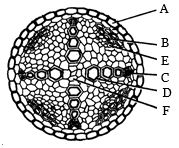
A
$A =$ Endodermis,$B =$ Conjunctive tissue,$C =$ Metaxylem,$D =$ Protoxylem,$E =$ Phloem,$F =$ Pith
B
$A =$ Endodermis,$B =$ Pith,$C =$ Protoxylem,$D =$ Metaxylem,$E =$ Protoxylem,$F =$ Conjunctive tissue
C
$A =$ Pericycle,$B =$ Conjunctive tissue,$C =$ Metaxylem,$D =$ Protoxylem,$E =$ Phloem
D
$A =$ Endodermis,$B =$ Conjunctive tissue,$C =$ Protoxylem,$D =$ Metaxylem,$E =$ Phloem,$F =$ Pith
Solution
(A) Based on the anatomical structure of a dicot root $T.S.$:
$A$ points to the innermost layer of the cortex,which is the Endodermis.
$B$ points to the parenchymatous cells lying between the xylem and phloem,known as Conjunctive tissue.
$C$ points to the larger xylem vessels located towards the center,which are Metaxylem.
$D$ points to the smaller xylem vessels located towards the periphery,which are Protoxylem.
$E$ points to the vascular tissue responsible for food transport,the Phloem.
$F$ points to the central core,which is the Pith (often small or inconspicuous in dicot roots).
Therefore,the correct matching is $A =$ Endodermis,$B =$ Conjunctive tissue,$C =$ Metaxylem,$D =$ Protoxylem,$E =$ Phloem,$F =$ Pith.
$A$ points to the innermost layer of the cortex,which is the Endodermis.
$B$ points to the parenchymatous cells lying between the xylem and phloem,known as Conjunctive tissue.
$C$ points to the larger xylem vessels located towards the center,which are Metaxylem.
$D$ points to the smaller xylem vessels located towards the periphery,which are Protoxylem.
$E$ points to the vascular tissue responsible for food transport,the Phloem.
$F$ points to the central core,which is the Pith (often small or inconspicuous in dicot roots).
Therefore,the correct matching is $A =$ Endodermis,$B =$ Conjunctive tissue,$C =$ Metaxylem,$D =$ Protoxylem,$E =$ Phloem,$F =$ Pith.
0 likes
View Solution34
MediumMCQ
Monocot root differs from dicot root in:
A
Presence of more than six xylem bundles
B
Well-developed pith
C
Absence of secondary growth
D
All of these
Solution
(D) Monocot roots typically exhibit polyarch xylem conditions,meaning they have more than six xylem bundles,whereas dicot roots usually have two to four (diarch to tetrarch).
Monocot roots possess a large,well-developed central pith,which is either absent or very small in dicot roots.
Furthermore,monocot roots do not undergo secondary growth,whereas dicot roots exhibit secondary growth due to the activity of the vascular cambium.
Therefore,all the given statements correctly describe the differences between monocot and dicot roots.
Monocot roots possess a large,well-developed central pith,which is either absent or very small in dicot roots.
Furthermore,monocot roots do not undergo secondary growth,whereas dicot roots exhibit secondary growth due to the activity of the vascular cambium.
Therefore,all the given statements correctly describe the differences between monocot and dicot roots.
0 likes
View Solution35
MediumMCQ
Which of the following is the correct sequence of layers in a typical monocot root (from outer surface to inside)?
A
Pericycle,cortex,endodermis,epiblema
B
Epiblema,endodermis,cortex,pericycle
C
Epiblema,cortex,endodermis,pericycle
D
Epiblema,pericycle,cortex,endodermis
Solution
(C) The anatomical structure of a typical monocot root,when viewed from the outer surface towards the center,consists of the following layers:
$1$. $Epiblema$ (or $Rhizodermis$): The outermost single layer of cells.
$2$. $Cortex$: $A$ multi-layered region of parenchyma cells located beneath the $Epiblema$.
$3$. $Endodermis$: The innermost layer of the cortex,characterized by the presence of Casparian strips.
$4$. $Pericycle$: The layer located just inside the $Endodermis$,which gives rise to lateral roots.
Therefore,the correct sequence is $Epiblema \rightarrow Cortex \rightarrow Endodermis \rightarrow Pericycle$.
$1$. $Epiblema$ (or $Rhizodermis$): The outermost single layer of cells.
$2$. $Cortex$: $A$ multi-layered region of parenchyma cells located beneath the $Epiblema$.
$3$. $Endodermis$: The innermost layer of the cortex,characterized by the presence of Casparian strips.
$4$. $Pericycle$: The layer located just inside the $Endodermis$,which gives rise to lateral roots.
Therefore,the correct sequence is $Epiblema \rightarrow Cortex \rightarrow Endodermis \rightarrow Pericycle$.
0 likes
View Solution36
MediumMCQ
If four radial vascular bundles are present,then the structure will be
A
Monocot stem
B
Monocot root
C
Dicot stem
D
Dicot root
Solution
(D) In plants,radial vascular bundles are a characteristic feature of roots.
In a dicot root,the number of vascular bundles (xylem and phloem patches) is typically $2$ to $4$.
When there are $4$ radial vascular bundles,the condition is known as tetrarch.
Monocot roots typically have more than $6$ vascular bundles,which is known as polyarch.
Stems possess conjoint vascular bundles,not radial ones.
Therefore,a structure with four radial vascular bundles is a dicot root.
In a dicot root,the number of vascular bundles (xylem and phloem patches) is typically $2$ to $4$.
When there are $4$ radial vascular bundles,the condition is known as tetrarch.
Monocot roots typically have more than $6$ vascular bundles,which is known as polyarch.
Stems possess conjoint vascular bundles,not radial ones.
Therefore,a structure with four radial vascular bundles is a dicot root.
0 likes
View Solution37
MediumMCQ
Considering the root apex of monocotyledons,there are three groups of initials. Which of the following correctly describes their derivatives?
A
The terminal ones form the dermatogen and the cap,the median forms the periblem and the innermost ones form the plerome.
B
The terminal ones form the cap,the median ones form the dermatogen and the innermost ones form the periblem and plerome.
C
The terminal ones form the cap,the median ones form the dermatogen and periblem and the innermost ones form the plerome.
D
The terminal ones form the cap and the dermatogen,the median ones are non-functional and the innermost ones form the periblem and plerome.
Solution
(C) In the root apex of monocotyledons,the organization of the apical meristem is often described by the Korper-Kappe theory or specific initial groups.
According to the classical view of monocotyledon root apices,there are three distinct groups of initials:
$1$. The terminal group of initials gives rise to the root cap (calyptrogen).
$2$. The median group of initials gives rise to the dermatogen (epidermis) and the periblem (cortex).
$3$. The innermost group of initials gives rise to the plerome (stele/vascular cylinder).
Therefore,option $C$ is the correct description.
According to the classical view of monocotyledon root apices,there are three distinct groups of initials:
$1$. The terminal group of initials gives rise to the root cap (calyptrogen).
$2$. The median group of initials gives rise to the dermatogen (epidermis) and the periblem (cortex).
$3$. The innermost group of initials gives rise to the plerome (stele/vascular cylinder).
Therefore,option $C$ is the correct description.
0 likes
View Solution38
MediumMCQ
In a transverse section of a dicot root,how are the protoxylem and metaxylem vessels arranged?
A
The protoxylem vessels are present towards the periphery and metaxylem vessels are present towards the centre.
B
The protoxylem vessels are present towards the centre and metaxylem vessels are present towards the periphery.
C
Both protoxylem and metaxylem vessels are present towards the centre.
D
Both protoxylem and metaxylem vessels are present towards the periphery.
Solution
(A) In a dicot root,the xylem arrangement is described as exarch.
In an exarch condition,the protoxylem vessels are located towards the periphery (outer side) of the root,while the metaxylem vessels are located towards the centre (inner side).
This arrangement helps in the efficient transport of water from the root hairs towards the vascular cylinder.
In an exarch condition,the protoxylem vessels are located towards the periphery (outer side) of the root,while the metaxylem vessels are located towards the centre (inner side).
This arrangement helps in the efficient transport of water from the root hairs towards the vascular cylinder.
0 likes
View Solution39
MediumMCQ
In dicotyledonous angiosperms,the dermatogen originates from:
A
Terminal group of initials
B
The middle group of initials
C
Both the terminal and middle initials
D
The periblem during later development
Solution
(A) In dicotyledonous angiosperms,the root apical meristematic region differentiates into distinct zones. The dermatogen is the outermost layer of the root apical meristem,which originates from the terminal group of initials. This layer eventually gives rise to the epidermis and the epidermal tissue system of the root.
0 likes
View Solution40
MediumMCQ
The cell wall of which of the following is thickened with suberin?
A
Endodermis cells
B
Pericycle cells
C
Cortex cells
D
Xylem cells
Solution
(A) The $Endodermis$ is the innermost layer of the cortex in roots.
It is characterized by the presence of $Casparian$ $strips$ on its radial and tangential walls.
These $Casparian$ $strips$ are composed of $suberin$, a water-impermeable, waxy substance.
This layer prevents the apoplastic movement of water into the vascular cylinder, forcing water to enter the symplastic pathway.
It is characterized by the presence of $Casparian$ $strips$ on its radial and tangential walls.
These $Casparian$ $strips$ are composed of $suberin$, a water-impermeable, waxy substance.
This layer prevents the apoplastic movement of water into the vascular cylinder, forcing water to enter the symplastic pathway.
0 likes
View Solution41
MediumMCQ
In which of the following is the pith small and inconspicuous?
A
Monocot root
B
Monocot stem
C
Dicot root
D
Dicot stem
Solution
(C) In a $Dicot$ root,the pith is either absent or very small and inconspicuous.
In contrast,$Monocot$ roots have a large and well-developed pith.
$Monocot$ stems have scattered vascular bundles with no distinct pith,and $Dicot$ stems have a large,well-developed central pith.
Therefore,the correct answer is $Dicot$ root.
In contrast,$Monocot$ roots have a large and well-developed pith.
$Monocot$ stems have scattered vascular bundles with no distinct pith,and $Dicot$ stems have a large,well-developed central pith.
Therefore,the correct answer is $Dicot$ root.
0 likes
View Solution42
MediumMCQ
Casparian strips are found in the .........
A
Epidermis
B
Endodermis
C
Pericycle
D
Hypodermis
Solution
(B) The $Casparian$ strips are characteristic features of the $Endodermis$ in the roots of flowering plants.
These strips are composed of suberin,a water-impermeable waxy substance,which prevents the radial movement of water through the cell walls (apoplastic pathway).
Therefore,water must enter the cytoplasm of the endodermal cells to cross this barrier,allowing the plant to regulate the flow of water and solutes into the vascular cylinder.
These strips are composed of suberin,a water-impermeable waxy substance,which prevents the radial movement of water through the cell walls (apoplastic pathway).
Therefore,water must enter the cytoplasm of the endodermal cells to cross this barrier,allowing the plant to regulate the flow of water and solutes into the vascular cylinder.
0 likes
View Solution43
MediumMCQ
In the transverse section of a root,which of the following statements is correct regarding the arrangement of xylem?
A
Protoxylem and metaxylem are not on the same radius.
B
Protoxylem is absent.
C
Protoxylem lies towards the center and metaxylem lies towards the periphery.
D
Metaxylem lies towards the center and protoxylem lies towards the periphery.
Solution
(D) In the roots of flowering plants,the arrangement of xylem is $exarch$.
In an $exarch$ condition,the protoxylem is located towards the periphery (outer side) and the metaxylem is located towards the center (inner side) of the organ.
This is a characteristic feature of root anatomy,which helps in distinguishing it from stem anatomy where the arrangement is $endarch$.
In an $exarch$ condition,the protoxylem is located towards the periphery (outer side) and the metaxylem is located towards the center (inner side) of the organ.
This is a characteristic feature of root anatomy,which helps in distinguishing it from stem anatomy where the arrangement is $endarch$.
0 likes
View Solution44
MediumMCQ
Which histogen is present in the root apex of monocotyledonous plants?
A
Dermatogen
B
Plerome
C
Calyptrogen
D
Periblem
Solution
(C) According to the Histogen theory proposed by Hanstein, the root apex consists of three distinct histogens:
$1$. $Dermatogen$: Forms the epidermis.
$2$. $Periblem$: Forms the cortex.
$3$. $Plerome$: Forms the stele (vascular cylinder).
In monocotyledonous plants, an additional fourth histogen called $Calyptrogen$ is present, which is responsible for the formation of the root cap $(root \, cap)$. Therefore, $Calyptrogen$ is the specific histogen found in the root apex of monocots.
$1$. $Dermatogen$: Forms the epidermis.
$2$. $Periblem$: Forms the cortex.
$3$. $Plerome$: Forms the stele (vascular cylinder).
In monocotyledonous plants, an additional fourth histogen called $Calyptrogen$ is present, which is responsible for the formation of the root cap $(root \, cap)$. Therefore, $Calyptrogen$ is the specific histogen found in the root apex of monocots.
0 likes
View Solution45
MediumMCQ
In which of the following is the endodermis with passage cells clearly visible?
A
Dicot stem
B
Monocot stem
C
Dicot leaf
D
Monocot root
Solution
(D) The endodermis is the innermost layer of the cortex in roots. In many monocot roots,the endodermal cells opposite to the protoxylem are thin-walled and lack the Casparian strips (suberin deposition). These specialized cells are known as passage cells. They facilitate the movement of water and dissolved solutes from the cortex into the vascular cylinder (stele). Therefore,passage cells are a characteristic feature of the endodermis in monocot roots.
0 likes
View Solution46
MediumMCQ
In dicot roots,the pericycle gives rise to ..........
A
Lateral roots
B
Vascular cambium
C
Part of the vascular cambium
D
All of the above
Solution
(D) In dicot roots,the pericycle is responsible for the initiation of lateral roots.
During secondary growth,the cells of the pericycle located opposite to the protoxylem also participate in the formation of the vascular cambium ring.
Since the pericycle contributes to both lateral root formation and the development of the vascular cambium,the correct answer is $D$.
During secondary growth,the cells of the pericycle located opposite to the protoxylem also participate in the formation of the vascular cambium ring.
Since the pericycle contributes to both lateral root formation and the development of the vascular cambium,the correct answer is $D$.
0 likes
View Solution47
MediumMCQ
The transition from the exarch condition of the root to the endarch condition of the stem occurs in the ..........
A
Epicotyl
B
Hypocotyl
C
Terminal bud
D
Coleoptile
Solution
(B) In plants,the vascular arrangement in the root is $exarch$ (protoxylem towards the periphery),while in the stem,it is $endarch$ (protoxylem towards the center).
This transition from the $exarch$ condition of the root to the $endarch$ condition of the stem takes place in the region known as the $hypocotyl$ (the portion of the embryonic axis below the cotyledons).
This transition from the $exarch$ condition of the root to the $endarch$ condition of the stem takes place in the region known as the $hypocotyl$ (the portion of the embryonic axis below the cotyledons).
0 likes
View Solution48
MediumMCQ
Well-developed pith and exarch vascular bundles are characteristics of which of the following?
A
Dicot stem
B
Dicot root
C
Monocot stem
D
Monocot root
Solution
(D) In plants,the arrangement of vascular bundles is classified based on the position of the protoxylem.
$1$. In roots,the protoxylem is directed towards the periphery,which is known as $exarch$ condition.
$2$. In stems,the protoxylem is directed towards the center,which is known as $endarch$ condition.
$3$. Monocot roots typically possess a large,well-developed pith in the center,whereas dicot roots have a small or absent pith.
$4$. Therefore,the combination of $exarch$ vascular bundles and a well-developed pith is a characteristic feature of $monocot$ roots.
$1$. In roots,the protoxylem is directed towards the periphery,which is known as $exarch$ condition.
$2$. In stems,the protoxylem is directed towards the center,which is known as $endarch$ condition.
$3$. Monocot roots typically possess a large,well-developed pith in the center,whereas dicot roots have a small or absent pith.
$4$. Therefore,the combination of $exarch$ vascular bundles and a well-developed pith is a characteristic feature of $monocot$ roots.
0 likes
View Solution49
MediumMCQ
Thin-walled passage cells are found in:
A
The region of the style through which the pollen tube grows towards the ovule.
B
The endodermis of roots,facilitating the rapid transport of water from the cortex to the pericycle.
C
The elements of the phloem that act as entry points for substances being transported to other parts of the plant.
D
The seed coat during germination,allowing the embryonic axis to develop.
Solution
(B) Passage cells are specialized thin-walled cells found in the endodermis of roots.
These cells are located opposite to the protoxylem elements.
They lack the Casparian strips (suberin deposits) that are present in other endodermal cells.
Therefore,they allow the radial movement of water and dissolved minerals from the cortex into the pericycle and subsequently into the vascular tissue.
These cells are located opposite to the protoxylem elements.
They lack the Casparian strips (suberin deposits) that are present in other endodermal cells.
Therefore,they allow the radial movement of water and dissolved minerals from the cortex into the pericycle and subsequently into the vascular tissue.
0 likes
View Solution50
MediumMCQ
Which of the following is $NOT$ a characteristic of a dicot root?
A
Radial vascular bundles
B
Secondary growth
C
Pith is small or absent
D
Vascular bundles are $15-20$ in number
Solution
(D) In a dicot root,the vascular bundles are typically radial and limited in number,usually ranging from $2$ to $6$ (diarch to hexarch).
$15-20$ vascular bundles (polyarch condition) are a characteristic feature of monocot roots,not dicot roots.
Radial vascular bundles,secondary growth,and a small or absent pith are all characteristic features of dicot roots.
$15-20$ vascular bundles (polyarch condition) are a characteristic feature of monocot roots,not dicot roots.
Radial vascular bundles,secondary growth,and a small or absent pith are all characteristic features of dicot roots.
0 likes
View SolutionAnatomy of Flowering Plants — Internal structure of root · Frequently Asked Questions
1Are these Anatomy of Flowering Plants questions useful for JEE and NEET?
Yes. All questions in this section are mapped to JEE Main and NEET exam patterns. Previous year questions from JEE Main, NEET, GUJCET and state-level exams are included with full solutions.
2Can I switch to Hindi or Gujarati for these questions?
Yes. Use the language tabs in the hero section or the sidebar to view the same questions and solutions in English, Hindi or Gujarati.
3How do I generate a question paper from this subtopic?
Use the Vedclass Exam Paper Generator — select the chapter and subtopic, set difficulty, and generate Sets A, B, C, D automatically. First 3 chapters of every subject are free.
Vedclass Products
For Students
Vedclass Test Series
Mock tests in real JEE/NEET style with performance analysis. 5-day free trial.
Start Free TrialFor Teachers
Exam Paper Generator
Generate Set A/B/C/D papers from this chapter in 2 minutes. 3 chapters free.
Try FreeFor Institutes
Online Exam Module
Live online exams with unlimited students, 360° analytics & white-label branding.
See DemoFor Teachers & Institutes
Generate a Anatomy of Flowering Plants Exam Paper in 2 Minutes
Select subtopic & difficulty — Sets A, B, C, D auto-generated with No Repeat logic.
First 3 chapters of every subject are free — no payment required.