
A English
Internal structure of root Questions in English
Class 11 Biology · Anatomy of Flowering Plants · Internal structure of root
159+
Questions
English
Language
100%
With Solutions
Showing 9 of 159 questions in English
151
MediumMCQ
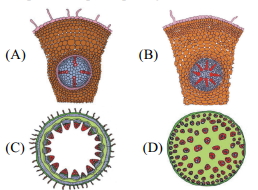
Casparian strip and passage cells are observed in $:-$
A
$A, B \ \&\ C$
B
$C \ \&\ D$
C
Only $A$
D
$A \ \&\ B$
Solution
(D) The Casparian strip and passage cells are characteristic features of the endodermis in roots.
In the provided image:
- $(A)$ represents a Dicot root.
- $(B)$ represents a Monocot root.
- $(C)$ represents a Dicot stem.
- $(D)$ represents a Monocot stem.
Both Casparian strips (suberin deposits) and passage cells (thin-walled cells) are found in the endodermis of roots (both Dicot and Monocot). Therefore,they are observed in both $(A)$ and $(B)$.
In the provided image:
- $(A)$ represents a Dicot root.
- $(B)$ represents a Monocot root.
- $(C)$ represents a Dicot stem.
- $(D)$ represents a Monocot stem.
Both Casparian strips (suberin deposits) and passage cells (thin-walled cells) are found in the endodermis of roots (both Dicot and Monocot). Therefore,they are observed in both $(A)$ and $(B)$.
0 likes
View Solution152
MediumMCQ
On the basis of the number of xylem bundles,the maize root is termed as:
A
Polyarch
B
Tetrarch
C
Diarch
D
Triarch
Solution
(A) In monocot roots like maize,the number of xylem bundles is usually more than six,which is typically referred to as polyarch condition.
In contrast,dicot roots generally exhibit diarch,triarch,or tetrarch conditions.
Therefore,based on the number of xylem bundles,the maize root is termed as polyarch.
In contrast,dicot roots generally exhibit diarch,triarch,or tetrarch conditions.
Therefore,based on the number of xylem bundles,the maize root is termed as polyarch.
0 likes
View Solution153
EasyMCQ
Which of the following is a stelar tissue in the primary internal structure of dicotyledonous root but not a stelar tissue in the primary internal structure of dicotyledonous stem?
A
Pericycle
B
Conjunctive tissue
C
Vascular bundle
D
Pith
Solution
(B) In the primary internal structure of a dicotyledonous root,the stele consists of the pericycle,vascular bundles,and conjunctive tissue (parenchyma between xylem and phloem).
In the primary internal structure of a dicotyledonous stem,the stele consists of the pericycle,vascular bundles,and pith.
Conjunctive tissue is a characteristic feature of the root stele and is absent in the stem.
Therefore,conjunctive tissue is a stelar tissue in the dicot root but not in the dicot stem.
In the primary internal structure of a dicotyledonous stem,the stele consists of the pericycle,vascular bundles,and pith.
Conjunctive tissue is a characteristic feature of the root stele and is absent in the stem.
Therefore,conjunctive tissue is a stelar tissue in the dicot root but not in the dicot stem.
0 likes
View Solution154
EasyMCQ
Lateral roots initiate from
A
Endodermis
B
Cortex
C
Epidermis
D
Pericycle
Solution
(D) In dicotyledonous roots,the lateral roots originate from the $Pericycle$ cells.
These cells are located just inside the $Endodermis$.
When the plant needs to develop lateral roots,the cells of the $Pericycle$ undergo rapid cell division (meristematic activity) to form a root primordium.
This primordium then pushes through the $Endodermis$,$Cortex$,and $Epidermis$ to emerge as a lateral root.
Therefore,the origin of lateral roots is endogenous.
These cells are located just inside the $Endodermis$.
When the plant needs to develop lateral roots,the cells of the $Pericycle$ undergo rapid cell division (meristematic activity) to form a root primordium.
This primordium then pushes through the $Endodermis$,$Cortex$,and $Epidermis$ to emerge as a lateral root.
Therefore,the origin of lateral roots is endogenous.
0 likes
View Solution155
EasyMCQ
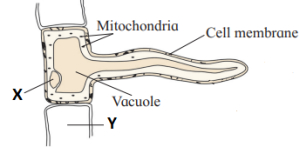
The following diagram shows the internal structure of a root hair. Identify the parts labelled as $X$ and $Y$.
A
$X$-Nucleus, $Y$-Root epithelial cell
B
$X$-Cytoplasm, $Y$-Root epithelial cell
C
$X$-Nucleus, $Y$-Cell wall
D
$X$-Root epithelial cell, $Y$-Nucleus
Solution
(C) In the provided diagram of a root hair cell:
$1$. The label $X$ points to the dense, spherical organelle located within the cell, which is the $Nucleus$.
$2$. The label $Y$ points to the outer boundary of the adjacent cell, which is the $Cell wall$.
Therefore, $X$ represents the $Nucleus$ and $Y$ represents the $Cell wall$.
$1$. The label $X$ points to the dense, spherical organelle located within the cell, which is the $Nucleus$.
$2$. The label $Y$ points to the outer boundary of the adjacent cell, which is the $Cell wall$.
Therefore, $X$ represents the $Nucleus$ and $Y$ represents the $Cell wall$.
0 likes
View Solution156
EasyMCQ
The endodermal cells show Casparian strips made up of . . . . . . .
A
cellulose
B
cutin
C
suberin
D
pectin
Solution
(C) The endodermis is the innermost layer of the cortex in roots.
It is characterized by the presence of Casparian strips on its radial and tangential walls.
These strips are composed of a water-impermeable,waxy substance called $suberin$.
$Suberin$ prevents the movement of water and dissolved solutes through the cell walls,forcing them to pass through the plasma membrane into the cytoplasm,which allows the plant to regulate the uptake of water and minerals.
It is characterized by the presence of Casparian strips on its radial and tangential walls.
These strips are composed of a water-impermeable,waxy substance called $suberin$.
$Suberin$ prevents the movement of water and dissolved solutes through the cell walls,forcing them to pass through the plasma membrane into the cytoplasm,which allows the plant to regulate the uptake of water and minerals.
0 likes
View Solution157
EasyMCQ
Conjunctive tissue is present between $(i)$ and (ii) in (iii).
A
$(i)$ Pericycle (ii) Endodermis (iii) Dicot root
B
$(i)$ Xylem (ii) Phloem (iii) Dicot root
C
$(i)$ Palisade parenchyma (ii) Spongy parenchyma (iii) Dicot root
D
$(i)$ Xylem (ii) Palisade parenchyma (iii) Dicot root
Solution
(B) The correct answer is $B$.
In the anatomy of a dicotyledonous root,the parenchymatous cells that are located between the xylem and phloem vascular bundles are specifically referred to as conjunctive tissue.
These cells play a role in the storage of food and can sometimes become meristematic during secondary growth.
In the anatomy of a dicotyledonous root,the parenchymatous cells that are located between the xylem and phloem vascular bundles are specifically referred to as conjunctive tissue.
These cells play a role in the storage of food and can sometimes become meristematic during secondary growth.
0 likes
View Solution158
EasyMCQ
The secondary wall material suberin is deposited on the walls of
A
pericycle of stem and endodermis of root
B
phellem of stem and endodermis of root
C
epidermis of stem and endodermis of root
D
phellogen and phelloderm
Solution
(B) The correct answer is $B$.
Suberin is a hydrophobic,waxy substance that provides protection and prevents water loss.
It is characteristically deposited in the cell walls of the $phellem$ (cork) cells in the stem,which are part of the periderm.
Additionally,it is deposited in the radial and tangential walls of the $endodermis$ of the root,forming the Casparian strips,which regulate the movement of water and solutes into the vascular cylinder.
Suberin is a hydrophobic,waxy substance that provides protection and prevents water loss.
It is characteristically deposited in the cell walls of the $phellem$ (cork) cells in the stem,which are part of the periderm.
Additionally,it is deposited in the radial and tangential walls of the $endodermis$ of the root,forming the Casparian strips,which regulate the movement of water and solutes into the vascular cylinder.
0 likes
View Solution159
MediumMCQ
Match List-$I$ with List-$II$ :
Choose the correct answer from the options given below :
| List-$I$ | List-$II$ |
| $A$. Conjunctive tissue | $I$. Specialised cells in the vicinity of guard cells |
| $B$. Casparian strips | $II$. Endodermal cells rich in starch |
| $C$. Subsidiary cells | $III$. Tissue between xylem and phloem |
| $D$. Starch sheath | $IV$. Endodermal cells with suberin deposition |
Choose the correct answer from the options given below :
A
$A-IV, B-III, C-II, D-I$
B
$A-III, B-IV, C-I, D-II$
C
$A-IV, B-III, C-I, D-II$
D
$A-III, B-IV, C-II, D-I$
Solution
(B) . Conjunctive tissue is the parenchymatous tissue present between the xylem and phloem bundles in roots $(III)$.
$B$. Casparian strips are the water-impermeable bands of suberin found in the endodermal cells $(IV)$.
$C$. Subsidiary cells are specialized epidermal cells that surround the guard cells of the stomata $(I)$.
$D$. Starch sheath refers to the endodermis of the stem,which is rich in starch grains $(II)$.
Therefore,the correct matching is $A-III, B-IV, C-I, D-II$.
$B$. Casparian strips are the water-impermeable bands of suberin found in the endodermal cells $(IV)$.
$C$. Subsidiary cells are specialized epidermal cells that surround the guard cells of the stomata $(I)$.
$D$. Starch sheath refers to the endodermis of the stem,which is rich in starch grains $(II)$.
Therefore,the correct matching is $A-III, B-IV, C-I, D-II$.
0 likes
View SolutionAnatomy of Flowering Plants — Internal structure of root · Frequently Asked Questions
1Are these Anatomy of Flowering Plants questions useful for JEE and NEET?
Yes. All questions in this section are mapped to JEE Main and NEET exam patterns. Previous year questions from JEE Main, NEET, GUJCET and state-level exams are included with full solutions.
2Can I switch to Hindi or Gujarati for these questions?
Yes. Use the language tabs in the hero section or the sidebar to view the same questions and solutions in English, Hindi or Gujarati.
3How do I generate a question paper from this subtopic?
Use the Vedclass Exam Paper Generator — select the chapter and subtopic, set difficulty, and generate Sets A, B, C, D automatically. First 3 chapters of every subject are free.
Vedclass Products
For Students
Vedclass Test Series
Mock tests in real JEE/NEET style with performance analysis. 5-day free trial.
Start Free TrialFor Teachers
Exam Paper Generator
Generate Set A/B/C/D papers from this chapter in 2 minutes. 3 chapters free.
Try FreeFor Institutes
Online Exam Module
Live online exams with unlimited students, 360° analytics & white-label branding.
See DemoFor Teachers & Institutes
Generate a Anatomy of Flowering Plants Exam Paper in 2 Minutes
Select subtopic & difficulty — Sets A, B, C, D auto-generated with No Repeat logic.
First 3 chapters of every subject are free — no payment required.