
A English
Internal structure of root Questions in English
Class 11 Biology · Anatomy of Flowering Plants · Internal structure of root
159+
Questions
English
Language
100%
With Solutions
Showing 48 of 159 questions in English
51
MediumMCQ
In which order does the development of xylem occur?
A
Centripetal
B
Centrifugal
C
Exarch
D
Both $(A)$ and $(B)$
Solution
(D) The development of xylem occurs in two main patterns based on the position of protoxylem and metaxylem:
$1$. Centripetal: In this type,the protoxylem is located towards the periphery and the metaxylem towards the center. This is characteristic of roots (exarch condition).
$2$. Centrifugal: In this type,the protoxylem is located towards the center and the metaxylem towards the periphery. This is characteristic of stems (endarch condition).
Therefore,the development of xylem can occur in both these orders.
$1$. Centripetal: In this type,the protoxylem is located towards the periphery and the metaxylem towards the center. This is characteristic of roots (exarch condition).
$2$. Centrifugal: In this type,the protoxylem is located towards the center and the metaxylem towards the periphery. This is characteristic of stems (endarch condition).
Therefore,the development of xylem can occur in both these orders.
0 likes
View Solution52
MediumMCQ
What is the layer of cells located between the endodermis and the vascular bundle called?
A
Cortex
B
Pith
C
Pericycle
D
Epidermis
Solution
(C) The $Pericycle$ is a layer of cells that lies between the endodermis and the vascular bundles in the roots of plants. It is typically composed of parenchyma cells and plays a crucial role in the initiation of lateral roots and secondary growth.
0 likes
View Solution53
MediumMCQ
In terms of anatomy,a mature dicot root is distinguished from a dicot stem by the presence of:
A
Position of protoxylem
B
Absence of secondary xylem
C
Absence of secondary phloem
D
Presence of cortex
Solution
(A) In dicot roots,the protoxylem is exarch,meaning the protoxylem is located towards the periphery and the metaxylem towards the center. In contrast,in dicot stems,the protoxylem is endarch,meaning the protoxylem is located towards the center and the metaxylem towards the periphery. This difference in the arrangement of xylem is a key anatomical feature used to distinguish between dicot roots and dicot stems.
0 likes
View Solution54
EasyMCQ
How many histogens are present in the root apex of dicots?
A
Four
B
One
C
Three
D
Two
Solution
(C) According to the Histogen theory proposed by Hanstein,the root apex of dicotyledonous plants consists of three distinct layers of meristematic cells,known as histogens:
$1$. Dermatogen: The outermost layer that gives rise to the epidermis (epiblema).
$2$. Periblem: The middle layer that develops into the cortex.
$3$. Plerome: The innermost core that forms the stele (vascular cylinder).
Therefore,there are $3$ histogens present in the root apex of dicots.
$1$. Dermatogen: The outermost layer that gives rise to the epidermis (epiblema).
$2$. Periblem: The middle layer that develops into the cortex.
$3$. Plerome: The innermost core that forms the stele (vascular cylinder).
Therefore,there are $3$ histogens present in the root apex of dicots.
0 likes
View Solution55
MediumMCQ
The layer of suberized cells found just below the epidermis in the roots of some plants is called:
A
Exodermis
B
Hypodermis
C
Epiblema
D
Endodermis
Solution
(A) In the roots of many plants,the layer of cells immediately below the epidermis (epiblema) becomes suberized to form a protective layer known as the $Exodermis$. This layer acts as a barrier to water loss and provides protection against pathogens. It is distinct from the $Endodermis$,which is located deeper in the root cortex.
0 likes
View Solution56
MediumMCQ
Dicot roots are distinguished from monocot roots by the presence of:
A
Open vascular bundles
B
Scattered vascular bundles
C
Large pith
D
Radial vascular bundles
Solution
(C) In dicot roots,the number of vascular bundles is typically $2$ to $4$,and the pith is either very small or absent.
In contrast,monocot roots possess a polyarch condition (more than $6$ vascular bundles) and have a large,well-developed pith.
Therefore,the presence of a large pith is a characteristic feature of monocot roots that distinguishes them from dicot roots.
In contrast,monocot roots possess a polyarch condition (more than $6$ vascular bundles) and have a large,well-developed pith.
Therefore,the presence of a large pith is a characteristic feature of monocot roots that distinguishes them from dicot roots.
0 likes
View Solution57
MediumMCQ
Pith is absent in $...........$.
A
Mesophytes
B
Hydrophytes
C
Epiphytes
D
Xerophytes
Solution
(B) The pith (medulla) is the central part of the stem or root,composed of parenchyma cells. In many monocot roots and some dicot roots,the pith is either very small or completely absent. Among the given options,the pith is typically absent in the roots of monocotyledonous plants. However,in the context of general plant anatomy questions regarding the absence of pith,it is often noted that pith is absent in the roots of many monocots. Among the provided choices,if we consider the standard anatomical structure,the pith is absent in the roots of monocots. Since the options provided are ecological categories,it is important to note that in many monocot roots,the pith is absent. Therefore,the most appropriate answer in this context is the root structure of monocots,which is often associated with these categories.
0 likes
View Solution58
MediumMCQ
How many histogens are present in the root apex of monocotyledonous plants?
A
$1$
B
$2$
C
$3$
D
$4$
Solution
(C) According to the Histogen theory proposed by Hanstein,the root apex of most angiosperms consists of three distinct histogens:
$1$. Dermatogen: The outermost layer that gives rise to the epidermis (epiblema in roots).
$2$. Periblem: The middle layer that develops into the cortex.
$3$. Plerome: The central core that gives rise to the stele (vascular cylinder).
In monocotyledonous plants,these three histogens are clearly distinguishable at the root apex.
$1$. Dermatogen: The outermost layer that gives rise to the epidermis (epiblema in roots).
$2$. Periblem: The middle layer that develops into the cortex.
$3$. Plerome: The central core that gives rise to the stele (vascular cylinder).
In monocotyledonous plants,these three histogens are clearly distinguishable at the root apex.
0 likes
View Solution59
MediumMCQ
Exarch protoxylem is found in .........
A
Osmunda and Equisetum
B
Adiantum and Cucurbitaceae
C
Marsilea and Botrychium
D
Dicksonia and Maidenhair fern
Solution
(A) In plants,the arrangement of xylem is classified based on the position of protoxylem relative to metaxylem.
In $Exarch$ condition,the protoxylem is situated towards the periphery and the metaxylem towards the center.
This arrangement is a characteristic feature of roots in vascular plants.
$Osmunda$ and $Equisetum$ are pteridophytes that exhibit $Exarch$ protoxylem in their roots.
Therefore,the correct option is $A$.
In $Exarch$ condition,the protoxylem is situated towards the periphery and the metaxylem towards the center.
This arrangement is a characteristic feature of roots in vascular plants.
$Osmunda$ and $Equisetum$ are pteridophytes that exhibit $Exarch$ protoxylem in their roots.
Therefore,the correct option is $A$.
0 likes
View Solution60
MediumMCQ
When the protoxylem is located towards the periphery,the arrangement is called:
A
Endarch
B
Mesarch
C
Exarch
D
Polyarch
Solution
(C) In plant anatomy,the arrangement of xylem is classified based on the position of the protoxylem relative to the metaxylem.
When the protoxylem is situated towards the periphery (outer side) and the metaxylem is towards the center (inner side),the condition is known as $Exarch$.
This arrangement is a characteristic feature of roots in angiosperms.
Conversely,$Endarch$ is when the protoxylem is towards the center,which is typical of stems.
When the protoxylem is situated towards the periphery (outer side) and the metaxylem is towards the center (inner side),the condition is known as $Exarch$.
This arrangement is a characteristic feature of roots in angiosperms.
Conversely,$Endarch$ is when the protoxylem is towards the center,which is typical of stems.
0 likes
View Solution61
EasyMCQ
Casparian strips are present in the ........
A
Endodermis
B
Pericycle
C
Epidermis
D
Cortex
Solution
(A) The Casparian strip is a band of cell wall material deposited in the radial and transverse walls of the endodermis.
It is composed of suberin and sometimes lignin,which is water-repellent and prevents the apoplastic movement of water and solutes into the vascular cylinder.
Therefore,the correct answer is the endodermis.
It is composed of suberin and sometimes lignin,which is water-repellent and prevents the apoplastic movement of water and solutes into the vascular cylinder.
Therefore,the correct answer is the endodermis.
0 likes
View Solution62
MediumMCQ
In a dicot root,the vascular bundles are:
A
scattered with cambium.
B
arranged in a ring with cambium.
C
radial,with xylem and phloem arranged in alternating radii.
D
always endarch.
Solution
(C) In the internal structure of a dicot root,the vascular bundles are of the radial type. This means that the xylem and phloem tissues are arranged in an alternating manner on different radii. In a dicot root,the xylem is always of the exarch type,where the protoxylem is situated towards the periphery and the metaxylem is towards the center. Therefore,the correct option is $C$.
0 likes
View Solution63
MediumMCQ
How does a monocot root differ from a dicot root?
A
Presence of piliferous layer
B
Presence of exodermis
C
Presence of a poorly developed pith
D
Presence of separate radial vascular bundles
Solution
(C) In dicot roots,the pith is generally small or inconspicuous.
In contrast,monocot roots possess a large and well-developed pith.
Therefore,the presence of a large,well-developed pith is a characteristic feature that distinguishes monocot roots from dicot roots,where the pith is either absent or very poorly developed.
In contrast,monocot roots possess a large and well-developed pith.
Therefore,the presence of a large,well-developed pith is a characteristic feature that distinguishes monocot roots from dicot roots,where the pith is either absent or very poorly developed.
0 likes
View Solution64
EasyMCQ
Radial vascular bundles are found in .........
A
Dicot roots only
B
Monocot roots only
C
Dicot stems only
D
Roots of all vascular plants
Solution
(D) In radial vascular bundles,the xylem and phloem are arranged in an alternate manner on different radii. This type of vascular bundle is a characteristic feature of roots in all vascular plants,including both monocots and dicots.
0 likes
View Solution65
MediumMCQ
Dicot roots are distinguished from monocot roots by the presence of:
A
Exarch xylem
B
$2-4$ xylem bundles
C
$> 6$ xylem bundles
D
Large and well-developed pith
Solution
(B) In dicot roots,the number of xylem bundles is typically limited,usually ranging from $2$ to $4$ (diarch to tetrarch).
In contrast,monocot roots typically possess a polyarch condition,meaning they have more than $6$ xylem bundles.
Additionally,monocot roots are characterized by a large and well-developed pith,which is either absent or very small in dicot roots.
Therefore,the presence of $2-4$ xylem bundles is a key diagnostic feature used to distinguish dicot roots from monocot roots.
In contrast,monocot roots typically possess a polyarch condition,meaning they have more than $6$ xylem bundles.
Additionally,monocot roots are characterized by a large and well-developed pith,which is either absent or very small in dicot roots.
Therefore,the presence of $2-4$ xylem bundles is a key diagnostic feature used to distinguish dicot roots from monocot roots.
0 likes
View Solution66
MediumMCQ
In .......,there are fewer than six radial vascular bundles.
A
Monocot stem
B
Dicot stem
C
Monocot root
D
Dicot root
Solution
(D) In plants,the number of vascular bundles in the root is used to classify them.
In a $Dicot$ root,the xylem bundles are usually two to four in number (diarch to tetrarch).
In a $Monocot$ root,the xylem bundles are usually more than six in number (polyarch).
Since the question specifies fewer than six radial vascular bundles,it refers to the $Dicot$ root.
In a $Dicot$ root,the xylem bundles are usually two to four in number (diarch to tetrarch).
In a $Monocot$ root,the xylem bundles are usually more than six in number (polyarch).
Since the question specifies fewer than six radial vascular bundles,it refers to the $Dicot$ root.
0 likes
View Solution67
MediumMCQ
In exarch xylem,the development of xylem is:
A
Centripetal
B
Centrifugal
C
Both centripetal and centrifugal
D
Irregular
Solution
(A) In exarch xylem,the protoxylem lies towards the periphery and the metaxylem lies towards the center. This arrangement results in the development of xylem towards the center,which is known as centripetal development. This is a characteristic feature of roots in angiosperms.
0 likes
View Solution68
MediumMCQ
Cortex is the region found between
A
epidermis and stele
B
pericycle and endodermis
C
endodermis and pith
D
endodermis and vascular bundle
Solution
(A) In the anatomy of dicotyledonous stems and roots,the cortex is the ground tissue located between the epidermis (the outermost layer) and the stele (the central part of the stem or root,which includes the pericycle,vascular bundles,and pith).
Therefore,the cortex acts as the layer between the epidermis and the stele.
Therefore,the cortex acts as the layer between the epidermis and the stele.
0 likes
View Solution69
MediumMCQ
$A$ major characteristic of $monocot$ root is the presence of
A
vasculature without $cambium$
B
$cambium$ sandwiched between $phloem$ and $xylem$ along the radius
C
open vascular bundles
D
scattered vascular bundles
Solution
(A) The correct answer is $A$.
In $monocot$ roots, the vascular bundles are radial, meaning $xylem$ and $phloem$ are arranged in separate patches along different radii.
$A$ key feature is that these vascular bundles are 'closed', which means there is no $cambium$ present between the $xylem$ and $phloem$.
Because $cambium$ is absent, $monocot$ roots do not undergo secondary growth.
In $monocot$ roots, the vascular bundles are radial, meaning $xylem$ and $phloem$ are arranged in separate patches along different radii.
$A$ key feature is that these vascular bundles are 'closed', which means there is no $cambium$ present between the $xylem$ and $phloem$.
Because $cambium$ is absent, $monocot$ roots do not undergo secondary growth.
0 likes
View Solution70
MediumMCQ
You are given a fairly old piece of dicot stem and a dicot root. Which of the following anatomical structures will you use to distinguish between the two?
A
Secondary xylem
B
Secondary phloem
C
Protoxylem
D
Cortical cells
Solution
(C) : In stems,the protoxylem lies towards the centre (pith) and the metaxylem lies towards the periphery. This type of primary xylem arrangement is called $endarch$. In roots,the protoxylem lies towards the periphery and the metaxylem lies towards the centre; such an arrangement is called $exarch$.
0 likes
View Solution71
MediumMCQ
As compared to a dicot root,a monocot root has
A
more abundant secondary xylem
B
many xylem bundles
C
inconspicuous annual rings
D
relatively thicker periderm
Solution
(B) : In monocot roots,secondary growth is absent,and the vascular cylinder consists of several alternate and radial xylem and phloem bundles. The vascular bundles are arranged in a ring around the central pith. Their number in maize ranges between $20-30$,whereas in Pandanus and palms,they may be up to $100$. Because of the presence of numerous xylem bundles and the exarch condition,the xylem of a monocot root is polyarch. On the other hand,in dicot roots,xylem and phloem are equal in number $(2-6)$ and are alternately arranged,i.e.,they lie on different radii,hence called radial bundles. Depending on the number of rays (equivalent to the number of xylem or phloem bundles),the roots may be diarch,triarch,tetrarch,pentarch,or hexarch.
0 likes
View Solution72
MediumMCQ
Anatomically,a fairly old dicotyledonous root is distinguished from a dicotyledonous stem by
A
absence of secondary phloem
B
presence of cortex
C
position of protoxylem
D
absence of secondary xylem
Solution
(C) The correct answer is $C$.
In a dicotyledonous root,the protoxylem is located near the periphery of the vascular cylinder,while the metaxylem is located further inward. This arrangement is known as $exarch$ or centripetal xylem.
In contrast,in a dicotyledonous stem,the protoxylem is located near the center of the vascular bundle,and the metaxylem is located near the periphery. This arrangement is known as $endarch$ or centrifugal xylem.
Therefore,the position of the protoxylem is a key anatomical feature used to distinguish between a dicot root and a dicot stem.
In a dicotyledonous root,the protoxylem is located near the periphery of the vascular cylinder,while the metaxylem is located further inward. This arrangement is known as $exarch$ or centripetal xylem.
In contrast,in a dicotyledonous stem,the protoxylem is located near the center of the vascular bundle,and the metaxylem is located near the periphery. This arrangement is known as $endarch$ or centrifugal xylem.
Therefore,the position of the protoxylem is a key anatomical feature used to distinguish between a dicot root and a dicot stem.
0 likes
View Solution73
MediumMCQ
Passage cells are thin-walled cells found in
A
phloem elements that serve as entry points for substances for transport to other plant parts
B
testa of seeds to enable emergence of growing embryonic axis during seed germination
C
central region of style through which the pollen tube grows towards the ovary
D
endodermis of roots facilitating rapid transport of water from cortex to pericycle
Solution
(D) : Endodermis is a single-layered structure that separates the cortex from the stele.
There are both thick-walled and thin-walled cells in the endodermis.
The thin-walled cells are known as passage cells or transfusion cells,which are located opposite the protoxylem groups.
These cells facilitate the rapid transport of water from the cortex to the pericycle.
There are both thick-walled and thin-walled cells in the endodermis.
The thin-walled cells are known as passage cells or transfusion cells,which are located opposite the protoxylem groups.
These cells facilitate the rapid transport of water from the cortex to the pericycle.
0 likes
View Solution74
MediumMCQ
Water does not pass through which of the following structures due to the presence of suberin?
A
Cortex
B
Root hair
C
Casparian strip
D
Xylem
Solution
(C) The $Casparian$ $strip$ is a band of cell wall material deposited in the radial and transverse walls of the endodermis in roots.
It is composed of $suberin$,a water-impermeable,waxy substance.
Because of this $suberin$ deposition,water cannot pass through the $Casparian$ $strip$ via the apoplastic pathway.
Therefore,water is forced to enter the cytoplasm of the endodermal cells to cross this barrier,which is known as the symplastic pathway.
It is composed of $suberin$,a water-impermeable,waxy substance.
Because of this $suberin$ deposition,water cannot pass through the $Casparian$ $strip$ via the apoplastic pathway.
Therefore,water is forced to enter the cytoplasm of the endodermal cells to cross this barrier,which is known as the symplastic pathway.
0 likes
View Solution75
EasyMCQ
What is the location of the Casparian strip?
A
Xylem
B
Cells of cortex
C
Cells of pericycle
D
Endodermis
Solution
(D) The Casparian strip is a band of cell wall material deposited in the radial and transverse walls of the endodermis in roots.
It is composed of suberin,a water-impermeable waxy substance.
This strip blocks the apoplastic pathway of water movement,forcing water to enter the symplastic pathway to reach the vascular cylinder (stele).
Therefore,the correct location is the endodermis.
It is composed of suberin,a water-impermeable waxy substance.
This strip blocks the apoplastic pathway of water movement,forcing water to enter the symplastic pathway to reach the vascular cylinder (stele).
Therefore,the correct location is the endodermis.
0 likes
View Solution76
MediumMCQ
The pericycle is defined as:
A
The region between the endodermis and the cortex.
B
The area immediately below the epidermis.
C
$A$ few layers of thick-walled parenchymatous cells lying next to the endodermis.
D
$A$ layer characterized by the presence of Casparian strips.
Solution
(C) In the anatomy of dicot roots,the pericycle is a layer of cells located between the endodermis and the vascular bundles.
It consists of a few layers of thick-walled parenchymatous cells.
These cells are responsible for the initiation of lateral roots and the secondary growth of the root.
Therefore,option $C$ is the correct description.
It consists of a few layers of thick-walled parenchymatous cells.
These cells are responsible for the initiation of lateral roots and the secondary growth of the root.
Therefore,option $C$ is the correct description.
0 likes
View Solution77
MediumMCQ
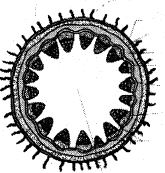
Identify the figure:
A
$T$. $S$. of monocot stem
B
$T$. $S$. of dicot stem
C
$T$. $S$. of dicot root
D
$T$. $S$. of monocot root
Solution
(D) The provided figure shows a transverse section $(T.S.)$ of a root with numerous vascular bundles arranged in a ring,which is a characteristic feature of a monocot root.
Key identification features include:
$1$. Presence of root hairs on the epidermis.
$2$. $A$ well-developed cortex.
$3$. $A$ distinct endodermis and pericycle.
$4$. Polyarch vascular bundles (more than six xylem bundles),which is typical for monocot roots.
Therefore,the figure represents a $T.S.$ of a monocot root.
Key identification features include:
$1$. Presence of root hairs on the epidermis.
$2$. $A$ well-developed cortex.
$3$. $A$ distinct endodermis and pericycle.
$4$. Polyarch vascular bundles (more than six xylem bundles),which is typical for monocot roots.
Therefore,the figure represents a $T.S.$ of a monocot root.
0 likes
View Solution78
MediumMCQ
Which of the following is absent in the root of a plant?
A
Cortex
B
Vascular bundle
C
Pith
D
Cuticle
Solution
(D) In the anatomy of flowering plants,the root system is characterized by the absence of a cuticle on the epidermis (which is called epiblema or piliferous layer) to facilitate the absorption of water and minerals. While the cortex and vascular bundles are present in roots,the pith is often reduced or absent in dicot roots but present in monocot roots. However,the most distinct and universal feature among the given options that is absent in the root epidermis is the cuticle.
0 likes
View Solution79
MediumMCQ
Exarch primary xylem is found in ........
A
Root
B
Stem
C
Leaf
D
All given
Solution
(A) In plants,the arrangement of primary xylem is classified based on the position of the protoxylem relative to the metaxylem.
Exarch condition is defined as the arrangement where the protoxylem is situated towards the periphery and the metaxylem is towards the center (pith).
This type of xylem arrangement is a characteristic feature of the roots of angiosperms and gymnosperms.
In contrast,stems typically exhibit an endarch condition,where the protoxylem is towards the center and the metaxylem is towards the periphery.
Exarch condition is defined as the arrangement where the protoxylem is situated towards the periphery and the metaxylem is towards the center (pith).
This type of xylem arrangement is a characteristic feature of the roots of angiosperms and gymnosperms.
In contrast,stems typically exhibit an endarch condition,where the protoxylem is towards the center and the metaxylem is towards the periphery.
0 likes
View Solution80
MediumMCQ
$A$ major characteristic of the monocot root is the presence of
A
Scattered vascular bundles
B
Vasculature without cambium
C
Cambium sandwiched between phloem and xylem along the radius
D
Open vascular bundles
Solution
(B) The vascular bundles in monocot roots are radial,meaning xylem and phloem are arranged in an alternating manner on different radii.
In monocot roots,the vascular bundles are closed,which means they lack cambium between the xylem and phloem.
Because there is no cambium,monocot roots do not undergo secondary growth.
Therefore,the presence of vasculature without cambium is a major characteristic of the monocot root.
In monocot roots,the vascular bundles are closed,which means they lack cambium between the xylem and phloem.
Because there is no cambium,monocot roots do not undergo secondary growth.
Therefore,the presence of vasculature without cambium is a major characteristic of the monocot root.
0 likes
View Solution81
MediumMCQ
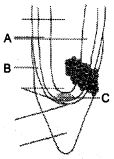
Identify $A, B$ and $C$ indicated in the diagram.
A
$A$-Cortex,$B$-Epidermis,$C$-Root apical meristem
B
$A$-Vascular bundle,$B$-Epidermis,$C$-Root apical meristem
C
$A$-Cortex,$B$-Protoderm,$C$-Root apical meristem
D
$A$-Cortex,$B$-Capitalization,$C$-Cellulose
Solution
(A) The provided diagram represents the longitudinal section of a root tip.
$A$ points to the region of the cortex,which is the ground tissue located between the epidermis and the vascular cylinder.
$B$ points to the outermost layer of the root,known as the epidermis (or epiblema).
$C$ points to the root apical meristem,which is the region of actively dividing cells at the tip of the root responsible for primary growth.
Therefore,the correct identification is $A$-Cortex,$B$-Epidermis,$C$-Root apical meristem.
$A$ points to the region of the cortex,which is the ground tissue located between the epidermis and the vascular cylinder.
$B$ points to the outermost layer of the root,known as the epidermis (or epiblema).
$C$ points to the root apical meristem,which is the region of actively dividing cells at the tip of the root responsible for primary growth.
Therefore,the correct identification is $A$-Cortex,$B$-Epidermis,$C$-Root apical meristem.
0 likes
View Solution82
MediumMCQ
As compared to the dicot root,monocotyledon root has:
A
more xylem bundles
B
more phloem bundles
C
less phloem bundles
D
less xylem bundles
Solution
(A) In dicot roots,the number of xylem bundles is usually limited,typically ranging from $2$ to $4$ (diarch to tetrarch).
In contrast,monocot roots exhibit a polyarch condition,where the number of xylem bundles is significantly higher,usually more than $6$.
Therefore,compared to the dicot root,the monocot root has more xylem bundles.
In contrast,monocot roots exhibit a polyarch condition,where the number of xylem bundles is significantly higher,usually more than $6$.
Therefore,compared to the dicot root,the monocot root has more xylem bundles.
0 likes
View Solution83
EasyMCQ
Where are the Casparian strips found?
A
Epidermis
B
Endodermis
C
Pericycle
D
Phloem
Solution
(B) The Casparian strips are characteristic features of the endodermis in the roots of vascular plants.
These are bands of suberin-impregnated cell wall material that prevent the apoplastic movement of water and solutes into the vascular cylinder.
Therefore,the correct option is $B$.
These are bands of suberin-impregnated cell wall material that prevent the apoplastic movement of water and solutes into the vascular cylinder.
Therefore,the correct option is $B$.
0 likes
View Solution84
MediumMCQ
The pericycle of the root gives rise to .............. .
A
Mechanical support
B
Lateral roots
C
Vascular bundles
D
Adventitious buds
Solution
(B) In dicotyledonous roots,the pericycle is the layer of cells located inside the endodermis.
It is responsible for the initiation of lateral roots and part of the vascular cambium during secondary growth.
Therefore,the pericycle gives rise to lateral roots.
It is responsible for the initiation of lateral roots and part of the vascular cambium during secondary growth.
Therefore,the pericycle gives rise to lateral roots.
0 likes
View Solution85
MediumMCQ
Tetrarch vascular bundles are found in ...............
A
Dicot root
B
Monocot root
C
Dicot stem
D
Monocot stem
Solution
(A) In plants,the number of vascular bundles in the root varies based on the type of plant.
$1$. Dicot roots typically exhibit a radial vascular arrangement with a limited number of xylem bundles,usually ranging from $2$ to $4$ (diarch to tetrarch).
$2$. Monocot roots,on the other hand,are polyarch,meaning they possess more than $6$ xylem bundles.
$3$. Stems generally have conjoint vascular bundles,not radial ones.
Therefore,tetrarch vascular bundles are characteristic of dicot roots.
$1$. Dicot roots typically exhibit a radial vascular arrangement with a limited number of xylem bundles,usually ranging from $2$ to $4$ (diarch to tetrarch).
$2$. Monocot roots,on the other hand,are polyarch,meaning they possess more than $6$ xylem bundles.
$3$. Stems generally have conjoint vascular bundles,not radial ones.
Therefore,tetrarch vascular bundles are characteristic of dicot roots.
0 likes
View Solution86
MediumMCQ
When roots or stems are $..........$, annular and spiral thickenings develop in the protoxylem vessels.
A
elongating
B
widening
C
differentiating
D
maturing
Solution
(A) In the development of xylem, the protoxylem elements are formed first. When the roots or stems are $elongating$, the primary xylem vessels develop annular (ring-like) or spiral (helical) thickenings. These types of thickenings allow the vessels to stretch as the organ grows in length. Once the organ stops elongating, the later-formed metaxylem develops more complex thickenings like scalariform, reticulate, or pitted patterns.
0 likes
View Solution87
MediumMCQ
Anatomically,a mature dicot root can be distinguished from a dicot stem by the:
A
Absence of secondary xylem
B
Absence of secondary phloem
C
Presence of cortex
D
Position of protoxylem
Solution
(D) In a dicot root,the protoxylem is situated towards the periphery,a condition known as $exarch$.
In contrast,in a dicot stem,the protoxylem is situated towards the center,a condition known as $endarch$.
Therefore,the position of the protoxylem is a key anatomical feature used to distinguish between a dicot root and a dicot stem.
In contrast,in a dicot stem,the protoxylem is situated towards the center,a condition known as $endarch$.
Therefore,the position of the protoxylem is a key anatomical feature used to distinguish between a dicot root and a dicot stem.
0 likes
View Solution88
MediumMCQ
The cortex is found between which of the following?
A
Endodermis and pith
B
Endodermis and vascular bundles
C
Epidermis and stele
D
Pericycle and endodermis
Solution
(C) In the anatomy of dicot stems and roots,the cortex is the region located between the epidermis (the outermost layer) and the stele (the central part containing vascular tissues).
Therefore,the cortex is found between the epidermis and the stele.
Therefore,the cortex is found between the epidermis and the stele.
0 likes
View Solution89
EasyMCQ
Casparian strips occur in
A
Pericycle
B
Epidermis
C
Cortex
D
Endodermis
Solution
(D) Casparian strips are water-impermeable deposits of suberin found in the radial and tangential walls of the endodermal cells of roots.
These strips play a crucial role in regulating the flow of water and solutes into the vascular cylinder by forcing water to move through the symplastic pathway rather than the apoplastic pathway.
Therefore,the correct location for Casparian strips is the endodermis.
These strips play a crucial role in regulating the flow of water and solutes into the vascular cylinder by forcing water to move through the symplastic pathway rather than the apoplastic pathway.
Therefore,the correct location for Casparian strips is the endodermis.
0 likes
View Solution90
EasyMCQ
What is anatomy?
A
Study of external morphology
B
Study of internal structure of organisms
C
Study of plant physiology
D
Study of cell division
Solution
(B) $\rightarrow$ We can very easily see the structural similarities and variations in the external morphology of the larger living organisms. Similarly,in the internal structure,several similarities as well as differences are found.
$\rightarrow$ The study of the internal structure of plants is called anatomy.
$\rightarrow$ Plants have cells as the basic unit. Cells are organised into tissues and in turn,the tissues are organised into organs.
$\rightarrow$ Different organs in a plant show differences in their internal structure.
$\rightarrow$ Within angiosperms,the monocots and dicots are also seen to be anatomically different.
$\rightarrow$ Internal structures also show adaptations to diverse environments.
$\rightarrow$ The study of the internal structure of plants is called anatomy.
$\rightarrow$ Plants have cells as the basic unit. Cells are organised into tissues and in turn,the tissues are organised into organs.
$\rightarrow$ Different organs in a plant show differences in their internal structure.
$\rightarrow$ Within angiosperms,the monocots and dicots are also seen to be anatomically different.
$\rightarrow$ Internal structures also show adaptations to diverse environments.
0 likes
View Solution91
Easy
Describe the internal structure of a dicot root.
Solution
(N/A) $\rightarrow$ To understand the tissue organization of roots,stems,and leaves,it is convenient to study the transverse sections of the mature zones of these organs.
$\rightarrow$ Internal structure of a mature dicot root (e.g.,sunflower): When a transverse section of a dicot root is stained and viewed under a microscope,the following regions are observed from outside to inside:
$(1)$ Epidermis $(2)$ Cortex $(3)$ Endodermis $(4)$ Pericycle $(5)$ Vascular bundles $(6)$ Pith.
$\rightarrow$ Epidermis: The outermost layer consisting of thin-walled cells. Many epidermal cells protrude to form unicellular root hairs,which help in the absorption of water and minerals.
$\rightarrow$ Cortex: Consists of several layers of thin-walled parenchyma cells with intercellular spaces.
$\rightarrow$ Endodermis: The innermost layer of the cortex,comprising barrel-shaped cells without intercellular spaces. The radial and tangential walls contain water-impermeable,waxy suberin deposits known as Casparian strips.
$\rightarrow$ Pericycle: Layers of thick-walled parenchyma cells located next to the endodermis. It is the site for the initiation of lateral roots and vascular cambium during secondary growth.
$\rightarrow$ Vascular Bundles: Xylem and phloem are arranged in an alternating manner. The number of xylem and phloem patches is usually two to four (diarch to tetrarch). Conjunctive tissue (parenchyma) lies between the xylem and phloem.
$\rightarrow$ Pith: The central part of the root,which is usually small or inconspicuous in dicot roots.
$\rightarrow$ Internal structure of a mature dicot root (e.g.,sunflower): When a transverse section of a dicot root is stained and viewed under a microscope,the following regions are observed from outside to inside:
$(1)$ Epidermis $(2)$ Cortex $(3)$ Endodermis $(4)$ Pericycle $(5)$ Vascular bundles $(6)$ Pith.
$\rightarrow$ Epidermis: The outermost layer consisting of thin-walled cells. Many epidermal cells protrude to form unicellular root hairs,which help in the absorption of water and minerals.
$\rightarrow$ Cortex: Consists of several layers of thin-walled parenchyma cells with intercellular spaces.
$\rightarrow$ Endodermis: The innermost layer of the cortex,comprising barrel-shaped cells without intercellular spaces. The radial and tangential walls contain water-impermeable,waxy suberin deposits known as Casparian strips.
$\rightarrow$ Pericycle: Layers of thick-walled parenchyma cells located next to the endodermis. It is the site for the initiation of lateral roots and vascular cambium during secondary growth.
$\rightarrow$ Vascular Bundles: Xylem and phloem are arranged in an alternating manner. The number of xylem and phloem patches is usually two to four (diarch to tetrarch). Conjunctive tissue (parenchyma) lies between the xylem and phloem.
$\rightarrow$ Pith: The central part of the root,which is usually small or inconspicuous in dicot roots.
0 likes
View Solution92
Easy
Describe the internal structure of a sunflower root.
Solution
(N/A) $\rightarrow$ To understand the tissue organization of roots,stems,and leaves,it is convenient to study the transverse sections of the mature zones of these organs.
$\rightarrow$ Internal structure of a mature sunflower root: Sunflower is a dicotyledonous plant. When a transverse section of the sunflower root is stained with safranin,washed with water,and viewed under a microscope,the following regions are seen from outside to inside:
$(1)$ Epidermis $(2)$ Cortex $(3)$ Endodermis $(4)$ Pericycle $(5)$ Vascular bundles $(6)$ Pith.
$\rightarrow$ Epidermis: It is the outermost layer. Many epidermal cells protrude as unicellular root hairs. The cells are thin-walled and composed of cellulose. Its primary function is the absorption of water and mineral salts.
$\rightarrow$ Cortex: It consists of several layers of thin-walled parenchyma cells with intercellular spaces.
$\rightarrow$ Endodermis: It comprises a single layer of barrel-shaped cells without intercellular spaces. The tangential and radial walls have a deposition of water-impermeable,waxy material called suberin,forming Casparian strips.
$\rightarrow$ Pericycle: Located next to the endodermis,it consists of a few layers of thick-walled parenchymatous cells. Initiation of lateral roots and vascular cambium during secondary growth occurs here.
$\rightarrow$ Vascular Bundles: These are radial,with xylem and phloem arranged in an alternating manner. The number of xylem and phloem patches is usually two to four (diarch to tetrarch).
$\rightarrow$ Conjunctive Tissue: The parenchymatous cells lying between the xylem and phloem are called conjunctive tissue.
$\rightarrow$ Pith: In dicot roots,the pith is small or inconspicuous.
$\rightarrow$ Internal structure of a mature sunflower root: Sunflower is a dicotyledonous plant. When a transverse section of the sunflower root is stained with safranin,washed with water,and viewed under a microscope,the following regions are seen from outside to inside:
$(1)$ Epidermis $(2)$ Cortex $(3)$ Endodermis $(4)$ Pericycle $(5)$ Vascular bundles $(6)$ Pith.
$\rightarrow$ Epidermis: It is the outermost layer. Many epidermal cells protrude as unicellular root hairs. The cells are thin-walled and composed of cellulose. Its primary function is the absorption of water and mineral salts.
$\rightarrow$ Cortex: It consists of several layers of thin-walled parenchyma cells with intercellular spaces.
$\rightarrow$ Endodermis: It comprises a single layer of barrel-shaped cells without intercellular spaces. The tangential and radial walls have a deposition of water-impermeable,waxy material called suberin,forming Casparian strips.
$\rightarrow$ Pericycle: Located next to the endodermis,it consists of a few layers of thick-walled parenchymatous cells. Initiation of lateral roots and vascular cambium during secondary growth occurs here.
$\rightarrow$ Vascular Bundles: These are radial,with xylem and phloem arranged in an alternating manner. The number of xylem and phloem patches is usually two to four (diarch to tetrarch).
$\rightarrow$ Conjunctive Tissue: The parenchymatous cells lying between the xylem and phloem are called conjunctive tissue.
$\rightarrow$ Pith: In dicot roots,the pith is small or inconspicuous.
0 likes
View Solution93
Easy
Describe the internal structure of a monocot (Maize) root.
Solution
(D) The internal structure of a monocot root (e.g.,Maize) consists of the following layers:
$(1)$ Epidermis: The outermost layer,also known as epiblema or piliferous layer. It consists of thin-walled,compactly arranged parenchyma cells. Some cells extend to form unicellular root hairs,which absorb water and minerals from the soil.
$(2)$ Cortex: It consists of several layers of thin-walled parenchyma cells with intercellular spaces. The innermost layer of the cortex is the endodermis.
$(i)$ Endodermis: It is the innermost layer of the cortex,composed of barrel-shaped cells. These cells show characteristic thickenings of lignin and suberin on their radial and tangential walls,known as Casparian strips. Some thin-walled cells opposite to the protoxylem are called passage cells,which allow the movement of water.
$(3)$ Stele: The central part of the root,which includes the pericycle,vascular bundles,and pith.
$(i)$ Pericycle: $A$ single layer of thin-walled parenchyma cells located just inside the endodermis. It gives rise to lateral roots.
$(ii)$ Vascular Bundles: Monocot roots are polyarch,meaning they have many xylem and phloem bundles (usually more than $8$). The arrangement is radial,where xylem and phloem are located on different radii. Xylem development is exarch (protoxylem towards the periphery and metaxylem towards the center).
$(iii)$ Pith: The central part of the root is occupied by a large,well-developed pith consisting of parenchyma cells.
$(1)$ Epidermis: The outermost layer,also known as epiblema or piliferous layer. It consists of thin-walled,compactly arranged parenchyma cells. Some cells extend to form unicellular root hairs,which absorb water and minerals from the soil.
$(2)$ Cortex: It consists of several layers of thin-walled parenchyma cells with intercellular spaces. The innermost layer of the cortex is the endodermis.
$(i)$ Endodermis: It is the innermost layer of the cortex,composed of barrel-shaped cells. These cells show characteristic thickenings of lignin and suberin on their radial and tangential walls,known as Casparian strips. Some thin-walled cells opposite to the protoxylem are called passage cells,which allow the movement of water.
$(3)$ Stele: The central part of the root,which includes the pericycle,vascular bundles,and pith.
$(i)$ Pericycle: $A$ single layer of thin-walled parenchyma cells located just inside the endodermis. It gives rise to lateral roots.
$(ii)$ Vascular Bundles: Monocot roots are polyarch,meaning they have many xylem and phloem bundles (usually more than $8$). The arrangement is radial,where xylem and phloem are located on different radii. Xylem development is exarch (protoxylem towards the periphery and metaxylem towards the center).
$(iii)$ Pith: The central part of the root is occupied by a large,well-developed pith consisting of parenchyma cells.
0 likes
View Solution94
Medium
Give differences: Dicot root and Monocot root.
Solution
(N/A)
| Dicot root | Monocot root |
|---|---|
| $(1)$ Exodermis is not distinct under the epidermis. | $(1)$ Exodermis is present below the epidermis. |
| $(2)$ In the endodermis,thickening is in the form of Casparian strips. | $(2)$ In the endodermis,thickening is $C$-shaped or $U$-shaped. |
| $(3)$ Xylem and phloem bundles are fewer in number (usually $2$ to $4$). | $(3)$ Many xylem and phloem bundles are present (polyarch condition). |
| $(4)$ Root is typically tetrarch. | $(4)$ Root is polyarch. |
| $(5)$ Phloem parenchyma is present. | $(5)$ Phloem parenchyma is absent. |
| $(6)$ Secondary growth occurs in older roots. | $(6)$ Secondary growth is absent. |
| $(7)$ Pith is small or absent. | $(7)$ Pith is large and well-developed. |
0 likes
View Solution95
Medium
Define the following terms:
$(i)$ Endarch xylem
$(ii)$ Exarch xylem
$(i)$ Endarch xylem
$(ii)$ Exarch xylem
Solution
(N/A) $(i)$ Endarch xylem: In this type of development,the protoxylem lies towards the centre (pith) and the metaxylem lies towards the periphery of the organ. This is a characteristic feature of stems in angiosperms.
$(ii)$ Exarch xylem: In this type of development,the protoxylem lies towards the periphery and the metaxylem lies towards the centre. This is a characteristic feature of roots in angiosperms.
$(ii)$ Exarch xylem: In this type of development,the protoxylem lies towards the periphery and the metaxylem lies towards the centre. This is a characteristic feature of roots in angiosperms.
0 likes
View Solution96
Medium
Distinguish between the following: Exarch and endarch condition of protoxylem.
Solution
(N/A)
| Exarch condition of protoxylem | Endarch condition of protoxylem |
| $(1)$ When protoxylem is towards the periphery and metaxylem is towards the center,such vascular bundles are called exarch,commonly found in roots. | $(1)$ When protoxylem is towards the center and metaxylem is towards the periphery,such vascular bundles are called endarch,commonly found in stems. |
0 likes
View Solution97
MediumMCQ
Complete the following analogy-type questions:
$(i)$ Innermost layer of cortex : Endodermis :: Layer just inside the endodermis : ........
$(ii)$ Adaxial epidermis in dorsiventral leaf : Palisade parenchyma :: Abaxial epidermis : ...........
$(i)$ Innermost layer of cortex : Endodermis :: Layer just inside the endodermis : ........
$(ii)$ Adaxial epidermis in dorsiventral leaf : Palisade parenchyma :: Abaxial epidermis : ...........
A
Pericycle,Spongy parenchyma
B
Stele,Vascular bundle
C
Pericycle,Bundle sheath
D
Endodermis,Mesophyll
Solution
(A) $(i)$ The innermost layer of the cortex is the endodermis. The layer immediately inside the endodermis is the pericycle.
$(ii)$ In a dorsiventral leaf,the adaxial epidermis is associated with the palisade parenchyma,while the abaxial epidermis is associated with the spongy parenchyma.
$(ii)$ In a dorsiventral leaf,the adaxial epidermis is associated with the palisade parenchyma,while the abaxial epidermis is associated with the spongy parenchyma.
0 likes
View Solution98
EasyMCQ
Complete the analogy:
Tissue between xylem and phloem : Conjunctive tissue :: Tissue present inside the endodermis : .............
Tissue between xylem and phloem : Conjunctive tissue :: Tissue present inside the endodermis : .............
A
Pericycle
B
Pith
C
Cortex
D
Epidermis
Solution
(A) In the anatomy of dicot and monocot roots,the tissue located inside the endodermis is collectively known as the stele or central cylinder. The outermost layer of the stele is the pericycle. Therefore,the correct answer is pericycle.
0 likes
View SolutionAnatomy of Flowering Plants — Internal structure of root · Frequently Asked Questions
1Are these Anatomy of Flowering Plants questions useful for JEE and NEET?
Yes. All questions in this section are mapped to JEE Main and NEET exam patterns. Previous year questions from JEE Main, NEET, GUJCET and state-level exams are included with full solutions.
2Can I switch to Hindi or Gujarati for these questions?
Yes. Use the language tabs in the hero section or the sidebar to view the same questions and solutions in English, Hindi or Gujarati.
3How do I generate a question paper from this subtopic?
Use the Vedclass Exam Paper Generator — select the chapter and subtopic, set difficulty, and generate Sets A, B, C, D automatically. First 3 chapters of every subject are free.
Vedclass Products
For Students
Vedclass Test Series
Mock tests in real JEE/NEET style with performance analysis. 5-day free trial.
Start Free TrialFor Teachers
Exam Paper Generator
Generate Set A/B/C/D papers from this chapter in 2 minutes. 3 chapters free.
Try FreeFor Institutes
Online Exam Module
Live online exams with unlimited students, 360° analytics & white-label branding.
See DemoFor Teachers & Institutes
Generate a Anatomy of Flowering Plants Exam Paper in 2 Minutes
Select subtopic & difficulty — Sets A, B, C, D auto-generated with No Repeat logic.
First 3 chapters of every subject are free — no payment required.