
A English
Mix Examples - The Human Eye and the Colourful World Questions in English
Class 10 Science · The Human Eye and the Colourful World · Mix Examples - The Human Eye and the Colourful World
300+
Questions
English
Language
100%
With Solutions
Showing 50 of 300 questions in English
101
Easy
$A$ person suffering from an eye defect uses lenses of power $-1\, D$. Name the defect he is suffering from and the nature of lens used.
Solution
(N/A) The power of the lens is negative $(-1\, D)$,which indicates that the lens is a concave lens.
Concave lenses are used to correct myopia (nearsightedness).
Therefore,the person is suffering from myopia and is using a concave lens.
Concave lenses are used to correct myopia (nearsightedness).
Therefore,the person is suffering from myopia and is using a concave lens.
0 likes
View Solution102
Easy
Mention the factor on which scattering of light depends. Why does the sky appear dark in space?
Solution
(N/A) The scattering of light depends on the size of the particles present in the atmosphere. Particles like smoke,tiny water droplets,suspended dust particles,and air molecules scatter light of different wavelengths.
In space,there is no atmosphere,which means there are no air molecules or other particles to scatter sunlight.
Since no light is scattered towards the observer's eyes in space,the sky appears dark.
In space,there is no atmosphere,which means there are no air molecules or other particles to scatter sunlight.
Since no light is scattered towards the observer's eyes in space,the sky appears dark.
0 likes
View Solution103
Medium
How can a change in the size of the eyeball be a reason for $(a)$ Myopia and $(b)$ Hypermetropia? Compare the size of the eyeball with that of a normal eye in each case. How does this change in size affect the position of the image in each case?
Solution
(N/A) Myopia: The eyeball becomes longer than normal. Due to this,the image formed by the eye lens is focused in front of the retina.
$(b)$ Hypermetropia: The eyeball becomes shorter than normal. Due to this,the image formed by the eye lens is focused behind the retina.
$(b)$ Hypermetropia: The eyeball becomes shorter than normal. Due to this,the image formed by the eye lens is focused behind the retina.
0 likes
View Solution104
Medium
Sushil went to an eye specialist for a check-up. The doctor prescribed him to use spectacle lenses of $+0.5 \text{ D}$ power.
$(a)$ Name the defect of vision he is suffering from.
$(b)$ Find the focal length of the spectacle lens.
$(a)$ Name the defect of vision he is suffering from.
$(b)$ Find the focal length of the spectacle lens.
Solution
(N/A) The defect of vision is Hypermetropia (farsightedness).
$(b)$ The formula for focal length $f$ in meters is given by $f = \frac{1}{P}$,where $P$ is the power in Diopters $(D)$.
Given $P = +0.5 \text{ D}$.
$f = \frac{1}{0.5} = 2 \text{ m}$.
Therefore,the focal length of the convex lens is $2 \text{ m}$.
$(b)$ The formula for focal length $f$ in meters is given by $f = \frac{1}{P}$,where $P$ is the power in Diopters $(D)$.
Given $P = +0.5 \text{ D}$.
$f = \frac{1}{0.5} = 2 \text{ m}$.
Therefore,the focal length of the convex lens is $2 \text{ m}$.
0 likes
View Solution105
Easy
State the function of the pupil and ciliary muscles.
Solution
(N/A) The pupil regulates and controls the amount of light entering the eye by adjusting its size.
The ciliary muscles control the curvature of the eye lens,which helps in the process of accommodation,allowing the eye to focus on objects at varying distances.
The ciliary muscles control the curvature of the eye lens,which helps in the process of accommodation,allowing the eye to focus on objects at varying distances.
0 likes
View Solution106
Medium
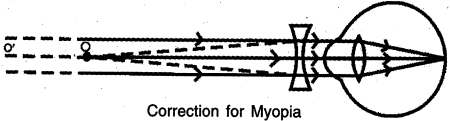
$A$ child sitting in a classroom is not able to read clearly the writing on the blackboard.
$(a)$ Name the type of defect from which his eye is suffering.
$(b)$ With the help of a ray diagram show how this defect can be remedied.
$(a)$ Name the type of defect from which his eye is suffering.
$(b)$ With the help of a ray diagram show how this defect can be remedied.
Solution
(N/A) The child's eye is suffering from the defect of myopia (near-sightedness).
$(b)$ This defect can be corrected by using a concave lens of suitable focal length. The concave lens diverges the incoming parallel rays from a distant object,making them appear to originate from the child's far point,thus allowing the eye lens to focus the image on the retina. The ray diagram for the correction of myopia is shown below.
$(b)$ This defect can be corrected by using a concave lens of suitable focal length. The concave lens diverges the incoming parallel rays from a distant object,making them appear to originate from the child's far point,thus allowing the eye lens to focus the image on the retina. The ray diagram for the correction of myopia is shown below.
0 likes
View Solution107
Medium
What are hypermetropia and myopia? What are their causes? How are they rectified?
Solution
(N/A) These are common defects of vision.
Hypermetropia (Farsightedness): $A$ person suffering from this defect can see distant objects clearly but cannot see nearby objects clearly. In this defect,the near point of the eye shifts farther away than $25 \ cm$.
Causes:
$1.$ The eyeball becomes too short.
$2.$ The focal length of the eye lens becomes too large.
Correction: This condition is corrected using a converging or convex lens.
Myopia (Nearsightedness): $A$ person suffering from myopia can see nearby objects clearly but cannot see distant objects clearly. In this defect,the far point of the eye comes closer than infinity.
Causes:
$1.$ The eyeball becomes too long.
$2.$ The focal length of the eye lens becomes too small.
Correction: This condition is corrected using a diverging or concave lens.
Hypermetropia (Farsightedness): $A$ person suffering from this defect can see distant objects clearly but cannot see nearby objects clearly. In this defect,the near point of the eye shifts farther away than $25 \ cm$.
Causes:
$1.$ The eyeball becomes too short.
$2.$ The focal length of the eye lens becomes too large.
Correction: This condition is corrected using a converging or convex lens.
Myopia (Nearsightedness): $A$ person suffering from myopia can see nearby objects clearly but cannot see distant objects clearly. In this defect,the far point of the eye comes closer than infinity.
Causes:
$1.$ The eyeball becomes too long.
$2.$ The focal length of the eye lens becomes too small.
Correction: This condition is corrected using a diverging or concave lens.
0 likes
View Solution108
Medium
Explain the following terms connected with the eye:
$(i)$ Ciliary muscles
$(ii)$ Accommodation
$(iii)$ Blind spot.
$(i)$ Ciliary muscles
$(ii)$ Accommodation
$(iii)$ Blind spot.
Solution
(N/A) $(i)$ Ciliary muscles: These are the muscles that hold the eye lens in position and control its curvature.
$(ii)$ Accommodation: The ability of the eye lens to adjust its focal length to focus objects at varying distances is called accommodation.
$(iii)$ Blind spot: This is the point on the retina where the optic nerve leaves the eye. There are no photoreceptor cells at this point,so any image formed here is not transmitted to the brain.
$(ii)$ Accommodation: The ability of the eye lens to adjust its focal length to focus objects at varying distances is called accommodation.
$(iii)$ Blind spot: This is the point on the retina where the optic nerve leaves the eye. There are no photoreceptor cells at this point,so any image formed here is not transmitted to the brain.
0 likes
View Solution109
MediumMCQ
Why do we have two eyes for vision instead of just one?
A
To increase the intensity of light
B
To provide a wider field of view and depth perception
C
To have a backup in case one eye fails
D
To see colors more clearly
Solution
(B) We need two eyes because a human being has a horizontal field of view of about $150^{\circ}$ with one eye and about $180^{\circ}$ with two eyes. Thus,two eyes provide us with a wider horizontal field of view.
With one eye,the world looks flat,i.e.,two-dimensional. With two eyes,the view is three-dimensional,which adds the dimension of depth to our vision.
With one eye,the world looks flat,i.e.,two-dimensional. With two eyes,the view is three-dimensional,which adds the dimension of depth to our vision.
0 likes
View Solution110
Easy
Define dispersion of white light and name the colours of white light in order.
Solution
(N/A) The phenomenon of splitting of white light into its constituent seven colours when passing through a glass prism is known as the dispersion of light.
When white light passes through a prism,it disperses into the following colours in the order of increasing wavelength (from violet to red): $Violet$,$Indigo$,$Blue$,$Green$,$Yellow$,$Orange$,and $Red$ (often remembered by the acronym $VIBGYOR$).
When white light passes through a prism,it disperses into the following colours in the order of increasing wavelength (from violet to red): $Violet$,$Indigo$,$Blue$,$Green$,$Yellow$,$Orange$,and $Red$ (often remembered by the acronym $VIBGYOR$).
0 likes
View Solution111
EasyMCQ
What is meant by the spectrum of white light?
A
The bending of light through a prism.
B
The band of seven colours obtained on a screen when white light is dispersed.
C
The reflection of light from a glass surface.
D
The scattering of light by atmospheric particles.
Solution
(B) When white light passes through a prism,it splits into its constituent seven colours. This band of colours is known as a spectrum. The sequence of colours is violet,indigo,blue,green,yellow,orange,and red $(VIBGYOR)$. The phenomenon of splitting white light into its component colours is called dispersion.
0 likes
View Solution112
Medium
Which colour has the maximum wavelength and which has the minimum wavelength? Explain on the basis of wavelength which colour bends the most and which colour bends the least.
Solution
(N/A) Red colour has the maximum wavelength,while violet colour has the minimum wavelength. According to the relationship between wavelength and deviation,the amount of bending (deviation) is inversely proportional to the wavelength. Since red light has the longest wavelength,it bends the least. Conversely,violet light has the shortest wavelength,so it bends the most.
0 likes
View Solution113
Easy
What is meant by persistence of vision?
Solution
(N/A) The impression of an object seen by the eye persists on the retina for $1/16$ of a second,even after the object is removed from the field of view.
If another object is seen before this time interval,the impressions of the two objects merge in the brain to give us the sensation of continuity.
This property of the human eye is known as persistence of vision.
If another object is seen before this time interval,the impressions of the two objects merge in the brain to give us the sensation of continuity.
This property of the human eye is known as persistence of vision.
0 likes
View Solution114
Easy
List four common defects of vision that can be corrected with the use of spectacles.
Solution
(N/A) The four common defects of vision that can be corrected with the use of spectacles are:
$(i)$ Myopia (nearsightedness): Corrected using concave lenses.
$(ii)$ Hypermetropia (farsightedness): Corrected using convex lenses.
$(iii)$ Presbyopia: Corrected using bifocal or progressive lenses.
$(iv)$ Astigmatism: Corrected using cylindrical lenses.
$(i)$ Myopia (nearsightedness): Corrected using concave lenses.
$(ii)$ Hypermetropia (farsightedness): Corrected using convex lenses.
$(iii)$ Presbyopia: Corrected using bifocal or progressive lenses.
$(iv)$ Astigmatism: Corrected using cylindrical lenses.
0 likes
View Solution115
Medium
Describe an experiment to discuss the recombination of dispersed light.
Solution
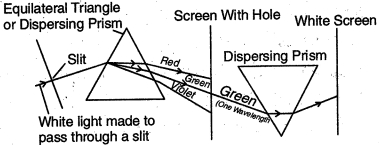
(N/A) Isaac Newton was the first to use a glass prism to obtain the spectrum of sunlight. He tried to split the colours of the spectrum of white light further by using another similar prism. However,he could not get any more colours.
He then placed a second identical prism in an inverted position with respect to the first,as shown in the diagram. This allowed all the colours of the spectrum to pass through the second prism. He found a beam of white light emerging from the other side of the second prism. This observation gave Newton the idea that sunlight is made up of seven colours.
He then placed a second identical prism in an inverted position with respect to the first,as shown in the diagram. This allowed all the colours of the spectrum to pass through the second prism. He found a beam of white light emerging from the other side of the second prism. This observation gave Newton the idea that sunlight is made up of seven colours.
0 likes
View Solution116
Medium
Explain why stars twinkle while planets do not.
Solution
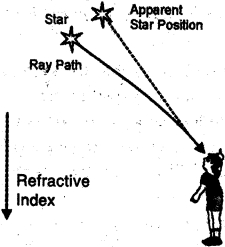
(N/A) The twinkling of a star is due to atmospheric refraction of starlight. As starlight enters the Earth's atmosphere,it undergoes continuous refraction before reaching the observer. This refraction occurs in a medium with a gradually changing refractive index. Because the atmosphere bends starlight towards the normal,the apparent position of the star is slightly different from its actual position. When viewed near the horizon,the star appears slightly higher than its actual position.
Furthermore,this apparent position is not stationary but keeps changing slightly because the physical conditions of the Earth's atmosphere are dynamic. Since stars are extremely distant,they act as point-sized sources of light. As the path of light rays from the star varies slightly,the apparent position fluctuates,and the amount of starlight entering the eye flickers. This causes the star to appear brighter at one moment and fainter at another,which is the twinkling effect.
Planets are much closer to the Earth and are seen as extended sources of light. If we consider a planet as a collection of a large number of point-sized sources,the total variation in the amount of light entering our eye from all these individual sources averages out to zero,thereby nullifying the twinkling effect.
Furthermore,this apparent position is not stationary but keeps changing slightly because the physical conditions of the Earth's atmosphere are dynamic. Since stars are extremely distant,they act as point-sized sources of light. As the path of light rays from the star varies slightly,the apparent position fluctuates,and the amount of starlight entering the eye flickers. This causes the star to appear brighter at one moment and fainter at another,which is the twinkling effect.
Planets are much closer to the Earth and are seen as extended sources of light. If we consider a planet as a collection of a large number of point-sized sources,the total variation in the amount of light entering our eye from all these individual sources averages out to zero,thereby nullifying the twinkling effect.
0 likes
View Solution117
Easy
What is Tyndall effect?
Solution
(N/A) The Earth's atmosphere is a heterogeneous mixture of minute particles. These particles include smoke,tiny water droplets,suspended particles of dust,and molecules of air. When a beam of light strikes such fine particles,the path of the beam becomes visible. The light reaches us after being scattered by these particles. The phenomenon of scattering of light by colloidal particles is called the Tyndall effect.
0 likes
View Solution118
Easy
Why is the colour of the sky blue?
Solution
(N/A) The molecules of air and other fine particles in the atmosphere have a size smaller than the wavelength of visible light.
These particles are more effective at scattering light of shorter wavelengths (at the blue end of the spectrum) than light of longer wavelengths (at the red end).
The red light has a wavelength about $1.8$ times greater than blue light.
Thus,when sunlight passes through the atmosphere,the fine particles in the air scatter the blue colour (shorter wavelengths) more strongly than the red colour.
The scattered blue light enters our eyes,making the sky appear blue.
These particles are more effective at scattering light of shorter wavelengths (at the blue end of the spectrum) than light of longer wavelengths (at the red end).
The red light has a wavelength about $1.8$ times greater than blue light.
Thus,when sunlight passes through the atmosphere,the fine particles in the air scatter the blue colour (shorter wavelengths) more strongly than the red colour.
The scattered blue light enters our eyes,making the sky appear blue.
0 likes
View Solution119
Medium
$(a)$ What will be the colour of the sky in the absence of an atmosphere?
$(b)$ Why are traffic light signals (or danger signals) of red colour?
$(b)$ Why are traffic light signals (or danger signals) of red colour?
Solution
(N/A) In the absence of an atmosphere, there is no scattering of sunlight by air molecules or dust particles. Consequently, no light reaches the observer's eye from the sky, making it appear dark.
$(b)$ According to Rayleigh scattering, the intensity of scattered light is inversely proportional to the fourth power of its wavelength $(I \propto 1/\lambda^4)$. Red light has the longest wavelength in the visible spectrum, meaning it undergoes the least scattering. This allows red light to travel longer distances without being significantly dispersed, making it clearly visible even from a distance through fog, smoke, or dust.
$(b)$ According to Rayleigh scattering, the intensity of scattered light is inversely proportional to the fourth power of its wavelength $(I \propto 1/\lambda^4)$. Red light has the longest wavelength in the visible spectrum, meaning it undergoes the least scattering. This allows red light to travel longer distances without being significantly dispersed, making it clearly visible even from a distance through fog, smoke, or dust.
0 likes
View Solution120
EasyMCQ
Why does the sky appear dark and black to an astronaut instead of blue?
A
Due to the absence of light in space.
B
Due to the absence of atmosphere to scatter light.
C
Due to the reflection of light by the moon.
D
Due to the high speed of the spacecraft.
Solution
(B) The sky appears blue on Earth because the atmosphere contains gas molecules and particles that scatter sunlight (Rayleigh scattering).
In outer space,there is no atmosphere to scatter light.
Since there is no scattered light reaching the eyes of an astronaut,the sky appears dark and black.
In outer space,there is no atmosphere to scatter light.
Since there is no scattered light reaching the eyes of an astronaut,the sky appears dark and black.
0 likes
View Solution121
Easy
Explain why,when the sun is overhead at noon,it appears white?
Solution
(N/A) When the sun is overhead at noon,the light coming from the sun travels a relatively shorter distance through the atmosphere to reach us.
As a result,only a small portion of the blue component of the white light is scattered,while most of the light reaches the observer.
Since the light reaching us from the overhead sun contains almost all its component colours in the correct proportion,the sun appears white.
As a result,only a small portion of the blue component of the white light is scattered,while most of the light reaches the observer.
Since the light reaching us from the overhead sun contains almost all its component colours in the correct proportion,the sun appears white.
0 likes
View Solution122
Medium
$(a)$ How does the sky appear from the surface of the moon?
$(b)$ What is the cause of the blue colour of the ocean?
$(b)$ What is the cause of the blue colour of the ocean?
Solution
(N/A) The sky appears dark from the surface of the moon because there is no atmosphere to scatter sunlight.
$(b)$ The water molecules of the ocean scatter blue light more strongly than light of other colours due to the phenomenon of scattering. Consequently,the ocean appears bluish.
$(b)$ The water molecules of the ocean scatter blue light more strongly than light of other colours due to the phenomenon of scattering. Consequently,the ocean appears bluish.
0 likes
View Solution123
Medium
$(a)$ State two main causes of a person developing near-sightedness. How can this defect be corrected?
$(b)$ What is 'astigmatism' and how is this vision defect corrected?
$(b)$ What is 'astigmatism' and how is this vision defect corrected?
Solution
(N/A) When a person can see near objects but is unable to see distant objects clearly,the defect is known as near-sightedness (myopia). This defect is caused by either $(i)$ excessive curvature of the cornea or $(ii)$ elongation of the eyeball. As a result,the image of a distant object is formed in front of the retina instead of on the retina. It can be corrected by using a concave lens of appropriate power.
$(b)$ Astigmatism is a vision defect where a person is unable to focus equally on objects in all directions (horizontal and vertical) simultaneously. This occurs because the cornea or the eye lens has different curvatures along different planes. This defect is corrected by using cylindrical lenses.
$(b)$ Astigmatism is a vision defect where a person is unable to focus equally on objects in all directions (horizontal and vertical) simultaneously. This occurs because the cornea or the eye lens has different curvatures along different planes. This defect is corrected by using cylindrical lenses.
0 likes
View Solution124
Medium
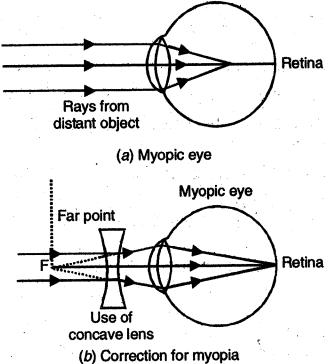
$A$ $14$ year old student is not able to see clearly the questions written on the blackboard placed at a distance of $5\, m$ from him.
$(a)$ Name the defect of vision he is suffering from.
$(b)$ With the help of labelled ray diagrams show how this defect can be corrected.
$(c)$ Name the type of lens used to correct this defect.
$(a)$ Name the defect of vision he is suffering from.
$(b)$ With the help of labelled ray diagrams show how this defect can be corrected.
$(c)$ Name the type of lens used to correct this defect.
Solution
(N/A) The student is suffering from Myopia (near-sightedness).
$(b)$ The defect is corrected by using a concave lens of appropriate power. The concave lens diverges the incoming parallel rays from a distant object so that they appear to originate from the student's far point,allowing the eye lens to focus them on the retina.
$(c)$ $A$ concave lens is used to correct this defect.
$(b)$ The defect is corrected by using a concave lens of appropriate power. The concave lens diverges the incoming parallel rays from a distant object so that they appear to originate from the student's far point,allowing the eye lens to focus them on the retina.
$(c)$ $A$ concave lens is used to correct this defect.
0 likes
View Solution125
Medium
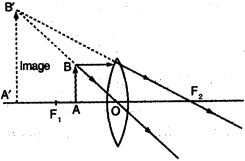
For which position of the object does a convex lens form a virtual and erect image? Explain with the help of a ray diagram.
Solution
(N/A) convex lens forms a virtual and erect image when the object is placed between the optical centre $(O)$ and the principal focus $(F_1)$.
To explain this,consider two rays originating from the top of the object $(B)$: one ray moves parallel to the principal axis and passes through the focus $(F_2)$ after refraction,while the other ray passes through the optical centre $(O)$ without deviation.
When these two refracted rays are extended backwards,they appear to meet at a point $(B')$ on the same side of the lens as the object.
Thus,the image $(A'B')$ formed is virtual,erect,and magnified,and it lies on the same side as the object.
To explain this,consider two rays originating from the top of the object $(B)$: one ray moves parallel to the principal axis and passes through the focus $(F_2)$ after refraction,while the other ray passes through the optical centre $(O)$ without deviation.
When these two refracted rays are extended backwards,they appear to meet at a point $(B')$ on the same side of the lens as the object.
Thus,the image $(A'B')$ formed is virtual,erect,and magnified,and it lies on the same side as the object.
0 likes
View Solution126
Medium
Why does the clear sky appear blue? How would the sky appear in the absence of Earth's atmosphere?
Solution
(N/A) The blue colour of the sky is due to the scattering of sunlight by the molecules of gases present in the Earth's atmosphere. According to Rayleigh's law of scattering, the intensity of scattered light is inversely proportional to the fourth power of its wavelength $(I \propto 1/\lambda^4)$. Since blue light has a shorter wavelength compared to other colours in the visible spectrum, it is scattered more strongly by the atmospheric particles. In the absence of an atmosphere, there would be no particles to scatter the sunlight. Consequently, no light would reach our eyes from the sky, and it would appear black.
0 likes
View Solution127
MediumMCQ
Why do we observe differences in the colours of the sun during sunrise,sunset,and noon?
A
Due to reflection of light
B
Due to scattering of light
C
Due to refraction of light
D
Due to dispersion of light
Solution
(B) The difference in the colour of the sun is due to the scattering of light.
At noon,the sun is overhead,and the light travels a shorter distance through the atmosphere,resulting in less scattering,so the sun appears white.
During sunrise and sunset,the sun is near the horizon,and the light travels a longer distance through the atmosphere.
Most of the blue light and shorter wavelengths are scattered away by atmospheric particles.
Therefore,the light that reaches our eyes consists mainly of longer wavelengths (red/orange),giving the sun a reddish appearance.
At noon,the sun is overhead,and the light travels a shorter distance through the atmosphere,resulting in less scattering,so the sun appears white.
During sunrise and sunset,the sun is near the horizon,and the light travels a longer distance through the atmosphere.
Most of the blue light and shorter wavelengths are scattered away by atmospheric particles.
Therefore,the light that reaches our eyes consists mainly of longer wavelengths (red/orange),giving the sun a reddish appearance.
0 likes
View Solution128
Easy
Why do we observe the seven colours when white light passes through a glass prism? Which component of white light deviates the least?
Solution
(D) When white light passes through a glass prism,it undergoes dispersion because the prism offers different refractive indices for different wavelengths of light.
Since the speed of light of different colours is different in the glass medium,each colour bends (refracts) by a different angle.
Violet light has the shortest wavelength and bends the most,while red light has the longest wavelength and bends the least.
Therefore,the red light deviates the least.
Since the speed of light of different colours is different in the glass medium,each colour bends (refracts) by a different angle.
Violet light has the shortest wavelength and bends the most,while red light has the longest wavelength and bends the least.
Therefore,the red light deviates the least.
0 likes
View Solution129
Easy
Why does it take some time to see objects in a dim room when we enter the room from bright sunlight outside?
Solution
(N/A) In bright sunlight,the size of the pupil is small to restrict the amount of light entering the eye. When we enter a dim room,the pupil takes some time to dilate (expand) so that more light can enter the eye,which eventually allows us to see objects clearly.
0 likes
View Solution130
Easy
Why does it take some time to see objects in a cinema hall when we just enter the hall from bright sunlight? Explain in brief.
Solution
(N/A) The pupil of the eye regulates and controls the amount of light entering the eye.
In bright sunlight,the iris causes the pupil to contract,making its size small to limit light entry.
When we enter a dark cinema hall,the amount of light is significantly lower.
It takes some time for the iris to relax and the pupil to expand in size to allow more light to enter the eye so that we can see objects clearly in the dim light.
In bright sunlight,the iris causes the pupil to contract,making its size small to limit light entry.
When we enter a dark cinema hall,the amount of light is significantly lower.
It takes some time for the iris to relax and the pupil to expand in size to allow more light to enter the eye so that we can see objects clearly in the dim light.
0 likes
View Solution131
Easy
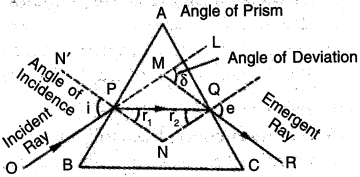
Draw a neat diagram to show the refraction of a light ray through a glass prism,and label on it the angle of incidence,and angle of deviation.
Solution
(N/A) The refraction of a light ray through a glass prism is shown in the diagram below.
Key components of the diagram:
$1$. $A$ is the apex of the prism.
$2$. $OP$ is the incident ray.
$3$. $i$ represents the angle of incidence.
$4$. $PQ$ is the refracted ray inside the prism.
$5$. $QR$ is the emergent ray.
$6$. $e$ is the angle of emergence.
$7$. $\delta$ represents the angle of deviation,which is the angle between the incident ray and the emergent ray.
Key components of the diagram:
$1$. $A$ is the apex of the prism.
$2$. $OP$ is the incident ray.
$3$. $i$ represents the angle of incidence.
$4$. $PQ$ is the refracted ray inside the prism.
$5$. $QR$ is the emergent ray.
$6$. $e$ is the angle of emergence.
$7$. $\delta$ represents the angle of deviation,which is the angle between the incident ray and the emergent ray.
0 likes
View Solution132
Easy
$(a)$ What is "power of accommodation of the eye"?
$(b)$ What happens to the image distance when the object being viewed is moved away from the eye?
$(b)$ What happens to the image distance when the object being viewed is moved away from the eye?
Solution
(N/A) The "power of accommodation of the eye" is the ability of the eye lens to adjust its focal length to focus objects at varying distances clearly on the retina.
$(b)$ The image distance in the eye remains constant. It is equal to the distance between the eye lens and the retina, which does not change regardless of the object's distance.
$(b)$ The image distance in the eye remains constant. It is equal to the distance between the eye lens and the retina, which does not change regardless of the object's distance.
0 likes
View Solution133
Easy
$(a)$ What is meant by the least distance of distinct vision?
$(b)$ How does the thickness of the eye lens change when we shift our focus from a distant tree to reading a book?
$(b)$ How does the thickness of the eye lens change when we shift our focus from a distant tree to reading a book?
Solution
(N/A) The least distance of distinct vision is the minimum distance at which an object can be placed so that a normal eye can see it clearly without any strain. For a normal adult eye,this distance is approximately $25 \ cm$.
$(b)$ When we shift our focus from a distant tree to reading a book,the ciliary muscles contract. This contraction increases the curvature of the eye lens,making it thicker. This increase in thickness increases the converging power of the lens,allowing the image of the nearby object (the book) to be focused clearly on the retina.
$(b)$ When we shift our focus from a distant tree to reading a book,the ciliary muscles contract. This contraction increases the curvature of the eye lens,making it thicker. This increase in thickness increases the converging power of the lens,allowing the image of the nearby object (the book) to be focused clearly on the retina.
0 likes
View Solution134
Medium
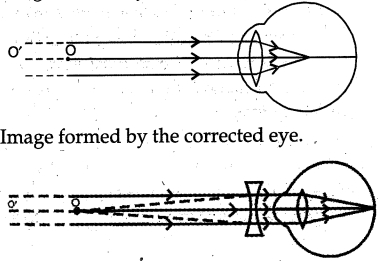
List two causes leading to myopia of the eye. Draw ray diagrams to show the image formation in case of a defective eye and a corrected eye.
Solution
(N/A) The two main causes of myopia are:
$(i)$ Excessive curvature of the eye lens (decrease in focal length).
$(ii)$ Elongation of the eyeball.
In myopia,the image of a distant object is formed in front of the retina instead of on the retina itself. This defect is corrected by using a concave lens of suitable power,which diverges the incoming light rays so that the image is formed on the retina.
$(i)$ Excessive curvature of the eye lens (decrease in focal length).
$(ii)$ Elongation of the eyeball.
In myopia,the image of a distant object is formed in front of the retina instead of on the retina itself. This defect is corrected by using a concave lens of suitable power,which diverges the incoming light rays so that the image is formed on the retina.
0 likes
View Solution135
Medium
$(i)$ What is the least distance of distinct vision for a normal eye?
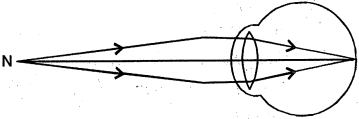
$(ii)$ Does the above distance increase or decrease for a long-sighted eye (hypermetropia)? Give a reason for your answer with a diagram.
$(ii)$ Does the above distance increase or decrease for a long-sighted eye (hypermetropia)? Give a reason for your answer with a diagram.
Solution
(N/A) $(i)$ The least distance of distinct vision for a normal eye is $25\, cm$.
$(ii)$ For a long-sighted eye (hypermetropia),the least distance of distinct vision increases. $A$ person with hypermetropia cannot see objects clearly at the normal near point $(25\, cm)$ because the image is formed behind the retina. The near point of such an eye shifts further away from the eye,meaning the minimum distance at which they can see clearly is greater than $25\, cm$. This is illustrated in the diagram where the near point $N$ is at a distance greater than $25\, cm$.
$(ii)$ For a long-sighted eye (hypermetropia),the least distance of distinct vision increases. $A$ person with hypermetropia cannot see objects clearly at the normal near point $(25\, cm)$ because the image is formed behind the retina. The near point of such an eye shifts further away from the eye,meaning the minimum distance at which they can see clearly is greater than $25\, cm$. This is illustrated in the diagram where the near point $N$ is at a distance greater than $25\, cm$.
0 likes
View Solution136
Medium
$A$ person needs a lens of power $-2.5 \ D$ for correcting his vision. Name the defect of vision he is suffering from. Which lens will he be using for the correction? Also,find the focal length of the lens.
Solution
(N/A) The power of the lens is negative $(P = -2.5 \ D)$,which indicates that the person is using a concave lens.
Since a concave lens is used to correct myopia (nearsightedness),the person is suffering from myopia.
The focal length $f$ is calculated using the formula $f = 1 / P$.
Substituting the value: $f = 1 / (-2.5) = -0.4 \ m$.
Converting to centimeters: $f = -0.4 \times 100 = -40 \ cm$.
The negative sign indicates that the lens is concave.
Since a concave lens is used to correct myopia (nearsightedness),the person is suffering from myopia.
The focal length $f$ is calculated using the formula $f = 1 / P$.
Substituting the value: $f = 1 / (-2.5) = -0.4 \ m$.
Converting to centimeters: $f = -0.4 \times 100 = -40 \ cm$.
The negative sign indicates that the lens is concave.
0 likes
View Solution137
Medium
Name the part of the eye where the image is formed by the eye lens. What is the nature of the image formed? How is this image sent to the brain?
Solution
(N/A) The image of the object formed by the eye lens is formed on the retina of the eye.
The nature of the image formed on the retina is real and inverted.
The image is converted into electrical signals by photoreceptors in the retina and is sent to the brain via the optic nerve.
The nature of the image formed on the retina is real and inverted.
The image is converted into electrical signals by photoreceptors in the retina and is sent to the brain via the optic nerve.
0 likes
View Solution138
Medium
Explain how a normal human eye is able to see distinctly objects placed at a distance as well as those placed at a nearer distance. What is the far point and near point of a normal human eye?
Solution
(N/A) normal human eye can adjust its focal length using the ciliary muscles, a process known as accommodation.
To see distant objects, the ciliary muscles relax, making the eye lens thin and increasing its focal length.
To see near objects, the ciliary muscles contract, making the eye lens thick and decreasing its focal length.
The far point of a normal human eye is at infinity $(\infty)$.
The near point of a normal human eye is at $25\, cm$ from the eye.
To see distant objects, the ciliary muscles relax, making the eye lens thin and increasing its focal length.
To see near objects, the ciliary muscles contract, making the eye lens thick and decreasing its focal length.
The far point of a normal human eye is at infinity $(\infty)$.
The near point of a normal human eye is at $25\, cm$ from the eye.
0 likes
View Solution139
Medium
An old person is unable to see clearly nearby objects as well as distant objects. $(i)$ What defect of vision is he suffering from? $(ii)$ What kind of lens will be required to see clearly the nearby as well as distant objects? Give reasons.
Solution
(N/A) $(i)$ The person is suffering from $Presbyopia$.
$(ii)$ The person will require $Bifocal$ lenses. $Bifocal$ lenses consist of both convex and concave lenses. The upper portion consists of a concave lens to correct myopia (nearsightedness) for distant vision,and the lower portion consists of a convex lens to correct hypermetropia (farsightedness) for near vision. This combination allows the person to see both distant and nearby objects clearly.
$(ii)$ The person will require $Bifocal$ lenses. $Bifocal$ lenses consist of both convex and concave lenses. The upper portion consists of a concave lens to correct myopia (nearsightedness) for distant vision,and the lower portion consists of a convex lens to correct hypermetropia (farsightedness) for near vision. This combination allows the person to see both distant and nearby objects clearly.
0 likes
View Solution140
Easy
What is dispersion of light? Name the $(i)$ component of white light that deviates the least,$(ii)$ component of white light that deviates the most,while passing through a glass prism.
Solution
(N/A) Dispersion of light is the phenomenon of splitting of white light into its constituent seven colours when it passes through a transparent medium like a glass prism.
$(i)$ The component of white light that deviates the least is Red light because it has the longest wavelength.
$(ii)$ The component of white light that deviates the most is Violet light because it has the shortest wavelength.
$(i)$ The component of white light that deviates the least is Red light because it has the longest wavelength.
$(ii)$ The component of white light that deviates the most is Violet light because it has the shortest wavelength.
0 likes
View Solution141
Medium
$(a)$ Explain how a normal human eye is able to see distinctly objects placed at a distance as well as those placed at a nearer distance.
$(b)$ What are the far point and near point of a normal human eye?
$(b)$ What are the far point and near point of a normal human eye?
Solution
(N/A) The ciliary muscles change the curvature of the eye lens as per the requirement of the eye. This process changes the focal length of the eye lens,which is known as accommodation.
When the ciliary muscles are relaxed,the lens becomes thin,increasing its focal length,which allows the eye to see distant objects clearly.
When viewing closer objects,the ciliary muscles contract,which makes the eye lens thicker and decreases its focal length,allowing the eye to focus on near objects.
$(b)$ The far point of a normal human eye is at infinity,and the near point is at $25\, cm$ from the eye.
When the ciliary muscles are relaxed,the lens becomes thin,increasing its focal length,which allows the eye to see distant objects clearly.
When viewing closer objects,the ciliary muscles contract,which makes the eye lens thicker and decreases its focal length,allowing the eye to focus on near objects.
$(b)$ The far point of a normal human eye is at infinity,and the near point is at $25\, cm$ from the eye.
0 likes
View Solution142
Easy
What is meant by the least distance of distinct vision? How does this vary between the very young and old people?
Solution
(N/A) The least distance of distinct vision is defined as the minimum distance at which an object can be placed so that the eye lens can form a clear and sharp image on the retina without any strain. For a normal adult eye,this distance is approximately $25 \ cm$.
$(b)$ This distance varies with age because the flexibility of the ciliary muscles and the eye lens decreases over time. In very young people,the eye lens is highly flexible,allowing for a shorter least distance of distinct vision. In contrast,as people age,the lens becomes less flexible and the ciliary muscles weaken (a condition often associated with presbyopia),which increases the least distance of distinct vision.
$(b)$ This distance varies with age because the flexibility of the ciliary muscles and the eye lens decreases over time. In very young people,the eye lens is highly flexible,allowing for a shorter least distance of distinct vision. In contrast,as people age,the lens becomes less flexible and the ciliary muscles weaken (a condition often associated with presbyopia),which increases the least distance of distinct vision.
0 likes
View Solution143
Medium
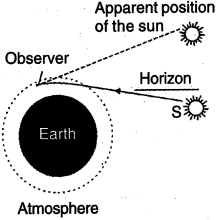
$(a)$ With the help of a suitable diagram,explain why the Sun is visible to us two minutes before the actual sunrise and two minutes after the actual sunset.
$(b)$ Name the phenomenon responsible for the apparent flattening of the Sun's disc at sunrise and sunset.
$(b)$ Name the phenomenon responsible for the apparent flattening of the Sun's disc at sunrise and sunset.
Solution
(N/A) The Sun is visible to us about two minutes before the actual sunrise and about two minutes after the actual sunset because of atmospheric refraction.
By actual sunrise,we mean the actual crossing of the horizon by the Sun.
As light from the Sun enters the Earth's atmosphere,it undergoes refraction due to the varying density of air layers.
This causes the light rays to bend towards the normal,making the Sun appear slightly higher than its actual position when it is just below the horizon.
The time difference between the actual sunset and the apparent sunset is about two minutes.
$(b)$ The phenomenon responsible for the apparent flattening of the Sun's disc at sunrise and sunset is also atmospheric refraction.
By actual sunrise,we mean the actual crossing of the horizon by the Sun.
As light from the Sun enters the Earth's atmosphere,it undergoes refraction due to the varying density of air layers.
This causes the light rays to bend towards the normal,making the Sun appear slightly higher than its actual position when it is just below the horizon.
The time difference between the actual sunset and the apparent sunset is about two minutes.
$(b)$ The phenomenon responsible for the apparent flattening of the Sun's disc at sunrise and sunset is also atmospheric refraction.
0 likes
View Solution144
Medium
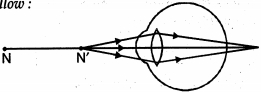
Study the diagram and answer the questions that follow:
$(i)$ Identify the defect of vision represented by this diagram.
$(ii)$ List the two possible causes of this defect.
$(iii)$ With the help of a ray diagram,explain how this defect can be corrected.
$(i)$ Identify the defect of vision represented by this diagram.
$(ii)$ List the two possible causes of this defect.
$(iii)$ With the help of a ray diagram,explain how this defect can be corrected.
Solution
(N/A) $(i)$ The defect of vision represented is Hypermetropia (farsightedness).
$(ii)$ The two possible causes of this defect are:
$(a)$ The eyeball has become too short,so that light rays from a nearby object are focused at a point behind the retina.
$(b)$ The focal length of the eye lens is too long,meaning the ciliary muscles are unable to make the lens sufficiently convex to focus the image on the retina.
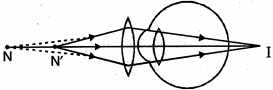
$(iii)$ This defect can be corrected by using a convex lens of appropriate power. The convex lens converges the incoming light rays before they enter the eye,allowing the eye lens to focus the image exactly on the retina,as shown in the diagram.
$(ii)$ The two possible causes of this defect are:
$(a)$ The eyeball has become too short,so that light rays from a nearby object are focused at a point behind the retina.
$(b)$ The focal length of the eye lens is too long,meaning the ciliary muscles are unable to make the lens sufficiently convex to focus the image on the retina.
$(iii)$ This defect can be corrected by using a convex lens of appropriate power. The convex lens converges the incoming light rays before they enter the eye,allowing the eye lens to focus the image exactly on the retina,as shown in the diagram.
0 likes
View Solution145
Medium
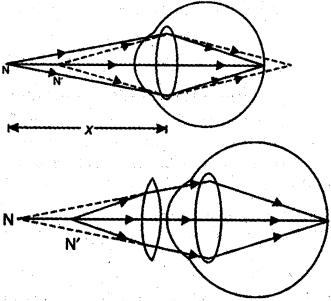
$A$ person can see distant sign boards clearly but cannot read clearly a book which is at $25\, cm$ from his eye. Giving reason,identify the defect. Draw a labelled ray diagram to illustrate this defect and its correction.
Solution
(N/A) The person is suffering from Hypermetropia (farsightedness).
Reasons for this defect:
$(a)$ The eyeball has become too short,so that light rays from a nearby object are focused at a point behind the retina.
$(b)$ The focal length of the eye lens is too long because the ciliary muscles are unable to make the lens sufficiently convex.
This defect is corrected by using a convex lens of appropriate power,which converges the light rays before they enter the eye,allowing them to focus on the retina.
Reasons for this defect:
$(a)$ The eyeball has become too short,so that light rays from a nearby object are focused at a point behind the retina.
$(b)$ The focal length of the eye lens is too long because the ciliary muscles are unable to make the lens sufficiently convex.
This defect is corrected by using a convex lens of appropriate power,which converges the light rays before they enter the eye,allowing them to focus on the retina.
0 likes
View Solution146
Medium
Study the diagram given below and answer the questions that follow it.
$(i)$ Identify the defect of vision represented in this case. Give a reason for your answer.
$(ii)$ Mention the two causes of this defect.
$(i)$ Identify the defect of vision represented in this case. Give a reason for your answer.
$(ii)$ Mention the two causes of this defect.
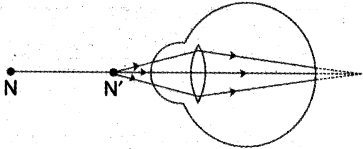
Solution
(N/A) $(i)$ Hypermetropia (far-sightedness). The reason is that the image of nearby objects is focused behind the retina instead of on the retina.
$(ii)$ This defect arises due to the following two causes:
$(a)$ The focal length of the eye lens is too long.
$(b)$ The eyeball has become too small.
$(ii)$ This defect arises due to the following two causes:
$(a)$ The focal length of the eye lens is too long.
$(b)$ The eyeball has become too small.
0 likes
View Solution147
Medium
What is meant by scattering of light? Use this phenomenon to explain why the clear sky appears blue or the sun appears reddish at sunrise.
Solution
(N/A) $(i)$ Scattering of light: It is the phenomenon of the redirection of light in different directions by the particles (such as atoms,molecules,dust,or smoke) present in the atmosphere.
$(ii)$ Why the sky appears blue: The fine particles in the atmosphere have a size smaller than the wavelength of visible light. These particles scatter light of shorter wavelengths (like blue and violet) much more strongly than light of longer wavelengths (like red). Since blue light has a shorter wavelength,it is scattered the most,which is why the sky appears blue to our eyes.
$(iii)$ Why the sun appears reddish at sunrise: At sunrise,the sun is near the horizon. Sunlight has to travel through a much thicker layer of the atmosphere to reach the observer. During this long journey,most of the blue and shorter wavelength light is scattered away by the atmospheric particles. Only the light of longer wavelengths,such as red,reaches our eyes,which is why the sun appears reddish at sunrise.
$(ii)$ Why the sky appears blue: The fine particles in the atmosphere have a size smaller than the wavelength of visible light. These particles scatter light of shorter wavelengths (like blue and violet) much more strongly than light of longer wavelengths (like red). Since blue light has a shorter wavelength,it is scattered the most,which is why the sky appears blue to our eyes.
$(iii)$ Why the sun appears reddish at sunrise: At sunrise,the sun is near the horizon. Sunlight has to travel through a much thicker layer of the atmosphere to reach the observer. During this long journey,most of the blue and shorter wavelength light is scattered away by the atmospheric particles. Only the light of longer wavelengths,such as red,reaches our eyes,which is why the sun appears reddish at sunrise.
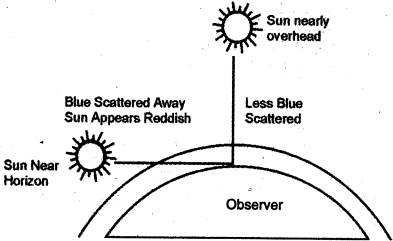
0 likes
View Solution148
Medium
With the help of scattering of light,explain the reason for the difference in colours of the Sun as it appears during sunrise/sunset and noon.
Solution
(N/A) The Sun appears reddish at sunrise and sunset,while it appears white at noon when it is overhead.
At sunrise and sunset,the light from the Sun travels through a thicker layer of the atmosphere. The blue light,having a shorter wavelength,is scattered away by the atmospheric particles,while the red light,having a longer wavelength,reaches our eyes.
At noon,the Sun is overhead,and the light travels a relatively shorter distance through the atmosphere. Consequently,only a small amount of blue and violet light is scattered,allowing the Sun to appear white as the majority of the light reaches our eyes.
At sunrise and sunset,the light from the Sun travels through a thicker layer of the atmosphere. The blue light,having a shorter wavelength,is scattered away by the atmospheric particles,while the red light,having a longer wavelength,reaches our eyes.
At noon,the Sun is overhead,and the light travels a relatively shorter distance through the atmosphere. Consequently,only a small amount of blue and violet light is scattered,allowing the Sun to appear white as the majority of the light reaches our eyes.
0 likes
View Solution149
Medium
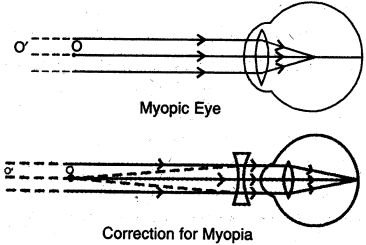
$A$ person cannot see objects farther than $12\, m$ from the eye clearly. Name the defect of vision he is suffering from and the lens that should be used for correction of this defect. Illustrate with the help of a diagram,how this lens will correct the defective vision?
Solution
(N/A) The person is suffering from Myopia (near-sightedness),as they cannot see distant objects clearly beyond a certain point ($12\, m$ in this case).
The corrective lens to be used is a Concave Lens (diverging lens).
$A$ concave lens diverges the incoming light rays from a distant object,making them appear to originate from the person's far point $(12\, m)$. This allows the eye lens to focus the image correctly on the retina.
The diagrams are as shown in the provided image.
The corrective lens to be used is a Concave Lens (diverging lens).
$A$ concave lens diverges the incoming light rays from a distant object,making them appear to originate from the person's far point $(12\, m)$. This allows the eye lens to focus the image correctly on the retina.
The diagrams are as shown in the provided image.
0 likes
View Solution150
Medium
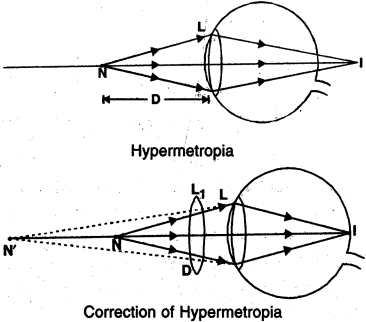
$A$ person cannot read a book at distances less than $50\, cm$. Name the defect of vision he is suffering from. How can it be corrected? Draw ray diagrams to show the image formation
$(i)$ by defective eye and
$(ii)$ after using corrective lens.
$(i)$ by defective eye and
$(ii)$ after using corrective lens.
Solution
(N/A) The defect of vision is Hypermetropia,also known as long-sightedness.
In this condition,the person can see distant objects clearly but cannot see nearby objects distinctly because the image of a nearby object is formed behind the retina.
It can be corrected by using a convex lens of suitable power,which converges the light rays before they enter the eye,allowing the image to be formed exactly on the retina.
In this condition,the person can see distant objects clearly but cannot see nearby objects distinctly because the image of a nearby object is formed behind the retina.
It can be corrected by using a convex lens of suitable power,which converges the light rays before they enter the eye,allowing the image to be formed exactly on the retina.
0 likes
View SolutionThe Human Eye and the Colourful World — Mix Examples - The Human Eye and the Colourful World · Frequently Asked Questions
1Are these The Human Eye and the Colourful World questions useful for JEE and NEET?
Yes. All questions in this section are mapped to JEE Main and NEET exam patterns. Previous year questions from JEE Main, NEET, GUJCET and state-level exams are included with full solutions.
2Can I switch to Hindi or Gujarati for these questions?
Yes. Use the language tabs in the hero section or the sidebar to view the same questions and solutions in English, Hindi or Gujarati.
3How do I generate a question paper from this subtopic?
Use the Vedclass Exam Paper Generator — select the chapter and subtopic, set difficulty, and generate Sets A, B, C, D automatically. First 3 chapters of every subject are free.
Vedclass Products
For Students
Vedclass Test Series
Mock tests in real JEE/NEET style with performance analysis. 5-day free trial.
Start Free TrialFor Teachers
Exam Paper Generator
Generate Set A/B/C/D papers from this chapter in 2 minutes. 3 chapters free.
Try FreeFor Institutes
Online Exam Module
Live online exams with unlimited students, 360° analytics & white-label branding.
See DemoFor Teachers & Institutes
Generate a The Human Eye and the Colourful World Exam Paper in 2 Minutes
Select subtopic & difficulty — Sets A, B, C, D auto-generated with No Repeat logic.
First 3 chapters of every subject are free — no payment required.