
A English
Textbook - The Human Eye and the Colourful World Questions in English
Class 10 Science · The Human Eye and the Colourful World · Textbook - The Human Eye and the Colourful World
18+
Questions
English
Language
100%
With Solutions
Showing 18 of 18 questions in English
1
Easy
What is meant by the power of accommodation of the eye?
Solution
(N/A) The power of accommodation is the ability of the human eye to adjust the focal length of its lens to focus on objects at varying distances.
When the ciliary muscles are relaxed,the eye lens becomes thin,its focal length increases,and distant objects are clearly visible.
To see nearby objects clearly,the ciliary muscles contract,making the eye lens thicker.
This contraction decreases the focal length of the eye lens,allowing the image of nearby objects to be formed clearly on the retina.
Thus,the ability of the eye to change its focal length to view both distant and nearby objects is known as the power of accommodation.
When the ciliary muscles are relaxed,the eye lens becomes thin,its focal length increases,and distant objects are clearly visible.
To see nearby objects clearly,the ciliary muscles contract,making the eye lens thicker.
This contraction decreases the focal length of the eye lens,allowing the image of nearby objects to be formed clearly on the retina.
Thus,the ability of the eye to change its focal length to view both distant and nearby objects is known as the power of accommodation.
0 likes
View Solution2
MediumMCQ
$A$ person with a myopic eye cannot see objects beyond $1.2\, m$ distinctly. What should be the type of the corrective lens used to restore proper vision?
A
Convex lens
B
Concave lens
C
Bifocal lens
D
Cylindrical lens
Solution
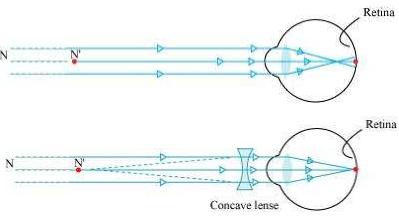
(B) The person is suffering from myopia (near-sightedness),which means they can see nearby objects clearly but cannot see distant objects beyond a certain point (the far point).
In this case,the far point of the person is $1.2\, m$.
This happens because the image of an object placed beyond $1.2\, m$ is formed in front of the retina instead of on the retina.
To correct this defect,a concave lens (diverging lens) is used.
The concave lens diverges the incoming light rays from distant objects,effectively shifting the image back onto the retina,as shown in the figure.
In this case,the far point of the person is $1.2\, m$.
This happens because the image of an object placed beyond $1.2\, m$ is formed in front of the retina instead of on the retina.
To correct this defect,a concave lens (diverging lens) is used.
The concave lens diverges the incoming light rays from distant objects,effectively shifting the image back onto the retina,as shown in the figure.
0 likes
View Solution3
MediumMCQ
What is the far point and near point of the human eye with normal vision?
A
$25 \ cm$ and $infinity$
B
$infinity$ and $25 \ cm$
C
$25 \ cm$ and $50 \ cm$
D
$50 \ cm$ and $infinity$
Solution
(A) The near point of the eye is the minimum distance of an object from the eye,which can be seen distinctly without strain. For a normal human eye,this distance is $25 \ cm$.
The far point of the eye is the maximum distance to which the eye can see objects clearly. The far point of the normal human eye is infinity.
The far point of the eye is the maximum distance to which the eye can see objects clearly. The far point of the normal human eye is infinity.
0 likes
View Solution4
Easy
$A$ student has difficulty reading the blackboard while sitting in the last row. What could be the defect the child is suffering from? How can it be corrected?
Solution
A student who has difficulty reading the blackboard while sitting in the last row is unable to see distant objects clearly. This condition is known as $Myopia$ (near-sightedness). In this defect, the image of a distant object is formed in front of the retina rather than on the retina itself. This defect can be corrected by using a concave lens of suitable focal length, which diverges the light rays before they enter the eye, allowing the image to be focused correctly on the retina.
0 likes
View Solution5
EasyMCQ
The human eye can focus on objects at different distances by adjusting the focal length of the eye lens. This is due to
A
accommodation
B
presbyopia
C
near-sightedness
D
far-sightedness
Solution
(A) The human eye can change the focal length of the eye lens to see objects situated at various distances from the eye.
This ability of the eye lens to adjust its focal length with the help of ciliary muscles is known as the power of accommodation.
This ability of the eye lens to adjust its focal length with the help of ciliary muscles is known as the power of accommodation.
0 likes
View Solution6
EasyMCQ
The human eye forms the image of an object at its
A
cornea
B
retina
C
pupil
D
iris
Solution
(B) The human eye functions like a camera. Light enters the eye through the cornea and passes through the pupil. The eye lens focuses this light onto the light-sensitive screen located at the back of the eye,which is known as the retina. Therefore,the image of an object is formed on the retina.
1 likes
View Solution7
EasyMCQ
The least distance of distinct vision for a young adult with normal vision is about ...... $cm$.
A
$0.25$
B
$2.5$
C
$25$
D
$250$
Solution
(C) The least distance of distinct vision is the minimum distance at which an object can be placed so that a clear and distinct image is formed on the retina without any strain on the eye.
For a young adult with normal vision,this distance is approximately $25\, cm$.
For a young adult with normal vision,this distance is approximately $25\, cm$.
0 likes
View Solution8
EasyMCQ
The change in focal length of an eye lens is caused by the action of the
A
pupil
B
retina
C
iris
D
ciliary muscles
Solution
(D) The relaxation or contraction of ciliary muscles changes the curvature of the eye lens.
The change in curvature of the eye lens changes the focal length of the eyes.
Hence,the change in focal length of an eye lens is caused by the action of ciliary muscles.
The change in curvature of the eye lens changes the focal length of the eyes.
Hence,the change in focal length of an eye lens is caused by the action of ciliary muscles.
0 likes
View Solution9
MediumMCQ
$A$ person needs a lens of power $-5.5$ dioptres for correcting his distant vision. For correcting his near vision he needs a lens of power $+1.5$ dioptre. What is the focal length (in $cm$) of the lens required for correcting distant vision?
A
-$18.2$
B
-$9.1$
C
$9.1$
D
$27.3$
Solution
(A) The power $P$ of a lens is related to its focal length $f$ (in meters) by the formula $P = \frac{1}{f}$.
To find the focal length in centimeters,we use the formula $f (cm) = \frac{100}{P}$.
For correcting distant vision,the power required is $P = -5.5 \, D$.
Substituting the value of $P$ into the formula:
$f = \frac{100}{-5.5} \, cm$
$f \approx -18.18 \, cm$.
Rounding to one decimal place,the focal length is $-18.2 \, cm$.
To find the focal length in centimeters,we use the formula $f (cm) = \frac{100}{P}$.
For correcting distant vision,the power required is $P = -5.5 \, D$.
Substituting the value of $P$ into the formula:
$f = \frac{100}{-5.5} \, cm$
$f \approx -18.18 \, cm$.
Rounding to one decimal place,the focal length is $-18.2 \, cm$.
0 likes
View Solution10
MediumMCQ
$A$ person needs a lens of power $-5.5 \, D$ for correcting his distant vision. For correcting his near vision,he needs a lens of power $+1.5 \, D$. What is the focal length (in $cm$) of the lens required for correcting near vision?
A
$33.3$
B
$66.7$
C
$8.25$
D
$16.5$
Solution
(B) The power $P$ of a lens is related to its focal length $f$ (in meters) by the formula $P = \frac{1}{f}$.
For correcting near vision,the required power $P = +1.5 \, D$.
Using the formula,$f = \frac{1}{P} = \frac{1}{1.5} \, m$.
$f = 0.6666... \, m \approx 0.667 \, m$.
To convert the focal length into centimeters $(cm)$,we multiply by $100$:
$f = 0.667 \times 100 \, cm = 66.7 \, cm$.
Therefore,the focal length of the lens required for correcting near vision is $66.7 \, cm$.
For correcting near vision,the required power $P = +1.5 \, D$.
Using the formula,$f = \frac{1}{P} = \frac{1}{1.5} \, m$.
$f = 0.6666... \, m \approx 0.667 \, m$.
To convert the focal length into centimeters $(cm)$,we multiply by $100$:
$f = 0.667 \times 100 \, cm = 66.7 \, cm$.
Therefore,the focal length of the lens required for correcting near vision is $66.7 \, cm$.
0 likes
View Solution11
MediumMCQ
The far point of a myopic person is $80 \,cm$ in front of the eye. What is the nature and power of the lens required to correct the problem?
A
Convex lens ; $0.75 \,D$
B
Convex lens ; $1.25 \,D$
C
Concave lens ; $1.25 \,D$
D
Concave lens ; $0.75 \,D$
Solution
(C) The person is suffering from an eye defect called myopia. In this defect,the image is formed in front of the retina. Hence,a concave lens is used to correct this defect of vision.
Object distance,$u = \infty$
Image distance,$v = -80 \,cm = -0.8 \,m$
Focal length = $f$
According to the lens formula,$\frac{1}{v} - \frac{1}{u} = \frac{1}{f}$
$\frac{1}{-0.8} - \frac{1}{\infty} = \frac{1}{f}$
$\frac{1}{f} = -1.25 \,m^{-1}$
$f = -0.8 \,m$
We know,Power,$P = \frac{1}{f(\text{in metres})}$
$P = \frac{1}{-0.8} = -1.25 \,D$
$A$ concave lens of power $-1.25 \,D$ is required by the person to correct his defect.
Object distance,$u = \infty$
Image distance,$v = -80 \,cm = -0.8 \,m$
Focal length = $f$
According to the lens formula,$\frac{1}{v} - \frac{1}{u} = \frac{1}{f}$
$\frac{1}{-0.8} - \frac{1}{\infty} = \frac{1}{f}$
$\frac{1}{f} = -1.25 \,m^{-1}$
$f = -0.8 \,m$
We know,Power,$P = \frac{1}{f(\text{in metres})}$
$P = \frac{1}{-0.8} = -1.25 \,D$
$A$ concave lens of power $-1.25 \,D$ is required by the person to correct his defect.
0 likes
View Solution12
Difficult
Make a diagram to show how hypermetropia is corrected. The near point of a hypermetropic eye is $1 \, m$. What is the power of the lens required to correct this defect? Assume that the near point of the normal eye is $25 \, cm$.
Solution
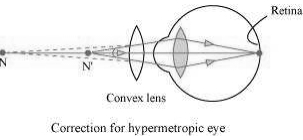
(D) person suffering from hypermetropia can see distant objects clearly but faces difficulty in seeing nearby objects clearly. It happens because the eye lens focuses the incoming divergent rays beyond the retina. This defect of vision is corrected by using a convex lens. $A$ convex lens of suitable power converges the incoming light in such a way that the image is formed on the retina,as shown in the following figure.
The convex lens actually creates a virtual image of a nearby object ( $N'$ in the figure) at the near point of vision $(N)$ of the person suffering from hypermetropia.
The given person will be able to clearly see the object kept at $25 \, cm$ (near point of the normal eye),if the image of the object is formed at his near point,which is given as $1 \, m$.
Object distance,$u = -25 \, cm = -0.25 \, m$
Image distance,$v = -1 \, m$
Focal length,$f$
Using the lens formula,
$\frac{1}{v} - \frac{1}{u} = \frac{1}{f}$
$\frac{1}{-1} - \frac{1}{-0.25} = \frac{1}{f}$
$\frac{1}{f} = \frac{1}{0.25} - 1 = 4 - 1 = 3 \, D$
Power,$P = +3.0 \, D$
$A$ convex lens of power $+3.0 \, D$ is required to correct the defect.
The convex lens actually creates a virtual image of a nearby object ( $N'$ in the figure) at the near point of vision $(N)$ of the person suffering from hypermetropia.
The given person will be able to clearly see the object kept at $25 \, cm$ (near point of the normal eye),if the image of the object is formed at his near point,which is given as $1 \, m$.
Object distance,$u = -25 \, cm = -0.25 \, m$
Image distance,$v = -1 \, m$
Focal length,$f$
Using the lens formula,
$\frac{1}{v} - \frac{1}{u} = \frac{1}{f}$
$\frac{1}{-1} - \frac{1}{-0.25} = \frac{1}{f}$
$\frac{1}{f} = \frac{1}{0.25} - 1 = 4 - 1 = 3 \, D$
Power,$P = +3.0 \, D$
$A$ convex lens of power $+3.0 \, D$ is required to correct the defect.
0 likes
View Solution13
EasyMCQ
Why is a normal eye not able to see clearly the objects placed closer than $25 \,cm$?
A
The ciliary muscles cannot contract enough to increase the curvature of the lens.
B
The focal length of the eye lens cannot be decreased below a certain limit.
C
The image is formed behind the retina.
D
Both $A$ and $B$.
Solution
(D) The human eye has a limited power of accommodation.
To see objects closer than $25 \,cm$,the ciliary muscles need to contract significantly to increase the curvature of the eye lens,thereby decreasing its focal length.
However,the ciliary muscles have a limit to their contraction,meaning the focal length of the eye lens cannot be decreased below a certain minimum value.
Consequently,the image of an object placed closer than $25 \,cm$ is formed behind the retina,resulting in a blurred image.
This distance of $25 \,cm$ is known as the least distance of distinct vision.
To see objects closer than $25 \,cm$,the ciliary muscles need to contract significantly to increase the curvature of the eye lens,thereby decreasing its focal length.
However,the ciliary muscles have a limit to their contraction,meaning the focal length of the eye lens cannot be decreased below a certain minimum value.
Consequently,the image of an object placed closer than $25 \,cm$ is formed behind the retina,resulting in a blurred image.
This distance of $25 \,cm$ is known as the least distance of distinct vision.
0 likes
View Solution14
EasyMCQ
What happens to the image distance in the eye when we increase the distance of an object from the eye?
A
It increases.
B
It decreases.
C
It remains constant.
D
It becomes zero.
Solution
(C) Since the size of the eyeball cannot change,the distance between the eye lens and the retina remains constant.
Therefore,the image distance in the eye remains constant.
When we increase the distance of an object from the eye,the image distance does not change.
The increase in the object distance is compensated by the change in the focal length of the eye lens through the action of ciliary muscles.
The focal length of the eye lens adjusts such that the image is always formed on the retina.
Therefore,the image distance in the eye remains constant.
When we increase the distance of an object from the eye,the image distance does not change.
The increase in the object distance is compensated by the change in the focal length of the eye lens through the action of ciliary muscles.
The focal length of the eye lens adjusts such that the image is always formed on the retina.
0 likes
View Solution15
MediumMCQ
Why do stars twinkle?
A
Due to reflection of light by the atmosphere.
B
Due to atmospheric refraction of light.
C
Due to dispersion of light by the atmosphere.
D
Due to scattering of light by the atmosphere.
Solution
(B) Stars emit their own light and they appear to twinkle due to the atmospheric refraction of light.
Stars are located at a very large distance from the Earth,so they act as point sources of light.
As the light from a star enters the Earth's atmosphere,it undergoes continuous refraction due to the changing density of air at different altitudes.
This varying refraction causes the apparent position and brightness of the star to fluctuate.
When more light reaches our eyes,the star appears brighter,and when less light reaches our eyes,it appears dimmer,creating the twinkling effect.
Stars are located at a very large distance from the Earth,so they act as point sources of light.
As the light from a star enters the Earth's atmosphere,it undergoes continuous refraction due to the changing density of air at different altitudes.
This varying refraction causes the apparent position and brightness of the star to fluctuate.
When more light reaches our eyes,the star appears brighter,and when less light reaches our eyes,it appears dimmer,creating the twinkling effect.
0 likes
View Solution16
Easy
Explain why the planets do not twinkle.
Solution
(N/A) Planets do not twinkle because they appear larger in size than the stars as they are relatively closer to the Earth.
Planets can be considered as a collection of a large number of point-sized sources of light.
The different parts of these planets produce either brighter or dimmer effects in such a way that the average of the brighter and dimmer effects is zero.
Hence,the twinkling effects of the planets are nullified and they do not twinkle.
Planets can be considered as a collection of a large number of point-sized sources of light.
The different parts of these planets produce either brighter or dimmer effects in such a way that the average of the brighter and dimmer effects is zero.
Hence,the twinkling effects of the planets are nullified and they do not twinkle.
0 likes
View Solution17
EasyMCQ
Why does the Sun appear reddish early in the morning?
A
Due to the reflection of light from the atmosphere.
B
Due to the scattering of shorter wavelengths of light by atmospheric particles.
C
Due to the absorption of red light by the atmosphere.
D
Due to the refraction of light through the atmosphere.
Solution
(B) During sunrise,the light rays from the Sun travel a greater distance through the Earth's atmosphere to reach our eyes.
In this journey,light with shorter wavelengths (like blue and violet) is scattered away by atmospheric particles.
Only light with longer wavelengths,such as red,can reach our eyes without being scattered significantly.
Therefore,the Sun appears reddish early in the morning.
In this journey,light with shorter wavelengths (like blue and violet) is scattered away by atmospheric particles.
Only light with longer wavelengths,such as red,can reach our eyes without being scattered significantly.
Therefore,the Sun appears reddish early in the morning.
0 likes
View Solution18
MediumMCQ
Why does the sky appear dark instead of blue to an astronaut?
A
Due to the absence of scattering of light in space.
B
Due to the presence of high-intensity radiation.
C
Due to the reflection of light from the moon.
D
Due to the absorption of light by the spacecraft.
Solution
(A) The sky appears dark instead of blue to an astronaut because there is no atmosphere in outer space to scatter sunlight.
Since there are no gas molecules or particles to scatter the light,no scattered light reaches the eyes of the astronauts.
Consequently,the sky appears black or dark to them.
Since there are no gas molecules or particles to scatter the light,no scattered light reaches the eyes of the astronauts.
Consequently,the sky appears black or dark to them.
0 likes
View SolutionThe Human Eye and the Colourful World — Textbook - The Human Eye and the Colourful World · Frequently Asked Questions
1Are these The Human Eye and the Colourful World questions useful for JEE and NEET?
Yes. All questions in this section are mapped to JEE Main and NEET exam patterns. Previous year questions from JEE Main, NEET, GUJCET and state-level exams are included with full solutions.
2Can I switch to Hindi or Gujarati for these questions?
Yes. Use the language tabs in the hero section or the sidebar to view the same questions and solutions in English, Hindi or Gujarati.
3How do I generate a question paper from this subtopic?
Use the Vedclass Exam Paper Generator — select the chapter and subtopic, set difficulty, and generate Sets A, B, C, D automatically. First 3 chapters of every subject are free.
Vedclass Products
For Students
Vedclass Test Series
Mock tests in real JEE/NEET style with performance analysis. 5-day free trial.
Start Free TrialFor Teachers
Exam Paper Generator
Generate Set A/B/C/D papers from this chapter in 2 minutes. 3 chapters free.
Try FreeFor Institutes
Online Exam Module
Live online exams with unlimited students, 360° analytics & white-label branding.
See DemoFor Teachers & Institutes
Generate a The Human Eye and the Colourful World Exam Paper in 2 Minutes
Select subtopic & difficulty — Sets A, B, C, D auto-generated with No Repeat logic.
First 3 chapters of every subject are free — no payment required.