
A English
Mix Examples - The Human Eye and the Colourful World Questions in English
Class 10 Science · The Human Eye and the Colourful World · Mix Examples - The Human Eye and the Colourful World
300+
Questions
English
Language
100%
With Solutions
Showing 50 of 300 questions in English
201
EasyMCQ
In the case of the human eye,when light rays enter the eye,most of the refraction occurs at the
A
outer surface of the cornea
B
iris
C
crystalline lens
D
pupil
Solution
(A) When light rays enter the human eye,they first encounter the cornea.
The cornea is the transparent,curved,outermost layer of the eye.
Because the cornea has a significant difference in refractive index compared to the air outside,it is responsible for the majority of the refraction of light entering the eye.
The crystalline lens provides the fine-tuning of the focus,but the primary bending of light occurs at the outer surface of the cornea.
The cornea is the transparent,curved,outermost layer of the eye.
Because the cornea has a significant difference in refractive index compared to the air outside,it is responsible for the majority of the refraction of light entering the eye.
The crystalline lens provides the fine-tuning of the focus,but the primary bending of light occurs at the outer surface of the cornea.
0 likes
View Solution202
MediumMCQ
Reddish appearance of the sun at sunrise or sunset is significantly due to
A
dispersion of light
B
total internal reflection of light
C
reflection of light from the earth
D
scattering of light
Solution
(D) At sunrise or sunset,the sun is near the horizon.
Light from the sun has to travel a larger distance through the atmosphere of the Earth to reach our eyes.
During this journey,most of the blue and shorter wavelengths of light are scattered away by the atmospheric particles.
Only the light of longer wavelengths,such as red,is able to reach our eyes.
Therefore,the sun appears reddish at sunrise or sunset due to the scattering of light.
Light from the sun has to travel a larger distance through the atmosphere of the Earth to reach our eyes.
During this journey,most of the blue and shorter wavelengths of light are scattered away by the atmospheric particles.
Only the light of longer wavelengths,such as red,is able to reach our eyes.
Therefore,the sun appears reddish at sunrise or sunset due to the scattering of light.
0 likes
View Solution203
MediumMCQ
Identify the correct statement regarding the propagation of light of different colours of white light in air.
A
All the colours of white light move with the same speed.
B
Red light moves fastest.
C
Blue light moves faster than green light.
D
Yellow light moves with the mean speed as that of the red and the violet light.
Solution
(A) In a vacuum or air,all colours of white light travel with the same speed,which is approximately $3 \times 10^8 \ m/s$.
While light of different colours travels at different speeds in a medium like glass or water (leading to dispersion),they do not exhibit this difference in air.
Therefore,all colours of white light propagate at the same speed in air.
While light of different colours travels at different speeds in a medium like glass or water (leading to dispersion),they do not exhibit this difference in air.
Therefore,all colours of white light propagate at the same speed in air.
0 likes
View Solution204
MediumMCQ
Identify the phenomena of light involved in the formation of a rainbow.
A
reflection,refraction and dispersion.
B
refraction,dispersion and total internal reflection.
C
dispersion,scattering and total internal reflection.
D
refraction,dispersion and internal reflection.
Solution
(B) The formation of a rainbow is a natural spectrum appearing in the sky after a rain shower.
It is caused by the dispersion of sunlight by tiny water droplets,present in the atmosphere.
These water droplets act like small prisms.
They refract and disperse the incident sunlight,then reflect it internally,and finally refract it again when it comes out of the raindrop.
Therefore,the phenomena involved are refraction,dispersion,and total internal reflection.
It is caused by the dispersion of sunlight by tiny water droplets,present in the atmosphere.
These water droplets act like small prisms.
They refract and disperse the incident sunlight,then reflect it internally,and finally refract it again when it comes out of the raindrop.
Therefore,the phenomena involved are refraction,dispersion,and total internal reflection.
0 likes
View Solution205
MediumMCQ
The focal length of the eye lens increases when eye muscles
A
contract and lens becomes thinner.
B
contract and lens becomes thicker.
C
are relaxed and lens becomes thicker.
D
are relaxed and lens becomes thinner.
Solution
(D) The focal length of the eye lens is controlled by the ciliary muscles.
When the ciliary muscles are relaxed,the suspensory ligaments become taut,which pulls the lens and makes it thinner.
$A$ thinner lens has a greater radius of curvature,which results in an increased focal length,allowing the eye to focus on distant objects.
Therefore,the focal length increases when the eye muscles are relaxed and the lens becomes thinner.
When the ciliary muscles are relaxed,the suspensory ligaments become taut,which pulls the lens and makes it thinner.
$A$ thinner lens has a greater radius of curvature,which results in an increased focal length,allowing the eye to focus on distant objects.
Therefore,the focal length increases when the eye muscles are relaxed and the lens becomes thinner.
0 likes
View Solution206
MediumMCQ
At noon,the sun appears white because:
A
blue colour is scattered the most.
B
all the colours of the white light are scattered away.
C
red colour is scattered the most.
D
light is least scattered.
Solution
(D) At noon,the sun is overhead,and the light from the sun has to travel a relatively shorter distance through the Earth's atmosphere to reach the observer.
Because the distance is short,only a small amount of blue and violet light is scattered.
Since most of the light reaches the observer without significant scattering,the sun appears white to us.
Because the distance is short,only a small amount of blue and violet light is scattered.
Since most of the light reaches the observer without significant scattering,the sun appears white to us.
0 likes
View Solution207
MediumMCQ
$A$ prism $ABC,$ with base $BC,$ is placed in four different orientations as shown. $A$ narrow beam of white light is incident on the prism as shown. In which of the following cases,after dispersion,the third colour from the top corresponds to the colour of the sky?
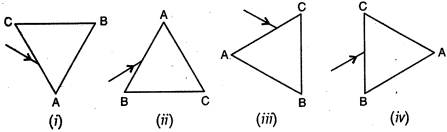
A
$(i)$
B
$(ii)$
C
$(iii)$
D
$(iv)$
Solution
(A) When white light passes through a prism,it disperses into its constituent colours: Violet,Indigo,Blue,Green,Yellow,Orange,and Red $(VIBGYOR)$.
In a standard prism orientation (where the base is at the bottom),the colours appear in the order $VIBGYOR$ from bottom to top.
If the prism is inverted (base at the top),the order of colours from top to bottom is $VIBGYOR$.
The third colour from the top in the inverted prism is Blue,which corresponds to the colour of the sky.
In the given options,case $(i)$ shows the prism with the vertex $A$ at the bottom,which is an inverted orientation. Therefore,the third colour from the top will be Blue.
In a standard prism orientation (where the base is at the bottom),the colours appear in the order $VIBGYOR$ from bottom to top.
If the prism is inverted (base at the top),the order of colours from top to bottom is $VIBGYOR$.
The third colour from the top in the inverted prism is Blue,which corresponds to the colour of the sky.
In the given options,case $(i)$ shows the prism with the vertex $A$ at the bottom,which is an inverted orientation. Therefore,the third colour from the top will be Blue.
0 likes
View Solution208
MediumMCQ
$A$ person cannot see distinctly objects kept beyond $2\, m$. This defect can be corrected by using a lens of power:
A
$-0.2\, D$
B
$+0.5\, D$
C
$-0.5\, D$
D
$-0.25\, D$
Solution
(C) The person is suffering from myopia (near-sightedness) because they cannot see objects beyond $2\, m$.
To correct this defect, a concave lens is used to bring the image of an object at infinity to the person's far point $(2\, m)$.
Here, the object distance $u = \infty$ and the image distance $v = -2\, m$.
Using the lens formula: $\frac{1}{f} = \frac{1}{v} - \frac{1}{u}$.
Substituting the values: $\frac{1}{f} = \frac{1}{-2} - \frac{1}{\infty} = -0.5\, m^{-1}$.
Since power $P = \frac{1}{f(\text{in meters})}$, we get $P = -0.5\, D$.
To correct this defect, a concave lens is used to bring the image of an object at infinity to the person's far point $(2\, m)$.
Here, the object distance $u = \infty$ and the image distance $v = -2\, m$.
Using the lens formula: $\frac{1}{f} = \frac{1}{v} - \frac{1}{u}$.
Substituting the values: $\frac{1}{f} = \frac{1}{-2} - \frac{1}{\infty} = -0.5\, m^{-1}$.
Since power $P = \frac{1}{f(\text{in meters})}$, we get $P = -0.5\, D$.
0 likes
View Solution209
EasyMCQ
Accommodation means the adjustment of light going into the eye for image formation.
A
True
B
False
Solution
(B) The statement is False.
Accommodation is the ability of the eye to focus on objects at varying distances by changing the focal length of the eye lens with the help of ciliary muscles.
The adjustment of the amount of light entering the eye is controlled by the iris and the pupil,not by accommodation.
Accommodation is the ability of the eye to focus on objects at varying distances by changing the focal length of the eye lens with the help of ciliary muscles.
The adjustment of the amount of light entering the eye is controlled by the iris and the pupil,not by accommodation.
0 likes
View Solution210
EasyMCQ
$A$ near-sighted person can see only nearer objects.
A
True
B
False
Solution
(B) The statement is $False$.
Myopia,or near-sightedness,is a defect of vision in which a person can see nearby objects clearly but cannot see distant objects distinctly.
While the statement says they can see 'only' nearer objects,it is important to clarify that the primary characteristic of myopia is the inability to see distant objects clearly,rather than a limitation that prevents them from seeing anything else.
However,in the context of standard physics problems,this statement is often considered false because it implies an exclusive capability that ignores the definition of the defect as a failure to focus on distant objects.
Myopia,or near-sightedness,is a defect of vision in which a person can see nearby objects clearly but cannot see distant objects distinctly.
While the statement says they can see 'only' nearer objects,it is important to clarify that the primary characteristic of myopia is the inability to see distant objects clearly,rather than a limitation that prevents them from seeing anything else.
However,in the context of standard physics problems,this statement is often considered false because it implies an exclusive capability that ignores the definition of the defect as a failure to focus on distant objects.
0 likes
View Solution211
EasyMCQ
Presbyopia is a type of far-sightedness.
A
True
B
False
Solution
(B) Presbyopia is a defect of vision in which an old person cannot see the nearby objects clearly due to the loss of accommodation power of the eye. It is not a type of far-sightedness (hypermetropia),although it shares some similarities in terms of corrective lenses. Therefore,the statement is False.
0 likes
View Solution212
EasyMCQ
$A$ convex lens can be used to correct long-sightedness (hypermetropia).
A
True
B
False
Solution
(A) Long-sightedness,also known as $Hypermetropia$,is a defect of vision where a person can see distant objects clearly but cannot see nearby objects distinctly. This happens because the light rays from a nearby object focus behind the retina. $A$ convex lens is used to converge the light rays before they enter the eye,allowing the image to be focused correctly on the retina. Therefore,the statement is $True$.
0 likes
View Solution213
EasyMCQ
To correct astigmatism,we use a cylindrical lens.
A
True
B
False
Solution
(A) Astigmatism is a common vision condition caused by an irregularly shaped cornea or lens,which prevents light from focusing properly on the retina. This results in blurred or distorted vision at all distances. To correct this refractive error,a cylindrical lens is used,which compensates for the uneven curvature of the eye by providing different refractive powers in different meridians. Therefore,the statement is true.
0 likes
View Solution214
EasyMCQ
Short-sightedness (myopia) is caused due to the elongation of the eyeball.
A
True
B
False
Solution
(A) Short-sightedness,also known as myopia,is a defect of vision in which a person can see nearby objects clearly but cannot see distant objects distinctly.
This condition occurs because the eyeball becomes too long,causing the light rays from distant objects to focus in front of the retina instead of directly on it.
Therefore,the statement is True.
This condition occurs because the eyeball becomes too long,causing the light rays from distant objects to focus in front of the retina instead of directly on it.
Therefore,the statement is True.
0 likes
View Solution215
EasyMCQ
Abnormalities in the normal vision of the eye are called defects of vision.
A
True
B
False
Solution
(A) The statement is $True$.
Defects of vision occur when the eye loses its ability to accommodate or focus light properly on the retina.
Common examples include myopia (nearsightedness),hypermetropia (farsightedness),and presbyopia.
Defects of vision occur when the eye loses its ability to accommodate or focus light properly on the retina.
Common examples include myopia (nearsightedness),hypermetropia (farsightedness),and presbyopia.
0 likes
View Solution216
EasyMCQ
For a person suffering from myopia,the image of the object is formed in front of the retina.
A
True
B
False
Solution
(A) Myopia,also known as near-sightedness,is a common vision condition in which near objects appear clear,but objects far away look blurry.
In a myopic eye,the light rays from a distant object converge at a point in front of the retina instead of directly on the retina.
This occurs because the eyeball becomes too long or the cornea is too curved,causing the image to focus before reaching the retina.
Therefore,the statement is True.
In a myopic eye,the light rays from a distant object converge at a point in front of the retina instead of directly on the retina.
This occurs because the eyeball becomes too long or the cornea is too curved,causing the image to focus before reaching the retina.
Therefore,the statement is True.
0 likes
View Solution217
EasyMCQ
Light coming from the sun is white light and contains seven colours.
A
True
B
False
Solution
(A) The light emitted by the sun is known as white light. When this light passes through a prism or is dispersed by water droplets in the atmosphere (as in a rainbow),it splits into its constituent seven colours: Violet,Indigo,Blue,Green,Yellow,Orange,and Red $(VIBGYOR)$. Therefore,the statement is true.
0 likes
View Solution218
EasyMCQ
When a beam of white light is passed through a prism,violet colour bends the most and red colour the least.
A
True
B
False
Solution
(A) When white light passes through a prism,it splits into its constituent colours (dispersion).
According to Cauchy's equation,the refractive index of a material depends on the wavelength of light.
The refractive index is higher for shorter wavelengths (violet) and lower for longer wavelengths (red).
Since the angle of deviation is directly related to the refractive index,violet light (having the shortest wavelength) undergoes the maximum deviation (bends the most),while red light (having the longest wavelength) undergoes the minimum deviation (bends the least).
According to Cauchy's equation,the refractive index of a material depends on the wavelength of light.
The refractive index is higher for shorter wavelengths (violet) and lower for longer wavelengths (red).
Since the angle of deviation is directly related to the refractive index,violet light (having the shortest wavelength) undergoes the maximum deviation (bends the most),while red light (having the longest wavelength) undergoes the minimum deviation (bends the least).
0 likes
View Solution219
EasyMCQ
Every colour travels with the same speed in a transparent medium.
A
True
B
False
Solution
(B) The statement is $False$. In a transparent medium (other than a vacuum),the speed of light depends on its wavelength (or frequency). This phenomenon is known as dispersion. Different colours of light have different wavelengths; therefore,they travel at different speeds in a medium like glass or water. Violet light,having a shorter wavelength,travels slower than red light,which has a longer wavelength.
0 likes
View Solution220
EasyMCQ
Dispersion of white light occurs because every colour travels with a different speed in a transparent medium.
A
True
B
False
Solution
(A) The phenomenon of dispersion is the splitting of white light into its constituent colours when it passes through a transparent medium like a glass prism.
This occurs because the refractive index of the medium is different for different wavelengths (colours) of light.
Since the speed of light in a medium is given by $v = c/n$ (where $c$ is the speed of light in vacuum and $n$ is the refractive index),different colours travel at different speeds in the medium.
Consequently,each colour undergoes a different amount of deviation,leading to the separation of colours.
This occurs because the refractive index of the medium is different for different wavelengths (colours) of light.
Since the speed of light in a medium is given by $v = c/n$ (where $c$ is the speed of light in vacuum and $n$ is the refractive index),different colours travel at different speeds in the medium.
Consequently,each colour undergoes a different amount of deviation,leading to the separation of colours.
0 likes
View Solution221
EasyMCQ
What is the phenomenon of splitting of white light into its seven constituent colors called?
A
Reflection
B
Refraction
C
Dispersion
D
Interference
Solution
(C) The phenomenon of splitting of white light into its seven constituent colors (violet, indigo, blue, green, yellow, orange, and red) when passing through a glass prism is known as $Dispersion$ of light. This occurs because different colors of light travel at different speeds in the glass medium, causing them to bend by different angles.
0 likes
View Solution222
EasyMCQ
In the dispersion of white light by a prism,which color of light undergoes the maximum deviation?
A
Violet
B
Blue
C
Green
D
Red
Solution
(A) When white light passes through a prism,it splits into its constituent colors due to the difference in the refractive index of the glass for different wavelengths.
According to Cauchy's equation,the refractive index is inversely proportional to the wavelength of light.
Violet light has the shortest wavelength among the visible spectrum,which results in the highest refractive index for violet light in the glass prism.
Consequently,violet light undergoes the maximum deviation,while red light,having the longest wavelength,undergoes the minimum deviation.
According to Cauchy's equation,the refractive index is inversely proportional to the wavelength of light.
Violet light has the shortest wavelength among the visible spectrum,which results in the highest refractive index for violet light in the glass prism.
Consequently,violet light undergoes the maximum deviation,while red light,having the longest wavelength,undergoes the minimum deviation.
0 likes
View Solution223
EasyMCQ
Which of the following colors are primary colors?
A
Red,Blue,Yellow
B
Red,Green,Purple
C
Yellow,Green,Blue
D
Red,Green,Blue
Solution
(D) In the context of light and color vision,the primary colors are Red,Green,and Blue $(RGB)$.
These colors are considered primary because they cannot be created by mixing other colors,and they can be combined in various intensities to produce a wide spectrum of other colors.
Therefore,the correct option is $D$.
These colors are considered primary because they cannot be created by mixing other colors,and they can be combined in various intensities to produce a wide spectrum of other colors.
Therefore,the correct option is $D$.
0 likes
View Solution224
EasyMCQ
Which of the following are the primary colours of light?
A
Yellow,Green and Maroon
B
Maroon,Yellow and Cyan
C
Blue,Green and Red
D
Red,Green and Yellow
Solution
(C) The primary colours of light are $Red$,$Green$,and $Blue$ $(RGB)$.
These colours are considered primary because they cannot be created by mixing other colours of light,but when combined in various intensities,they can produce a wide range of colours,including white light.
These colours are considered primary because they cannot be created by mixing other colours of light,but when combined in various intensities,they can produce a wide range of colours,including white light.
0 likes
View Solution225
EasyMCQ
In the human eye,the image of an object is formed on the $................$.
A
Iris
B
Pupil
C
Retina
D
Cornea
Solution
(C) In the human eye,light enters through the cornea and passes through the pupil. The eye lens focuses this light to form a real and inverted image on the light-sensitive screen located at the back of the eye,which is called the retina. Therefore,the correct option is $C$.
0 likes
View Solution226
EasyMCQ
What is the complementary color of blue?
A
Cyan
B
Maroon
C
Green
D
Yellow
Solution
(D) In the context of additive color theory ($RGB$ model),the complementary color of blue is yellow.
When blue light is combined with yellow light,they produce white light.
Therefore,yellow is the complementary color to blue.
When blue light is combined with yellow light,they produce white light.
Therefore,yellow is the complementary color to blue.
0 likes
View Solution227
EasyMCQ
Which color is produced by mixing blue and red?
A
Green
B
Maroon
C
Magenta
D
Yellow
Solution
(C) When mixing primary colors of light,red and blue combine to produce magenta. This is a standard result in the additive color model used in physics and optics.
0 likes
View Solution228
EasyMCQ
The focal length of the eye lens can be changed due to the action of $......................$.
A
Pupil
B
Retina
C
Ciliary muscles
D
Iris
Solution
(C) The focal length of the eye lens is adjusted by the $Ciliary muscles$.
When the $Ciliary muscles$ contract, the curvature of the lens increases, making it thicker, which decreases the focal length.
When the $Ciliary muscles$ relax, the lens becomes thinner, which increases the focal length.
This process is known as the accommodation of the eye.
When the $Ciliary muscles$ contract, the curvature of the lens increases, making it thicker, which decreases the focal length.
When the $Ciliary muscles$ relax, the lens becomes thinner, which increases the focal length.
This process is known as the accommodation of the eye.
0 likes
View Solution229
EasyMCQ
When white light is incident on a blue pigment,which colors of light are reflected?
A
Yellow,orange,green
B
Violet,green,blue
C
Violet,yellow,green
D
Yellow,green,blue
Solution
(B) pigment appears blue because it absorbs all other colors of the visible spectrum except blue.
When white light (which consists of $VIBGYOR$) falls on a blue pigment,the pigment absorbs colors like red,orange,yellow,and green.
It reflects the blue light back to our eyes.
However,in the context of pigments and color mixing,a blue pigment often reflects a range of wavelengths in the blue-green region.
Among the given options,the combination that best describes the reflected light from a blue pigment is violet,green,and blue,as these are closer to the blue end of the spectrum.
When white light (which consists of $VIBGYOR$) falls on a blue pigment,the pigment absorbs colors like red,orange,yellow,and green.
It reflects the blue light back to our eyes.
However,in the context of pigments and color mixing,a blue pigment often reflects a range of wavelengths in the blue-green region.
Among the given options,the combination that best describes the reflected light from a blue pigment is violet,green,and blue,as these are closer to the blue end of the spectrum.
0 likes
View Solution230
EasyMCQ
The eye defect known as $Presbyopia$ is corrected by using a $........$ lens.
A
Convex
B
Concave
C
Bifocal
D
Contact
Solution
(C) $Presbyopia$ is a vision defect that occurs due to the gradual weakening of ciliary muscles and diminishing flexibility of the eye lens with aging. This condition makes it difficult for a person to see nearby objects clearly. To correct this defect,a $Bifocal$ lens is used,which consists of both concave and convex lenses. The upper part of the lens is concave (for distant vision) and the lower part is convex (for near vision).
0 likes
View Solution231
EasyMCQ
Which of the following phenomena is $NOT$ involved in the formation of a rainbow?
A
Reflection
B
Refraction
C
Dispersion
D
Absorption
Solution
(D) The formation of a rainbow is a combined effect of three optical phenomena:
$1$. Refraction: Light enters the water droplet and bends.
$2$. Dispersion: White light splits into its constituent colors $(VIBGYOR)$ inside the droplet.
$3$. Internal Reflection: Light reflects off the inner surface of the droplet.
Absorption is not a process involved in the formation of a rainbow. Therefore,the correct option is $D$.
$1$. Refraction: Light enters the water droplet and bends.
$2$. Dispersion: White light splits into its constituent colors $(VIBGYOR)$ inside the droplet.
$3$. Internal Reflection: Light reflects off the inner surface of the droplet.
Absorption is not a process involved in the formation of a rainbow. Therefore,the correct option is $D$.
0 likes
View Solution232
EasyMCQ
For which of the following cases is total internal reflection of light possible?
A
The angle of incidence is smaller than the critical angle.
B
The angle of incidence is equal to the critical angle.
C
The angle of incidence is greater than the critical angle.
D
The angle of incidence is equal to the angle of refraction.
Solution
(C) Total internal reflection $(TIR)$ occurs when light travels from a denser medium to a rarer medium.
For $TIR$ to take place,two conditions must be satisfied:
$1$. Light must travel from an optically denser medium to an optically rarer medium.
$2$. The angle of incidence $(i)$ must be greater than the critical angle $(c)$ for the pair of media $(i > c)$.
For $TIR$ to take place,two conditions must be satisfied:
$1$. Light must travel from an optically denser medium to an optically rarer medium.
$2$. The angle of incidence $(i)$ must be greater than the critical angle $(c)$ for the pair of media $(i > c)$.
0 likes
View Solution233
EasyMCQ
In the eye of a person suffering from myopia (nearsightedness),where is the image of a distant object formed?
A
On the retina
B
Behind the retina
C
In front of the retina
D
On the pupil
Solution
(C) Myopia,also known as nearsightedness,is a defect of vision in which a person can see nearby objects clearly but cannot see distant objects distinctly.
In a myopic eye,the image of a distant object is formed in front of the retina because the eyeball becomes too long or the curvature of the lens is too high.
Therefore,the correct option is $C$.
In a myopic eye,the image of a distant object is formed in front of the retina because the eyeball becomes too long or the curvature of the lens is too high.
Therefore,the correct option is $C$.
0 likes
View Solution234
EasyMCQ
Which optical phenomenon is responsible for the twinkling of stars?
A
Atmospheric reflection
B
Atmospheric refraction
C
Reflection
D
Total internal reflection
Solution
(B) The twinkling of stars is due to atmospheric refraction of starlight.
As starlight enters the Earth's atmosphere,it undergoes continuous refraction due to the changing refractive index of different layers of air.
These layers have varying temperatures and densities,causing the light to bend as it passes through them.
This continuous bending of light causes the apparent position of the star to fluctuate slightly,and the amount of light reaching the eye varies,resulting in the twinkling effect.
As starlight enters the Earth's atmosphere,it undergoes continuous refraction due to the changing refractive index of different layers of air.
These layers have varying temperatures and densities,causing the light to bend as it passes through them.
This continuous bending of light causes the apparent position of the star to fluctuate slightly,and the amount of light reaching the eye varies,resulting in the twinkling effect.
0 likes
View Solution235
EasyMCQ
Which phenomenon of light is responsible for the Tyndall effect?
A
Reflection
B
Refraction
C
Scattering
D
Dispersion
Solution
(C) The Tyndall effect is the phenomenon in which the particles in a colloid or a fine suspension scatter the beams of light that are directed at them.
This scattering of light by colloidal particles is known as the Tyndall effect.
Therefore,the correct phenomenon responsible for the Tyndall effect is scattering.
This scattering of light by colloidal particles is known as the Tyndall effect.
Therefore,the correct phenomenon responsible for the Tyndall effect is scattering.
0 likes
View Solution236
EasyMCQ
What is the time difference between the actual sunset and the apparent sunset?
A
$2$ seconds
B
$20$ seconds
C
$2$ minutes
D
$20$ minutes
Solution
(C) Due to atmospheric refraction,the Sun is visible to us about $2$ minutes before the actual sunrise and about $2$ minutes after the actual sunset.
As the light from the Sun enters the Earth's atmosphere,it bends due to the varying refractive indices of the air layers.
This bending causes the Sun to appear slightly higher than its actual position,leading to an apparent delay in sunset by approximately $2$ minutes.
As the light from the Sun enters the Earth's atmosphere,it bends due to the varying refractive indices of the air layers.
This bending causes the Sun to appear slightly higher than its actual position,leading to an apparent delay in sunset by approximately $2$ minutes.
0 likes
View Solution237
EasyMCQ
Which color of light is scattered the most due to the atmosphere?
A
Blue
B
Yellow
C
Green
D
Red
Solution
(A) According to Rayleigh scattering, the intensity of scattered light is inversely proportional to the fourth power of its wavelength $(I \propto 1/\lambda^4)$.
Since blue light has a shorter wavelength compared to red, yellow, and green light, it undergoes the maximum scattering by the particles present in the atmosphere.
Therefore, the correct option is $A$.
Since blue light has a shorter wavelength compared to red, yellow, and green light, it undergoes the maximum scattering by the particles present in the atmosphere.
Therefore, the correct option is $A$.
0 likes
View Solution238
EasyMCQ
Which color of light has the minimum velocity in a prism?
A
Red
B
Green
C
Blue
D
Violet
Solution
(D) When white light passes through a prism,it undergoes dispersion into its constituent colors.
Different colors travel at different speeds within the medium of the prism.
The refractive index $(n)$ of a material is related to the velocity of light $(v)$ by the formula $n = c/v$,where $c$ is the speed of light in a vacuum.
According to Cauchy's dispersion formula,the refractive index is higher for light with a shorter wavelength.
Violet light has the shortest wavelength in the visible spectrum,which results in the highest refractive index for the prism material for violet light.
Since $v = c/n$,a higher refractive index $(n)$ leads to a lower velocity $(v)$.
Therefore,violet light travels with the minimum velocity in a prism.
Different colors travel at different speeds within the medium of the prism.
The refractive index $(n)$ of a material is related to the velocity of light $(v)$ by the formula $n = c/v$,where $c$ is the speed of light in a vacuum.
According to Cauchy's dispersion formula,the refractive index is higher for light with a shorter wavelength.
Violet light has the shortest wavelength in the visible spectrum,which results in the highest refractive index for the prism material for violet light.
Since $v = c/n$,a higher refractive index $(n)$ leads to a lower velocity $(v)$.
Therefore,violet light travels with the minimum velocity in a prism.
0 likes
View Solution239
EasyMCQ
In the dispersion of white light by a prism,which color of light has the maximum velocity?
A
Yellow
B
Red
C
Violet
D
Green
Solution
(B) When white light passes through a prism,it splits into its constituent colors due to the difference in their refractive indices in the glass medium.
According to the relation $v = c/n$,where $v$ is the velocity of light in the medium,$c$ is the speed of light in a vacuum,and $n$ is the refractive index of the medium.
The refractive index $n$ is inversely proportional to the wavelength $\lambda$ of the light.
Red light has the longest wavelength,which results in the lowest refractive index for the glass prism.
Since the refractive index is lowest for red light,its velocity $v$ is the maximum among all the colors of the visible spectrum.
According to the relation $v = c/n$,where $v$ is the velocity of light in the medium,$c$ is the speed of light in a vacuum,and $n$ is the refractive index of the medium.
The refractive index $n$ is inversely proportional to the wavelength $\lambda$ of the light.
Red light has the longest wavelength,which results in the lowest refractive index for the glass prism.
Since the refractive index is lowest for red light,its velocity $v$ is the maximum among all the colors of the visible spectrum.
0 likes
View Solution240
EasyMCQ
In the dispersion of white light by a prism,which color of light undergoes the minimum deviation?
A
Blue
B
Green
C
Violet
D
Red
Solution
(D) When white light passes through a prism,it splits into its constituent colors due to the difference in the refractive index of the glass for different wavelengths.
According to Cauchy's equation,the refractive index is inversely proportional to the wavelength of light.
Red light has the longest wavelength in the visible spectrum,which results in the lowest refractive index for red light in the prism.
Since the angle of deviation is directly related to the refractive index,the light with the lowest refractive index undergoes the minimum deviation.
Therefore,red light deviates the least,while violet light,having the shortest wavelength,deviates the most.
According to Cauchy's equation,the refractive index is inversely proportional to the wavelength of light.
Red light has the longest wavelength in the visible spectrum,which results in the lowest refractive index for red light in the prism.
Since the angle of deviation is directly related to the refractive index,the light with the lowest refractive index undergoes the minimum deviation.
Therefore,red light deviates the least,while violet light,having the shortest wavelength,deviates the most.
0 likes
View Solution241
EasyMCQ
In the spectrum obtained by the dispersion of white light through a prism,which color band is located in the middle?
A
Violet
B
Red
C
Green
D
Blue
Solution
(C) When white light passes through a prism,it splits into its constituent seven colors,known as the spectrum,represented by the acronym $VIBGYOR$.
The order of colors from the bottom (least deviated) to the top (most deviated) is: $Violet, Indigo, Blue, Green, Yellow, Orange, Red$.
Counting from either end,the color located exactly in the middle of the $VIBGYOR$ sequence is $Green$ $(G)$.
The order of colors from the bottom (least deviated) to the top (most deviated) is: $Violet, Indigo, Blue, Green, Yellow, Orange, Red$.
Counting from either end,the color located exactly in the middle of the $VIBGYOR$ sequence is $Green$ $(G)$.
0 likes
View Solution242
EasyMCQ
Which scientist established that white light is composed of seven constituent colors?
A
Newton
B
Dr. $C$. $V$. Raman
C
Edwin Hubble
D
Richard $E$. Smalley
Solution
(A) Sir Isaac Newton was the first to demonstrate through his prism experiments that white light is composed of a spectrum of seven colors (Violet,Indigo,Blue,Green,Yellow,Orange,and Red). He used a glass prism to split white light into its constituent colors and then used a second inverted prism to recombine them back into white light.
0 likes
View Solution243
EasyMCQ
What color does a red rose appear when green light is incident upon it?
A
Red
B
Green
C
White
D
Black
Solution
(D) An object appears to be a certain color because it reflects that specific color of light and absorbs all other colors.
$A$ red rose appears red because it reflects red light and absorbs all other colors of the visible spectrum.
When green light is incident on a red rose,the rose absorbs the green light and reflects almost nothing.
Since no light is reflected back to our eyes,the rose appears black.
$A$ red rose appears red because it reflects red light and absorbs all other colors of the visible spectrum.
When green light is incident on a red rose,the rose absorbs the green light and reflects almost nothing.
Since no light is reflected back to our eyes,the rose appears black.
0 likes
View Solution244
EasyMCQ
When white light is incident on an object and it reflects all its constituent colors,what color does it appear to be?
A
White
B
Red
C
Black
D
Blue
Solution
(A) White light is composed of seven colors $(VIBGYOR)$. When an object reflects all the constituent colors of white light,it does not absorb any of them. Since all colors are reflected back to our eyes,the object appears white. If an object absorbs all colors,it appears black.
0 likes
View Solution245
EasyMCQ
When white light is incident on an object and it absorbs all the component colors and reflects none of them,what color does the object appear to be?
A
White
B
Red
C
Blue
D
Black
Solution
(D) The color of an object is determined by the light it reflects to our eyes.
When white light (which consists of $7$ colors) falls on an object,the object absorbs some colors and reflects others.
The reflected light reaches our eyes,and our brain perceives the object as having that specific color.
If an object absorbs all the component colors of white light and reflects none of them,no light reaches our eyes from the object.
Therefore,the object appears black.
When white light (which consists of $7$ colors) falls on an object,the object absorbs some colors and reflects others.
The reflected light reaches our eyes,and our brain perceives the object as having that specific color.
If an object absorbs all the component colors of white light and reflects none of them,no light reaches our eyes from the object.
Therefore,the object appears black.
0 likes
View Solution246
EasyMCQ
What is the method of obtaining various colors by mixing primary colors in appropriate proportions called?
A
Additive color mixing
B
Superposition method
C
Subtractive color mixing
D
Division method
Solution
(A) The process of creating a wide range of colors by combining primary colors (such as Red, Green, and Blue) in different proportions is known as $Additive$ $\text{color mixing}$.
In this method, light of different wavelengths is added together to produce new colors.
For example, mixing Red and Green light produces Yellow light.
Therefore, the correct option is $A$.
In this method, light of different wavelengths is added together to produce new colors.
For example, mixing Red and Green light produces Yellow light.
Therefore, the correct option is $A$.
0 likes
View Solution247
EasyMCQ
What are the colors obtained by mixing primary colors called?
A
Primary pigments
B
Complementary colors
C
Secondary colors
D
Compound colors
Solution
(C) The colors obtained by mixing primary colors (such as Red,Green,and Blue in the context of light) are known as secondary colors.
When primary colors are combined in different proportions,they produce a wide range of secondary colors.
For example,mixing Red and Green light produces Yellow,Green and Blue produces Cyan,and Red and Blue produces Magenta.
When primary colors are combined in different proportions,they produce a wide range of secondary colors.
For example,mixing Red and Green light produces Yellow,Green and Blue produces Cyan,and Red and Blue produces Magenta.
0 likes
View Solution248
EasyMCQ
Which of the following colors is not a primary color?
A
Blue
B
Green
C
Red
D
Yellow
Solution
(D) In the context of additive color mixing (light),the primary colors are $Red$,$Green$,and $Blue$ $(RGB)$.
These colors are considered primary because they cannot be created by mixing other colors,and they can be combined in various intensities to produce a wide range of other colors.
$Yellow$ is a secondary color formed by mixing $Red$ and $Green$ light.
Therefore,$Yellow$ is not a primary color.
These colors are considered primary because they cannot be created by mixing other colors,and they can be combined in various intensities to produce a wide range of other colors.
$Yellow$ is a secondary color formed by mixing $Red$ and $Green$ light.
Therefore,$Yellow$ is not a primary color.
0 likes
View Solution249
EasyMCQ
Which two colors of light combine to form the color maroon?
A
Blue and Green
B
Blue and Red
C
Red and Green
D
Blue and Yellow
Solution
(B) The color maroon is a dark shade of red. In the context of additive color mixing (light),maroon is produced by combining red light with a smaller proportion of blue light. Therefore,the combination of red and blue light results in the formation of maroon.
0 likes
View Solution250
EasyMCQ
When blue and green light overlap,what color does that region appear?
A
Yellow
B
Cyan
C
Maroon
D
White
Solution
(B) The mixing of light colors follows the additive color mixing principle.
When blue light and green light are superimposed or overlap,they produce cyan light.
This is a fundamental concept in the $RGB$ (Red,Green,Blue) color model where cyan is the secondary color formed by the combination of green and blue.
When blue light and green light are superimposed or overlap,they produce cyan light.
This is a fundamental concept in the $RGB$ (Red,Green,Blue) color model where cyan is the secondary color formed by the combination of green and blue.
0 likes
View SolutionThe Human Eye and the Colourful World — Mix Examples - The Human Eye and the Colourful World · Frequently Asked Questions
1Are these The Human Eye and the Colourful World questions useful for JEE and NEET?
Yes. All questions in this section are mapped to JEE Main and NEET exam patterns. Previous year questions from JEE Main, NEET, GUJCET and state-level exams are included with full solutions.
2Can I switch to Hindi or Gujarati for these questions?
Yes. Use the language tabs in the hero section or the sidebar to view the same questions and solutions in English, Hindi or Gujarati.
3How do I generate a question paper from this subtopic?
Use the Vedclass Exam Paper Generator — select the chapter and subtopic, set difficulty, and generate Sets A, B, C, D automatically. First 3 chapters of every subject are free.
Vedclass Products
For Students
Vedclass Test Series
Mock tests in real JEE/NEET style with performance analysis. 5-day free trial.
Start Free TrialFor Teachers
Exam Paper Generator
Generate Set A/B/C/D papers from this chapter in 2 minutes. 3 chapters free.
Try FreeFor Institutes
Online Exam Module
Live online exams with unlimited students, 360° analytics & white-label branding.
See DemoFor Teachers & Institutes
Generate a The Human Eye and the Colourful World Exam Paper in 2 Minutes
Select subtopic & difficulty — Sets A, B, C, D auto-generated with No Repeat logic.
First 3 chapters of every subject are free — no payment required.