
A English
Mix Examples - The Human Eye and the Colourful World Questions in English
Class 10 Science · The Human Eye and the Colourful World · Mix Examples - The Human Eye and the Colourful World
300+
Questions
English
Language
100%
With Solutions
Showing 50 of 300 questions in English
1
EasyMCQ
$A$ person cannot see distinctly objects kept beyond $2\, m$. This defect can be corrected by using a lens of power ........ $D$.
A
$-0.5$
B
$+0.5$
C
$+0.2$
D
$-0.2$
Solution
(A) The person is suffering from myopia (nearsightedness) because they cannot see distant objects beyond $2\, m$.
To correct this defect,a concave lens is used.
The focal length $(f)$ of the required lens should be equal to the far point of the person,which is $-2\, m$ (negative because it is a concave lens).
The power $(P)$ of a lens is given by the formula $P = 1/f$ (in meters).
Substituting the value: $P = 1 / (-2) = -0.5\, D$.
Therefore,the correct power of the lens is $-0.5\, D$.
To correct this defect,a concave lens is used.
The focal length $(f)$ of the required lens should be equal to the far point of the person,which is $-2\, m$ (negative because it is a concave lens).
The power $(P)$ of a lens is given by the formula $P = 1/f$ (in meters).
Substituting the value: $P = 1 / (-2) = -0.5\, D$.
Therefore,the correct power of the lens is $-0.5\, D$.
0 likes
View Solution2
MediumMCQ
$A$ student sitting on the last bench can read the letters written on the blackboard but is not able to read the letters written in his textbook. Which of the following statements is correct?
A
The near point of his eyes has come closer to him
B
The near point of his eyes has receded away
C
The far point of his eyes has come closer to him
D
The far point of his eyes has receded away
Solution
(B) The student is suffering from hypermetropia (farsightedness).
In hypermetropia,a person can see distant objects clearly but cannot see nearby objects clearly.
This happens because the near point of the eye,which is normally $25 \text{ cm}$,has receded away from the eye.
Therefore,the student is unable to read the textbook held at a normal distance.
In hypermetropia,a person can see distant objects clearly but cannot see nearby objects clearly.
This happens because the near point of the eye,which is normally $25 \text{ cm}$,has receded away from the eye.
Therefore,the student is unable to read the textbook held at a normal distance.
0 likes
View Solution3
DifficultMCQ
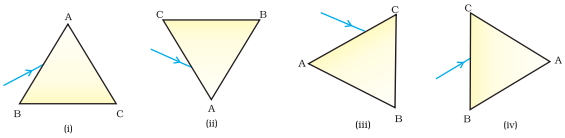
$A$ prism $ABC$ (with $BC$ as base) is placed in different orientations. $A$ narrow beam of white light is incident on the prism as shown in the figure. In which of the following cases,after dispersion,the third colour from the top corresponds to the colour of the sky?
A
$(i)$
B
$(iii)$
C
$(ii)$
D
$(iv)$
Solution
(C) When white light passes through a prism,it disperses into its constituent colours: Violet,Indigo,Blue,Green,Yellow,Orange,and Red $(VIBGYOR)$.
The light bends towards the base of the prism.
In case $(i)$,the base is $BC$. The light enters through face $AB$ and bends towards the base $BC$. The order of colours from top to bottom will be $Red, Orange, Yellow, Green, Blue, Indigo, Violet$.
The third colour from the top is Yellow.
In case $(ii)$,the prism is inverted,so the base is $BC$ at the top. The light bends towards the base (upwards). The order of colours from top to bottom will be $Violet, Indigo, Blue, Green, Yellow, Orange, Red$.
The third colour from the top is Blue,which corresponds to the colour of the sky.
Therefore,case $(ii)$ is the correct orientation.
The light bends towards the base of the prism.
In case $(i)$,the base is $BC$. The light enters through face $AB$ and bends towards the base $BC$. The order of colours from top to bottom will be $Red, Orange, Yellow, Green, Blue, Indigo, Violet$.
The third colour from the top is Yellow.
In case $(ii)$,the prism is inverted,so the base is $BC$ at the top. The light bends towards the base (upwards). The order of colours from top to bottom will be $Violet, Indigo, Blue, Green, Yellow, Orange, Red$.
The third colour from the top is Blue,which corresponds to the colour of the sky.
Therefore,case $(ii)$ is the correct orientation.
0 likes
View Solution4
EasyMCQ
At noon,the sun appears white because:
A
red colour is scattered the most
B
all the colours of the white light are scattered away
C
blue colour is scattered the most
D
light is least scattered
Solution
(D) At noon,the sun is overhead,and the light from the sun travels a relatively shorter distance through the Earth's atmosphere to reach the observer.
Because the distance is short,only a small amount of blue and violet light is scattered.
As a result,all the colours of the white light reach the observer's eye in almost equal proportions,making the sun appear white.
Because the distance is short,only a small amount of blue and violet light is scattered.
As a result,all the colours of the white light reach the observer's eye in almost equal proportions,making the sun appear white.
0 likes
View Solution5
MediumMCQ
Which of the following phenomena of light are involved in the formation of a rainbow?
A
Refraction,dispersion and internal reflection
B
Refraction,dispersion and total internal reflection
C
Reflection,refraction and dispersion
D
Dispersion,scattering and total internal reflection
Solution
(B) The formation of a rainbow is a natural phenomenon caused by the dispersion of sunlight by tiny water droplets present in the atmosphere.
$1$. Refraction: As sunlight enters the water droplet,it bends due to the change in medium.
$2$. Dispersion: The white light splits into its constituent colors $(VIBGYOR)$ inside the droplet.
$3$. Total Internal Reflection: The light rays strike the inner surface of the droplet and are reflected back.
$4$. Refraction: Finally,the light rays refract again as they exit the droplet,reaching the observer's eye.
Therefore,the correct combination of phenomena is refraction,dispersion,and total internal reflection.
$1$. Refraction: As sunlight enters the water droplet,it bends due to the change in medium.
$2$. Dispersion: The white light splits into its constituent colors $(VIBGYOR)$ inside the droplet.
$3$. Total Internal Reflection: The light rays strike the inner surface of the droplet and are reflected back.
$4$. Refraction: Finally,the light rays refract again as they exit the droplet,reaching the observer's eye.
Therefore,the correct combination of phenomena is refraction,dispersion,and total internal reflection.
0 likes
View Solution6
MediumMCQ
The twinkling of stars is due to atmospheric:
A
dispersion of light by water droplets
B
refraction of light by different layers of varying refractive indices
C
scattering of light by dust particles
D
internal reflection of light by clouds
Solution
(B) The twinkling of stars is caused by the atmospheric refraction of starlight.
As starlight enters the Earth's atmosphere,it undergoes continuous refraction due to the presence of various layers of air with varying densities and refractive indices.
These layers are in constant motion due to changing temperature and air currents,which causes the path of the light to fluctuate.
As a result,the apparent position of the star shifts slightly,and the amount of light entering the eye varies,leading to the twinkling effect.
As starlight enters the Earth's atmosphere,it undergoes continuous refraction due to the presence of various layers of air with varying densities and refractive indices.
These layers are in constant motion due to changing temperature and air currents,which causes the path of the light to fluctuate.
As a result,the apparent position of the star shifts slightly,and the amount of light entering the eye varies,leading to the twinkling effect.
0 likes
View Solution7
MediumMCQ
The clear sky appears blue because
A
blue light gets absorbed in the atmosphere
B
ultraviolet radiations are absorbed in the atmosphere
C
violet and blue lights get scattered more than lights of all other colours by the atmosphere
D
light of all other colours is scattered more than the violet and blue colour lights by the atmosphere
Solution
(C) The phenomenon responsible for the blue colour of the sky is Rayleigh scattering.
According to Rayleigh's law of scattering,the intensity of scattered light is inversely proportional to the fourth power of its wavelength $(I \propto 1/\lambda^4)$.
Since violet and blue light have shorter wavelengths compared to other colours in the visible spectrum,they are scattered much more strongly by the fine particles and molecules present in the Earth's atmosphere.
As a result,when sunlight enters the atmosphere,these shorter wavelengths reach our eyes from all directions,making the sky appear blue.
According to Rayleigh's law of scattering,the intensity of scattered light is inversely proportional to the fourth power of its wavelength $(I \propto 1/\lambda^4)$.
Since violet and blue light have shorter wavelengths compared to other colours in the visible spectrum,they are scattered much more strongly by the fine particles and molecules present in the Earth's atmosphere.
As a result,when sunlight enters the atmosphere,these shorter wavelengths reach our eyes from all directions,making the sky appear blue.
0 likes
View Solution8
MediumMCQ
Which of the following statements is correct regarding the propagation of light of different colours of white light in air?
A
Red light moves fastest
B
Blue light moves faster than green light
C
Yellow light moves with the mean speed as that of the red and the violet light
D
All the colours of the white light move with the same speed
Solution
(D) In a vacuum or air,all colours of white light travel with the same speed,which is approximately $3 \times 10^8 \ m/s$. Dispersion and differences in speed for different colours only occur when light travels through a dispersive medium like glass or water. Therefore,in air,all colours of white light move with the same speed.
0 likes
View Solution9
MediumMCQ
The danger signals installed at the top of tall buildings are red in colour. These can be easily seen from a distance because among all other colours, the red light
A
is scattered the least by smoke or fog
B
is scattered the most by smoke or fog
C
is absorbed the most by smoke or fog
D
moves fastest in air
Solution
(A) According to Rayleigh's law of scattering, the intensity of scattered light is inversely proportional to the fourth power of its wavelength $(I \propto 1/\lambda^4)$.
Since red light has the longest wavelength in the visible spectrum, it undergoes the least scattering by atmospheric particles like smoke or fog.
Because it is scattered the least, red light can travel longer distances without being dispersed, making it clearly visible from far away.
Therefore, the correct option is $A$.
Since red light has the longest wavelength in the visible spectrum, it undergoes the least scattering by atmospheric particles like smoke or fog.
Because it is scattered the least, red light can travel longer distances without being dispersed, making it clearly visible from far away.
Therefore, the correct option is $A$.
0 likes
View Solution10
EasyMCQ
Which of the following phenomena contributes significantly to the reddish appearance of the sun at sunrise or sunset?
A
Dispersion of light
B
Scattering of light
C
Total internal reflection of light
D
Reflection of light from the earth
Solution
(B) At sunrise or sunset,the sun is near the horizon.
Light from the sun has to travel a much larger distance through the atmosphere to reach the observer.
During this journey,most of the blue and shorter wavelengths of light are scattered away by the atmospheric particles.
Only the light of longer wavelengths,such as red,is able to reach our eyes.
Therefore,the sun appears reddish at sunrise or sunset due to the scattering of light.
Light from the sun has to travel a much larger distance through the atmosphere to reach the observer.
During this journey,most of the blue and shorter wavelengths of light are scattered away by the atmospheric particles.
Only the light of longer wavelengths,such as red,is able to reach our eyes.
Therefore,the sun appears reddish at sunrise or sunset due to the scattering of light.
0 likes
View Solution11
MediumMCQ
The bluish colour of water in deep sea is due to
A
the presence of algae and other plants found in water
B
reflection of sky in water
C
scattering of light
D
absorption of light by the sea
Solution
(C) The bluish colour of water in the deep sea is primarily due to the scattering of light.
When sunlight enters the water,the water molecules and other suspended particles scatter the light.
According to Rayleigh scattering,shorter wavelengths (like blue and violet) are scattered more strongly than longer wavelengths (like red).
As the light penetrates deeper into the sea,the longer wavelengths are absorbed by the water,while the blue light is scattered back towards our eyes,giving the deep sea its characteristic blue appearance.
When sunlight enters the water,the water molecules and other suspended particles scatter the light.
According to Rayleigh scattering,shorter wavelengths (like blue and violet) are scattered more strongly than longer wavelengths (like red).
As the light penetrates deeper into the sea,the longer wavelengths are absorbed by the water,while the blue light is scattered back towards our eyes,giving the deep sea its characteristic blue appearance.
0 likes
View Solution12
EasyMCQ
When light rays enter the eye,most of the refraction occurs at the
A
crystalline lens
B
pupil
C
iris
D
outer surface of the cornea
Solution
(D) When light rays enter the eye,they first encounter the cornea. The cornea is the transparent,curved,outermost layer of the eye. Because of the significant difference in the refractive index between air and the cornea,the majority of the light refraction occurs at the outer surface of the cornea. The crystalline lens then provides the fine-tuning of the focus to form a sharp image on the retina.
0 likes
View Solution13
EasyMCQ
The focal length of the eye lens increases when eye muscles
A
are relaxed and lens becomes thinner
B
contract and lens becomes thicker
C
are relaxed and lens becomes thicker
D
contract and lens becomes thinner
Solution
(A) The focal length of the eye lens is controlled by the ciliary muscles.
When the ciliary muscles are relaxed,the suspensory ligaments become taut,which pulls the lens and makes it thinner.
$A$ thinner lens has a larger radius of curvature,which results in an increase in the focal length of the eye lens.
This adjustment allows the eye to focus on distant objects.
When the ciliary muscles are relaxed,the suspensory ligaments become taut,which pulls the lens and makes it thinner.
$A$ thinner lens has a larger radius of curvature,which results in an increase in the focal length of the eye lens.
This adjustment allows the eye to focus on distant objects.
0 likes
View Solution14
EasyMCQ
Which of the following statements is correct?
A
$A$ person with myopia can see distant objects clearly.
B
$A$ person with myopia can see nearby objects clearly.
C
$A$ person with hypermetropia can see nearby objects clearly.
D
$A$ person with hypermetropia cannot see distant objects clearly.
Solution
(B) Myopia,also known as near-sightedness,is a defect of vision in which a person can see nearby objects clearly but cannot see distant objects distinctly.
Hypermetropia,also known as far-sightedness,is a defect of vision in which a person can see distant objects clearly but cannot see nearby objects distinctly.
Therefore,the statement '$A$ person with myopia can see nearby objects clearly' is correct.
Hypermetropia,also known as far-sightedness,is a defect of vision in which a person can see distant objects clearly but cannot see nearby objects distinctly.
Therefore,the statement '$A$ person with myopia can see nearby objects clearly' is correct.
0 likes
View Solution15
Medium
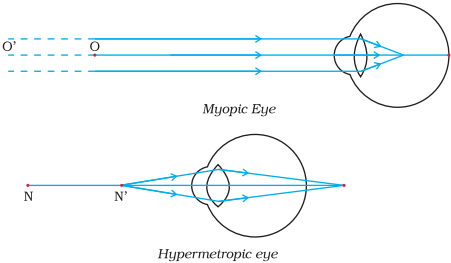
Draw ray diagrams each showing $(i)$ myopic eye and $(ii)$ hypermetropic eye.
Solution
(N/A) $(i)$ Myopic eye (Near-sightedness): In a myopic eye,the image of a distant object is formed in front of the retina instead of on the retina. This occurs because the eye lens becomes too curved or the eyeball becomes too long.
$(ii)$ Hypermetropic eye (Far-sightedness): In a hypermetropic eye,the image of a nearby object is formed behind the retina. This occurs because the eye lens becomes too flat or the eyeball becomes too short.
$(ii)$ Hypermetropic eye (Far-sightedness): In a hypermetropic eye,the image of a nearby object is formed behind the retina. This occurs because the eye lens becomes too flat or the eyeball becomes too short.
0 likes
View Solution16
Medium
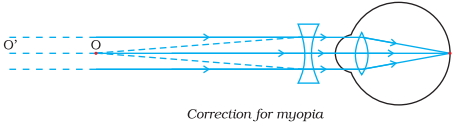
$A$ student sitting at the back of the classroom cannot read clearly the letters written on the blackboard. What advice will a doctor give to her? Draw a ray diagram for the correction of this defect.
Solution
The student is suffering from myopia,also known as near-sightedness. In this defect,a person can see nearby objects clearly but cannot see distant objects distinctly because the image of a distant object is formed in front of the retina.
To correct this defect,a doctor will advise her to use a concave lens of appropriate power. The concave lens diverges the incoming light rays from a distant object,effectively shifting the image back onto the retina.
To correct this defect,a doctor will advise her to use a concave lens of appropriate power. The concave lens diverges the incoming light rays from a distant object,effectively shifting the image back onto the retina.
0 likes
View Solution17
EasyMCQ
How are we able to see nearby and also the distant objects clearly?
A
By changing the size of the pupil.
B
By changing the focal length of the eye lens.
C
By changing the distance between the retina and the lens.
D
By changing the intensity of light entering the eye.
Solution
(B) The human eye is able to see both nearby and distant objects clearly by adjusting the focal length of the eye lens.
This process is known as the power of accommodation.
The ciliary muscles change the curvature of the lens,thereby altering its focal length to focus images of objects at varying distances onto the retina.
This process is known as the power of accommodation.
The ciliary muscles change the curvature of the lens,thereby altering its focal length to focus images of objects at varying distances onto the retina.
0 likes
View Solution18
Easy
$A$ person needs a lens of power $-4.5\, D$ for the correction of her vision.
$(a)$ What kind of defect in vision is she suffering from?
$(b)$ What is the focal length of the corrective lens?
$(c)$ What is the nature of the corrective lens?
$(a)$ What kind of defect in vision is she suffering from?
$(b)$ What is the focal length of the corrective lens?
$(c)$ What is the nature of the corrective lens?
Solution
(N/A) The person is suffering from $Myopia$ (near-sightedness) because the power of the lens is negative.
$(b)$ The focal length $f$ is given by the formula $f = \frac{1}{P}$,where $P$ is the power in diopters $(D)$.
$f = \frac{1}{-4.5\, D} = -0.222\, m$ or $-22.2\, cm$.
$(c)$ Since the power and focal length are negative,the nature of the corrective lens is a $Concave$ lens.
$(b)$ The focal length $f$ is given by the formula $f = \frac{1}{P}$,where $P$ is the power in diopters $(D)$.
$f = \frac{1}{-4.5\, D} = -0.222\, m$ or $-22.2\, cm$.
$(c)$ Since the power and focal length are negative,the nature of the corrective lens is a $Concave$ lens.
0 likes
View Solution19
Medium
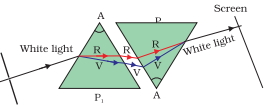
How will you use two identical prisms so that a narrow beam of white light incident on one prism emerges out of the second prism as white light? Draw the diagram.
Solution
(N/A) To obtain a beam of white light from a narrow beam of white light after passing through two prisms,the two identical prisms must be placed in an inverted position with respect to each other.
When a beam of white light enters the first prism $(P_1)$,it undergoes dispersion and splits into its constituent seven colors.
When these dispersed rays fall on the second prism $(P_2)$,which is placed in an inverted position,it recombines the colors to form a beam of white light that emerges from the second prism.
When a beam of white light enters the first prism $(P_1)$,it undergoes dispersion and splits into its constituent seven colors.
When these dispersed rays fall on the second prism $(P_2)$,which is placed in an inverted position,it recombines the colors to form a beam of white light that emerges from the second prism.
0 likes
View Solution20
Medium
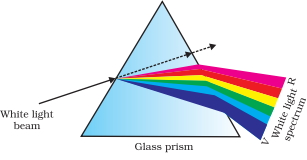
Draw a ray diagram showing the dispersion through a prism when a narrow beam of white light is incident on one of its refracting surfaces. Also,indicate the order of the colours of the spectrum obtained.
Solution
(N/A) When a narrow beam of white light is incident on one of the refracting surfaces of a glass prism,it splits into its constituent seven colours. This phenomenon is known as the dispersion of light.
The order of colours in the spectrum obtained,from the base of the prism upwards,is Violet $(V)$,Indigo $(I)$,Blue $(B)$,Green $(G)$,Yellow $(Y)$,Orange $(O)$,and Red $(R)$. This is commonly remembered by the acronym $VIBGYOR$.
Red light bends the least,while violet light bends the most because the refractive index of glass is different for different wavelengths of light.
The order of colours in the spectrum obtained,from the base of the prism upwards,is Violet $(V)$,Indigo $(I)$,Blue $(B)$,Green $(G)$,Yellow $(Y)$,Orange $(O)$,and Red $(R)$. This is commonly remembered by the acronym $VIBGYOR$.
Red light bends the least,while violet light bends the most because the refractive index of glass is different for different wavelengths of light.
0 likes
View Solution21
EasyMCQ
Is the position of a star as seen by us its true position? Justify your answer.
A
Yes,it is the true position.
B
No,it is not the true position.
C
It depends on the time of the day.
D
It is the true position only during the night.
Solution
(B) No,the position of a star as seen by us is not its true position.
This occurs because the light coming from the stars undergoes atmospheric refraction.
The Earth's atmosphere consists of layers with varying densities and gradually changing refractive indices.
As starlight enters the atmosphere,it bends continuously towards the normal due to these changes in refractive index.
Consequently,the star appears to be at a higher position than its actual location.
This occurs because the light coming from the stars undergoes atmospheric refraction.
The Earth's atmosphere consists of layers with varying densities and gradually changing refractive indices.
As starlight enters the atmosphere,it bends continuously towards the normal due to these changes in refractive index.
Consequently,the star appears to be at a higher position than its actual location.
0 likes
View Solution22
EasyMCQ
Why do we see a rainbow in the sky only after rainfall?
A
The sun is brighter after rain.
B
Water droplets act as prisms and disperse sunlight.
C
The air is cleaner after rain.
D
Raindrops reflect light like a mirror.
Solution
(B) rainbow is a natural spectrum appearing in the sky after a rain shower.
It is caused by the dispersion of sunlight by tiny water droplets,present in the atmosphere.
These water droplets act like small prisms.
They refract and disperse the incident sunlight,then reflect it internally,and finally refract it again when it comes out of the raindrop.
Due to the dispersion of light and internal reflection,we see a spectrum of colours in the form of a rainbow.
It is caused by the dispersion of sunlight by tiny water droplets,present in the atmosphere.
These water droplets act like small prisms.
They refract and disperse the incident sunlight,then reflect it internally,and finally refract it again when it comes out of the raindrop.
Due to the dispersion of light and internal reflection,we see a spectrum of colours in the form of a rainbow.
0 likes
View Solution23
EasyMCQ
Why is the colour of the clear sky blue?
A
Due to reflection of light by the atmosphere.
B
Due to scattering of light by atmospheric particles.
C
Due to refraction of light by the atmosphere.
D
Due to dispersion of light by water droplets.
Solution
(B) The molecules of air and other fine particles in the atmosphere have a size smaller than the wavelength of visible light. These particles are more effective in scattering light of shorter wavelengths at the blue end of the spectrum than light of longer wavelengths at the red end. As blue light has a shorter wavelength,it gets scattered the maximum by the atmospheric particles,which makes the sky appear blue to our eyes.
0 likes
View Solution24
Medium
What is the difference in the colours of the Sun observed during sunrise/sunset and at noon? Provide an explanation for each.
Solution
(N/A) During sunrise and sunset,the Sun appears reddish,whereas at noon,the Sun appears white.
$1$. At noon,the Sun is overhead,and light travels a relatively shorter distance through the Earth's atmosphere. Consequently,only a small amount of blue and shorter wavelengths are scattered,causing the Sun to appear white.
$2$. During sunrise and sunset,the Sun is near the horizon. Light must travel a much longer distance through the atmosphere to reach the observer. Most of the blue light and shorter wavelengths are scattered away by atmospheric particles,leaving only the longer wavelengths,such as red,to reach our eyes,making the Sun appear reddish.
$1$. At noon,the Sun is overhead,and light travels a relatively shorter distance through the Earth's atmosphere. Consequently,only a small amount of blue and shorter wavelengths are scattered,causing the Sun to appear white.
$2$. During sunrise and sunset,the Sun is near the horizon. Light must travel a much longer distance through the atmosphere to reach the observer. Most of the blue light and shorter wavelengths are scattered away by atmospheric particles,leaving only the longer wavelengths,such as red,to reach our eyes,making the Sun appear reddish.
0 likes
View Solution25
Medium
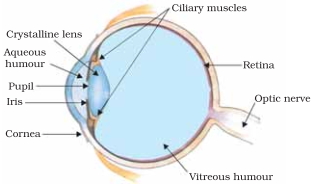
Explain the structure and functioning of the human eye. How are we able to see nearby as well as distant objects?
Solution
(N/A) The human eye is a complex organ that functions like a camera. Its main parts are:
$1$. Cornea: The thin membrane covering the front of the eyeball,which acts as the primary refractive surface.
$2$. Iris: $A$ dark muscular diaphragm that controls the size of the pupil.
$3$. Pupil: The aperture that regulates the amount of light entering the eye.
$4$. Crystalline Lens: $A$ transparent,flexible lens that focuses light onto the retina.
$5$. Ciliary Muscles: Muscles that change the curvature and focal length of the lens.
$6$. Retina: The light-sensitive screen where the image is formed.
$7$. Optic Nerve: Transmits visual information from the retina to the brain.
Functioning and Power of Accommodation:
The ability of the eye to adjust its focal length to see objects at varying distances is called the power of accommodation.
- To see distant objects: The ciliary muscles relax,making the lens thin,which increases its focal length.
- To see nearby objects: The ciliary muscles contract,making the lens thicker,which decreases its focal length.
$1$. Cornea: The thin membrane covering the front of the eyeball,which acts as the primary refractive surface.
$2$. Iris: $A$ dark muscular diaphragm that controls the size of the pupil.
$3$. Pupil: The aperture that regulates the amount of light entering the eye.
$4$. Crystalline Lens: $A$ transparent,flexible lens that focuses light onto the retina.
$5$. Ciliary Muscles: Muscles that change the curvature and focal length of the lens.
$6$. Retina: The light-sensitive screen where the image is formed.
$7$. Optic Nerve: Transmits visual information from the retina to the brain.
Functioning and Power of Accommodation:
The ability of the eye to adjust its focal length to see objects at varying distances is called the power of accommodation.
- To see distant objects: The ciliary muscles relax,making the lens thin,which increases its focal length.
- To see nearby objects: The ciliary muscles contract,making the lens thicker,which decreases its focal length.
0 likes
View Solution26
MediumMCQ
When do we consider a person to be myopic or hypermetropic? Explain using diagrams how the defects associated with myopic and hypermetropic eye can be corrected?
A
Myopia: Near-sightedness; Hypermetropia: Far-sightedness.
B
Myopia is corrected by a concave lens; Hypermetropia is corrected by a convex lens.
C
Myopia is corrected by a convex lens; Hypermetropia is corrected by a concave lens.
D
Myopia is corrected by a bifocal lens; Hypermetropia is corrected by a concave lens.
Solution
(B) person is considered myopic (near-sighted) when they can see nearby objects clearly but cannot see distant objects distinctly. This occurs because the image of a distant object is formed in front of the retina. It is corrected using a concave lens of suitable focal length.
$A$ person is considered hypermetropic (far-sighted) when they can see distant objects clearly but cannot see nearby objects distinctly. This occurs because the image of a nearby object is formed behind the retina. It is corrected using a convex lens of suitable focal length.
$A$ person is considered hypermetropic (far-sighted) when they can see distant objects clearly but cannot see nearby objects distinctly. This occurs because the image of a nearby object is formed behind the retina. It is corrected using a convex lens of suitable focal length.
0 likes
View Solution27
Medium
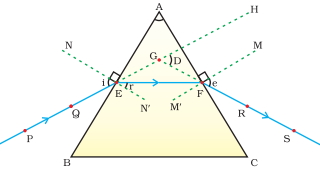
Explain the refraction of light through a triangular glass prism using a labelled ray diagram. Hence,define the angle of deviation.
Solution
(N/A) $1$. Refraction through a prism: When a light ray $PQ$ enters a triangular glass prism $ABC$,it undergoes refraction at the first surface $AB$ and bends towards the normal $NN'$.
$2$. Inside the prism,the ray travels as $EF$ and bends away from the normal $MM'$ at the second surface $AC$,emerging as ray $FS$.
$3$. The incident ray $PQ$ is extended forward,and the emergent ray $FS$ is extended backward to meet at point $G$.
$4$. Angle of deviation: The angle $D$ formed between the direction of the incident ray and the direction of the emergent ray is known as the angle of deviation.
$2$. Inside the prism,the ray travels as $EF$ and bends away from the normal $MM'$ at the second surface $AC$,emerging as ray $FS$.
$3$. The incident ray $PQ$ is extended forward,and the emergent ray $FS$ is extended backward to meet at point $G$.
$4$. Angle of deviation: The angle $D$ formed between the direction of the incident ray and the direction of the emergent ray is known as the angle of deviation.
0 likes
View Solution28
Medium
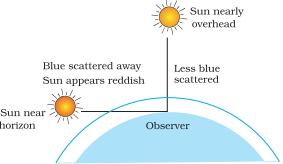
How can we explain the reddish appearance of the Sun at sunrise or sunset? Why does it not appear red at noon?
Solution
(N/A) At sunrise or sunset,the Sun is near the horizon. The light from the Sun has to travel a larger distance through the Earth's atmosphere to reach the observer. During this journey,most of the blue and shorter wavelengths of light are scattered away by the atmospheric particles. Therefore,only the light of longer wavelengths,such as red,reaches our eyes,making the Sun appear reddish.
At noon,the Sun is overhead,and the light travels a relatively shorter distance through the atmosphere. Consequently,only a small amount of blue and violet light is scattered,and the Sun appears white or slightly yellowish.
At noon,the Sun is overhead,and the light travels a relatively shorter distance through the atmosphere. Consequently,only a small amount of blue and violet light is scattered,and the Sun appears white or slightly yellowish.
0 likes
View Solution29
Medium
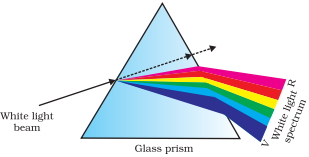
Explain the phenomenon of dispersion of white light through a glass prism,using a suitable ray diagram.
Solution
(N/A) Dispersion is the phenomenon of splitting of white light into its constituent colours when it passes through a glass prism.
When a beam of white light enters a glass prism,it gets refracted and splits into a band of seven colours: Violet,Indigo,Blue,Green,Yellow,Orange,and Red $(VIBGYOR)$.
This splitting occurs because different colours of light travel at different speeds in the glass medium,and thus,they undergo different amounts of deviation.
Violet light bends the most because it has the shortest wavelength,while red light bends the least because it has the longest wavelength.
The resulting band of colours is called a spectrum.
When a beam of white light enters a glass prism,it gets refracted and splits into a band of seven colours: Violet,Indigo,Blue,Green,Yellow,Orange,and Red $(VIBGYOR)$.
This splitting occurs because different colours of light travel at different speeds in the glass medium,and thus,they undergo different amounts of deviation.
Violet light bends the most because it has the shortest wavelength,while red light bends the least because it has the longest wavelength.
The resulting band of colours is called a spectrum.
0 likes
View Solution30
Medium
How does atmospheric refraction take place? Why do stars twinkle,but planets do not?
Solution
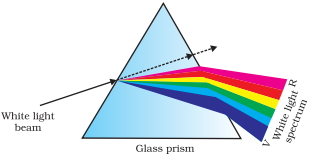
(N/A) Atmospheric refraction occurs due to the gradual change in the refractive index of the Earth's atmosphere. As light from a star enters the atmosphere,it undergoes continuous refraction as it passes through layers of varying density and temperature,causing the star's apparent position to fluctuate and its brightness to change,which we perceive as twinkling.
Planets do not twinkle because they are much closer to the Earth than stars. They appear as extended sources of light rather than point sources. $A$ planet can be considered as a collection of a large number of point-sized sources of light. The total variation in the amount of light entering our eye from all these individual point-sized sources will average out to zero,thereby nullifying the twinkling effect.
Planets do not twinkle because they are much closer to the Earth than stars. They appear as extended sources of light rather than point sources. $A$ planet can be considered as a collection of a large number of point-sized sources of light. The total variation in the amount of light entering our eye from all these individual point-sized sources will average out to zero,thereby nullifying the twinkling effect.
0 likes
View Solution31
Easy
Name the essential parts of the human eye.
Solution
(N/A) The essential parts of the human eye are as follows:
$(i)$ Cornea: The transparent outer layer that protects the eye and helps focus light.
$(ii)$ Iris: The colored part of the eye that controls the size of the pupil.
$(iii)$ Pupil: The opening in the center of the iris that allows light to enter the eye.
$(iv)$ Eye lens: $A$ transparent,biconvex structure that focuses light onto the retina.
$(v)$ Ciliary muscles: Muscles that change the shape of the lens to adjust focus.
$(vi)$ Retina: The light-sensitive layer at the back of the eye where images are formed.
$(i)$ Cornea: The transparent outer layer that protects the eye and helps focus light.
$(ii)$ Iris: The colored part of the eye that controls the size of the pupil.
$(iii)$ Pupil: The opening in the center of the iris that allows light to enter the eye.
$(iv)$ Eye lens: $A$ transparent,biconvex structure that focuses light onto the retina.
$(v)$ Ciliary muscles: Muscles that change the shape of the lens to adjust focus.
$(vi)$ Retina: The light-sensitive layer at the back of the eye where images are formed.
0 likes
View Solution32
EasyMCQ
What is the cornea?
A
The colored part of the eye
B
The transparent spherical membrane covering the front of the eye
C
The light-sensitive layer at the back of the eye
D
The muscle that controls the size of the pupil
Solution
(B) The cornea is the thin,transparent,spherical membrane that covers the front surface of the eyeball.
It acts as the primary refractive element of the eye,allowing light to enter and focusing it onto the lens.
It acts as the primary refractive element of the eye,allowing light to enter and focusing it onto the lens.
0 likes
View Solution33
EasyMCQ
Which liquid fills the space behind the cornea?
A
Vitreous humour
B
Aqueous humour
C
Synovial fluid
D
Cerebrospinal fluid
Solution
(B) The space between the cornea and the lens is filled with a thin,watery fluid called the $Aqueous$ $humour$. This fluid helps in maintaining the intraocular pressure and provides nourishment to the cornea and the lens.
0 likes
View Solution34
EasyMCQ
What is the iris?
A
$A$ transparent membrane covering the eye
B
$A$ dark muscular diaphragm that controls the size of the pupil
C
The light-sensitive screen at the back of the eye
D
The lens that focuses light on the retina
Solution
(B) The iris is a dark,muscular diaphragm located behind the cornea and in front of the lens. It is responsible for controlling the size of the pupil,thereby regulating the amount of light entering the eye.
0 likes
View Solution35
EasyMCQ
Which part of the eye controls the amount of light entering the eye?
A
Iris
B
Pupil
C
Cornea
D
Retina
Solution
(B) The $iris$ is a dark muscular diaphragm that controls the size of the $pupil$. The $pupil$ regulates and controls the amount of light entering the eye by adjusting its size based on the intensity of light present in the environment.
0 likes
View Solution36
EasyMCQ
What is the eye lens made of?
A
$A$ transparent,jelly-like proteinaceous substance
B
$A$ hard,calcified bone structure
C
$A$ layer of pigmented epithelial cells
D
$A$ fluid-filled sac of aqueous humor
Solution
(A) The eye lens is a transparent,biconvex structure in the eye.
It is composed of a jelly-like,proteinaceous material.
This material is organized into layers,which allows the lens to change its shape to focus light on the retina,a process known as accommodation.
It is composed of a jelly-like,proteinaceous material.
This material is organized into layers,which allows the lens to change its shape to focus light on the retina,a process known as accommodation.
0 likes
View Solution37
EasyMCQ
How is the eye lens held in its position?
A
By the iris
B
By the ciliary muscles
C
By the cornea
D
By the aqueous humor
Solution
(B) The eye lens is a transparent,biconvex structure made of a jelly-like proteinaceous material.
It is held in its position by the ciliary muscles.
These muscles not only hold the lens in place but also change its focal length by adjusting its curvature,which allows the eye to focus on objects at varying distances.
It is held in its position by the ciliary muscles.
These muscles not only hold the lens in place but also change its focal length by adjusting its curvature,which allows the eye to focus on objects at varying distances.
0 likes
View Solution38
EasyMCQ
How is the sense of vision carried from the eye to the brain?
A
Through the sensory nerve
B
Through the optic nerve
C
Through the auditory nerve
D
Through the spinal cord
Solution
(B) The sense of vision is carried from the eye to the brain through the optic nerve. When light enters the eye,it forms an image on the retina. The photoreceptor cells in the retina generate electrical signals,which are then transmitted to the brain via the optic nerve for visual processing.
0 likes
View Solution39
EasyMCQ
Which liquid fills the space between the eye lens and the retina?
A
Aqueous humour
B
Vitreous humour
C
Synovial fluid
D
Cerebrospinal fluid
Solution
(B) The space between the eye lens and the retina is filled with a transparent,jelly-like substance known as the vitreous humour. It helps in maintaining the shape of the eyeball and supports the retina.
0 likes
View Solution40
EasyMCQ
What is a blind spot?
A
The point where the image is clearest.
B
The point at which the optic nerve leaves the eye.
C
The center of the iris.
D
The area where the lens is attached.
Solution
(B) blind spot is a small area on the retina where the optic nerve exits the eye to travel to the brain.
This region lacks photoreceptor cells (rods and cones).
Therefore,no image can be formed at this specific point,making it 'blind'.
This region lacks photoreceptor cells (rods and cones).
Therefore,no image can be formed at this specific point,making it 'blind'.
0 likes
View Solution41
EasyMCQ
Why is the blind spot so called?
A
It is located at the center of the retina.
B
It contains only cone cells.
C
No photoreceptor cells are present at this point,so no image is formed.
D
It is the point where the optic nerve leaves the eye.
Solution
(C) The blind spot is a small area on the retina where the optic nerve exits the eye to connect to the brain.
This region lacks both rod and cone cells,which are the photoreceptor cells responsible for detecting light.
Because there are no photoreceptor cells present at this specific point,no visual information is captured or transmitted to the brain.
Therefore,any image formed at this point cannot be perceived,which is why it is called the blind spot.
This region lacks both rod and cone cells,which are the photoreceptor cells responsible for detecting light.
Because there are no photoreceptor cells present at this specific point,no visual information is captured or transmitted to the brain.
Therefore,any image formed at this point cannot be perceived,which is why it is called the blind spot.
0 likes
View Solution42
EasyMCQ
What is the number of receptors contained in the retina?
A
Approximately $100$ million
B
Approximately $125$ million
C
Approximately $150$ million
D
Approximately $200$ million
Solution
(B) The retina is the light-sensitive layer of the eye that contains photoreceptor cells known as rods and cones.
These cells are responsible for converting light energy into electrical signals.
The human retina contains more than $125$ million of these photoreceptor cells.
These cells are responsible for converting light energy into electrical signals.
The human retina contains more than $125$ million of these photoreceptor cells.
0 likes
View Solution43
EasyMCQ
What is meant by accommodation of the eye?
A
The ability of the eye to see distant objects clearly.
B
The ability of the eye lens to adjust its focal length.
C
The process of changing the shape of the pupil.
D
The ability of the retina to capture light.
Solution
(B) The ability of the eye lens to adjust its focal length to focus objects at varying distances on the retina is known as accommodation. This is achieved by the action of ciliary muscles,which change the curvature and,consequently,the focal length of the eye lens.
0 likes
View Solution44
EasyMCQ
What is the other name for the accommodation of the eye?
A
Power of accommodation
B
Refractive index
C
Persistence of vision
D
Visual acuity
Solution
(A) The ability of the eye lens to adjust its focal length to focus objects at varying distances is known as the $Power$ of $Accommodation$.
0 likes
View Solution45
Easy
What is meant by the far point?
Solution
(N/A) The farthest point up to which an eye can see objects clearly is called the far point of the eye. For a normal human eye, this point is at infinity.
0 likes
View Solution46
EasyMCQ
What is the far point of a normal human eye?
A
$25 \ cm$
B
$50 \ cm$
C
$100 \ cm$
D
Infinity
Solution
(D) The far point of a normal human eye is the maximum distance up to which the eye can see objects clearly.
For a normal human eye,this distance is considered to be infinity.
For a normal human eye,this distance is considered to be infinity.
0 likes
View Solution47
EasyMCQ
What is meant by the near point of the eye?
A
The farthest point an eye can see.
B
The nearest point up to which an eye can see objects clearly.
C
The point where the image is formed on the blind spot.
D
The point where the lens changes its focal length.
Solution
(B) The nearest point up to which an eye can see objects clearly without any strain is called the near point of the eye.
For a normal human eye,this distance is approximately $25 \ cm$.
For a normal human eye,this distance is approximately $25 \ cm$.
0 likes
View Solution48
EasyMCQ
What is the near point of a normal human eye (in $cm$)?
A
$20$
B
$25$
C
$30$
D
$10$
Solution
(B) For a normal human eye of an adult,the near point is the minimum distance at which an object can be seen clearly without strain.
This distance is approximately $25 \ cm$ from the eye.
This distance is approximately $25 \ cm$ from the eye.
0 likes
View Solution49
Easy
What is meant by the least distance of distinct vision?
Solution
(N/A) The minimum distance at which an object can be placed so that the human eye can see it clearly without any strain is known as the least distance of distinct vision. For a normal adult eye,this distance is approximately $25 \ cm$.
0 likes
View Solution50
EasyMCQ
What is the least distance of distinct vision of a normal human eye (in $cm$)?
A
$15$
B
$20$
C
$25$
D
$30$
Solution
(C) The least distance of distinct vision is the minimum distance at which an object can be seen clearly without any strain on the eye.
For a normal human eye,this distance is standardly accepted as $25 \, cm$.
For a normal human eye,this distance is standardly accepted as $25 \, cm$.
0 likes
View SolutionThe Human Eye and the Colourful World — Mix Examples - The Human Eye and the Colourful World · Frequently Asked Questions
1Are these The Human Eye and the Colourful World questions useful for JEE and NEET?
Yes. All questions in this section are mapped to JEE Main and NEET exam patterns. Previous year questions from JEE Main, NEET, GUJCET and state-level exams are included with full solutions.
2Can I switch to Hindi or Gujarati for these questions?
Yes. Use the language tabs in the hero section or the sidebar to view the same questions and solutions in English, Hindi or Gujarati.
3How do I generate a question paper from this subtopic?
Use the Vedclass Exam Paper Generator — select the chapter and subtopic, set difficulty, and generate Sets A, B, C, D automatically. First 3 chapters of every subject are free.
Vedclass Products
For Students
Vedclass Test Series
Mock tests in real JEE/NEET style with performance analysis. 5-day free trial.
Start Free TrialFor Teachers
Exam Paper Generator
Generate Set A/B/C/D papers from this chapter in 2 minutes. 3 chapters free.
Try FreeFor Institutes
Online Exam Module
Live online exams with unlimited students, 360° analytics & white-label branding.
See DemoFor Teachers & Institutes
Generate a The Human Eye and the Colourful World Exam Paper in 2 Minutes
Select subtopic & difficulty — Sets A, B, C, D auto-generated with No Repeat logic.
First 3 chapters of every subject are free — no payment required.