
A English
Mix Examples - The Human Eye and the Colourful World Questions in English
Class 10 Science · The Human Eye and the Colourful World · Mix Examples - The Human Eye and the Colourful World
300+
Questions
English
Language
100%
With Solutions
Showing 50 of 300 questions in English
151
Difficult
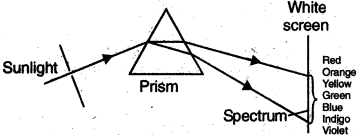
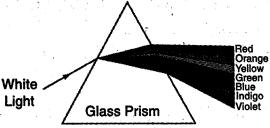
$(i)$ What is meant by dispersion of white light? Draw a diagram to show the dispersion of white light by a glass prism.
$(ii)$ Light of two colours $A$ and $B$ pass through a prism. $A$ deviates more than $B$ from its path of incidence. Which colour has a higher speed in the prism?
$(ii)$ Light of two colours $A$ and $B$ pass through a prism. $A$ deviates more than $B$ from its path of incidence. Which colour has a higher speed in the prism?
Solution
(B) $(i)$ The phenomenon of splitting of white light into its constituent colours (spectrum) when passing through a glass prism is called dispersion of light.
$(ii)$ The deviation of light depends on its refractive index in the medium. $A$ higher deviation implies a higher refractive index,and since refractive index is inversely proportional to the speed of light in that medium $(n = c/v)$,the colour that deviates more $(A)$ travels slower. Therefore,the colour that deviates less $(B)$ has a higher speed in the prism.
$(ii)$ The deviation of light depends on its refractive index in the medium. $A$ higher deviation implies a higher refractive index,and since refractive index is inversely proportional to the speed of light in that medium $(n = c/v)$,the colour that deviates more $(A)$ travels slower. Therefore,the colour that deviates less $(B)$ has a higher speed in the prism.
0 likes
View Solution152
Medium
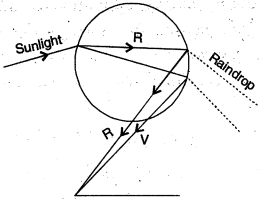
With the help of a diagram,explain the formation of a rainbow in the sky.
Solution
(N/A) rainbow is a natural spectrum appearing in the sky after a rainfall. It is caused by the dispersion of sunlight by tiny water droplets present in the atmosphere.
$1$. When sunlight enters a water droplet,it undergoes refraction and dispersion.
$2$. The light then undergoes internal reflection inside the droplet.
$3$. Finally,the light undergoes refraction again as it exits the droplet.
Due to these phenomena (refraction,dispersion,and internal reflection),different colours reach the observer's eye at different angles,resulting in the formation of a rainbow. The observer must always have their back towards the Sun to see a rainbow.
$1$. When sunlight enters a water droplet,it undergoes refraction and dispersion.
$2$. The light then undergoes internal reflection inside the droplet.
$3$. Finally,the light undergoes refraction again as it exits the droplet.
Due to these phenomena (refraction,dispersion,and internal reflection),different colours reach the observer's eye at different angles,resulting in the formation of a rainbow. The observer must always have their back towards the Sun to see a rainbow.
0 likes
View Solution153
Medium
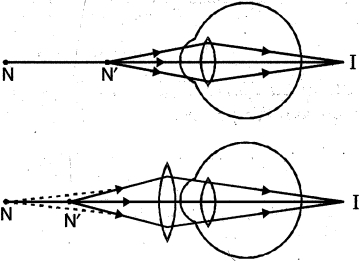
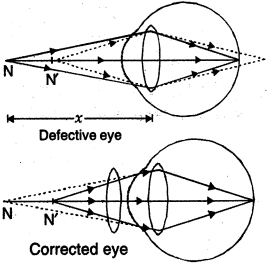
$A$ person is unable to read a book clearly when kept at a distance of $25 \,cm$ from his eye. Name the defect. How can it be corrected? Draw ray diagrams for $(i)$ defective eye $(ii)$ corrected eye and explain them.
Solution
(N/A) The defect is Hypermetropia,also known as long-sightedness. In this condition,the near point of the eye shifts further away than the normal $25 \,cm$.
It can be corrected by using a convex lens of suitable focal length,which converges the light rays from the object at $25 \,cm$ to the eye's actual near point $(N')$,allowing the eye to focus the image on the retina.
$(i)$ Defective eye: Rays from an object placed at the normal near point $(N = 25 \,cm)$ are focused behind the retina because the eye's near point has shifted to $N'$.
$(ii)$ Corrected eye: $A$ convex lens is placed in front of the eye. It forms a virtual image of the object (placed at $N$) at the eye's actual near point $(N')$. The eye then focuses this image onto the retina.
It can be corrected by using a convex lens of suitable focal length,which converges the light rays from the object at $25 \,cm$ to the eye's actual near point $(N')$,allowing the eye to focus the image on the retina.
$(i)$ Defective eye: Rays from an object placed at the normal near point $(N = 25 \,cm)$ are focused behind the retina because the eye's near point has shifted to $N'$.
$(ii)$ Corrected eye: $A$ convex lens is placed in front of the eye. It forms a virtual image of the object (placed at $N$) at the eye's actual near point $(N')$. The eye then focuses this image onto the retina.
0 likes
View Solution154
Medium
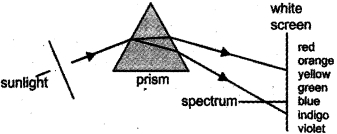
State the cause of dispersion when white light enters a glass prism. Explain with a diagram.
Solution
(N/A) The cause of dispersion is that white light is composed of different colours,each having a different wavelength.
When white light enters a glass prism,each colour travels at a different speed within the medium.
Because the refractive index of glass is different for different wavelengths,each colour bends through a different angle with respect to the incident ray.
Specifically,red light has the longest wavelength and bends the least,while violet light has the shortest wavelength and bends the most.
As a result,the rays of each colour emerge along different paths,becoming distinct and forming a band of colours known as a spectrum.
The diagram is as shown below:
When white light enters a glass prism,each colour travels at a different speed within the medium.
Because the refractive index of glass is different for different wavelengths,each colour bends through a different angle with respect to the incident ray.
Specifically,red light has the longest wavelength and bends the least,while violet light has the shortest wavelength and bends the most.
As a result,the rays of each colour emerge along different paths,becoming distinct and forming a band of colours known as a spectrum.
The diagram is as shown below:
0 likes
View Solution155
Medium
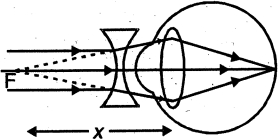
$A$ person suffering from an eye defect uses lenses of power $-1 \,D$. Identify the eye defect. Draw a suitable diagram to illustrate how this type of lens corrects the defect. Give the nature of the corrective lens to be used. Also,calculate the focal length of the corrective lens.
Solution
(N/A) The person is suffering from myopia (short-sightedness).
$A$ concave lens is used to correct this defect.
The nature of the corrective lens is a concave lens (diverging lens).
We know that the power of a lens $P = 1 / f$ (where $f$ is in meters).
Given $P = -1 \,D$.
Therefore,$f = 1 / P = 1 / (-1) = -1 \,m = -100 \,cm$.
The negative sign indicates that the lens is concave.
$A$ concave lens is used to correct this defect.
The nature of the corrective lens is a concave lens (diverging lens).
We know that the power of a lens $P = 1 / f$ (where $f$ is in meters).
Given $P = -1 \,D$.
Therefore,$f = 1 / P = 1 / (-1) = -1 \,m = -100 \,cm$.
The negative sign indicates that the lens is concave.
0 likes
View Solution156
Medium
$(i)$ Calculate the maximum power of accommodation of a person having normal vision.
$(ii)$ $A$ person needs to use glasses for reading a newspaper. Identify the defect in her vision and the type of lens she would need to correct it.
$(iii)$ Sometimes when we enter a dark room from bright sunlight,we are unable to see objects clearly. Why?
$(ii)$ $A$ person needs to use glasses for reading a newspaper. Identify the defect in her vision and the type of lens she would need to correct it.
$(iii)$ Sometimes when we enter a dark room from bright sunlight,we are unable to see objects clearly. Why?
Solution
(A) $(i)$ The near point of a normal eye is $D = 25 \text{ cm}$. The power of accommodation $P$ is given by $P = 1/f = 100/D$ (where $D$ is in cm).
$P = 100 / 25 = 4 \text{ D}$.
Thus,for a person with normal vision,the power of accommodation is about $4 \text{ Dioptre}$.
$(ii)$ The defect is Hypermetropia (long-sightedness),as the person has difficulty reading nearby objects. She would need a convex lens to correct this defect.
$(iii)$ The pupil regulates and controls the amount of light entering the eye. In bright sunlight,the pupil size is small. When we enter a dark room,it takes some time for the pupil to dilate (expand) to allow more light to enter,which is why we cannot see objects clearly immediately.
$P = 100 / 25 = 4 \text{ D}$.
Thus,for a person with normal vision,the power of accommodation is about $4 \text{ Dioptre}$.
$(ii)$ The defect is Hypermetropia (long-sightedness),as the person has difficulty reading nearby objects. She would need a convex lens to correct this defect.
$(iii)$ The pupil regulates and controls the amount of light entering the eye. In bright sunlight,the pupil size is small. When we enter a dark room,it takes some time for the pupil to dilate (expand) to allow more light to enter,which is why we cannot see objects clearly immediately.
0 likes
View Solution157
Medium
State one function each of iris,pupil,and cornea.
Solution
(N/A) Iris: It regulates the amount of light entering the eye by dilating the pupil in low-intensity light and contracting the pupil in high-intensity light.
Pupil: It is the aperture that allows light to enter the eye.
Cornea: It is a transparent spherical membrane covering the front of the eyeball. It acts as the primary refractive surface where light is refracted the most upon entering the eye.
Pupil: It is the aperture that allows light to enter the eye.
Cornea: It is a transparent spherical membrane covering the front of the eyeball. It acts as the primary refractive surface where light is refracted the most upon entering the eye.
0 likes
View Solution158
Medium
$(a)$ Explain the phenomenon of scattering of light. State the factor on which the colour of scattered light depends.
$(b)$ List any two natural phenomena based on the scattering of light.
$(b)$ List any two natural phenomena based on the scattering of light.
Solution
(N/A) Scattering of light is the phenomenon where light rays change their direction upon striking obstacles such as atoms,molecules,dust particles,or water droplets. The colour of the scattered light depends on the size of the scattering particles. Very fine particles scatter mainly blue light of shorter wavelengths,while larger particles scatter light of longer wavelengths.
$(b)$ Two natural phenomena based on the scattering of light are:
$(i)$ The blue colour of the sky.
$(ii)$ The reddish appearance of the Sun at sunrise and sunset.
$(b)$ Two natural phenomena based on the scattering of light are:
$(i)$ The blue colour of the sky.
$(ii)$ The reddish appearance of the Sun at sunrise and sunset.
0 likes
View Solution159
Medium
Account for the following:
$(a)$ Part of the human eye that helps in changing the focal length of the eye lens.
$(b)$ The condition resulting due to the eye lens becoming cloudy.
$(c)$ The factors on which the colour of the scattered white light depends.
$(d)$ The range of vision of a normal eye.
$(e)$ The sky appears dark to the astronauts in space.
$(a)$ Part of the human eye that helps in changing the focal length of the eye lens.
$(b)$ The condition resulting due to the eye lens becoming cloudy.
$(c)$ The factors on which the colour of the scattered white light depends.
$(d)$ The range of vision of a normal eye.
$(e)$ The sky appears dark to the astronauts in space.
Solution
(N/A) Ciliary muscles help in changing the focal length of the eye lens.
$(b)$ Cataract: The crystalline lens of the eye is made of proteins arranged in a regular pattern,which makes the lens transparent. When a group of these protein molecules clump together in a region,they make the region opaque. Gradually,this membrane grows,and the whole lens becomes opaque.
$(c)$ The colour of scattered light depends on the size of the scattering particles (air molecules,dust particles,and pollutants) in the atmosphere.
$(d)$ From $25 \ cm$ to infinity.
$(e)$ There is no atmosphere in space,hence there are no air molecules to scatter sunlight,making the sky appear dark.
$(b)$ Cataract: The crystalline lens of the eye is made of proteins arranged in a regular pattern,which makes the lens transparent. When a group of these protein molecules clump together in a region,they make the region opaque. Gradually,this membrane grows,and the whole lens becomes opaque.
$(c)$ The colour of scattered light depends on the size of the scattering particles (air molecules,dust particles,and pollutants) in the atmosphere.
$(d)$ From $25 \ cm$ to infinity.
$(e)$ There is no atmosphere in space,hence there are no air molecules to scatter sunlight,making the sky appear dark.
0 likes
View Solution160
Medium
$(a)$ If a person wears a lens of power $-6\, D$ for distant vision and for correcting his near vision he needs a lens of $+2\, D$. Determine the focal length of the lenses in both the cases.
$(b)$ Give reasons for the following natural phenomena:
$(i)$ Stars twinkle.
$(ii)$ Planets do not twinkle.
$(iii)$ Stars appear raised in the sky.
$(b)$ Give reasons for the following natural phenomena:
$(i)$ Stars twinkle.
$(ii)$ Planets do not twinkle.
$(iii)$ Stars appear raised in the sky.
Solution
(A) $(i)$ Focal length for distant vision: $f = \frac{1}{P} = \frac{1}{-6} = -0.1667\, m = -16.67\, cm$.
$(ii)$ Focal length for near vision: $f = \frac{1}{P} = \frac{1}{2} = +0.5\, m = +50\, cm$.
$(b)$ $(i)$ Stars twinkle due to atmospheric refraction. The Earth's atmosphere has layers of varying densities and temperatures,causing the refractive index to change continuously. Light from distant stars (point sources) undergoes continuous refraction,causing the apparent position and intensity of the star to fluctuate,which we perceive as twinkling.
$(ii)$ Planets are much closer to Earth than stars and appear as extended sources of light rather than point sources. $A$ planet can be considered as a collection of a large number of point-sized sources. The total variation in the amount of light entering our eye from all these point-sized sources averages out to zero,resulting in a steady light,so they do not twinkle.
$(iii)$ Stars appear raised due to atmospheric refraction. As starlight enters the Earth's atmosphere,it travels from a rarer medium to a denser medium,bending towards the normal at each layer. This continuous bending makes the star appear at a higher position than its actual location.
$(ii)$ Focal length for near vision: $f = \frac{1}{P} = \frac{1}{2} = +0.5\, m = +50\, cm$.
$(b)$ $(i)$ Stars twinkle due to atmospheric refraction. The Earth's atmosphere has layers of varying densities and temperatures,causing the refractive index to change continuously. Light from distant stars (point sources) undergoes continuous refraction,causing the apparent position and intensity of the star to fluctuate,which we perceive as twinkling.
$(ii)$ Planets are much closer to Earth than stars and appear as extended sources of light rather than point sources. $A$ planet can be considered as a collection of a large number of point-sized sources. The total variation in the amount of light entering our eye from all these point-sized sources averages out to zero,resulting in a steady light,so they do not twinkle.
$(iii)$ Stars appear raised due to atmospheric refraction. As starlight enters the Earth's atmosphere,it travels from a rarer medium to a denser medium,bending towards the normal at each layer. This continuous bending makes the star appear at a higher position than its actual location.
0 likes
View Solution161
Medium
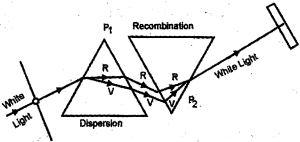
$(a)$ Explain with the help of a labelled diagram how a combination of two prisms can be used so that incident white light emerges out of the second prism as white light.
$(b)$ Name the scientist who first performed this activity.
$(c)$ Explain the term spectrum in brief.
$(b)$ Name the scientist who first performed this activity.
$(c)$ Explain the term spectrum in brief.
Solution
(N/A) prism $P_{1}$ in the path of white light disperses it into various colours. The red rays are deviated the least and the violet rays are deviated the most. The second prism $P_{2}$ is placed in an inverted position relative to $P_{1}$ such that its refracting edge is at the bottom. The second refracting surface of $P_{1}$ and the first refracting surface of $P_{2}$ are parallel. The dispersion produced by $P_{1}$ is neutralised by $P_{2}$. The colours recombine in prism $P_{2}$ and a beam of white light emerges from it.
$(b)$ Isaac Newton.
$(c)$ Spectrum: It is the band of coloured components of light $(VIBGYOR)$ that is obtained when a beam of white light is passed through a glass prism.
$(b)$ Isaac Newton.
$(c)$ Spectrum: It is the band of coloured components of light $(VIBGYOR)$ that is obtained when a beam of white light is passed through a glass prism.
0 likes
View Solution162
Medium
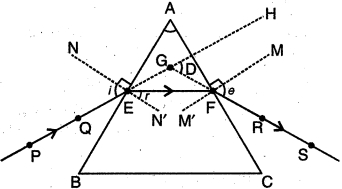
Draw a ray diagram showing the refraction of light through a glass prism and mark the following:
$(a)$ Incident ray
$(b)$ Emergent ray
$(c)$ Refracted ray
$(d)$ Angle of incidence
$(e)$ Angle of deviation
$(f)$ Angle of emergence
$(a)$ Incident ray
$(b)$ Emergent ray
$(c)$ Refracted ray
$(d)$ Angle of incidence
$(e)$ Angle of deviation
$(f)$ Angle of emergence
Solution
(N/A) The labelled diagram is as shown in the provided image.
Here,the components are as follows:
$(a)$ $PE$ - Incident ray
$(b)$ $FS$ - Emergent ray
$(c)$ $EF$ - Refracted ray
$(d)$ $\angle i$ - Angle of incidence
$(e)$ $\angle D$ - Angle of deviation
$(f)$ $\angle e$ - Angle of emergence
Here,the components are as follows:
$(a)$ $PE$ - Incident ray
$(b)$ $FS$ - Emergent ray
$(c)$ $EF$ - Refracted ray
$(d)$ $\angle i$ - Angle of incidence
$(e)$ $\angle D$ - Angle of deviation
$(f)$ $\angle e$ - Angle of emergence
0 likes
View Solution163
Medium
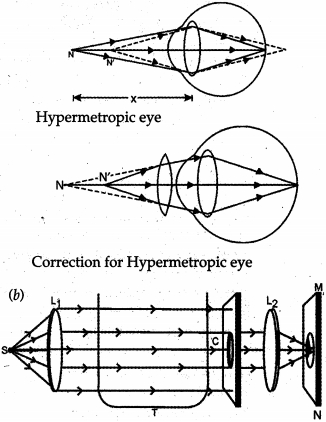
$(a)$ State the reasons which lead to hypermetropia. With the help of suitable diagrams,explain this defect of vision and its correction.
$(b)$ Draw a diagram of an experimental arrangement for observing the scattering of light in a colloidal solution. Name the two chemicals used in this activity.
$(b)$ Draw a diagram of an experimental arrangement for observing the scattering of light in a colloidal solution. Name the two chemicals used in this activity.
Solution
(N/A) Hypermetropia,also known as farsightedness,is a vision defect where a person can see distant objects clearly but cannot see nearby objects distinctly. This happens because the near point of the eye has shifted further away than the normal $25 \ cm$.
Reasons for hypermetropia:
$1$. The eyeball has become too short.
$2$. The focal length of the eye lens has become too large.
Correction: This defect is corrected by using a convex lens of suitable focal length,which converges the light rays before they enter the eye,allowing the image to form on the retina.
$(b)$ The experimental arrangement for observing the Tyndall effect (scattering of light) involves passing a strong beam of light through a colloidal solution (e.g.,sodium thiosulphate solution). The two chemicals used are:
$1$. Sodium thiosulphate $(Na_2S_2O_3)$
$2$. Concentrated sulphuric acid $(H_2SO_4)$
Reasons for hypermetropia:
$1$. The eyeball has become too short.
$2$. The focal length of the eye lens has become too large.
Correction: This defect is corrected by using a convex lens of suitable focal length,which converges the light rays before they enter the eye,allowing the image to form on the retina.
$(b)$ The experimental arrangement for observing the Tyndall effect (scattering of light) involves passing a strong beam of light through a colloidal solution (e.g.,sodium thiosulphate solution). The two chemicals used are:
$1$. Sodium thiosulphate $(Na_2S_2O_3)$
$2$. Concentrated sulphuric acid $(H_2SO_4)$
0 likes
View Solution164
Medium
What is meant by scattering of light? Mention the factor on which it depends. Explain why the colour of the clear sky is blue? An astronaut in space finds the sky to be dark. Explain the reason for this observation.
Solution
(N/A) $(i)$ Scattering of light is the phenomenon in which light rays deviate from their straight path upon striking small particles such as dust,air molecules,or other impurities in the atmosphere.
$(ii)$ The extent of scattering depends primarily on the size of the particles. Very fine particles scatter mainly blue light of shorter wavelengths,while larger particles scatter light of longer wavelengths.
$(iii)$ As sunlight passes through the atmosphere,the fine particles in the air scatter the blue component of white light more strongly than the red component due to its shorter wavelength. This scattered blue light reaches our eyes,making the sky appear blue.
$(iv)$ In space,there is no atmosphere and therefore no particles (like air molecules or dust) to scatter sunlight. Since no light reaches the astronaut's eyes from the sky,it appears dark.
$(ii)$ The extent of scattering depends primarily on the size of the particles. Very fine particles scatter mainly blue light of shorter wavelengths,while larger particles scatter light of longer wavelengths.
$(iii)$ As sunlight passes through the atmosphere,the fine particles in the air scatter the blue component of white light more strongly than the red component due to its shorter wavelength. This scattered blue light reaches our eyes,making the sky appear blue.
$(iv)$ In space,there is no atmosphere and therefore no particles (like air molecules or dust) to scatter sunlight. Since no light reaches the astronaut's eyes from the sky,it appears dark.
0 likes
View Solution165
Medium
$(a)$ How does refraction take place in the atmosphere? Why do stars twinkle but not the planets?
$(b)$ State any two effects of atmospheric refraction on the sun as observed from the Earth.
$(b)$ State any two effects of atmospheric refraction on the sun as observed from the Earth.
Solution
(A-D) Atmospheric refraction is the change in the direction of propagation of light rays as they travel through the atmosphere due to variations in the density of different air layers. The Earth's atmosphere is not uniform; it is optically and molecularly denser near the surface and becomes rarer at higher altitudes,causing the velocity of light to change from layer to layer. Factors such as varying concentrations of gas molecules,dust particles,and temperature differences (hot air is optically rarer than cold air) create layers of different optical densities,leading to refraction.
Stars appear to twinkle because light from distant stars passes through these varying layers of the atmosphere. Fluctuations in the atmosphere cause the amount of starlight reaching the eye to vary,making the star appear alternately bright and dim,which results in the twinkling effect.
Planets are much closer to the Earth and appear as extended sources rather than point sources. The high intensity of light from planets means that slight atmospheric refraction does not cause significant changes in their perceived brightness,so they do not twinkle.
$(b)$ Two effects of atmospheric refraction on the Sun as observed from the Earth are:
$1$. Advance sunrise: The Sun is visible about $2$ minutes before the actual sunrise.
$2$. Delayed sunset: The Sun remains visible for about $2$ minutes after the actual sunset.
Stars appear to twinkle because light from distant stars passes through these varying layers of the atmosphere. Fluctuations in the atmosphere cause the amount of starlight reaching the eye to vary,making the star appear alternately bright and dim,which results in the twinkling effect.
Planets are much closer to the Earth and appear as extended sources rather than point sources. The high intensity of light from planets means that slight atmospheric refraction does not cause significant changes in their perceived brightness,so they do not twinkle.
$(b)$ Two effects of atmospheric refraction on the Sun as observed from the Earth are:
$1$. Advance sunrise: The Sun is visible about $2$ minutes before the actual sunrise.
$2$. Delayed sunset: The Sun remains visible for about $2$ minutes after the actual sunset.
0 likes
View Solution166
Medium
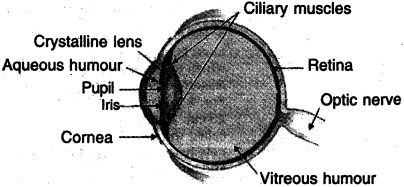
Draw a neat labelled diagram of the structure of the human eye and mention the functions of any four parts.
Solution
(N/A) Cornea: $A$ thin transparent membrane that allows light to enter and refracts it to focus on the crystalline lens.
$(b)$ Crystalline lens: $A$ double convex lens that changes its focal length with the help of ciliary muscles and suspensory ligaments,enabling light rays to focus on the retina.
$(c)$ Iris: The coloured portion of the eye that regulates the size of the pupil and controls the amount of light entering the eye.
$(d)$ Retina: Consists of light-sensitive cells,known as rod and cone cells,which enable us to see in dim and bright light.
$(b)$ Crystalline lens: $A$ double convex lens that changes its focal length with the help of ciliary muscles and suspensory ligaments,enabling light rays to focus on the retina.
$(c)$ Iris: The coloured portion of the eye that regulates the size of the pupil and controls the amount of light entering the eye.
$(d)$ Retina: Consists of light-sensitive cells,known as rod and cone cells,which enable us to see in dim and bright light.
0 likes
View Solution167
Medium
$(a)$ State two main causes of a person developing near-sightedness (myopia). With the help of a ray diagram, suggest how this disability can be corrected.
$(b)$ The far point of a myopic person is $150 \ cm$ in front of the eye. Calculate the focal length and power of the lens required to enable him to see distant objects clearly.
$(b)$ The far point of a myopic person is $150 \ cm$ in front of the eye. Calculate the focal length and power of the lens required to enable him to see distant objects clearly.
Solution
(N/A) The two main causes of myopia are:
$1$. Excessive curvature of the eye lens.
$2$. Elongation of the eyeball.
To correct this, a concave lens of suitable focal length is used. The lens diverges the incoming parallel rays from a distant object so that they appear to come from the far point of the myopic eye, allowing the image to be formed on the retina.
$(b)$ Given:
Far point of the myopic eye $(v)$ = $-150 \ cm = -1.5 \ m$.
For a distant object, the object distance $(u)$ = $\infty$.
Using the lens formula: $\frac{1}{f} = \frac{1}{v} - \frac{1}{u}$.
$\frac{1}{f} = \frac{1}{-150} - \frac{1}{\infty} = \frac{1}{-150} - 0 = -\frac{1}{150}$.
Thus, the focal length $(f)$ = $-150 \ cm = -1.5 \ m$.
Power $(P)$ = $\frac{1}{f(in \ meters)} = \frac{1}{-1.5} = -0.667 \ D \approx -0.67 \ D$.
$1$. Excessive curvature of the eye lens.
$2$. Elongation of the eyeball.
To correct this, a concave lens of suitable focal length is used. The lens diverges the incoming parallel rays from a distant object so that they appear to come from the far point of the myopic eye, allowing the image to be formed on the retina.
$(b)$ Given:
Far point of the myopic eye $(v)$ = $-150 \ cm = -1.5 \ m$.
For a distant object, the object distance $(u)$ = $\infty$.
Using the lens formula: $\frac{1}{f} = \frac{1}{v} - \frac{1}{u}$.
$\frac{1}{f} = \frac{1}{-150} - \frac{1}{\infty} = \frac{1}{-150} - 0 = -\frac{1}{150}$.
Thus, the focal length $(f)$ = $-150 \ cm = -1.5 \ m$.
Power $(P)$ = $\frac{1}{f(in \ meters)} = \frac{1}{-1.5} = -0.667 \ D \approx -0.67 \ D$.
0 likes
View Solution168
Medium
$(a)$ Explain the following terms used in relation to defects of vision and corrections provided for them:
$(i)$ Myopia $(ii)$ Astigmatism $(iii)$ Bifocal lenses $(iv)$ Far-sightedness (Hypermetropia).
$(b)$ Describe with a ray diagram how a person with myopia can be helped by spectacles.
$(i)$ Myopia $(ii)$ Astigmatism $(iii)$ Bifocal lenses $(iv)$ Far-sightedness (Hypermetropia).
$(b)$ Describe with a ray diagram how a person with myopia can be helped by spectacles.
Solution
(N/A) $(i)$ Myopia (Near-sightedness): $A$ defect where a person can see nearby objects clearly but cannot see distant objects distinctly. It is corrected using a concave lens.
$(ii)$ Astigmatism: $A$ defect where the cornea or lens has an irregular curvature,causing blurred vision at all distances. It is corrected using cylindrical lenses.
$(iii)$ Bifocal lenses: Lenses consisting of both concave and convex parts,used to correct Presbyopia,where a person has both Myopia and Hypermetropia.
$(iv)$ Far-sightedness (Hypermetropia): $A$ defect where a person can see distant objects clearly but cannot see nearby objects distinctly. It is corrected using a convex lens.
$(b)$ In Myopia,the image of a distant object forms in front of the retina. $A$ concave lens of suitable focal length is placed in front of the eye to diverge the incoming light rays,shifting the image back onto the retina.
$(ii)$ Astigmatism: $A$ defect where the cornea or lens has an irregular curvature,causing blurred vision at all distances. It is corrected using cylindrical lenses.
$(iii)$ Bifocal lenses: Lenses consisting of both concave and convex parts,used to correct Presbyopia,where a person has both Myopia and Hypermetropia.
$(iv)$ Far-sightedness (Hypermetropia): $A$ defect where a person can see distant objects clearly but cannot see nearby objects distinctly. It is corrected using a convex lens.
$(b)$ In Myopia,the image of a distant object forms in front of the retina. $A$ concave lens of suitable focal length is placed in front of the eye to diverge the incoming light rays,shifting the image back onto the retina.
0 likes
View Solution169
Medium
What is long-sightedness (hypermetropia)? List two causes for the development of long-sightedness. Describe with a ray diagram how this defect may be corrected by using spectacles.
Solution
(N/A) Long-sightedness,also known as $Hypermetropia$,is a vision defect in which a person can see distant objects clearly but cannot see nearby objects distinctly.
Two causes for the development of $Hypermetropia$ are:
$1$. The focal length of the eye lens is too long.
$2$. The eyeball has become too small.
Correction:
This defect is corrected by using a convex lens of appropriate power. The convex lens converges the light rays coming from a nearby object before they enter the eye,allowing the image to be formed on the retina.
[Ray Diagram Description: $A$ diagram showing the image forming behind the retina in a defective eye,and a second diagram showing a convex lens placed in front of the eye,which converges the rays so that the image is formed exactly on the retina.]
Two causes for the development of $Hypermetropia$ are:
$1$. The focal length of the eye lens is too long.
$2$. The eyeball has become too small.
Correction:
This defect is corrected by using a convex lens of appropriate power. The convex lens converges the light rays coming from a nearby object before they enter the eye,allowing the image to be formed on the retina.
[Ray Diagram Description: $A$ diagram showing the image forming behind the retina in a defective eye,and a second diagram showing a convex lens placed in front of the eye,which converges the rays so that the image is formed exactly on the retina.]
0 likes
View Solution170
Medium
$(a)$ What is dispersion of white light? What is the cause of such dispersion? Draw a diagram to show the dispersion of white light by a glass prism.
$(b)$ $A$ glass prism is able to produce a spectrum when white light passes through it,but a glass slab does not produce any spectrum. Explain why this is so.
$(b)$ $A$ glass prism is able to produce a spectrum when white light passes through it,but a glass slab does not produce any spectrum. Explain why this is so.
Solution
(N/A) Dispersion: The splitting of white light into its constituent seven colours is called dispersion of light.
Cause: Ordinary white light is a superposition of waves of wavelengths extending throughout the visible spectrum. The speed of light in a vacuum is the same for all wavelengths,but the speed in a material substance is different for different wavelengths. As a result,different colours are deviated by different angles when they pass through a prism. This is called dispersion of light.
$(b)$ In a prism,the refraction of light takes place at the two slant surfaces. The dispersion of white light occurs at the first surface of the prism where its constituent colours are deviated through different angles. At the second surface,these split colours undergo further refraction and get separated more. However,in a rectangular glass slab,the refraction of light takes place at two parallel surfaces. At the first surface,although the white light splits into its constituent colours on refraction,these split colours,upon undergoing refraction at the second parallel surface,emerge as a parallel beam,which gives the impression of white light.
Cause: Ordinary white light is a superposition of waves of wavelengths extending throughout the visible spectrum. The speed of light in a vacuum is the same for all wavelengths,but the speed in a material substance is different for different wavelengths. As a result,different colours are deviated by different angles when they pass through a prism. This is called dispersion of light.
$(b)$ In a prism,the refraction of light takes place at the two slant surfaces. The dispersion of white light occurs at the first surface of the prism where its constituent colours are deviated through different angles. At the second surface,these split colours undergo further refraction and get separated more. However,in a rectangular glass slab,the refraction of light takes place at two parallel surfaces. At the first surface,although the white light splits into its constituent colours on refraction,these split colours,upon undergoing refraction at the second parallel surface,emerge as a parallel beam,which gives the impression of white light.
0 likes
View Solution171
Medium
$A$ person cannot see objects distinctly when placed at a distance less than $50\, cm$.
$(a)$ Identify the defect of vision.
$(b)$ Give two reasons for this defect.
$(c)$ Calculate the power and nature of the lens he should be using to see clearly the object placed at a distance of $25\, cm$ from his eyes.
$(d)$ Draw the ray diagrams for the defective and the corrected eye.
$(a)$ Identify the defect of vision.
$(b)$ Give two reasons for this defect.
$(c)$ Calculate the power and nature of the lens he should be using to see clearly the object placed at a distance of $25\, cm$ from his eyes.
$(d)$ Draw the ray diagrams for the defective and the corrected eye.
Solution
(A) The defect of vision is Hypermetropia (farsightedness).
$(b)$ Two reasons for this defect are:
$(i)$ The eyeball has become too short,so that light rays from a nearby object are focused at a point behind the retina.
$(ii)$ The focal length of the eye lens is too long because the ciliary muscles are unable to make the lens sufficiently convex.
$(c)$ Given: Object distance $u = -25\, cm$,Image distance $v = -50\, cm$ (the near point of the defective eye).
Using the lens formula: $\frac{1}{f} = \frac{1}{v} - \frac{1}{u}$
$\frac{1}{f} = \frac{1}{-50} - \frac{1}{-25} = \frac{-1 + 2}{50} = \frac{1}{50}$
$f = +50\, cm = +0.5\, m$
Power $P = \frac{1}{f(m)} = \frac{1}{0.5} = +2.0\, D$.
The nature of the lens is a convex lens.
$(d)$ The ray diagrams are as shown in the image.
$(b)$ Two reasons for this defect are:
$(i)$ The eyeball has become too short,so that light rays from a nearby object are focused at a point behind the retina.
$(ii)$ The focal length of the eye lens is too long because the ciliary muscles are unable to make the lens sufficiently convex.
$(c)$ Given: Object distance $u = -25\, cm$,Image distance $v = -50\, cm$ (the near point of the defective eye).
Using the lens formula: $\frac{1}{f} = \frac{1}{v} - \frac{1}{u}$
$\frac{1}{f} = \frac{1}{-50} - \frac{1}{-25} = \frac{-1 + 2}{50} = \frac{1}{50}$
$f = +50\, cm = +0.5\, m$
Power $P = \frac{1}{f(m)} = \frac{1}{0.5} = +2.0\, D$.
The nature of the lens is a convex lens.
$(d)$ The ray diagrams are as shown in the image.
0 likes
View Solution172
Medium
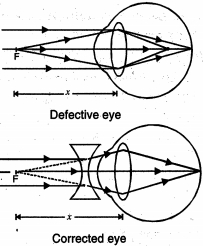
$A$ person cannot see objects distinctly when placed beyond $2\, m$.
$(a)$ Identify the eye defect.
$(b)$ Give two reasons for this defect.
$(c)$ Calculate the power and nature of the lens he should be using to see the distant objects clearly.
$(d)$ Draw the ray diagrams for the defective and the corrected eye.
$(a)$ Identify the eye defect.
$(b)$ Give two reasons for this defect.
$(c)$ Calculate the power and nature of the lens he should be using to see the distant objects clearly.
$(d)$ Draw the ray diagrams for the defective and the corrected eye.
Solution
(N/A) The eye defect is Myopia (nearsightedness).
$(b)$ The two reasons for this defect are:
$(i)$ Excessive curvature of the eye lens.
$(ii)$ Elongation of the eyeball.
$(c)$ To see distant objects clearly,the person needs a lens that forms a virtual image of an object at infinity at his far point $(2\, m)$.
Given: Object distance $u = \infty$,Image distance $v = -2\, m$.
Using the lens formula: $\frac{1}{f} = \frac{1}{v} - \frac{1}{u} = \frac{1}{-2} - \frac{1}{\infty} = -0.5\, m^{-1}$.
Power $P = \frac{1}{f(m)} = -0.5\, D$.
The negative sign indicates that the lens is a concave lens (diverging lens).
$(d)$ The ray diagrams are as shown in the provided image.
$(b)$ The two reasons for this defect are:
$(i)$ Excessive curvature of the eye lens.
$(ii)$ Elongation of the eyeball.
$(c)$ To see distant objects clearly,the person needs a lens that forms a virtual image of an object at infinity at his far point $(2\, m)$.
Given: Object distance $u = \infty$,Image distance $v = -2\, m$.
Using the lens formula: $\frac{1}{f} = \frac{1}{v} - \frac{1}{u} = \frac{1}{-2} - \frac{1}{\infty} = -0.5\, m^{-1}$.
Power $P = \frac{1}{f(m)} = -0.5\, D$.
The negative sign indicates that the lens is a concave lens (diverging lens).
$(d)$ The ray diagrams are as shown in the provided image.
0 likes
View Solution173
Medium
$(a)$ Explain why the colour of a clear sky appears blue during the day with the help of a diagram.
$(b)$ Explain why the Sun looks reddish at the time of sunrise and sunset.
$(b)$ Explain why the Sun looks reddish at the time of sunrise and sunset.
Solution
(N/A) The Earth's atmosphere contains air molecules and other fine particles. These particles are smaller in size than the wavelength of visible light. According to Rayleigh scattering, the amount of scattering is inversely proportional to the fourth power of the wavelength $(I \propto 1/\lambda^4)$. Since blue light has a shorter wavelength compared to red light, it is scattered much more strongly by the atmospheric particles in all directions. When this scattered blue light enters our eyes, the sky appears blue.
$(b)$ At the time of sunrise or sunset, the Sun is near the horizon. Sunlight has to travel through a much thicker layer of the Earth's atmosphere to reach the observer. During this long journey, most of the blue and shorter wavelength light is scattered away by atmospheric particles. Only the light with the longest wavelength, which is red light, is able to reach the observer's eyes without being scattered significantly. Therefore, the Sun appears reddish at sunrise and sunset.
$(b)$ At the time of sunrise or sunset, the Sun is near the horizon. Sunlight has to travel through a much thicker layer of the Earth's atmosphere to reach the observer. During this long journey, most of the blue and shorter wavelength light is scattered away by atmospheric particles. Only the light with the longest wavelength, which is red light, is able to reach the observer's eyes without being scattered significantly. Therefore, the Sun appears reddish at sunrise and sunset.
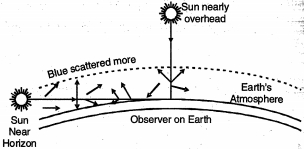
0 likes
View Solution174
MediumMCQ
$A$ person with defective vision is unable to see objects nearer than $1.5 \ m$. He wants to read books at a distance of $30 \ cm$. Find the nature, focal length, and power of the lens he needs in his spectacles.
A
Convex lens, $37.5 \ cm$, $+2.67 \ D$
B
Concave lens, $37.5 \ cm$, $-2.67 \ D$
C
Convex lens, $30 \ cm$, $+3.33 \ D$
D
Concave lens, $30 \ cm$, $-3.33 \ D$
Solution
(A) This person suffers from hypermetropia (farsightedness).
For the corrective lens, the object distance $u = -30 \ cm$ and the image must be formed at the person's near point $v = -150 \ cm$.
Using the lens formula: $\frac{1}{f} = \frac{1}{v} - \frac{1}{u}$.
$\frac{1}{f} = \frac{1}{-150} - \frac{1}{-30} = \frac{-1 + 5}{150} = \frac{4}{150}$.
$f = \frac{150}{4} = +37.5 \ cm = +0.375 \ m$.
The positive sign indicates a convex lens.
Power $P = \frac{1}{f(\text{in } m)} = \frac{1}{0.375} = +2.67 \ D$.
For the corrective lens, the object distance $u = -30 \ cm$ and the image must be formed at the person's near point $v = -150 \ cm$.
Using the lens formula: $\frac{1}{f} = \frac{1}{v} - \frac{1}{u}$.
$\frac{1}{f} = \frac{1}{-150} - \frac{1}{-30} = \frac{-1 + 5}{150} = \frac{4}{150}$.
$f = \frac{150}{4} = +37.5 \ cm = +0.375 \ m$.
The positive sign indicates a convex lens.
Power $P = \frac{1}{f(\text{in } m)} = \frac{1}{0.375} = +2.67 \ D$.
0 likes
View Solution175
MediumMCQ
The far point of a myopic person is $80 \, cm$ in front of the eyes. What is the nature and power of the lens required to enable him to see very distant objects distinctly?
A
Concave lens of power $-1.25 \, D$
B
Convex lens of power $+1.25 \, D$
C
Concave lens of power $+1.25 \, D$
D
Convex lens of power $-1.25 \, D$
Solution
(A) For a myopic eye, the correcting lens is a concave lens.
The far point of the myopic person is $x = 80 \, cm = 0.8 \, m$.
To see distant objects (at infinity) clearly, the lens must form a virtual image of an object at infinity at the person's far point $(80 \, cm)$.
Thus, the focal length $f$ of the corrective lens is equal to the negative of the far point distance:
$f = -x = -80 \, cm = -0.8 \, m$.
The power $P$ of the lens is given by the formula $P = \frac{1}{f(in \, meters)}$.
$P = \frac{1}{-0.8 \, m} = -1.25 \, D$.
Therefore, a concave lens of power $-1.25 \, D$ is required.
The far point of the myopic person is $x = 80 \, cm = 0.8 \, m$.
To see distant objects (at infinity) clearly, the lens must form a virtual image of an object at infinity at the person's far point $(80 \, cm)$.
Thus, the focal length $f$ of the corrective lens is equal to the negative of the far point distance:
$f = -x = -80 \, cm = -0.8 \, m$.
The power $P$ of the lens is given by the formula $P = \frac{1}{f(in \, meters)}$.
$P = \frac{1}{-0.8 \, m} = -1.25 \, D$.
Therefore, a concave lens of power $-1.25 \, D$ is required.
0 likes
View Solution176
MediumMCQ
The far point of a myopic person is $40 \, cm$. What type of lens should they wear to see distant objects clearly? Calculate the focal length and the power of the lens they should use.
A
Concave lens,$f = -40 \, cm, P = -2.5 \, D$
B
Convex lens,$f = 40 \, cm, P = 2.5 \, D$
C
Concave lens,$f = -20 \, cm, P = -5.0 \, D$
D
Convex lens,$f = -40 \, cm, P = -2.5 \, D$
Solution
(A) myopic person suffers from myopia (nearsightedness),which is corrected using a concave lens.
For a myopic person,the far point is at $40 \, cm$. To see distant objects (at infinity) clearly,the lens must form a virtual image of the object at the person's far point.
Given: Object distance $u = \infty$,Image distance $v = -40 \, cm = -0.4 \, m$.
Using the lens formula: $\frac{1}{f} = \frac{1}{v} - \frac{1}{u}$.
Substituting the values: $\frac{1}{f} = \frac{1}{-0.4} - \frac{1}{\infty} = -2.5 \, m^{-1}$.
Thus,the focal length $f = -0.4 \, m = -40 \, cm$.
The power of the lens $P = \frac{1}{f \text{ (in meters)}} = \frac{1}{-0.4} = -2.5 \, D$.
Therefore,a concave lens of focal length $40 \, cm$ and power $-2.5 \, D$ is required.
For a myopic person,the far point is at $40 \, cm$. To see distant objects (at infinity) clearly,the lens must form a virtual image of the object at the person's far point.
Given: Object distance $u = \infty$,Image distance $v = -40 \, cm = -0.4 \, m$.
Using the lens formula: $\frac{1}{f} = \frac{1}{v} - \frac{1}{u}$.
Substituting the values: $\frac{1}{f} = \frac{1}{-0.4} - \frac{1}{\infty} = -2.5 \, m^{-1}$.
Thus,the focal length $f = -0.4 \, m = -40 \, cm$.
The power of the lens $P = \frac{1}{f \text{ (in meters)}} = \frac{1}{-0.4} = -2.5 \, D$.
Therefore,a concave lens of focal length $40 \, cm$ and power $-2.5 \, D$ is required.
0 likes
View Solution177
MediumMCQ
$A$ myopic person has been using spectacles of power $-1.00\, D$ for clear vision. During old age,he also needs to use separate reading glasses of power $+2.00\, D$. Explain what may have happened to his eyesight?
A
He developed hypermetropia.
B
He developed presbyopia.
C
He developed astigmatism.
D
He developed cataract.
Solution
(B) Initially,the person suffered from myopia (nearsightedness),which was corrected by a concave lens of power $-1.00\, D$. This lens allowed him to see distant objects clearly.
As the person aged,he developed presbyopia,a condition where the eye loses its ability to focus on near objects due to the weakening of ciliary muscles and reduced flexibility of the eye lens.
To correct this,he requires a convex lens for reading. The power of $+2.00\, D$ indicates that his near point has shifted further away from the normal $25\, cm$.
Using the lens formula $\frac{1}{f} = \frac{1}{v} - \frac{1}{u}$,where $f = +0.5\, m$ $(+50\, cm)$ and $u = -25\, cm$ (the standard near point),we find the image distance $v$ that his eye can currently accommodate:
$\frac{1}{v} = \frac{1}{50} + \frac{1}{-25} = \frac{1-2}{50} = -\frac{1}{50}$.
Thus,$v = -50\, cm$. This means his new near point has shifted to $50\, cm$ from his eyes,necessitating the use of reading glasses.
As the person aged,he developed presbyopia,a condition where the eye loses its ability to focus on near objects due to the weakening of ciliary muscles and reduced flexibility of the eye lens.
To correct this,he requires a convex lens for reading. The power of $+2.00\, D$ indicates that his near point has shifted further away from the normal $25\, cm$.
Using the lens formula $\frac{1}{f} = \frac{1}{v} - \frac{1}{u}$,where $f = +0.5\, m$ $(+50\, cm)$ and $u = -25\, cm$ (the standard near point),we find the image distance $v$ that his eye can currently accommodate:
$\frac{1}{v} = \frac{1}{50} + \frac{1}{-25} = \frac{1-2}{50} = -\frac{1}{50}$.
Thus,$v = -50\, cm$. This means his new near point has shifted to $50\, cm$ from his eyes,necessitating the use of reading glasses.
0 likes
View Solution178
Medium
The far point of a myopic person is $150 \ cm$ in front of the eye. Calculate the focal length and the power of a lens required to enable him to see distant objects clearly.
Solution
(D) Given: The object distance $u = \infty$ (for distant objects) and the image distance $v = -150 \ cm = -1.5 \ m$ (since the image must be formed at the person's far point).
Using the lens formula, $\frac{1}{f} = \frac{1}{v} - \frac{1}{u}$.
Substituting the values: $\frac{1}{f} = \frac{1}{-1.5} - \frac{1}{\infty}$.
Since $\frac{1}{\infty} = 0$, we get $\frac{1}{f} = -\frac{1}{1.5}$.
Therefore, the focal length $f = -1.5 \ m$.
The power of the lens $P$ is given by $P = \frac{1}{f(\text{in meters})}$.
$P = \frac{1}{-1.5} = -0.67 \ D$.
Thus, the required focal length is $-1.5 \ m$ and the power is $-0.67 \ D$.
Using the lens formula, $\frac{1}{f} = \frac{1}{v} - \frac{1}{u}$.
Substituting the values: $\frac{1}{f} = \frac{1}{-1.5} - \frac{1}{\infty}$.
Since $\frac{1}{\infty} = 0$, we get $\frac{1}{f} = -\frac{1}{1.5}$.
Therefore, the focal length $f = -1.5 \ m$.
The power of the lens $P$ is given by $P = \frac{1}{f(\text{in meters})}$.
$P = \frac{1}{-1.5} = -0.67 \ D$.
Thus, the required focal length is $-1.5 \ m$ and the power is $-0.67 \ D$.
0 likes
View Solution179
EasyMCQ
$A$ person needs a lens of power $-0.5 \text{ D}$ for correcting his distant vision. For correcting his near vision,he needs a lens of power $+1.5 \text{ D}$. What is the focal length of the lens required for correcting his $(i)$ distant vision,$(ii)$ near vision?
A
$f_1 = -2 \text{ m}, f_2 = +0.67 \text{ m}$
B
$f_1 = -0.5 \text{ m}, f_2 = +1.5 \text{ m}$
C
$f_1 = +2 \text{ m}, f_2 = -0.67 \text{ m}$
D
$f_1 = -1 \text{ m}, f_2 = +0.5 \text{ m}$
Solution
(A) The focal length $f$ of a lens is given by the formula $f = 1 / P$,where $P$ is the power of the lens in dioptres $(D)$ and $f$ is in metres $(m)$.
$(i)$ For distant vision:
Given power $P = -0.5 \text{ D}$.
$f = 1 / (-0.5) = -2 \text{ m}$.
$(ii)$ For near vision:
Given power $P = +1.5 \text{ D}$.
$f = 1 / 1.5 = 0.67 \text{ m}$ (approximately).
$(i)$ For distant vision:
Given power $P = -0.5 \text{ D}$.
$f = 1 / (-0.5) = -2 \text{ m}$.
$(ii)$ For near vision:
Given power $P = +1.5 \text{ D}$.
$f = 1 / 1.5 = 0.67 \text{ m}$ (approximately).
0 likes
View Solution180
Easy
$A$ person is able to see objects clearly only when these are lying at distances between $50 \text{ cm}$ and $300 \text{ cm}$ from his eye. Identify the kind of defects of vision he is suffering from. Give reason for your answer.
Solution
(N/A) The person is suffering from both myopia (short-sightedness) and presbyopia.
$1$. The near point of a normal eye is $25 \text{ cm}$. Since the person's near point is $50 \text{ cm}$, he cannot see objects closer than $50 \text{ cm}$, which indicates presbyopia (or hypermetropia).
$2$. The far point of a normal eye is infinity $(\infty)$. Since the person's far point is limited to $300 \text{ cm}$, he cannot see distant objects clearly, which indicates myopia (short-sightedness).
$1$. The near point of a normal eye is $25 \text{ cm}$. Since the person's near point is $50 \text{ cm}$, he cannot see objects closer than $50 \text{ cm}$, which indicates presbyopia (or hypermetropia).
$2$. The far point of a normal eye is infinity $(\infty)$. Since the person's far point is limited to $300 \text{ cm}$, he cannot see distant objects clearly, which indicates myopia (short-sightedness).
0 likes
View Solution181
Medium
$(i)$ Write the range of distance for a person having normal vision.
$(ii)$ $A$ person needs to use glasses for reading a newspaper. Identify the defect in his vision and the type of lens he would need to correct it.
$(iii)$ Sometimes when we enter into a dark room from bright sunlight,we are unable to see objects clearly. Why?
$(ii)$ $A$ person needs to use glasses for reading a newspaper. Identify the defect in his vision and the type of lens he would need to correct it.
$(iii)$ Sometimes when we enter into a dark room from bright sunlight,we are unable to see objects clearly. Why?
Solution
(N/A) $(i)$ The near point for a person with normal vision is $25 \, cm$ and the far point is infinity.
$(ii)$ The defect is Hypermetropia (farsightedness). The person needs a convex lens to correct this defect.
$(iii)$ In bright sunlight,the pupil of the eye is small to allow less light to enter. When we enter a dark room,the pupil takes some time to dilate (expand) to allow more light to enter,which is why we cannot see objects clearly immediately.
$(ii)$ The defect is Hypermetropia (farsightedness). The person needs a convex lens to correct this defect.
$(iii)$ In bright sunlight,the pupil of the eye is small to allow less light to enter. When we enter a dark room,the pupil takes some time to dilate (expand) to allow more light to enter,which is why we cannot see objects clearly immediately.
0 likes
View Solution182
Medium
$A$ beam of white light falling on a glass prism gets split up into seven colours marked $1$ to $7$ as shown in the diagram.
$(a)$ The colours at positions marked $3$ and $5$ are similar to the colour of the sky and the colour of gold metal respectively. Is the above statement made by the student correct or incorrect? Justify.
$(b)$ Which of the above shown positions corresponds approximately to the colour of:
$(i)$ a brinjal
$(ii)$ danger signal
$(iii)$ neel (indigo) which is applied to clothes
$(iv)$ orange
$(a)$ The colours at positions marked $3$ and $5$ are similar to the colour of the sky and the colour of gold metal respectively. Is the above statement made by the student correct or incorrect? Justify.
$(b)$ Which of the above shown positions corresponds approximately to the colour of:
$(i)$ a brinjal
$(ii)$ danger signal
$(iii)$ neel (indigo) which is applied to clothes
$(iv)$ orange
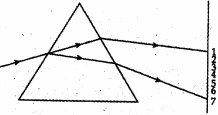
Solution
(N/A) As a result of dispersion produced by the prism,the white light is split up into seven colours. These colours are represented by the acronym '$VIBGYOR$' in the order of increasing deviation: $1$ (Red),$2$ (Orange),$3$ (Yellow),$4$ (Green),$5$ (Blue),$6$ (Indigo),$7$ (Violet). Thus,the colour at position $3$ is yellow and at position $5$ is blue. The student's statement is incorrect because the sky is blue and gold is yellow,which corresponds to positions $5$ and $3$ respectively,not $3$ and $5$.
$(b)$ The positions of the colours of the given objects are represented by:
$(i)$ Brinjal (Violet) $- 7$
$(ii)$ Danger signal (Red) $- 1$
$(iii)$ Neel (Indigo) $- 6$
$(iv)$ Orange (Orange) $- 2$
$(b)$ The positions of the colours of the given objects are represented by:
$(i)$ Brinjal (Violet) $- 7$
$(ii)$ Danger signal (Red) $- 1$
$(iii)$ Neel (Indigo) $- 6$
$(iv)$ Orange (Orange) $- 2$
0 likes
View Solution183
Medium
$(a)$ Demonstrate an activity with a well-labelled diagram to prove that white light is made up of seven colours.
$(b)$ Which colour of light bends least and which one the most while passing out from the prism? Also,state the reason for the same.
$(b)$ Which colour of light bends least and which one the most while passing out from the prism? Also,state the reason for the same.
Solution
(N/A) Take a thick sheet of cardboard and make a small hole or narrow slit in its middle. Allow sunlight to fall on the narrow slit. This gives a narrow beam of white light. Now,take a glass prism and allow the light from the slit to fall on one of its faces as shown in the figure.
Turn the prism slowly until the light that comes out of it appears on a nearby screen. We will observe that sunlight has split into seven colours. This shows that sunlight is made up of seven colours.
$(b)$ Red colour bends least while violet colour bends the most. The different colours bend at different angles with respect to the incident ray due to refraction. This happens because the speed of light of different colours is different in the glass medium,leading to different refractive indices for different wavelengths.
Turn the prism slowly until the light that comes out of it appears on a nearby screen. We will observe that sunlight has split into seven colours. This shows that sunlight is made up of seven colours.
$(b)$ Red colour bends least while violet colour bends the most. The different colours bend at different angles with respect to the incident ray due to refraction. This happens because the speed of light of different colours is different in the glass medium,leading to different refractive indices for different wavelengths.
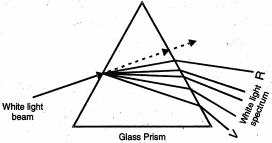
0 likes
View Solution184
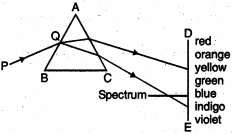
Medium
$A$ narrow beam $PQ$ of white light is passing through a glass prism $ABC$ as shown in the diagram.
Trace it on your answer sheet and show the path of the emergent beam as observed on the screen $DE$.
$(i)$ Write the name and cause of the phenomenon observed.
$(ii)$ Where else in nature is this phenomenon observed?
$(iii)$ Based on this observation,state the conclusion which can be drawn about the constituents of white light.
Trace it on your answer sheet and show the path of the emergent beam as observed on the screen $DE$.
$(i)$ Write the name and cause of the phenomenon observed.
$(ii)$ Where else in nature is this phenomenon observed?
$(iii)$ Based on this observation,state the conclusion which can be drawn about the constituents of white light.
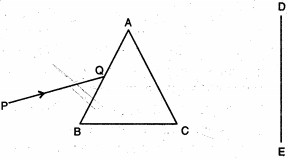
Solution
(N/A) The diagram is as shown in the reference image.
$(i)$ The phenomenon is called the dispersion of light. It occurs because different wavelengths of light travel with different speeds in the glass prism,causing them to bend at different angles.
$(ii)$ This phenomenon is observed in nature in the formation of a rainbow.
$(iii)$ White light consists of seven different colors (wavelengths),which are violet,indigo,blue,green,yellow,orange,and red.
$(i)$ The phenomenon is called the dispersion of light. It occurs because different wavelengths of light travel with different speeds in the glass prism,causing them to bend at different angles.
$(ii)$ This phenomenon is observed in nature in the formation of a rainbow.
$(iii)$ White light consists of seven different colors (wavelengths),which are violet,indigo,blue,green,yellow,orange,and red.
0 likes
View Solution185
Medium
When one enters a dim-lit room from bright light,one is unable to see the objects in the room for some time. Explain why.
Solution
(N/A) In bright light,the iris contracts the pupil of the eye to allow less light to enter. When we enter a dim-lit room,the iris takes time to expand the pupil to allow more light to enter the eye. Thus,for a short duration,one is unable to see clearly in a dim-lit room.
0 likes
View Solution186
Medium
$A$ person is able to see objects clearly only when these are lying at distances between $50\, cm$ and $300\, cm$ from his eye.
$(a)$ What kind of defect of vision is he suffering from?
$(b)$ What kind of lenses will be required to increase his range of vision from $25\, cm$ to infinity? Explain.
$(a)$ What kind of defect of vision is he suffering from?
$(b)$ What kind of lenses will be required to increase his range of vision from $25\, cm$ to infinity? Explain.
Solution
(N/A) For a normal eye,the near point is at $25\, cm$ and the far point is at infinity. The given person cannot see objects clearly closer than $50\, cm$ (near point defect) or farther than $300\, cm$ (far point defect). Therefore,he is suffering from both myopia (nearsightedness) and hypermetropia (farsightedness),a condition often referred to as presbyopia.
$(b)$ To correct these defects,a bifocal lens is required. $A$ concave lens of suitable focal length is used in the upper part to correct myopia (to see distant objects up to infinity),and a convex lens of suitable focal length is used in the lower part to correct hypermetropia (to see near objects up to $25\, cm$).
$(b)$ To correct these defects,a bifocal lens is required. $A$ concave lens of suitable focal length is used in the upper part to correct myopia (to see distant objects up to infinity),and a convex lens of suitable focal length is used in the lower part to correct hypermetropia (to see near objects up to $25\, cm$).
0 likes
View Solution187
Medium
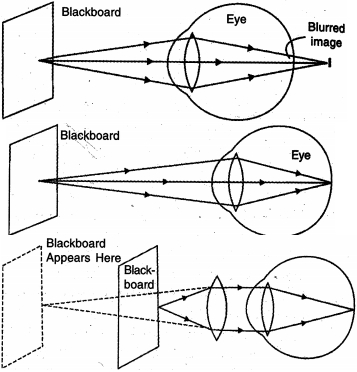
$A$ student cannot read properly from the blackboard while sitting on the front desk in a large classroom. However,he can read clearly while sitting on the last desk of the classroom.
$(a)$ Draw ray diagrams to illustrate the formation of the image of the blackboard writing by his eye lens when he is seated at the $(i)$ front desk,$(ii)$ last desk.
$(b)$ Name the defect of the eye from which the student is suffering.
$(c)$ Name the type of lens that would enable him to see the blackboard writing clearly when seated at the front desk. Draw a ray diagram to illustrate how this lens helps him to see clearly.
$(a)$ Draw ray diagrams to illustrate the formation of the image of the blackboard writing by his eye lens when he is seated at the $(i)$ front desk,$(ii)$ last desk.
$(b)$ Name the defect of the eye from which the student is suffering.
$(c)$ Name the type of lens that would enable him to see the blackboard writing clearly when seated at the front desk. Draw a ray diagram to illustrate how this lens helps him to see clearly.
Solution
(N/A) $(i)$ When the student sits at the front desk,the object is too close. The light rays from the blackboard focus behind the retina,resulting in a blurred image on the retina.
$(ii)$ When the student sits at the last desk,the object is at a sufficient distance. The light rays from the blackboard focus exactly on the retina,resulting in a clear image.
$(b)$ The student is suffering from hypermetropia,also known as long-sightedness.
$(c)$ This defect can be corrected by using a convex lens of suitable focal length. The convex lens converges the light rays before they enter the eye,allowing the image to be formed on the retina.
$(ii)$ When the student sits at the last desk,the object is at a sufficient distance. The light rays from the blackboard focus exactly on the retina,resulting in a clear image.
$(b)$ The student is suffering from hypermetropia,also known as long-sightedness.
$(c)$ This defect can be corrected by using a convex lens of suitable focal length. The convex lens converges the light rays before they enter the eye,allowing the image to be formed on the retina.
0 likes
View Solution188
Medium
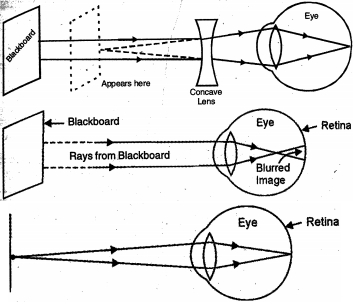
$A$ student finds the writing on the blackboard blurred and unclear while sitting on the last desk in a classroom. He,however,sees it clearly while sitting on the front desk at about $2\, m$ from the blackboard.
$(a)$ Draw ray diagrams to illustrate the formation of image of the blackboard writing by his eye lens when he is seated at the $(i)$ last desk,$(ii)$ front desk.
$(b)$ Name the defect of the eye from which the student is suffering.
$(c)$ Name the kind of lens that would help him to see clearly even when he is seated at the last desk. Draw a ray diagram to illustrate how this lens helps him to see clearly.
$(a)$ Draw ray diagrams to illustrate the formation of image of the blackboard writing by his eye lens when he is seated at the $(i)$ last desk,$(ii)$ front desk.
$(b)$ Name the defect of the eye from which the student is suffering.
$(c)$ Name the kind of lens that would help him to see clearly even when he is seated at the last desk. Draw a ray diagram to illustrate how this lens helps him to see clearly.
Solution
(N/A) $(i)$ When the student is seated at the last desk,the image of the distant object forms in front of the retina because the eye lens is unable to focus light rays from distant objects onto the retina.
$(ii)$ When the student is seated at the front desk,the object is closer,and the eye lens can focus the light rays onto the retina,resulting in a clear image.
$(b)$ The student is suffering from myopia (near-sightedness).
$(c)$ The defect can be corrected by using a concave lens of suitable focal length. The concave lens diverges the incoming light rays from the distant object,making them appear to come from the student's far point,thus allowing the eye lens to focus them onto the retina.
$(ii)$ When the student is seated at the front desk,the object is closer,and the eye lens can focus the light rays onto the retina,resulting in a clear image.
$(b)$ The student is suffering from myopia (near-sightedness).
$(c)$ The defect can be corrected by using a concave lens of suitable focal length. The concave lens diverges the incoming light rays from the distant object,making them appear to come from the student's far point,thus allowing the eye lens to focus them onto the retina.
0 likes
View Solution189
Medium
$A$ prism causes dispersion of white light while a rectangular glass block does not. Explain.
Solution
(N/A) In a prism,the refraction of light takes place at two slant surfaces that are not parallel to each other. The dispersion of white light occurs at the first surface of the prism,where its constituent colours are deviated through different angles. At the second surface,these split colours undergo further refraction and separation,resulting in a spectrum.
In a rectangular glass block,the refraction of light takes place at two parallel surfaces. At the first surface,white light splits into its constituent colours upon refraction. However,because the second surface is parallel to the first,these split colours undergo refraction at the second surface in such a way that they emerge as a parallel beam,which recombines to give the impression of white light.
In a rectangular glass block,the refraction of light takes place at two parallel surfaces. At the first surface,white light splits into its constituent colours upon refraction. However,because the second surface is parallel to the first,these split colours undergo refraction at the second surface in such a way that they emerge as a parallel beam,which recombines to give the impression of white light.
0 likes
View Solution190
Medium
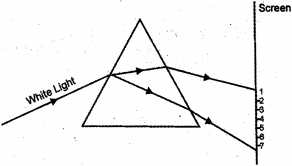
$A$ beam of white light falling on a glass prism gets split up into seven colours marked $1$ to $7$ as shown in the diagram. $A$ student makes the following statements about the spectrum observed on the screen.
$(a)$ The colours at position marked $3$ and $5$ are similar to the colour of the core of a hard-boiled egg and the colour of the sky respectively. Is the statement made by the student correct or incorrect? Justify.
$(b)$ Which of the two positions correspond closely to the colour of $(i)$ a solution of potassium permanganate,$(ii)$ danger or stop signal lights?
$(a)$ The colours at position marked $3$ and $5$ are similar to the colour of the core of a hard-boiled egg and the colour of the sky respectively. Is the statement made by the student correct or incorrect? Justify.
$(b)$ Which of the two positions correspond closely to the colour of $(i)$ a solution of potassium permanganate,$(ii)$ danger or stop signal lights?
Solution
(N/A) The colours at positions $3$ and $5$ are yellow and blue respectively. The student has identified them as yellow (i.e.,colour of the core of a hard-boiled egg) and blue (i.e.,colour of the sky) respectively. Hence,the statement is correct.
$(b)$ $(i)$ Position $7$ is the position of violet colour,which corresponds to the colour of a solution of potassium permanganate.
$(ii)$ Position $1$ is the position of red colour,which corresponds to the colour of danger or stop signal lights.
$(b)$ $(i)$ Position $7$ is the position of violet colour,which corresponds to the colour of a solution of potassium permanganate.
$(ii)$ Position $1$ is the position of red colour,which corresponds to the colour of danger or stop signal lights.
0 likes
View Solution191
Medium
The figure below shows the refraction of a ray through a prism. Copy the diagram and,ignoring dispersion at the faces $AB$ and $AC$,mark the following angles: $(i)$ The angle of incidence,$(ii)$ the angle of refraction at the face $AB$,$(iii)$ the angle of emergence,and $(iv)$ the angle of deviation.
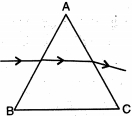
Solution
(N/A) To represent the refraction of a light ray through a prism,we follow these steps:
$1$. Draw a triangular prism $ABC$.
$2$. Draw an incident ray $PQ$ striking the face $AB$.
$3$. Draw a normal $N$ at the point of incidence $Q$ on face $AB$.
$4$. The angle between the incident ray $PQ$ and the normal $N$ is the angle of incidence,denoted by $i$.
$5$. The refracted ray $QR$ travels inside the prism. The angle between the refracted ray $QR$ and the normal $N$ at face $AB$ is the angle of refraction,denoted by $r_1$.
$6$. At face $AC$,the ray emerges as $RS$. Draw a normal $N'$ at the point of emergence $R$.
$7$. The angle between the emergent ray $RS$ and the normal $N'$ is the angle of emergence,denoted by $e$.
$8$. Extend the incident ray $PQ$ forward and the emergent ray $RS$ backward to meet at a point $D$. The angle between these two lines is the angle of deviation,denoted by $\delta$.
$1$. Draw a triangular prism $ABC$.
$2$. Draw an incident ray $PQ$ striking the face $AB$.
$3$. Draw a normal $N$ at the point of incidence $Q$ on face $AB$.
$4$. The angle between the incident ray $PQ$ and the normal $N$ is the angle of incidence,denoted by $i$.
$5$. The refracted ray $QR$ travels inside the prism. The angle between the refracted ray $QR$ and the normal $N$ at face $AB$ is the angle of refraction,denoted by $r_1$.
$6$. At face $AC$,the ray emerges as $RS$. Draw a normal $N'$ at the point of emergence $R$.
$7$. The angle between the emergent ray $RS$ and the normal $N'$ is the angle of emergence,denoted by $e$.
$8$. Extend the incident ray $PQ$ forward and the emergent ray $RS$ backward to meet at a point $D$. The angle between these two lines is the angle of deviation,denoted by $\delta$.
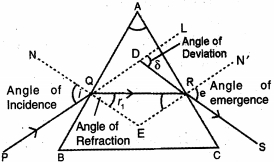
0 likes
View Solution192
Medium
The figure below shows a glass prism placed in the minimum deviation position. $A$ ray of monochromatic light is incident on its face $AB$. Copy the diagram and show the refracted and the emergent ray. Mark the angle of deviation. State any two factors on which the angle of deviation depends.
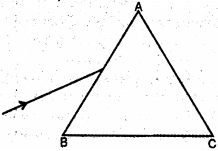
Solution
(N/A) In the minimum deviation position, the refracted ray inside the prism is parallel to the base $BC$. The emergent ray is shown in the provided solution image.
The angle of deviation $\delta$ depends upon the following factors:
$(i)$ The angle of the prism $(A)$.
$(ii)$ The refractive index of the material of the prism $\mu$.
$(iii)$ The angle of incidence $(i)$.
$(iv)$ The wavelength of the light used $\lambda$.
The angle of deviation $\delta$ depends upon the following factors:
$(i)$ The angle of the prism $(A)$.
$(ii)$ The refractive index of the material of the prism $\mu$.
$(iii)$ The angle of incidence $(i)$.
$(iv)$ The wavelength of the light used $\lambda$.
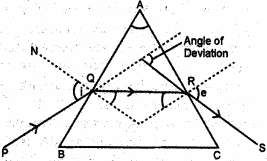
0 likes
View Solution193
Difficult
In the figure,a ray of light $PQ$ is incident normally on one face $AB$ of an equilateral glass prism. What are the angles of incidence at faces $AB$ and $AC$?
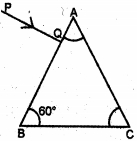
Solution
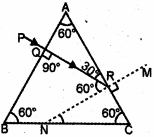
(N/A) We have the angle of incidence at the face $AB = 0^{\circ}$ as the ray $PQ$ falls normally on this face.
The normally incident ray $PQ$ passes through the prism undeviated and strikes the face $AC$ at the point $R$.
We draw the normal $MN$ to the face $AC$ at the point $R$.
The angle of incidence at the point $R$ is the angle $NRQ$.
From the geometry of the equilateral triangle $ABC$,the angle at vertex $A$ is $60^{\circ}$. In the triangle formed by the ray $PQ$ and the sides of the prism,the angle at $Q$ is $90^{\circ}$ and the angle at $A$ is $60^{\circ}$,so the angle at $R$ inside the triangle is $180^{\circ} - (90^{\circ} + 60^{\circ}) = 30^{\circ}$.
Since $MN$ is normal to $AC$,the angle of incidence $i = 90^{\circ} - 30^{\circ} = 60^{\circ}$.
Hence,the angle of incidence at face $AB = 0^{\circ}$ and the angle of incidence at face $AC = 60^{\circ}$.
The normally incident ray $PQ$ passes through the prism undeviated and strikes the face $AC$ at the point $R$.
We draw the normal $MN$ to the face $AC$ at the point $R$.
The angle of incidence at the point $R$ is the angle $NRQ$.
From the geometry of the equilateral triangle $ABC$,the angle at vertex $A$ is $60^{\circ}$. In the triangle formed by the ray $PQ$ and the sides of the prism,the angle at $Q$ is $90^{\circ}$ and the angle at $A$ is $60^{\circ}$,so the angle at $R$ inside the triangle is $180^{\circ} - (90^{\circ} + 60^{\circ}) = 30^{\circ}$.
Since $MN$ is normal to $AC$,the angle of incidence $i = 90^{\circ} - 30^{\circ} = 60^{\circ}$.
Hence,the angle of incidence at face $AB = 0^{\circ}$ and the angle of incidence at face $AC = 60^{\circ}$.
0 likes
View Solution194
Medium
$A$ glass slab is placed over a page on which the word $VIBGYOR$ is printed with each letter in its corresponding colour. $(i)$ Will the image of all the letters be in the same place? $(ii)$ If not, state which letter will be raised to the maximum. Give a reason for your answer.
Solution
$(i)$ No, the images of letters of different colours will be raised by slightly different heights.
$(ii)$ The letter $V$, corresponding to the violet colour, will be raised to the maximum. This is because the apparent depth is given by the formula: $\text{Apparent depth} = \frac{\text{Real depth}}{n}$. Since the refractive index $n$ is maximum for the violet colour, its apparent depth will be the least. Consequently, the shift (raised height) is maximum for the violet colour.
$(ii)$ The letter $V$, corresponding to the violet colour, will be raised to the maximum. This is because the apparent depth is given by the formula: $\text{Apparent depth} = \frac{\text{Real depth}}{n}$. Since the refractive index $n$ is maximum for the violet colour, its apparent depth will be the least. Consequently, the shift (raised height) is maximum for the violet colour.
0 likes
View Solution195
EasyMCQ
$A$ human eye can focus objects at different distances by adjusting the focal length of the eye lens. This is due to
A
accommodation
B
near sightedness
C
persistence of vision
D
far sightedness
Solution
(A) The ability of the eye lens to adjust its focal length to focus objects at varying distances is known as $accommodation$.
This process is facilitated by the ciliary muscles,which change the curvature and thickness of the lens.
When the ciliary muscles relax,the lens becomes thin,increasing the focal length to see distant objects.
When the ciliary muscles contract,the lens becomes thick,decreasing the focal length to see nearby objects.
This process is facilitated by the ciliary muscles,which change the curvature and thickness of the lens.
When the ciliary muscles relax,the lens becomes thin,increasing the focal length to see distant objects.
When the ciliary muscles contract,the lens becomes thick,decreasing the focal length to see nearby objects.
0 likes
View Solution196
EasyMCQ
Cinematography makes use of
A
accommodation
B
persistence of vision
C
least distance of distinct vision
D
bifocal lens system
Solution
(B) Cinematography relies on the phenomenon known as the $persistence \ of \ vision$.
This is the ability of the human eye to retain an image on the retina for approximately $1/16$ of a second after the object has been removed from the field of view.
In cinematography,a series of still images are projected in rapid succession (usually $24$ frames per second).
Because the brain perceives these images as continuous motion due to the $persistence \ of \ vision$,the viewer sees a smooth,moving picture rather than individual static frames.
This is the ability of the human eye to retain an image on the retina for approximately $1/16$ of a second after the object has been removed from the field of view.
In cinematography,a series of still images are projected in rapid succession (usually $24$ frames per second).
Because the brain perceives these images as continuous motion due to the $persistence \ of \ vision$,the viewer sees a smooth,moving picture rather than individual static frames.
0 likes
View Solution197
EasyMCQ
The human eye forms the image of an object at its
A
cornea
B
pupil
C
retina
D
iris
Solution
(C) The human eye functions like a camera. Light enters the eye through the cornea and pupil,passes through the crystalline lens,and is focused onto the light-sensitive screen located at the back of the eye,known as the retina. The retina contains photoreceptor cells (rods and cones) that convert light energy into electrical signals,which are then transmitted to the brain via the optic nerve. Therefore,the correct answer is the retina.
0 likes
View Solution198
EasyMCQ
The change in focal length of an eye lens to focus the image of objects at varying distances is done by the action of the
A
pupil
B
retina
C
blind spot
D
ciliary muscles
Solution
(D) The ability of the eye lens to adjust its focal length to focus objects at varying distances is known as accommodation.
This process is controlled by the ciliary muscles.
When the ciliary muscles contract,the curvature of the lens increases,making it thicker and decreasing its focal length,which allows the eye to focus on nearby objects.
When the ciliary muscles relax,the lens becomes thinner,increasing its focal length,which allows the eye to focus on distant objects.
This process is controlled by the ciliary muscles.
When the ciliary muscles contract,the curvature of the lens increases,making it thicker and decreasing its focal length,which allows the eye to focus on nearby objects.
When the ciliary muscles relax,the lens becomes thinner,increasing its focal length,which allows the eye to focus on distant objects.
0 likes
View Solution199
EasyMCQ
The colour of light which is deviated the least by a prism in the spectrum of white light is
A
red
B
green
C
violet
D
yellow
Solution
(A) When white light passes through a prism,it splits into its component colours,a phenomenon known as dispersion.
According to Cauchy's dispersion formula,the refractive index of a material depends on the wavelength of the light.
The refractive index is inversely proportional to the wavelength of light.
Red light has the longest wavelength in the visible spectrum,which results in the lowest refractive index for the prism material.
Since the angle of deviation is directly related to the refractive index,the colour with the lowest refractive index undergoes the least deviation.
Therefore,red light is deviated the least,while violet light,having the shortest wavelength,is deviated the most.
According to Cauchy's dispersion formula,the refractive index of a material depends on the wavelength of the light.
The refractive index is inversely proportional to the wavelength of light.
Red light has the longest wavelength in the visible spectrum,which results in the lowest refractive index for the prism material.
Since the angle of deviation is directly related to the refractive index,the colour with the lowest refractive index undergoes the least deviation.
Therefore,red light is deviated the least,while violet light,having the shortest wavelength,is deviated the most.
0 likes
View Solution200
EasyMCQ
Which of the following relationships regarding the wavelengths $\lambda$ of different colors of light is correct?
A
$\lambda_{\text{blue}} > \lambda_{\text{yellow}} > \lambda_{\text{green}}$
B
$\lambda_{\text{yellow}} > \lambda_{\text{green}} > \lambda_{\text{blue}}$
C
$\lambda_{\text{yellow}} > \lambda_{\text{blue}} > \lambda_{\text{green}}$
D
$\lambda_{\text{green}} > \lambda_{\text{blue}} > \lambda_{\text{yellow}}$
Solution
(B) The visible spectrum of light follows the order of $VIBGYOR$ (Violet, Indigo, Blue, Green, Yellow, Orange, Red).
In this spectrum, the wavelength $\lambda$ increases from violet to red.
Comparing the given colors: Blue, Green, and Yellow.
According to the $VIBGYOR$ sequence, the order of increasing wavelength is: $\lambda_{\text{blue}} < \lambda_{\text{green}} < \lambda_{\text{yellow}}$.
Therefore, the correct order of decreasing wavelength is $\lambda_{\text{yellow}} > \lambda_{\text{green}} > \lambda_{\text{blue}}$.
In this spectrum, the wavelength $\lambda$ increases from violet to red.
Comparing the given colors: Blue, Green, and Yellow.
According to the $VIBGYOR$ sequence, the order of increasing wavelength is: $\lambda_{\text{blue}} < \lambda_{\text{green}} < \lambda_{\text{yellow}}$.
Therefore, the correct order of decreasing wavelength is $\lambda_{\text{yellow}} > \lambda_{\text{green}} > \lambda_{\text{blue}}$.
0 likes
View SolutionThe Human Eye and the Colourful World — Mix Examples - The Human Eye and the Colourful World · Frequently Asked Questions
1Are these The Human Eye and the Colourful World questions useful for JEE and NEET?
Yes. All questions in this section are mapped to JEE Main and NEET exam patterns. Previous year questions from JEE Main, NEET, GUJCET and state-level exams are included with full solutions.
2Can I switch to Hindi or Gujarati for these questions?
Yes. Use the language tabs in the hero section or the sidebar to view the same questions and solutions in English, Hindi or Gujarati.
3How do I generate a question paper from this subtopic?
Use the Vedclass Exam Paper Generator — select the chapter and subtopic, set difficulty, and generate Sets A, B, C, D automatically. First 3 chapters of every subject are free.
Vedclass Products
For Students
Vedclass Test Series
Mock tests in real JEE/NEET style with performance analysis. 5-day free trial.
Start Free TrialFor Teachers
Exam Paper Generator
Generate Set A/B/C/D papers from this chapter in 2 minutes. 3 chapters free.
Try FreeFor Institutes
Online Exam Module
Live online exams with unlimited students, 360° analytics & white-label branding.
See DemoFor Teachers & Institutes
Generate a The Human Eye and the Colourful World Exam Paper in 2 Minutes
Select subtopic & difficulty — Sets A, B, C, D auto-generated with No Repeat logic.
First 3 chapters of every subject are free — no payment required.