
A English
Mix Examples - Magnetic Effects of Electric Current Questions in English
Class 10 Science · Magnetic Effects of Electric Current · Mix Examples - Magnetic Effects of Electric Current
332+
Questions
English
Language
100%
With Solutions
Showing 50 of 332 questions in English
251
EasyMCQ
Electric motor converts mechanical energy into electrical energy.
A
True
B
False
Solution
(B) The statement is $False$. An electric motor is a device that converts electrical energy into mechanical energy. Conversely,an electric generator is a device that converts mechanical energy into electrical energy.
0 likes
View Solution252
EasyMCQ
Fleming's right-hand rule can be used to find the direction of the magnetic field.
A
True
B
False
Solution
(B) The statement is $False$.
Fleming's right-hand rule is used to determine the direction of the induced current in a conductor moving within a magnetic field.
The direction of the magnetic field around a current-carrying conductor is determined by the Right-Hand Thumb Rule (also known as Maxwell's Right-Hand Grip Rule).
Fleming's right-hand rule is used to determine the direction of the induced current in a conductor moving within a magnetic field.
The direction of the magnetic field around a current-carrying conductor is determined by the Right-Hand Thumb Rule (also known as Maxwell's Right-Hand Grip Rule).
0 likes
View Solution253
EasyMCQ
An electric generator works on the principle of electromagnetic induction.
A
True
B
False
Solution
(A) An electric generator is a device that converts mechanical energy into electrical energy. It operates based on the principle of electromagnetic induction,which states that a changing magnetic flux through a coil induces an electromotive force $(EMF)$ or current in the coil. When the coil rotates within a magnetic field,the magnetic flux linked with it changes,thereby inducing an electric current.
0 likes
View Solution254
EasyMCQ
The electric current that always flows in the same direction is called alternating current.
A
True
B
False
Solution
(B) The statement is $False$.
Electric current that flows in a single direction is known as $Direct \ Current$ $(DC)$.
$Alternating \ Current$ $(AC)$ is the current that periodically reverses its direction.
Electric current that flows in a single direction is known as $Direct \ Current$ $(DC)$.
$Alternating \ Current$ $(AC)$ is the current that periodically reverses its direction.
0 likes
View Solution255
EasyMCQ
Normally,a red colour cable is used for the live wire in domestic electrical circuits.
A
True
B
False
Solution
(A) In domestic electrical circuits,the standard colour coding for wires is as follows:
$1$. The $Live$ wire is red.
$2$. The $Neutral$ wire is black.
$3$. The $Earth$ wire is green.
Therefore,the statement is $True$.
$1$. The $Live$ wire is red.
$2$. The $Neutral$ wire is black.
$3$. The $Earth$ wire is green.
Therefore,the statement is $True$.
0 likes
View Solution256
EasyMCQ
All the distribution circuits for domestic purposes are parallel connections.
A
True
B
False
Solution
(A) In domestic electrical circuits,all appliances are connected in parallel.
This is because parallel circuits ensure that each appliance receives the same voltage ($220 \ V$ in India) regardless of the number of appliances connected.
Additionally,if one appliance fails or is switched off,it does not affect the operation of other appliances,and each appliance can be controlled by its own individual switch.
This is because parallel circuits ensure that each appliance receives the same voltage ($220 \ V$ in India) regardless of the number of appliances connected.
Additionally,if one appliance fails or is switched off,it does not affect the operation of other appliances,and each appliance can be controlled by its own individual switch.
0 likes
View Solution257
EasyMCQ
One should always use rubber gloves and rubber shoes when dealing with electricity.
A
True
B
False
Solution
(A) Rubber is an insulator,meaning it does not allow electric current to flow through it. By wearing rubber gloves and rubber shoes,a person creates a high-resistance barrier that prevents electricity from passing through the body to the ground,thereby protecting the individual from electric shocks.
0 likes
View Solution258
EasyMCQ
Earthing of electrical appliances is very important.
A
True
B
False
Solution
(A) Earthing is a safety measure used to protect users from electric shocks. It involves connecting the metallic body of an electrical appliance to the ground through a wire. If there is any leakage of current in the appliance,the current flows directly to the earth instead of passing through the user's body,thereby preventing a fatal electric shock.
0 likes
View Solution259
EasyMCQ
Like magnetic poles attract each other; unlike poles repel.
A
True
B
False
Solution
(B) The fundamental law of magnetism states that like magnetic poles (North-North or South-South) repel each other,while unlike magnetic poles (North-South) attract each other. Therefore,the given statement is false.
0 likes
View Solution260
EasyMCQ
If you strike a sharp edge of a metallic knife against the north pole of a bar magnet,it will induce a north pole.
A
True
B
False
C
Cannot be determined
D
Depends on the material of the knife
Solution
(B) The statement is $False$. When a magnetic material is magnetized by contact with a magnet,the pole induced at the point of contact is always the opposite of the pole used for magnetization. Therefore,if a metallic knife is stroked against the north pole of a bar magnet,the point of contact on the knife will develop a south pole,not a north pole.
0 likes
View Solution261
EasyMCQ
The magnetic field produced by a current in a straight wire has no poles.
A
True
B
False
Solution
(A) The magnetic field lines produced by a current-carrying straight wire are concentric circles around the wire. Unlike a bar magnet,which has distinct North and South poles,a magnetic field generated by a straight current-carrying conductor does not have defined poles. Therefore,the statement is True.
0 likes
View Solution262
EasyMCQ
An electric generator is a device that converts electrical energy into mechanical energy.
A
True
B
False
Solution
(B) The statement is False.
An electric generator is a device that converts mechanical energy into electrical energy.
Conversely,an electric motor is a device that converts electrical energy into mechanical energy.
An electric generator is a device that converts mechanical energy into electrical energy.
Conversely,an electric motor is a device that converts electrical energy into mechanical energy.
0 likes
View Solution263
EasyMCQ
The direction of magnetic field lines in a region outside the bar magnet is $.....$
A
from the $N$-pole towards the $S$-pole of a magnet.
B
from the $S$-pole toward the $N$-pole of a magnet.
C
in the direction coming out from both the poles of magnet.
D
in the direction entering in both the poles of magnet.
Solution
(A) Magnetic field lines are imaginary lines used to represent the magnetic field.
Outside a bar magnet,the magnetic field lines always emerge from the North $(N)$ pole and enter the South $(S)$ pole.
Inside the magnet,the field lines travel from the South $(S)$ pole to the North $(N)$ pole,forming continuous closed loops.
Therefore,the correct direction outside the magnet is from the $N$-pole towards the $S$-pole.
Outside a bar magnet,the magnetic field lines always emerge from the North $(N)$ pole and enter the South $(S)$ pole.
Inside the magnet,the field lines travel from the South $(S)$ pole to the North $(N)$ pole,forming continuous closed loops.
Therefore,the correct direction outside the magnet is from the $N$-pole towards the $S$-pole.
0 likes
View Solution264
EasyMCQ
Which of the following statements is false?
A
The direction of magnetic field lines is from $N$ to $S$.
B
In the region where the magnetic field lines are at a close distance from each other,there will be a strong magnetic field.
C
The magnetic field lines form closed loops.
D
The magnetic field lines can cross each other.
Solution
(D) Magnetic field lines are imaginary lines that represent the magnetic field.
Properties of magnetic field lines include:
$1$. They emerge from the $N$ pole and enter the $S$ pole outside the magnet,making their direction $N$ to $S$.
$2$. They form continuous closed loops.
$3$. The closeness of the lines indicates the strength of the magnetic field; closer lines mean a stronger field.
$4$. Two magnetic field lines can never cross each other because if they did,there would be two directions for the magnetic field at the point of intersection,which is physically impossible.
Therefore,the statement that magnetic field lines can cross each other is false.
Properties of magnetic field lines include:
$1$. They emerge from the $N$ pole and enter the $S$ pole outside the magnet,making their direction $N$ to $S$.
$2$. They form continuous closed loops.
$3$. The closeness of the lines indicates the strength of the magnetic field; closer lines mean a stronger field.
$4$. Two magnetic field lines can never cross each other because if they did,there would be two directions for the magnetic field at the point of intersection,which is physically impossible.
Therefore,the statement that magnetic field lines can cross each other is false.
0 likes
View Solution265
EasyMCQ
By which instrument can the presence of a magnetic field be determined?
A
Voltmeter
B
Ammeter
C
Galvanometer
D
Magnetic needle
Solution
(D) magnetic needle (or compass needle) is a small magnet that aligns itself with the direction of a magnetic field.
When placed in a region where a magnetic field exists,the magnetic needle experiences a torque and deflects from its original position.
This deflection indicates the presence of a magnetic field.
While a galvanometer can also detect small currents,the most direct and fundamental instrument used to detect the presence of a magnetic field is a magnetic needle.
When placed in a region where a magnetic field exists,the magnetic needle experiences a torque and deflects from its original position.
This deflection indicates the presence of a magnetic field.
While a galvanometer can also detect small currents,the most direct and fundamental instrument used to detect the presence of a magnetic field is a magnetic needle.
0 likes
View Solution266
EasyMCQ
Who first observed the magnetic effect of an electric current?
A
Faraday
B
Oersted
C
Volta
D
Ampere
Solution
(B) In $1820$,the Danish physicist $Hans$ $Christian$ $Oersted$ observed that a magnetic compass needle gets deflected when placed near a current-carrying wire. This observation demonstrated that an electric current produces a magnetic field around it,which is known as the magnetic effect of electric current.
0 likes
View Solution267
EasyMCQ
With the help of which law or rule can the direction of a magnetic field be known?
A
Faraday's law
B
Fleming's right hand rule
C
Right hand thumb rule
D
Fleming's left hand rule
Solution
(C) The direction of the magnetic field produced by a current-carrying conductor is determined by the $Right$ $hand$ $thumb$ $rule$.
According to this rule,if you hold a current-carrying straight conductor in your right hand such that your thumb stretches along the direction of the current,then your fingers will wrap around the conductor in the direction of the magnetic field lines.
According to this rule,if you hold a current-carrying straight conductor in your right hand such that your thumb stretches along the direction of the current,then your fingers will wrap around the conductor in the direction of the magnetic field lines.
0 likes
View Solution268
EasyMCQ
According to the Right-Hand Thumb Rule,what does the thumb indicate?
A
Electric current
B
Magnetic field
C
Magnetic force
D
Motion of the conductor
Solution
(A) The Right-Hand Thumb Rule states that if you hold a current-carrying straight conductor in your right hand such that your thumb points in the direction of the electric current,then your fingers wrapped around the conductor will show the direction of the magnetic field lines. Therefore,the thumb indicates the direction of the electric current.
0 likes
View Solution269
EasyMCQ
The magnetic field produced in a straight conducting wire on passing the current through it is ............ .
A
in the direction of current
B
in the direction opposite to the current
C
circular around the wire
D
in the direction parallel to the wire
Solution
(C) When an electric current flows through a straight conducting wire,it generates a magnetic field around it. According to the Right-Hand Thumb Rule,the magnetic field lines are represented as concentric circles centered on the wire. Therefore,the magnetic field produced is circular around the wire.
0 likes
View Solution270
EasyMCQ
What is the nature of the magnetic field lines passing through the center of a current-carrying circular loop?
A
Circular
B
Straight line
C
Elliptical
D
No magnetic field at the center
Solution
(B) As we move away from the wire of a current-carrying circular loop,the concentric circles representing the magnetic field lines become larger and larger.
At the center of the circular loop,the arcs of these large circles appear as straight lines.
Therefore,the magnetic field lines passing through the center of a current-carrying circular loop are straight lines.
At the center of the circular loop,the arcs of these large circles appear as straight lines.
Therefore,the magnetic field lines passing through the center of a current-carrying circular loop are straight lines.
0 likes
View Solution271
EasyMCQ
Whose magnetic field is like a magnetic field of a bar magnet?
A
Current carrying wire
B
Current carrying ring
C
Current carrying solenoid
D
Current carrying rectangular loop
Solution
(C) current-carrying solenoid consists of a long coil of many circular turns of insulated copper wire wrapped in a cylindrical form.
When current flows through the solenoid,it produces a magnetic field pattern that is identical to that of a bar magnet.
The magnetic field lines emerge from one end (acting as the North pole) and enter the other end (acting as the South pole),forming closed loops both inside and outside the solenoid,just like a bar magnet.
When current flows through the solenoid,it produces a magnetic field pattern that is identical to that of a bar magnet.
The magnetic field lines emerge from one end (acting as the North pole) and enter the other end (acting as the South pole),forming closed loops both inside and outside the solenoid,just like a bar magnet.
0 likes
View Solution272
EasyMCQ
Who proposed the principle of electromagnetic induction?
A
Faraday
B
Oersted
C
Ampere
D
Volta
Solution
(A) The principle of electromagnetic induction was discovered by $Michael \ Faraday$ in $1831$.
He demonstrated that a changing magnetic field induces an electromotive force $(EMF)$ or current in a conductor.
Therefore, the correct option is $A$.
He demonstrated that a changing magnetic field induces an electromotive force $(EMF)$ or current in a conductor.
Therefore, the correct option is $A$.
0 likes
View Solution273
EasyMCQ
Which is the direction of magnetic force acting on a current-carrying wire placed in a magnetic field?
A
Along the magnetic field
B
Along the electric current
C
Perpendicular to both the magnetic field and the electric current
D
Opposite to the magnetic field
Solution
(C) The magnetic force $(F)$ acting on a current-carrying conductor of length $(l)$ carrying current $(I)$ placed in a magnetic field $(B)$ is given by the vector product: $F = I(l \times B)$.
According to the right-hand rule or Fleming's left-hand rule,the direction of the magnetic force is always perpendicular to the plane containing both the direction of the electric current and the direction of the magnetic field.
Therefore,the force is perpendicular to both the magnetic field and the electric current.
According to the right-hand rule or Fleming's left-hand rule,the direction of the magnetic force is always perpendicular to the plane containing both the direction of the electric current and the direction of the magnetic field.
Therefore,the force is perpendicular to both the magnetic field and the electric current.
0 likes
View Solution274
EasyMCQ
How is a current-carrying wire placed in a magnetic field so that the magnetic field does not act on it?
A
Parallel to the magnetic field
B
Perpendicular to the magnetic field
C
At an angle of $45^{\circ}$ with the magnetic field
D
At an angle of $120^{\circ}$ with the magnetic field
Solution
(A) The magnetic force $F$ acting on a current-carrying wire of length $L$ carrying current $I$ in a magnetic field $B$ is given by the formula: $F = I L B \sin(\theta)$,where $\theta$ is the angle between the direction of the current and the magnetic field.
For the magnetic force to be zero $(F = 0)$,the value of $\sin(\theta)$ must be zero.
This occurs when $\theta = 0^{\circ}$ or $\theta = 180^{\circ}$.
Therefore,when the current-carrying wire is placed parallel to the magnetic field,the magnetic field does not exert any force on it.
For the magnetic force to be zero $(F = 0)$,the value of $\sin(\theta)$ must be zero.
This occurs when $\theta = 0^{\circ}$ or $\theta = 180^{\circ}$.
Therefore,when the current-carrying wire is placed parallel to the magnetic field,the magnetic field does not exert any force on it.
0 likes
View Solution275
EasyMCQ
From which of the following cases,will the induced current in the loop not be obtained?
A
The loop is moved in the direction of the magnet.
B
The magnet is moved in the direction of the loop.
C
The loop and magnet are moved in the opposite direction with the same speed.
D
The loop and magnet are moved in one direction with the same speed.
Solution
(D) According to Faraday's law of electromagnetic induction,an induced current is produced in a loop only when there is a change in the magnetic flux linked with the loop.
Magnetic flux $\phi = B \cdot A \cdot \cos(\theta)$.
In cases $A$,$B$,and $C$,there is a relative motion between the magnet and the loop,which causes a change in the magnetic field $B$ passing through the loop,thereby changing the magnetic flux and inducing a current.
In case $D$,both the loop and the magnet are moving in the same direction with the same speed. Therefore,there is no relative motion between them.
Since there is no relative motion,the magnetic flux linked with the loop remains constant.
As there is no change in magnetic flux,no induced current will be obtained in the loop.
Magnetic flux $\phi = B \cdot A \cdot \cos(\theta)$.
In cases $A$,$B$,and $C$,there is a relative motion between the magnet and the loop,which causes a change in the magnetic field $B$ passing through the loop,thereby changing the magnetic flux and inducing a current.
In case $D$,both the loop and the magnet are moving in the same direction with the same speed. Therefore,there is no relative motion between them.
Since there is no relative motion,the magnetic flux linked with the loop remains constant.
As there is no change in magnetic flux,no induced current will be obtained in the loop.
0 likes
View Solution276
EasyMCQ
Which instrument is used to convert electrical energy into mechanical energy?
A
Electric generator
B
Electric motor
C
Electric iron
D
Electric oven
Solution
(B) An $Electric \text{ } motor$ is a device that converts electrical energy into mechanical energy.
It works on the principle of the magnetic effect of electric current, where a current-carrying coil placed in a magnetic field experiences a force that causes it to rotate.
In contrast, an $Electric \text{ } generator$ converts mechanical energy into electrical energy.
$Electric \text{ } iron$ and $Electric \text{ } oven$ convert electrical energy into heat energy.
It works on the principle of the magnetic effect of electric current, where a current-carrying coil placed in a magnetic field experiences a force that causes it to rotate.
In contrast, an $Electric \text{ } generator$ converts mechanical energy into electrical energy.
$Electric \text{ } iron$ and $Electric \text{ } oven$ convert electrical energy into heat energy.
0 likes
View Solution277
EasyMCQ
On which principle does an electric generator work?
A
It converts electrical energy into mechanical energy.
B
It converts electrical energy into heat energy.
C
It converts mechanical energy into electrical energy.
D
It converts electrical energy into light energy.
Solution
(C) An electric generator works on the principle of $Electromagnetic \text{ } Induction$.
It converts mechanical energy into electrical energy by rotating a coil within a magnetic field, which induces an electric current.
It converts mechanical energy into electrical energy by rotating a coil within a magnetic field, which induces an electric current.
0 likes
View Solution278
EasyMCQ
The magnitude of an $AC$ voltage used in India is $......$ and its frequency is $......$.
A
$110 \ V, 60 \ Hz$
B
$110 \ V, 50 \ Hz$
C
$220 \ V, 50 \ Hz$
D
$220 \ V, 60 \ Hz$
Solution
(C) In India,the standard domestic power supply provided by the electricity grid is an alternating current $(AC)$ with a root mean square $(RMS)$ voltage magnitude of $220 \ V$.
The frequency of this alternating current is standardized at $50 \ Hz$,which means the current changes its direction $100$ times per second (completing $50$ cycles per second).
Therefore,the correct values are $220 \ V$ and $50 \ Hz$.
The frequency of this alternating current is standardized at $50 \ Hz$,which means the current changes its direction $100$ times per second (completing $50$ cycles per second).
Therefore,the correct values are $220 \ V$ and $50 \ Hz$.
0 likes
View Solution279
EasyMCQ
Traditionally,which coloured insulation on wire is used for earthing?
A
Red
B
Black
C
Green
D
White
Solution
(C) In domestic electrical circuits,different colours of insulation are used for wires to distinguish them.
$1$. The live wire is typically red.
$2$. The neutral wire is typically black.
$3$. The earth wire is traditionally green or yellow-green.
Therefore,green insulation is used for earthing to ensure safety by providing a low-resistance path for leakage current.
$1$. The live wire is typically red.
$2$. The neutral wire is typically black.
$3$. The earth wire is traditionally green or yellow-green.
Therefore,green insulation is used for earthing to ensure safety by providing a low-resistance path for leakage current.
0 likes
View Solution280
EasyMCQ
Which type of current is obtained from a battery?
A
$DC$
B
$AC$
C
Both $DC$ and $AC$
D
None of $A$ and $B$
Solution
(A) battery is a device that converts chemical energy into electrical energy.
It produces a steady flow of electrons in a single direction,which is known as Direct Current $(DC)$.
Unlike Alternating Current $(AC)$,which periodically reverses its direction,the current from a battery remains constant in its polarity and direction over time.
Therefore,the correct option is $A$.
It produces a steady flow of electrons in a single direction,which is known as Direct Current $(DC)$.
Unlike Alternating Current $(AC)$,which periodically reverses its direction,the current from a battery remains constant in its polarity and direction over time.
Therefore,the correct option is $A$.
0 likes
View Solution281
EasyMCQ
Which instrument is used to know the presence of an electric current in a circuit?
A
Fuse
B
Galvanometer
C
Voltmeter
D
Battery
Solution
(B) $Galvanometer$ is an electromechanical instrument used for detecting and indicating an electric current.
It works on the principle that a magnetic field exerts a torque on a current-carrying coil placed within it.
When a small current flows through the coil,it deflects,indicating the presence and direction of the current.
In contrast,a $Voltmeter$ measures potential difference,a $Fuse$ is a safety device,and a $Battery$ is a source of electric energy.
It works on the principle that a magnetic field exerts a torque on a current-carrying coil placed within it.
When a small current flows through the coil,it deflects,indicating the presence and direction of the current.
In contrast,a $Voltmeter$ measures potential difference,a $Fuse$ is a safety device,and a $Battery$ is a source of electric energy.
0 likes
View Solution282
EasyMCQ
$A$ fuse is a $.......$ wire.
A
Conductor with a low melting point
B
Insulator with a low melting point
C
Semiconductor with a low melting point
D
Conductor with a high melting point
Solution
(A) An electric fuse is a safety device used in electrical circuits to prevent damage from excessive current.
It consists of a wire made of a material with a low melting point (such as an alloy of lead and tin).
When the current in the circuit exceeds a safe limit,the heat generated causes the fuse wire to melt and break the circuit,thereby protecting the appliances.
Therefore,a fuse is a conductor with a low melting point.
It consists of a wire made of a material with a low melting point (such as an alloy of lead and tin).
When the current in the circuit exceeds a safe limit,the heat generated causes the fuse wire to melt and break the circuit,thereby protecting the appliances.
Therefore,a fuse is a conductor with a low melting point.
0 likes
View Solution283
EasyMCQ
Which rule is used to determine the direction of induced current in a circuit?
A
Fleming's Left-Hand Rule
B
Fleming's Right-Hand Rule
C
Right-Hand Thumb Rule
D
Ampere's Rule
Solution
(B) Fleming's Right-Hand Rule is used to determine the direction of the induced current in a conductor moving in a magnetic field.
According to this rule,if you stretch the thumb,forefinger,and middle finger of your right hand such that they are mutually perpendicular to each other,then the thumb points in the direction of the motion of the conductor,the forefinger points in the direction of the magnetic field,and the middle finger points in the direction of the induced current.
According to this rule,if you stretch the thumb,forefinger,and middle finger of your right hand such that they are mutually perpendicular to each other,then the thumb points in the direction of the motion of the conductor,the forefinger points in the direction of the magnetic field,and the middle finger points in the direction of the induced current.
0 likes
View Solution284
EasyMCQ
How many times does an $AC$ electric current with the frequency $50\, Hz$ change its direction in one second?
A
$25$
B
$50$
C
$100$
D
$200$
Solution
(C) The frequency of an $AC$ current is defined as the number of complete cycles per second.
One complete cycle consists of two alternations (or half-cycles) where the current flows in one direction and then in the opposite direction.
Therefore,in one complete cycle,the current changes its direction twice.
Given that the frequency is $50\, Hz$,there are $50$ complete cycles in one second.
Total number of direction changes $= 50 \times 2 = 100$ times per second.
One complete cycle consists of two alternations (or half-cycles) where the current flows in one direction and then in the opposite direction.
Therefore,in one complete cycle,the current changes its direction twice.
Given that the frequency is $50\, Hz$,there are $50$ complete cycles in one second.
Total number of direction changes $= 50 \times 2 = 100$ times per second.
0 likes
View Solution285
EasyMCQ
At the centre of which of the following four circular rings has the maximum magnetic field while passing equal current through each of them?
A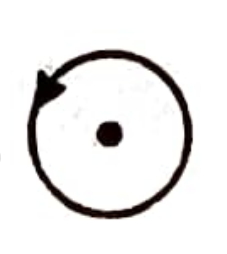
B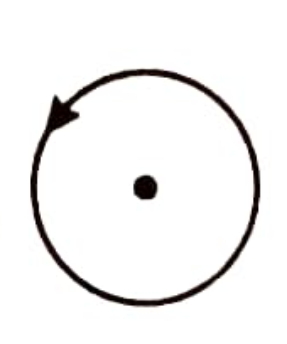
C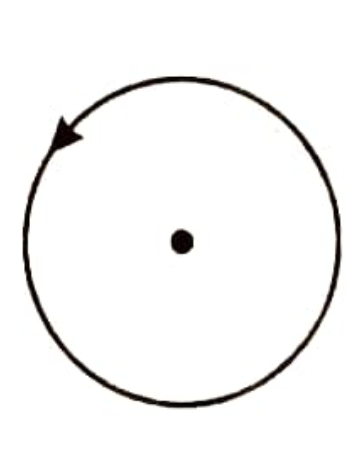
D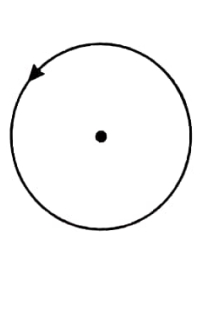
Solution
(A) The magnetic field $B$ at the centre of a circular current-carrying coil is given by the formula $B = \frac{\mu_0 I}{2R}$,where $\mu_0$ is the permeability of free space,$I$ is the current,and $R$ is the radius of the coil.
Since the current $I$ is equal for all rings,the magnetic field $B$ is inversely proportional to the radius $R$ of the ring $(B \propto \frac{1}{R})$.
Therefore,the smaller the radius $R$,the larger the magnetic field $B$ at the centre.
Thus,the ring with the smallest radius will have the maximum magnetic field at its centre.
Since the current $I$ is equal for all rings,the magnetic field $B$ is inversely proportional to the radius $R$ of the ring $(B \propto \frac{1}{R})$.
Therefore,the smaller the radius $R$,the larger the magnetic field $B$ at the centre.
Thus,the ring with the smallest radius will have the maximum magnetic field at its centre.
0 likes
View Solution286
EasyMCQ
Which scientist discovered that an electric current can be produced using a magnetic field?
A
Oersted
B
Faraday
C
Volta
D
Joule
Solution
(B) Michael Faraday discovered the phenomenon of electromagnetic induction in $1831$. He demonstrated that a changing magnetic field can induce an electric current in a conductor. This principle is the basis for the operation of electric generators and transformers.
0 likes
View Solution287
EasyMCQ
The branch of science that covers the comprehensive study of electricity and magnetism is known as $.........$.
A
Electrostatics
B
Magnetism
C
Electromagnetism
D
Electric field
Solution
(C) Electromagnetism is the branch of physics that deals with the study of electromagnetic force,a type of physical interaction that occurs between electrically charged particles. It encompasses the study of both electricity and magnetism,as they are fundamentally linked phenomena. When electric charges are in motion,they create magnetic fields,and changing magnetic fields can induce electric currents,which is the core principle of electromagnetism.
0 likes
View Solution288
EasyMCQ
What is the direction of magnetic field lines inside a bar magnet?
A
From $S$-pole to $N$-pole of the magnet
B
From $N$-pole to $S$-pole of the magnet
C
Outwards from both poles of the magnet
D
Inwards towards both poles of the magnet
Solution
(A) Magnetic field lines are continuous closed loops.
Outside the magnet,the field lines emerge from the $N$-pole and merge into the $S$-pole.
Inside the magnet,the direction of the magnetic field lines is from the $S$-pole to the $N$-pole to complete the closed loop.
Therefore,the correct direction inside the magnet is from $S$ to $N$.
Outside the magnet,the field lines emerge from the $N$-pole and merge into the $S$-pole.
Inside the magnet,the direction of the magnetic field lines is from the $S$-pole to the $N$-pole to complete the closed loop.
Therefore,the correct direction inside the magnet is from $S$ to $N$.
0 likes
View Solution289
EasyMCQ
In a region where magnetic field lines are close to each other,what is the nature of the magnetic field?
A
It is weak.
B
It is strong.
C
It is zero.
D
It is minimum.
Solution
(B) The strength of a magnetic field is represented by the degree of closeness of the magnetic field lines.
If the magnetic field lines are crowded or close to each other,it indicates a strong magnetic field.
Conversely,if the field lines are far apart,it indicates a weak magnetic field.
Therefore,in a region where magnetic field lines are close to each other,the magnetic field is strong.
If the magnetic field lines are crowded or close to each other,it indicates a strong magnetic field.
Conversely,if the field lines are far apart,it indicates a weak magnetic field.
Therefore,in a region where magnetic field lines are close to each other,the magnetic field is strong.
0 likes
View Solution290
EasyMCQ
Which of the following statements is $NOT$ true regarding the magnetic field lines of a bar magnet?
A
They do not intersect each other.
B
They are closer to each other near the poles.
C
Inside the magnet,they are directed from the $N$ pole to the $S$ pole.
D
Outside the magnet,they are directed from the $N$ pole to the $S$ pole.
Solution
(C) Magnetic field lines are continuous closed loops.
Outside the magnet,the field lines emerge from the $N$ pole and enter the $S$ pole.
Inside the magnet,the field lines are directed from the $S$ pole to the $N$ pole to complete the closed loop.
Therefore,the statement that they are directed from the $N$ pole to the $S$ pole inside the magnet is incorrect.
Outside the magnet,the field lines emerge from the $N$ pole and enter the $S$ pole.
Inside the magnet,the field lines are directed from the $S$ pole to the $N$ pole to complete the closed loop.
Therefore,the statement that they are directed from the $N$ pole to the $S$ pole inside the magnet is incorrect.
0 likes
View Solution291
EasyMCQ
When an electric current flows through a conducting wire,what is produced in the region around it?
A
Electric field
B
Magnetic field
C
Gravitational field
D
Energy
Solution
(B) When an electric current passes through a conductor,it creates a magnetic field around the conductor. This phenomenon is known as the magnetic effect of electric current,first observed by Hans Christian Oersted. The strength and direction of the magnetic field depend on the magnitude and direction of the current flowing through the wire.
0 likes
View Solution292
EasyMCQ
How does the magnetic field produced by a current-carrying straight wire vary with the distance from the wire?
A
Directly proportional
B
Directly proportional to the square of the distance
C
Inversely proportional
D
Inversely proportional to the square of the distance
Solution
(C) According to the Biot-Savart Law,the magnetic field $B$ produced by a long straight current-carrying wire at a distance $r$ is given by the formula $B = \frac{\mu_0 I}{2 \pi r}$.
From this expression,it is clear that the magnetic field $B$ is inversely proportional to the distance $r$ from the wire $(B \propto \frac{1}{r})$.
Therefore,as the distance from the wire increases,the magnetic field decreases in inverse proportion to the distance.
From this expression,it is clear that the magnetic field $B$ is inversely proportional to the distance $r$ from the wire $(B \propto \frac{1}{r})$.
Therefore,as the distance from the wire increases,the magnetic field decreases in inverse proportion to the distance.
0 likes
View Solution293
EasyMCQ
The magnetic field produced by a current flowing through a straight conductor is inversely proportional to the $........$.
A
Current flowing
B
Distance
C
Radius of the wire
D
Length of the wire
Solution
(B) According to the Biot-Savart Law or the right-hand thumb rule application for a straight current-carrying conductor,the magnitude of the magnetic field $B$ at a distance $r$ from the conductor is given by the formula $B = \frac{\mu_0 I}{2 \pi r}$.
From this expression,it is clear that the magnetic field $B$ is directly proportional to the current $I$ $(B \propto I)$ and inversely proportional to the perpendicular distance $r$ from the conductor $(B \propto \frac{1}{r})$.
Therefore,the magnetic field is inversely proportional to the distance from the conductor.
From this expression,it is clear that the magnetic field $B$ is directly proportional to the current $I$ $(B \propto I)$ and inversely proportional to the perpendicular distance $r$ from the conductor $(B \propto \frac{1}{r})$.
Therefore,the magnetic field is inversely proportional to the distance from the conductor.
0 likes
View Solution294
EasyMCQ
The direction of the magnetic field produced by a current-carrying straight wire depends on which of the following?
A
Magnitude of the electric current
B
Direction of the electric current
C
Length of the straight wire
D
Material of the straight wire
Solution
(B) According to the Right-Hand Thumb Rule,if you hold a current-carrying straight conductor in your right hand such that your thumb points in the direction of the current,then your fingers will wrap around the conductor in the direction of the magnetic field lines. Therefore,the direction of the magnetic field is determined by the direction of the electric current flowing through the wire.
0 likes
View Solution295
EasyMCQ
The magnetic field at the center of a circular loop carrying an electric current is inversely proportional to $..........$.
A
Electric current
B
Radius of the loop
C
Number of turns
D
Material of the loop
Solution
(B) The magnetic field $B$ at the center of a circular loop of radius $R$ carrying a current $I$ with $N$ turns is given by the formula: $B = \frac{\mu_0 N I}{2R}$.
From this formula,it is clear that the magnetic field $B$ is directly proportional to the current $I$ and the number of turns $N$,and inversely proportional to the radius $R$ of the loop.
Therefore,the magnetic field at the center is inversely proportional to the radius of the loop.
From this formula,it is clear that the magnetic field $B$ is directly proportional to the current $I$ and the number of turns $N$,and inversely proportional to the radius $R$ of the loop.
Therefore,the magnetic field at the center is inversely proportional to the radius of the loop.
0 likes
View Solution296
EasyMCQ
If a circular loop is made of $6$ closely wound turns instead of a single turn,the magnetic field produced at the center of the loop becomes $.........$ times stronger.
A
$2$
B
$3$
C
$6$
D
$12$
Solution
(C) The magnetic field $B$ at the center of a circular loop carrying current $I$ with radius $r$ and $N$ turns is given by the formula: $B = \frac{\mu_0 N I}{2r}$.
From this formula,it is clear that the magnetic field $B$ is directly proportional to the number of turns $N$ $(B \propto N)$.
If the number of turns increases from $1$ to $6$,the magnetic field will also increase by a factor of $6$.
Therefore,the magnetic field becomes $6$ times stronger.
From this formula,it is clear that the magnetic field $B$ is directly proportional to the number of turns $N$ $(B \propto N)$.
If the number of turns increases from $1$ to $6$,the magnetic field will also increase by a factor of $6$.
Therefore,the magnetic field becomes $6$ times stronger.
0 likes
View Solution297
EasyMCQ
What is the coil-like structure made of insulated copper wire wound in a cylindrical shape called?
A
Electromagnet
B
Computer
C
Solenoid
D
Cylindrical magnet
Solution
(C) coil of many circular turns of insulated copper wire wrapped closely in the shape of a cylinder is called a $Solenoid$.
When an electric current flows through the $Solenoid$,it produces a magnetic field similar to that of a bar magnet.
The magnetic field lines inside the $Solenoid$ are parallel to each other,indicating a uniform magnetic field.
When an electric current flows through the $Solenoid$,it produces a magnetic field similar to that of a bar magnet.
The magnetic field lines inside the $Solenoid$ are parallel to each other,indicating a uniform magnetic field.
0 likes
View Solution298
EasyMCQ
Which of the following statements is incorrect for a current-carrying solenoid?
A
The magnetic field at all points inside the solenoid is uniform.
B
It acts as a magnet when a soft iron core is placed inside it to produce a strong magnetic field.
C
The pattern of its magnetic field lines is different from that of a bar magnet.
D
Reversing the direction of the current in the solenoid reverses the positions of its $N$ and $S$ poles.
Solution
(C) current-carrying solenoid behaves exactly like a bar magnet. The magnetic field lines inside a solenoid are parallel to the axis,indicating a uniform magnetic field. When a soft iron rod is placed inside,it becomes an electromagnet. The pattern of magnetic field lines for a solenoid is identical to that of a bar magnet,not different. Therefore,statement $C$ is incorrect.
0 likes
View Solution299
EasyMCQ
By placing an iron-like metal inside the solenoid,its magnetic field becomes $......$
A
stronger
B
weaker
C
steady
D
zero
Solution
(A) When a soft iron rod is placed inside a solenoid,it acts as a core.
Soft iron is a ferromagnetic material,which gets easily magnetized by the magnetic field produced by the current flowing through the solenoid.
This induced magnetism adds to the magnetic field of the solenoid,making the overall magnetic field significantly stronger.
This arrangement is commonly used to create an electromagnet.
Soft iron is a ferromagnetic material,which gets easily magnetized by the magnetic field produced by the current flowing through the solenoid.
This induced magnetism adds to the magnetic field of the solenoid,making the overall magnetic field significantly stronger.
This arrangement is commonly used to create an electromagnet.
0 likes
View Solution300
EasyMCQ
What is the nature of the magnetic field lines inside a current-carrying solenoid?
A
Circular
B
Parallel straight lines
C
Parabolic
D
Curved
Solution
(B) Inside a current-carrying solenoid,the magnetic field lines are parallel to each other and to the axis of the solenoid. This indicates that the magnetic field is uniform at all points inside the solenoid. Therefore,the correct option is $B$.
0 likes
View SolutionMagnetic Effects of Electric Current — Mix Examples - Magnetic Effects of Electric Current · Frequently Asked Questions
1Are these Magnetic Effects of Electric Current questions useful for JEE and NEET?
Yes. All questions in this section are mapped to JEE Main and NEET exam patterns. Previous year questions from JEE Main, NEET, GUJCET and state-level exams are included with full solutions.
2Can I switch to Hindi or Gujarati for these questions?
Yes. Use the language tabs in the hero section or the sidebar to view the same questions and solutions in English, Hindi or Gujarati.
3How do I generate a question paper from this subtopic?
Use the Vedclass Exam Paper Generator — select the chapter and subtopic, set difficulty, and generate Sets A, B, C, D automatically. First 3 chapters of every subject are free.
Vedclass Products
For Students
Vedclass Test Series
Mock tests in real JEE/NEET style with performance analysis. 5-day free trial.
Start Free TrialFor Teachers
Exam Paper Generator
Generate Set A/B/C/D papers from this chapter in 2 minutes. 3 chapters free.
Try FreeFor Institutes
Online Exam Module
Live online exams with unlimited students, 360° analytics & white-label branding.
See DemoFor Teachers & Institutes
Generate a Magnetic Effects of Electric Current Exam Paper in 2 Minutes
Select subtopic & difficulty — Sets A, B, C, D auto-generated with No Repeat logic.
First 3 chapters of every subject are free — no payment required.