
A English
Mix Examples - Surface Areas and Volumes Questions in English
Class 10 Mathematics · Surface Areas and Volumes · Mix Examples - Surface Areas and Volumes
257+
Questions
English
Language
100%
With Solutions
Showing 50 of 257 questions in English
51
DifficultMCQ
Two solid cones $A$ and $B$ are placed in a cylindrical tube as shown in the figure. The ratio of their capacities is $2:1$. Find the heights and capacities of the cones. Also,find the volume of the remaining portion of the cylinder (in $cm^{3}$).
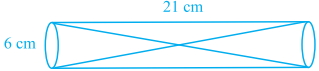
A
$594$
B
$234$
C
$396$
D
$132$
Solution
(C) Let the volume of cone $A$ be $2V$ and the volume of cone $B$ be $V$. Let the height of cone $A$ be $h_1 \, cm$,then the height of cone $B$ is $(21 - h_1) \, cm$.
Given,the diameter of the cones $= 6 \, cm$.
Therefore,the radius of the cones $r = \frac{6}{2} = 3 \, cm$.
Volume of cone $A = 2V = \frac{1}{3} \pi r^2 h_1 = \frac{1}{3} \pi (3)^2 h_1 = 3 \pi h_1$.
Thus,$V = \frac{3}{2} \pi h_1$ ...... $(i)$
Volume of cone $B = V = \frac{1}{3} \pi r^2 (21 - h_1) = \frac{1}{3} \pi (3)^2 (21 - h_1) = 3 \pi (21 - h_1)$ ...... $(ii)$
Equating $(i)$ and $(ii)$:
$\frac{3}{2} \pi h_1 = 3 \pi (21 - h_1)$
$\frac{1}{2} h_1 = 21 - h_1$
$\frac{3}{2} h_1 = 21$
$h_1 = 14 \, cm$.
Height of cone $A = 14 \, cm$,Height of cone $B = 21 - 14 = 7 \, cm$.
Volume of cone $A = 3 \pi (14) = 3 \times \frac{22}{7} \times 14 = 132 \, cm^3$.
Volume of cone $B = 3 \pi (7) = 3 \times \frac{22}{7} \times 7 = 66 \, cm^3$.
Volume of the cylinder $= \pi r^2 H = \frac{22}{7} \times (3)^2 \times 21 = 22 \times 9 \times 3 = 594 \, cm^3$.
Volume of the remaining portion $=$ Volume of cylinder $-$ (Volume of cone $A$ $+$ Volume of cone $B$)
$= 594 - (132 + 66) = 594 - 198 = 396 \, cm^3$.
Given,the diameter of the cones $= 6 \, cm$.
Therefore,the radius of the cones $r = \frac{6}{2} = 3 \, cm$.
Volume of cone $A = 2V = \frac{1}{3} \pi r^2 h_1 = \frac{1}{3} \pi (3)^2 h_1 = 3 \pi h_1$.
Thus,$V = \frac{3}{2} \pi h_1$ ...... $(i)$
Volume of cone $B = V = \frac{1}{3} \pi r^2 (21 - h_1) = \frac{1}{3} \pi (3)^2 (21 - h_1) = 3 \pi (21 - h_1)$ ...... $(ii)$
Equating $(i)$ and $(ii)$:
$\frac{3}{2} \pi h_1 = 3 \pi (21 - h_1)$
$\frac{1}{2} h_1 = 21 - h_1$
$\frac{3}{2} h_1 = 21$
$h_1 = 14 \, cm$.
Height of cone $A = 14 \, cm$,Height of cone $B = 21 - 14 = 7 \, cm$.
Volume of cone $A = 3 \pi (14) = 3 \times \frac{22}{7} \times 14 = 132 \, cm^3$.
Volume of cone $B = 3 \pi (7) = 3 \times \frac{22}{7} \times 7 = 66 \, cm^3$.
Volume of the cylinder $= \pi r^2 H = \frac{22}{7} \times (3)^2 \times 21 = 22 \times 9 \times 3 = 594 \, cm^3$.
Volume of the remaining portion $=$ Volume of cylinder $-$ (Volume of cone $A$ $+$ Volume of cone $B$)
$= 594 - (132 + 66) = 594 - 198 = 396 \, cm^3$.
0 likes
View Solution52
MediumMCQ
An ice cream cone full of ice cream has a radius of $5 \, cm$ and a total height of $10 \, cm$ as shown in the figure. Calculate the volume of the ice cream,provided that its $\frac{1}{6}$ part is left unfilled with ice cream. (in $cm^{3}$)
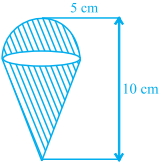
A
$355$
B
$330.25$
C
$322.8$
D
$327.4$
Solution
(D) The ice cream cone is a combination of a hemisphere and a cone.
Given,radius of the hemisphere $(r)$ $= 5 \, cm$.
Volume of the hemisphere $= \frac{2}{3} \pi r^{3} = \frac{2}{3} \times \frac{22}{7} \times (5)^{3} = \frac{5500}{21} \approx 261.90 \, cm^{3}$.
Now,the radius of the cone $(r)$ $= 5 \, cm$.
The total height of the ice cream cone is $10 \, cm$. Since the hemisphere has a radius of $5 \, cm$,the height of the conical part $(h)$ $= 10 - 5 = 5 \, cm$.
Volume of the cone $= \frac{1}{3} \pi r^{2} h = \frac{1}{3} \times \frac{22}{7} \times (5)^{2} \times 5 = \frac{2750}{21} \approx 130.95 \, cm^{3}$.
Total volume of the ice cream cone $= 261.90 + 130.95 = 392.85 \, cm^{3}$.
Since $\frac{1}{6}$ part is left unfilled,the volume of ice cream filled is $\frac{5}{6}$ of the total volume.
Required volume of ice cream $= \frac{5}{6} \times 392.85 = 5 \times 65.475 = 327.375 \approx 327.4 \, cm^{3}$.
Given,radius of the hemisphere $(r)$ $= 5 \, cm$.
Volume of the hemisphere $= \frac{2}{3} \pi r^{3} = \frac{2}{3} \times \frac{22}{7} \times (5)^{3} = \frac{5500}{21} \approx 261.90 \, cm^{3}$.
Now,the radius of the cone $(r)$ $= 5 \, cm$.
The total height of the ice cream cone is $10 \, cm$. Since the hemisphere has a radius of $5 \, cm$,the height of the conical part $(h)$ $= 10 - 5 = 5 \, cm$.
Volume of the cone $= \frac{1}{3} \pi r^{2} h = \frac{1}{3} \times \frac{22}{7} \times (5)^{2} \times 5 = \frac{2750}{21} \approx 130.95 \, cm^{3}$.
Total volume of the ice cream cone $= 261.90 + 130.95 = 392.85 \, cm^{3}$.
Since $\frac{1}{6}$ part is left unfilled,the volume of ice cream filled is $\frac{5}{6}$ of the total volume.
Required volume of ice cream $= \frac{5}{6} \times 392.85 = 5 \times 65.475 = 327.375 \approx 327.4 \, cm^{3}$.
0 likes
View Solution53
MediumMCQ
Marbles of diameter $1.4 \,cm$ are dropped into a cylindrical beaker of diameter $7 \,cm$ containing some water. Find the number of marbles that should be dropped into the beaker so that the water level rises by $5.6 \,cm$.
A
$150$
B
$140$
C
$130$
D
$120$
Solution
(A) Given,diameter of a marble $= 1.4 \,cm$.
$\therefore$ Radius of a marble $(r) = \frac{1.4}{2} = 0.7 \,cm$.
Volume of one spherical marble $= \frac{4}{3} \pi r^3 = \frac{4}{3} \pi (0.7)^3 = \frac{4}{3} \pi (0.343) = \frac{1.372}{3} \pi \,cm^3$.
Given,diameter of the cylindrical beaker $= 7 \,cm$.
$\therefore$ Radius of the beaker $(R) = \frac{7}{2} = 3.5 \,cm$.
Height of the water level raised $(h) = 5.6 \,cm$.
Volume of the water displaced (raised) in the beaker $= \pi R^2 h = \pi (3.5)^2 (5.6) = \pi (12.25) (5.6) = 68.6 \pi \,cm^3$.
Let the number of marbles be $n$.
Then,$n \times (\text{Volume of one marble}) = \text{Volume of raised water}$.
$n \times \frac{1.372}{3} \pi = 68.6 \pi$.
$n = \frac{68.6 \times 3}{1.372} = \frac{205.8}{1.372} = 150$.
Thus,$150$ marbles are required.
$\therefore$ Radius of a marble $(r) = \frac{1.4}{2} = 0.7 \,cm$.
Volume of one spherical marble $= \frac{4}{3} \pi r^3 = \frac{4}{3} \pi (0.7)^3 = \frac{4}{3} \pi (0.343) = \frac{1.372}{3} \pi \,cm^3$.
Given,diameter of the cylindrical beaker $= 7 \,cm$.
$\therefore$ Radius of the beaker $(R) = \frac{7}{2} = 3.5 \,cm$.
Height of the water level raised $(h) = 5.6 \,cm$.
Volume of the water displaced (raised) in the beaker $= \pi R^2 h = \pi (3.5)^2 (5.6) = \pi (12.25) (5.6) = 68.6 \pi \,cm^3$.
Let the number of marbles be $n$.
Then,$n \times (\text{Volume of one marble}) = \text{Volume of raised water}$.
$n \times \frac{1.372}{3} \pi = 68.6 \pi$.
$n = \frac{68.6 \times 3}{1.372} = \frac{205.8}{1.372} = 150$.
Thus,$150$ marbles are required.
0 likes
View Solution54
DifficultMCQ
How many spherical lead shots,each of diameter $4.2 \, cm$,can be obtained from a solid rectangular lead piece with dimensions $66 \, cm \times 42 \, cm \times 21 \, cm$?
A
$1400$
B
$1500$
C
$1550$
D
$1450$
Solution
(B) Given that,spherical lead shots are made from a solid rectangular lead piece.
$\therefore$ Number of spherical lead shots $= \frac{\text{Volume of solid rectangular lead piece}}{\text{Volume of a spherical lead shot}}$ ......$(i)$
Given,diameter of a spherical lead shot $= 4.2 \, cm$.
$\therefore$ Radius of a spherical lead shot,$r = \frac{4.2}{2} = 2.1 \, cm$.
Volume of a spherical lead shot $= \frac{4}{3} \pi r^3 = \frac{4}{3} \times \frac{22}{7} \times (2.1)^3 = \frac{4}{3} \times \frac{22}{7} \times 2.1 \times 2.1 \times 2.1 = 4 \times 22 \times 0.1 \times 2.1 \times 2.1 = 38.808 \, cm^3$.
Volume of the rectangular lead piece (cuboid) $= l \times b \times h = 66 \times 42 \times 21 = 58212 \, cm^3$.
From Eq. $(i)$,
Number of spherical lead shots $= \frac{58212}{38.808} = 1500$.
Hence,the required number of spherical lead shots is $1500$.
$\therefore$ Number of spherical lead shots $= \frac{\text{Volume of solid rectangular lead piece}}{\text{Volume of a spherical lead shot}}$ ......$(i)$
Given,diameter of a spherical lead shot $= 4.2 \, cm$.
$\therefore$ Radius of a spherical lead shot,$r = \frac{4.2}{2} = 2.1 \, cm$.
Volume of a spherical lead shot $= \frac{4}{3} \pi r^3 = \frac{4}{3} \times \frac{22}{7} \times (2.1)^3 = \frac{4}{3} \times \frac{22}{7} \times 2.1 \times 2.1 \times 2.1 = 4 \times 22 \times 0.1 \times 2.1 \times 2.1 = 38.808 \, cm^3$.
Volume of the rectangular lead piece (cuboid) $= l \times b \times h = 66 \times 42 \times 21 = 58212 \, cm^3$.
From Eq. $(i)$,
Number of spherical lead shots $= \frac{58212}{38.808} = 1500$.
Hence,the required number of spherical lead shots is $1500$.
0 likes
View Solution55
DifficultMCQ
How many spherical lead shots of diameter $4 \,cm$ can be made out of a solid cube of lead whose edge measures $44 \,cm$?
A
$2500$
B
$2561$
C
$2541$
D
$2535$
Solution
(C) Given that,spherical lead shots are made from a solid cube of lead.
$\therefore$ Number of spherical lead shots $= \frac{\text{Volume of the solid cube}}{\text{Volume of one spherical lead shot}}$ ...........$(i)$
Given that,the diameter of a spherical lead shot $= 4 \,cm$.
$\Rightarrow$ Radius of a spherical lead shot $(r) = \frac{4}{2} = 2 \,cm$.
Volume of one spherical lead shot $= \frac{4}{3} \pi r^3 = \frac{4}{3} \times \frac{22}{7} \times (2)^3 = \frac{4 \times 22 \times 8}{3 \times 7} = \frac{704}{21} \,cm^3$.
Given that,the edge of the solid cube $(a) = 44 \,cm$.
Volume of the solid cube $= a^3 = (44)^3 = 44 \times 44 \times 44 = 85184 \,cm^3$.
From Eq. $(i)$,
Number of spherical lead shots $= \frac{44 \times 44 \times 44}{\frac{4}{3} \times \frac{22}{7} \times 8} = \frac{44 \times 44 \times 44 \times 3 \times 7}{4 \times 22 \times 8} = 11 \times 21 \times 11 = 2541$.
Hence,the required number of spherical lead shots is $2541$.
$\therefore$ Number of spherical lead shots $= \frac{\text{Volume of the solid cube}}{\text{Volume of one spherical lead shot}}$ ...........$(i)$
Given that,the diameter of a spherical lead shot $= 4 \,cm$.
$\Rightarrow$ Radius of a spherical lead shot $(r) = \frac{4}{2} = 2 \,cm$.
Volume of one spherical lead shot $= \frac{4}{3} \pi r^3 = \frac{4}{3} \times \frac{22}{7} \times (2)^3 = \frac{4 \times 22 \times 8}{3 \times 7} = \frac{704}{21} \,cm^3$.
Given that,the edge of the solid cube $(a) = 44 \,cm$.
Volume of the solid cube $= a^3 = (44)^3 = 44 \times 44 \times 44 = 85184 \,cm^3$.
From Eq. $(i)$,
Number of spherical lead shots $= \frac{44 \times 44 \times 44}{\frac{4}{3} \times \frac{22}{7} \times 8} = \frac{44 \times 44 \times 44 \times 3 \times 7}{4 \times 22 \times 8} = 11 \times 21 \times 11 = 2541$.
Hence,the required number of spherical lead shots is $2541$.
0 likes
View Solution56
MediumMCQ
$A$ wall $24 \, m$ long,$0.4 \, m$ thick and $6 \, m$ high is constructed with bricks each of dimensions $25 \, cm \times 16 \, cm \times 10 \, cm$. If the mortar occupies $\frac{1}{10}$th of the volume of the wall,then find the number of bricks used in constructing the wall.
A
$12900$
B
$12924$
C
$13960$
D
$12960$
Solution
(D) Given that,a wall is constructed with the help of bricks and mortar.
Number of bricks $= \frac{\text{Volume of wall} - (\frac{1}{10} \text{th volume of wall})}{\text{Volume of a brick}}$ .........$(i)$
Length of wall $(l) = 24 \, m$,Thickness $(b) = 0.4 \, m$,Height $(h) = 6 \, m$.
Volume of wall $= l \times b \times h = 24 \times 0.4 \times 6 = 57.6 \, m^3$.
Volume occupied by mortar $= \frac{1}{10} \times 57.6 = 5.76 \, m^3$.
Volume occupied by bricks $= 57.6 - 5.76 = 51.84 \, m^3$.
Dimensions of a brick $= 25 \, cm \times 16 \, cm \times 10 \, cm = 0.25 \, m \times 0.16 \, m \times 0.10 \, m$.
Volume of one brick $= 0.25 \times 0.16 \times 0.10 = 0.004 \, m^3$.
Number of bricks $= \frac{51.84}{0.004} = \frac{51840}{4} = 12960$.
Hence,the required number of bricks used in constructing the wall is $12960$.
Number of bricks $= \frac{\text{Volume of wall} - (\frac{1}{10} \text{th volume of wall})}{\text{Volume of a brick}}$ .........$(i)$
Length of wall $(l) = 24 \, m$,Thickness $(b) = 0.4 \, m$,Height $(h) = 6 \, m$.
Volume of wall $= l \times b \times h = 24 \times 0.4 \times 6 = 57.6 \, m^3$.
Volume occupied by mortar $= \frac{1}{10} \times 57.6 = 5.76 \, m^3$.
Volume occupied by bricks $= 57.6 - 5.76 = 51.84 \, m^3$.
Dimensions of a brick $= 25 \, cm \times 16 \, cm \times 10 \, cm = 0.25 \, m \times 0.16 \, m \times 0.10 \, m$.
Volume of one brick $= 0.25 \times 0.16 \times 0.10 = 0.004 \, m^3$.
Number of bricks $= \frac{51.84}{0.004} = \frac{51840}{4} = 12960$.
Hence,the required number of bricks used in constructing the wall is $12960$.
0 likes
View Solution57
DifficultMCQ
Find the number of metallic circular discs with $1.5\, cm$ base diameter and height $0.2\, cm$ that must be melted to form a right circular cylinder of height $10\, cm$ and diameter $4.5\, cm$.
A
$450$
B
$400$
C
$1050$
D
$1020$
Solution
(A) metallic circular disc is essentially a thin right circular cylinder.
For the metallic circular disc:
Diameter $= 1.5\, cm$,so radius $(r) = \frac{1.5}{2} = 0.75\, cm$.
Height $(h) = 0.2\, cm$.
Volume of one disc $= \pi r^2 h = \pi \times (0.75)^2 \times 0.2 = \pi \times 0.5625 \times 0.2 = 0.1125\pi\, cm^3$.
For the large right circular cylinder:
Diameter $= 4.5\, cm$,so radius $(R) = \frac{4.5}{2} = 2.25\, cm$.
Height $(H) = 10\, cm$.
Volume of the cylinder $= \pi R^2 H = \pi \times (2.25)^2 \times 10 = \pi \times 5.0625 \times 10 = 50.625\pi\, cm^3$.
Number of discs required $= \frac{\text{Volume of cylinder}}{\text{Volume of one disc}} = \frac{50.625\pi}{0.1125\pi} = \frac{506250}{1125} = 450$.
Thus,the required number of metallic circular discs is $450$.
For the metallic circular disc:
Diameter $= 1.5\, cm$,so radius $(r) = \frac{1.5}{2} = 0.75\, cm$.
Height $(h) = 0.2\, cm$.
Volume of one disc $= \pi r^2 h = \pi \times (0.75)^2 \times 0.2 = \pi \times 0.5625 \times 0.2 = 0.1125\pi\, cm^3$.
For the large right circular cylinder:
Diameter $= 4.5\, cm$,so radius $(R) = \frac{4.5}{2} = 2.25\, cm$.
Height $(H) = 10\, cm$.
Volume of the cylinder $= \pi R^2 H = \pi \times (2.25)^2 \times 10 = \pi \times 5.0625 \times 10 = 50.625\pi\, cm^3$.
Number of discs required $= \frac{\text{Volume of cylinder}}{\text{Volume of one disc}} = \frac{50.625\pi}{0.1125\pi} = \frac{506250}{1125} = 450$.
Thus,the required number of metallic circular discs is $450$.
0 likes
View Solution58
Medium
$A$ bucket is in the form of a frustum of a cone of height $30 \,cm$ with radii of its lower and upper ends as $10 \,cm$ and $20 \,cm$,respectively. Find the capacity and surface area of the bucket. Also,find the cost of milk which can completely fill the container,at the rate of $Rs. \, 25$ per $litre$ (use $\pi = 3.14$).
Solution
(N/A) The capacity (volume) of the bucket is given by the formula $V = \frac{\pi h}{3} [r_1^2 + r_2^2 + r_1 r_2]$.
Given $h = 30 \, cm$,$r_1 = 20 \, cm$,and $r_2 = 10 \, cm$.
Capacity $= \frac{3.14 \times 30}{3} [20^2 + 10^2 + 20 \times 10] = 31.4 [400 + 100 + 200] = 31.4 \times 700 = 21980 \, cm^3$.
Since $1000 \, cm^3 = 1 \, litre$,the capacity is $21.98 \, litres$.
The cost of milk at $Rs. \, 25$ per $litre$ is $21.98 \times 25 = Rs. \, 549.50$.
The slant height $l = \sqrt{h^2 + (r_1 - r_2)^2} = \sqrt{30^2 + (20 - 10)^2} = \sqrt{900 + 100} = \sqrt{1000} \approx 31.62 \, cm$.
The surface area of the bucket (open at the top) is the curved surface area plus the area of the base: $A = \pi l (r_1 + r_2) + \pi r_2^2$.
$A = 3.14 \times 31.62 \times (20 + 10) + 3.14 \times 10^2 = 3.14 \times 31.62 \times 30 + 314 = 2978.56 + 314 = 3292.56 \, cm^2 \approx 3292.6 \, cm^2$.
Given $h = 30 \, cm$,$r_1 = 20 \, cm$,and $r_2 = 10 \, cm$.
Capacity $= \frac{3.14 \times 30}{3} [20^2 + 10^2 + 20 \times 10] = 31.4 [400 + 100 + 200] = 31.4 \times 700 = 21980 \, cm^3$.
Since $1000 \, cm^3 = 1 \, litre$,the capacity is $21.98 \, litres$.
The cost of milk at $Rs. \, 25$ per $litre$ is $21.98 \times 25 = Rs. \, 549.50$.
The slant height $l = \sqrt{h^2 + (r_1 - r_2)^2} = \sqrt{30^2 + (20 - 10)^2} = \sqrt{900 + 100} = \sqrt{1000} \approx 31.62 \, cm$.
The surface area of the bucket (open at the top) is the curved surface area plus the area of the base: $A = \pi l (r_1 + r_2) + \pi r_2^2$.
$A = 3.14 \times 31.62 \times (20 + 10) + 3.14 \times 10^2 = 3.14 \times 31.62 \times 30 + 314 = 2978.56 + 314 = 3292.56 \, cm^2 \approx 3292.6 \, cm^2$.
0 likes
View Solution59
Difficult
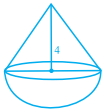
$A$ solid toy is in the form of a hemisphere surmounted by a right circular cone. The height of the cone is $4\, cm$ and the diameter of the base is $8\, cm$. Determine the volume of the toy. If a cube circumscribes the toy,then find the difference of the volumes of cube and the toy. Also,find the total surface area of the toy.
Solution
(N/A) Let $r$ be the radius of the hemisphere and the cone,and $h$ be the height of the cone. Given $h = 4\, cm$ and diameter $d = 8\, cm$,so $r = 4\, cm$.
Volume of the toy $=$ Volume of the hemisphere $+$ Volume of the cone
$= \frac{2}{3} \pi r^3 + \frac{1}{3} \pi r^2 h = \frac{1}{3} \pi r^2 (2r + h)$
$= \frac{1}{3} \times \frac{22}{7} \times 4^2 \times (2 \times 4 + 4) = \frac{1}{3} \times \frac{22}{7} \times 16 \times 12 = \frac{1408}{7} \approx 201.14\, cm^3$.
$A$ cube circumscribes the toy. The height of the toy is $h + r = 4 + 4 = 8\, cm$ and the width is $8\, cm$. Thus,the edge of the cube is $a = 8\, cm$.
Volume of the cube $= a^3 = 8^3 = 512\, cm^3$.
Difference in volumes $= 512 - 201.14 = 310.86\, cm^3$.
Total surface area of the toy $=$ Curved surface area of cone $+$ Curved surface area of hemisphere
$= \pi r l + 2 \pi r^2$,where slant height $l = \sqrt{h^2 + r^2} = \sqrt{4^2 + 4^2} = 4\sqrt{2}\, cm$.
$= \pi r (l + 2r) = \frac{22}{7} \times 4 \times (4\sqrt{2} + 8) = \frac{88}{7} \times 4(\sqrt{2} + 2) = \frac{352}{7} (1.414 + 2) \approx 171.68\, cm^2$.
Volume of the toy $=$ Volume of the hemisphere $+$ Volume of the cone
$= \frac{2}{3} \pi r^3 + \frac{1}{3} \pi r^2 h = \frac{1}{3} \pi r^2 (2r + h)$
$= \frac{1}{3} \times \frac{22}{7} \times 4^2 \times (2 \times 4 + 4) = \frac{1}{3} \times \frac{22}{7} \times 16 \times 12 = \frac{1408}{7} \approx 201.14\, cm^3$.
$A$ cube circumscribes the toy. The height of the toy is $h + r = 4 + 4 = 8\, cm$ and the width is $8\, cm$. Thus,the edge of the cube is $a = 8\, cm$.
Volume of the cube $= a^3 = 8^3 = 512\, cm^3$.
Difference in volumes $= 512 - 201.14 = 310.86\, cm^3$.
Total surface area of the toy $=$ Curved surface area of cone $+$ Curved surface area of hemisphere
$= \pi r l + 2 \pi r^2$,where slant height $l = \sqrt{h^2 + r^2} = \sqrt{4^2 + 4^2} = 4\sqrt{2}\, cm$.
$= \pi r (l + 2r) = \frac{22}{7} \times 4 \times (4\sqrt{2} + 8) = \frac{88}{7} \times 4(\sqrt{2} + 2) = \frac{352}{7} (1.414 + 2) \approx 171.68\, cm^2$.
0 likes
View Solution60
MediumMCQ
$A$ building is in the form of a cylinder surmounted by a hemispherical dome (see figure). The base diameter of the dome is equal to $\frac{2}{3}$ of the total height of the building. Find the height of the building,if it contains $67 \frac{1}{21} \, m^3$ of air. (in $m$)
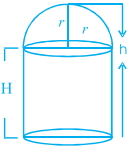
A
$3$
B
$4$
C
$5$
D
$6$
Solution
(D) Let the radius of the hemispherical dome be $r$ meters and the total height of the building be $h$ meters.
Since the base diameter of the dome is equal to $\frac{2}{3}$ of the total height,therefore $2r = \frac{2}{3}h$,which implies $r = \frac{h}{3}$.
Let $H$ be the height of the cylindrical portion. Then $H = h - r = h - \frac{h}{3} = \frac{2}{3}h$ meters.
The volume of air inside the building is the sum of the volume of the hemispherical dome and the volume of the cylindrical portion.
Volume $= \frac{2}{3}\pi r^3 + \pi r^2 H = \frac{2}{3}\pi (\frac{h}{3})^3 + \pi (\frac{h}{3})^2 (\frac{2}{3}h) = \frac{2}{3}\pi (\frac{h^3}{27}) + \pi (\frac{h^2}{9}) (\frac{2}{3}h) = \frac{2\pi h^3}{81} + \frac{2\pi h^3}{27} = \frac{2\pi h^3 + 6\pi h^3}{81} = \frac{8\pi h^3}{81}$.
Given the volume is $67 \frac{1}{21} = \frac{1408}{21} \, m^3$.
So,$\frac{8}{81} \times \frac{22}{7} \times h^3 = \frac{1408}{21}$.
$h^3 = \frac{1408}{21} \times \frac{81 \times 7}{8 \times 22} = \frac{1408}{21} \times \frac{567}{176} = 8 \times 27 = 216$.
$h = \sqrt[3]{216} = 6 \, m$.
Since the base diameter of the dome is equal to $\frac{2}{3}$ of the total height,therefore $2r = \frac{2}{3}h$,which implies $r = \frac{h}{3}$.
Let $H$ be the height of the cylindrical portion. Then $H = h - r = h - \frac{h}{3} = \frac{2}{3}h$ meters.
The volume of air inside the building is the sum of the volume of the hemispherical dome and the volume of the cylindrical portion.
Volume $= \frac{2}{3}\pi r^3 + \pi r^2 H = \frac{2}{3}\pi (\frac{h}{3})^3 + \pi (\frac{h}{3})^2 (\frac{2}{3}h) = \frac{2}{3}\pi (\frac{h^3}{27}) + \pi (\frac{h^2}{9}) (\frac{2}{3}h) = \frac{2\pi h^3}{81} + \frac{2\pi h^3}{27} = \frac{2\pi h^3 + 6\pi h^3}{81} = \frac{8\pi h^3}{81}$.
Given the volume is $67 \frac{1}{21} = \frac{1408}{21} \, m^3$.
So,$\frac{8}{81} \times \frac{22}{7} \times h^3 = \frac{1408}{21}$.
$h^3 = \frac{1408}{21} \times \frac{81 \times 7}{8 \times 22} = \frac{1408}{21} \times \frac{567}{176} = 8 \times 27 = 216$.
$h = \sqrt[3]{216} = 6 \, m$.
0 likes
View Solution61
MediumMCQ
$A$ solid metallic hemisphere of radius $8 \, cm$ is melted and recast into a right circular cone of base radius $6 \, cm$. Determine the height of the cone (in $cm$).
A
$28.44$
B
$38.50$
C
$25.67$
D
$69.54$
Solution
(A) Let the height of the cone be $h \, cm$.
Given,the radius of the base of the cone $r = 6 \, cm$.
The volume of the cone is given by $V_{cone} = \frac{1}{3} \pi r^2 h = \frac{1}{3} \pi (6)^2 h = \frac{36 \pi h}{3} = 12 \pi h \, cm^3$.
Given,the radius of the hemisphere $R = 8 \, cm$.
The volume of the hemisphere is given by $V_{hemisphere} = \frac{2}{3} \pi R^3 = \frac{2}{3} \pi (8)^3 = \frac{2}{3} \pi (512) = \frac{1024 \pi}{3} \, cm^3$.
Since the hemisphere is melted and recast into a cone,their volumes must be equal:
$12 \pi h = \frac{1024 \pi}{3}$
$h = \frac{1024 \pi}{3 \times 12 \pi} = \frac{1024}{36} = \frac{256}{9} \approx 28.44 \, cm$.
Thus,the height of the cone is $28.44 \, cm$.
Given,the radius of the base of the cone $r = 6 \, cm$.
The volume of the cone is given by $V_{cone} = \frac{1}{3} \pi r^2 h = \frac{1}{3} \pi (6)^2 h = \frac{36 \pi h}{3} = 12 \pi h \, cm^3$.
Given,the radius of the hemisphere $R = 8 \, cm$.
The volume of the hemisphere is given by $V_{hemisphere} = \frac{2}{3} \pi R^3 = \frac{2}{3} \pi (8)^3 = \frac{2}{3} \pi (512) = \frac{1024 \pi}{3} \, cm^3$.
Since the hemisphere is melted and recast into a cone,their volumes must be equal:
$12 \pi h = \frac{1024 \pi}{3}$
$h = \frac{1024 \pi}{3 \times 12 \pi} = \frac{1024}{36} = \frac{256}{9} \approx 28.44 \, cm$.
Thus,the height of the cone is $28.44 \, cm$.
0 likes
View Solution62
MediumMCQ
$A$ rectangular water tank of base $11 \,m \times 6 \,m$ contains water up to a height of $5 \,m$. If the water in the tank is transferred to a cylindrical tank of radius $3.5 \,m$,find the height of the water level in the tank. (in $m$)
A
$9.6$
B
$8.6$
C
$9.2$
D
$16.4$
Solution
(B) Given,dimensions of the base of the rectangular tank $= 11 \,m \times 6 \,m$ and the height of water $= 5 \,m$.
Volume of the water in the rectangular tank $= 11 \times 6 \times 5 = 330 \,m^3$.
Also,the radius of the cylindrical tank is given as $r = 3.5 \,m$.
Let the height of the water level in the cylindrical tank be $h$. The volume of water in the cylindrical tank is given by the formula $V = \pi r^2 h$.
$V = \frac{22}{7} \times (3.5)^2 \times h = \frac{22}{7} \times 3.5 \times 3.5 \times h = 22 \times 0.5 \times 3.5 \times h = 38.5 h \,m^3$.
Since the volume of water remains the same when transferred:
$38.5 h = 330$.
$h = \frac{330}{38.5} = \frac{3300}{385} \approx 8.571 \,m$.
Rounding to one decimal place,the height of the water level is $8.6 \,m$.
Volume of the water in the rectangular tank $= 11 \times 6 \times 5 = 330 \,m^3$.
Also,the radius of the cylindrical tank is given as $r = 3.5 \,m$.
Let the height of the water level in the cylindrical tank be $h$. The volume of water in the cylindrical tank is given by the formula $V = \pi r^2 h$.
$V = \frac{22}{7} \times (3.5)^2 \times h = \frac{22}{7} \times 3.5 \times 3.5 \times h = 22 \times 0.5 \times 3.5 \times h = 38.5 h \,m^3$.
Since the volume of water remains the same when transferred:
$38.5 h = 330$.
$h = \frac{330}{38.5} = \frac{3300}{385} \approx 8.571 \,m$.
Rounding to one decimal place,the height of the water level is $8.6 \,m$.
0 likes
View Solution63
Difficult
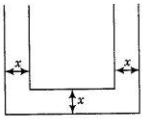
How many cubic centimetres of iron are required to construct an open box whose external dimensions are $36 \, cm$,$25 \, cm$,and $16.5 \, cm$,provided the thickness of the iron is $1.5 \, cm$? If one cubic $cm$ of iron weighs $7.5 \, g$,find the weight of the box.
Solution
(N/A) Let the external length $(l) = 36 \, cm$,external breadth $(b) = 25 \, cm$,and external height $(h) = 16.5 \, cm$. The thickness of the iron is $x = 1.5 \, cm$.
External volume of the open box $= l \times b \times h = 36 \times 25 \times 16.5 = 14850 \, cm^3$.
For an open box,the internal dimensions are:
Internal length $(l_i) = l - 2x = 36 - 2(1.5) = 36 - 3 = 33 \, cm$.
Internal breadth $(b_i) = b - 2x = 25 - 2(1.5) = 25 - 3 = 22 \, cm$.
Internal height $(h_i) = h - x = 16.5 - 1.5 = 15 \, cm$ (since it is an open box,only the base thickness is subtracted).
Internal volume $= l_i \times b_i \times h_i = 33 \times 22 \times 15 = 10890 \, cm^3$.
Volume of iron required = External volume - Internal volume
$= 14850 - 10890 = 3960 \, cm^3$.
Weight of the box = Volume of iron $\times$ density
$= 3960 \, cm^3 \times 7.5 \, g/cm^3 = 29700 \, g = 29.7 \, kg$.
External volume of the open box $= l \times b \times h = 36 \times 25 \times 16.5 = 14850 \, cm^3$.
For an open box,the internal dimensions are:
Internal length $(l_i) = l - 2x = 36 - 2(1.5) = 36 - 3 = 33 \, cm$.
Internal breadth $(b_i) = b - 2x = 25 - 2(1.5) = 25 - 3 = 22 \, cm$.
Internal height $(h_i) = h - x = 16.5 - 1.5 = 15 \, cm$ (since it is an open box,only the base thickness is subtracted).
Internal volume $= l_i \times b_i \times h_i = 33 \times 22 \times 15 = 10890 \, cm^3$.
Volume of iron required = External volume - Internal volume
$= 14850 - 10890 = 3960 \, cm^3$.
Weight of the box = Volume of iron $\times$ density
$= 3960 \, cm^3 \times 7.5 \, g/cm^3 = 29700 \, g = 29.7 \, kg$.
0 likes
View Solution64
MediumMCQ
The barrel of a fountain pen,cylindrical in shape,is $7 \, cm$ long and $5 \, mm$ in diameter. $A$ full barrel of ink in the pen is used up on writing $3300$ words on an average. How many words can be written in a bottle of ink containing one-fifth of a litre?
A
$400000$
B
$4800$
C
$488000$
D
$480000$
Solution
(D) Given,length of the barrel of a fountain pen $h = 7 \, cm$.
Diameter $d = 5 \, mm = 0.5 \, cm$,so radius $r = 0.25 \, cm$.
Volume of the cylindrical barrel $V = \pi r^2 h = \frac{22}{7} \times (0.25)^2 \times 7 = 22 \times 0.0625 = 1.375 \, cm^3$.
It is given that $1.375 \, cm^3$ of ink writes $3300$ words.
Volume of ink in the bottle $= \frac{1}{5} \, L = \frac{1}{5} \times 1000 \, cm^3 = 200 \, cm^3$.
Number of words written with $200 \, cm^3$ of ink $= \frac{3300}{1.375} \times 200$.
$= \frac{3300 \times 200}{1.375} = \frac{660000}{1.375} = 480000$ words.
Diameter $d = 5 \, mm = 0.5 \, cm$,so radius $r = 0.25 \, cm$.
Volume of the cylindrical barrel $V = \pi r^2 h = \frac{22}{7} \times (0.25)^2 \times 7 = 22 \times 0.0625 = 1.375 \, cm^3$.
It is given that $1.375 \, cm^3$ of ink writes $3300$ words.
Volume of ink in the bottle $= \frac{1}{5} \, L = \frac{1}{5} \times 1000 \, cm^3 = 200 \, cm^3$.
Number of words written with $200 \, cm^3$ of ink $= \frac{3300}{1.375} \times 200$.
$= \frac{3300 \times 200}{1.375} = \frac{660000}{1.375} = 480000$ words.
0 likes
View Solution65
MediumMCQ
Water flows at the rate of $10 \, m/min$ through a cylindrical pipe $5 \, mm$ in diameter. How long would it take to fill a conical vessel whose diameter at the base is $40 \, cm$ and depth $24 \, cm$?
A
$51 \, min \, 12 \, s$
B
$41 \, min \, 12 \, s$
C
$51 \, min \, 52 \, s$
D
$31 \, min \, 30 \, s$
Solution
(A) Given,speed of water flow $= 10 \, m/min = 1000 \, cm/min$.
Radius of the pipe $r = \frac{5 \, mm}{2} = 2.5 \, mm = 0.25 \, cm$.
Area of the cross-section of the pipe $= \pi r^2 = \pi \times (0.25)^2 = 0.0625 \pi \, cm^2$.
Volume of water flowing per minute $= \text{Area} \times \text{Speed} = 0.0625 \pi \times 1000 = 62.5 \pi \, cm^3$.
Volume of the conical vessel $= \frac{1}{3} \pi R^2 H$,where $R = 20 \, cm$ and $H = 24 \, cm$.
Volume $= \frac{1}{3} \pi \times (20)^2 \times 24 = 8 \pi \times 400 = 3200 \pi \, cm^3$.
Time required $= \frac{\text{Volume of vessel}}{\text{Volume per minute}} = \frac{3200 \pi}{62.5 \pi} = \frac{3200}{62.5} = 51.2 \, minutes$.
$51.2 \, minutes = 51 \, minutes + 0.2 \times 60 \, seconds = 51 \, minutes \, 12 \, seconds$.
Radius of the pipe $r = \frac{5 \, mm}{2} = 2.5 \, mm = 0.25 \, cm$.
Area of the cross-section of the pipe $= \pi r^2 = \pi \times (0.25)^2 = 0.0625 \pi \, cm^2$.
Volume of water flowing per minute $= \text{Area} \times \text{Speed} = 0.0625 \pi \times 1000 = 62.5 \pi \, cm^3$.
Volume of the conical vessel $= \frac{1}{3} \pi R^2 H$,where $R = 20 \, cm$ and $H = 24 \, cm$.
Volume $= \frac{1}{3} \pi \times (20)^2 \times 24 = 8 \pi \times 400 = 3200 \pi \, cm^3$.
Time required $= \frac{\text{Volume of vessel}}{\text{Volume per minute}} = \frac{3200 \pi}{62.5 \pi} = \frac{3200}{62.5} = 51.2 \, minutes$.
$51.2 \, minutes = 51 \, minutes + 0.2 \times 60 \, seconds = 51 \, minutes \, 12 \, seconds$.
0 likes
View Solution66
Medium
$A$ heap of rice is in the form of a cone of diameter $9 \, m$ and height $3.5 \, m$. Find the volume of the rice. How much canvas cloth is required to just cover the heap?
Solution
(N/A) Given that,a heap of rice is in the form of a cone.
Height of the cone $(h) = 3.5 \, m$.
Diameter of the cone $= 9 \, m$,so the radius $(r) = \frac{9}{2} = 4.5 \, m$.
Volume of the rice $= \frac{1}{3} \pi r^2 h = \frac{1}{3} \times \frac{22}{7} \times (4.5)^2 \times 3.5 = \frac{1}{3} \times \frac{22}{7} \times 20.25 \times 3.5 = 74.25 \, m^3$.
To cover the heap,we need the curved surface area of the cone,which is $\pi r l$,where $l = \sqrt{r^2 + h^2}$.
$l = \sqrt{(4.5)^2 + (3.5)^2} = \sqrt{20.25 + 12.25} = \sqrt{32.5} \approx 5.70 \, m$.
Curved surface area $= \frac{22}{7} \times 4.5 \times 5.70 \approx 80.61 \, m^2$.
Thus,the volume is $74.25 \, m^3$ and the required canvas cloth is $80.61 \, m^2$.
Height of the cone $(h) = 3.5 \, m$.
Diameter of the cone $= 9 \, m$,so the radius $(r) = \frac{9}{2} = 4.5 \, m$.
Volume of the rice $= \frac{1}{3} \pi r^2 h = \frac{1}{3} \times \frac{22}{7} \times (4.5)^2 \times 3.5 = \frac{1}{3} \times \frac{22}{7} \times 20.25 \times 3.5 = 74.25 \, m^3$.
To cover the heap,we need the curved surface area of the cone,which is $\pi r l$,where $l = \sqrt{r^2 + h^2}$.
$l = \sqrt{(4.5)^2 + (3.5)^2} = \sqrt{20.25 + 12.25} = \sqrt{32.5} \approx 5.70 \, m$.
Curved surface area $= \frac{22}{7} \times 4.5 \times 5.70 \approx 80.61 \, m^2$.
Thus,the volume is $74.25 \, m^3$ and the required canvas cloth is $80.61 \, m^2$.
0 likes
View Solution67
MediumMCQ
$A$ factory manufactures $120000$ pencils daily. The pencils are cylindrical in shape,each of length $25 \,cm$ and circumference of base $1.5 \,cm$. Determine the cost of colouring the curved surfaces of the pencils manufactured in one day at $\operatorname{Rs.} 0.05$ per $dm^2$ (in $Rs.$).
A
$2200$
B
$2300$
C
$2250$
D
$2350$
Solution
(C) The curved surface area of a cylinder is given by $CSA = 2 \pi r h$,where $2 \pi r$ is the circumference of the base and $h$ is the length (height).
Given,circumference of the base $= 1.5 \,cm$ and length $h = 25 \,cm$.
Curved surface area of one pencil $= 1.5 \,cm \times 25 \,cm = 37.5 \,cm^2$.
Since $1 \,dm = 10 \,cm$,then $1 \,dm^2 = 100 \,cm^2$. Therefore,$1 \,cm^2 = 0.01 \,dm^2$.
Curved surface area of one pencil in $dm^2 = 37.5 \times 0.01 = 0.375 \,dm^2$.
Total curved surface area for $120000$ pencils $= 120000 \times 0.375 \,dm^2 = 45000 \,dm^2$.
Cost of colouring $= 45000 \,dm^2 \times \operatorname{Rs.} 0.05/dm^2 = \operatorname{Rs.} 2250$.
Given,circumference of the base $= 1.5 \,cm$ and length $h = 25 \,cm$.
Curved surface area of one pencil $= 1.5 \,cm \times 25 \,cm = 37.5 \,cm^2$.
Since $1 \,dm = 10 \,cm$,then $1 \,dm^2 = 100 \,cm^2$. Therefore,$1 \,cm^2 = 0.01 \,dm^2$.
Curved surface area of one pencil in $dm^2 = 37.5 \times 0.01 = 0.375 \,dm^2$.
Total curved surface area for $120000$ pencils $= 120000 \times 0.375 \,dm^2 = 45000 \,dm^2$.
Cost of colouring $= 45000 \,dm^2 \times \operatorname{Rs.} 0.05/dm^2 = \operatorname{Rs.} 2250$.
0 likes
View Solution68
MediumMCQ
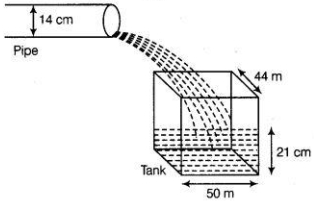
Water is flowing at the rate of $15\, km/h$ through a pipe of diameter $14\, cm$ into a cuboidal pond which is $50\, m$ long and $44\, m$ wide. In what time will the level of water in the pond rise by $21\, cm$? (in $h$)
A
$1$
B
$4$
C
$3$
D
$2$
Solution
(D) Given: Length of the pond $= 50\, m$,Width of the pond $= 44\, m$.
Required rise in water level $= 21\, cm = 0.21\, m$.
Volume of water required in the pond $= 50 \times 44 \times 0.21 = 462\, m^3$.
Radius of the pipe $(r) = \frac{14}{2} = 7\, cm = 0.07\, m$.
Speed of water $= 15\, km/h = 15000\, m/h$.
Volume of water flowing through the pipe in $1\, h = \pi r^2 \times \text{speed} = \frac{22}{7} \times (0.07)^2 \times 15000$.
$= \frac{22}{7} \times 0.0049 \times 15000 = 22 \times 0.0007 \times 15000 = 231\, m^3$.
Time required to fill $462\, m^3$ of water $= \frac{\text{Total volume required}}{\text{Volume flow per hour}} = \frac{462}{231} = 2\, h$.
Thus,the required time is $2\, h$.
Required rise in water level $= 21\, cm = 0.21\, m$.
Volume of water required in the pond $= 50 \times 44 \times 0.21 = 462\, m^3$.
Radius of the pipe $(r) = \frac{14}{2} = 7\, cm = 0.07\, m$.
Speed of water $= 15\, km/h = 15000\, m/h$.
Volume of water flowing through the pipe in $1\, h = \pi r^2 \times \text{speed} = \frac{22}{7} \times (0.07)^2 \times 15000$.
$= \frac{22}{7} \times 0.0049 \times 15000 = 22 \times 0.0007 \times 15000 = 231\, m^3$.
Time required to fill $462\, m^3$ of water $= \frac{\text{Total volume required}}{\text{Volume flow per hour}} = \frac{462}{231} = 2\, h$.
Thus,the required time is $2\, h$.
0 likes
View Solution69
DifficultMCQ
$A$ solid iron cuboidal block of dimensions $4.4 \, m \times 2.6 \, m \times 1 \, m$ is recast into a hollow cylindrical pipe of internal radius $30 \, cm$ and thickness $5 \, cm$. Find the length of the pipe in meters.
A
$112$
B
$120$
C
$142$
D
$132$
Solution
(A) Given that,a solid iron cuboidal block is recast into a hollow cylindrical pipe.
Volume of the cuboidal block $= l \times b \times h = 4.4 \, m \times 2.6 \, m \times 1 \, m = 11.44 \, m^3$.
Internal radius of the hollow cylindrical pipe $(r_i) = 30 \, cm = 0.3 \, m$.
Thickness of the pipe $= 5 \, cm = 0.05 \, m$.
External radius $(r_e) = r_i + \text{thickness} = 0.3 \, m + 0.05 \, m = 0.35 \, m$.
Volume of the hollow cylindrical pipe $= \pi (r_e^2 - r_i^2) h_1$,where $h_1$ is the length of the pipe.
Volume $= \frac{22}{7} \times (0.35^2 - 0.3^2) \times h_1 = \frac{22}{7} \times (0.1225 - 0.09) \times h_1 = \frac{22}{7} \times 0.0325 \times h_1$.
Since the volume remains constant: $11.44 = \frac{22}{7} \times 0.0325 \times h_1$.
$h_1 = \frac{11.44 \times 7}{22 \times 0.0325} = \frac{80.08}{0.715} = 112 \, m$.
Thus,the length of the pipe is $112 \, m$.
Volume of the cuboidal block $= l \times b \times h = 4.4 \, m \times 2.6 \, m \times 1 \, m = 11.44 \, m^3$.
Internal radius of the hollow cylindrical pipe $(r_i) = 30 \, cm = 0.3 \, m$.
Thickness of the pipe $= 5 \, cm = 0.05 \, m$.
External radius $(r_e) = r_i + \text{thickness} = 0.3 \, m + 0.05 \, m = 0.35 \, m$.
Volume of the hollow cylindrical pipe $= \pi (r_e^2 - r_i^2) h_1$,where $h_1$ is the length of the pipe.
Volume $= \frac{22}{7} \times (0.35^2 - 0.3^2) \times h_1 = \frac{22}{7} \times (0.1225 - 0.09) \times h_1 = \frac{22}{7} \times 0.0325 \times h_1$.
Since the volume remains constant: $11.44 = \frac{22}{7} \times 0.0325 \times h_1$.
$h_1 = \frac{11.44 \times 7}{22 \times 0.0325} = \frac{80.08}{0.715} = 112 \, m$.
Thus,the length of the pipe is $112 \, m$.
0 likes
View Solution70
DifficultMCQ
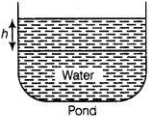
$500$ persons are taking a dip into a cuboidal pond which is $80 \, m$ long and $50 \, m$ broad. What is the rise of water level in the pond,if the average displacement of the water by a person is $0.04 \, m^3$? (in $cm$)
A
$0.1$
B
$0.5$
C
$0.05$
D
$5$
Solution
(B) Let the rise of water level in the pond be $h \, m$,when $500$ persons are taking a dip into a cuboidal pond.
Given that,
Length of the cuboidal pond $= 80 \, m$
Breadth of the cuboidal pond $= 50 \, m$
Now,the volume of the water rise in the pond is given by:
Volume $= \text{Length} \times \text{Breadth} \times \text{Height}$
Volume $= 80 \times 50 \times h = 4000h \, m^3$
The average displacement of water by one person $= 0.04 \, m^3$
So,the total displacement of water by $500$ persons $= 500 \times 0.04 \, m^3 = 20 \, m^3$
According to the problem,the volume of the rise in water level equals the total displacement of water by $500$ persons:
$4000h = 20$
$h = \frac{20}{4000} \, m$
$h = \frac{1}{200} \, m = 0.005 \, m$
To convert the height into centimeters $(cm)$:
$h = 0.005 \times 100 \, cm = 0.5 \, cm$
Hence,the required rise of water level in the pond is $0.5 \, cm$.
Given that,
Length of the cuboidal pond $= 80 \, m$
Breadth of the cuboidal pond $= 50 \, m$
Now,the volume of the water rise in the pond is given by:
Volume $= \text{Length} \times \text{Breadth} \times \text{Height}$
Volume $= 80 \times 50 \times h = 4000h \, m^3$
The average displacement of water by one person $= 0.04 \, m^3$
So,the total displacement of water by $500$ persons $= 500 \times 0.04 \, m^3 = 20 \, m^3$
According to the problem,the volume of the rise in water level equals the total displacement of water by $500$ persons:
$4000h = 20$
$h = \frac{20}{4000} \, m$
$h = \frac{1}{200} \, m = 0.005 \, m$
To convert the height into centimeters $(cm)$:
$h = 0.005 \times 100 \, cm = 0.5 \, cm$
Hence,the required rise of water level in the pond is $0.5 \, cm$.
0 likes
View Solution71
MediumMCQ
$16$ glass spheres,each of radius $2 \,cm$,are packed into a cuboidal box of internal dimensions $16 \,cm \times 8 \,cm \times 8 \,cm$. The box is then filled with water. Find the volume of water filled in the box (in $cm^3$).
A
$450.4$
B
$477.8$
C
$487.6$
D
$497.8$
Solution
(C) Given,dimensions of the cuboidal box $= 16 \,cm \times 8 \,cm \times 8 \,cm$.
Volume of the cuboidal box $= 16 \times 8 \times 8 = 1024 \,cm^3$.
Radius of one glass sphere $(r) = 2 \,cm$.
Volume of one glass sphere $= \frac{4}{3} \pi r^3 = \frac{4}{3} \times \frac{22}{7} \times (2)^3 = \frac{4}{3} \times \frac{22}{7} \times 8 = \frac{704}{21} \approx 33.524 \,cm^3$.
Volume of $16$ glass spheres $= 16 \times 33.524 = 536.384 \,cm^3$.
Volume of water filled $= \text{Volume of cuboidal box} - \text{Volume of } 16 \text{ glass spheres}$.
Volume of water $= 1024 - 536.384 = 487.616 \,cm^3$.
Rounding to one decimal place,the volume is $487.6 \,cm^3$.
Volume of the cuboidal box $= 16 \times 8 \times 8 = 1024 \,cm^3$.
Radius of one glass sphere $(r) = 2 \,cm$.
Volume of one glass sphere $= \frac{4}{3} \pi r^3 = \frac{4}{3} \times \frac{22}{7} \times (2)^3 = \frac{4}{3} \times \frac{22}{7} \times 8 = \frac{704}{21} \approx 33.524 \,cm^3$.
Volume of $16$ glass spheres $= 16 \times 33.524 = 536.384 \,cm^3$.
Volume of water filled $= \text{Volume of cuboidal box} - \text{Volume of } 16 \text{ glass spheres}$.
Volume of water $= 1024 - 536.384 = 487.616 \,cm^3$.
Rounding to one decimal place,the volume is $487.6 \,cm^3$.
0 likes
View Solution72
MediumMCQ
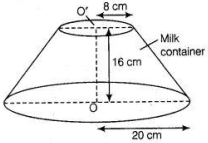
$A$ milk container of height $16 \, cm$ is made of metal sheet in the form of a frustum of a cone with radii of its lower and upper ends as $8 \, cm$ and $20 \, cm$ respectively. Find the cost of milk at the rate of $Rs. \, 22$ per $litre$ which the container can hold. (in $Rs.$)
A
$220$
B
$235$
C
$240.50$
D
$230.12$
Solution
(D) Given: Height of the milk container $(h) = 16 \, cm$,radius of the lower end $(r) = 8 \, cm$,and radius of the upper end $(R) = 20 \, cm$.
The volume of a frustum of a cone is given by the formula: $V = \frac{\pi h}{3} (R^2 + r^2 + Rr)$.
Substituting the values:
$V = \frac{1}{3} \times \frac{22}{7} \times 16 \times (20^2 + 8^2 + 20 \times 8)$
$V = \frac{22 \times 16}{21} \times (400 + 64 + 160)$
$V = \frac{352}{21} \times 624$
$V = \frac{219648}{21} \approx 10459.43 \, cm^3$.
Since $1000 \, cm^3 = 1 \, litre$,the volume in litres is $V = \frac{10459.43}{1000} = 10.45943 \, litres$.
The cost of milk at the rate of $Rs. \, 22$ per $litre$ is:
Cost $= 10.45943 \times 22 = Rs. \, 230.107 \approx Rs. \, 230.12$ (rounding to the nearest option).
The volume of a frustum of a cone is given by the formula: $V = \frac{\pi h}{3} (R^2 + r^2 + Rr)$.
Substituting the values:
$V = \frac{1}{3} \times \frac{22}{7} \times 16 \times (20^2 + 8^2 + 20 \times 8)$
$V = \frac{22 \times 16}{21} \times (400 + 64 + 160)$
$V = \frac{352}{21} \times 624$
$V = \frac{219648}{21} \approx 10459.43 \, cm^3$.
Since $1000 \, cm^3 = 1 \, litre$,the volume in litres is $V = \frac{10459.43}{1000} = 10.45943 \, litres$.
The cost of milk at the rate of $Rs. \, 22$ per $litre$ is:
Cost $= 10.45943 \times 22 = Rs. \, 230.107 \approx Rs. \, 230.12$ (rounding to the nearest option).
0 likes
View Solution73
Difficult
$A$ cylindrical bucket of height $32 \,cm$ and base radius $18 \,cm$ is filled with sand. This bucket is emptied on the ground and a conical heap of sand is formed. If the height of the conical heap is $24 \,cm$,find the radius and slant height of the heap.
Solution
(N/A) Given,radius of the base of the bucket $(R) = 18 \,cm$.
Height of the bucket $(H) = 32 \,cm$.
Volume of the sand in the cylindrical bucket $= \pi R^2 H = \pi \times (18)^2 \times 32 = 10368 \pi \,cm^3$.
Let the radius of the conical heap be $r \,cm$ and its height be $h = 24 \,cm$.
Volume of the conical heap $= \frac{1}{3} \pi r^2 h = \frac{1}{3} \pi r^2 \times 24 = 8 \pi r^2 \,cm^3$.
Since the volume of sand remains the same,$8 \pi r^2 = 10368 \pi$.
$r^2 = \frac{10368}{8} = 1296$.
$r = \sqrt{1296} = 36 \,cm$.
The slant height $l$ of the cone is given by $l = \sqrt{r^2 + h^2}$.
$l = \sqrt{36^2 + 24^2} = \sqrt{1296 + 576} = \sqrt{1872}$.
$l = 12\sqrt{13} \approx 43.27 \,cm$.
Thus,the radius of the heap is $36 \,cm$ and the slant height is approximately $43.27 \,cm$.
Height of the bucket $(H) = 32 \,cm$.
Volume of the sand in the cylindrical bucket $= \pi R^2 H = \pi \times (18)^2 \times 32 = 10368 \pi \,cm^3$.
Let the radius of the conical heap be $r \,cm$ and its height be $h = 24 \,cm$.
Volume of the conical heap $= \frac{1}{3} \pi r^2 h = \frac{1}{3} \pi r^2 \times 24 = 8 \pi r^2 \,cm^3$.
Since the volume of sand remains the same,$8 \pi r^2 = 10368 \pi$.
$r^2 = \frac{10368}{8} = 1296$.
$r = \sqrt{1296} = 36 \,cm$.
The slant height $l$ of the cone is given by $l = \sqrt{r^2 + h^2}$.
$l = \sqrt{36^2 + 24^2} = \sqrt{1296 + 576} = \sqrt{1872}$.
$l = 12\sqrt{13} \approx 43.27 \,cm$.
Thus,the radius of the heap is $36 \,cm$ and the slant height is approximately $43.27 \,cm$.
0 likes
View Solution74
Difficult
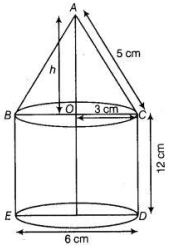
$A$ rocket is in the form of a right circular cylinder closed at the lower end and surmounted by a cone with the same radius as that of the cylinder. The diameter and height of the cylinder are $6 \, cm$ and $12 \, cm$,respectively. If the slant height of the conical portion is $5 \, cm$,find the total surface area and volume of the rocket. [Use $\pi = 3.14$]
Solution
(N/A) The rocket is a combination of a right circular cylinder and a cone.
Given: Diameter of the cylinder $= 6 \, cm$.
Radius of the cylinder $(r) = \frac{6}{2} = 3 \, cm$.
Height of the cylinder $(H) = 12 \, cm$.
Volume of the cylinder $= \pi r^2 H = 3.14 \times (3)^2 \times 12 = 3.14 \times 9 \times 12 = 339.12 \, cm^3$.
Curved surface area of the cylinder $= 2 \pi r H = 2 \times 3.14 \times 3 \times 12 = 226.08 \, cm^2$.
For the cone,slant height $(l) = 5 \, cm$ and radius $(r) = 3 \, cm$.
Height of the cone $(h) = \sqrt{l^2 - r^2} = \sqrt{5^2 - 3^2} = \sqrt{25 - 9} = \sqrt{16} = 4 \, cm$.
Volume of the cone $= \frac{1}{3} \pi r^2 h = \frac{1}{3} \times 3.14 \times (3)^2 \times 4 = 3.14 \times 3 \times 4 = 37.68 \, cm^3$.
Curved surface area of the cone $= \pi r l = 3.14 \times 3 \times 5 = 47.1 \, cm^2$.
Total volume of the rocket $= \text{Volume of cylinder} + \text{Volume of cone} = 339.12 + 37.68 = 376.8 \, cm^3$.
Total surface area of the rocket $= \text{CSA of cone} + \text{CSA of cylinder} + \text{Area of base of cylinder} = 47.1 + 226.08 + (\pi r^2) = 47.1 + 226.08 + (3.14 \times 3^2) = 47.1 + 226.08 + 28.26 = 301.44 \, cm^2$.
Given: Diameter of the cylinder $= 6 \, cm$.
Radius of the cylinder $(r) = \frac{6}{2} = 3 \, cm$.
Height of the cylinder $(H) = 12 \, cm$.
Volume of the cylinder $= \pi r^2 H = 3.14 \times (3)^2 \times 12 = 3.14 \times 9 \times 12 = 339.12 \, cm^3$.
Curved surface area of the cylinder $= 2 \pi r H = 2 \times 3.14 \times 3 \times 12 = 226.08 \, cm^2$.
For the cone,slant height $(l) = 5 \, cm$ and radius $(r) = 3 \, cm$.
Height of the cone $(h) = \sqrt{l^2 - r^2} = \sqrt{5^2 - 3^2} = \sqrt{25 - 9} = \sqrt{16} = 4 \, cm$.
Volume of the cone $= \frac{1}{3} \pi r^2 h = \frac{1}{3} \times 3.14 \times (3)^2 \times 4 = 3.14 \times 3 \times 4 = 37.68 \, cm^3$.
Curved surface area of the cone $= \pi r l = 3.14 \times 3 \times 5 = 47.1 \, cm^2$.
Total volume of the rocket $= \text{Volume of cylinder} + \text{Volume of cone} = 339.12 + 37.68 = 376.8 \, cm^3$.
Total surface area of the rocket $= \text{CSA of cone} + \text{CSA of cylinder} + \text{Area of base of cylinder} = 47.1 + 226.08 + (\pi r^2) = 47.1 + 226.08 + (3.14 \times 3^2) = 47.1 + 226.08 + 28.26 = 301.44 \, cm^2$.
0 likes
View Solution75
MediumMCQ
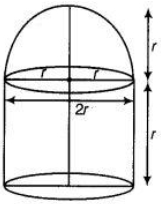
$A$ building is in the form of a cylinder surmounted by a hemispherical vaulted dome and contains $41 \frac{19}{21} \, m^3$ of air. If the internal diameter of the dome is equal to its total height above the floor,find the height of the building? (in $m$)
A
$2$
B
$20$
C
$4$
D
$40$
Solution
(C) Let the total height of the building be equal to the internal diameter of the dome,which is $2r \, m$.
Therefore,the radius of the building (or dome) is $\frac{2r}{2} = r \, m$.
The height of the cylindrical part is $2r - r = r \, m$.
Volume of the cylinder $= \pi r^2 h = \pi r^2 (r) = \pi r^3 \, m^3$.
Volume of the hemispherical dome $= \frac{2}{3} \pi r^3 \, m^3$.
Total volume of the building $=$ Volume of the cylinder $+$ Volume of the hemispherical dome.
Total volume $= \pi r^3 + \frac{2}{3} \pi r^3 = \frac{5}{3} \pi r^3 \, m^3$.
Given that the volume of air inside is $41 \frac{19}{21} \, m^3 = \frac{880}{21} \, m^3$.
Equating the volumes: $\frac{5}{3} \pi r^3 = \frac{880}{21}$.
Using $\pi = \frac{22}{7}$,we get $\frac{5}{3} \times \frac{22}{7} \times r^3 = \frac{880}{21}$.
$\frac{110}{21} r^3 = \frac{880}{21}$.
$r^3 = \frac{880}{110} = 8$.
$r = \sqrt[3]{8} = 2 \, m$.
Total height of the building $= 2r = 2 \times 2 = 4 \, m$.
Therefore,the radius of the building (or dome) is $\frac{2r}{2} = r \, m$.
The height of the cylindrical part is $2r - r = r \, m$.
Volume of the cylinder $= \pi r^2 h = \pi r^2 (r) = \pi r^3 \, m^3$.
Volume of the hemispherical dome $= \frac{2}{3} \pi r^3 \, m^3$.
Total volume of the building $=$ Volume of the cylinder $+$ Volume of the hemispherical dome.
Total volume $= \pi r^3 + \frac{2}{3} \pi r^3 = \frac{5}{3} \pi r^3 \, m^3$.
Given that the volume of air inside is $41 \frac{19}{21} \, m^3 = \frac{880}{21} \, m^3$.
Equating the volumes: $\frac{5}{3} \pi r^3 = \frac{880}{21}$.
Using $\pi = \frac{22}{7}$,we get $\frac{5}{3} \times \frac{22}{7} \times r^3 = \frac{880}{21}$.
$\frac{110}{21} r^3 = \frac{880}{21}$.
$r^3 = \frac{880}{110} = 8$.
$r = \sqrt[3]{8} = 2 \, m$.
Total height of the building $= 2r = 2 \times 2 = 4 \, m$.
0 likes
View Solution76
EasyMCQ
$A$ hemispherical bowl of internal radius $9 \,cm$ is full of liquid. The liquid is to be filled into cylindrical shaped bottles each of radius $1.5 \,cm$ and height $4 \,cm$. How many bottles are needed to empty the bowl?
A
$50$
B
$51$
C
$53$
D
$54$
Solution
(D) Given,radius of the hemispherical bowl,$r = 9 \,cm$.
The volume of the hemispherical bowl is $V_{bowl} = \frac{2}{3} \pi r^3 = \frac{2}{3} \times \pi \times 9^3 = \frac{2}{3} \times \pi \times 729 = 486 \pi \,cm^3$.
Radius of each cylindrical bottle,$R = 1.5 \,cm$ and height,$h = 4 \,cm$.
The volume of one cylindrical bottle is $V_{bottle} = \pi R^2 h = \pi \times (1.5)^2 \times 4 = \pi \times 2.25 \times 4 = 9 \pi \,cm^3$.
Number of bottles required $= \frac{V_{bowl}}{V_{bottle}} = \frac{486 \pi}{9 \pi} = 54$.
Therefore,$54$ bottles are needed to empty the bowl.
The volume of the hemispherical bowl is $V_{bowl} = \frac{2}{3} \pi r^3 = \frac{2}{3} \times \pi \times 9^3 = \frac{2}{3} \times \pi \times 729 = 486 \pi \,cm^3$.
Radius of each cylindrical bottle,$R = 1.5 \,cm$ and height,$h = 4 \,cm$.
The volume of one cylindrical bottle is $V_{bottle} = \pi R^2 h = \pi \times (1.5)^2 \times 4 = \pi \times 2.25 \times 4 = 9 \pi \,cm^3$.
Number of bottles required $= \frac{V_{bowl}}{V_{bottle}} = \frac{486 \pi}{9 \pi} = 54$.
Therefore,$54$ bottles are needed to empty the bowl.
0 likes
View Solution77
Difficult
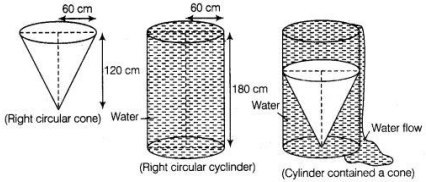
$A$ solid right circular cone of height $120 \,cm$ and radius $60 \,cm$ is placed in a right circular cylinder full of water of height $180 \,cm$ such that it touches the bottom. Find the volume of water left in the cylinder,if the radius of the cylinder is equal to the radius of the cone.
Solution
(N/A) $(i)$ When a solid object is submerged in a container full of water,the volume of water displaced is equal to the volume of the submerged part of the object.
$(ii)$ The total volume of water initially in the cylinder is equal to the volume of the cylinder.
$(iii)$ The volume of water left in the cylinder $=$ (Total volume of the cylinder) $-$ (Volume of the submerged cone).
Given:
Height of the cone $(h_1)$ $= 120 \,cm$
Radius of the cone $(r)$ $= 60 \,cm$
Height of the cylinder $(h_2)$ $= 180 \,cm$
Radius of the cylinder $(r)$ $= 60 \,cm$
Volume of the cone $= \frac{1}{3} \pi r^2 h_1 = \frac{1}{3} \times \pi \times (60)^2 \times 120 = 144000 \pi \,cm^3$.
Volume of the cylinder $= \pi r^2 h_2 = \pi \times (60)^2 \times 180 = 648000 \pi \,cm^3$.
Since the cone is fully submerged,the volume of water displaced is equal to the volume of the cone,which is $144000 \pi \,cm^3$.
Volume of water left in the cylinder $= 648000 \pi - 144000 \pi = 504000 \pi \,cm^3$.
Using $\pi \approx \frac{22}{7}$:
Volume $= 504000 \times \frac{22}{7} = 72000 \times 22 = 1584000 \,cm^3$.
Converting to cubic meters $(1 \,m^3 = 10^6 \,cm^3)$:
Volume $= \frac{1584000}{1000000} \,m^3 = 1.584 \,m^3$.
Thus,the volume of water left in the cylinder is $1.584 \,m^3$.
$(ii)$ The total volume of water initially in the cylinder is equal to the volume of the cylinder.
$(iii)$ The volume of water left in the cylinder $=$ (Total volume of the cylinder) $-$ (Volume of the submerged cone).
Given:
Height of the cone $(h_1)$ $= 120 \,cm$
Radius of the cone $(r)$ $= 60 \,cm$
Height of the cylinder $(h_2)$ $= 180 \,cm$
Radius of the cylinder $(r)$ $= 60 \,cm$
Volume of the cone $= \frac{1}{3} \pi r^2 h_1 = \frac{1}{3} \times \pi \times (60)^2 \times 120 = 144000 \pi \,cm^3$.
Volume of the cylinder $= \pi r^2 h_2 = \pi \times (60)^2 \times 180 = 648000 \pi \,cm^3$.
Since the cone is fully submerged,the volume of water displaced is equal to the volume of the cone,which is $144000 \pi \,cm^3$.
Volume of water left in the cylinder $= 648000 \pi - 144000 \pi = 504000 \pi \,cm^3$.
Using $\pi \approx \frac{22}{7}$:
Volume $= 504000 \times \frac{22}{7} = 72000 \times 22 = 1584000 \,cm^3$.
Converting to cubic meters $(1 \,m^3 = 10^6 \,cm^3)$:
Volume $= \frac{1584000}{1000000} \,m^3 = 1.584 \,m^3$.
Thus,the volume of water left in the cylinder is $1.584 \,m^3$.
0 likes
View Solution78
MediumMCQ
Water flows through a cylindrical pipe,whose inner radius is $1 \,cm$,at the rate of $80 \,cm/sec$ into an empty cylindrical tank,the radius of whose base is $40 \,cm$. What is the rise of water level in the tank in half an hour? (in $cm$)
A
$45$
B
$90$
C
$450$
D
$9$
Solution
(B) Given,radius of the tank,$r_{1} = 40 \,cm$.
Let the rise in the height of the water level in the tank in half an hour be $h_{1} \,cm$.
Internal radius of the cylindrical pipe,$r_{2} = 1 \,cm$.
Speed of water flow $= 80 \,cm/s$.
Time $= 30 \,minutes = 30 \times 60 = 1800 \,seconds$.
Length of water column flowing out of the pipe in $1800 \,seconds$,$h_{2} = 80 \times 1800 = 144000 \,cm$.
According to the principle of conservation of volume:
Volume of water in the cylindrical tank $=$ Volume of water flowed from the pipe in half an hour.
$\pi r_{1}^{2} h_{1} = \pi r_{2}^{2} h_{2}$
$40^2 \times h_{1} = 1^2 \times 144000$
$1600 \times h_{1} = 144000$
$h_{1} = \frac{144000}{1600} = 90 \,cm$.
Thus,the water level in the tank rises by $90 \,cm$ in half an hour.
Let the rise in the height of the water level in the tank in half an hour be $h_{1} \,cm$.
Internal radius of the cylindrical pipe,$r_{2} = 1 \,cm$.
Speed of water flow $= 80 \,cm/s$.
Time $= 30 \,minutes = 30 \times 60 = 1800 \,seconds$.
Length of water column flowing out of the pipe in $1800 \,seconds$,$h_{2} = 80 \times 1800 = 144000 \,cm$.
According to the principle of conservation of volume:
Volume of water in the cylindrical tank $=$ Volume of water flowed from the pipe in half an hour.
$\pi r_{1}^{2} h_{1} = \pi r_{2}^{2} h_{2}$
$40^2 \times h_{1} = 1^2 \times 144000$
$1600 \times h_{1} = 144000$
$h_{1} = \frac{144000}{1600} = 90 \,cm$.
Thus,the water level in the tank rises by $90 \,cm$ in half an hour.
0 likes
View Solution79
MediumMCQ
The rainwater from a roof of dimensions $22 \, m \times 20 \, m$ drains into a cylindrical vessel having a base diameter of $2 \, m$ and a height of $3.5 \, m$. If the rainwater collected from the roof just fills the cylindrical vessel,find the rainfall in $cm$.
A
$5$
B
$7.5$
C
$2.5$
D
$9$
Solution
(C) Given,length of roof $= 22 \, m$ and breadth of roof $= 20 \, m$.
Let the rainfall be $a \, cm = \frac{a}{100} \, m$.
Volume of water collected on the roof $= \text{length} \times \text{breadth} \times \text{height of rainfall} = 22 \times 20 \times \frac{a}{100} = \frac{22a}{5} \, m^3$.
Radius of the cylindrical vessel $r = \frac{\text{diameter}}{2} = \frac{2}{2} = 1 \, m$.
Height of the cylindrical vessel $h = 3.5 \, m = \frac{7}{2} \, m$.
Volume of the cylindrical vessel $= \pi r^2 h = \frac{22}{7} \times (1)^2 \times \frac{7}{2} = 11 \, m^3$.
Since the water collected from the roof fills the vessel,the volumes are equal:
$\frac{22a}{5} = 11$.
$a = \frac{11 \times 5}{22} = 2.5 \, cm$.
Thus,the rainfall is $2.5 \, cm$.
Let the rainfall be $a \, cm = \frac{a}{100} \, m$.
Volume of water collected on the roof $= \text{length} \times \text{breadth} \times \text{height of rainfall} = 22 \times 20 \times \frac{a}{100} = \frac{22a}{5} \, m^3$.
Radius of the cylindrical vessel $r = \frac{\text{diameter}}{2} = \frac{2}{2} = 1 \, m$.
Height of the cylindrical vessel $h = 3.5 \, m = \frac{7}{2} \, m$.
Volume of the cylindrical vessel $= \pi r^2 h = \frac{22}{7} \times (1)^2 \times \frac{7}{2} = 11 \, m^3$.
Since the water collected from the roof fills the vessel,the volumes are equal:
$\frac{22a}{5} = 11$.
$a = \frac{11 \times 5}{22} = 2.5 \, cm$.
Thus,the rainfall is $2.5 \, cm$.
0 likes
View Solution80
DifficultMCQ
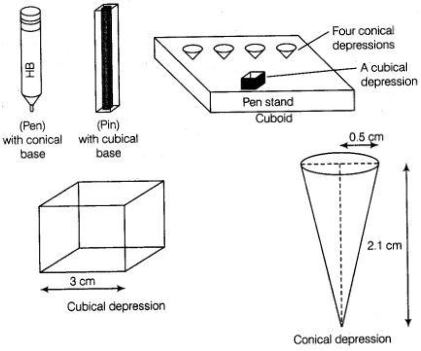
$A$ pen stand made of wood is in the shape of a cuboid with four conical depressions and a cubical depression to hold the pens and pins,respectively. The dimensions of the cuboid are $10 \, cm$,$5 \, cm$,and $4 \, cm$. The radius of each of the conical depressions is $0.5 \, cm$ and the depth is $2.1 \, cm$. The edge of the cubical depression is $3 \, cm$. Find the volume of the wood in the entire stand. (in $, cm^3$)
A
$188.8$
B
$172.6$
C
$175.2$
D
$170.8$
Solution
(D) Given:
Length of the cuboid $(l) = 10 \, cm$,breadth $(b) = 5 \, cm$,and height $(h) = 4 \, cm$.
Volume of the cuboid $= l \times b \times h = 10 \times 5 \times 4 = 200 \, cm^3$.
Radius of each conical depression $(r) = 0.5 \, cm$ and depth $(h_1) = 2.1 \, cm$.
Volume of one conical depression $= \frac{1}{3} \pi r^2 h_1 = \frac{1}{3} \times \frac{22}{7} \times (0.5)^2 \times 2.1 = \frac{1}{3} \times \frac{22}{7} \times 0.25 \times 2.1 = 0.55 \, cm^3$.
Volume of $4$ conical depressions $= 4 \times 0.55 = 2.2 \, cm^3$.
Edge of the cubical depression $(a) = 3 \, cm$.
Volume of the cubical depression $= a^3 = 3^3 = 27 \, cm^3$.
Volume of wood in the stand $=$ Volume of cuboid $-$ (Volume of $4$ conical depressions $+$ Volume of cubical depression)
$= 200 - (2.2 + 27) = 200 - 29.2 = 170.8 \, cm^3$.
Length of the cuboid $(l) = 10 \, cm$,breadth $(b) = 5 \, cm$,and height $(h) = 4 \, cm$.
Volume of the cuboid $= l \times b \times h = 10 \times 5 \times 4 = 200 \, cm^3$.
Radius of each conical depression $(r) = 0.5 \, cm$ and depth $(h_1) = 2.1 \, cm$.
Volume of one conical depression $= \frac{1}{3} \pi r^2 h_1 = \frac{1}{3} \times \frac{22}{7} \times (0.5)^2 \times 2.1 = \frac{1}{3} \times \frac{22}{7} \times 0.25 \times 2.1 = 0.55 \, cm^3$.
Volume of $4$ conical depressions $= 4 \times 0.55 = 2.2 \, cm^3$.
Edge of the cubical depression $(a) = 3 \, cm$.
Volume of the cubical depression $= a^3 = 3^3 = 27 \, cm^3$.
Volume of wood in the stand $=$ Volume of cuboid $-$ (Volume of $4$ conical depressions $+$ Volume of cubical depression)
$= 200 - (2.2 + 27) = 200 - 29.2 = 170.8 \, cm^3$.
0 likes
View Solution81
DifficultMCQ
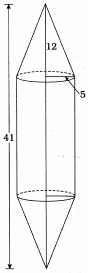
$A$ cylinder is closed at both the ends by $12 \, cm$ high cones. The radius of the cylinder is $5 \, cm$ and the total height of the combined article is $41 \, cm$. Find the total surface area of this article in $cm^2$. $(\pi = 3.14)$
A
$942$
B
$169$
C
$13$
D
$900$
Solution
(A) For both the cones:
Radius $r = 5 \, cm$ and height $h = 12 \, cm$.
For the cylinder:
Radius $r = 5 \, cm$.
Height of the cylinder $H = \text{Total height of the article} - 2 \times \text{Height of cone}$.
$H = 41 - 2 \times 12 = 41 - 24 = 17 \, cm$.
Slant height of the cone $l = \sqrt{r^2 + h^2}$.
$l = \sqrt{5^2 + 12^2} = \sqrt{25 + 144} = \sqrt{169} = 13 \, cm$.
Total Surface Area $(TSA)$ of the combined article:
$TSA = \text{CSA of the cylinder} + 2 \times \text{CSA of the cone}$.
$TSA = 2 \pi r H + 2 \times (\pi r l) = 2 \pi r (H + l)$.
$TSA = 2 \times 3.14 \times 5 \times (17 + 13)$.
$TSA = 3.14 \times 10 \times 30 = 3.14 \times 300 = 942 \, cm^2$.
Thus,the total surface area of the given article is $942 \, cm^2$.
Radius $r = 5 \, cm$ and height $h = 12 \, cm$.
For the cylinder:
Radius $r = 5 \, cm$.
Height of the cylinder $H = \text{Total height of the article} - 2 \times \text{Height of cone}$.
$H = 41 - 2 \times 12 = 41 - 24 = 17 \, cm$.
Slant height of the cone $l = \sqrt{r^2 + h^2}$.
$l = \sqrt{5^2 + 12^2} = \sqrt{25 + 144} = \sqrt{169} = 13 \, cm$.
Total Surface Area $(TSA)$ of the combined article:
$TSA = \text{CSA of the cylinder} + 2 \times \text{CSA of the cone}$.
$TSA = 2 \pi r H + 2 \times (\pi r l) = 2 \pi r (H + l)$.
$TSA = 2 \times 3.14 \times 5 \times (17 + 13)$.
$TSA = 3.14 \times 10 \times 30 = 3.14 \times 300 = 942 \, cm^2$.
Thus,the total surface area of the given article is $942 \, cm^2$.
0 likes
View Solution82
MediumMCQ
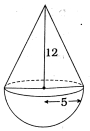
The base of a cone with radius $5 \, cm$ and height $12 \, cm$ is hemispherical. Find the total surface area of the article. $(\pi = 3.14)$ (in $cm^2$)
A
$371.9$
B
$361.1$
C
$261.9$
D
$345.7$
Solution
(B) Radius of the cone $=$ radius of the hemisphere $= r = 5 \, cm$.
Height of the cone $= h = 12 \, cm$.
The slant height of the cone is given by $l = \sqrt{r^2 + h^2}$.
$l = \sqrt{5^2 + 12^2} = \sqrt{25 + 144} = \sqrt{169} = 13 \, cm$.
The total surface area of the article is the sum of the curved surface area of the cone and the curved surface area of the hemisphere.
Total Surface Area $= \pi rl + 2\pi r^2 = \pi r(l + 2r)$.
Substituting the values: $3.14 \times 5 \times (13 + 2 \times 5) = 3.14 \times 5 \times (13 + 10) = 3.14 \times 5 \times 23$.
$= 15.7 \times 23 = 361.1 \, cm^2$.
Height of the cone $= h = 12 \, cm$.
The slant height of the cone is given by $l = \sqrt{r^2 + h^2}$.
$l = \sqrt{5^2 + 12^2} = \sqrt{25 + 144} = \sqrt{169} = 13 \, cm$.
The total surface area of the article is the sum of the curved surface area of the cone and the curved surface area of the hemisphere.
Total Surface Area $= \pi rl + 2\pi r^2 = \pi r(l + 2r)$.
Substituting the values: $3.14 \times 5 \times (13 + 2 \times 5) = 3.14 \times 5 \times (13 + 10) = 3.14 \times 5 \times 23$.
$= 15.7 \times 23 = 361.1 \, cm^2$.
0 likes
View Solution83
MediumMCQ
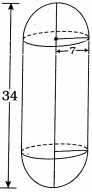
$A$ cylinder is closed at both the ends by hemispheres. The radius of the cylinder is $7 \, cm$ and the total height of the article is $34 \, cm$. Find the total surface area of the article. (in $cm^2$)
A
$1400$
B
$4434$
C
$1496$
D
$1504$
Solution
(C) The radius of the cylinder is equal to the radius of both the hemispheres,$r = 7 \, cm$.
The height of the cylinder is calculated by subtracting the radii of the two hemispheres from the total height of the article:
$h = 34 \, cm - (2 \times 7 \, cm) = 34 - 14 = 20 \, cm$.
The total surface area $(TSA)$ of the combined article is the sum of the curved surface area $(CSA)$ of the cylinder and the curved surface areas of the two hemispheres:
$TSA = CSA_{\text{cylinder}} + 2 \times CSA_{\text{hemisphere}}$
$TSA = 2 \pi r h + 2 \times (2 \pi r^2)$
$TSA = 2 \pi r (h + 2r)$
Substituting the values:
$TSA = 2 \times \frac{22}{7} \times 7 \times (20 + 2 \times 7)$
$TSA = 44 \times (20 + 14)$
$TSA = 44 \times 34 = 1496 \, cm^2$.
Thus,the total surface area of the given article is $1496 \, cm^2$.
The height of the cylinder is calculated by subtracting the radii of the two hemispheres from the total height of the article:
$h = 34 \, cm - (2 \times 7 \, cm) = 34 - 14 = 20 \, cm$.
The total surface area $(TSA)$ of the combined article is the sum of the curved surface area $(CSA)$ of the cylinder and the curved surface areas of the two hemispheres:
$TSA = CSA_{\text{cylinder}} + 2 \times CSA_{\text{hemisphere}}$
$TSA = 2 \pi r h + 2 \times (2 \pi r^2)$
$TSA = 2 \pi r (h + 2r)$
Substituting the values:
$TSA = 2 \times \frac{22}{7} \times 7 \times (20 + 2 \times 7)$
$TSA = 44 \times (20 + 14)$
$TSA = 44 \times 34 = 1496 \, cm^2$.
Thus,the total surface area of the given article is $1496 \, cm^2$.
0 likes
View Solution84
MediumMCQ
$A$ cylinder with radius $14 \, cm$ is closed at one end by a $48 \, cm$ high cone and at the other end by a hemisphere. If the height of the cylinder is $22 \, cm$,find the total surface area of the article (in $cm^2$).
A
$5478$
B
$5698$
C
$5123$
D
$5368$
Solution
(D) Radius of the cylinder = radius of the cone = radius of the hemisphere = $r = 14 \, cm$.
Height of the cylinder $H = 22 \, cm$.
Height of the cone $h = 48 \, cm$.
Slant height of the cone $l = \sqrt{r^2 + h^2} = \sqrt{14^2 + 48^2} = \sqrt{196 + 2304} = \sqrt{2500} = 50 \, cm$.
The total surface area $(TSA)$ of the combined article is the sum of the curved surface areas $(CSA)$ of the cylinder,the cone,and the hemisphere.
$TSA = CSA_{\text{cylinder}} + CSA_{\text{cone}} + CSA_{\text{hemisphere}}$
$TSA = 2\pi rH + \pi rl + 2\pi r^2 = \pi r(2H + l + 2r)$.
Substituting the values: $TSA = \frac{22}{7} \times 14 \times (2 \times 22 + 50 + 2 \times 14)$.
$TSA = 44 \times (44 + 50 + 28) = 44 \times 122 = 5368 \, cm^2$.
Thus,the total surface area of the article is $5368 \, cm^2$.
Height of the cylinder $H = 22 \, cm$.
Height of the cone $h = 48 \, cm$.
Slant height of the cone $l = \sqrt{r^2 + h^2} = \sqrt{14^2 + 48^2} = \sqrt{196 + 2304} = \sqrt{2500} = 50 \, cm$.
The total surface area $(TSA)$ of the combined article is the sum of the curved surface areas $(CSA)$ of the cylinder,the cone,and the hemisphere.
$TSA = CSA_{\text{cylinder}} + CSA_{\text{cone}} + CSA_{\text{hemisphere}}$
$TSA = 2\pi rH + \pi rl + 2\pi r^2 = \pi r(2H + l + 2r)$.
Substituting the values: $TSA = \frac{22}{7} \times 14 \times (2 \times 22 + 50 + 2 \times 14)$.
$TSA = 44 \times (44 + 50 + 28) = 44 \times 122 = 5368 \, cm^2$.
Thus,the total surface area of the article is $5368 \, cm^2$.
0 likes
View Solution85
MediumMCQ
Six wooden cubes of length $3 \, cm$ are arranged in a row touching each other face to face. Find the total surface area of the solid formed in this manner. (in $cm^2$)
A
$234$
B
$345$
C
$117$
D
$545$
Solution
(A) cuboid is formed by arranging six cubes touching each other face to face in a row.
For the cuboid so formed,the length $l = 6 \times 3 \, cm = 18 \, cm$.
The breadth $b = 3 \, cm$ and the height $h = 3 \, cm$.
The total surface area $(TSA)$ of the cuboid is given by the formula $2(lb + bh + hl)$.
Substituting the values: $TSA = 2(18 \times 3 + 3 \times 3 + 3 \times 18)$.
$TSA = 2(54 + 9 + 54) = 2(117) = 234 \, cm^2$.
Thus,the total surface area of the solid formed is $234 \, cm^2$.
For the cuboid so formed,the length $l = 6 \times 3 \, cm = 18 \, cm$.
The breadth $b = 3 \, cm$ and the height $h = 3 \, cm$.
The total surface area $(TSA)$ of the cuboid is given by the formula $2(lb + bh + hl)$.
Substituting the values: $TSA = 2(18 \times 3 + 3 \times 3 + 3 \times 18)$.
$TSA = 2(54 + 9 + 54) = 2(117) = 234 \, cm^2$.
Thus,the total surface area of the solid formed is $234 \, cm^2$.
0 likes
View Solution86
MediumMCQ
$A$ cylinder is closed at both ends by $40 \, cm$ high cones. The radius of the cylinder is $30 \, cm$ and the total height of the article is $180 \, cm$. Find the total surface area of the article. $(\pi = 3.14)$ (in $cm^2$)
A
$29260$
B
$28260$
C
$28370$
D
$29680$
Solution
(B) $1$. The article consists of a cylinder and two cones at its ends.
$2$. Radius of cylinder $(r)$ = $30 \, cm$.
$3$. Height of each cone $(h_{cone})$ = $40 \, cm$.
$4$. Total height of the article = $180 \, cm$.
$5$. Height of the cylinder $(h_{cyl})$ = $180 - (40 + 40) = 100 \, cm$.
$6$. Slant height of the cone $(l)$ = $\sqrt{r^2 + h_{cone}^2} = \sqrt{30^2 + 40^2} = \sqrt{900 + 1600} = \sqrt{2500} = 50 \, cm$.
$7$. Total Surface Area = (Curved Surface Area of Cylinder) + $2$ $\times$ (Curved Surface Area of Cone).
$8$. Total Surface Area = $(2 \pi r h_{cyl}) + 2 \times (\pi r l) = 2 \pi r (h_{cyl} + l)$.
$9$. Total Surface Area = $2 \times 3.14 \times 30 \times (100 + 50) = 188.4 \times 150 = 28260 \, cm^2$.
$2$. Radius of cylinder $(r)$ = $30 \, cm$.
$3$. Height of each cone $(h_{cone})$ = $40 \, cm$.
$4$. Total height of the article = $180 \, cm$.
$5$. Height of the cylinder $(h_{cyl})$ = $180 - (40 + 40) = 100 \, cm$.
$6$. Slant height of the cone $(l)$ = $\sqrt{r^2 + h_{cone}^2} = \sqrt{30^2 + 40^2} = \sqrt{900 + 1600} = \sqrt{2500} = 50 \, cm$.
$7$. Total Surface Area = (Curved Surface Area of Cylinder) + $2$ $\times$ (Curved Surface Area of Cone).
$8$. Total Surface Area = $(2 \pi r h_{cyl}) + 2 \times (\pi r l) = 2 \pi r (h_{cyl} + l)$.
$9$. Total Surface Area = $2 \times 3.14 \times 30 \times (100 + 50) = 188.4 \times 150 = 28260 \, cm^2$.
0 likes
View Solution87
MediumMCQ
$A$ cylinder is closed at both ends by hemispheres. The radius of the cylinder is $21 \, cm$ and the total height of the article is $92 \, cm$. Find the total surface area of the article (in $cm^2$).
A
$12244$
B
$12354$
C
$12144$
D
$22144$
Solution
(C) The article consists of a cylinder and two hemispheres at its ends.
Given: Radius $r = 21 \, cm$,Total height $H = 92 \, cm$.
The height of the cylindrical part $h = H - 2r = 92 - 2(21) = 92 - 42 = 50 \, cm$.
The total surface area of the article = (Curved surface area of cylinder) + $2$ $\times$ (Curved surface area of hemisphere).
Total surface area = $2\pi rh + 2(2\pi r^2) = 2\pi r(h + 2r)$.
Substituting the values: $2 \times \frac{22}{7} \times 21 \times (50 + 2(21)) = 2 \times 22 \times 3 \times (50 + 42) = 132 \times 92 = 12,144 \, cm^2$.
Given: Radius $r = 21 \, cm$,Total height $H = 92 \, cm$.
The height of the cylindrical part $h = H - 2r = 92 - 2(21) = 92 - 42 = 50 \, cm$.
The total surface area of the article = (Curved surface area of cylinder) + $2$ $\times$ (Curved surface area of hemisphere).
Total surface area = $2\pi rh + 2(2\pi r^2) = 2\pi r(h + 2r)$.
Substituting the values: $2 \times \frac{22}{7} \times 21 \times (50 + 2(21)) = 2 \times 22 \times 3 \times (50 + 42) = 132 \times 92 = 12,144 \, cm^2$.
0 likes
View Solution88
EasyMCQ
The radius of a hemispherical dome of a temple is $21\, m$. Find the cost of painting its outer surface at the rate of ₹ $80/m^2$. (in ₹)
A
$22555$
B
$251760$
C
$221650$
D
$221760$
Solution
(D) The radius $(r)$ of the hemispherical dome is $21\, m$.
The curved surface area $(CSA)$ of a hemisphere is given by the formula $2\pi r^2$.
$CSA = 2 \times \frac{22}{7} \times 21 \times 21$
$CSA = 2 \times 22 \times 3 \times 21$
$CSA = 44 \times 63 = 2772\, m^2$.
The cost of painting is ₹ $80$ per $m^2$.
Total cost = $CSA \times \text{Rate} = 2772 \times 80 = 2,21,760$.
Thus,the total cost of painting the outer surface is ₹ $2,21,760$.
The curved surface area $(CSA)$ of a hemisphere is given by the formula $2\pi r^2$.
$CSA = 2 \times \frac{22}{7} \times 21 \times 21$
$CSA = 2 \times 22 \times 3 \times 21$
$CSA = 44 \times 63 = 2772\, m^2$.
The cost of painting is ₹ $80$ per $m^2$.
Total cost = $CSA \times \text{Rate} = 2772 \times 80 = 2,21,760$.
Thus,the total cost of painting the outer surface is ₹ $2,21,760$.
0 likes
View Solution89
EasyMCQ
The base of a cone with radius $7\, cm$ and height $24\, cm$ is hemispherical. Find the cost of painting its surface at the rate of ₹ $2/cm^2$. (in ₹)
A
$1716$
B
$1516$
C
$1226$
D
$1698$
Solution
(A) Given: Radius $(r)$ = $7\, cm$,Height $(h)$ = $24\, cm$.
First,find the slant height $(l)$ of the cone: $l = \sqrt{r^2 + h^2} = \sqrt{7^2 + 24^2} = \sqrt{49 + 576} = \sqrt{625} = 25\, cm$.
The surface area to be painted consists of the curved surface area of the cone and the curved surface area of the hemisphere.
Curved Surface Area of Cone = $\pi rl = \frac{22}{7} \times 7 \times 25 = 550\, cm^2$.
Curved Surface Area of Hemisphere = $2\pi r^2 = 2 \times \frac{22}{7} \times 7 \times 7 = 308\, cm^2$.
Total Surface Area = $550 + 308 = 858\, cm^2$.
Cost of painting = Total Surface Area $\times$ Rate = $858 \times 2 = ₹ 1716$.
First,find the slant height $(l)$ of the cone: $l = \sqrt{r^2 + h^2} = \sqrt{7^2 + 24^2} = \sqrt{49 + 576} = \sqrt{625} = 25\, cm$.
The surface area to be painted consists of the curved surface area of the cone and the curved surface area of the hemisphere.
Curved Surface Area of Cone = $\pi rl = \frac{22}{7} \times 7 \times 25 = 550\, cm^2$.
Curved Surface Area of Hemisphere = $2\pi r^2 = 2 \times \frac{22}{7} \times 7 \times 7 = 308\, cm^2$.
Total Surface Area = $550 + 308 = 858\, cm^2$.
Cost of painting = Total Surface Area $\times$ Rate = $858 \times 2 = ₹ 1716$.
0 likes
View Solution90
MediumMCQ
$A$ cylinder is closed at both the ends by $28 \, cm$ high cones. The radius and the height of the cylinder are $21 \, cm$ and $50 \, cm$ respectively. Find the total surface area of the article in $cm^2$.
A
$11330$
B
$11220$
C
$14560$
D
$18450$
Solution
(B) The article consists of a cylinder with two cones attached at its ends.
Radius of cylinder $(r)$ = $21 \, cm$.
Height of cylinder $(h)$ = $50 \, cm$.
Height of cone $(H)$ = $28 \, cm$.
Slant height of cone $(l)$ = $\sqrt{r^2 + H^2} = \sqrt{21^2 + 28^2} = \sqrt{441 + 784} = \sqrt{1225} = 35 \, cm$.
The total surface area of the article = (Curved surface area of cylinder) + $2 \times$ (Curved surface area of cone).
Curved surface area of cylinder = $2 \pi r h = 2 \times \frac{22}{7} \times 21 \times 50 = 44 \times 3 \times 50 = 6600 \, cm^2$.
Curved surface area of one cone = $\pi r l = \frac{22}{7} \times 21 \times 35 = 22 \times 3 \times 35 = 2310 \, cm^2$.
Total surface area = $6600 + 2 \times 2310 = 6600 + 4620 = 11220 \, cm^2$.
Radius of cylinder $(r)$ = $21 \, cm$.
Height of cylinder $(h)$ = $50 \, cm$.
Height of cone $(H)$ = $28 \, cm$.
Slant height of cone $(l)$ = $\sqrt{r^2 + H^2} = \sqrt{21^2 + 28^2} = \sqrt{441 + 784} = \sqrt{1225} = 35 \, cm$.
The total surface area of the article = (Curved surface area of cylinder) + $2 \times$ (Curved surface area of cone).
Curved surface area of cylinder = $2 \pi r h = 2 \times \frac{22}{7} \times 21 \times 50 = 44 \times 3 \times 50 = 6600 \, cm^2$.
Curved surface area of one cone = $\pi r l = \frac{22}{7} \times 21 \times 35 = 22 \times 3 \times 35 = 2310 \, cm^2$.
Total surface area = $6600 + 2 \times 2310 = 6600 + 4620 = 11220 \, cm^2$.
0 likes
View Solution91
MediumMCQ
The dome of a temple is in the shape of a cone with radius $3.5\, m$ and height $12\, m$. Find the cost of painting its outer surface at the rate of ₹ $30/m^2$.
A
$4175$
B
$4150$
C
$4125$
D
$4165$
Solution
(C) Given: Radius $(r)$ = $3.5\, m$,Height $(h)$ = $12\, m$.
First,find the slant height $(l)$ of the cone using the formula $l = \sqrt{r^2 + h^2}$.
$l = \sqrt{(3.5)^2 + (12)^2} = \sqrt{12.25 + 144} = \sqrt{156.25} = 12.5\, m$.
The curved surface area $(CSA)$ of the cone is given by $\pi rl$.
$CSA = \frac{22}{7} \times 3.5 \times 12.5 = 22 \times 0.5 \times 12.5 = 11 \times 12.5 = 137.5\, m^2$.
The cost of painting is at the rate of ₹ $30/m^2$.
Total cost = $137.5 \times 30 = ₹ 4125$.
First,find the slant height $(l)$ of the cone using the formula $l = \sqrt{r^2 + h^2}$.
$l = \sqrt{(3.5)^2 + (12)^2} = \sqrt{12.25 + 144} = \sqrt{156.25} = 12.5\, m$.
The curved surface area $(CSA)$ of the cone is given by $\pi rl$.
$CSA = \frac{22}{7} \times 3.5 \times 12.5 = 22 \times 0.5 \times 12.5 = 11 \times 12.5 = 137.5\, m^2$.
The cost of painting is at the rate of ₹ $30/m^2$.
Total cost = $137.5 \times 30 = ₹ 4125$.
0 likes
View Solution92
MediumMCQ
$A$ cylinder is closed at both the ends by hemispheres. The radius of the cylinder is $20 \, cm$ and the total height of the article is $80 \, cm$. Find the total surface area of this combined article. $(\pi = 3.14)$ (in $cm^2$)
A
$10258$
B
$10568$
C
$12048$
D
$10048$
Solution
(D) The article consists of a cylinder and two hemispheres at its ends.
Given: Radius of cylinder $(r)$ = $20 \, cm$,Total height $(H)$ = $80 \, cm$.
The height of the cylindrical part $(h)$ = $H - 2r = 80 - 2(20) = 80 - 40 = 40 \, cm$.
The total surface area of the article = (Curved surface area of cylinder) + $2$ $\times$ (Curved surface area of hemisphere).
$= 2\pi rh + 2(2\pi r^2) = 2\pi r(h + 2r)$.
$= 2 \times 3.14 \times 20 \times (40 + 2 \times 20)$.
$= 125.6 \times (40 + 40) = 125.6 \times 80 = 10048 \, cm^2$.
Given: Radius of cylinder $(r)$ = $20 \, cm$,Total height $(H)$ = $80 \, cm$.
The height of the cylindrical part $(h)$ = $H - 2r = 80 - 2(20) = 80 - 40 = 40 \, cm$.
The total surface area of the article = (Curved surface area of cylinder) + $2$ $\times$ (Curved surface area of hemisphere).
$= 2\pi rh + 2(2\pi r^2) = 2\pi r(h + 2r)$.
$= 2 \times 3.14 \times 20 \times (40 + 2 \times 20)$.
$= 125.6 \times (40 + 40) = 125.6 \times 80 = 10048 \, cm^2$.
0 likes
View Solution93
MediumMCQ
The radius and the height of a cylinder are $28 \, cm$ and $54.5 \, cm$ respectively. It is closed at one end by a hemisphere and at the other end by a $21 \, cm$ high cone. Find the total surface area of the combined article. (in $cm^2$)
A
$17600$
B
$15200$
C
$15630$
D
$21600$
Solution
(A) The article consists of a cylinder,a hemisphere,and a cone.
Radius of cylinder $(r)$ = $28 \, cm$,Height of cylinder $(h_1)$ = $54.5 \, cm$.
Radius of hemisphere $(r)$ = $28 \, cm$.
Radius of cone $(r)$ = $28 \, cm$,Height of cone $(h_2)$ = $21 \, cm$.
Slant height of cone $(l)$ = $\sqrt{r^2 + h_2^2} = \sqrt{28^2 + 21^2} = \sqrt{784 + 441} = \sqrt{1225} = 35 \, cm$.
The total surface area is the sum of the curved surface area of the cylinder,the curved surface area of the hemisphere,and the curved surface area of the cone.
Total Surface Area = $2\pi rh_1 + 2\pi r^2 + \pi rl$.
Total Surface Area = $\pi r (2h_1 + 2r + l) = \frac{22}{7} \times 28 \times (2 \times 54.5 + 2 \times 28 + 35)$.
Total Surface Area = $22 \times 4 \times (109 + 56 + 35) = 88 \times 200 = 17600 \, cm^2$.
Radius of cylinder $(r)$ = $28 \, cm$,Height of cylinder $(h_1)$ = $54.5 \, cm$.
Radius of hemisphere $(r)$ = $28 \, cm$.
Radius of cone $(r)$ = $28 \, cm$,Height of cone $(h_2)$ = $21 \, cm$.
Slant height of cone $(l)$ = $\sqrt{r^2 + h_2^2} = \sqrt{28^2 + 21^2} = \sqrt{784 + 441} = \sqrt{1225} = 35 \, cm$.
The total surface area is the sum of the curved surface area of the cylinder,the curved surface area of the hemisphere,and the curved surface area of the cone.
Total Surface Area = $2\pi rh_1 + 2\pi r^2 + \pi rl$.
Total Surface Area = $\pi r (2h_1 + 2r + l) = \frac{22}{7} \times 28 \times (2 \times 54.5 + 2 \times 28 + 35)$.
Total Surface Area = $22 \times 4 \times (109 + 56 + 35) = 88 \times 200 = 17600 \, cm^2$.
0 likes
View Solution94
EasyMCQ
$A$ cylinder is closed at both ends by $12 \, cm$ high cones. The radius of the cylinder is $5 \, cm$ and the total height of the article is $41 \, cm$. Find the total surface area of the article. $(\pi = 3.14)$ (in $cm^2$)
A
$954$
B
$942$
C
$142$
D
$996$
Solution
(B) $1$. Identify the dimensions: Radius $(r)$ = $5 \, cm$,Height of each cone $(h_{cone})$ = $12 \, cm$,Total height $(H)$ = $41 \, cm$.
$2$. Calculate the height of the cylinder $(h_{cyl})$: $h_{cyl} = H - 2 \times h_{cone} = 41 - 2(12) = 41 - 24 = 17 \, cm$.
$3$. Calculate the slant height $(l)$ of the cone: $l = \sqrt{r^2 + h_{cone}^2} = \sqrt{5^2 + 12^2} = \sqrt{25 + 144} = \sqrt{169} = 13 \, cm$.
$4$. The total surface area of the article consists of the curved surface area of the cylinder and the curved surface areas of the two cones.
$5$. Total Surface Area = $2 \pi r h_{cyl} + 2 \times (\pi r l) = 2 \pi r (h_{cyl} + l)$.
$6$. Substitute the values: $2 \times 3.14 \times 5 \times (17 + 13) = 31.4 \times 30 = 942 \, cm^2$.
$2$. Calculate the height of the cylinder $(h_{cyl})$: $h_{cyl} = H - 2 \times h_{cone} = 41 - 2(12) = 41 - 24 = 17 \, cm$.
$3$. Calculate the slant height $(l)$ of the cone: $l = \sqrt{r^2 + h_{cone}^2} = \sqrt{5^2 + 12^2} = \sqrt{25 + 144} = \sqrt{169} = 13 \, cm$.
$4$. The total surface area of the article consists of the curved surface area of the cylinder and the curved surface areas of the two cones.
$5$. Total Surface Area = $2 \pi r h_{cyl} + 2 \times (\pi r l) = 2 \pi r (h_{cyl} + l)$.
$6$. Substitute the values: $2 \times 3.14 \times 5 \times (17 + 13) = 31.4 \times 30 = 942 \, cm^2$.
0 likes
View Solution95
EasyMCQ
$A$ cylinder with radius $6 \, cm$ is closed at one end by a $8 \, cm$ high cone and is open at the other end. The total height of the article is $20 \, cm$. Find the total surface area of the article. $(\pi = 3.14)$ (in $cm^2$)
A
$660.44$
B
$695.56$
C
$640.56$
D
$740.56$
Solution
(C) The article consists of a cylinder and a cone joined together.
Given: Radius of cylinder and cone $(r) = 6 \, cm$,Height of cone $(h_{cone}) = 8 \, cm$,Total height of article $= 20 \, cm$.
Height of cylinder $(h_{cyl}) = 20 \, cm - 8 \, cm = 12 \, cm$.
Slant height of cone $(l) = \sqrt{r^2 + h_{cone}^2} = \sqrt{6^2 + 8^2} = \sqrt{36 + 64} = \sqrt{100} = 10 \, cm$.
Total Surface Area = (Curved Surface Area of Cylinder) + (Curved Surface Area of Cone) + (Area of base of cylinder).
Total Surface Area = $(2 \pi r h_{cyl}) + (\pi r l) + (\pi r^2)$.
Total Surface Area = $\pi r (2 h_{cyl} + l + r) = 3.14 \times 6 \times (2 \times 12 + 10 + 6)$.
Total Surface Area = $18.84 \times (24 + 10 + 6) = 18.84 \times 40 = 753.60 \, cm^2$.
Wait,re-evaluating: The article is open at the other end,so the base area is not included.
Surface Area = (Curved Surface Area of Cylinder) + (Curved Surface Area of Cone) = $2 \pi r h_{cyl} + \pi r l$.
Surface Area = $\pi r (2 h_{cyl} + l) = 3.14 \times 6 \times (2 \times 12 + 10) = 18.84 \times (24 + 10) = 18.84 \times 34 = 640.56 \, cm^2$.
Given: Radius of cylinder and cone $(r) = 6 \, cm$,Height of cone $(h_{cone}) = 8 \, cm$,Total height of article $= 20 \, cm$.
Height of cylinder $(h_{cyl}) = 20 \, cm - 8 \, cm = 12 \, cm$.
Slant height of cone $(l) = \sqrt{r^2 + h_{cone}^2} = \sqrt{6^2 + 8^2} = \sqrt{36 + 64} = \sqrt{100} = 10 \, cm$.
Total Surface Area = (Curved Surface Area of Cylinder) + (Curved Surface Area of Cone) + (Area of base of cylinder).
Total Surface Area = $(2 \pi r h_{cyl}) + (\pi r l) + (\pi r^2)$.
Total Surface Area = $\pi r (2 h_{cyl} + l + r) = 3.14 \times 6 \times (2 \times 12 + 10 + 6)$.
Total Surface Area = $18.84 \times (24 + 10 + 6) = 18.84 \times 40 = 753.60 \, cm^2$.
Wait,re-evaluating: The article is open at the other end,so the base area is not included.
Surface Area = (Curved Surface Area of Cylinder) + (Curved Surface Area of Cone) = $2 \pi r h_{cyl} + \pi r l$.
Surface Area = $\pi r (2 h_{cyl} + l) = 3.14 \times 6 \times (2 \times 12 + 10) = 18.84 \times (24 + 10) = 18.84 \times 34 = 640.56 \, cm^2$.
0 likes
View Solution96
EasyMCQ
The slant height of a cone with a hemispherical base is $5 \, cm$. If the total surface area of the article is $103.62 \, cm^2$,find its total height. $(\pi = 3.14)$ (in $cm$)
A
$8$
B
$5$
C
$6$
D
$7$
Solution
(D) Let the radius of the hemispherical base be $r$ and the slant height of the cone be $l = 5 \, cm$.
The total surface area of the article is the sum of the curved surface area of the cone and the curved surface area of the hemisphere.
Total Surface Area $= \pi rl + 2\pi r^2 = 103.62 \, cm^2$.
Given $\pi = 3.14$,we have $3.14 \times r \times 5 + 2 \times 3.14 \times r^2 = 103.62$.
$15.7r + 6.28r^2 = 103.62$.
Dividing by $3.14$: $5r + 2r^2 = 33$.
$2r^2 + 5r - 33 = 0$.
Solving the quadratic equation: $2r^2 + 11r - 6r - 33 = 0 \implies r(2r + 11) - 3(2r + 11) = 0$.
$(r - 3)(2r + 11) = 0$. Since $r > 0$,$r = 3 \, cm$.
The height of the cone $h$ is given by $h = \sqrt{l^2 - r^2} = \sqrt{5^2 - 3^2} = \sqrt{25 - 9} = \sqrt{16} = 4 \, cm$.
The total height of the article is the sum of the height of the cone and the radius of the hemisphere: $H = h + r = 4 + 3 = 7 \, cm$.
The total surface area of the article is the sum of the curved surface area of the cone and the curved surface area of the hemisphere.
Total Surface Area $= \pi rl + 2\pi r^2 = 103.62 \, cm^2$.
Given $\pi = 3.14$,we have $3.14 \times r \times 5 + 2 \times 3.14 \times r^2 = 103.62$.
$15.7r + 6.28r^2 = 103.62$.
Dividing by $3.14$: $5r + 2r^2 = 33$.
$2r^2 + 5r - 33 = 0$.
Solving the quadratic equation: $2r^2 + 11r - 6r - 33 = 0 \implies r(2r + 11) - 3(2r + 11) = 0$.
$(r - 3)(2r + 11) = 0$. Since $r > 0$,$r = 3 \, cm$.
The height of the cone $h$ is given by $h = \sqrt{l^2 - r^2} = \sqrt{5^2 - 3^2} = \sqrt{25 - 9} = \sqrt{16} = 4 \, cm$.
The total height of the article is the sum of the height of the cone and the radius of the hemisphere: $H = h + r = 4 + 3 = 7 \, cm$.
0 likes
View Solution97
EasyMCQ
The base of a cone with radius $15 \, cm$ and height $20 \, cm$ is hemispherical. Find the total surface area of this article. $(\pi = 3.14)$ (in $cm^2$) (in $.5$)
A
$2590$
B
$2950$
C
$2310$
D
$1350$
Solution
(A) Given: Radius of the cone $(r)$ = $15 \, cm$,Height of the cone $(h)$ = $20 \, cm$.
First,calculate the slant height $(l)$ of the cone: $l = \sqrt{r^2 + h^2} = \sqrt{15^2 + 20^2} = \sqrt{225 + 400} = \sqrt{625} = 25 \, cm$.
The total surface area of the article consists of the curved surface area of the cone and the curved surface area of the hemisphere.
Curved surface area of the cone = $\pi rl = 3.14 \times 15 \times 25 = 1177.5 \, cm^2$.
Curved surface area of the hemisphere = $2\pi r^2 = 2 \times 3.14 \times 15^2 = 2 \times 3.14 \times 225 = 1413 \, cm^2$.
Total surface area = $1177.5 + 1413 = 2590.5 \, cm^2$.
First,calculate the slant height $(l)$ of the cone: $l = \sqrt{r^2 + h^2} = \sqrt{15^2 + 20^2} = \sqrt{225 + 400} = \sqrt{625} = 25 \, cm$.
The total surface area of the article consists of the curved surface area of the cone and the curved surface area of the hemisphere.
Curved surface area of the cone = $\pi rl = 3.14 \times 15 \times 25 = 1177.5 \, cm^2$.
Curved surface area of the hemisphere = $2\pi r^2 = 2 \times 3.14 \times 15^2 = 2 \times 3.14 \times 225 = 1413 \, cm^2$.
Total surface area = $1177.5 + 1413 = 2590.5 \, cm^2$.
0 likes
View Solution98
MediumMCQ
The base of a cone with radius $15\, cm$ and slant height $25\, cm$ is hemispherical. Find the volume of this solid. $(\pi=3.14)$ (in $cm^{3}$)
A
$12775$
B
$11775$
C
$1375$
D
$14565$
Solution
(B) Radius of the cone $=$ radius of the hemisphere $= r = 15\, cm$ and slant height of the cone $l = 25\, cm$.
For a cone,$l^{2} = r^{2} + h^{2}$.
$\therefore h^{2} = l^{2} - r^{2} = 25^{2} - 15^{2} = 625 - 225 = 400 = (20)^{2}$.
So,$h = 20\, cm$.
Volume of the combined solid $=$ Volume of the cone $+$ Volume of the hemisphere.
Volume $= \frac{1}{3} \pi r^{2} h + \frac{2}{3} \pi r^{3} = \frac{1}{3} \pi r^{2} (h + 2r)$.
Substituting the values: Volume $= \frac{1}{3} \times 3.14 \times 15 \times 15 \times (20 + 2 \times 15)$.
Volume $= 3.14 \times 5 \times 15 \times (20 + 30) = 3.14 \times 75 \times 50 = 3.14 \times 3750 = 11775\, cm^{3}$.
Thus,the volume of the given solid is $11775\, cm^{3}$.
For a cone,$l^{2} = r^{2} + h^{2}$.
$\therefore h^{2} = l^{2} - r^{2} = 25^{2} - 15^{2} = 625 - 225 = 400 = (20)^{2}$.
So,$h = 20\, cm$.
Volume of the combined solid $=$ Volume of the cone $+$ Volume of the hemisphere.
Volume $= \frac{1}{3} \pi r^{2} h + \frac{2}{3} \pi r^{3} = \frac{1}{3} \pi r^{2} (h + 2r)$.
Substituting the values: Volume $= \frac{1}{3} \times 3.14 \times 15 \times 15 \times (20 + 2 \times 15)$.
Volume $= 3.14 \times 5 \times 15 \times (20 + 30) = 3.14 \times 75 \times 50 = 3.14 \times 3750 = 11775\, cm^{3}$.
Thus,the volume of the given solid is $11775\, cm^{3}$.
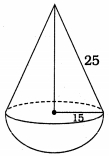
0 likes
View Solution99
MediumMCQ
$A$ cylindrical tank with radius $8.4 \,cm$ is closed at one end by a hemisphere. If the total height of the tank is $52.8 \,cm$,how many litres of petrol can it contain (in $.088$)? (in $litres$)
A
$61$
B
$21$
C
$11$
D
$15$
Solution
(C) Radius of the cylinder $=$ radius of the hemisphere $= r = 8.4 \,cm$.
Height of the cylinder $h =$ Total height $-$ Radius of the hemisphere.
$h = 52.8 - 8.4 = 44.4 \,cm$.
Volume of the combined tank $=$ Volume of the cylinder $+$ Volume of the hemisphere.
$V = \pi r^2 h + \frac{2}{3} \pi r^3 = \pi r^2 (h + \frac{2}{3} r)$.
$V = \frac{22}{7} \times 8.4 \times 8.4 \times (44.4 + \frac{2}{3} \times 8.4)$.
$V = \frac{22}{7} \times 8.4 \times 8.4 \times (44.4 + 5.6)$.
$V = \frac{22}{7} \times 8.4 \times 8.4 \times 50$.
$V = 22 \times 1.2 \times 8.4 \times 50 = 11088 \,cm^3$.
Since $1000 \,cm^3 = 1 \,litre$,the volume in litres is $\frac{11088}{1000} = 11.088 \,litres$.
Height of the cylinder $h =$ Total height $-$ Radius of the hemisphere.
$h = 52.8 - 8.4 = 44.4 \,cm$.
Volume of the combined tank $=$ Volume of the cylinder $+$ Volume of the hemisphere.
$V = \pi r^2 h + \frac{2}{3} \pi r^3 = \pi r^2 (h + \frac{2}{3} r)$.
$V = \frac{22}{7} \times 8.4 \times 8.4 \times (44.4 + \frac{2}{3} \times 8.4)$.
$V = \frac{22}{7} \times 8.4 \times 8.4 \times (44.4 + 5.6)$.
$V = \frac{22}{7} \times 8.4 \times 8.4 \times 50$.
$V = 22 \times 1.2 \times 8.4 \times 50 = 11088 \,cm^3$.
Since $1000 \,cm^3 = 1 \,litre$,the volume in litres is $\frac{11088}{1000} = 11.088 \,litres$.
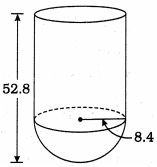
0 likes
View Solution100
MediumMCQ
The radius of a cone is $15 \, cm$ and its base is hemispherical. If the total height of the solid is $55 \, cm$,find its volume in $cm^3$.
A
$29500$
B
$18500$
C
$17500$
D
$16500$
Solution
(D) Radius of the cone $=$ radius of the hemisphere $= r = 15 \, cm$.
Height of the cone $h = \text{Total height} - \text{Radius of the hemisphere} = 55 - 15 = 40 \, cm$.
Volume of the combined solid $=$ Volume of the cone $+$ Volume of the hemisphere.
Volume $= \frac{1}{3} \pi r^2 h + \frac{2}{3} \pi r^3 = \frac{1}{3} \pi r^2 (h + 2r)$.
Substituting the values: Volume $= \frac{1}{3} \times \frac{22}{7} \times 15 \times 15 \times (40 + 2 \times 15)$.
Volume $= \frac{1}{3} \times \frac{22}{7} \times 225 \times (40 + 30) = \frac{1}{3} \times \frac{22}{7} \times 225 \times 70$.
Volume $= 22 \times 75 \times 10 = 16500 \, cm^3$.
Height of the cone $h = \text{Total height} - \text{Radius of the hemisphere} = 55 - 15 = 40 \, cm$.
Volume of the combined solid $=$ Volume of the cone $+$ Volume of the hemisphere.
Volume $= \frac{1}{3} \pi r^2 h + \frac{2}{3} \pi r^3 = \frac{1}{3} \pi r^2 (h + 2r)$.
Substituting the values: Volume $= \frac{1}{3} \times \frac{22}{7} \times 15 \times 15 \times (40 + 2 \times 15)$.
Volume $= \frac{1}{3} \times \frac{22}{7} \times 225 \times (40 + 30) = \frac{1}{3} \times \frac{22}{7} \times 225 \times 70$.
Volume $= 22 \times 75 \times 10 = 16500 \, cm^3$.
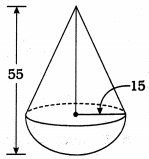
0 likes
View SolutionSurface Areas and Volumes — Mix Examples - Surface Areas and Volumes · Frequently Asked Questions
1Are these Surface Areas and Volumes questions useful for JEE and NEET?
Yes. All questions in this section are mapped to JEE Main and NEET exam patterns. Previous year questions from JEE Main, NEET, GUJCET and state-level exams are included with full solutions.
2Can I switch to Hindi or Gujarati for these questions?
Yes. Use the language tabs in the hero section or the sidebar to view the same questions and solutions in English, Hindi or Gujarati.
3How do I generate a question paper from this subtopic?
Use the Vedclass Exam Paper Generator — select the chapter and subtopic, set difficulty, and generate Sets A, B, C, D automatically. First 3 chapters of every subject are free.
Vedclass Products
For Students
Vedclass Test Series
Mock tests in real JEE/NEET style with performance analysis. 5-day free trial.
Start Free TrialFor Teachers
Exam Paper Generator
Generate Set A/B/C/D papers from this chapter in 2 minutes. 3 chapters free.
Try FreeFor Institutes
Online Exam Module
Live online exams with unlimited students, 360° analytics & white-label branding.
See DemoFor Teachers & Institutes
Generate a Surface Areas and Volumes Exam Paper in 2 Minutes
Select subtopic & difficulty — Sets A, B, C, D auto-generated with No Repeat logic.
First 3 chapters of every subject are free — no payment required.