
A English
Mix Examples - Surface Areas and Volumes Questions in English
Class 10 Mathematics · Surface Areas and Volumes · Mix Examples - Surface Areas and Volumes
257+
Questions
English
Language
100%
With Solutions
Showing 50 of 257 questions in English
101
MediumMCQ
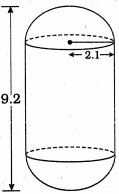
$A$ cylindrical tank is closed at both the ends by hemispheres. Its radius is $2.1 \,m$ and the total height is $9.2 \,m$. How many litres of petrol can it contain?
A
$108108$
B
$100008$
C
$108000$
D
$280108$
Solution
(A) Radius of the cylinder $=$ radius of each hemisphere $= r = 2.1 \,m$.
Height of the cylinder $h =$ Total height of the tank $- 2 \times$ Radius of the hemisphere $= 9.2 - 2 \times 2.1 = 5 \,m$.
Volume of the combined tank $=$ Volume of the cylinder $+ 2 \times$ Volume of the hemisphere
$= \pi r^{2} h + 2 \times (\frac{2}{3} \pi r^{3}) = \pi r^{2} (h + \frac{4}{3} r)$
$= \frac{22}{7} \times 2.1 \times 2.1 \times (5 + \frac{4}{3} \times 2.1)$
$= \frac{22}{7} \times 2.1 \times 2.1 \times (5 + 2.8) = \frac{22}{7} \times 2.1 \times 2.1 \times 7.8 = 108.108 \,m^{3}$.
Since $1 \,m^{3} = 1000$ litres,
Volume in litres $= 108.108 \times 1000 = 1,08,108$ litres.
Thus,the tank can contain $1,08,108$ litres of petrol.
Height of the cylinder $h =$ Total height of the tank $- 2 \times$ Radius of the hemisphere $= 9.2 - 2 \times 2.1 = 5 \,m$.
Volume of the combined tank $=$ Volume of the cylinder $+ 2 \times$ Volume of the hemisphere
$= \pi r^{2} h + 2 \times (\frac{2}{3} \pi r^{3}) = \pi r^{2} (h + \frac{4}{3} r)$
$= \frac{22}{7} \times 2.1 \times 2.1 \times (5 + \frac{4}{3} \times 2.1)$
$= \frac{22}{7} \times 2.1 \times 2.1 \times (5 + 2.8) = \frac{22}{7} \times 2.1 \times 2.1 \times 7.8 = 108.108 \,m^{3}$.
Since $1 \,m^{3} = 1000$ litres,
Volume in litres $= 108.108 \times 1000 = 1,08,108$ litres.
Thus,the tank can contain $1,08,108$ litres of petrol.
0 likes
View Solution102
MediumMCQ
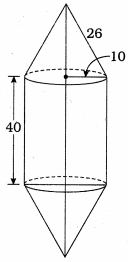
For the science fair,a student prepared a model in the shape of a cylinder with radius $10 \,cm$ and height $40 \,cm$,closed at both ends by cones with slant height $26 \,cm$. How many litres of water can it contain?
A
$144.6$
B
$17.6$
C
$1700$
D
$1705$
Solution
(B) Radius of the cylinder $=$ radius of each cone $= r = 10 \,cm$.
Height of the cylinder $H = 40 \,cm$.
Slant height of the cone $l = 26 \,cm$.
For the cone,$l^2 = r^2 + h^2$,where $h$ is the height of the cone.
$h = \sqrt{l^2 - r^2} = \sqrt{26^2 - 10^2} = \sqrt{676 - 100} = \sqrt{576} = 24 \,cm$.
Volume of the combined container $=$ Volume of the cylinder $+ 2 \times$ Volume of the cone.
Volume $= \pi r^2 H + 2 \times (\frac{1}{3} \pi r^2 h) = \pi r^2 (H + \frac{2}{3} h)$.
Substituting the values: Volume $= \frac{22}{7} \times 10^2 \times (40 + \frac{2}{3} \times 24) = \frac{22}{7} \times 100 \times (40 + 16) = \frac{22}{7} \times 100 \times 56$.
Volume $= 22 \times 100 \times 8 = 17600 \,cm^3$.
Since $1000 \,cm^3 = 1 \,litre$,the volume in litres is $\frac{17600}{1000} = 17.6 \,litres$.
Thus,the model can contain $17.6 \,litres$ of water.
Height of the cylinder $H = 40 \,cm$.
Slant height of the cone $l = 26 \,cm$.
For the cone,$l^2 = r^2 + h^2$,where $h$ is the height of the cone.
$h = \sqrt{l^2 - r^2} = \sqrt{26^2 - 10^2} = \sqrt{676 - 100} = \sqrt{576} = 24 \,cm$.
Volume of the combined container $=$ Volume of the cylinder $+ 2 \times$ Volume of the cone.
Volume $= \pi r^2 H + 2 \times (\frac{1}{3} \pi r^2 h) = \pi r^2 (H + \frac{2}{3} h)$.
Substituting the values: Volume $= \frac{22}{7} \times 10^2 \times (40 + \frac{2}{3} \times 24) = \frac{22}{7} \times 100 \times (40 + 16) = \frac{22}{7} \times 100 \times 56$.
Volume $= 22 \times 100 \times 8 = 17600 \,cm^3$.
Since $1000 \,cm^3 = 1 \,litre$,the volume in litres is $\frac{17600}{1000} = 17.6 \,litres$.
Thus,the model can contain $17.6 \,litres$ of water.
0 likes
View Solution103
EasyMCQ
$A$ cylinder is closed at both the ends by $18\, cm$ high cones. The radius of the cylinder is $7\, cm$ and the total height of the solid is $64\, cm$. Find the volume of this solid (in $cm^3$).
A
$6000$
B
$6260$
C
$6160$
D
$6150$
Solution
(C) The solid consists of a cylinder and two cones at its ends.
Given:
Radius of cylinder and cones $(r)$ = $7\, cm$.
Height of each cone $(h_1)$ = $18\, cm$.
Total height of the solid $(H)$ = $64\, cm$.
Height of the cylinder $(h_2)$ = $H - 2 \times h_1 = 64 - 2(18) = 64 - 36 = 28\, cm$.
Volume of the solid = Volume of cylinder + $2 \times$ Volume of cone.
Volume = $\pi r^2 h_2 + 2 \times (\frac{1}{3} \pi r^2 h_1)$.
Volume = $\pi r^2 (h_2 + \frac{2}{3} h_1)$.
Volume = $\frac{22}{7} \times 7^2 \times (28 + \frac{2}{3} \times 18)$.
Volume = $22 \times 7 \times (28 + 12) = 154 \times 40 = 6160\, cm^3$.
Given:
Radius of cylinder and cones $(r)$ = $7\, cm$.
Height of each cone $(h_1)$ = $18\, cm$.
Total height of the solid $(H)$ = $64\, cm$.
Height of the cylinder $(h_2)$ = $H - 2 \times h_1 = 64 - 2(18) = 64 - 36 = 28\, cm$.
Volume of the solid = Volume of cylinder + $2 \times$ Volume of cone.
Volume = $\pi r^2 h_2 + 2 \times (\frac{1}{3} \pi r^2 h_1)$.
Volume = $\pi r^2 (h_2 + \frac{2}{3} h_1)$.
Volume = $\frac{22}{7} \times 7^2 \times (28 + \frac{2}{3} \times 18)$.
Volume = $22 \times 7 \times (28 + 12) = 154 \times 40 = 6160\, cm^3$.
0 likes
View Solution104
EasyMCQ
The base of a cone with radius $14 \, cm$ and height $32 \, cm$ is hemispherical. Find its volume in $cm^3$.
A
$12020$
B
$12120$
C
$12220$
D
$12320$
Solution
(D) The volume of the solid is the sum of the volume of the cone and the volume of the hemisphere.
Given: Radius $r = 14 \, cm$,Height of cone $h = 32 \, cm$.
Volume of cone $V_1 = \frac{1}{3} \pi r^2 h = \frac{1}{3} \times \frac{22}{7} \times 14 \times 14 \times 32 = \frac{1}{3} \times 22 \times 2 \times 14 \times 32 = \frac{19712}{3} \approx 6570.67 \, cm^3$.
Volume of hemisphere $V_2 = \frac{2}{3} \pi r^3 = \frac{2}{3} \times \frac{22}{7} \times 14 \times 14 \times 14 = \frac{2}{3} \times 22 \times 2 \times 14 \times 14 = \frac{17248}{3} \approx 5749.33 \, cm^3$.
Total Volume $V = V_1 + V_2 = \frac{19712 + 17248}{3} = \frac{36960}{3} = 12320 \, cm^3$.
Given: Radius $r = 14 \, cm$,Height of cone $h = 32 \, cm$.
Volume of cone $V_1 = \frac{1}{3} \pi r^2 h = \frac{1}{3} \times \frac{22}{7} \times 14 \times 14 \times 32 = \frac{1}{3} \times 22 \times 2 \times 14 \times 32 = \frac{19712}{3} \approx 6570.67 \, cm^3$.
Volume of hemisphere $V_2 = \frac{2}{3} \pi r^3 = \frac{2}{3} \times \frac{22}{7} \times 14 \times 14 \times 14 = \frac{2}{3} \times 22 \times 2 \times 14 \times 14 = \frac{17248}{3} \approx 5749.33 \, cm^3$.
Total Volume $V = V_1 + V_2 = \frac{19712 + 17248}{3} = \frac{36960}{3} = 12320 \, cm^3$.
0 likes
View Solution105
EasyMCQ
$A$ cylinder is closed at both the ends by $30 \, cm$ high cones. The radius of the cylinder is $21 \, cm$ and the total height of the solid is $140 \, cm$. Find the volume of this solid (in $cm^3$).
A
$138600$
B
$132600$
C
$156600$
D
$196600$
Solution
(A) The solid consists of a cylinder and two cones at its ends.
Radius of cylinder $(r)$ = $21 \, cm$.
Height of each cone $(h_{cone})$ = $30 \, cm$.
Total height of the solid = $140 \, cm$.
Height of the cylinder $(h_{cyl})$ = Total height - $2 \times h_{cone} = 140 - 2(30) = 140 - 60 = 80 \, cm$.
Volume of the solid = Volume of cylinder + $2 \times$ Volume of cone.
Volume of cylinder = $\pi r^2 h_{cyl} = \frac{22}{7} \times 21 \times 21 \times 80 = 22 \times 3 \times 21 \times 80 = 1,10,880 \, cm^3$.
Volume of two cones = $2 \times (\frac{1}{3} \pi r^2 h_{cone}) = 2 \times \frac{1}{3} \times \frac{22}{7} \times 21 \times 21 \times 30 = 2 \times 22 \times 21 \times 30 = 27,720 \, cm^3$.
Total Volume = $1,10,880 + 27,720 = 1,38,600 \, cm^3$.
Radius of cylinder $(r)$ = $21 \, cm$.
Height of each cone $(h_{cone})$ = $30 \, cm$.
Total height of the solid = $140 \, cm$.
Height of the cylinder $(h_{cyl})$ = Total height - $2 \times h_{cone} = 140 - 2(30) = 140 - 60 = 80 \, cm$.
Volume of the solid = Volume of cylinder + $2 \times$ Volume of cone.
Volume of cylinder = $\pi r^2 h_{cyl} = \frac{22}{7} \times 21 \times 21 \times 80 = 22 \times 3 \times 21 \times 80 = 1,10,880 \, cm^3$.
Volume of two cones = $2 \times (\frac{1}{3} \pi r^2 h_{cone}) = 2 \times \frac{1}{3} \times \frac{22}{7} \times 21 \times 21 \times 30 = 2 \times 22 \times 21 \times 30 = 27,720 \, cm^3$.
Total Volume = $1,10,880 + 27,720 = 1,38,600 \, cm^3$.
0 likes
View Solution106
EasyMCQ
$A$ cylinder is closed at both the ends by hemispheres. The radius of the cylinder is $4.2 \, cm$ and the total height of the solid is $15 \, cm$. Find the volume of this solid (in $cm^3$).
A
$666.368$
B
$676.368$
C
$616.388$
D
$746.368$
Solution
(B) The solid consists of a cylinder and two hemispheres at its ends.
Radius of the cylinder $(r)$ = $4.2 \, cm$.
Total height of the solid = $15 \, cm$.
Height of the cylindrical part $(h)$ = Total height - $2 \times$ radius of hemisphere = $15 - 2(4.2) = 15 - 8.4 = 6.6 \, cm$.
Volume of the solid = Volume of cylinder + $2 \times$ Volume of hemisphere.
Volume of solid = $\pi r^2 h + 2 \times (\frac{2}{3} \pi r^3) = \pi r^2 (h + \frac{4}{3} r)$.
Volume = $\frac{22}{7} \times (4.2)^2 \times (6.6 + \frac{4}{3} \times 4.2)$.
Volume = $\frac{22}{7} \times 17.64 \times (6.6 + 5.6) = 22 \times 2.52 \times 12.2$.
Volume = $55.44 \times 12.2 = 676.368 \, cm^3$.
Radius of the cylinder $(r)$ = $4.2 \, cm$.
Total height of the solid = $15 \, cm$.
Height of the cylindrical part $(h)$ = Total height - $2 \times$ radius of hemisphere = $15 - 2(4.2) = 15 - 8.4 = 6.6 \, cm$.
Volume of the solid = Volume of cylinder + $2 \times$ Volume of hemisphere.
Volume of solid = $\pi r^2 h + 2 \times (\frac{2}{3} \pi r^3) = \pi r^2 (h + \frac{4}{3} r)$.
Volume = $\frac{22}{7} \times (4.2)^2 \times (6.6 + \frac{4}{3} \times 4.2)$.
Volume = $\frac{22}{7} \times 17.64 \times (6.6 + 5.6) = 22 \times 2.52 \times 12.2$.
Volume = $55.44 \times 12.2 = 676.368 \, cm^3$.
0 likes
View Solution107
EasyMCQ
$A$ top is made by joining a hemisphere to the base of a cone. The radius and the height of the conical part are $2.8 \, cm$ and $6.4 \, cm$ respectively. Find the volume of the top in $cm^3$.
A
$38.50$
B
$88.91$
C
$98.56$
D
$108.56$
Solution
(C) The top consists of a cone and a hemisphere joined at their bases. The radius of both the cone and the hemisphere is $r = 2.8 \, cm$. The height of the cone is $h = 6.4 \, cm$.
Volume of the cone $V_{cone} = \frac{1}{3} \pi r^2 h = \frac{1}{3} \times \frac{22}{7} \times (2.8)^2 \times 6.4 = \frac{1}{3} \times \frac{22}{7} \times 7.84 \times 6.4 \approx 52.53 \, cm^3$.
Volume of the hemisphere $V_{hemi} = \frac{2}{3} \pi r^3 = \frac{2}{3} \times \frac{22}{7} \times (2.8)^3 = \frac{2}{3} \times \frac{22}{7} \times 21.952 \approx 46.03 \, cm^3$.
Total volume $V = V_{cone} + V_{hemi} = 52.53 + 46.03 = 98.56 \, cm^3$.
Volume of the cone $V_{cone} = \frac{1}{3} \pi r^2 h = \frac{1}{3} \times \frac{22}{7} \times (2.8)^2 \times 6.4 = \frac{1}{3} \times \frac{22}{7} \times 7.84 \times 6.4 \approx 52.53 \, cm^3$.
Volume of the hemisphere $V_{hemi} = \frac{2}{3} \pi r^3 = \frac{2}{3} \times \frac{22}{7} \times (2.8)^3 = \frac{2}{3} \times \frac{22}{7} \times 21.952 \approx 46.03 \, cm^3$.
Total volume $V = V_{cone} + V_{hemi} = 52.53 + 46.03 = 98.56 \, cm^3$.
0 likes
View Solution108
EasyMCQ
$A$ container is in the form of a cylinder closed at one end by a hemisphere. The radius of the cylinder is $8.4 \,cm$ and the total height of the container is $52.8 \,cm$. How many litres of petrol can this container hold? (in $litres$)
A
$11.088$
B
$14.058$
C
$13.048$
D
$12.088$
Solution
(A) The container consists of a cylinder and a hemisphere.
Radius of the cylinder $(r)$ = $8.4 \,cm$.
Radius of the hemisphere $(r)$ = $8.4 \,cm$.
Total height of the container $(H)$ = $52.8 \,cm$.
Height of the cylinder $(h)$ = $H - r = 52.8 - 8.4 = 44.4 \,cm$.
Volume of the container = Volume of cylinder + Volume of hemisphere.
Volume = $\pi r^2 h + \frac{2}{3} \pi r^3 = \pi r^2 (h + \frac{2}{3} r)$.
Volume = $\frac{22}{7} \times (8.4)^2 \times (44.4 + \frac{2}{3} \times 8.4)$.
Volume = $\frac{22}{7} \times 70.56 \times (44.4 + 5.6) = \frac{22}{7} \times 70.56 \times 50$.
Volume = $22 \times 10.08 \times 50 = 11088 \,cm^3$.
Since $1000 \,cm^3 = 1 \,litre$,the volume in litres = $11088 / 1000 = 11.088 \,litres$.
Radius of the cylinder $(r)$ = $8.4 \,cm$.
Radius of the hemisphere $(r)$ = $8.4 \,cm$.
Total height of the container $(H)$ = $52.8 \,cm$.
Height of the cylinder $(h)$ = $H - r = 52.8 - 8.4 = 44.4 \,cm$.
Volume of the container = Volume of cylinder + Volume of hemisphere.
Volume = $\pi r^2 h + \frac{2}{3} \pi r^3 = \pi r^2 (h + \frac{2}{3} r)$.
Volume = $\frac{22}{7} \times (8.4)^2 \times (44.4 + \frac{2}{3} \times 8.4)$.
Volume = $\frac{22}{7} \times 70.56 \times (44.4 + 5.6) = \frac{22}{7} \times 70.56 \times 50$.
Volume = $22 \times 10.08 \times 50 = 11088 \,cm^3$.
Since $1000 \,cm^3 = 1 \,litre$,the volume in litres = $11088 / 1000 = 11.088 \,litres$.
0 likes
View Solution109
EasyMCQ
The base of a cone with radius $15 \, cm$ and slant height $25 \, cm$ is hemispherical. Find the volume of this solid. $(\pi = 3.14)$ (in $cm^3$)
A
$11775$
B
$12775$
C
$11955$
D
$12345$
Solution
(A) Given: Radius of the cone $(r)$ = $15 \, cm$,Slant height $(l)$ = $25 \, cm$.
First,find the height $(h)$ of the cone using the relation $l^2 = r^2 + h^2$.
$h^2 = 25^2 - 15^2 = 625 - 225 = 400$.
$h = \sqrt{400} = 20 \, cm$.
Volume of the cone = $\frac{1}{3} \pi r^2 h = \frac{1}{3} \times 3.14 \times 15^2 \times 20 = 3.14 \times 225 \times \frac{20}{3} = 3.14 \times 75 \times 20 = 3.14 \times 1500 = 4710 \, cm^3$.
Volume of the hemisphere = $\frac{2}{3} \pi r^3 = \frac{2}{3} \times 3.14 \times 15^3 = \frac{2}{3} \times 3.14 \times 3375 = 2 \times 3.14 \times 1125 = 7065 \, cm^3$.
Total volume of the solid = Volume of cone + Volume of hemisphere = $4710 + 7065 = 11775 \, cm^3$.
First,find the height $(h)$ of the cone using the relation $l^2 = r^2 + h^2$.
$h^2 = 25^2 - 15^2 = 625 - 225 = 400$.
$h = \sqrt{400} = 20 \, cm$.
Volume of the cone = $\frac{1}{3} \pi r^2 h = \frac{1}{3} \times 3.14 \times 15^2 \times 20 = 3.14 \times 225 \times \frac{20}{3} = 3.14 \times 75 \times 20 = 3.14 \times 1500 = 4710 \, cm^3$.
Volume of the hemisphere = $\frac{2}{3} \pi r^3 = \frac{2}{3} \times 3.14 \times 15^3 = \frac{2}{3} \times 3.14 \times 3375 = 2 \times 3.14 \times 1125 = 7065 \, cm^3$.
Total volume of the solid = Volume of cone + Volume of hemisphere = $4710 + 7065 = 11775 \, cm^3$.
0 likes
View Solution110
EasyMCQ
The base of a cone is hemispherical. The radius of the cone is $15 \, cm$ and the total height of the solid is $55 \, cm$. Find the volume of this solid (in $cm^3$).
A
$17100$
B
$16500$
C
$19600$
D
$37100$
Solution
(B) The solid consists of a cone mounted on a hemisphere.
Given: Radius of the hemisphere $(r)$ = $15 \, cm$.
Total height of the solid $(H)$ = $55 \, cm$.
Height of the cone $(h)$ = $H - r = 55 - 15 = 40 \, cm$.
Volume of the solid = Volume of the cone + Volume of the hemisphere.
Volume of the cone = $\frac{1}{3} \pi r^2 h = \frac{1}{3} \times \pi \times (15)^2 \times 40 = 3000 \pi \, cm^3$.
Volume of the hemisphere = $\frac{2}{3} \pi r^3 = \frac{2}{3} \times \pi \times (15)^3 = 2250 \pi \, cm^3$.
Total Volume = $3000 \pi + 2250 \pi = 5250 \pi \, cm^3$.
Using $\pi \approx 3.14$,Total Volume = $5250 \times 3.14 = 16485 \, cm^3$. Rounding to the nearest option,the answer is $16500 \, cm^3$.
Given: Radius of the hemisphere $(r)$ = $15 \, cm$.
Total height of the solid $(H)$ = $55 \, cm$.
Height of the cone $(h)$ = $H - r = 55 - 15 = 40 \, cm$.
Volume of the solid = Volume of the cone + Volume of the hemisphere.
Volume of the cone = $\frac{1}{3} \pi r^2 h = \frac{1}{3} \times \pi \times (15)^2 \times 40 = 3000 \pi \, cm^3$.
Volume of the hemisphere = $\frac{2}{3} \pi r^3 = \frac{2}{3} \times \pi \times (15)^3 = 2250 \pi \, cm^3$.
Total Volume = $3000 \pi + 2250 \pi = 5250 \pi \, cm^3$.
Using $\pi \approx 3.14$,Total Volume = $5250 \times 3.14 = 16485 \, cm^3$. Rounding to the nearest option,the answer is $16500 \, cm^3$.
0 likes
View Solution111
MediumMCQ
The earth dug out by digging a well with diameter $5.4 \, m$ and depth $20 \, m$ is uniformly spread on a circular ground with radius $15 \, m$. Find the increase in the level of the ground in $cm$.
A
$156.2$
B
$96.1$
C
$64.8$
D
$32.8$
Solution
(C) For the cylindrical well,the radius $r = \frac{5.4}{2} = 2.7 \, m$ and the depth $h = 20 \, m$.
The volume of the earth dug out is $V = \pi r^2 h = \pi \times (2.7)^2 \times 20 \, m^3$.
This earth is spread on a circular ground of radius $R = 15 \, m$ to a height $H$. The volume of this spread earth is $V = \pi R^2 H = \pi \times (15)^2 \times H \, m^3$.
Equating the volumes: $\pi \times (2.7)^2 \times 20 = \pi \times (15)^2 \times H$.
$H = \frac{2.7 \times 2.7 \times 20}{15 \times 15} = \frac{7.29 \times 20}{225} = \frac{145.8}{225} = 0.648 \, m$.
Converting the height to centimeters: $H = 0.648 \times 100 = 64.8 \, cm$.
Thus,the increase in the level of the ground is $64.8 \, cm$.
The volume of the earth dug out is $V = \pi r^2 h = \pi \times (2.7)^2 \times 20 \, m^3$.
This earth is spread on a circular ground of radius $R = 15 \, m$ to a height $H$. The volume of this spread earth is $V = \pi R^2 H = \pi \times (15)^2 \times H \, m^3$.
Equating the volumes: $\pi \times (2.7)^2 \times 20 = \pi \times (15)^2 \times H$.
$H = \frac{2.7 \times 2.7 \times 20}{15 \times 15} = \frac{7.29 \times 20}{225} = \frac{145.8}{225} = 0.648 \, m$.
Converting the height to centimeters: $H = 0.648 \times 100 = 64.8 \, cm$.
Thus,the increase in the level of the ground is $64.8 \, cm$.
0 likes
View Solution112
MediumMCQ
$A$ metallic sphere of radius $21 \,cm$ is melted and recast to form a wire with diameter $0.5 \,cm$. Find the length of the wire in $m$.
A
$1175.28$
B
$2975.68$
C
$1985.60$
D
$1975.68$
Solution
(D) Radius of the sphere $R = 21 \,cm$.
Volume of the sphere $= \frac{4}{3} \pi R^3 = \frac{4}{3} \pi (21)^3 \,cm^3$.
For the cylindrical wire,diameter $= 0.5 \,cm$,so radius $r = \frac{0.5}{2} = 0.25 = \frac{1}{4} \,cm$.
Let the length of the wire be $h \,cm$.
Volume of the wire $= \pi r^2 h = \pi (\frac{1}{4})^2 h \,cm^3$.
Since the sphere is recast into a wire,their volumes are equal:
$\pi (\frac{1}{4})^2 h = \frac{4}{3} \pi (21)^3$
$\frac{1}{16} h = \frac{4}{3} \times 21 \times 21 \times 21$
$h = 16 \times 4 \times 7 \times 21 \times 21$
$h = 64 \times 7 \times 441 = 197568 \,cm$.
To convert into meters,divide by $100$:
$h = \frac{197568}{100} = 1975.68 \,m$.
Thus,the length of the wire is $1975.68 \,m$.
Volume of the sphere $= \frac{4}{3} \pi R^3 = \frac{4}{3} \pi (21)^3 \,cm^3$.
For the cylindrical wire,diameter $= 0.5 \,cm$,so radius $r = \frac{0.5}{2} = 0.25 = \frac{1}{4} \,cm$.
Let the length of the wire be $h \,cm$.
Volume of the wire $= \pi r^2 h = \pi (\frac{1}{4})^2 h \,cm^3$.
Since the sphere is recast into a wire,their volumes are equal:
$\pi (\frac{1}{4})^2 h = \frac{4}{3} \pi (21)^3$
$\frac{1}{16} h = \frac{4}{3} \times 21 \times 21 \times 21$
$h = 16 \times 4 \times 7 \times 21 \times 21$
$h = 64 \times 7 \times 441 = 197568 \,cm$.
To convert into meters,divide by $100$:
$h = \frac{197568}{100} = 1975.68 \,m$.
Thus,the length of the wire is $1975.68 \,m$.
0 likes
View Solution113
MediumMCQ
$A$ metallic sphere with radius $42\, cm$ is melted to cast $8000$ identical balls. Find the radius of these balls (in $cm$).
A
$2.1$
B
$2.7$
C
$21$
D
$210$
Solution
(A) Let the radius of the large metallic sphere be $r = 42\, cm$ and the radius of each small ball be $R\, cm$.
The volume of the large sphere is equal to the total volume of the $8000$ small balls.
Volume of sphere $= \frac{4}{3} \pi r^3$
Volume of $8000$ balls $= 8000 \times \frac{4}{3} \pi R^3$
Equating the volumes: $8000 \times \frac{4}{3} \pi R^3 = \frac{4}{3} \pi r^3$
$8000 R^3 = r^3$
$8000 R^3 = (42)^3$
$R^3 = \frac{42 \times 42 \times 42}{8000}$
$R^3 = \left(\frac{42}{20}\right)^3$
$R = \frac{42}{20} = 2.1\, cm$
Thus,the radius of each small ball is $2.1\, cm$.
The volume of the large sphere is equal to the total volume of the $8000$ small balls.
Volume of sphere $= \frac{4}{3} \pi r^3$
Volume of $8000$ balls $= 8000 \times \frac{4}{3} \pi R^3$
Equating the volumes: $8000 \times \frac{4}{3} \pi R^3 = \frac{4}{3} \pi r^3$
$8000 R^3 = r^3$
$8000 R^3 = (42)^3$
$R^3 = \frac{42 \times 42 \times 42}{8000}$
$R^3 = \left(\frac{42}{20}\right)^3$
$R = \frac{42}{20} = 2.1\, cm$
Thus,the radius of each small ball is $2.1\, cm$.
0 likes
View Solution114
MediumMCQ
$A$ metallic cylinder with radius $15\, cm$ and height $20\, cm$ is melted and recast to produce identical balls with radius $3\, cm$. Find the number of balls produced.
A
$122$
B
$125$
C
$126$
D
$128$
Solution
(B) Radius of the cylinder $r = 15\, cm$ and height $h = 20\, cm$.
Radius of each ball $R = 3\, cm$.
Suppose $n$ balls are produced.
Since the volume remains constant during melting and recasting:
Volume of $n$ balls $=$ Volume of the cylinder
$n \times \frac{4}{3} \pi R^3 = \pi r^2 h$
$n \times \frac{4}{3} \times (3)^3 = (15)^2 \times 20$
$n \times \frac{4}{3} \times 27 = 225 \times 20$
$n \times 36 = 4500$
$n = \frac{4500}{36} = 125$
Thus,$125$ balls are produced.
Radius of each ball $R = 3\, cm$.
Suppose $n$ balls are produced.
Since the volume remains constant during melting and recasting:
Volume of $n$ balls $=$ Volume of the cylinder
$n \times \frac{4}{3} \pi R^3 = \pi r^2 h$
$n \times \frac{4}{3} \times (3)^3 = (15)^2 \times 20$
$n \times \frac{4}{3} \times 27 = 225 \times 20$
$n \times 36 = 4500$
$n = \frac{4500}{36} = 125$
Thus,$125$ balls are produced.
0 likes
View Solution115
MediumMCQ
$A$ metallic sphere with radius $18 \,cm$ is melted and recast to produce cylinders with radius $3 \,cm$ and height $12 \,cm$. Find the number of cylinders produced.
A
$70$
B
$71$
C
$72$
D
$73$
Solution
(C) Radius of the sphere $R = 18 \,cm$.
For each cylinder,radius $r = 3 \,cm$ and height $h = 12 \,cm$.
Suppose $n$ cylinders are produced.
Volume of $n$ cylinders = Volume of the sphere.
$n \times \pi r^{2} h = \frac{4}{3} \pi R^{3}$.
$n \times r^{2} h = \frac{4}{3} R^{3}$.
$n \times 3^{2} \times 12 = \frac{4}{3} \times 18^{3}$.
$n \times 9 \times 12 = \frac{4}{3} \times 5832$.
$n \times 108 = 4 \times 1944$.
$n \times 108 = 7776$.
$n = \frac{7776}{108} = 72$.
Thus,$72$ cylinders are produced.
For each cylinder,radius $r = 3 \,cm$ and height $h = 12 \,cm$.
Suppose $n$ cylinders are produced.
Volume of $n$ cylinders = Volume of the sphere.
$n \times \pi r^{2} h = \frac{4}{3} \pi R^{3}$.
$n \times r^{2} h = \frac{4}{3} R^{3}$.
$n \times 3^{2} \times 12 = \frac{4}{3} \times 18^{3}$.
$n \times 9 \times 12 = \frac{4}{3} \times 5832$.
$n \times 108 = 4 \times 1944$.
$n \times 108 = 7776$.
$n = \frac{7776}{108} = 72$.
Thus,$72$ cylinders are produced.
0 likes
View Solution116
MediumMCQ
$A$ metallic sphere of radius $21 \,cm$ is melted and recast into a wire with radius $0.5 \,cm$. Find the length of the wire in metres.
A
$403.52$
B
$496.12$
C
$495.92$
D
$493.92$
Solution
(D) The volume of the metallic sphere is given by the formula $V = \frac{4}{3} \pi r^3$,where $r = 21 \,cm$.
$V = \frac{4}{3} \times \pi \times (21)^3 = 4 \times \pi \times 441 \times 7 = 12348 \pi \,cm^3$.
The wire is in the shape of a cylinder with radius $R = 0.5 \,cm$ and length $h$. The volume of the wire is $V = \pi R^2 h$.
Equating the volumes: $12348 \pi = \pi \times (0.5)^2 \times h$.
$12348 = 0.25 \times h$.
$h = \frac{12348}{0.25} = 12348 \times 4 = 49392 \,cm$.
To convert the length into metres,divide by $100$: $h = \frac{49392}{100} = 493.92 \,m$.
$V = \frac{4}{3} \times \pi \times (21)^3 = 4 \times \pi \times 441 \times 7 = 12348 \pi \,cm^3$.
The wire is in the shape of a cylinder with radius $R = 0.5 \,cm$ and length $h$. The volume of the wire is $V = \pi R^2 h$.
Equating the volumes: $12348 \pi = \pi \times (0.5)^2 \times h$.
$12348 = 0.25 \times h$.
$h = \frac{12348}{0.25} = 12348 \times 4 = 49392 \,cm$.
To convert the length into metres,divide by $100$: $h = \frac{49392}{100} = 493.92 \,m$.
0 likes
View Solution117
MediumMCQ
$A$ metallic sphere with diameter $12 \, cm$ is melted and identical balls with radius $0.3 \, cm$ are produced. Find the number of balls produced.
A
$8000$
B
$4000$
C
$8550$
D
$8120$
Solution
(A) Given: Diameter of the metallic sphere $D = 12 \, cm$,so radius $R = 6 \, cm$.
Radius of the smaller ball $r = 0.3 \, cm$.
Let the number of balls produced be $n$.
Since the volume remains constant during melting and recasting,the volume of the large sphere equals the sum of the volumes of $n$ small balls.
$V_{\text{large}} = n \times V_{\text{small}}$
$\frac{4}{3} \pi R^3 = n \times \frac{4}{3} \pi r^3$
$R^3 = n \times r^3$
$n = \frac{R^3}{r^3} = \left( \frac{R}{r} \right)^3$
$n = \left( \frac{6}{0.3} \right)^3 = (20)^3$
$n = 8000$.
Thus,the number of balls produced is $8000$.
Radius of the smaller ball $r = 0.3 \, cm$.
Let the number of balls produced be $n$.
Since the volume remains constant during melting and recasting,the volume of the large sphere equals the sum of the volumes of $n$ small balls.
$V_{\text{large}} = n \times V_{\text{small}}$
$\frac{4}{3} \pi R^3 = n \times \frac{4}{3} \pi r^3$
$R^3 = n \times r^3$
$n = \frac{R^3}{r^3} = \left( \frac{R}{r} \right)^3$
$n = \left( \frac{6}{0.3} \right)^3 = (20)^3$
$n = 8000$.
Thus,the number of balls produced is $8000$.
0 likes
View Solution118
MediumMCQ
How many balls with diameter $1 \, cm$ can be produced by melting a metallic cylinder with radius $6 \, cm$ and height $4 \, cm$?
A
$942$
B
$864$
C
$745$
D
$649$
Solution
(B) The volume of the metallic cylinder is given by $V_{cylinder} = \pi r^2 h = \pi \times (6)^2 \times 4 = 144\pi \, cm^3$.
The diameter of each ball is $1 \, cm$,so the radius $r_{ball} = 0.5 \, cm$.
The volume of one spherical ball is $V_{ball} = \frac{4}{3} \pi r^3 = \frac{4}{3} \pi (0.5)^3 = \frac{4}{3} \pi (0.125) = \frac{0.5}{3} \pi = \frac{1}{6} \pi \, cm^3$.
The number of balls produced is $n = \frac{V_{cylinder}}{V_{ball}} = \frac{144\pi}{\frac{1}{6}\pi} = 144 \times 6 = 864$.
The diameter of each ball is $1 \, cm$,so the radius $r_{ball} = 0.5 \, cm$.
The volume of one spherical ball is $V_{ball} = \frac{4}{3} \pi r^3 = \frac{4}{3} \pi (0.5)^3 = \frac{4}{3} \pi (0.125) = \frac{0.5}{3} \pi = \frac{1}{6} \pi \, cm^3$.
The number of balls produced is $n = \frac{V_{cylinder}}{V_{ball}} = \frac{144\pi}{\frac{1}{6}\pi} = 144 \times 6 = 864$.
0 likes
View Solution119
MediumMCQ
How many balls with diameter $0.5\, cm$ can be produced by melting a metallic cylinder with radius $2\, cm$ and height $8\, cm$?
A
$1246$
B
$1926$
C
$1536$
D
$1500$
Solution
(C) The volume of the metallic cylinder is given by $V_{cylinder} = \pi r^2 h$. Substituting $r = 2\, cm$ and $h = 8\, cm$,we get $V_{cylinder} = \pi \times (2)^2 \times 8 = 32\pi\, cm^3$.
The volume of one spherical ball with diameter $0.5\, cm$ (radius $r_b = 0.25\, cm = 1/4\, cm$) is $V_{ball} = \frac{4}{3} \pi r_b^3 = \frac{4}{3} \pi (1/4)^3 = \frac{4}{3} \pi \times \frac{1}{64} = \frac{\pi}{48}\, cm^3$.
The number of balls produced is $n = \frac{V_{cylinder}}{V_{ball}} = \frac{32\pi}{\pi/48} = 32 \times 48 = 1536$.
The volume of one spherical ball with diameter $0.5\, cm$ (radius $r_b = 0.25\, cm = 1/4\, cm$) is $V_{ball} = \frac{4}{3} \pi r_b^3 = \frac{4}{3} \pi (1/4)^3 = \frac{4}{3} \pi \times \frac{1}{64} = \frac{\pi}{48}\, cm^3$.
The number of balls produced is $n = \frac{V_{cylinder}}{V_{ball}} = \frac{32\pi}{\pi/48} = 32 \times 48 = 1536$.
0 likes
View Solution120
MediumMCQ
The radii of three metallic spheres are $3 \, cm$,$4 \, cm$,and $5 \, cm$. These spheres are melted and recast into a single new sphere. Find the radius of the new sphere (in $cm$).
A
$5.4$
B
$3$
C
$4$
D
$6$
Solution
(D) The volume of a sphere is given by the formula $V = \frac{4}{3} \pi r^3$.
When three spheres are melted and recast into a new sphere,the total volume remains conserved.
Let the radii of the three spheres be $r_1 = 3 \, cm$,$r_2 = 4 \, cm$,and $r_3 = 5 \, cm$.
Let the radius of the new sphere be $R$.
The total volume of the three spheres is $V_{total} = \frac{4}{3} \pi (r_1^3 + r_2^3 + r_3^3)$.
The volume of the new sphere is $V_{new} = \frac{4}{3} \pi R^3$.
Equating the volumes: $\frac{4}{3} \pi (3^3 + 4^3 + 5^3) = \frac{4}{3} \pi R^3$.
$R^3 = 3^3 + 4^3 + 5^3 = 27 + 64 + 125 = 216$.
$R = \sqrt[3]{216} = 6 \, cm$.
When three spheres are melted and recast into a new sphere,the total volume remains conserved.
Let the radii of the three spheres be $r_1 = 3 \, cm$,$r_2 = 4 \, cm$,and $r_3 = 5 \, cm$.
Let the radius of the new sphere be $R$.
The total volume of the three spheres is $V_{total} = \frac{4}{3} \pi (r_1^3 + r_2^3 + r_3^3)$.
The volume of the new sphere is $V_{new} = \frac{4}{3} \pi R^3$.
Equating the volumes: $\frac{4}{3} \pi (3^3 + 4^3 + 5^3) = \frac{4}{3} \pi R^3$.
$R^3 = 3^3 + 4^3 + 5^3 = 27 + 64 + 125 = 216$.
$R = \sqrt[3]{216} = 6 \, cm$.
0 likes
View Solution121
MediumMCQ
$A$ metallic sphere of radius $6 \, cm$ is melted and recast into a wire with diameter $1 \, cm$. Find the length of the wire in metres.
A
$11.52$
B
$14.52$
C
$21.46$
D
$18.91$
Solution
(A) The volume of the metallic sphere is given by $V = \frac{4}{3} \pi r^3$,where $r = 6 \, cm$.
$V = \frac{4}{3} \times \pi \times (6)^3 = \frac{4}{3} \times \pi \times 216 = 288 \pi \, cm^3$.
The wire is in the shape of a cylinder with diameter $1 \, cm$,so the radius $R = 0.5 \, cm = \frac{1}{2} \, cm$.
Let the length of the wire be $h$. The volume of the wire is $V = \pi R^2 h$.
Equating the volumes: $288 \pi = \pi \times (\frac{1}{2})^2 \times h$.
$288 = \frac{1}{4} \times h$.
$h = 288 \times 4 = 1152 \, cm$.
Since $100 \, cm = 1 \, m$,the length in metres is $1152 / 100 = 11.52 \, m$.
$V = \frac{4}{3} \times \pi \times (6)^3 = \frac{4}{3} \times \pi \times 216 = 288 \pi \, cm^3$.
The wire is in the shape of a cylinder with diameter $1 \, cm$,so the radius $R = 0.5 \, cm = \frac{1}{2} \, cm$.
Let the length of the wire be $h$. The volume of the wire is $V = \pi R^2 h$.
Equating the volumes: $288 \pi = \pi \times (\frac{1}{2})^2 \times h$.
$288 = \frac{1}{4} \times h$.
$h = 288 \times 4 = 1152 \, cm$.
Since $100 \, cm = 1 \, m$,the length in metres is $1152 / 100 = 11.52 \, m$.
0 likes
View Solution122
MediumMCQ
$A$ well with radius $2 \, m$ and depth $50 \, m$ is dug and the soil taken out is spread evenly on a circular plot with radius $40 \, m$. Find the increase in the level of the plot in $cm$.
A
$13.5$
B
$12.5$
C
$29$
D
$30.5$
Solution
(B) The volume of the soil taken out from the well is equal to the volume of the cylinder formed by the well.
Volume of soil = $\pi r^2 h = \pi \times (2)^2 \times 50 = 200\pi \, m^3$.
Let the increase in the level of the circular plot be $H$ meters.
The soil is spread over a circular plot of radius $R = 40 \, m$.
The volume of the soil spread is equal to the volume of the cylinder of radius $40 \, m$ and height $H$.
Volume = $\pi R^2 H = \pi \times (40)^2 \times H = 1600\pi H \, m^3$.
Equating the two volumes: $1600\pi H = 200\pi$.
$H = \frac{200}{1600} = \frac{1}{8} \, m$.
To convert the height into $cm$,multiply by $100$: $H = \frac{1}{8} \times 100 = 12.5 \, cm$.
Volume of soil = $\pi r^2 h = \pi \times (2)^2 \times 50 = 200\pi \, m^3$.
Let the increase in the level of the circular plot be $H$ meters.
The soil is spread over a circular plot of radius $R = 40 \, m$.
The volume of the soil spread is equal to the volume of the cylinder of radius $40 \, m$ and height $H$.
Volume = $\pi R^2 H = \pi \times (40)^2 \times H = 1600\pi H \, m^3$.
Equating the two volumes: $1600\pi H = 200\pi$.
$H = \frac{200}{1600} = \frac{1}{8} \, m$.
To convert the height into $cm$,multiply by $100$: $H = \frac{1}{8} \times 100 = 12.5 \, cm$.
0 likes
View Solution123
MediumMCQ
$A$ metallic cone with radius $5 \, cm$ and height $8 \, cm$ is melted and recast to produce identical balls with diameter $0.5 \, cm$. Find the number of balls produced.
A
$3960$
B
$3450$
C
$3200$
D
$3300$
Solution
(C) The volume of the metallic cone is given by the formula $V_{cone} = \frac{1}{3} \pi r^2 h$. Substituting the given values $r = 5 \, cm$ and $h = 8 \, cm$,we get $V_{cone} = \frac{1}{3} \pi (5)^2 (8) = \frac{200}{3} \pi \, cm^3$.
The volume of each spherical ball with diameter $0.5 \, cm$ (radius $r_b = 0.25 \, cm = \frac{1}{4} \, cm$) is $V_{ball} = \frac{4}{3} \pi r_b^3 = \frac{4}{3} \pi (\frac{1}{4})^3 = \frac{4}{3} \pi (\frac{1}{64}) = \frac{1}{48} \pi \, cm^3$.
The number of balls produced is $n = \frac{V_{cone}}{V_{ball}} = \frac{\frac{200}{3} \pi}{\frac{1}{48} \pi} = \frac{200}{3} \times 48 = 200 \times 16 = 3200$.
The volume of each spherical ball with diameter $0.5 \, cm$ (radius $r_b = 0.25 \, cm = \frac{1}{4} \, cm$) is $V_{ball} = \frac{4}{3} \pi r_b^3 = \frac{4}{3} \pi (\frac{1}{4})^3 = \frac{4}{3} \pi (\frac{1}{64}) = \frac{1}{48} \pi \, cm^3$.
The number of balls produced is $n = \frac{V_{cone}}{V_{ball}} = \frac{\frac{200}{3} \pi}{\frac{1}{48} \pi} = \frac{200}{3} \times 48 = 200 \times 16 = 3200$.
0 likes
View Solution124
MediumMCQ
$A$ metallic sphere with radius $6 \, cm$ is melted and recast into a wire of radius $0.4 \, cm$. Find the length of the wire in metres.
A
$14$
B
$15$
C
$16$
D
$18$
Solution
(D) The volume of the metallic sphere is given by the formula $V = \frac{4}{3} \pi r^3$,where $r = 6 \, cm$.
$V = \frac{4}{3} \pi (6)^3 = \frac{4}{3} \pi (216) = 288 \pi \, cm^3$.
The wire is in the shape of a cylinder with radius $R = 0.4 \, cm$ and length $h$. The volume of the wire is $V = \pi R^2 h$.
Since the volume remains constant during the process of melting and recasting,we have:
$288 \pi = \pi (0.4)^2 h$
$288 = 0.16 \times h$
$h = \frac{288}{0.16} = \frac{28800}{16} = 1800 \, cm$.
To convert the length into metres,we divide by $100$:
$h = \frac{1800}{100} = 18 \, m$.
$V = \frac{4}{3} \pi (6)^3 = \frac{4}{3} \pi (216) = 288 \pi \, cm^3$.
The wire is in the shape of a cylinder with radius $R = 0.4 \, cm$ and length $h$. The volume of the wire is $V = \pi R^2 h$.
Since the volume remains constant during the process of melting and recasting,we have:
$288 \pi = \pi (0.4)^2 h$
$288 = 0.16 \times h$
$h = \frac{288}{0.16} = \frac{28800}{16} = 1800 \, cm$.
To convert the length into metres,we divide by $100$:
$h = \frac{1800}{100} = 18 \, m$.
0 likes
View Solution125
MediumMCQ
How many cones with diameter $7\,cm$ and height $3\,cm$ can be produced by melting a metallic sphere with diameter $21\,cm$?
A
$126$
B
$136$
C
$196$
D
$226$
Solution
(A) The volume of the metallic sphere with diameter $21\,cm$ (radius $R = 10.5\,cm$ or $21/2\,cm$) is given by $V_s = \frac{4}{3} \pi R^3 = \frac{4}{3} \pi (\frac{21}{2})^3 = \frac{4}{3} \pi \times \frac{9261}{8} = \frac{3087}{2} \pi \, cm^3$.
The volume of one cone with diameter $7\,cm$ (radius $r = 3.5\,cm$ or $7/2\,cm$) and height $h = 3\,cm$ is given by $V_c = \frac{1}{3} \pi r^2 h = \frac{1}{3} \pi (\frac{7}{2})^2 \times 3 = \pi \times \frac{49}{4} = 12.25 \pi \, cm^3$.
The number of cones $n$ is calculated as $n = \frac{V_s}{V_c} = \frac{3087 \pi / 2}{49 \pi / 4} = \frac{3087}{2} \times \frac{4}{49} = \frac{3087 \times 2}{49} = 63 \times 2 = 126$.
Thus,$126$ cones can be produced.
The volume of one cone with diameter $7\,cm$ (radius $r = 3.5\,cm$ or $7/2\,cm$) and height $h = 3\,cm$ is given by $V_c = \frac{1}{3} \pi r^2 h = \frac{1}{3} \pi (\frac{7}{2})^2 \times 3 = \pi \times \frac{49}{4} = 12.25 \pi \, cm^3$.
The number of cones $n$ is calculated as $n = \frac{V_s}{V_c} = \frac{3087 \pi / 2}{49 \pi / 4} = \frac{3087}{2} \times \frac{4}{49} = \frac{3087 \times 2}{49} = 63 \times 2 = 126$.
Thus,$126$ cones can be produced.
0 likes
View Solution126
MediumMCQ
For a bucket in the shape of a frustum of a cone,the radii are $28\,cm$ and $7\,cm$ and the height is $45\,cm$. How many litres of water can it hold?
A
$91.41$
B
$48.51$
C
$58.11$
D
$63.50$
Solution
(B) For the bucket in the shape of a frustum of a cone,the larger radius $r_{1} = 28\,cm$,the smaller radius $r_{2} = 7\,cm$,and the height $h = 45\,cm$.
The volume of the frustum of a cone is given by the formula:
$V = \frac{1}{3} \pi h (r_{1}^{2} + r_{2}^{2} + r_{1}r_{2})$
Substituting the values:
$V = \frac{1}{3} \times \frac{22}{7} \times 45 \times (28^{2} + 7^{2} + 28 \times 7)$
$V = \frac{22 \times 15}{7} \times (784 + 49 + 196)$
$V = \frac{22 \times 15}{7} \times 1029$
$V = 22 \times 15 \times 147$
$V = 48510\,cm^{3}$
Since $1000\,cm^{3} = 1\,litre$:
$V = \frac{48510}{1000}\,litres = 48.51\,litres$
Thus,the bucket can hold $48.51\,litres$ of water.
The volume of the frustum of a cone is given by the formula:
$V = \frac{1}{3} \pi h (r_{1}^{2} + r_{2}^{2} + r_{1}r_{2})$
Substituting the values:
$V = \frac{1}{3} \times \frac{22}{7} \times 45 \times (28^{2} + 7^{2} + 28 \times 7)$
$V = \frac{22 \times 15}{7} \times (784 + 49 + 196)$
$V = \frac{22 \times 15}{7} \times 1029$
$V = 22 \times 15 \times 147$
$V = 48510\,cm^{3}$
Since $1000\,cm^{3} = 1\,litre$:
$V = \frac{48510}{1000}\,litres = 48.51\,litres$
Thus,the bucket can hold $48.51\,litres$ of water.
0 likes
View Solution127
Difficult
The radii of a frustum of a cone are $14 \,cm$ and $7 \,cm$. If its height is $24 \,cm$,find its curved surface area,total surface area,and volume.
Solution
(N/A) For the given frustum of a cone,
bigger radius $r_{1} = 14 \,cm$,smaller radius $r_{2} = 7 \,cm$,and height $h = 24 \,cm$.
Slant height of the frustum of a cone $l = \sqrt{h^{2} + (r_{1} - r_{2})^{2}}$
$= \sqrt{24^{2} + (14 - 7)^{2}}$
$= \sqrt{576 + 49}$
$= \sqrt{625} = 25 \,cm$.
Curved Surface Area $(CSA)$ $= \pi l(r_{1} + r_{2})$
$= \frac{22}{7} \times 25 \times (14 + 7)$
$= \frac{22}{7} \times 25 \times 21 = 22 \times 25 \times 3 = 1650 \,cm^{2}$.
Total Surface Area $(TSA)$ $= \pi l(r_{1} + r_{2}) + \pi r_{1}^{2} + \pi r_{2}^{2}$
$= 1650 + \frac{22}{7} \times (14^{2} + 7^{2})$
$= 1650 + \frac{22}{7} \times (196 + 49)$
$= 1650 + \frac{22}{7} \times 245$
$= 1650 + 22 \times 35 = 1650 + 770 = 2420 \,cm^{2}$.
Volume $= \frac{1}{3} \pi h(r_{1}^{2} + r_{2}^{2} + r_{1}r_{2})$
$= \frac{1}{3} \times \frac{22}{7} \times 24 \times (196 + 49 + 98)$
$= \frac{22 \times 8}{7} \times 343$
$= 22 \times 8 \times 49 = 8624 \,cm^{3}$.
Thus,the $CSA$ is $1650 \,cm^{2}$,$TSA$ is $2420 \,cm^{2}$,and volume is $8624 \,cm^{3}$.
bigger radius $r_{1} = 14 \,cm$,smaller radius $r_{2} = 7 \,cm$,and height $h = 24 \,cm$.
Slant height of the frustum of a cone $l = \sqrt{h^{2} + (r_{1} - r_{2})^{2}}$
$= \sqrt{24^{2} + (14 - 7)^{2}}$
$= \sqrt{576 + 49}$
$= \sqrt{625} = 25 \,cm$.
Curved Surface Area $(CSA)$ $= \pi l(r_{1} + r_{2})$
$= \frac{22}{7} \times 25 \times (14 + 7)$
$= \frac{22}{7} \times 25 \times 21 = 22 \times 25 \times 3 = 1650 \,cm^{2}$.
Total Surface Area $(TSA)$ $= \pi l(r_{1} + r_{2}) + \pi r_{1}^{2} + \pi r_{2}^{2}$
$= 1650 + \frac{22}{7} \times (14^{2} + 7^{2})$
$= 1650 + \frac{22}{7} \times (196 + 49)$
$= 1650 + \frac{22}{7} \times 245$
$= 1650 + 22 \times 35 = 1650 + 770 = 2420 \,cm^{2}$.
Volume $= \frac{1}{3} \pi h(r_{1}^{2} + r_{2}^{2} + r_{1}r_{2})$
$= \frac{1}{3} \times \frac{22}{7} \times 24 \times (196 + 49 + 98)$
$= \frac{22 \times 8}{7} \times 343$
$= 22 \times 8 \times 49 = 8624 \,cm^{3}$.
Thus,the $CSA$ is $1650 \,cm^{2}$,$TSA$ is $2420 \,cm^{2}$,and volume is $8624 \,cm^{3}$.
0 likes
View Solution128
DifficultMCQ
For a given frustum of a cone,the circumference of the base is $48 \, cm$ and the circumference of the top is $36 \, cm$. If its height is $11 \, cm$,find its volume (in $cm^3$).
A
$1970$
B
$1894$
C
$1654$
D
$1554$
Solution
(D) For the frustum of a cone,the circumference of the base is $C_1 = 2 \pi r_1 = 48 \, cm$,so $r_1 = \frac{24}{\pi} \, cm$.
The circumference of the top is $C_2 = 2 \pi r_2 = 36 \, cm$,so $r_2 = \frac{18}{\pi} \, cm$.
The height of the frustum is $h = 11 \, cm$.
The volume $V$ of a frustum of a cone is given by $V = \frac{1}{3} \pi h (r_1^2 + r_2^2 + r_1 r_2)$.
Substituting the values: $V = \frac{1}{3} \pi (11) \left[ (\frac{24}{\pi})^2 + (\frac{18}{\pi})^2 + (\frac{24}{\pi})(\frac{18}{\pi}) \right]$.
$V = \frac{11 \pi}{3} \left[ \frac{576}{\pi^2} + \frac{324}{\pi^2} + \frac{432}{\pi^2} \right]$.
$V = \frac{11 \pi}{3} \left[ \frac{1332}{\pi^2} \right] = \frac{11 \times 1332}{3 \pi} = \frac{11 \times 444}{\pi} = \frac{4884}{\pi}$.
Using $\pi \approx \frac{22}{7}$,$V = \frac{4884 \times 7}{22} = 222 \times 7 = 1554 \, cm^3$.
The circumference of the top is $C_2 = 2 \pi r_2 = 36 \, cm$,so $r_2 = \frac{18}{\pi} \, cm$.
The height of the frustum is $h = 11 \, cm$.
The volume $V$ of a frustum of a cone is given by $V = \frac{1}{3} \pi h (r_1^2 + r_2^2 + r_1 r_2)$.
Substituting the values: $V = \frac{1}{3} \pi (11) \left[ (\frac{24}{\pi})^2 + (\frac{18}{\pi})^2 + (\frac{24}{\pi})(\frac{18}{\pi}) \right]$.
$V = \frac{11 \pi}{3} \left[ \frac{576}{\pi^2} + \frac{324}{\pi^2} + \frac{432}{\pi^2} \right]$.
$V = \frac{11 \pi}{3} \left[ \frac{1332}{\pi^2} \right] = \frac{11 \times 1332}{3 \pi} = \frac{11 \times 444}{\pi} = \frac{4884}{\pi}$.
Using $\pi \approx \frac{22}{7}$,$V = \frac{4884 \times 7}{22} = 222 \times 7 = 1554 \, cm^3$.
0 likes
View Solution129
MediumMCQ
The diameters of a frustum of a cone are $32 \,cm$ and $20 \,cm$. If its height is $8 \,cm$,find its curved surface area and volume. $(\pi = 3.14)$
A
Curved Surface Area: $816.4 \,cm^2$,Volume: $4320.64 \,cm^3$
B
Curved Surface Area: $820.4 \,cm^2$,Volume: $4325.64 \,cm^3$
C
Curved Surface Area: $810.4 \,cm^2$,Volume: $4310.64 \,cm^3$
D
Curved Surface Area: $816.4 \,cm^2$,Volume: $4325.64 \,cm^3$
Solution
(A) Given: Diameter $D_1 = 32 \,cm$,so radius $r_1 = 16 \,cm$. Diameter $D_2 = 20 \,cm$,so radius $r_2 = 10 \,cm$. Height $h = 8 \,cm$.
$1$. Slant height $l = \sqrt{h^2 + (r_1 - r_2)^2} = \sqrt{8^2 + (16 - 10)^2} = \sqrt{64 + 36} = \sqrt{100} = 10 \,cm$.
$2$. Curved Surface Area $(CSA)$ = $\pi(r_1 + r_2)l = 3.14 \times (16 + 10) \times 10 = 3.14 \times 26 \times 10 = 816.4 \,cm^2$.
$3$. Volume $V = \frac{1}{3}\pi h(r_1^2 + r_2^2 + r_1r_2) = \frac{1}{3} \times 3.14 \times 8 \times (16^2 + 10^2 + 16 \times 10) = \frac{1}{3} \times 3.14 \times 8 \times (256 + 100 + 160) = \frac{1}{3} \times 3.14 \times 8 \times 516 = 3.14 \times 8 \times 172 = 4320.64 \,cm^3$.
$1$. Slant height $l = \sqrt{h^2 + (r_1 - r_2)^2} = \sqrt{8^2 + (16 - 10)^2} = \sqrt{64 + 36} = \sqrt{100} = 10 \,cm$.
$2$. Curved Surface Area $(CSA)$ = $\pi(r_1 + r_2)l = 3.14 \times (16 + 10) \times 10 = 3.14 \times 26 \times 10 = 816.4 \,cm^2$.
$3$. Volume $V = \frac{1}{3}\pi h(r_1^2 + r_2^2 + r_1r_2) = \frac{1}{3} \times 3.14 \times 8 \times (16^2 + 10^2 + 16 \times 10) = \frac{1}{3} \times 3.14 \times 8 \times (256 + 100 + 160) = \frac{1}{3} \times 3.14 \times 8 \times 516 = 3.14 \times 8 \times 172 = 4320.64 \,cm^3$.
0 likes
View Solution130
MediumMCQ
The radii of a bucket in the shape of a frustum of a cone are $28 \, cm$ and $21 \, cm$. If its capacity is $28.490 \, \text{litres}$, find its height in $cm$.
A
$150.5$
B
$15$
C
$19$
D
$25.9$
Solution
(B) The volume $V$ of a frustum of a cone is given by the formula $V = \frac{1}{3} \pi h (R^2 + r^2 + Rr)$.
Given: $R = 28 \, cm$, $r = 21 \, cm$, and $V = 28.490 \, \text{litres} = 28490 \, cm^3$ (since $1 \, \text{litre} = 1000 \, cm^3$).
Substituting the values into the formula:
$28490 = \frac{1}{3} \times \frac{22}{7} \times h \times (28^2 + 21^2 + 28 \times 21)$.
$28490 = \frac{22}{21} \times h \times (784 + 441 + 588)$.
$28490 = \frac{22}{21} \times h \times (1813)$.
$28490 = \frac{22 \times 1813}{21} \times h$.
$28490 = \frac{39886}{21} \times h$.
$h = \frac{28490 \times 21}{39886} = \frac{598290}{39886} = 15 \, cm$.
Given: $R = 28 \, cm$, $r = 21 \, cm$, and $V = 28.490 \, \text{litres} = 28490 \, cm^3$ (since $1 \, \text{litre} = 1000 \, cm^3$).
Substituting the values into the formula:
$28490 = \frac{1}{3} \times \frac{22}{7} \times h \times (28^2 + 21^2 + 28 \times 21)$.
$28490 = \frac{22}{21} \times h \times (784 + 441 + 588)$.
$28490 = \frac{22}{21} \times h \times (1813)$.
$28490 = \frac{22 \times 1813}{21} \times h$.
$28490 = \frac{39886}{21} \times h$.
$h = \frac{28490 \times 21}{39886} = \frac{598290}{39886} = 15 \, cm$.
0 likes
View Solution131
MediumMCQ
The radii of a frustum of a cone are $9\, cm$ and $3\, cm$. If its height is $8\, cm$,find its curved surface area and volume. $(\pi=3.14)$
A
$376.8\, cm^2, 979.68\, cm^3$
B
$376.8\, cm^2, 980.00\, cm^3$
C
$377.0\, cm^2, 979.68\, cm^3$
D
$376.8\, cm^2, 985.50\, cm^3$
Solution
(A) Given: Radii $r_1 = 9\, cm$,$r_2 = 3\, cm$,and height $h = 8\, cm$.
First,calculate the slant height $l$ using the formula $l = \sqrt{h^2 + (r_1 - r_2)^2}$.
$l = \sqrt{8^2 + (9 - 3)^2} = \sqrt{64 + 36} = \sqrt{100} = 10\, cm$.
Curved Surface Area $(CSA)$ of the frustum is given by $\pi(r_1 + r_2)l$.
$CSA = 3.14 \times (9 + 3) \times 10 = 3.14 \times 12 \times 10 = 376.8\, cm^2$.
Volume of the frustum is given by $\frac{1}{3}\pi h(r_1^2 + r_2^2 + r_1r_2)$.
$V = \frac{1}{3} \times 3.14 \times 8 \times (9^2 + 3^2 + 9 \times 3) = \frac{1}{3} \times 3.14 \times 8 \times (81 + 9 + 27) = \frac{1}{3} \times 3.14 \times 8 \times 117$.
$V = 3.14 \times 8 \times 39 = 979.68\, cm^3$.
First,calculate the slant height $l$ using the formula $l = \sqrt{h^2 + (r_1 - r_2)^2}$.
$l = \sqrt{8^2 + (9 - 3)^2} = \sqrt{64 + 36} = \sqrt{100} = 10\, cm$.
Curved Surface Area $(CSA)$ of the frustum is given by $\pi(r_1 + r_2)l$.
$CSA = 3.14 \times (9 + 3) \times 10 = 3.14 \times 12 \times 10 = 376.8\, cm^2$.
Volume of the frustum is given by $\frac{1}{3}\pi h(r_1^2 + r_2^2 + r_1r_2)$.
$V = \frac{1}{3} \times 3.14 \times 8 \times (9^2 + 3^2 + 9 \times 3) = \frac{1}{3} \times 3.14 \times 8 \times (81 + 9 + 27) = \frac{1}{3} \times 3.14 \times 8 \times 117$.
$V = 3.14 \times 8 \times 39 = 979.68\, cm^3$.
0 likes
View Solution132
Medium
The radii of a frustum of a cone are $35 \, cm$ and $21 \, cm$ and its height is $48 \, cm$. Find the curved surface area,the total surface area,and the volume of the frustum of a cone.
Solution
(N/A) Given: $R = 35 \, cm$,$r = 21 \, cm$,$h = 48 \, cm$.
First,calculate the slant height $l = \sqrt{h^2 + (R - r)^2} = \sqrt{48^2 + (35 - 21)^2} = \sqrt{2304 + 196} = \sqrt{2500} = 50 \, cm$.
Curved Surface Area $(CSA)$ $= \pi(R + r)l = \frac{22}{7} \times (35 + 21) \times 50 = \frac{22}{7} \times 56 \times 50 = 22 \times 8 \times 50 = 8800 \, cm^2$.
Total Surface Area $(TSA)$ $= \pi l(R + r) + \pi R^2 + \pi r^2 = 8800 + \frac{22}{7} \times (35^2 + 21^2) = 8800 + \frac{22}{7} \times (1225 + 441) = 8800 + \frac{22}{7} \times 1666 = 8800 + 22 \times 238 = 8800 + 5236 = 14036 \, cm^2$.
Volume $V = \frac{1}{3} \pi h (R^2 + r^2 + Rr) = \frac{1}{3} \times \frac{22}{7} \times 48 \times (35^2 + 21^2 + 35 \times 21) = \frac{22 \times 16}{7} \times (1225 + 441 + 735) = \frac{352}{7} \times 2401 = 352 \times 343 = 120736 \, cm^3$.
First,calculate the slant height $l = \sqrt{h^2 + (R - r)^2} = \sqrt{48^2 + (35 - 21)^2} = \sqrt{2304 + 196} = \sqrt{2500} = 50 \, cm$.
Curved Surface Area $(CSA)$ $= \pi(R + r)l = \frac{22}{7} \times (35 + 21) \times 50 = \frac{22}{7} \times 56 \times 50 = 22 \times 8 \times 50 = 8800 \, cm^2$.
Total Surface Area $(TSA)$ $= \pi l(R + r) + \pi R^2 + \pi r^2 = 8800 + \frac{22}{7} \times (35^2 + 21^2) = 8800 + \frac{22}{7} \times (1225 + 441) = 8800 + \frac{22}{7} \times 1666 = 8800 + 22 \times 238 = 8800 + 5236 = 14036 \, cm^2$.
Volume $V = \frac{1}{3} \pi h (R^2 + r^2 + Rr) = \frac{1}{3} \times \frac{22}{7} \times 48 \times (35^2 + 21^2 + 35 \times 21) = \frac{22 \times 16}{7} \times (1225 + 441 + 735) = \frac{352}{7} \times 2401 = 352 \times 343 = 120736 \, cm^3$.
0 likes
View Solution133
MediumMCQ
$A$ cylinder with radius $8 \, cm$ and height $9 \, cm$ is surmounted by a cone of height $15 \, cm$. Find the total surface area and the volume of the combined solid.
A
$880 \, cm^2, 2816 \, cm^3$
B
$900 \, cm^2, 2500 \, cm^3$
C
$850 \, cm^2, 2700 \, cm^3$
D
$920 \, cm^2, 3000 \, cm^3$
Solution
(A) Given: Radius of cylinder $(r)$ = $8 \, cm$,Height of cylinder $(h_1)$ = $9 \, cm$,Height of cone $(h_2)$ = $15 \, cm$.
Slant height of cone $(l)$ = $\sqrt{r^2 + h_2^2} = \sqrt{8^2 + 15^2} = \sqrt{64 + 225} = \sqrt{289} = 17 \, cm$.
Total Surface Area = Curved surface area of cylinder + Curved surface area of cone + Base area of cylinder.
$= 2\pi rh_1 + \pi rl + \pi r^2 = \pi r(2h_1 + l + r) = \frac{22}{7} \times 8 \times (2 \times 9 + 17 + 8) = \frac{176}{7} \times (18 + 17 + 8) = \frac{176}{7} \times 43 \approx 1081.14 \, cm^2$.
(Note: Using $\pi = 3.14$,Area $\approx 3.14 \times 8 \times 43 = 1079.68 \, cm^2$).
Volume = Volume of cylinder + Volume of cone = $\pi r^2 h_1 + \frac{1}{3} \pi r^2 h_2 = \pi r^2 (h_1 + \frac{h_2}{3}) = \frac{22}{7} \times 8^2 \times (9 + \frac{15}{3}) = \frac{22}{7} \times 64 \times 14 = 22 \times 64 \times 2 = 2816 \, cm^3$.
Slant height of cone $(l)$ = $\sqrt{r^2 + h_2^2} = \sqrt{8^2 + 15^2} = \sqrt{64 + 225} = \sqrt{289} = 17 \, cm$.
Total Surface Area = Curved surface area of cylinder + Curved surface area of cone + Base area of cylinder.
$= 2\pi rh_1 + \pi rl + \pi r^2 = \pi r(2h_1 + l + r) = \frac{22}{7} \times 8 \times (2 \times 9 + 17 + 8) = \frac{176}{7} \times (18 + 17 + 8) = \frac{176}{7} \times 43 \approx 1081.14 \, cm^2$.
(Note: Using $\pi = 3.14$,Area $\approx 3.14 \times 8 \times 43 = 1079.68 \, cm^2$).
Volume = Volume of cylinder + Volume of cone = $\pi r^2 h_1 + \frac{1}{3} \pi r^2 h_2 = \pi r^2 (h_1 + \frac{h_2}{3}) = \frac{22}{7} \times 8^2 \times (9 + \frac{15}{3}) = \frac{22}{7} \times 64 \times 14 = 22 \times 64 \times 2 = 2816 \, cm^3$.
1 likes
View Solution134
MediumMCQ
The base of a cone with radius $6 \, cm$ and height $8 \, cm$ is hemispherical. Find the curved surface area and the volume of the solid. $(\pi = 3.14)$
A
$414.48 \, cm^2, 753.6 \, cm^3$
B
$314.48 \, cm^2, 653.6 \, cm^3$
C
$514.48 \, cm^2, 853.6 \, cm^3$
D
$214.48 \, cm^2, 453.6 \, cm^3$
Solution
(A) Given: Radius of cone and hemisphere $r = 6 \, cm$,Height of cone $h = 8 \, cm$.
First,find the slant height $l$ of the cone: $l = \sqrt{r^2 + h^2} = \sqrt{6^2 + 8^2} = \sqrt{36 + 64} = \sqrt{100} = 10 \, cm$.
Curved Surface Area $(CSA)$ of the solid = $CSA$ of cone + $CSA$ of hemisphere.
$CSA$ = $\pi rl + 2\pi r^2 = \pi r(l + 2r) = 3.14 \times 6 \times (10 + 2 \times 6) = 18.84 \times (10 + 12) = 18.84 \times 22 = 414.48 \, cm^2$.
Volume of the solid = Volume of cone + Volume of hemisphere.
Volume = $\frac{1}{3}\pi r^2h + \frac{2}{3}\pi r^3 = \frac{1}{3}\pi r^2(h + 2r) = \frac{1}{3} \times 3.14 \times 6^2 \times (8 + 2 \times 6) = \frac{1}{3} \times 3.14 \times 36 \times (8 + 12) = 3.14 \times 12 \times 20 = 37.68 \times 20 = 753.6 \, cm^3$.
First,find the slant height $l$ of the cone: $l = \sqrt{r^2 + h^2} = \sqrt{6^2 + 8^2} = \sqrt{36 + 64} = \sqrt{100} = 10 \, cm$.
Curved Surface Area $(CSA)$ of the solid = $CSA$ of cone + $CSA$ of hemisphere.
$CSA$ = $\pi rl + 2\pi r^2 = \pi r(l + 2r) = 3.14 \times 6 \times (10 + 2 \times 6) = 18.84 \times (10 + 12) = 18.84 \times 22 = 414.48 \, cm^2$.
Volume of the solid = Volume of cone + Volume of hemisphere.
Volume = $\frac{1}{3}\pi r^2h + \frac{2}{3}\pi r^3 = \frac{1}{3}\pi r^2(h + 2r) = \frac{1}{3} \times 3.14 \times 6^2 \times (8 + 2 \times 6) = \frac{1}{3} \times 3.14 \times 36 \times (8 + 12) = 3.14 \times 12 \times 20 = 37.68 \times 20 = 753.6 \, cm^3$.
0 likes
View Solution135
MediumMCQ
$A$ tent is cylindrical at the base and conical at the top. Its radius is $1.2\, m$. The height of the cylindrical part is $4\, m$ and the height of the conical part is $3.5\, m$. How many square metres of cloth is used to make the tent?
A
$12$
B
$24$
C
$44$
D
$54$
Solution
(C) The total surface area of the tent is the sum of the curved surface area of the cylinder and the curved surface area of the cone.
Radius $(r)$ = $1.2\, m$.
Height of cylinder $(h_1)$ = $4\, m$.
Height of cone $(h_2)$ = $3.5\, m$.
Slant height of the cone $(l)$ = $\sqrt{r^2 + h_2^2} = \sqrt{(1.2)^2 + (3.5)^2} = \sqrt{1.44 + 12.25} = \sqrt{13.69} = 3.7\, m$.
Curved surface area of cylinder = $2\pi rh_1 = 2 \times \frac{22}{7} \times 1.2 \times 4 \approx 30.17\, m^2$.
Curved surface area of cone = $\pi rl = \frac{22}{7} \times 1.2 \times 3.7 \approx 13.95\, m^2$.
Total area = $30.17 + 13.95 = 44.12\, m^2$.
Rounding to the nearest whole number,the cloth used is $44\, m^2$.
Radius $(r)$ = $1.2\, m$.
Height of cylinder $(h_1)$ = $4\, m$.
Height of cone $(h_2)$ = $3.5\, m$.
Slant height of the cone $(l)$ = $\sqrt{r^2 + h_2^2} = \sqrt{(1.2)^2 + (3.5)^2} = \sqrt{1.44 + 12.25} = \sqrt{13.69} = 3.7\, m$.
Curved surface area of cylinder = $2\pi rh_1 = 2 \times \frac{22}{7} \times 1.2 \times 4 \approx 30.17\, m^2$.
Curved surface area of cone = $\pi rl = \frac{22}{7} \times 1.2 \times 3.7 \approx 13.95\, m^2$.
Total area = $30.17 + 13.95 = 44.12\, m^2$.
Rounding to the nearest whole number,the cloth used is $44\, m^2$.
0 likes
View Solution136
Medium
$A$ container is made by closing one end of a cylinder with radius $35 \,cm$ and height $52 \,cm$ by a cone with height $12 \,cm$. How many litres of water can it store? Find the total surface area of this closed container.
Solution
(N/A) $1$. Volume of the container: The container consists of a cylinder and a cone. The radius $r = 35 \,cm$,height of cylinder $h_1 = 52 \,cm$,and height of cone $h_2 = 12 \,cm$.
Volume of cylinder $V_1 = \pi r^2 h_1 = \frac{22}{7} \times 35 \times 35 \times 52 = 200,200 \,cm^3$.
Volume of cone $V_2 = \frac{1}{3} \pi r^2 h_2 = \frac{1}{3} \times \frac{22}{7} \times 35 \times 35 \times 12 = 15,400 \,cm^3$.
Total volume $V = V_1 + V_2 = 200,200 + 15,400 = 215,600 \,cm^3$.
Since $1,000 \,cm^3 = 1 \,litre$,the volume is $215.6 \,litres$.
$2$. Total Surface Area: The surface area includes the base of the cylinder,the curved surface area of the cylinder,and the curved surface area of the cone.
Slant height of cone $l = \sqrt{r^2 + h_2^2} = \sqrt{35^2 + 12^2} = \sqrt{1225 + 144} = \sqrt{1369} = 37 \,cm$.
Base area of cylinder $= \pi r^2 = \frac{22}{7} \times 35 \times 35 = 3,850 \,cm^2$.
Curved surface area of cylinder $= 2 \pi r h_1 = 2 \times \frac{22}{7} \times 35 \times 52 = 11,440 \,cm^2$.
Curved surface area of cone $= \pi r l = \frac{22}{7} \times 35 \times 37 = 4,070 \,cm^2$.
Total surface area $= 3,850 + 11,440 + 4,070 = 19,360 \,cm^2$.
Volume of cylinder $V_1 = \pi r^2 h_1 = \frac{22}{7} \times 35 \times 35 \times 52 = 200,200 \,cm^3$.
Volume of cone $V_2 = \frac{1}{3} \pi r^2 h_2 = \frac{1}{3} \times \frac{22}{7} \times 35 \times 35 \times 12 = 15,400 \,cm^3$.
Total volume $V = V_1 + V_2 = 200,200 + 15,400 = 215,600 \,cm^3$.
Since $1,000 \,cm^3 = 1 \,litre$,the volume is $215.6 \,litres$.
$2$. Total Surface Area: The surface area includes the base of the cylinder,the curved surface area of the cylinder,and the curved surface area of the cone.
Slant height of cone $l = \sqrt{r^2 + h_2^2} = \sqrt{35^2 + 12^2} = \sqrt{1225 + 144} = \sqrt{1369} = 37 \,cm$.
Base area of cylinder $= \pi r^2 = \frac{22}{7} \times 35 \times 35 = 3,850 \,cm^2$.
Curved surface area of cylinder $= 2 \pi r h_1 = 2 \times \frac{22}{7} \times 35 \times 52 = 11,440 \,cm^2$.
Curved surface area of cone $= \pi r l = \frac{22}{7} \times 35 \times 37 = 4,070 \,cm^2$.
Total surface area $= 3,850 + 11,440 + 4,070 = 19,360 \,cm^2$.
0 likes
View Solution137
MediumMCQ
$A$ tank is in the form of a cylinder with radius $21\, cm$ closed at both the ends by hemispheres. If the total height of the tank is $62\, cm$, how many litres of water can it store? (in $liters$)
A
$66.528$
B
$56.508$
C
$36.408$
D
$91.584$
Solution
(A) The tank consists of a cylinder and two hemispheres at the ends.
Radius of the cylinder $(r)$ = $21\, cm$.
Radius of the hemispheres $(r)$ = $21\, cm$.
Total height of the tank = $62\, cm$.
Height of the cylindrical part $(h)$ = Total height - $2 \times$ radius of hemisphere = $62 - 2(21) = 62 - 42 = 20\, cm$.
Volume of the tank = Volume of cylinder + $2 \times$ Volume of hemisphere.
Volume = $\pi r^2 h + 2 \times (2/3) \pi r^3 = \pi r^2 (h + 4/3 r)$.
Volume = $(22/7) \times (21)^2 \times (20 + (4/3) \times 21) = (22/7) \times 441 \times (20 + 28) = 22 \times 63 \times 48 = 66528\, cm^3$.
Since $1000\, cm^3 = 1\, liter$, the volume in liters = $66528 / 1000 = 66.528\, liters$.
Radius of the cylinder $(r)$ = $21\, cm$.
Radius of the hemispheres $(r)$ = $21\, cm$.
Total height of the tank = $62\, cm$.
Height of the cylindrical part $(h)$ = Total height - $2 \times$ radius of hemisphere = $62 - 2(21) = 62 - 42 = 20\, cm$.
Volume of the tank = Volume of cylinder + $2 \times$ Volume of hemisphere.
Volume = $\pi r^2 h + 2 \times (2/3) \pi r^3 = \pi r^2 (h + 4/3 r)$.
Volume = $(22/7) \times (21)^2 \times (20 + (4/3) \times 21) = (22/7) \times 441 \times (20 + 28) = 22 \times 63 \times 48 = 66528\, cm^3$.
Since $1000\, cm^3 = 1\, liter$, the volume in liters = $66528 / 1000 = 66.528\, liters$.
0 likes
View Solution138
Medium
The base of a cone with radius $21 \, cm$ and height $20 \, cm$ is hemispherical. Find its curved surface area and volume.
Solution
(N/A) $1$. Slant height $(l)$ of the cone: $l = \sqrt{r^2 + h^2} = \sqrt{21^2 + 20^2} = \sqrt{441 + 400} = \sqrt{841} = 29 \, cm$.
$2$. Curved Surface Area $(CSA)$ of the cone: $CSA_{cone} = \pi rl = \frac{22}{7} \times 21 \times 29 = 22 \times 3 \times 29 = 1914 \, cm^2$.
$3$. Curved Surface Area $(CSA)$ of the hemisphere: $CSA_{hemi} = 2\pi r^2 = 2 \times \frac{22}{7} \times 21 \times 21 = 2 \times 22 \times 3 \times 21 = 2772 \, cm^2$.
$4$. Total Curved Surface Area: $1914 + 2772 = 4686 \, cm^2$.
$5$. Volume of the cone $(V_{cone})$: $V_{cone} = \frac{1}{3} \pi r^2 h = \frac{1}{3} \times \frac{22}{7} \times 21 \times 21 \times 20 = 22 \times 21 \times 20 = 9240 \, cm^3$.
$6$. Volume of the hemisphere $(V_{hemi})$: $V_{hemi} = \frac{2}{3} \pi r^3 = \frac{2}{3} \times \frac{22}{7} \times 21 \times 21 \times 21 = 2 \times 22 \times 21 \times 21 = 19404 \, cm^3$.
$7$. Total Volume: $9240 + 19404 = 28644 \, cm^3$.
$2$. Curved Surface Area $(CSA)$ of the cone: $CSA_{cone} = \pi rl = \frac{22}{7} \times 21 \times 29 = 22 \times 3 \times 29 = 1914 \, cm^2$.
$3$. Curved Surface Area $(CSA)$ of the hemisphere: $CSA_{hemi} = 2\pi r^2 = 2 \times \frac{22}{7} \times 21 \times 21 = 2 \times 22 \times 3 \times 21 = 2772 \, cm^2$.
$4$. Total Curved Surface Area: $1914 + 2772 = 4686 \, cm^2$.
$5$. Volume of the cone $(V_{cone})$: $V_{cone} = \frac{1}{3} \pi r^2 h = \frac{1}{3} \times \frac{22}{7} \times 21 \times 21 \times 20 = 22 \times 21 \times 20 = 9240 \, cm^3$.
$6$. Volume of the hemisphere $(V_{hemi})$: $V_{hemi} = \frac{2}{3} \pi r^3 = \frac{2}{3} \times \frac{22}{7} \times 21 \times 21 \times 21 = 2 \times 22 \times 21 \times 21 = 19404 \, cm^3$.
$7$. Total Volume: $9240 + 19404 = 28644 \, cm^3$.
0 likes
View Solution139
MediumMCQ
$A$ cylindrical tank is closed at both the ends by hemispheres. The diameter of the tank is $24 \, cm$ and the total height is $78 \, cm$. How many litres of kerosene can it hold?
A
$45.60$
B
$91.12$
C
$31.68$
D
$32.88$
Solution
(C) The tank consists of a cylinder and two hemispheres at the ends.
Radius of the cylinder and hemispheres, $r = 24 / 2 = 12 \, cm$.
Height of the cylindrical part, $h = 78 - (12 + 12) = 78 - 24 = 54 \, cm$.
Volume of the tank = Volume of cylinder + $2 \times$ Volume of hemisphere.
Volume = $\pi r^2 h + 2 \times (2/3 \pi r^3) = \pi r^2 (h + 4/3 r)$.
Volume = $3.14159 \times (12)^2 \times (54 + 4/3 \times 12) = 3.14159 \times 144 \times 70$.
Volume = $31667.2$
approx $31667 \, cm^3$.
Since $1000 \, cm^3 = 1 \, litre$, the volume in litres is $31667 / 1000 = 31.667 \, litres \approx 31.68 \, litres$ (using $\pi \approx 22/7$ gives $31.68 \, litres$).
Radius of the cylinder and hemispheres, $r = 24 / 2 = 12 \, cm$.
Height of the cylindrical part, $h = 78 - (12 + 12) = 78 - 24 = 54 \, cm$.
Volume of the tank = Volume of cylinder + $2 \times$ Volume of hemisphere.
Volume = $\pi r^2 h + 2 \times (2/3 \pi r^3) = \pi r^2 (h + 4/3 r)$.
Volume = $3.14159 \times (12)^2 \times (54 + 4/3 \times 12) = 3.14159 \times 144 \times 70$.
Volume = $31667.2$
approx $31667 \, cm^3$.
Since $1000 \, cm^3 = 1 \, litre$, the volume in litres is $31667 / 1000 = 31.667 \, litres \approx 31.68 \, litres$ (using $\pi \approx 22/7$ gives $31.68 \, litres$).
0 likes
View Solution140
MediumMCQ
$A$ cylindrical tank is closed at both the ends by cones of height $12 \, cm$. The diameter of the cylindrical part is $14 \, cm$ and its height is $20 \, cm$. Find the volume of this tank (in $cm^3$).
A
$4300$
B
$4396$
C
$4521$
D
$4312$
Solution
(D) The tank consists of one cylinder and two identical cones.
Radius of the cylinder and cones $(r)$ = $14 / 2 = 7 \, cm$.
Height of the cylinder $(h_1)$ = $20 \, cm$.
Height of each cone $(h_2)$ = $12 \, cm$.
Volume of the tank = (Volume of cylinder) + $2$ $\times$ (Volume of cone).
Volume of cylinder = $\pi r^2 h_1 = (22/7) \times 7^2 \times 20 = 22 \times 7 \times 20 = 3080 \, cm^3$.
Volume of one cone = $(1/3) \pi r^2 h_2 = (1/3) \times (22/7) \times 7^2 \times 12 = 22 \times 7 \times 4 = 616 \, cm^3$.
Total volume = $3080 + 2 \times 616 = 3080 + 1232 = 4312 \, cm^3$.
Radius of the cylinder and cones $(r)$ = $14 / 2 = 7 \, cm$.
Height of the cylinder $(h_1)$ = $20 \, cm$.
Height of each cone $(h_2)$ = $12 \, cm$.
Volume of the tank = (Volume of cylinder) + $2$ $\times$ (Volume of cone).
Volume of cylinder = $\pi r^2 h_1 = (22/7) \times 7^2 \times 20 = 22 \times 7 \times 20 = 3080 \, cm^3$.
Volume of one cone = $(1/3) \pi r^2 h_2 = (1/3) \times (22/7) \times 7^2 \times 12 = 22 \times 7 \times 4 = 616 \, cm^3$.
Total volume = $3080 + 2 \times 616 = 3080 + 1232 = 4312 \, cm^3$.
0 likes
View Solution141
MediumMCQ
The base of a cone with radius $0.6 \ m$ and height $1.6 \ m$ is hemispherical. Find the volume of this combined solid in $m^{3}$.
A
$1.056$
B
$6.156$
C
$3.946$
D
$4.217$
Solution
(A) The solid consists of a cone and a hemisphere joined at their bases.
Radius of the cone $(r)$ = $0.6 \ m$.
Height of the cone $(h)$ = $1.6 \ m$.
Radius of the hemisphere $(r)$ = $0.6 \ m$.
Volume of the cone = $\frac{1}{3} \pi r^{2} h = \frac{1}{3} \times \pi \times (0.6)^{2} \times 1.6 = 0.192 \pi \ m^{3}$.
Volume of the hemisphere = $\frac{2}{3} \pi r^{3} = \frac{2}{3} \times \pi \times (0.6)^{3} = 0.144 \pi \ m^{3}$.
Total volume = $0.192 \pi + 0.144 \pi = 0.336 \pi \ m^{3}$.
Using $\pi \approx 3.14159$,Total volume $\approx 0.336 \times 3.14159 \approx 1.05557 \ m^{3}$,which rounds to $1.056 \ m^{3}$.
Radius of the cone $(r)$ = $0.6 \ m$.
Height of the cone $(h)$ = $1.6 \ m$.
Radius of the hemisphere $(r)$ = $0.6 \ m$.
Volume of the cone = $\frac{1}{3} \pi r^{2} h = \frac{1}{3} \times \pi \times (0.6)^{2} \times 1.6 = 0.192 \pi \ m^{3}$.
Volume of the hemisphere = $\frac{2}{3} \pi r^{3} = \frac{2}{3} \times \pi \times (0.6)^{3} = 0.144 \pi \ m^{3}$.
Total volume = $0.192 \pi + 0.144 \pi = 0.336 \pi \ m^{3}$.
Using $\pi \approx 3.14159$,Total volume $\approx 0.336 \times 3.14159 \approx 1.05557 \ m^{3}$,which rounds to $1.056 \ m^{3}$.
0 likes
View Solution142
MediumMCQ
$A$ metallic cylinder with diameter $1 \, cm$ and height $4 \, cm$ is melted and recast to produce balls of radius $\frac{1}{8} \, cm$. Find the number of balls produced.
A
$204$
B
$384$
C
$941$
D
$621$
Solution
(B) The volume of the cylinder is given by $V_{cylinder} = \pi r^2 h$. Given diameter $= 1 \, cm$,so radius $r = 0.5 \, cm = \frac{1}{2} \, cm$ and height $h = 4 \, cm$.
$V_{cylinder} = \pi \times (\frac{1}{2})^2 \times 4 = \pi \times \frac{1}{4} \times 4 = \pi \, cm^3$.
The volume of one spherical ball is $V_{sphere} = \frac{4}{3} \pi r^3$. Given radius $r = \frac{1}{8} \, cm$.
$V_{sphere} = \frac{4}{3} \times \pi \times (\frac{1}{8})^3 = \frac{4}{3} \times \pi \times \frac{1}{512} = \frac{\pi}{3 \times 128} = \frac{\pi}{384} \, cm^3$.
The number of balls produced is $n = \frac{V_{cylinder}}{V_{sphere}} = \frac{\pi}{\frac{\pi}{384}} = 384$.
$V_{cylinder} = \pi \times (\frac{1}{2})^2 \times 4 = \pi \times \frac{1}{4} \times 4 = \pi \, cm^3$.
The volume of one spherical ball is $V_{sphere} = \frac{4}{3} \pi r^3$. Given radius $r = \frac{1}{8} \, cm$.
$V_{sphere} = \frac{4}{3} \times \pi \times (\frac{1}{8})^3 = \frac{4}{3} \times \pi \times \frac{1}{512} = \frac{\pi}{3 \times 128} = \frac{\pi}{384} \, cm^3$.
The number of balls produced is $n = \frac{V_{cylinder}}{V_{sphere}} = \frac{\pi}{\frac{\pi}{384}} = 384$.
0 likes
View Solution143
MediumMCQ
How many balls of radius $1.4 \, cm$ can be produced by melting a metallic sphere of radius $42 \, cm$?
A
$29610$
B
$24560$
C
$27000$
D
$25500$
Solution
(C) The volume of a sphere is given by the formula $V = \frac{4}{3} \pi r^3$.
Let $R$ be the radius of the large metallic sphere $(R = 42 \, cm)$ and $r$ be the radius of the small ball $(r = 1.4 \, cm)$.
The number of balls $n$ that can be produced is given by the ratio of the volume of the large sphere to the volume of one small ball:
$n = \frac{\frac{4}{3} \pi R^3}{\frac{4}{3} \pi r^3} = \left( \frac{R}{r} \right)^3$.
Substituting the values:
$n = \left( \frac{42}{1.4} \right)^3 = (30)^3$.
$n = 27,000$.
Therefore,$27,000$ balls can be produced.
Let $R$ be the radius of the large metallic sphere $(R = 42 \, cm)$ and $r$ be the radius of the small ball $(r = 1.4 \, cm)$.
The number of balls $n$ that can be produced is given by the ratio of the volume of the large sphere to the volume of one small ball:
$n = \frac{\frac{4}{3} \pi R^3}{\frac{4}{3} \pi r^3} = \left( \frac{R}{r} \right)^3$.
Substituting the values:
$n = \left( \frac{42}{1.4} \right)^3 = (30)^3$.
$n = 27,000$.
Therefore,$27,000$ balls can be produced.
0 likes
View Solution144
MediumMCQ
How many balls of radius $0.5\, cm$ can be produced by melting a metallic cylinder with radius $4\, cm$ and height $3\, cm$?
A
$140$
B
$189$
C
$208$
D
$288$
Solution
(D) The volume of the metallic cylinder is given by $V_{cylinder} = \pi r^2 h = \pi \times (4)^2 \times 3 = 48\pi\, cm^3$.
The volume of one spherical ball is given by $V_{ball} = \frac{4}{3} \pi r^3 = \frac{4}{3} \times \pi \times (0.5)^3 = \frac{4}{3} \times \pi \times 0.125 = \frac{0.5}{3}\pi = \frac{1}{6}\pi\, cm^3$.
The number of balls produced is $n = \frac{V_{cylinder}}{V_{ball}} = \frac{48\pi}{\frac{1}{6}\pi} = 48 \times 6 = 288$.
The volume of one spherical ball is given by $V_{ball} = \frac{4}{3} \pi r^3 = \frac{4}{3} \times \pi \times (0.5)^3 = \frac{4}{3} \times \pi \times 0.125 = \frac{0.5}{3}\pi = \frac{1}{6}\pi\, cm^3$.
The number of balls produced is $n = \frac{V_{cylinder}}{V_{ball}} = \frac{48\pi}{\frac{1}{6}\pi} = 48 \times 6 = 288$.
0 likes
View Solution145
MediumMCQ
The radius of a hemispherical bowl is $9 \, cm$. It is completely filled with some medicine. If this medicine is filled in cylindrical bottles of diameter $3 \, cm$ and height $4 \, cm$,how many bottles can be filled?
A
$54$
B
$55$
C
$56$
D
$57$
Solution
(A) The volume of the hemispherical bowl is given by $V_h = \frac{2}{3} \pi r^3$,where $r = 9 \, cm$.
$V_h = \frac{2}{3} \times \pi \times (9)^3 = \frac{2}{3} \times \pi \times 729 = 486 \pi \, cm^3$.
The volume of one cylindrical bottle is given by $V_c = \pi r_c^2 h$,where diameter $d = 3 \, cm$,so radius $r_c = 1.5 \, cm$ and height $h = 4 \, cm$.
$V_c = \pi \times (1.5)^2 \times 4 = \pi \times 2.25 \times 4 = 9 \pi \, cm^3$.
The number of bottles that can be filled is $n = \frac{V_h}{V_c} = \frac{486 \pi}{9 \pi} = 54$.
Therefore,$54$ bottles can be filled.
$V_h = \frac{2}{3} \times \pi \times (9)^3 = \frac{2}{3} \times \pi \times 729 = 486 \pi \, cm^3$.
The volume of one cylindrical bottle is given by $V_c = \pi r_c^2 h$,where diameter $d = 3 \, cm$,so radius $r_c = 1.5 \, cm$ and height $h = 4 \, cm$.
$V_c = \pi \times (1.5)^2 \times 4 = \pi \times 2.25 \times 4 = 9 \pi \, cm^3$.
The number of bottles that can be filled is $n = \frac{V_h}{V_c} = \frac{486 \pi}{9 \pi} = 54$.
Therefore,$54$ bottles can be filled.
0 likes
View Solution146
MediumMCQ
$A$ cylinder with radius $21 \, cm$ and height $18 \, cm$ is closed at both the ends by hemispheres. Find the surface area of this article. $(\pi = \frac{22}{7})$ (in $cm^2$)
A
$7920$
B
$8120$
C
$7520$
D
$8520$
Solution
(A) The article consists of a cylinder and two hemispheres attached at both ends.
Radius of the cylinder $(r)$ = $21 \, cm$.
Height of the cylinder $(h)$ = $18 \, cm$.
Radius of the hemispheres $(r)$ = $21 \, cm$.
The total surface area of the article = (Curved surface area of the cylinder) + $2 \times$ (Curved surface area of the hemisphere).
Curved surface area of the cylinder = $2 \pi r h = 2 \times \frac{22}{7} \times 21 \times 18 = 2 \times 22 \times 3 \times 18 = 2376 \, cm^2$.
Curved surface area of two hemispheres = $2 \times (2 \pi r^2) = 4 \pi r^2 = 4 \times \frac{22}{7} \times 21 \times 21 = 4 \times 22 \times 3 \times 21 = 5544 \, cm^2$.
Total surface area = $2376 + 5544 = 7920 \, cm^2$.
Radius of the cylinder $(r)$ = $21 \, cm$.
Height of the cylinder $(h)$ = $18 \, cm$.
Radius of the hemispheres $(r)$ = $21 \, cm$.
The total surface area of the article = (Curved surface area of the cylinder) + $2 \times$ (Curved surface area of the hemisphere).
Curved surface area of the cylinder = $2 \pi r h = 2 \times \frac{22}{7} \times 21 \times 18 = 2 \times 22 \times 3 \times 18 = 2376 \, cm^2$.
Curved surface area of two hemispheres = $2 \times (2 \pi r^2) = 4 \pi r^2 = 4 \times \frac{22}{7} \times 21 \times 21 = 4 \times 22 \times 3 \times 21 = 5544 \, cm^2$.
Total surface area = $2376 + 5544 = 7920 \, cm^2$.
0 likes
View Solution147
MediumMCQ
$A$ toy is in the form of a cone surmounted on a hemisphere. The radius of the cone as well as the hemisphere is $3.5\, cm$ and the total height of the toy is $15.5\, cm$. Find its total surface area (in $cm^2$).
A
$294.5$
B
$314.1$
C
$214.5$
D
$200.5$
Solution
(C) Given: Radius of hemisphere $(r)$ = $3.5\, cm = \frac{7}{2}\, cm$.
Total height of the toy = $15.5\, cm$.
Height of the cone $(h)$ = Total height - Radius of hemisphere = $15.5 - 3.5 = 12\, cm$.
Slant height of the cone $(l)$ = $\sqrt{r^2 + h^2} = \sqrt{(3.5)^2 + 12^2} = \sqrt{12.25 + 144} = \sqrt{156.25} = 12.5\, cm$.
Total surface area of the toy = Curved surface area of cone + Curved surface area of hemisphere.
$= \pi rl + 2\pi r^2 = \pi r(l + 2r)$.
$= \frac{22}{7} \times 3.5 \times (12.5 + 2 \times 3.5) = 11 \times (12.5 + 7) = 11 \times 19.5 = 214.5\, cm^2$.
Total height of the toy = $15.5\, cm$.
Height of the cone $(h)$ = Total height - Radius of hemisphere = $15.5 - 3.5 = 12\, cm$.
Slant height of the cone $(l)$ = $\sqrt{r^2 + h^2} = \sqrt{(3.5)^2 + 12^2} = \sqrt{12.25 + 144} = \sqrt{156.25} = 12.5\, cm$.
Total surface area of the toy = Curved surface area of cone + Curved surface area of hemisphere.
$= \pi rl + 2\pi r^2 = \pi r(l + 2r)$.
$= \frac{22}{7} \times 3.5 \times (12.5 + 2 \times 3.5) = 11 \times (12.5 + 7) = 11 \times 19.5 = 214.5\, cm^2$.
0 likes
View Solution148
MediumMCQ
The base of a cone with radius $5 \, cm$ and height $12 \, cm$ is hemispherical. Find the total surface area of the article. $(\pi = 3.14)$ (in $cm^2$)
A
$452.3$
B
$374.6$
C
$941.1$
D
$361.1$
Solution
(D) The article consists of a cone placed on a hemisphere. The total surface area is the sum of the curved surface area of the cone and the curved surface area of the hemisphere.
$1$. Slant height of the cone $(l)$: $l = \sqrt{r^2 + h^2} = \sqrt{5^2 + 12^2} = \sqrt{25 + 144} = \sqrt{169} = 13 \, cm$.
$2$. Curved surface area of the cone $(CSA_{cone})$: $\pi rl = 3.14 \times 5 \times 13 = 204.1 \, cm^2$.
$3$. Curved surface area of the hemisphere $(CSA_{hemi})$: $2\pi r^2 = 2 \times 3.14 \times 5^2 = 2 \times 3.14 \times 25 = 157 \, cm^2$.
$4$. Total surface area: $CSA_{cone} + CSA_{hemi} = 204.1 + 157 = 361.1 \, cm^2$.
$1$. Slant height of the cone $(l)$: $l = \sqrt{r^2 + h^2} = \sqrt{5^2 + 12^2} = \sqrt{25 + 144} = \sqrt{169} = 13 \, cm$.
$2$. Curved surface area of the cone $(CSA_{cone})$: $\pi rl = 3.14 \times 5 \times 13 = 204.1 \, cm^2$.
$3$. Curved surface area of the hemisphere $(CSA_{hemi})$: $2\pi r^2 = 2 \times 3.14 \times 5^2 = 2 \times 3.14 \times 25 = 157 \, cm^2$.
$4$. Total surface area: $CSA_{cone} + CSA_{hemi} = 204.1 + 157 = 361.1 \, cm^2$.
0 likes
View Solution149
MediumMCQ
The radii of two $10 \, cm$ high metallic cylinders are $3.5 \, cm$ and $7 \, cm$. These cylinders are melted and recast to produce a cylinder with height $50 \, cm$. Find the radius of this new cylinder (in $cm$).
A
$3.5$
B
$45$
C
$9.1$
D
$10$
Solution
(A) The volume of a cylinder is given by the formula $V = \pi r^2 h$.
For the first cylinder: $r_1 = 3.5 \, cm$,$h_1 = 10 \, cm$. Volume $V_1 = \pi (3.5)^2 (10) = \pi (12.25)(10) = 122.5 \pi \, cm^3$.
For the second cylinder: $r_2 = 7 \, cm$,$h_2 = 10 \, cm$. Volume $V_2 = \pi (7)^2 (10) = \pi (49)(10) = 490 \pi \, cm^3$.
Total volume of the two cylinders = $V_1 + V_2 = 122.5 \pi + 490 \pi = 612.5 \pi \, cm^3$.
Let the radius of the new cylinder be $R$ and its height be $H = 50 \, cm$.
The volume of the new cylinder is $V_{new} = \pi R^2 H = \pi R^2 (50)$.
Since the volume remains constant,$50 \pi R^2 = 612.5 \pi$.
$R^2 = \frac{612.5}{50} = 12.25$.
$R = \sqrt{12.25} = 3.5 \, cm$.
For the first cylinder: $r_1 = 3.5 \, cm$,$h_1 = 10 \, cm$. Volume $V_1 = \pi (3.5)^2 (10) = \pi (12.25)(10) = 122.5 \pi \, cm^3$.
For the second cylinder: $r_2 = 7 \, cm$,$h_2 = 10 \, cm$. Volume $V_2 = \pi (7)^2 (10) = \pi (49)(10) = 490 \pi \, cm^3$.
Total volume of the two cylinders = $V_1 + V_2 = 122.5 \pi + 490 \pi = 612.5 \pi \, cm^3$.
Let the radius of the new cylinder be $R$ and its height be $H = 50 \, cm$.
The volume of the new cylinder is $V_{new} = \pi R^2 H = \pi R^2 (50)$.
Since the volume remains constant,$50 \pi R^2 = 612.5 \pi$.
$R^2 = \frac{612.5}{50} = 12.25$.
$R = \sqrt{12.25} = 3.5 \, cm$.
0 likes
View Solution150
MediumMCQ
The shape of a lump of jaggery is that of a frustum of a cone. Its radii are $14 \, cm$ and $7 \, cm$ and height is $12 \, cm$. Find the volume of the lump of jaggery (in $cm^3$).
A
$4002$
B
$4312$
C
$4391$
D
$5012$
Solution
(B) The volume of a frustum of a cone is given by the formula: $V = \frac{1}{3} \pi h (r_1^2 + r_2^2 + r_1 r_2)$.
Given: $r_1 = 14 \, cm$,$r_2 = 7 \, cm$,and $h = 12 \, cm$.
Substituting the values into the formula:
$V = \frac{1}{3} \times \frac{22}{7} \times 12 \times (14^2 + 7^2 + 14 \times 7)$
$V = \frac{1}{3} \times \frac{22}{7} \times 12 \times (196 + 49 + 98)$
$V = \frac{1}{3} \times \frac{22}{7} \times 12 \times (343)$
$V = 22 \times 4 \times 49 = 4312 \, cm^3$.
Given: $r_1 = 14 \, cm$,$r_2 = 7 \, cm$,and $h = 12 \, cm$.
Substituting the values into the formula:
$V = \frac{1}{3} \times \frac{22}{7} \times 12 \times (14^2 + 7^2 + 14 \times 7)$
$V = \frac{1}{3} \times \frac{22}{7} \times 12 \times (196 + 49 + 98)$
$V = \frac{1}{3} \times \frac{22}{7} \times 12 \times (343)$
$V = 22 \times 4 \times 49 = 4312 \, cm^3$.
0 likes
View SolutionSurface Areas and Volumes — Mix Examples - Surface Areas and Volumes · Frequently Asked Questions
1Are these Surface Areas and Volumes questions useful for JEE and NEET?
Yes. All questions in this section are mapped to JEE Main and NEET exam patterns. Previous year questions from JEE Main, NEET, GUJCET and state-level exams are included with full solutions.
2Can I switch to Hindi or Gujarati for these questions?
Yes. Use the language tabs in the hero section or the sidebar to view the same questions and solutions in English, Hindi or Gujarati.
3How do I generate a question paper from this subtopic?
Use the Vedclass Exam Paper Generator — select the chapter and subtopic, set difficulty, and generate Sets A, B, C, D automatically. First 3 chapters of every subject are free.
Vedclass Products
For Students
Vedclass Test Series
Mock tests in real JEE/NEET style with performance analysis. 5-day free trial.
Start Free TrialFor Teachers
Exam Paper Generator
Generate Set A/B/C/D papers from this chapter in 2 minutes. 3 chapters free.
Try FreeFor Institutes
Online Exam Module
Live online exams with unlimited students, 360° analytics & white-label branding.
See DemoFor Teachers & Institutes
Generate a Surface Areas and Volumes Exam Paper in 2 Minutes
Select subtopic & difficulty — Sets A, B, C, D auto-generated with No Repeat logic.
First 3 chapters of every subject are free — no payment required.