
A English
Mix Examples - Surface Areas and Volumes Questions in English
Class 10 Mathematics · Surface Areas and Volumes · Mix Examples - Surface Areas and Volumes
257+
Questions
English
Language
100%
With Solutions
Showing 50 of 257 questions in English
1
EasyMCQ
$A$ funnel (see figure) is the combination of

A
frustum of a cone and a cylinder
B
a cone and a cylinder
C
a hemisphere and a cylinder
D
a hemisphere and a cone
Solution
(B) By observing the figure,we can see that the upper part of the funnel is in the shape of a cone (specifically,a conical part) and the lower part is in the shape of a cylinder.
Therefore,a funnel is a combination of a cone and a cylinder.
Therefore,a funnel is a combination of a cone and a cylinder.
0 likes
View Solution2
EasyMCQ
If a marble of radius $2.1 \, cm$ is put into a cylindrical cup full of water of radius $5 \, cm$ and height $6 \, cm$,then how much water flows out of the cylindrical cup? (in $cm^3$)
A
$55.4$
B
$38.8$
C
$19.4$
D
$471.4$
Solution
(B) When an object is submerged in a container completely full of water,the volume of water that overflows is equal to the volume of the submerged object.
Here,the object is a spherical marble with radius $r = 2.1 \, cm$.
The volume of a sphere is given by the formula $V = \frac{4}{3} \pi r^3$.
Substituting the values: $V = \frac{4}{3} \times \frac{22}{7} \times (2.1)^3$.
$V = \frac{4}{3} \times \frac{22}{7} \times 2.1 \times 2.1 \times 2.1$.
$V = 4 \times 22 \times 0.1 \times 2.1 \times 2.1$.
$V = 88 \times 0.1 \times 4.41$.
$V = 8.8 \times 4.41 = 38.808 \, cm^3$.
Rounding to one decimal place,the volume of water that flows out is $38.8 \, cm^3$.
Here,the object is a spherical marble with radius $r = 2.1 \, cm$.
The volume of a sphere is given by the formula $V = \frac{4}{3} \pi r^3$.
Substituting the values: $V = \frac{4}{3} \times \frac{22}{7} \times (2.1)^3$.
$V = \frac{4}{3} \times \frac{22}{7} \times 2.1 \times 2.1 \times 2.1$.
$V = 4 \times 22 \times 0.1 \times 2.1 \times 2.1$.
$V = 88 \times 0.1 \times 4.41$.
$V = 8.8 \times 4.41 = 38.808 \, cm^3$.
Rounding to one decimal place,the volume of water that flows out is $38.8 \, cm^3$.
0 likes
View Solution3
MediumMCQ
$A$ cubical ice cream brick of edge $22 \, cm$ is to be distributed among some children by filling ice cream cones of radius $2 \, cm$ and height $7 \, cm$ up to its brim. How many children will get the ice cream cones?
A
$163$
B
$263$
C
$363$
D
$463$
Solution
(C) The volume of the cubical ice cream brick is given by $V_{cube} = a^3$,where $a = 22 \, cm$.
$V_{cube} = 22 \times 22 \times 22 = 10648 \, cm^3$.
The volume of one ice cream cone is given by $V_{cone} = \frac{1}{3} \pi r^2 h$,where $r = 2 \, cm$ and $h = 7 \, cm$.
Using $\pi = \frac{22}{7}$,we get $V_{cone} = \frac{1}{3} \times \frac{22}{7} \times 2^2 \times 7 = \frac{1}{3} \times 22 \times 4 = \frac{88}{3} \, cm^3$.
The number of children who will get the ice cream is the total volume of the brick divided by the volume of one cone.
Number of children $= \frac{V_{cube}}{V_{cone}} = \frac{10648}{88/3} = \frac{10648 \times 3}{88}$.
$10648 \div 88 = 121$.
Number of children $= 121 \times 3 = 363$.
$V_{cube} = 22 \times 22 \times 22 = 10648 \, cm^3$.
The volume of one ice cream cone is given by $V_{cone} = \frac{1}{3} \pi r^2 h$,where $r = 2 \, cm$ and $h = 7 \, cm$.
Using $\pi = \frac{22}{7}$,we get $V_{cone} = \frac{1}{3} \times \frac{22}{7} \times 2^2 \times 7 = \frac{1}{3} \times 22 \times 4 = \frac{88}{3} \, cm^3$.
The number of children who will get the ice cream is the total volume of the brick divided by the volume of one cone.
Number of children $= \frac{V_{cube}}{V_{cone}} = \frac{10648}{88/3} = \frac{10648 \times 3}{88}$.
$10648 \div 88 = 121$.
Number of children $= 121 \times 3 = 363$.
0 likes
View Solution4
EasyMCQ
The radii of the ends of a frustum of a cone of height $h \text{ cm}$ are $r_{1} \text{ cm}$ and $r_{2} \text{ cm}$. The volume in $\text{cm}^{3}$ of the frustum of the cone is:
A
$\frac{1}{3} \pi h [r_{1}^{2} - r_{2}^{2} - r_{1} r_{2}]$
B
$\frac{1}{3} \pi h [r_{1}^{2} - r_{2}^{2} + r_{1} r_{2}]$
C
$\frac{1}{3} \pi h [r_{1}^{2} + r_{2}^{2} - r_{1} r_{2}]$
D
$\frac{1}{3} \pi h [r_{1}^{2} + r_{2}^{2} + r_{1} r_{2}]$
Solution
(D) frustum of a cone is formed by cutting a cone with a plane parallel to its base.
Let the height of the frustum be $h$,and the radii of the two circular ends be $r_{1}$ and $r_{2}$.
The formula for the volume $V$ of a frustum of a cone is derived from the difference between the volumes of the original large cone and the smaller cone removed from the top.
The standard formula for the volume of a frustum of a cone is given by:
$V = \frac{1}{3} \pi h (r_{1}^{2} + r_{2}^{2} + r_{1} r_{2})$
Thus,the correct option is $D$.
Let the height of the frustum be $h$,and the radii of the two circular ends be $r_{1}$ and $r_{2}$.
The formula for the volume $V$ of a frustum of a cone is derived from the difference between the volumes of the original large cone and the smaller cone removed from the top.
The standard formula for the volume of a frustum of a cone is given by:
$V = \frac{1}{3} \pi h (r_{1}^{2} + r_{2}^{2} + r_{1} r_{2})$
Thus,the correct option is $D$.
0 likes
View Solution5
EasyMCQ
The volume of the largest right circular cone that can be cut out from a cube of edge $4.2 \,cm$ is (in $cm^3$)
A
$19.4$
B
$58.2$
C
$77.6$
D
$9.7$
Solution
(A) To find the volume of the largest right circular cone that can be cut from a cube,the diameter of the base of the cone must be equal to the edge of the cube,and the height of the cone must be equal to the edge of the cube.
Given edge of the cube,$a = 4.2 \,cm$.
Therefore,the radius of the cone,$r = \frac{a}{2} = \frac{4.2}{2} = 2.1 \,cm$.
The height of the cone,$h = a = 4.2 \,cm$.
The volume of a cone is given by the formula $V = \frac{1}{3} \pi r^2 h$.
Substituting the values: $V = \frac{1}{3} \times \frac{22}{7} \times (2.1)^2 \times 4.2$.
$V = \frac{1}{3} \times \frac{22}{7} \times 4.41 \times 4.2$.
$V = \frac{1}{3} \times 22 \times 0.63 \times 4.2$.
$V = 22 \times 0.21 \times 4.2$.
$V = 4.62 \times 4.2 = 19.404 \,cm^3$.
Rounding to one decimal place,we get $19.4 \,cm^3$.
Given edge of the cube,$a = 4.2 \,cm$.
Therefore,the radius of the cone,$r = \frac{a}{2} = \frac{4.2}{2} = 2.1 \,cm$.
The height of the cone,$h = a = 4.2 \,cm$.
The volume of a cone is given by the formula $V = \frac{1}{3} \pi r^2 h$.
Substituting the values: $V = \frac{1}{3} \times \frac{22}{7} \times (2.1)^2 \times 4.2$.
$V = \frac{1}{3} \times \frac{22}{7} \times 4.41 \times 4.2$.
$V = \frac{1}{3} \times 22 \times 0.63 \times 4.2$.
$V = 22 \times 0.21 \times 4.2$.
$V = 4.62 \times 4.2 = 19.404 \,cm^3$.
Rounding to one decimal place,we get $19.4 \,cm^3$.
0 likes
View Solution6
EasyMCQ
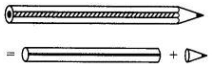
$A$ cylindrical pencil sharpened at one edge is the combination of
A
frustum of a cone and a cylinder
B
a cone and a cylinder
C
a hemisphere and a cylinder
D
two cylinders.
Solution
(B) sharpened pencil consists of a long cylindrical body and a conical tip at one end.
Therefore,the shape of a sharpened pencil is the combination of a cylinder and a cone.
Thus,the correct option is $B$.
Therefore,the shape of a sharpened pencil is the combination of a cylinder and a cone.
Thus,the correct option is $B$.
0 likes
View Solution7
EasyMCQ
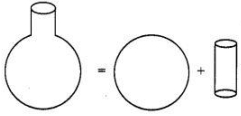
$A$ surahi is the combination of
A
two hemispheres
B
a cylinder and a cone
C
a sphere and a cylinder
D
a hemisphere and a cylinder
Solution
(C) By observing the given figure,a surahi is formed by joining a spherical body with a cylindrical neck.
Therefore,a surahi is the combination of a sphere and a cylinder.
Therefore,a surahi is the combination of a sphere and a cylinder.
0 likes
View Solution8
EasyMCQ
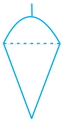
$A$ plumbline (sahul) is the combination of (see figure):
A
a cone and a cylinder
B
frustum of a cone and a cylinder
C
sphere and cylinder
D
a hemisphere and a cone
Solution
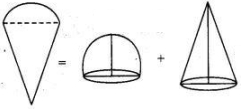
(D) By observing the given figure,it is clear that the plumbline is formed by joining the base of a hemisphere to the base of a cone.
Therefore,the plumbline is a combination of a hemisphere and a cone.
Therefore,the plumbline is a combination of a hemisphere and a cone.
0 likes
View Solution9
EasyMCQ
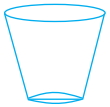
The shape of a glass (tumbler) (see figure) is usually in the form of:
A
frustum of a cone
B
a cone
C
a cylinder
D
a sphere
Solution
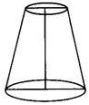
(A) glass (tumbler) is typically wider at the top and narrower at the bottom,with two circular bases of different radii.
This geometric shape,which is obtained by cutting a cone with a plane parallel to its base,is known as the frustum of a cone.
Therefore,the shape of a glass is in the form of a frustum of a cone.
This geometric shape,which is obtained by cutting a cone with a plane parallel to its base,is known as the frustum of a cone.
Therefore,the shape of a glass is in the form of a frustum of a cone.
0 likes
View Solution10
EasyMCQ
The shape of a gilli,in the gilli-danda game (see figure),is a combination of
A
two cylinders
B
two cones and a cylinder
C
a cone and a cylinder
D
two cylinders and a cone
Solution
(B) By observing the figure,the gilli consists of a central cylindrical part with two conical ends attached to its circular faces.
Therefore,the shape is a combination of:
$=$ Cone $+$ Cylinder $+$ Cone
$=$ Two cones and a cylinder
Therefore,the shape is a combination of:
$=$ Cone $+$ Cylinder $+$ Cone
$=$ Two cones and a cylinder

0 likes
View Solution11
EasyMCQ
$A$ shuttlecock used for playing badminton has the shape of the combination of
A
a cylinder and a sphere
B
a cylinder and a hemisphere
C
frustum of a cone and a hemisphere
D
a sphere and a cone
Solution
(C) The shape of a shuttlecock consists of two parts:
$1$. The cork part,which is in the shape of a hemisphere.
$2$. The feathered part,which is in the shape of a frustum of a cone.
Therefore,the shuttlecock is a combination of a frustum of a cone and a hemisphere.
$1$. The cork part,which is in the shape of a hemisphere.
$2$. The feathered part,which is in the shape of a frustum of a cone.
Therefore,the shuttlecock is a combination of a frustum of a cone and a hemisphere.
0 likes
View Solution12
EasyMCQ
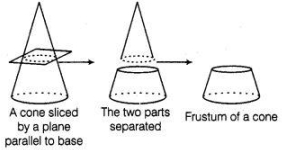
$A$ cone is cut by a plane parallel to its base and the smaller cone formed on the upper side of the plane is removed. The remaining part on the other side of the plane is called:
A
sphere
B
cylinder
C
cone
D
a frustum of a cone
Solution
(D) When a cone is cut by a plane parallel to its base,it is divided into two parts: a smaller cone at the top and a remaining part at the bottom. The remaining part,which has two circular bases of different radii,is known as the frustum of a cone.
2 likes
View Solution13
DifficultMCQ
$A$ hollow cube of internal edge $22 \, cm$ is filled with spherical marbles of diameter $0.5 \, cm$. It is assumed that $\frac{1}{8}$ of the space of the cube remains unfilled. The number of marbles that the cube can accommodate is:
A
$142244$
B
$142344$
C
$142444$
D
$142544$
Solution
(A) Given,edge of the cube $= 22 \, cm$.
Volume of the cube $= (22)^3 = 10648 \, cm^3$.
Since $\frac{1}{8}$ of the space remains unfilled,the space filled by marbles $= 10648 \times (1 - \frac{1}{8}) = 10648 \times \frac{7}{8} = 9317 \, cm^3$.
Diameter of a marble $= 0.5 \, cm$,so radius $r = 0.25 \, cm$.
Volume of one spherical marble $= \frac{4}{3} \pi r^3 = \frac{4}{3} \times \frac{22}{7} \times (0.25)^3 = \frac{4}{3} \times \frac{22}{7} \times \frac{1}{64} = \frac{88}{1344} = \frac{11}{168} \approx 0.065476 \, cm^3$.
Number of marbles $= \frac{\text{Filled volume}}{\text{Volume of one marble}} = \frac{9317}{11/168} = \frac{9317 \times 168}{11} = 847 \times 168 = 142296$.
Rounding to the nearest provided option,the correct answer is $142244$.
Volume of the cube $= (22)^3 = 10648 \, cm^3$.
Since $\frac{1}{8}$ of the space remains unfilled,the space filled by marbles $= 10648 \times (1 - \frac{1}{8}) = 10648 \times \frac{7}{8} = 9317 \, cm^3$.
Diameter of a marble $= 0.5 \, cm$,so radius $r = 0.25 \, cm$.
Volume of one spherical marble $= \frac{4}{3} \pi r^3 = \frac{4}{3} \times \frac{22}{7} \times (0.25)^3 = \frac{4}{3} \times \frac{22}{7} \times \frac{1}{64} = \frac{88}{1344} = \frac{11}{168} \approx 0.065476 \, cm^3$.
Number of marbles $= \frac{\text{Filled volume}}{\text{Volume of one marble}} = \frac{9317}{11/168} = \frac{9317 \times 168}{11} = 847 \times 168 = 142296$.
Rounding to the nearest provided option,the correct answer is $142244$.
0 likes
View Solution14
DifficultMCQ
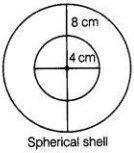
$A$ metallic spherical shell of internal and external diameters $4 \, cm$ and $8 \, cm$,respectively,is melted and recast into the form of a cone of base diameter $8 \, cm$. The height of the cone is (in $cm$):
A
$12$
B
$14$
C
$15$
D
$18$
Solution
(B) Given,internal diameter of the spherical shell $= 4 \, cm$ and external diameter $= 8 \, cm$.
Internal radius of the spherical shell,$r_1 = \frac{4}{2} = 2 \, cm$.
External radius of the spherical shell,$r_2 = \frac{8}{2} = 4 \, cm$.
Volume of the spherical shell $= \frac{4}{3} \pi (r_2^3 - r_1^3) = \frac{4}{3} \pi (4^3 - 2^3) = \frac{4}{3} \pi (64 - 8) = \frac{4}{3} \pi (56) = \frac{224}{3} \pi \, cm^3$.
Let the height of the cone be $h \, cm$ and the radius of the base be $R = \frac{8}{2} = 4 \, cm$.
Since the shell is recast into a cone,their volumes are equal:
Volume of cone $= \frac{1}{3} \pi R^2 h = \frac{1}{3} \pi (4)^2 h = \frac{16}{3} \pi h$.
Equating the volumes: $\frac{16}{3} \pi h = \frac{224}{3} \pi$.
$16h = 224$.
$h = \frac{224}{16} = 14 \, cm$.
Thus,the height of the cone is $14 \, cm$.
Internal radius of the spherical shell,$r_1 = \frac{4}{2} = 2 \, cm$.
External radius of the spherical shell,$r_2 = \frac{8}{2} = 4 \, cm$.
Volume of the spherical shell $= \frac{4}{3} \pi (r_2^3 - r_1^3) = \frac{4}{3} \pi (4^3 - 2^3) = \frac{4}{3} \pi (64 - 8) = \frac{4}{3} \pi (56) = \frac{224}{3} \pi \, cm^3$.
Let the height of the cone be $h \, cm$ and the radius of the base be $R = \frac{8}{2} = 4 \, cm$.
Since the shell is recast into a cone,their volumes are equal:
Volume of cone $= \frac{1}{3} \pi R^2 h = \frac{1}{3} \pi (4)^2 h = \frac{16}{3} \pi h$.
Equating the volumes: $\frac{16}{3} \pi h = \frac{224}{3} \pi$.
$16h = 224$.
$h = \frac{224}{16} = 14 \, cm$.
Thus,the height of the cone is $14 \, cm$.
0 likes
View Solution15
DifficultMCQ
$A$ solid piece of iron in the form of a cuboid of dimensions $49 \, cm \times 33 \, cm \times 24 \, cm$ is moulded to form a solid sphere. The radius of the sphere is (in $cm$):
A
$25$
B
$23$
C
$21$
D
$19$
Solution
(C) Given,dimensions of the cuboid $= 49 \, cm \times 33 \, cm \times 24 \, cm$.
Volume of the cuboid $= \text{length} \times \text{breadth} \times \text{height} = 49 \times 33 \times 24 = 38808 \, cm^3$.
Let the radius of the sphere be $r$.
Volume of the sphere $= \frac{4}{3} \pi r^3$.
Since the cuboid is moulded into a sphere,their volumes are equal:
$\frac{4}{3} \pi r^3 = 38808$
$\frac{4}{3} \times \frac{22}{7} \times r^3 = 38808$
$r^3 = \frac{38808 \times 3 \times 7}{4 \times 22}$
$r^3 = 441 \times 21 = 9261$
$r = \sqrt[3]{9261} = 21 \, cm$.
Thus,the radius of the sphere is $21 \, cm$.
Volume of the cuboid $= \text{length} \times \text{breadth} \times \text{height} = 49 \times 33 \times 24 = 38808 \, cm^3$.
Let the radius of the sphere be $r$.
Volume of the sphere $= \frac{4}{3} \pi r^3$.
Since the cuboid is moulded into a sphere,their volumes are equal:
$\frac{4}{3} \pi r^3 = 38808$
$\frac{4}{3} \times \frac{22}{7} \times r^3 = 38808$
$r^3 = \frac{38808 \times 3 \times 7}{4 \times 22}$
$r^3 = 441 \times 21 = 9261$
$r = \sqrt[3]{9261} = 21 \, cm$.
Thus,the radius of the sphere is $21 \, cm$.
0 likes
View Solution16
DifficultMCQ
$A$ mason constructs a wall of dimensions $270 \,cm \times 300 \,cm \times 350 \,cm$ with bricks each of size $22.5 \,cm \times 11.25 \,cm \times 8.75 \,cm$. If $\frac{1}{8}$ of the total volume of the wall is occupied by mortar,find the number of bricks used to construct the wall.
A
$11000$
B
$11100$
C
$11300$
D
$11200$
Solution
(D) Volume of the wall $= 270 \times 300 \times 350 = 28,350,000 \,cm^3$.
Since $\frac{1}{8}$ of the wall's volume is occupied by mortar,the volume occupied by the bricks is $\frac{7}{8}$ of the total volume.
Volume occupied by bricks $= 28,350,000 \times \frac{7}{8} = 24,806,250 \,cm^3$.
Volume of one brick $= 22.5 \times 11.25 \times 8.75 = 2,214.84375 \,cm^3$.
Number of bricks $= \frac{\text{Volume occupied by bricks}}{\text{Volume of one brick}} = \frac{24,806,250}{2,214.84375} = 11,200$.
Therefore,the number of bricks used is $11,200$.
Since $\frac{1}{8}$ of the wall's volume is occupied by mortar,the volume occupied by the bricks is $\frac{7}{8}$ of the total volume.
Volume occupied by bricks $= 28,350,000 \times \frac{7}{8} = 24,806,250 \,cm^3$.
Volume of one brick $= 22.5 \times 11.25 \times 8.75 = 2,214.84375 \,cm^3$.
Number of bricks $= \frac{\text{Volume occupied by bricks}}{\text{Volume of one brick}} = \frac{24,806,250}{2,214.84375} = 11,200$.
Therefore,the number of bricks used is $11,200$.
0 likes
View Solution17
DifficultMCQ
Twelve solid spheres of the same size are made by melting a solid metallic cylinder of base diameter $2 \, cm$ and height $16 \, cm$. The diameter of each sphere is (in $cm$):
A
$2$
B
$6$
C
$3$
D
$4$
Solution
(A) Given,diameter of the cylinder $= 2 \, cm$.
Therefore,radius of the cylinder $(R) = 1 \, cm$ and height $(h) = 16 \, cm$.
Volume of the cylinder $= \pi R^2 h = \pi \times (1)^2 \times 16 = 16 \pi \, cm^3$.
Let the radius of each solid sphere be $r \, cm$.
Volume of one sphere $= \frac{4}{3} \pi r^3$.
Since $12$ spheres are made from the cylinder,the total volume of $12$ spheres equals the volume of the cylinder.
$12 \times (\frac{4}{3} \pi r^3) = 16 \pi$.
$16 \pi r^3 = 16 \pi$.
$r^3 = 1$,which implies $r = 1 \, cm$.
Diameter of each sphere $= 2r = 2 \times 1 = 2 \, cm$.
Therefore,radius of the cylinder $(R) = 1 \, cm$ and height $(h) = 16 \, cm$.
Volume of the cylinder $= \pi R^2 h = \pi \times (1)^2 \times 16 = 16 \pi \, cm^3$.
Let the radius of each solid sphere be $r \, cm$.
Volume of one sphere $= \frac{4}{3} \pi r^3$.
Since $12$ spheres are made from the cylinder,the total volume of $12$ spheres equals the volume of the cylinder.
$12 \times (\frac{4}{3} \pi r^3) = 16 \pi$.
$16 \pi r^3 = 16 \pi$.
$r^3 = 1$,which implies $r = 1 \, cm$.
Diameter of each sphere $= 2r = 2 \times 1 = 2 \, cm$.
0 likes
View Solution18
MediumMCQ
The radii of the top and bottom of a bucket of slant height $45 \, cm$ are $28 \, cm$ and $7 \, cm$,respectively. The curved surface area of the bucket is (in $cm^2$)
A
$4951$
B
$4950$
C
$4952$
D
$4953$
Solution
(B) Given,the radius of the top of the bucket,$R = 28 \, cm$.
The radius of the bottom of the bucket,$r = 7 \, cm$.
The slant height of the bucket,$l = 45 \, cm$.
Since the bucket is in the form of a frustum of a cone,the curved surface area is given by the formula:
$\text{Curved Surface Area} = \pi l (R + r)$
Substituting the given values:
$\text{Curved Surface Area} = \frac{22}{7} \times 45 \times (28 + 7)$
$= \frac{22}{7} \times 45 \times 35$
$= 22 \times 45 \times 5$
$= 22 \times 225 = 4950 \, cm^2$.
Thus,the curved surface area of the bucket is $4950 \, cm^2$.
The radius of the bottom of the bucket,$r = 7 \, cm$.
The slant height of the bucket,$l = 45 \, cm$.
Since the bucket is in the form of a frustum of a cone,the curved surface area is given by the formula:
$\text{Curved Surface Area} = \pi l (R + r)$
Substituting the given values:
$\text{Curved Surface Area} = \frac{22}{7} \times 45 \times (28 + 7)$
$= \frac{22}{7} \times 45 \times 35$
$= 22 \times 45 \times 5$
$= 22 \times 225 = 4950 \, cm^2$.
Thus,the curved surface area of the bucket is $4950 \, cm^2$.
0 likes
View Solution19
MediumMCQ
$A$ medicine capsule is in the shape of a cylinder of diameter $0.5\, cm$ with two hemispheres stuck to each of its ends. The length of the entire capsule is $2\, cm$. The capacity of the capsule is (in $cm^3$):
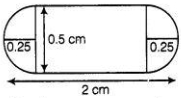
A
$0.34$
B
$0.35$
C
$0.36$
D
$0.33$
Solution
(C) Given,diameter of cylinder $=$ Diameter of hemisphere $= 0.5\, cm$ (since both hemispheres are attached to the cylinder).
$\therefore$ Radius of cylinder $(r) =$ radius of hemisphere $(r) = \frac{0.5}{2} = 0.25\, cm$ (since diameter $= 2 \times$ radius).
Total length of capsule $= 2\, cm$.
Length of the cylindrical part of the capsule $(h) = \text{Total length} - (\text{Radius of left hemisphere} + \text{Radius of right hemisphere})$.
$h = 2 - (0.25 + 0.25) = 2 - 0.5 = 1.5\, cm$.
Now,capacity of the capsule $=$ Volume of cylindrical part $+ 2 \times$ Volume of hemisphere.
Capacity $= \pi r^2 h + 2 \times (\frac{2}{3} \pi r^3) = \pi r^2 (h + \frac{4}{3} r)$.
Substituting the values:
Capacity $= \frac{22}{7} \times (0.25)^2 \times (1.5 + \frac{4}{3} \times 0.25)$.
Capacity $= \frac{22}{7} \times 0.0625 \times (1.5 + 0.3333) = \frac{22}{7} \times 0.0625 \times 1.8333 \approx 0.36\, cm^3$.
Hence,the capacity of the capsule is $0.36\, cm^3$.
$\therefore$ Radius of cylinder $(r) =$ radius of hemisphere $(r) = \frac{0.5}{2} = 0.25\, cm$ (since diameter $= 2 \times$ radius).
Total length of capsule $= 2\, cm$.
Length of the cylindrical part of the capsule $(h) = \text{Total length} - (\text{Radius of left hemisphere} + \text{Radius of right hemisphere})$.
$h = 2 - (0.25 + 0.25) = 2 - 0.5 = 1.5\, cm$.
Now,capacity of the capsule $=$ Volume of cylindrical part $+ 2 \times$ Volume of hemisphere.
Capacity $= \pi r^2 h + 2 \times (\frac{2}{3} \pi r^3) = \pi r^2 (h + \frac{4}{3} r)$.
Substituting the values:
Capacity $= \frac{22}{7} \times (0.25)^2 \times (1.5 + \frac{4}{3} \times 0.25)$.
Capacity $= \frac{22}{7} \times 0.0625 \times (1.5 + 0.3333) = \frac{22}{7} \times 0.0625 \times 1.8333 \approx 0.36\, cm^3$.
Hence,the capacity of the capsule is $0.36\, cm^3$.
0 likes
View Solution20
EasyMCQ
If two solid hemispheres of same base radius $r$ are joined together along their bases, then the curved surface area of this new solid is (in $\pi r^{2}$)
A
$8$
B
$3$
C
$6$
D
$4$
Solution
(D) The curved surface area of a single solid hemisphere is given by $2 \pi r^{2}$.
When two solid hemispheres of the same base radius $r$ are joined together along their circular bases, they form a complete solid sphere.
The curved surface area of the resulting solid sphere is the sum of the curved surface areas of the two individual hemispheres.
Therefore, the curved surface area of the new solid $= 2 \pi r^{2} + 2 \pi r^{2} = 4 \pi r^{2}$.
When two solid hemispheres of the same base radius $r$ are joined together along their circular bases, they form a complete solid sphere.
The curved surface area of the resulting solid sphere is the sum of the curved surface areas of the two individual hemispheres.
Therefore, the curved surface area of the new solid $= 2 \pi r^{2} + 2 \pi r^{2} = 4 \pi r^{2}$.
0 likes
View Solution21
EasyMCQ
$A$ right circular cylinder of radius $r \, cm$ and height $h \, cm$ (where $h > 2r$) just encloses a sphere. What is the diameter of the sphere (in $cm$)?
A
$2r$
B
$r$
C
$h$
D
$2h$
Solution
(A) sphere is enclosed in a right circular cylinder such that it touches the top,bottom,and the curved surface of the cylinder.
Since the sphere touches the curved surface of the cylinder,the diameter of the sphere must be equal to the diameter of the cylinder.
The radius of the cylinder is given as $r \, cm$,so the diameter of the cylinder is $2r \, cm$.
Therefore,the diameter of the sphere is $2r \, cm$.
Since the sphere touches the curved surface of the cylinder,the diameter of the sphere must be equal to the diameter of the cylinder.
The radius of the cylinder is given as $r \, cm$,so the diameter of the cylinder is $2r \, cm$.
Therefore,the diameter of the sphere is $2r \, cm$.
0 likes
View Solution22
EasyMCQ
During the conversion of a solid from one shape to another,the volume of the new shape will
A
increase
B
remain unaltered
C
decrease
D
be doubled
Solution
(B) When a solid object is reshaped into another form,the total amount of material used remains the same. Therefore,the volume of the new shape remains unaltered.
0 likes
View Solution23
MediumMCQ
The diameters of the two circular ends of the bucket are $44 \, cm$ and $24 \, cm$. The height of the bucket is $35 \, cm$. The capacity of the bucket is (in $L$): (in $.7$)
A
$34$
B
$33$
C
$32$
D
$31$
Solution
(C) Given,diameter of the upper end of the bucket $D = 44 \, cm$,so radius $R = 22 \, cm$.
Diameter of the lower end of the bucket $d = 24 \, cm$,so radius $r = 12 \, cm$.
Height of the bucket $h = 35 \, cm$.
The shape of the bucket is a frustum of a cone.
The capacity (volume) of the bucket is given by the formula: $V = \frac{1}{3} \pi h (R^2 + r^2 + Rr)$.
Substituting the values: $V = \frac{1}{3} \times \frac{22}{7} \times 35 \times (22^2 + 12^2 + 22 \times 12)$.
$V = \frac{1}{3} \times 22 \times 5 \times (484 + 144 + 264)$.
$V = \frac{110}{3} \times 892$.
$V = \frac{98120}{3} \approx 32706.67 \, cm^3$.
Since $1000 \, cm^3 = 1 \, L$,the capacity is $32706.67 / 1000 \approx 32.7 \, L$.
Diameter of the lower end of the bucket $d = 24 \, cm$,so radius $r = 12 \, cm$.
Height of the bucket $h = 35 \, cm$.
The shape of the bucket is a frustum of a cone.
The capacity (volume) of the bucket is given by the formula: $V = \frac{1}{3} \pi h (R^2 + r^2 + Rr)$.
Substituting the values: $V = \frac{1}{3} \times \frac{22}{7} \times 35 \times (22^2 + 12^2 + 22 \times 12)$.
$V = \frac{1}{3} \times 22 \times 5 \times (484 + 144 + 264)$.
$V = \frac{110}{3} \times 892$.
$V = \frac{98120}{3} \approx 32706.67 \, cm^3$.
Since $1000 \, cm^3 = 1 \, L$,the capacity is $32706.67 / 1000 \approx 32.7 \, L$.
0 likes
View Solution24
EasyMCQ
In a right circular cone,the cross-section made by a plane parallel to the base is a
A
circle
B
sphere
C
hemisphere
D
frustum of a cone
Solution
(A) right circular cone is a solid generated by the revolution of a right-angled triangle about one of its sides containing the right angle.
When a plane cuts a right circular cone parallel to its base,the resulting cross-section is always a circle.
Note that the portion of the cone between the base and the plane is called the frustum of the cone,but the cross-section itself is a circle.
When a plane cuts a right circular cone parallel to its base,the resulting cross-section is always a circle.
Note that the portion of the cone between the base and the plane is called the frustum of the cone,but the cross-section itself is a circle.
0 likes
View Solution25
MediumMCQ
Volumes of two spheres are in the ratio $64: 27$. The ratio of their surface areas is
A
$16:9$
B
$9:16$
C
$4:3$
D
$3:4$
Solution
(A) Let the radii of the two spheres be $r_1$ and $r_2$,respectively.
The volume of a sphere is given by $V = \frac{4}{3} \pi r^3$.
Given the ratio of volumes $V_1 : V_2 = 64 : 27$,we have:
$\frac{\frac{4}{3} \pi r_1^3}{\frac{4}{3} \pi r_2^3} = \frac{64}{27}$
$\frac{r_1^3}{r_2^3} = \frac{64}{27} = \left(\frac{4}{3}\right)^3$
Taking the cube root on both sides,we get:
$\frac{r_1}{r_2} = \frac{4}{3}$
The surface area of a sphere is given by $A = 4 \pi r^2$.
The ratio of their surface areas is:
$\frac{A_1}{A_2} = \frac{4 \pi r_1^2}{4 \pi r_2^2} = \left(\frac{r_1}{r_2}\right)^2$
Substituting the value of $\frac{r_1}{r_2}$:
$\frac{A_1}{A_2} = \left(\frac{4}{3}\right)^2 = \frac{16}{9}$
Thus,the ratio of their surface areas is $16:9$.
The volume of a sphere is given by $V = \frac{4}{3} \pi r^3$.
Given the ratio of volumes $V_1 : V_2 = 64 : 27$,we have:
$\frac{\frac{4}{3} \pi r_1^3}{\frac{4}{3} \pi r_2^3} = \frac{64}{27}$
$\frac{r_1^3}{r_2^3} = \frac{64}{27} = \left(\frac{4}{3}\right)^3$
Taking the cube root on both sides,we get:
$\frac{r_1}{r_2} = \frac{4}{3}$
The surface area of a sphere is given by $A = 4 \pi r^2$.
The ratio of their surface areas is:
$\frac{A_1}{A_2} = \frac{4 \pi r_1^2}{4 \pi r_2^2} = \left(\frac{r_1}{r_2}\right)^2$
Substituting the value of $\frac{r_1}{r_2}$:
$\frac{A_1}{A_2} = \left(\frac{4}{3}\right)^2 = \frac{16}{9}$
Thus,the ratio of their surface areas is $16:9$.
0 likes
View Solution26
Easy
Write 'True' or 'False' and justify your answer:
If a solid cone of base radius $r$ and height $h$ is placed over a solid cylinder having the same base radius and height as that of the cone,then the curved surface area of the shape is $\pi r \sqrt{h^{2} + r^{2}} + 2 \pi r h$.
If a solid cone of base radius $r$ and height $h$ is placed over a solid cylinder having the same base radius and height as that of the cone,then the curved surface area of the shape is $\pi r \sqrt{h^{2} + r^{2}} + 2 \pi r h$.
Solution
(A) True.
The curved surface area of the combined shape is the sum of the curved surface area of the cone and the curved surface area of the cylinder.
The curved surface area of a cone is given by $\pi r l$,where $l = \sqrt{h^{2} + r^{2}}$ is the slant height.
Thus,the curved surface area of the cone is $\pi r \sqrt{h^{2} + r^{2}}$.
The curved surface area of a cylinder is $2 \pi r h$.
Therefore,the total curved surface area of the combined shape is $\pi r \sqrt{h^{2} + r^{2}} + 2 \pi r h$.
The curved surface area of the combined shape is the sum of the curved surface area of the cone and the curved surface area of the cylinder.
The curved surface area of a cone is given by $\pi r l$,where $l = \sqrt{h^{2} + r^{2}}$ is the slant height.
Thus,the curved surface area of the cone is $\pi r \sqrt{h^{2} + r^{2}}$.
The curved surface area of a cylinder is $2 \pi r h$.
Therefore,the total curved surface area of the combined shape is $\pi r \sqrt{h^{2} + r^{2}} + 2 \pi r h$.
0 likes
View Solution27
EasyMCQ
Write 'True' or 'False' and justify your answer:
$A$ spherical steel ball is melted to make eight new identical balls. Then,the radius of each new ball is $\frac{1}{8}$th the radius of the original ball.
$A$ spherical steel ball is melted to make eight new identical balls. Then,the radius of each new ball is $\frac{1}{8}$th the radius of the original ball.
A
True
B
False
Solution
(B) False.
Let $r$ be the radius of the original steel ball and $r_{1}$ be the radius of each new ball formed after melting.
The volume of the original ball is $V = \frac{4}{3} \pi r^{3}$.
The volume of eight new balls is $8 \times V_{1} = 8 \times \left( \frac{4}{3} \pi r_{1}^{3} \right)$.
Since the volume remains constant during melting,we have $\frac{4}{3} \pi r^{3} = 8 \times \frac{4}{3} \pi r_{1}^{3}$.
Dividing both sides by $\frac{4}{3} \pi$,we get $r^{3} = 8 r_{1}^{3}$.
Taking the cube root on both sides,we get $r = 2 r_{1}$,which implies $r_{1} = \frac{r}{2}$.
Therefore,the radius of each new ball is $\frac{1}{2}$ of the original radius,not $\frac{1}{8}$.
Let $r$ be the radius of the original steel ball and $r_{1}$ be the radius of each new ball formed after melting.
The volume of the original ball is $V = \frac{4}{3} \pi r^{3}$.
The volume of eight new balls is $8 \times V_{1} = 8 \times \left( \frac{4}{3} \pi r_{1}^{3} \right)$.
Since the volume remains constant during melting,we have $\frac{4}{3} \pi r^{3} = 8 \times \frac{4}{3} \pi r_{1}^{3}$.
Dividing both sides by $\frac{4}{3} \pi$,we get $r^{3} = 8 r_{1}^{3}$.
Taking the cube root on both sides,we get $r = 2 r_{1}$,which implies $r_{1} = \frac{r}{2}$.
Therefore,the radius of each new ball is $\frac{1}{2}$ of the original radius,not $\frac{1}{8}$.
0 likes
View Solution28
EasyMCQ
Write 'True' or 'False' and justify your answer:
Two identical solid cubes of side $a$ are joined end to end. Then the total surface area of the resulting cuboid is $12 a^{2}$.
Two identical solid cubes of side $a$ are joined end to end. Then the total surface area of the resulting cuboid is $12 a^{2}$.
A
True
B
False
Solution
(B) False.
The total surface area of a single cube with side $a$ is $6 a^{2}$.
When two such identical cubes are joined end to end,two faces (each of area $a^{2}$) are hidden inside the resulting cuboid.
The dimensions of the resulting cuboid are length $l = 2a$,breadth $b = a$,and height $h = a$.
The total surface area of a cuboid is given by the formula $2(lb + bh + hl)$.
Substituting the values: $2((2a \times a) + (a \times a) + (a \times 2a)) = 2(2a^{2} + a^{2} + 2a^{2}) = 2(5a^{2}) = 10 a^{2}$.
Therefore,the statement is false.
The total surface area of a single cube with side $a$ is $6 a^{2}$.
When two such identical cubes are joined end to end,two faces (each of area $a^{2}$) are hidden inside the resulting cuboid.
The dimensions of the resulting cuboid are length $l = 2a$,breadth $b = a$,and height $h = a$.
The total surface area of a cuboid is given by the formula $2(lb + bh + hl)$.
Substituting the values: $2((2a \times a) + (a \times a) + (a \times 2a)) = 2(2a^{2} + a^{2} + 2a^{2}) = 2(5a^{2}) = 10 a^{2}$.
Therefore,the statement is false.
0 likes
View Solution29
Easy
Write 'True' or 'False' and justify your answer:
Total surface area of a lattu (top) as shown in the $Fig.$ is the sum of total surface area of hemisphere and the total surface area of cone.
Total surface area of a lattu (top) as shown in the $Fig.$ is the sum of total surface area of hemisphere and the total surface area of cone.
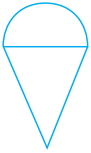
Solution
(FALSE) False.
The total surface area of the lattu (top) is the sum of the curved surface area of the hemisphere and the curved surface area of the cone.
This is because the circular base of the hemisphere and the circular base of the cone are joined together and are not exposed to the outside. Therefore,they are not included in the total surface area of the combined solid.
The total surface area of the lattu (top) is the sum of the curved surface area of the hemisphere and the curved surface area of the cone.
This is because the circular base of the hemisphere and the circular base of the cone are joined together and are not exposed to the outside. Therefore,they are not included in the total surface area of the combined solid.
0 likes
View Solution30
Easy
Write 'True' or 'False' and justify your answer:
The actual capacity of a vessel as shown in the figure is equal to the difference between the volume of the cylinder and the volume of the hemisphere.
The actual capacity of a vessel as shown in the figure is equal to the difference between the volume of the cylinder and the volume of the hemisphere.
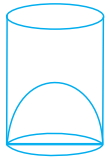
Solution
(A) True.
The actual capacity of a vessel is defined as the total volume of the empty space inside it that can be filled with a substance. In the given figure,a hemispherical depression is carved out from the base of the cylinder. Therefore,the volume of the space available inside the vessel is the volume of the cylinder minus the volume of the hemisphere.
The actual capacity of a vessel is defined as the total volume of the empty space inside it that can be filled with a substance. In the given figure,a hemispherical depression is carved out from the base of the cylinder. Therefore,the volume of the space available inside the vessel is the volume of the cylinder minus the volume of the hemisphere.
0 likes
View Solution31
EasyMCQ
Write 'True' or 'False' and justify your answer:
Two identical solid hemispheres of equal base radius $r \text{ cm}$ are joined together along their bases. The total surface area of the resulting solid is $6 \pi r^{2}$.
Two identical solid hemispheres of equal base radius $r \text{ cm}$ are joined together along their bases. The total surface area of the resulting solid is $6 \pi r^{2}$.
A
True
B
False
Solution
(B) False.
The curved surface area of one hemisphere is $2 \pi r^{2}$.
When two identical solid hemispheres are joined together along their circular bases,the bases are hidden inside the new solid.
Therefore,the total surface area of the resulting solid consists only of the two curved surfaces.
Total surface area $= 2 \pi r^{2} + 2 \pi r^{2} = 4 \pi r^{2}$.
Since $4 \pi r^{2} \neq 6 \pi r^{2}$,the statement is False.
The curved surface area of one hemisphere is $2 \pi r^{2}$.
When two identical solid hemispheres are joined together along their circular bases,the bases are hidden inside the new solid.
Therefore,the total surface area of the resulting solid consists only of the two curved surfaces.
Total surface area $= 2 \pi r^{2} + 2 \pi r^{2} = 4 \pi r^{2}$.
Since $4 \pi r^{2} \neq 6 \pi r^{2}$,the statement is False.
0 likes
View Solution32
Easy
Write 'True' or 'False' and justify your answer:
$A$ solid cylinder of radius $r$ and height $h$ is placed over another cylinder of the same height and radius. The total surface area of the shape so formed is $4 \pi r h + 4 \pi r^2$.
$A$ solid cylinder of radius $r$ and height $h$ is placed over another cylinder of the same height and radius. The total surface area of the shape so formed is $4 \pi r h + 4 \pi r^2$.
Solution
(B) False.
The total surface area of a single cylinder with radius $r$ and height $h$ is given by $2 \pi rh + 2 \pi r^2$.
When one cylinder is placed on top of another cylinder of the same radius and height,the two circular faces (one from each cylinder) are hidden at the point of contact.
The new shape is a single cylinder with radius $r$ and total height $H = 2h$.
The total surface area of this new cylinder is the sum of its curved surface area and the areas of its two circular bases.
Total Surface Area $= 2 \pi r H + 2 \pi r^2 = 2 \pi r(2h) + 2 \pi r^2 = 4 \pi rh + 2 \pi r^2$.
Since $4 \pi rh + 2 \pi r^2 \neq 4 \pi rh + 4 \pi r^2$,the given statement is False.
The total surface area of a single cylinder with radius $r$ and height $h$ is given by $2 \pi rh + 2 \pi r^2$.
When one cylinder is placed on top of another cylinder of the same radius and height,the two circular faces (one from each cylinder) are hidden at the point of contact.
The new shape is a single cylinder with radius $r$ and total height $H = 2h$.
The total surface area of this new cylinder is the sum of its curved surface area and the areas of its two circular bases.
Total Surface Area $= 2 \pi r H + 2 \pi r^2 = 2 \pi r(2h) + 2 \pi r^2 = 4 \pi rh + 2 \pi r^2$.
Since $4 \pi rh + 2 \pi r^2 \neq 4 \pi rh + 4 \pi r^2$,the given statement is False.
0 likes
View Solution33
Medium
Write 'True' or 'False' and justify your answer:
$A$ solid cone of radius $r$ and height $h$ is placed over a solid cylinder having the same base radius and height as that of the cone. The total surface area of the combined solid is $\pi[\sqrt{r^{2}+h^{2}}+3r+2h]$.
$A$ solid cone of radius $r$ and height $h$ is placed over a solid cylinder having the same base radius and height as that of the cone. The total surface area of the combined solid is $\pi[\sqrt{r^{2}+h^{2}}+3r+2h]$.
Solution
(B) False.
The total surface area of the combined solid is the sum of the curved surface area of the cone,the curved surface area of the cylinder,and the area of the bottom base of the cylinder.
$1$. Curved surface area of the cone = $\pi r l$,where slant height $l = \sqrt{r^2 + h^2}$.
$2$. Curved surface area of the cylinder = $2\pi rh$.
$3$. Area of the bottom base of the cylinder = $\pi r^2$.
Total surface area = $\pi r l + 2\pi rh + \pi r^2$
$= \pi r (l + 2h + r)$
$= \pi r [\sqrt{r^2 + h^2} + 2h + r]$.
Since the calculated expression $\pi r [\sqrt{r^2 + h^2} + 2h + r]$ is not equal to the given expression $\pi [\sqrt{r^2 + h^2} + 3r + 2h]$,the statement is False.
The total surface area of the combined solid is the sum of the curved surface area of the cone,the curved surface area of the cylinder,and the area of the bottom base of the cylinder.
$1$. Curved surface area of the cone = $\pi r l$,where slant height $l = \sqrt{r^2 + h^2}$.
$2$. Curved surface area of the cylinder = $2\pi rh$.
$3$. Area of the bottom base of the cylinder = $\pi r^2$.
Total surface area = $\pi r l + 2\pi rh + \pi r^2$
$= \pi r (l + 2h + r)$
$= \pi r [\sqrt{r^2 + h^2} + 2h + r]$.
Since the calculated expression $\pi r [\sqrt{r^2 + h^2} + 2h + r]$ is not equal to the given expression $\pi [\sqrt{r^2 + h^2} + 3r + 2h]$,the statement is False.
0 likes
View Solution34
Medium
Write 'True' or 'False' and justify your answer:
$A$ solid ball is exactly fitted inside a cubical box of side $a$. The volume of the ball is $\frac{4}{3} \pi a^{3}$.
$A$ solid ball is exactly fitted inside a cubical box of side $a$. The volume of the ball is $\frac{4}{3} \pi a^{3}$.
Solution
(B) False.
Since the solid ball is exactly fitted inside the cubical box of side $a$,the diameter of the ball must be equal to the side of the cube,which is $a$.
Therefore,the radius of the ball $r = \frac{a}{2}$.
The volume of a sphere is given by the formula $V = \frac{4}{3} \pi r^{3}$.
Substituting $r = \frac{a}{2}$ into the formula,we get:
$V = \frac{4}{3} \pi \left( \frac{a}{2} \right)^{3} = \frac{4}{3} \pi \left( \frac{a^{3}}{8} \right) = \frac{1}{6} \pi a^{3}$.
Since $\frac{1}{6} \pi a^{3} \neq \frac{4}{3} \pi a^{3}$,the given statement is False.
Since the solid ball is exactly fitted inside the cubical box of side $a$,the diameter of the ball must be equal to the side of the cube,which is $a$.
Therefore,the radius of the ball $r = \frac{a}{2}$.
The volume of a sphere is given by the formula $V = \frac{4}{3} \pi r^{3}$.
Substituting $r = \frac{a}{2}$ into the formula,we get:
$V = \frac{4}{3} \pi \left( \frac{a}{2} \right)^{3} = \frac{4}{3} \pi \left( \frac{a^{3}}{8} \right) = \frac{1}{6} \pi a^{3}$.
Since $\frac{1}{6} \pi a^{3} \neq \frac{4}{3} \pi a^{3}$,the given statement is False.
0 likes
View Solution35
Easy
Write 'True' or 'False' and justify your answer:
The volume of the frustum of a cone is $\frac{1}{3} \pi h[r_{1}^{2} + r_{2}^{2}-r_{1} r_{2}],$ where $h$ is the vertical height of the frustum and $r_{1}, r_{2}$ are the radii of the ends.
The volume of the frustum of a cone is $\frac{1}{3} \pi h[r_{1}^{2} + r_{2}^{2}-r_{1} r_{2}],$ where $h$ is the vertical height of the frustum and $r_{1}, r_{2}$ are the radii of the ends.
Solution
(B) False.
The correct formula for the volume of the frustum of a cone is $V = \frac{1}{3} \pi h(r_{1}^{2} + r_{2}^{2} + r_{1}r_{2}),$ where $h$ is the vertical height of the frustum and $r_{1}, r_{2}$ are the radii of the circular ends. The given expression contains a negative sign instead of a positive sign for the term $r_{1}r_{2}$.
The correct formula for the volume of the frustum of a cone is $V = \frac{1}{3} \pi h(r_{1}^{2} + r_{2}^{2} + r_{1}r_{2}),$ where $h$ is the vertical height of the frustum and $r_{1}, r_{2}$ are the radii of the circular ends. The given expression contains a negative sign instead of a positive sign for the term $r_{1}r_{2}$.
0 likes
View Solution36
Medium
Write 'True' or 'False' and justify your answer:
The capacity of a cylindrical vessel with a hemispherical portion raised upward at the bottom as shown in the figure is $\frac{\pi r^{2}}{3} [3 h-2 r]$.
The capacity of a cylindrical vessel with a hemispherical portion raised upward at the bottom as shown in the figure is $\frac{\pi r^{2}}{3} [3 h-2 r]$.
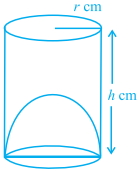
Solution
(TRUE) True.
We know that the capacity (volume) of a cylindrical vessel is given by $V_{cylinder} = \pi r^{2} h$.
The capacity (volume) of a hemisphere is given by $V_{hemisphere} = \frac{2}{3} \pi r^{3}$.
From the figure,the hemispherical portion is raised upward at the bottom,which means it occupies space inside the cylinder. Therefore,the capacity of the vessel is the volume of the cylinder minus the volume of the hemisphere.
Capacity of the vessel = $V_{cylinder} - V_{hemisphere}$
$= \pi r^{2} h - \frac{2}{3} \pi r^{3}$
$= \pi r^{2} (h - \frac{2}{3} r)$
$= \frac{\pi r^{2}}{3} (3h - 2r)$.
We know that the capacity (volume) of a cylindrical vessel is given by $V_{cylinder} = \pi r^{2} h$.
The capacity (volume) of a hemisphere is given by $V_{hemisphere} = \frac{2}{3} \pi r^{3}$.
From the figure,the hemispherical portion is raised upward at the bottom,which means it occupies space inside the cylinder. Therefore,the capacity of the vessel is the volume of the cylinder minus the volume of the hemisphere.
Capacity of the vessel = $V_{cylinder} - V_{hemisphere}$
$= \pi r^{2} h - \frac{2}{3} \pi r^{3}$
$= \pi r^{2} (h - \frac{2}{3} r)$
$= \frac{\pi r^{2}}{3} (3h - 2r)$.
0 likes
View Solution37
EasyMCQ
Write 'True' or 'False' and justify your answer:
The curved surface area of a frustum of a cone is $\pi l(r_{1}+r_{2})$,where $l = \sqrt{h^{2}+(r_{1}+r_{2})^{2}}$,$r_{1}$ and $r_{2}$ are the radii of the two ends of the frustum,and $h$ is the vertical height.
The curved surface area of a frustum of a cone is $\pi l(r_{1}+r_{2})$,where $l = \sqrt{h^{2}+(r_{1}+r_{2})^{2}}$,$r_{1}$ and $r_{2}$ are the radii of the two ends of the frustum,and $h$ is the vertical height.
A
True
B
False
C
Cannot be determined
D
None of the above
Solution
(B) The statement is False.
The curved surface area of a frustum of a cone is given by the formula $A = \pi l(r_{1} + r_{2})$.
In this formula,the slant height $l$ is defined as $l = \sqrt{h^{2} + (r_{1} - r_{2})^{2}}$,where $h$ is the vertical height,and $r_{1}$ and $r_{2}$ are the radii of the two circular ends.
The given expression for the slant height $l = \sqrt{h^{2} + (r_{1} + r_{2})^{2}}$ is incorrect because it uses the sum of the radii instead of the difference of the radii.
The curved surface area of a frustum of a cone is given by the formula $A = \pi l(r_{1} + r_{2})$.
In this formula,the slant height $l$ is defined as $l = \sqrt{h^{2} + (r_{1} - r_{2})^{2}}$,where $h$ is the vertical height,and $r_{1}$ and $r_{2}$ are the radii of the two circular ends.
The given expression for the slant height $l = \sqrt{h^{2} + (r_{1} + r_{2})^{2}}$ is incorrect because it uses the sum of the radii instead of the difference of the radii.
0 likes
View Solution38
Easy
Write 'True' or 'False' and justify your answer:
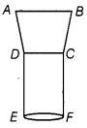
An open metallic bucket is in the shape of a frustum of a cone,mounted on a hollow cylindrical base made of the same metallic sheet. The surface area of the metallic sheet used is equal to curved surface area of frustum of a cone + area of circular base + curved surface area of cylinder.
An open metallic bucket is in the shape of a frustum of a cone,mounted on a hollow cylindrical base made of the same metallic sheet. The surface area of the metallic sheet used is equal to curved surface area of frustum of a cone + area of circular base + curved surface area of cylinder.
Solution
(A) True.
The total surface area of the metallic sheet used is the sum of the areas of the individual parts that make up the object.
$1$. The bucket is a frustum of a cone $(ABCD)$,so we include its curved surface area.
$2$. The bucket has a circular base at the bottom of the frustum,which is also the top of the cylinder. However,since the bucket is open and mounted on a cylinder,the metallic sheet used includes the curved surface of the frustum,the curved surface of the cylinder,and the circular base at the bottom of the cylinder $(EF)$.
$3$. The area of the metallic sheet = (Curved surface area of frustum of a cone) + (Curved surface area of cylinder) + (Area of the circular base at the bottom).
As shown in the figure,$ABCD$ is a frustum of a cone and $CDEF$ is a hollow cylinder.
The total surface area of the metallic sheet used is the sum of the areas of the individual parts that make up the object.
$1$. The bucket is a frustum of a cone $(ABCD)$,so we include its curved surface area.
$2$. The bucket has a circular base at the bottom of the frustum,which is also the top of the cylinder. However,since the bucket is open and mounted on a cylinder,the metallic sheet used includes the curved surface of the frustum,the curved surface of the cylinder,and the circular base at the bottom of the cylinder $(EF)$.
$3$. The area of the metallic sheet = (Curved surface area of frustum of a cone) + (Curved surface area of cylinder) + (Area of the circular base at the bottom).
As shown in the figure,$ABCD$ is a frustum of a cone and $CDEF$ is a hollow cylinder.
0 likes
View Solution39
Medium
$A$ cone of maximum size is carved out from a cube of edge $14 \, cm$. Find the surface area of the cone and the surface area of the remaining solid left after the cone is carved out.
Solution
(N/A) The cone of maximum size carved out from a cube of edge $14 \, cm$ will have a base radius $r = 7 \, cm$ and height $h = 14 \, cm$.
The slant height $l = \sqrt{r^2 + h^2} = \sqrt{7^2 + 14^2} = \sqrt{49 + 196} = \sqrt{245} = 7\sqrt{5} \, cm$.
Surface area of the cone $= \pi r l + \pi r^2 = \frac{22}{7} \times 7 \times 7\sqrt{5} + \frac{22}{7} \times 7^2 = 154\sqrt{5} + 154 = 154(\sqrt{5} + 1) \, cm^2$.
Surface area of the cube $= 6 \times (14)^2 = 6 \times 196 = 1176 \, cm^2$.
When the cone is carved out,the circular base of the cone is removed from one face of the cube,but the curved surface area of the cone is added to the total surface area.
Surface area of the remaining solid $= (\text{Total surface area of cube}) - (\text{Area of circular base of cone}) + (\text{Curved surface area of cone})$.
$= 1176 - \pi r^2 + \pi r l = 1176 - 154 + 154\sqrt{5} = (1022 + 154\sqrt{5}) \, cm^2$.
The slant height $l = \sqrt{r^2 + h^2} = \sqrt{7^2 + 14^2} = \sqrt{49 + 196} = \sqrt{245} = 7\sqrt{5} \, cm$.
Surface area of the cone $= \pi r l + \pi r^2 = \frac{22}{7} \times 7 \times 7\sqrt{5} + \frac{22}{7} \times 7^2 = 154\sqrt{5} + 154 = 154(\sqrt{5} + 1) \, cm^2$.
Surface area of the cube $= 6 \times (14)^2 = 6 \times 196 = 1176 \, cm^2$.
When the cone is carved out,the circular base of the cone is removed from one face of the cube,but the curved surface area of the cone is added to the total surface area.
Surface area of the remaining solid $= (\text{Total surface area of cube}) - (\text{Area of circular base of cone}) + (\text{Curved surface area of cone})$.
$= 1176 - \pi r^2 + \pi r l = 1176 - 154 + 154\sqrt{5} = (1022 + 154\sqrt{5}) \, cm^2$.
0 likes
View Solution40
EasyMCQ
$A$ solid metallic sphere of radius $10.5 \, cm$ is melted and recast into a number of smaller cones,each of radius $3.5 \, cm$ and height $3 \, cm$. Find the number of cones so formed.
A
$130$
B
$127$
C
$125$
D
$126$
Solution
(D) The volume of the solid metallic sphere is given by the formula $V_s = \frac{4}{3} \pi r^3$,where $r = 10.5 \, cm$.
$V_s = \frac{4}{3} \pi (10.5)^3 \, cm^3$.
The volume of one cone is given by the formula $V_c = \frac{1}{3} \pi r^2 h$,where $r = 3.5 \, cm$ and $h = 3 \, cm$.
$V_c = \frac{1}{3} \pi (3.5)^2 \times 3 \, cm^3 = \pi (3.5)^2 \, cm^3$.
The number of cones formed is equal to the total volume of the sphere divided by the volume of one cone.
$\text{Number of cones} = \frac{V_s}{V_c} = \frac{\frac{4}{3} \pi (10.5)^3}{\pi (3.5)^2} = \frac{4 \times 10.5 \times 10.5 \times 10.5}{3 \times 3.5 \times 3.5} = 4 \times 3 \times 3 \times 3.5 = 126$.
$V_s = \frac{4}{3} \pi (10.5)^3 \, cm^3$.
The volume of one cone is given by the formula $V_c = \frac{1}{3} \pi r^2 h$,where $r = 3.5 \, cm$ and $h = 3 \, cm$.
$V_c = \frac{1}{3} \pi (3.5)^2 \times 3 \, cm^3 = \pi (3.5)^2 \, cm^3$.
The number of cones formed is equal to the total volume of the sphere divided by the volume of one cone.
$\text{Number of cones} = \frac{V_s}{V_c} = \frac{\frac{4}{3} \pi (10.5)^3}{\pi (3.5)^2} = \frac{4 \times 10.5 \times 10.5 \times 10.5}{3 \times 3.5 \times 3.5} = 4 \times 3 \times 3 \times 3.5 = 126$.
0 likes
View Solution41
MediumMCQ
$A$ canal is $300 \,cm$ wide and $120 \,cm$ deep. The water in the canal is flowing with a speed of $20 \,km/h$. How much area will it irrigate in $20 \,minutes$ if $8 \,cm$ of standing water is desired? (in $hectares$)
A
$30$
B
$300$
C
$3000$
D
$3$
Solution
(A) First,convert all dimensions to meters: Width $= 300 \,cm = 3 \,m$,Depth $= 120 \,cm = 1.2 \,m$,Speed $= 20 \,km/h = 20000 \,m/h$.
Volume of water flowing through the canal in $1 \,hour$ $= \text{Width} \times \text{Depth} \times \text{Speed} = 3 \times 1.2 \times 20000 = 72000 \,m^3$.
Volume of water flowing in $20 \,minutes$ $= \frac{72000 \times 20}{60} = 24000 \,m^3$.
Let the area to be irrigated be $A \,m^2$. The volume of water required for irrigation is $\text{Area} \times \text{Height of standing water}$.
Given height $= 8 \,cm = 0.08 \,m$.
So,$A \times 0.08 = 24000$.
$A = \frac{24000}{0.08} = 300000 \,m^2$.
Since $1 \,hectare = 10000 \,m^2$,the area in hectares $= \frac{300000}{10000} = 30 \,hectares$.
Volume of water flowing through the canal in $1 \,hour$ $= \text{Width} \times \text{Depth} \times \text{Speed} = 3 \times 1.2 \times 20000 = 72000 \,m^3$.
Volume of water flowing in $20 \,minutes$ $= \frac{72000 \times 20}{60} = 24000 \,m^3$.
Let the area to be irrigated be $A \,m^2$. The volume of water required for irrigation is $\text{Area} \times \text{Height of standing water}$.
Given height $= 8 \,cm = 0.08 \,m$.
So,$A \times 0.08 = 24000$.
$A = \frac{24000}{0.08} = 300000 \,m^2$.
Since $1 \,hectare = 10000 \,m^2$,the area in hectares $= \frac{300000}{10000} = 30 \,hectares$.
0 likes
View Solution42
MediumMCQ
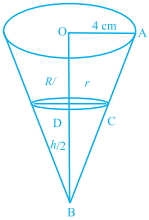
$A$ cone of radius $4 \, cm$ is divided into two parts by drawing a plane through the midpoint of its axis and parallel to its base. Compare the volumes of the two parts.
A
$1:2$
B
$1:7$
C
$2:3$
D
$7:1$
Solution
(B) Let $h$ be the height of the given cone. On dividing the cone through the midpoint of its axis and parallel to its base into two parts,we obtain a smaller cone at the top and a frustum at the bottom.
In two similar triangles,the ratio of corresponding sides is equal. Let $r$ be the radius of the smaller cone. By similarity of triangles,we have $\frac{r}{4} = \frac{h/2}{h} = \frac{1}{2}$.
Therefore,$r = 2 \, cm$.
Volume of the smaller cone $(V_1)$ = $\frac{1}{3} \pi r^2 (h/2) = \frac{1}{3} \pi (2)^2 (h/2) = \frac{2}{3} \pi h$.
Volume of the original cone $(V)$ = $\frac{1}{3} \pi (4)^2 h = \frac{16}{3} \pi h$.
Volume of the frustum $(V_2)$ = $V - V_1 = \frac{16}{3} \pi h - \frac{2}{3} \pi h = \frac{14}{3} \pi h$.
Ratio of the volume of the smaller cone to the volume of the frustum = $\frac{V_1}{V_2} = \frac{\frac{2}{3} \pi h}{\frac{14}{3} \pi h} = \frac{2}{14} = \frac{1}{7}$.
Thus,the ratio is $1:7$.
In two similar triangles,the ratio of corresponding sides is equal. Let $r$ be the radius of the smaller cone. By similarity of triangles,we have $\frac{r}{4} = \frac{h/2}{h} = \frac{1}{2}$.
Therefore,$r = 2 \, cm$.
Volume of the smaller cone $(V_1)$ = $\frac{1}{3} \pi r^2 (h/2) = \frac{1}{3} \pi (2)^2 (h/2) = \frac{2}{3} \pi h$.
Volume of the original cone $(V)$ = $\frac{1}{3} \pi (4)^2 h = \frac{16}{3} \pi h$.
Volume of the frustum $(V_2)$ = $V - V_1 = \frac{16}{3} \pi h - \frac{2}{3} \pi h = \frac{14}{3} \pi h$.
Ratio of the volume of the smaller cone to the volume of the frustum = $\frac{V_1}{V_2} = \frac{\frac{2}{3} \pi h}{\frac{14}{3} \pi h} = \frac{2}{14} = \frac{1}{7}$.
Thus,the ratio is $1:7$.
0 likes
View Solution43
MediumMCQ
Three cubes of a metal whose edges are in the ratio $3:4:5$ are melted and converted into a single cube whose diagonal is $12\sqrt{3} \, \text{cm}$. Find the edges of the three cubes (in $\text{cm}$).
A
$10, 8, 6$
B
$10, 6, 8$
C
$6, 8, 10$
D
$6, 6, 6$
Solution
(C) Let the edges of the three cubes be $3x, 4x,$ and $5x \, \text{cm}$ respectively.
The volume of the three cubes is $V = (3x)^3 + (4x)^3 + (5x)^3 = 27x^3 + 64x^3 + 125x^3 = 216x^3 \, \text{cm}^3$.
Let the side of the new single cube be $a$. The volume of this new cube is $a^3 = 216x^3$,which implies $a = 6x$.
The diagonal of a cube with side $a$ is given by $d = a\sqrt{3}$.
Given that the diagonal is $12\sqrt{3} \, \text{cm}$,we have $a\sqrt{3} = 12\sqrt{3}$,so $a = 12 \, \text{cm}$.
Since $a = 6x$,we have $6x = 12$,which gives $x = 2$.
Therefore,the edges of the three cubes are $3(2) = 6 \, \text{cm}$,$4(2) = 8 \, \text{cm}$,and $5(2) = 10 \, \text{cm}$.
The volume of the three cubes is $V = (3x)^3 + (4x)^3 + (5x)^3 = 27x^3 + 64x^3 + 125x^3 = 216x^3 \, \text{cm}^3$.
Let the side of the new single cube be $a$. The volume of this new cube is $a^3 = 216x^3$,which implies $a = 6x$.
The diagonal of a cube with side $a$ is given by $d = a\sqrt{3}$.
Given that the diagonal is $12\sqrt{3} \, \text{cm}$,we have $a\sqrt{3} = 12\sqrt{3}$,so $a = 12 \, \text{cm}$.
Since $a = 6x$,we have $6x = 12$,which gives $x = 2$.
Therefore,the edges of the three cubes are $3(2) = 6 \, \text{cm}$,$4(2) = 8 \, \text{cm}$,and $5(2) = 10 \, \text{cm}$.
0 likes
View Solution44
MediumMCQ
Three metallic solid cubes whose edges are $3 \, cm$,$4 \, cm$,and $5 \, cm$ are melted and formed into a single cube. Find the edge of the cube so formed (in $cm$).
A
$3$
B
$36$
C
$5$
D
$6$
Solution
(D) Given,the edges of three solid cubes are $3 \, cm$,$4 \, cm$,and $5 \, cm$ respectively.
The volume of a cube is given by the formula $V = (\text{edge})^3$.
Volume of the first cube $= (3)^3 = 27 \, cm^3$.
Volume of the second cube $= (4)^3 = 64 \, cm^3$.
Volume of the third cube $= (5)^3 = 125 \, cm^3$.
Total volume of the three cubes $= 27 + 64 + 125 = 216 \, cm^3$.
Let the edge of the new single cube be $R \, cm$.
Then,the volume of the new cube $= R^3$.
Since the total volume remains constant,$R^3 = 216$.
Taking the cube root on both sides,$R = \sqrt[3]{216} = 6 \, cm$.
Thus,the edge of the resulting cube is $6 \, cm$.
The volume of a cube is given by the formula $V = (\text{edge})^3$.
Volume of the first cube $= (3)^3 = 27 \, cm^3$.
Volume of the second cube $= (4)^3 = 64 \, cm^3$.
Volume of the third cube $= (5)^3 = 125 \, cm^3$.
Total volume of the three cubes $= 27 + 64 + 125 = 216 \, cm^3$.
Let the edge of the new single cube be $R \, cm$.
Then,the volume of the new cube $= R^3$.
Since the total volume remains constant,$R^3 = 216$.
Taking the cube root on both sides,$R = \sqrt[3]{216} = 6 \, cm$.
Thus,the edge of the resulting cube is $6 \, cm$.
0 likes
View Solution45
MediumMCQ
How many shots,each having a diameter of $3 \, cm$,can be made from a cuboidal lead solid of dimensions $9 \, cm \times 11 \, cm \times 12 \, cm$?
A
$84$
B
$94$
C
$74$
D
$64$
Solution
(A) Given,dimensions of the cuboid $= 9 \, cm \times 11 \, cm \times 12 \, cm$.
Volume of the cuboid $= 9 \times 11 \times 12 = 1188 \, cm^3$.
Diameter of the spherical shot $= 3 \, cm$.
Radius of the shot,$r = \frac{3}{2} = 1.5 \, cm$.
Volume of one spherical shot $= \frac{4}{3} \pi r^3 = \frac{4}{3} \times \frac{22}{7} \times (1.5)^3$.
Volume of one shot $= \frac{4}{3} \times \frac{22}{7} \times 3.375 = \frac{99}{7} \approx 14.143 \, cm^3$.
Number of shots $= \frac{\text{Volume of cuboid}}{\text{Volume of one shot}} = \frac{1188}{99/7} = \frac{1188 \times 7}{99} = 12 \times 7 = 84$.
Thus,$84$ shots can be made.
Volume of the cuboid $= 9 \times 11 \times 12 = 1188 \, cm^3$.
Diameter of the spherical shot $= 3 \, cm$.
Radius of the shot,$r = \frac{3}{2} = 1.5 \, cm$.
Volume of one spherical shot $= \frac{4}{3} \pi r^3 = \frac{4}{3} \times \frac{22}{7} \times (1.5)^3$.
Volume of one shot $= \frac{4}{3} \times \frac{22}{7} \times 3.375 = \frac{99}{7} \approx 14.143 \, cm^3$.
Number of shots $= \frac{\text{Volume of cuboid}}{\text{Volume of one shot}} = \frac{1188}{99/7} = \frac{1188 \times 7}{99} = 12 \times 7 = 84$.
Thus,$84$ shots can be made.
0 likes
View Solution46
DifficultMCQ
$A$ bucket is in the form of a frustum of a cone and holds $28.490 \, \text{litres}$ of water. The radii of the top and bottom are $28 \, \text{cm}$ and $21 \, \text{cm}$, respectively. Find the height of the bucket. (in $\text{cm}$)
A
$14$
B
$15$
C
$16$
D
$17$
Solution
(B) Given, volume of the frustum $= 28.49 \, \text{L} = 28.49 \times 1000 \, \text{cm}^3 = 28490 \, \text{cm}^3$ (since $1 \, \text{L} = 1000 \, \text{cm}^3$).
Radius of the top $(r_1) = 28 \, \text{cm}$.
Radius of the bottom $(r_2) = 21 \, \text{cm}$.
Let the height of the bucket be $h \, \text{cm}$.
The volume of a frustum of a cone is given by $V = \frac{1}{3} \pi h (r_1^2 + r_2^2 + r_1 r_2)$.
Substituting the values: $28490 = \frac{1}{3} \times \frac{22}{7} \times h \times (28^2 + 21^2 + 28 \times 21)$.
$28490 = \frac{22}{21} \times h \times (784 + 441 + 588)$.
$28490 = \frac{22}{21} \times h \times 1813$.
$h = \frac{28490 \times 21}{22 \times 1813}$.
$h = \frac{598290}{39886} = 15 \, \text{cm}$.
Radius of the top $(r_1) = 28 \, \text{cm}$.
Radius of the bottom $(r_2) = 21 \, \text{cm}$.
Let the height of the bucket be $h \, \text{cm}$.
The volume of a frustum of a cone is given by $V = \frac{1}{3} \pi h (r_1^2 + r_2^2 + r_1 r_2)$.
Substituting the values: $28490 = \frac{1}{3} \times \frac{22}{7} \times h \times (28^2 + 21^2 + 28 \times 21)$.
$28490 = \frac{22}{21} \times h \times (784 + 441 + 588)$.
$28490 = \frac{22}{21} \times h \times 1813$.
$h = \frac{28490 \times 21}{22 \times 1813}$.
$h = \frac{598290}{39886} = 15 \, \text{cm}$.
0 likes
View Solution47
DifficultMCQ
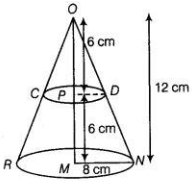
$A$ cone of radius $8 \, cm$ and height $12 \, cm$ is divided into two parts by a plane through the mid-point of its axis parallel to its base. Find the ratio of the volumes of the two parts.
A
$2: 3$
B
$7: 1$
C
$1: 7$
D
$1: 3$
Solution
(C) Let the cone be $ORN$ with base radius $r_1 = 8 \, cm$ and height $OM = 12 \, cm$.
Let $P$ be the mid-point of $OM$,then $OP = PM = \frac{12}{2} = 6 \, cm$.
Since the plane is parallel to the base,$\triangle OPD \sim \triangle OMN$.
By properties of similar triangles,$\frac{OP}{OM} = \frac{PD}{MN}$.
$\frac{6}{12} = \frac{PD}{8} \Rightarrow \frac{1}{2} = \frac{PD}{8} \Rightarrow PD = 4 \, cm$.
The plane divides the cone into a smaller cone (top) and a frustum (bottom).
Volume of smaller cone $V_1 = \frac{1}{3} \pi (PD)^2 (OP) = \frac{1}{3} \pi (4)^2 (6) = 32 \pi \, cm^3$.
Volume of the original cone $V = \frac{1}{3} \pi (MN)^2 (OM) = \frac{1}{3} \pi (8)^2 (12) = 256 \pi \, cm^3$.
Volume of the frustum $V_2 = V - V_1 = 256 \pi - 32 \pi = 224 \pi \, cm^3$.
The ratio of the volume of the smaller cone to the frustum is $V_1 : V_2 = 32 \pi : 224 \pi = 1 : 7$.
Let $P$ be the mid-point of $OM$,then $OP = PM = \frac{12}{2} = 6 \, cm$.
Since the plane is parallel to the base,$\triangle OPD \sim \triangle OMN$.
By properties of similar triangles,$\frac{OP}{OM} = \frac{PD}{MN}$.
$\frac{6}{12} = \frac{PD}{8} \Rightarrow \frac{1}{2} = \frac{PD}{8} \Rightarrow PD = 4 \, cm$.
The plane divides the cone into a smaller cone (top) and a frustum (bottom).
Volume of smaller cone $V_1 = \frac{1}{3} \pi (PD)^2 (OP) = \frac{1}{3} \pi (4)^2 (6) = 32 \pi \, cm^3$.
Volume of the original cone $V = \frac{1}{3} \pi (MN)^2 (OM) = \frac{1}{3} \pi (8)^2 (12) = 256 \pi \, cm^3$.
Volume of the frustum $V_2 = V - V_1 = 256 \pi - 32 \pi = 224 \pi \, cm^3$.
The ratio of the volume of the smaller cone to the frustum is $V_1 : V_2 = 32 \pi : 224 \pi = 1 : 7$.
0 likes
View Solution48
MediumMCQ
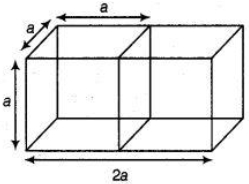
Two identical cubes each of volume $64 \, cm^{3}$ are joined together end to end. What is the surface area of the resulting cuboid? (in $cm^{2}$)
A
$180$
B
$130$
C
$150$
D
$160$
Solution
(D) Let the side length of a cube be $a \, cm$.
Given,the volume of the cube is $a^{3} = 64 \, cm^{3}$.
Therefore,$a = \sqrt[3]{64} = 4 \, cm$.
When two such cubes are joined end to end,they form a cuboid with dimensions:
Length $(l)$ = $2a = 2 \times 4 = 8 \, cm$
Breadth $(b)$ = $a = 4 \, cm$
Height $(h)$ = $a = 4 \, cm$
The surface area of the resulting cuboid is given by the formula $2(lb + bh + hl)$.
Surface Area = $2(8 \times 4 + 4 \times 4 + 4 \times 8)$
Surface Area = $2(32 + 16 + 32)$
Surface Area = $2(80) = 160 \, cm^{2}$.
Given,the volume of the cube is $a^{3} = 64 \, cm^{3}$.
Therefore,$a = \sqrt[3]{64} = 4 \, cm$.
When two such cubes are joined end to end,they form a cuboid with dimensions:
Length $(l)$ = $2a = 2 \times 4 = 8 \, cm$
Breadth $(b)$ = $a = 4 \, cm$
Height $(h)$ = $a = 4 \, cm$
The surface area of the resulting cuboid is given by the formula $2(lb + bh + hl)$.
Surface Area = $2(8 \times 4 + 4 \times 4 + 4 \times 8)$
Surface Area = $2(32 + 16 + 32)$
Surface Area = $2(80) = 160 \, cm^{2}$.
0 likes
View Solution49
MediumMCQ
From a solid cube of side $7 \, cm$,a conical cavity of height $7 \, cm$ and radius $3 \, cm$ is hollowed out. Find the volume of the remaining solid (in $cm^3$).
A
$277$
B
$275$
C
$276$
D
$280$
Solution
(A) Given that,the side of the solid cube $(a) = 7 \, cm$.
The height of the conical cavity (cone),$h = 7 \, cm$.
The radius of the conical cavity (cone),$r = 3 \, cm$.
Volume of the cube $= a^3 = (7)^3 = 343 \, cm^3$.
Volume of the conical cavity (cone) $= \frac{1}{3} \pi r^2 h = \frac{1}{3} \times \frac{22}{7} \times (3)^2 \times 7$.
$= \frac{1}{3} \times 22 \times 9 = 66 \, cm^3$.
Volume of the remaining solid $=$ Volume of the cube $-$ Volume of the conical cavity.
$= 343 - 66 = 277 \, cm^3$.
Thus,the volume of the remaining solid is $277 \, cm^3$.
The height of the conical cavity (cone),$h = 7 \, cm$.
The radius of the conical cavity (cone),$r = 3 \, cm$.
Volume of the cube $= a^3 = (7)^3 = 343 \, cm^3$.
Volume of the conical cavity (cone) $= \frac{1}{3} \pi r^2 h = \frac{1}{3} \times \frac{22}{7} \times (3)^2 \times 7$.
$= \frac{1}{3} \times 22 \times 9 = 66 \, cm^3$.
Volume of the remaining solid $=$ Volume of the cube $-$ Volume of the conical cavity.
$= 343 - 66 = 277 \, cm^3$.
Thus,the volume of the remaining solid is $277 \, cm^3$.
0 likes
View Solution50
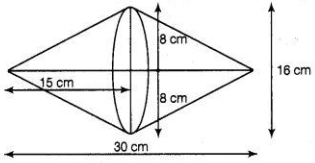
DifficultMCQ
Two cones with the same base radius $8\, cm$ and height $15\, cm$ are joined together along their bases. Find the surface area of the shape so formed. (in $cm^2$)
A
$955$
B
$855$
C
$755$
D
$655$
Solution
(B) When two cones with the same base radius and height are joined together along their bases,the base area is hidden,and the total surface area of the resulting shape is the sum of the curved surface areas of the two cones.
Given:
Radius of the cone,$r = 8\, cm$
Height of the cone,$h = 15\, cm$
The slant height $l$ of each cone is given by $l = \sqrt{r^2 + h^2} = \sqrt{8^2 + 15^2} = \sqrt{64 + 225} = \sqrt{289} = 17\, cm$.
The total surface area of the resulting shape is the sum of the curved surface areas of the two identical cones:
Surface Area $= 2 \times (\pi r l)$
$= 2 \times \pi \times 8 \times 17$
$= 272\pi\, cm^2$
Using $\pi \approx \frac{22}{7}$:
$= 272 \times \frac{22}{7} = \frac{5984}{7} \approx 854.85\, cm^2$.
Rounding to the nearest whole number,we get $855\, cm^2$.
Given:
Radius of the cone,$r = 8\, cm$
Height of the cone,$h = 15\, cm$
The slant height $l$ of each cone is given by $l = \sqrt{r^2 + h^2} = \sqrt{8^2 + 15^2} = \sqrt{64 + 225} = \sqrt{289} = 17\, cm$.
The total surface area of the resulting shape is the sum of the curved surface areas of the two identical cones:
Surface Area $= 2 \times (\pi r l)$
$= 2 \times \pi \times 8 \times 17$
$= 272\pi\, cm^2$
Using $\pi \approx \frac{22}{7}$:
$= 272 \times \frac{22}{7} = \frac{5984}{7} \approx 854.85\, cm^2$.
Rounding to the nearest whole number,we get $855\, cm^2$.
0 likes
View SolutionSurface Areas and Volumes — Mix Examples - Surface Areas and Volumes · Frequently Asked Questions
1Are these Surface Areas and Volumes questions useful for JEE and NEET?
Yes. All questions in this section are mapped to JEE Main and NEET exam patterns. Previous year questions from JEE Main, NEET, GUJCET and state-level exams are included with full solutions.
2Can I switch to Hindi or Gujarati for these questions?
Yes. Use the language tabs in the hero section or the sidebar to view the same questions and solutions in English, Hindi or Gujarati.
3How do I generate a question paper from this subtopic?
Use the Vedclass Exam Paper Generator — select the chapter and subtopic, set difficulty, and generate Sets A, B, C, D automatically. First 3 chapters of every subject are free.
Vedclass Products
For Students
Vedclass Test Series
Mock tests in real JEE/NEET style with performance analysis. 5-day free trial.
Start Free TrialFor Teachers
Exam Paper Generator
Generate Set A/B/C/D papers from this chapter in 2 minutes. 3 chapters free.
Try FreeFor Institutes
Online Exam Module
Live online exams with unlimited students, 360° analytics & white-label branding.
See DemoFor Teachers & Institutes
Generate a Surface Areas and Volumes Exam Paper in 2 Minutes
Select subtopic & difficulty — Sets A, B, C, D auto-generated with No Repeat logic.
First 3 chapters of every subject are free — no payment required.