
PhysicsQ1–4 of 4 questions
Page 1 of 1 · English
1
PhysicsDifficultMCQIIT JEE · 1991
$A$ solid copper sphere (density $\rho$ and specific heat capacity $c$) of radius $r$ at an initial temperature $200 \, K$ is suspended inside a chamber whose walls are at almost $0 \, K$. The time required (in $\mu s$) for the temperature of the sphere to drop to $100 \, K$ is:
A
$\frac{72}{7} \frac{r \rho c}{\sigma}$
B
$\frac{7}{72} \frac{r \rho c}{\sigma}$
C
$\frac{27}{7} \frac{r \rho c}{\sigma}$
D
$\frac{7}{27} \frac{r \rho c}{\sigma}$
Solution
(B) According to the Stefan-Boltzmann law,the rate of cooling is given by: $\frac{dQ}{dt} = \sigma A (T^4 - T_0^4)$.
Since $dQ = mc \, dT$ and $m = \rho V = \rho (\frac{4}{3} \pi r^3)$,we have: $mc \frac{dT}{dt} = -\sigma (4 \pi r^2) T^4$ (as $T_0 = 0 \, K$).
Substituting $m$: $(\rho \frac{4}{3} \pi r^3) c \frac{dT}{dt} = -4 \pi r^2 \sigma T^4$.
Simplifying: $\frac{dT}{T^4} = -\frac{3 \sigma}{\rho c r} dt$.
Integrating from $T_i = 200 \, K$ to $T_f = 100 \, K$: $\int_{200}^{100} T^{-4} dT = -\frac{3 \sigma}{\rho c r} \int_{0}^{t} dt$.
$[-\frac{1}{3} T^{-3}]_{200}^{100} = -\frac{3 \sigma}{\rho c r} t$.
$\frac{1}{3} [\frac{1}{100^3} - \frac{1}{200^3}] = \frac{3 \sigma}{\rho c r} t$.
$\frac{1}{3} [\frac{8 - 1}{8 \times 10^6}] = \frac{3 \sigma}{\rho c r} t$.
$\frac{7}{24 \times 10^6} = \frac{3 \sigma}{\rho c r} t$.
$t = \frac{7}{72} \frac{r \rho c}{\sigma} \times 10^{-6} \, s$.
Since the time is requested in $\mu s$ $(10^{-6} \, s)$,the value is $\frac{7}{72} \frac{r \rho c}{\sigma} \, \mu s$.
Since $dQ = mc \, dT$ and $m = \rho V = \rho (\frac{4}{3} \pi r^3)$,we have: $mc \frac{dT}{dt} = -\sigma (4 \pi r^2) T^4$ (as $T_0 = 0 \, K$).
Substituting $m$: $(\rho \frac{4}{3} \pi r^3) c \frac{dT}{dt} = -4 \pi r^2 \sigma T^4$.
Simplifying: $\frac{dT}{T^4} = -\frac{3 \sigma}{\rho c r} dt$.
Integrating from $T_i = 200 \, K$ to $T_f = 100 \, K$: $\int_{200}^{100} T^{-4} dT = -\frac{3 \sigma}{\rho c r} \int_{0}^{t} dt$.
$[-\frac{1}{3} T^{-3}]_{200}^{100} = -\frac{3 \sigma}{\rho c r} t$.
$\frac{1}{3} [\frac{1}{100^3} - \frac{1}{200^3}] = \frac{3 \sigma}{\rho c r} t$.
$\frac{1}{3} [\frac{8 - 1}{8 \times 10^6}] = \frac{3 \sigma}{\rho c r} t$.
$\frac{7}{24 \times 10^6} = \frac{3 \sigma}{\rho c r} t$.
$t = \frac{7}{72} \frac{r \rho c}{\sigma} \times 10^{-6} \, s$.
Since the time is requested in $\mu s$ $(10^{-6} \, s)$,the value is $\frac{7}{72} \frac{r \rho c}{\sigma} \, \mu s$.
0 likesView Solution
2
PhysicsMediumMCQIIT JEE · 1991
Two identical straight wires are stretched so as to produce $6$ beats per second when vibrating simultaneously. On changing the tension in one of them,the beat frequency remains unchanged. Denoting by ${T_1}$ and ${T_2}$ the higher and the lower initial tensions in the strings,respectively,then it could be said that while making the above change in tension:
A
${T_2}$ was decreased
B
${T_2}$ was increased
C
${T_1}$ was increased
D
${T_1}$ was kept constant
Solution
(B) The frequency of a vibrating wire is given by $n = \frac{1}{2l}\sqrt{\frac{T}{m}}$.
Since the wires are identical,$l$ and $m$ are constant,so $n \propto \sqrt{T}$.
Let the initial frequencies be $n_1$ and $n_2$ corresponding to tensions $T_1$ and $T_2$ respectively,where $T_1 > T_2$,which implies $n_1 > n_2$.
The beat frequency is $n_1 - n_2 = 6$.
If the beat frequency remains $6$ after changing the tension,the new frequencies $n_1'$ and $n_2'$ must satisfy $|n_1' - n_2'| = 6$.
Case $(i)$: If $n_1$ remains constant,$n_2$ must increase to $n_2'$ such that $n_1 - n_2' = 6$ is not possible unless $n_2$ increases past $n_1$. However,if $n_2$ increases to a value $n_2'$ such that $n_2' - n_1 = 6$,the beat frequency is still $6$. This requires increasing $T_2$.
Case $(ii)$: If $n_2$ remains constant,$n_1$ must decrease to $n_1'$ such that $n_1' - n_2 = 6$ (not possible as $n_1 > n_1'$) or $n_2 - n_1' = 6$ (not possible as $n_2 < n_1$).
Thus,the only valid physical change to maintain $6$ beats per second while changing one tension is increasing the lower tension $T_2$ such that the new frequency $n_2'$ exceeds $n_1$ by $6$ Hz.
Since the wires are identical,$l$ and $m$ are constant,so $n \propto \sqrt{T}$.
Let the initial frequencies be $n_1$ and $n_2$ corresponding to tensions $T_1$ and $T_2$ respectively,where $T_1 > T_2$,which implies $n_1 > n_2$.
The beat frequency is $n_1 - n_2 = 6$.
If the beat frequency remains $6$ after changing the tension,the new frequencies $n_1'$ and $n_2'$ must satisfy $|n_1' - n_2'| = 6$.
Case $(i)$: If $n_1$ remains constant,$n_2$ must increase to $n_2'$ such that $n_1 - n_2' = 6$ is not possible unless $n_2$ increases past $n_1$. However,if $n_2$ increases to a value $n_2'$ such that $n_2' - n_1 = 6$,the beat frequency is still $6$. This requires increasing $T_2$.
Case $(ii)$: If $n_2$ remains constant,$n_1$ must decrease to $n_1'$ such that $n_1' - n_2 = 6$ (not possible as $n_1 > n_1'$) or $n_2 - n_1' = 6$ (not possible as $n_2 < n_1$).
Thus,the only valid physical change to maintain $6$ beats per second while changing one tension is increasing the lower tension $T_2$ such that the new frequency $n_2'$ exceeds $n_1$ by $6$ Hz.
0 likesView Solution
3
PhysicsDifficultMCQIIT JEE · 1991
$A$ parallel plate capacitor of plate area $A$ and plate separation $d$ is charged to a potential $V$ and then the battery is disconnected. $A$ slab of dielectric constant $k$ is then inserted between the plates of the capacitor so as to fill the space between the plates. If $Q$,$E$,and $W$ denote respectively the magnitude of charge on each plate,the electric field between the plates (after the slab is inserted),and the work done on the system in the process of inserting the slab,then state the incorrect relation from the following:
A
$Q = \frac{{\varepsilon _0}AV}{d}$
B
$W = \frac{{\varepsilon _0}A{V^2}}{{2kd}}$
C
$E = \frac{V}{{kd}}$
D
$W = \frac{{\varepsilon _0}A{V^2}}{{2d}}\left( {1 - \frac{1}{k}} \right)$
Solution
(B) Initial capacitance $C = \frac{{\varepsilon _0}A}{d}$. Initial charge $Q = CV = \frac{{\varepsilon _0}AV}{d}$. Since the battery is disconnected,the charge $Q$ remains constant.
After inserting the dielectric slab of constant $k$,the new capacitance is $C' = kC = \frac{k{\varepsilon _0}A}{d}$.
The new potential difference is $V' = \frac{Q}{C'} = \frac{CV}{kC} = \frac{V}{k}$.
The new electric field is $E = \frac{V'}{d} = \frac{V}{kd}$.
The work done $W$ on the system is the change in stored energy: $W = U_{final} - U_{initial}$.
$U_{initial} = \frac{1}{2}CV^2$.
$U_{final} = \frac{Q^2}{2C'} = \frac{(CV)^2}{2kC} = \frac{CV^2}{2k}$.
$W = \frac{CV^2}{2k} - \frac{1}{2}CV^2 = \frac{1}{2}CV^2 \left( \frac{1}{k} - 1 \right) = -\frac{{\varepsilon _0}AV^2}{2d} \left( 1 - \frac{1}{k} \right)$.
Comparing the options,option $B$ is incorrect as it does not match the derived expression for work done.
After inserting the dielectric slab of constant $k$,the new capacitance is $C' = kC = \frac{k{\varepsilon _0}A}{d}$.
The new potential difference is $V' = \frac{Q}{C'} = \frac{CV}{kC} = \frac{V}{k}$.
The new electric field is $E = \frac{V'}{d} = \frac{V}{kd}$.
The work done $W$ on the system is the change in stored energy: $W = U_{final} - U_{initial}$.
$U_{initial} = \frac{1}{2}CV^2$.
$U_{final} = \frac{Q^2}{2C'} = \frac{(CV)^2}{2kC} = \frac{CV^2}{2k}$.
$W = \frac{CV^2}{2k} - \frac{1}{2}CV^2 = \frac{1}{2}CV^2 \left( \frac{1}{k} - 1 \right) = -\frac{{\varepsilon _0}AV^2}{2d} \left( 1 - \frac{1}{k} \right)$.
Comparing the options,option $B$ is incorrect as it does not match the derived expression for work done.
0 likesView Solution
4
PhysicsDifficultMCQIIT JEE · 1991
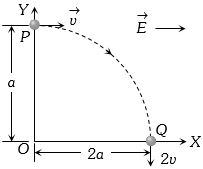
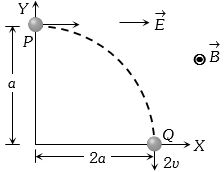
$A$ particle of charge $+q$ and mass $m$ moving under the influence of a uniform electric field $E\hat i$ and a uniform magnetic field $B\hat k$ follows a trajectory from $P$ to $Q$ as shown in the figure. The velocities at $P$ and $Q$ are $v\hat i$ and $-2v\hat j$ respectively. Which of the following statement$(s)$ is/are correct?
A
$E = \frac{3}{4}\frac{mv^2}{qa}$
B
Rate of work done by electric field at $P$ is $\frac{3}{4}\frac{mv^3}{a}$
C
Rate of work done by both the fields at $Q$ is zero
D
All of the above
Solution
(D) The kinetic energy of the particle at point $P$ is $K_P = \frac{1}{2}mv^2$.
The kinetic energy of the particle at point $Q$ is $K_Q = \frac{1}{2}m(2v)^2 = 2mv^2$.
The increase in kinetic energy is $\Delta K = K_Q - K_P = 2mv^2 - \frac{1}{2}mv^2 = \frac{3}{2}mv^2$.
This increase is due to the work done by the electric force $F_e = qE$ as the particle moves a distance $2a$ along the $x$-axis.
Thus,$W = qE(2a) = \frac{3}{2}mv^2$,which gives $E = \frac{3}{4}\frac{mv^2}{qa}$. So,option $A$ is correct.
The rate of work done by the electric field is $P_e = \vec{F_e} \cdot \vec{v}$. At point $P$,$\vec{F_e} = qE\hat{i}$ and $\vec{v} = v\hat{i}$,so $P_e = (qE)(v) = q(\frac{3}{4}\frac{mv^2}{qa})v = \frac{3}{4}\frac{mv^3}{a}$. So,option $B$ is correct.
At point $Q$,the velocity is $\vec{v} = -2v\hat{j}$. The electric force is $\vec{F_e} = qE\hat{i}$. Since $\vec{F_e} \perp \vec{v}$,the rate of work done by the electric field is $P_e = \vec{F_e} \cdot \vec{v} = 0$. The magnetic force $\vec{F_m} = q(\vec{v} \times \vec{B})$ is always perpendicular to the velocity $\vec{v}$,so the rate of work done by the magnetic field is $P_m = \vec{F_m} \cdot \vec{v} = 0$. Thus,the total rate of work done at $Q$ is $0+0=0$. So,option $C$ is correct.
Therefore,all statements are correct.
The kinetic energy of the particle at point $Q$ is $K_Q = \frac{1}{2}m(2v)^2 = 2mv^2$.
The increase in kinetic energy is $\Delta K = K_Q - K_P = 2mv^2 - \frac{1}{2}mv^2 = \frac{3}{2}mv^2$.
This increase is due to the work done by the electric force $F_e = qE$ as the particle moves a distance $2a$ along the $x$-axis.
Thus,$W = qE(2a) = \frac{3}{2}mv^2$,which gives $E = \frac{3}{4}\frac{mv^2}{qa}$. So,option $A$ is correct.
The rate of work done by the electric field is $P_e = \vec{F_e} \cdot \vec{v}$. At point $P$,$\vec{F_e} = qE\hat{i}$ and $\vec{v} = v\hat{i}$,so $P_e = (qE)(v) = q(\frac{3}{4}\frac{mv^2}{qa})v = \frac{3}{4}\frac{mv^3}{a}$. So,option $B$ is correct.
At point $Q$,the velocity is $\vec{v} = -2v\hat{j}$. The electric force is $\vec{F_e} = qE\hat{i}$. Since $\vec{F_e} \perp \vec{v}$,the rate of work done by the electric field is $P_e = \vec{F_e} \cdot \vec{v} = 0$. The magnetic force $\vec{F_m} = q(\vec{v} \times \vec{B})$ is always perpendicular to the velocity $\vec{v}$,so the rate of work done by the magnetic field is $P_m = \vec{F_m} \cdot \vec{v} = 0$. Thus,the total rate of work done at $Q$ is $0+0=0$. So,option $C$ is correct.
Therefore,all statements are correct.
0 likesView Solution
Vedclass Products
For Students
Vedclass Test Series
Mock tests in real IIT JEE style covering Physics with performance analysis. 5-day free trial.
Start Free TrialFor Teachers
Exam Paper Generator
Generate Set A/B/C/D Physics papers from 7.5L+ questions in 2 minutes. 3 chapters free.
Try FreeFor Institutes
Online Exam Module
Run live IIT JEE mock exams with unlimited students, 360° analytics & white-label branding.
See DemoFrequently Asked Questions
How many Physics questions are in IIT JEE 1991?
There are 4 Physics questions from the IIT JEE 1991 paper on Vedclass, each with a detailed step-by-step solution in English.
Are IIT JEE 1991 Physics solutions available in English?
Yes. All solutions on this page are in English. You can also switch to English or Hindi using the language buttons above the questions.
Can I practice IIT JEE 1991 Physics as a timed test?
Yes. Use the Vedclass Test Series to attempt a full IIT JEE mock test covering Physics with time limits and instant score analysis.
Can teachers create Physics papers from IIT JEE previous year questions?
Yes. The Vedclass Exam Paper Generator lets teachers mix IIT JEE Physics questions and generate Set A/B/C/D papers in minutes.
For Teachers & Institutes
Build a Custom Physics Paper
Pick IIT JEE 1991 Physics questions, set difficulty, and generate Set A/B/C/D in 2 minutes.