
MathematicsQ1–15 of 15 questions
Page 1 of 1 · English
1
MathematicsMediumMCQIIT JEE · 1976
The expression $\frac{3 + 2i\sin \theta}{1 - 2i\sin \theta}$ will be real,if $\theta = $ [Where $n$ is an integer]
A
$2n\pi$
B
$n\pi + \frac{\pi}{2}$
C
$n\pi$
D
None of these
Solution
(C) Let $z = \frac{3 + 2i\sin \theta}{1 - 2i\sin \theta}$.
To simplify,multiply the numerator and denominator by the conjugate of the denominator $(1 + 2i\sin \theta)$:
$z = \frac{(3 + 2i\sin \theta)(1 + 2i\sin \theta)}{(1 - 2i\sin \theta)(1 + 2i\sin \theta)}$
$z = \frac{3 + 6i\sin \theta + 2i\sin \theta + 4i^2\sin^2 \theta}{1 + 4\sin^2 \theta}$
Since $i^2 = -1$,we have:
$z = \frac{3 - 4\sin^2 \theta + 8i\sin \theta}{1 + 4\sin^2 \theta} = \left( \frac{3 - 4\sin^2 \theta}{1 + 4\sin^2 \theta} \right) + i\left( \frac{8\sin \theta}{1 + 4\sin^2 \theta} \right)$
For $z$ to be real,the imaginary part must be zero:
$\text{Im}(z) = \frac{8\sin \theta}{1 + 4\sin^2 \theta} = 0$
This implies $\sin \theta = 0$.
The general solution for $\sin \theta = 0$ is $\theta = n\pi$,where $n$ is an integer.
To simplify,multiply the numerator and denominator by the conjugate of the denominator $(1 + 2i\sin \theta)$:
$z = \frac{(3 + 2i\sin \theta)(1 + 2i\sin \theta)}{(1 - 2i\sin \theta)(1 + 2i\sin \theta)}$
$z = \frac{3 + 6i\sin \theta + 2i\sin \theta + 4i^2\sin^2 \theta}{1 + 4\sin^2 \theta}$
Since $i^2 = -1$,we have:
$z = \frac{3 - 4\sin^2 \theta + 8i\sin \theta}{1 + 4\sin^2 \theta} = \left( \frac{3 - 4\sin^2 \theta}{1 + 4\sin^2 \theta} \right) + i\left( \frac{8\sin \theta}{1 + 4\sin^2 \theta} \right)$
For $z$ to be real,the imaginary part must be zero:
$\text{Im}(z) = \frac{8\sin \theta}{1 + 4\sin^2 \theta} = 0$
This implies $\sin \theta = 0$.
The general solution for $\sin \theta = 0$ is $\theta = n\pi$,where $n$ is an integer.
0 likesView Solution
2
MathematicsMediumMCQIIT JEE · 1976
$\frac{3 + 2i\sin \theta}{1 - 2i\sin \theta}$ will be purely imaginary,if $\theta = $ [Where $n$ is an integer]
A
$2n\pi \pm \frac{\pi}{3}$
B
$n\pi + \frac{\pi}{3}$
C
$n\pi \pm \frac{\pi}{3}$
D
None of these
Solution
(C) complex number is purely imaginary if its real part is $0$.
Multiply the numerator and denominator by the conjugate of the denominator:
$\frac{3 + 2i\sin \theta}{1 - 2i\sin \theta} \times \frac{1 + 2i\sin \theta}{1 + 2i\sin \theta} = \frac{3 + 6i\sin \theta + 2i\sin \theta + 4i^2\sin^2 \theta}{1^2 + (2\sin \theta)^2} = \frac{(3 - 4\sin^2 \theta) + i(8\sin \theta)}{1 + 4\sin^2 \theta}$.
For the expression to be purely imaginary,the real part must be $0$:
$\frac{3 - 4\sin^2 \theta}{1 + 4\sin^2 \theta} = 0$
$3 - 4\sin^2 \theta = 0$
$\sin^2 \theta = \frac{3}{4}$
$\sin \theta = \pm \frac{\sqrt{3}}{2} = \sin \left( \pm \frac{\pi}{3} \right)$
Therefore,$\theta = n\pi \pm \frac{\pi}{3}$.
Multiply the numerator and denominator by the conjugate of the denominator:
$\frac{3 + 2i\sin \theta}{1 - 2i\sin \theta} \times \frac{1 + 2i\sin \theta}{1 + 2i\sin \theta} = \frac{3 + 6i\sin \theta + 2i\sin \theta + 4i^2\sin^2 \theta}{1^2 + (2\sin \theta)^2} = \frac{(3 - 4\sin^2 \theta) + i(8\sin \theta)}{1 + 4\sin^2 \theta}$.
For the expression to be purely imaginary,the real part must be $0$:
$\frac{3 - 4\sin^2 \theta}{1 + 4\sin^2 \theta} = 0$
$3 - 4\sin^2 \theta = 0$
$\sin^2 \theta = \frac{3}{4}$
$\sin \theta = \pm \frac{\sqrt{3}}{2} = \sin \left( \pm \frac{\pi}{3} \right)$
Therefore,$\theta = n\pi \pm \frac{\pi}{3}$.
0 likesView Solution
3
MathematicsMediumMCQIIT JEE · 1976
If a root of the equations $x^2 + px + q = 0$ and $x^2 + \alpha x + \beta = 0$ is common,then its value will be (where $p \neq \alpha$ and $q \neq \beta$)
A
$\frac{q - \beta}{\alpha - p}$
B
$\frac{p\beta - \alpha q}{q - \beta}$
C
$\frac{q - \beta}{\alpha - p}$ or $\frac{p\beta - \alpha q}{q - \beta}$
D
None of these
Solution
(C) Let the common root be $y$.
Then,$y^2 + py + q = 0$ and $y^2 + \alpha y + \beta = 0$.
Subtracting the two equations:
$(y^2 + py + q) - (y^2 + \alpha y + \beta) = 0$
$y(p - \alpha) + (q - \beta) = 0$
$y(p - \alpha) = \beta - q$
$y = \frac{\beta - q}{p - \alpha} = \frac{q - \beta}{\alpha - p}$.
Alternatively,using the method of cross-multiplication for the system:
$\frac{y^2}{p\beta - q\alpha} = \frac{y}{q - \beta} = \frac{1}{\alpha - p}$.
From the second and third terms,$y = \frac{q - \beta}{\alpha - p}$.
From the first and second terms,$y = \frac{p\beta - q\alpha}{q - \beta}$.
Thus,the common root is $\frac{q - \beta}{\alpha - p}$ or $\frac{p\beta - \alpha q}{q - \beta}$.
Then,$y^2 + py + q = 0$ and $y^2 + \alpha y + \beta = 0$.
Subtracting the two equations:
$(y^2 + py + q) - (y^2 + \alpha y + \beta) = 0$
$y(p - \alpha) + (q - \beta) = 0$
$y(p - \alpha) = \beta - q$
$y = \frac{\beta - q}{p - \alpha} = \frac{q - \beta}{\alpha - p}$.
Alternatively,using the method of cross-multiplication for the system:
$\frac{y^2}{p\beta - q\alpha} = \frac{y}{q - \beta} = \frac{1}{\alpha - p}$.
From the second and third terms,$y = \frac{q - \beta}{\alpha - p}$.
From the first and second terms,$y = \frac{p\beta - q\alpha}{q - \beta}$.
Thus,the common root is $\frac{q - \beta}{\alpha - p}$ or $\frac{p\beta - \alpha q}{q - \beta}$.
0 likesView Solution
4
MathematicsEasyMCQIIT JEE · 1976
Numbers greater than $1000$ but not greater than $4000$ which can be formed with the digits $0, 1, 2, 3, 4$ (repetition of digits is allowed),are
A
$350$
B
$375$
C
$450$
D
$576$
Solution
(B) The numbers are $4$-digit numbers formed using the set $\{0, 1, 2, 3, 4\}$.
Since the number must be greater than $1000$ and less than or equal to $4000$,the first digit can be $1, 2, 3,$ or $4$.
Case $1$: First digit is $1, 2,$ or $3$.
For each of these $3$ choices,the remaining $3$ positions can each be filled in $5$ ways (digits $0, 1, 2, 3, 4$).
Total numbers for these cases $= 3 \times 5 \times 5 \times 5 = 375$.
However,we must exclude the case where the number is $1000$ (since it must be greater than $1000$).
So,$375 - 1 = 374$ numbers.
Case $2$: First digit is $4$.
The only number $\le 4000$ starting with $4$ is $4000$ itself.
Adding this to our count: $374 + 1 = 375$.
Thus,the total count is $375$.
Since the number must be greater than $1000$ and less than or equal to $4000$,the first digit can be $1, 2, 3,$ or $4$.
Case $1$: First digit is $1, 2,$ or $3$.
For each of these $3$ choices,the remaining $3$ positions can each be filled in $5$ ways (digits $0, 1, 2, 3, 4$).
Total numbers for these cases $= 3 \times 5 \times 5 \times 5 = 375$.
However,we must exclude the case where the number is $1000$ (since it must be greater than $1000$).
So,$375 - 1 = 374$ numbers.
Case $2$: First digit is $4$.
The only number $\le 4000$ starting with $4$ is $4000$ itself.
Adding this to our count: $374 + 1 = 375$.
Thus,the total count is $375$.
0 likesView Solution
5
MathematicsDifficultMCQIIT JEE · 1976
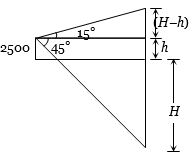
The angle of elevation of a stationary cloud from a point $2500 \, m$ above a lake is $15^\circ$ and the angle of depression of its reflection in the lake is $45^\circ$. The height of the cloud above the lake level is
A
$2500 \sqrt{3} \, m$
B
$2500 \, m$
C
$500 \sqrt{3} \, m$
D
None of these
Solution
(A) Let $H$ be the height of the cloud above the lake level and $h = 2500 \, m$ be the height of the observation point above the lake.
Let $x$ be the horizontal distance from the observation point to the cloud.
From the angle of elevation,we have $\tan(15^\circ) = \frac{H - h}{x}$,so $x = \frac{H - h}{\tan(15^\circ)} = (H - h) \cot(15^\circ)$.
From the angle of depression of the reflection,the depth of the reflection below the lake is $H$. The total vertical distance from the observation point to the reflection is $H + h$.
Thus,$\tan(45^\circ) = \frac{H + h}{x}$,so $x = \frac{H + h}{\tan(45^\circ)} = (H + h) \cot(45^\circ)$.
Equating the two expressions for $x$: $(H - h) \cot(15^\circ) = (H + h) \cot(45^\circ)$.
Since $\cot(45^\circ) = 1$ and $\cot(15^\circ) = 2 + \sqrt{3}$,we have $(H - 2500)(2 + \sqrt{3}) = H + 2500$.
$H(2 + \sqrt{3}) - 2500(2 + \sqrt{3}) = H + 2500$.
$H(1 + \sqrt{3}) = 2500(3 + \sqrt{3}) = 2500 \sqrt{3}(\sqrt{3} + 1)$.
$H = 2500 \sqrt{3} \, m$.
Let $x$ be the horizontal distance from the observation point to the cloud.
From the angle of elevation,we have $\tan(15^\circ) = \frac{H - h}{x}$,so $x = \frac{H - h}{\tan(15^\circ)} = (H - h) \cot(15^\circ)$.
From the angle of depression of the reflection,the depth of the reflection below the lake is $H$. The total vertical distance from the observation point to the reflection is $H + h$.
Thus,$\tan(45^\circ) = \frac{H + h}{x}$,so $x = \frac{H + h}{\tan(45^\circ)} = (H + h) \cot(45^\circ)$.
Equating the two expressions for $x$: $(H - h) \cot(15^\circ) = (H + h) \cot(45^\circ)$.
Since $\cot(45^\circ) = 1$ and $\cot(15^\circ) = 2 + \sqrt{3}$,we have $(H - 2500)(2 + \sqrt{3}) = H + 2500$.
$H(2 + \sqrt{3}) - 2500(2 + \sqrt{3}) = H + 2500$.
$H(1 + \sqrt{3}) = 2500(3 + \sqrt{3}) = 2500 \sqrt{3}(\sqrt{3} + 1)$.
$H = 2500 \sqrt{3} \, m$.
0 likesView Solution
6
MathematicsMediumMCQIIT JEE · 1976
The orthocentre of the triangle formed by the lines $4x - 7y + 10 = 0$,$x + y = 5$,and $7x + 4y = 15$ is
A
$(1, 2)$
B
$(1, -2)$
C
$(-1, -2)$
D
$(-1, 2)$
Solution
(A) Let the lines be $L_1: 4x - 7y + 10 = 0$,$L_2: x + y - 5 = 0$,and $L_3: 7x + 4y - 15 = 0$.
First,check the slopes of the lines:
Slope of $L_1$ $(m_1)$ = $4/7$.
Slope of $L_3$ $(m_3)$ = $-7/4$.
Since $m_1 \times m_3 = (4/7) \times (-7/4) = -1$,the lines $L_1$ and $L_3$ are perpendicular to each other.
Therefore,the triangle is a right-angled triangle with the right angle at the intersection of $L_1$ and $L_3$.
The orthocentre of a right-angled triangle is the vertex where the right angle is formed.
Solving $4x - 7y = -10$ and $7x + 4y = 15$:
Multiply the first by $4$ and the second by $7$: $16x - 28y = -40$ and $49x + 28y = 105$.
Adding these gives $65x = 65$,so $x = 1$.
Substituting $x = 1$ into $4(1) - 7y = -10$ gives $-7y = -14$,so $y = 2$.
The orthocentre is $(1, 2)$.
First,check the slopes of the lines:
Slope of $L_1$ $(m_1)$ = $4/7$.
Slope of $L_3$ $(m_3)$ = $-7/4$.
Since $m_1 \times m_3 = (4/7) \times (-7/4) = -1$,the lines $L_1$ and $L_3$ are perpendicular to each other.
Therefore,the triangle is a right-angled triangle with the right angle at the intersection of $L_1$ and $L_3$.
The orthocentre of a right-angled triangle is the vertex where the right angle is formed.
Solving $4x - 7y = -10$ and $7x + 4y = 15$:
Multiply the first by $4$ and the second by $7$: $16x - 28y = -40$ and $49x + 28y = 105$.
Adding these gives $65x = 65$,so $x = 1$.
Substituting $x = 1$ into $4(1) - 7y = -10$ gives $-7y = -14$,so $y = 2$.
The orthocentre is $(1, 2)$.
0 likesView Solution
7
MathematicsMediumMCQIIT JEE · 1976
The vertices of a triangle $OBC$ are $(0,0)$,$(-3,-1)$,and $(-1,-3)$ respectively. The equation of the line parallel to $BC$ which is at a distance of $\frac{1}{2}$ unit from the origin and cuts $OB$ and $OC$ is:
A
$2x + 2y + \sqrt{2} = 0$
B
$2x + 2y - \sqrt{2} = 0$
C
$2x - 2y + \sqrt{2} = 0$
D
None of these
Solution
(A) The slope of line $BC$ passing through $(-3, -1)$ and $(-1, -3)$ is $m = \frac{-3 - (-1)}{-1 - (-3)} = \frac{-2}{2} = -1$.
Since the required line is parallel to $BC$,its equation is of the form $x + y + \lambda = 0$.
The distance of this line from the origin $(0, 0)$ is given by $\frac{|\lambda|}{\sqrt{1^2 + 1^2}} = \frac{1}{2}$.
This implies $\frac{|\lambda|}{\sqrt{2}} = \frac{1}{2}$,so $|\lambda| = \frac{\sqrt{2}}{2} = \frac{1}{\sqrt{2}}$.
Thus,$\lambda = \pm \frac{1}{\sqrt{2}}$.
For the line to cut $OB$ and $OC$,it must lie between the origin and the line $BC$. The line $BC$ is $x + y + 4 = 0$. Since the origin $(0,0)$ gives $0+0+4 > 0$,we choose $\lambda$ such that the line lies between them,which gives $\lambda = \frac{1}{\sqrt{2}}$.
The equation is $x + y + \frac{1}{\sqrt{2}} = 0$,which simplifies to $2x + 2y + \sqrt{2} = 0$.
Since the required line is parallel to $BC$,its equation is of the form $x + y + \lambda = 0$.
The distance of this line from the origin $(0, 0)$ is given by $\frac{|\lambda|}{\sqrt{1^2 + 1^2}} = \frac{1}{2}$.
This implies $\frac{|\lambda|}{\sqrt{2}} = \frac{1}{2}$,so $|\lambda| = \frac{\sqrt{2}}{2} = \frac{1}{\sqrt{2}}$.
Thus,$\lambda = \pm \frac{1}{\sqrt{2}}$.
For the line to cut $OB$ and $OC$,it must lie between the origin and the line $BC$. The line $BC$ is $x + y + 4 = 0$. Since the origin $(0,0)$ gives $0+0+4 > 0$,we choose $\lambda$ such that the line lies between them,which gives $\lambda = \frac{1}{\sqrt{2}}$.
The equation is $x + y + \frac{1}{\sqrt{2}} = 0$,which simplifies to $2x + 2y + \sqrt{2} = 0$.
0 likesView Solution
8
MathematicsMediumMCQIIT JEE · 1976
The points on the line $x + y = 4$ which lie at a unit distance from the line $4x + 3y = 10$ are
A
$(3, 1), (-7, 11)$
B
$(3, 1), (7, 11)$
C
$(-3, 1), (-7, 11)$
D
$(1, 3), (-7, 11)$
Solution
(A) Let the point be $(h, k)$. Since it lies on the line $x + y = 4$,we have $h + k = 4$ or $k = 4 - h$ $(i)$.
The perpendicular distance from $(h, k)$ to the line $4x + 3y - 10 = 0$ is given by $d = \frac{|4h + 3k - 10|}{\sqrt{4^2 + 3^2}} = 1$.
Thus,$|4h + 3k - 10| = 5$,which implies $4h + 3k - 10 = 5$ or $4h + 3k - 10 = -5$.
Case $1$: $4h + 3k = 15$. Substituting $k = 4 - h$,we get $4h + 3(4 - h) = 15$ $\Rightarrow 4h + 12 - 3h = 15$ $\Rightarrow h = 3$. Then $k = 4 - 3 = 1$. So,the point is $(3, 1)$.
Case $2$: $4h + 3k = 5$. Substituting $k = 4 - h$,we get $4h + 3(4 - h) = 5$ $\Rightarrow 4h + 12 - 3h = 5$ $\Rightarrow h = -7$. Then $k = 4 - (-7) = 11$. So,the point is $(-7, 11)$.
Therefore,the required points are $(3, 1)$ and $(-7, 11)$.
The perpendicular distance from $(h, k)$ to the line $4x + 3y - 10 = 0$ is given by $d = \frac{|4h + 3k - 10|}{\sqrt{4^2 + 3^2}} = 1$.
Thus,$|4h + 3k - 10| = 5$,which implies $4h + 3k - 10 = 5$ or $4h + 3k - 10 = -5$.
Case $1$: $4h + 3k = 15$. Substituting $k = 4 - h$,we get $4h + 3(4 - h) = 15$ $\Rightarrow 4h + 12 - 3h = 15$ $\Rightarrow h = 3$. Then $k = 4 - 3 = 1$. So,the point is $(3, 1)$.
Case $2$: $4h + 3k = 5$. Substituting $k = 4 - h$,we get $4h + 3(4 - h) = 5$ $\Rightarrow 4h + 12 - 3h = 5$ $\Rightarrow h = -7$. Then $k = 4 - (-7) = 11$. So,the point is $(-7, 11)$.
Therefore,the required points are $(3, 1)$ and $(-7, 11)$.
0 likesView Solution
9
MathematicsDifficultMCQIIT JEE · 1976
The line $2x + 3y = 12$ meets the $x$-axis at $A$ and $y$-axis at $B$. The line through $(5, 5)$ perpendicular to $AB$ meets the $x$-axis,$y$-axis,and the $AB$ at $C, D,$ and $E$ respectively. If $O$ is the origin of coordinates,then the area of $OCEB$ is
A
$23 \text{ sq. units}$
B
$\frac{23}{2} \text{ sq. units}$
C
$\frac{23}{3} \text{ sq. units}$
D
None of these
Solution
(C) The line $2x + 3y = 12$ meets the $y$-axis at $B$ where $x=0$,so $B = (0, 4)$.
The slope of the line $2x + 3y = 12$ is $m_1 = -\frac{2}{3}$.
The slope of the line perpendicular to $AB$ is $m_2 = -\frac{1}{m_1} = \frac{3}{2}$.
The equation of the line passing through $(5, 5)$ with slope $\frac{3}{2}$ is $y - 5 = \frac{3}{2}(x - 5)$,which simplifies to $3x - 2y = 5$.
This line meets the $x$-axis at $C$ where $y=0$,so $3x = 5 \implies C = (\frac{5}{3}, 0)$.
To find $E$,we solve the system of equations:
$2x + 3y = 12$ $(i)$
$3x - 2y = 5$ (ii)
Multiplying $(i)$ by $2$ and (ii) by $3$: $4x + 6y = 24$ and $9x - 6y = 15$.
Adding these gives $13x = 39 \implies x = 3$. Substituting $x=3$ into $(i)$,$6 + 3y = 12 \implies 3y = 6 \implies y = 2$. So $E = (3, 2)$.
The area of quadrilateral $OCEB$ can be calculated by splitting it into $\Delta OCE$ and $\Delta OEB$.
Area of $\Delta OCE = \frac{1}{2} |x_O(y_C - y_E) + x_C(y_E - y_O) + x_E(y_O - y_C)| = \frac{1}{2} |0 + \frac{5}{3}(2 - 0) + 3(0 - 0)| = \frac{5}{3}$.
Area of $\Delta OEB = \frac{1}{2} |x_O(y_E - y_B) + x_E(y_B - y_O) + x_B(y_O - y_E)| = \frac{1}{2} |0 + 3(4 - 0) + 0| = 6$.
Total area $= \frac{5}{3} + 6 = \frac{23}{3} \text{ sq. units}$.
The slope of the line $2x + 3y = 12$ is $m_1 = -\frac{2}{3}$.
The slope of the line perpendicular to $AB$ is $m_2 = -\frac{1}{m_1} = \frac{3}{2}$.
The equation of the line passing through $(5, 5)$ with slope $\frac{3}{2}$ is $y - 5 = \frac{3}{2}(x - 5)$,which simplifies to $3x - 2y = 5$.
This line meets the $x$-axis at $C$ where $y=0$,so $3x = 5 \implies C = (\frac{5}{3}, 0)$.
To find $E$,we solve the system of equations:
$2x + 3y = 12$ $(i)$
$3x - 2y = 5$ (ii)
Multiplying $(i)$ by $2$ and (ii) by $3$: $4x + 6y = 24$ and $9x - 6y = 15$.
Adding these gives $13x = 39 \implies x = 3$. Substituting $x=3$ into $(i)$,$6 + 3y = 12 \implies 3y = 6 \implies y = 2$. So $E = (3, 2)$.
The area of quadrilateral $OCEB$ can be calculated by splitting it into $\Delta OCE$ and $\Delta OEB$.
Area of $\Delta OCE = \frac{1}{2} |x_O(y_C - y_E) + x_C(y_E - y_O) + x_E(y_O - y_C)| = \frac{1}{2} |0 + \frac{5}{3}(2 - 0) + 3(0 - 0)| = \frac{5}{3}$.
Area of $\Delta OEB = \frac{1}{2} |x_O(y_E - y_B) + x_E(y_B - y_O) + x_B(y_O - y_E)| = \frac{1}{2} |0 + 3(4 - 0) + 0| = 6$.
Total area $= \frac{5}{3} + 6 = \frac{23}{3} \text{ sq. units}$.
0 likesView Solution
10
MathematicsEasyMCQIIT JEE · 1976
$\mathop {\lim }\limits_{x \to 1} \frac{x - 1}{2x^2 - 7x + 5} = $
A
$1/3$
B
$1/11$
C
$-1/3$
D
None of these
Solution
(C) Given limit: $\mathop {\lim }\limits_{x \to 1} \frac{x - 1}{2x^2 - 7x + 5}$.
Substituting $x = 1$,we get the indeterminate form $\frac{0}{0}$.
Factorizing the denominator: $2x^2 - 7x + 5 = (x - 1)(2x - 5)$.
Thus,$\mathop {\lim }\limits_{x \to 1} \frac{x - 1}{(x - 1)(2x - 5)} = \mathop {\lim }\limits_{x \to 1} \frac{1}{2x - 5}$.
Substituting $x = 1$: $\frac{1}{2(1) - 5} = \frac{1}{-3} = -\frac{1}{3}$.
Alternatively,using $L$-Hospital's rule: $\mathop {\lim }\limits_{x \to 1} \frac{\frac{d}{dx}(x - 1)}{\frac{d}{dx}(2x^2 - 7x + 5)} = \mathop {\lim }\limits_{x \to 1} \frac{1}{4x - 7} = \frac{1}{4(1) - 7} = -\frac{1}{3}$.
Substituting $x = 1$,we get the indeterminate form $\frac{0}{0}$.
Factorizing the denominator: $2x^2 - 7x + 5 = (x - 1)(2x - 5)$.
Thus,$\mathop {\lim }\limits_{x \to 1} \frac{x - 1}{(x - 1)(2x - 5)} = \mathop {\lim }\limits_{x \to 1} \frac{1}{2x - 5}$.
Substituting $x = 1$: $\frac{1}{2(1) - 5} = \frac{1}{-3} = -\frac{1}{3}$.
Alternatively,using $L$-Hospital's rule: $\mathop {\lim }\limits_{x \to 1} \frac{\frac{d}{dx}(x - 1)}{\frac{d}{dx}(2x^2 - 7x + 5)} = \mathop {\lim }\limits_{x \to 1} \frac{1}{4x - 7} = \frac{1}{4(1) - 7} = -\frac{1}{3}$.
0 likesView Solution
11
MathematicsEasyMCQIIT JEE · 1976
$\mathop {\lim }\limits_{\theta \to \pi /2} (\sec \theta - \tan \theta ) = $
A
$0$
B
$0.5$
C
$2$
D
$\infty $
Solution
(A) We need to evaluate $\mathop {\lim }\limits_{\theta \to \pi /2} (\sec \theta - \tan \theta )$.
Substituting $\sec \theta = \frac{1}{\cos \theta}$ and $\tan \theta = \frac{\sin \theta}{\cos \theta}$,we get:
$\mathop {\lim }\limits_{\theta \to \pi /2} \left( \frac{1 - \sin \theta}{\cos \theta} \right)$.
As $\theta \to \pi /2$,this is a $\frac{0}{0}$ indeterminate form.
Using the identity $1 - \sin \theta = \left( \cos \frac{\theta}{2} - \sin \frac{\theta}{2} \right)^2$ and $\cos \theta = \cos^2 \frac{\theta}{2} - \sin^2 \frac{\theta}{2} = (\cos \frac{\theta}{2} - \sin \frac{\theta}{2})(\cos \frac{\theta}{2} + \sin \frac{\theta}{2})$:
$\mathop {\lim }\limits_{\theta \to \pi /2} \frac{(\cos \frac{\theta}{2} - \sin \frac{\theta}{2})^2}{(\cos \frac{\theta}{2} - \sin \frac{\theta}{2})(\cos \frac{\theta}{2} + \sin \frac{\theta}{2})} = \mathop {\lim }\limits_{\theta \to \pi /2} \frac{\cos \frac{\theta}{2} - \sin \frac{\theta}{2}}{\cos \frac{\theta}{2} + \sin \frac{\theta}{2}}$.
Substituting $\theta = \pi / 2$,we get $\frac{\cos(\pi/4) - \sin(\pi/4)}{\cos(\pi/4) + \sin(\pi/4)} = \frac{1/\sqrt{2} - 1/\sqrt{2}}{1/\sqrt{2} + 1/\sqrt{2}} = \frac{0}{\sqrt{2}} = 0$.
Substituting $\sec \theta = \frac{1}{\cos \theta}$ and $\tan \theta = \frac{\sin \theta}{\cos \theta}$,we get:
$\mathop {\lim }\limits_{\theta \to \pi /2} \left( \frac{1 - \sin \theta}{\cos \theta} \right)$.
As $\theta \to \pi /2$,this is a $\frac{0}{0}$ indeterminate form.
Using the identity $1 - \sin \theta = \left( \cos \frac{\theta}{2} - \sin \frac{\theta}{2} \right)^2$ and $\cos \theta = \cos^2 \frac{\theta}{2} - \sin^2 \frac{\theta}{2} = (\cos \frac{\theta}{2} - \sin \frac{\theta}{2})(\cos \frac{\theta}{2} + \sin \frac{\theta}{2})$:
$\mathop {\lim }\limits_{\theta \to \pi /2} \frac{(\cos \frac{\theta}{2} - \sin \frac{\theta}{2})^2}{(\cos \frac{\theta}{2} - \sin \frac{\theta}{2})(\cos \frac{\theta}{2} + \sin \frac{\theta}{2})} = \mathop {\lim }\limits_{\theta \to \pi /2} \frac{\cos \frac{\theta}{2} - \sin \frac{\theta}{2}}{\cos \frac{\theta}{2} + \sin \frac{\theta}{2}}$.
Substituting $\theta = \pi / 2$,we get $\frac{\cos(\pi/4) - \sin(\pi/4)}{\cos(\pi/4) + \sin(\pi/4)} = \frac{1/\sqrt{2} - 1/\sqrt{2}}{1/\sqrt{2} + 1/\sqrt{2}} = \frac{0}{\sqrt{2}} = 0$.
0 likesView Solution
12
MathematicsMediumMCQIIT JEE · 1976
If the sum of the roots of the equation $ax^2 + bx + c = 0$ is equal to the sum of the reciprocals of their squares,then $bc^2, ca^2, ab^2$ will be in
A
$A.P.$
B
$G.P.$
C
$H.P.$
D
None of these
Solution
(A) Given the equation $ax^2 + bx + c = 0$. Let the roots be $\alpha$ and $\beta$. Then $\alpha + \beta = -\frac{b}{a}$ and $\alpha\beta = \frac{c}{a}$.
The sum of the reciprocals of their squares is $\frac{1}{\alpha^2} + \frac{1}{\beta^2} = \frac{\alpha^2 + \beta^2}{\alpha^2\beta^2} = \frac{(\alpha + \beta)^2 - 2\alpha\beta}{(\alpha\beta)^2}$.
Substituting the values: $\frac{(-\frac{b}{a})^2 - 2(\frac{c}{a})}{(\frac{c}{a})^2} = \frac{\frac{b^2}{a^2} - \frac{2c}{a}}{\frac{c^2}{a^2}} = \frac{b^2 - 2ac}{c^2}$.
According to the given condition,$\alpha + \beta = \frac{1}{\alpha^2} + \frac{1}{\beta^2}$,so $-\frac{b}{a} = \frac{b^2 - 2ac}{c^2}$.
Cross-multiplying gives $-bc^2 = a(b^2 - 2ac) = ab^2 - 2a^2c$.
Rearranging the terms,we get $2a^2c = ab^2 + bc^2$.
Dividing by $a^2c^2$ is not necessary here; we observe that $2(ca^2) = bc^2 + ab^2$. This is the condition for $bc^2, ca^2, ab^2$ to be in $A.P.$
The sum of the reciprocals of their squares is $\frac{1}{\alpha^2} + \frac{1}{\beta^2} = \frac{\alpha^2 + \beta^2}{\alpha^2\beta^2} = \frac{(\alpha + \beta)^2 - 2\alpha\beta}{(\alpha\beta)^2}$.
Substituting the values: $\frac{(-\frac{b}{a})^2 - 2(\frac{c}{a})}{(\frac{c}{a})^2} = \frac{\frac{b^2}{a^2} - \frac{2c}{a}}{\frac{c^2}{a^2}} = \frac{b^2 - 2ac}{c^2}$.
According to the given condition,$\alpha + \beta = \frac{1}{\alpha^2} + \frac{1}{\beta^2}$,so $-\frac{b}{a} = \frac{b^2 - 2ac}{c^2}$.
Cross-multiplying gives $-bc^2 = a(b^2 - 2ac) = ab^2 - 2a^2c$.
Rearranging the terms,we get $2a^2c = ab^2 + bc^2$.
Dividing by $a^2c^2$ is not necessary here; we observe that $2(ca^2) = bc^2 + ab^2$. This is the condition for $bc^2, ca^2, ab^2$ to be in $A.P.$
0 likesView Solution
13
MathematicsMediumMCQIIT JEE · 1976
How many numbers can be formed using the digits $0, 1, 2, 3, 4, 5$ that are greater than $3000$ (repetition is not allowed)?
A
$180$
B
$360$
C
$1380$
D
$1500$
Solution
(C) To find the total numbers greater than $3000$ using digits ${0, 1, 2, 3, 4, 5}$,we consider $4, 5,$ and $6$ digit numbers.
$1$. $4$-digit numbers greater than $3000$:
The first digit can be $3, 4,$ or $5$ ($3$ choices).
The remaining $3$ positions can be filled by the remaining $5$ digits in $^5P_3 = 5 \times 4 \times 3 = 60$ ways.
Total $4$-digit numbers $= 3 \times 60 = 180$.
$2$. $5$-digit numbers:
The first digit cannot be $0$ ($5$ choices: $1, 2, 3, 4, 5$).
The remaining $4$ positions can be filled by the remaining $5$ digits in $^5P_4 = 5 \times 4 \times 3 \times 2 = 120$ ways.
Total $5$-digit numbers $= 5 \times 120 = 600$.
$3$. $6$-digit numbers:
The first digit cannot be $0$ ($5$ choices: $1, 2, 3, 4, 5$).
The remaining $5$ positions can be filled by the remaining $5$ digits in $5! = 120$ ways.
Total $6$-digit numbers $= 5 \times 120 = 600$.
Total numbers $= 180 + 600 + 600 = 1380$.
$1$. $4$-digit numbers greater than $3000$:
The first digit can be $3, 4,$ or $5$ ($3$ choices).
The remaining $3$ positions can be filled by the remaining $5$ digits in $^5P_3 = 5 \times 4 \times 3 = 60$ ways.
Total $4$-digit numbers $= 3 \times 60 = 180$.
$2$. $5$-digit numbers:
The first digit cannot be $0$ ($5$ choices: $1, 2, 3, 4, 5$).
The remaining $4$ positions can be filled by the remaining $5$ digits in $^5P_4 = 5 \times 4 \times 3 \times 2 = 120$ ways.
Total $5$-digit numbers $= 5 \times 120 = 600$.
$3$. $6$-digit numbers:
The first digit cannot be $0$ ($5$ choices: $1, 2, 3, 4, 5$).
The remaining $5$ positions can be filled by the remaining $5$ digits in $5! = 120$ ways.
Total $6$-digit numbers $= 5 \times 120 = 600$.
Total numbers $= 180 + 600 + 600 = 1380$.
0 likesView Solution
14
MathematicsMediumMCQIIT JEE · 1976
$A$ bag $A$ contains $2$ white and $3$ red balls and bag $B$ contains $4$ white and $5$ red balls. One ball is drawn at random from a randomly chosen bag and is found to be red. The probability that it was drawn from bag $B$ is:
A
$\frac{5}{14}$
B
$\frac{5}{16}$
C
$\frac{5}{18}$
D
$\frac{25}{52}$
Solution
(D) Let $E_1$ be the event that the ball is drawn from bag $A$,$E_2$ be the event that it is drawn from bag $B$,and $E$ be the event that the drawn ball is red.
We need to find $P(E_2|E)$.
Since both bags are equally likely to be selected,we have $P(E_1) = P(E_2) = \frac{1}{2}$.
Also,the probability of drawing a red ball from bag $A$ is $P(E|E_1) = \frac{3}{5}$,and from bag $B$ is $P(E|E_2) = \frac{5}{9}$.
Using Bayes' theorem:
$P(E_2|E) = \frac{P(E_2) \cdot P(E|E_2)}{P(E_1) \cdot P(E|E_1) + P(E_2) \cdot P(E|E_2)}$
$P(E_2|E) = \frac{\frac{1}{2} \cdot \frac{5}{9}}{\frac{1}{2} \cdot \frac{3}{5} + \frac{1}{2} \cdot \frac{5}{9}}$
$P(E_2|E) = \frac{\frac{5}{18}}{\frac{3}{10} + \frac{5}{18}} = \frac{\frac{5}{18}}{\frac{27 + 25}{90}} = \frac{5}{18} \cdot \frac{90}{52} = \frac{5 \cdot 5}{52} = \frac{25}{52}$.
We need to find $P(E_2|E)$.
Since both bags are equally likely to be selected,we have $P(E_1) = P(E_2) = \frac{1}{2}$.
Also,the probability of drawing a red ball from bag $A$ is $P(E|E_1) = \frac{3}{5}$,and from bag $B$ is $P(E|E_2) = \frac{5}{9}$.
Using Bayes' theorem:
$P(E_2|E) = \frac{P(E_2) \cdot P(E|E_2)}{P(E_1) \cdot P(E|E_1) + P(E_2) \cdot P(E|E_2)}$
$P(E_2|E) = \frac{\frac{1}{2} \cdot \frac{5}{9}}{\frac{1}{2} \cdot \frac{3}{5} + \frac{1}{2} \cdot \frac{5}{9}}$
$P(E_2|E) = \frac{\frac{5}{18}}{\frac{3}{10} + \frac{5}{18}} = \frac{\frac{5}{18}}{\frac{27 + 25}{90}} = \frac{5}{18} \cdot \frac{90}{52} = \frac{5 \cdot 5}{52} = \frac{25}{52}$.
0 likesView Solution
15
MathematicsEasyMCQIIT JEE · 1976
$\int \sqrt{2 + \sin 3x} \cdot \cos 3x \, dx = $
A
$\frac{2}{9}(2 + \sin 3x)^{1/2} + c$
B
$\frac{2}{3}(2 + \sin 3x)^{2/3} + c$
C
$\frac{2}{3}(2 + \sin 3x)^{3/2} + c$
D
$\frac{2}{9}(2 + \sin 3x)^{3/2} + c$
Solution
(D) Let $I = \int \sqrt{2 + \sin 3x} \cdot \cos 3x \, dx$.
Substitute $t = 2 + \sin 3x$.
Then,differentiating with respect to $x$,we get $dt = 3 \cos 3x \, dx$,which implies $\cos 3x \, dx = \frac{1}{3} dt$.
Substituting these into the integral:
$I = \int \sqrt{t} \cdot \frac{1}{3} dt = \frac{1}{3} \int t^{1/2} dt$.
Using the power rule $\int t^n dt = \frac{t^{n+1}}{n+1} + c$:
$I = \frac{1}{3} \cdot \frac{t^{3/2}}{3/2} + c = \frac{1}{3} \cdot \frac{2}{3} t^{3/2} + c = \frac{2}{9} t^{3/2} + c$.
Substituting back $t = 2 + \sin 3x$:
$I = \frac{2}{9}(2 + \sin 3x)^{3/2} + c$.
Substitute $t = 2 + \sin 3x$.
Then,differentiating with respect to $x$,we get $dt = 3 \cos 3x \, dx$,which implies $\cos 3x \, dx = \frac{1}{3} dt$.
Substituting these into the integral:
$I = \int \sqrt{t} \cdot \frac{1}{3} dt = \frac{1}{3} \int t^{1/2} dt$.
Using the power rule $\int t^n dt = \frac{t^{n+1}}{n+1} + c$:
$I = \frac{1}{3} \cdot \frac{t^{3/2}}{3/2} + c = \frac{1}{3} \cdot \frac{2}{3} t^{3/2} + c = \frac{2}{9} t^{3/2} + c$.
Substituting back $t = 2 + \sin 3x$:
$I = \frac{2}{9}(2 + \sin 3x)^{3/2} + c$.
0 likesView Solution
Vedclass Products
For Students
Vedclass Test Series
Mock tests in real IIT JEE style covering Mathematics with performance analysis. 5-day free trial.
Start Free TrialFor Teachers
Exam Paper Generator
Generate Set A/B/C/D Mathematics papers from 7.5L+ questions in 2 minutes. 3 chapters free.
Try FreeFor Institutes
Online Exam Module
Run live IIT JEE mock exams with unlimited students, 360° analytics & white-label branding.
See DemoFrequently Asked Questions
How many Mathematics questions are in IIT JEE 1976?
There are 15 Mathematics questions from the IIT JEE 1976 paper on Vedclass, each with a detailed step-by-step solution in English.
Are IIT JEE 1976 Mathematics solutions available in English?
Yes. All solutions on this page are in English. You can also switch to English or Hindi using the language buttons above the questions.
Can I practice IIT JEE 1976 Mathematics as a timed test?
Yes. Use the Vedclass Test Series to attempt a full IIT JEE mock test covering Mathematics with time limits and instant score analysis.
Can teachers create Mathematics papers from IIT JEE previous year questions?
Yes. The Vedclass Exam Paper Generator lets teachers mix IIT JEE Mathematics questions and generate Set A/B/C/D papers in minutes.
For Teachers & Institutes
Build a Custom Mathematics Paper
Pick IIT JEE 1976 Mathematics questions, set difficulty, and generate Set A/B/C/D in 2 minutes.