
MathematicsQ1–12 of 12 questions
Page 1 of 1 · English
1
MathematicsMediumMCQIIT JEE · 1974
The sum of the series $6 + 66 + 666 + \dots$ up to $n$ terms is
A
$(10^{n+1} - 9n - 10)/81$
B
$2(10^{n+1} - 9n - 10)/27$
C
$2(10^n - 9n - 10)/27$
D
None of these
Solution
(B) Let $S_n = 6 + 66 + 666 + \dots$ up to $n$ terms.
$S_n = 6(1 + 11 + 111 + \dots + n \text{ terms})$
$S_n = \frac{6}{9}(9 + 99 + 999 + \dots + n \text{ terms})$
$S_n = \frac{2}{3}((10 - 1) + (10^2 - 1) + (10^3 - 1) + \dots + (10^n - 1))$
$S_n = \frac{2}{3}((10 + 10^2 + 10^3 + \dots + 10^n) - (1 + 1 + 1 + \dots + n \text{ times}))$
Using the sum of a geometric progression formula $\frac{a(r^n - 1)}{r - 1}$:
$S_n = \frac{2}{3} \left( \frac{10(10^n - 1)}{10 - 1} - n \right)$
$S_n = \frac{2}{3} \left( \frac{10(10^n - 1)}{9} - n \right)$
$S_n = \frac{2}{3} \left( \frac{10^{n+1} - 10 - 9n}{9} \right)$
$S_n = \frac{2(10^{n+1} - 9n - 10)}{27}$.
$S_n = 6(1 + 11 + 111 + \dots + n \text{ terms})$
$S_n = \frac{6}{9}(9 + 99 + 999 + \dots + n \text{ terms})$
$S_n = \frac{2}{3}((10 - 1) + (10^2 - 1) + (10^3 - 1) + \dots + (10^n - 1))$
$S_n = \frac{2}{3}((10 + 10^2 + 10^3 + \dots + 10^n) - (1 + 1 + 1 + \dots + n \text{ times}))$
Using the sum of a geometric progression formula $\frac{a(r^n - 1)}{r - 1}$:
$S_n = \frac{2}{3} \left( \frac{10(10^n - 1)}{10 - 1} - n \right)$
$S_n = \frac{2}{3} \left( \frac{10(10^n - 1)}{9} - n \right)$
$S_n = \frac{2}{3} \left( \frac{10^{n+1} - 10 - 9n}{9} \right)$
$S_n = \frac{2(10^{n+1} - 9n - 10)}{27}$.
0 likesView Solution
2
MathematicsMediumMCQIIT JEE · 1974
In a set of four numbers,the first three are in $G.P.$ and the last three are in $A.P.$ with a common difference of $6$. If the first and last numbers are equal,then the first number is:
A
$2$
B
$4$
C
$6$
D
$8$
Solution
(D) Let the four numbers be $\frac{a}{r}, a, ar, x$.
Since the last three numbers $a, ar, x$ are in $A.P.$ with common difference $d = 6$,we have $ar - a = 6$ and $x - ar = 6$.
Thus,$x = ar + 6$.
Since $ar = a + 6$,we have $x = (a + 6) + 6 = a + 12$.
Given that the first and last numbers are equal,$\frac{a}{r} = x = a + 12$.
From $ar - a = 6$,we get $a(r - 1) = 6$,so $r - 1 = \frac{6}{a}$,which means $r = 1 + \frac{6}{a} = \frac{a + 6}{a}$.
Substituting $r$ into $\frac{a}{r} = a + 12$:
$\frac{a}{(a + 6)/a} = a + 12$
$\frac{a^2}{a + 6} = a + 12$
$a^2 = (a + 12)(a + 6)$
$a^2 = a^2 + 6a + 12a + 72$
$0 = 18a + 72$
$18a = -72$
$a = -4$.
The first number is $\frac{a}{r} = a + 12 = -4 + 12 = 8$.
Since the last three numbers $a, ar, x$ are in $A.P.$ with common difference $d = 6$,we have $ar - a = 6$ and $x - ar = 6$.
Thus,$x = ar + 6$.
Since $ar = a + 6$,we have $x = (a + 6) + 6 = a + 12$.
Given that the first and last numbers are equal,$\frac{a}{r} = x = a + 12$.
From $ar - a = 6$,we get $a(r - 1) = 6$,so $r - 1 = \frac{6}{a}$,which means $r = 1 + \frac{6}{a} = \frac{a + 6}{a}$.
Substituting $r$ into $\frac{a}{r} = a + 12$:
$\frac{a}{(a + 6)/a} = a + 12$
$\frac{a^2}{a + 6} = a + 12$
$a^2 = (a + 12)(a + 6)$
$a^2 = a^2 + 6a + 12a + 72$
$0 = 18a + 72$
$18a = -72$
$a = -4$.
The first number is $\frac{a}{r} = a + 12 = -4 + 12 = 8$.
0 likesView Solution
3
MathematicsMediumMCQIIT JEE · 1974
If a root of the equations $x^2 + px + q = 0$ and $x^2 + \alpha x + \beta = 0$ is common,then its value will be (where $p \neq \alpha$ and $q \neq \beta$)
A
$\frac{q - \beta}{\alpha - p}$
B
$\frac{p\beta - \alpha q}{q - \beta}$
C
$\frac{q - \beta}{\alpha - p}$ or $\frac{p\beta - \alpha q}{q - \beta}$
D
None of these
Solution
(C) Let the common root be $y$.
Then,$y^2 + py + q = 0$ and $y^2 + \alpha y + \beta = 0$.
Subtracting the two equations:
$(y^2 + py + q) - (y^2 + \alpha y + \beta) = 0$
$y(p - \alpha) + (q - \beta) = 0$
$y(p - \alpha) = \beta - q$
$y = \frac{\beta - q}{p - \alpha} = \frac{q - \beta}{\alpha - p}$.
Alternatively,using the method of cross-multiplication for the system:
$\frac{y^2}{p\beta - q\alpha} = \frac{y}{q - \beta} = \frac{1}{\alpha - p}$.
From the second and third terms,$y = \frac{q - \beta}{\alpha - p}$.
From the first and second terms,$y = \frac{p\beta - q\alpha}{q - \beta}$.
Thus,the common root is $\frac{q - \beta}{\alpha - p}$ or $\frac{p\beta - \alpha q}{q - \beta}$.
Then,$y^2 + py + q = 0$ and $y^2 + \alpha y + \beta = 0$.
Subtracting the two equations:
$(y^2 + py + q) - (y^2 + \alpha y + \beta) = 0$
$y(p - \alpha) + (q - \beta) = 0$
$y(p - \alpha) = \beta - q$
$y = \frac{\beta - q}{p - \alpha} = \frac{q - \beta}{\alpha - p}$.
Alternatively,using the method of cross-multiplication for the system:
$\frac{y^2}{p\beta - q\alpha} = \frac{y}{q - \beta} = \frac{1}{\alpha - p}$.
From the second and third terms,$y = \frac{q - \beta}{\alpha - p}$.
From the first and second terms,$y = \frac{p\beta - q\alpha}{q - \beta}$.
Thus,the common root is $\frac{q - \beta}{\alpha - p}$ or $\frac{p\beta - \alpha q}{q - \beta}$.
0 likesView Solution
4
MathematicsMediumMCQIIT JEE · 1974
If $x^2 - 3x + 2$ is a factor of $x^4 - px^2 + q$,then $(p, q) = $
A
$(3, 4)$
B
$(4, 5)$
C
$(4, 3)$
D
$(5, 4)$
Solution
(D) Let $f(x) = x^4 - px^2 + q$. Since $x^2 - 3x + 2$ is a factor of $f(x)$,the roots of $x^2 - 3x + 2 = 0$ must also be roots of $f(x) = 0$.
$x^2 - 3x + 2 = (x - 1)(x - 2) = 0$,so the roots are $x = 1$ and $x = 2$.
For $x = 1$: $1^4 - p(1)^2 + q = 0$ $\Rightarrow 1 - p + q = 0$ $\Rightarrow p - q = 1$ (Equation $i$).
For $x = 2$: $2^4 - p(2)^2 + q = 0$ $\Rightarrow 16 - 4p + q = 0$ $\Rightarrow 4p - q = 16$ (Equation $ii$).
Subtracting $(i)$ from (ii): $(4p - q) - (p - q) = 16 - 1$ $\Rightarrow 3p = 15$ $\Rightarrow p = 5$.
Substituting $p = 5$ into $(i)$: $5 - q = 1 \Rightarrow q = 4$.
Thus,$(p, q) = (5, 4)$.
$x^2 - 3x + 2 = (x - 1)(x - 2) = 0$,so the roots are $x = 1$ and $x = 2$.
For $x = 1$: $1^4 - p(1)^2 + q = 0$ $\Rightarrow 1 - p + q = 0$ $\Rightarrow p - q = 1$ (Equation $i$).
For $x = 2$: $2^4 - p(2)^2 + q = 0$ $\Rightarrow 16 - 4p + q = 0$ $\Rightarrow 4p - q = 16$ (Equation $ii$).
Subtracting $(i)$ from (ii): $(4p - q) - (p - q) = 16 - 1$ $\Rightarrow 3p = 15$ $\Rightarrow p = 5$.
Substituting $p = 5$ into $(i)$: $5 - q = 1 \Rightarrow q = 4$.
Thus,$(p, q) = (5, 4)$.
0 likesView Solution
5
MathematicsDifficultMCQIIT JEE · 1974
The number of groups that can be made from $5$ different green balls,$4$ different blue balls,and $3$ different red balls,if at least $1$ green and $1$ blue ball must be included.
A
$3700$
B
$3720$
C
$4340$
D
None of these
Solution
(B) To form a group,we must select a subset of the available balls.
For the $5$ different green balls,the number of ways to select at least one green ball is $2^5 - 1 = 31$.
For the $4$ different blue balls,the number of ways to select at least one blue ball is $2^4 - 1 = 15$.
For the $3$ different red balls,we can either select or not select each ball,which gives $2^3 = 8$ ways.
Since the selections are independent,the total number of ways to form the group is $31 \times 15 \times 8 = 3720$.
For the $5$ different green balls,the number of ways to select at least one green ball is $2^5 - 1 = 31$.
For the $4$ different blue balls,the number of ways to select at least one blue ball is $2^4 - 1 = 15$.
For the $3$ different red balls,we can either select or not select each ball,which gives $2^3 = 8$ ways.
Since the selections are independent,the total number of ways to form the group is $31 \times 15 \times 8 = 3720$.
0 likesView Solution
6
MathematicsMediumMCQIIT JEE · 1974
$\frac{1}{\sin 10^\circ} - \frac{\sqrt{3}}{\cos 10^\circ} =$
A
$0$
B
$1$
C
$2$
D
$4$
Solution
(D) Given expression: $\frac{1}{\sin 10^\circ} - \frac{\sqrt{3}}{\cos 10^\circ}$
$= \frac{\cos 10^\circ - \sqrt{3} \sin 10^\circ}{\sin 10^\circ \cos 10^\circ}$
Multiply numerator and denominator by $2$:
$= \frac{2(\frac{1}{2} \cos 10^\circ - \frac{\sqrt{3}}{2} \sin 10^\circ)}{\sin 10^\circ \cos 10^\circ}$
Using $\sin 30^\circ = \frac{1}{2}$ and $\cos 30^\circ = \frac{\sqrt{3}}{2}$:
$= \frac{2(\sin 30^\circ \cos 10^\circ - \cos 30^\circ \sin 10^\circ)}{\sin 10^\circ \cos 10^\circ}$
Using $\sin(A - B) = \sin A \cos B - \cos A \sin B$:
$= \frac{2 \sin(30^\circ - 10^\circ)}{\sin 10^\circ \cos 10^\circ}$
$= \frac{2 \sin 20^\circ}{\sin 10^\circ \cos 10^\circ}$
Multiply numerator and denominator by $2$:
$= \frac{4 \sin 20^\circ}{2 \sin 10^\circ \cos 10^\circ}$
Using $\sin 2\theta = 2 \sin \theta \cos \theta$:
$= \frac{4 \sin 20^\circ}{\sin 20^\circ} = 4$.
$= \frac{\cos 10^\circ - \sqrt{3} \sin 10^\circ}{\sin 10^\circ \cos 10^\circ}$
Multiply numerator and denominator by $2$:
$= \frac{2(\frac{1}{2} \cos 10^\circ - \frac{\sqrt{3}}{2} \sin 10^\circ)}{\sin 10^\circ \cos 10^\circ}$
Using $\sin 30^\circ = \frac{1}{2}$ and $\cos 30^\circ = \frac{\sqrt{3}}{2}$:
$= \frac{2(\sin 30^\circ \cos 10^\circ - \cos 30^\circ \sin 10^\circ)}{\sin 10^\circ \cos 10^\circ}$
Using $\sin(A - B) = \sin A \cos B - \cos A \sin B$:
$= \frac{2 \sin(30^\circ - 10^\circ)}{\sin 10^\circ \cos 10^\circ}$
$= \frac{2 \sin 20^\circ}{\sin 10^\circ \cos 10^\circ}$
Multiply numerator and denominator by $2$:
$= \frac{4 \sin 20^\circ}{2 \sin 10^\circ \cos 10^\circ}$
Using $\sin 2\theta = 2 \sin \theta \cos \theta$:
$= \frac{4 \sin 20^\circ}{\sin 20^\circ} = 4$.
0 likesView Solution
7
MathematicsMediumMCQIIT JEE · 1974
$\tan 20^\circ \tan 40^\circ \tan 60^\circ \tan 80^\circ = $
A
$1$
B
$2$
C
$3$
D
$\sqrt{3}/2$
Solution
(C) We use the identity $\tan \theta \tan(60^\circ - \theta) \tan(60^\circ + \theta) = \tan 3\theta$.
Given expression is $E = \tan 20^\circ \tan 40^\circ \tan 60^\circ \tan 80^\circ$.
Rearranging the terms,we have $E = \tan 60^\circ (\tan 20^\circ \tan 40^\circ \tan 80^\circ)$.
Note that $\tan 80^\circ = \tan(60^\circ + 20^\circ)$ and $\tan 40^\circ = \tan(60^\circ - 20^\circ)$.
Using the identity for $\theta = 20^\circ$:
$\tan 20^\circ \tan(60^\circ - 20^\circ) \tan(60^\circ + 20^\circ) = \tan(3 \times 20^\circ) = \tan 60^\circ$.
Substituting this back into the expression for $E$:
$E = \tan 60^\circ \times \tan 60^\circ = \sqrt{3} \times \sqrt{3} = 3$.
Given expression is $E = \tan 20^\circ \tan 40^\circ \tan 60^\circ \tan 80^\circ$.
Rearranging the terms,we have $E = \tan 60^\circ (\tan 20^\circ \tan 40^\circ \tan 80^\circ)$.
Note that $\tan 80^\circ = \tan(60^\circ + 20^\circ)$ and $\tan 40^\circ = \tan(60^\circ - 20^\circ)$.
Using the identity for $\theta = 20^\circ$:
$\tan 20^\circ \tan(60^\circ - 20^\circ) \tan(60^\circ + 20^\circ) = \tan(3 \times 20^\circ) = \tan 60^\circ$.
Substituting this back into the expression for $E$:
$E = \tan 60^\circ \times \tan 60^\circ = \sqrt{3} \times \sqrt{3} = 3$.
0 likesView Solution
8
MathematicsMediumMCQIIT JEE · 1974
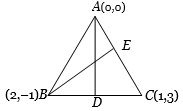
The orthocentre of the triangle whose vertices are $(0, 0)$,$(2, -1)$,and $(1, 3)$ is
A
$\left( \frac{4}{7}, \frac{1}{7} \right)$
B
$\left( -\frac{4}{7}, -\frac{1}{7} \right)$
C
$(-4, -1)$
D
$(4, 1)$
Solution
(B) Let the vertices be $A(0, 0)$,$B(2, -1)$,and $C(1, 3)$.
$1$. Find the equation of altitude from $A$ to $BC$:
Slope of $BC = \frac{3 - (-1)}{1 - 2} = \frac{4}{-1} = -4$.
The slope of the altitude $AD$ is the negative reciprocal of the slope of $BC$,which is $\frac{1}{4}$.
The equation of $AD$ passing through $A(0, 0)$ is $y - 0 = \frac{1}{4}(x - 0)$,which simplifies to $x - 4y = 0$ ..... $(i)$.
$2$. Find the equation of altitude from $B$ to $AC$:
Slope of $AC = \frac{3 - 0}{1 - 0} = 3$.
The slope of the altitude $BE$ is the negative reciprocal of the slope of $AC$,which is $-\frac{1}{3}$.
The equation of $BE$ passing through $B(2, -1)$ is $y - (-1) = -\frac{1}{3}(x - 2)$,which simplifies to $3(y + 1) = -(x - 2)$ $\Rightarrow 3y + 3 = -x + 2$ $\Rightarrow x + 3y + 1 = 0$ ..... $(ii)$.
$3$. Solve the system of equations $(i)$ and $(ii)$:
From $(i)$,$x = 4y$. Substitute this into $(ii)$:
$4y + 3y + 1 = 0$ $\Rightarrow 7y = -1$ $\Rightarrow y = -\frac{1}{7}$.
Then $x = 4(-\frac{1}{7}) = -\frac{4}{7}$.
Thus,the orthocentre is $\left( -\frac{4}{7}, -\frac{1}{7} \right)$.
$1$. Find the equation of altitude from $A$ to $BC$:
Slope of $BC = \frac{3 - (-1)}{1 - 2} = \frac{4}{-1} = -4$.
The slope of the altitude $AD$ is the negative reciprocal of the slope of $BC$,which is $\frac{1}{4}$.
The equation of $AD$ passing through $A(0, 0)$ is $y - 0 = \frac{1}{4}(x - 0)$,which simplifies to $x - 4y = 0$ ..... $(i)$.
$2$. Find the equation of altitude from $B$ to $AC$:
Slope of $AC = \frac{3 - 0}{1 - 0} = 3$.
The slope of the altitude $BE$ is the negative reciprocal of the slope of $AC$,which is $-\frac{1}{3}$.
The equation of $BE$ passing through $B(2, -1)$ is $y - (-1) = -\frac{1}{3}(x - 2)$,which simplifies to $3(y + 1) = -(x - 2)$ $\Rightarrow 3y + 3 = -x + 2$ $\Rightarrow x + 3y + 1 = 0$ ..... $(ii)$.
$3$. Solve the system of equations $(i)$ and $(ii)$:
From $(i)$,$x = 4y$. Substitute this into $(ii)$:
$4y + 3y + 1 = 0$ $\Rightarrow 7y = -1$ $\Rightarrow y = -\frac{1}{7}$.
Then $x = 4(-\frac{1}{7}) = -\frac{4}{7}$.
Thus,the orthocentre is $\left( -\frac{4}{7}, -\frac{1}{7} \right)$.
0 likesView Solution
9
MathematicsMediumMCQIIT JEE · 1974
The equation of the lines which pass through the point $(3, -2)$ and are inclined at $60^o$ to the line $\sqrt{3}x + y = 1$ is:
A
$y + 2 = 0, \sqrt{3}x - y - 2 - 3\sqrt{3} = 0$
B
$x - 2 = 0, \sqrt{3}x - y + 2 + 3\sqrt{3} = 0$
C
$\sqrt{3}x - y - 2 - 3\sqrt{3} = 0$
D
None of these
Solution
(A) The equation of any line passing through $(3, -2)$ is $y + 2 = m(x - 3)$ ..... $(i)$
The slope of the given line $\sqrt{3}x + y = 1$ is $m_1 = -\sqrt{3}$.
The angle $\theta = 60^o$ between the lines is given by $\tan \theta = \left| \frac{m - m_1}{1 + m \cdot m_1} \right|$.
Substituting the values,$\tan 60^o = \left| \frac{m - (-\sqrt{3})}{1 + m(-\sqrt{3})} \right| \implies \sqrt{3} = \left| \frac{m + \sqrt{3}}{1 - m\sqrt{3}} \right|$.
Case $1$: $\frac{m + \sqrt{3}}{1 - m\sqrt{3}} = \sqrt{3} \implies m + \sqrt{3} = \sqrt{3} - 3m \implies 4m = 0 \implies m = 0$.
Case $2$: $\frac{m + \sqrt{3}}{1 - m\sqrt{3}} = -\sqrt{3} \implies m + \sqrt{3} = -\sqrt{3} + 3m \implies 2m = 2\sqrt{3} \implies m = \sqrt{3}$.
Substituting $m = 0$ in $(i)$: $y + 2 = 0(x - 3) \implies y + 2 = 0$.
Substituting $m = \sqrt{3}$ in $(i)$: $y + 2 = \sqrt{3}(x - 3) \implies y + 2 = \sqrt{3}x - 3\sqrt{3} \implies \sqrt{3}x - y - 2 - 3\sqrt{3} = 0$.
The slope of the given line $\sqrt{3}x + y = 1$ is $m_1 = -\sqrt{3}$.
The angle $\theta = 60^o$ between the lines is given by $\tan \theta = \left| \frac{m - m_1}{1 + m \cdot m_1} \right|$.
Substituting the values,$\tan 60^o = \left| \frac{m - (-\sqrt{3})}{1 + m(-\sqrt{3})} \right| \implies \sqrt{3} = \left| \frac{m + \sqrt{3}}{1 - m\sqrt{3}} \right|$.
Case $1$: $\frac{m + \sqrt{3}}{1 - m\sqrt{3}} = \sqrt{3} \implies m + \sqrt{3} = \sqrt{3} - 3m \implies 4m = 0 \implies m = 0$.
Case $2$: $\frac{m + \sqrt{3}}{1 - m\sqrt{3}} = -\sqrt{3} \implies m + \sqrt{3} = -\sqrt{3} + 3m \implies 2m = 2\sqrt{3} \implies m = \sqrt{3}$.
Substituting $m = 0$ in $(i)$: $y + 2 = 0(x - 3) \implies y + 2 = 0$.
Substituting $m = \sqrt{3}$ in $(i)$: $y + 2 = \sqrt{3}(x - 3) \implies y + 2 = \sqrt{3}x - 3\sqrt{3} \implies \sqrt{3}x - y - 2 - 3\sqrt{3} = 0$.
0 likesView Solution
10
MathematicsEasyMCQIIT JEE · 1974
$\mathop {\lim }\limits_{x \to 0} \frac{{\tan x - \sin x}}{{{x^3}}} = $
A
$\frac{1}{2}$
B
$-\frac{1}{2}$
C
$\frac{2}{3}$
D
None of these
Solution
(A) We have $\mathop {\lim }\limits_{x \to 0} \frac{{\tan x - \sin x}}{{{x^3}}}$.
Using the expansion $\tan x = x + \frac{x^3}{3} + \dots$ and $\sin x = x - \frac{x^3}{6} + \dots$,we get:
$\mathop {\lim }\limits_{x \to 0} \frac{{(x + \frac{x^3}{3} + \dots) - (x - \frac{x^3}{6} + \dots)}}{{{x^3}}}$
$= \mathop {\lim }\limits_{x \to 0} \frac{{\frac{x^3}{3} + \frac{x^3}{6}}}{{{x^3}}}$
$= \mathop {\lim }\limits_{x \to 0} \frac{{\frac{3x^3}{6}}}{{{x^3}}} = \frac{1}{2}$.
Using the expansion $\tan x = x + \frac{x^3}{3} + \dots$ and $\sin x = x - \frac{x^3}{6} + \dots$,we get:
$\mathop {\lim }\limits_{x \to 0} \frac{{(x + \frac{x^3}{3} + \dots) - (x - \frac{x^3}{6} + \dots)}}{{{x^3}}}$
$= \mathop {\lim }\limits_{x \to 0} \frac{{\frac{x^3}{3} + \frac{x^3}{6}}}{{{x^3}}}$
$= \mathop {\lim }\limits_{x \to 0} \frac{{\frac{3x^3}{6}}}{{{x^3}}} = \frac{1}{2}$.
0 likesView Solution
11
MathematicsEasyMCQIIT JEE · 1974
Two dice are thrown. The probability that the sum of the points on two dice will be $7$ is:
A
$\frac{5}{36}$
B
$\frac{6}{36}$
C
$\frac{7}{36}$
D
$\frac{8}{36}$
Solution
(B) When two dice are thrown,the total number of possible outcomes is $6 \times 6 = 36$.
The outcomes where the sum of the points is $7$ are: $(1, 6), (2, 5), (3, 4), (4, 3), (5, 2), (6, 1)$.
The number of favourable outcomes is $6$.
Therefore,the probability is $\frac{\text{Number of favourable outcomes}}{\text{Total number of outcomes}} = \frac{6}{36}$.
The outcomes where the sum of the points is $7$ are: $(1, 6), (2, 5), (3, 4), (4, 3), (5, 2), (6, 1)$.
The number of favourable outcomes is $6$.
Therefore,the probability is $\frac{\text{Number of favourable outcomes}}{\text{Total number of outcomes}} = \frac{6}{36}$.
0 likesView Solution
12
MathematicsMediumMCQIIT JEE · 1974
$\int x^2 \sin 2x \, dx = $
A
$\frac{1}{2}x^2 \cos 2x + \frac{1}{2}x \sin 2x + \frac{1}{4} \cos 2x + c$
B
$-\frac{1}{2}x^2 \cos 2x + \frac{1}{2}x \sin 2x + \frac{1}{4} \cos 2x + c$
C
$\frac{1}{2}x^2 \cos 2x - \frac{1}{2}x \sin 2x + \frac{1}{4} \cos 2x + c$
D
None of these
Solution
(B) To evaluate $I = \int x^2 \sin 2x \, dx$,we use the integration by parts formula: $\int u \, dv = uv - \int v \, du$.
Let $u = x^2$ and $dv = \sin 2x \, dx$.
Then $du = 2x \, dx$ and $v = -\frac{\cos 2x}{2}$.
Applying the formula:
$I = x^2 \left(-\frac{\cos 2x}{2}\right) - \int \left(-\frac{\cos 2x}{2}\right) (2x \, dx)$
$I = -\frac{x^2 \cos 2x}{2} + \int x \cos 2x \, dx$.
Now,apply integration by parts again for $\int x \cos 2x \, dx$:
Let $u = x$ and $dv = \cos 2x \, dx$.
Then $du = dx$ and $v = \frac{\sin 2x}{2}$.
$\int x \cos 2x \, dx = x \left(\frac{\sin 2x}{2}\right) - \int \frac{\sin 2x}{2} \, dx$
$= \frac{x \sin 2x}{2} - \frac{1}{2} \left(-\frac{\cos 2x}{2}\right) = \frac{x \sin 2x}{2} + \frac{\cos 2x}{4}$.
Substituting this back into the expression for $I$:
$I = -\frac{x^2 \cos 2x}{2} + \frac{x \sin 2x}{2} + \frac{\cos 2x}{4} + c$.
Let $u = x^2$ and $dv = \sin 2x \, dx$.
Then $du = 2x \, dx$ and $v = -\frac{\cos 2x}{2}$.
Applying the formula:
$I = x^2 \left(-\frac{\cos 2x}{2}\right) - \int \left(-\frac{\cos 2x}{2}\right) (2x \, dx)$
$I = -\frac{x^2 \cos 2x}{2} + \int x \cos 2x \, dx$.
Now,apply integration by parts again for $\int x \cos 2x \, dx$:
Let $u = x$ and $dv = \cos 2x \, dx$.
Then $du = dx$ and $v = \frac{\sin 2x}{2}$.
$\int x \cos 2x \, dx = x \left(\frac{\sin 2x}{2}\right) - \int \frac{\sin 2x}{2} \, dx$
$= \frac{x \sin 2x}{2} - \frac{1}{2} \left(-\frac{\cos 2x}{2}\right) = \frac{x \sin 2x}{2} + \frac{\cos 2x}{4}$.
Substituting this back into the expression for $I$:
$I = -\frac{x^2 \cos 2x}{2} + \frac{x \sin 2x}{2} + \frac{\cos 2x}{4} + c$.
0 likesView Solution
Vedclass Products
For Students
Vedclass Test Series
Mock tests in real IIT JEE style covering Mathematics with performance analysis. 5-day free trial.
Start Free TrialFor Teachers
Exam Paper Generator
Generate Set A/B/C/D Mathematics papers from 7.5L+ questions in 2 minutes. 3 chapters free.
Try FreeFor Institutes
Online Exam Module
Run live IIT JEE mock exams with unlimited students, 360° analytics & white-label branding.
See DemoFrequently Asked Questions
How many Mathematics questions are in IIT JEE 1974?
There are 12 Mathematics questions from the IIT JEE 1974 paper on Vedclass, each with a detailed step-by-step solution in English.
Are IIT JEE 1974 Mathematics solutions available in English?
Yes. All solutions on this page are in English. You can also switch to English or Hindi using the language buttons above the questions.
Can I practice IIT JEE 1974 Mathematics as a timed test?
Yes. Use the Vedclass Test Series to attempt a full IIT JEE mock test covering Mathematics with time limits and instant score analysis.
Can teachers create Mathematics papers from IIT JEE previous year questions?
Yes. The Vedclass Exam Paper Generator lets teachers mix IIT JEE Mathematics questions and generate Set A/B/C/D papers in minutes.
For Teachers & Institutes
Build a Custom Mathematics Paper
Pick IIT JEE 1974 Mathematics questions, set difficulty, and generate Set A/B/C/D in 2 minutes.