
MathematicsQ1–7 of 7 questions
Page 1 of 1 · English
1
MathematicsMediumMCQIIT JEE · 1967
If the roots of the equation $\frac{1}{x + p} + \frac{1}{x + q} = \frac{1}{r}$ are equal in magnitude but opposite in sign,then the product of the roots will be
A
$\frac{p^2 + q^2}{2}$
B
$-\frac{p^2 + q^2}{2}$
C
$\frac{p^2 - q^2}{2}$
D
$-\frac{p^2 - q^2}{2}$
Solution
(B) The given equation is $\frac{1}{x + p} + \frac{1}{x + q} = \frac{1}{r}$.
Multiplying by $r(x + p)(x + q)$,we get $r(x + q) + r(x + p) = (x + p)(x + q)$.
$rx + rq + rx + rp = x^2 + px + qx + pq$.
$x^2 + x(p + q - 2r) + (pq - rp - rq) = 0$.
Let the roots be $\alpha$ and $-\alpha$. Since the sum of the roots is zero,the coefficient of $x$ must be zero:
$p + q - 2r = 0 \implies r = \frac{p + q}{2}$.
The product of the roots is $\alpha(-\alpha) = -\alpha^2 = pq - r(p + q)$.
Substituting $r = \frac{p + q}{2}$ into the product expression:
$-\alpha^2 = pq - \frac{p + q}{2}(p + q) = pq - \frac{(p + q)^2}{2}$.
$-\alpha^2 = \frac{2pq - (p^2 + q^2 + 2pq)}{2} = -\frac{p^2 + q^2}{2}$.
Multiplying by $r(x + p)(x + q)$,we get $r(x + q) + r(x + p) = (x + p)(x + q)$.
$rx + rq + rx + rp = x^2 + px + qx + pq$.
$x^2 + x(p + q - 2r) + (pq - rp - rq) = 0$.
Let the roots be $\alpha$ and $-\alpha$. Since the sum of the roots is zero,the coefficient of $x$ must be zero:
$p + q - 2r = 0 \implies r = \frac{p + q}{2}$.
The product of the roots is $\alpha(-\alpha) = -\alpha^2 = pq - r(p + q)$.
Substituting $r = \frac{p + q}{2}$ into the product expression:
$-\alpha^2 = pq - \frac{p + q}{2}(p + q) = pq - \frac{(p + q)^2}{2}$.
$-\alpha^2 = \frac{2pq - (p^2 + q^2 + 2pq)}{2} = -\frac{p^2 + q^2}{2}$.
0 likesView Solution
2
MathematicsEasyMCQIIT JEE · 1967
If $^{15}C_{3r} = ^{15}C_{r+3}$,then the value of $r$ is
A
$3$
B
$4$
C
$5$
D
$8$
Solution
(A) We know the property of combinations: $^{n}C_{x} = ^{n}C_{y}$ implies either $x = y$ or $x + y = n$.
Given $^{15}C_{3r} = ^{15}C_{r+3}$.
Case $1$: $3r = r + 3$ $\Rightarrow 2r = 3$ $\Rightarrow r = 1.5$ (Not an integer,so reject).
Case $2$: $3r + (r + 3) = 15$ $\Rightarrow 4r + 3 = 15$ $\Rightarrow 4r = 12$ $\Rightarrow r = 3$.
Thus,the value of $r$ is $3$.
Given $^{15}C_{3r} = ^{15}C_{r+3}$.
Case $1$: $3r = r + 3$ $\Rightarrow 2r = 3$ $\Rightarrow r = 1.5$ (Not an integer,so reject).
Case $2$: $3r + (r + 3) = 15$ $\Rightarrow 4r + 3 = 15$ $\Rightarrow 4r = 12$ $\Rightarrow r = 3$.
Thus,the value of $r$ is $3$.
0 likesView Solution
3
MathematicsEasyMCQIIT JEE · 1967
The coefficient of $x^{-7}$ in the expansion of $\left( ax - \frac{1}{bx^2} \right)^{11}$ is
A
$\frac{462a^5}{b^6}$
B
$\frac{462a^6}{b^5}$
C
$\frac{-462a^5}{b^6}$
D
$\frac{-462a^6}{b^5}$
Solution
(A) The general term in the expansion of $(ax - \frac{1}{bx^2})^{11}$ is given by $T_{r+1} = ^{11}C_r (ax)^{11-r} (-\frac{1}{bx^2})^r$.
$T_{r+1} = ^{11}C_r a^{11-r} x^{11-r} (-1)^r b^{-r} x^{-2r}$
$T_{r+1} = ^{11}C_r a^{11-r} (-1)^r b^{-r} x^{11-3r}$
To find the coefficient of $x^{-7}$,we set the exponent of $x$ equal to $-7$:
$11 - 3r = -7$
$3r = 18 \Rightarrow r = 6$
Substituting $r = 6$ into the expression for the coefficient:
Coefficient $= ^{11}C_6 a^{11-6} (-1)^6 b^{-6}$
$= ^{11}C_6 a^5 \frac{1}{b^6}$
Since $^{11}C_6 = ^{11}C_5 = \frac{11 \times 10 \times 9 \times 8 \times 7}{5 \times 4 \times 3 \times 2 \times 1} = 462$
Therefore,the coefficient is $\frac{462a^5}{b^6}$.
$T_{r+1} = ^{11}C_r a^{11-r} x^{11-r} (-1)^r b^{-r} x^{-2r}$
$T_{r+1} = ^{11}C_r a^{11-r} (-1)^r b^{-r} x^{11-3r}$
To find the coefficient of $x^{-7}$,we set the exponent of $x$ equal to $-7$:
$11 - 3r = -7$
$3r = 18 \Rightarrow r = 6$
Substituting $r = 6$ into the expression for the coefficient:
Coefficient $= ^{11}C_6 a^{11-6} (-1)^6 b^{-6}$
$= ^{11}C_6 a^5 \frac{1}{b^6}$
Since $^{11}C_6 = ^{11}C_5 = \frac{11 \times 10 \times 9 \times 8 \times 7}{5 \times 4 \times 3 \times 2 \times 1} = 462$
Therefore,the coefficient is $\frac{462a^5}{b^6}$.
0 likesView Solution
4
MathematicsEasyMCQIIT JEE · 1967
If $\tan A = -\frac{1}{2}$ and $\tan B = -\frac{1}{3},$ then $A + B = $
A
$\frac{\pi}{4}$
B
$\frac{3\pi}{4}$
C
$\frac{5\pi}{4}$
D
None of these
Solution
(B) We are given $\tan A = -\frac{1}{2}$ and $\tan B = -\frac{1}{3}.$
Using the formula for the tangent of the sum of two angles:
$\tan(A + B) = \frac{\tan A + \tan B}{1 - \tan A \tan B}$
Substituting the values:
$\tan(A + B) = \frac{-\frac{1}{2} - \frac{1}{3}}{1 - (-\frac{1}{2})(-\frac{1}{3})}$
$\tan(A + B) = \frac{-\frac{5}{6}}{1 - \frac{1}{6}} = \frac{-\frac{5}{6}}{\frac{5}{6}} = -1$
Since $\tan(A + B) = -1,$ and knowing that $\tan(\frac{3\pi}{4}) = -1,$
$A + B = \frac{3\pi}{4}.$
Using the formula for the tangent of the sum of two angles:
$\tan(A + B) = \frac{\tan A + \tan B}{1 - \tan A \tan B}$
Substituting the values:
$\tan(A + B) = \frac{-\frac{1}{2} - \frac{1}{3}}{1 - (-\frac{1}{2})(-\frac{1}{3})}$
$\tan(A + B) = \frac{-\frac{5}{6}}{1 - \frac{1}{6}} = \frac{-\frac{5}{6}}{\frac{5}{6}} = -1$
Since $\tan(A + B) = -1,$ and knowing that $\tan(\frac{3\pi}{4}) = -1,$
$A + B = \frac{3\pi}{4}.$
0 likesView Solution
5
MathematicsMediumMCQIIT JEE · 1967
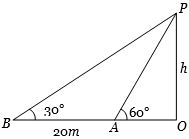
The angle of elevation of the top of a tower at a point on the ground is $30^\circ$. If on walking $20 \, m$ toward the tower,the angle of elevation becomes $60^\circ$,then the height of the tower is:
A
$10 \, m$
B
$\frac{10}{\sqrt{3}} \, m$
C
$10\sqrt{3} \, m$
D
None of these
Solution
(C) Let the height of the tower be $h$ and the distance from the tower to the first point be $x$.
From the right-angled triangle,we have:
$\tan(60^\circ) = \frac{h}{OA}$ $\Rightarrow \sqrt{3} = \frac{h}{OA}$ $\Rightarrow OA = \frac{h}{\sqrt{3}}$.
$\tan(30^\circ) = \frac{h}{OB}$ $\Rightarrow \frac{1}{\sqrt{3}} = \frac{h}{20 + OA}$ $\Rightarrow 20 + OA = h\sqrt{3}$.
Substituting $OA = \frac{h}{\sqrt{3}}$ into the equation:
$20 + \frac{h}{\sqrt{3}} = h\sqrt{3}$
$20 = h\sqrt{3} - \frac{h}{\sqrt{3}}$
$20 = h \left( \frac{3 - 1}{\sqrt{3}} \right) = h \left( \frac{2}{\sqrt{3}} \right)$
$h = \frac{20 \times \sqrt{3}}{2} = 10\sqrt{3} \, m$.
From the right-angled triangle,we have:
$\tan(60^\circ) = \frac{h}{OA}$ $\Rightarrow \sqrt{3} = \frac{h}{OA}$ $\Rightarrow OA = \frac{h}{\sqrt{3}}$.
$\tan(30^\circ) = \frac{h}{OB}$ $\Rightarrow \frac{1}{\sqrt{3}} = \frac{h}{20 + OA}$ $\Rightarrow 20 + OA = h\sqrt{3}$.
Substituting $OA = \frac{h}{\sqrt{3}}$ into the equation:
$20 + \frac{h}{\sqrt{3}} = h\sqrt{3}$
$20 = h\sqrt{3} - \frac{h}{\sqrt{3}}$
$20 = h \left( \frac{3 - 1}{\sqrt{3}} \right) = h \left( \frac{2}{\sqrt{3}} \right)$
$h = \frac{20 \times \sqrt{3}}{2} = 10\sqrt{3} \, m$.
0 likesView Solution
6
MathematicsMediumMCQIIT JEE · 1967
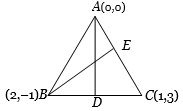
The orthocentre of the triangle whose vertices are $(0, 0)$,$(2, -1)$,and $(1, 3)$ is
A
$\left( \frac{4}{7}, \frac{1}{7} \right)$
B
$\left( -\frac{4}{7}, -\frac{1}{7} \right)$
C
$(-4, -1)$
D
$(4, 1)$
Solution
(B) Let the vertices be $A(0, 0)$,$B(2, -1)$,and $C(1, 3)$.
$1$. Find the equation of altitude from $A$ to $BC$:
Slope of $BC = \frac{3 - (-1)}{1 - 2} = \frac{4}{-1} = -4$.
The slope of the altitude $AD$ is the negative reciprocal of the slope of $BC$,which is $\frac{1}{4}$.
The equation of $AD$ passing through $A(0, 0)$ is $y - 0 = \frac{1}{4}(x - 0)$,which simplifies to $x - 4y = 0$ ..... $(i)$.
$2$. Find the equation of altitude from $B$ to $AC$:
Slope of $AC = \frac{3 - 0}{1 - 0} = 3$.
The slope of the altitude $BE$ is the negative reciprocal of the slope of $AC$,which is $-\frac{1}{3}$.
The equation of $BE$ passing through $B(2, -1)$ is $y - (-1) = -\frac{1}{3}(x - 2)$,which simplifies to $3(y + 1) = -(x - 2)$ $\Rightarrow 3y + 3 = -x + 2$ $\Rightarrow x + 3y + 1 = 0$ ..... $(ii)$.
$3$. Solve the system of equations $(i)$ and $(ii)$:
From $(i)$,$x = 4y$. Substitute this into $(ii)$:
$4y + 3y + 1 = 0$ $\Rightarrow 7y = -1$ $\Rightarrow y = -\frac{1}{7}$.
Then $x = 4(-\frac{1}{7}) = -\frac{4}{7}$.
Thus,the orthocentre is $\left( -\frac{4}{7}, -\frac{1}{7} \right)$.
$1$. Find the equation of altitude from $A$ to $BC$:
Slope of $BC = \frac{3 - (-1)}{1 - 2} = \frac{4}{-1} = -4$.
The slope of the altitude $AD$ is the negative reciprocal of the slope of $BC$,which is $\frac{1}{4}$.
The equation of $AD$ passing through $A(0, 0)$ is $y - 0 = \frac{1}{4}(x - 0)$,which simplifies to $x - 4y = 0$ ..... $(i)$.
$2$. Find the equation of altitude from $B$ to $AC$:
Slope of $AC = \frac{3 - 0}{1 - 0} = 3$.
The slope of the altitude $BE$ is the negative reciprocal of the slope of $AC$,which is $-\frac{1}{3}$.
The equation of $BE$ passing through $B(2, -1)$ is $y - (-1) = -\frac{1}{3}(x - 2)$,which simplifies to $3(y + 1) = -(x - 2)$ $\Rightarrow 3y + 3 = -x + 2$ $\Rightarrow x + 3y + 1 = 0$ ..... $(ii)$.
$3$. Solve the system of equations $(i)$ and $(ii)$:
From $(i)$,$x = 4y$. Substitute this into $(ii)$:
$4y + 3y + 1 = 0$ $\Rightarrow 7y = -1$ $\Rightarrow y = -\frac{1}{7}$.
Then $x = 4(-\frac{1}{7}) = -\frac{4}{7}$.
Thus,the orthocentre is $\left( -\frac{4}{7}, -\frac{1}{7} \right)$.
0 likesView Solution
7
MathematicsMediumMCQIIT JEE · 1967
The point $A$ divides the join of the points $(-5, 1)$ and $(3, 5)$ in the ratio $k : 1$. The coordinates of the points $B$ and $C$ are $(1, 5)$ and $(7, -2)$ respectively. If the area of the triangle $ABC$ is $2$ square units,then $k =$
A
$6, 7$
B
$31/9, 9$
C
$7, 31/9$
D
$7, 9$
Solution
(C) The coordinates of point $A$ using the section formula are $\left( \frac{3k - 5}{k + 1}, \frac{5k + 1}{k + 1} \right)$.
Given $B = (1, 5)$ and $C = (7, -2)$,the area of $\triangle ABC$ is given by $\frac{1}{2} |x_1(y_2 - y_3) + x_2(y_3 - y_1) + x_3(y_1 - y_2)| = 2$.
Substituting the coordinates: $\frac{1}{2} \left| \frac{3k - 5}{k + 1}(5 - (-2)) + 1(-2 - \frac{5k + 1}{k + 1}) + 7(\frac{5k + 1}{k + 1} - 5) \right| = 2$.
$\frac{1}{2} \left| \frac{7(3k - 5) - (2k + 2 + 5k + 1) + 7(5k + 1 - 5k - 5)}{k + 1} \right| = 2$.
$\frac{1}{2} \left| \frac{21k - 35 - 7k - 3 - 28}{k + 1} \right| = 2$.
$|14k - 66| = 4|k + 1|$.
Case $1$: $14k - 66 = 4k + 4$ $\Rightarrow 10k = 70$ $\Rightarrow k = 7$.
Case $2$: $14k - 66 = -4k - 4$ $\Rightarrow 18k = 62$ $\Rightarrow k = 31/9$.
Given $B = (1, 5)$ and $C = (7, -2)$,the area of $\triangle ABC$ is given by $\frac{1}{2} |x_1(y_2 - y_3) + x_2(y_3 - y_1) + x_3(y_1 - y_2)| = 2$.
Substituting the coordinates: $\frac{1}{2} \left| \frac{3k - 5}{k + 1}(5 - (-2)) + 1(-2 - \frac{5k + 1}{k + 1}) + 7(\frac{5k + 1}{k + 1} - 5) \right| = 2$.
$\frac{1}{2} \left| \frac{7(3k - 5) - (2k + 2 + 5k + 1) + 7(5k + 1 - 5k - 5)}{k + 1} \right| = 2$.
$\frac{1}{2} \left| \frac{21k - 35 - 7k - 3 - 28}{k + 1} \right| = 2$.
$|14k - 66| = 4|k + 1|$.
Case $1$: $14k - 66 = 4k + 4$ $\Rightarrow 10k = 70$ $\Rightarrow k = 7$.
Case $2$: $14k - 66 = -4k - 4$ $\Rightarrow 18k = 62$ $\Rightarrow k = 31/9$.
0 likesView Solution
Vedclass Products
For Students
Vedclass Test Series
Mock tests in real IIT JEE style covering Mathematics with performance analysis. 5-day free trial.
Start Free TrialFor Teachers
Exam Paper Generator
Generate Set A/B/C/D Mathematics papers from 7.5L+ questions in 2 minutes. 3 chapters free.
Try FreeFor Institutes
Online Exam Module
Run live IIT JEE mock exams with unlimited students, 360° analytics & white-label branding.
See DemoFrequently Asked Questions
How many Mathematics questions are in IIT JEE 1967?
There are 7 Mathematics questions from the IIT JEE 1967 paper on Vedclass, each with a detailed step-by-step solution in English.
Are IIT JEE 1967 Mathematics solutions available in English?
Yes. All solutions on this page are in English. You can also switch to English or Hindi using the language buttons above the questions.
Can I practice IIT JEE 1967 Mathematics as a timed test?
Yes. Use the Vedclass Test Series to attempt a full IIT JEE mock test covering Mathematics with time limits and instant score analysis.
Can teachers create Mathematics papers from IIT JEE previous year questions?
Yes. The Vedclass Exam Paper Generator lets teachers mix IIT JEE Mathematics questions and generate Set A/B/C/D papers in minutes.
For Teachers & Institutes
Build a Custom Mathematics Paper
Pick IIT JEE 1967 Mathematics questions, set difficulty, and generate Set A/B/C/D in 2 minutes.