
PhysicsQ101–132 of 232 questions
Page 3 of 3 · English
101
PhysicsMediumMCQAP EAMCET · 2019
$A$ siren placed at a railway platform is emitting a sound of frequency $5 \text{ kHz}$. $A$ passenger sitting in a moving train $A$ records the frequency of the siren as $5.5 \text{ kHz}$. During his return journey by train $B$,he records the frequency of the siren as $6 \text{ kHz}$. The ratio of the speed of train $B$ to that of train $A$ is
A
$\frac{242}{252}$
B
$2$
C
$\frac{5}{6}$
D
$\frac{11}{6}$
Solution
(B) Given,frequency of source,$f_s = 5 \text{ kHz}$.
For the passenger in train $A$,the observed frequency is $f_A = 5.5 \text{ kHz}$.
Using the Doppler effect formula for an observer moving towards a stationary source: $f_A = f_s \left( \frac{v + v_A}{v} \right)$,where $v$ is the speed of sound.
$5.5 = 5 \left( 1 + \frac{v_A}{v} \right) \implies 1.1 = 1 + \frac{v_A}{v} \implies \frac{v_A}{v} = 0.1$ --- $(i)$
For the passenger in train $B$,the observed frequency is $f_B = 6 \text{ kHz}$.
Similarly,$f_B = f_s \left( \frac{v + v_B}{v} \right)$.
$6 = 5 \left( 1 + \frac{v_B}{v} \right) \implies 1.2 = 1 + \frac{v_B}{v} \implies \frac{v_B}{v} = 0.2$ --- $(ii)$
Dividing equation $(ii)$ by equation $(i)$:
$\frac{v_B / v}{v_A / v} = \frac{0.2}{0.1} = 2$.
Thus,the ratio of the speed of train $B$ to that of train $A$ is $2$.
For the passenger in train $A$,the observed frequency is $f_A = 5.5 \text{ kHz}$.
Using the Doppler effect formula for an observer moving towards a stationary source: $f_A = f_s \left( \frac{v + v_A}{v} \right)$,where $v$ is the speed of sound.
$5.5 = 5 \left( 1 + \frac{v_A}{v} \right) \implies 1.1 = 1 + \frac{v_A}{v} \implies \frac{v_A}{v} = 0.1$ --- $(i)$
For the passenger in train $B$,the observed frequency is $f_B = 6 \text{ kHz}$.
Similarly,$f_B = f_s \left( \frac{v + v_B}{v} \right)$.
$6 = 5 \left( 1 + \frac{v_B}{v} \right) \implies 1.2 = 1 + \frac{v_B}{v} \implies \frac{v_B}{v} = 0.2$ --- $(ii)$
Dividing equation $(ii)$ by equation $(i)$:
$\frac{v_B / v}{v_A / v} = \frac{0.2}{0.1} = 2$.
Thus,the ratio of the speed of train $B$ to that of train $A$ is $2$.

0 likesView Solution
102
PhysicsDifficultMCQAP EAMCET · 2019
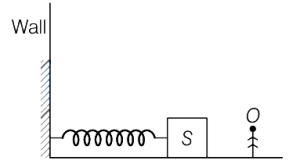
$A$ source of sound $S$ in the form of a block kept on a smooth horizontal surface is connected to a spring, as shown in the figure. If the spring oscillates with an amplitude of $50 \,cm$ along the horizontal between the wall and the observer $O$, the maximum frequency heard by the observer is $12.5 \%$ more than the minimum frequency heard by him. If the mass of the source of sound is $100 \,g$, the force constant of the spring is (Speed of sound in air is $340 \,ms^{-1}$) (in $\,N m^{-1}$)
A
$40$
B
$80$
C
$160$
D
$320$
Solution
(C) Given, amplitude of spring, $A = 50 \,cm = 0.5 \,m$.
Mass of sound source, $m = 100 \,g = 0.1 \,kg$.
Speed of sound, $v = 340 \,ms^{-1}$.
The maximum frequency heard by the observer is $n_{\max} = n_{\min} + 0.125 n_{\min} = 1.125 n_{\min}$.
Using the Doppler effect formula for a moving source:
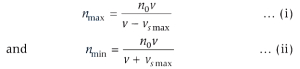
$n_{\max} = \frac{n_0 v}{v - v_{s\max}} \quad (i)$
$n_{\min} = \frac{n_0 v}{v + v_{s\max}} \quad (ii)$
Dividing $(i)$ by $(ii)$:
$\frac{n_{\max}}{n_{\min}} = \frac{v + v_{s\max}}{v - v_{s\max}} = 1.125$
$v + v_{s\max} = 1.125(v - v_{s\max})$
$v + v_{s\max} = 1.125v - 1.125v_{s\max}$
$2.125 v_{s\max} = 0.125v$
$v_{s\max} = \frac{0.125 \times 340}{2.125} = \frac{42.5}{2.125} = 20 \,ms^{-1}$.
For a spring-mass system, $v_{s\max} = A\omega = A\sqrt{\frac{k}{m}}$.
$20 = 0.5 \sqrt{\frac{k}{0.1}}$
$40 = \sqrt{\frac{k}{0.1}}$
$1600 = \frac{k}{0.1}$
$k = 160 \,N m^{-1}$.
Thus, the correct option is $(c)$.
Mass of sound source, $m = 100 \,g = 0.1 \,kg$.
Speed of sound, $v = 340 \,ms^{-1}$.
The maximum frequency heard by the observer is $n_{\max} = n_{\min} + 0.125 n_{\min} = 1.125 n_{\min}$.
Using the Doppler effect formula for a moving source:
$n_{\max} = \frac{n_0 v}{v - v_{s\max}} \quad (i)$
$n_{\min} = \frac{n_0 v}{v + v_{s\max}} \quad (ii)$
Dividing $(i)$ by $(ii)$:
$\frac{n_{\max}}{n_{\min}} = \frac{v + v_{s\max}}{v - v_{s\max}} = 1.125$
$v + v_{s\max} = 1.125(v - v_{s\max})$
$v + v_{s\max} = 1.125v - 1.125v_{s\max}$
$2.125 v_{s\max} = 0.125v$
$v_{s\max} = \frac{0.125 \times 340}{2.125} = \frac{42.5}{2.125} = 20 \,ms^{-1}$.
For a spring-mass system, $v_{s\max} = A\omega = A\sqrt{\frac{k}{m}}$.
$20 = 0.5 \sqrt{\frac{k}{0.1}}$
$40 = \sqrt{\frac{k}{0.1}}$
$1600 = \frac{k}{0.1}$
$k = 160 \,N m^{-1}$.
Thus, the correct option is $(c)$.
0 likesView Solution
103
PhysicsDifficultMCQAP EAMCET · 2019
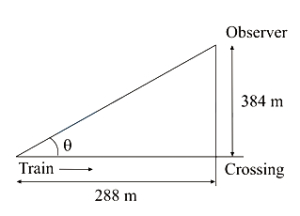
$A$ train approaching a railway crossing at a speed of $120 \ km/h$ sounds a whistle of frequency $576 \ Hz$,when it is $288 \ m$ away from the crossing. The frequency heard by an observer standing on the road perpendicular to the track at a distance of $384 \ m$ from the crossing is (Speed of sound in air $= 340 \ m/s$): (in $Hz$)
A
$632$
B
$612$
C
$512$
D
$472$
Solution
(B) Let the position of the train be $T$,the crossing be $C$,and the observer be $O$. The distance $TC = 288 \ m$ and $CO = 384 \ m$. The distance $TO = \sqrt{288^2 + 384^2} = \sqrt{82944 + 147456} = \sqrt{230400} = 480 \ m$.
The component of the train's velocity along the line joining the train and the observer is the effective velocity of the source moving towards the observer.
Let $v_s$ be the velocity of the train $(120 \ km/h = 120 \times \frac{5}{18} \ m/s = \frac{100}{3} \ m/s)$.
The angle $\theta$ is between the track and the line $TO$. From the geometry,$\cos \theta = \frac{TC}{TO} = \frac{288}{480} = \frac{3}{5} = 0.6$.
The velocity of the source towards the observer is $u = v_s \cos \theta = \frac{100}{3} \times 0.6 = 20 \ m/s$.
Using the Doppler effect formula for a source moving towards a stationary observer:
$f' = f \left( \frac{v}{v - u} \right)$
Where $f = 576 \ Hz$,$v = 340 \ m/s$,and $u = 20 \ m/s$.
$f' = 576 \left( \frac{340}{340 - 20} \right) = 576 \left( \frac{340}{320} \right) = 576 \times 1.0625 = 612 \ Hz$.
The component of the train's velocity along the line joining the train and the observer is the effective velocity of the source moving towards the observer.
Let $v_s$ be the velocity of the train $(120 \ km/h = 120 \times \frac{5}{18} \ m/s = \frac{100}{3} \ m/s)$.
The angle $\theta$ is between the track and the line $TO$. From the geometry,$\cos \theta = \frac{TC}{TO} = \frac{288}{480} = \frac{3}{5} = 0.6$.
The velocity of the source towards the observer is $u = v_s \cos \theta = \frac{100}{3} \times 0.6 = 20 \ m/s$.
Using the Doppler effect formula for a source moving towards a stationary observer:
$f' = f \left( \frac{v}{v - u} \right)$
Where $f = 576 \ Hz$,$v = 340 \ m/s$,and $u = 20 \ m/s$.
$f' = 576 \left( \frac{340}{340 - 20} \right) = 576 \left( \frac{340}{320} \right) = 576 \times 1.0625 = 612 \ Hz$.
0 likesView Solution
104
PhysicsDifficultMCQAP EAMCET · 2019
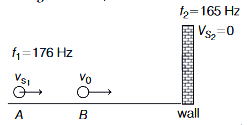
$A$ police car moving at $22 \,ms^{-1}$ chases a motorcyclist. The policeman sounds a horn at $176 \,Hz$, while both of them move towards a stationary siren of frequency $165 \,Hz$. If the number of beats heard by the motorcyclist per second is zero, then the speed of the motorcycle is (Speed of sound in air $= 330 \,ms^{-1}$) (in $\,ms^{-1}$)
A
$33$
B
$22$
C
$44$
D
$11$
Solution
(B) Given: Velocity of the police car, $v_{s_1} = 22 \,ms^{-1}$.
Speed of sound in air, $v = 330 \,ms^{-1}$.
Frequency of the police car horn, $f_1 = 176 \,Hz$.
Frequency of the stationary siren, $f_2 = 165 \,Hz$.
Let the velocity of the motorcyclist be $v_0$.
The apparent frequency $f_1^{\prime}$ heard by the motorcyclist from the police car (source moving towards observer, observer moving away from source) is:
$f_1^{\prime} = \left( \frac{v - v_0}{v - v_{s_1}} \right) f_1 = \left( \frac{330 - v_0}{330 - 22} \right) \times 176 = \left( \frac{330 - v_0}{308} \right) \times 176$
The apparent frequency $f_2^{\prime}$ heard by the motorcyclist from the stationary siren (source stationary, observer moving towards source) is:
$f_2^{\prime} = \left( \frac{v + v_0}{v} \right) f_2 = \left( \frac{330 + v_0}{330} \right) \times 165$
Since the number of beats heard is zero, $f_1^{\prime} = f_2^{\prime}$:
$\left( \frac{330 - v_0}{308} \right) \times 176 = \left( \frac{330 + v_0}{330} \right) \times 165$
$\left( 330 - v_0 \right) \times \frac{176}{308} = \left( 330 + v_0 \right) \times \frac{165}{330}$
$\left( 330 - v_0 \right) \times 0.5714 = \left( 330 + v_0 \right) \times 0.5$
$188.56 - 0.5714 v_0 = 165 + 0.5 v_0$
$23.56 = 1.0714 v_0$
$v_0 = 22 \,ms^{-1}$
Thus, the speed of the motorcycle is $22 \,ms^{-1}$. The correct option is $(b)$.
Speed of sound in air, $v = 330 \,ms^{-1}$.
Frequency of the police car horn, $f_1 = 176 \,Hz$.
Frequency of the stationary siren, $f_2 = 165 \,Hz$.
Let the velocity of the motorcyclist be $v_0$.
The apparent frequency $f_1^{\prime}$ heard by the motorcyclist from the police car (source moving towards observer, observer moving away from source) is:
$f_1^{\prime} = \left( \frac{v - v_0}{v - v_{s_1}} \right) f_1 = \left( \frac{330 - v_0}{330 - 22} \right) \times 176 = \left( \frac{330 - v_0}{308} \right) \times 176$
The apparent frequency $f_2^{\prime}$ heard by the motorcyclist from the stationary siren (source stationary, observer moving towards source) is:
$f_2^{\prime} = \left( \frac{v + v_0}{v} \right) f_2 = \left( \frac{330 + v_0}{330} \right) \times 165$
Since the number of beats heard is zero, $f_1^{\prime} = f_2^{\prime}$:
$\left( \frac{330 - v_0}{308} \right) \times 176 = \left( \frac{330 + v_0}{330} \right) \times 165$
$\left( 330 - v_0 \right) \times \frac{176}{308} = \left( 330 + v_0 \right) \times \frac{165}{330}$
$\left( 330 - v_0 \right) \times 0.5714 = \left( 330 + v_0 \right) \times 0.5$
$188.56 - 0.5714 v_0 = 165 + 0.5 v_0$
$23.56 = 1.0714 v_0$
$v_0 = 22 \,ms^{-1}$
Thus, the speed of the motorcycle is $22 \,ms^{-1}$. The correct option is $(b)$.
0 likesView Solution
105
PhysicsMediumMCQAP EAMCET · 2019
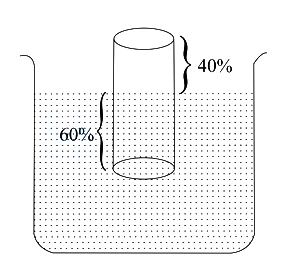
$A$ cylindrical tube open at both ends has a fundamental frequency $f$ in air. The tube is dipped vertically in water so that $60 \%$ of the tube is in water. Then the fundamental frequency of the air column is
A
$\frac{f}{2}$
B
$\frac{5 f}{4}$
C
$\frac{3 f}{4}$
D
$2 f$
Solution
(B) Let the length of the tube be $L$.
The fundamental frequency for an open organ pipe is given by:
$f = \frac{V}{2L}$
When the tube is dipped vertically in water such that $60 \%$ of its length is submerged,the remaining length of the air column above the water surface acts as a closed organ pipe (closed at one end by the water surface).
The length of this air column is:
$l' = (100 \% - 60 \%) L = 40 \% L = 0.4L = \frac{2L}{5}$
The fundamental frequency of a closed organ pipe is given by:
$f' = \frac{V}{4l'}$
Substituting the value of $l'$:
$f' = \frac{V}{4(\frac{2L}{5})} = \frac{5V}{8L}$
We can rewrite this in terms of $f$:
$f' = \frac{5}{4} \left( \frac{V}{2L} \right) = \frac{5}{4} f$
The fundamental frequency for an open organ pipe is given by:
$f = \frac{V}{2L}$
When the tube is dipped vertically in water such that $60 \%$ of its length is submerged,the remaining length of the air column above the water surface acts as a closed organ pipe (closed at one end by the water surface).
The length of this air column is:
$l' = (100 \% - 60 \%) L = 40 \% L = 0.4L = \frac{2L}{5}$
The fundamental frequency of a closed organ pipe is given by:
$f' = \frac{V}{4l'}$
Substituting the value of $l'$:
$f' = \frac{V}{4(\frac{2L}{5})} = \frac{5V}{8L}$
We can rewrite this in terms of $f$:
$f' = \frac{5}{4} \left( \frac{V}{2L} \right) = \frac{5}{4} f$
0 likesView Solution
106
PhysicsMediumMCQAP EAMCET · 2019
When the air column of a resonance tube is vibrated together with a tuning fork,$3$ beats are heard per second,either the temperature of the air column is $51^{\circ} C$ or $16^{\circ} C$. The frequency of the tuning fork is (in $Hz$)
A
$128$
B
$98$
C
$105$
D
$256$
Solution
(C) The frequency of an air column in a resonance tube is proportional to the speed of sound,which is proportional to the square root of the absolute temperature $(v \propto \sqrt{T})$.
Let $n$ be the frequency of the tuning fork.
At $T_1 = 273 + 51 = 324 \ K$,the frequency of the air column is $n_1 = n + 3$.
At $T_2 = 273 + 16 = 289 \ K$,the frequency of the air column is $n_2 = n - 3$.
Using the relation $\frac{n_1}{n_2} = \sqrt{\frac{T_1}{T_2}}$,we get:
$\frac{n+3}{n-3} = \sqrt{\frac{324}{289}} = \frac{18}{17}$.
Cross-multiplying gives: $17(n + 3) = 18(n - 3)$.
$17n + 51 = 18n - 54$.
$n = 51 + 54 = 105 \ Hz$.
Let $n$ be the frequency of the tuning fork.
At $T_1 = 273 + 51 = 324 \ K$,the frequency of the air column is $n_1 = n + 3$.
At $T_2 = 273 + 16 = 289 \ K$,the frequency of the air column is $n_2 = n - 3$.
Using the relation $\frac{n_1}{n_2} = \sqrt{\frac{T_1}{T_2}}$,we get:
$\frac{n+3}{n-3} = \sqrt{\frac{324}{289}} = \frac{18}{17}$.
Cross-multiplying gives: $17(n + 3) = 18(n - 3)$.
$17n + 51 = 18n - 54$.
$n = 51 + 54 = 105 \ Hz$.
0 likesView Solution
107
PhysicsMediumMCQAP EAMCET · 2019
Potential energy of a body of mass $1 \ kg$ free to move along $X$-axis is given by $U(x) = (\frac{x^2}{2} - x) \ J$. If the total mechanical energy of the body is $2 \ J$,then the maximum speed of the body is (Assume only conservative force acts on the body).
A
$\sqrt{5} \ ms^{-1}$
B
$5 \ ms^{-1}$
C
$3.5 \ ms^{-1}$
D
$\sqrt{8} \ ms^{-1}$
Solution
(A) The total mechanical energy $E$ of a system is the sum of its potential energy $U$ and kinetic energy $KE$. That is,$E = U + KE$.
Given,$E = 2 \ J$ and $m = 1 \ kg$.
To find the maximum speed,we need the maximum kinetic energy,which occurs when the potential energy is at its minimum.
$U(x) = \frac{x^2}{2} - x$.
To find the minimum potential energy,we set $\frac{dU}{dx} = 0$:
$\frac{d}{dx}(\frac{x^2}{2} - x) = x - 1 = 0 \implies x = 1 \ m$.
$U_{\min} = U(1) = \frac{1^2}{2} - 1 = -0.5 \ J$.
Since $E = U + KE$,we have $KE_{\max} = E - U_{\min} = 2 - (-0.5) = 2.5 \ J$.
Using $KE = \frac{1}{2}mv^2$:
$2.5 = \frac{1}{2}(1)v^2 \implies v^2 = 5 \implies v = \sqrt{5} \ ms^{-1}$.
Given,$E = 2 \ J$ and $m = 1 \ kg$.
To find the maximum speed,we need the maximum kinetic energy,which occurs when the potential energy is at its minimum.
$U(x) = \frac{x^2}{2} - x$.
To find the minimum potential energy,we set $\frac{dU}{dx} = 0$:
$\frac{d}{dx}(\frac{x^2}{2} - x) = x - 1 = 0 \implies x = 1 \ m$.
$U_{\min} = U(1) = \frac{1^2}{2} - 1 = -0.5 \ J$.
Since $E = U + KE$,we have $KE_{\max} = E - U_{\min} = 2 - (-0.5) = 2.5 \ J$.
Using $KE = \frac{1}{2}mv^2$:
$2.5 = \frac{1}{2}(1)v^2 \implies v^2 = 5 \implies v = \sqrt{5} \ ms^{-1}$.
0 likesView Solution
108
PhysicsEasyMCQAP EAMCET · 2019
$A$ body is released from a height of $30 \ m$ vertically downwards. The speed of the body at which potential energy is twice that of kinetic energy is (Acceleration due to gravity $= 10 \ m \ s^{-2}$)
A
$20 \sqrt{2} \ m \ s^{-1}$
B
$10 \sqrt{2} \ m \ s^{-1}$
C
$10 \ m \ s^{-1}$
D
$20 \ m \ s^{-1}$
Solution
(B) Let the total height be $H = 30 \ m$ and the velocity of the body be $v$ at a point where potential energy $(PE)$ is twice the kinetic energy $(KE)$.
According to the law of conservation of energy,the total energy at any point is equal to the initial potential energy:
$m g H = PE + KE$
Given that $PE = 2 \times KE$,we substitute this into the equation:
$m g H = 2 \times KE + KE = 3 \times KE$
Since $KE = \frac{1}{2} m v^2$,we have:
$m g H = 3 \times (\frac{1}{2} m v^2)$
$g H = \frac{3}{2} v^2$
$v^2 = \frac{2}{3} g H$
Substituting the values $g = 10 \ m \ s^{-2}$ and $H = 30 \ m$:
$v^2 = \frac{2}{3} \times 10 \times 30$
$v^2 = 2 \times 10 \times 10 = 200$
$v = \sqrt{200} = 10 \sqrt{2} \ m \ s^{-1}$
According to the law of conservation of energy,the total energy at any point is equal to the initial potential energy:
$m g H = PE + KE$
Given that $PE = 2 \times KE$,we substitute this into the equation:
$m g H = 2 \times KE + KE = 3 \times KE$
Since $KE = \frac{1}{2} m v^2$,we have:
$m g H = 3 \times (\frac{1}{2} m v^2)$
$g H = \frac{3}{2} v^2$
$v^2 = \frac{2}{3} g H$
Substituting the values $g = 10 \ m \ s^{-2}$ and $H = 30 \ m$:
$v^2 = \frac{2}{3} \times 10 \times 30$
$v^2 = 2 \times 10 \times 10 = 200$
$v = \sqrt{200} = 10 \sqrt{2} \ m \ s^{-1}$
0 likesView Solution
109
PhysicsEasyMCQAP EAMCET · 2019
$A$ man who is running has half the kinetic energy of a boy of half his mass. The man speeds up by $1 \,ms^{-1}$ and then has the same kinetic energy as the boy. The initial speed of the boy is
A
$\sqrt{2}+1 \,ms^{-1}$
B
$2(\sqrt{2}+1) \,ms^{-1}$
C
$\sqrt{2} \,ms^{-1}$
D
$2 \,ms^{-1}$
Solution
(B) Let the mass of the man be $m$. Then the mass of the boy is $m_b = \frac{m}{2}$.
Let the initial speed of the man be $v_m$ and the speed of the boy be $v_b$.
According to the problem,the kinetic energy of the man is half the kinetic energy of the boy:
$\frac{1}{2} m v_m^2 = \frac{1}{2} (\frac{1}{2} m_b v_b^2) = \frac{1}{2} (\frac{1}{2} \cdot \frac{m}{2} v_b^2) = \frac{1}{8} m v_b^2$.
Simplifying,$v_m^2 = \frac{1}{4} v_b^2$,which gives $v_m = \frac{v_b}{2}$.
When the man speeds up by $1 \,ms^{-1}$,his new speed is $v_m' = v_m + 1 = \frac{v_b}{2} + 1$.
Now,his kinetic energy equals the boy's kinetic energy:
$\frac{1}{2} m (\frac{v_b}{2} + 1)^2 = \frac{1}{2} (\frac{m}{2}) v_b^2$.
Dividing both sides by $\frac{m}{2}$,we get $(\frac{v_b}{2} + 1)^2 = \frac{v_b^2}{2}$.
Taking the square root of both sides: $\frac{v_b}{2} + 1 = \frac{v_b}{\sqrt{2}}$.
$1 = v_b (\frac{1}{\sqrt{2}} - \frac{1}{2}) = v_b (\frac{2 - \sqrt{2}}{2\sqrt{2}})$.
$v_b = \frac{2\sqrt{2}}{2 - \sqrt{2}} = \frac{2\sqrt{2}(2 + \sqrt{2})}{4 - 2} = \frac{4\sqrt{2} + 4}{2} = 2\sqrt{2} + 2 = 2(\sqrt{2} + 1) \,ms^{-1}$.
Let the initial speed of the man be $v_m$ and the speed of the boy be $v_b$.
According to the problem,the kinetic energy of the man is half the kinetic energy of the boy:
$\frac{1}{2} m v_m^2 = \frac{1}{2} (\frac{1}{2} m_b v_b^2) = \frac{1}{2} (\frac{1}{2} \cdot \frac{m}{2} v_b^2) = \frac{1}{8} m v_b^2$.
Simplifying,$v_m^2 = \frac{1}{4} v_b^2$,which gives $v_m = \frac{v_b}{2}$.
When the man speeds up by $1 \,ms^{-1}$,his new speed is $v_m' = v_m + 1 = \frac{v_b}{2} + 1$.
Now,his kinetic energy equals the boy's kinetic energy:
$\frac{1}{2} m (\frac{v_b}{2} + 1)^2 = \frac{1}{2} (\frac{m}{2}) v_b^2$.
Dividing both sides by $\frac{m}{2}$,we get $(\frac{v_b}{2} + 1)^2 = \frac{v_b^2}{2}$.
Taking the square root of both sides: $\frac{v_b}{2} + 1 = \frac{v_b}{\sqrt{2}}$.
$1 = v_b (\frac{1}{\sqrt{2}} - \frac{1}{2}) = v_b (\frac{2 - \sqrt{2}}{2\sqrt{2}})$.
$v_b = \frac{2\sqrt{2}}{2 - \sqrt{2}} = \frac{2\sqrt{2}(2 + \sqrt{2})}{4 - 2} = \frac{4\sqrt{2} + 4}{2} = 2\sqrt{2} + 2 = 2(\sqrt{2} + 1) \,ms^{-1}$.
0 likesView Solution
110
PhysicsMediumMCQAP EAMCET · 2019
$A$ motor engine pumps $1800 \,L$ of water per minute from a well of depth $30 \,m$ and allows it to pass through a pipe of cross-sectional area $30 \,cm^2$. Then the power of the engine is (Acceleration due to gravity,$g=10 \,m/s^2$) (in $\,kW$)
A
$20.5$
B
$15.5$
C
$10.5$
D
$9.5$
Solution
(C) Given:
Depth of the well,$d = 30 \,m$
Volume of water per minute,$V = 1800 \,L = 1800 \times 10^{-3} \,m^3 = 1.8 \,m^3$
Mass of water per minute,$m = \rho \times V = 1000 \,kg/m^3 \times 1.8 \,m^3 = 1800 \,kg$
Cross-sectional area of pipe,$A = 30 \,cm^2 = 30 \times 10^{-4} \,m^2$
Time,$t = 60 \,s$
Velocity of water jet,$v = \frac{V}{A \times t} = \frac{1.8}{30 \times 10^{-4} \times 60} = \frac{1.8}{0.18} = 10 \,m/s$
Total work done by the engine is the sum of potential energy and kinetic energy:
$W = mgd + \frac{1}{2}mv^2$
$W = (1800 \times 10 \times 30) + (\frac{1}{2} \times 1800 \times 10^2)$
$W = 540000 + 90000 = 630000 \,J$
Power of the engine,$P = \frac{W}{t} = \frac{630000}{60} = 10500 \,W$
$P = 10.5 \,kW$
Depth of the well,$d = 30 \,m$
Volume of water per minute,$V = 1800 \,L = 1800 \times 10^{-3} \,m^3 = 1.8 \,m^3$
Mass of water per minute,$m = \rho \times V = 1000 \,kg/m^3 \times 1.8 \,m^3 = 1800 \,kg$
Cross-sectional area of pipe,$A = 30 \,cm^2 = 30 \times 10^{-4} \,m^2$
Time,$t = 60 \,s$
Velocity of water jet,$v = \frac{V}{A \times t} = \frac{1.8}{30 \times 10^{-4} \times 60} = \frac{1.8}{0.18} = 10 \,m/s$
Total work done by the engine is the sum of potential energy and kinetic energy:
$W = mgd + \frac{1}{2}mv^2$
$W = (1800 \times 10 \times 30) + (\frac{1}{2} \times 1800 \times 10^2)$
$W = 540000 + 90000 = 630000 \,J$
Power of the engine,$P = \frac{W}{t} = \frac{630000}{60} = 10500 \,W$
$P = 10.5 \,kW$
0 likesView Solution
111
PhysicsMediumMCQAP EAMCET · 2019
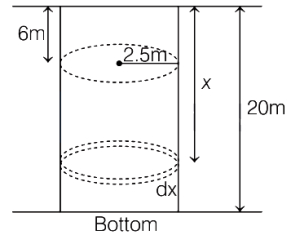
$A$ cylindrical well of radius $2.5 \ m$ has water up to a height of $14 \ m$ from the bottom. If the water level is at a depth of $6 \ m$ from the top of the well,then the time taken (in minutes) to empty the well using a motor of $10 \ HP$ is approximately,(Take $g = 10 \ m/s^2$)
A
$30$
B
$80$
C
$98$
D
$90$
Solution
(B) The total depth of the well is $6 \ m + 14 \ m = 20 \ m$. Let a small volume element $dx$ be at a distance $x$ from the top surface. The mass of this element is $dm = \rho dV = \rho \pi r^2 dx$.
The potential energy required to lift this element to the top is $dU = dm \cdot g \cdot x = \rho \pi r^2 g x dx$.
Integrating from $x = 6 \ m$ to $x = 20 \ m$ to find the total work done $W$:
$W = \int_{6}^{20} \rho \pi r^2 g x dx = \rho \pi r^2 g \left[ \frac{x^2}{2} \right]_{6}^{20} = \rho \pi r^2 g \left( \frac{400 - 36}{2} \right) = \rho \pi r^2 g (182)$.
Given $\rho = 10^3 \ kg/m^3$,$r = 2.5 \ m$,$g = 10 \ m/s^2$:
$W = 10^3 \times 3.14 \times (2.5)^2 \times 10 \times 182 = 35.71 \times 10^6 \ J$.
Power $P = 10 \ HP = 10 \times 746 \ W = 7460 \ W$.
Time $t = \frac{W}{P} = \frac{35.71 \times 10^6}{7460} \approx 4787 \ s$.
Converting to minutes: $t = \frac{4787}{60} \approx 79.78 \ min \approx 80 \ min$.
Thus,the correct option is $B$.
The potential energy required to lift this element to the top is $dU = dm \cdot g \cdot x = \rho \pi r^2 g x dx$.
Integrating from $x = 6 \ m$ to $x = 20 \ m$ to find the total work done $W$:
$W = \int_{6}^{20} \rho \pi r^2 g x dx = \rho \pi r^2 g \left[ \frac{x^2}{2} \right]_{6}^{20} = \rho \pi r^2 g \left( \frac{400 - 36}{2} \right) = \rho \pi r^2 g (182)$.
Given $\rho = 10^3 \ kg/m^3$,$r = 2.5 \ m$,$g = 10 \ m/s^2$:
$W = 10^3 \times 3.14 \times (2.5)^2 \times 10 \times 182 = 35.71 \times 10^6 \ J$.
Power $P = 10 \ HP = 10 \times 746 \ W = 7460 \ W$.
Time $t = \frac{W}{P} = \frac{35.71 \times 10^6}{7460} \approx 4787 \ s$.
Converting to minutes: $t = \frac{4787}{60} \approx 79.78 \ min \approx 80 \ min$.
Thus,the correct option is $B$.
0 likesView Solution
112
PhysicsEasyMCQAP EAMCET · 2019
$A$ constant power of $7 \,W$ is supplied to a toy car of mass $15 \,kg$. The distance travelled by the car when its velocity increases from $3 \,ms^{-1}$ to $5 \,ms^{-1}$ is: (in $\,m$)
A
$56$
B
$7$
C
$61$
D
$70$
Solution
(D) Given: Power $P = 7 \,W$, mass $m = 15 \,kg$, initial velocity $v_i = 3 \,ms^{-1}$, and final velocity $v_f = 5 \,ms^{-1}$.
According to the work-energy theorem, the work done $W$ is equal to the change in kinetic energy:
$W = \Delta K = \frac{1}{2} m (v_f^2 - v_i^2)$
$W = \frac{1}{2} \times 15 \times (5^2 - 3^2) = \frac{1}{2} \times 15 \times (25 - 9) = \frac{1}{2} \times 15 \times 16 = 120 \,J$.
Since power is constant, $P = \frac{W}{t}$, so the time taken is $t = \frac{W}{P} = \frac{120}{7} \,s$.
Using the equation of motion $v_f = v_i + at$, we find the acceleration $a$:
$a = \frac{v_f - v_i}{t} = \frac{5 - 3}{120/7} = \frac{2 \times 7}{120} = \frac{14}{120} = \frac{7}{60} \,ms^{-2}$.
Now, using the kinematic equation $v_f^2 - v_i^2 = 2as$, the distance $s$ is:
$s = \frac{v_f^2 - v_i^2}{2a} = \frac{25 - 9}{2 \times (7/60)} = \frac{16 \times 60}{14} = \frac{8 \times 60}{7} = \frac{480}{7} \approx 68.57 \,m$.
Rounding to the nearest integer provided in the options, the distance is $70 \,m$.
According to the work-energy theorem, the work done $W$ is equal to the change in kinetic energy:
$W = \Delta K = \frac{1}{2} m (v_f^2 - v_i^2)$
$W = \frac{1}{2} \times 15 \times (5^2 - 3^2) = \frac{1}{2} \times 15 \times (25 - 9) = \frac{1}{2} \times 15 \times 16 = 120 \,J$.
Since power is constant, $P = \frac{W}{t}$, so the time taken is $t = \frac{W}{P} = \frac{120}{7} \,s$.
Using the equation of motion $v_f = v_i + at$, we find the acceleration $a$:
$a = \frac{v_f - v_i}{t} = \frac{5 - 3}{120/7} = \frac{2 \times 7}{120} = \frac{14}{120} = \frac{7}{60} \,ms^{-2}$.
Now, using the kinematic equation $v_f^2 - v_i^2 = 2as$, the distance $s$ is:
$s = \frac{v_f^2 - v_i^2}{2a} = \frac{25 - 9}{2 \times (7/60)} = \frac{16 \times 60}{14} = \frac{8 \times 60}{7} = \frac{480}{7} \approx 68.57 \,m$.
Rounding to the nearest integer provided in the options, the distance is $70 \,m$.
0 likesView Solution
113
PhysicsDifficultMCQAP EAMCET · 2019
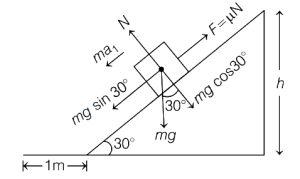
$A$ disc of mass $100 \,g$ slides down from rest on an inclined plane of $30^{\circ}$ and comes to rest after travelling a distance of $1 \,m$ along the horizontal plane. If the coefficient of friction is $0.2$ for both inclined and horizontal planes, then the work done by the frictional force over the whole journey, approximately, is (Acceleration due to gravity, $g=10 \,ms^{-2}$) (in $\,J$)
A
$0.106$
B
$0.05$
C
$0.306$
D
$0.2$
Solution
(C) Let $m = 0.1 \,kg$, $\mu = 0.2$, $g = 10 \,ms^{-2}$, $\theta = 30^{\circ}$, and $s_2 = 1 \,m$ (horizontal distance).
On the horizontal plane, the retardation $a_2 = \mu g = 0.2 \times 10 = 2 \,ms^{-2}$.
Using $v^2 = u^2 - 2a_2s_2$, where $v=0$ (comes to rest), we get $0 = u^2 - 2(2)(1)$, so $u^2 = 4$, or $u = 2 \,ms^{-1}$. This is the velocity at the bottom of the incline.
On the inclined plane, the net acceleration $a_1 = g(\sin \theta - \mu \cos \theta) = 10(\sin 30^{\circ} - 0.2 \cos 30^{\circ}) = 10(0.5 - 0.2 \times 0.866) = 10(0.5 - 0.1732) = 3.268 \,ms^{-2}$.
Using $v^2 = u_0^2 + 2a_1s_1$, where $u_0=0$ and $v=2 \,ms^{-1}$, we get $4 = 2(3.268)s_1$, so $s_1 = 4 / 6.536 \approx 0.612 \,m$.
The work done by friction on the incline is $W_1 = -f_1 s_1 = -(\mu mg \cos 30^{\circ}) s_1 = -(0.2 \times 0.1 \times 10 \times 0.866) \times 0.612 \approx -0.106 \,J$.
The work done by friction on the horizontal plane is $W_2 = -f_2 s_2 = -(\mu mg) s_2 = -(0.2 \times 0.1 \times 10) \times 1 = -0.2 \,J$.
The total work done by friction is $W = W_1 + W_2 = -0.106 - 0.2 = -0.306 \,J$. The magnitude is $0.306 \,J$.
On the horizontal plane, the retardation $a_2 = \mu g = 0.2 \times 10 = 2 \,ms^{-2}$.
Using $v^2 = u^2 - 2a_2s_2$, where $v=0$ (comes to rest), we get $0 = u^2 - 2(2)(1)$, so $u^2 = 4$, or $u = 2 \,ms^{-1}$. This is the velocity at the bottom of the incline.
On the inclined plane, the net acceleration $a_1 = g(\sin \theta - \mu \cos \theta) = 10(\sin 30^{\circ} - 0.2 \cos 30^{\circ}) = 10(0.5 - 0.2 \times 0.866) = 10(0.5 - 0.1732) = 3.268 \,ms^{-2}$.
Using $v^2 = u_0^2 + 2a_1s_1$, where $u_0=0$ and $v=2 \,ms^{-1}$, we get $4 = 2(3.268)s_1$, so $s_1 = 4 / 6.536 \approx 0.612 \,m$.
The work done by friction on the incline is $W_1 = -f_1 s_1 = -(\mu mg \cos 30^{\circ}) s_1 = -(0.2 \times 0.1 \times 10 \times 0.866) \times 0.612 \approx -0.106 \,J$.
The work done by friction on the horizontal plane is $W_2 = -f_2 s_2 = -(\mu mg) s_2 = -(0.2 \times 0.1 \times 10) \times 1 = -0.2 \,J$.
The total work done by friction is $W = W_1 + W_2 = -0.106 - 0.2 = -0.306 \,J$. The magnitude is $0.306 \,J$.
0 likesView Solution
114
PhysicsEasyMCQAP EAMCET · 2019
$A$ particle moves in the $x-y$ plane under the action of a force,$F = K \left[ \frac{x}{(x^2+y^2)^{3/2}} \hat{i} + \frac{y}{(x^2+y^2)^{3/2}} \hat{j} \right]$,where $K$ is a constant. The work done by the force when the particle moves from $(0, a)$ to $(a, 0)$ along a circular path of radius $a$ about the origin is:
A
$\frac{2 K \pi}{a}$
B
$\frac{K \pi}{a}$
C
$\frac{K \pi}{2 a}$
D
$0$
Solution
(D) The given force is $F = K \left[ \frac{x}{(x^2+y^2)^{3/2}} \hat{i} + \frac{y}{(x^2+y^2)^{3/2}} \hat{j} \right]$.
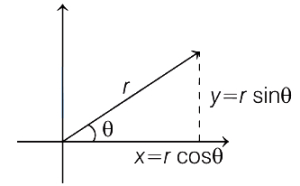
In polar coordinates,$x = r \cos \theta$ and $y = r \sin \theta$,where $r = \sqrt{x^2+y^2}$.
Substituting these into the force expression:
$F = K \left[ \frac{r \cos \theta}{r^3} \hat{i} + \frac{r \sin \theta}{r^3} \hat{j} \right] = \frac{K}{r^2} (\cos \theta \hat{i} + \sin \theta \hat{j})$.
This force is a central force directed radially outward,i.e.,$F = \frac{K}{r^2} \hat{r}$.
The work done by a central force is given by $W = \int F \cdot dr = \int \frac{K}{r^2} dr$.
Since the particle moves along a circular path of radius $a$,the distance $r$ from the origin is constant $(r = a)$.
For a circular path,the displacement vector $d\vec{l}$ is always perpendicular to the radial force vector $\vec{F}$.
Therefore,the dot product $\vec{F} \cdot d\vec{l} = 0$ at every point on the path.
Thus,the total work done $W = \int \vec{F} \cdot d\vec{l} = 0$.
In polar coordinates,$x = r \cos \theta$ and $y = r \sin \theta$,where $r = \sqrt{x^2+y^2}$.
Substituting these into the force expression:
$F = K \left[ \frac{r \cos \theta}{r^3} \hat{i} + \frac{r \sin \theta}{r^3} \hat{j} \right] = \frac{K}{r^2} (\cos \theta \hat{i} + \sin \theta \hat{j})$.
This force is a central force directed radially outward,i.e.,$F = \frac{K}{r^2} \hat{r}$.
The work done by a central force is given by $W = \int F \cdot dr = \int \frac{K}{r^2} dr$.
Since the particle moves along a circular path of radius $a$,the distance $r$ from the origin is constant $(r = a)$.
For a circular path,the displacement vector $d\vec{l}$ is always perpendicular to the radial force vector $\vec{F}$.
Therefore,the dot product $\vec{F} \cdot d\vec{l} = 0$ at every point on the path.
Thus,the total work done $W = \int \vec{F} \cdot d\vec{l} = 0$.
0 likesView Solution
115
PhysicsEasyMCQAP EAMCET · 2019
The work done by a force $\vec{F} = -5x^4 \hat{i} \text{ N}$ in displacing a body from $x = 2 \text{ m}$ to $x = -2 \text{ m}$ is: (in $\text{ J}$)
A
$6$
B
$8$
C
$64$
D
$0$
Solution
(C) The work done $W$ by a variable force $\vec{F}$ is given by the integral $W = \int_{x_i}^{x_f} \vec{F} \cdot d\vec{r}$.
Given $\vec{F} = -5x^4 \hat{i}$ and $d\vec{r} = dx \hat{i}$,the work done is:
$W = \int_{2}^{-2} (-5x^4) dx$
$W = -5 \int_{2}^{-2} x^4 dx$
$W = -5 \left[ \frac{x^5}{5} \right]_{2}^{-2}$
$W = -[x^5]_{2}^{-2}$
$W = -[(-2)^5 - (2)^5]$
$W = -[-32 - 32]$
$W = -[-64] = 64 \text{ J}$.
Given $\vec{F} = -5x^4 \hat{i}$ and $d\vec{r} = dx \hat{i}$,the work done is:
$W = \int_{2}^{-2} (-5x^4) dx$
$W = -5 \int_{2}^{-2} x^4 dx$
$W = -5 \left[ \frac{x^5}{5} \right]_{2}^{-2}$
$W = -[x^5]_{2}^{-2}$
$W = -[(-2)^5 - (2)^5]$
$W = -[-32 - 32]$
$W = -[-64] = 64 \text{ J}$.
0 likesView Solution
116
PhysicsDifficultMCQAP EAMCET · 2019
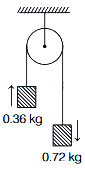
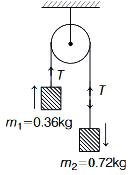
In the arrangement shown in the figure, the work done by the string on the block of mass $0.36 \,kg$ during the first second after the blocks are released from a state of rest is: (Ignore friction and the mass of the string.)
(Acceleration due to gravity, $g = 10 \,m/s^2$) (in $\,J$)
(Acceleration due to gravity, $g = 10 \,m/s^2$) (in $\,J$)
A
$8$
B
$4$
C
$12$
D
$2$
Solution
(A) Given:
Mass of block $1$, $m_1 = 0.36 \,kg$
Mass of block $2$, $m_2 = 0.72 \,kg$
Acceleration due to gravity, $g = 10 \,m/s^2$
Time, $t = 1 \,s$
The acceleration $a$ of the system is given by:
$a = \frac{(m_2 - m_1)g}{m_1 + m_2} = \frac{(0.72 - 0.36) \times 10}{0.72 + 0.36} = \frac{0.36 \times 10}{1.08} = \frac{3.6}{1.08} = \frac{10}{3} \,m/s^2$
The tension $T$ in the string is:
$T = m_1(g + a) = 0.36 \times (10 + \frac{10}{3}) = 0.36 \times \frac{40}{3} = 0.12 \times 40 = 4.8 \,N$
The displacement $s$ of the block $m_1$ in $t = 1 \,s$ is:
$s = ut + \frac{1}{2}at^2 = 0 + \frac{1}{2} \times \frac{10}{3} \times (1)^2 = \frac{5}{3} \,m$
The work done by the string on block $m_1$ is:
$W = T \times s \times \cos(0^\circ) = 4.8 \times \frac{5}{3} = 1.6 \times 5 = 8 \,J$
Mass of block $1$, $m_1 = 0.36 \,kg$
Mass of block $2$, $m_2 = 0.72 \,kg$
Acceleration due to gravity, $g = 10 \,m/s^2$
Time, $t = 1 \,s$
The acceleration $a$ of the system is given by:
$a = \frac{(m_2 - m_1)g}{m_1 + m_2} = \frac{(0.72 - 0.36) \times 10}{0.72 + 0.36} = \frac{0.36 \times 10}{1.08} = \frac{3.6}{1.08} = \frac{10}{3} \,m/s^2$
The tension $T$ in the string is:
$T = m_1(g + a) = 0.36 \times (10 + \frac{10}{3}) = 0.36 \times \frac{40}{3} = 0.12 \times 40 = 4.8 \,N$
The displacement $s$ of the block $m_1$ in $t = 1 \,s$ is:
$s = ut + \frac{1}{2}at^2 = 0 + \frac{1}{2} \times \frac{10}{3} \times (1)^2 = \frac{5}{3} \,m$
The work done by the string on block $m_1$ is:
$W = T \times s \times \cos(0^\circ) = 4.8 \times \frac{5}{3} = 1.6 \times 5 = 8 \,J$
0 likesView Solution
117
PhysicsDifficultMCQAP EAMCET · 2019
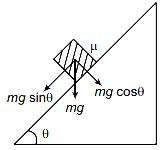
The force required to move a body up a rough inclined plane is double the force required to prevent the body from sliding down the plane. The coefficient of friction,when the angle of inclination of the plane is $60^{\circ}$ is
A
$\frac{1}{3}$
B
$\frac{1}{\sqrt{2}}$
C
$\frac{1}{\sqrt{3}}$
D
$\frac{1}{2}$
Solution
(C) For upward motion,the force required is $F_{\text{up}} = mg(\sin \theta + \mu \cos \theta)$.
For downward motion,the force required to prevent sliding is $F_{\text{down}} = mg(\sin \theta - \mu \cos \theta)$.
According to the problem,$F_{\text{up}} = 2 F_{\text{down}}$.
Substituting the expressions,we get $mg(\sin \theta + \mu \cos \theta) = 2mg(\sin \theta - \mu \cos \theta)$.
Dividing both sides by $mg$,we have $\sin \theta + \mu \cos \theta = 2 \sin \theta - 2 \mu \cos \theta$.
Rearranging the terms,$3 \mu \cos \theta = \sin \theta$,which simplifies to $\mu = \frac{1}{3} \tan \theta$.
Given $\theta = 60^{\circ}$,we have $\mu = \frac{1}{3} \tan 60^{\circ} = \frac{1}{3} \times \sqrt{3} = \frac{1}{\sqrt{3}}$.
For downward motion,the force required to prevent sliding is $F_{\text{down}} = mg(\sin \theta - \mu \cos \theta)$.
According to the problem,$F_{\text{up}} = 2 F_{\text{down}}$.
Substituting the expressions,we get $mg(\sin \theta + \mu \cos \theta) = 2mg(\sin \theta - \mu \cos \theta)$.
Dividing both sides by $mg$,we have $\sin \theta + \mu \cos \theta = 2 \sin \theta - 2 \mu \cos \theta$.
Rearranging the terms,$3 \mu \cos \theta = \sin \theta$,which simplifies to $\mu = \frac{1}{3} \tan \theta$.
Given $\theta = 60^{\circ}$,we have $\mu = \frac{1}{3} \tan 60^{\circ} = \frac{1}{3} \times \sqrt{3} = \frac{1}{\sqrt{3}}$.
0 likesView Solution
118
PhysicsEasyMCQAP EAMCET · 2019
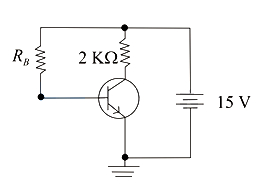
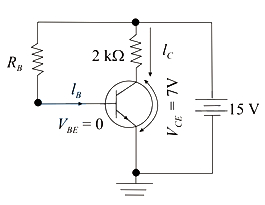
In the following common emitter circuit,$\beta=100$ and $V_{CE}=7 \text{ V}$. If $V_{BE}$ is negligible,then the base current is (in $\text{ mA}$)
A
$0.01$
B
$0.04$
C
$0.02$
D
$0.03$
Solution
(B) For the output loop of the common emitter circuit,applying Kirchhoff's voltage law $(KVL)$:
$15 \text{ V} - I_C \times (2 \text{ k}\Omega) - V_{CE} = 0$
Given $V_{CE} = 7 \text{ V}$,we have:
$15 - I_C \times 2000 - 7 = 0$
$8 = I_C \times 2000$
$I_C = \frac{8}{2000} \text{ A} = 4 \times 10^{-3} \text{ A} = 4 \text{ mA}$
Now,using the current gain relation $\beta = \frac{I_C}{I_B}$:
$100 = \frac{4 \text{ mA}}{I_B}$
$I_B = \frac{4 \text{ mA}}{100} = 0.04 \text{ mA}$
$15 \text{ V} - I_C \times (2 \text{ k}\Omega) - V_{CE} = 0$
Given $V_{CE} = 7 \text{ V}$,we have:
$15 - I_C \times 2000 - 7 = 0$
$8 = I_C \times 2000$
$I_C = \frac{8}{2000} \text{ A} = 4 \times 10^{-3} \text{ A} = 4 \text{ mA}$
Now,using the current gain relation $\beta = \frac{I_C}{I_B}$:
$100 = \frac{4 \text{ mA}}{I_B}$
$I_B = \frac{4 \text{ mA}}{100} = 0.04 \text{ mA}$
0 likesView Solution
119
PhysicsEasyMCQAP EAMCET · 2019
Three amplifiers with voltage gains $10, 20$ and $30$ are connected in series. If the input signal has a peak value of $1 mV$, then the peak value of the output voltage is (in $\,V$)
A
$6$
B
$60$
C
$0.6$
D
$0.06$
Solution
(A) Given, voltage gains of three amplifiers are $A_1 = 10, A_2 = 20$, and $A_3 = 30$.
The peak value of the input signal is $V_i = 1 mV = 10^{-3} \,V$.
When amplifiers are connected in series, the total voltage gain $A$ is the product of individual gains:
$A = A_1 \times A_2 \times A_3 = 10 \times 20 \times 30 = 6000$.
The relationship between output voltage $V_0$ and input voltage $V_i$ is given by $A = \frac{V_0}{V_i}$.
Therefore, the peak output voltage is $V_0 = A \times V_i = 6000 \times 10^{-3} \,V = 6 \,V$.
The peak value of the input signal is $V_i = 1 mV = 10^{-3} \,V$.
When amplifiers are connected in series, the total voltage gain $A$ is the product of individual gains:
$A = A_1 \times A_2 \times A_3 = 10 \times 20 \times 30 = 6000$.
The relationship between output voltage $V_0$ and input voltage $V_i$ is given by $A = \frac{V_0}{V_i}$.
Therefore, the peak output voltage is $V_0 = A \times V_i = 6000 \times 10^{-3} \,V = 6 \,V$.
0 likesView Solution
120
PhysicsEasyMCQAP EAMCET · 2019
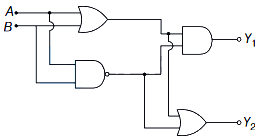
Find the values of $Y_1$ and $Y_2$ respectively in the following logic circuit if both $A$ and $B$ are $1$.
A
$1, 1$
B
$1, 0$
C
$0, 1$
D
$0, 0$
Solution
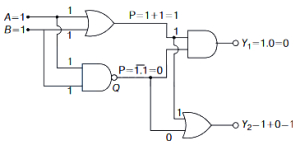
(C) Let the output of the $OR$ gate be $P = A + B$. Given $A = 1$ and $B = 1$,we have $P = 1 + 1 = 1$.
Let the output of the $NAND$ gate be $Q = \overline{A \cdot B}$. Given $A = 1$ and $B = 1$,we have $Q = \overline{1 \cdot 1} = \overline{1} = 0$.
Now,$Y_1$ is the output of an $AND$ gate with inputs $P$ and $Q$. Thus,$Y_1 = P \cdot Q = 1 \cdot 0 = 0$.
$Y_2$ is the output of an $OR$ gate with inputs $P$ and $Q$. Thus,$Y_2 = P + Q = 1 + 0 = 1$.
Therefore,the values are $Y_1 = 0$ and $Y_2 = 1$. The correct option is $(C)$.
Let the output of the $NAND$ gate be $Q = \overline{A \cdot B}$. Given $A = 1$ and $B = 1$,we have $Q = \overline{1 \cdot 1} = \overline{1} = 0$.
Now,$Y_1$ is the output of an $AND$ gate with inputs $P$ and $Q$. Thus,$Y_1 = P \cdot Q = 1 \cdot 0 = 0$.
$Y_2$ is the output of an $OR$ gate with inputs $P$ and $Q$. Thus,$Y_2 = P + Q = 1 + 0 = 1$.
Therefore,the values are $Y_1 = 0$ and $Y_2 = 1$. The correct option is $(C)$.
0 likesView Solution
121
PhysicsDifficultMCQAP EAMCET · 2019
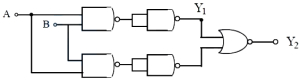
In the given logic circuit,$A=1$ and $B=0$. The values of $Y_1$ and $Y_2$ are respectively:
A
$1$,$0$
B
$0$,$1$
C
$1$,$1$
D
$0$,$0$
Solution
(B) The circuit consists of two branches feeding into a $NOR$ gate. Each branch has a $NAND$ gate followed by a $NOT$ gate (which together form an $AND$ gate).
Let the output of the top branch be $Y_1$. The top branch has inputs $A$ and $B$ to a $NAND$ gate,followed by a $NOT$ gate. This is equivalent to an $AND$ gate. So,$Y_1 = A \cdot B = 1 \cdot 0 = 0$.
Similarly,the bottom branch has inputs $A$ and $B$ to a $NAND$ gate,followed by a $NOT$ gate. This is also equivalent to an $AND$ gate. So,the output of the bottom branch is $A \cdot B = 1 \cdot 0 = 0$.
Now,$Y_1$ is the output of the top branch,so $Y_1 = 0$.
The final gate is a $NOR$ gate with both inputs as $0$.
The output $Y_2$ of a $NOR$ gate is given by $\overline{0 + 0} = \overline{0} = 1$.
Thus,$Y_1 = 0$ and $Y_2 = 1$.
Let the output of the top branch be $Y_1$. The top branch has inputs $A$ and $B$ to a $NAND$ gate,followed by a $NOT$ gate. This is equivalent to an $AND$ gate. So,$Y_1 = A \cdot B = 1 \cdot 0 = 0$.
Similarly,the bottom branch has inputs $A$ and $B$ to a $NAND$ gate,followed by a $NOT$ gate. This is also equivalent to an $AND$ gate. So,the output of the bottom branch is $A \cdot B = 1 \cdot 0 = 0$.
Now,$Y_1$ is the output of the top branch,so $Y_1 = 0$.
The final gate is a $NOR$ gate with both inputs as $0$.
The output $Y_2$ of a $NOR$ gate is given by $\overline{0 + 0} = \overline{0} = 1$.
Thus,$Y_1 = 0$ and $Y_2 = 1$.
0 likesView Solution
122
PhysicsDifficultMCQAP EAMCET · 2019
In a $p$-type semiconductor,the acceptor level is at $50 \text{ meV}$ above the valence band. To produce one hole,the maximum wavelength of the light photon required is (Planck's constant,$h = 6.6 \times 10^{-34} \text{ Js}$ and speed of light in vacuum,$c = 3 \times 10^8 \text{ m/s}$) (in $\mu \text{m}$)
A
$0.0248$
B
$0.248$
C
$2.48$
D
$24.8$
Solution
(D) Given energy required to produce a hole,$E = 50 \text{ meV} = 50 \times 10^{-3} \times 1.6 \times 10^{-19} \text{ J} = 8.0 \times 10^{-21} \text{ J}$.
Planck's constant,$h = 6.6 \times 10^{-34} \text{ Js}$.
Speed of light,$c = 3 \times 10^8 \text{ m/s}$.
The energy of a photon is given by $E = \frac{hc}{\lambda}$.
To find the maximum wavelength $\lambda$,we use $\lambda = \frac{hc}{E}$.
Substituting the values:
$\lambda = \frac{6.6 \times 10^{-34} \times 3 \times 10^8}{8.0 \times 10^{-21}}$
$\lambda = \frac{19.8 \times 10^{-26}}{8.0 \times 10^{-21}}$
$\lambda = 2.475 \times 10^{-5} \text{ m} = 24.75 \times 10^{-6} \text{ m} = 24.75 \mu \text{m}$.
Rounding to the nearest option,the maximum wavelength is $24.8 \mu \text{m}$.
Planck's constant,$h = 6.6 \times 10^{-34} \text{ Js}$.
Speed of light,$c = 3 \times 10^8 \text{ m/s}$.
The energy of a photon is given by $E = \frac{hc}{\lambda}$.
To find the maximum wavelength $\lambda$,we use $\lambda = \frac{hc}{E}$.
Substituting the values:
$\lambda = \frac{6.6 \times 10^{-34} \times 3 \times 10^8}{8.0 \times 10^{-21}}$
$\lambda = \frac{19.8 \times 10^{-26}}{8.0 \times 10^{-21}}$
$\lambda = 2.475 \times 10^{-5} \text{ m} = 24.75 \times 10^{-6} \text{ m} = 24.75 \mu \text{m}$.
Rounding to the nearest option,the maximum wavelength is $24.8 \mu \text{m}$.
0 likesView Solution
123
PhysicsMediumMCQAP EAMCET · 2019
For an $LED$ to emit light in the visible region of the electromagnetic spectrum,it can have an energy band gap in the range of (Planck's constant,$h = 6.6 \times 10^{-34} \ J s$ and speed of light,$c = 3 \times 10^8 \ m s^{-1}$ in vacuum).
A
$0.1 \ eV$ to $0.4 \ eV$
B
$0.9 \ eV$ to $1.6 \ eV$
C
$1.7 \ eV$ to $3.1 \ eV$
D
$0.5 \ eV$ to $0.8 \ eV$
Solution
(C) The visible region of the electromagnetic spectrum corresponds to wavelengths approximately between $400 \ nm$ and $700 \ nm$. The energy $E$ of a photon is given by $E = \frac{hc}{\lambda}$.
For $\lambda = 700 \ nm = 700 \times 10^{-9} \ m$:
$E_{\min} = \frac{6.6 \times 10^{-34} \times 3 \times 10^8}{700 \times 10^{-9} \times 1.6 \times 10^{-19}} \ eV \approx 1.77 \ eV$.
For $\lambda = 400 \ nm = 400 \times 10^{-9} \ m$:
$E_{\max} = \frac{6.6 \times 10^{-34} \times 3 \times 10^8}{400 \times 10^{-9} \times 1.6 \times 10^{-19}} \ eV \approx 3.1 \ eV$.
Thus,the energy band gap required for an $LED$ to emit visible light is in the range of $1.7 \ eV$ to $3.1 \ eV$. The correct option is $(c)$.
For $\lambda = 700 \ nm = 700 \times 10^{-9} \ m$:
$E_{\min} = \frac{6.6 \times 10^{-34} \times 3 \times 10^8}{700 \times 10^{-9} \times 1.6 \times 10^{-19}} \ eV \approx 1.77 \ eV$.
For $\lambda = 400 \ nm = 400 \times 10^{-9} \ m$:
$E_{\max} = \frac{6.6 \times 10^{-34} \times 3 \times 10^8}{400 \times 10^{-9} \times 1.6 \times 10^{-19}} \ eV \approx 3.1 \ eV$.
Thus,the energy band gap required for an $LED$ to emit visible light is in the range of $1.7 \ eV$ to $3.1 \ eV$. The correct option is $(c)$.
0 likesView Solution
124
PhysicsEasyMCQAP EAMCET · 2019
The angular deviation of the $5^{th}$ order dark fringe is $12^{\circ}$ in a single slit experiment. If the width of the slit is $9 \mu m$, then the wavelength of the incident light is: (in $Å$)
A
$4862$
B
$5892$
C
$6002$
D
$3768$
Solution
(D) For a single slit diffraction, the condition for the $n^{th}$ order dark fringe is given by $d \sin \theta = n \lambda$.
Given: $n = 5$, $\theta = 12^{\circ}$, $d = 9 \mu m = 9 \times 10^{-6} \text{ m}$.
Using the small angle approximation $\sin \theta \approx \theta$ (in radians), we have:
$\theta = 12^{\circ} = 12 \times \frac{\pi}{180} \text{ rad} = \frac{\pi}{15} \text{ rad}$.
Substituting the values into the formula:
$d \theta = n \lambda$
$(9 \times 10^{-6}) \times (\frac{\pi}{15}) = 5 \times \lambda$
$\lambda = \frac{9 \times 10^{-6} \times \pi}{15 \times 5} = \frac{9 \times 3.14159 \times 10^{-6}}{75} \approx 3.77 \times 10^{-7} \text{ m}$.
Converting to $\mathring{A}$s: $\lambda \approx 3770 Å$.
Given the options, the closest value is $3768 Å$.
Given: $n = 5$, $\theta = 12^{\circ}$, $d = 9 \mu m = 9 \times 10^{-6} \text{ m}$.
Using the small angle approximation $\sin \theta \approx \theta$ (in radians), we have:
$\theta = 12^{\circ} = 12 \times \frac{\pi}{180} \text{ rad} = \frac{\pi}{15} \text{ rad}$.
Substituting the values into the formula:
$d \theta = n \lambda$
$(9 \times 10^{-6}) \times (\frac{\pi}{15}) = 5 \times \lambda$
$\lambda = \frac{9 \times 10^{-6} \times \pi}{15 \times 5} = \frac{9 \times 3.14159 \times 10^{-6}}{75} \approx 3.77 \times 10^{-7} \text{ m}$.
Converting to $\mathring{A}$s: $\lambda \approx 3770 Å$.
Given the options, the closest value is $3768 Å$.
0 likesView Solution
125
PhysicsMediumMCQAP EAMCET · 2019
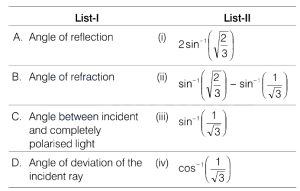
Unpolarised light from air is incident on the surface of a transparent medium of refractive index $1.414$ such that the reflected light is completely polarised. Match the angles given in List-$I$ with the corresponding values given in List-$II$.
| $A$. Angle of reflection | $(i)$ $2 \sin^{-1} \left(\sqrt{\frac{2}{3}}\right)$ |
| $B$. Angle of refraction | $(ii)$ $\sin^{-1} \left(\sqrt{\frac{2}{3}}\right) - \sin^{-1} \left(\frac{1}{\sqrt{3}}\right)$ |
| $C$. Angle between incident and completely polarised light | $(iii)$ $\sin^{-1} \left(\frac{1}{\sqrt{3}}\right)$ |
| $D$. Angle of deviation of the incident ray | $(iv)$ $\cos^{-1} \left(\frac{1}{\sqrt{3}}\right)$ |
A
$(ii), (iii), (i), (iv)$
B
$(ii), (iii), (iv), (i)$
C
$(iv), (i), (iii), (ii)$
D
$(iv), (iii), (i), (ii)$
Solution
(D) Given, refractive index $\mu = 1.414 = \sqrt{2}$.
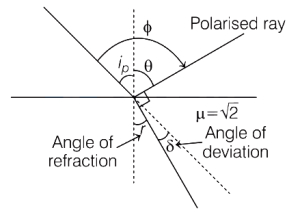
For complete polarisation, the angle of incidence is the Brewster's angle $i_p$, where $\tan i_p = \mu = \sqrt{2}$.
Thus, $\sin i_p = \sqrt{\frac{2}{3}}$ and $\cos i_p = \frac{1}{\sqrt{3}}$.
From Snell's law, $\sin i_p = \mu \sin r$, so $\sin r = \frac{\sin i_p}{\mu} = \frac{\sqrt{2/3}}{\sqrt{2}} = \frac{1}{\sqrt{3}}$.
Therefore, $r = \sin^{-1} \left(\frac{1}{\sqrt{3}}\right)$. This matches $(iii)$.
The angle of reflection $\theta$ is equal to the angle of incidence $i_p$. Since $\cos i_p = \frac{1}{\sqrt{3}}$, we have $i_p = \cos^{-1} \left(\frac{1}{\sqrt{3}}\right)$. This matches $(iv)$.
The angle of deviation $\delta$ of the refracted ray is $i_p - r = \sin^{-1} \left(\sqrt{\frac{2}{3}}\right) - \sin^{-1} \left(\frac{1}{\sqrt{3}}\right)$. This matches $(ii)$.
The angle $\phi$ between the incident ray and the reflected (polarised) ray is $i_p + \theta = 2i_p = 2 \sin^{-1} \left(\sqrt{\frac{2}{3}}\right)$. This matches $(i)$.
The correct matching is $A-(iv), B-(iii), C-(i), D-(ii)$.
For complete polarisation, the angle of incidence is the Brewster's angle $i_p$, where $\tan i_p = \mu = \sqrt{2}$.
Thus, $\sin i_p = \sqrt{\frac{2}{3}}$ and $\cos i_p = \frac{1}{\sqrt{3}}$.
From Snell's law, $\sin i_p = \mu \sin r$, so $\sin r = \frac{\sin i_p}{\mu} = \frac{\sqrt{2/3}}{\sqrt{2}} = \frac{1}{\sqrt{3}}$.
Therefore, $r = \sin^{-1} \left(\frac{1}{\sqrt{3}}\right)$. This matches $(iii)$.
The angle of reflection $\theta$ is equal to the angle of incidence $i_p$. Since $\cos i_p = \frac{1}{\sqrt{3}}$, we have $i_p = \cos^{-1} \left(\frac{1}{\sqrt{3}}\right)$. This matches $(iv)$.
The angle of deviation $\delta$ of the refracted ray is $i_p - r = \sin^{-1} \left(\sqrt{\frac{2}{3}}\right) - \sin^{-1} \left(\frac{1}{\sqrt{3}}\right)$. This matches $(ii)$.
The angle $\phi$ between the incident ray and the reflected (polarised) ray is $i_p + \theta = 2i_p = 2 \sin^{-1} \left(\sqrt{\frac{2}{3}}\right)$. This matches $(i)$.
The correct matching is $A-(iv), B-(iii), C-(i), D-(ii)$.
0 likesView Solution
126
PhysicsEasyMCQAP EAMCET · 2019
In a Young's double-slit experiment,if the slit separation is twice the wavelength of light used,then the maximum number of interference maxima is
A
$0$
B
$3$
C
$5$
D
$7$
Solution
(C) For interference maxima on the screen,the path difference condition is given by:
$d \sin \theta = n \lambda$
where $d$ is the slit separation,$\theta$ is the angle,$n$ is the order of maxima,and $\lambda$ is the wavelength.
Given that $d = 2 \lambda$,the equation becomes:
$2 \lambda \sin \theta = n \lambda$
$2 \sin \theta = n$
Since the maximum value of $\sin \theta$ is $1$,the maximum value of $n$ is:
$n_{max} = 2 \times 1 = 2$
The possible values for $n$ are integers such that $-2 \le n \le 2$.
These values are $\{-2, -1, 0, 1, 2\}$.
Counting these,we get a total of $5$ interference maxima.
$d \sin \theta = n \lambda$
where $d$ is the slit separation,$\theta$ is the angle,$n$ is the order of maxima,and $\lambda$ is the wavelength.
Given that $d = 2 \lambda$,the equation becomes:
$2 \lambda \sin \theta = n \lambda$
$2 \sin \theta = n$
Since the maximum value of $\sin \theta$ is $1$,the maximum value of $n$ is:
$n_{max} = 2 \times 1 = 2$
The possible values for $n$ are integers such that $-2 \le n \le 2$.
These values are $\{-2, -1, 0, 1, 2\}$.
Counting these,we get a total of $5$ interference maxima.
0 likesView Solution
127
PhysicsMediumMCQAP EAMCET · 2019
$A$ Young's double-slit experimental setup is immersed in water of refractive index $1.33$. It has a slit separation of $1 \ mm$ and the distance between the slits and the screen is $1.33 \ m$. If the wavelength of incident light on the slits is $6300 \ \mathring{A}$,then the fringe width on the screen is:
A
$6.3 \ mm$
B
$0.63 \ mm$
C
$0.63 \ m$
D
$6.3 \ m$
Solution
(B) The fringe width $\beta$ in a medium with refractive index $\mu$ is given by the formula: $\beta = \frac{\lambda' D}{d}$,where $\lambda' = \frac{\lambda}{\mu}$.
Thus,$\beta = \frac{\lambda D}{\mu d}$.
Given values:
$\lambda = 6300 \ \mathring{A} = 6300 \times 10^{-10} \ m$
$D = 1.33 \ m$
$d = 1 \ mm = 10^{-3} \ m$
$\mu = 1.33$
Substituting these values into the formula:
$\beta = \frac{6300 \times 10^{-10} \times 1.33}{1.33 \times 10^{-3}}$
$\beta = 6300 \times 10^{-7} \ m$
$\beta = 6.3 \times 10^{-4} \ m = 0.63 \ mm$.
Thus,$\beta = \frac{\lambda D}{\mu d}$.
Given values:
$\lambda = 6300 \ \mathring{A} = 6300 \times 10^{-10} \ m$
$D = 1.33 \ m$
$d = 1 \ mm = 10^{-3} \ m$
$\mu = 1.33$
Substituting these values into the formula:
$\beta = \frac{6300 \times 10^{-10} \times 1.33}{1.33 \times 10^{-3}}$
$\beta = 6300 \times 10^{-7} \ m$
$\beta = 6.3 \times 10^{-4} \ m = 0.63 \ mm$.
0 likesView Solution
128
PhysicsMediumMCQAP EAMCET · 2019
In a Young's double slit experiment, light of wavelength $5900 \text{ Å}$ is used. When the slits are $2 \text{ mm}$ apart, the fringe width is $1.2 \text{ mm}$. If the slit separation is increased to one and half times the previous value, then the fringe width will be (in $\text{ mm}$)
A
$0.9$
B
$0.8$
C
$1.8$
D
$1.6$
Solution
(B) In a Young's double slit experiment, the fringe width $\beta$ is given by the formula $\beta = \frac{\lambda D}{d}$, where $\lambda$ is the wavelength of light, $D$ is the distance between the slits and the screen, and $d$ is the distance between the slits.
From the formula, we can see that $\beta \propto \frac{1}{d}$ when $\lambda$ and $D$ are constant.
Given: Initial slit separation $d_1 = 2 \text{ mm}$, initial fringe width $\beta_1 = 1.2 \text{ mm}$.
New slit separation $d_2 = 1.5 \times d_1 = 1.5 \times 2 \text{ mm} = 3 \text{ mm}$.
Using the proportionality $\beta_1 d_1 = \beta_2 d_2$, we get:
$\beta_2 = \beta_1 \times \frac{d_1}{d_2} = 1.2 \text{ mm} \times \frac{2 \text{ mm}}{3 \text{ mm}} = 1.2 \times \frac{2}{3} \text{ mm} = 0.4 \times 2 \text{ mm} = 0.8 \text{ mm}$.
Therefore, the new fringe width is $0.8 \text{ mm}$.
From the formula, we can see that $\beta \propto \frac{1}{d}$ when $\lambda$ and $D$ are constant.
Given: Initial slit separation $d_1 = 2 \text{ mm}$, initial fringe width $\beta_1 = 1.2 \text{ mm}$.
New slit separation $d_2 = 1.5 \times d_1 = 1.5 \times 2 \text{ mm} = 3 \text{ mm}$.
Using the proportionality $\beta_1 d_1 = \beta_2 d_2$, we get:
$\beta_2 = \beta_1 \times \frac{d_1}{d_2} = 1.2 \text{ mm} \times \frac{2 \text{ mm}}{3 \text{ mm}} = 1.2 \times \frac{2}{3} \text{ mm} = 0.4 \times 2 \text{ mm} = 0.8 \text{ mm}$.
Therefore, the new fringe width is $0.8 \text{ mm}$.
0 likesView Solution
129
PhysicsDifficultMCQAP EAMCET · 2019
In a double-slit interference experiment, the fringe width obtained with light of wavelength $5900 \ \mathring{A}$ was $1.2 \ \text{mm}$ for parallel narrow slits placed $2 \ \text{mm}$ apart. In this arrangement, if the slit separation is increased by one-and-a-half times the previous value, then the fringe width is: (in $\text{mm}$)
A
$0.9$
B
$0.8$
C
$1.8$
D
$1.6$
Solution
(B) In Young's double-slit interference experiment, the fringe width $\beta$ is given by the formula:
$\beta = \frac{\lambda D}{d}$
where $\lambda$ is the wavelength, $D$ is the distance between the slits and the screen, and $d$ is the separation between the slits.
Given:
$\beta_1 = 1.2 \ \text{mm}$
$d_2 = 1.5 \times d_1$
Since $\beta \propto \frac{1}{d}$ (assuming $\lambda$ and $D$ remain constant),
$\frac{\beta_1}{\beta_2} = \frac{d_2}{d_1} = 1.5$
Substituting the values:
$\frac{1.2}{\beta_2} = 1.5$
$\beta_2 = \frac{1.2}{1.5} = 0.8 \ \text{mm}$
Thus, the new fringe width is $0.8 \ \text{mm}$.
$\beta = \frac{\lambda D}{d}$
where $\lambda$ is the wavelength, $D$ is the distance between the slits and the screen, and $d$ is the separation between the slits.
Given:
$\beta_1 = 1.2 \ \text{mm}$
$d_2 = 1.5 \times d_1$
Since $\beta \propto \frac{1}{d}$ (assuming $\lambda$ and $D$ remain constant),
$\frac{\beta_1}{\beta_2} = \frac{d_2}{d_1} = 1.5$
Substituting the values:
$\frac{1.2}{\beta_2} = 1.5$
$\beta_2 = \frac{1.2}{1.5} = 0.8 \ \text{mm}$
Thus, the new fringe width is $0.8 \ \text{mm}$.
0 likesView Solution
130
PhysicsEasyMCQAP EAMCET · 2019
Assertion $(A)$: The work done by the electrostatic force is zero when a point charge moves in a circular path around another charge.
Reason $(R)$: The dot product of force and displacement vectors gives work done.
Reason $(R)$: The dot product of force and displacement vectors gives work done.
A
Both Assertion and Reason are true and Reason is the correct explanation of Assertion.
B
Both Assertion and Reason are true but Reason is $\text{NOT}$ the correct explanation of Assertion.
C
Assertion is true but Reason is false.
D
Assertion is false but Reason is true.
Solution
(A) The work done $W$ by a force $\vec{F}$ over a displacement $d\vec{r}$ is given by the dot product: $W = \int \vec{F} \cdot d\vec{r}$.
When a point charge moves in a circular path around another charge,the electrostatic force is always directed radially (towards or away from the center),while the displacement vector is always tangential to the circular path.
Since the angle between the radial force and the tangential displacement is $90^{\circ}$,the dot product $\vec{F} \cdot d\vec{r} = F dr \cos 90^{\circ} = 0$.
Thus,the work done is zero. Both the assertion and the reason are true,and the reason correctly explains why the work done is zero.
When a point charge moves in a circular path around another charge,the electrostatic force is always directed radially (towards or away from the center),while the displacement vector is always tangential to the circular path.
Since the angle between the radial force and the tangential displacement is $90^{\circ}$,the dot product $\vec{F} \cdot d\vec{r} = F dr \cos 90^{\circ} = 0$.
Thus,the work done is zero. Both the assertion and the reason are true,and the reason correctly explains why the work done is zero.
0 likesView Solution
131
PhysicsDifficultMCQAP EAMCET · 2019
Four resistors $A, B, C$ and $D$ form a Wheatstone bridge. The bridge is balanced when $C = 100 \ \Omega$. If $A$ and $B$ are interchanged,the bridge balances for $C = 121 \ \Omega$. The value of $D$ is: (in $Omega$)
A
$10$
B
$100$
C
$110$
D
$120$
Solution
(C) For a balanced Wheatstone bridge,the ratio of resistances in the arms is equal: $\frac{A}{B} = \frac{C}{D}$.
Given,in the first case: $\frac{A}{B} = \frac{100}{D} \quad ... (1)$
When $A$ and $B$ are interchanged,the new ratio becomes $\frac{B}{A} = \frac{121}{D} \quad ... (2)$
Multiplying equation $(1)$ and $(2)$:
$\left(\frac{A}{B}\right) \times \left(\frac{B}{A}\right) = \left(\frac{100}{D}\right) \times \left(\frac{121}{D}\right)$
$1 = \frac{12100}{D^2}$
$D^2 = 12100$
$D = \sqrt{12100} = 110 \ \Omega$.
Given,in the first case: $\frac{A}{B} = \frac{100}{D} \quad ... (1)$
When $A$ and $B$ are interchanged,the new ratio becomes $\frac{B}{A} = \frac{121}{D} \quad ... (2)$
Multiplying equation $(1)$ and $(2)$:
$\left(\frac{A}{B}\right) \times \left(\frac{B}{A}\right) = \left(\frac{100}{D}\right) \times \left(\frac{121}{D}\right)$
$1 = \frac{12100}{D^2}$
$D^2 = 12100$
$D = \sqrt{12100} = 110 \ \Omega$.
0 likesView Solution
132
PhysicsDifficultMCQAP EAMCET · 2019
In a double slit interference experiment,the fringe width obtained with a light of wavelength $5900 \text{ Å}$ was $1.2 \text{ mm}$ for parallel narrow slits placed $2 \text{ mm}$ apart. In this arrangement,if the slit separation is increased by one-and-half times the previous value,then the fringe width is (in $ \text{ mm}$)
A
$0.9$
B
$0.8$
C
$1.8$
D
$1.6$
Solution
(B) The formula for fringe width in Young's double slit experiment is given by $\beta = \frac{\lambda D}{d}$.
Given:
Initial fringe width $\beta_1 = 1.2 \text{ mm}$.
Initial slit separation $d_1 = 2 \text{ mm}$.
The slit separation is increased by one-and-half times the previous value,so $d_2 = 1.5 d_1$.
Since $\beta \propto \frac{1}{d}$,we have $\frac{\beta_1}{\beta_2} = \frac{d_2}{d_1}$.
Substituting the values:
$\frac{1.2}{\beta_2} = 1.5$.
$\beta_2 = \frac{1.2}{1.5} = 0.8 \text{ mm}$.
Given:
Initial fringe width $\beta_1 = 1.2 \text{ mm}$.
Initial slit separation $d_1 = 2 \text{ mm}$.
The slit separation is increased by one-and-half times the previous value,so $d_2 = 1.5 d_1$.
Since $\beta \propto \frac{1}{d}$,we have $\frac{\beta_1}{\beta_2} = \frac{d_2}{d_1}$.
Substituting the values:
$\frac{1.2}{\beta_2} = 1.5$.
$\beta_2 = \frac{1.2}{1.5} = 0.8 \text{ mm}$.
0 likesView Solution
Vedclass Products
For Students
Vedclass Test Series
Mock tests in real AP EAMCET style covering Physics with performance analysis. 5-day free trial.
Start Free TrialFor Teachers
Exam Paper Generator
Generate Set A/B/C/D Physics papers from 7.5L+ questions in 2 minutes. 3 chapters free.
Try FreeFor Institutes
Online Exam Module
Run live AP EAMCET mock exams with unlimited students, 360° analytics & white-label branding.
See DemoFrequently Asked Questions
How many Physics questions are in AP EAMCET 2019?
There are 232 Physics questions from the AP EAMCET 2019 paper on Vedclass, each with a detailed step-by-step solution in English.
Are AP EAMCET 2019 Physics solutions available in English?
Yes. All solutions on this page are in English. You can also switch to English or Hindi using the language buttons above the questions.
Can I practice AP EAMCET 2019 Physics as a timed test?
Yes. Use the Vedclass Test Series to attempt a full AP EAMCET mock test covering Physics with time limits and instant score analysis.
Can teachers create Physics papers from AP EAMCET previous year questions?
Yes. The Vedclass Exam Paper Generator lets teachers mix AP EAMCET Physics questions and generate Set A/B/C/D papers in minutes.
For Teachers & Institutes
Build a Custom Physics Paper
Pick AP EAMCET 2019 Physics questions, set difficulty, and generate Set A/B/C/D in 2 minutes.