
MathematicsQ251–280 of 482 questions
Page 6 of 6 · English
251
MathematicsDifficultMCQAP EAMCET · 2017
If $R = \frac{65}{8}$,$r_1 = \frac{21}{2}$,and $r_2 = 12$ are the circumradius and the radii of the excircles opposite to the vertices $A$ and $B$ of a triangle $ABC$ respectively,then the area of the triangle (in square units) is
A
$21$
B
$28$
C
$84$
D
$168$
Solution
(C) We know the formula for the exradii of a triangle: $r_1 = \frac{\Delta}{s-a}$,$r_2 = \frac{\Delta}{s-b}$,and $r_3 = \frac{\Delta}{s-c}$,where $\Delta$ is the area and $s$ is the semi-perimeter.
Also,$r_1 = 4R \sin(\frac{A}{2}) \cos(\frac{B}{2}) \cos(\frac{C}{2})$ is not needed here; we use $r_1 = s \tan(\frac{A}{2})$ and $R = \frac{abc}{4\Delta}$.
Given $r_1 = \frac{21}{2}$ and $r_2 = 12$,we use the relation $\frac{1}{r_1} + \frac{1}{r_2} = \frac{s-a}{\Delta} + \frac{s-b}{\Delta} = \frac{2s-a-b}{\Delta} = \frac{c}{\Delta}$.
Using the identity $\frac{1}{r_1} + \frac{1}{r_2} + \frac{1}{r_3} = \frac{1}{r}$,where $r = 4R \sin(\frac{A}{2}) \sin(\frac{B}{2}) \sin(\frac{C}{2}) = \frac{\Delta}{s}$.
Alternatively,$\Delta = \sqrt{r r_1 r_2 r_3}$.
Using the property $r_1 r_2 + r_2 r_3 + r_3 r_1 = s^2$,and $\Delta = rs$,we find the area $\Delta = 84$.
Also,$r_1 = 4R \sin(\frac{A}{2}) \cos(\frac{B}{2}) \cos(\frac{C}{2})$ is not needed here; we use $r_1 = s \tan(\frac{A}{2})$ and $R = \frac{abc}{4\Delta}$.
Given $r_1 = \frac{21}{2}$ and $r_2 = 12$,we use the relation $\frac{1}{r_1} + \frac{1}{r_2} = \frac{s-a}{\Delta} + \frac{s-b}{\Delta} = \frac{2s-a-b}{\Delta} = \frac{c}{\Delta}$.
Using the identity $\frac{1}{r_1} + \frac{1}{r_2} + \frac{1}{r_3} = \frac{1}{r}$,where $r = 4R \sin(\frac{A}{2}) \sin(\frac{B}{2}) \sin(\frac{C}{2}) = \frac{\Delta}{s}$.
Alternatively,$\Delta = \sqrt{r r_1 r_2 r_3}$.
Using the property $r_1 r_2 + r_2 r_3 + r_3 r_1 = s^2$,and $\Delta = rs$,we find the area $\Delta = 84$.
0 likesView Solution
252
MathematicsEasyMCQAP EAMCET · 2017
In $\triangle ABC$,if $a=2(\sqrt{3}+1)$,$B=45^{\circ}$ and $C=60^{\circ}$,then the area (in sq.units) of that triangle is
A
$2 \sqrt{3}$
B
$6$
C
$6+2 \sqrt{3}$
D
$6-2 \sqrt{3}$
Solution
(C) Given $A = 180^{\circ} - (B + C) = 180^{\circ} - (45^{\circ} + 60^{\circ}) = 75^{\circ}$.
Using the Sine Rule,$\frac{a}{\sin A} = \frac{b}{\sin B} = \frac{c}{\sin C}$.
$a = 2(\sqrt{3}+1)$,$\sin 75^{\circ} = \sin(45^{\circ}+30^{\circ}) = \frac{\sqrt{3}+1}{2\sqrt{2}}$.
So,$\frac{2(\sqrt{3}+1)}{\frac{\sqrt{3}+1}{2\sqrt{2}}} = 4\sqrt{2}$.
Thus,$b = 4\sqrt{2} \sin 45^{\circ} = 4\sqrt{2} \times \frac{1}{\sqrt{2}} = 4$.
$c = 4\sqrt{2} \sin 60^{\circ} = 4\sqrt{2} \times \frac{\sqrt{3}}{2} = 2\sqrt{6}$.
Area $= \frac{1}{2} ab \sin C = \frac{1}{2} \times 2(\sqrt{3}+1) \times 4 \times \sin 60^{\circ} = 4(\sqrt{3}+1) \times \frac{\sqrt{3}}{2} = 2(3+\sqrt{3}) = 6+2\sqrt{3}$.
Using the Sine Rule,$\frac{a}{\sin A} = \frac{b}{\sin B} = \frac{c}{\sin C}$.
$a = 2(\sqrt{3}+1)$,$\sin 75^{\circ} = \sin(45^{\circ}+30^{\circ}) = \frac{\sqrt{3}+1}{2\sqrt{2}}$.
So,$\frac{2(\sqrt{3}+1)}{\frac{\sqrt{3}+1}{2\sqrt{2}}} = 4\sqrt{2}$.
Thus,$b = 4\sqrt{2} \sin 45^{\circ} = 4\sqrt{2} \times \frac{1}{\sqrt{2}} = 4$.
$c = 4\sqrt{2} \sin 60^{\circ} = 4\sqrt{2} \times \frac{\sqrt{3}}{2} = 2\sqrt{6}$.
Area $= \frac{1}{2} ab \sin C = \frac{1}{2} \times 2(\sqrt{3}+1) \times 4 \times \sin 60^{\circ} = 4(\sqrt{3}+1) \times \frac{\sqrt{3}}{2} = 2(3+\sqrt{3}) = 6+2\sqrt{3}$.
0 likesView Solution
253
MathematicsMediumMCQAP EAMCET · 2017
In $\triangle ABC$,if $b=2, c=\sqrt{3}$,and $A=30^{\circ}$,then its inradius $r=$
A
$\sqrt{3}-1$
B
$\sqrt{3}+1$
C
$\frac{\sqrt{3}+1}{2}$
D
$\frac{\sqrt{3}-1}{2}$
Solution
(D) Using the Law of Cosines,$a^2 = b^2 + c^2 - 2bc \cos A$.
Substituting the values: $a^2 = 2^2 + (\sqrt{3})^2 - 2(2)(\sqrt{3}) \cos 30^{\circ} = 4 + 3 - 4\sqrt{3} \times \frac{\sqrt{3}}{2} = 7 - 6 = 1$.
Thus,$a = 1$.
The area of the triangle $\Delta = \frac{1}{2} bc \sin A = \frac{1}{2} (2)(\sqrt{3}) \sin 30^{\circ} = \sqrt{3} \times \frac{1}{2} = \frac{\sqrt{3}}{2}$.
The semi-perimeter $s = \frac{a+b+c}{2} = \frac{1+2+\sqrt{3}}{2} = \frac{3+\sqrt{3}}{2}$.
The inradius $r = \frac{\Delta}{s} = \frac{\sqrt{3}/2}{(3+\sqrt{3})/2} = \frac{\sqrt{3}}{3+\sqrt{3}}$.
Rationalizing the denominator: $r = \frac{\sqrt{3}(3-\sqrt{3})}{(3+\sqrt{3})(3-\sqrt{3})} = \frac{3\sqrt{3}-3}{9-3} = \frac{3(\sqrt{3}-1)}{6} = \frac{\sqrt{3}-1}{2}$.
Substituting the values: $a^2 = 2^2 + (\sqrt{3})^2 - 2(2)(\sqrt{3}) \cos 30^{\circ} = 4 + 3 - 4\sqrt{3} \times \frac{\sqrt{3}}{2} = 7 - 6 = 1$.
Thus,$a = 1$.
The area of the triangle $\Delta = \frac{1}{2} bc \sin A = \frac{1}{2} (2)(\sqrt{3}) \sin 30^{\circ} = \sqrt{3} \times \frac{1}{2} = \frac{\sqrt{3}}{2}$.
The semi-perimeter $s = \frac{a+b+c}{2} = \frac{1+2+\sqrt{3}}{2} = \frac{3+\sqrt{3}}{2}$.
The inradius $r = \frac{\Delta}{s} = \frac{\sqrt{3}/2}{(3+\sqrt{3})/2} = \frac{\sqrt{3}}{3+\sqrt{3}}$.
Rationalizing the denominator: $r = \frac{\sqrt{3}(3-\sqrt{3})}{(3+\sqrt{3})(3-\sqrt{3})} = \frac{3\sqrt{3}-3}{9-3} = \frac{3(\sqrt{3}-1)}{6} = \frac{\sqrt{3}-1}{2}$.
0 likesView Solution
254
MathematicsMediumMCQAP EAMCET · 2017
In $\triangle ABC$,if $r_1=8, r_2=12$ and $r_3=24$,then the ordered triple $(a, b, c) =$
A
$(8, 12, 14)$
B
$(12, 16, 20)$
C
$(16, 12, 20)$
D
$(16, 20, 12)$
Solution
(B) We know that $\frac{1}{r_1} + \frac{1}{r_2} + \frac{1}{r_3} = \frac{1}{r}$.
Given $r_1=8, r_2=12, r_3=24$,we have $\frac{1}{r} = \frac{1}{8} + \frac{1}{12} + \frac{1}{24} = \frac{3+2+1}{24} = \frac{6}{24} = \frac{1}{4}$.
Thus,$r=4$.
Also,$r_1 = \frac{\Delta}{s-a} \implies 8 = \frac{\Delta}{s-a}$,$r_2 = \frac{\Delta}{s-b} \implies 12 = \frac{\Delta}{s-b}$,$r_3 = \frac{\Delta}{s-c} \implies 24 = \frac{\Delta}{s-c}$.
Since $\Delta = rs = 4s$,we have $s-a = \frac{4s}{8} = \frac{s}{2} \implies a = \frac{s}{2}$.
$s-b = \frac{4s}{12} = \frac{s}{3} \implies b = \frac{2s}{3}$.
$s-c = \frac{4s}{24} = \frac{s}{6} \implies c = \frac{5s}{6}$.
Using $s = \frac{a+b+c}{2} = \frac{1}{2}(\frac{s}{2} + \frac{2s}{3} + \frac{5s}{6}) = \frac{1}{2}(\frac{3s+4s+5s}{6}) = s$,which is consistent.
Using $\Delta = \sqrt{s(s-a)(s-b)(s-c)} = 4s$,we get $\sqrt{s(\frac{s}{2})(\frac{s}{3})(\frac{s}{6})} = 4s$.
$\sqrt{\frac{s^4}{36}} = 4s \implies \frac{s^2}{6} = 4s \implies s = 24$.
Then $a = \frac{24}{2} = 12$,$b = \frac{2(24)}{3} = 16$,$c = \frac{5(24)}{6} = 20$.
So,$(a, b, c) = (12, 16, 20)$.
Given $r_1=8, r_2=12, r_3=24$,we have $\frac{1}{r} = \frac{1}{8} + \frac{1}{12} + \frac{1}{24} = \frac{3+2+1}{24} = \frac{6}{24} = \frac{1}{4}$.
Thus,$r=4$.
Also,$r_1 = \frac{\Delta}{s-a} \implies 8 = \frac{\Delta}{s-a}$,$r_2 = \frac{\Delta}{s-b} \implies 12 = \frac{\Delta}{s-b}$,$r_3 = \frac{\Delta}{s-c} \implies 24 = \frac{\Delta}{s-c}$.
Since $\Delta = rs = 4s$,we have $s-a = \frac{4s}{8} = \frac{s}{2} \implies a = \frac{s}{2}$.
$s-b = \frac{4s}{12} = \frac{s}{3} \implies b = \frac{2s}{3}$.
$s-c = \frac{4s}{24} = \frac{s}{6} \implies c = \frac{5s}{6}$.
Using $s = \frac{a+b+c}{2} = \frac{1}{2}(\frac{s}{2} + \frac{2s}{3} + \frac{5s}{6}) = \frac{1}{2}(\frac{3s+4s+5s}{6}) = s$,which is consistent.
Using $\Delta = \sqrt{s(s-a)(s-b)(s-c)} = 4s$,we get $\sqrt{s(\frac{s}{2})(\frac{s}{3})(\frac{s}{6})} = 4s$.
$\sqrt{\frac{s^4}{36}} = 4s \implies \frac{s^2}{6} = 4s \implies s = 24$.
Then $a = \frac{24}{2} = 12$,$b = \frac{2(24)}{3} = 16$,$c = \frac{5(24)}{6} = 20$.
So,$(a, b, c) = (12, 16, 20)$.
0 likesView Solution
255
MathematicsEasyMCQAP EAMCET · 2017
In $\triangle ABC$,if $r_1=3, r_2=10$ and $r_3=15$,then $R=$
A
$5$
B
$12$
C
$\frac{13}{2}$
D
$13$
Solution
(C) We know the relation between the exradii $r_1, r_2, r_3$ and the circumradius $R$ is given by $\frac{1}{r_1} + \frac{1}{r_2} + \frac{1}{r_3} = \frac{1}{r}$,where $r$ is the inradius.
Also,the area of the triangle $\Delta = \sqrt{r r_1 r_2 r_3}$.
Given $r_1=3, r_2=10, r_3=15$.
$\frac{1}{r} = \frac{1}{3} + \frac{1}{10} + \frac{1}{15} = \frac{10+3+2}{30} = \frac{15}{30} = \frac{1}{2}$.
So,$r=2$.
Now,$\Delta = \sqrt{2 \times 3 \times 10 \times 15} = \sqrt{900} = 30$.
We also have the formula $\Delta = rs$,where $s$ is the semi-perimeter.
$30 = 2s \implies s = 15$.
Using the formula $r_1 = \frac{\Delta}{s-a}$,we get $3 = \frac{30}{15-a} \implies 15-a = 10 \implies a = 5$.
Similarly,$r_2 = \frac{\Delta}{s-b} \implies 10 = \frac{30}{15-b} \implies 15-b = 3 \implies b = 12$.
And $r_3 = \frac{\Delta}{s-c} \implies 15 = \frac{30}{15-c} \implies 15-c = 2 \implies c = 13$.
Since $a^2 + b^2 = 5^2 + 12^2 = 25 + 144 = 169 = 13^2 = c^2$,the triangle is a right-angled triangle.
For a right-angled triangle,the circumradius $R = \frac{c}{2} = \frac{13}{2} = 6.5$.
Also,the area of the triangle $\Delta = \sqrt{r r_1 r_2 r_3}$.
Given $r_1=3, r_2=10, r_3=15$.
$\frac{1}{r} = \frac{1}{3} + \frac{1}{10} + \frac{1}{15} = \frac{10+3+2}{30} = \frac{15}{30} = \frac{1}{2}$.
So,$r=2$.
Now,$\Delta = \sqrt{2 \times 3 \times 10 \times 15} = \sqrt{900} = 30$.
We also have the formula $\Delta = rs$,where $s$ is the semi-perimeter.
$30 = 2s \implies s = 15$.
Using the formula $r_1 = \frac{\Delta}{s-a}$,we get $3 = \frac{30}{15-a} \implies 15-a = 10 \implies a = 5$.
Similarly,$r_2 = \frac{\Delta}{s-b} \implies 10 = \frac{30}{15-b} \implies 15-b = 3 \implies b = 12$.
And $r_3 = \frac{\Delta}{s-c} \implies 15 = \frac{30}{15-c} \implies 15-c = 2 \implies c = 13$.
Since $a^2 + b^2 = 5^2 + 12^2 = 25 + 144 = 169 = 13^2 = c^2$,the triangle is a right-angled triangle.
For a right-angled triangle,the circumradius $R = \frac{c}{2} = \frac{13}{2} = 6.5$.
0 likesView Solution
256
MathematicsMediumMCQAP EAMCET · 2017
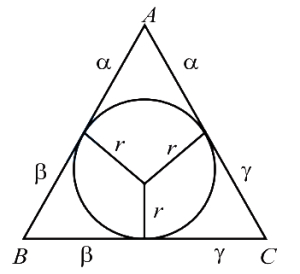
If $\alpha, \beta, \gamma$ are the lengths of the tangents from the vertices of a triangle to its incircle,then:
A
$\alpha+\beta+\gamma=\frac{1}{r^2}(\alpha \beta \gamma)$
B
$\frac{1}{\alpha}+\frac{1}{\beta}+\frac{1}{\gamma}=r(\alpha \beta \gamma)$
C
$\alpha+\beta+\gamma=\frac{1}{r}(\alpha \beta \gamma)$
D
$\alpha^2+\beta^2+\gamma^2=\frac{2}{r}(\alpha \beta \gamma)$
Solution
(A) Let $\alpha, \beta, \gamma$ be the lengths of the tangents from vertices $A, B, C$ to the incircle respectively.
Then the sides of the triangle are $a = \beta + \gamma$,$b = \alpha + \gamma$,and $c = \alpha + \beta$.
The semi-perimeter $s$ is given by $s = \frac{a+b+c}{2} = \frac{(\beta+\gamma) + (\alpha+\gamma) + (\alpha+\beta)}{2} = \alpha + \beta + \gamma$.
The area of the triangle $\Delta$ is given by Heron's formula: $\Delta = \sqrt{s(s-a)(s-b)(s-c)}$.
Substituting the values: $\Delta = \sqrt{(\alpha+\beta+\gamma)(\alpha)(\beta)(\gamma)} = \sqrt{s \alpha \beta \gamma}$.
We know that the inradius $r$ is given by $r = \frac{\Delta}{s}$.
Therefore,$r^2 = \frac{\Delta^2}{s^2} = \frac{s \alpha \beta \gamma}{s^2} = \frac{\alpha \beta \gamma}{s}$.
Substituting $s = \alpha + \beta + \gamma$,we get $r^2 = \frac{\alpha \beta \gamma}{\alpha + \beta + \gamma}$.
Thus,$\alpha + \beta + \gamma = \frac{\alpha \beta \gamma}{r^2}$.
Then the sides of the triangle are $a = \beta + \gamma$,$b = \alpha + \gamma$,and $c = \alpha + \beta$.
The semi-perimeter $s$ is given by $s = \frac{a+b+c}{2} = \frac{(\beta+\gamma) + (\alpha+\gamma) + (\alpha+\beta)}{2} = \alpha + \beta + \gamma$.
The area of the triangle $\Delta$ is given by Heron's formula: $\Delta = \sqrt{s(s-a)(s-b)(s-c)}$.
Substituting the values: $\Delta = \sqrt{(\alpha+\beta+\gamma)(\alpha)(\beta)(\gamma)} = \sqrt{s \alpha \beta \gamma}$.
We know that the inradius $r$ is given by $r = \frac{\Delta}{s}$.
Therefore,$r^2 = \frac{\Delta^2}{s^2} = \frac{s \alpha \beta \gamma}{s^2} = \frac{\alpha \beta \gamma}{s}$.
Substituting $s = \alpha + \beta + \gamma$,we get $r^2 = \frac{\alpha \beta \gamma}{\alpha + \beta + \gamma}$.
Thus,$\alpha + \beta + \gamma = \frac{\alpha \beta \gamma}{r^2}$.
0 likesView Solution
257
MathematicsMediumMCQAP EAMCET · 2017
In a triangle $ABC$,if $2r_1 = 3r_2 = r_3$,then $a : b : c =$
A
$4 : 3 : 5$
B
$3 : 4 : 5$
C
$5 : 3 : 4$
D
$3 : 5 : 4$
Solution
(A) We know that the exradii of a triangle are given by $r_1 = \frac{\Delta}{s-a}$,$r_2 = \frac{\Delta}{s-b}$,and $r_3 = \frac{\Delta}{s-c}$.
Given $2r_1 = 3r_2 = r_3 = k$ (let).
Then $r_1 = \frac{k}{2}$,$r_2 = \frac{k}{3}$,and $r_3 = k$.
Thus,$\frac{1}{r_1} = \frac{2}{k}$,$\frac{1}{r_2} = \frac{3}{k}$,and $\frac{1}{r_3} = \frac{1}{k}$.
We know that $\frac{1}{r_1} = \frac{s-a}{\Delta}$,$\frac{1}{r_2} = \frac{s-b}{\Delta}$,and $\frac{1}{r_3} = \frac{s-c}{\Delta}$.
Summing these,$\frac{1}{r_1} + \frac{1}{r_2} + \frac{1}{r_3} = \frac{3s - (a+b+c)}{\Delta} = \frac{3s - 2s}{\Delta} = \frac{s}{\Delta} = \frac{1}{r}$.
Also,$\frac{1}{r_1} + \frac{1}{r_2} + \frac{1}{r_3} = \frac{2}{k} + \frac{3}{k} + \frac{1}{k} = \frac{6}{k} = \frac{1}{r}$,so $r = \frac{k}{6}$.
Using $s-a = \frac{\Delta}{r_1} = \frac{\Delta}{k/2} = \frac{2\Delta}{k}$,$s-b = \frac{3\Delta}{k}$,and $s-c = \frac{\Delta}{k}$.
Since $s = \frac{6\Delta}{k}$,we have $a = s - (s-a) = \frac{6\Delta}{k} - \frac{2\Delta}{k} = \frac{4\Delta}{k}$,$b = \frac{3\Delta}{k}$,and $c = \frac{5\Delta}{k}$.
Therefore,$a : b : c = 4 : 3 : 5$.
Given $2r_1 = 3r_2 = r_3 = k$ (let).
Then $r_1 = \frac{k}{2}$,$r_2 = \frac{k}{3}$,and $r_3 = k$.
Thus,$\frac{1}{r_1} = \frac{2}{k}$,$\frac{1}{r_2} = \frac{3}{k}$,and $\frac{1}{r_3} = \frac{1}{k}$.
We know that $\frac{1}{r_1} = \frac{s-a}{\Delta}$,$\frac{1}{r_2} = \frac{s-b}{\Delta}$,and $\frac{1}{r_3} = \frac{s-c}{\Delta}$.
Summing these,$\frac{1}{r_1} + \frac{1}{r_2} + \frac{1}{r_3} = \frac{3s - (a+b+c)}{\Delta} = \frac{3s - 2s}{\Delta} = \frac{s}{\Delta} = \frac{1}{r}$.
Also,$\frac{1}{r_1} + \frac{1}{r_2} + \frac{1}{r_3} = \frac{2}{k} + \frac{3}{k} + \frac{1}{k} = \frac{6}{k} = \frac{1}{r}$,so $r = \frac{k}{6}$.
Using $s-a = \frac{\Delta}{r_1} = \frac{\Delta}{k/2} = \frac{2\Delta}{k}$,$s-b = \frac{3\Delta}{k}$,and $s-c = \frac{\Delta}{k}$.
Since $s = \frac{6\Delta}{k}$,we have $a = s - (s-a) = \frac{6\Delta}{k} - \frac{2\Delta}{k} = \frac{4\Delta}{k}$,$b = \frac{3\Delta}{k}$,and $c = \frac{5\Delta}{k}$.
Therefore,$a : b : c = 4 : 3 : 5$.
0 likesView Solution
258
MathematicsDifficultMCQAP EAMCET · 2017
If $a < 1$ and $2 \operatorname{Sinh}^{-1}\left(\frac{a}{\sqrt{1-a^2}}\right)=\log \left(\frac{1+x}{1-x}\right)$,then $x=$
A
$2a$
B
$3a$
C
$4a$
D
$a$
Solution
(D) We know that $\operatorname{Sinh}^{-1}(y) = \log(y + \sqrt{y^2+1})$.
Let $y = \frac{a}{\sqrt{1-a^2}}$.
Then $y^2+1 = \frac{a^2}{1-a^2} + 1 = \frac{a^2+1-a^2}{1-a^2} = \frac{1}{1-a^2}$.
So,$\sqrt{y^2+1} = \frac{1}{\sqrt{1-a^2}}$ (since $a < 1$).
Thus,$\operatorname{Sinh}^{-1}\left(\frac{a}{\sqrt{1-a^2}}\right) = \log\left(\frac{a+1}{\sqrt{1-a^2}}\right) = \log\left(\frac{a+1}{\sqrt{(1-a)(1+a)}}\right) = \log\left(\sqrt{\frac{1+a}{1-a}}\right) = \frac{1}{2} \log\left(\frac{1+a}{1-a}\right)$.
Given equation: $2 \operatorname{Sinh}^{-1}\left(\frac{a}{\sqrt{1-a^2}}\right) = \log \left(\frac{1+x}{1-x}\right)$.
Substituting the derived value: $2 \times \frac{1}{2} \log\left(\frac{1+a}{1-a}\right) = \log \left(\frac{1+x}{1-x}\right)$.
Therefore,$\log\left(\frac{1+a}{1-a}\right) = \log \left(\frac{1+x}{1-x}\right)$.
Comparing both sides,we get $x = a$.
Let $y = \frac{a}{\sqrt{1-a^2}}$.
Then $y^2+1 = \frac{a^2}{1-a^2} + 1 = \frac{a^2+1-a^2}{1-a^2} = \frac{1}{1-a^2}$.
So,$\sqrt{y^2+1} = \frac{1}{\sqrt{1-a^2}}$ (since $a < 1$).
Thus,$\operatorname{Sinh}^{-1}\left(\frac{a}{\sqrt{1-a^2}}\right) = \log\left(\frac{a+1}{\sqrt{1-a^2}}\right) = \log\left(\frac{a+1}{\sqrt{(1-a)(1+a)}}\right) = \log\left(\sqrt{\frac{1+a}{1-a}}\right) = \frac{1}{2} \log\left(\frac{1+a}{1-a}\right)$.
Given equation: $2 \operatorname{Sinh}^{-1}\left(\frac{a}{\sqrt{1-a^2}}\right) = \log \left(\frac{1+x}{1-x}\right)$.
Substituting the derived value: $2 \times \frac{1}{2} \log\left(\frac{1+a}{1-a}\right) = \log \left(\frac{1+x}{1-x}\right)$.
Therefore,$\log\left(\frac{1+a}{1-a}\right) = \log \left(\frac{1+x}{1-x}\right)$.
Comparing both sides,we get $x = a$.
0 likesView Solution
259
MathematicsMediumMCQAP EAMCET · 2017
If $\operatorname{Sinh}^{-1}(2)+\operatorname{Sinh}^{-1}(3)=\alpha$,then $\sinh \alpha=$
A
$2 \sqrt{5}+3 \sqrt{10}$
B
$3 \sqrt{10}+3 \sqrt{5}$
C
$2 \sqrt{10}+2 \sqrt{5}$
D
$2 \sqrt{10}+3 \sqrt{5}$
Solution
(D) Given $\operatorname{Sinh}^{-1}(2)+\operatorname{Sinh}^{-1}(3)=\alpha$.
Let $x = \operatorname{Sinh}^{-1}(2)$ and $y = \operatorname{Sinh}^{-1}(3)$.
Then $\sinh x = 2$ and $\sinh y = 3$.
We know that $\cosh^2 x - \sinh^2 x = 1$,so $\cosh x = \sqrt{1 + \sinh^2 x} = \sqrt{1 + 2^2} = \sqrt{5}$.
Similarly,$\cosh y = \sqrt{1 + \sinh^2 y} = \sqrt{1 + 3^2} = \sqrt{10}$.
We need to find $\sinh \alpha = \sinh(x+y)$.
Using the identity $\sinh(x+y) = \sinh x \cosh y + \cosh x \sinh y$:
$\sinh \alpha = (2)(\sqrt{10}) + (\sqrt{5})(3) = 2 \sqrt{10} + 3 \sqrt{5}$.
Let $x = \operatorname{Sinh}^{-1}(2)$ and $y = \operatorname{Sinh}^{-1}(3)$.
Then $\sinh x = 2$ and $\sinh y = 3$.
We know that $\cosh^2 x - \sinh^2 x = 1$,so $\cosh x = \sqrt{1 + \sinh^2 x} = \sqrt{1 + 2^2} = \sqrt{5}$.
Similarly,$\cosh y = \sqrt{1 + \sinh^2 y} = \sqrt{1 + 3^2} = \sqrt{10}$.
We need to find $\sinh \alpha = \sinh(x+y)$.
Using the identity $\sinh(x+y) = \sinh x \cosh y + \cosh x \sinh y$:
$\sinh \alpha = (2)(\sqrt{10}) + (\sqrt{5})(3) = 2 \sqrt{10} + 3 \sqrt{5}$.
0 likesView Solution
260
MathematicsMediumMCQAP EAMCET · 2017
If $\alpha, \beta, \gamma$ are the roots of the equation $x^3-6x^2+11x-6=0$,then $\sum \alpha^2 \beta + \sum \alpha \beta^2 =$
A
$60$
B
$66$
C
$72$
D
$48$
Solution
(D) For the cubic equation $x^3 - 6x^2 + 11x - 6 = 0$,the roots are $\alpha, \beta, \gamma$.
From Vieta's formulas:
$\sum \alpha = 6$,
$\sum \alpha \beta = 11$,
$\alpha \beta \gamma = 6$.
We need to find $\sum \alpha^2 \beta + \sum \alpha \beta^2$.
This expression can be written as $(\sum \alpha \beta)(\sum \alpha) - 3 \alpha \beta \gamma$.
Substituting the values:
$(11)(6) - 3(6) = 66 - 18 = 48$.
Wait,let us re-evaluate the expression:
$(\alpha + \beta + \gamma)(\alpha \beta + \beta \gamma + \gamma \alpha) = \sum \alpha^2 \beta + \sum \alpha \beta^2 + 3 \alpha \beta \gamma$.
So,$\sum \alpha^2 \beta + \sum \alpha \beta^2 = (\sum \alpha)(\sum \alpha \beta) - 3 \alpha \beta \gamma$.
$= (6)(11) - 3(6) = 66 - 18 = 48$.
Given the options provided,there might be a typo in the original equation constant. If the equation was $x^3 - 6x^2 + 11x - 6 = 0$,the roots are $1, 2, 3$.
Then $\sum \alpha^2 \beta + \sum \alpha \beta^2 = (1^2 \cdot 2 + 1^2 \cdot 3 + 2^2 \cdot 1 + 2^2 \cdot 3 + 3^2 \cdot 1 + 3^2 \cdot 2) = 2 + 3 + 4 + 12 + 9 + 18 = 48$.
If the constant was different,the result would change. Based on the standard form,the answer is $48$.
From Vieta's formulas:
$\sum \alpha = 6$,
$\sum \alpha \beta = 11$,
$\alpha \beta \gamma = 6$.
We need to find $\sum \alpha^2 \beta + \sum \alpha \beta^2$.
This expression can be written as $(\sum \alpha \beta)(\sum \alpha) - 3 \alpha \beta \gamma$.
Substituting the values:
$(11)(6) - 3(6) = 66 - 18 = 48$.
Wait,let us re-evaluate the expression:
$(\alpha + \beta + \gamma)(\alpha \beta + \beta \gamma + \gamma \alpha) = \sum \alpha^2 \beta + \sum \alpha \beta^2 + 3 \alpha \beta \gamma$.
So,$\sum \alpha^2 \beta + \sum \alpha \beta^2 = (\sum \alpha)(\sum \alpha \beta) - 3 \alpha \beta \gamma$.
$= (6)(11) - 3(6) = 66 - 18 = 48$.
Given the options provided,there might be a typo in the original equation constant. If the equation was $x^3 - 6x^2 + 11x - 6 = 0$,the roots are $1, 2, 3$.
Then $\sum \alpha^2 \beta + \sum \alpha \beta^2 = (1^2 \cdot 2 + 1^2 \cdot 3 + 2^2 \cdot 1 + 2^2 \cdot 3 + 3^2 \cdot 1 + 3^2 \cdot 2) = 2 + 3 + 4 + 12 + 9 + 18 = 48$.
If the constant was different,the result would change. Based on the standard form,the answer is $48$.
0 likesView Solution
261
MathematicsMediumMCQAP EAMCET · 2017
If the roots of the equation $x^3+3px^2+3qx-8=0$ are in a geometric progression,then $\frac{q^3}{p^3}=$
A
$1$
B
-$2$
C
$4$
D
-$8$
Solution
(D) Let the roots of the cubic equation $x^3+3px^2+3qx-8=0$ be $\frac{a}{r}, a, ar$.
From the relation between roots and coefficients,the product of the roots is $\frac{a}{r} \times a \times ar = -(-8) = 8$.
Thus,$a^3 = 8$,which implies $a = 2$.
Since $a=2$ is a root,it must satisfy the equation: $(2)^3 + 3p(2)^2 + 3q(2) - 8 = 0$.
$8 + 12p + 6q - 8 = 0$,which simplifies to $12p + 6q = 0$,or $q = -2p$.
Substituting $q = -2p$ into the expression $\frac{q^3}{p^3}$,we get $\frac{(-2p)^3}{p^3} = \frac{-8p^3}{p^3} = -8$.
From the relation between roots and coefficients,the product of the roots is $\frac{a}{r} \times a \times ar = -(-8) = 8$.
Thus,$a^3 = 8$,which implies $a = 2$.
Since $a=2$ is a root,it must satisfy the equation: $(2)^3 + 3p(2)^2 + 3q(2) - 8 = 0$.
$8 + 12p + 6q - 8 = 0$,which simplifies to $12p + 6q = 0$,or $q = -2p$.
Substituting $q = -2p$ into the expression $\frac{q^3}{p^3}$,we get $\frac{(-2p)^3}{p^3} = \frac{-8p^3}{p^3} = -8$.
0 likesView Solution
262
MathematicsEasyMCQAP EAMCET · 2017
Among the following functions defined on $R$ into $R$,the constant function is
A
$\frac{3}{5+4 \sin 3x}$
B
$\frac{1}{2-\cos 3x}$
C
$\cos^2 x + \cos^2(x + \frac{\pi}{3}) - \cos x \cdot \cos(x + \frac{\pi}{3})$
D
$\frac{15}{3 \sin x + 4 \cos x + 10}$
Solution
(C) Let $f(x) = \cos^2 x + \cos^2(x + \frac{\pi}{3}) - \cos x \cdot \cos(x + \frac{\pi}{3})$.
Using the identity $\cos^2 A + \cos^2 B - 2 \cos A \cos B \cos(A-B) = \sin^2(A-B)$,we simplify the expression.
Alternatively,expand the terms:
$f(x) = \cos^2 x + (\cos x \cos \frac{\pi}{3} - \sin x \sin \frac{\pi}{3})^2 - \cos x (\cos x \cos \frac{\pi}{3} - \sin x \sin \frac{\pi}{3})$
$f(x) = \cos^2 x + (\frac{1}{2} \cos x - \frac{\sqrt{3}}{2} \sin x)^2 - \cos x (\frac{1}{2} \cos x - \frac{\sqrt{3}}{2} \sin x)$
$f(x) = \cos^2 x + (\frac{1}{4} \cos^2 x + \frac{3}{4} \sin^2 x - \frac{\sqrt{3}}{2} \sin x \cos x) - \frac{1}{2} \cos^2 x + \frac{\sqrt{3}}{2} \sin x \cos x$
$f(x) = (1 + \frac{1}{4} - \frac{1}{2}) \cos^2 x + \frac{3}{4} \sin^2 x = \frac{3}{4} \cos^2 x + \frac{3}{4} \sin^2 x = \frac{3}{4}(\cos^2 x + \sin^2 x) = \frac{3}{4}$.
Since $f(x) = \frac{3}{4}$ for all $x \in R$,it is a constant function.
Using the identity $\cos^2 A + \cos^2 B - 2 \cos A \cos B \cos(A-B) = \sin^2(A-B)$,we simplify the expression.
Alternatively,expand the terms:
$f(x) = \cos^2 x + (\cos x \cos \frac{\pi}{3} - \sin x \sin \frac{\pi}{3})^2 - \cos x (\cos x \cos \frac{\pi}{3} - \sin x \sin \frac{\pi}{3})$
$f(x) = \cos^2 x + (\frac{1}{2} \cos x - \frac{\sqrt{3}}{2} \sin x)^2 - \cos x (\frac{1}{2} \cos x - \frac{\sqrt{3}}{2} \sin x)$
$f(x) = \cos^2 x + (\frac{1}{4} \cos^2 x + \frac{3}{4} \sin^2 x - \frac{\sqrt{3}}{2} \sin x \cos x) - \frac{1}{2} \cos^2 x + \frac{\sqrt{3}}{2} \sin x \cos x$
$f(x) = (1 + \frac{1}{4} - \frac{1}{2}) \cos^2 x + \frac{3}{4} \sin^2 x = \frac{3}{4} \cos^2 x + \frac{3}{4} \sin^2 x = \frac{3}{4}(\cos^2 x + \sin^2 x) = \frac{3}{4}$.
Since $f(x) = \frac{3}{4}$ for all $x \in R$,it is a constant function.
0 likesView Solution
263
MathematicsMediumMCQAP EAMCET · 2017
The shortest distance between the line $y-x=1$ and the curve $x=y^2$ is
A
$\frac{2 \sqrt{3}}{8}$
B
$\frac{3 \sqrt{2}}{5}$
C
$\frac{\sqrt{3}}{4}$
D
$\frac{3 \sqrt{2}}{8}$
Solution
(D) The given line is $x - y + 1 = 0$. The curve is $x = y^2$.
Let a point on the curve be $P(y^2, y)$.
The distance $d$ from point $P$ to the line $x - y + 1 = 0$ is given by $d = \frac{|y^2 - y + 1|}{\sqrt{1^2 + (-1)^2}} = \frac{|y^2 - y + 1|}{\sqrt{2}}$.
Since $y^2 - y + 1 > 0$ for all real $y$,we have $d = \frac{y^2 - y + 1}{\sqrt{2}}$.
To find the shortest distance,we minimize $f(y) = y^2 - y + 1$.
Taking the derivative,$f'(y) = 2y - 1$. Setting $f'(y) = 0$ gives $y = \frac{1}{2}$.
The minimum value is $f(\frac{1}{2}) = (\frac{1}{2})^2 - \frac{1}{2} + 1 = \frac{1}{4} - \frac{1}{2} + 1 = \frac{3}{4}$.
Thus,the shortest distance is $d = \frac{3/4}{\sqrt{2}} = \frac{3}{4 \sqrt{2}} = \frac{3 \sqrt{2}}{8}$.
Let a point on the curve be $P(y^2, y)$.
The distance $d$ from point $P$ to the line $x - y + 1 = 0$ is given by $d = \frac{|y^2 - y + 1|}{\sqrt{1^2 + (-1)^2}} = \frac{|y^2 - y + 1|}{\sqrt{2}}$.
Since $y^2 - y + 1 > 0$ for all real $y$,we have $d = \frac{y^2 - y + 1}{\sqrt{2}}$.
To find the shortest distance,we minimize $f(y) = y^2 - y + 1$.
Taking the derivative,$f'(y) = 2y - 1$. Setting $f'(y) = 0$ gives $y = \frac{1}{2}$.
The minimum value is $f(\frac{1}{2}) = (\frac{1}{2})^2 - \frac{1}{2} + 1 = \frac{1}{4} - \frac{1}{2} + 1 = \frac{3}{4}$.
Thus,the shortest distance is $d = \frac{3/4}{\sqrt{2}} = \frac{3}{4 \sqrt{2}} = \frac{3 \sqrt{2}}{8}$.
0 likesView Solution
264
MathematicsMediumMCQAP EAMCET · 2017
If $A=(5,4,2), B=(6,2,-1), C=(8,-2,-7)$,then the harmonic conjugate of $A$ with respect to $B$ and $C$ is
A
$(7,0,-3)$
B
$(\frac{13}{2},-1, \frac{-5}{2})$
C
$(\frac{13}{2}, 1, \frac{-5}{2})$
D
$(\frac{11}{2}, 3, \frac{1}{2})$
Solution
(C) The harmonic conjugate of a point $A$ with respect to points $B$ and $C$ is a point $P$ that divides the line segment $BC$ externally in the ratio of the distances $AB$ and $AC$.
First,we calculate the distances $AB$ and $AC$:
$AB = \sqrt{(6-5)^2 + (2-4)^2 + (-1-2)^2} = \sqrt{1^2 + (-2)^2 + (-3)^2} = \sqrt{1+4+9} = \sqrt{14}$.
$AC = \sqrt{(8-5)^2 + (-2-4)^2 + (-7-2)^2} = \sqrt{3^2 + (-6)^2 + (-9)^2} = \sqrt{9+36+81} = \sqrt{126} = 3\sqrt{14}$.
The ratio $m:n = AB:AC = \sqrt{14} : 3\sqrt{14} = 1:3$.
Since $P$ divides $BC$ externally in the ratio $1:3$,the coordinates of $P$ are given by the section formula for external division:
$P = \left(\frac{m x_2 - n x_1}{m-n}, \frac{m y_2 - n y_1}{m-n}, \frac{m z_2 - n z_1}{m-n}\right)$
Substituting $m=1, n=3, B=(6,2,-1), C=(8,-2,-7)$:
$x = \frac{1(8) - 3(6)}{1-3} = \frac{8-18}{-2} = \frac{-10}{-2} = 5$.
Wait,let us re-evaluate the definition. The harmonic conjugate $P$ of $A$ with respect to $B$ and $C$ means $A$ divides $BC$ internally in ratio $k$ and $P$ divides $BC$ externally in ratio $k$.
$A$ divides $BC$ in ratio $k:1$.
$5 = \frac{k(8) + 1(6)}{k+1} \implies 5k+5 = 8k+6 \implies 3k = -1 \implies k = -1/3$.
Since $k$ is negative,$A$ divides $BC$ externally.
Using the property that $P$ is the harmonic conjugate,$P$ divides $BC$ internally in the same ratio $1:3$.
$P = \left(\frac{1(8) + 3(6)}{1+3}, \frac{1(-2) + 3(2)}{1+3}, \frac{1(-7) + 3(-1)}{1+3}\right) = \left(\frac{26}{4}, \frac{4}{4}, \frac{-10}{4}\right) = (6.5, 1, -2.5) = (\frac{13}{2}, 1, \frac{-5}{2})$.
Thus,the correct option is $C$.
First,we calculate the distances $AB$ and $AC$:
$AB = \sqrt{(6-5)^2 + (2-4)^2 + (-1-2)^2} = \sqrt{1^2 + (-2)^2 + (-3)^2} = \sqrt{1+4+9} = \sqrt{14}$.
$AC = \sqrt{(8-5)^2 + (-2-4)^2 + (-7-2)^2} = \sqrt{3^2 + (-6)^2 + (-9)^2} = \sqrt{9+36+81} = \sqrt{126} = 3\sqrt{14}$.
The ratio $m:n = AB:AC = \sqrt{14} : 3\sqrt{14} = 1:3$.
Since $P$ divides $BC$ externally in the ratio $1:3$,the coordinates of $P$ are given by the section formula for external division:
$P = \left(\frac{m x_2 - n x_1}{m-n}, \frac{m y_2 - n y_1}{m-n}, \frac{m z_2 - n z_1}{m-n}\right)$
Substituting $m=1, n=3, B=(6,2,-1), C=(8,-2,-7)$:
$x = \frac{1(8) - 3(6)}{1-3} = \frac{8-18}{-2} = \frac{-10}{-2} = 5$.
Wait,let us re-evaluate the definition. The harmonic conjugate $P$ of $A$ with respect to $B$ and $C$ means $A$ divides $BC$ internally in ratio $k$ and $P$ divides $BC$ externally in ratio $k$.
$A$ divides $BC$ in ratio $k:1$.
$5 = \frac{k(8) + 1(6)}{k+1} \implies 5k+5 = 8k+6 \implies 3k = -1 \implies k = -1/3$.
Since $k$ is negative,$A$ divides $BC$ externally.
Using the property that $P$ is the harmonic conjugate,$P$ divides $BC$ internally in the same ratio $1:3$.
$P = \left(\frac{1(8) + 3(6)}{1+3}, \frac{1(-2) + 3(2)}{1+3}, \frac{1(-7) + 3(-1)}{1+3}\right) = \left(\frac{26}{4}, \frac{4}{4}, \frac{-10}{4}\right) = (6.5, 1, -2.5) = (\frac{13}{2}, 1, \frac{-5}{2})$.
Thus,the correct option is $C$.
0 likesView Solution
265
MathematicsEasyMCQAP EAMCET · 2017
The points $A(2, 3, 5)$,$B(-1, 5, -1)$,and $C(4, -3, 2)$ form:
A
a right angled but not an isosceles triangle
B
an isosceles but not a right angled triangle
C
an equilateral triangle
D
an isosceles right angled triangle
Solution
(D) Let the points be $A(2, 3, 5)$,$B(-1, 5, -1)$,and $C(4, -3, 2)$.
Calculate the squared distances between the points using the distance formula $d^2 = (x_2 - x_1)^2 + (y_2 - y_1)^2 + (z_2 - z_1)^2$:
$AB^2 = (-1 - 2)^2 + (5 - 3)^2 + (-1 - 5)^2 = (-3)^2 + (2)^2 + (-6)^2 = 9 + 4 + 36 = 49$.
$BC^2 = (4 - (-1))^2 + (-3 - 5)^2 + (2 - (-1))^2 = (5)^2 + (-8)^2 + (3)^2 = 25 + 64 + 9 = 98$.
$AC^2 = (4 - 2)^2 + (-3 - 3)^2 + (2 - 5)^2 = (2)^2 + (-6)^2 + (-3)^2 = 4 + 36 + 9 = 49$.
Since $AB^2 = AC^2 = 49$,the triangle is isosceles because $AB = AC = 7$.
Check for the right-angled condition: $AB^2 + AC^2 = 49 + 49 = 98 = BC^2$.
Since the sum of the squares of two sides equals the square of the third side,the triangle is a right-angled triangle.
Thus,the triangle is an isosceles right-angled triangle.
Calculate the squared distances between the points using the distance formula $d^2 = (x_2 - x_1)^2 + (y_2 - y_1)^2 + (z_2 - z_1)^2$:
$AB^2 = (-1 - 2)^2 + (5 - 3)^2 + (-1 - 5)^2 = (-3)^2 + (2)^2 + (-6)^2 = 9 + 4 + 36 = 49$.
$BC^2 = (4 - (-1))^2 + (-3 - 5)^2 + (2 - (-1))^2 = (5)^2 + (-8)^2 + (3)^2 = 25 + 64 + 9 = 98$.
$AC^2 = (4 - 2)^2 + (-3 - 3)^2 + (2 - 5)^2 = (2)^2 + (-6)^2 + (-3)^2 = 4 + 36 + 9 = 49$.
Since $AB^2 = AC^2 = 49$,the triangle is isosceles because $AB = AC = 7$.
Check for the right-angled condition: $AB^2 + AC^2 = 49 + 49 = 98 = BC^2$.
Since the sum of the squares of two sides equals the square of the third side,the triangle is a right-angled triangle.
Thus,the triangle is an isosceles right-angled triangle.
0 likesView Solution
266
MathematicsEasyMCQAP EAMCET · 2017
The circumcentre of the triangle formed by the points $A(3,4,5)$,$B(2,3,1)$,and $C(-1,6,1)$ is:
A
$\left(\frac{1}{2}, \frac{9}{2}, 1\right)$
B
$(2,3,1)$
C
$(1,5,3)$
D
$\left(\frac{4}{3}, \frac{13}{3}, \frac{7}{3}\right)$
Solution
(C) Let the circumcentre be $P(x, y, z)$. The circumcentre is equidistant from the vertices $A, B$,and $C$. Thus,$PA^2 = PB^2 = PC^2$.
$PA^2 = (x-3)^2 + (y-4)^2 + (z-5)^2$
$PB^2 = (x-2)^2 + (y-3)^2 + (z-1)^2$
$PC^2 = (x+1)^2 + (y-6)^2 + (z-1)^2$
Equating $PB^2 = PC^2$:
$(x-2)^2 + (y-3)^2 + (z-1)^2 = (x+1)^2 + (y-6)^2 + (z-1)^2$
$x^2 - 4x + 4 + y^2 - 6y + 9 = x^2 + 2x + 1 + y^2 - 12y + 36$
$-6x + 6y = 24 \implies -x + y = 4 \implies y = x + 4$.
Equating $PA^2 = PB^2$:
$(x-3)^2 + (y-4)^2 + (z-5)^2 = (x-2)^2 + (y-3)^2 + (z-1)^2$
Substitute $y = x+4$:
$(x-3)^2 + (x+4-4)^2 + (z-5)^2 = (x-2)^2 + (x+4-3)^2 + (z-1)^2$
$(x-3)^2 + x^2 + (z-5)^2 = (x-2)^2 + (x+1)^2 + (z-1)^2$
$x^2 - 6x + 9 + x^2 + z^2 - 10z + 25 = x^2 - 4x + 4 + x^2 + 2x + 1 + z^2 - 2z + 1$
$-6x - 10z + 34 = -2x - 2z + 6$
$-4x - 8z = -28 \implies x + 2z = 7 \implies z = \frac{7-x}{2}$.
Since $P$ lies on the plane of the triangle,we check the options. For option $C(1, 5, 3)$:
$y = 1+4 = 5$ (Matches).
$z = (7-1)/2 = 3$ (Matches).
Thus,the circumcentre is $(1, 5, 3)$.
$PA^2 = (x-3)^2 + (y-4)^2 + (z-5)^2$
$PB^2 = (x-2)^2 + (y-3)^2 + (z-1)^2$
$PC^2 = (x+1)^2 + (y-6)^2 + (z-1)^2$
Equating $PB^2 = PC^2$:
$(x-2)^2 + (y-3)^2 + (z-1)^2 = (x+1)^2 + (y-6)^2 + (z-1)^2$
$x^2 - 4x + 4 + y^2 - 6y + 9 = x^2 + 2x + 1 + y^2 - 12y + 36$
$-6x + 6y = 24 \implies -x + y = 4 \implies y = x + 4$.
Equating $PA^2 = PB^2$:
$(x-3)^2 + (y-4)^2 + (z-5)^2 = (x-2)^2 + (y-3)^2 + (z-1)^2$
Substitute $y = x+4$:
$(x-3)^2 + (x+4-4)^2 + (z-5)^2 = (x-2)^2 + (x+4-3)^2 + (z-1)^2$
$(x-3)^2 + x^2 + (z-5)^2 = (x-2)^2 + (x+1)^2 + (z-1)^2$
$x^2 - 6x + 9 + x^2 + z^2 - 10z + 25 = x^2 - 4x + 4 + x^2 + 2x + 1 + z^2 - 2z + 1$
$-6x - 10z + 34 = -2x - 2z + 6$
$-4x - 8z = -28 \implies x + 2z = 7 \implies z = \frac{7-x}{2}$.
Since $P$ lies on the plane of the triangle,we check the options. For option $C(1, 5, 3)$:
$y = 1+4 = 5$ (Matches).
$z = (7-1)/2 = 3$ (Matches).
Thus,the circumcentre is $(1, 5, 3)$.
0 likesView Solution
267
MathematicsEasyMCQAP EAMCET · 2017
In the triangle with vertices $A(3,2,0)$,$B(5,3,2)$,and $C(-9,6,-3)$,the bisector of $\angle BAC$ meets $BC$ at $D$. The coordinates of $D$ are
A
$\left(\frac{57}{16}, \frac{38}{16}, \frac{17}{16}\right)$
B
$\left(\frac{38}{16}, \frac{57}{16}, \frac{17}{16}\right)$
C
$\left(\frac{38}{16}, \frac{17}{16}, \frac{57}{16}\right)$
D
$\left(\frac{17}{16}, \frac{38}{16}, \frac{57}{16}\right)$
Solution
(B) The angle bisector theorem states that the bisector of $\angle BAC$ divides the opposite side $BC$ in the ratio of the sides adjacent to the angle,i.e.,$BD/DC = AB/AC$.
First,calculate the lengths of sides $AB$ and $AC$:
$AB = \sqrt{(5-3)^2 + (3-2)^2 + (2-0)^2} = \sqrt{2^2 + 1^2 + 2^2} = \sqrt{4+1+4} = \sqrt{9} = 3$.
$AC = \sqrt{(-9-3)^2 + (6-2)^2 + (-3-0)^2} = \sqrt{(-12)^2 + 4^2 + (-3)^2} = \sqrt{144 + 16 + 9} = \sqrt{169} = 13$.
Thus,the ratio $BD:DC = AB:AC = 3:13$.
Using the section formula,the coordinates of $D$ are given by:
$D = \left(\frac{m x_2 + n x_1}{m+n}, \frac{m y_2 + n y_1}{m+n}, \frac{m z_2 + n z_1}{m+n}\right)$ where $m=3, n=13$,$B(5,3,2)$,and $C(-9,6,-3)$.
$x = \frac{3(-9) + 13(5)}{3+13} = \frac{-27 + 65}{16} = \frac{38}{16}$.
$y = \frac{3(6) + 13(3)}{3+13} = \frac{18 + 39}{16} = \frac{57}{16}$.
$z = \frac{3(-3) + 13(2)}{3+13} = \frac{-9 + 26}{16} = \frac{17}{16}$.
Therefore,the coordinates of $D$ are $\left(\frac{38}{16}, \frac{57}{16}, \frac{17}{16}\right)$.
First,calculate the lengths of sides $AB$ and $AC$:
$AB = \sqrt{(5-3)^2 + (3-2)^2 + (2-0)^2} = \sqrt{2^2 + 1^2 + 2^2} = \sqrt{4+1+4} = \sqrt{9} = 3$.
$AC = \sqrt{(-9-3)^2 + (6-2)^2 + (-3-0)^2} = \sqrt{(-12)^2 + 4^2 + (-3)^2} = \sqrt{144 + 16 + 9} = \sqrt{169} = 13$.
Thus,the ratio $BD:DC = AB:AC = 3:13$.
Using the section formula,the coordinates of $D$ are given by:
$D = \left(\frac{m x_2 + n x_1}{m+n}, \frac{m y_2 + n y_1}{m+n}, \frac{m z_2 + n z_1}{m+n}\right)$ where $m=3, n=13$,$B(5,3,2)$,and $C(-9,6,-3)$.
$x = \frac{3(-9) + 13(5)}{3+13} = \frac{-27 + 65}{16} = \frac{38}{16}$.
$y = \frac{3(6) + 13(3)}{3+13} = \frac{18 + 39}{16} = \frac{57}{16}$.
$z = \frac{3(-3) + 13(2)}{3+13} = \frac{-9 + 26}{16} = \frac{17}{16}$.
Therefore,the coordinates of $D$ are $\left(\frac{38}{16}, \frac{57}{16}, \frac{17}{16}\right)$.
0 likesView Solution
268
MathematicsMediumMCQAP EAMCET · 2017
The mean deviation from the mean of the data given below is
| $\text{Marks}$ | $10$ | $15$ | $20$ | $25$ | $30$ |
| $\text{Number of students}$ | $2$ | $4$ | $6$ | $8$ | $5$ |
A
$5$
B
$5.12$
C
$5.25$
D
$5.6$
Solution
(B) Step $1$: Calculate the mean $(\bar{x})$.
$\bar{x} = \frac{\sum f_i x_i}{\sum f_i} = \frac{(10 \times 2) + (15 \times 4) + (20 \times 6) + (25 \times 8) + (30 \times 5)}{2 + 4 + 6 + 8 + 5} = \frac{20 + 60 + 120 + 200 + 150}{25} = \frac{550}{25} = 22$.
Step $2$: Calculate the mean deviation about the mean $(\text{M.D.}(\bar{x}))$.
$\text{M.D.}(\bar{x}) = \frac{\sum f_i |x_i - \bar{x}|}{\sum f_i}$.
$|10 - 22| = 12, |15 - 22| = 7, |20 - 22| = 2, |25 - 22| = 3, |30 - 22| = 8$.
$\text{M.D.}(\bar{x}) = \frac{(2 \times 12) + (4 \times 7) + (6 \times 2) + (8 \times 3) + (5 \times 8)}{25} = \frac{24 + 28 + 12 + 24 + 40}{25} = \frac{128}{25} = 5.12$.
$\bar{x} = \frac{\sum f_i x_i}{\sum f_i} = \frac{(10 \times 2) + (15 \times 4) + (20 \times 6) + (25 \times 8) + (30 \times 5)}{2 + 4 + 6 + 8 + 5} = \frac{20 + 60 + 120 + 200 + 150}{25} = \frac{550}{25} = 22$.
Step $2$: Calculate the mean deviation about the mean $(\text{M.D.}(\bar{x}))$.
$\text{M.D.}(\bar{x}) = \frac{\sum f_i |x_i - \bar{x}|}{\sum f_i}$.
$|10 - 22| = 12, |15 - 22| = 7, |20 - 22| = 2, |25 - 22| = 3, |30 - 22| = 8$.
$\text{M.D.}(\bar{x}) = \frac{(2 \times 12) + (4 \times 7) + (6 \times 2) + (8 \times 3) + (5 \times 8)}{25} = \frac{24 + 28 + 12 + 24 + 40}{25} = \frac{128}{25} = 5.12$.
0 likesView Solution
269
MathematicsMediumMCQAP EAMCET · 2017
Three faces of a fair die are yellow,two faces are red and one face is blue. If the die is tossed $3$ times,then the probability that the colours yellow,red and blue appear is (need not be in that order).
A
$\frac{1}{36}$
B
$\frac{1}{6}$
C
$\frac{5}{6}$
D
$\frac{1}{2}$
Solution
(B) The probabilities of getting yellow $(Y)$,red $(R)$,and blue $(B)$ in a single toss are: $P(Y) = \frac{3}{6} = \frac{1}{2}$,$P(R) = \frac{2}{6} = \frac{1}{3}$,and $P(B) = \frac{1}{6}$.
We want the probability that in $3$ tosses,we get one yellow,one red,and one blue face.
The number of ways to arrange the sequence $(Y, R, B)$ is $3! = 6$.
The probability of any one such sequence (e.g.,$Y, R, B$) is $P(Y) \times P(R) \times P(B) = \frac{1}{2} \times \frac{1}{3} \times \frac{1}{6} = \frac{1}{36}$.
Since there are $6$ such permutations,the total probability is $6 \times \frac{1}{36} = \frac{6}{36} = \frac{1}{6}$.
We want the probability that in $3$ tosses,we get one yellow,one red,and one blue face.
The number of ways to arrange the sequence $(Y, R, B)$ is $3! = 6$.
The probability of any one such sequence (e.g.,$Y, R, B$) is $P(Y) \times P(R) \times P(B) = \frac{1}{2} \times \frac{1}{3} \times \frac{1}{6} = \frac{1}{36}$.
Since there are $6$ such permutations,the total probability is $6 \times \frac{1}{36} = \frac{6}{36} = \frac{1}{6}$.
0 likesView Solution
270
MathematicsMediumMCQAP EAMCET · 2017
If $5$ red roses and $5$ white roses of different sizes are used in preparing a garland,the probability that red and white roses come alternately is
A
$\frac{1}{252}$
B
$\frac{1}{126}$
C
$\frac{1}{63}$
D
$\frac{5}{126}$
Solution
(B) Total number of ways to arrange $5$ red and $5$ white roses in a garland is the number of ways to arrange $10$ distinct items in a circle,which is $(10-1)! = 9!$.
Since the roses are of different sizes,we consider them distinct.
For the roses to be placed alternately,we first fix the $5$ red roses in a circle in $(5-1)! = 4!$ ways.
This creates $5$ gaps between the red roses.
We can place the $5$ white roses in these $5$ gaps in $5!$ ways.
Thus,the number of favorable arrangements is $4! \times 5!$.
The probability is $\frac{4! \times 5!}{9!} = \frac{24 \times 120}{362880} = \frac{2880}{362880} = \frac{1}{126}$.
Since the roses are of different sizes,we consider them distinct.
For the roses to be placed alternately,we first fix the $5$ red roses in a circle in $(5-1)! = 4!$ ways.
This creates $5$ gaps between the red roses.
We can place the $5$ white roses in these $5$ gaps in $5!$ ways.
Thus,the number of favorable arrangements is $4! \times 5!$.
The probability is $\frac{4! \times 5!}{9!} = \frac{24 \times 120}{362880} = \frac{2880}{362880} = \frac{1}{126}$.
0 likesView Solution
271
MathematicsMediumMCQAP EAMCET · 2017
There are $8$ different coloured balls and $8$ bags having the same colours as that of the balls. If one ball is placed at random in each one of the bags,then the probability that $5$ of the balls are placed in the respective coloured bags,is
A
$\frac{1}{120}$
B
$\frac{1}{160}$
C
$\frac{1}{180}$
D
$\frac{1}{360}$
Solution
(D) The total number of ways to place $8$ balls in $8$ bags is $8!$.
We want to find the number of ways such that exactly $5$ balls are in their respective coloured bags.
First,we choose $5$ balls out of $8$ to be in their correct bags,which can be done in $\binom{8}{5}$ ways.
The remaining $3$ balls must be placed in the remaining $3$ bags such that none of them is in its respective coloured bag. This is a derangement of $3$ items,denoted by $D_3$.
$D_3 = 3! \times (1 - \frac{1}{1!} + \frac{1}{2!} - \frac{1}{3!}) = 6 \times (1 - 1 + 0.5 - 0.1667) = 2$.
So,the number of favorable outcomes is $\binom{8}{5} \times D_3 = \binom{8}{3} \times 2 = 56 \times 2 = 112$.
The probability is $\frac{112}{8!} = \frac{112}{40320} = \frac{1}{360}$.
We want to find the number of ways such that exactly $5$ balls are in their respective coloured bags.
First,we choose $5$ balls out of $8$ to be in their correct bags,which can be done in $\binom{8}{5}$ ways.
The remaining $3$ balls must be placed in the remaining $3$ bags such that none of them is in its respective coloured bag. This is a derangement of $3$ items,denoted by $D_3$.
$D_3 = 3! \times (1 - \frac{1}{1!} + \frac{1}{2!} - \frac{1}{3!}) = 6 \times (1 - 1 + 0.5 - 0.1667) = 2$.
So,the number of favorable outcomes is $\binom{8}{5} \times D_3 = \binom{8}{3} \times 2 = 56 \times 2 = 112$.
The probability is $\frac{112}{8!} = \frac{112}{40320} = \frac{1}{360}$.
0 likesView Solution
272
MathematicsMediumMCQAP EAMCET · 2017
If three numbers are drawn at random successively without replacement from a set $S = \{1, 2, \ldots, 10\}$,then the probability that the minimum of the chosen numbers is $3$ or their maximum is $7$ is:
A
$\frac{11}{40}$
B
$\frac{5}{40}$
C
$\frac{3}{40}$
D
$\frac{1}{40}$
Solution
(A) The total number of ways to choose $3$ numbers from $10$ is $n(S) = {}^{10}C_3 = \frac{10 \times 9 \times 8}{3 \times 2 \times 1} = 120$.
Let $A$ be the event that the minimum of the chosen numbers is $3$. This means $3$ is chosen,and the other two numbers must be chosen from $\{4, 5, 6, 7, 8, 9, 10\}$.
Thus,$n(A) = {}^{7}C_2 = 21$.
Let $B$ be the event that the maximum of the chosen numbers is $7$. This means $7$ is chosen,and the other two numbers must be chosen from $\{1, 2, 3, 4, 5, 6\}$.
Thus,$n(B) = {}^{6}C_2 = 15$.
Let $A \cap B$ be the event that the minimum is $3$ $AND$ the maximum is $7$. This means $3$ and $7$ are chosen,and the third number must be chosen from $\{4, 5, 6\}$.
Thus,$n(A \cap B) = {}^{3}C_1 = 3$.
Using the inclusion-exclusion principle,$n(A \cup B) = n(A) + n(B) - n(A \cap B) = 21 + 15 - 3 = 33$.
The required probability is $P(A \cup B) = \frac{n(A \cup B)}{n(S)} = \frac{33}{120} = \frac{11}{40}$.
Let $A$ be the event that the minimum of the chosen numbers is $3$. This means $3$ is chosen,and the other two numbers must be chosen from $\{4, 5, 6, 7, 8, 9, 10\}$.
Thus,$n(A) = {}^{7}C_2 = 21$.
Let $B$ be the event that the maximum of the chosen numbers is $7$. This means $7$ is chosen,and the other two numbers must be chosen from $\{1, 2, 3, 4, 5, 6\}$.
Thus,$n(B) = {}^{6}C_2 = 15$.
Let $A \cap B$ be the event that the minimum is $3$ $AND$ the maximum is $7$. This means $3$ and $7$ are chosen,and the third number must be chosen from $\{4, 5, 6\}$.
Thus,$n(A \cap B) = {}^{3}C_1 = 3$.
Using the inclusion-exclusion principle,$n(A \cup B) = n(A) + n(B) - n(A \cap B) = 21 + 15 - 3 = 33$.
The required probability is $P(A \cup B) = \frac{n(A \cup B)}{n(S)} = \frac{33}{120} = \frac{11}{40}$.
0 likesView Solution
273
MathematicsEasyMCQAP EAMCET · 2017
If $A$ and $B$ are any two events such that $P(\overline{A \cup B}) = \frac{1}{6}$,$P(A \cap B) = \frac{1}{4}$,and $P(\bar{A}) = \frac{1}{4}$,then the events $A$ and $B$ are
A
Equally likely but not independent
B
Equally likely and mutually exclusive
C
Mutually exclusive and independent
D
Independent but not equally likely
Solution
(D) Given $P(\bar{A}) = \frac{1}{4}$,so $P(A) = 1 - \frac{1}{4} = \frac{3}{4}$.
Given $P(\overline{A \cup B}) = \frac{1}{6}$,so $P(A \cup B) = 1 - \frac{1}{6} = \frac{5}{6}$.
Using the formula $P(A \cup B) = P(A) + P(B) - P(A \cap B)$,we have $\frac{5}{6} = \frac{3}{4} + P(B) - \frac{1}{4}$.
$\frac{5}{6} = \frac{2}{4} + P(B) = \frac{1}{2} + P(B)$.
$P(B) = \frac{5}{6} - \frac{1}{2} = \frac{5-3}{6} = \frac{2}{6} = \frac{1}{3}$.
Since $P(A) = \frac{3}{4}$ and $P(B) = \frac{1}{3}$,$P(A) \neq P(B)$,so they are not equally likely.
Check for independence: $P(A) \times P(B) = \frac{3}{4} \times \frac{1}{3} = \frac{1}{4}$.
Since $P(A \cap B) = \frac{1}{4}$,we have $P(A \cap B) = P(A) \times P(B)$,which means $A$ and $B$ are independent.
Thus,the events are independent but not equally likely.
Given $P(\overline{A \cup B}) = \frac{1}{6}$,so $P(A \cup B) = 1 - \frac{1}{6} = \frac{5}{6}$.
Using the formula $P(A \cup B) = P(A) + P(B) - P(A \cap B)$,we have $\frac{5}{6} = \frac{3}{4} + P(B) - \frac{1}{4}$.
$\frac{5}{6} = \frac{2}{4} + P(B) = \frac{1}{2} + P(B)$.
$P(B) = \frac{5}{6} - \frac{1}{2} = \frac{5-3}{6} = \frac{2}{6} = \frac{1}{3}$.
Since $P(A) = \frac{3}{4}$ and $P(B) = \frac{1}{3}$,$P(A) \neq P(B)$,so they are not equally likely.
Check for independence: $P(A) \times P(B) = \frac{3}{4} \times \frac{1}{3} = \frac{1}{4}$.
Since $P(A \cap B) = \frac{1}{4}$,we have $P(A \cap B) = P(A) \times P(B)$,which means $A$ and $B$ are independent.
Thus,the events are independent but not equally likely.
0 likesView Solution
274
MathematicsMediumMCQAP EAMCET · 2017
If $A, B$ and $C$ are mutually exclusive and exhaustive events of a random experiment such that $P(A) = \frac{2}{3} P(B)$ and $P(B) = 2 P(C)$,then $P(A \cup C) =$
A
$\frac{3}{13}$
B
$\frac{5}{13}$
C
$\frac{7}{13}$
D
$\frac{9}{13}$
Solution
(C) Since $A, B, C$ are mutually exclusive and exhaustive events,$P(A) + P(B) + P(C) = 1$.
Given $P(B) = 2 P(C)$,we can write $P(C) = \frac{1}{2} P(B)$.
Also given $P(A) = \frac{2}{3} P(B)$.
Substituting these into the sum: $\frac{2}{3} P(B) + P(B) + \frac{1}{2} P(B) = 1$.
Finding a common denominator $(6)$: $\frac{4}{6} P(B) + \frac{6}{6} P(B) + \frac{3}{6} P(B) = 1$.
$\frac{13}{6} P(B) = 1 \implies P(B) = \frac{6}{13}$.
Then $P(A) = \frac{2}{3} \times \frac{6}{13} = \frac{4}{13}$ and $P(C) = \frac{1}{2} \times \frac{6}{13} = \frac{3}{13}$.
Since $A$ and $C$ are mutually exclusive,$P(A \cup C) = P(A) + P(C) = \frac{4}{13} + \frac{3}{13} = \frac{7}{13}$.
Given $P(B) = 2 P(C)$,we can write $P(C) = \frac{1}{2} P(B)$.
Also given $P(A) = \frac{2}{3} P(B)$.
Substituting these into the sum: $\frac{2}{3} P(B) + P(B) + \frac{1}{2} P(B) = 1$.
Finding a common denominator $(6)$: $\frac{4}{6} P(B) + \frac{6}{6} P(B) + \frac{3}{6} P(B) = 1$.
$\frac{13}{6} P(B) = 1 \implies P(B) = \frac{6}{13}$.
Then $P(A) = \frac{2}{3} \times \frac{6}{13} = \frac{4}{13}$ and $P(C) = \frac{1}{2} \times \frac{6}{13} = \frac{3}{13}$.
Since $A$ and $C$ are mutually exclusive,$P(A \cup C) = P(A) + P(C) = \frac{4}{13} + \frac{3}{13} = \frac{7}{13}$.
0 likesView Solution
275
MathematicsMediumMCQAP EAMCET · 2017
Boxes $B_1, B_2$,and $B_3$ contain balls as given below:
One ball is drawn at random from each box. Then,among the balls drawn,the probability that two are black and one is white,is
| Box | White | Black |
| $B_1$ | $1$ | $2$ |
| $B_2$ | $3$ | $1$ |
| $B_3$ | $2$ | $3$ |
One ball is drawn at random from each box. Then,among the balls drawn,the probability that two are black and one is white,is
A
$\frac{5}{12}$
B
$\frac{7}{12}$
C
$\frac{9}{12}$
D
$\frac{11}{12}$
Solution
(A) Let $W_i$ and $B_i$ denote the events of drawing a white ball and a black ball from box $B_i$ respectively. The probabilities are:
For $B_1$: $P(W_1) = \frac{1}{3}, P(B_1) = \frac{2}{3}$
For $B_2$: $P(W_2) = \frac{3}{4}, P(B_2) = \frac{1}{4}$
For $B_3$: $P(W_3) = \frac{2}{5}, P(B_3) = \frac{3}{5}$
We want the probability of drawing two black balls and one white ball. This can happen in three mutually exclusive ways:
$1$. $(W_1, B_2, B_3)$: $P(W_1) \times P(B_2) \times P(B_3) = \frac{1}{3} \times \frac{1}{4} \times \frac{3}{5} = \frac{3}{60}$
$2$. $(B_1, W_2, B_3)$: $P(B_1) \times P(W_2) \times P(B_3) = \frac{2}{3} \times \frac{3}{4} \times \frac{3}{5} = \frac{18}{60}$
$3$. $(B_1, B_2, W_3)$: $P(B_1) \times P(B_2) \times P(W_3) = \frac{2}{3} \times \frac{1}{4} \times \frac{2}{5} = \frac{4}{60}$
The total probability is the sum of these probabilities:
$P = \frac{3}{60} + \frac{18}{60} + \frac{4}{60} = \frac{25}{60} = \frac{5}{12}$
For $B_1$: $P(W_1) = \frac{1}{3}, P(B_1) = \frac{2}{3}$
For $B_2$: $P(W_2) = \frac{3}{4}, P(B_2) = \frac{1}{4}$
For $B_3$: $P(W_3) = \frac{2}{5}, P(B_3) = \frac{3}{5}$
We want the probability of drawing two black balls and one white ball. This can happen in three mutually exclusive ways:
$1$. $(W_1, B_2, B_3)$: $P(W_1) \times P(B_2) \times P(B_3) = \frac{1}{3} \times \frac{1}{4} \times \frac{3}{5} = \frac{3}{60}$
$2$. $(B_1, W_2, B_3)$: $P(B_1) \times P(W_2) \times P(B_3) = \frac{2}{3} \times \frac{3}{4} \times \frac{3}{5} = \frac{18}{60}$
$3$. $(B_1, B_2, W_3)$: $P(B_1) \times P(B_2) \times P(W_3) = \frac{2}{3} \times \frac{1}{4} \times \frac{2}{5} = \frac{4}{60}$
The total probability is the sum of these probabilities:
$P = \frac{3}{60} + \frac{18}{60} + \frac{4}{60} = \frac{25}{60} = \frac{5}{12}$
0 likesView Solution
276
MathematicsMediumMCQAP EAMCET · 2017
The number of subsets of $\{1, 2, 3, \ldots, 9\}$ containing at least one odd number is
A
$324$
B
$396$
C
$496$
D
$512$
Solution
(C) The total number of subsets of the set $S = \{1, 2, 3, 4, 5, 6, 7, 8, 9\}$ is $2^n$,where $n=9$.
Total subsets $= 2^9 = 512$.
We want to find the number of subsets that contain at least one odd number.
It is easier to calculate the complement: the number of subsets that contain $NO$ odd numbers.
$A$ subset contains no odd numbers if and only if all its elements are even.
The even numbers in the set are $\{2, 4, 6, 8\}$.
The number of subsets formed using only these even numbers is $2^4 = 16$.
These $16$ subsets include the empty set $\emptyset$.
Therefore,the number of subsets containing at least one odd number is Total subsets $-$ Subsets with only even numbers.
Required number $= 512 - 16 = 496$.
Total subsets $= 2^9 = 512$.
We want to find the number of subsets that contain at least one odd number.
It is easier to calculate the complement: the number of subsets that contain $NO$ odd numbers.
$A$ subset contains no odd numbers if and only if all its elements are even.
The even numbers in the set are $\{2, 4, 6, 8\}$.
The number of subsets formed using only these even numbers is $2^4 = 16$.
These $16$ subsets include the empty set $\emptyset$.
Therefore,the number of subsets containing at least one odd number is Total subsets $-$ Subsets with only even numbers.
Required number $= 512 - 16 = 496$.
0 likesView Solution
277
MathematicsEasyMCQAP EAMCET · 2017
The general solution of the equation $(\sqrt{3}-1) \sin \theta + (\sqrt{3}+1) \cos \theta = 2$ is
A
$2 n \pi \pm \frac{\pi}{4} + \frac{\pi}{12}$
B
$n \pi + (-1)^n \frac{\pi}{4} + \frac{\pi}{12}$
C
$2 n \pi \pm \frac{\pi}{4} - \frac{\pi}{12}$
D
$n \pi + (-1)^n \frac{\pi}{4} - \frac{\pi}{12}$
Solution
(A) Given equation: $(\sqrt{3}-1) \sin \theta + (\sqrt{3}+1) \cos \theta = 2$.
Divide both sides by $\sqrt{(\sqrt{3}-1)^2 + (\sqrt{3}+1)^2} = \sqrt{3+1-2\sqrt{3} + 3+1+2\sqrt{3}} = \sqrt{8} = 2\sqrt{2}$.
$\frac{\sqrt{3}-1}{2\sqrt{2}} \sin \theta + \frac{\sqrt{3}+1}{2\sqrt{2}} \cos \theta = \frac{2}{2\sqrt{2}} = \frac{1}{\sqrt{2}}$.
Let $\cos \alpha = \frac{\sqrt{3}+1}{2\sqrt{2}}$ and $\sin \alpha = \frac{\sqrt{3}-1}{2\sqrt{2}}$.
Then $\tan \alpha = \frac{\sqrt{3}-1}{\sqrt{3}+1} = \tan(60^\circ - 45^\circ) = \tan(15^\circ) = \tan(\frac{\pi}{12})$.
So,$\alpha = \frac{\pi}{12}$.
The equation becomes $\cos \alpha \cos \theta + \sin \alpha \sin \theta = \frac{1}{\sqrt{2}}$.
$\cos(\theta - \alpha) = \cos(\frac{\pi}{4})$.
The general solution is $\theta - \alpha = 2n\pi \pm \frac{\pi}{4}$.
$\theta = 2n\pi \pm \frac{\pi}{4} + \frac{\pi}{12}$.
Divide both sides by $\sqrt{(\sqrt{3}-1)^2 + (\sqrt{3}+1)^2} = \sqrt{3+1-2\sqrt{3} + 3+1+2\sqrt{3}} = \sqrt{8} = 2\sqrt{2}$.
$\frac{\sqrt{3}-1}{2\sqrt{2}} \sin \theta + \frac{\sqrt{3}+1}{2\sqrt{2}} \cos \theta = \frac{2}{2\sqrt{2}} = \frac{1}{\sqrt{2}}$.
Let $\cos \alpha = \frac{\sqrt{3}+1}{2\sqrt{2}}$ and $\sin \alpha = \frac{\sqrt{3}-1}{2\sqrt{2}}$.
Then $\tan \alpha = \frac{\sqrt{3}-1}{\sqrt{3}+1} = \tan(60^\circ - 45^\circ) = \tan(15^\circ) = \tan(\frac{\pi}{12})$.
So,$\alpha = \frac{\pi}{12}$.
The equation becomes $\cos \alpha \cos \theta + \sin \alpha \sin \theta = \frac{1}{\sqrt{2}}$.
$\cos(\theta - \alpha) = \cos(\frac{\pi}{4})$.
The general solution is $\theta - \alpha = 2n\pi \pm \frac{\pi}{4}$.
$\theta = 2n\pi \pm \frac{\pi}{4} + \frac{\pi}{12}$.
0 likesView Solution
278
MathematicsEasyMCQAP EAMCET · 2017
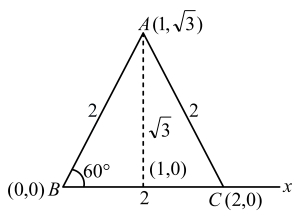
The incentre of the triangle with vertices $(1, \sqrt{3}), (0, 0)$ and $(2, 0)$ is:
A
$\left(1, \frac{\sqrt{3}}{2}\right)$
B
$\left(\frac{2}{3}, \frac{1}{\sqrt{3}}\right)$
C
$\left(\frac{2}{3}, \frac{\sqrt{3}}{2}\right)$
D
$\left(1, \frac{1}{\sqrt{3}}\right)$
Solution
(D) Let the vertices be $A(1, \sqrt{3})$,$B(0, 0)$,and $C(2, 0)$.
Calculate the side lengths:
$AB = \sqrt{(1-0)^2 + (\sqrt{3}-0)^2} = \sqrt{1 + 3} = 2$
$BC = \sqrt{(2-0)^2 + (0-0)^2} = \sqrt{4} = 2$
$AC = \sqrt{(2-1)^2 + (0-\sqrt{3})^2} = \sqrt{1 + 3} = 2$
Since all sides are equal,the triangle is an equilateral triangle.
For an equilateral triangle,the incentre is the same as the centroid.
The centroid $(G)$ is given by $\left(\frac{x_1+x_2+x_3}{3}, \frac{y_1+y_2+y_3}{3}\right)$.
$G = \left(\frac{1+0+2}{3}, \frac{\sqrt{3}+0+0}{3}\right) = \left(\frac{3}{3}, \frac{\sqrt{3}}{3}\right) = \left(1, \frac{1}{\sqrt{3}}\right)$.
Calculate the side lengths:
$AB = \sqrt{(1-0)^2 + (\sqrt{3}-0)^2} = \sqrt{1 + 3} = 2$
$BC = \sqrt{(2-0)^2 + (0-0)^2} = \sqrt{4} = 2$
$AC = \sqrt{(2-1)^2 + (0-\sqrt{3})^2} = \sqrt{1 + 3} = 2$
Since all sides are equal,the triangle is an equilateral triangle.
For an equilateral triangle,the incentre is the same as the centroid.
The centroid $(G)$ is given by $\left(\frac{x_1+x_2+x_3}{3}, \frac{y_1+y_2+y_3}{3}\right)$.
$G = \left(\frac{1+0+2}{3}, \frac{\sqrt{3}+0+0}{3}\right) = \left(\frac{3}{3}, \frac{\sqrt{3}}{3}\right) = \left(1, \frac{1}{\sqrt{3}}\right)$.
0 likesView Solution
279
MathematicsDifficultMCQAP EAMCET · 2017
If two pairs of straight lines with combined equations $xy+4x-3y-12=0$ and $xy-3x+4y-12=0$ form a square,then the combined equation of its diagonals is
A
$x^2-2xy+y^2+x-y=0$
B
$x^2+2xy+y^2+x+y=0$
C
$x^2-y^2+x-y=0$
D
$x^2-y^2+x+y=0$
Solution
(C) The given equations are $xy+4x-3y-12=0$ and $xy-3x+4y-12=0$.
For the first equation: $x(y+4)-3(y+4)=0 \Rightarrow (x-3)(y+4)=0$. This represents the lines $x=3$ and $y=-4$.
For the second equation: $x(y-3)+4(y-3)=0 \Rightarrow (x+4)(y-3)=0$. This represents the lines $x=-4$ and $y=3$.
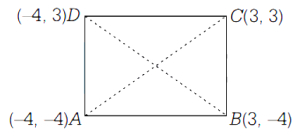
The four lines forming the square are $x=3, x=-4, y=3, y=-4$.
The vertices of the square are $A(-4,-4), B(3,-4), C(3,3),$ and $D(-4,3)$.
The diagonal $AC$ passes through $A(-4,-4)$ and $C(3,3)$. Its equation is $y-(-4) = \frac{3-(-4)}{3-(-4)}(x-(-4))$ $\Rightarrow y+4 = 1(x+4)$ $\Rightarrow x-y=0$.
The diagonal $BD$ passes through $B(3,-4)$ and $D(-4,3)$. Its equation is $y-(-4) = \frac{3-(-4)}{-4-3}(x-3)$ $\Rightarrow y+4 = \frac{7}{-7}(x-3)$ $\Rightarrow y+4 = -x+3$ $\Rightarrow x+y+1=0$.
The combined equation of the diagonals is $(x-y)(x+y+1)=0$.
Expanding this,we get $x^2+xy+x-xy-y^2-y=0$,which simplifies to $x^2-y^2+x-y=0$.
For the first equation: $x(y+4)-3(y+4)=0 \Rightarrow (x-3)(y+4)=0$. This represents the lines $x=3$ and $y=-4$.
For the second equation: $x(y-3)+4(y-3)=0 \Rightarrow (x+4)(y-3)=0$. This represents the lines $x=-4$ and $y=3$.
The four lines forming the square are $x=3, x=-4, y=3, y=-4$.
The vertices of the square are $A(-4,-4), B(3,-4), C(3,3),$ and $D(-4,3)$.
The diagonal $AC$ passes through $A(-4,-4)$ and $C(3,3)$. Its equation is $y-(-4) = \frac{3-(-4)}{3-(-4)}(x-(-4))$ $\Rightarrow y+4 = 1(x+4)$ $\Rightarrow x-y=0$.
The diagonal $BD$ passes through $B(3,-4)$ and $D(-4,3)$. Its equation is $y-(-4) = \frac{3-(-4)}{-4-3}(x-3)$ $\Rightarrow y+4 = \frac{7}{-7}(x-3)$ $\Rightarrow y+4 = -x+3$ $\Rightarrow x+y+1=0$.
The combined equation of the diagonals is $(x-y)(x+y+1)=0$.
Expanding this,we get $x^2+xy+x-xy-y^2-y=0$,which simplifies to $x^2-y^2+x-y=0$.
0 likesView Solution
280
MathematicsDifficultMCQAP EAMCET · 2017
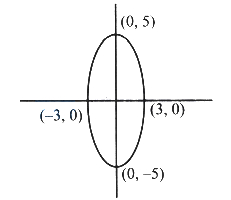
The product of the lengths of the perpendiculars drawn from the two foci of the ellipse $\frac{x^2}{9}+\frac{y^2}{25}=1$ to the tangent at any point on the ellipse is
A
$6$
B
$7$
C
$8$
D
$9$
Solution
(D) The product of the lengths of the perpendiculars drawn from the two foci of an ellipse to any tangent is equal to the square of the semi-minor axis.
For the given ellipse $\frac{x^2}{9}+\frac{y^2}{25}=1$,we have $a^2 = 9$ and $b^2 = 25$. Since $b^2 > a^2$,the semi-minor axis is $b = \sqrt{9} = 3$.
Therefore,the product of the lengths of the perpendiculars is $b^2 = 3^2 = 9$.
For the given ellipse $\frac{x^2}{9}+\frac{y^2}{25}=1$,we have $a^2 = 9$ and $b^2 = 25$. Since $b^2 > a^2$,the semi-minor axis is $b = \sqrt{9} = 3$.
Therefore,the product of the lengths of the perpendiculars is $b^2 = 3^2 = 9$.
0 likesView Solution
Vedclass Products
For Students
Vedclass Test Series
Mock tests in real AP EAMCET style covering Mathematics with performance analysis. 5-day free trial.
Start Free TrialFor Teachers
Exam Paper Generator
Generate Set A/B/C/D Mathematics papers from 7.5L+ questions in 2 minutes. 3 chapters free.
Try FreeFor Institutes
Online Exam Module
Run live AP EAMCET mock exams with unlimited students, 360° analytics & white-label branding.
See DemoFrequently Asked Questions
How many Mathematics questions are in AP EAMCET 2017?
There are 482 Mathematics questions from the AP EAMCET 2017 paper on Vedclass, each with a detailed step-by-step solution in English.
Are AP EAMCET 2017 Mathematics solutions available in English?
Yes. All solutions on this page are in English. You can also switch to English or Hindi using the language buttons above the questions.
Can I practice AP EAMCET 2017 Mathematics as a timed test?
Yes. Use the Vedclass Test Series to attempt a full AP EAMCET mock test covering Mathematics with time limits and instant score analysis.
Can teachers create Mathematics papers from AP EAMCET previous year questions?
Yes. The Vedclass Exam Paper Generator lets teachers mix AP EAMCET Mathematics questions and generate Set A/B/C/D papers in minutes.
For Teachers & Institutes
Build a Custom Mathematics Paper
Pick AP EAMCET 2017 Mathematics questions, set difficulty, and generate Set A/B/C/D in 2 minutes.