
PhysicsQ1–38 of 38 questions
Page 1 of 1 · English
1
PhysicsDifficultMCQAP EAMCET · 2010
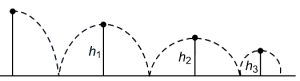
$A$ ball falls from a height $h$ and rebounds after striking the floor. The coefficient of restitution is $e$. The total distance covered by the ball before it comes to rest is
A
$\frac{\left(1-e^2\right) h}{e^2}$
B
$\frac{\left(1+e^2\right) h}{e^2}$
C
$\left(\frac{1+e^2}{1-e^2}\right) h$
D
$\frac{e^2 h}{1-e^2}$
Solution
(C) When a ball falls from a height $h$,it strikes the floor and rebounds to a height $h_1 = h e^2$.
After the second impact,it rebounds to a height $h_2 = h_1 e^2 = h e^4$.
In general,the height reached after the $n$-th rebound is $h_n = h e^{2n}$.
The total distance $H$ covered by the ball is the sum of the initial fall and the subsequent upward and downward paths for each rebound:
$H = h + 2h_1 + 2h_2 + 2h_3 + \dots$
$H = h + 2(h e^2 + h e^4 + h e^6 + \dots)$
$H = h + 2h(e^2 + e^4 + e^6 + \dots)$
The term in the bracket is an infinite geometric progression with first term $a = e^2$ and common ratio $r = e^2$. The sum is $S = \frac{a}{1-r} = \frac{e^2}{1-e^2}$.
$H = h + 2h \left( \frac{e^2}{1-e^2} \right)$
$H = h \left( 1 + \frac{2e^2}{1-e^2} \right)$
$H = h \left( \frac{1 - e^2 + 2e^2}{1 - e^2} \right)$
$H = h \left( \frac{1 + e^2}{1 - e^2} \right)$
After the second impact,it rebounds to a height $h_2 = h_1 e^2 = h e^4$.
In general,the height reached after the $n$-th rebound is $h_n = h e^{2n}$.
The total distance $H$ covered by the ball is the sum of the initial fall and the subsequent upward and downward paths for each rebound:
$H = h + 2h_1 + 2h_2 + 2h_3 + \dots$
$H = h + 2(h e^2 + h e^4 + h e^6 + \dots)$
$H = h + 2h(e^2 + e^4 + e^6 + \dots)$
The term in the bracket is an infinite geometric progression with first term $a = e^2$ and common ratio $r = e^2$. The sum is $S = \frac{a}{1-r} = \frac{e^2}{1-e^2}$.
$H = h + 2h \left( \frac{e^2}{1-e^2} \right)$
$H = h \left( 1 + \frac{2e^2}{1-e^2} \right)$
$H = h \left( \frac{1 - e^2 + 2e^2}{1 - e^2} \right)$
$H = h \left( \frac{1 + e^2}{1 - e^2} \right)$
0 likesView Solution
2
PhysicsDifficultMCQAP EAMCET · 2010
$A$ bomb moving with velocity $(40 \hat{i} + 50 \hat{j} - 25 \hat{k}) \text{ m/s}$ explodes into two pieces of mass ratio $1:4$. After the explosion,the smaller piece moves away with velocity $(200 \hat{i} + 70 \hat{j} + 15 \hat{k}) \text{ m/s}$. The velocity of the larger piece after the explosion is:
A
$45 \hat{j} - 35 \hat{k}$
B
$45 \hat{i} - 35 \hat{j}$
C
$45 \hat{k} - 35 \hat{j}$
D
$-35 \hat{i} + 45 \hat{k}$
Solution
(A) Let the total mass of the bomb be $M = 5m$. The mass of the smaller piece is $m_1 = m$ and the mass of the larger piece is $m_2 = 4m$.
According to the law of conservation of linear momentum,the initial momentum equals the final momentum:
$M \vec{v} = m_1 \vec{v}_1 + m_2 \vec{v}_2$
$5m(40 \hat{i} + 50 \hat{j} - 25 \hat{k}) = m(200 \hat{i} + 70 \hat{j} + 15 \hat{k}) + 4m \vec{v}_2$
Dividing by $m$:
$5(40 \hat{i} + 50 \hat{j} - 25 \hat{k}) = (200 \hat{i} + 70 \hat{j} + 15 \hat{k}) + 4 \vec{v}_2$
$(200 \hat{i} + 250 \hat{j} - 125 \hat{k}) - (200 \hat{i} + 70 \hat{j} + 15 \hat{k}) = 4 \vec{v}_2$
$0 \hat{i} + 180 \hat{j} - 140 \hat{k} = 4 \vec{v}_2$
$\vec{v}_2 = \frac{180 \hat{j} - 140 \hat{k}}{4} = 45 \hat{j} - 35 \hat{k} \text{ m/s}$.
According to the law of conservation of linear momentum,the initial momentum equals the final momentum:
$M \vec{v} = m_1 \vec{v}_1 + m_2 \vec{v}_2$
$5m(40 \hat{i} + 50 \hat{j} - 25 \hat{k}) = m(200 \hat{i} + 70 \hat{j} + 15 \hat{k}) + 4m \vec{v}_2$
Dividing by $m$:
$5(40 \hat{i} + 50 \hat{j} - 25 \hat{k}) = (200 \hat{i} + 70 \hat{j} + 15 \hat{k}) + 4 \vec{v}_2$
$(200 \hat{i} + 250 \hat{j} - 125 \hat{k}) - (200 \hat{i} + 70 \hat{j} + 15 \hat{k}) = 4 \vec{v}_2$
$0 \hat{i} + 180 \hat{j} - 140 \hat{k} = 4 \vec{v}_2$
$\vec{v}_2 = \frac{180 \hat{j} - 140 \hat{k}}{4} = 45 \hat{j} - 35 \hat{k} \text{ m/s}$.
0 likesView Solution
3
PhysicsDifficultMCQAP EAMCET · 2010
Water from a tap emerges vertically downwards with an initial velocity of $4 \,m/s$. The cross-sectional area of the tap is $A$. The flow is steady and the pressure is constant throughout the stream of water. The distance $h$ vertically below the tap,where the cross-sectional area of the stream becomes $\frac{2}{3} A$,is (take $g = 10 \,m/s^2$): (in $\,m$)
A
$0.5$
B
$1$
C
$1.5$
D
$2.2$
Solution
(B) According to the equation of continuity,the product of cross-sectional area and velocity remains constant for an incompressible fluid: $A_1 v_1 = A_2 v_2$.
Given $A_1 = A$,$v_1 = 4 \,m/s$,and $A_2 = \frac{2}{3} A$.
Substituting these values: $A \times 4 = \frac{2}{3} A \times v_2$.
Solving for $v_2$: $v_2 = 4 \times \frac{3}{2} = 6 \,m/s$.
Now,using the principle of conservation of energy (Bernoulli's equation) for the falling stream: $P + \rho g h_1 + \frac{1}{2} \rho v_1^2 = P + \rho g h_2 + \frac{1}{2} \rho v_2^2$.
Since the pressure $P$ is constant (atmospheric pressure) and $h_1 - h_2 = h$,the equation simplifies to: $g h = \frac{1}{2} (v_2^2 - v_1^2)$.
Substituting the known values: $10 \times h = \frac{1}{2} (6^2 - 4^2)$.
$10 h = \frac{1}{2} (36 - 16) = \frac{1}{2} (20) = 10$.
Therefore,$h = 1 \,m$.
Given $A_1 = A$,$v_1 = 4 \,m/s$,and $A_2 = \frac{2}{3} A$.
Substituting these values: $A \times 4 = \frac{2}{3} A \times v_2$.
Solving for $v_2$: $v_2 = 4 \times \frac{3}{2} = 6 \,m/s$.
Now,using the principle of conservation of energy (Bernoulli's equation) for the falling stream: $P + \rho g h_1 + \frac{1}{2} \rho v_1^2 = P + \rho g h_2 + \frac{1}{2} \rho v_2^2$.
Since the pressure $P$ is constant (atmospheric pressure) and $h_1 - h_2 = h$,the equation simplifies to: $g h = \frac{1}{2} (v_2^2 - v_1^2)$.
Substituting the known values: $10 \times h = \frac{1}{2} (6^2 - 4^2)$.
$10 h = \frac{1}{2} (36 - 16) = \frac{1}{2} (20) = 10$.
Therefore,$h = 1 \,m$.
0 likesView Solution
4
PhysicsDifficultMCQAP EAMCET · 2010
The excess pressure inside a spherical soap bubble of radius $1 \,cm$ is balanced by a column of oil (specific gravity $= 0.8$), $2 \,mm$ high. The surface tension of the bubble is: (in $\,N/m$)
A
$3.92$
B
$0.0392$
C
$0.392$
D
$0.00392$
Solution
(D) The excess pressure inside a soap bubble is given by $p = \frac{4T}{R}$.
This pressure is balanced by the pressure exerted by the oil column, which is $p = h \rho g$.
Equating the two, we get $h \rho g = \frac{4T}{R}$.
Rearranging for surface tension $T$, we have $T = \frac{R h \rho g}{4}$.
Given values:
Radius $R = 1 \,cm = 10^{-2} \,m$.
Height $h = 2 \,mm = 2 \times 10^{-3} \,m$.
Density of oil $\rho = 0.8 \times 10^3 \,kg/m^3$.
Acceleration due to gravity $g = 9.8 \,m/s^2$.
Substituting these values:
$T = \frac{10^{-2} \times 2 \times 10^{-3} \times 0.8 \times 10^3 \times 9.8}{4}$.
$T = \frac{1.568 \times 10^{-2}}{4} = 0.392 \times 10^{-2} \,N/m = 0.00392 \,N/m$.
This pressure is balanced by the pressure exerted by the oil column, which is $p = h \rho g$.
Equating the two, we get $h \rho g = \frac{4T}{R}$.
Rearranging for surface tension $T$, we have $T = \frac{R h \rho g}{4}$.
Given values:
Radius $R = 1 \,cm = 10^{-2} \,m$.
Height $h = 2 \,mm = 2 \times 10^{-3} \,m$.
Density of oil $\rho = 0.8 \times 10^3 \,kg/m^3$.
Acceleration due to gravity $g = 9.8 \,m/s^2$.
Substituting these values:
$T = \frac{10^{-2} \times 2 \times 10^{-3} \times 0.8 \times 10^3 \times 9.8}{4}$.
$T = \frac{1.568 \times 10^{-2}}{4} = 0.392 \times 10^{-2} \,N/m = 0.00392 \,N/m$.
0 likesView Solution
5
PhysicsDifficultMCQAP EAMCET · 2010
$A$ body of mass $m_1 = 4 \text{ kg}$ moves at $5 \hat{i} \text{ m/s}$ and another body of mass $m_2 = 2 \text{ kg}$ moves at $10 \hat{i} \text{ m/s}$. The kinetic energy of the centre of mass is:
A
$\frac{200}{3} \text{ J}$
B
$\frac{500}{3} \text{ J}$
C
$\frac{400}{3} \text{ J}$
D
$\frac{800}{3} \text{ J}$
Solution
(C) The velocity of the centre of mass $(v_{CM})$ is given by the formula:
$v_{CM} = \frac{m_1 v_1 + m_2 v_2}{m_1 + m_2}$
Substituting the given values:
$v_{CM} = \frac{4 \times 5 \hat{i} + 2 \times 10 \hat{i}}{4 + 2}$
$v_{CM} = \frac{20 \hat{i} + 20 \hat{i}}{6} = \frac{40 \hat{i}}{6} = \frac{20}{3} \hat{i} \text{ m/s}$
The kinetic energy of the centre of mass is calculated as:
$K_{CM} = \frac{1}{2} (m_1 + m_2) v_{CM}^2$
$K_{CM} = \frac{1}{2} \times (4 + 2) \times \left( \frac{20}{3} \right)^2$
$K_{CM} = \frac{1}{2} \times 6 \times \frac{400}{9}$
$K_{CM} = 3 \times \frac{400}{9} = \frac{400}{3} \text{ J}$
$v_{CM} = \frac{m_1 v_1 + m_2 v_2}{m_1 + m_2}$
Substituting the given values:
$v_{CM} = \frac{4 \times 5 \hat{i} + 2 \times 10 \hat{i}}{4 + 2}$
$v_{CM} = \frac{20 \hat{i} + 20 \hat{i}}{6} = \frac{40 \hat{i}}{6} = \frac{20}{3} \hat{i} \text{ m/s}$
The kinetic energy of the centre of mass is calculated as:
$K_{CM} = \frac{1}{2} (m_1 + m_2) v_{CM}^2$
$K_{CM} = \frac{1}{2} \times (4 + 2) \times \left( \frac{20}{3} \right)^2$
$K_{CM} = \frac{1}{2} \times 6 \times \frac{400}{9}$
$K_{CM} = 3 \times \frac{400}{9} = \frac{400}{3} \text{ J}$
0 likesView Solution
6
PhysicsDifficultMCQAP EAMCET · 2010
$A$ launching vehicle carrying an artificial satellite of mass $m$ is set for launch on the surface of the earth of mass $M$ and radius $R$. If the satellite is intended to move in a circular orbit of radius $7R$,the minimum energy required to be spent by the launching vehicle on the satellite is ($G$ is the gravitational constant).
A
$\frac{GMm}{R}$
B
$\frac{13GMm}{14R}$
C
$\frac{GMm}{7R}$
D
$\frac{GMm}{14R}$
Solution
(B) The total energy of the satellite on the surface of the earth is the sum of its potential energy and kinetic energy. Since it is at rest on the surface,its kinetic energy is $0$. Thus,$E_1 = -\frac{GMm}{R}$.
When the satellite is in a circular orbit of radius $r = 7R$,its total energy is given by $E_2 = -\frac{GMm}{2r}$.
Substituting $r = 7R$,we get $E_2 = -\frac{GMm}{2(7R)} = -\frac{GMm}{14R}$.
The minimum energy required to be spent by the launching vehicle is the difference between the final energy and the initial energy: $\Delta E = E_2 - E_1$.
$\Delta E = -\frac{GMm}{14R} - (-\frac{GMm}{R}) = -\frac{GMm}{14R} + \frac{GMm}{R}$.
$\Delta E = \frac{-GMm + 14GMm}{14R} = \frac{13GMm}{14R}$.
When the satellite is in a circular orbit of radius $r = 7R$,its total energy is given by $E_2 = -\frac{GMm}{2r}$.
Substituting $r = 7R$,we get $E_2 = -\frac{GMm}{2(7R)} = -\frac{GMm}{14R}$.
The minimum energy required to be spent by the launching vehicle is the difference between the final energy and the initial energy: $\Delta E = E_2 - E_1$.
$\Delta E = -\frac{GMm}{14R} - (-\frac{GMm}{R}) = -\frac{GMm}{14R} + \frac{GMm}{R}$.
$\Delta E = \frac{-GMm + 14GMm}{14R} = \frac{13GMm}{14R}$.
0 likesView Solution
7
PhysicsDifficultMCQAP EAMCET · 2010
An object takes $n$ times as much time to slide down a $45^{\circ}$ rough inclined plane as it takes to slide down a perfectly smooth inclined plane of the same inclination. The coefficient of kinetic friction between the object and the rough incline is given by:
A
$\left(1-\frac{1}{n^2}\right)$
B
$\left(\frac{1}{1-n^2}\right)$
C
$\sqrt{1-\frac{1}{n^2}}$
D
$\sqrt{1+\frac{1}{n^2}}$
Solution
(A) For a smooth inclined plane,the acceleration is $a_s = g \sin \theta$. The time taken to cover distance $s$ is $t_s = \sqrt{\frac{2s}{g \sin \theta}}$.
For a rough inclined plane,the acceleration is $a_r = g(\sin \theta - \mu \cos \theta)$. The time taken is $t_r = \sqrt{\frac{2s}{g(\sin \theta - \mu \cos \theta)}} = n t_s$.
Squaring both sides: $\frac{2s}{g(\sin \theta - \mu \cos \theta)} = n^2 \frac{2s}{g \sin \theta}$.
This simplifies to $\sin \theta = n^2(\sin \theta - \mu \cos \theta)$,which gives $\mu \cos \theta = \sin \theta (1 - \frac{1}{n^2})$.
Thus,$\mu = \tan \theta (1 - \frac{1}{n^2})$.
Given $\theta = 45^{\circ}$,$\tan 45^{\circ} = 1$,so $\mu = 1 - \frac{1}{n^2}$.
For a rough inclined plane,the acceleration is $a_r = g(\sin \theta - \mu \cos \theta)$. The time taken is $t_r = \sqrt{\frac{2s}{g(\sin \theta - \mu \cos \theta)}} = n t_s$.
Squaring both sides: $\frac{2s}{g(\sin \theta - \mu \cos \theta)} = n^2 \frac{2s}{g \sin \theta}$.
This simplifies to $\sin \theta = n^2(\sin \theta - \mu \cos \theta)$,which gives $\mu \cos \theta = \sin \theta (1 - \frac{1}{n^2})$.
Thus,$\mu = \tan \theta (1 - \frac{1}{n^2})$.
Given $\theta = 45^{\circ}$,$\tan 45^{\circ} = 1$,so $\mu = 1 - \frac{1}{n^2}$.
0 likesView Solution
8
PhysicsMediumMCQAP EAMCET · 2010
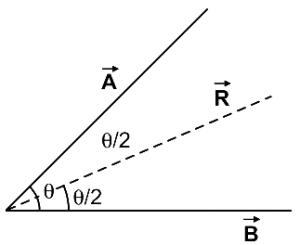
$\overrightarrow{A}$ and $\overrightarrow{B}$ are two vectors of equal magnitudes and $\theta$ is the angle between them. The angle between $\overrightarrow{A}$ or $\overrightarrow{B}$ with their resultant is
A
$\frac{\theta}{4}$
B
$\frac{\theta}{2}$
C
$2 \theta$
D
zero
Solution
(B) Let the magnitudes of the two vectors be $|\overrightarrow{A}| = |\overrightarrow{B}| = a$.
The resultant vector $\overrightarrow{R} = \overrightarrow{A} + \overrightarrow{B}$ makes an angle $\alpha$ with vector $\overrightarrow{A}$,given by the formula:
$\tan \alpha = \frac{B \sin \theta}{A + B \cos \theta}$
Since $A = B = a$,we have:
$\tan \alpha = \frac{a \sin \theta}{a + a \cos \theta} = \frac{\sin \theta}{1 + \cos \theta}$
Using trigonometric identities $\sin \theta = 2 \sin(\frac{\theta}{2}) \cos(\frac{\theta}{2})$ and $1 + \cos \theta = 2 \cos^2(\frac{\theta}{2})$:
$\tan \alpha = \frac{2 \sin(\frac{\theta}{2}) \cos(\frac{\theta}{2})}{2 \cos^2(\frac{\theta}{2})} = \tan(\frac{\theta}{2})$
Therefore,$\alpha = \frac{\theta}{2}$.
This shows that the resultant vector bisects the angle between the two vectors of equal magnitude.
The resultant vector $\overrightarrow{R} = \overrightarrow{A} + \overrightarrow{B}$ makes an angle $\alpha$ with vector $\overrightarrow{A}$,given by the formula:
$\tan \alpha = \frac{B \sin \theta}{A + B \cos \theta}$
Since $A = B = a$,we have:
$\tan \alpha = \frac{a \sin \theta}{a + a \cos \theta} = \frac{\sin \theta}{1 + \cos \theta}$
Using trigonometric identities $\sin \theta = 2 \sin(\frac{\theta}{2}) \cos(\frac{\theta}{2})$ and $1 + \cos \theta = 2 \cos^2(\frac{\theta}{2})$:
$\tan \alpha = \frac{2 \sin(\frac{\theta}{2}) \cos(\frac{\theta}{2})}{2 \cos^2(\frac{\theta}{2})} = \tan(\frac{\theta}{2})$
Therefore,$\alpha = \frac{\theta}{2}$.
This shows that the resultant vector bisects the angle between the two vectors of equal magnitude.
0 likesView Solution
9
PhysicsMediumMCQAP EAMCET · 2010
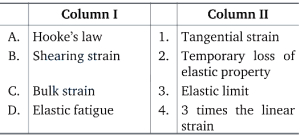
Match the following:
| Column $I$ | Column $II$ |
|---|---|
| $A$. Hooke's law | $1$. Tangential strain |
| $B$. Shearing strain | $2$. Temporary loss of elastic property |
| $C$. Bulk strain | $3$. Elastic limit |
| $D$. Elastic fatigue | $4$. $3$ times the linear strain |
A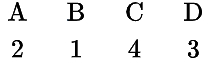
$A-2, B-1, C-4, D-3$
B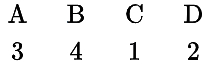
$A-3, B-4, C-1, D-2$
C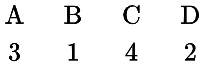
$A-3, B-1, C-4, D-2$
D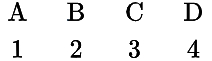
$A-1, B-2, C-3, D-4$
Solution
(C) The correct matches are as follows:
$A$. Hooke's law: Within the elastic limit,stress is directly proportional to strain. Thus,$A-3$.
$B$. Shearing strain: It is defined as the angle in radians through which a plane perpendicular to the fixed surface of a cubical body gets turned under the effect of a tangential force. It is also known as tangential strain. Thus,$B-1$.
$C$. Bulk strain: For a solid,the bulk strain (volumetric strain) is equal to $3$ times the linear strain. Thus,$C-4$.
$D$. Elastic fatigue: The temporary loss of elastic properties due to the action of repeated alternating deforming forces is called elastic fatigue. Thus,$D-2$.
Therefore,the correct matching is $A-3, B-1, C-4, D-2$,which corresponds to option $C$.
$A$. Hooke's law: Within the elastic limit,stress is directly proportional to strain. Thus,$A-3$.
$B$. Shearing strain: It is defined as the angle in radians through which a plane perpendicular to the fixed surface of a cubical body gets turned under the effect of a tangential force. It is also known as tangential strain. Thus,$B-1$.
$C$. Bulk strain: For a solid,the bulk strain (volumetric strain) is equal to $3$ times the linear strain. Thus,$C-4$.
$D$. Elastic fatigue: The temporary loss of elastic properties due to the action of repeated alternating deforming forces is called elastic fatigue. Thus,$D-2$.
Therefore,the correct matching is $A-3, B-1, C-4, D-2$,which corresponds to option $C$.
0 likesView Solution
10
PhysicsDifficultMCQAP EAMCET · 2010
An athlete completes one round of a circular track of radius $R$ in $40 \,s$. What will be his displacement at the end of $2 \,min \,20 \,s$?
A
$7 R$
B
$2 R$
C
$2 \pi R$
D
$7 \pi R$
Solution
(B) The total time given is $2 \,min \,20 \,s$.
Converting this into seconds: $2 \times 60 \,s + 20 \,s = 120 \,s + 20 \,s = 140 \,s$.
The athlete completes one round in $40 \,s$.
The number of rounds completed in $140 \,s$ is $\frac{140}{40} = 3.5$ rounds.
After $3$ complete rounds, the athlete returns to the starting point, so the displacement for these $3$ rounds is $0$.
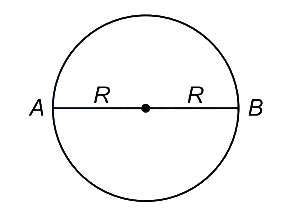
In the remaining $0.5$ round, the athlete moves from the starting point $A$ to the diametrically opposite point $B$.
The displacement is the shortest distance between the initial and final positions, which is the diameter of the circular track.
Therefore, the displacement $= 2R$.
Converting this into seconds: $2 \times 60 \,s + 20 \,s = 120 \,s + 20 \,s = 140 \,s$.
The athlete completes one round in $40 \,s$.
The number of rounds completed in $140 \,s$ is $\frac{140}{40} = 3.5$ rounds.
After $3$ complete rounds, the athlete returns to the starting point, so the displacement for these $3$ rounds is $0$.
In the remaining $0.5$ round, the athlete moves from the starting point $A$ to the diametrically opposite point $B$.
The displacement is the shortest distance between the initial and final positions, which is the diameter of the circular track.
Therefore, the displacement $= 2R$.
0 likesView Solution
11
PhysicsMediumMCQAP EAMCET · 2010
The displacements of two particles of same mass executing $SHM$ are represented by the equations $x_1=4 \sin \left(10 t+\frac{\pi}{6}\right)$ and $x_2=5 \cos (\omega t)$. The value of $\omega$ for which the energies of both the particles remain same is (in $\text{ unit}$)
A
$16$
B
$6$
C
$4$
D
$8$
Solution
(D) The energy of a particle executing $SHM$ is given by $E = \frac{1}{2} m \omega^2 A^2$, where $m$ is the mass, $\omega$ is the angular frequency, and $A$ is the amplitude.
For the first particle, $x_1 = 4 \sin (10t + \frac{\pi}{6})$, the amplitude $A_1 = 4$ and angular frequency $\omega_1 = 10$.
The energy is $E_1 = \frac{1}{2} m (10)^2 (4)^2 = \frac{1}{2} m (100)(16) = 800m$.
For the second particle, $x_2 = 5 \cos (\omega t)$, the amplitude $A_2 = 5$ and angular frequency is $\omega$.
The energy is $E_2 = \frac{1}{2} m \omega^2 (5)^2 = \frac{25}{2} m \omega^2$.
Given that the energies are equal, $E_1 = E_2$.
$800m = \frac{25}{2} m \omega^2$.
$1600 = 25 \omega^2$.
$\omega^2 = \frac{1600}{25} = 64$.
$\omega = 8 \text{ unit}$.
For the first particle, $x_1 = 4 \sin (10t + \frac{\pi}{6})$, the amplitude $A_1 = 4$ and angular frequency $\omega_1 = 10$.
The energy is $E_1 = \frac{1}{2} m (10)^2 (4)^2 = \frac{1}{2} m (100)(16) = 800m$.
For the second particle, $x_2 = 5 \cos (\omega t)$, the amplitude $A_2 = 5$ and angular frequency is $\omega$.
The energy is $E_2 = \frac{1}{2} m \omega^2 (5)^2 = \frac{25}{2} m \omega^2$.
Given that the energies are equal, $E_1 = E_2$.
$800m = \frac{25}{2} m \omega^2$.
$1600 = 25 \omega^2$.
$\omega^2 = \frac{1600}{25} = 64$.
$\omega = 8 \text{ unit}$.
0 likesView Solution
12
PhysicsDifficultMCQAP EAMCET · 2010
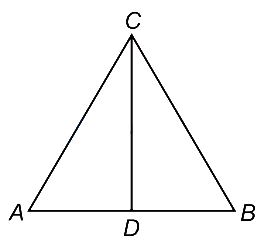
Three rods of equal lengths are joined to form an equilateral triangle $ABC$. $D$ is the mid-point of $AB$. The coefficient of linear expansion is $\alpha_1$ for the material of rod $AB$ and $\alpha_2$ for the material of rods $AC$ and $BC$. If the distance $DC$ remains constant for small changes in temperature,then:
A
$\alpha_1 = 2\alpha_2$
B
$\alpha_1 = 4\alpha_2$
C
$\alpha_1 = 8\alpha_2$
D
$\alpha_1 = \alpha_2$
Solution
(B) Let the initial length of each rod be $l$. In the equilateral triangle $ABC$,the length of the altitude $DC$ is given by:
$DC^2 = AC^2 - AD^2 = l^2 - (l/2)^2 = 3l^2/4$.
After a small change in temperature $\Delta t$,the new lengths are $l' = l(1 + \alpha \Delta t)$.
For rod $AC$,the new length is $l_{AC}' = l(1 + \alpha_2 \Delta t)$.
For segment $AD$,the new length is $l_{AD}' = (l/2)(1 + \alpha_1 \Delta t)$.
Since $DC$ remains constant,$DC^2 = (l_{AC}')^2 - (l_{AD}')^2$.
$3l^2/4 = [l(1 + \alpha_2 \Delta t)]^2 - [(l/2)(1 + \alpha_1 \Delta t)]^2$.
$3l^2/4 = l^2(1 + 2\alpha_2 \Delta t + \alpha_2^2 \Delta t^2) - (l^2/4)(1 + 2\alpha_1 \Delta t + \alpha_1^2 \Delta t^2)$.
Neglecting higher-order terms $\alpha^2 \Delta t^2$ and simplifying:
$3l^2/4 = l^2 + 2l^2 \alpha_2 \Delta t - l^2/4 - (l^2/4)(2\alpha_1 \Delta t)$.
$3l^2/4 = 3l^2/4 + 2l^2 \alpha_2 \Delta t - (l^2/2)\alpha_1 \Delta t$.
$0 = 2l^2 \alpha_2 \Delta t - (l^2/2)\alpha_1 \Delta t$.
$2\alpha_2 = \alpha_1/2 \implies \alpha_1 = 4\alpha_2$.
$DC^2 = AC^2 - AD^2 = l^2 - (l/2)^2 = 3l^2/4$.
After a small change in temperature $\Delta t$,the new lengths are $l' = l(1 + \alpha \Delta t)$.
For rod $AC$,the new length is $l_{AC}' = l(1 + \alpha_2 \Delta t)$.
For segment $AD$,the new length is $l_{AD}' = (l/2)(1 + \alpha_1 \Delta t)$.
Since $DC$ remains constant,$DC^2 = (l_{AC}')^2 - (l_{AD}')^2$.
$3l^2/4 = [l(1 + \alpha_2 \Delta t)]^2 - [(l/2)(1 + \alpha_1 \Delta t)]^2$.
$3l^2/4 = l^2(1 + 2\alpha_2 \Delta t + \alpha_2^2 \Delta t^2) - (l^2/4)(1 + 2\alpha_1 \Delta t + \alpha_1^2 \Delta t^2)$.
Neglecting higher-order terms $\alpha^2 \Delta t^2$ and simplifying:
$3l^2/4 = l^2 + 2l^2 \alpha_2 \Delta t - l^2/4 - (l^2/4)(2\alpha_1 \Delta t)$.
$3l^2/4 = 3l^2/4 + 2l^2 \alpha_2 \Delta t - (l^2/2)\alpha_1 \Delta t$.
$0 = 2l^2 \alpha_2 \Delta t - (l^2/2)\alpha_1 \Delta t$.
$2\alpha_2 = \alpha_1/2 \implies \alpha_1 = 4\alpha_2$.
0 likesView Solution
13
PhysicsMediumMCQAP EAMCET · 2010
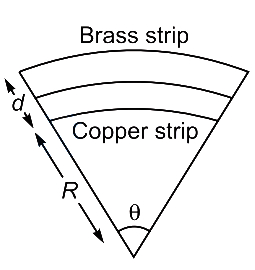
$A$ bimetallic strip is formed out of two identical strips,one of copper and the other of brass. The coefficients of linear expansion of the two metals are $\alpha_C$ and $\alpha_B$. On heating,the temperature of the strip increases by $\Delta T$ and the strip bends to form an arc of radius $R$. Then $R$ is proportional to
A
$\Delta T$
B
$\frac{1}{\Delta T}$
C
$\sqrt{\Delta T}$
D
$\frac{1}{\sqrt{\Delta T}}$
Solution
(B) Let $L_0$ be the initial length of each strip before heating. After heating,the lengths of the brass and copper strips are given by:
$L_B = L_0(1 + \alpha_B \Delta T) = (R + d)\theta$
$L_C = L_0(1 + \alpha_C \Delta T) = R\theta$
Dividing the two equations,we get:
$\frac{R + d}{R} = \frac{1 + \alpha_B \Delta T}{1 + \alpha_C \Delta T}$
$1 + \frac{d}{R} = \frac{1 + \alpha_B \Delta T}{1 + \alpha_C \Delta T}$
$\frac{d}{R} = \frac{1 + \alpha_B \Delta T}{1 + \alpha_C \Delta T} - 1 = \frac{1 + \alpha_B \Delta T - 1 - \alpha_C \Delta T}{1 + \alpha_C \Delta T} = \frac{(\alpha_B - \alpha_C) \Delta T}{1 + \alpha_C \Delta T}$
Since $\alpha \Delta T \ll 1$,we can approximate $1 + \alpha_C \Delta T \approx 1$. Thus:
$R \approx \frac{d}{(\alpha_B - \alpha_C) \Delta T}$
Therefore,$R \propto \frac{1}{\Delta T}$.
$L_B = L_0(1 + \alpha_B \Delta T) = (R + d)\theta$
$L_C = L_0(1 + \alpha_C \Delta T) = R\theta$
Dividing the two equations,we get:
$\frac{R + d}{R} = \frac{1 + \alpha_B \Delta T}{1 + \alpha_C \Delta T}$
$1 + \frac{d}{R} = \frac{1 + \alpha_B \Delta T}{1 + \alpha_C \Delta T}$
$\frac{d}{R} = \frac{1 + \alpha_B \Delta T}{1 + \alpha_C \Delta T} - 1 = \frac{1 + \alpha_B \Delta T - 1 - \alpha_C \Delta T}{1 + \alpha_C \Delta T} = \frac{(\alpha_B - \alpha_C) \Delta T}{1 + \alpha_C \Delta T}$
Since $\alpha \Delta T \ll 1$,we can approximate $1 + \alpha_C \Delta T \approx 1$. Thus:
$R \approx \frac{d}{(\alpha_B - \alpha_C) \Delta T}$
Therefore,$R \propto \frac{1}{\Delta T}$.
0 likesView Solution
14
PhysicsEasyMCQAP EAMCET · 2010
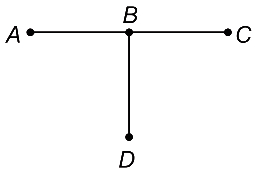
Three rods $AB$,$BC$,and $BD$ made of the same material and having the same cross-section have been joined as shown in the figure. The ends $A$,$C$,and $D$ are held at temperatures of $20^{\circ} C$,$80^{\circ} C$,and $80^{\circ} C$ respectively. If each rod is of the same length,then the temperature at the junction $B$ of the three rods is: (in $^{\circ} C$)
A
$90$
B
$60$
C
$40$
D
$30$
Solution
(B) Let the temperature at junction $B$ be $\theta$.
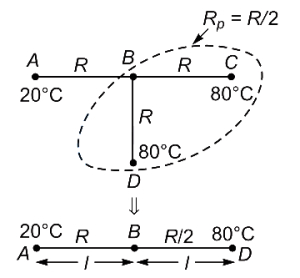
Since the rods $BC$ and $BD$ are connected to the same temperature source $(80^{\circ} C)$ at their outer ends,they act as parallel thermal resistances.
Let $R$ be the thermal resistance of each rod.
The equivalent resistance of the parallel combination of rods $BC$ and $BD$ is $R_p = \frac{R \times R}{R + R} = \frac{R}{2}$.
At steady state,the heat current flowing through rod $AB$ must be equal to the sum of heat currents flowing through rods $BC$ and $BD$.
Using the formula for heat current $\frac{Q}{t} = \frac{\Delta T}{R}$,we have:
$\frac{\theta - 20}{R} = \frac{80 - \theta}{R/2}$
$\theta - 20 = 2(80 - \theta)$
$\theta - 20 = 160 - 2\theta$
$3\theta = 180$
$\theta = 60^{\circ} C$
Thus,the temperature at junction $B$ is $60^{\circ} C$.
Since the rods $BC$ and $BD$ are connected to the same temperature source $(80^{\circ} C)$ at their outer ends,they act as parallel thermal resistances.
Let $R$ be the thermal resistance of each rod.
The equivalent resistance of the parallel combination of rods $BC$ and $BD$ is $R_p = \frac{R \times R}{R + R} = \frac{R}{2}$.
At steady state,the heat current flowing through rod $AB$ must be equal to the sum of heat currents flowing through rods $BC$ and $BD$.
Using the formula for heat current $\frac{Q}{t} = \frac{\Delta T}{R}$,we have:
$\frac{\theta - 20}{R} = \frac{80 - \theta}{R/2}$
$\theta - 20 = 2(80 - \theta)$
$\theta - 20 = 160 - 2\theta$
$3\theta = 180$
$\theta = 60^{\circ} C$
Thus,the temperature at junction $B$ is $60^{\circ} C$.
0 likesView Solution
15
PhysicsDifficultMCQAP EAMCET · 2010
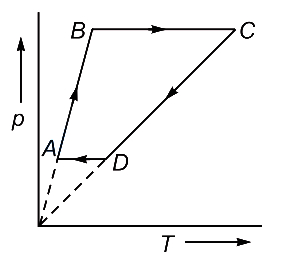
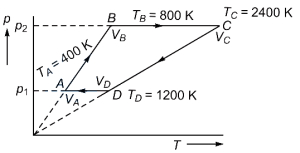
$3$ moles of an ideal monoatomic gas performs an $ABCDA$ cyclic process as shown in the figure below. The gas temperatures are $T_A=400 \, K$, $T_B=800 \, K$, $T_C=2400 \, K$, and $T_D=1200 \, K$. The work done by the gas is (approximately) $(R=8.314 \, J/mol \cdot K)$. (in $ \, kJ$)
A
$10$
B
$20$
C
$40$
D
$100$
Solution
(B) For an ideal gas, the equation of state is $pV = \mu RT$, which implies $p = (\frac{\mu R}{V})T$.
In a $p-T$ diagram, lines passing through the origin represent isochoric processes (constant volume) because $p \propto T$ implies $V = \text{constant}$.
Processes $AB$ and $CD$ are straight lines passing through the origin, so they are isochoric processes.
Work done in an isochoric process is zero. Thus, $W_{AB} = 0$ and $W_{CD} = 0$.
Processes $BC$ and $DA$ are isobaric processes (constant pressure).
Work done in an isobaric process is $W = p\Delta V = \mu R \Delta T$.
For process $BC$ (at pressure $p_2$): $W_{BC} = \mu R(T_C - T_B) = 3 \times R \times (2400 - 800) = 3R \times 1600 = 4800R$.
For process $DA$ (at pressure $p_1$): $W_{DA} = \mu R(T_A - T_D) = 3 \times R \times (400 - 1200) = 3R \times (-800) = -2400R$.
The total work done in the cycle is $W = W_{AB} + W_{BC} + W_{CD} + W_{DA} = 0 + 4800R + 0 - 2400R = 2400R$.
Substituting $R = 8.314 \, J/mol \cdot K$: $W = 2400 \times 8.314 = 19953.6 \, J \approx 20 \, kJ$.
In a $p-T$ diagram, lines passing through the origin represent isochoric processes (constant volume) because $p \propto T$ implies $V = \text{constant}$.
Processes $AB$ and $CD$ are straight lines passing through the origin, so they are isochoric processes.
Work done in an isochoric process is zero. Thus, $W_{AB} = 0$ and $W_{CD} = 0$.
Processes $BC$ and $DA$ are isobaric processes (constant pressure).
Work done in an isobaric process is $W = p\Delta V = \mu R \Delta T$.
For process $BC$ (at pressure $p_2$): $W_{BC} = \mu R(T_C - T_B) = 3 \times R \times (2400 - 800) = 3R \times 1600 = 4800R$.
For process $DA$ (at pressure $p_1$): $W_{DA} = \mu R(T_A - T_D) = 3 \times R \times (400 - 1200) = 3R \times (-800) = -2400R$.
The total work done in the cycle is $W = W_{AB} + W_{BC} + W_{CD} + W_{DA} = 0 + 4800R + 0 - 2400R = 2400R$.
Substituting $R = 8.314 \, J/mol \cdot K$: $W = 2400 \times 8.314 = 19953.6 \, J \approx 20 \, kJ$.
0 likesView Solution
16
PhysicsMediumMCQAP EAMCET · 2010
An ideal gas expands isothermally from volume $V_1$ to volume $V_2$. It is then compressed to the original volume $V_1$ adiabatically. If $p_1$ and $p_2$ represent the initial pressure and final pressure respectively,and $W$ represents the net work done by the gas during the entire process,then:
A
$p_1 > p_2, W = 0$
B
$p_1 > p_2, W > 0$
C
$p_2 > p_1, W > 0$
D
$p_2 > p_1, W < 0$
Solution
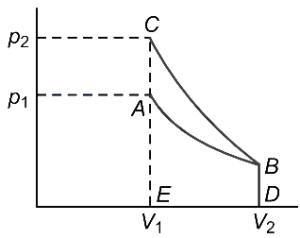
(D) $1$. In the $p-V$ diagram,the isothermal expansion from $A$ to $B$ follows the curve $AB$. The work done by the gas is the area under the curve $AB$,which is the area $ABDE$.
$2$. The adiabatic compression from $B$ to $C$ follows the curve $BC$. The work done on the gas is the area under the curve $BC$,which is the area $BCDE$.
$3$. From the graph,it is clear that the final pressure $p_2$ at point $C$ is greater than the initial pressure $p_1$ at point $A$,so $p_2 > p_1$.
$4$. The net work done by the gas $W$ is the sum of the work done during expansion $(W_{exp} > 0)$ and the work done during compression $(W_{comp} < 0)$.
$5$. Since the area under the adiabatic curve $BC$ (which represents the magnitude of work done on the gas) is greater than the area under the isothermal curve $AB$ (which represents the magnitude of work done by the gas),the net work done $W = W_{AB} - W_{BC}$ is negative $(W < 0)$.
$6$. Therefore,$p_2 > p_1$ and $W < 0$.
$2$. The adiabatic compression from $B$ to $C$ follows the curve $BC$. The work done on the gas is the area under the curve $BC$,which is the area $BCDE$.
$3$. From the graph,it is clear that the final pressure $p_2$ at point $C$ is greater than the initial pressure $p_1$ at point $A$,so $p_2 > p_1$.
$4$. The net work done by the gas $W$ is the sum of the work done during expansion $(W_{exp} > 0)$ and the work done during compression $(W_{comp} < 0)$.
$5$. Since the area under the adiabatic curve $BC$ (which represents the magnitude of work done on the gas) is greater than the area under the isothermal curve $AB$ (which represents the magnitude of work done by the gas),the net work done $W = W_{AB} - W_{BC}$ is negative $(W < 0)$.
$6$. Therefore,$p_2 > p_1$ and $W < 0$.
0 likesView Solution
17
PhysicsEasyMCQAP EAMCET · 2010
If the force is given by $F = at + bt^2$ where $t$ is time,the dimensions of $a$ and $b$ are:
A
$[MLT^{-4}], [MLT^{-2}]$
B
$[MLT^{-3}], [MLT^{-4}]$
C
$[ML^2 T^{-3}], [ML^2 T^{-2}]$
D
$[ML^2 T^{-3}], [ML^3 T^{-4}]$
Solution
(B) According to the principle of homogeneity of dimensions,the dimensions of each term in a physical equation must be the same.
Given the equation $F = at + bt^2$,where $F$ is force and $t$ is time.
The dimension of force $F$ is $[MLT^{-2}]$.
For the first term: $[at] = [F]$
$[a] = [F] / [t] = [MLT^{-2}] / [T] = [MLT^{-3}]$.
For the second term: $[bt^2] = [F]$
$[b] = [F] / [t^2] = [MLT^{-2}] / [T^2] = [MLT^{-4}]$.
Therefore,the dimensions of $a$ and $b$ are $[MLT^{-3}]$ and $[MLT^{-4}]$ respectively.
Given the equation $F = at + bt^2$,where $F$ is force and $t$ is time.
The dimension of force $F$ is $[MLT^{-2}]$.
For the first term: $[at] = [F]$
$[a] = [F] / [t] = [MLT^{-2}] / [T] = [MLT^{-3}]$.
For the second term: $[bt^2] = [F]$
$[b] = [F] / [t^2] = [MLT^{-2}] / [T^2] = [MLT^{-4}]$.
Therefore,the dimensions of $a$ and $b$ are $[MLT^{-3}]$ and $[MLT^{-4}]$ respectively.
0 likesView Solution
18
PhysicsDifficultMCQAP EAMCET · 2010
An organ pipe $P_1$,closed at one end and containing a gas of density $\rho_1$ is vibrating in its first harmonic. Another organ pipe $P_2$,open at both ends and containing a gas of density $\rho_2$ is vibrating in its third harmonic. Both the pipes are in resonance with a given tuning fork. If the compressibility of gases is equal in both pipes,the ratio of the lengths of $P_1$ and $P_2$ is (assume the given gases to be monoatomic)
A
$\frac{1}{3}$
B
$3$
C
$\frac{1}{6} \sqrt{\frac{\rho_1}{\rho_2}}$
D
$\frac{1}{6} \sqrt{\frac{\rho_2}{\rho_1}}$
Solution
(D) The frequency of a closed organ pipe vibrating in its first harmonic is $n_1 = \frac{v_1}{4 l_1}$.
The frequency of an open organ pipe vibrating in its third harmonic is $n_3 = \frac{3 v_2}{2 l_2}$.
Since both pipes are in resonance with the same tuning fork,$n_1 = n_3$.
Therefore,$\frac{v_1}{4 l_1} = \frac{3 v_2}{2 l_2}$,which implies $\frac{l_1}{l_2} = \frac{1}{6} \left( \frac{v_1}{v_2} \right)$.
The speed of sound in a gas is given by $v = \sqrt{\frac{B}{\rho}}$,where $B$ is the bulk modulus (reciprocal of compressibility) and $\rho$ is the density.
Since the compressibility is equal,$B_1 = B_2 = B$.
Thus,$\frac{v_1}{v_2} = \sqrt{\frac{B/\rho_1}{B/\rho_2}} = \sqrt{\frac{\rho_2}{\rho_1}}$.
Substituting this into the ratio of lengths,we get $\frac{l_1}{l_2} = \frac{1}{6} \sqrt{\frac{\rho_2}{\rho_1}}$.
The frequency of an open organ pipe vibrating in its third harmonic is $n_3 = \frac{3 v_2}{2 l_2}$.
Since both pipes are in resonance with the same tuning fork,$n_1 = n_3$.
Therefore,$\frac{v_1}{4 l_1} = \frac{3 v_2}{2 l_2}$,which implies $\frac{l_1}{l_2} = \frac{1}{6} \left( \frac{v_1}{v_2} \right)$.
The speed of sound in a gas is given by $v = \sqrt{\frac{B}{\rho}}$,where $B$ is the bulk modulus (reciprocal of compressibility) and $\rho$ is the density.
Since the compressibility is equal,$B_1 = B_2 = B$.
Thus,$\frac{v_1}{v_2} = \sqrt{\frac{B/\rho_1}{B/\rho_2}} = \sqrt{\frac{\rho_2}{\rho_1}}$.
Substituting this into the ratio of lengths,we get $\frac{l_1}{l_2} = \frac{1}{6} \sqrt{\frac{\rho_2}{\rho_1}}$.
0 likesView Solution
19
PhysicsMediumMCQAP EAMCET · 2010
$A$ sonometer wire has a length of $114 \ cm$,between two fixed ends. Where should two bridges be placed so as to divide the wire into three segments (in $cm$) whose fundamental frequencies are in the ratio $1:3:4$?
A
$l_1, l_2, l_3=18, 24, 72$
B
$l_1, l_2, l_3=24, 18, 72$
C
$l_1, l_2, l_3=72, 18, 24$
D
$l_1, l_2, l_3=72, 24, 18$
Solution
(C) The fundamental frequency of a sonometer wire is given by $n = \frac{1}{2l} \sqrt{\frac{T}{m}}$.
Since $T$ (tension) and $m$ (mass per unit length) are constant for the same wire,$n \propto \frac{1}{l}$.
Given the ratio of frequencies $n_1 : n_2 : n_3 = 1 : 3 : 4$,the lengths of the segments must be in the inverse ratio:
$l_1 : l_2 : l_3 = \frac{1}{1} : \frac{1}{3} : \frac{1}{4}$.
To simplify this ratio,multiply by the least common multiple of $1, 3, 4$,which is $12$:
$l_1 : l_2 : l_3 = 12 : 4 : 3$.
The sum of the parts is $12 + 4 + 3 = 19$.
The total length of the wire is $114 \ cm$.
Therefore,the lengths are:
$l_1 = \frac{12}{19} \times 114 = 12 \times 6 = 72 \ cm$
$l_2 = \frac{4}{19} \times 114 = 4 \times 6 = 24 \ cm$
$l_3 = \frac{3}{19} \times 114 = 3 \times 6 = 18 \ cm$.
Thus,the lengths are $72 \ cm, 24 \ cm, 18 \ cm$.
Since $T$ (tension) and $m$ (mass per unit length) are constant for the same wire,$n \propto \frac{1}{l}$.
Given the ratio of frequencies $n_1 : n_2 : n_3 = 1 : 3 : 4$,the lengths of the segments must be in the inverse ratio:
$l_1 : l_2 : l_3 = \frac{1}{1} : \frac{1}{3} : \frac{1}{4}$.
To simplify this ratio,multiply by the least common multiple of $1, 3, 4$,which is $12$:
$l_1 : l_2 : l_3 = 12 : 4 : 3$.
The sum of the parts is $12 + 4 + 3 = 19$.
The total length of the wire is $114 \ cm$.
Therefore,the lengths are:
$l_1 = \frac{12}{19} \times 114 = 12 \times 6 = 72 \ cm$
$l_2 = \frac{4}{19} \times 114 = 4 \times 6 = 24 \ cm$
$l_3 = \frac{3}{19} \times 114 = 3 \times 6 = 18 \ cm$.
Thus,the lengths are $72 \ cm, 24 \ cm, 18 \ cm$.
0 likesView Solution
20
PhysicsDifficultMCQAP EAMCET · 2010
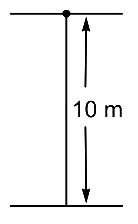
$A$ ball is falling freely from a height. When it reaches $10 ~m$ height from the ground,its velocity is $v_0$. It collides with the ground,loses $50 \%$ of its energy,and rises back to a height of $10 ~m$. Then the velocity $v_0$ is (in $~m / s$)
A
$7$
B
$10$
C
$14$
D
$16$
Solution
(C) Let $m$ be the mass of the ball. When the ball is at a height $h = 10 ~m$,its velocity is $v_0$.
Just before hitting the ground,let its velocity be $v$. By conservation of energy,the kinetic energy just before impact is $K_i = \frac{1}{2} m v_0^2 + mgh$.
However,the problem states that at $10 ~m$ height,the velocity is $v_0$. Let $H$ be the total height from which it fell. Then $\frac{1}{2} m v^2 = mgH$.
After collision,it loses $50 \%$ of its kinetic energy. The remaining kinetic energy is $K_f = 0.5 \times K_i = 0.5 \times (\frac{1}{2} m v^2)$.
This energy allows it to rise back to $h = 10 ~m$. Thus,$0.5 \times (\frac{1}{2} m v^2) = mgh$.
Substituting $h = 10 ~m$ and $g = 9.8 ~m/s^2$:
$0.25 v^2 = 9.8 \times 10 = 98$.
$v^2 = 392$.
Now,consider the motion from $10 ~m$ height to the ground: $v^2 = v_0^2 + 2gh$.
$392 = v_0^2 + 2 \times 9.8 \times 10$.
$392 = v_0^2 + 196$.
$v_0^2 = 196$.
$v_0 = 14 ~m/s$.
Just before hitting the ground,let its velocity be $v$. By conservation of energy,the kinetic energy just before impact is $K_i = \frac{1}{2} m v_0^2 + mgh$.
However,the problem states that at $10 ~m$ height,the velocity is $v_0$. Let $H$ be the total height from which it fell. Then $\frac{1}{2} m v^2 = mgH$.
After collision,it loses $50 \%$ of its kinetic energy. The remaining kinetic energy is $K_f = 0.5 \times K_i = 0.5 \times (\frac{1}{2} m v^2)$.
This energy allows it to rise back to $h = 10 ~m$. Thus,$0.5 \times (\frac{1}{2} m v^2) = mgh$.
Substituting $h = 10 ~m$ and $g = 9.8 ~m/s^2$:
$0.25 v^2 = 9.8 \times 10 = 98$.
$v^2 = 392$.
Now,consider the motion from $10 ~m$ height to the ground: $v^2 = v_0^2 + 2gh$.
$392 = v_0^2 + 2 \times 9.8 \times 10$.
$392 = v_0^2 + 196$.
$v_0^2 = 196$.
$v_0 = 14 ~m/s$.
0 likesView Solution
21
PhysicsMediumMCQAP EAMCET · 2010
$A$ ray of light passes through an equilateral glass prism in such a manner that the angle of incidence is equal to the angle of emergence and each of these angles is equal to $\frac{3}{4}$ of the angle of the prism. The angle of deviation is (in $^{\circ}$)
A
$39$
B
$20$
C
$30$
D
$45$
Solution
(C) For an equilateral glass prism,the angle of the prism is $A = 60^{\circ}$.
Given that the angle of incidence $i$ is equal to the angle of emergence $e$,and each is $\frac{3}{4}$ of the angle of the prism:
$i = e = \frac{3}{4} A = \frac{3}{4} \times 60^{\circ} = 45^{\circ}$.
The formula for the angle of deviation $\delta$ is given by:
$\delta = i + e - A$.
Substituting the values:
$\delta = 45^{\circ} + 45^{\circ} - 60^{\circ} = 90^{\circ} - 60^{\circ} = 30^{\circ}$.
Thus,the angle of deviation is $30^{\circ}$.
Given that the angle of incidence $i$ is equal to the angle of emergence $e$,and each is $\frac{3}{4}$ of the angle of the prism:
$i = e = \frac{3}{4} A = \frac{3}{4} \times 60^{\circ} = 45^{\circ}$.
The formula for the angle of deviation $\delta$ is given by:
$\delta = i + e - A$.
Substituting the values:
$\delta = 45^{\circ} + 45^{\circ} - 60^{\circ} = 90^{\circ} - 60^{\circ} = 30^{\circ}$.
Thus,the angle of deviation is $30^{\circ}$.
0 likesView Solution
22
PhysicsDifficultMCQAP EAMCET · 2010
$A$ capacitor of capacity $0.1 \mu F$ connected in series to a resistor of $10 M \Omega$ is charged to a certain potential and then made to discharge through the resistor. The time in which the potential will take to fall to half its original value is (Given, $\log _{10} 2=0.3010$ ) (in $\,s$)
A
$2$
B
$0.693$
C
$0.5$
D
$1.0$
Solution
(B) The potential across a discharging capacitor is given by $V = V_0 e^{-t/RC}$.
We want to find the time $t$ when $V = V_0/2$.
Substituting this into the equation: $V_0/2 = V_0 e^{-t/RC}$.
This simplifies to $1/2 = e^{-t/RC}$, or $e^{t/RC} = 2$.
Taking the natural logarithm on both sides: $t/RC = \ln(2)$.
Using the conversion $\ln(2) = 2.3026 \times \log_{10}(2)$, we get $t = RC \times 2.3026 \times 0.3010$.
Given $C = 0.1 \mu F = 0.1 \times 10^{-6} F$ and $R = 10 M \Omega = 10 \times 10^6 \Omega$.
Calculating the time constant: $RC = (0.1 \times 10^{-6}) \times (10 \times 10^6) = 1 \ s$.
Therefore, $t = 1 \times 2.3026 \times 0.3010 \approx 0.693 \ s$.
We want to find the time $t$ when $V = V_0/2$.
Substituting this into the equation: $V_0/2 = V_0 e^{-t/RC}$.
This simplifies to $1/2 = e^{-t/RC}$, or $e^{t/RC} = 2$.
Taking the natural logarithm on both sides: $t/RC = \ln(2)$.
Using the conversion $\ln(2) = 2.3026 \times \log_{10}(2)$, we get $t = RC \times 2.3026 \times 0.3010$.
Given $C = 0.1 \mu F = 0.1 \times 10^{-6} F$ and $R = 10 M \Omega = 10 \times 10^6 \Omega$.
Calculating the time constant: $RC = (0.1 \times 10^{-6}) \times (10 \times 10^6) = 1 \ s$.
Therefore, $t = 1 \times 2.3026 \times 0.3010 \approx 0.693 \ s$.
0 likesView Solution
23
PhysicsDifficultMCQAP EAMCET · 2010
Two capacitors of capacities $1 \mu F$ and $C \mu F$ are connected in series and the combination is charged to a potential difference of $120 \ V$. If the charge on the combination is $80 \mu C$,the energy stored in the capacitor of capacity $C$ in $\mu J$ is
A
$1800$
B
$1600$
C
$14400$
D
$7200$
Solution
(B) When capacitors are connected in series,the equivalent capacitance $C_{\text{eq}}$ is given by $\frac{1}{C_{\text{eq}}} = \frac{1}{C_1} + \frac{1}{C_2}$.
For $C_1 = 1 \mu F$ and $C_2 = C \mu F$,we have $C_{\text{eq}} = \frac{1 \times C}{1 + C} = \frac{C}{C+1} \mu F$.
Given the total charge $q = 80 \mu C$ and potential difference $V = 120 \ V$,we use the relation $q = C_{\text{eq}} V$.
Substituting the values: $80 = \left( \frac{C}{C+1} \right) \times 120$.
Dividing both sides by $40$: $2 = \left( \frac{C}{C+1} \right) \times 3$.
$2(C+1) = 3C \implies 2C + 2 = 3C \implies C = 2 \mu F$.
In a series combination,the charge on each capacitor is the same as the total charge $q = 80 \mu C$.
The energy stored in a capacitor is given by $U = \frac{q^2}{2C}$.
For the capacitor $C = 2 \mu F$: $U = \frac{(80 \mu C)^2}{2 \times 2 \mu F} = \frac{6400}{4} \mu J = 1600 \mu J$.
For $C_1 = 1 \mu F$ and $C_2 = C \mu F$,we have $C_{\text{eq}} = \frac{1 \times C}{1 + C} = \frac{C}{C+1} \mu F$.
Given the total charge $q = 80 \mu C$ and potential difference $V = 120 \ V$,we use the relation $q = C_{\text{eq}} V$.
Substituting the values: $80 = \left( \frac{C}{C+1} \right) \times 120$.
Dividing both sides by $40$: $2 = \left( \frac{C}{C+1} \right) \times 3$.
$2(C+1) = 3C \implies 2C + 2 = 3C \implies C = 2 \mu F$.
In a series combination,the charge on each capacitor is the same as the total charge $q = 80 \mu C$.
The energy stored in a capacitor is given by $U = \frac{q^2}{2C}$.
For the capacitor $C = 2 \mu F$: $U = \frac{(80 \mu C)^2}{2 \times 2 \mu F} = \frac{6400}{4} \mu J = 1600 \mu J$.
0 likesView Solution
24
PhysicsDifficultMCQAP EAMCET · 2010
The potential difference between two parallel plates is $10^4 \,V$. If the plates are separated by $0.5 \,cm$, the force on an electron between the plates is
A
$32 \times 10^{-13} \,N$
B
$0.32 \times 10^{-13} \,N$
C
$0.032 \times 10^{-13} \,N$
D
$3.2 \times 10^{-13} \,N$
Solution
(D) The electric field $E$ between the parallel plates is given by $E = \frac{V}{d}$.
Given, $V = 10^4 \,V$ and $d = 0.5 \,cm = 0.5 \times 10^{-2} \,m$.
Therefore, $E = \frac{10^4}{0.5 \times 10^{-2}} = 2 \times 10^6 \,V/m$.
The force $F$ on an electron of charge $e = 1.6 \times 10^{-19} \,C$ is given by $F = eE$.
$F = (1.6 \times 10^{-19} \,C) \times (2 \times 10^6 \,V/m) = 3.2 \times 10^{-13} \,N$.
Given, $V = 10^4 \,V$ and $d = 0.5 \,cm = 0.5 \times 10^{-2} \,m$.
Therefore, $E = \frac{10^4}{0.5 \times 10^{-2}} = 2 \times 10^6 \,V/m$.
The force $F$ on an electron of charge $e = 1.6 \times 10^{-19} \,C$ is given by $F = eE$.
$F = (1.6 \times 10^{-19} \,C) \times (2 \times 10^6 \,V/m) = 3.2 \times 10^{-13} \,N$.
0 likesView Solution
25
PhysicsDifficultMCQAP EAMCET · 2010
Charge passing through a conductor of cross-section area $A=0.3 \,m^2$ is given by $q=3 t^2+5 t+2$ in coulomb,where $t$ is in second. What is the value of drift velocity at $t=2 \,s$ ? (Given,$n=2 \times 10^{25} / m^3$ )
A
$0.77 \times 10^{-5} \,m / s$
B
$1.77 \times 10^{-5} \,m / s$
C
$2.08 \times 10^{-5} \,m / s$
D
$0.57 \times 10^{-5} \,m / s$
Solution
(B) Given: Area $A = 0.3 \,m^2$,charge density $n = 2 \times 10^{25} / m^3$,and charge $q = 3t^2 + 5t + 2$.
First,calculate the current $i$ at $t = 2 \,s$ using $i = \frac{dq}{dt}$.
$i = \frac{d}{dt}(3t^2 + 5t + 2) = 6t + 5$.
At $t = 2 \,s$,$i = 6(2) + 5 = 17 \,A$.
The relationship between current and drift velocity $v_d$ is $i = n e A v_d$,where $e = 1.6 \times 10^{-19} \,C$.
Rearranging for $v_d$: $v_d = \frac{i}{n e A}$.
Substituting the values: $v_d = \frac{17}{2 \times 10^{25} \times 1.6 \times 10^{-19} \times 0.3}$.
$v_d = \frac{17}{0.96 \times 10^6} = 17.708 \times 10^{-6} \,m/s = 1.77 \times 10^{-5} \,m/s$.
First,calculate the current $i$ at $t = 2 \,s$ using $i = \frac{dq}{dt}$.
$i = \frac{d}{dt}(3t^2 + 5t + 2) = 6t + 5$.
At $t = 2 \,s$,$i = 6(2) + 5 = 17 \,A$.
The relationship between current and drift velocity $v_d$ is $i = n e A v_d$,where $e = 1.6 \times 10^{-19} \,C$.
Rearranging for $v_d$: $v_d = \frac{i}{n e A}$.
Substituting the values: $v_d = \frac{17}{2 \times 10^{25} \times 1.6 \times 10^{-19} \times 0.3}$.
$v_d = \frac{17}{0.96 \times 10^6} = 17.708 \times 10^{-6} \,m/s = 1.77 \times 10^{-5} \,m/s$.
0 likesView Solution
26
PhysicsEasyMCQAP EAMCET · 2010
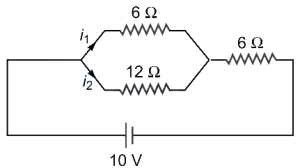
$6 \Omega$ and $12 \Omega$ resistors are connected in parallel. This combination is connected in series with a $10 \text{ V}$ battery and a $6 \Omega$ resistor. What is the potential difference between the terminals of the $12 \Omega$ resistor (in $\text{ V}$)?
A
$4$
B
$16$
C
$2$
D
$8$
Solution
(A) First, calculate the equivalent resistance of the parallel combination of $6 \Omega$ and $12 \Omega$ resistors:
$R_p = \frac{6 \times 12}{6 + 12} = \frac{72}{18} = 4 \Omega$
Next, calculate the total resistance of the circuit, as the parallel combination is in series with the $6 \Omega$ resistor:
$R_{eq} = R_p + 6 \Omega = 4 \Omega + 6 \Omega = 10 \Omega$
Now, calculate the total current flowing from the $10 \text{ V}$ battery:
$I = \frac{V}{R_{eq}} = \frac{10 \text{ V}}{10 \Omega} = 1 \text{ A}$
The potential difference across the parallel combination is the product of the total current and the equivalent resistance of the parallel part:
$V_p = I \times R_p = 1 \text{ A} \times 4 \Omega = 4 \text{ V}$
Since the $6 \Omega$ and $12 \Omega$ resistors are connected in parallel, the potential difference across each of them is the same and is equal to the potential difference across the parallel combination.
Therefore, the potential difference across the $12 \Omega$ resistor is $4 \text{ V}$.
$R_p = \frac{6 \times 12}{6 + 12} = \frac{72}{18} = 4 \Omega$
Next, calculate the total resistance of the circuit, as the parallel combination is in series with the $6 \Omega$ resistor:
$R_{eq} = R_p + 6 \Omega = 4 \Omega + 6 \Omega = 10 \Omega$
Now, calculate the total current flowing from the $10 \text{ V}$ battery:
$I = \frac{V}{R_{eq}} = \frac{10 \text{ V}}{10 \Omega} = 1 \text{ A}$
The potential difference across the parallel combination is the product of the total current and the equivalent resistance of the parallel part:
$V_p = I \times R_p = 1 \text{ A} \times 4 \Omega = 4 \text{ V}$
Since the $6 \Omega$ and $12 \Omega$ resistors are connected in parallel, the potential difference across each of them is the same and is equal to the potential difference across the parallel combination.
Therefore, the potential difference across the $12 \Omega$ resistor is $4 \text{ V}$.
0 likesView Solution
27
PhysicsMediumMCQAP EAMCET · 2010
Photoelectric emission is observed from a metallic surface for frequencies $v_1$ and $v_2$ of the incident light $(v_1 > v_2)$. If the maximum values of kinetic energy of the photoelectrons emitted in the two cases are in the ratio $1: n$,then the threshold frequency of the metallic surface is
A
$\frac{(v_1-v_2)}{(n-1)}$
B
$\frac{(n v_1-v_2)}{(n-1)}$
C
$\frac{(n v_2-v_1)}{(n-1)}$
D
$\frac{(v_1-v_2)}{n}$
Solution
(B) According to Einstein's photoelectric equation,the maximum kinetic energy $K_{\max}$ is given by $K_{\max} = h v - h v_0$,where $h$ is Planck's constant and $v_0$ is the threshold frequency.
For frequency $v_1$,$K_1 = h(v_1 - v_0)$.
For frequency $v_2$,$K_2 = h(v_2 - v_0)$.
Given the ratio of maximum kinetic energies is $K_1 : K_2 = 1 : n$,we have $\frac{K_1}{K_2} = \frac{1}{n}$.
Substituting the expressions,we get $\frac{h(v_1 - v_0)}{h(v_2 - v_0)} = \frac{1}{n}$.
$\frac{v_1 - v_0}{v_2 - v_0} = \frac{1}{n}$.
Cross-multiplying gives $n(v_1 - v_0) = v_2 - v_0$.
$n v_1 - n v_0 = v_2 - v_0$.
$n v_1 - v_2 = n v_0 - v_0$.
$n v_1 - v_2 = v_0(n - 1)$.
Therefore,the threshold frequency is $v_0 = \frac{n v_1 - v_2}{n - 1}$.
For frequency $v_1$,$K_1 = h(v_1 - v_0)$.
For frequency $v_2$,$K_2 = h(v_2 - v_0)$.
Given the ratio of maximum kinetic energies is $K_1 : K_2 = 1 : n$,we have $\frac{K_1}{K_2} = \frac{1}{n}$.
Substituting the expressions,we get $\frac{h(v_1 - v_0)}{h(v_2 - v_0)} = \frac{1}{n}$.
$\frac{v_1 - v_0}{v_2 - v_0} = \frac{1}{n}$.
Cross-multiplying gives $n(v_1 - v_0) = v_2 - v_0$.
$n v_1 - n v_0 = v_2 - v_0$.
$n v_1 - v_2 = n v_0 - v_0$.
$n v_1 - v_2 = v_0(n - 1)$.
Therefore,the threshold frequency is $v_0 = \frac{n v_1 - v_2}{n - 1}$.
0 likesView Solution
28
PhysicsDifficultMCQAP EAMCET · 2010
The time constant of an inductance coil is $3 \text{ ms}$. When a $90 \Omega$ resistance is joined in series,the time constant becomes $0.5 \text{ ms}$. The inductance and the resistance of the coil are:
A
$54 \text{ mH}, 18 \Omega$
B
$14 \text{ mH}, 42 \Omega$
C
$42 \text{ mH}, 14 \Omega$
D
$14 \text{ mH}, 60 \Omega$
Solution
(A) The time constant $\tau$ of an $LR$ circuit is given by $\tau = \frac{L}{R}$.
Initially,$\tau_1 = \frac{L}{R} = 3 \times 10^{-3} \text{ s}$ ...$(i)$
When a $90 \Omega$ resistor is added in series,the total resistance becomes $(R + 90) \Omega$. The new time constant is $\tau_2 = \frac{L}{R + 90} = 0.5 \times 10^{-3} \text{ s}$ ...(ii)
Dividing equation $(i)$ by equation (ii):
$\frac{3 \times 10^{-3}}{0.5 \times 10^{-3}} = \frac{L/R}{L/(R + 90)}$
$6 = \frac{R + 90}{R}$
$6R = R + 90$
$5R = 90 \implies R = 18 \Omega$
Substituting $R = 18 \Omega$ into equation $(i)$:
$L = 3 \times 10^{-3} \times 18 = 54 \times 10^{-3} \text{ H} = 54 \text{ mH}$.
Thus,the inductance is $54 \text{ mH}$ and the resistance is $18 \Omega$.
Initially,$\tau_1 = \frac{L}{R} = 3 \times 10^{-3} \text{ s}$ ...$(i)$
When a $90 \Omega$ resistor is added in series,the total resistance becomes $(R + 90) \Omega$. The new time constant is $\tau_2 = \frac{L}{R + 90} = 0.5 \times 10^{-3} \text{ s}$ ...(ii)
Dividing equation $(i)$ by equation (ii):
$\frac{3 \times 10^{-3}}{0.5 \times 10^{-3}} = \frac{L/R}{L/(R + 90)}$
$6 = \frac{R + 90}{R}$
$6R = R + 90$
$5R = 90 \implies R = 18 \Omega$
Substituting $R = 18 \Omega$ into equation $(i)$:
$L = 3 \times 10^{-3} \times 18 = 54 \times 10^{-3} \text{ H} = 54 \text{ mH}$.
Thus,the inductance is $54 \text{ mH}$ and the resistance is $18 \Omega$.
0 likesView Solution
29
PhysicsDifficultMCQAP EAMCET · 2010
The thermo emf of a thermocouple is given by $E = aT + bT^2$,where $\frac{a}{b} = -200^{\circ}C$. If the cold junction is kept at $30^{\circ}C$,then the inversion temperature is ($\varepsilon$ in volt,$T$ in centigrade). (in $K$)
A
$103$
B
$143$
C
$333$
D
$443$
Solution
(D) The thermo emf is given by $E = aT + bT^2$.
At the neutral temperature $(T_n)$,the emf is maximum,and at the inversion temperature $(T_i)$,the emf becomes zero.
Setting $E = 0$:
$aT_i + bT_i^2 = 0$
$T_i(a + bT_i) = 0$
Since $T_i \neq 0$,we have $T_i = -\frac{a}{b}$.
Given $\frac{a}{b} = -200^{\circ}C$,therefore $T_i = -(-200^{\circ}C) = 200^{\circ}C$.
This $T_i$ is the temperature relative to the cold junction at $0^{\circ}C$.
If the cold junction is at $T_c = 30^{\circ}C$,the inversion temperature relative to the cold junction is $T_i = 200^{\circ}C$.
However,the standard relation for inversion temperature is $T_i - T_c = T_n - T_i$,where $T_n = -\frac{a}{2b} = 100^{\circ}C$.
Thus,$T_i = 2T_n - T_c = 2(100) - 30 = 170^{\circ}C$.
Converting to Kelvin: $T = 170 + 273 = 443 \ K$.
At the neutral temperature $(T_n)$,the emf is maximum,and at the inversion temperature $(T_i)$,the emf becomes zero.
Setting $E = 0$:
$aT_i + bT_i^2 = 0$
$T_i(a + bT_i) = 0$
Since $T_i \neq 0$,we have $T_i = -\frac{a}{b}$.
Given $\frac{a}{b} = -200^{\circ}C$,therefore $T_i = -(-200^{\circ}C) = 200^{\circ}C$.
This $T_i$ is the temperature relative to the cold junction at $0^{\circ}C$.
If the cold junction is at $T_c = 30^{\circ}C$,the inversion temperature relative to the cold junction is $T_i = 200^{\circ}C$.
However,the standard relation for inversion temperature is $T_i - T_c = T_n - T_i$,where $T_n = -\frac{a}{2b} = 100^{\circ}C$.
Thus,$T_i = 2T_n - T_c = 2(100) - 30 = 170^{\circ}C$.
Converting to Kelvin: $T = 170 + 273 = 443 \ K$.
0 likesView Solution
30
PhysicsDifficultMCQAP EAMCET · 2010
$A$ proton, a deuteron, and an $\alpha$-particle having the same momentum enter a region of uniform electric field between the parallel plates of a capacitor. The electric field is perpendicular to the initial path of the particles. Then the ratio of deflections suffered by them is
A
$1: 2: 8$
B
$1: 2: 4$
C
$1: 1: 2$
D
None of these
Solution
(A) The deflection $y$ of a charged particle moving with velocity $u$ in a uniform electric field $E$ over a distance $L$ is given by $y = \frac{1}{2} a t^2 = \frac{1}{2} (\frac{qE}{m}) (\frac{L}{u})^2 = \frac{qEL^2}{2mu^2}$.
Since momentum $p = mu$, we have $u = p/m$. Substituting this, $y = \frac{qEL^2}{2m(p/m)^2} = \frac{qEL^2m}{2p^2}$.
Given that $E, L,$ and $p$ are constant for all particles, the deflection $y \propto qm$.
For a proton $(p)$, deuteron $(d)$, and $\alpha$-particle $(\alpha)$:
Charge ratio: $q_p : q_d : q_\alpha = 1 : 1 : 2$.
Mass ratio: $m_p : m_d : m_\alpha = 1 : 2 : 4$.
Therefore, the ratio of deflections is $y_p : y_d : y_\alpha = (q_p m_p) : (q_d m_d) : (q_\alpha m_\alpha) = (1 \times 1) : (1 \times 2) : (2 \times 4) = 1 : 2 : 8$.
Since momentum $p = mu$, we have $u = p/m$. Substituting this, $y = \frac{qEL^2}{2m(p/m)^2} = \frac{qEL^2m}{2p^2}$.
Given that $E, L,$ and $p$ are constant for all particles, the deflection $y \propto qm$.
For a proton $(p)$, deuteron $(d)$, and $\alpha$-particle $(\alpha)$:
Charge ratio: $q_p : q_d : q_\alpha = 1 : 1 : 2$.
Mass ratio: $m_p : m_d : m_\alpha = 1 : 2 : 4$.
Therefore, the ratio of deflections is $y_p : y_d : y_\alpha = (q_p m_p) : (q_d m_d) : (q_\alpha m_\alpha) = (1 \times 1) : (1 \times 2) : (2 \times 4) = 1 : 2 : 8$.
0 likesView Solution
31
PhysicsDifficultMCQAP EAMCET · 2010
In Thomson's experiment to determine $\frac{e}{m}$ of an electron,it is found that an electron beam having a kinetic energy of $45.5 \ eV$ remains undeflected,when subjected to crossed electric and magnetic fields. If $E = 1 \times 10^3 \ Vm^{-1}$,the value of $B$ is (mass of the electron is $9.1 \times 10^{-31} \ kg$).
A
$2.5 \times 10^{-3} \ Wb \ m^{-2}$
B
$5.0 \times 10^{-4} \ Wb \ m^{-2}$
C
$2.5 \times 10^{-4} \ Wb \ m^{-2}$
D
$1.0 \times 10^{-4} \ Wb \ m^{-2}$
Solution
(C) The kinetic energy of the electron is given by $K = \frac{1}{2}mv^2$.
Given $K = 45.5 \ eV = 45.5 \times 1.6 \times 10^{-19} \ J$ and $m = 9.1 \times 10^{-31} \ kg$.
$v^2 = \frac{2K}{m} = \frac{2 \times 45.5 \times 1.6 \times 10^{-19}}{9.1 \times 10^{-31}} = \frac{145.6 \times 10^{-19}}{9.1 \times 10^{-31}} = 16 \times 10^{12} \ m^2s^{-2}$.
Thus,$v = 4 \times 10^6 \ ms^{-1}$.
For an electron to remain undeflected in crossed electric and magnetic fields,the electric force must balance the magnetic force: $eE = evB$,which implies $v = \frac{E}{B}$.
Given $E = 1 \times 10^3 \ Vm^{-1}$,we have $B = \frac{E}{v} = \frac{1 \times 10^3}{4 \times 10^6} = 0.25 \times 10^{-3} = 2.5 \times 10^{-4} \ Wb \ m^{-2}$.
Given $K = 45.5 \ eV = 45.5 \times 1.6 \times 10^{-19} \ J$ and $m = 9.1 \times 10^{-31} \ kg$.
$v^2 = \frac{2K}{m} = \frac{2 \times 45.5 \times 1.6 \times 10^{-19}}{9.1 \times 10^{-31}} = \frac{145.6 \times 10^{-19}}{9.1 \times 10^{-31}} = 16 \times 10^{12} \ m^2s^{-2}$.
Thus,$v = 4 \times 10^6 \ ms^{-1}$.
For an electron to remain undeflected in crossed electric and magnetic fields,the electric force must balance the magnetic force: $eE = evB$,which implies $v = \frac{E}{B}$.
Given $E = 1 \times 10^3 \ Vm^{-1}$,we have $B = \frac{E}{v} = \frac{1 \times 10^3}{4 \times 10^6} = 0.25 \times 10^{-3} = 2.5 \times 10^{-4} \ Wb \ m^{-2}$.
0 likesView Solution
32
PhysicsDifficultMCQAP EAMCET · 2010
The frequency of vibration in a vibration magnetometer of the combination of two bar magnets of magnetic moments $M_1$ and $M_2$ is $6 \ Hz$ when like poles are tied together and it is $2 \ Hz$ when the unlike poles are tied together,then the ratio $M_1: M_2$ is
A
$4: 5$
B
$5: 4$
C
$1: 3$
D
$3: 1$
Solution
(B) The frequency of oscillation in a vibration magnetometer is given by $n = \frac{1}{2\pi} \sqrt{\frac{MB}{I}}$.
For two magnets with moments $M_1$ and $M_2$ and moment of inertia $I_1$ and $I_2$,when tied together,the total moment of inertia is $I = I_1 + I_2$.
When like poles are tied,the effective magnetic moment is $M_{sum} = M_1 + M_2$. The frequency is $n_1 = 6 \ Hz$.
When unlike poles are tied,the effective magnetic moment is $M_{diff} = M_1 - M_2$. The frequency is $n_2 = 2 \ Hz$.
Since $n \propto \sqrt{M}$,we have $\frac{n_1}{n_2} = \sqrt{\frac{M_1 + M_2}{M_1 - M_2}}$.
Squaring both sides: $(\frac{6}{2})^2 = \frac{M_1 + M_2}{M_1 - M_2} \implies 9 = \frac{M_1 + M_2}{M_1 - M_2}$.
$9M_1 - 9M_2 = M_1 + M_2$.
$8M_1 = 10M_2$.
$\frac{M_1}{M_2} = \frac{10}{8} = \frac{5}{4}$.
For two magnets with moments $M_1$ and $M_2$ and moment of inertia $I_1$ and $I_2$,when tied together,the total moment of inertia is $I = I_1 + I_2$.
When like poles are tied,the effective magnetic moment is $M_{sum} = M_1 + M_2$. The frequency is $n_1 = 6 \ Hz$.
When unlike poles are tied,the effective magnetic moment is $M_{diff} = M_1 - M_2$. The frequency is $n_2 = 2 \ Hz$.
Since $n \propto \sqrt{M}$,we have $\frac{n_1}{n_2} = \sqrt{\frac{M_1 + M_2}{M_1 - M_2}}$.
Squaring both sides: $(\frac{6}{2})^2 = \frac{M_1 + M_2}{M_1 - M_2} \implies 9 = \frac{M_1 + M_2}{M_1 - M_2}$.
$9M_1 - 9M_2 = M_1 + M_2$.
$8M_1 = 10M_2$.
$\frac{M_1}{M_2} = \frac{10}{8} = \frac{5}{4}$.
0 likesView Solution
33
PhysicsEasyMCQAP EAMCET · 2010
The intensity of the magnetic induction field at the centre of a single turn circular coil of radius $5 \,cm$ carrying a current of $0.9 \,A$ is:
A
$36 \pi \times 10^{-7} \,T$
B
$9 \pi \times 10^{-7} \,T$
C
$36 \pi \times 10^{-6} \,T$
D
$9 \pi \times 10^{-6} \,T$
Solution
(A) The formula for the magnetic field at the center of a circular coil is given by $B = \frac{\mu_0 I}{2r}$.
Given values are:
Permeability of free space,$\mu_0 = 4\pi \times 10^{-7} \,T \cdot m/A$
Current,$I = 0.9 \,A$
Radius,$r = 5 \,cm = 5 \times 10^{-2} \,m$
Substituting these values into the formula:
$B = \frac{4\pi \times 10^{-7} \times 0.9}{2 \times 5 \times 10^{-2}}$
$B = \frac{3.6\pi \times 10^{-7}}{10 \times 10^{-2}}$
$B = \frac{3.6\pi \times 10^{-7}}{10^{-1}}$
$B = 3.6\pi \times 10^{-6} \,T$
$B = 36\pi \times 10^{-7} \,T$
Given values are:
Permeability of free space,$\mu_0 = 4\pi \times 10^{-7} \,T \cdot m/A$
Current,$I = 0.9 \,A$
Radius,$r = 5 \,cm = 5 \times 10^{-2} \,m$
Substituting these values into the formula:
$B = \frac{4\pi \times 10^{-7} \times 0.9}{2 \times 5 \times 10^{-2}}$
$B = \frac{3.6\pi \times 10^{-7}}{10 \times 10^{-2}}$
$B = \frac{3.6\pi \times 10^{-7}}{10^{-1}}$
$B = 3.6\pi \times 10^{-6} \,T$
$B = 36\pi \times 10^{-7} \,T$
0 likesView Solution
34
PhysicsMediumMCQAP EAMCET · 2010
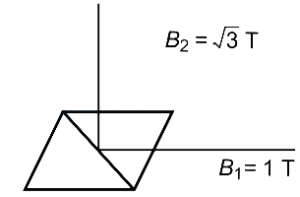
$A$ short magnetic needle is pivoted in a uniform magnetic field of induction $1 \text{ T}$. Now,simultaneously another magnetic field of induction $\sqrt{3} \text{ T}$ is applied at right angles to the first field; the needle deflects through an angle $\theta$ whose value is (in $^{\circ}$)
A
$30$
B
$45$
C
$90$
D
$60$
Solution
(D) When a magnetic needle is placed in two mutually perpendicular magnetic fields $B_1$ and $B_2$,it aligns itself along the direction of the resultant magnetic field.
The torque due to the first field $B_1$ is $\tau_1 = mB_1 \sin \theta$,where $m$ is the magnetic moment.
The torque due to the second field $B_2$ is $\tau_2 = mB_2 \cos \theta$.
In equilibrium,the net torque on the needle is zero,so $\tau_1 = \tau_2$.
$mB_1 \sin \theta = mB_2 \cos \theta$
$\tan \theta = \frac{B_2}{B_1}$
Given $B_1 = 1 \text{ T}$ and $B_2 = \sqrt{3} \text{ T}$.
$\tan \theta = \frac{\sqrt{3}}{1} = \sqrt{3}$
$\theta = 60^{\circ}$
The torque due to the first field $B_1$ is $\tau_1 = mB_1 \sin \theta$,where $m$ is the magnetic moment.
The torque due to the second field $B_2$ is $\tau_2 = mB_2 \cos \theta$.
In equilibrium,the net torque on the needle is zero,so $\tau_1 = \tau_2$.
$mB_1 \sin \theta = mB_2 \cos \theta$
$\tan \theta = \frac{B_2}{B_1}$
Given $B_1 = 1 \text{ T}$ and $B_2 = \sqrt{3} \text{ T}$.
$\tan \theta = \frac{\sqrt{3}}{1} = \sqrt{3}$
$\theta = 60^{\circ}$
0 likesView Solution
35
PhysicsDifficultMCQAP EAMCET · 2010
In an optical fibre,the core and cladding are made with materials of refractive indices $1.5$ and $1.414$ respectively. To observe total internal reflection,what will be the range of the incident angle with the axis of the optical fibre?
A
$0^{\circ}-60^{\circ}$
B
$0^{\circ}-48^{\circ}$
C
$0^{\circ}-30^{\circ}$
D
$0^{\circ}-82^{\circ}$
Solution
(C) The acceptance angle $\theta_a$ is the maximum angle of incidence at the entrance of the optical fibre such that the light undergoes total internal reflection at the core-cladding interface.
For an optical fibre with core refractive index $\mu_1 = 1.5$ and cladding refractive index $\mu_2 = 1.414$,the acceptance angle $\theta_a$ is given by the formula:
$\sin \theta_a = \sqrt{\mu_1^2 - \mu_2^2}$
Substituting the given values:
$\sin \theta_a = \sqrt{(1.5)^2 - (1.414)^2}$
$\sin \theta_a = \sqrt{2.25 - 1.999396} \approx \sqrt{0.2506} \approx 0.5006$
$\theta_a = \sin^{-1}(0.5006) \approx 30^{\circ}$
Thus,the range of the incident angle with the axis of the optical fibre for total internal reflection is $0^{\circ}$ to $30^{\circ}$.
Therefore,option $C$ is correct.
For an optical fibre with core refractive index $\mu_1 = 1.5$ and cladding refractive index $\mu_2 = 1.414$,the acceptance angle $\theta_a$ is given by the formula:
$\sin \theta_a = \sqrt{\mu_1^2 - \mu_2^2}$
Substituting the given values:
$\sin \theta_a = \sqrt{(1.5)^2 - (1.414)^2}$
$\sin \theta_a = \sqrt{2.25 - 1.999396} \approx \sqrt{0.2506} \approx 0.5006$
$\theta_a = \sin^{-1}(0.5006) \approx 30^{\circ}$
Thus,the range of the incident angle with the axis of the optical fibre for total internal reflection is $0^{\circ}$ to $30^{\circ}$.
Therefore,option $C$ is correct.
0 likesView Solution
36
PhysicsDifficultMCQAP EAMCET · 2010
The diameter of the objective of a telescope is $1 \ m$. Its resolving limit for light of wavelength $4538 \ \text{Å}$ will be:
A
$5.54 \times 10^{-7} \ \text{rad}$
B
$2.54 \times 10^{-4} \ \text{rad}$
C
$6.54 \times 10^{-7} \ \text{rad}$
D
None of these
Solution
(A) The resolving limit $(d\theta)$ of a telescope is given by the formula:
$d\theta = \frac{1.22 \lambda}{a}$
where $\lambda$ is the wavelength of light and $a$ is the diameter of the objective lens.
Given:
$\lambda = 4538 \ \text{Å} = 4538 \times 10^{-10} \ \text{m}$
$a = 1 \ \text{m}$
Substituting the values:
$d\theta = \frac{1.22 \times 4538 \times 10^{-10}}{1}$
$d\theta = 5536.36 \times 10^{-10} \ \text{rad}$
$d\theta \approx 5.54 \times 10^{-7} \ \text{rad}$
$d\theta = \frac{1.22 \lambda}{a}$
where $\lambda$ is the wavelength of light and $a$ is the diameter of the objective lens.
Given:
$\lambda = 4538 \ \text{Å} = 4538 \times 10^{-10} \ \text{m}$
$a = 1 \ \text{m}$
Substituting the values:
$d\theta = \frac{1.22 \times 4538 \times 10^{-10}}{1}$
$d\theta = 5536.36 \times 10^{-10} \ \text{rad}$
$d\theta \approx 5.54 \times 10^{-7} \ \text{rad}$
0 likesView Solution
37
PhysicsEasyMCQAP EAMCET · 2010
$A$ transistor having a $\beta$ equal to $80$ has a change in base current of $250 \mu A$. What is the change in collector current?
A
$20,000 \text{ mA}$
B
$200 \text{ mA}$
C
$2000 \text{ mA}$
D
$20 \text{ mA}$
Solution
(D) The current gain $\beta$ of a transistor in common-emitter configuration is defined as the ratio of the change in collector current $(\Delta i_C)$ to the change in base current $(\Delta i_B)$.
$\beta = \frac{\Delta i_C}{\Delta i_B}$
Given: $\beta = 80$ and $\Delta i_B = 250 \mu A = 250 \times 10^{-6} \text{ A}$.
Substituting the values into the formula:
$80 = \frac{\Delta i_C}{250 \times 10^{-6} \text{ A}}$
$\Delta i_C = 80 \times 250 \times 10^{-6} \text{ A}$
$\Delta i_C = 20,000 \times 10^{-6} \text{ A}$
$\Delta i_C = 20 \times 10^{-3} \text{ A} = 20 \text{ mA}$.
Therefore,the change in collector current is $20 \text{ mA}$.
$\beta = \frac{\Delta i_C}{\Delta i_B}$
Given: $\beta = 80$ and $\Delta i_B = 250 \mu A = 250 \times 10^{-6} \text{ A}$.
Substituting the values into the formula:
$80 = \frac{\Delta i_C}{250 \times 10^{-6} \text{ A}}$
$\Delta i_C = 80 \times 250 \times 10^{-6} \text{ A}$
$\Delta i_C = 20,000 \times 10^{-6} \text{ A}$
$\Delta i_C = 20 \times 10^{-3} \text{ A} = 20 \text{ mA}$.
Therefore,the change in collector current is $20 \text{ mA}$.
0 likesView Solution
38
PhysicsMediumMCQAP EAMCET · 2010
Two coherent sources whose intensity ratio is $64: 1$ produce interference fringes. The ratio of intensities of maxima and minima is
A
$9: 7$
B
$8: 1$
C
$81: 49$
D
$81: 7$
Solution
(C) The ratio of intensities of two coherent sources is given as $\frac{I_1}{I_2} = \frac{64}{1}$.
Let the intensities be $I_1 = 64k$ and $I_2 = 1k$.
The ratio of maximum intensity to minimum intensity in an interference pattern is given by the formula:
$\frac{I_{\max}}{I_{\min}} = \frac{(\sqrt{I_1} + \sqrt{I_2})^2}{(\sqrt{I_1} - \sqrt{I_2})^2}$
Substituting the values:
$\frac{I_{\max}}{I_{\min}} = \frac{(\sqrt{64k} + \sqrt{1k})^2}{(\sqrt{64k} - \sqrt{1k})^2}$
$\frac{I_{\max}}{I_{\min}} = \frac{(8\sqrt{k} + 1\sqrt{k})^2}{(8\sqrt{k} - 1\sqrt{k})^2}$
$\frac{I_{\max}}{I_{\min}} = \frac{(9\sqrt{k})^2}{(7\sqrt{k})^2} = \frac{81k}{49k} = \frac{81}{49}$.
Let the intensities be $I_1 = 64k$ and $I_2 = 1k$.
The ratio of maximum intensity to minimum intensity in an interference pattern is given by the formula:
$\frac{I_{\max}}{I_{\min}} = \frac{(\sqrt{I_1} + \sqrt{I_2})^2}{(\sqrt{I_1} - \sqrt{I_2})^2}$
Substituting the values:
$\frac{I_{\max}}{I_{\min}} = \frac{(\sqrt{64k} + \sqrt{1k})^2}{(\sqrt{64k} - \sqrt{1k})^2}$
$\frac{I_{\max}}{I_{\min}} = \frac{(8\sqrt{k} + 1\sqrt{k})^2}{(8\sqrt{k} - 1\sqrt{k})^2}$
$\frac{I_{\max}}{I_{\min}} = \frac{(9\sqrt{k})^2}{(7\sqrt{k})^2} = \frac{81k}{49k} = \frac{81}{49}$.
0 likesView Solution
Vedclass Products
For Students
Vedclass Test Series
Mock tests in real AP EAMCET style covering Physics with performance analysis. 5-day free trial.
Start Free TrialFor Teachers
Exam Paper Generator
Generate Set A/B/C/D Physics papers from 7.5L+ questions in 2 minutes. 3 chapters free.
Try FreeFor Institutes
Online Exam Module
Run live AP EAMCET mock exams with unlimited students, 360° analytics & white-label branding.
See DemoFrequently Asked Questions
How many Physics questions are in AP EAMCET 2010?
There are 38 Physics questions from the AP EAMCET 2010 paper on Vedclass, each with a detailed step-by-step solution in English.
Are AP EAMCET 2010 Physics solutions available in English?
Yes. All solutions on this page are in English. You can also switch to English or Hindi using the language buttons above the questions.
Can I practice AP EAMCET 2010 Physics as a timed test?
Yes. Use the Vedclass Test Series to attempt a full AP EAMCET mock test covering Physics with time limits and instant score analysis.
Can teachers create Physics papers from AP EAMCET previous year questions?
Yes. The Vedclass Exam Paper Generator lets teachers mix AP EAMCET Physics questions and generate Set A/B/C/D papers in minutes.
For Teachers & Institutes
Build a Custom Physics Paper
Pick AP EAMCET 2010 Physics questions, set difficulty, and generate Set A/B/C/D in 2 minutes.